Rochester Institute of Technology
RIT Scholar Works
Theses
8-14-2019
Lore: A world beyond pages
Anushka Nalluri
Lore
A world beyond pages
Anushka Nalluri
A Thesis submitted in partial fulfillment of the requirements
for the Degree of Master of Fine Arts in Visual Communication Design Rochester Institute of Technology
School of Design
College of Art and Design Visual Communication Design Rochester, NY
Committee Members
Chief Advisor
Prof. Michael Strobert
Visual Communication Design
School of Design | College of Art and Design
Associate Advisor
Prof. Joel Rosen
Visual Communication Design
School of Design | College of Art and Design
Associate Advisor
Prof. Adam Smith
Visual Communication Design
Table of Contents
Abstract
Keywords
Introduction
Context
Process
Research
Target Audience
Personas
Surveys and Interviews
Competitve Analysis
Personas
Design Ideation and Validation
Results
Evaluation and Discussion
Solution Statement
Future Directions
Conclusion
Abstract
All around us are hundreds of people with years of accumulated knowledge and unique life stories. These people are referred to as ‘Human-Books.’ At the same time, there are people around us who want to hear the stories from these human books and glean the knowledge from their life experiences. When people realize this potential, I believe they will naturally seek to connect with the others and learn more from them. Unfortunately, in our increasingly impersonal and disconnected culture, we do not have an effective method to discover and connect with those who are interested in sharing their knowledge. I’m proposing to create system which provides a bridge between content experts and people seeking to learn.
The system would consist of an online library of ‘Human-Books’ and a website with tools for readers to find the specific ‘Human-books’ they are interested in. Readers would be able to sort, filter and learn about available ‘Human Books’ and then, make connections with them. There would also be a process on the website for people to volunteer to serve as ‘Human-Books’. Lastly, there would be site administrators to validate these people as ‘Human-Books’ and oversee the online community.
Introduction
My goal is to develop an internet-based system to help people engage and bring them together from varied backgrounds to share their life stories, experiences and knowledge. The motive behind this is to remind one another of our shared humanity, to support and make connections between people, to teach the value of listening, and to weave into the fabric of our society the understanding that everyone’s story is of value to someone. The system will consist of an online database and browser based mobile and desktop interfaces to enable both the readers and books to connect and engage via email. Video conference or
face-to-face meetings.
Context
My thesis project is designed to help people build connections between the readers and human-books. There are two primary functions: the ability to read and learn through someone else’s story and experiences; the opportunity to share your knowledge. It also aims to address people's prejudices by helping them to talk to those they would not normally otherwise meet. The idea is to use a library analogy of referring to people as ‘Human-books’. These people could range from being industry experts to people who have personally experienced
prejudice, social exclusion or stigma. Readers can ask them questions in order to learn and to challenge their own prejudices. This application has been named ‘Lore’ which means ‘a body of traditions and knowledge on a subject or held by a particular group, typically passed from person to person by word of mouth.’
To share your knowing –
Finding the right platform –
The right source is as important as the knowledge they provide. Learning just through written words like from books, journals, blogs or even by watching videos and tutorials can certainly be passive, there sure is a better way. When we can learn something from a real person, it definitely adds to the quality of our learning and also helping us make a bond with the person you are learning from. The idea is to have an on-going dialogue with the
‘Hu-man-book’ to help you through all stages of learning. We live in a world where we are getting disconnected from our own families and friends due to various reasons like travel, staying away etc. The other aspect to Lore, is to be able to talk to someone involving deep
emotional challenges that otherwise cannot be addressed.
Process
I began by listing questions that I believed were required for this thesis. Research, surveys, interviews, competitive analysis were done to develop answers to these questions. A series of personas were developed from the research, the target audience, their goals and
characteristics. Based on the personas, I created user-flows to conceptualize the structure of the interface. After developing the structure, I made wireframes (pencil sketches) to outline the screens. I moved to designing the final visual screens after finalizing the color and type choices. User testing was conducted throughout during the design process by taking some feedback from my advisors and other people around me. The interface was iterated several times based on the feedback. User testing certainly helped in shaping the project to go in the right direction.
Research
The main inspiration behind Lore was The Human Library Organization whose activities and concept helped develop this project. The first question I had when I started my initial
To find the answers, I did extensive research on how these connections between people can be made. The major challenge was to figure out the existing connections modules within social media and how to make this different to exclusively respond to the need of learning directly from another person and to be able to share one’s life story. I learnt that the advertising industry uses storytelling as a powerful tool to connect with the audience. Emotional advertising strategies are used everywhere to influence the audience to take action. 90% of our everyday decisions among people are influenced by emotions. This thesis helps make a connection between human-books and readers by appealing to readers
emotions to persuade them to seek out to real people instead of relying on books or videos.
Stories are a great medium to express your views, impress people, and make a human connection. Humans are social creatures and we are attracted to stories. Everyone has a story, and everyone loves a great story. It gives us a reason to communicate and engage. From this research, I identified that when the user learns about the relevance of someone else’s story or skill, they develop a natural urge to want to connect with them if they are also seeking something knowledge or insight about the same topic, This behavior is similar to the emotional messaging used in advertising. I believe this will motivate them to reach out to others to be able to learn from their shared interests.
Survey and Interviews
Some of the user comments are as follows:
“I want to make handmade shoes for my niece. I want someone to be able to guide me through the process first-hand.”
“I want someone to talk to about my depression and whether to know if I need clinical help.”
“I am physically attracted to my best friend. I don’t know if it’s a bad thing or if I need to address this.”
“I need some courage for my chemo. I want to talk to somebody who’s been through it so that I can learn something from their experience.”
“I want to know where I can travel with the little money I have. I want someone who has been to that place to be able to tell me how to work this out.”
As a result of the survey and interviews, I learned what kind of information and skill sets inter-est people the most. Some appeal to particular skill sets and some to deep emotional talks. Based on the learnings, I decided to add relevant information like stereotypes and prejudices related to the particular topic where applicable.
Competitive Analysis
I wanted to explore existing platforms where people shared their stories and experiences. One of the latest and strongest competitors to address the need of
sharing stories is Medium but it does not give the reader the ability to connect to the author. I found this to be a very strong opportunity to validate the usage of Lore.
The target audience for Lore is anyone who want to share their expertise and life stories, more specifically the ‘Human Books’. The idea behind this to remind people of the
importance of human connections and how listening to someone else’s experiences can add to our learning in more than one way. The target age group is 18 to 55-year-olds.
The target location can be all over the world based on where the ‘Human-books’ and readers are located. The above personas were built based on the target audience, the goals and characteristics. According to my research, the demographics of my target audience that is People who would love to share and hear stories and real-life experience are as follows. 94 % were between 22-35 years of age.
90 % were interested in learning others life experience in different subjects
92% of younger generations ranked getting opinions/ideas from a real person than the bloggers/books as something that more trustworthy.
88% of them was not able to find a real-life person/source whom they could share their enquiries or get inspiration/motivation for the respective subjects.
Persona Summary 1
Aswin Suresh : 26
● Aswin is a 26 year old, an aspiring tattoo artist who works hard and a great learner who keeps updating himself with the design trends and techniques
● Recently a client approached him regarding a tattoo work, where the client needed an intricate mandala tattoo to be done.
● Post that he started his research in how to tattoo this particular type of design and couldn’t find any source in the internet which he was disappointed.
● He even checked with his fellow tattooist friends from whom he didn’t get a satisfying infor-mation from.
● Finally he experiments with different methods in tattooing and found a technique that he finally settled to, though not satisfied with the outcome.
Persona Summary 2
Derby David : 29
● Post 5 months after her delivery, she realised that she has been gone out of shape and decided to take care of her body.
● Though she took decision to take care of her body, workout and diet, she was hesitant to go to a dietician or a lifestyle specialist.
● She started reading books, and visiting blogs to find information about post pregnancy workouts and diets.
● She started trying them. She found the methods hard to follow but gave her 100% to it. ● There was very little results to which she concluded the methods were not apt for her and discontinued the process.
Figure 1. Homepage design 1
Ideation Summary
● Mainly two Type of users, Readers and Human Books, where people can become both. The user first Signs up to be a reader and then he/she is further given option to become a Human Book, Though to become a Human Book, the user/reader submits a request which is further analysed and accepted if the the user qualifies.
● Post log in, the user can keep a track on saved articles, follow categories/ topics of feed they would love to read, a messaging platform where the user can interact with the Human Books and can even request for a in Person meet up which will be organised by the Lore, Also user can request for organising events where the Human Books will be available for the people to meet and greet.
Design Validation
After assessing the pain points of the users and the structure of the app, I started drawing rough pencil sketches of the interface. As I now had a basic workflow for the experience, I began sketching out ideas for the major interactions. I came up with several sketches for home page, the individual human-book page, the categories page, the search results page and the become-a-book page. I did a quick user test of the preliminary designs with three of my fellow students. Each participant spent only 15 minutes to validate each of the designs. The questions I asked them were, “How easy is to find a human-book?”,
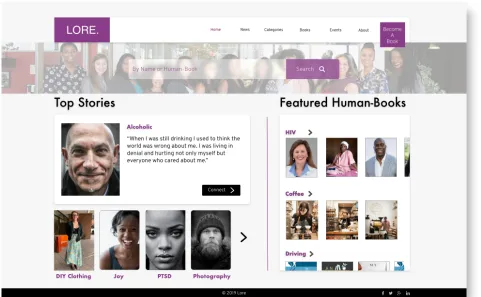
I made four different sketches with the basic idea in mind about the navigation and the kind of content the home page would contain. I first worked on the 1st sketch but it did not have tabs to navigate from one page to the other to skim through the categories. Then, I decided to execute the 3rd sketch further to see how the visual design develops with the addition of navigation, the top story module and the feature story tab.
Figure 2. Human-book page iterations
kjb
Figure 2. Human-book page iterations
These sketches helped me determine the content and the visual design of the human-book page which is the goal of almost every visit to Lore. There needed to be two options for making a connection with the human-book and also the ability to explore nearby events. I decided to execute the 1st sketch because I decided it would be more visually appealing with a large image of the human-book and also would create a sense of realness to drive the user to connect with them. The title would be the highlight of this page because that would determine which category/sub-category the human-book would fall under.
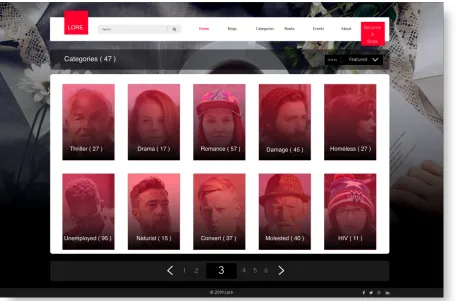
The major difference between these two iterations for the search results page was
[image:17.612.5.409.122.373.2]the ability to see the trending topics/human-books on the second sketch and just the listing of sub-categories in the first sketch. I decided to further execute the first sketch based on some preliminary feedback. It is important for the user to clearly skim through the topics under the particular category they looked up. Trending stories are kind of irrelevant at this stage of the search is one of the key takeaways from my feedback sessions from fellow students.
This sketch was made based on the underlying idea that the questionnaire needs to minimalistic and not overwhelming for the user to answer. I included a collapse-and-open option as two categories: Information for Lore which would include details of the ‘Human-book’ that wouldn’t be published. The other category would be Information to be published which is for the reader.
[image:18.612.77.351.47.473.2]The interactions were planned to be navigated vertically by giving the best of the results for the user based on their previous activity. The search results would give the user the option of hovering horizontally if there are more options available than to fit into one screen. For visual design, I decided to go with a plain and simple design with fewer colors.
One major challenge is to present all the information visually and try to reduce the text content as much as possible. Another challenge is to make the interactions required for the user to navigate through the categories as intuitive as possible.
This is one of the first pages I designed to test the colors and take feedback for the visual appeal. After this quick user testing of the preliminary ideas, I decided to change the color palette based on the feedback I received that the colors were too overwhelming. I also changed the overall layout of the page and content.
[image:19.612.61.517.147.448.2].
This was the first visual design of the home page which was considerably changed in the later stages based on user testing and feedback sessions. A shade of purple was chosen for further visual designs which embodies the balance of red's stimulation and blue's calm. I decided to use this color in the early stages of the development to give that aesthetic appeal for a positive, energizing feel of the overall design. I tried quite a few typefaces like Roboto, Futura but decided to stay with Overpass for the body text and Butler Stencil for the logotype of Lore. The typeface went well with the color to increase the positivity and cheerfulness.
Results
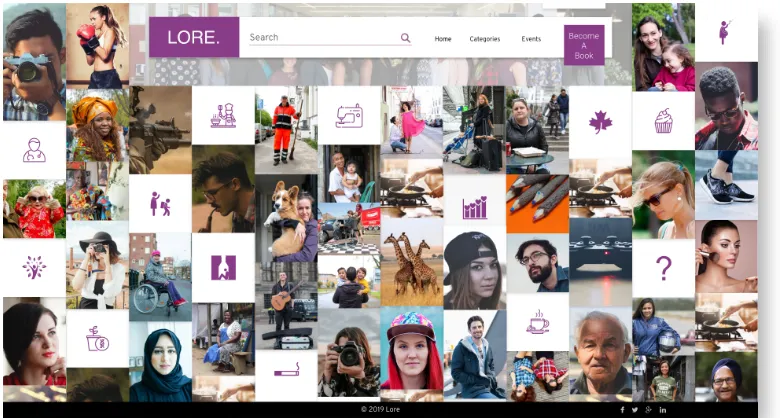
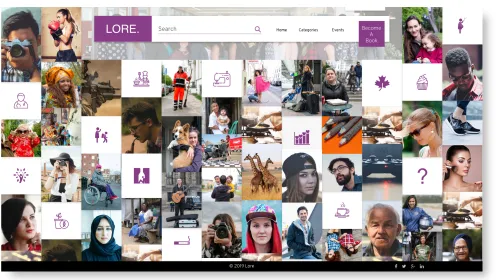
[image:20.612.60.541.57.354.2]The final home page design is shown below. This design was based on the feedback that there could be an element of serendipity for the user to navigate through the system while the search option still being an integral part of the home page.
The home page gives the user ability to navigate through all the categories, sub-categories, expertise, skills etc.; thrown at them to choose from. These options on the home page show up based on their previous activity within the interface of Lore. The search tool is still a very important aspect to the home page which could help the user get to the exact human-book they are looking for. The option of “Become a book” is a global navigation option to help the user get to the application as and when they choose to become a human-book anytime while they are exploring Lore.
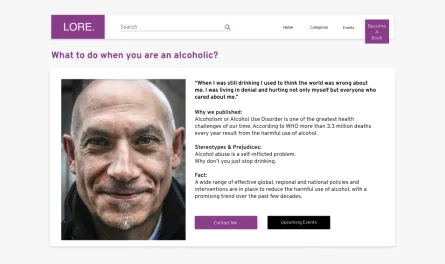
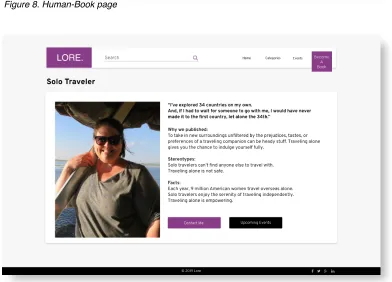
These are examples of a human-book page. These pages have information about the ‘Human-Book’ and also the reasons why Lore published it and any other relevant information about that particular topic. They are more like a profile page for a person to describe themselves. The key options for further interaction are the ability to connect with the human-book and to know about the upcoming Lore events they’re going to be a part of.
Figure 8. Human-Book page
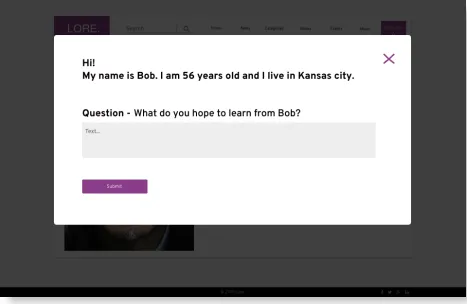
Figure 9. Connection page
After the user chooses the “Contact me” option on the human-book page, there would be a pop-up giving some basic information about the human-book and to ask the reader why they want to connect in order to see if the human-book will be able to fit their needs.
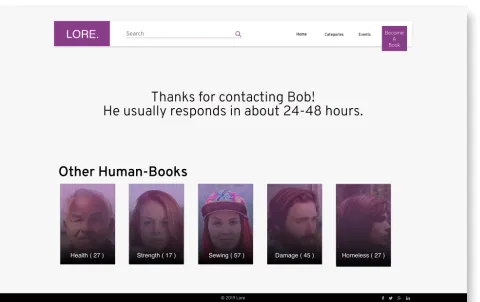
Figure 10. After submission page
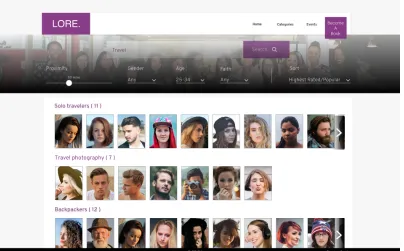
The search tool is a very important aspect of Lore. If a user searched for a particular topic, the search results would be everything under that category including all the
[image:25.612.58.563.71.347.2]sub-categories, expertise, skills etc. The user will have the ability to filter the search results based on proximity, gender, age and faith. There is also an option to sort based on ratings and reviews.
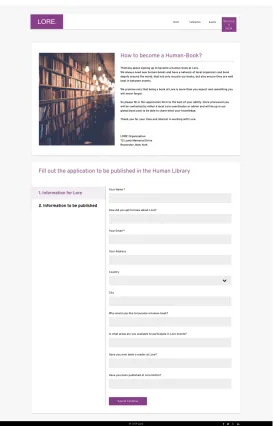
The other main aspect to Lore is to become a ‘Human-book’. Anyone can become a Human-Book by answering a questionnaire to meet the needs of a human-book within the policy of Lore. There are two categories of questions in the questionnaire which the prospective human-book needs to fill out. After submitting the application,
[image:27.612.59.300.35.283.2]the administrators of Lore would assess the application and then approve/disapprove the ‘Human-Book’ whether or not to be published at Lore.
Figure 11. Become-a-book aapplication page 2
[image:27.612.60.489.323.552.2]Evaluation and Discussion
A lot of preliminary user testing and feedback sessions were conducted amongst my peer group and advisors to see how best the visual design and user-flow can help better the entire experience at Lore.
Most people gave a common feedback that Lore would help enrich their knowledge about subjects they don’t have an idea about and to be able to learn about uncommon topics by providing information about different kinds of people and experiences across the globe. They also felt that the user flow was well established in a way that was not overwhelming. However, some people advised to have add some more interesting information about the ‘Human-book’ to motivate the user to want to make the connection. Most of the
participants mentioned that this could actually help them talk to content experts about ‘taboo’ topics which is one of the main goals of Lore. The idea that Lore could help you learn particular skills from real-people rather than just reading a book or watching a tutorial was greatly acknowledged and appreciated because all the people felt it’s very important to have an on-going dialogue with someone while learning a skill which lacks in other aspects of book/web learning.
Solution statement
With the advancement of social media like never before, we are all still very disconnected from one another because the need to listen to each other is being ignored. Thus, Lore is a platform to find content experts and skilled people who are willing to share their knowl-edge and expertise to make a one-on-one connection and share in a dialogue about that individual’s experience to address the emotional needs of humans and to learn by talking to another human.
The initial focus was just to share real-life stories but with some further research and effort, I found a way to make room for skill/expertise sharing option too, which could add to the entire concept of Lore and help people learn skills while also being inspired from someone else’s story. My preliminary approach was practical and driven through
discovery by chance which I believe would make the experience much more engaging particularly, for personal experience stories.
Future Directions
I believe that this project holds real potential and would be of practical value to a broad audience. Next steps would be to the development of a business model and marketing plan. While the concept of Lore is to provide a benefit to individual users, it is unclear if this would be commercially viable through a subscription or advertising-based model. Ideally, funding from a benefactor could allow development to proceed before requiring the site to make a profit.
Conclusion
Lore was developed from the notion that promoting deeper dialogue between people can reduce prejudice and fear and encourage understanding of people’s learning and
stories beyond nationalities, religion and gender. The basic idea of recognizing people as ‘Human-Books’, to tell their stories and to share their skills is the main component of Lore. Instead of learning through reading a book or watching a video, readers can directly engage in a conversation with another human being, sharing life experiences far different from their own. In addition, readers can also become a ‘Human-Book’ to share their own story or to help other people learn the skills they possess. I believe that this idea is simple and intuitive and builds upon an innate aspect of human behavior that compels
Bibliography
Boss, Jeff. "Why the Secret to Success Is Human Connection." World Economic Forum. Accessed May 02, 2019. https://www.weforum.org/agenda/2018/05/a-lack-of-work-place-connection-is-costing-you.
Constable, Giff, Frank Rimalovski, and Tom Fishburne. Talking to Humans: Success Starts with Understanding Your Customers. Middletown, DE.: Giff Constable, 2014.
Marinakos, Cynthia, and Cynthia Marinakos. "When Two Souls Collide: The Power of Human Connection." Medium. May 31, 2018. Accessed May 02, 2019. https://medi-
um.com/the-mission/when-two-souls-collide-the-pow-er-of-human-connection-b467b6462c08.
Summary, A. GoodTherapy.org News. "The Profound Impact of Human Connection." GoodTherapy.org Therapy Blog. October 25, 2013. Accessed May 02, 2019. https://ww-w.goodtherapy.org/blog/profound-impact-of-human-connection.
"The Human Library Organization." HumanLibrary.org. April 26, 2019. Accessed May 02, 2019. http://humanlibrary.org/.
TodayShow. "Look inside the Human Library, Where You Check out People (not Books)." TODAY.com. Accessed May 02, 2019. https://www.today.com/news/look-inside-human-li-brary-where-you-check-out-people-instead-t78736.