Equality and Human Rights Commission
Research report 70
The equality duties and schools
The equality duties
and schools
Graham Bukowski, Hazel Roberts,
Jen Fraser and Fiona Johnson
© Equality and Human Rights Commission 2011
First published Summer 2011
ISBN 978 1 84206 353 8
Equality and Human Rights Commission Research Report Series
The Equality and Human Rights Commission Research Report Series publishes research carried out for the Commission by commissioned researchers.
The views expressed in this report are those of the authors and do not necessarily represent the views of the Commission. The Commission is publishing the report as a contribution to discussion and debate.
Please contact the Research Team for further information about other Commission research reports, or visit our website:
Research Team
Equality and Human Rights Commission Arndale House
The Arndale Centre Manchester
M4 3AQ
Email: [email protected] Telephone: 0161 829 8500
Website: www.equalityhumanrights.com
You can download a copy of this report as a PDF from our website: http://www.equalityhumanrights.com/
If you require this publication in an alternative format, please contact the Communications Team to discuss your needs at:
Contents
Figures ... i
Tables ... iii
Acknowledgements ... iv
Executive summary ... v
Introduction ... v
The drivers of equality duties work in schools ... vi
Delivery of core equality duty requirements within schools ... vii
Positive practice and its impact upon pupil outcomes: Gender ... vii
Positive practice and its impact upon pupil outcomes: Disability ... ix
Positive practice and its impact upon pupil outcomes: Race ... ix
Embedding the equality duties within broader school activities ... x
Progress on wider equality issues ... xi
Looking ahead: overcoming barriers and implementing solutions ... xii
Conclusions ... xiii
1 Introduction and methodology ... 16
1.1 Introduction to the study ... 16
1.2 Research objectives ... 16
1.3 Methodology ... 17
1.4 Presentation and interpretation of the quantitative findings ... 24
1.5 Presentation and interpretation of the qualitative findings ... 25
1.6 Definition of key terminology ... 25
1.7 Structure of the report ... 27
2 Background to the study ... 28
2.1 The equality duties ... 28
2.2 Evidence on equality and education ... 31
2.3 Evidence on the impact of the gender, race and disability equality duties ... 32
2.4 The Equality Act 2010 and the Public Sector Equality Duty... 34
2.5 Human rights ... 36
3 The drivers of equality duties work in schools ... 37
4 Delivery of core equality duty requirements within schools ... 42
4.1 Developing equality policies/schemes ... 43
4.2 Developing action plans with set targets for the duties ... 45
4.3 Schools with policies or schemes and action plans with set targets ... 49
4.4 Schools’ overall levels of action on each of the three equality duties (gender, disability and race) ... 51
4.5 Engaging schools’ partners in the duties ... 54
4.6 Involving disabled people in developing a disability equality scheme ... 59
4.7 General activities being carried out by schools ... 62
4.8 Making use of information and evidence ... 64
5 Positive practice and its impact upon pupil outcomes: Gender ... 68
5.1 Gender Equality Duty action that has contributed to measurable, positive outcomes for pupils ... 69
5.2 Linking action to positive outcomes for pupils ... 72
6 Positive practice and its impact upon pupil outcomes: Disability ... 77
6.1 Disability Equality Duty action that has contributed to measurable, positive outcomes for pupils ... 78
6.2 Linking action to positive outcomes for pupils ... 80
7 Positive practice and its impact upon pupil outcomes: Race ... 85
7.1 Race Equality Duty action that has contributed to measurable, positive outcomes for pupils ... 86
7.2 Linking action to positive outcomes for pupils ... 88
8 Embedding the equality duties within broader school activities ... 93
8.1 Embedding the duties in school improvement/development plans and self-evaluation forms ... 93
8.2 Equality duties and staff training/performance management ... 97
9 Progress on wider equality issues ... 100
9.1 Awareness of the new Single Equality Duty ... 101
9.2 Inclusion of newer equality strands in policies or schemes (and human rights) ... 102
9.4 Actions that have contributed to positive outcomes for pupils
related to the newer equality strands ... 107
10 Looking ahead: Overcoming barriers and implementing solutions . 111 10.1 The main barriers to schools effectively engaging with and embedding the duties ... 112
10.2 Is more training required to help school deliver on the equality duties? ... 114
10.3 What guidance is required to help schools to deliver on the equality duties? ... 116
11 Conclusions and implications ... 120
References ... 123
Appendix 1: Weighting ... 124
Appendix 2: Sampling tolerances ... 125
Appendix 3: Questionnaire ... 127
Appendix 4: Questions affected by interview length ... 144
Figures
3.1 Drivers for fulfilling the equality duties (%) 38
4.1 Single equality policy/scheme 43
4.2 Gender, disability and race equality policy or schemes
(either integrated or separate) 45
4.3 Action plans and set targets to meet the race, disability and gender
equality duties 46
4.4 Equality policies/schemes and action plans 49
4.5 A policy or scheme, action plan, example of promising practice, and identified positive impact on pupil outcomes for gender,
disability and race equality 53
4.6 People consulted in developing equality policies or schemes, action plans, targets and/or improvement or development plans 55
4.7 Consulting and involving disabled people in the development of
disability equality schemes 59
4.8 Effectively using information and evidence to identify priorities or
action for each of the equality duties 65
4.9 Effectively using information and evidence to monitor progress
towards improving equality-related outcomes 65
5.1 Gender Equality Duty-related action that has contributed to positive
pupil outcomes 70
5.2 Impact of Gender Equality Duty-related action upon female pupil
outcomes 73
5.3 Impact of Gender Equality Duty-related action upon male
pupil outcomes 75
6.1 Disability Equality Duty-related action that has contributed to
positive pupil outcomes 78
6.2 Impact of Disability Equality Duty-related action upon disabled
pupil outcomes 81
7.1 Race Equality Duty-related action that has contributed to positive
pupil outcomes 86
7.2 Impact of Race Equality Duty-related action upon ethnic minority
pupil outcomes 89
8.1 Equality duties an explicit feature of school improvement/
development plans 94
8.2 Equality duties an explicit feature of school self-evaluation forms 96
8.3 Equality duties an explicit feature of performance management
targets/objectives for senior leaders 98
8.4 Equality duties an explicit feature of performance management
8.5 Equality duties an explicit feature of performance management
targets/objectives for support staff 99
9.1 Aware of the forthcoming Public Sector Equality Duty 101
9.2 Inclusion of newer equality strands in equality policies or schemes
(and human rights) 102
9.3 Setting targets for the newer equality strands (and human rights)
among schools that cover these in their policy or scheme 105
9.4 Setting targets for the newer equality strands (and human rights)
among all schools 106
10.1 Barriers to fulfilling the equality duties 112
10.2 Training/continuing professional development (CPD) received to
deliver the equality duties (senior leaders) 114
10.3 Training/continuing professional development (CPD) received to
deliver the equality duties (established teachers) 115
10.4 Training/continuing professional development (CPD) received to
deliver the equality duties (new entrants to teaching profession) 115
10.5 Need for guidance on how to design and deliver training related to
the equality duties 116
10.6 Need for guidance on how to collect appropriate and relevant
evidence 117
10.7 Need for guidance on the duties generally, and what they mean
for schools 117
10.8 Need for guidance on how to involve and engage stakeholders 117
10.9 Need for guidance on setting targets and monitoring progress
towards improved outcomes 118
Tables
3.1 Drivers for fulfilling the equality duties (by school type) 39
3.2 Drivers for fulfilling the equality duties (by country) 40
3.3 Drivers for fulfilling the equality duties (faith schools) 40
4.1 Single equality policy/scheme (by school type) 44
4.2 Single equality policy/scheme (by country) 44
4.3 Action plans and set targets (by school type) 47
4.4 Action plans and set targets (by country) 48
4.5 Action plans and set targets (faith schools) 48
4.6 Equality policies/schemes and action plans (by school type) 50
4.7 Equality policies/schemes and action plans (by country) 50
4.8 Consultation (by country) 57
4.9 General activities carried out relating to the gender, disability and
race equality duties 63
8.1 Equality duties an explicit feature of school improvement/
development plans (by school type) 95
8.2 Equality duties an explicit feature of school improvement/
development plans (by country) 95
8.3 Equality duties an explicit feature of school improvement/
development plans (faith schools) 95
8.4 Equality duties an explicit feature of school self-evaluation forms
(by school type) 96
8.5 Equality duties an explicit feature of school self-evaluation forms
(by country) 97
8.6 Equality duties an explicit feature of school self-evaluation forms
(faith schools) 97
9.1 Inclusion of newer equality strands in policies/schemes
(and human rights) by school type 103
9.2 Inclusion of newer equality strands in policies/schemes
(and human rights) by country 104
9.3 Inclusion of newer equality strands in policies/schemes
(and human rights) faith schools 104
9.4 Action on newer equality strands (including human rights) that has
Acknowledgements
It is clear that staff in schools are increasingly working under great pressure from a number of different sources. They also receive numerous requests to participate in studies such as this. Consequently, we wish to record our immense gratitude to the many respondents who took part and made the research possible.
Executive summary
Introduction
The equality duties were pieces of equality legislation that required public bodies (including schools) to pay due regard to work towards eliminating unlawful discrimination and harassment and to actively promote equality with regard to gender, disability and race. The new Public Sector Equality Duty replaced the existing legislation on 5 April 2011, to include: disability, gender, gender reassignment, pregnancy and maternity, race, religion or belief, and sexual orientation.
The Equality and Human Rights Commission (the Commission)’s first Triennial Review of evidence on inequality, How Fair is Britain?, found in its education chapter that educational attainment continues to be strongly associated with socio-economic background, and the gap in attainment between ethnic groups has narrowed more clearly, with some previously low-performing groups catching up with the average. Young women are now ahead of young men in many aspects of educational attainment, but subject and course choices remain heavily segregated, with
repercussions in higher education and the labour market. Young people with Special Educational Needs (SEN) account for the majority of permanent exclusions from school in England, and continue to have low educational attainment. For lesbian, gay, bisexual and transgender (LGBT) young people, attainment trends are harder to measure, but there are signs that they are being penalised by unfair treatment and bullying in the education system, at school and beyond.
Ipsos MORI was contracted by the Commission to undertake a detailed programme of research to examine ways in which schools in England and Wales were carrying out and implementing the equality duties, and to identify examples of positive practice. In addition, the study sought to provide some early indications of awareness about the then forthcoming Public Sector Equality Duty and to what extent the new protected characteristics (gender reassignment, pregnancy and maternity, religion or belief, and sexual orientation) and human rights are under development and integrated into schools’ existing equality policies, schemes and target-setting. The research was commissioned in order to learn lessons from how schools have implemented the equality duties and inform guidance and policy for the successful implementation of the Public Sector Equality Duty in 2011.
This research is the first systematic review to be conducted of the equality duties in schools in England and Wales. While neither an audit of implementation nor an assessment of compliance, for the very first time, it provides a set of baseline statistics which indicate the extent to which schools are carrying out key duty-related activities. The research focuses upon pupils, rather than schools as an employer, in order to investigate impact upon pupil outcomes. It serves as a rich evidence base for illustrating the types of equality duty-related actions and processes schools are pursuing and the impact this has on addressing differences in pupil outcomes.
The drivers of equality duties work in schools
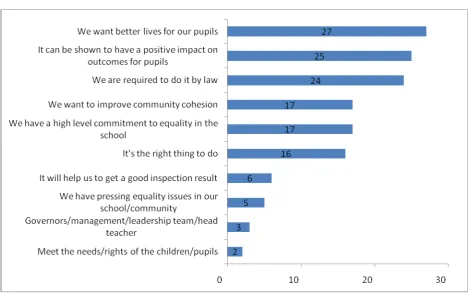
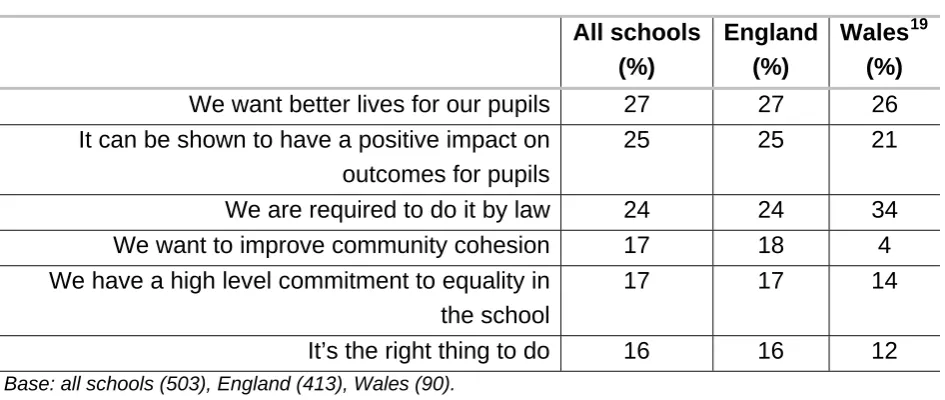
The most commonly mentioned drivers for fulfilling the equality duties were wanting better lives for pupils (27 per cent) and the demonstrated positive impact the duties have on pupil outcomes (25 per cent). Although most schools mentioned drivers that relate to improving pupils’ experience and/or outcomes, there is some indication that
the law (24 per cent) is also an important driver.
There were some notable significant differences in the drivers across types of school. Secondary schools were more likely to cite it’s the right thing to do as a driver to fulfilling the equality duties than primary schools (23 per cent versus 14 per cent). Large schools were more likely than small schools to say that
having a high level of commitment to equality and pressing equalities issues in the school/community are drivers; schools in areas of high ethnic diversity compared with those in areas of low ethnic diversity were more likely to say that
There is some evidence in the quantitative and qualitative research that the equality duties and other duties in combination were acting as drivers, including the duty to promote community cohesion and the duty of care, for example. The qualitative research findings also revealed adequate funding to be an important driver (an issue that was not really raised in the telephone survey).
Delivery of core equality duty requirements within schools
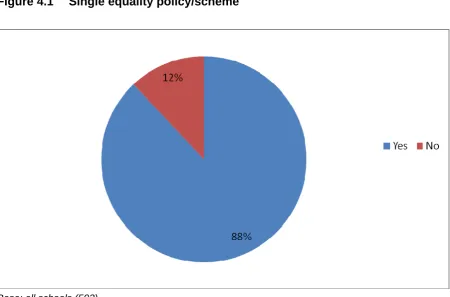
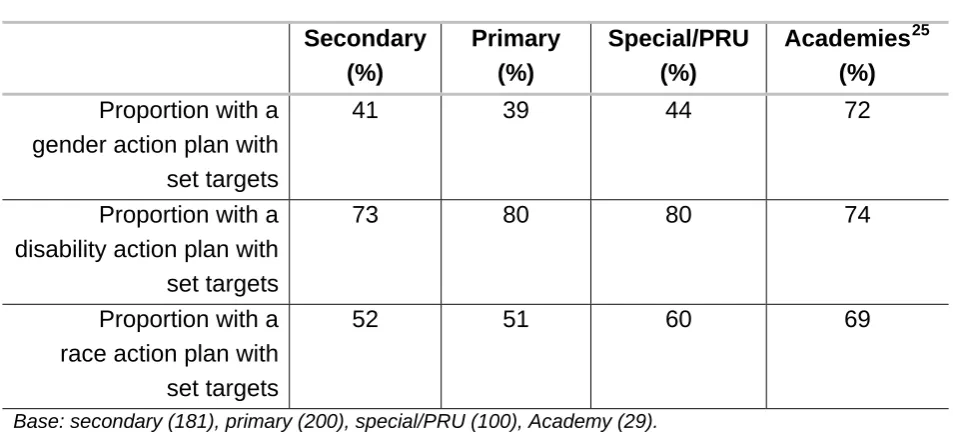
Almost nine in 10 schools (88 per cent) had a singleequality policy/scheme that incorporates gender, disability and race equality. Only a small proportion (3 per cent) of schools appeared to be failing in their obligation to produce equality schemes or policies to cover gender, race and disability (either in one scheme or policy or within separate schemes or policies).
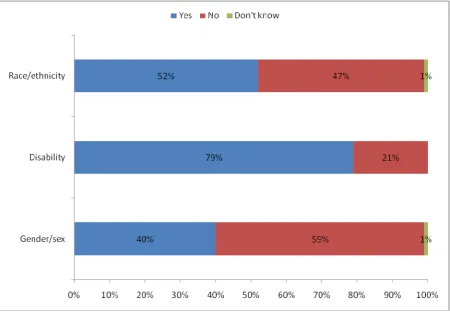
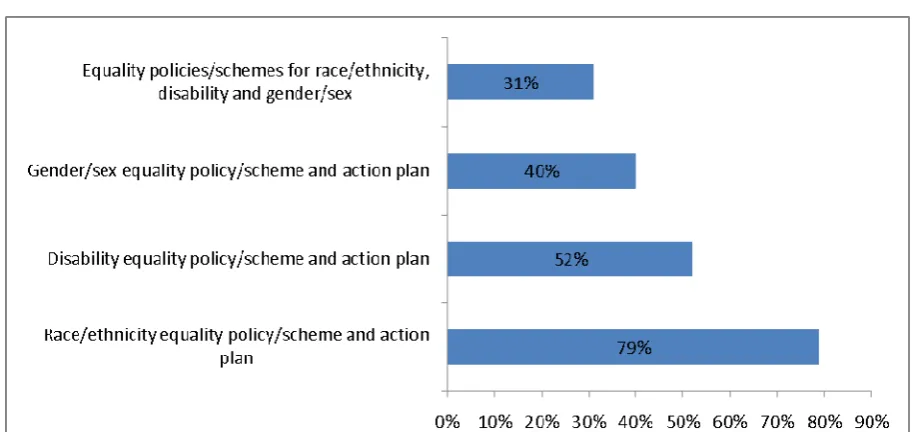
Schools were most likely to have an action plan with set targets specifically around meeting the Disability Equality Duty (79 per cent) than an action plan with set targets for race equality (52 per cent) or gender equality (40 per cent).
Three in 10 schools (31 per cent) had an equality policy or scheme and action plan with set targets for all three equality duties. Only 40 per cent had an equality policy or scheme and action plan for gender, compared with 52 per cent for race and 79 per cent for disability. Schools in England and schools in areas with high ethnic diversity were most likely to have an equality policy or scheme and action plan with set targets for all three duties.
When developing equality duty-related plans and policies, schools were most likely to consult teaching staff (67 per cent), governors (65 per cent) and parents or carers (59 per cent). Less than half (42 per cent) spontaneously reported consulting pupils.
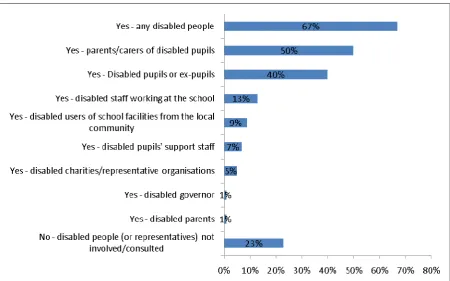
Just under a quarter of schools (23 per cent) have not involved at least one group of disabled people (or their representatives) in the development of their disability equality scheme, which is a requirement of the Disability Equality Duty.
The majority of schools believe they are using information and evidence effectively to identify priorities for action for each of the equality duties (87 per cent) and to monitor progress towards equality-related outcomes (92 per cent).
Positive practice and its impact upon pupil outcomes: Gender
likely than faith schools to be taking any action on gender equality that contributes to positive pupil outcomes (85 per cent versus 72 per cent respectively – though this is an indicative finding only1). Schools with an equality policy or scheme and action plan for gender were also more likely to give an example of positive practice (93 per cent versus 73 per cent without).
In terms of positive practice arising from the Gender Equality Duty that has
contributed to measurable outcomes, schools were most likely to say they ensure that clubs/activities/subjects/sports are open to both boys and girls (19 per cent). They also mentioned monitoring progress, improving boys’ learning, adapting the curriculum to meet the needs of boys and encouraging pupils to take up non-traditional subjects and options.
Schools were more likely to provide an example of positive impact for malepupils than femalepupils (75 per cent versus 69 per cent respectively). Overall, one in 10 (11 per cent) were unable to attribute any improvement in female pupils’ outcomes to the implementation of the duty.
Schools are making some links between action and outcomes for female and male pupils. The most commonly cited positive impact on female pupils was increased rates of participation in sports, which correlates with the most commonly cited action to promote gender equality. Schools also identify improved subject attainment for girls; improved wellbeing/self-esteem and better engagement/higher aspirations.
The qualitative research indicates that when schools are able to recognise the link between outcome and action, this motivates them to continue and expand on equality-related action (this applies across the three equality duties).
With regard to male pupils, again, there is a recognised link between action and outcomes in terms of schools’ work in fulfilling the Gender Equality Duty. This was evident, for example, in the link between the top three pupil outcomes (better attainment by subject, narrower gap in performance and better
engagement/higher aspirations) and the action with the second highest mentions (reviewing and monitoring results and/or the curriculum to ensure there is no disparity between boys and girls).
There were some differences in the perceived positive impacts on girls and boys. Schools were more likely to say that equality-related action has led to increased
1
rates of participation in sports for girls (19 per cent versus 10 per cent for boys) and a narrower gap in performance for boys (15 per cent versus 4 per cent for girls).
Positive practice and its impact upon pupil outcomes: Disability
Almost all schools (93 per cent) could describe something they had done (an activity, action or process) to meet the Disability Equality Duty that has contributed towards measurable, positive outcomes for pupils.
Over half of schools (54 per cent) said they have made school facilities suitable for disabled pupils (or have plans to do so). This is the most cited action by a considerable margin: schools were at least 40 percentage points more likely to say they have made school facilities suitable for disabled pupils (or have plans to do so) than anything else. The next most commonly cited action was ensuring that clubs/subjects/curriculum/trips/sports can be accessed by everyone (14 per cent). Schools also mentioned the training of staff and teaching/encouraging awareness about disability.
Schools with a disability equality policy or scheme and action plan were most able to give an example of promising practice that has contributed to improved pupil outcomes; they were also most likely to mention a positive impact on pupils as a result of their equality-related work, along with schools in England.
Almost four in five schools (77 per cent) were able to identify how their work has had a positive impact on disabled pupils (its outcome/benefit). This is in line with the proportion of schools that were able to identify a positive impact on male pupils as a result of their work on gender equality (75 per cent) but more than that for female pupils (69 per cent).
In line with the most common action to promote disability equality (making school facilities more accessible), the most cited positive impact is an increased reported sense of accessibility to school facilities/resources. Schools also spontaneously identify improvements in pupils’ wellbeing, disabled pupils feeling more valued, and increased key stage and subject attainment.
Positive practice and its impact upon pupil outcomes: Race
Schools were most likely to say that they have worked to raise awareness, tolerance and understanding, and that they hold multicultural days, conferences and/or
assemblies. They also mentioned forging links with schools and communities overseas; using interpreters; building links with parents; monitoring progress, and dealing with racist incidents.
Schools that were most able to give an example of positive practice with regard to duty-related action on race equality included non-faith schools (though this is an indicative finding only) and those with an equality policy or scheme and action plan for all three duties.
Almost three-quarters of schools (73 per cent) were able to attribute an improvement in ethnic minority pupil outcomes to the Race Equality Duty; this is lower than the equivalent findings for disabled pupils (77 per cent) and male pupils (75 per cent) but slightly higher than that for female pupils (69 per cent).
Again, there are some links being made between equality-related action and positive impacts on pupil outcomes. The most commonly cited positive impactis an increase in pupils reporting feeling valued. Schools also mention improved attainment at key stages and in subjects; better engagement and higher aspirations; narrowed gaps in performance; increased wellbeing, and reduction in racist incidents.
Embedding the equality duties within broader school activities
Seven in 10 schools (69 per cent) said that gender, disability and/or race equality are an explicit feature of their Improvement or Development Plan.
Schools were more likely to say that gender, disability and/or race equality is an explicit feature of their Self-Evaluation Form (85 per cent) than their Improvement or Development Plan (69 per cent).
Performance management targets/objectives related to the duties were most likely to be set for some/all teaching staff (52 per cent) and least likely to be set for some/all support staff (45 per cent). Half of schools (50 per cent) set performance
management targets and objectives for some/all senior leaders.
Schools that were most likely to make gender, disability and race equality issues an explicit feature of performance management targets/objectives for all or some senior leaders included those that are large, or in the most deprived areas of England, or in areas with high ethnic diversity; and those that have equality policies and/or schemes and action plans for gender, disability and race equality.
Progress on wider equality issues
The majority of schools (62 per cent) were unaware of the forthcoming Single Equality Duty (now known as the Public Sector Equality Duty) and the range of protected equality strands covered, which suggests that it will be important to build schools’ awareness of the change in legislation.
Schools were asked if they cover wider equality issues and human rights in their equality policy or scheme. They were significantly more likely to say that they cover religion or belief (93 per cent), human rights (73 per cent) and sexual orientation (68 per cent) in their equality policies or schemes than gender reassignment (29 per cent) and pregnancy and maternity (26 per cent).
Secondary schools were significantly more likely than schools overall to cover all of the newer equality strands in their equality policy or scheme, and more likely than primary schools to cover religion or belief, sexual orientation, and pregnancy and maternity.
Special schools and Pupil Referral Units (PRUs) were significantly more likely than all schools overall to cover religion or belief, sexual orientation, and pregnancy and maternity in their equality policy or scheme, and were more likely than primary schools to cover sexual orientation and pregnancy and maternity.
English schools were significantly more likely than Welsh schools to include sexual orientation in their equality policy or scheme2.
Welsh schools were more likely than English schools and all schools overall to include pregnancy and maternity in their equality policy or scheme3.
Schools were most likely to have set specific targets to improve equality relating to religion or belief (31 per cent) and least likely to have done so in the case of gender reassignment (5 per cent). Nearly a quarter (23 per cent) of schools had set specific
2
Small base size for Wales (90); indicative finding.
3
targets for human rights, 10 per cent for pregnancy and maternity, and 6 per cent for sexual orientation.
Actions that schools had taken in these areas included anti-bullying work, clamping down on homophobic language and behaviour, school trips to places of worship and teaching pupils about their rights and responsibilities.
Looking ahead: overcoming barriers and implementing solutions
Schools were most likely to say that the main barriers to fulfilling the equality duties were a lack of time and money. Additional barriers included: convincing parents or carers to take equality duties on board; a lack of guidance; a lack of relevant training; confusing legislation.
There were some differences in perceived barriers across schools. For instance, secondary schools were most likely to cite a lack of money, special schools and PRUs were most likely to cite a lack of continuing professional development for school staff, and schools in the most deprived areas are most likely to cite difficulties in convincing parents or carers to take the equality duties on board.
The vast majority of schools believed that a lot or a little more training or continuing professional development on the equality duties is needed. Only a fifth of schools (20 per cent) believed established teachers have received enough training, with 24 per cent saying senior leaders and 22 per cent saying that new entrants to the profession have received enough. It is believed that new entrants to the teaching profession are significantly more likely to need a lot moretraining.
When asked specifically about their duty-related guidance needs, schools were most likely to agree that they need better guidance on how to design and deliver training related to the equality duties (55 per cent gave this response), followed by needing better guidance on how to collect appropriate and relevant evidence (49 per cent) and guidance on the duties generally and what they mean for schools (49 per cent).
Welsh schools4 were more likely than English schools to agree that they need better guidance in setting targets and monitoring progress towards improved outcomes, and collecting appropriate and relevant evidence. This was particularly evident among Welsh primary schools5.
Primary schools were more inclined than secondary schools to say they need better guidance on collecting appropriate and relevant evidence.
Faith schools were more likely than non-faith schools to feel they need better guidance on designing and delivering training in relation to the equality duties.
Conclusions
The majority of schools are engaged with the importance of equality and there are clear signs that the duties are having some impact on their actions and pupil outcomes; this is good news.
However, many schools in England and Wales are not, generally speaking,
operatingfully within the equality duties framework. Rather, the evidence suggests that schools are falling somewhere along a scale of adherence to and adoption of the duties and consequently there is some considerable variation in schools’ capacity to link pupil outcomes to the equalities framework. This means there is notable variation in the types of equality duty-related action taken by schools, the extent to which they were adhering to the specific duties and the ways in which schools think about differences in pupil outcomes and the type and scale of the actions they take to address these differences.
For example, some schools are not associating differences in outcome with issues of inequality and they do not follow particular practices, such as consultation, reviewing equality schemes and considering new targets and outcomes which the duties
promote as the ideal framework within which to tackle inequality. These schools may say they ‘don’t have equality issues’.
Some schools are thinking differently about equality and are implementing the duties to identify and tackle inequality and monitor/improve pupil outcomes. This means that they consider whether differences in pupil outcomes are influenced by
experiences of inequality and use the key steps outlined in the legislation and guidance on duties to tackle these equality issues (for example, by reviewing
4
Small base size (90); indicative finding.
5
schemes, consulting stakeholders, embedding the duties in broader school policies and monitoring the impact of action taken on pupil outcomes).
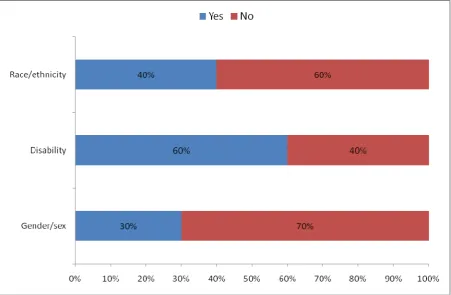
According to the measures used in this study, the results suggest that schools are more active in demonstrating how they have implemented the Disability Equality Duty: six in 10 schools6 are meeting some of the key requirements for this key measure, in that they:
• have a disability equality policy or scheme and an action plan with set targets for disability
• have demonstrated promising practice with regards to disability equality, and
• have seen a positive impact on disabled pupils’ outcomes.
In contrast, two in five schools (40 per cent) have achieved the same for race equality and three in 10 (30 per cent) have achieved the same for gender equality.
When schools are asked to identify positive practice that has led to measurable improvements, they tend to focus upon improving access for disabled pupils. Schools also mention the training of staff and teaching/encouraging awareness about disability. They have seen impact in increased reported sense of accessibility to school facilities and resources, improvement in pupils’ wellbeing; disabled pupils feeling more valued, and increased key stage and subject attainment.
For race, schools prioritise raising awareness and promoting tolerance and understanding. Schools also mention forging links with schools and communities overseas; using interpreters; building links with parents; monitoring progress; and dealing with racist incidents.
For gender, schools tend to prioritise ensuring that clubs, activities, subjects and sports are open to both boys and girls. They also mention monitoring progress; improving boys’ learning; adapting the curriculum to meet the needs of boys; and encouraging pupils to take up non-traditional subjects and options. They have seen a positive impact on female pupils’ outcomes in increased rates of participation in sports; improved subject attainment for girls; improved wellbeing/self-esteem; and better engagement/higher aspirations. They have identified better attainment by subject, narrower gap in performance and better engagement/higher aspirations for boys.
6
Therefore, while many schools have good intentions and believe (often rightly) that they are taking effective action on inequalities, their positive intentions do not always follow the systematic and evidence-based approaches emphasised in the equality duties, from which their pupils should benefit. The study implies that the real benefits of implementing the duties for pupils can be further developed.
Overall, the study indicates that:
•
There is evidence of widespread goodwill and support for equality, and some considerable progress in implementing the duties, which have had a positive impact on pupil outcomes. This can be harnessed, shared and improved.•
There will need to be a greater emphasis upon action-planning and using evidence. Schools have good intentions and policies or schemes, but would benefit from translating these into more actions that can be measured.•
It will be important to continue to tackle entrenched inequalities (such as gender segregation in subjects and choices, gaps in attainment between groups, and high rates of exclusion and bullying) and make measurable progress.•
Schools can take greater steps to embed equality duties in their development plans and performance targets. This commitment makes a difference.•
Schools would like better guidance on how to design and deliver training related to the equality duties, how to collect appropriate and relevant evidence, and guidance on the duties generally and what they mean for schools.1
Introduction and methodology
1.1 Introduction to the study
Ipsos MORI was contracted by the Equality and Human Rights Commission (the Commission) to undertake a detailed programme of research to examine ways in which schools in England and Wales are carrying out and implementing the three existing equality duties (for gender, disability and race), and to identify examples of promising practice. In addition, the study sought to provide some early indications of awareness about the forthcoming Single Equality Duty (now known as the Public Sector Equality Duty) that came into force in April 2011, and to what extent the newer equality strands, and human rights, are being thought about and integrated into schools’ existing equality policies, schemes and target-setting.
The research is the first systematic review to be conducted of the equality duties in schools in England and Wales. While neither an audit of implementation nor an assessment of compliance, it does provide, for the very first time, a set of baseline statistics which indicate the extent to which schools are carrying out key duty-related activities. It focuses upon pupils, rather than schools as an employer, in order to give detailed consideration to the impact upon pupil outcomes. The research serves as a rich evidence base for illustrating the types of equality-related actions and processes being pursued by schools and the impact this has on addressing differences in pupil outcomes.
The research findings will be used to inform guidance on improving outcomes for pupils in the future through the single Public Sector Equality Duty which is being driven by the new legal framework for equality as set out in the Equality Act 2010. Information about the new duty, the Equality Act 2010 and a synopsis of what evidence has told us to date (that is, prior to this study) may be found in Chapter 2.
1.2 Research objectives
The overall aims of the research project were as follows:
• to provide baseline evidence regarding how schools are implementing the requirements of the specific gender7, disability and race duties in England and Wales, and evidence of progress in wider equality issues
7
• to capture examples of promising practice, where schools are able to
demonstrate that they are raising standards and improving outcomes for pupils through the implementation of the general and specific duties, and
• to highlight the key reasons why schools are more or less successful in delivering their obligations, and making the best use of the public sector duties to improve pupil outcomes.
1.3 Methodology
The research project comprised four methodological strands:
• A number of scoping interviews with key education stakeholders to explore expert perspectives on promoting equality in schools and to identify the key issues for schools in implementing the equality duties.
• A review of materials to critically examine policy and literature relating to school implementation of the equality duties and improving pupil outcomes, in order to identify the main themes and approaches being used (including examples of good practice), and any gaps between policy and practice.
• A quantitative telephone survey of maintained primary schools, secondary schools, special schools and Pupil Referral Units (PRUs) in England and Wales, plus a booster survey of Academies.
• Qualitative research involving follow-up telephone in-depth interviews and one case study visit with a selection of schools that had taken part in the quantitative survey and had agreed to be re-contacted.
Adopting a mixed methodology enabled the research not only to collect robust data relating to key measures about the uptake and implementation of key duty-related activities, but also, through the qualitative research in particular, to provide detailed insight into how schools are going about fulfilling duty-related activity and how this activity can translate into positive outcomes for pupils.
The four strands of research are now looked at in more detail.
Scoping stage
are and could, in the future, monitor and measure success with regard to the implementation of the duties through hard and soft pupil outcomes.
A sample of potential interviewees was provided to Ipsos MORI by the Commission. An initial advance letter and email were sent to each of the contacts, outlining the purpose of the interview and the types of things to be discussed. Follow-up phone calls were made and interviewees were recruited for interview.
A total of three telephone interviews, each lasting up to 45 minutes, were conducted with a relevant representative from the following organisations:
• Office for Standards in Training and Education (Ofsted).
• Estyn.
• the Department for Education (DfE).
The scoping interviews enabled later stages of the research to be informed by ‘expert’ voices on the subject of the equality duties.
Literature review
A non-exhaustive literature review ran alongside the scoping interviews, where a number of different strategies were utilised in order to uncover the key issues. Initially, a list of potential useful sources was drawn up and formed the basis for the first general enquiries. The search list included:
• central government sources (DfE) and the Welsh Assembly (WA)
• Teachernet and Governornet
• the Equality and Human Rights Commission
• local authorities
• General Teaching Council for England (GTCE) and General Teaching Council (GTC) Wales
• Ofsted and Estyn
• the Specialist Schools and Academies Trust (SSAT)
• Mencap
• the National Union of Teachers (NUT)
• the Times Educational Supplement (TES), and
• the wider news media.
Early searches, particularly on the Commission website, led to an overall
Working through these leads meant that specific examples of policies and activities undertaken by schools, charities and local authorities were identified.
Working outwards from the core information sources meant that the impact and messages of the equality duties could be traced from a government level, through local authorities, to schools and individuals. It is this lineage and these linkages that formed the basis of the literature review.
Quantitative telephone survey of schools in England and Wales
Ipsos MORI conducted 503 telephone interviews with maintained primary schools, secondary schools, special schools and PRUs in England and Wales. The interviews with secondary schools included an Academy booster, where all Academies that were not included in the main secondary sample were contacted for interview.
Schools in both England and Wales were included as the Commission was interested in gaining an insight into similarities and differences between schools’ practices in the two countries. The survey included faith and non-faith schools, mixed and single-sex schools, and schools in rural and urban areas. Fieldwork took place from 7 June to 20 July 2010 and all interviews were conducted using Computer-Assisted Telephone Interviewing (CATI).
The questionnaire
The questionnaire was designed after the scoping interviews and literature review to enable its content to be informed by the findings from the initial research phase. Questions were designed and selected in close consultation with the Commission and the final draft was tested in four cognitive interviews with senior school staff. These cognitive interviews aimed to test the wording and interpretation of the questions, in addition to the overall ‘feel’ of the questionnaire. Each participant was sent a copy of the questionnaire in advance and was later contacted for an hour-long telephone interview to discuss their views and understanding of it. Following the cognitive interviews, further revisions were made to the questionnaire before it was used for the main telephone survey.
The key topics that the questionnaire covered include the following:
• the equality duties in general (including schools’ equality policies or schemes and target-setting)
• specific questions about the Gender Equality Duty
• specific questions about the Disability Equality Duty
• specific questions about the Race Equality Duty
• basic questions about wider equality issues
• information, guidance and support, and
• summing up (including barriers and drivers for fulfilling the equality duties).
A copy of the questionnaire can be found in Appendix 3. The average length of interview (across the full fieldwork period) was 20 minutes. This compares with the anticipated length of 17 minutes.
Sampling
Four separate sets of sample were drawn for the telephone survey: one for primary schools, one for secondary schools, one for special schools/PRUs and one for Academies (a census that excluded any already drawn in the secondary school sample). The primary school, secondary school and special school/PRU samples were all stratified by Government Office Region (GOR) and size (based on pupil numbers). Additionally, GOR Wales schools were over-represented in the primary school and secondary school samples; a proportionately representative sample was drawn for special schools/PRUs. The sampling strategy involved over-sampling in Wales to ensure that a reasonable number of Welsh schools participated in the research so as to draw useful conclusions from the findings.
Fieldwork process
A letter was sent to headteachers informing them about the survey prior to the start date to ensure that schools were expecting a phone call and had the opportunity to opt out, should they wish. Once fieldwork started, interviewers contacted schools by telephone and attempted to secure one interview with a member of staff in each school. Interviews were conducted with the headteacher, deputy headteacher, another member of the senior leadership team or another member of staff with responsibility for inclusion, personalisation and/or equal opportunities. If interviewers were unable to secure an interview on their first call, they either secured an
Interviews completed
In total, interviewers contacted 3,339 schools and completed 503 interviews overall, giving an unadjusted response rate of 32.9 per cent8. The following table shows the
target number of interviews and interviews achieved by school type.
School type Target interviews Interviews completed
Primary 200 200
Secondary 200 181
(incl. seven Academies)
Special/PRU 100 100
Academy booster As many as possible
(from a maximum of 151)
22
The following table provides a more detailed breakdown of the schools interviewed by country, gender and faith.
Country Interviews achieved
England 413 Wales 90
Gender Interviews achieved
Mixed 481 Girls 12 Boys 10
Faith Interviews achieved
Faith school 69
Non-faith school 423
Further details of the school breakdown may be found in the data tables9.
Weighting
Data were weighted by school type and GOR to ensure the findings reflected the profile of maintained schools in England and Wales. Detailed information on the weighting processes may be found in Appendix 1.
8
Calculated as follows: completes/(completes + refusals) = 503/(503+1,026).
9
Qualitative research
The qualitative phase of the research comprised 12 in-depth telephone interviews with schools and one full-day case study visit.
Sampling
In the quantitative survey, interviewers asked schools if they would be willing to be re-contacted for further research on the equality duties.
From the 336 schools that were willing to be re-contacted, Ipsos MORI, in consultation with the project team at the Commission, produced a shortlist to approach for a follow-up telephone interview or case study visit. The shortlisted sample was compiled from schools that appeared to demonstrate interesting practice across at least one of the three existing equality duties (gender, disability and race) and across a variety of equality issues (bullying, gender stereotyping,
under-achievement). This was based on a review of their open-ended verbatim responses from the quantitative telephone survey. In addition, profile characteristics were considered for each school (for example GOR, school type and size) to include a broad mix of schools across England and Wales.
Recruitment
Recruitment took place between 4 June and 12 November 2010, with a break for the summer and autumn half-term holidays. All shortlisted schools were sent an advance letter by post and by email and were subsequently followed-up by a telephone call from a member of the Ipsos MORI project team. The purpose of the advance letter/ email and follow-up call was to re-introduce the study and to recruit the school to participate in an in-depth telephone discussion about their schools’ work in regard to implementing equality duty activities and the impact this work might be having on pupil outcomes. Upon agreeing to take part in an in-depth telephone discussion, an appointment for interview was made with the nominated person at each school.
Profile of participants
Research conducted
Total achieved
By phase By GOR
In-depth telephone interview
12 2 primary;
5 secondary; 4 special; 1 Academy
1 East Midlands; 3 Greater London;
1 North East; 3 North West; 2 South East; 1 West Midlands;
1 Wales
Case study visit 1 Secondary Wales
The discussion guides
Four discussion guides were developed for the qualitative research: one for the in-depth telephone interviews and three for the case study visit (one for staff, pupils and Local Authority/community organisation representatives). All discussion guides aimed to find out the same information – a detailed account of what equality-related processes schools have been through, the impact their work has had on pupil outcomes and role of the equality duties in this.
The discussion guide used for the telephone interviews was revised for the September-November phase of the research after reflecting on the findings from earlier interviews. The discussion guide was modified slightly to enable the interviewers to better explore the whole process the school pursues, between the actions and processes the school follows to identify, tackle and monitor the impact their equality-related work is having on pupil outcomes. The questioning also aimed to more explicitly probe on whether schools are linking their actions to the equality duties.
Conducting the research
1.4 Presentation and interpretation of the quantitative findings
When interpreting the telephone survey findings, it is important to remember that the results are based on a sample, not the entire population, of schools in England and Wales. Consequently, results are subject to sampling tolerances, and not all differences between sub-groups are statistically significant (that is, a real difference). The sampling tolerances are indicated in Appendix 2.
Caution should be exercised when comparing percentages derived from base sizes of 99 schools or fewer, and particularly when comparing percentages derived from base sizes of 30 schools or fewer. In the reporting that follows, percentages which derive from base sizes of 99 schools or fewer should be regarded as indicative only. With regard to the questions that were removed or restricted to certain schools part way through fieldwork, it is also worth recognising that the base sizes here are not as large as initially anticipated (though most still consist of more than 100 schools). Base sizes and definitions are made clear in all charts (and in the text if findings are indicative only).
Where percentages do not sum to 100 per cent, this is due to computer rounding, the exclusion of ‘don’t know’ categories, or multiple responses. An asterisk (*) denotes a value of less than 0.5 per cent but greater than zero.
Where net figures are discussed in plus (+) or minus (-) percentages, this refers to the two most favourable ratings minus the two least favourable ratings. References are also made to aggregate figures; this is when responses are combined to make up another ‘code’ (for example, the responses ‘a lot’ and ‘a little’ may be combined to make a new code of ‘a lot/a little’).
Within the telephone survey, schools were asked a number of ‘open-ended’, unprompted questions (where a list of pre-coded responses was not provided to interviewers and individual verbatim replies were recorded). When interpreting the findings at these questions, it is worth exercising caution as schools will have given ‘top of mind’ and fairly short responses. Therefore, for example, if something receives very few mentions, this may just be because schools did not think or did not choose to mention it, and not necessarily that only very few schools are doing it.
schools were asked to give an example of promising practice with regard to each individual equality duty).
All findings in this report are derived from the weighted data in the ‘all schools’ data tables (data is weighted by school type and GOR). Unweighted data may be accessed in the data tables and phase-specific data can also be found in the individual sets of tables by school type (primary, secondary and special/PRU).
Where the report makes reference to deprivation levels, these are based on the Indices of Deprivation (IMD). IMD is calculated in a different way in England and Wales: due to low base sizes against each level of deprivation (low, medium and high) in Wales, differences by deprivation are reported for England only. Where reference is made to ethnic fractionalisation, this indicates how ethnically diverse an area is, as opposed to how large the ethnic minority population is.
1.5 Presentation and interpretation of the qualitative findings
A qualitative approach was considered appropriate to enable us to achieve greater depth in considering the wide range of actions taken by schools in responding to equality-related duties, and ultimately to understand the impact of this work on positive pupil outcomes. It is important to note that although qualitative research provides more detailed insights into complex issues, such as equality in education, the views obtained and the actions reported are not necessarily representative of the type of school. Throughout the report, use is made of verbatim comments from participants. Where this is the case, it is important to remember that the views expressed do not always represent the views of the school as a whole.
It is also worth noting that the equality-related language used by schools is often more informal or ‘shorthand’ than that used by the Commission. For example, schools did not really talk about ‘tackling persistent inequalities’ or ‘using an
evidence-based approach’, but this does not mean that actions should be interpreted as not following an approach which is in line with the equality duties and guidance.
1.6 Definition of key terminology
Definitions of key terminology used in the report are listed below.
Ethnic fractionalisation: This refers to the ethnic diversity of a small local area. A school in a more ethnically fractionalised (or diverse) area contains a larger number of different ethnic groups. Areas have been split into three bands and the most fractionalised third (that is, the least ethnically homogenous) has been compared with the least fractionalised third (that is, the most ethnically homogenous), (‘most ethnically diverse’ versus ‘least ethnically diverse’). The 33.3 per cent of
schools between these two groups (‘areas with medium levels of ethnic fractionalisation’) are also commented on within the report.
School size: Throughout the report, schools are referred to as small, medium or large in terms of their size. Within this report, small schools are those with up to 200 pupils, medium schools are those with 201-999 pupils and large schools are those with 1,000+ pupils. As mentioned in the analysis, school size tends to correspond with school type (for example, small schools are more likely to be primary than secondary schools).
Government Office Region (GOR): This refers to the region of the country in which schools are located. There are nine Government Office Regions in England: East Midlands, East of England, Greater London, North East, North West, South West, South East, West Midlands and Yorkshire and the Humber. Wales constitutes its own GOR.
Community cohesion: A cohesive community (as defined by the Local Government Association and partners in 2002) is one where people from different backgrounds and circumstances feel they belong, are positively valued, have similar life
opportunities and are building strong relationships with each other in work, school and their neighbourhoods.
Significant difference: Unless indicated in the report, all differences reported are statistically significant. This means that the difference between two figures is a real, not just an apparent, difference.
Indicative finding: Where differences between figures are reported as indicative, this means that the base size is small (that is, below 100) and so conclusions based on the statistics should be interpreted with caution. If a larger base size answered the question, then conclusions can be drawn with more confidence.
1.7 Structure of the report
In the pages following:
Chapter 2 provides some background information, designed to set the context for the commissioned study.
Chapter 3 provides an overview of what schools perceive to be the main drivers for fulfilling the equality duties.
Chapter 4 identifies the extent to which schools are carrying out and implementing some of the specific gender, disability and race equality duties.
Chapters 5, 6 and 7 provide examples of what schools are doing to tackle gender, disability and race inequality (respectively), and the impact this is perceived to have upon the outcomes of their pupils. They also consider the extent to which this evidence suggests that schools are making links between the duties and pupil outcomes.
Chapter 8 discusses how schools are actually embedding the equality duties within broader school activities, and how far they are consulting relevant stakeholders. Chapter 9 discusses the progress being made by schools in wider equality issues. Chapter 10 looks at the key issues facing schools in the future, the barriers that schools believe they face, and the guidance they feel they need most.
2
Background to the study
This chapter provides some background information, designed to set the context for the commissioned study. A brief overview outlines what has been required of schools in England and Wales with regards to implementing the general and specific duties for gender, disability and race. Building on this legislative framework, the chapter goes on to provide a short synopsis of the evidence (specific to the schools sector in England and Wales) available to date (that is, prior to this study being conducted), summarising what is known about how well schools are implementing duty-related activities and using these to improve pupil outcomes. Finally, the chapter concludes with an introduction to the Equality Act 2010 and what the Public Sector Equality Duty means for schools in England and Wales.
2.1 The equality duties
The equality duties were pieces of equality legislation that require most public authorities including schools (and, in the case of the disability and equality gender duties, those performing public functions) to pay due regard to working towards eliminating unlawful discrimination and harassment and to actively promote equality with regard to race, disability and gender. Three separate duties have come into force over the past decade, as follows:
•
The Race Equality Duty, introduced into legislation in the Race Relations (Amendment) Act 2000.•
The Disability Equality Duty, introduced into legislation in the Disability Discrimination Act (amended 2005).•
The Gender Equality Duty, introduced into legislation in the Equality Act 2006.Each equality duty was made up of a general duty and a number of specific duties. The specific duties provide a framework of action or key steps that schools should take in order to help them to meet the requirements of the general duty.
Race Equality Duty
Under the Race Equality Duty, schools are legally required to take action to fulfil the general duty by having due regard to:
1) Eliminate unlawful racial discrimination.
In order to achieve the general duty, schools were required to fulfil a number of specific duties as follows:
1) Produce a written statement of the school’s race equality policy.
2) Have in place arrangements for fulfilling its race equality policy (linked to the race equality policy) using the information and evidence collected (in practice, this would usually be an action plan).
3) Assess the impact of its current and proposed policies and practices on race equality.
4) Monitor the impact of policies and use the evidence to track progress towards race equality targets and objectives.
5) Publish the results of the monitoring on an annual basis.
Disability Equality Duty
Under the Disability Equality Duty, schools are legally required to take action to fulfil the general duty by having due regard to:
1) Promote equality of opportunity between disabled people and other people. 2) Eliminate discrimination that is unlawful under the Disability Discrimination Act
1995.
3) Eliminate disability-related harassment.
4) Promote positive attitudes towards disabled people. 5) Encourage participation by disabled people in public life.
6) Take steps to meet disabled people’s needs, even if this requires more favourable treatment.
In order to achieve the general duty, schools were required to take a number of steps, known as the specific duties, which include the following:
1) Prepare and publish a disability equality scheme which includes an action plan, and shows how it will fulfil its general and specific duties.
2) Involve disabled people in the development of the Disability Equality Scheme. 3) Collect and use information to assist in the performance of the general
Disability Equality Duty.
4) Assess the impact of its current and proposed policies and practices on disability equality.
5) Develop a plan of action using the information and evidence collected to fulfil the general Disability Equality Duty.
6) Implement the actions set out in its scheme.
Gender Equality Duty
Under the Gender Equality Duty, schools in England are legally required to take action to fulfil the general duty by having due regard to:
1) Eliminate unlawful sex discrimination and harassment. 2) Promote equality of opportunity between men and women.
In order to achieve the general duty, schools were required to fulfil a number of specific duties as follows:
1) Develop and publish a gender equality scheme, showing how it intends to fulfil its general and specific duties and setting out its gender equality objectives. 2) Consult stakeholders and take account of relevant information when
preparing a scheme. 3) Collect information.
4) Use this information, and any other relevant information, to meet the general and the specific duties and review the effectiveness of its implementation of the duty and to prepare subsequent schemes.
5) Assess the impact of its current and proposed policies and practices on gender equality.
6) Set gender equality objectives (and consider the need to have ones to address the gender pay gap).
7) Fulfil its objectives.
8) Report against the scheme every year and review the scheme at least every three years.
The specific duties for the Gender Equality Duty do not apply to schools in Wales. In practice, schools needed to develop action plans to meet all three duties.
Published guidance is available to public bodies to help them meet their obligations, providing advice on the general duties and the specific steps that lead to fulfilment of the duties. The Commission aims to ensure adherence to the equality duties and uses a number of strategies to do so, including legal action and working with partners to promote compliance. More detailed information about each of the three equality duties may be found on the Commission website10.
10
2.2 Evidence on equality and education
A wealth of research has been carried out over the past few years examining the situation within schools regarding gender, disability and race equality. This review is not intended to capture that body of work.
Every three years, the Commission is required to report to Parliament on the progress that society is making in relation to equality, human rights and good
relations. The report How Fair is Britain?, published in 2010, is the first such Triennial Review. The review covers eight key areas or domains, including education, and brings together evidence from a range of sources. These include Census data, surveys and research, and help to paint a picture of how far what happens in
people’s real lives matches up to the ideals of equality. The Triennial Review gives a recent overview of equality in education. The education chapter reminds us that education is a key determinant of life chances. Alongside the right to education, education enables individuals to develop the skills, capacity and confidence to secure other rights and economic opportunities.
The Triennial Review found that educational attainment continues to be strongly associated with socio-economic background, but the gap in attainment between ethnic groups has narrowed, with some previously low-performing groups catching up with the average. Young women are now ahead of young men in many aspects of educational attainment, but subject and course choices remain heavily segregated, with repercussions in higher education and the labour market. Young people with Special Educational Needs (SEN) account for the majority of permanent exclusions from school in England, and continue to have low educational attainment. For lesbian, gay, bisexual and transgender (LGBT) young people, attainment trends are harder to measure, but there are signs that they are being penalised by unfair treatment and bullying in the education system, at school and beyond (Equality and Human Rights Commission, 2010: 301/302)
2.3 Evidence on the impact of the gender, race and disability equality duties
The main purpose of the review is to highlight existing evidence on aspects of the duties and schools, where it exists.
The review found that very few studies have investigated any of the equality duties work carried out by schools. This is an under-researched area within education. No comprehensive research into how schools have implemented the three equality duties has been conducted to date.
A report by Estyn in 2007 on the practice of schools and local education authorities in implementing their duties in relation to the Disability Discrimination Act 2005 found that where disabled pupils did not have good access to the curriculum, it was often because schools lacked an appropriate variety of teaching methods, had poor ICT, and support staff did not have adequate specialist knowledge.
The Association of Teachers and Lecturers published its findings from research on disability equality in schools and colleges in Britain in 2008. Ninety-five percent of respondents were English so the findings are weighted towards the situation in England. The findings of this survey revealed limited knowledge around the duty to promote disability equality and in particular around the obligation on schools and colleges to produce a disability equality scheme and action plan to promote disability equality. When asked about their school or college’s action plan to promote disability equality, 74 per cent of respondents said that their workplace either did not have one or that they did not know about it. Three quarters of respondents also indicated that they had not received any training at their school or college on disability equality.
Research by Mencap published in 2008 also found that tackling disablist bullying and promoting disability equality is not a priority for schools. The study found that eight in 10 children with a learning disability experienced bullying and many did not feel safe at school or within their community. Although the research was conducted with a small sample of schools (40 in total), the findings suggest that schools are failing in their duty to promote the wellbeing of this vulnerable group of children. Among the 40 participating schools, the Mencap study found that only seven schools had a Disability Equality Scheme (DES) in place and that just one of these was deemed to meet the legal requirements of the Disability Discrimination Act 2005. Furthermore, despite it being a legal requirement for disabled people to be involved in the
One head teacher said: ‘We have never heard of a DES, we have no idea how to produce one and no one from the local authority has contacted us about this.’
Research by Beckett et al. (2009) found that a quarter (24 per cent) of the teachers who responded to their survey of primary schools stated that they did not have a Disability Equality Scheme in place by December 2007, despite it being past the deadline for when schools were legally required to do so. This is a much smaller proportion than the 2008 Mencap study where 33 out of 40 schools did not have a scheme in place. The Mencap study included primary, secondary and special schools. It is unclear when their fieldwork took place. Feedback from schools that participated in the Beckett study suggested there was not often a clear link between the Disability Equality Scheme and promoting positive attitudes towards disabled people. In addition, Fifty-seven per cent of schools responded that they ‘could do more’ to promote positive attitudes towards disabled people. The evidence from the study suggests that efforts to embed disability equality into the wider curriculum were often limited and more than four in five schools felt that there was insufficient time to teach disability equality within the existing curriculum. Resources designed to help teach about disability equality were also absent in many schools. However, the majority of schools indicated that they believed that it was either important or fairly important to take a planned approach to teaching for disability equality. Overall, the survey findings from this study suggested that primary schools’ acceptance of, and progress in relation to, the Disability Equality Duty has been slow and ‘patchy’.
A report on the impact of schools’ race equality policies published by Estyn in 2009 found that while most schools had a race equality policy in place, only around half of schools had adapted it to meet the specific needs of pupils, staff and the broader school community (based on a review of 25 Welsh schools). Most of the schools that had a significant number of ethnic minority pupils also had race equality action plans, and teachers in these schools promoted race equality and diversity as part of their mission. In these schools, it was also felt that race equality had been better embedded within the culture of the school and broader school policies and practices. Most of the schools that had no or few ethnic minority pupils said that race equality action plans had little relevance for them. Only a minority of the schools had action plans for racial equality that were clearly linked to targets and actions in their school development plans. The report went on to highlight some of the ways in which the participating schools were working to raise awareness and tackle racial inequality:
A lack of monitoring and tracking of the attainment and general achievement of ethnic minority pupils is something that was also noted by Estyn. The report states that: very few schools track the achievement and attainment of their pupils by minority ethnic group. Many of the schools visited report that many pupils from minority ethnic groups are well motivated and achieve well. However, only a few schools collect and analyse data on the performance of pupils from minority ethnic groups to demonstrate this. This research highlights the complexity around schools’ fulfilment of the public sector equality duties and the importance of using a variety