E
VALUATING THEA
NTI-C
ORRUPTIONC
APABILITIES OFP
UBLIC E-P
ROCUREMENT IN AD
EVELOPINGC
OUNTRYArjun Neupane
School of Information Systems University of Southern Queensland
Australia
Jeffrey Soar
School of Information Systems University of Southern Queensland
Australia [email protected]
Kishor Vaidya
School of Information Systems University of Southern Queensland,
Australia
ABSTRACT
This paper reports on research undertaken in Nepal into perceptions of trust in public e-procurement systems and of their anti-corruption capabilities. The research set out to examine the relationships between factors including perceived usefulness, perceived ease of use, trust, and intent to adopt anti-corruption technology in public procurement. The research was guided by the Technology Acceptance model and Principal-agent theory. The findings suggest that the intent-to-adopt public e-procurement has a positive and significant relationship with concepts of usefulness, ease of use, and trust when democratic governments in developing countries attempt to combat corruption in public procurement.
Keywords: Public e-procurement, intent-to-adopt e-procurement, technology acceptance,
perceived benefits
1. INTRODUCTION
Public e-procurement is one of the important factors in public procurement reform and can play a significant supporting role in making governments more transparent and accountable. Reducing corruption in public procurement has been on the agenda of many governments (Henriksen & Andersen, 2003). There is interest in the application of public e-procurement technology to enhance efficiency to improve the speed and quality of procurement processes, and importantly to enhance transparency and accountability in government procurement. According to Vaidya & Hyde (2011) e-procurement has been popular in advanced countries like Australia, UK, and USA as well as in governments in emerging economies including China, India, Mexico, South Korea, and Brazil, which are implementing e-procurement initiatives. E-procurement is seen as an effective way to better support transparency and accountability (Joongi, 2006).
In a review of the literature in public e-procurement, Brun et al. (2010) found evidence for five areas of benefit including greater transparency, control, decentralisation, maverick-buying reduction, and supply based rationalisation. Wen & Wei (2007) found the benefits of public e-procurement to be greater efficiency, lower cost, and time saved per transaction, as well as greater flexibility, and enhanced accessibility of procurement information, faster communication, and quick response time, and improved procurement quality. Gunasekaran et al. (2009) examined the adoption of public e-procurement in SMEs and recommended different key factors that were grouped into perceived benefits and organisational performance of e-procurement. Neupane et al. (2012) conducted a study into perceived benefits linked to reduced corruption from e-tendering in Nepal, and concluded that e-tendering is perceived to have the potential to improve transparency and accountability, which in turn, can reduce the likelihood of corruption in public tendering. This conclusion supported the findings of previous studies that electronic government applications such as public e-procurement could be used as anti-corruption tools (Andersen, 2008). Citing examples in India, Ethiopia, and Fiji, Singh et al. (2010) noted that public e-government systems could increase transparency by improving public sector service delivery in developing countries such as India, Ethiopia, and Fiji (Singh et al., 2010).
Corruption is an international issue and is a threat to economic and human development of all countries. International reports from organisations such as the World Bank, the United Nations (UN), Transparency International, and the Asian Development Bank (ADB) show that corruption in developing countries is at comparatively higher level than in more developed countries (ADB 2007). There are a number of different factors that influence the misuse of public office for private gain such as history, culture, economic development, political institutions, and public policies of the country (Treisman 1999). Corruption, especially in the least developed countries (LDC) and emerging and developing economies (EDS), is considered to be very serious and at an alarming stage (Iqbal & Seo 2008; Kumar et al., 2007). The annual amount of bribes paid worldwide is estimated to be US $1 trillion (WB 2004). The cost of corruption equals more than 5% GDP (US $2.6 trillion) with over US$1trillion paid in bribes each year (WEF 2010).This is considered a conservative estimate of actual bribes paid worldwide in both developed and developing countries (WBI 2004). Nepal is regarded as a ‘developing country’ and it is ranked as the second most corrupt country in South Asia after Afghanistan according to the Transparency International Corruption Perception Index (2011). Information and Communication Technology (ICT) is still in its infancy in public institutions in Nepal.To overcome the serious problem posed by corruption in developing countries like Nepal and other countries, ICT can be used as an important anti-corruption tool in order to promote good governance, and enhance the transparency of relationships between service providers and service receivers, which in turn discourages corruption (Bertot et al., 2010).
The objective of this study is to evaluate the perceptions of the potential for public e-procurement to reduce corruption by addressing the following main research questions. Which factors are associated with the intent to adopt e-procurement technology as an anti-corruption technology? In particular:
1) Is a higher level of perceived ease of use positively related to the willingness to adopt e-procurement as an anti-corruption technology?
2) Is a higher level of perceived usefulness positively related to the willingness to adopt e-procurement as an anti-corruption technology?
This research paper is divided into seven sections. In Section 2, the study reviews the selected literature and theories of procurement corruption to identify the potential capabilities of public e-procurement to reduce corruption. The development of three research hypotheses and research models that are based on the construct of two theories is presented in Section 3. Research methodology of the study has been discussed in Section 4. Similarly, Section 5 presents statistical analysis of collected survey data. The Sixth Section discusses the findings of the results and the final section provides the Conclusion of the study.
2. LITERATURE REVIEW
2.1 ICT Adoption and Use in Developing Countries
Information and Communication Technology (ICT) is one of the major drivers and enablers of economic development of most countries (Braund et al., 2007) and is crucial for sustainable development in developing countries (Credé et al., 1998). Adoption and use of ICT could yield significant benefits in improving economic development can be applied to ameliorate many problems through greater transparency and accountability, and better governance in the public sector. ICT is widely viewed as enabling organisations to change business practices, improve organisational management, and improve performance (Basant et al., 2006). Public e-procurement offers improvements in transparency, accountability, and citizen empowerment through better access to information. It can improve interactions between government agencies and businesses that can help developing countries to reduce corruption, which is a pervasive problem in much of the developing world (Olken, 2007).
In most developing countries and transitional economies corruption is widespread. The motivation to earn income via corrupt means is extremely strong in developing nations, and is linked to poverty and low civil service salaries (Bannon, 1999). Other factors include low levels of professionalism within the bureaucracy, lack of transparency and accountability, political instability, lack of monitoring and auditing in government works and services, and a weak separation between the civil service and politics (Del Monte & Papagni, 2007; Kolstad & Wiig, 2009; Pellegrini & Gerlagh, 2008; Subedi, 2006). Government procurement and contract management systems in both developed and developing countries can be vulnerable to fraud and corruption (Bannon, 1999).
Corruption is a major problem in Nepal. The Sudan Darfur Scam case was the biggest public procurement corruption scandal in Nepal. The Special Court (SC) convicted three Inspector Generals of Police (IGPs) in single case (Bhattari, 2012b). The Commission for the Investigation of Abuse of Authority (CIAA) is the top constitutional body of Nepal that investigates financial irregularities and corruption involving public officials. Most of the Nepalese government departments still use paper-based systems, which also makes it easier for government officers to misuse public funds. According to Bhattarai (2012a) “Transparency International’s report recent survey 53.4 % of Nepalese feel the level of corruption has increased in last five years”. ICT has the potential to assist countries like Nepal to combat these problems.
2.2 Technology Acceptance Model and Principal Agent Theory
1995;Vaidya & Hyde, 2011). Contingency Theory focuses on a better understanding of information technology efficiency and performance measurement (Flynn et al., 2010) while Principal-Agent Theory focuses on the contracts between government purchases and their respective bidders (Jensen & Meckling, 1976; Lambsdorff, 2001). This study selected TAM and the Principal Agent theory.
Principal Agent theory explains how the major issue in managing agency relationship is in ensuring that the agent acts in the interests of the principal. Likewise, Technology Acceptance Model is centred on suggesting technology use based on the two beliefs of perceived usefulness and ease of use. Both theories touch upon the two major issues in this study. The first issue is centred on the bounded rationality of how the trust between government (principal) and the bidders (agents) can be improved through the use of technology (public e-procurement). The second concern relates to how the technological benefits associated with intention to use of technology when used as a strategy to combat corruption. Therefore, the two theories jointly explain and predicting system use.
2.2.1 Technology Acceptance Model (TAM)
TAM offers a theoretical basis for specifying the casual linkages between the two key beliefs: perceived usefulness and perceived ease of use; and user’s attitudes, intensions and user behaviour (Davis et al., 1989). TAM is one of the most widely used models in e-commerce acceptance research (Li & Huang, 2009). The rationale for using TAM in this research was to help to explain and predict the intent-to-adopt public e-procurement technology at government level based on two beliefs: perceived usefulness and perceived ease of use.
2.2.2 Principal-Agent Theory
The Principal-Agent (PA) theory refers to the relationship between two actors: a Principal and the Agent who makes the decision or takes any action on the behalf of the Principal (Jensen & Meckling, 1976; Eisenhardt, 1989). In the context of this research, the Principal is the government body, which provides the public services to the people, and the Agents are the bidders who work for the government in roles such as suppliers of goods and services. The main contribution of this theory in the study is to assist in evaluating the trust factor within contracting processes as these affect the relationship between government officials and bidders for tenders. PA provides for different independent constructs including trust, information asymmetry, power, moral hazard, and contract. This study examines the relationship between trust and intent-to-adopt e-procurement system.
3. DEVELOPMENT OF HYPOTHESES AND RESEARCH MODEL 3.1 Intent to Adopt e-Procurement Technology
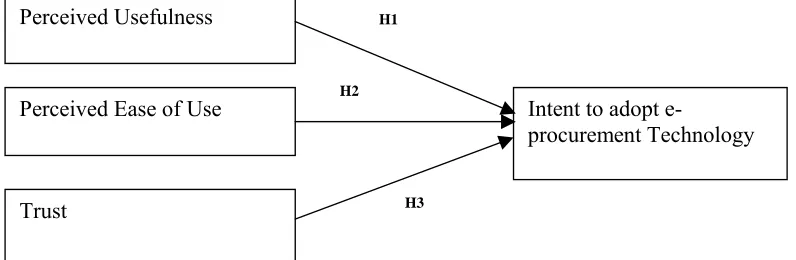
the intent to adopt e-procurement is in to determine the relationship between three independent variables; namely perceived usefulness, perceived ease of use, and trust.
3.2 Perceived Usefulness and Ease of Use of Public e-Procurement
Previous literature has identified major advantages of public e-procurement such as the reduction of paper work, less bureaucracy, online reporting, standardisation of procurement processes, clear and more transparent communication between government and citizens, minimisation of human error, user-friendliness, ease of access to public information, as well as greater efficiency and transparency (Ronchi et al., 2010; Teo et al., 2009). Other benefits include better relationships between government agencies and vendors, shorter order cycle, reduced inventory carrying cost, better information management, increased buyer productivity, reduction of administration costs and better pricing (Brun et al., 2010; Gunasekaran et al., 2009; Panayiotou et al., 2004). This study selected perceived usefulness and perceived ease of use independent constructs from the TAM model. These two independent variables influence users’ intentions to use public e-procurement services in government level. The hypotheses included:
H1: Higher levels of perceived ease of use will be positively related to the willingness to adopt anti-corruption technology (e-procurement)
H2: Higher levels of perceived usefulness will be positively related to the willingness to adopt anti-corruption technology (e-procurement)
3.3 Trust between Government and Bidders
Trust is an important key facilitator of e-commerce (Kartiwi, 2006). Trust builds a good atmosphere between government and bidders in the contracting process. The key measurement items of trust of public e-procurement are tracking and monitoring bidder’s information and documents, security of transactions, fairness in competition, and the user-friendly nature of the commercial environment. Hence, the following hypothesis summarises this relationship.
H3: Higher levels of perception of the potential of e-procurement to increase trust is positively related to the willingness to adopt.
Figure 1: Research Model of this Study
The general regression equation model is as follows:
A= β0+β1+β2+β3+ε
Where: A= Intent-to-adopt public e-procurement technology β1= Perceived usefulness
β2= Perceived Ease of Use β3= Trust
4. RESEARCH METHODOLOGY
The participants for this study were invited from seven Nepalese government departments including the Department of Road (DOR), Nepal Electric Authority, Department of Urban Development and Building construction, Department of Local Infrastructure Development of Agricultural Road, Roads Board Nepal, Public Procurement Monitoring office, and Ministry of Irrigation, Department of Water Induced Disaster Prevention. The main reason for selecting these organisations for this study was that they have already implemented, and are currently using public e-procurement systems, and are located in capital city of Nepal, Kathmandu. The departments’ names and addresses were gathered from the Government of Nepal directory (http://nepalgov.gov.np). Then the researcher took further steps to confirm that the participants were indeed implementing and using public e-procurement systems. It quickly turned out that the above-mentioned organisations were using a separate web portal for their procurement.
The Public Procurement Monitoring Office (PPMO) is a guiding body for procurement policy formulation, implementation, and monitoring procurement system in Nepal. The main mission of PPMO is to maintain transparency, accountability, effectiveness, efficiency, and as well as non-discrimination and equality in public procurement processes in Nepal. The PPMO installed (http://gepson.gov.np) as a single web portal system for all public entities of government procurement of Nepal. The PPMO has begun the process of creating a centralised web portal. Some of the government departments are also using the DOR web portal (http://eproc.dor.gov.np/) for procurement. DOR was the first organisation to introduce public e-procurement in Nepal. It was designed to facilitate the bidder to submit their bids through e-submission. Research participants included government officers who were involved in procurement and administration sections including Joint Secretary, Director, Senior Divisional Engineer, Computer Officer, IT Manager, and Training Officer. The study used a convenience sampling approach as determined by the level of interest shown by the
Perceived Usefulness
Perceived Ease of Use
Trust
Intent to adopt
e-procurement Technology H1
H2
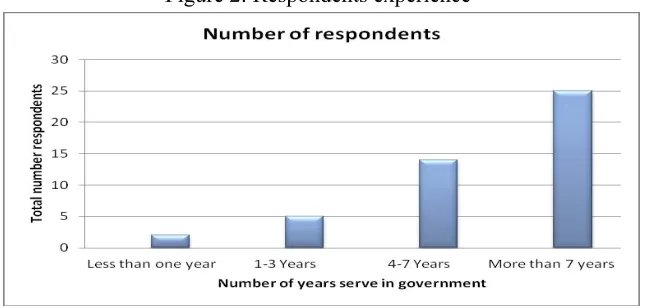
participants to respond to the survey and finally, 46 Government Officers from seven Government Departments were selected to complete a questionnaire field survey. The items used in the field survey are listed in Appendix A. Figure 2 shows the number of respondents working in various Government Departments. More than twenty-five respondents had more than seven years of experience in the field of public e-procurement.
Figure 2: Respondents experience
Survey research has several inherent strengths compared to other research methods because it measures a wide range of unobservable data such as peoples’ attitudes, beliefs, factual information and behaviours (Bhattacherjee, 2012, p. 73). In this research, data was collected through face-to-face field surveys. Firstly, the researcher discussed and asked questions of the participant about public e-procurement. Secondly, a questionnaire was conducted to collect the data related to the measuring of the perceived benefits of public e-procurement in the context of reducing corruption. This study evaluates several literary sources as key reference points for developing a survey instruments. This study includes three independent variables: namely perceived usefulness, perceived ease of use, and trust. Each construct has different scale measurement item, and those items were measured by asking the respondents perceptions on e-procurement benefits. All the variables are coded on a five-point Likert scale with authors ranging from “Strongly Agree” to “Strongly Disagree”. The dependent variable intent-to-adopt e-procurement was also measured through six items and coded on five-point Likert scale.
5. DATA ANALYSIS
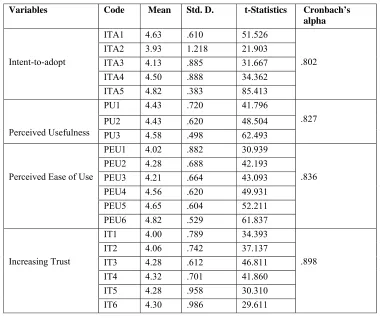
Table 1: Descriptive Statistics
The reliability test for examining the internal consistency within the constructs is represented by t-statistics and Cronbach’s alpha. Cronbach’s α was used to assess the reliability of the construct. As shown in Table 1, all of the Cronbach’s alpha values are above 0.7, which is an acceptable value. George and Mallery (2003, p. 231) providing the range of Cronbach’s alpha value “>.9-Excellent, >.8-Good, >.7-Acceptable, >.6-Questionnable, >.5-Poor”. Reliability, cross loading for all the constructs is illustrated in Appendix B.
[image:8.612.116.496.91.409.2]Content validity is an assessment of how well a set of scale items matches with the relevant content domain of the construct (Bhattacherjee, 2012). In this study, all the measurement scale items are adopted from previous studies and were modified for the context of this study. In addition, Table 2 shows the discriminant validity and the notation of Average Variance Extracted (AVE). Discriminant validity refers to a measurements ability to correlate or vary inversely with an accepted measure of the opposite construct. In Table 2 below, diagonal elements highlighted in bold (square root of AVE), are greater than the off-diagonal elements.
Table 2: Discriminant Validity (Squared Correlations < AVE
Variables AVE PU PEU Trust ITA
Perceived Usefulness (PU) 0.757 1
Perceived Ease of Use (PEU) 0.520 0.299 1
Increasing Trust (IT) 0.672 0.037 0.364 1
Intent-to-adopt e-proc (ITA) 0.555 0.224 0.464 0.196 1
Diagonal element (in bold) are the square root of Average Extracted (AVE) Variables Code Mean Std. D. t-Statistics Cronbach’s
alpha
ITA1 4.63 .610 51.526
ITA2 3.93 1.218 21.903
ITA3 4.13 .885 31.667
ITA4 4.50 .888 34.362
Intent-to-adopt
ITA5 4.82 .383 85.413
.802
PU1 4.43 .720 41.796
PU2 4.43 .620 48.504
Perceived Usefulness PU3 4.58 .498 62.493 .827
PEU1 4.02 .882 30.939
PEU2 4.28 .688 42.193
PEU3 4.21 .664 43.093
PEU4 4.56 .620 49.931
PEU5 4.65 .604 52.211
Perceived Ease of Use
PEU6 4.82 .529 61.837
.836
IT1 4.00 .789 34.393
IT2 4.06 .742 37.137
IT3 4.28 .612 46.811
IT4 4.32 .701 41.860
IT5 4.28 .958 30.310
Increasing Trust
IT6 4.30 .986 29.611
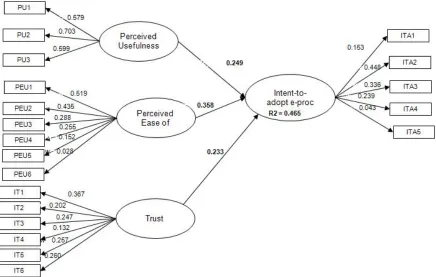
Appendix C examines the Pearson Correlation matrix of the dependent and independent variables. Figure 3 shows the test of structural model was performed using PLS graphs.
Figure 3: PLS Structural Equation Model
[image:9.612.89.525.511.575.2]Table 3 shows the R squared value of the statistical model result. A R2 of 0.465 can be considered as a good value. The equation model explained that 46.5 % of the variation in intent-to-adopt public e-procurement is explained by independent variables.
Table 3: R2 (Intent to Adopt e-Procurement) R² F Pr>F R²
(Bootstrap)
Standard errors
Critical ratio (CR)
Lower bound (95%)
Upper bound (95%)
0.465 13.090 0.000 0.501 0.085 5.452 0.334 0.685
Table 4: Path Coefficient (Intent to adopt e-procurement)
Hypothesis Path coefficient value t-value Pr>|t| Supported?
H1: Perceived Usefulness 0.252 1.183 0.243 Yes H2: Perceived Ease of Use 0.364 3.262 0.002 Yes
H3: Increasing Trust 0.242 0.590 0.558 Yes
6. DISCUSSION
The goal of this paper was to explain the perceived benefits of public e-procurement in a developing country with a specific interest in reducing corruption. The result indicates that the potential public e-procurement benefits include usefulness, ease of use, and increasing trust between government and bidders and are seen to have the potential for lowering the level of corruption. In data analysis, the use of multiple models, like mean, standard deviation, t-statistics, Cronbach’s alpha, and PLS regression attempted to isolate the effects of intent-to-adopt e-procurement on corruption in public procurement by the effects of perceived usefulness, ease of use, and trust.
The explanatory variable, the intent to adopt e-procurement, is found to be significant in reducing corruption in public procurement. Previous studies support the finding that the implementation of public e-procurement enhances transparency, efficiency, and accountability in public procurement process. Therefore, the adoption of new technology that is driving the economic growth of the country is also lowering the risk of misuse of public office for private gain. The empirical results also indicate that positive attitudes relating to the adoption of e-procurement can help prevent fraud in public procurement processes.
Previous literature has suggested that e-procurement helps increase organisational efficiency and quality (Gunasekaran et al., 2009). This study was concerned about the perceived benefits of public e-procurement as perceived usefulness and perceived ease of use. This study relates these perceived factors to anti-corruption factors of public e-procurement, which can help governments to lower the procurement corruption. The statistical results reveal that a positive relationship exists between usefulness and level of intent-to-adopt e-procurement.
7. CONCLUSION
The TAM is a well-developed theoretical model in the field of information system research. Particularly, TAM models helps to understand and uses of perceptions of technology. Similarly, Principal-Agent theory is an economic theory used to explain economic behavioural subsets within organisational behaviour studies. However, in the context of IS research, it provides the opportunity to access the impact of technology performance in between two actors: the Principal and the Agent. The main contribution made by using this theory in this study is to evaluate the public e-procurement benefits in relation between government and bidders including transparent transaction processes like tracing and monitoring, user-friendliness, security of transactions, fairness of competition, and overall reduction of corruption within public procurement. In fact, Agency Theory can be a good theory with which to evaluate the technology benefits of organisation in order to reduce information asymmetry problems, monopoly on power, moral hazards, and to increase trust between two parties.
This study investigated the perceived benefits of public e-procurement in reducing corruption in public procurement processes. Technology was perceived to be a powerful anti-corruption tool that promotes numerous other benefits. Therefore, our objective was to identify the most important anti-corruption factors that affected the perceptions of public e-procurement technology for reducing corruption in government e-procurement.
In this research, there are several limitations, which should be taken into consideration. The main limitation of this study was the limited number of respondents used in the study sample and the limited number of public e-procurement respondents in Government Departments in Nepal - this study only employs 46 respondents. This number was limited due to the relatively small number of government officers who were aware of public e-procurement systems in Nepal. Thus, future research could expand the work done in this study to capture more responses and to widen the scope of the study of public e-procurement within the Nepalese Government. Additional research could also add more variables and employ rigorous research methodologies such as focus group discussions, as well as personal interviews about the anti-corruption capabilities of public e-procurement systems.
8. REFERENCES
Alam, S.S., Noor, M. and Kamal, M. (2009) ICT Adoption in Small and Medium Enterprises: an Empirical Evidence of Service Sectors in Malaysia, International Journal of Business and Management, 4, 2, 112-125
Al-Moalla, A. and Li, D. (2010) Organisational Issues with Electronic Government Procurement: A Case Study of the UAE', The Electronic Journal on Information Systems in Developing Countries, 41, 3, 1-18.
Alsaghier, H., Ford, M., Nguyen, A. and Hexel, R. (2009) Conceptualising Citizen’s Trust in e-Government: Application of Q Methodology, Electronic Journal of E-government, 7, 4, 295-310
Andersen, T.B. (2008) E-Government as an Anti-Ccorruption Tool, Department of Economics, University of Copenhagen, Denmark.
Asian Development Bank (2007) Fighting Corruption in Afghanistan: A Roadmap for Strategy and Action, http://www.unodc.org/pdf/afg/anti_corruption_roadmap.pdf Bacharach, S.B. (1989) Organizational Theories: Some Criteria for Evaluation, Academy of
Basant, R., Commander, S., Harrison, R. and Menezes-Filho, N. (2006) ICT Adoption and Productivity in Developing Countries: New Firm Level Evidence from Brazil and India, IZA Discussion Paper No. 2294.
Bélanger, F. and Carter, L. (2008) Trust and Risk in E-government Adoption, The Journal of Strategic Information Systems, 17, 2, 165-176.
Bertot, J.C., Jaeger, P.T. and Grimes, J.M. (2010) Crowd-sourcing Transparency: ICTs, Social Media, and Government Transparency Initiatives, Proceedings of the 11th Annual International Conference on Digital Government Research.
Bhattacherjee, A. (2012) Social Science Research: Principles, Methods, and Practices, 2nd edition, Open Access Textbooks, http://scholarcommons.usf.edu/oa_textbooks/3/.
Bhattari, P. (2012a) Progress on Graft, Rupablica 6 March.
Bhattari, P. (2012b) Corruption in Security Sector, Rupablica, 15 April.
Braund, P., Frauscher, K., Schwittay, A. and Petkoski, D. (2007) Information and Communications Technology for Economic Development Exploring Possibilities for Multi-sector Technology Collaborations, Global E-Discussion, The World Bank. Brun, A., Ronchi, S., Fan, X. and Golini, R. (2010) What is the Value of an IT
E-Procurement System?, Journal of Purchasing and Supply Management, 16, 131-140. Carter, L. and Bélanger, F. (2005) The Utilization of E-Government Services: Citizen Trust,
Innovation and Acceptance Factors, Information Systems Journal, 15, 1, 5-25. Chan, J.K.Y. and Lee, M.K.O. (2003) SME E-procurement Adoption in Hong Kong - The
Roles of Power, Trust and Value, Proceedings of the 36th Hawaii International Conference on System Sciences.
Chang, H.H. and Wong, K.H. (2010) Adoption of procurement and Participation of E-marketplace on Firm Performance: Trust as a Moderator, Information & Management, 47, 5, 262-270.
Cheng, T, Lam, D.Y.C. and Yeung, A.C.L. (2006) Adoption of Internet Banking: An Empirical Study in Hong Kong, Decision Support Systems,42, 3, 1558-1572.
Cordella, A. (2005) The Role of Information and Communication Technology in Building Trust in Governance: Towards Effectiveness and Results, in: Vitro, R (ed.) Inter-American Development Bank, Washington, D.C.
Credé, A., Mansell, R. and Mansell, R.E. (1998) Knowledge Societies in a Nutshell: Information Technology for Sustainable Development, IDRC, Ottawa, Canada.
Davis, F.D. (1989) Perceived Usefulness, Perceived Ease of Use, and User Acceptance of Information Technology, MIS Quarterly, 13, 3, 319-340.
Davis, F.D., Bagozzi, R.P. and Warshaw, P.R. (1989) User Acceptance of Computer Technology: A Comparison of Two Theoretical Models, Management Science, 35, 8, 982-1003.
Del Monte, A. and Papagni, E. (2007) The Determinants of Corruption in Italy: Regional Panel Data Analysis, European Journal of Political Economy, 23, 2, 379-396.
Eisenhardt, K. (1989) Agency Theory: An Assessment and Review, Academy of Management Review, 14, 1, 57-74.
Flynn, B.B., Huo, B. and Zhao, X. (2010) The Impact of Supply Chain Integration on Performance: A Contingency and Configuration Approach, Journal of Operations Management, 28, 1, 58-71.
George, D. and Mallery, P. (2003) SPSS for Windows Step by Step: A Simple Guide and Reference, 11.0 Update, Boston, MA: Allyn & Bacon.
Gunasekaran, A., McGaughey, R.E., Ngai, E.W.T. & Rai, B.K. (2009) E-Procurement Adoption in the Southcoast SMEs, International Journal of Production Economics, 122, 1, 161-75.
Henriksen, H. and Andersen, K. (2003) e-Procurement Adoption: Theory and Practice, in Goos, J.H.G. and Leeuwen, J. van (Eds.), Lecture Notes in Computer Science: Electronic Government, 2739, Springer Berlin, 121-124.
Iqbal, M. and Seo, J. (2008) E-governance as an Anti Corruption Tool: Korean Cases, Journal ofKorean Association for Regional Information Society, 11, 2, 51-78.
Jensen, M.C. and Meckling, W.H. (1976) Theory of the Firm: Managerial Behavior, Agency Costs and Ownership Structure, Journal of Financial Economics, 3, 4, 305-360.
Joongi, K. (2006) National Integrity Systems: Transparency International Country Study Report: Republic of Korea, Transparency International Secretariat, Berlin, Germany. Kartiwi, M. (2006) Customer Characteristics Influence on Online Trust in Developing
Countries: An Examination of Confidence Level, 6th International Business Information Management Association (IBIMA) Conference, Bonn, 19-21 June.
Kolstad, I. and Wiig, A. (2009) Is Transparency the Key to Reducing Corruption in Resource-Rich Countries?, World Development, 37, 3, 521-32.
Kumar, V., Mukerji, B., Butt, I. and Persaud, A. (2007) Factors for Successful E-government Adoption: A Conceptual Framework, The Electronic Journal of e-Government, 5, 1, 63–76.
Lai, V.S. and Li, H. (2005) Technology Acceptance Model for Internet Banking: An Invariance Analysis, Information & Management, 42, 2, 373-386.
Lambsdorff, J. (2001) How Corruption in Government Affects Public Welfare: A Review of Theories, Zentrum für Globalisierung und Europäisierung der Wirtschaft, Georg-August-Univ.
Li, Y.H. and Huang, J.W. (2009) Applying Theory of Perceived Risk and Technology Acceptance Model in the Online Shopping Channel, World Academy of Science, Engineering and Technology, 53, 919-925.
McKnight, D.H., Choudhury, V. and Kacmar, C. (2002) Developing and Validating Trust Measures for E-commerce: An Integrative Typology, Information Systems Research, 13, 3, 334-359.
Neupane, A., Soar, J. and Vaidya, K. (2012) Perceived Benefits Related to Anti-Corruption from e-Tendering System in Nepal, Asian Journal of Information Technology, 11, 1, 22-29.
Olken, B.A. (2007) The Problem of Corruption, Boston Review, March/April.
Panayiotou, N.A., Gayialis, S.P. and Tatsiopoulos, I.P.I.P. (2004) An E-procurement System for Governmental Purchasing, International Journal of Production Economics, 90, 1, 79-102.
Pellegrini, L. and Gerlagh, R. (2008) Causes of Corruption: A Survey of Cross-country Analyses and Extended Results, Economics of Governance, 9, 3, 245-263.
Rogers, E.M. (1995) Diffusion of Innovations, Free Press, New York.
E-Rosipal, R. and Krämer, N. (2006) Overview and Recent Advances in Partial Least Squares, Lecture Notes in Computer Science, 3940: Subspace, Latent Structure and Feature Selection, 3940, 34-51.
Singh, G., Pathak, R., Naz, R. and Belwal, R. (2010) E-governance for Improved Public Sector Service Delivery in India, Ethiopia and Fiji, International Journal of Public Sector Management, 23, 3, 254-275.
Subedi, M.S. (2006) Corruption In Nepal: An Anthropological Inquiry, Dhaulagiri Journal of Sociology and Anthropology, 1, 110-128.
Teo, T.S.H., Lin, S.J. and Lai, K.H. (2009) Adopters and Non-adopters of E-procurement in Singapore: An Empirical Study, Omega, 37, 5, 972-987.
Treisman, D. (1999) The Causes of Corruption: A Cross-national Study, Journal of Public Economics, 76, 399-457.
Vaidya, K. and Hyde, M. (2011) Inter-organisational Information Systems Assimilation: An Empirical Evaluation in Light of the Diffusion of Innovation Theory, International Journal of Business Information Systems, 7, 3, 247-268.
Vaidya, K. (2007) Electronic Procurement in the Australian Public Sector: The Organizational Assimilation Process and Its Impact on Public Procurement Performance, University of New England.
Wen, W. and Wei, L. (2007) Decision-making Analysis of E-procurement with the Rough Set Theory, International Conference on Wireless Communications, Networking and Mobile Computing, Shanghai, 21-25 September.
World Bank (2004) The Cost of Corruption, World Bank News & Broadcast, Washington, DC, USA. http://web.worldbank.org/WBSITE/EXTERNAL/NEWS/
0,,contentMDK:20035595~menuPK:36691~pagePK:116743~piPK:36693~theSitePK:4607,00.html World Bank Institute (2004) The Cost of Corruption, World Bank News and Broadcast.
http://web.worldbank.org/WBSITE/EXTERNAL/NEWS/0,contentMDK:20190187~menuPK:34457~p agePK:34370~piPK:34424~theSitePK:4607,00.html
World Economic Forum (2010) Global Agenda Council on Anti-corruption 2010. http://www.weforum.org/content/global-agenda-council-anti-corruption-2010. Wu, I.L. Chen, J.L. (2005) An Extension of Trust and TAM Model with TPB in the Initial
Adoption of On-line Tax: An Empirical Study, International Journal of Human-Computer Studies, 62, 6, 784-808.
APPENDIX A
Questionnaire: A five point Likert scales was used to measure the perception of the
government officers about the perceived benefits of public e-procurement technology to reduce corruption in public procurement.
Perceived Usefulness through e-procurement technology
PU1 E-procurement technology would enable our department to accomplish our procurement task faster than a manual system.
PU2 It improves our tendering process environment.
PU3: Overall, I find the e-procurement technology useful in my job.
(Source: (Alsaghier et al. 2009; Cheng,Lam & Yeung 2006; Davis 1989; Gefen et al. 2003; Lai & Li 2005; Wu & Chen 2005)
Perceived ease of Use through e-procurement technology
PEU1: E-procurement technology provides our department to handle all procurement task use-friendly environment for publishing tender / bid information.
PEU2: It is an easy to use of public tendering and contracting practices. PEU3: It is an ease for our organization to learn to use e-procurement services. PEU4: It is an ease system to publish all the procurement information.
PEU5: Interested bidders can register with essential information through e-submission at any time anywhere.
PEU6: All bidders can directly download the entire tendering document through our e-procurement web portal.
(Source: (Alsaghier et al. 2009; Cheng et al. 2006; Davis 1989; Gefen et al. 2003; Lai & Li 2005; Wu & Chen 2005)
Increasing Trust through e-procurement technology
IT1: E-procurement technology contributes us to track and monitor the entire bidder’s information and document that can increase trust between bidders and government departments.
IT2: It can help to build trust between governments and bidders (e.g. good governance). IT3: It contributes us the security of transaction in government contracting process that can
increase level of trust.
IT4: It provides the fair competition among bidders in public tendering that can increase a level of trust.
IT5: It provides a user-friendly environment among bidders in public tendering process that can also increase level of trust.
IT6: Overall, increasing trust between government and bidders helps to reduce the chances of corruption in public procurement.
Intent to adopt anti-corruption technology (e-procurement)
ITA1: Our organization would like to intent-to-adopt e-procurement system for our organization needs.
ITA2: E-procurement helps our organization to coordinate with other bidders partners for government work and services.
ITA3: Our organization adopts e-procurement system to enhance procurement efficiency and for better decision making in government work and services.
ITA4: Our organizations adopt e-procurement system to avoid the human interference in public tendering process.
ITA5: Overall, our organization intent to adopt e-procurement system to increase transparency, for non-discrimination, equality of access, and open competition in government work and services.
(Source: (Alsaghier et al. 2009; Cheng et al. 2006; Lai & Li 2005; Wu & Chen 2005)
APPENDIX B: Cross loading table
Variables
Perceived Usefulness
Perceived Ease of
Use Trust
Intent-to-adopt e-procurement
PU1 0.889 0.389 0.064 0.321
PU2 0.847 0.474 0.198 0.452
PU3 0.874 0.598 0.266 0.479
PEU1 0.582 0.937 0.689 0.636
PEU2 0.586 0.880 0.434 0.683
PEU3 0.491 0.890 0.407 0.469
PEU4 0.024 0.540 0.200 0.444
PEU5 0.073 0.505 0.506 0.272
PEU6 0.039 0.353 0.127 0.058
IT1 0.252 0.737 0.938 0.531
IT2 0.273 0.673 0.706 0.310
IT3 0.125 0.497 0.781 0.454
IT4 -0.016 0.369 0.743 0.214
IT5 0.087 0.326 0.845 0.306
IT6 0.152 0.382 0.880 0.301
ITA1 0.552 0.597 -0.136 0.405
ITA2 0.378 0.614 0.490 0.960
ITA3 0.315 0.650 0.568 0.869
ITA4 0.565 0.431 0.091 0.810
Variables PU1 PU2 PU3 PEU1 PEU2 PEU3 PEU4 PEU5 PEU6 IT1 IT2 IT3 IT4 IT5 IT6 ITA1 ITA2 ITA3 ITA4 ITA5
PU1 1
PU2 0.563 1
PU3 0.761 0.595 1
PEU1 0.370 0.551 0.628 1
PEU2 0.509 0.487 0.543 0.832 1
PEU3 0.403 0.413 0.480 0.751 0.738 1
PEU4 -0.065 -0.018 0.197 0.302 0.294 0.505 1
PEU5 -0.002 -0.003 0.250 0.390 0.135 0.525 0.536 1
PEU6 0.028 -0.035 0.143 0.199 0.016 0.426 0.645 0.640 1
IT1 0.117 0.273 0.283 0.767 0.573 0.594 0.318 0.513 0.213 1
IT2 0.237 0.227 0.255 0.677 0.659 0.557 0.256 0.200 0.030 0.759 1
IT3 -0.032 0.251 0.099 0.557 0.381 0.279 0.326 0.209 0.221 0.772 0.634 1
IT4 -0.111 -0.027 0.140 0.384 0.265 0.131 0.333 0.379 0.096 0.643 0.556 0.601 1
IT5 0.011 0.050 0.204 0.413 0.146 0.181 0.024 0.596 0.011 0.676 0.380 0.423 0.621 1
IT6 0.029 0.142 0.262 0.555 0.198 0.202 -0.070 0.443 0.061 0.743 0.367 0.583 0.529 0.871 1
ITA1 0.628 0.317 0.511 0.470 0.731 0.642 0.271 -0.055 0.141 0.046 0.349 -0.070 -0.232 -0.350 -0.326 1
ITA2 0.185 0.421 0.394 0.622 0.579 0.375 0.373 0.270 0.051 0.555 0.250 0.525 0.208 0.359 0.405 0.236 1
ITA3 0.258 0.218 0.377 0.566 0.668 0.480 0.430 0.336 0.002 0.637 0.460 0.417 0.432 0.480 0.361 0.339 0.771 1
ITA4 0.382 0.605 0.477 0.383 0.454 0.264 0.363 0.124 0.047 0.159 0.017 0.222 -0.018 0.013 0.025 0.349 0.729 0.537 1
ITA5 0.200 -0.049 0.198 0.209 0.275 0.327 0.610 0.213 0.395 0.074 0.041 0.211 -0.115 -0.166 -0.151 0.480 0.499 0.331 0.457 1