Statistical Notice
Statistical Policy Statement on Statistical Quality:
Principles and Procedures
Principle 4 Practice 4 of the Code of Practice for Official Statistics requires producers of Official Statistics to publish quality guidelines for their official statistics. The Code is at:
www.statisticsauthority.gov.uk/assessment/code-of-practice/index.html
Version number
Date Details
1 March 2010 First edition
1.1 November 2010 Amended references to Department for Children, Schools and Families, to Department for Education
1.2 June 2011 Updated Head of Profession
2 Statistical Policy Statement on Statistical Quality: Principles and Procedures
Principles
Statistical quality in the Department for Education (the Department) is defined as meeting users’ needs with particular reference to the six quality dimensions:
relevance;
accuracy;
timeliness and punctuality;
accessibility and clarity;
comparability; and,
coherence
… of the statistics collected, analysed and reported.
The following principles underpin the delivery of statistical quality in the Department:
Users are identified and we engage with them in a spirit of consultation and responsiveness, and their needs prioritised and met within available resources.
Suppliers are respected and dealt with ethically, legally and effectively.
Methodologies, processes and practices are documented to the correct level of detail for their purpose, kept up to date and made available where appropriate.
Statistical processes and outputs are monitored and measured against standards with a view to their maintenance and improvement.
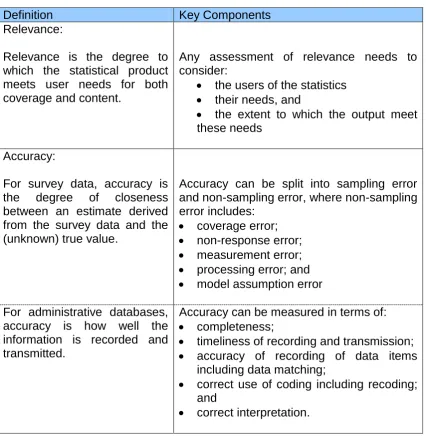
Table 1:
Statistical Quality Dimensions: Definitions and Key Components
Definition Key Components
Relevance:
Relevance is the degree to which the statistical product meets user needs for both coverage and content.
Any assessment of relevance needs to consider:
the users of the statistics
their needs, and
the extent to which the output meet these needs
Accuracy:
For survey data, accuracy is the degree of closeness between an estimate derived from the survey data and the (unknown) true value.
Accuracy can be split into sampling error and non-sampling error, where non-sampling error includes:
coverage error;
non-response error;
measurement error;
processing error; and
model assumption error
For administrative databases, accuracy is how well the information is recorded and transmitted.
Accuracy can be measured in terms of:
completeness;
timeliness of recording and transmission;
accuracy of recording of data items including data matching;
correct use of coding including recoding; and
4 Timeliness and Punctuality
Timeliness is related to the time elapsed from the period to which the statistics relate to the date of release of the statistics. For example, if the statistics relate to the financial year 2008-09 and they are released in January 2010 then the elapsed time is ten months. The timeliness could be improved by one month if the statistics for the financial year 2009-10 could be released in December 2010. Punctuality is elapsed time between the actual and planned (and published) time and date of release.
An assessment of timeliness and punctuality should consider the following:
production time;
frequency of release; and
punctuality of release
Accessibility and Clarity
Accessibility is the ease with which users are able to access the data. It also relates to the format in which the data are available and the availability of supporting information. Clarity refers to the quality and sufficiency of the metadata, illustrations and accompanying advice.
Specific areas where accessibility and clarity may be addressed include:
needs of expert and non expert users;
consistency of standard in relation to revisions, rounding, data suppression and spreadsheet type;
assistance to locate information;
Comparability
Comparability is the degree to which data can be compared over time and domain.
Comparability should be addressed in terms of comparability over:
time;
spatial domains e.g. sub-national, national, international; and
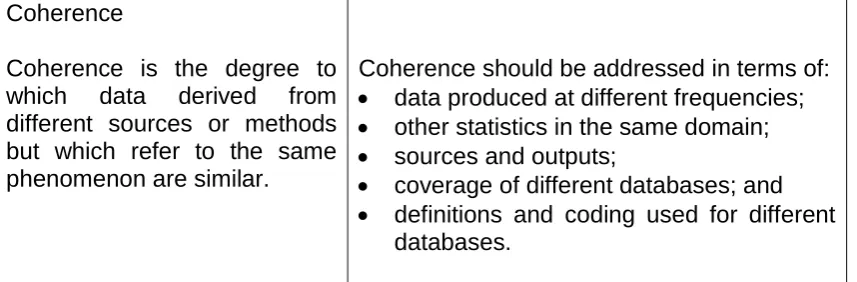
Coherence
Coherence is the degree to which data derived from different sources or methods but which refer to the same phenomenon are similar.
Coherence should be addressed in terms of:
data produced at different frequencies;
other statistics in the same domain;
sources and outputs;
coverage of different databases; and
definitions and coding used for different databases.
Procedures to deliver quality
[image:5.595.87.516.73.214.2]To put the quality principles into practice, reference should be made to the Department’s statistical policy notices identified in Table 2 below (as well as more specific information contained in the Department’s statistical releases) which overlap with and reinforce particular aspects of delivering statistical quality.
Table 2:
Delivering quality statistics
Quality Dimension Users should expect that:
Relevance they will be appropriately consulted about quality principles and procedures in line with the Department’s Statistical Policy Statement on Meeting User Needs through Engagement with Users.
Accuracy statistical releases will contain a description of data quality issues relating to the release; and any impact that has on analysis of changes over time or comparisons between different groups will be transparent to a lay and expert audience;
6 Timeliness and
Punctuality
release dates for statistical releases will be announced in advance in accordance with the code of practice for official statistics;
statistical releases based on either provisional or revised (final) data will be released as soon as possible after the relevant time period (subject to the coherence below);
statistical releases will be produced and released in line with the Department’s policy statement on meeting user needs through engagement with users. Accessibility and
Clarity
statistical releases and other information posted on the Department’s Research and Statistics Gateway will comply with the Department’s Internet Accessibility policies.
all publications will use plain English wherever possible.
Comparability we will use harmonised concepts and definitions in statistical releases wherever these are available.
any statistical release which does not use harmonised definitions will clearly explain why the harmonised definition has not been used and any plans to move to harmonised definitions.
Coherence we will release related statistical releases at the same time and on the same day to aid user understanding unless this requires significant delay to the release of one or more of the statistical releases.
where related statistics are released across more than one release, we will make it clear to users where the related statistics can be located.
Monitoring and Reporting
The annual report from the Head of Profession for Statistics to the National Statistician will provide information on the quality of our statistical releases and outputs, including the timeliness and punctuality of our statistical releases, and any unplanned revisions to our releases.
Jude Hillary