Copyright © 2004, American Society for Microbiology. All Rights Reserved.
Model Suggesting that Replication of Influenza Virus Is Regulated by
Stabilization of Replicative Intermediates†
Frank T. Vreede, Tanis E. Jung, and George G. Brownlee*
Sir William Dunn School of Pathology, University of Oxford, Oxford, United Kingdom
Received 10 March 2004/Accepted 26 April 2004
The RNA-dependent RNA polymerase of influenza A virus is responsible for both transcription and repli-cation of negative-sense viral RNA. It is thought that a “switching” mechanism regulates the transition between these activities. We demonstrate that, in the presence of preexisting viral RNA polymerase and nucleoprotein (NP), influenza A virus synthesizes both mRNA (transcription) and cRNA (replication) early in infection. We suggest that there may be no switch regulating the initiation of RNA synthesis and present a model suggesting that nascent cRNA is degraded by host cell nucleases unless it is stabilized by newly synthesized viral RNA polymerase and NP.
As in all negative-sense RNA viruses, the viral genomic RNA (vRNA) of influenza A virus is complexed with an RNA-dependent RNA polymerase (comprising PB1, PB2, and PA subunits) and nucleoprotein (NP) into active viral ribonucleo-protein (vRNP), which serves as a template for both transcrip-tion and replicatranscrip-tion (19). Whereas mRNA transcriptranscrip-tion re-quires capped RNA primers snatched from host pre-mRNA and premature poly(A) termination of transcripts, genome replication is primer independent and generates full-length cRNA. cRNA subsequently serves as the template for synthesis of progeny vRNA. Early studies (2, 13, 14, 30) suggested that replication requires de novo protein synthesis, and it was pro-posed that a “switch” regulates the transition from transcrip-tion to replicatranscrip-tion, but the molecular mechanism for such a switch has remained elusive despite more than two decades of research.
We approached an investigation of this switch in influenza A virus-infected cell cultures by inhibiting the transition from mRNA transcription to RNA replication with cycloheximide (2, 14, 30), an inhibitor of protein synthesis. We confirmed the
inhibitory effect of 100 g of cycloheximide/ml on influenza
A/WSN/33 replication in human transformed kidney (293T) cells. Total RNA was isolated by TRIzol (Invitrogen) extrac-tion from 293T cells at various time points after infecextrac-tion with influenza virus A/WSN/33 at a multiplicity of infection (MOI) of 5 in the presence or absence of cycloheximide. The RNA was analyzed by primer extension analysis (8) by using two
32P-labeled primers, one specific for neuraminidase (NA)
mRNA and cRNA and the other specific for NA vRNA, gen-erating cDNA with an expected size of 129 nucleotides from vRNA, 160 nucleotides from cRNA, and 169 to 177 nucleo-tides from mRNA depending on the length of the capped primer (Fig. 1A). Transcription of mRNA from vRNA and replication of vRNA through cRNA intermediates in infected
293T cells in the absence of cycloheximide is clearly demon-strated (Fig. 1A, left panel). RNA detected at zero hours postinfection represents RNA derived from the infecting virus particles. However, whereas vRNA derived from the infecting
virus particle is transcribed to mRNA in the presence of 100g
of cycloheximide/ml, only minimal cRNA synthesis was de-tected at 6 h postinfection (Fig. 1A, middle and right panels). In addition, the vRNA signal remained constant throughout, representing input vRNA derived from the infecting virus par-ticles. Therefore, synthesis of cRNA and replication of vRNA
is severely inhibited in the presence of 100 g of
cyclohexi-mide/ml.
We then investigated whether the switch to cRNA synthesis could be rescued by expressing viral PB1, PB2, PA, and NP in the cells prior to cycloheximide treatment and infection. In order to avoid transcription and replication of viral RNA driven by these expressed proteins, a double mutant in the conserved SDD motif of the active site of the RNA polymerase PB1 subunit (PB1-D445A/D446A [PB1a]) (5) was constructed by site-directed mutagenesis. As expected, PB1a, PB2, and PA expressed from recombinant plasmids in vivo was negative for RNA polymerase activity (i.e., no cRNA or mRNA synthesized above background) on an NA vRNA-like template derived from cotransfected pPOLI-NA-RT (9) (Fig. 2, compare lanes 1 to 3). These data were further confirmed by an in vivo chloramphenicol acetyltransferase (CAT) reporter assay (see Fig. S1 in the supplemental material). 293T cells were then transfected with plasmids expressing PB2, PA, NP, and either PB1a or empty plasmid vector, followed 12 to 14 h later by infection with influenza virus A/WSN/33 at an MOI of 5 in the
presence of 100g of cycloheximide/ml. Viral RNA species at
various time points postinfection were analyzed by primer ex-tension as before. Surprisingly, cRNA was detected, but only in the presence of PB1a, whereas mRNA and vRNA levels were essentially the same in the presence or absence of PB1a (Fig. 1B). Identical results were obtained with nonstructural protein 1 (NS1) gene-specific primers (see Fig. S2 in the supplemental material). Therefore, despite the cycloheximide-mediated in-hibition of viral replication, viral cRNA synthesis was evident if viral polymerase and NP were present.
As a control to demonstrate that the rescued cRNA signal
* Corresponding author. Mailing address: Sir William Dunn School of Pathology, University of Oxford, Oxford, United Kingdom. Phone: 44-1865-275559. Fax: 44-1865-275556. E-mail: george.brownlee@path .ox.ac.uk.
† Supplemental material for this article may be found at http: //jvi.asm.org/.
9568
on November 8, 2019 by guest
http://jvi.asm.org/
does not derive from “decapped” mRNA, we investigated whether the cRNA could be rescued by influenza virus poly-merase containing a previously described cap binding mutant of the PB2 subunit (7) (PB2-F404A [PB2c]). The replication-positive but transcription-negative phenotype of polymerase containing PB2c was confirmed on a polymerase I-transcribed vRNA template by an in vivo RNA synthesis assay as described above (Fig. 2, compare lanes 2 and 6). However, expression of
polymerase containing PA, PB1a, and wild-type or mutant PB2, together with NP, prior to infection yielded identical cRNA signals in primer extension analyses (Fig. 1C, compare lanes 2 and 3) demonstrating that, as expected, rescue of cRNA was independent of the cap binding activity of the pre-expressed RNA polymerase.
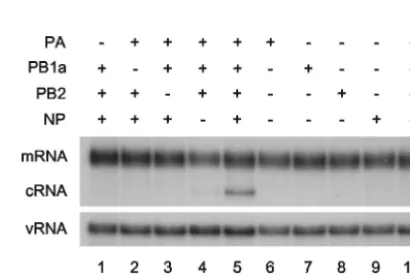
[image:2.603.319.524.513.651.2]The determinants of the switch to cRNA synthesis were analyzed in more detail by replacing individual viral protein-expression plasmids in the transfection mixture with empty plasmid vector or by transfecting the plasmids separately. Ex-pression of proteins (PB1a, PB2, PA, and NP) from transfected plasmids was confirmed by Western blot analyses (see, for example, Fig. S5 in the supplemental material). Omission of any one of the three polymerase subunits (PB1a, PB2, or PA) resulted in elimination of the cRNA signal (Fig. 3, compare lanes 1 to 3 with lane 5). However, in the absence of NP (lane 4), the cRNA signal was reduced but nevertheless remained clearly detectable (on a longer exposure) above background (lane 10). It follows that expression of any individual protein
FIG. 1. Cycloheximide-mediated inhibition of influenza virus A/WSN/33 cRNA synthesis can be rescued by the expression of PB1, PB2, PA, and NP. Viral RNA species were analyzed by NA gene-specific primer extension assays. mRNA is a broad heterogeneous band 9 to 17 nucleotides longer than cRNA due to its 5⬘cap-snatched sequence. (A) Time course of viral infection in the absence (⫺) or presence (⫹) of 100g of cycloheximide (CHX)/ml. The left-hand and middle panels are equally exposed, with a longer exposure of the middle panel at right showing minor breakthrough of cycloheximide inhibition of cRNA synthesis at 6 h postinfection. (B) Time course of viral infection in the presence of 100g of cycloheximide/ml after prior (12 to 14 h) transfection of expression plasmids expressing viral pro-teins as indicated. (C) cRNA rescue with a cap binding mutant of PB2. 293T cells were transfected with plasmids expressing viral proteins (⫹) or empty plasmid vector (⫺), as indicated, 12 to 14 h prior to infection by A/WSN/33 virus in the presence of 100 g of cycloheximide/ml. RNA was harvested at 2 h postinfection. PB1a, PB1-D445A/D446A; PB2c, PB2-F404A; wt, wild type; h pi, hours postinfection.
FIG. 2. Analysis of the in vivo RNA synthesis activity of polymerase mutants used in the study. Plasmids expressing viral proteins (⫹) or empty plasmid vector (⫺), as indicated, were transfected into 293T cells together with a plasmid (pPOLI-NA-RT) (9) directing polymer-ase I-driven transcription of NA vRNA as a template for RNA syn-thesis. Total RNA was isolated at 15 h posttransfection and analyzed by NA gene-specific primer extension. vRNA detected in the absence of PB1 (lane 1) represents polymerase I-derived template RNA. wt, wild type; PB1a, D445A/D446A; PB1r, Y559A; PB1ar, PB1-D445A/D446A/Y559A; PB2c, PB2-F404A.
FIG. 3. RNA polymerase and NP are essential for rescuing cRNA. 293T cells were transfected with plasmids expressing viral proteins (⫹) or empty plasmid vector (⫺), as indicated, 12 to 14 h prior to infection with A/WSN/33 virus in the presence of 100g of cycloheximide/ml. RNA was harvested at 2 h postinfection and the viral RNA species were analyzed by NA gene-specific primer extension assays. A longer exposure of the cRNA-specific bands is shown below to emphasise the detection of cRNA in lane 4. PB1a, PB1-D445A/D446A.
on November 8, 2019 by guest
http://jvi.asm.org/
component alone (lanes 6 to 9) would yield no detectable cRNA signal. Overall, therefore, these data suggest that the polymerase, comprising subunits PB1, PB2, and PA, is neces-sary and sufficient for switching to cRNA synthesis, but it is strongly reinforced by NP. However, NP alone is insufficient for switching.
The dose dependence and stoichiometry of the polymer-ase-NP complex required to rescue cRNA was investigated by titrating the amount of polymerase and/or NP-expressing plas-mids in the transfections. The effect of increasing plasmid transfection levels on protein expression 12 to 14 h posttrans-fection could be confirmed by Western blotting (see, for ex-ample, Fig. S5 in the supplemental material). Altering the transfection levels of plasmids expressing the polymerase sub-units by 0.5- to 3-fold over that used in Fig. 3 had no significant effect on cRNA signals (see Fig. S3A in the supplemental material), suggesting that the concentration of expressed poly-merase is not limiting. However, cRNA signals were found to
increase with increasing NP (tested up to 4g of transfected
plasmid; see Fig. S3B in the supplemental material). Although this showed that suboptimal levels of NP were used in the experiments described in the present study, practical consider-ations prevented optimization. Nevertheless, no cRNA could be detected if plasmids expressing the polymerase subunits were omitted, even at the maximum NP concentration tested (see Fig. S3B, lane 2, in the supplemental material).
We then examined whether the RNA-binding activity of the preexpressed polymerase was required for cRNA rescue. With this aim in mind, we identified a mutation in PB1 which inhibits cRNA promoter binding. Substituting tyrosine with alanine at residue 559, immediately adjacent to the proposed binding site
for the 5⬘end of the vRNA promoter (20), in either PB1 (to
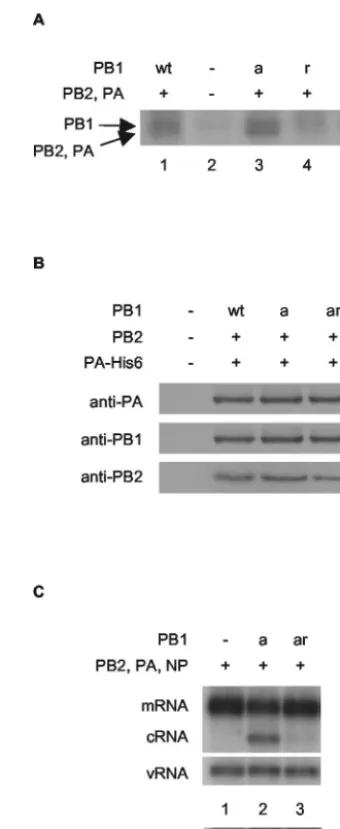
yield PB1-Y559A [PB1r]) or in PB1a (to yield PB1-D445A/ D446A/Y559A [PB1ar]), was found to result in significantly reduced but still detectable cRNA promoter binding in an in vitro cross-linking assay (Fig. 4A, compare lane 1 with lane 4 and lane 3 with lane 5). Polymerase possessing the Y559A mutation in PB1 was found to have no detectable transcrip-tional or replicative activity, both in vivo by an RNA synthesis (Fig. 2, compare lanes 2 and 4) or a CAT reporter (see Fig. S4A in the supplemental material) assay and in vitro by an ApG-primed transcription assay (see Fig. S4B in the supple-mental material). The amino acid substitution was shown by Western blot analyses not to inhibit expression levels of PB1ar compared to PB1a in transfected cells (see Fig. S5 in the supplemental material). Furthermore, PB1a and PB1ar were shown to be complexed with the other polymerase subunits, since PB1 and PB2 could be readily detected by Western blot-ting after nickel-affinity purification of His-tagged PA (Fig. 4B). Strikingly, expression of PB1ar in the cRNA rescue assay yielded significantly reduced, but still detectable, cRNA signals compared to PB1a (Fig. 4C, compare lanes 2 and 3; lane 1 is background). This suggests that rescue of the cRNA signal is dependent on binding of the cRNA promoter by the polymer-ase.
We have, therefore, demonstrated that infecting influenza A virions can initiate both capped RNA-dependent mRNA tran-scription and primer-independent RNA replication early in infection. We have shown that the detection of significant levels of cRNA is dependent on the expression of viral
poly-FIG. 4. cRNA rescue is reduced by a mutation inhibiting the cRNA promoter-binding activity of PB1. (A) Substitution of tyrosine at res-idue 559 in PB1 or PB1a with alanine inhibits photochemical cross-linking of the polymerase complex to labeled cRNA. Partially purified His-tagged polymerase from cells transfected with plasmids expressing wild-type or mutant PB1, PB2, and PA-His6 (8), or empty vectors, as indicated, were cross-linked with a 32P-labeled RNA probe
corre-sponding to the 3⬘-end cRNA in the presence of an excess unlabeled 5⬘-end cRNA by UV irradiation (8). The products were analyzed by 8% sodium dodecyl sulfate-polyacrylamide gel electrophoresis and autoradiography. The positions of the PB1 and comigrating PB2 and PA cross-linked bands are shown. (B) The Y559A mutation in PB1 does not inhibit polymerase complex formation. Partially purified His-tagged polymerase from cells transfected with plasmids expressing wild-type or mutant PB1, PB2, and PA-His6 (8), or empty vectors, as indicated, was subjected to Western blotting with antibodies raised against the individual subunits as shown. (C) PB1-Y559A severely restricts cRNA rescue. 293T cells were transfected with plasmids ex-pressing viral proteins (⫹) or empty plasmid vector (⫺), as indicated, 12 to 14 h prior to infection by A/WSN/33 virus in the presence of 100
g of cycloheximide/ml. RNA was harvested at 2 h postinfection, and viral RNA species were analyzed by NA gene-specific primer extension assays. A longer exposure of the cRNA-specific bands is shown below to emphasize the differences in cRNA levels. wt, wild type; PB1a, PB1-D445A/D446A; PB1r, PB1-Y559A; PB1ar, PB1-D445A/D446A/ Y559A.
on November 8, 2019 by guest
http://jvi.asm.org/
[image:3.603.331.501.71.485.2]merase and NP and that the cRNA signal is significantly re-duced if the RNA-binding capacity of the PB1 subunit of the polymerase is impaired. Therefore, we postulate that viral polymerase and NP expressed prior to virus infection bind nascent cRNA synthesized by the incoming vRNPs.
Various models of switching from transcription to replica-tion in influenza A virus infecreplica-tion have been proposed (27). NP was identified as a prime candidate for a switching molecule based on several temperature-sensitive NP mutants defective in replication and RNA binding (18, 22, 29) and biochemical studies that suggested that free NP is required for the synthesis of full-length transcripts (3, 28). It was proposed that interac-tion of NP with the polymerase (4, 23) or with the promoter element of the template RNA (10, 17) alters the mode of transcriptional initiation. More recently, the PB2 and PA sub-units of the polymerase have also been implicated from studies of mutations affecting viral replication but not transcription (11, 16). However, all of these models were based on the assumption that cRNA is not synthesized early in infection, an assumption that is now challenged. In fact, low levels of cRNA have previously been detected early in infection in the pres-ence of cycloheximide (2), but these data were discounted at the time.
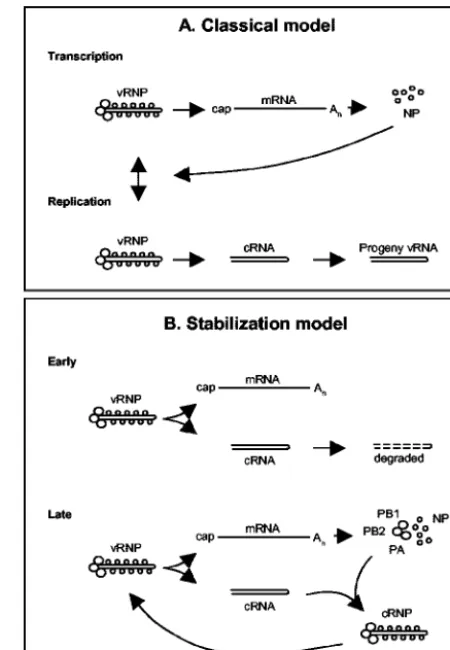
Based on our results, we propose a new “stabilization” model for influenza viral infection (Fig. 5) in which vRNPs derived from the infecting virus synthesize both mRNA and cRNA. mRNA is protected from normal cellular degradative
processes by the presence of a 5⬘ cap and a 3⬘ poly(A) tail,
whereas nascent cRNA is presumably rapidly degraded by host cell nucleases. The transition to a replicative phase occurs when cRNA is protected by the specific binding of RNA poly-merase (assembled from newly synthesized PB1, PB2, and PA) to the cRNA promoter (12). The fact that polymerase alone
(i.e., in the absence of NP), which is known to bind both the 5⬘
and 3⬘ends of cRNA (6), can rescue cRNA suggests that host
5⬘and 3⬘exonucleases may be involved. The
cRNA-polymer-ase promoter complex then serves as a nucleation point for binding of free newly synthesized NP, leading to the formation of active and stable cRNPs suitable for replicative vRNA syn-thesis. Crucially, this model proposes that there is no switch regulating initiation of mRNA or cRNA synthesis but that newly synthesized polymerase and NP stabilize cRNA tran-scripts later in infection. We suggest that it explains why mu-tations in NP (4, 22, 23, 28), PB2 (16), or PA (11), which may interfere with cRNP complex formation, can affect the transi-tion between mRNA transcriptransi-tion and RNA replicatransi-tion phases.
Although we cannot at present exclude other models, we believe that the data best fit our stabilization model. For in-stance, it may be argued that the preexisting inactive polymer-ase used in our experiments induces a host factor (24) or forms a higher-order polymerase complex or lattice (21), switching the polymerase in the infecting virus to replicative activity. However, the demonstrated requirement for RNA-binding ac-tivity of the preexisting polymerase would argue against these alternative models.
Our stabilization model suggests that the initiation of mRNA or cRNA synthesis by influenza A virus polymerase may be regulated stochastically; that is, random primer-depen-dent or indepenprimer-depen-dent initiation dictating the synthesis of
mRNA or cRNA, possibly involving subtle conformational dif-ferences in the structure of the polymerase (15, 26). Stochastic regulation at the level of initiation of cRNA synthesis, while being “wasteful” by generating cRNA destined for degrada-tion, would reflect the limited genetic resources possessed by RNA viruses for complex regulation. It will be interesting to use our new model and our methodological approach to de-termine whether a similar mechanism of gene regulation also occurs in other negative- and positive-sense RNA viruses in which it has proved difficult to define the precise mechanism regulating transcription and replication (1, 19, 25).
We thank Ervin Fodor for helpful discussions and Julian Robinson for DNA sequencing.
This study was supported by MRC grants G9523972 and G9901312 to G.G.B. and an EPA Fellowship to T.E.J.
REFERENCES
1. Barr, J. N., S. P. J. Whelan, and G. W. Wertz.2002. Transcriptional control of the RNA-dependent RNA polymerase of vesicular stomatitis virus. Bio-chim. Biophys. Acta1577:337–353.
[image:4.603.308.533.70.395.2]2. Barrett, T., A. J. Wolstenholme, and B. W. J. Mahy.1979. Transcription and replication of influenza virus RNA. Virology98:211–225.
FIG. 5. Models for switching between influenza A viral transcrip-tion and replicatranscrip-tion. (A) Classical model. Early in infectranscrip-tion, vRNA is transcribed to mRNA (primary transcription). Expression of NP switches primary transcription to replication (synthesis of cRNA and vRNA) and subsequent secondary transcription. (B) Proposed “stabi-lization” model. Early in infection, mRNA and cRNA are synthesized, but cRNA is degraded. Later in infection, once PB1, PB2, PA, and NP are synthesized, cRNA is stabilized as a cRNP complex that can be replicated to vRNA. See the text for further details.
on November 8, 2019 by guest
http://jvi.asm.org/
3. Beaton, A. R., and R. M. Krug.1986. Transcription antitermination during influenza viral template RNA synthesis requires the nucleocapsid protein and the absence of a 5⬘capped end. Proc. Natl. Acad. Sci. USA83:6282– 6286.
4. Biswas, S. K., P. L. Boutz, and D. P. Nayak.1998. Influenza virus nucleo-protein interacts with influenza virus polymerase nucleo-proteins. J. Virol.72:5493– 5501.
5. Biswas, S. K., and D. P. Nayak.1994. Mutational analysis of the conserved motifs of influenza A virus polymerase basic protein 1. J. Virol.68:1819– 1826.
6. Crow, M., T. Deng, M. Addley, and G. G. Brownlee.2004. Mutational anal-ysis of the influenza virus cRNA promoter and identification of nucleotides critical for replication. J. Virol.78:6263–6270.
7. Fechter, P., L. Mingay, J. Sharps, A. Chambers, E. Fodor, and G. G. Brown-lee.2003. Two aromatic residues in the PB2 subunit of influenza A RNA polymerase are crucial for cap binding. J. Biol. Chem.278:20381–20388. 8. Fodor, E., M. Crow, L. J. Mingay, T. Deng, J. Sharps, P. Fechter, and G. G.
Brownlee.2002. A single amino acid mutation in the PA subunit of the influenza virus RNA polymerase inhibits endonucleolytic cleavage of capped RNAs. J. Virol.76:8989–9001.
9. Fodor, E., L. Devenish, O. G. Engelhardt, P. Palese, G. G. Brownlee, and A. García-Sastre.1999. Rescue of influenza A virus from recombinant DNA. J. Virol.73:9679–9682.
10. Fodor, E., D. C. Pritlove, and G. G. Brownlee.1994. The influenza virus panhandle is involved in the initiation of transcription. J. Virol.68:4092– 4096.
11. Gastaminza, P., B. Perales, A. M. Falco´n, and J. Ortín.2003. Mutations in the N-terminal region of influenza virus PB2 protein affect virus RNA rep-lication but not transcription. J. Virol.77:5098–5108.
12. Gonza´lez, S., and J. Ortín.1999. Distinct regions of influenza virus PB1 polymerase subunit recognize vRNA and cRNA templates. EMBO J.18:
3767–3775.
13. Hatada, E., M. Hasegawa, J. Mukaigawa, K. Shimizu, and R. Fukuda.1989. Control of influenza virus gene expression: quantitative analysis of each viral RNA species in infected cells. J. Biochem.105:537–546.
14. Hay, A. J., B. Lomniczi, A. R. Bellamy, and J. J. Skehel.1977. Transcription of the influenza virus genome. Virology83:337–355.
15. Honda, A., K. Mizumoto, and A. Ishihama.1999. Two separate sequences of PB2 subunit constitute the RNA cap-binding site of influenza virus RNA polymerase. Genes Cells.4:475–485.
16. Huarte, M., A. Falco´n, Y. Nakaya, J. Ortín, A. García-Sastre, and A. Nieto.
2003. Threonine 157 of influenza virus PA polymerase subunit modulates RNA replication in infectious viruses. J. Virol.77:6007–6013.
17. Klumpp, K., R. W. H. Ruigrok, and F. Baudin.1997. Roles of the influenza virus polymerase and nucleoprotein in forming a functional RNP structure. EMBO J.16:1248–1257.
18. Krug, R. M., M. Ueda, and P. Palese.1975. Temperature-sensitive mutants of influenza WSN virus defective in virus-specific RNA synthesis. J. Virol.
16:790–796.
19. Lamb, R. A., and R. M. Krug.2001.Orthomyxoviridae: the viruses and their replication, p. 1487–1530.InD. M. Knipe and P. M. Howley (ed.), Fields virology, 4th ed. Lippincott/The Williams & Wilkins Co., Philadelphia, Pa. 20. Li, M.-L., B. C. Ramirez, and R. M. Krug.1998. RNA-dependent activation
of primer RNA production by influenza virus polymerase: different regions of the same protein subunit constitute the two required RNA-binding sites. EMBO J.17:5844–5852.
21. Lyle, J. M., E. Bullitt, K. Bienz, and K. Kirkegaard.2002. Visualization and functional analysis of RNA-dependent RNA polymerase lattices. Science
296:2218–2222.
22. Medcalf, L., E. Poole, D. Elton, and P. Digard.1999. Temperature-sensitive lesions in two influenza A viruses defective for replicative transcription disrupt RNA binding by the nucleoprotein. J. Virol.73:7349–7356. 23. Mena, I., E. Jambrina, C. Albo, B. Perales, J. Ortín, M. Arrese, D. Vallejo,
and A. Portela.1999. Mutational analysis of influenza A virus nucleoprotein: identification of mutations that affect RNA replication. J. Virol.73:1186– 1194.
24. Momose, F., T. Naito, K. Yano, S. Sugimoto, Y. Morikawa, and K. Nagata.
2002. Identification of hsp90 as a stimulatory host factor involved in influ-enza virus RNA synthesis. J. Biol. Chem.277:45306–45314.
25. Neumann, G., M. A. Whitt, and Y. Kawaoka.2002. A decade after the generation of a negative-sense RNA virus from cloned cDNA - what have we learned? J. Gen. Virol.83:2635–2662.
26. Penn, C. R., and B. W. Mahy.1984. Capped mRNAs may stimulate the influenza virion polymerase by allosteric modulation. Virus Res.1:1–13. 27. Portela, A., and P. Digard.2002. The influenza virus nucleoprotein: a
mul-tifunctional RNA-binding protein pivotal to virus replication. J. Gen. Virol.
83:723–734.
28. Shapiro, G. I., and R. M. Krug.1988. Influenza virus RNA replication in vitro: synthesis of viral template RNAs and virion RNAs in the absence of an added primer. J. Virol.62:2285–2290.
29. Sugiura, A., M. Ueda, K. Tobita, and C. Enomoto.1975. Further isolation and characterization of temperature-sensitive mutants of influenza virus. Virology65:363–373.
30. Taylor, J. M., R. Illmensee, S. Litwin, L. Herring, B. Broni, and R. M. Krug.
1977. Use of specific radioactive probes to study transcription and replication of the influenza virus genome. J. Virol.21:530–540.