Evaluation of
the Entry to
Learning pilots
Tim Bickerstaffe, Fiona Walton
This research report was written before the new UK Government took office on
11 May 2010. As a result the content may not reflect current Government policy
and may make reference to the Department for Children, Schools and Families
(DCSF) which has now been replaced by the Department for Education (DFE).
Contents
SUMMARY ... I
1 INTRODUCTION ... 1
1.1 PROGRAMME CONTEXT ... 1
1.2 E2LPRINCIPLES ... 3
1.3 PILOTS‟CONTEXT ... 4
1.4 STRUCTURE OF THE REPORT ... 5
2 METHODOLOGY ... 6
2.1 THE REALIST METHOD (PROGRAMME THEORY EVALUATION) ... 6
2.2 THE PRIMARY RESEARCH ... 7
3 PILOT DEVELOPMENT ... 8
3.1 DEVELOPING THE PILOTS ... 8
3.1.1 Adherence to the Implementation Plan ... 9
3.1.2 Reviews of Local Beneficiary Need and Available Provision ... 9
3.2 PROMOTION AND MARKETING ...12
4 PILOT MANAGEMENT ...13
4.1 MANAGEMENT ARRANGEMENTS ...14
4.1.1 Staffing Structures ...15
4.1.2 Staff Background and Experience ...16
4.1.3 Partnership Working ...17
4.2 THE STEERING GROUP ...18
4.3 ROLES OF THE THIRD SECTOR IN MANAGEMENT AND OPERATIONS...18
4.4 DCSFMONITORING,SUPPORT AND OVERSIGHT ...21
5 PILOT OPERATIONS ...22
5.1 RECRUITMENT ...23
5.3 SUPPORT FOR BENEFICIARIES ...25
5.3.1 Levels of Support Provided ...25
5.3.2 Establishing Beneficiary Needs ...26
5.3.3 Identifying Appropriate Provision ...28
5.3.4 Support for Beneficiaries on Bridging Provision ...29
5.3.5 Support Beyond 15 Weeks ...31
5.4 PACASELOADS ...32
5.5 FINANCIAL SUPPORT ...34
5.5.1 Administration ...34
5.5.2 Non Payment ...35
5.5.3 Significance for Recruitment and Retention ...36
5.5.4 Issues Concerning Welfare Benefits ...36
5.5.5 Bank Accounts ...37
5.5.6 Discretionary Fund ...38
5.6 ADMINISTRATION AND MANAGEMENT INFORMATION ...38
6 THE YOUNG PEOPLE ...40
6.1 NATURE OF THE CLIENT GROUP ...40
6.2 PILOT EXPERIENCES OF YOUNG PEOPLE ...41
7 PROVISION ...48
7.1 IDENTIFYING AND COMMISSIONING PROVISION ...49
7.1.1 The Nature of Provision ...51
7.1.2 Securing Flexible Quality Provision ...52
7.2 THIRD SECTOR PROVISION ...54
8 OUTCOMES & IMPACT...58
8.1 PROGRESSION ROUTES ...58
8.1.1 Post E2L Support ...60
8.3 SUCCESS OF PILOTS ...64
8.3.1 What Has Worked Well ...65
8.4 THE E2LPILOTS AND ACTIVITY AGREEMENTS ...66
9 CONCLUSIONS & RECOMMENDATIONS ...69
APPENDIX ONE: STAKEHOLDERS’ TOPIC GUIDE ...73
APPENDIX TWO: BENEFICIARIES’ TOPIC GUIDE ...80
i
S
UMMARY
Introduction
A central priority for the Department for Children, Schools and Families (DCSF) is to
reduce the proportion of young people not in education, employment or training
(NEET). This priority is set in a context of evidence which has revealed that being
„NEET‟ between the ages of 16 and 18 is not only a severe waste of individual
potential, but is also linked to a range of other poor outcomes including low levels of
educational attainment and skills acquisition, leading to poor employment outcomes,
or even labour market exclusion.
Entry to Learning (E2L) was designed to provide young people who are NEET with
opportunities to improve their skills and employability through strengthening the
progression between re-engagement activity and formal learning. The Policy
Research Institute at Leeds Metropolitan University was commissioned by DCSF to
undertake a process evaluation of the four pilot E2L projects delivered in
Birmingham, Brighton and Hove, Lancashire and Sandwell.
Key findings from the evaluation are presented below:
Pilot development
All the Pilots have followed the strategy and design detailed in their respective
Implementation Plan.
Initial operationalisation of the Implementation Plans entailed the Pilots orientating
themselves within their local demographic, NEET, and provision context.
Pre-existing relationships and/or access to local networks proved valuable in this respect.
The tailored approach encapsulated in the E2L Pilot design has enabled the
individual Pilots to develop new partnership working and support – for example,
arranging for established city-wide provision to be delivered in local venues easily
accessible to beneficiaries, and through establishing relationships with student
support services at local colleges to better facilitate beneficiary support upon entering
formal learning
The ability of the Pilots to identify and commission appropriate third sector provision
has also allowed the Pilots to address some identified local „gaps‟ in provision for
ii
As the Pilots have progressed, a mix of provision intended to facilitate a „light touch‟ engagement leading to more structured learning during the beneficiaries‟ 15 week
participation has become a common feature.
Recognition and understanding of how local young people conduct themselves in
their daily lives has necessitated careful planning in some cases to address local
issues such as notions of „territoriality‟, local gang activity, or local inter-community or
inter-ethnic tensions more generally.
Pilot management
Management of the intervention has been identified by Pilot staff as quite complex,
given the intricate organisational relationships and extensive subject areas covered
by the provision.
The Model 2 Pilots (where Local Authorities (LAs) contract with a third sector
provider) acknowledge the tension between managing the intervention and affording
the third sector the flexibility to remain true to their organisational culture.
The experience and local knowledge of the Personal Advisers (PAs) has been
critical in the promotion of the Pilots.
Experience of working with young people from different backgrounds and with
different needs has emerged as a key characteristic of a successful E2L PA.
In areas where Steering Groups have been established, all stakeholders consider
them to be operating effectively.
The importance of existing contacts and relationships between key staff, Steering
Group members, agencies and organisations central and peripheral to the Pilots was
stressed by all respondents.
The E2L Pilots have been welcomed by many local stakeholders with whom no
previous working partnership has been established by the delivery partners.
Different models of engagement of third sector providers have been established in
the Pilot areas.
There are both positive and negative aspects arising from the heterogeneity evident
in the Pilot areas‟ third sector provision landscape. Third Sector agencies often work
creatively with the young people but there may also be some lack of consistency in
iii Pilot operations
Recruitment to the pilots was running at just under 90 per cent of profiled starts at the
end of December 2009.
No „typical‟ level of support is given to beneficiaries. There is a mix between intensive support and more „light touch‟ support, depending on individual need.
There are formal processes for establishing beneficiary needs, for example through
existing and new assessment procedures. Informal routes, which underpin the
development of the relationship between the PA and the beneficiary, are also
important in contributing to an understanding of individuals‟ barriers to learning.
Action planning has been a useful tool to help to provide a focus on short and
long-term goals.
The level of PA caseloads has been highly variable, ranging from 15 to more than 30
clients. Overall, caseloads of between 15 and 20 clients were felt to be manageable
in order to allow Personal Advisers (PAs) to offer a truly bespoke and personal
service.
The financial incentive is felt to have brought more young people into E2L and kept
them there than would have been the case had there been no financial reward for
participation.
There was a strong and commonly held view that young people in receipt of
Jobseekers Allowance and Income Support should be eligible for the financial
incentive if they participate in E2L.
The discretionary fund is considered to be an important tool in helping to overcome
some specific, financial, barriers to engagement in formal learning.
Pilots remain frustrated that young people on E2L are recorded as NEET.
The young people
E2L is attracting a range of young people, a significant proportion of whom are
considered to be from one or more vulnerable group. The diverse nature of the client
group was stressed by stakeholders in the different pilot areas.
Amongst the beneficiaries that we spoke to, most had had negative experiences of
school and many lacked a clear idea of what they would like to do when they began
iv
positive in helping young people to identify areas of interest that could be pursued
further.
Beneficiaries had heard of E2L from a number of sources, most commonly
Connexions or word of mouth through their friends.
The relationship between the PA and the beneficiary was frequently identified as an
important factor in helping the individual to progress.
Reinforcing the findings from other stakeholders, there was no consistent view
amongst beneficiaries about the extent to which motivation for engaging with E2L is
dependent upon the financial incentive.
A number of beneficiaries had progressed into positive outcomes at colleges or
training providers, studying for a range of courses and qualifications.
The large majority of beneficiaries that we spoke to were positive about their
experiences on E2L, a number indicating that, without it they would have been “doing nothing”.
Provision
Each Pilot area has its own characteristics, opportunities and challenges in relation
to the provision landscape.
Efforts, issues and aspects of identifying and commissioning appropriate provision
have been driven as much by practical requirements as original Pilot intentions.
The tailored focus of identifying and commissioning provision has required Pilot staff
to find appropriate and attractive provision for their beneficiaries; the flexibility within
the intervention has enabled them to do this. All Pilots report the existence of certain
pre-existing or developing local consortia of providers, enabling commissioners to
identify provision via a single access point.
Issues relating to economies of scale required by various providers have been faced
by all Pilots.
All Pilots have experienced successes and failures in relation to securing flexible
quality provision.
Two Pilot areas have encountered difficulties engaging some of the local Further
v
The start dates of college courses have had an impact on progression for some
beneficiaries who may have completed their E2L provision but must face perhaps
several months delay before being able to start at college.
Very good relationships between one Pilot and two of their local FE colleges has led
to better outcomes in relation to progression into college courses and retention.
The flexibility and general ethos of many third sector providers is regarded very
positively by all Pilots, although third sector flexibility is usually limited by funding.
There is evidence that E2L is helping to build capacity among commissioned third
sector providers in terms of internal operations and external delivery.
Outcomes and impact
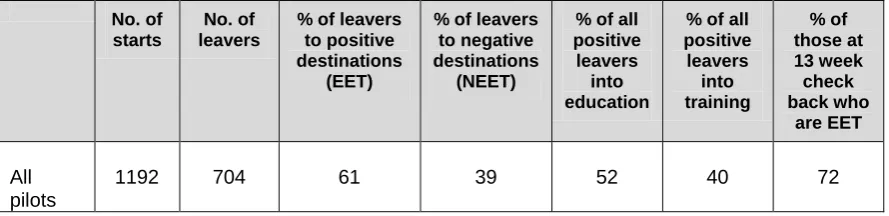
Management information indicates that just over 60 per cent of young people that
have started E2L have progressed into positive destinations, about half into
education. Destinations appear to vary significantly across the different pilot areas.
The rigidity of September start dates in colleges was frequently identified as a
potential barrier to progression for those leaving E2L. This was particularly felt to be
an issue for the more academically able (level 2 and 3) E2L clients.
Responsibility for E2L clients transfers to a range of professionals in the wider
support and learning environment once they have left the PAs‟ caseloads. There is
potential to develop a more formal approach to this, with guidelines to clarify roles
and responsibilities. Some concerns were expressed about the lack of support for
this client group within many colleges.
A range of soft outcomes from E2L were identified and the importance of these in
evidencing the impact of the programme was highlighted. In taking the pilots
forward, it may be beneficial to formalise processes for recording and monitoring soft
outcomes.
Stakeholders were overwhelmingly positive about the success of E2L and identified a
range of areas where the pilots have worked well, including in relation to: being client
centred; the development of management and delivery infrastructures; putting in
vi Conclusions and recommendations
Some management structures and supervision arrangements within the pilots should
be simplified and pilot managers should continue to share experiences and
knowledge in this regard with a view to establish a „model‟ or „toolkit‟ of effective E2L
management.
Continued recording of relevant management information will be important to this end
and also important in relation to more fully revealing the local context within which the
pilots are operating.
All pilots will need to maintain or develop further their flexible working arrangements
to ensure continued positive outcomes but this flexibility must be recognised as
context-dependent.
Pilots should maintain and develop their current focus on the importance of local
networks and partnerships in relation to both operational and strategic issues.
Consideration should be given to the possible graduated payment of the
Financial Incentive but local arrangements for payment of the Financial Incentive
may need to be simplified to accommodate this.
There should be a continued focus on the numbers of E2L beneficiaries
appearing on PA caseloads at any particular time. Efforts should be made to
ensure that caseloads do not exceed 15 – 20 young people.
Pilots should seek to develop their ability to target potential E2L beneficiaries
within the local NEET population.
All pilots will need to develop their understanding of local provision and continue
to focus on the importance of capacity building in this regard.
In order to ensure all E2L interventions can be appropriately evaluated and to
allow for a fuller appreciation of „distanced travelled‟ and accompanying „soft outcomes‟ in relation to all beneficiaries regardless of the extent of their E2L engagement, the MI classification „Negative Destinations‟ should be replaced with the classification „Other Destinations‟.
The measuring of E2L pilot outcomes should take due account of those
beneficiaries who encounter difficulties accessing funded progression routes due
to them having reached the maximum age for E2L support during their 15-week
vii
DCSF should consider the option of removing young people from the NEET
register for the duration of their engagement with E2L although this risks
reducing the incentive for local areas to support young people to progress on
from the programme.
The issues and problems associated with E2L participation and its reported
effects upon Child Benefit and other public welfare eligibility should be resolved
1
1 I
NTRODUCTION
1.1 Programme Context
A central priority for DCSF is to reduce the proportion of young people not in
education, employment or training (NEET)1. This priority is set in a context of evidence which has revealed that being „NEET‟ between the ages of 16 and 18 is not
only a severe waste of individual potential, thus restricting the ability to fully contribute
to society, but is also linked to a range of other poor outcomes – including low levels
of educational attainment and skills acquisition, leading to poor employment
outcomes, or even labour market exclusion2.
The DCSF target is to reduce the proportion of 16-18 year olds who are NEET by two
percentage points by 2010. Subsequently, the publication of the DCSF NEET
Strategy in 2007 set out the key steps the Department is taking to support local
authorities and delivery partners to prevent young people from becoming NEET, as
well as to support those who are NEET to re-engage in education, employment or
training3.
The Strategy contains four key themes considered essential to reducing the
proportion of young people who are NEET:
Careful tracking – to identify early those young people who are NEET, or who at risk of becoming NEET;
Personalised guidance and support – to make sure young people know how to access education, training or employment and to enable them to overcome barriers to participation;
Provision of a full range of courses to meet demand – to engage young people through sufficient provision at every level and in every style of learning;
A new emphasis on rights and responsibilities – so that there is a clear set of incentives on young people to re-engage as quickly as possible if they drop out.
1
DCSF produces NEET estimates by calculating the number of young people (aged 16-18) not in education or training (NET), then subtracting the number of young people known to be in education and training from the total population. Data from the Labour Force Survey is then used to calculate what proportion of that residual group is NEET.
2
Coles, B., Hutton, S., Bradshaw, J., Craig, G., Godfrey, C. & Johnson, J. (2002) Literature Review of the Costs of Being „Not in Education, Employment or Training‟ at Age 16-18 RR347 Norwich: HMSO
3
2
The subsequent publication in 2009 „Investing in Potential‟4 set out the Department‟s
aim to drive up participation in education and training and maximise employment
opportunities for 16 to 24 year olds.
Following on from, and complementing, the various policies and initiatives contained
within the Children‟s Plan5 is a commitment to pilot a new Entry to Learning programme (E2L), to include a process evaluation, intended to provide young people
who are NEET with opportunities to improve their skills and employability through
strengthening the progression between Third Sector re-engagement activity and
formal learning.
As a subject of evaluation, the E2L Pilots follow a series of initiatives and
interventions designed within the broader Strategy and proposed within the Children‟s
Plan, to reduce the numbers of 16-18 year-olds classified as NEET (DCSF, op cit.). Thus, in terms of both their timing and key elements of their internal mechanisms, the
E2L Pilots have been informed by the development, piloting, and evaluation of
interventions such as Entry to Employment6 and the Activity Agreements7.
The specific purpose of the E2L Pilots, commissioned by DCSF in November 2008 in
four local areas, is to examine how local authorities can most effectively ensure that
the re-engagement provision they commission has maximum positive impact on the
NEET beneficiaries and supports them to progress into formal learning.
DCSF wishes to test three key elements of the Pilots:
A personal adviser (PA) – to provide continuity of support throughout the beneficiary‟s re-engagement and to broker their access to further learning and development opportunities;
Bridging provision – to provide smaller manageable steps between re-engagement provision and formal learning, accredited wherever possible, and;
A financial incentive – to encourage young people to take part in the Pilots
and to remain committed as they return to formal learning.
4
DCSF, DWP, BIS (2009) Investing in Potential, Nottingham: DCSF
5
DCSF (2007) The Children‟s Plan, Norwich: DCSF
6
LSC (2006) The Framework for Entry to Learning Programmes Coventry: LSC National Office http://readingroom.lsc.gov.uk/lsc/National/The_Framework_For_Entry_To_Employment_Programmes accessed 04/10/09; IPSOS MORI (2008) Evaluation of Education Maintenance Allowance to Entry to Employment and Programme Led Apprenticeships Coventry: LSC National Office
7
3
These three elements are to be tested via two specific Pilot models:
In Model 1, the Connexions Personal Adviser will act as the E2L PA, holding a flexible pot of funding to be used to secure the appropriate provision for the beneficiary.
In Model 2, the local authority will contract with a third sector provider (or consortium of providers) in order for the PAs, working with Connexions, to ensure the appropriate provision is in place for their beneficiaries.
The financial incentive will be available under both models.
Following a tender procedure conducted in October and November 2008, the four
Pilot areas commissioned by DCSF are:
Birmingham (Model 1)
Lancashire (Model 1)
Sandwell (Model 2)
Brighton & Hove [with East Sussex] (Model 2)
In a recent joint publication with the Department for Work and Pensions and the
Department for Business, Innovation and Skills, DCSF announced a continuation of
the E2L Pilots in 2010-11 to refine the model and to work towards creating the most
effective and efficient support for NEET young people.8
1.2 E2L Principles
The key success measure for the Pilots will be the proportion of young people who
take part in E2L and go on to make a successful transition into formal learning.
Further, both Pilot models must operate around certain key principles:
Through engagement in the Pilot, beneficiaries develop knowledge, skills, understanding and personal qualities essential to enable their continuation in learning and to improve their employability;
Beneficiaries should work towards qualification(s) or accreditation where appropriate. For example, through ADSAN or Foundation Learning;
The Pilot should complement and build upon existing core activities and funding for the NEET group, rather than commissioning large amounts of additional re-engagement provision; and
8 DCSF, DWP, BIS (2009)
4
Where possible, the outcomes and lessons of the Pilot should be sustainable beyond the end of the Pilot period.
1.3 Pilots’ Context
Each of the Pilot areas faces its own particular challenges in relation to the reduction
in the numbers of local young people classified as NEET aged 16-18.
In Sandwell, local authority documents published in 2008 and 2009 highlighted a fall
in the proportion of NEETs from 14.4 per cent in July 2007 to 11.7 per cent in quarter
3 of 20089. Key informants interviewed for this evaluation spoke of a series of interventions targeted at the local NEET population (e.g. Entry to Employment, „Kick Start Life‟, „Krunch‟, and „Ready Steady Go‟) but reflected upon a general dearth of
available provision in the Sandwell district historically. Interviewees with long-term
experience of the local support and guidance infrastructure for young people reported
a pattern of identifying and attempting to close persistent gaps in available provision
over recent years.
The Learning and Skills Council „Statement of Need‟ 2009-2010 for the Birmingham
local area reported a 16-17 NEET population of 7.7 per cent10. Yet, it noted both a decline in apprenticeship participation and a local take up of the Education
Maintenance Allowance below the national average. Key local informants reported
on some recent efforts from the NEET Strategy Group, which has worked with local
schools, the youth offending service, as well as seeking to promote E2E – with some success. There has also been a local strategy to „clean up‟ the NEET data, which is
now tracked on a monthly basis and reveals that in the east and south west areas of
the city, the NEET population is made up of high concentrations of White British;
whereas in the inner city and north west areas, an ethnic mix is more apparent. This
data has helped inform a recent Connexions strategy to match personal advisers to
the city‟s twelve priority wards.
Data from 2006 was used to map the NEET population in Brighton and Hove by
electoral ward, and revealed that the incidence of NEET ranged from a low of 1 per
cent in some wards to above 8 per cent in certain others11.
9 Sandwell Metropolitan Council (2009)
Sandwell Economic Review January-March 2009; Sandwell Metropolitan Council (2009) Report to the Cabinet Member for Children and Young People 16 March 2009.
10
LSC West Midlands Region (2008) Birmingham Local Area Statement of Need 2009/10
11
5
The highest NEET population was mapped across East Brighton where 27 per cent of
16-18 year olds fell into the classification.
For East Sussex, 2007 data revealed 7.8 per cent of 16-18 year olds classified as
NEET12. In Brighton & Hove (with East Sussex), the trialling of E2L has enabled a process of joint working practices and a discovery of different working cultures. In this
respect, several respondents spoke of the E2L Pilot as a „pilot within a pilot‟.
The Lancashire „Annual Plan‟ for 2007-2008 noted a NEET rate of 8.9 per cent
across the county, but with particularly high rates in certain NEET „hot spots‟ such as
Preston and Burnley13. These „hot spots‟ were also highlighted in the Local Area Agreement Improvement Target, which included the aim to reduce the county‟s NEET
population to 7.7 per cent in 2010/201114. Given the difficulty of offering the E2L Pilot across Lancashire, a large county with two unitary authorities operating within it, the
Pilot is concentrating upon Preston and Burnley. The Lancashire E2L Pilot has
reviewed the existing local NEET data and has categorised its NEET population into
groups, where some fall into the classification only briefly, whilst others are more
entrenched as NEET. The Pilot is seeking to concentrate upon the „entrenched‟
NEETs who are likely to require the most extensive support and guidance.
Across England, despite the increase in participation rates in education and training
over recent years, the proportion of 16-18 years olds classified as NEET has also
increased: from 9.7 per cent in 2007 to 10.3 per cent in 2008. Moreover, as
employment rates among NEET young people have declined as the recession has
proceeded, the proportion of NETs (not in education or training) in a job fell from 56
per cent in 2007 to 49 per cent in 200815.
1.4 Structure of the Report
The following sections detail the findings from the interim and second phase fieldwork
visits to the four Pilots. As Section 1.3 of Chapter 1 and Chapter 3 refer to each
Pilot‟s local context and experience of development, the Pilots are identified.
Subsequent sections are presented thematically.
12
LSC South East (2007) Young People Not in Education, Employment or Training South East
13
LSC Lancashire (2007) Learning and Skills Council Lancashire Annual Plan 2007-08
14
Lancashire Local Area Agreement Improvement Target 2008-09: Children and Young People
15
6
2
M
ETHODOLOGY
The evaluation research strategy employed by the research team involves several
stages:
A scoping phase – including an inception meeting with DCSF, a review of
management information, and an initial visit to the Pilot areas to meet project
staff and to gain an understanding of how each Pilot has been organised. This
phase of the research was conducted between February and April 2009.
Two distinct primary research phases, each including: analysis of management
information; fieldwork visits to each Pilot area to conduct a series of
face-to-face semi-structured interviews with key Pilot informants, stakeholders and
beneficiaries; and data analysis and reporting. The first primary research
phase was undertaken between May and July 2009.
A learning workshop – with representatives from each Pilot in order to share
experiences, views and best practice. This workshop was conducted following
the second primary research phase in January 2010.
2.1 The Realist Method (Programme Theory Evaluation)
The E2L evaluation utilises the approach and tenets of the realist evaluation
methodology. Sometimes referred to as „programme theory evaluation‟, the realist
method recognises that interventions are always based upon a hypothesis (e.g. a
policy or programme theory). Often these hypotheses postulate: „If a programme is
delivered thus, or services are managed like so, then it will bring about some
improved outcome.‟ Such conjectures are grounded on assumptions about what
gives rise to poor performance, inappropriate behaviour, and so on, and then
speculate how changes may be made to these patterns16.
Further, as the E2L pilot interventions involve stakeholder consultation, networking
and partnership working, and a deliberate attempt to foster support and guidance
relationships with young pilot beneficiaries, the realist method can be useful as it
acknowledges that interventions are embedded in social systems.
Thus as an evaluation tool it recognises that the individual capacities of the Pilots‟ key actors, the interpersonal relationships supporting the Pilots‟ operations, the
16 Pawson, R & Tilley, N (1997)
Realistic Evaluation London: Sage; Pawson, R (2006)
7
institutional setting, and the wider infrastructural system, will all have considerable
influence over the E2L Pilots‟ outcomes.
However, the realist method does not attempt to provide some arithmetic verdict on
an intervention but rather a refinement of the underlying programme theory. That is,
there is no attempt to offer a mechanical cause and effect model. Instead, the
method seeks to identify the „theory of change‟ that lies behind an intervention,
drawing out both intended and unintended outcomes, to address the configuration
puzzle: what works, for whom, in what circumstances, in what respects, and why?
2.2 The Primary Research
Following the scoping phase, each of the four Pilots were visited twice over a two or
three day period. Over the two fieldwork visits, eighty-five face-to-face or telephone
semi-structured interviews and focus groups were conducted with Pilot staff,
stakeholders, key local partnership agencies, providers, and beneficiaries.
The resulting data was then transcribed verbatim and coded using the qualitative data
analysis software, NVivo.
Management information supplied by DCSF was also reviewed as were documents
and local research papers relevant to each Pilot area – particularly in relation to the
local NEET population.
8
3 P
ILOT
D
EVELOPMENT
Key findings
All the Pilots have followed the strategy and design detailed in their respective
Implementation Plan.
Initial operationalisation of the Implementation Plans entailed the Pilots orientating
themselves within their local demographic, NEET, and provision context. Pre-existing
relationships and/or access to local networks proved valuable in this respect.
The tailored approach encapsulated in the E2L Pilot design has enabled the individual
Pilots to develop new partnership working and support – for example, arranging for
established city-wide provision to be delivered in local venues easily accessible to
beneficiaries, and through establishing relationships with student support services at
local colleges to better facilitate beneficiary support upon entering formal learning.
The ability of the Pilots to identify and commission appropriate third sector provision
has also allowed the Pilots to address some identified local „gaps‟ in provision for
young people generally.
As the Pilots have progressed, a mix of provision intended to facilitate a „light touch‟
engagement leading to more structured learning during the beneficiaries‟ 15 week
participation has become a common feature.
Recognition and understanding of how local young people conduct themselves on a
day-to-day basis has necessitated careful planning in some cases to address local
issues such as notions of „territoriality‟, local gang activity, or local inter-community or
inter-ethnic tensions more generally.
3.1 Developing the Pilots
The process of developing the Pilots has involved two main aspects. First, each of
the Pilots had to implement the internal and external working arrangements as
proposed in their Implementation Plan. This has included the recruitment of staff
members and the formation of working partnerships with the relevant local agencies,
communities, and third sector organisations included in the Plans. Details of this
9
3.1.1 Adherence to the Implementation Plan
Documentation and respondent evidence shows that the four pilots have remained
true to the Implementation Plans agreed at the outset of the programme. In one
case, it was suggested by the pilot manager that the original Implementation Plan
allowed for some interpretation, but that the focus remains on achieving the target
outputs in terms of NEET progression to learning.
The fact that the E2L model affords PAs the opportunity to take creative approaches
to address the needs of their clients has been lauded by the majority of respondents
in all four pilots. One respondent felt that their PAs have the opportunity to be really
creative, which can be of real benefit when working with young people.
The fact that E2L is currently a pilot intervention was cited by some respondents as a
reason to allow for some flexibility in delivery. This point was made by a Learning
Partnership representative:
“You work against the grain almost, and you are allowed to fail … or not fail … and that you learn from mistakes that are made along the way”.
3.1.2 Reviews of Local Beneficiary Need and Available Provision
Parallel to this process, have been the efforts by each staff team to position their Pilot
both within the context of the local NEET strategy and alongside the existing provision
and learning infrastructure. For all of the Pilots, this process has entailed a careful
review of needs of their intended beneficiaries and a review of available local
provision – drawing upon evidence of best practice of working with the local NEET
population. These reviews were conducted through a process of information
gathering, previous pilot and NEET experience among the Pilot staff, and through
10
For the Lancashire Pilot, the elements of the E2L programme – in particular the
intensive individual beneficiary support and the option to offer bespoke provision –
was seen as a „golden opportunity‟ for beneficiaries at risk of becoming completely
disengaged from any employability or learning opportunities. Initially, for some local
stakeholders, there was some confusion as to the nature of E2L; some thought that it
was an adjunct to E2E – an intervention considered by some as having important
elements but somewhat of a „one size fits all‟ initiative.
“I made it clear with the emails and staff briefings that this wasn‟t E2E and it was a bespoke programme for young people … To be honest with you, we‟d been looking for this because there have been similar pilots to this in other parts of the country in the past but we‟ve never had one in Burnley”.
Local Connexions Stakeholder, Burnley
Furthermore, the Lancashire Pilot has been pleased to be able to take advantage of
the flexible delivery offered by some of the third sector providers who have joined the
county-wide Commissioned Outcome Funding network. As the Pilot has progressed
there have been some variations in the type of providers being commissioned, so that
each „area‟ has been able to offer a mix of „light touch‟ and more structured provision
to facilitate both initial engagement and progression.
For the E2L Pilot team in Birmingham, the initiative has provided an opportunity to
address local NEET needs and to provide support and guidance that had been
identified through local research some years ago. This research highlighted the
importance for NEET young people of achieving qualifications but that this often
necessitates accessible local tailored provision and one-to-one support – including
help with travelling, which can be a significant barrier for local young people whose
life may be bounded within just a few streets. Thus, part of the Birmingham Pilot‟s
early efforts concentrated upon persuading providers, traditionally based in the city
centre, to deliver training in a more local venue.
These efforts also took account of the stakeholder consultation, which revealed that
some of the city‟s „right‟ provision for NEET young people is considered to be located in the „wrong‟ places – that is, it is geographically inaccessible for all those potential
beneficiaries who do not live within very short distances of it.
11
In Brighton and East Sussex, one of the potential benefits of E2L in the view of Pilot
staff is the opportunity to support young people when they first enter formal learning.
Local evidence has revealed a high drop-out rate from FE college in the early days
and weeks of the new college year. For example, E2E providers do not have the
capacity to support beneficiaries into college and some young people can feel lost in
a large college environment even when fully committed to their learning. The ability of
the E2L Pilot PAs to support their beneficiaries‟ transition into a formal learning
environment is seen as a key strength of the E2L Pilot design by key Pilot staff –
several of whom mentioned their preparations for the September 2009 intake at their
local FE college(s).
“We‟ve got a lot of E2E provision in Brighton and Hove, probably more than most places in the South East, certainly; a lot of providers offering a wide range of E2E. But there isn‟t this additional Trusted Adult support for those that are the furthest disengaged” Learning Partnership Manager, Brighton
The situation facing the new Sandwell Pilot included an existing 10 training providers
in the local area, as well as an FE college, all effectively competing to offer provision
to local young people. However, under the E2L tenets, the Pilot has been able to
commission provision from a number of established local third sector providers with
capacity – and local credibility. The Sandwell Pilot considers itself to be fortunate to
have had this access to existing third sector provision, particularly in respect of the
need to get the Pilot set up and operational in a short period. Moreover, being able to
commission bespoke third sector provision has enabled the Pilot to help address
some of the gaps in local provision identified by the research unit of the local
authority.
The Sandwell Pilot is aware of significant local research having recently been
conducted into the NEET population. One aspect of this research highlighted by the
PA respondents concerns the importance of appropriate information, advice and
guidance in relation to young people of dual heritage – an increasing phenomenon in
the Sandwell area.
The importance of local knowledge about the likely beneficiaries and availability of
appropriate provision has also proved valuable in enabling some of the Pilots to
address issues of „territoriality‟ among local young people, including possible membership of local „gangs‟, and the potential for clashes between certain groups of
beneficiaries. For some PAs, this has involved accompanying beneficiaries on their
12
that could result in physical confrontation from those who consider the young person
to have encroached upon their „territory‟.
3.2 Promotion and Marketing
A range of activities to promote and market E2L have taken place across the pilot
areas. These have included:
Networking with all key stakeholders (including Connexions, Entry to Employment, colleges, youth centres, third sector, work based learning providers, other NEET providers etc.)
Advertising on websites
Advertising in appropriate publications e.g. the Connexions staff bulletin
Producing flyers and leaflets (separate ones for practitioners and for young people)
Holding publicity events
Publishing personal success stories in the local press
Pilots have tended to avoid a blanket approach to marketing, stressing that E2L is a
targeted programme and that, therefore, practitioners need to be the priority recipient
of information about the programme, enabling them to identify appropriate potential
beneficiaries. As such, networking with stakeholders has been a significant
marketing tool. This has been particularly important for PAs that are new to a locality,
as they have had to begin to develop relationships with the key players in the area. In
most of the pilots these relationships were already at least partially established; and
in some these have been in place for a number of years.
The experience and local knowledge of the PAs has also been critical in the
promotion of the initiative. In two areas, potential beneficiaries were identified from
locally held Management Information. In one of these pilots, the PAs „cold called‟ all
of the young people on their local system for an update on circumstances and, where
13
4 P
ILOT
M
ANAGEMENT
Key findings
Management of the intervention has been identified by Pilot staff as quite complex,
given the intricate organisational relationships and extensive subject areas covered
by the provision.
The Model 2 Pilots acknowledge the tension between managing the intervention and
affording the third sector the flexibility to remain true to their organisational culture.
The experience and local knowledge of the PAs has been critical in the promotion of
the Pilots.
Experience of working with young people from different backgrounds and with
different needs has emerged as a key characteristic of a successful E2L PA.
In areas where Steering Groups have been established, all stakeholders consider
them to be operating effectively.
The importance of existing contacts and relationships between key staff, Steering
Group members, agencies and organisations central and peripheral to the Pilots was
stressed by all respondents.
The E2L Pilots have been welcomed by many local stakeholders with whom no
previous working partnership has been established by the delivery partners.
Different models of engagement of third sector providers have been established in the
Pilot areas.
There are both positive and negative aspects arising from the heterogeneity evident
in the Pilot areas‟ third sector provision landscape. Third Sector agencies often work
creatively with the young people but there may also be some lack of consistency in
14
4.1 Management Arrangements
Not all Pilot managers line manage delivery staff, which can mean that staff are not
getting the support they require. One manager identified this as a very important
issue for the next year of the Pilot, saying that they:
“need to pull the team together so that they can get a bit more support and make sure that things are up to scratch and that we‟re all singing off the same hymn sheet, as it were … we need to tighten the whole team issue”. Pilot manager
Management of the intervention has been identified by participants from all four Pilots
as quite complex, given the intricate organisational relationships and extensive
subject areas covered by the provision. One Pilot admitted encountering some
problems with staffing relating to travel to work issues and an early departure of a PA
as a result of this. Moreover, the highly structured information, advice and guidance
environments that some former Young People‟s Service workers had been used to
before joining the Pilot entailed a period of readjustment to the close, flexible
mentoring of E2L.
The delegation of budgets to delivery partners, whilst seen as beneficial (particularly
in that it gives PAs control over negotiations with providers, and allows for greater
flexibility of provision), has also been identified as problematic in one key aspect.
One Pilot manager observed that she would have more leverage over providers if she
was able to negotiate for multiple places, and it would be easier for the programme to
absorb costs relating to participants failing to attend sessions if the budgets were
managed centrally:
“ … if we‟re looking for places for three young people from different partners to do something, as an over-arching organisation I could say to a provider „I‟ll pay you for six, and if only three turn up, that‟s my problem‟; different organisations can‟t do that”. Pilot manager
The Model 2 pilots acknowledge that there can be a tension between managing the
programme while at the same time trying to afford the third sector delivery partners
the flexibility they need to remain true to their organisational culture. One respondent
described this process as a case of trying to stay „hands off‟ to a certain extent, “to let the third sector get on with it and trial and test what they are meant to be doing, but also making sure that the pilot‟s successful” in terms of meeting output targets. Another programme manager described their frustration in that they are managing the
programme, but the day-to-day caseload management – management of the
15
cases, however, this tension appears to have been well managed, and has been
addressed by collaborative sessions between programme managers and front line
staff (particularly PAs), or through enhanced communication with delivery partner
managers.
4.1.1 Staffing Structures
Staffing structures vary between pilots, although all employ a programme manager /
co-ordinator who retains oversight of progress and provides support to staff in all of
the other parts of the structure. Delivery partners employ the PAs, although none use
this term to promote their service (using terms such as Young People‟s Worker or
Youth Support Worker instead).
The following table presents an overview of the staffing structures of the four pilots,
for ease of comparison:
Programme Manager Delivery Manager Personal Advisers
Birmingham Connexions
Birmingham City Council Youth Service Birmingham City Council Youth Service Brighton & East Sussex
Brighton & Hove City
Council; East Sussex
County Council
Third Sector Delivery
Partners
Third Sector Delivery
Partners
Lancashire Lancashire County Council
Lancashire Young
People‟s Service/
Children and Young
People‟s Service
Lancashire Young
People‟s Service/
Children and Young
People‟s Service
Sandwell
Sandwell Metropolitan Borough
Council (seconded from Prospects)
Third Sector Delivery
Partners
Third Sector Delivery
Partners
One of the third sector delivery partners‟ managers identified a potential shortcoming
of the management of the programme in their pilot, expressing concern that their
contract did not include payment for their organisation‟s management time. So, while some third sector organisations‟ staff act as the PAs‟ line managers, there is no
16
4.1.2 Staff Background and Experience
As described elsewhere in this report, effective delivery by PAs has been found to be
crucial to the success of the E2L process. Respondents from all four pilots
emphasised this point, and described the characteristics that they felt contributed
towards the effectiveness of these workers. Several respondents identified as key
the need for PAs to have extensive experience of “working with young people from different backgrounds and with different needs …”, and, in particular, experience of covering a wide range of issues with young people, including “money issues, complex issues, multiple issues”, many of which are likely to have been of a personal nature.
To this end, one Pilot took an early operational decision to only recruit PAs with Level
4 information, advice and guidance qualifications.
Equivalent similar themes to have emerged from the research is that the success of
E2L pilots in securing rapid turnaround from inception to delivery has been a function
of the network of local contacts developed prior to their appointment of the Pilot
managers/ co-ordinators. One PA expressed this in the following way:
“… with any project it‟s a gradual process, and I already had relationships or somebody within the Council had relationships with all of these people. So it wasn‟t that we were knocking on doors and trying to break barriers … I‟ve already got strong connections”. PA
The same can be seen to apply to staff working in PA roles, some of whom were able
to describe how they had been able to build on existing relationships to ensure that
partner agencies refer young people to the programme. Others spoke of their need to
familiarise themselves with a new area, stakeholders and contacts. The following
quote highlights both the potential benefits of building on such relationships, as well
as the potential drawbacks of relying too much on such contacts:
“I‟ve had four or five referrals from one client adviser, and that‟s purely been because she‟s based where I‟m based and she knows me … inevitably you get this strong contact – „if you‟ve got any queries then pop up and see us‟ kind of thing – but there‟s less of that from other advice centres, so the young people in that area possibly aren‟t getting quite such a good service …”. PA
One Pilot manager emphasised the benefits to the programme‟s delivery of her
having a Connexions background. In particular, it is felt that this has allowed third
sector delivery partners with limited experience of the Connexions service‟s approach
to learn from her, shortening the lead-in time. Other respondents questioned whether
it was likely to be more beneficial for delivery staff to have any previous or current link
17
seems that teams comprised of individuals with both types of background are able to
draw on complementary skills, contacts and experience to the benefit of the
programme.
4.1.3 Partnership Working
The importance of existing contacts and relationships between key staff or Steering
Group members and the various agencies and organisations central or peripheral to
the Pilots‟ operations was stressed by all respondents. In this respect, all of the Pilot
managers spoke of the importance of their existing relationships or contacts in
relation to timely set up and early delivery arrangements.
There were also reports from key respondents that any new partnerships needed for
the Pilot were considered when the Implementation Plans were being drafted. To this
end, one Pilot held an „open event‟ at a local venue and invited a range of providers to attend – a number of whom were unknown to the more established local providers.
In this way, the Pilot has helped to foster new relationships and partnerships among
the local providers.
Another Pilot manager spoke of how the E2L programme has been welcomed by
many local stakeholders with whom no previous working partnership had been
established. So, despite the usual processes and issues that accompany any new
relationship, all those involved have shown real commitment to the Pilot‟s aims.
“You know, you‟ve got to start somewhere and you build on the rest … You‟ve got to feel your way through and see what‟s needed and what level of partnership‟s needed … There‟ve not been particularly any obstacles, its just taken time to implement”. Pilot Manager
During the second phase of fieldwork, a number of Pilot respondents spoke of how,
as their local profile has increased, so partners have come to see them as an
established part of the local NEET reduction landscape – with, moreover, the ability to
fund or part-fund provision for young people that has real benefit and a focus upon
genuine progression to a positive outcome. The following quote from a Connexions
partner is indicative of the type of comments received:
18
4.2 The Steering Group
At the time of the field work, not all Pilots had established Steering Groups, although
in all Pilots there was evidence of extensive networking between the programme staff,
delivery partners and other local stakeholders. All Pilots intend to have a Steering
Group in place for the second year of their operations. In areas where the Steering
Groups are currently established, there are terms of reference and most respondents
expressed satisfaction with the way that they are being run. There was a high degree
of commonality in relation to members‟ understanding of the Groups‟ roles, typified by
the following comment:
“It‟s [role is] to provide a general oversight, to ensure that the targets are being met, to ensure the linkages are made with other organisations‟ vacancies, and to ensure the programme is successful”. Local Stakeholder
One Pilot manager explained that the Steering Group had been very useful in „pulling together‟ the two areas involved in the Pilot, and in helping to identify and deal with
any issues that might arise from the Local Authority or providers. As well as being a
valuable source of local information regarding target groups within the local NEET
population in the Pilot‟s early days, the Steering Group is also considered to be a „safe‟ forum for the third sector delivery partners to feed into and to discuss any
delivery issues or problems.
One Pilot currently without a Steering Group is seeking to establish one for the
coming operational year that will include members who can lend valuable guidance
and assistance in relation to progression routes for their beneficiaries and how these
progression routes can link to the Foundation Learning framework.
4.3 Roles of the Third Sector in Management and Operations
One of the elements that the E2L pilots were designed to test was the effectiveness
of third sector involvement in supporting young NEET beneficiaries. Originally, three
of the Pilots were to be delivered by the third sector, with the fourth delivered by the
relevant local authority. This subsequently changed so that two of the pilots are now
being delivered by the third sector, and two by local authorities. The intention is to
understand what benefits the third sector can bring when considering future delivery
19
Different models of engagement of third sector providers have been established in the
areas where the E2L pilots are running. For example, in one third sector led pilot
area there is a consortium of third sector providers that have been working together
for about five years. This has given the E2L Pilot a sound basis for the identification
of providers, which have already undergone stringent quality and monitoring checks,
and as a result they feel confident about the provision that they can commission. In
one of the local authority led Pilots the process of developing a more effective
relationship with the third sector is in its relatively early stages. In this area, one third
sector organisation has been selected as a „portal‟ through which the local authority
will work to identify and access a wider range of third sector providers. This is
intended as a model that E2L will be able to work to in the future.
A number of interviewees stressed the heterogeneity of their local third sector
landscape. This was seen as having both positive and negative aspects. On the one
hand it enabled the Pilots to work more creatively to meet the needs of young people,
but on the other it could also mean addressing issues such as a lack of consistency
by some third sector providers in terms of policies, procedures and quality.
“What you do get with the third sector…is different structures, different boundaries, different. At least with statutory, it‟s statutory. You understand what you‟re getting …The third sector, you can‟t lump them together, they are individual charities, organisations…with different policies and procedures” Local Stakeholder
However, a range of benefits of third sector involvement in the pilots were identified,
including:
Bringing added value by having access to a range of inter-related support mechanisms, for example: housing; Information, Advice and Guidance; and job clubs
Delivering a wide variety of provision, with young people signposted to the most appropriate for their needs
Having access to provision to act as an „in fill‟ for young people whilst they are waiting to start at college
Bringing a different kind of outlook and the opportunity to meet different people in terms of age, culture and so on
Having access to venues where young people feel comfortable, which may not always be the case for local authorities.
Yet, the relative inexperience of some, smaller third sector organisations in terms of
the development of financial and quality systems to align with those of the statutory
20
sector, as it was acknowledged that some of the larger national providers operate to a
model that fits well with the procedures of statutory bodies, but that this can be a
problem for the capacity of smaller grassroots organisations:
“I think some people think they‟re all the same, but they‟re not. I think that‟s very important because local grass roots organisations often bring something different, but you‟ve got to be careful about using them too much....because…young people have got to move on, but when you use people like xxx, that‟s not a community organisation. Young people come from all over the city, so it‟s a difference again.” Project Manager
One Pilot described attempts in their local area by the Voluntary and Community
Sector Executive to establish a group that could represent the local sector to a range
of existing and potential statutory partners. The impetus for this initiative had been
the recognition that more could be done to promote what the third sector can offer, as
well as to provide a mechanism for feedback into the sector with the experiences and
expectations of their local partners.
For example, one Pilot manager spoke from their experience when recommending
that third sector workers should undergo some kind of central, collective induction and
work to a common staff development framework. Their Pilot experiences of working
with a third sector delivery partner had revealed that staff had not always undergone
the same level or intensity of relevant training, particularly in relation to some of the
challenges when dealing with vulnerable and disengaged young people.
Dependency on external funding and limited geographic coverage were also identified
as issue which may be barriers to the third sector‟s ability to deliver on a programme
such as E2L. Nevertheless, one of the Pilots has benefited significantly from the
experience and professionalism of their two third sector delivery partners – both of
whom were existing delivery agents of the local authority and experienced providers.
Not only have they been able to offer considerable flexibility in terms of delivery and
management but they have also been able to take advantage of their significant local
knowledge and established networks to build up packages of provision to offer the
21
4.4 DCSF Monitoring, Support and Oversight
The number of DCSF progress monitoring meetings appear to have reduced, in one
case from monthly initially to quarterly, a level of monitoring which is felt to be more
appropriate now the programme is up-and-running. The high level of staff turnover at
the DCSF has been felt to be challenging (one pilot citing the fact that they have had
three DCSF contacts in six months; another thought they were onto their fourth), as it
has necessitated programme staff going over the same ground with replacement
staff. (As well as the practical problems this turnover presents, some respondents
expressed concern about the message this sends out about the status of the E2L
programmes). Experiences of support from DCSF have also been varied, with
collective meetings (of DCSF staff and E2L programme managers / co-ordinators)
having been found to be useful, but sporadic responses to e-mail requests for
information less so.
There has been some networking between pilots, with programme managers /
co-ordinators from each area getting together to compare progress. This has been felt to
be useful, with information on how clients have progressed and what appears to have
worked in different contexts, being shared between pilots.
22
5 P
ILOT
O
PERATIONS
Key findings
Recruitment to the pilots was running at just under 90 per cent of profiled starts at the
end of December 2009.
No „typical‟ level of support is given to beneficiaries. There is a mix between intensive support and more „light touch‟ support, depending on individual need.
There are formal processes for establishing beneficiary needs, for example through
existing and new assessment procedures. Informal routes, which underpin the
development of the relationship between the PA and the beneficiary, are also
important in contributing to an understanding of individuals‟ barriers to learning.
Action planning has been a useful tool to help provide a focus on short and long-term
goals.
September start dates remain a key issue in relation to outcomes from E2L, with the
academic calendar being highly influential in determining what is available and when.
The level of PA caseloads has been highly variable, ranging from 15 to more than 30
clients. Overall, caseloads of between 15-20 clients were felt to be manageable in
order to allow PAs to offer a truly bespoke and personal service.
The financial incentive is felt to have brought more young people into E2L and kept
them there than would have been the case had there been no financial reward for
participation.
There was a strong and commonly held view that young people in receipt of
Jobseekers Allowance and Income Support should be eligible for the financial
incentive if they participate in E2L.
The discretionary fund is considered to be an important tool in helping to overcome
some specific, financial, barriers to engagement in formal learning.
Pilots remain frustrated that young people on E2L are recorded as NEET, although
they remain on the register to incentivise local areas to support young people to
23
5.1 Recruitment
The latest available Management Information (end of December 2009) indicates that
recruitment to E2L nationally is running at just under 90 per cent of profiled starts,
with some variation in these figures at an individual pilot level.
All of the pilots indicated that their experiences with recruitment to the project have
been positive, although there have been peaks and troughs through the year, for
example with starts being relatively low in August, with the exception of one pilot
area. In this area, where there has been a strong focus on education outcomes,
recruitment exceeded that profiled for August, in preparation for the new college start
dates; and then fell off in September and October, as emphasis was placed on
supporting beneficiaries as they entered Further Education, rather than building up
the new intake. In this pilot in particular, the influence of the academic calendar in
relation to recruitment, retention and progression is apparent. As a result, recruitment
patterns have not followed those set out in the implementation plan, but ebbed and
flowed according to the availability of provision and progression routes.
Referrals to E2L are predominantly made by Connexions PAs, although in some
areas the Youth Offending Team have also been a significant source of recruitment.
The importance of raising awareness and understanding of E2L amongst
professionals working with the client group was emphasised in order for the referrals
process to work effectively. In particular, it was acknowledged that Connexions PAs
have a range of choices in terms of provision for NEET clients and that they need to
be clear about what it is that E2L is offering and how this is both different and more
appropriate than other interventions. The choice can be confusing for young people,
so it is important that Connexions hold the correct information to make those
decisions. In one pilot area the need for Connexions to understand the additional
support that E2L can offer was identified as a key factor in stimulating referrals –
Connexions PAs were