CROSS STEP MOVING ON FOUR SPOT TEST VALIDITY AND
IT IS RELATION WITH FALL RELATED PHYSICAL FUNCTION
IN STROKE PATIENTS - A CROSS SECTIONAL STUDY
Dissertation submitted in
the Partial fulfillment
for the degree of
MASTER OF PHYSIOTHERAPY
(Neurology)
The Tamil Nadu Dr. M.G.R. Medical University
Chennai
May 2018
PSG COLLEGE OF PHYSIOTHERAPY
PSG COLLEGE OF PHYSIOTHERAPY
Coimbatore
CERTIFICATE
This is to certify that the research work entitled
“CROSS STEP MOVING
ON FOUR SPOT TEST – VALIDITY AND IT IS RELATION WITH FALL
RELATED PHYSICAL FUNCTIONS IN STROKE PATIENTS – A CROSS
SECTIONAL
STUDY”
was
carried
out
by
SATHIYARAJI.D,
REG. No. 271620243,
of P.S.G. College of Physiotherapy, towards the partial
fulfilment for the degree of
MASTER OF PHYSIOTHERAPY (Physiotherapy
in Neurology),
affiliated to The Tamil Nadu Dr. M.G.R. Medical University,
Chennai.
Internal Examiner
External Examiner
PSG COLLEGE OF PHYSIOTHERAPY
Coimbatore
CERTIFICATE
This is to certify that the dissertation work entitled
“CROSS STEP
MOVING ON FOUR SPOT TEST VALIDITY AND IT IS RELATION
WITH FALL RELATED PHYSICAL FUNCTIONS IN STROKE PATIENTS
A CROSS SECTIONAL STUDY”
was carried out by
SATHIYARAJI.D,
Reg. No. 271620243,
of P.S.G. College of Physiotherapy, affiliated to The Tamil
Nadu Dr. M.G.R. Medical University, Chennai.
Prof. R.MAHESH, MPT.,
Principal
P.S.G. College of Physiotherapy
Coimbatore - 641 004.
PSG COLLEGE OF PHYSIOTHERAPY
Coimbatore
CERTIFICATE
This is to certify that the research work entitled
“CROSS STEP MOVING
ON FOUR SPOT TEST VALIDITY AND IT IS RELATION WITH FALL
RELATED PHYSICAL FUNCTIONS IN STROKE PATIENTS – A CROSS
SECTIONAL
STUDY”
was
carried
out
by
SATHIYARAJI.D,
Reg. No. 271620243,
of P.S.G. College of Physiotherapy, towards the partial
fulfilment for the degree of
MASTER OF PHYSIOTHERAPY (Physiotherapy
in Neurology),
affiliated to The Tamilnadu Dr. M.G.R. Medical University,
Chennai, under my guidance.
Dr. R. BALAKRISHNAN, MD, DM, DNB (NEURO)
HOD, Department of Neurology
P.S.G Hospitals
Coimbatore – 641 004.
Place: Coimbatore
PSG COLLEGE OF PHYSIOTHERAPY
Coimbatore
CERTIFICATE
This is to certify that the dissertation work entitled
“CROSS STEP
MOVING ON FOUR SPOT TEST VALIDITY AND IT IS RELATION
WITH FALL RELATED PHYSICAL FUNCTIONS IN STROKE PATIENTS
– A CROSS SECTIONAL STUDY”
was carried out by
SATHIYARAJI.D,
Reg. No. 271620243
of P.S.G. College of Physiotherapy, Coimbatore, affiliated to
The Tamilnadu Dr. M.G.R. Medical University Chennai, under our guidance.
Guide
Co-Guide
Prof. R.MAHESH, MPT,
Mr. Raja Regan, MPT,
Principal
Associate Professor
P.S.G. College of Physiotherapy
P.S.G. College of Physiotherapy
Coimbatore - 641 004.
Coimbatore - 641 004.
ACKNOWLEDGEMENT
It is my privilege to express my deep sense of gratitude to the
GOD
for
showering his blessings, who has always been my source of strength and who
guides me throughout.
For the ancestors who paved the path before me upon whose shoulders I
stand. I dedicate this study to
MY FAMILY
and
FRIENDS
for providing their
moral support and love in each and every step of my life.
With due respect, I would like to express my immense gratitude to
Professor R. Mahesh, MPT, Principal,
PSG College of Physiotherapy,
Coimbatore, for his encouragement and inspiration during the course of my study.
I feel it my duty to thank Professor
Dr. Dr. R. BALAKRISHNAN, MD,
DM., DNB(NEURO),
Department of Neurology, PSG IMS&R Hospitals for his
constant and unwavering encouragement, who rendered his invaluable experience
as guidance to this project.
I also thank Professor
Dr. Ramamoorthy, MD, HOD,
Department of PMR,
PSG IMS& R Hospitals for his encouragement, who rendered his invaluable
experience as guidance to this project.
I am thankful to my project guides
Mr. Mahesh.R, MPT,
and
Mr. Raja
Regan, MPT,
for their encouragement, inspiration and untiring efforts given
throughout the study.
I am indebted to
Mrs. Sweety Subha MPT,
and
Mrs. Malarvizhi, MPT,
My special thanks to
Mrs V. Mahalakshmi, MPT
, Post graduate
Coordinator, PSG College of physiotherapy who has moulded me in my academics
activities and made my project completion easier.
I express my gratitude to
Mrs. Ashraf MPT
,
Ms. Shanmugapriya MPT,
Mr. Saravanan, MPT, Mr. Mahendiran, MPT,
and
Mr. Nagaraj, MPT,
for
their timely help.
I am grateful to
Mr. A. Parthiban
,
MPT,
for his expert guidance and
constant support throughout the study.
My special thanks to
Dr. ANIL MATHEW Ph.D, Professor,
Department
of Biostatistics, PSG Institute of Medical Science and Research who gave me a
helping hand in statistical method of data analysis.
I thank all the members of
Institutional Review Committee of Research,
College of Physiotherapy and Human Ethics Committee of PSG Institute of
Medical Science and Research for their kind suggestions to complete the
dissertation.
I also thank all the staff members of the PSG College of Physiotherapy and
Department of Physiotherapy for helping me to complete this project successfully.
ABBREVIATIONS
CSFT
-
Cross step moving on four spot
BBS
-
Berg balance scale
FRT
- Functional reach test
TIS
- Trunk Impairment Scale
FMLEIS
- fugal Meyer lower extremity impairment scale
TUGT
- time up and go test
MMSE
- Mini Mental Status Examination
ROC
- Receiver operating characteristics
CONTENTS
CHAPTER TITLE PAGE NO
I INTRODUCTION 1
1.1 Need for the Study 3
1.2 Objective 3
1.3 Hypothesis 3
1.4 Operational Definitions 3
II LITERATURE REVIEW 4 III MATERIALS AND METHODS 9 3.1 Materials 9
3.2 Study Design 9
3.3 Study Setting 9
3.4 Human Participation Protection 9
3.5 Population/Participants 9 3.6 Sampling 9
3.7 Intervention 9
3.8 Criteria for Sample Selection 9 3.8.1 Inclusion Criteria 9 3.8.2 Exclusion Criteria 10 3.9 Study Duration 10
3.10 Instrument and Tools for Data collection 10
3.11 Technique of Data Collection 10
3.12 Technique of Data Analysis and Interpretation 11
IV DATA ANALYSIS AND INTERPRETATION 12
V RESULTS AND DISCUSSION 19 VI SUMMARY AND CONCLUSION 24 BIBLIOGRAPHY 25 ANNEXURE
LIST OF ANNEXURES
Annexure
Content
I
Ethical Committee Clearance Letter
II
Neurological Assessment Form for Stroke
III
Patient Record form
IV Informed Consent (English and Tamil)
V Assessment Tools
1
CHAP TER – I
INTRODUCTION
Stroke is a disorder in which the arteries to the brain become blocked or rupture, resulting in death of brain tissue. According to the world health organization (WHO) it is a clinical syndrome consisting of rapidly developing signs of focal or global disturbance of cerebral function lasting more than 24 hours or leading to death, with no apparent cause other than of vascular origin. It usually occurs among men aging 60-70 years and young as 30-40 years old because of the change in lifestyle.1
Falls are more common in people with stroke, who fall 1.5 to 2 times than the age matched older population without stroke. After stroke people commonly have physical, cognitive and psychological impairments, which can increase their propensity to fall. Other impairments are poor balance, visual neglect, and sensory loss. Increased muscle tone, decreased muscle strength, and leads to fear of falling. Falls can result in serious consequences (fractures) which in people with stroke compared with age-matched healthy adults. Other sequences of falls in the post stroke populations may include fear of falling and reduced confidence in mobility, which can have debilitating effects on the everyday life of people with stroke.1, 2
The increased risk of falling, people with stroke have decreased mobility levels. Decreased mobility in this population because of reduced independence in activities of daily living, lower health quality of life, sedentary lifestyles, muscle atrophy, weakness, and bone loss, particularly in the hemi paretic lower limb.3 It is important to investigate the falls and mobility levels because people with have increased risk of falling and decreased mobility levels with subsequent determinate effects. Therefore the first 12 months after rehabilitation is an important time period, because the falls are common in throughout this period.4,
2
characteristics (e.g use of antihypertensive, anti-anxiety, antidepressant medications, urinary incontinence, history of previous falls) to indicate fall risk however these characteristics may be less relevant to fall risk after stroke specific disabilities and impairments8,.9
The harm risk screen is a three items scale that asses three levels of fall risk (low, medium, high) based on patient functional ability, history of falls, and clinical judgement of fall risk . so the fall harm risk scale is used for all patients throughout the healthy populations. Stroke assessment fall risk scale using clinical documentation from firs t 72 hours of the inpatient rehabilitation admission. These comprise four impairments (impulsivity, hemi neglect, static and dynamic balance) and three functional limitations (transfer, problem solving and memory. Like many patients fall risk scores such as, Morse scale, hand rich two scales etc. In stroke rehabilitation every patient scores at high fall risk one these tools yet not every patients will fall.
Preventive strategies may be initiated for reducing the vigilance provided to these truly at risk.4, 10
There are number of fall risk assessment tools available with some evidence, to support their use in predicting risk of fall. If the purpose is to screen for high risk populations ,a tool is need that is guide and easy to apply , yet has good sensitivity and specificity, tools needs to reliably identify remediable risk factors on which intervention can be focused. Five minutes’ walk, the five step test and functional reach test , mobility fall chart, fall risk assessment ,STRATIFY tools were tested in acute care settings. Four of these studies were conducted in community settings on following five tools are, CTSIB, floor transfer, five minutes’ walk, functional reach and maximum step length. Jane Smith, et al.,
3
1.1 NEED OF THE STUDY:
The CROSS STEP MOVING ON FOUR SPOT TEST used in geriatrics and studies have shown that it is a reliable and valid test to identify the fall risk in elderly populations. This test is not yet used in stroke population for the same purpose. Therefore there is need to do a study to find its validity as well as to find what are the impairments post stroke are related to this test to identify fall risk .there are many validity scales and test are to identifying the fall risk in stroke patients but cross step moving on four spot test is a additional new test to identifying fall risk in stroke patients for futures studies.
1.2 OBJECTIVES:
To find the validity of Cross step moving on four spot test.
To find the relation between cross step moving on four spot test and fall related physical function.
To find the cut off score to identifying fall risk in stroke patients using cross step moving on spot test and time up and go test.
1.3 HYPOTHESIS:
NULL HYPOTHEISIS:
There is no relation between cross step moving on four spot test and fall related physical. There is no correlation between cross step moving on four spot test and time up and go test
ALTERNATE HYPOTHESIS:
There is a relation between cross step moving on four spot test and fall related p hysical function. There is a correlation between cross step moving on four spot test and berg balance scale
1.4 OPERATIONAL DEFINITIONS:
Balance: -Refers to individual ability to maintain the line of gravity within the base of support
4
CHAP TER-II
REVIEW OF LITERATURE
Demurashini et al., (2013) concluded the trail to trail reliability test indicated good reliability of the CSFT in both sexes (interclass correlation coefficient=0.833 in men , o.825in women). However, trail to trail errors increased with increase in the CSFT values in both sexes. Significant correlations were observed between the CSFT values and scores for most fall related physical function test in both sexes.
K. Berg et al., (1995) conducted a study to asses the reliability of berg balance scale the result showed that there was excellent inter-rater and intra-rater reliability
with ICCs=0.98 and 0.97 respectively.
Noriaki Maed. A et al (2015) conducted a study discriminate analysis for predictor of falls in stroke , to examine factors that may aid in the prediction of the likelihood of falls in stroke patient .A total of 53 stroke patients (30 male, 23 female) aged 67.0 ± 11.1 years were interviewed regarding their fall history. Physical performance was assessed using the Berg Balance Scale (BBS) . Discriminate analysis for predicting falls in stroke patients showed that admission BBS score was significantly related to the likelihood of falls. Moreover, discriminate analysis showed that the use of a significant BBS score to classify fallers and non- fallers had an accuracy of 81.1%. The discriminating criterion between the two groups was a score of 31 points on the BBS.
Results of this study suggest that BBS score is a strong predictor of falls in stroke patients.
5
percent body weight per second, respectively [p < .OO5]). The centre of pressure sway in medio- lateral direction during rising/sitting down was much greater in stroke fallers than in stroke non fallers or healthy subjects (p < .05). Body weight distribution was asymmetric on the feet of stroke patients, with much more body weight on their sound side. The significantly lower rate of rise in force and greater postural sway while rising/sitting down may be useful indentifying stroke patients who are at risk for falling.
Terry P Breising, et al., (2008) conducted study on stroke assessment of fall risk predictive validity in inpatient stroke rehabilitatio n. To evaluate relative accuracy of a newly developed Stroke Assessment of Fall Risk (SAFR) for classifying fallers and non-fallers, compared with a health system fall risk screening tool, the Fall Harm Risk Screen .Patients admitted for inpatient stroke rehabilitation (N = 419) with imaging or clinical evidence of ischemic or hemorrhagic stroke .A total of 68 (16%) participants fell at least once. The SAFR was significantly more accurate than the Fall Harm Risk Screen (p < 0.001), with area under the curve of 0.73, positive predictive value of 0.29, and negative predictive value of 0.94. For the Fall Harm Risk Screen, area under the curve was 0.56, positive predictive value was 0.19, and negative predictive value was 0.86. Sensitivity and specificity of the SAFR (0.78 and 0.63, respectively) was higher than the Fall Harm Risk Screen (0.57 and 0.48, respectively).
6
Jane smith et al., (2006) conducted a study on use of the ‘STRATIFY’ falls risk assessment inpatients recovering from acute stroke to investigate the predictive validity and reliability of the STRATIFY falls risk assessment tool387 patients admitted to the participating units during the study period, 225 contributed to the 28 day inpatient study, and 234 were followed up at 3 months after discharge. STRATIFY performed poorly in predicting falls in the first 28 days (sensitivity 11.3% and spec ificity 89.5%) and after discharge (sensitivity 16.3% and specificity 86.4%). Agreement was ‘fair’ between baseline and discharge scores (kappa = 0.263) and ‘good’ between the pre-hospital discharge score and that obtained in the week preceding discharge (kappa = 0.639).STRATIFY performed poorly as a predictor of falls in a heterogeneous population of stroke patients. There is a need for a disease-specific rather than a generic falls risk assessment tool.
N.Maeda, et al., (2009) conducted study on Predicting the Probability fall Incidence in Stroke Patients Using the Berg Balance Scale investigated the relationship between balance, mobility and falls in 72hemiplegic stroke inpatients, with the aim of developing a model for predicting fall risk. Balance was assessed using the Berg Balance Scale (BBS) and activities of daily living were evaluated using the Functional Independence Measure (FIM). Fallers (occasional and repeat; n = 27) had a shorter time from stroke onset, lower FIM scores on admission and discharge, lower BBS and Mini-Mental State Examination scores, a greater age and longer length of hospital stay compared with non-fallers (all differences were significant).
A logistic model for predicting falls showed that BBS at admission was significantly related to falls, with fallers having lower BBS scores at admission (cut-off ≤ 29; sensitivity 80%; specificity 78%). These data suggest BBS is a sensitive and specific measure for identifying stroke patients at risk of falling.
7
result shows that Increasing age, depression, and heart disease were significant risk factors for falling (heart disease had a negative influence). A right hemispheric infarct was significantly more common among the falling group.
Seung Heon An, et al., (2014) conducted a study on Validity of the Performance-Oriented Mobility Assessment in Predicting Fall of Stroke investigated the usability of the performance-oriented mobility assessment(POMA) for predicting falls in stroke patients. The POMA examines the level of balance and mobility. Data were collected on the number of falls and physical functions from 72 stroke survivors the result shows that accuracy of the POMA balance subscale was moderate, the cut off value used for predicting falls was 12.5points (sensitivity: 72%; specificity: 74%), and the area under the curve was 0.78 (95% confidence interval:0.66-0.91, p < 0.001). When comparing the physical functions (i.e., OLS, STS, 10WT, FM, and TIS) to the cut off value for the POMA balance subscale, the physical functions of the group over 12.5 points for the subscale were significantly higher than those in the group below 12.5 points (p < 0.05). The muscle strength shown in the STS was the most important factor affecting the performance in the POMA balance subscale (β = −0.447). For the group below 12.5 points on the POMA balance subscale, the risk of falling increased by 0.304 times more than the group over 12.5 points. The POMA balance subscale is a valid tool for assessing the physical function and fall risk of stroke
8
in the past for joint arthroplasty (p ¼ 0.035) predicted falls in the multivariate model, while using a wheelchair was a negative predictive factor (p ¼ 0.023). The current study reveals a poor predictive value for falls for most patient characteristics(excep t delirium and dementia) in elderly hospitalized patients, illustrating the incertitude of developing and using predictive falls tools based on such characteristics in hospitalized elderly patients
9
CHAP TER- III
MATERIALS AND METHOD
3.1 MATERIALS:
A wooden chair of 43cms of height Inch tape
Bed
Stop watch
Cross step moving on four spot test chart
3.2 STUDY DESIGN
:
Cross sectional study
3.3 STUDY SETTING:
Department of neurology and department of PMR in stroke rehabilitation centre, PSG hospitals, Coimbatore.
3.4 HUMAN PARTICIPATION PROTECTION
The study was reviewed and approved by Institutional Human Ethics Committee, PSG IMS&R.
3.5 POPULATIONS AND PARTICIPANTS:
Participants with hemiparesis from PSG IMS&R Hospitals were chosen as population for the study. A total of 30 hemi paretic participants were included in the study
3.6 CRITERIA FOR SAMPLE COLLECTION:
3.6.1 Inclusion Criteria:
First episode of thrombotic stroke
Age 40 to 50 years patients
10 Able to follow verbal commands
Mini mental score examination score>23
Patient who are walking without walking aids
Patient who are able to complete the test.
3.6.2 Exclusion Criteria:
Vestibular dysfunction
Visual problems that will affect walking
Other neurological and orthopaedic conditions that will affect walking.
3.7 INTERVENTION:
Not applicable.
3.8 SAMPLING:
Convenience Sampling
3.9 STUDY DURATION:
10 months.
3.10 OUTCOME MEASURES:
Cross step moving on four spot test: time taken to complete the task.
Berg balance scale
Timed up and go test
Fugal Meyer lower extremity motor impairment scale
Trunk impairment scale
Functional reach test
11
3.11 TECHNIQUE OF DATA COLLECTION:
Patient will be assessed for eligibility based on the inclusion and exclusion criteria. The informed consent will be obtained from the eligible patient. Each patient will be tested with all the outcome measures used in this study in random order. Adequate rest period will be given between the tests. Data will be collected and analysed.
3.12 TECHNIQUE OF DATA ANALYSIS AND INTERPRETAION
Data collected from subjects were analyzed using Pearson correlation coefficient was used to measure the relationship between the cross step moving on four spot test and fall related physical function. ROC curve was used to measure the cut off score to identifying fall risk in stroke patients using cross step moving on spot test and time up
and go test in stroke patients. All these statistical analysis was done using SPSS 16.O
SD
n
d
12
CHAP TER – IV
DATA ANALAYSIS AND INTERPRETATION
Data analysis is the systemic organization and synthesis of research data and testing of research hypothesis using these data. Interpretation is the process of making sense of the results of a study and examining the implication. stroke patients were tested with cross step moving on four spot test and stroke patients were assessed with trunk impairment scale, time up and go test, berg balance scale , Romberg test, functional reach test, fugl- meyer lower extremity impairment scale additionally.
13
SCHEMATIC REPRESENTATION OF FLOW OF PARTICIPANTS
Screened for eligibility (n=50)
No of eligible patients (n=30)
No of patients excluded
(n=20)
1. unable to perform -8
2. Age criteria-12
No of patients
included (n=30)
9n=10
Patients assessed with
CSFT,TIS,ROMBERG,FRT,BBS,TUGT, FMLEIS
14
[image:24.612.100.515.223.700.2]COLLECTED DATA
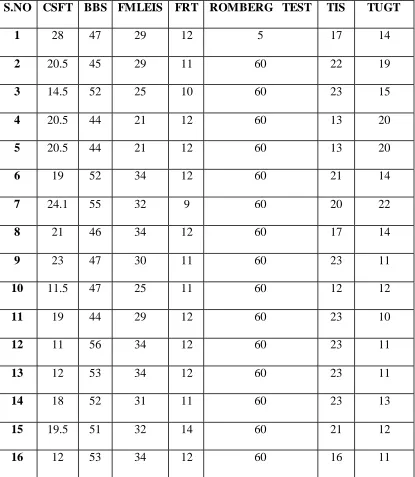
TABLE-1
Cross step moving on Four Spot Test, Trunk Impairment Scale, Romberg
test, functional reach test, Fugal Meyer Lower Extremity impairment scale,
Berg Balance Scale, time up go test values of stroke subjects (NO=30)
S.NO CSFT BBS FMLEIS FRT ROMBERG TEST TIS TUGT
1 28 47 29 12 5 17 14
2 20.5 45 29 11 60 22 19
3 14.5 52 25 10 60 23 15
4 20.5 44 21 12 60 13 20
5 20.5 44 21 12 60 13 20
6 19 52 34 12 60 21 14
7 24.1 55 32 9 60 20 22
8 21 46 34 12 60 17 14
9 23 47 30 11 60 23 11
10 11.5 47 25 11 60 12 12
11 19 44 29 12 60 23 10
12 11 56 34 12 60 23 11
13 12 53 34 12 60 23 11
14 18 52 31 11 60 23 13
15 19.5 51 32 14 60 21 12
15
17 16.5 53 34 12 60 23 11
18 19 51 31 12 40 19 12
19 9 53 34 14 60 22 9
20 11.5 50 34 13 60 21 10
21 14 52 34 12 60 23 13
22 18.5 52 34 14 60 20 10
23 12 53 34 14 60 23 11
24 15 54 34 14 60 22 10
25 17.5 51 32 14 60 21 9
26 16.5 53 33 11.5 60 23 13
27 9.5 52 32 15 60 21 9
28 22 54 26 15 60 19 10
29 25.5 53 28 12 30 21 11
16
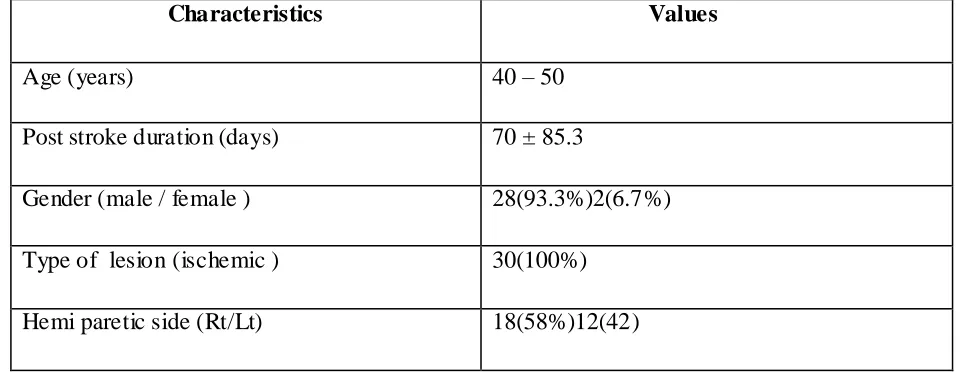
TABLE-2
DEMOGRAPHIC DATA OF STROKE PATIENTS: (N = 30)
Characteristics Values
Age (years) 40 – 50
Post stroke duration (days) 70 ± 85.3
Gender (male / female ) 28(93.3%)2(6.7%)
Type of lesion (ischemic ) 30(100%)
17
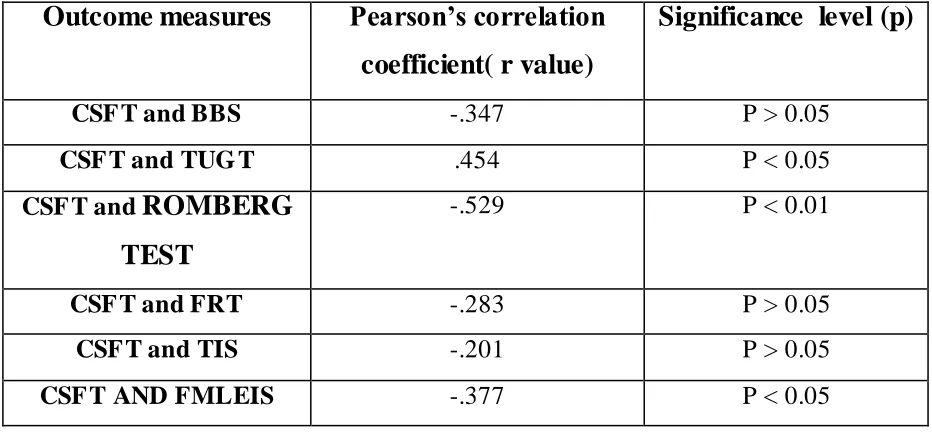
TABLE: 3
Pearson correlation coefficient values for CSFT and Berg Balance, Fugal
Meyer lower extremity scale, time up and go test, Trunk Impairment Scale,
functional reach test and Romberg test scores in stroke subjects:
Outcome measures
Pearson’s correlation
coefficient( r value)
Significance level (p)
CSF T and BBS -.347 P > 0.05
CSF T and TUG T .454 P < 0.05
CSF T and
ROMBERG
TEST
-.529 P < 0.01
CSF T and FRT -.283 P > 0.05
CSF T and TIS -.201 P > 0.05
CSF T AND FMLEIS -.377 P < 0.05
Based on Table 3, A Pearson product- moment correlation analysis shows that there is a strong, negative correlation between cross step moving on four spot test to berg balance scale (r=-.347, p=0.10), time up and go test(r=.454,p=0.05),Romberg test(r=-.529,p=0.01), functional reach test(r=-.290,p=0.10),trunk impairment scale(r=-.201,p=0.10),fugal Meyer lower extremity impairment scale (r=-.377, p=0.05) , which is not statistically significant.
18
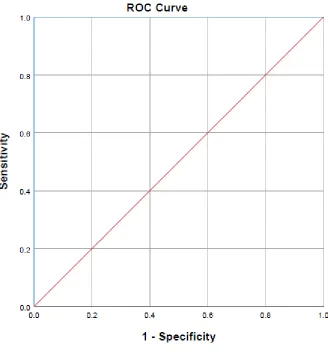
FIGURE- 1
Receiver operating characteristics curve by plotting correlation between cross step
moving on four spot test and time up and go test cut off score of high risk fall and
low risk fall in stroke patients.
19
CHAP TER - V
RESULTS AND DISSCUSSION
A total of 30 participants successfully completed all the seven tests involved in the study. using Pearson’s correlation the relation between cross step moving on four spot test and fall related physical function is calculated the Relation between the cross step moving on four spot test and berg balance scale showed, (r = .347) (p= 0.10)the moderate correlated. Relation between the cross step moving on four spot test and fugal Meyer lower extremity impairment scale showed (r = .377) the correlation significant at p= 0.05 level. Relation between the cross step moving four spot test and functional reach test showed (r =.290) (p=0.10) the weakly correlated. Relation between cross step moving on four spo t test and Romberg test showed r = -.529 the correlation significant at 0.01 level, Relation between cross step moving on four spot test and trunk impairment scale showed, (r = -.201)(p=0.10) the weakly correlated ,Relation between cross step moving on four spot test and time up and go test showed, (r = .454) the correlation significant at( p= 0.05) level
Using ROC curve to find the cut of score to identifying fall risk in stroke patients using cross step moving on four spot test and time up go test between, To find the cut off score between cross step moving on four spot test and time up and go test showed area under the curve valve is 1.000 it is a good valve and the fall risk cut off score in cross step moving on four spot test is 12.5 .therefore more than 12.5 score is high fall risk and less than 12.5 is low fall risk level.( sensitivity valve is 1.000 and specificity valve is 0.864).
20
SHUNSUKE YAMAJI et al., states that Rapid cross over stepping is considered to be important for avoiding falls. In cross over stepping the body position must change suddenly in an unstable direction, which rarely occurs under usual walking conditions. Difficult movements in addition to maintaining physical function (leg strength, balance and mobility) related to fall prevention are demanded of stroke participants for the CSFT to be successfully performed
SHINICHI DEMURA et al., states that many researchers have examined the relationship between falling, speed, and stability of gait in elderly individual. Kim et al., reported that elderly individuals with fall experience are more unstable in gait than those without such experience. Lee et al reported differences between groups with or without a previous fall in test, including a 2.45 m round trip walk, 10 m gait time, cadence and one leg standing. O n other hand a, relationship between muscle strength and, balance and those between muscle strength and walking speed were poor. Physical function such as strength, balance and mobility reflect and Falls in stroke patients with chronic disabilities have been associated with poor balance, activities of daily living and cognitive deficits are risk factor for falls in stroke patients. .
21
Stroke communities have highlighted the difficulties of developing a single predictive tool owing to the wide range of factors associated with falls (e.g fall history, impaired balance, altered mood and cognition), relating to environmental status (living in the community, hospital or supported housing) and the problems with validating fall events. The other variable that stood out was the River mead upper limb score. These findings suggested that sign of instability from falling poor upper limb function were relate to most at risk of falls. Repeat falle rs had worse upper limb function in comparison to non repeat fallers actually falling by using their arms.
PAO-TSAI CHENG et al., states that More than one third of falls in stroke patients occur while they are rising or sitting down, consequence of specific dysfunction, complex biomechanics underlying the performance of normal sit to stand. Dynamic postural balance characteristics during the way of rising / sitting down between healthy subjects and stroke patients is useful. Several condition may influence the dynamics of movement of the whole body during sit to stand transfer, such as subject age, variation in the speed rising, initial body position, and trunk flexion these factors are related to falls in stroke patients. Clinical experience suggested that body weight is usually distributed nearly symmetrically on the two legs when a healthy person rises or sits down, however body weight might be loaded more on one leg than the other if the person intends to move to the right or to the left after standing up. After stroke the patients usually use compensatory action of the uninvolved side, they spontaneously and constantly put more body weight on the non paretic leg when getting up from and sitting down on a chair. Engandt and associates the load on the paretic leg of stroke patients averaged 37% of body weight. Therefore the asymmetrical body weight distribution in stroke patients while rising and sitting down might be a contributing factor related to falls in stroke patients
22
In study conducted by ESTHER Y.et al., titled reliability and concurrent validity of four square step test scores in subjects with chronic stroke, they found that there will be loss of support and the participants were required to weight shift more laterally until the contra- lateral foot is lifted from floor.(single limb support phase)so this will lead to shift more weight either paretic or non paretic limb there by resulting in loss of stability resulting in stroke patients. In our present study the CSFT require more of complex clockwise and counter clockwise movement which will be difficult with stroke patient that was mention with above study. And also found that complex stepping sequence in the FSST is difficult for person with cognitive impairment .but in our present study cognitive level was more than 23 but the MMSE interpretation says that in stroke patients the value between 25- 30 has a significant degree of impairment and may have clinically significant but mild deficit likely to affect most demanding activities of daily living. So the CSFT require more of complex activity compare to normal ADL activities and also it is difficult for stroke patients.
In an article which was done to find the reliability and validity of STEP TEST score in subject with chronic stroke by SZE – JIA HONG et al., found that there is a correlation between and step test and they found BBS mean was score 50.3 which shows there is correlation coefficient of .675 and they stated that this is due to closer relation between similar items in BBS and STEP TEST. In our present study the BBS was 50.5 which show that there is a satisfactory balance performance. But comparing to the above study the components of the CSFT does not match with a BBS items and so there is no correlation between BBS and CSFT.
23
deficit likely to affect most demanding activities of daily living. So the CSFT require more of complex activity compare to normal ADL activities and also that it is most difficult for stroke patients to complete the CSFT even though with higher score of 34 indicating lesser impairment The result of the in this study says that using Pearson’s correlation relation between the CSFT and fall related physical function is calculated between CSFT and berg balance scale showed( r= 0.347 )(p= 0.10) moderately correlated, relation between CSFT and fugal Meyer lower extremity impairment scale showed( r= .377) (p= 0.05), CSFT and functional reach test showed r= 0.290 p=(0.10) weakly correlated, CSFT and Romberg test( r= .529) (p=0.01) significant correlated , CSFT and trunk impairment scale showed (r=.201) (p=0.10) weakly correlated , CSFT and time up go test showed( r=.201)correlation significant at level (p= 0.05) .
The ROC analysis in this study to identifying cut off value in the CSFT score of 12.5 seconds. Therefore >12.5 seconds high risk fall and < 12.5 seconds is low risk fall level (sensitivity value is 1.000) and (specificity value is 0.864). So in our study the stroke patients have a MMSE value between 25 and 30 and so there exists a significant degree of impairment and may have clinically significant but mild deficit likely to affect most demanding activities of daily living. So the CSFT require more of complex activity compare to normal AD L activities and also that it is most difficult for stroke patients to complete the CSFT.
LIMITATIONS:
According to the result, the cross step moving on four spot test may not be valid tool to measure fall risk in stroke patients due to small sample size.
Blinding was not done
SUGGESTIONS FOR FUTURE STUDY:
1. Future studies should examine the relationship between fall averting ability measure under simulated conditions and that measured using CSFT value.
24
CHAP TER - VI
CONCLUSIONS AND SUMMARY
25
BIBILOGRAPHY
1. Shunsuke Yamaji, PhD,., Reliability and Fall Experience Discrimination of Cross Step Moving on Four Spots Test in the Elderly. Archives of Physical Medicine and Rehabilitation 2013; 94:1312-9. 2013; 94:1312-9.
2. Noriaki Maeda1, PT, PhD, Yukio Urabe1, PT, PhD, Discriminant analysis for predictor of falls in stroke patients by using the Berg Balance Scale Singapore Med J 2015; 56(5): 280-283doi: 10.11622/smedj.2015033
3. Pao-Tsai Cheng, MD, Mei- Yun Liaw, MD,The Sit-to-Stand Movement in Stroke Patients And Its Correlation With Falling. Arch Phys Med Rehabil1998;79: 1043-6.1998;79: 1043-6.
4. Terry P Breisinger1,2, Elizabeth R Skidmore3,The Stroke Assessment of Fall Risk (SAFR): predictive validity in inpatient stroke rehabilitation . Clin Rehabil. 2014 December ; 28(12): 1218–1224. doi:10.1177/0269215514534276.
5. A. Ashburn1, d. Hyndman. Pickering, predicting people with stroke at risk of falls Age and Ageing 2008; 37: 270–276
6. Bogle Thorbahn LD, Newton RA: Use of the Berg Balance Test to predict falls in elderly Persons. Phys Ther 1996; 76: 576 – 585.
7. N maeda1,3, j kato2 and t shimada3 predicting the Probability for Fall Incidence in Stroke Patients Using the Berg Balance Scale. The Journal of International Medical Research. 2009; 37: 697 – 704
26
9. Seung Heon An,1 YunBok Lee2 and GyuChang Lee3Validity of the Performance-Oriented Mobility Assessment in Predicting Fall of Stroke Survivors: Tohoku J. Exp. Med., 2014, 233, 79-87Balance 2014, 233, 79-87
10.Efraim Aizen a,b,*, Elena Zlotver Prediction of falls in rehabilitation and acute care geriatric setting . Journal of Clinical Gerontology & Geriatrics 4 (2013) 57e61
11.Sherrington C, Lord SR, Close JC, et al. A simple tool predicted probability of Falling after aged care inpatient rehabilitation. J Clin Epidemiol 2011; 64:779
12.Nakagawa Y, Sannomiya K, Kinoshita M, et al. Development of an assessment Sheet for fall prediction in stroke inpatients in convalescent rehabilitation Wards in Japan. Environ Health Prev Med 2008; 13:138-47
13.Topper AK, Maki BE, Holliday PJ. Are activity-based assessments of balance and gait in the elderly predictive of risk of falling and/or type of fall? J Am Geriatr Soc 1993; 41:479-87.
14.Hill K, Schwarz J, Flicker L, and Carroll S. Falls among healthy, community-dwelling, older women: a prospective study of frequency, circumstances, consequences and prediction accuracy. Aust N Z J Public Health 1999; 23:41-8.
15.Mayo NE, Korner-Bitensky N, Becker R, Georges P. Predicting falls among patients in a rehabilitation hospital. Am J Phys MedRehabil 1989; 68:139-46.Nyberg L, Gustafson Y.
16.Rapport LJ, Webster JS, Fleming KL, Lindberg JW, GodlewskiMC, Brees JE, et al. Predictors of falls among right hemisphere stroke patients in the rehabilitation setting. Arch Phys Med Rehabil1993; 74:621-6.
17.Tiedemann A, Shimada H, Sherrington C, Murray S, Lord S. The comparative ability of eight functional mobility tests for predicting falls in community-dwelling older people. Age Ageing 2008; 37:430-5.
ANNEXURE II
NEUROLOGICAL ASSESSMENT FORM FOR STROKE
Medical Diagnosis:
Referred By:
Assessed by:
SUBJECTIVE EXAMINATION
DEMOGRAPHIC DATA
Name: OP No: IP No:
Age: Sex: Date:
Address:
Chief Complaints:
History of present illness:
Past history of current condition:
Past medical and surgical History:
Personal History:
Family History:
Occupational History:
History of living environment:
Social History:
Previous functional status:
Pain History
Side :
Site :
Onset :
Duration :
Type :
Aggravating factors :
Severity :
Vital Signs
Temperature :
Blood pressure :
Heart rate :
Respiratory rate :
OBJECTIVE EXAMINATION
ON OBSERVATION
Built :
Posture :
Attitude of limbs :
Muscle wasting :
Pattern of movement :
Gait :
Pressure sore :
Edema :
Tropical changes :
External appliances
:
On Palpation
Edema :
Tenderness :
Warmth :
1. HIGHER MENTAL FUNCTIONS
Level of consciousness
Orientation
Person :
Place :
Time :
Memory
Immediate :
Recent :
Remote :
Attention
:Communication
:Emotional status
:2. HIGHER CORTICAL FUNCTIONS
Fund of knowledge :
Calculation :
Proverb interpretation :
Perception:
Body scheme/ body image disorders:
Spatial relation disorders :
Agnosias :
Apraxia :
3. CRANIAL NERVES
4. SENSORY SYSTEM
5. MOTOR SYSTEM
Upper limb Lower limb
Muscle Power:
Voluntary motor control:
Right Left
Upper limb
Lower limb
Muscle girth:
AREA Rt(cms) Lt(cms)
Arm
Forearm
Thigh
Movement time:
Associated Reactions:
6. REFLEXES:
Superficial:
Abdominal :
Plantar :
Deep:
JERKS Rt Lt
Biceps
Brachio – radialis
Triceps
Knee
Ankle
Tonic Postural Reflexes:
7. INVOLUNTARY MOVEMENTS:
8. CO-ORDINATION
Equilibrium test :
9. BALANCE:
Balance Static Dynamic
Sitting
Standing
Centre of Gravity Control :
Balance Reactions :
Motor Strategies :
Sensory Strategies :
10. GAIT:
Bio mechanical deviations:
11. HAND FUNCTIONS:
Reaching :
Grasping :
Releasing :
12. ASSISTIVE DEVICES:
13. OTHER SYSTEMS:
Integumentary system :
Respiratory system :
Secretion :
Pattern of breathing :
Deformity :
Cardiovascular system:
Deep vein thrombosis :
Edema :
Musculoskeletal system:
Contracture :
Subluxation :
Stiffness :
Heterotopic ossification :
Osteoporosis :
Bladder and bowel function : Gastro intestinal system :
Sexual function :
Autonomic system:
Vasomotor :
Pseudomotor :
Postural hypotension:
Reflex sympathetic dystrophy:
14
.
FUNCTIONAL STATUS:
Bed mobility: Transfer:
PHYSICAL THERAPY DIAGNOSIS:
Direct impairments : Indirect impairments : Composite impairments : Functional limitations :
ANNEXURE - III
DATA COLLECTION FORM
Patient Name : Age :
Sex :
Occupation : Address : IP/ OP No : Contact no : Date of Assessment: Diagnosis : Post Stroke Duration:
OUTCOME MEASUREMENTS SCORING:
S.NO OUTCOME MEASURES TRIAL AVG. SCORE
1 Cross Step Moving On Four Spot Test I II
SCALES SCORE
2 Time Up Go Test
3 Berg Balance Scale
4 Fugl Meyer Assessment Lower Extremity
5 Functional Reach Test
6 Romberg Test
7 Trunk Impairment Scale
Date: Place:
ANNEXURE- IV
INFORMED CONSENT FOR PARTICIPATION IN RESEARCH STUDY PSG Institute of Medical Science and Research, Coimbatore
Institutional Human Ethics Committee
INFORMED CONSENT FORMAT FOR RESEARCH PROJECTS
I sathiyaraji carrying out a study on the topic: “CROSS STEP MOVING ON FOUR SPOT TEST VALIDITY AND IT IS RELATION WITH FALL RELATED PHYSICAL FUNCTION IN STROKE PATIENTS’’ as part of my research project being carried out under the aegis of the Department of Neurology & Physical Medicine and Rehabilitation.
My research guide is
:PROF. Mahesh.R , PRINCIPAL, PSG College of Physiotherapy.The justification for this study is:
The risk of falls is very high among stroke patients, and falling is a major complication in strike rehabilitation. there is also an overrepresentation of patients with previous stroke among hip fractures patients , and reducing these risk should be an essential element in rehabilitation strategies and predicting fall risk in stroke patients in advance and taking necessary precaution are included in our rehabilitation goals. So accordingly studies have been performed to identifying potential fallers using various scale like fall efficacy scale ,stroke assessment of fall risk,Demura fall risk assessment, BBS, Mini-Best scale and tests like alternative step test ,choice stepping reaction test ,four square test etc . Cross steps moving on four spot test is a new test used in geriatrics and studies have shown that it is a reliable and valid test to identify the fall risk in elderly participants. This test is not yet use in stroke population for same purpose. Therefore there is need to do a study to find its validity as well as a to find what are the impairments post stroke are related to this identify fall riskThe objectives of this study:
1. To find the validity of cross steps moving on four spot test.
2. To find relation between cross steps moving on four spot test and fall related physical function.
Sample size
: 47Study participants
are stroke subjects, age group of 40-60years.Location:
Department of neurology and Department of PMR, PSG Hospitals.We request you to kindly cooperate with us in this study. We propose collect background information and other relevant details related to this study. We will be carrying out:
Initial interview:
15 minutes.
Final interview:
15 minutes.If Photograph taken, purpose: yes, evidence for project purpose
Data collected will be stored for a period of 2 years. We will not use the data as part of another study. Health education sessions: number of sessions 1 approximate duration of each session: 15 minutes.
Clinical examination
(specify details purpose): YesBlood sample collection
: Not applicableSpecify quantity of blood being drawn: No. of times it will be collected:
Whether blood sample collection is part of routine procedure or for research (study) purpose: 1. Routine procedure 2. Research purpose
Specify purpose, discomfort likely to be felt and side effects, if any:
Whether blood sample collected will be stored after study period: Yes / No, it will be destroyed Whether blood sample collected will be sold: Yes/ No
Whether blood sample collected will be shared with persons from another institution: Yes/ No
Medication
given, if any, duration, side effects, purpose, benefits:Whether medication given is part of routine procedure: Yes / No (If not, state reasons for giving this medication)
Whether alternatives are available for medication given: Yes / No (If not, state reasons for giving this particular medication)
Data collected will be stored for a period of 2 years. We will not use the data as part of another study.
Benefits from this study
: Based on the results , if the test prove to be valid, then this test can be used as a tool to identify fall risk in stroke patients. In future studies this test can be used as an outcome measure to find the change in fall risk.Peer-reviewed scientific journals Conference presentation
Internal report
The data collected during the study will be used without revealing your identity. Your identity will be confidential even if the results of the study are published.
If you are uncomfortable in answering any of our questions during the course of the interview, you
have
the right to withdraw from the interview / study at anytime.
You have the freedom to withdraw from the study at any point of time. Kindly be assured that your refusal to participate or withdrawal at any stage, if you so decide, will not result in any form of compromise or discrimination in the services offered nor would it attract any penalty. You will continue to have access to the regular services offered to a patient. You will NOT be paid any remuneration for the time you spend with us for this interview / study. The information provided by you will be kept in strict confidence. Under no circumstances shall we reveal the identity of the respondent or their families to anyone. The information that we collect shall be used for approved research purposes only. You will be informed about any significant new findings - including adverse events, if any, – whether directly related to you or to other participants of this study, developed during the course of this research which may relate to your willingness to continue participation.Consent:
The above information regarding the study, has been read by me/ read to me, and has been explained to me by the investigator/s. Having understood the same, I hereby give my consent to them to interview me. I am affixing my signature / left thumb impression to indicate my consent and willingness to participate in this study (i.e., willingly abide by the project requirements).Signature / Left thumb impression of the Study Volunteer / Legal Representative: Signature of the Interviewer with date: Witness: Contact number of PI: 7867997839
Contact number of Ethics Committee Office: 0422 4345818
â. º¡. §¸¡ ÁÕòÐÅì ¸øæâ ÁüÚõ ¬Ã¡ö ¿¢ÚÅÉõ, §¸¡¨Å
ÁÉ¢¾ ¦¿È¢Ó¨Èì ÌØ
´ôÒ¾ø ÀÊÅõ
§¾¾¢:
¾. ºò¾¢Âሠ¬¸¢Â ¿¡ý ⺡§¸¡ ÁÕòÐÅì ¸øæâ¢ý / ÁÕòÐÅÁ¨É¢ý ¿ÃõÀ¢Âø
ШÈ¢ý ¸£ú Àì¸Å¡¾ §¿¡Â¡Ç¢¸Ç¢ø ¿¡ýÌ þ¼ÌÚìÌ ¿¸÷×
(Cross Step moving on
four spot test)
«Çţ𨼠Á¾¢ôÀ¢Î¾Öõ, §¿¡Â¡Ç¢ ¯¼ø ¦ºÂøÀ¡ðÊý §À¡Ð ¸£§Æ Å¢Øõ
¾ý¨Á¢ø «¾ý ÀÂýÀ¡Îõ ±ýÈ ¾¨ÄôÀ¢ø ¬ö× §Áü¦¸¡ûÇ ¯û§Çý.
±ý ¬ö× ÅÆ¢¸¡ðÊ: §ÀẢâÂ÷ ¾¢Õ. á. Á§¸‰, Ó¾øÅ÷, ⺡§¸¡ À¢º¢§Â¡¦¾ÃÀ¢ ¸øæâ
¬ö× §Áü¦¸¡ûžü¸¡É «ÊôÀ¨¼:
¿¡ýÌ þ¼ÌÚìÌ ¿¸÷× §º¡¾¨É¡ÉРž¡ÉÅ÷¸Ç¢ø ¯¼ø ¦ºÂøÀ¡ðÊý §À¡Ð ¸£§Æ
Å¢Øõ ¾ý¨Á¢ø «¾ý ÀÂýÀ¡ðÊý «Çţ𨼠Á¾¢ôÀ¢ðÎûÇÉ÷. ¬É¡ø Àì¸Å¡¾
§¿¡Â¡Ç¢¸Ç¢ø þó¾ ¿¡ýÌ þ¼ÌÚìÌ ¿¸÷× §º¡¾¨É¢ý «Çţ𨼠Àì¸Å¡¾ §¿¡Â¡Ç¢¸Ç¢ø
«¾ý ÀÂýÀ¡ðÊý Á¾¢ôÀ£Î¸¨Ç ¸ñ¼È¢ÂôÀ¼Å¢ø¨Ä ¬¨¸Â¡ø þó¾ ¬ö×
§Áü¦¸¡ûÇôÀθ¢ÈÐ ÁüÚõ þó¾ Ò¾¢Â §º¡¾¨É¨ÂÔõ ÁüÈ ¯¼ø ¦ºÂøÀ¡ðÊý ¦¾¡¼÷À¡É
§º¡¾¨É¸¨ÇÔõ ´ôÀ¢ðÎ À¡÷òÐ «¨Å¸Ç¢ý Á¾¢ôÒ¸ÙìÌ þ¨¼§ÂÂ¡É ¯È× Á¾¢ôÀ£Î
¦ºöÂôÀθ¢ÈÐ.
¬¯Å¢ý §¿¡ì¸õ:
1.
¿¡ýÌ þ¼ÌÚìÌ ¿¸÷× §º¡¾¨É¢ý «Çţ𨼠Á¾¢ôÀ¢Î¾ø.
2.
¿¡ýÌ þ¼ÌÚìÌ ¿¸÷× §º¡¾¨É ÁüÚõ ¯¼ø ¦ºÂøÀ¡ðÊý §À¡Ð ¸£§Æ Å¢Øõ ¾ý¨Á¢ø
«¾ý ÀÂýÀ¡ðÊüÌõ þ¨¼§Â ¯ûÇ ¯È׸¨Ç Á¾¢ôÀ¢Î¾ø.
3.
Àì¸Å¡¾ §¿¡Â¡Ç¢¸Ç¢ý ¯¼ø ¦ºÂøÀ¡ðÊý §À¡Ð ¸£§Æ Å¢Øõ ¾ý¨Á¢ø «¾ý ÀÂýÀ¡Î
ÁüÚõ «ÇÅ£ðÊý Á¾¢ôÒ¸û ¸ñ¼È¢¾ø.
¬öÅ¢ø ÀíÌ ¦Àڧš÷ ÁüÚõ ÅÂÐ: 40-50 ÅÂÐìÌðÀð¼ Àì¸Å¡¾ §¿¡Â¡Ç¢¸û, ¡÷ ¯¾Å¢Ôõ
þøÄ¡Áø ¾¡§É ¿¼ô§À¡÷.
¬ö× §Áü¦¸¡ûÙõ þ¼õ: ¿ÃõÀ¢Âø ШÈ, ÒÉ÷Å¡ú× Ð¨È ÁüÚõ ⺡§¸¡ ÁÕòÐÅÁ¨É,
§¸¡ÂõÒòà÷.
þó¾ ¬öÅ¢ø ±í¸Ù¼ý ´òШÆìÌÁ¡Ú §¸ðÎ즸¡û¸¢§È¡õ. ¿¡í¸û º¢Ä ¾¸Åø¸¨Ç þó¾
¬öÅ¢ü¸¡¸ §º¸Ã¢ì¸ ¯û§Çý.
¬ö× ¦ºöÂôÀÎõ Ó¨È:
þó¾ ¬öÅ¢ý ¦Á¡ò¾ ¸¡Ä «Ç× 8 Á¡¾í¸û, Ó¾ø ÅÕ¨¸Â¢ý §À¡Ð ÐÅì¸ ¿¢¨Ä
¬ö× ¦ºö¾ À¢ÈÌ ¬öÅ¢Ûû §º÷ì¸ôÀÎÅ÷. À¢ÈÌ ÌÚìÌ ÀÊ ¿¡ýÌ þ¼õ §º¡¾¨É¢ý
¯¾Å¢§Â¡Î «¾Û¨¼Â ¸¡Äõ ¸ñ¼È¢ÂôÀðÎ «¾ý À¢ÈÌ ÁüÈ §º¡¾¨É¸Ç¢ý ¸¡ÄÓõ
¸ñ¼È¢ÂôÀÎõ.
Ó¾ý¨Á §¿÷¸¡½ø: §º¡¾¨É ¦ºöÐ ÓÊìÌõ §¿Ãõ Ũà ±ÎòÐ즸¡ûÙõ §¿Ãõ 15 ¿¢Á¢¼õ.
þó¾ ¬öÅ¢ø ¸¢¨¼ìÌõ ¾¸Åø¸û 5 ÅÕ¼í¸û À¡Ð¸¡ì¸ôÀÎõ. þó¾ ¾¸Åø¸û §ÅÚ ¬öÅ¢üÌô
ÀÂýÀÎò¾ô À¼ Á¡ð¼¡Ð.
͸¡¾¡Ãì ¸øÅ¢: «Á÷׸û: __ Ó¨È ´Õ «Á÷×ì¸¡É §¿Ãõ: __ ¿¢Á¢¼í¸û
ÁÕòÐÅ À⧺¡¾¨É¸û: ¯ûÇÐ
þÃò¾ Á¡¾¢Ã¢ §º¸Ã¢ôÒ: ____ Á¢Ä¢ ____ Ó¨È
¦À¡Õó¾¡Ð
þÃò¾ Á¡¾¢Ã¢ ±ÎôÀÐ ÅÆì¸Á¡É º¢¸¢î¨ºì¸¡¸§Å¡ «øÄÐ þó¾ ¬öÅ¢ü¸¡¸§Å¡:
¦À¡Õó¾¡Ð
þÃò¾ Á¡¾¢Ã¢¸û ¬öÅ¢üÌô À¢ý À¡Ð¸¡òÐ ¨Åì¸ôÀÎÁ¡? ¬õ / þø¨Ä, «Æ¢ì¸ôÀÎõ:
¦À¡Õó¾¡Ð
§º¸Ã¢ì¸ôÀð¼ þÃò¾õ Å¢ü¸ôÀÎÁ¡? ¬õ / þø¨Ä ¦À¡Õó¾¡Ð
ÁÕóиû ²§¾Ûõ ¦¸¡Îì¸ôÀ¼Å¢Õó¾¡ø «¨Å ÀüȢ ŢÅÃõ (¦¸¡Îì¸ôÀÎõ ¸¡Ã½õ, ¸¡Äõ,
Àì¸ Å¢¨Ç׸û, ÀÂý¸û): ¦À¡Õó¾¡Ð
ÁÕóиû ¦¸¡Îì¸ôÀÎÅÐ ÅÆì¸Á¡É º¢¸¢î¨º Өȡ?: ¬õ / þø¨Ä (þø¨Ä ±ýÈ¡ø
¦¸¡Îì¸ôÀÎõ ¸¡Ã½õ) ¦À¡Õó¾¡Ð
¦¸¡Îì¸ôÀÎõ ÁÕóиÙìÌ Á¡üÚ ¯ûǾ¡?: ¬õ / þø¨Ä (¬õ ±ýÈ¡ø þó¾ ÌÈ¢ôÀ¢ð¼
ÁÕóÐ ¦¸¡Îì¸ôÀÎõ ¸¡Ã½õ) ¦À¡Õó¾¡Ð
¬öÅ¢ø Àí̦ÀÚž¡ø ²üÀÎõ ÀÄý¸û:
¿¡ýÌ þ¼õ ÌÚìÌ ÀÊ §º¡¾¨É. þÐ Ó¾¢§Â¡÷¸ÙìÌ ÀÂýÀÎò¾ôÀð¼Ð ÁüÚõ ÀÄ ¬ö׸û
þó¾ §º¡¾¨É ´Õ ¿õÀ¸Á¡É ¬ö׸û ±É ¦¾Ã¢Å¢ò¾¢Õ츢ýÈÉ.. ¬É¡ø þó¾ §º¡¾¨É
þÐŨà Àì¸Å¡¾ §¿¡Â¡Ç¢¸ÙìÌ ÀÂýÀÎò¾Å¢ø¨Ä. ±É§Å þó¾ §º¡¾¨É Àì¸Å¡¾
§¿¡Â¡Ç¢¸Ç¢ý ¸£§Æ Ţؾø ÍÄÀÁ¡¸ ¸ñ¼È¢Â §¾¨ÅôÀθ¢ÈÐ ÁüÚõ ¿õÀ¸Á¡É¾¡ ±É Å£ú
¦¾¡¼÷À¡É ¦ºÂø À¡Î¸¨ÇÔõ ¸ñ¼È¢ÂôÀθ¢ÈÐ.
¬öŢɡø ²üÀ¼ì ÜÊ «¦ºª¸Ã¢Âí¸û / Àì¸ Å¢¨Ç׸û: ¿¡ýÌ þ¼ÌÚìÌ ¿¸÷×
§º¡¾¨É¡ÉÐ ¦ÀâÂÅ÷¸ÙìÌ ¸£§Æ Ţؾø ÀüÈ¢ ¬ö׸û §Áü¦¸¡ñÎûÇÉ÷. ¬É¡ø þó¾
¿¡ýÌ þ¼ÌÚìÌ ¿¸÷× §º¡¾¨É Àì¸Å¡¾ ¦¿¡Â¡Ç¢¸ÙìÌ ÀÂýÀÎò¾¢ þÐŨà ¬ö׸û
§Áü¦¸¡ûÇÅ¢ø¨Ä. ±É§Å, þó¾ §º¡¾¨É ¦ºöÂôÀÎõ§À¡Ð ±ùÅ¢¾ Àì¸Å¢¨Ç׸Ùõ ²üÀ¼¡Ð.
§ÁÖõ, §º¡¾¨É ¦ºöÔõ§À¡Ð Àì¸Å¡ðÊø ÍüÈ¢Öõ ÀïÍ ¦Áò¨¾ «¨Áì¸ôÀðÊÕìÌõ ÁüÚõ
¬öÅ¡Ç÷ Àì¸Å¡ðÊø þÕôÀ¡÷.
¬öÅ¢ý ÓÊ׸û ±ó¾ ӨȢø ÀÂýÀÎò¾ôÀÎõ?
¬öÅ¢ý §À¡Ð §º¸Ã¢ì¸ôÀð¼ ¯í¸û «¨¼Â¡Çò¨¾ ¦ÅÇ¢ôÀÎò¾¡Áø ÀÂýÀÎò¾ôÀÎõ. ¬öÅ¢ý
ÓÊ׸û ¦ÅÇ¢ð¢¼ôÀð¼¡Öõ ¾í¸û «¨¼Â¡Çõ þøº¢ÂÁ¡¸ ¨Åì¸ôÀÎõ.
«Ç¢ì¸ôÀÎõ º¢¸¢î¨º ӨȢø ±ó¾ Å¢¾ À¡¾¢ôÒõ þÕ측Р±ýÚ ¯í¸ÙìÌ ¯Ú¾¢ÂǢ츢§È¡õ.
ÁÕòÐÅ Á¨É¢ø §¿¡Â¡Ç¢¸ÙìÌ «Ç¢ì¸ôÀÎõ §º¨Å¸¨Ç ¿£í¸û ¦¾¡¼÷óÐ ¦ÀÈÄ¡õ. þó¾
¬öÅ¢ø Àí§¸ü¸ ´ôÒ즸¡ûÙž¡ø §ÅÚ ±ó¾ Å¢¾Á¡É ÜÎ¾Ä¡É ÀÄÛõ ¯í¸ÙìÌì
¸¢¨¼ì¸¡Ð. ¿£í¸û «Ç¢ìÌõ ¾¸Åø¸û þøº¢ÂÁ¡¸ ¨Åì¸ôÀÎõ. ¬öÅ¢ø Àí§¸üÀÅ÷¸û ÀüÈ¢§Â¡
«Å÷¸û ÌÎõÀò¨¾ô ÀüÈ¢§Â¡ ±ó¾ò ¾¸ÅÖõ ±ì¸¡Ã½õ ¦¸¡ñÎõ ¦ÅǢ¢¼ôÀ¼¡Ð ±ýÚ
¯Ú¾¢ÂǢ츢§È¡õ. ¿£í¸û «Ç¢ìÌõ ¾¸Åø¸û / þÃò¾ Á¡¾¢Ã¢¸û / ¾¢Í Á¡¾¢Ã¢¸û «í¸£¸Ã¢ì¸ôÀð¼
¬öÅ¢üÌ ÁðΧÁ ÀÂýÀÎò¾ôÀÎõ. þó¾ ¬ö× ¿¨¼¦ÀÚõ ¸¡Äò¾¢ø ÌÈ¢ôÀ¢¼ò¾Ìó¾ Ò¾¢Â
¸ñÎÀ¢ÊôÒ¸û «øÄÐ Àì¸ Å¢¨Ç׸û ²Ðõ ²üÀð¼¡ø ¯í¸ÙìÌò ¦¾Ã¢Å¢ì¸ôÀÎõ. þ¾É¡ø
¬öÅ¢ø ¦¾¡¼÷óÐ ÀíÌ ¦ÀÚÅÐ ÀüȢ ¯í¸û ¿¢¨ÄôÀ¡ð¨¼ ¿£í¸û ¦¾Ã¢Å¢ì¸ ²ÐÅ¡Ìõ.
¬ö×ìÌðÀÎÀÅâý ´ôÒ¾ø: þó¾ ¬ö¨Åô ÀüȢ §ÁüÜȢ ¾¸Åø¸¨Ç ¿¡ý ÀÊòÐ «È¢óÐ
¦¸¡ñ§¼ý / ¬öÅ¡Ç÷ ÀÊì¸ì §¸ðÎò ¦¾Ã¢óÐ ¦¸¡ñ§¼ý. ¬öÅ¢¨Éô ÀüÈ¢ ¿ýÈ¡¸ô ÒâóÐ
¦¸¡ñÎ þó¾ ¬öÅ¢ø ÀíÌ ¦ÀÈ ´ôÒ즸¡û¸¢§Èý. þó¾ ¬öÅ¢ø Àí§¸üÀ¾ü¸¡É ±ÉÐ
´ôÒ¾¨Ä ¸£§Æ ¨¸¦Â¡ôÀÁ¢ðÎ / ¨¸ §Ã¨¸ À¾¢òÐ ¿¡ý ¦¾Ã¢Å¢òÐì ¦¸¡û¸¢§Èý.
Àí§¸üÀ¡Çâý ¦ÀÂ÷, Ó¸Åâ:
Àí§¸üÀ¡Çâý ¨¸¦Â¡ôÀõ / ¨¸ §Ã¨¸ / ºð¼ôâ÷Å À¢Ã¾¢¿¢¾¢Â¢ý ¨¸¦Â¡ôÀõ:
§¾¾¢ :
¬öÅ¡Çâý ¨¸¦Â¡ôÀõ:
§¾¾¢ :
¬öÅ¡Çâý ¦¾¡¨Ä§Àº¢ ±ñ: 7867997839
ANNEXURE- V
ASSESSMENT TOOLS
CROSS STEP MOVING ON FOUR SPOT TEST
BERG BALANCE SCALE:
The Berg Balance Scale (BBS) was developed to measure balance among older people with impairment in balance function by assessing the performance of functional tasks. It is a valid instrument used for evaluation of the effectiveness of interventions and for quantitative
descriptions of function in clinical practice and research. The BBS has been evaluated in several reliability studies. A recent study of the BBS, which was completed in Finland, indicates that a change
of eight (8) BBS points is required to reveal a genuine change in function between two assessments
among older people who are dependent in ADL and living in residential care facilities. Description:
14-item scale designed to measure balance of the older adult in a clinical setting.
Equipment needed: Ruler, two standard chairs (one with arm rests, one without), footstool or step, stopwatch or wristwatch, 15 ft walkway
Completion:
Time: 15-20 minutes
Scoring: A five-point scale, ranging from 0-4. “0” indicates the lowest level of function and “4” the highest level of function.
Total Score = 56
Interpretation:
41-56 = low fall risk 21-40 = medium fall risk 0 –20 = high fall risk
A change of 8 points is required to reveal a genuine change in function between 2 assessments. Berg Balance Scale
ITEM DESCRIPTION SCORE (0-4)
Sitting to standing ________ Standing unsupported ________ Sitting unsupported ________ Standing to sitting ________ Transfers ________
Standing with eyes closed ________ Standing with feet together ________
Reaching forward with outstretched arm ________ Retrieving object from floor ________
Turning to look behind ________ Turning 360 degrees ________
Placing alternate foot on stool ________ Standing with one foot in front ________ Standing on one foot ________
Total ________
GENERAL INSTRUCTIONS
Please document each task and/or give instructions as written. When scoring, please record the lowest response category that applies for each item.
In most items, the subject is asked to maintain a given position for a specific time. Progressively more points are deducted if:
• the time or distance requirements are not met • the subject’s performance warrants supervision
• the subject touches an external support or receives assistance from the examiner
Subject should understand that they must maintain their balance while attempting the tasks. The choices of which leg to stand on or how far to reach are left to the subject. Poor judgment will adversely influence the performance and the scoring.
Equipment required for testing is a stopwatch or watch with a second hand, and a ruler or other indicator of 2, 5, and 10 inches. Chairs used during testing should be a reasonable height. Either a step or a stool of average step height may be used for item # 12.
SITTING TO STANDING
INSTRUCTIONS: Please stand up. Try not to use your hand for support. ( ) 4 able to stand without using hands and stabilize independently
( ) 3 able to stand independently using hands ( ) 2 able to stand using hands after several tries ( ) 1 needs minimal aid to stand or stabilize ( ) 0 needs moderate or maximal assist to stand
STANDING UNSUPPORTED
INSTRUCTIONS: Please stand for two minutes without holding on. ( ) 4 able to stand safely for 2 minutes
( ) 3 able to stand 2 minutes with supervision ( ) 2 able to stand 30 seconds unsupported
( ) 1 needs several tries to stand 30 seconds unsupported ( ) 0 unable to stand 30 seconds unsupported
If a subject is able to stand 2 minutes unsupported, score full points for sitting unsupported. Proceed to item #4.
SITTING WITH BACK UNSUPPORTED BUT FEET SUPPORTED ON FLOOR OR ON A STOOL
INSTRUCTIONS: Please sit with arms folded for 2 minutes. ( ) 4 able to sit safely and securely for 2 minutes
( ) 3 able to sit 2 minutes under supervision ( ) 2 able to able to sit 30 seconds
( ) 1 able to sit 10 seconds
( ) 0 unable to sit without support 10 seconds
STANDING TO SITTING
INSTRUCTIONS: Please sit down. ( ) 4 sits safely with minimal use of hands ( ) 3 controls descent by using hands
TRANSFERS
INSTRUCTIONS: Arrange chair(s) for pivot transfer. Ask subject to transfer one way toward a seat with armrests and one way
toward a seat without armrests. You may use two chairs (one with and one without armrests) or a bed and a chair.
( ) 4 able to transfer safely with minor use of hands ( ) 3 able to transfer safely definite need of hands
( ) 2 able to transfer with verbal cuing and/or supervision ( ) 1 needs one person to assist
( ) 0 needs two people to assist or supervise to be safe
STANDING UNSUPPORTED WITH EYES CLOSED
INSTRUCTIONS: Please close your eyes and stand still for 10 seconds. ( ) 4 able to stand 10 seconds safely
( ) 3 able to stand 10 seconds with supervision ( ) 2 able to stand 3 seconds
( ) 1 unable to keep eyes closed 3 seconds but stays safely ( ) 0 needs help to keep from falling
STANDING UNSUPPORTED WITH FEET TOGETHER
INSTRUCTIONS: Place your feet together and stand without holding on. ( ) 4 able to place feet together independently and stand 1 minute safely
( ) 3 able to place feet together independently and stand 1 minute with supervision ( ) 2 able to place feet together independently but unable to hold for 30 seconds ( ) 1 needs help to attain position but able to stand 15 seconds feet together ( ) 0 needs help to attain position and unable to hold for 15 seconds
REACHING FORWARD WITH OUTSTRETCHED ARM WHILE STANDING
INSTRUCTIONS: Lift arm to 90 degrees. Stretch out your fingers and reach forward as far as you can. (Examiner places a ruler at
the end of fingertips when arm is at 90 degrees. Fingers should not touch the ruler while reaching forward. The recorded measure is
both arms when reaching to avoid rotation of the trunk.) ( ) 4 can reach forward confidently 25 cm (10 inches) ( ) 3 can reach forward 12 cm (5 inches)
( ) 2 can reach forward 5 cm (2 inches) ( ) 1 reaches forward but needs supervision
( ) 0 loses balance while trying/requires external support
PICK UP OBJECT FROM THE FLOOR FROM A STANDING POSITION INSTRUCTIONS: Pick up the shoe/slipper, which is in front of your feet. ( ) 4 able to pick up slipper safely and easily
( ) 3 able to pick up slipper but needs supervision
( ) 2 unable to pick up but reaches 2-5 cm(1-2 inches) from slipper and keeps balance independently
( ) 1 unable to pick up and needs supervision while trying
( ) 0 unable to try/needs assist to keep from losing balance or falling
TURNING TO LOOK BEHIND OVER LEFT AND RIGHT SHOULDERS WHILE STANDING
INSTRUCTIONS: Turn to look directly behind you over toward the left shoulder. Repeat to the right. (Examiner may pick an object
to look at directly behind the subject to encourage a better twist turn.) ( ) 4 looks behind from both sides and weight shifts well
( ) 3 looks behind one side only other side shows less weight shift ( ) 2 turns sideways only but maintains balance
( ) 1 needs supervision when turning
( ) 0 needs assist to keep from losing balance or falling
TURN 360 DEGREES
INSTRUCTIONS: Turn completely around in a full circle. Pause. Then turn a full circle in the other direction.
( ) 4 able to turn 360 degrees