Effectiveness of formative online quizzes in learning and
teaching a structural engineering course
Thiru Aravinthan1, Weena Lokuge2 and Allan Manalo3 University of Southern Queensland, Toowoomba, Australia [email protected]; [email protected]; [email protected]
Abstract: Formative assessments in the form of online quizzes are currently being
introduced by several lecturers in order to enhance the students’ learning experience and student engagement. Previous research has shown that the use of weekly online quizzes facilitate the students learning especially to resolve problems with weaker students under-performing in particular courses. The online quizzes have been adopted by others to provide flexible assess to self-paced interactive study materials and to self-assess the progress of study for on-campus teaching. While the online or paper-based quizzes are effective in on-campus delivery as reported elsewhere, they become very valuable tool and imperative especially when the courses are offered in dual-mode delivery (on-campus and external) in a flexible online environment as offered at University of Southern Queensland. Online quizzes are considered to be effective learning tools as formative assessments especially to those students who choose to learn through independent mode of study as they can give instantaneous feedback regarding their progress in understanding the key-concepts. Are these formative assessments increase
the students’ overall performance in their summative assessment where students are
required to demonstrate their understanding through assignments and exams? While some studies reported that students who elected to use online quizzes performed better in summative assessments, there are others reporting there is no correlation between the performance in formative quizzes and the subsequent performance on summative
assessments. In this study, we evaluate the overall performance of the students in a higher level structural design course where self-assessment quizzes were made available as formative assessments through the Moodle learning management system. Four years of data has been investigated to determine the effectiveness of the online quizzes to their learning of the course. The results showed there is a strong correlation between students who attempt the quizzes and their overall student performance assessed by final grades. The challenges in delivering the quizzes in flexible environment and increasing the student participation are also discussed. This paper will further discuss the important aspects that need to be considered when developing well formulated quizzes for technical courses and thereby maximising their potential as an effective learning and teaching tool.
Introduction
Online course developers agree that teaching and maintaining an online course takes a considerable amount of time (Green, 1997). However, time is well spent since the material developed in an online course can be used to assist in student’s learning. Formative assessments in the form of online quizzes
are currently being introduced by several lecturers in order to enhance the students’ learning
experience and student engagement. Formative assessment has been shown to be highly effective in
raising the level of student attainment, increasing equity of student outcomes and improving students’
student perspective, if the online formatives quiz ‘doesn’t count’, then why bother? Dobson (2008) indicated that students will only use formative assessments if they also view them to be worthwhile. Cherem (2011) suggested that formative assessments establish a more comfortable learning and
increase students’ potential for success on the summative final exam. Anderson (2009) recommended
that formative assessment should deal with the fundamental concepts that students need to know about a new topic, and how to place the basic information in its correct context.
Gretes and Green (2000) found a positive relationship between the number of practice tests attempted by students and course grades. Qualitative feedback from students of online and computer-based assessment showed improved student motivation and increased incidence of revision and enhanced engagement with the subject material. Daymont and Blau (2008) commented that there is a strong correlation between the average quiz score and final course grades showing the effectiveness of formative assessment. They also found out that there is a significant difference on the performance of students in online and traditional classroom management courses who have attempted the formative quizzes. Anderson (2009) also found that the substantially higher correlation between the online quiz for formative assessment and the summative assessment provided the students utilised this tool for gauging their achievement of the course learning outcomes. In this study, the effectiveness of online formative quizzes in learning and teaching a structural engineering course is determined. Similarly, the effectiveness of these quizzes as a teaching tool in varied learning environments such as both online and face-to-face classes are evaluated. The results of this study also provided an opportunity to
identify areas for further improvement to effectively utilise the formative assessments for best possible learning opportunities to students in structural engineering courses.
Course structure
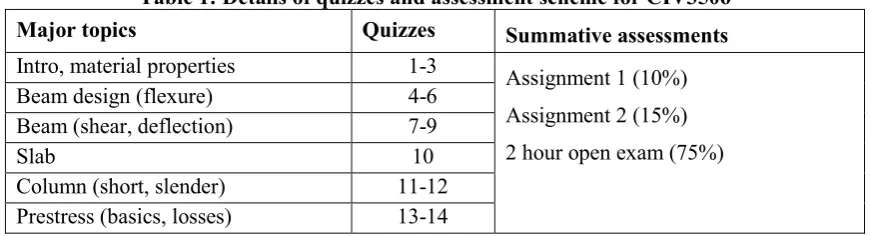
Concrete structures (CIV3506) is a design based course for bachelor of engineering program (civil engineering major) taught in the 3rd year of study. In this course, 14 quizzes were developed and progressively released throughout the semester. Students attempt these online quizzes as formative assessment, hence the marks for quizzes are not counted towards the final grade. The intent of this formative assessment is to encourage students to read ahead in the course lecture notes and textbook so that they would be better prepared for class meetings. These quizzes were developed in such a way to cover all the topics in the course to reinforce the key concepts in each topic. Table 1 shows the assessment scheme for this course, where the summative assessment consists of two assignments and an exam. The first assignment gauges the students’ knowledge on reinforced concrete beam design
[image:2.595.80.516.547.665.2]while the second assignment on slab, column and prestressed concrete design. The assessment scheme is designed in such a way that the quizzes are meant to facilitate fundamental concept learning, while the assignments check a deeper understanding of the design of structural elements and the exam is to confirm their understanding on critical objectives.
Table 1: Details of quizzes and assessment scheme for CIV3506
Major topics Quizzes Summative assessments
Intro, material properties 1-3
Assignment 1 (10%)
Assignment 2 (15%)
2 hour open exam (75%)
Beam design (flexure) 4-6
Beam (shear, deflection) 7-9
Slab 10
Column (short, slender) 11-12
Prestress (basics, losses) 13-14
Quiz design
understanding on the topics discussed. In modules that covered design of elements (such as beam or column), the questions in the quiz were designed in such a way that lead them through grasping the steps involved in the design of concrete structures. Hence, a wrong answer in the early steps could result in getting all the other questions wrong with consequent erroneous design. Immediate general feedback is given after the attempt of the quiz and in the case of distracters, more specific feedback is also provided why the selection is wrong. The online quizzes were developed and administered via the learning management system Moodle, which is an open-source software. Quizzes were released progressively throughout the semester. In Moodle, as soon as the students attempted the quiz, the correct answers and feedback could be released. In addition, Moodle also gives automatic scoring and reporting facilities that can be explored for evaluating the learning and teaching performances. In this case, reports can be generated on how many times a student attempts the quizzes and when they attempt. Furthermore, students are allowed several attempts to answer the quiz so that they can access this learning resource throughout the course of the semester. The quiz has no time limit such that the students have sufficient time to analyse each question and refer to study materials. This allows more flexibility for students to choose the times when they are productively engaged in the course rather than be constrained by the specific duration of a summative online quiz.
Data collection and analysis
The method of data collection for quizzes involved generating reports through Moodle. The data for
the students’ performance was extracted from the assignment and examination marks. The analysis was aimed for four years (2008-2011). The data reported for each year includes both on-campus and external modes of study. Data was compiled into spreadsheets and analysis was performed. Activity reports for individual students were also extracted to see how and when the students have completed the quizzes. As the online quizzes are not marked, the number of quiz that the students attempted is correlated with their overall performance. An analysis on how every student performed on the quizzes and how their overall grades were impacted was also conducted.
Results
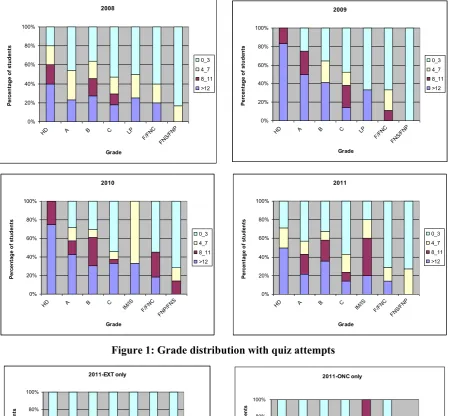
Table 2 shows the number of students who attempted the quiz and their corresponding grades. As indicated, there is an increasing number of students who attempted the quiz from 2008 to 2011. The distribution of the number of attempts and the overall performance of the students for four consecutive years is shown in Figure 1. In the figure, the number of attempts were grouped according to students who have attempted only up to 3 quizzes (0-3), between 4 and 7 (4-7), between 8 to 11 (8-11) and students who have attempted more than 12 out of the 14 quizzes (>12). Overall performance included three assessment items namely, Assignment 1, Assignment 2 and the final exam. The results shown in Figure 1 includes both on-campus and external cohorts of students.
Table 2: Number of students attempted quizzes and their corresponding grades in CIV3506
Year HD A B C LP/IM/IS F/FNC FNS/FNP Total
2008 5 13 11 17 4 10 6 66
2009 6 8 17 22 3 9 12 77
2010 4 14 23 24 3 11 7 86
2011 10 13 28 14 3 5 11 84
Total 25 48 79 77 13 35 36 313
Note:
HD – High Distinction, A – Distinction, B – Credit, C – Pass,
LP – Low Pass, IM – Incomplete (Make-up work), IS – Incomplete (Supplementary exam), F – Fail, FNC - Fail (Did not complete), FNS - Fail (Did not Sit), FNP - Fail (Did not participate).
Figure 1: Grade distribution with quiz attempts
Figure 2: Grade distribution for external and on campus students in 2011
In the extreme ends of the grade scale, it can be observed that there are some students who achieved HD (high-distinction) without attempting the quizzes at all and there are some students who tried all the quizzes but failed. In order to analyse this, 2011 year was taken as the sample (Figure 2).
When the results are carefully analysed it can be seen that majority of the students who did not do quizzes and obtained HD are on-campus students. Similarly, it was noted some students have attempted all the quizzes but obtained a F (fail) grade. However, their attempts of quizzes were mostly observed to be on the day or day before the examination, which was not the intent of these online quizzes. 2008 0% 20% 40% 60% 80% 100%
HD A B C LP
F/FN C FNS/ FNP Grade P e rc e nt a ge of s tude nt s 0_3 4_7 8_11 >12 2009 0% 20% 40% 60% 80% 100%
HD A B C LP
F/FN C FN S/FN P Grade P e rc e nt a ge of s tude nt s 0_3 4_7 8_11 >12 2010 0% 20% 40% 60% 80% 100%
HD A B C IM/IS
F/FN C FN P/FN S Grade P e rc e nt a ge of s tude nt s 0_3 4_7 8_11 >12 2011 0% 20% 40% 60% 80% 100%
HD A B C IM/IS
F/FN C FN S/FN P Grade P e rc e nt a ge of s tude nt s 0_3 4_7 8_11 >12 2011-EXT only 0% 20% 40% 60% 80% 100%
HD A B C IM/IS
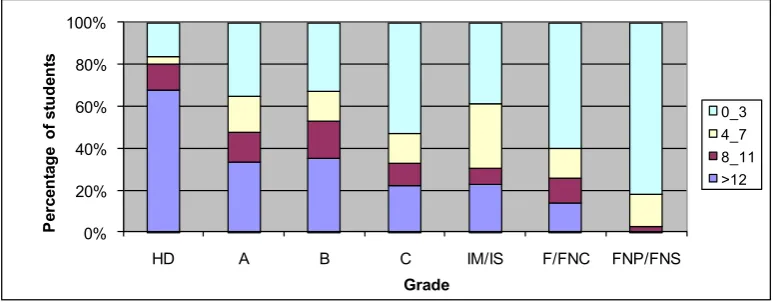
Since the quiz structure was not changed during the four years, the performance of the students in all the four years were analysed with the respect to their attempts in the quizzes. Corresponding grade distribution is shown in Figure 3.
Figure 3: Aggregate grade distribution for four years
It shows that there is a strong correlation between students who attempt the quizzes and their overall student performance assessed by final grades.
Discussion
It was made clear to students that the online quizzes were made available to help them in their learning of this course. This has made the students realise the value of the online quiz as a learning activity by showing what they have understand and not understand. In the course evaluation at the end of each semester, majority of the students, both on-campus and external, strongly agree that the online quizzes were very useful. They find the online quiz as an effective tool in developing their knowledge,
understanding and skills in the different topics of the course. This material helps them to think rather than memorise. Furthermore, the online quiz provided students with tools to judge the quality of their own work. Many students appreciated the online quiz as evidenced by the following comments:
x “In general I enjoyed the course and the material was very interesting. I greatly appreciated having the online quizzes and tutorials available - these were very helpful for understanding - particularly the way the online quizzes step you through processes.”
x “The online quizzes and the tutorials were excellent resources for external students.”
x “The quizzes at the end of each module were very helpful. They reinforced the material learnt in the section with very fast feedback.”
x “The immediate feedback in the quiz is the most helpful and effective aspects of this course”.
x “The quiz was great for exam preparation”.
x “Perhaps the online quizzes should be made compulsory ie. 5% of the assessment marks - make students have to attempt them. Students should take responsibility for their learning though.”
Information gathered in the formative assessment and evaluation is used to shape up strategies for improvement of the online quiz. In most cases, the performance of students in the different online quizzes provides information on areas of strength and weaknesses where strategies for improvement should focused. These concerns of the students are clarified during the semester in the classroom for the on-campus students and through the online discussion forum in the course website for external students. Though a few students requested the online quizzes to be including within the summative assessments, the nature of the quizzes and the flexibility of attempts given in a dual mode of delivery justifies the quizzes remain as a formative assessment. As indicated by the students, these quizzes are also a good tool to refresh their knowledge on the different topics in preparation for the exam. More importantly, the evaluation showed that the formative online quizzes help in the student’s learning by
aligning its content to the summative assessments such as the Assignments and the final exam.
0% 20% 40% 60% 80% 100%
HD A B C IM/IS F/FNC FNP/FNS
P
e
rc
e
nt
a
ge
of
s
tude
nt
s
Grade
0_3
4_7
8_11
Conclusions
This paper evaluated the overall students performance in a higher level structural engineering course developed through the online formative quizzes. A set of fourteen online quizzes were made available as a self-assessment learning tool. Analysing four continuous years of offer, the following conclusions are made.
x There is strong evidence of the effectiveness of the formative online quiz to student learning. Students who have completed most of the formative online quizzes performed better on
summative assessments than those students who attempted less, which agrees with the previous findings (Peat et al., 2005).
x The general trend of the student overall performance with the quiz attempts over a period of four years was similar. This validates the effectiveness of the online quizzes as a learning and teaching tool.
It is recommended to maintain these quizzes as formative assessments to maintain the flexibility especially considering the dual mode of course delivery consisting of on-campus and external students.
References
Anderson, H.D. (2009). Formative assessment: Evaluating the effectiveness of online quizzes in a core business finance course, Journal of Distance Learning, 13(1), 26-40.
Cherem, B.F. (2011). Using online formative assessments for improved learning, Currents in Teaching and Learning, 3(2), 42-48.
Daymont, T & Blau, G. (2008). Student performance in online and traditional sections of an undergraduate management course, Institute of Behavioural and Applied Management, 275-294.
Dobson, J.L. (2008). The use of formative online quizzes to enhance class preparation and scores on summative exams. Advances in Physiology Education, 32, 297-302.
Green, K. (1997). Drawn to the light, burned by the flame? Money, technology and distance education, ED Journal, 11(5), 9.
Gretes, J.A. & Green, M. (2000). Improving undergraduate learning with computer-assisted assessment, Journal of Research on Computing in Education, 33(1), 46-54.
Organisation for Economic Cooperation and Development (2005). Formative assessment: Improving learning in secondary classrooms, OECD Observer, 1-8.
Pallof, R.M. & Pratt, K. (2008). Effective course, faculty and program evaluation, Proceedings of the 24th Annual Conference on Distance Teaching and Learning, 1-5.
Peat, M., Franklin, S., Devlin, M. and Charles, M. (2005) Revisiting the impact of formative assessment opportunities on student learning, Australasian Journal of Education Technology, 21, 102-117.