Extended Services in Schools:
Baseline Survey of Maintained
Schools in 2005
Sam Clemens, Robert Kinnaird, Tara Mackey,
Gemma Deakin and Anna Ullman
BMRB Social Research
Research Report No 681
Extended Services in Schools:
Baseline Survey of Maintained
Schools in 2005
Sam Clemens, Robert Kinnaird, Tara Mackey,
Gemma Deakin and Anna Ullman
BMRB Social Research
The views expressed in this report are the authors’ and do not necessarily reflect those of the Department for Education and Skills.
Table of Contents
1 Acknowledgements... 1
2 Introduction... 2
2.1 Notes on the report ... 4
3 Summary ... 7
3.1 Summary table ... 16
4 Primary schools... 17
4.1 Childcare and activities (including study support) for school-age children... 17
4.1.1 Before school... 17
4.1.2 After school... 23
4.1.3 Provision of activities or childcare from 8am-6pm during term time ... 30
4.1.4 Activities and childcare provided in the school holidays ... 33
4.1.5 The full childcare offer ... 40
4.1.6 Activities and childcare at weekends ... 42
4.2 Childcare for pre-school children... 43
4.2.1 Integrated childcare for children with a standard nursery education place . 43 4.2.2 Other types of care for children aged four and under ... 46
4.2.3 Provision of any term time childcare for children aged three and four... 47
4.2.4 Full offer for pre-school children, including holiday childcare ... 49
4.3 Parenting support ... 49
4.3.1 Family learning and courses to provide parenting support... 50
4.3.2 Other parenting support facilities... 51
4.3.3 Provision of at least one type of parenting support ... 53
4.4.1 Adult education... 54
4.4.2 Services provided to local community... 56
4.4.3 Access to school facilities... 56
4.4.4 Opening hours of school site ... 58
4.5 Working in partnership with other agencies to support the school’s pupils ... 58
5 Secondary schools... 61
5.1 Activities for children (including study support) and childcare for school-age children... 61
5.1.1 Before school... 61
5.1.2 After school... 66
5.1.3 Provision of activities or childcare from 8am-6pm in term time ... 70
5.1.4 Activities and childcare provided in the school holidays ... 72
5.1.5 The full childcare offer ... 77
5.1.6 Activities and childcare at weekends ... 78
5.2 Childcare for pre-school children... 79
5.2.1 Provision of any childcare for pre-school children (aged three and four) in term time... 80
5.2.2 Full offer for children aged three and four, including holiday childcare ... 81
5.3 Parenting support ... 81
5.3.1 Family learning and courses to provide parenting support... 82
5.3.2 Other parenting support facilities... 83
5.3.3 Provision of at least one type of parenting support ... 85
5.4 Other extended services for local community and community use of school facilities... 86
5.4.1 Adult education... 86
5.4.3 Access to school facilities... 88
5.4.4 Opening hours of school site ... 89
5.5 Working in partnership with other agencies to support the school’s pupils ... 90
6 Maintained nursery schools ... 92
6.1 Wrap-around childcare for pre-school children... 92
6.1.1 Integrated childcare for children with a standard nursery education place . 92 6.1.2 Other types of care for pre-school children... 94
6.2 Provision of any childcare for pre-school children (aged three and four) ... 95
6.2.1 Plans to provide integrated care for nursery children... 96
6.2.2 Holiday care for pre-school children ... 96
6.2.3 Full offer, including holiday childcare, for three and four year olds... 99
6.2.4 Activities and childcare at weekends ... 100
6.3 Parenting support ... 101
6.3.1 Family learning and courses to provide parenting support... 101
6.3.2 Other parenting support facilities... 102
6.3.3 Provision of at least one type of parenting support ... 104
6.4 Other extended services for local community and community use of school facilities... 105
6.4.1 Adult education... 105
6.4.2 Services provided to local community... 106
6.4.3 Access to school facilities... 107
6.4.4 Opening hours of school site ... 108
6.5 Working in partnership with other agencies to support the school’s pupils ... 109
7.1 Childcare and activities for school-age children ... 111
7.1.1 Before school... 111
7.1.2 After school... 114
7.1.3 Provision of activities or childcare from 8am-6pm ... 116
7.1.4 Activities and childcare provided in the school holidays ... 117
7.1.5 The full childcare offer ... 120
7.1.6 Activities and childcare at weekends ... 121
7.2 Childcare for pre-school children... 122
7.2.1 Integrated childcare for children with a standard nursery education place 122 7.2.2 Other types of care for pre-school children... 123
7.2.3 Provision of any term time childcare for pre-school children (aged three and four) 124 7.2.4 Full offer for pre-school children, including holiday childcare ... 124
7.3 Parenting support ... 125
7.3.1 Family learning and courses to provide parenting support... 125
7.3.2 Other parenting support facilities... 126
7.3.3 Provision of at least one type of parenting support ... 128
7.4 Other extended services for local community and community use of school facilities... 129
7.4.1 Adult education... 129
7.4.2 Services provided to local community... 130
7.4.3 Access to school facilities... 131
7.4.4 Opening hours of school site ... 132
7.5 Working in partnership with other agencies to support the school’s pupils ... 133
8 Technical appendices ... 135
8.2 The main survey... 136
8.3 Sample design... 137
8.4 Response rates ... 138
8.5 Weighting... 139
8.6 Derived variables ... 145
8.7 Questionnaire design issues ... 155
9 Survey Materials ... 156
9.1 Questionnaire ... 156
9.2 Advance letter to local education authority ... 193
9.3 Advance letter to schools ... 194
9.4 Proxy refusal letter ... 195
1 Acknowledgements
A great many people contributed significantly to this research project and it is not
practical to acknowledge them all individually. However there have been a number of
key contributors to the work whose input we would like to recognise.
The project benefited considerably from the input of Rebecca Goldman, the project
manager at the Department for Education and Skills (DfES), and her colleague Richard
Heys. Genevieve Knight at PSI also provided valuable input throughout the project.
The BMRB researchers were supported by our colleagues in The Operations Centre:
Mitesh Somaiya who managed the fieldwork; the telephone interviewers who carried
out the survey; and Kevin Fountain and Al Burt who led on the data processing.
Most importantly, however, we would like to acknowledge the staff at the 3,806 schools
across England who gave up their time to take part in this survey.
Sam Clemens
Rob Kinnaird
Tara Mackay
2 Introduction
Extended schools provide a range of services and activities, often beyond the school day, to help meet the needs of children and young people, their families and the wider
community. The services provided can include childcare and activities for children and
young people, adult education, parenting support programmes and access to community based health and social care services.
The Every Child Matters: Change for Children programme aims to improve outcomes
for all children and young people. Children and young people said that five outcomes are key to well-being in childhood and in later life – being healthy, staying safe,
enjoying and achieving, making a positive contribution and achieving economic
well-being. The Change for Children programme sets out a national framework for local change programmes to build services around the needs of children and young people
which maximise opportunity and minimise risk.
Children’s trusts will bring together all services for children and young people in an area, underpinned by the Children Act 2004 Duty to Co-operate. This will be driven by
an analysis of local priorities and secured through more integrated front line delivery,
processes, strategy and governance.
Extended schools form a key part of developing integrated front line delivery in local
areas. Schools are encouraged to work in partnership with other organisations across
the private, voluntary and community sectors to offer childcare and to provide other activities and support for children and parents, including access to specialist services
on school sites.
The Government has set out a core offer1 of the extended services that all schools
should be able to offer by 2010 (with half of all primary schools and a third of all
secondary schools doing so by 2008). This core offer will comprise:
• Childcare/varied menu of activities for children and young people between the hours of 8am-6pm, all year round;
• Parenting support, including family learning;
• Ensuring swift referral from schools to a wider range of specialised support services for pupils;
• Widespread community use of the school’s facilities.
Schools will make this offer themselves or in partnership with other schools or the
private, voluntary and community sector. Provision will mainly be on school sites, at a
neighbouring school or on a different site.
Many schools already provide a range of services for pupils, their parents and the
wider community. However, prior to this survey in 2005 there were no nationally
representative figures for how many schools in England were providing such services, nor any measure of what types of services were being provided.
Therefore, this nationally representative survey was commissioned by the Department
for Education and Skills to provide a baseline measure of the prevalence and characteristics of extended services across different types of schools. This will allow
any change in the level of extended service provision over the next few years to be
assessed, as well as providing information on which types of schools currently have high and low levels of provision.
The survey involved a 20 minute telephone interview with the Headteacher (or other
staff member with specific responsibility for extended services) and looked at whether the school provided the following services:
• Integrated childcare for pre-school (three and four year old) children (for schools providing standard nursery education);
• before school childcare and activities for children; • after school childcare and activities for children;
• childcare and activities for children in the school holidays; • childcare and activities for children at weekends;
• specific childcare for young children (other than integrated care for three and four year olds in nursery education);
• other services for pre-school children and their parents;
• parenting support – including education courses or workshops, and family learning;
• other adult education (on non-parenting issues);
• provision of health, social care and other support/ advice services for the community;
• community access to school facilities (such as ICT, sports, arts and library facilities);
• school working with non-teaching professionals to support pupils.
The term “provide” as used throughout this report does not mean that services,
school site. Some schools may offer services to their pupils, parents or the local community which are directly provided by another school or provider with which the
school is in partnership, or services may be provided jointly by a school and other
schools/providers. In some cases, external providers may operate services on the school site.
For all services provided, details were collected. (As explained in greater detail in the
Technical Appendices, for the before and after school activities, details were not collected if the activities took place at another school. Therefore, for a few schools
details of their before and after school provision are missing).
A nationally representative sample of primary and secondary schools (drawn randomly from Edubase2) was interviewed between 3rd March 2005 and 20th May 2005 (with a
break for the Easter holidays). All maintained special schools and nursery schools were contacted for an interview during the same period. In total, 3,806 schools took
part in this research:
1,811 maintained primary schools
1,001 maintained secondary schools (including City Technology Colleges and
Academies)
655 maintained special schools 339 maintained nursery schools
Further details of the methodology, and a copy of the interview questionnaire and other fieldwork documents, are provided in the Technical Appendices of this report.
2.1
Notes on the report
In this report, schools are split into various sub-groups for analysis purposes. The
breakdowns used are defined below:
Level of deprivation The new Index of Multiple Deprivation 2004 (IMD 2004) is a
Super Output Area (SOA) level measure of multiple
deprivation and is made up of seven SOA level Domain Indices: Income deprivation, Employment deprivation, Health
deprivation and disability, Education, skills and training
deprivation, Barriers to Housing and Services, Living environment deprivation and Crime. Each school was
assigned to an SOA based on its postcode.
The main analysis divides SOAs into the 30 per cent most deprived; the next 20 per cent most deprived and the 50 per
cent least deprived.
Urban Schools are defined as being in either rural or urban areas on
Edubase.
No. pupils For most schools this was provided on Edubase. However,
where this figure was not provided or was 0, we asked for the current number of pupils at the end of the interview.
Free school meals The proportion of children at a school who are eligible for free
school meals (whether or not they take up the offer). This data was from the Department’s Annual School Census.
% BME The proportion of children at each school who are of black or
minority ethnic origin. This includes all children not defined as “White – British”, and so includes white minority ethnic groups.
This data was from the Department’s Annual School Census.
% SEN statement The proportion of pupils with Special Educational Needs.
School designation This is a proxy to assess whether a school receives any extra
funding. If a school was designated as any of the following
(based on Edubase information), it counts as a yes.
• Beacon School;
• Education Action Zone;
• Excellence in Cities; Excellence in Cities Group; Excellence in Cities – City Learning Centre; Excellence in Cities Action Zone;
• Training School;
• Leading Edge Partnership Programme; • Leadership Incentive Grant;
• Specialist school.
In this report the term “parent” includes any adult carer.
The figures presented in this report for primary, secondary and special schools have
been weighted to take account of non-response. Details of the weighting applied are
The percentages in the tables do not always add to 100 per cent due to rounding, and, where percentages in the text differ to the sum of percentages in the tables, this too will
be due to rounding.
3 Summary
The Government has set out a core offer3 of the extended services that all schools
should be able to offer by 2010 (with half of all primary schools and a third of all
secondary schools doing so by 2008). This core offer will comprise:
• Childcare/varied menu of activities for children and young people between the hours of 8am-6pm, all year round;
• Parenting support, including family learning;
• Ensuring swift referral from schools to a wider range of specialised support services for pupils;
• Widespread community use of the school’s facilities.
Schools will make this offer themselves or in partnership with other schools or the
private, voluntary and community sector. Provision will mainly be on school sites, at a
neighbouring school or on a different site.
This nationally representative survey was designed to assess the level and
characteristics of provision of extended services in maintained schools in England in
2005. It involved telephone interviews with 3,806 schools (339 maintained nursery schools, 1811 primary schools, 1001 secondary schools and 655 special schools)
which were carried out from March to May 2005.
Childcare and activities (including study support) offered by primary schools
Most primary schools (87 per cent) offer regular activities or childcare for their pupils
after the standard school day. This was most common in larger schools (92 per cent of
those with over 400 pupils) and those in less deprived areas (88 per cent of schools in the 70 per cent least deprived areas). Most schools did not run their after school
activities beyond 5pm (63 per cent of those schools offering after-school activities
finished at 5pm or earlier), and half of the primary schools providing after school activities (52 per cent) did so for fewer than five days a week. Nearly all (96 per cent)
of the primary schools offering after school activities said that children attending were
given supervised opportunities to take part in sports, arts, music or ICT; far fewer (38 per cent) provided supervised opportunities for children to complete homework or
coursework.
Two fifths (40 per cent) of primary schools offered before school activities or childcare to their pupils. Again, this was most common in larger schools (56 per cent of those
with over 400 pupils), but before school activities were more common in schools in
more deprived areas (54 per cent of schools in the 30 per cent most deprived areas). Most of the primary schools offering before school activities or childcare (75 per cent)
started their before school provision at 8am or earlier, and ran it five days a week (89
per cent) for all three terms (96 per cent). Of the primary schools providing activities before school, 44 per cent offered supervised opportunities for children to complete
homework and coursework, and 55 per cent offered supervised opportunities to take
part in sports, arts, music or ICT.
Holiday activities or childcare were less common. A quarter (23 per cent) of primary
schools offered some activities or childcare to their pupils (and often to other children)
in the school holidays (which was provided with input from the school (use of school site or school staff) or with some contract or partnership agreement with the provider).
Again this was more common in larger schools (35 per cent of those with over 400
pupils) and those in more deprived areas (26 per cent in the 30 per cent most deprived areas). Only a minority of primary schools offering holiday activities or childcare
provided these during all holidays (33 per cent), and similar proportions started their
holiday activities at 8am or earlier (35 per cent) and finished at 6pm or later (33 per cent). Nearly all (91 per cent) of the primary schools offering holiday activities, said
that children attending were given supervised opportunities to take part in sports, arts,
music or ICT; far fewer (23 per cent) provided supervised opportunities for children to complete homework or coursework.
To provide the core offer of 8am-6pm all year round childcare, primary schools would
need to offer before school activities or childcare that started at 8am or earlier and after school activities or childcare ending at 6pm or later, as well as holiday activities or
childcare that ran from at least 8am – 6pm (with school input or some contract or
partnership agreement with the provider). These would all have to be provided for five days a week, during all terms or holidays. If the before or after school activities were
not on the school site, supervised transport would have to be provided.
Twelve per cent of primary schools provided this level of childcare or activities for school-age children during term time, and three per cent provided this level of childcare
for school-age children in the holidays. This equates to around 2,060 primary schools
in England providing term time activities at this level, and around 578 providing holiday activities at this level. Overall, two per cent of primary schools in England (equating to
around 430 primary schools) were offering all year round childcare at the level
specified by the core offer. It appears to be slightly more common for schools in the least deprived areas to do so (three per cent of primary schools in the 50 per cent least
deprived areas compared to one per cent of primary schools in the 30 per cent most
greater number of children with two working parents, and so there is greater demand for this level of provision.
Although the core offer specifies 8am-6pm provision, we also looked at provision for
nine hours a day4. Eighteen per cent of primary schools provided activities or childcare
for school-age children for nine hours a day, five days a week, three terms a year, with
supervised transport where necessary. Five per cent provided this level of childcare or activities during all the school holidays, and three per cent of primary schools were
offering all year round childcare, five days a week for nine hours a day.
Access to study support and a range of activities for children provided by secondary schools
Nearly all secondary schools (95 per cent) offered regular activities for school-age
children after school. Ninety per cent of these offered supervised opportunities to complete homework and coursework and 99 per cent provided supervised
opportunities to take part in sports, arts, music or ICT. Most of these secondary
schools offer after school activities that finished before 5pm (55 per cent), while 28 per cent ran activities until 6pm or later. Sixty per cent of schools that offered after school
activities did so for five days a week.
The majority of secondary schools (61 per cent) offered regular activities for school age children before school. Most of the secondary schools providing before school
activities started them at 8am or earlier (72 per cent), ran them for five days a week (88
per cent) and three terms a year (97 per cent). Sixty per cent of the secondary schools providing before school activities offered supervised opportunities for children to do
homework and coursework; 54 per cent provided supervised opportunities to take part
in sports, arts, music, or ICT.
It was also common for secondary schools to offer activities to school age children in
the holidays (usually on the school site). In total, 65 per cent of secondary schools
offered holiday activities (either on site or with school staff, or with some partnership or contract with a provider). Ninety three per cent of these offered supervised
opportunities to take part in sports, arts, music, or ICT; 58 per cent provided
opportunities for children to complete homework or coursework. Although holiday activities were offered by most schools, they were often provided for fairly limited
hours. Only four per cent of secondary schools that provided holiday activities started
these at 8am or earlier – it was much more common for activities to start at 9am or
4 Nine hours a day was defined as starts at 8 am or before, and finishes at 5pm or later; or starts
later (83 per cent). Most schools also ended their holiday activities early – only five per cent of schools provided activities that ran until 6pm or later. Only ten per cent of the
schools providing holiday activities did so in all holidays, many (25 per cent) were just
open in the summer, or were closed at Christmas (29 per cent).
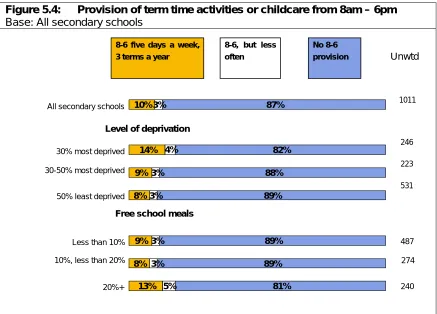
Although 60 per cent of secondary schools offered activities for school-age children
both before and after school, only ten per cent (approximately 331 secondary schools
in England) offered access to these activities from 8am to 6pm, five days a week in all three school terms. Secondary schools in more deprived areas were more likely to
provide activities across this time range (14 per cent of those in the 30 per cent most
deprived areas). Although the core offer specifies 8am-6pm provision, we also looked at provision for nine hours a day5. A far greater proportion of secondary schools (25
per cent) provided activities for nine hours a day, five days a week in all three school terms.
Access in holidays was lower. Only one per cent of secondary schools (around 34
schools in England) provided holiday activities that ran from 8am-6pm, five days a week during all holidays. This did not vary for the nine hour option.
A significant minority of secondary schools (43 per cent) offered activities before school
and after school and in the holidays. However, only five (weighted) of the interviewed schools (0.5 per cent) offered these activities for the time specified in the core offer i.e.
8am-6pm, all year round. Ten (weighted) interviewed secondary schools (one per
cent) offered activities for nine hours a day, five days a week, all year round.
5 Nine hours a day was defined as starts at 8 am or before, and finishes at 5pm or later; or starts
Wider community access to ICT, sports and arts facilities, and adult learning
Primary schools
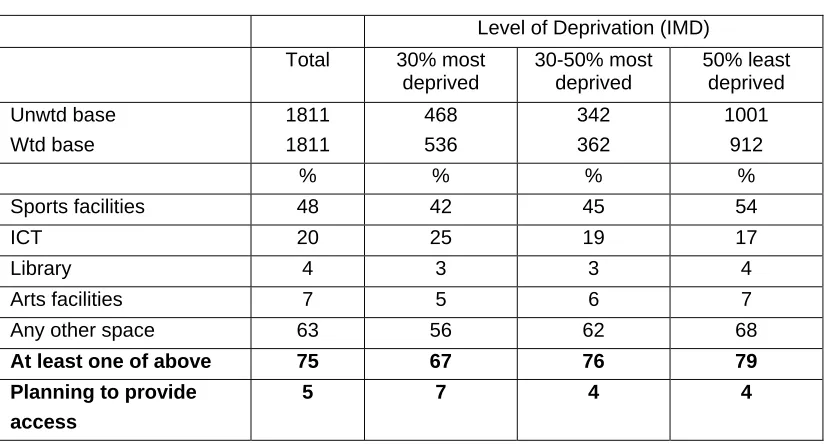
Most primary schools (75 per cent) allowed people from outside the school to use at
least one of the following facilities: rooms or other space (e.g. the school hall) (63 per cent); sports facilities (48 per cent); ICT facilities (20 per cent); arts facilities (seven per
cent); library facilities (four per cent). This was slightly more common among schools
in less deprived areas, although ICT access was more common in more deprived areas.
Access to these facilities was most common in the evenings after school in term time,
but sports facilities in particular were often available for use in the school holidays or at weekends.
Fifty-nine per cent of primary schools provided some courses or workshops for adults
(including family learning; courses or sessions on parenting support and adult education on non-parenting issues). These were most commonly held during school
hours (85 per cent of schools running such courses/sessions). A third of primary
schools that offered these courses or sessions ran them on weekday evenings after 5pm. Very few primary schools charged for these courses (three per cent always
charged; six per cent charged for some courses or attendees).
Secondary schools
Nearly all secondary schools (97 per cent) allowed people from outside the school to
use at least one of the following facilities: sports facilities (89 per cent); rooms or other
space (e.g. the school hall) (87 per cent); ICT facilities (51 per cent); arts facilities (46 per cent); library facilities (17 per cent). This was more common among schools with
less deprived intakes.
Access to these facilities was most common in the evening after school, but sports facilities in particular were usually available during school holidays and at weekends.
Fifty-eight per cent of secondary schools provided some courses or workshops for
adults (including family learning; courses or sessions on parenting support and adult education on non-parenting issues). These courses were most likely to be run on
weekday evenings after 5 (87 per cent of secondary schools running such courses ran
them then). Secondary schools were more likely than primary schools to charge for these courses. Eighteen per cent of secondary schools offering adult education
courses or sessions always charged, and 32 per cent charged for some courses or
Maintained nursery schools
Most maintained nursery schools (62 per cent) allowed people from outside the school
to use at least one of the following facilities: sports facilities (15 per cent); rooms or
other space (e.g. the school hall) (46 per cent); ICT facilities (22 per cent); arts facilities (six per cent); library facilities (14 per cent). This was more common among nursery
schools in more deprived areas.
Access to these facilities was most commonly during the school day, unlike primary and secondary schools.
The vast majority of nursery education schools (85 per cent) provided some courses or
workshops for adults (including family learning; courses or sessions on parenting support and adult education on non-parenting issues). It was more common for
nursery schools in more deprived areas to run these. Nearly all the nursery schools
that ran courses (99 per cent) did so between 9 and 5 during the week. A fifth provided courses in the evenings, and only eight per cent offered such courses at weekends.
The majority of nursery schools that provided these courses (89 per cent) did so free of
charge.
Special schools
Most special schools (74 per cent) allowed people from outside the school to use at
least one of the following facilities: sports facilities (52 per cent); rooms or other space (e.g. the school hall) (61 per cent); ICT facilities (14 per cent); arts facilities (10 per
cent); library facilities (four per cent).
Access to these facilities was most common in the evenings after school, but sports facilities were often available for use at weekends and during the school holidays.
Half of the special schools (52 per cent) provided some courses or workshops for
adults (including family learning; courses or sessions on parenting support and adult education on non-parenting issues). Most of the special schools that ran courses (85
per cent) did so between 9 and 5 during the week. Thirty nine per cent provided
courses in the evenings, and only eight per cent offered such courses at weekends. The majority of special schools (87 per cent) that provided these courses did not
charge.
Parenting support, including sessions for parents, parenting programmes and family learning
Schools were asked about the following parenting support services:
• courses, workshops and sessions specifically for parents to provide parenting support;
• whether the school employs a family support worker;
• whether there are other parent support facilities or groups at the school.
The questionnaire was developed before the core offer was finalised, and so these questions ask schools about a wider range of parenting support than the more specific
parenting support activities in the core offer.
Primary Schools
Sixty five per cent of primary schools provided at least one of these parenting support
services, the most common being courses, workshops or sessions that provide
parenting support for parents without their children (42 per cent), and the least common being the employment of a specific family support worker (20 per cent). Thirty-nine per
cent of primary schools offered family learning. There were quite marked differences
by school location: in the 30 per cent most deprived areas, 85 per cent of primary schools provided at least one of these types of parenting support, compared to 56 per
cent of primary schools in less deprived areas.
Secondary schools
Sixty five per cent of secondary schools provided at least one of these parenting
support services, the most common being the provision of parent support facilities or
groups at the school (37 per cent) and the least common being employment of a specific family support worker (27 per cent). Thirty-one per cent of secondary schools
offered family learning. There were quite marked differences between schools in more
and less deprived areas. 75 per cent of secondary schools in the 30 per cent most deprived areas provided at least one of these parenting support services compared to
61 per cent in the 50 per cent least deprived areas.
Maintained nursery schools
Nearly all maintained nursery schools (93 per cent) provided at least one of these
parenting support services. The most common parenting support services were the
provision of parent support facilities or groups at the school (78 per cent) and running courses, workshops or sessions that provide parenting support for parents without their
children (78 per cent). The least common was the employment of a family support
worker (42 per cent). Sixty seven per cent of nursery schools offered family learning. While it was slightly more common for maintained nursery schools in more deprived
for free school meals) to provide parenting support, it was also very common among maintained nursery schools in less deprived areas.
Special schools
Eighty four per cent of special schools provided at least one of these parenting support services, the most common being the provision of parent support facilities or groups at
the school (71 per cent) and the least common being family learning (24 per cent).
There were no significant differences between different types and locations of special schools.
Swift referral to a range of specialised support services
Schools were asked if they worked with a range of non-teaching professionals to help support their pupils. We do not, from this, know the detail of the joint working, for
example whether there is co-location at the school, or just some occasional
communication.
Primary schools
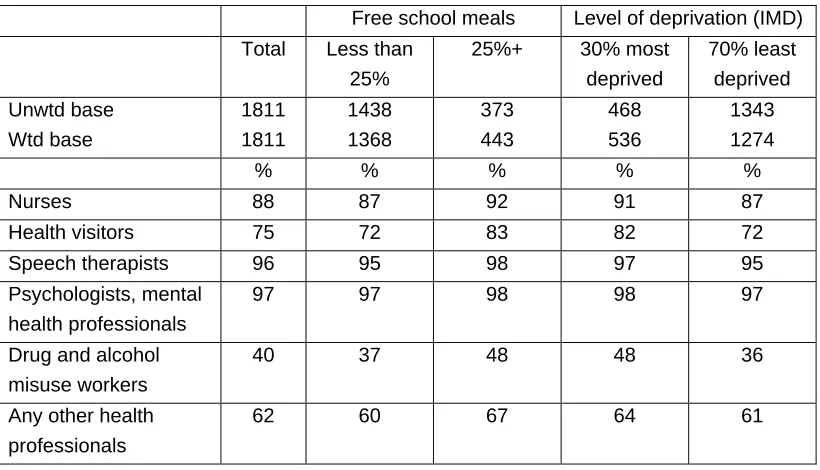
Nearly all (99 per cent) primary schools worked with at least one sort of health
professional, most commonly psychologists and mental health professionals (97 per cent) and speech therapists (96 per cent). There was a tendency for schools in more
deprived areas to work with a broader range of health professionals.
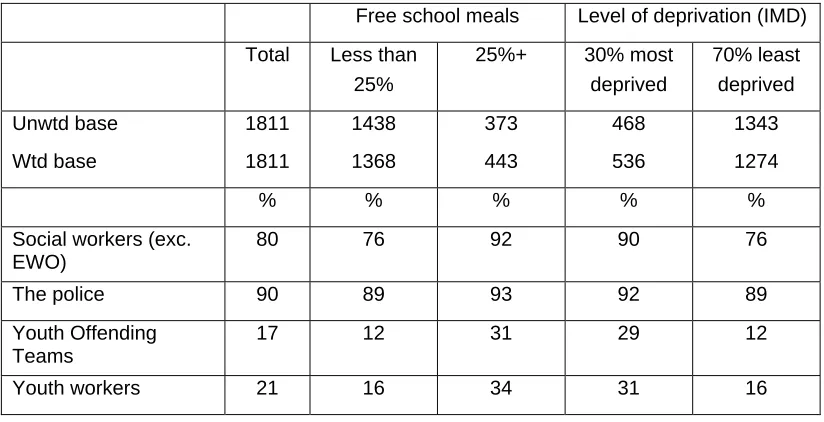
Primary schools also worked with a range of other professionals, most commonly the police (90 per cent) and social workers (excluding Educational Welfare Officers) (80
per cent). Again, schools with more deprived intakes were more likely to work with
other professionals.
Secondary Schools
Nearly all (99 per cent) secondary schools worked with at least one sort of health
professional, most commonly psychologists and mental health professionals (94 per cent), nurses (87 per cent) and health professionals dealing with sexual health issues
(84 per cent). There was a tendency for schools in more deprived areas to work with a
broader range of health professionals (especially drug and alcohol misuse workers and speech therapists).
Secondary schools also worked with a range of other professionals, most commonly
the police (97 per cent) and social workers (excluding Educational Welfare Officers) (87 per cent). Again, schools with more deprived intakes were more likely to work with
Maintained nursery schools
All maintained nursery schools worked with at least one sort of health professional,
most commonly speech therapists (98 per cent), psychologists and mental health
professionals (97 per cent) and health visitors (95 per cent). There was a tendency for schools in more deprived areas to work with a broader range of health professionals.
Maintained nursery schools also worked with a range of other professionals, most
commonly social workers (excluding Educational Welfare Officers) (87 per cent) and the police (73 per cent). Again, schools with more deprived intakes were more likely to
work with other professionals.
Special schools
All special schools worked with at least one sort of health professional. All special
schools worked with psychologists and mental health professionals, and most worked
with speech therapists (95 per cent) and nurses (92 per cent). All types of special school appear to work with a broad range of health professionals.
Special schools also worked with a range of other professionals, most commonly social
workers (excluding Educational Welfare Officers) (98 per cent) and the police (80 per cent). Special schools in more deprived areas and with more deprived intakes were
3.1 Summary
table
% OF PRIMARY SCHOOLS
% OF SECONDARY SCHOOLS SCHOOL-AGED CHILDREN –
CORE CHILDCARE OFFER
Term-time 8-6 core offer 12 10
Holiday 8-6 core offer 3 1
All year round 8-6 core offer 2 0.5
SCHOOL-AGED CHILDREN – SOME LEVEL OF CHILDCARE
Some before-school childcare/ activities
40 61
Some after-school childcare/ activities
87 95
Some holiday childcare/ activities 23 65
PARENTING SUPPORT
Any parenting support6 65 65
Family learning 39 31
Parenting courses 42 29
Family support worker 20 27
COMMUNITY SERVICES
Adult education7 59 58
Access for people from outside the school to at least some school facilities
75 97
Health/therapeutic, social and/or advice services to the local community
29 31
SUPPORT FOR PUPILS
Works with at least one type of health professional to support pupils
99 99
Works with social workers8 to
support pupils
80 87
6Includes parenting courses, family support worker, advice for parents, a parents' room, other
parenting support groups and facilities, and family learning.
7 Includes family learning and parenting courses.
4 Primary
schools
In January 2004, there were 17,762 maintained primary schools in England. Where
figures in this report for the interviewed sample of primary schools are grossed up to the overall population figure, this is the figure that has been used. 1,811 maintained
primary schools in England took part in this research.
4.1
Childcare and activities (including study support) for school-age children
By 2010, the aim is that all schools will deliver a core offer of extended services. The core offer relating to childcare for primary school children is that:
• “All parents of primary age children will be able to access affordable childcare at or through their school from 8am to 6pm, all year round. This childcare could be based at their child’s primary school, a nearby school or on a different site
provided in partnership with private or voluntary sector providers (including
childminders), with supervised travel arrangements to and from the provision.”9
This offer will be available in at least half of all primary schools by 2008.
In this section we look at the components of 8am – 6pm year round childcare (activities and childcare provided before school, after school and during the school holidays) to
assess the current level of provision.
4.1.1 Before school
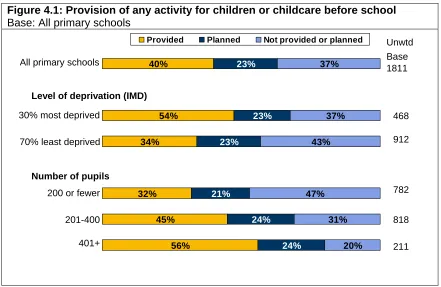
Two-fifths of primary schools (40 per cent) said that there were regular activities or
childcare provided for children before school. Twenty-three per cent said that they had
plans to provide such activities or childcare in the future, and 36 per cent were not providing any activities before school and had no plans to (one per cent were not sure
if they had plans). Most of the primary schools with plans to provide before school
activities had discussed this with other organisations (68 per cent) or the local authority (67 per cent); 64 per cent had looked into possible funding sources and 14 per cent
had recruited staff to run or plan such services.
In general, it appeared to be larger primary schools and those in more deprived areas that were more likely to provide activities or childcare before school, as figure 1.1
shows.
Figure 4.1: Provision of any activity for children or childcare before school
Base: All primary schools
Before school activities may consist of childcare, study support or recreational
activities. In this report, we call them “before school activities” as shorthand. It is
possible that the before school activities may be made up of a number of different clubs and activities. To allow for this, we asked for very general details of the provision (such
as the earliest starting time of all activities, latest finishing time etc.).
Nearly all of the schools providing activities before school did so on site at their school (95 per cent). For three per cent of the schools offering before school activities, the
activities were provided at another school (one per cent with supervised transport); for
a further three per cent the activities were provided at another site (one per cent with supervised transport). For primary-age children, if the activities or childcare are
provided on another site, there needs to be supervised transport always provided to
and from that site.
If this is taken into account, 39 per cent of all primary schools were providing some
before school activities or childcare for school age children (Reception to end of Key
Stage Four). (Three schools that answered the question claimed to provide before school activities, but not for children aged 3-19. We have assumed that this is
miscoded data. Two schools only provided before school childcare for nursery age
56% 45% 32%
34% 54% 40%
24% 24% 21%
23% 23% 23%
20% 31% 47%
43% 37% 37%
Provided Planned Not provided or planned
All primary schools
200 or fewer 201-400 401+
Number of pupils
Level of deprivation (IMD)
Unwtd Base 1811
468 912
782
818 211 70% least deprived
children but this does not affect the overall percentages). This suggests that around 7,000 (+ or – 414)10 primary schools in England were providing such services.
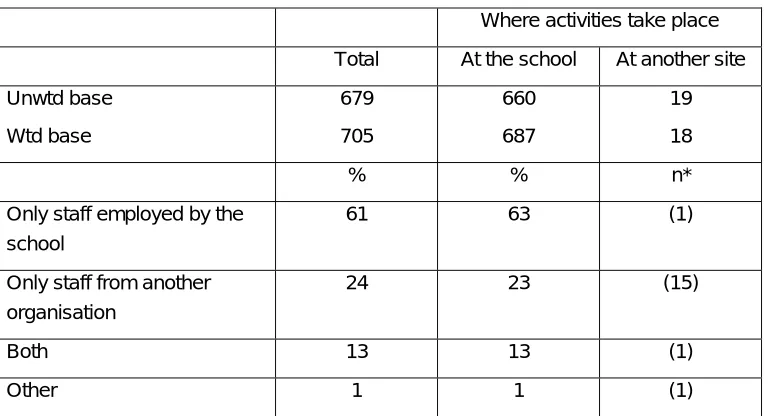
Most (61 per cent) of the schools providing activities and childcare before school used only staff employed by the school to run these activities. A quarter (24 per cent) used
only staff from another organisation and 13 per cent used both. Not surprisingly, where
schools offered before school activities at another site, these were most likely to be staffed by staff from another organisation, suggesting use of an external provider (of
the 18 schools that offered before school activities at another site, 15 of these were
staffed fully by staff from another organisation, one was staffed by school staff, one by a mixture and one by parents). However, around a quarter of schools (23 per cent)
providing before school activities on site used only external staff to run these.
Table 4.1 Who staffs the before school activities and where they take place; primary schools providing before school activities on site or at
another site (not another school)
Where activities take place
Total At the school At another site
Unwtd base
Wtd base
679
705
660
687
19
18
% % n*
Only staff employed by the school
61 63 (1)
Only staff from another organisation
24 23 (15)
Both 13 13 (1)
Other 1 1 (1)
*Due to small base, actual weighted frequencies are shown rather than percentages
Schools in more deprived areas, or with a more deprived intake, were most likely to use staff employed by the school (72 per cent used only staff employed by the school),
but there were no differences by size of school. This may be linked to school
designation, as primary schools in more deprived areas were more likely to receive some form of extra funding. In fact, schools that were identified as having some such
10 This figure is grossed up by applying the percentage to the total number of primary schools.
[image:26.595.82.473.335.543.2]designation were also more likely to use school employees to run their before school activities.
Figure 4.2: Who runs the activities or childcare before school
Base: primary schools providing services on site or at another site (not another school)
Of the 40 per cent of primary schools who said that they provided activities or childcare before school, full follow up questions were completed by 96 per cent of these (38 per
cent of the full sample of primary schools). There were 28 schools (two per cent of the
total sample) where we did not ask the follow up questions: 19 provided the services at another school, and nine referred us on to someone who we were not able to contact.
The rest of this section only covers those schools asked the follow up questions.
Before school activities in primary schools were predominantly provided to primary age children – especially Key Stage 2 (year 3 – year 6). Ninety-three per cent of schools
with before school activities provided them for this age group; 86 per cent provided
activities to Key Stage 1 (reception to year 2). In total, 99 per cent of primary schools offering before school activities did so for primary age children (reception to year 6).
Six of the primary schools did not provide their before school activities to primary age
children. (Two of the schools only provided before school childcare for nursery aged children (three and four year olds), one only provided it for older children and the other
three claimed that they did not provide services for any children aged 3-19. We have
assumed that these latter three were miscoded, and assumed for the rest of this section that they did provide before school activities for school age children).
As well as catering for primary age children, 29 per cent of primary schools that provide
activities or childcare before school did so for 3 and 4 year olds. This was more common among primary schools with nursery education provision (40 per cent
56% 73% 54%
72% 61%
30% 12% 34%
10% 24%
14% 12%
11% 16%
13%
Only staff employed by school Only staff employed by another organisation Both Other
All primary
30% most deprived
70% least deprived
Yes
No
School Designation Level of deprivation (IMD)
Unwtd Base
679
247
432
compared to 21 per cent of those with no nursery education). It should be noted that schools were asked very general questions about the provision they offered. We have
assumed in this report that the before school provision discussed relates to school age
children, but it is possible for these primary schools that provide services for pre-school children that some details of the provision would relate only to the pre-school group.
A few primary schools also offered these activities to older children. In five per cent of
schools that provided activities before school, the activities were available for 11-14 year olds, and in one per cent the activities were available for children aged 14 and
over. Of the four middle schools deemed primary that offered before school activities,
all provided them to 11-14 year olds. However, most of the primary schools with before school activities that were also available for 11-14 year olds did not teach this age
group.
These primary schools where the before school activities were offered to older children seemed slightly more likely to use only staff employed by another organisation than
primary schools that did not offer before school activities to older children (38 per cent
compared to 22 per cent), suggesting that the services were more likely to be provided by a provider external to the school, and possibly jointly managed. However, the base
size is small and so this should be treated as indicative only.
In most schools providing before school activities or childcare (78 per cent), these were only available for their pupils. In six per cent of schools with before school provision,
these before school activities were also available to pupils of other specific schools,
and in 18 per cent the before school activities were available to any child of a relevant age. Five per cent of the primary schools that offered before school activities on site
provided supervised transport to and from other schools so that pupils from other
schools could use the service.
Most schools with activities before school started these at 8am or earlier (75 per cent),
with the remainder starting them between 8 and 9am.
The table below shows that primary schools in the 30 per cent most deprived areas offering before school activities were less likely to open earlier than 8 am than those in
Table 4.2 Before school provision opening times; primary schools providing before school activities on site or at another site (not another
school)
Level of deprivation
Total 30% most
deprived
70% least deprived
Base 669 246 423
% % %
Before 8 am 28 21 33
8 am 47 48 46
8.01-8.59 24 31 20
9am or later * - *
Nearly all primary schools that offered before school activities did so for all three terms (96 per cent) and for five days a week (89 per cent).
Any activities provided before school will be limited, as the time available is fairly short,
and often a meal will be provided in this time. Fewer than half of the schools with before school activities (44 per cent) said that they provided supervised opportunities
for children to complete homework or coursework, and just over half (55 per cent)
provided supervised opportunities to take part in sports, arts, music or ICT. This did not vary much by school type, size or location.
Most before school provision was fairly limited in size. Eighty two per cent of primary
schools providing this service said that the maximum number of places that they could provide was less than 50. A further 11 per cent could provide between 50 and 100
places. Not surprisingly, larger schools with over 400 pupils were more likely to be
able to provide 50-100 places than smaller schools (20 per cent compared to 10 per cent). Schools in more deprived areas (those in the 30 per cent most deprived areas
or with 25 per cent or more of their pupils eligible for free school meals) were also
Table 4.3 Maximum number of places that could be provided before school each day; primary schools providing before school activities on site
or at another site (not another school)
Level of deprivation (IMD)
Number of pupils Free school meals
Total 30% most
deprived
70% least deprived
400 or fewer
401+ Less than 25%
25%+
Unwtd base
Wtd base
669
696
246
281
423
414
559
607
110
88
451
438
218
258
% % % % % % %
Less than 50 82 77 86 85 68 86 77
50-100 11 15 8 10 20 8 16
100+ 3 4 2 2 5 2 3
Don’t know 4 4 4 3 7 4 3
The distribution of places was not significantly different for those schools that provided before school activities from 8am or earlier and those that provided activities that
started later.
Most schools offering before-school activities (63 per cent) charged for all before school places and a further 14 per cent charge for some places. Around a quarter of
primary schools (23 per cent) made no charge. Schools with a specific designation
(denoting some extra funding) were less likely to charge (34 per cent do not charge for any places compared to 18 per cent of schools with no designation). Schools in more
deprived areas were also less likely to charge (32 per cent of schools in the 30 per cent
most deprived areas do not charge compared to 17 per cent schools in less deprived areas). Designation is closely linked with level of deprivation, so there will be a lot of
overlap between these two groups of schools.
4.1.2 After school
Most primary schools (87 per cent) said that there were regular activities or childcare
provided for children after school. Five per cent said that they had plans to provide
such activities or childcare in the future, and eight per cent were not providing any activities after school and had no plans to.
The largest primary schools seemed most likely to provide such services (92 per cent
of those with over 400 pupils provided after school services, compared to 85 per cent of schools with 200 or fewer pupils). However, there was little difference between
school meals). Schools in the most deprived areas were slightly less likely than those in the least deprived areas to provide after school activities.
Table 4.4 Provision of any activity for children or childcare after school; all
primary schools
Level of deprivation (IMD) Number of pupils
Total 30% most
deprived
70% least deprived
200 or fewer
201-400 401+
Unwtd base
Wtd base
1811
1811
468
536
1343
1274
782
842
818
807
211
161
% % % % % %
Provided 87 84 88 85 88 92
Planned 5 8 4 5 5 4
Not provided or planned
8 8 8 10 7 4
After school activities may consist of childcare, study support or recreational activities.
It is very likely that the after school activities provided by a school will be made up of a number of different clubs and activities, which have different start and finish times and
run for different durations across the school year. To allow for this, we asked for
details in general (such as the latest finish time of all activities; and the times when any after school activity was being run).
Nearly all of the schools providing activities after school did so on site at their school
(95 per cent). For two per cent of schools providing after school activities, the activities were provided at another school (nearly all with supervised transport); for a further two
per cent the activities were provided at another site (again nearly all with supervised
transport).
Thus, taking into account the need for supervised transport, 86 per cent of all primary
schools were providing some after school, activities or childcare for school age children
(reception to end of Key Stage 4). (Five schools that answered the question claimed to provide after school activities, but not for children aged 3-19. We have assumed that
this is miscoded data). In total, around 15,280 (+ or – 150) primary schools in England
were providing such services.
Unlike activities provided before school where most were staffed by people employed
by the school, after school activities were more likely to use staff from other
organisations. Many schools that provided after school activities (46 per cent) used a mixture of staff (both employed by the school and other organisations) and 16 per cent
after school activities only used staff employed by the school. Not surprisingly, where schools offered after school activities at another site, these were most likely to be run
by staff from another organisation (of the 37 schools that offered after school activities
at another site, 26 of these were staffed fully by staff from another organisation, four were staffed by school staff, six by a mixture and one by someone else). However, 38
per cent of the primary schools providing after school activities on site used only
external staff to run these.
Table 4.5 Who staffs the after school activities and where they take place;
primary schools providing after school activities on site or at
another site (not another school)
Where activities take place Total At the school At another site Unwtd base Wtd base 1540 1534 1502 1497 38 37
% % n*
Only staff employed by the school
38 38 (4)
Only staff from another organisation
16 14 (26)
Both 46 46 (6)
Other 1 1 (1)
*Due to small base, actual weighted frequencies are shown rather than percentages
Schools in more deprived areas, or with a more deprived intake, were most likely to
use staff employed by the school, but there were no differences by size of school.
Table 4.6 Who runs the activities or childcare after school; primary schools
providing after school activities on site or at another site (not
another school)
Level of deprivation (IMD) Free school meals
Total 30% most
deprived 70% least deprived Less than 25% 25%+ Unwtd base Wtd base 1540 1536 387 440 1153 1096 1229 1166 311 370 % % % % %
Only staff employed by the school
38 44 35 36 44
Only staff employed by another organisation
16 9 18 17 11
Both 46 46 46 46 44
Of the 87 per cent of primary schools who said that they provided activities or childcare after school, the full follow up questions were completed by 97 per cent (84 per cent of
the full sample of primary schools). There were 46 schools (2.5 per cent of the total
sample) where we did not ask the follow up questions: 31 provided the services at another school, and 15 referred us on to someone who we were not able to contact.
The rest of this section only covers those schools asked the follow up questions.
After school activities in primary schools were predominantly provided to primary age children – especially Key Stage 2 (year 3 – year 6). 91 per cent of schools with after
school activities provided them for this age group; 76 per cent provided activities to Key
Stage 1 (reception to year 2). In total, 99 per cent of the primary schools offering after school activities offered them to primary age children (reception to end of Key Stage 2).
Eight of the primary schools did not provide their after school activities to primary age
children. (Three of the schools only provided after school activities for older children and the other five claimed that they did not provide services for any children aged
3-19).
Fifteen per cent of primary schools with after school activities also offered these to younger children (aged 3 and 4). This was more common in primary schools that had
nursery education provision (21 per cent compared to 12 per cent of those with no
nursery education provision). It should be noted that schools were asked very general questions about the provision they offered. We have assumed in this report that the
after school provision discussed relates to school age children, but it is possible for
those primary schools that provided services for pre-school children that some details of the provision would relate only to the pre-school group.
A few primary schools also offered these services to older children. Six per cent of
schools that provided after-school activities provided them to 11-14 year olds (including four of the five middle schools deemed primary that provided after school activities),
and two per cent offered services for children aged 14 and over. There was no
difference between schools with after school activities run by school staff and those with after school activities run by external staff.
In most schools providing after school activities or childcare (78 per cent), these were
only available for their pupils. Six per cent also offered the service to pupils of other specific schools, and 17 per cent allowed any child of the relevant age to use the after
school services. Six per cent of the primary schools that offered after school activities
on site provided supervised transport to and from other schools so that pupils from other schools could use the service.
As would be expected, most schools with after school activities appeared to start them
as school finished. Most primary schools ended their standard day between 3-3.30 pm, and this is when 90 per cent of schools start their after school activities. Eight per
when school finished, and it is possible that these schools end their school day after 3.30. Few of these schools (only five) were providing activities off site, so the journey
to the other site does not explain the slightly later start. A further two per cent of
schools, start their after school activities before 3pm.
Most after school activities ended before 6pm. Two-thirds of the schools providing
after-school activities (63 per cent) finished at 5pm or earlier, and a further 12 per cent
ended before 6pm. A fifth (22 per cent) ended at 6pm, and very few (3 per cent) finished any later than this. Smaller schools were more likely to provide after school
activities that finished earlier than larger schools as the table below shows. Schools in
rural areas that provided after school activities tended to finish earlier than those in urban areas, and schools in London tended to finish later than those in most other
regions – possibly due to the longer commuting times that parents living in London are
likely to face. There were few differences by free school meal eligibility, or deprivation of the local area.
Table 4.7 Finish time for after school activities; primary schools providing
after school activities on site or at another site (not another school)
Number of pupils Location Region
Total 200 or
fewer
201+ Urban Rural London Elsewhere
Unwtd base
Wtd base
1525
1524
654
703
871
820
1033
1061
491
462
150
151
1375
1373
% % % % % % %
5pm or earlier
63 72 56 60 70 44 64
5.01pm-5.59pm
12 9 14 14 8 18 11
6pm 22 16 26 23 18 34 21
After 6pm 3 2 3 2 3 4 3
Nearly all schools offering after-school activities (97 per cent) provided after school
services during all three terms, but only half (48 per cent) provided them for five days a week. On average, after school services were provided for 3.9 days a week. Large
schools and those in urban areas, especially London, were most likely to provide after
school services every day of the week (65 per cent of schools with over 400 pupils; 52 per cent of schools in urban areas, and 65 per cent of schools in London that provided
Table 4.8 Number of days that after school activities are provided; primary schools providing after school activities on site or at another site
(not another school)
Number of pupils Location Region
Total 200 or
fewer
201+ Urban Rural London Elsewhere
Unwtd base
Wtd base
1525
1524
654
703
871
820
1033
1061
491
462
150
151
1375
1373
% % % % % % %
1 day 6 8 4 6 6 3 6
2 days 10 13 7 8 14 7 10
3 days 19 23 16 18 21 10 20
4 days 17 18 16 16 20 16 17
5 days 48 37 58 52 39 65 46
Nearly all of the primary schools that provided after school services (96 per cent) gave
the children attending the opportunity to take part in sports, arts, music or ICT. Far
fewer (38 per cent) provided supervised opportunities for children to complete homework or coursework, which is understandable given the age of the children
attending. This proportion is lower than was the case among schools providing before
school activities (where 44 per cent offered opportunities for homework or coursework). This is not that surprising, as the limited time before school is unlikely to allow as much
scope for other activities (such as sports, arts, music etc) and so time is more likely to
be spent on reading or other coursework. After school, when more time is available, schools providing activities to primary age children are more likely to offer a wider
range, and so provision of study support or coursework may be more limited.
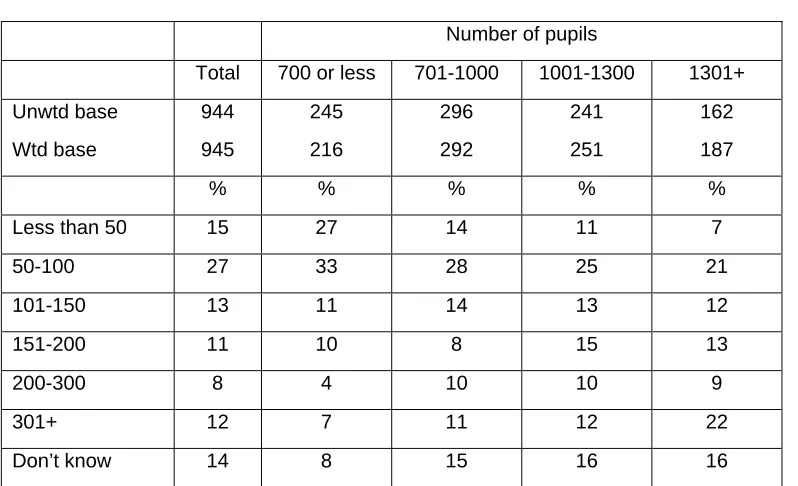
As was the case with before school provision, much of the after school provision was fairly limited in size. Three quarters (75 per cent) of primary schools providing this
service said that the maximum number of places that they could provide was less than
50. A further 15 per cent could provide between 50 and 100 places. Larger schools with over 400 pupils were more likely to be able to provide 50-100 places than smaller
Table 4.9 Maximum number of places that could be provided after school each day; primary schools providing after school activities on site
or at another site (not another school)
Number of pupils
Total 400 or
fewer 401+ Unwtd base Wtd base 1525 1524 1340 1381 185 142 % % %
Less than 50 75 77 86
50-100 15 14 25
100+ 3 2 _
Don’t know 3 2 4
Unlike before school activities, only a minority of schools providing after-school
activities (28 per cent) always charged for these. A third (35 per cent) charged for
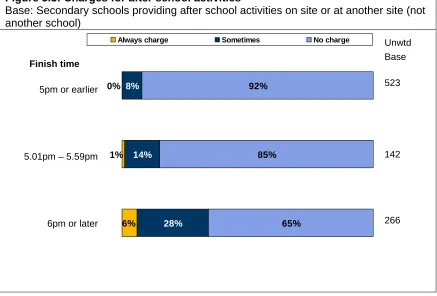
some places and a similar proportion (36 per cent) never charged. Schools offering services that finished later were more likely to charge than schools providing after
school activities for a shorter time. 92 per cent of schools where the after school
activities finished at 6pm or later charged for some or all places, compared to 46 per cent of those where the activities ended at 5pm or earlier. This may distinguish
childcare aimed at working parents from study support and recreational activities
primarily for children’s benefit.
Figure 4.3: Charges for after school activities
Base: Primary schools providing after school activities on site or at another site (not another school) 57% 59% 11% 35% 32% 35% 6% 9% 53%
Always charge Sometimes No charge
5pm or earlier
5.01pm – 5.59pm
6pm or later
Finish time Unwtd Base 965 183 369 57% 59% 11% 35% 32% 35% 6% 9% 53%
Always charge Sometimes No charge
5pm or earlier
5.01pm – 5.59pm
6pm or later
Primary schools providing after school activities for five days a week were also more likely to charge than those providing such activities for fewer days. Forty seven per
cent of those with after school activities every day charged for all places, while only 14
per cent of those with after school activities provided for one or two days a week did so. As mentioned above, this suggests that schools providing more of a childcare service
(with later finish times, and options for use every day) were more likely to charge than
those providing more ad hoc activities that would not be as suitable for childcare purposes (as they finish early, and were not across the whole week).
Figure 4.4: Charges for after school activities
Base: Primary schools providing after school activities on site or at another site (not another school)
Where the after-school provision appears to be provided by an organisation other than the school, charges are also more likely. Twenty-two of the thirty-five schools where
after school activities are provided off site charge for all places, and ten charge for
some places. Seventy per cent of the schools where after school activities were run by staff from another organisation charged for all places, and 23 per cent charged for
some places (whereas 62 per cent of schools where school staff ran the after school
activities provided these for no charge).
4.1.3 Provision of activities or childcare from 8am-6pm during term time
If extended schools are to provide a useful service for working parents, it is important
that they provide activities or childcare that cover working hours. Therefore, part of the extended schools core offer to parents is that primary schools will offer affordable
childcare between the hours of 8am-6pm, all year round. Primary schools will make this
59% 26% 14%
28%
54% 36%
10%
35%
15% 37% 47%
36%
Always charge Sometimes No charge
1-2 days
3-4 days
5 days
Days per week
Unwtd
Base
237
549
729 Total
offer themselves or in partnership with the private, voluntary and community sector. Provision will mainly be on school sites, at a neighbouring school or on a different site.
During term time this would require both before school activities or childcare that
started at 8am or earlier and after school activities or childcare that did not finish until 6pm or later. If this was not on the school site, there would need to be supervised
transport always provided. This 8-6 service would need to run for all three terms, for 5
days a week.
Using the information collected in the interview, it is possible to work out how many
primary schools are currently p