SCHOOL DISCIPLINE
CAMILLA KIDNER
This briefing updates SPICe briefing 03/59 and outlines the main developments in policies dealing with disruptive behaviour in schools. It outlines the implementation of Better Behaviour Better Learning, considers statistics on school behaviour and exclusions and highlights recommended approaches for improving school behaviour.
Policies referred to are those of the previous Scottish Executive unless otherwise indicated.
SPICe
briefing
1 November 2007
07/53
Scottish Parliament Information Centre (SPICe) Briefings are compiled for the benefit of the Members of the Parliament and their personal staff. Authors are available to discuss the contents of these papers with MSPs and their staff who should contact Camilla Kidner on extension 85376 or email
[email protected]. Members of the public or external organisations may comment on this briefing by emailing us at
[email protected]. However, researchers are unable to enter into personal discussion in relation to SPICe Briefing Papers. If you have any general questions about the work of the Parliament you can email the Parliament’s Public Information Service at [email protected].
Every effort is made to ensure that the information contained in SPICe briefings is correct at the time of publication. Readers should be aware however that briefings are not necessarily updated or otherwise amended to reflect subsequent changes.
CONTENTS
KEY POINTS ...3
BEHAVIOUR IN SCOTTISH SCHOOLS ...4
HOW SERIOUS A PROBLEM IS INDISCIPLINE? ...4
LOW LEVEL DISRUPTIVE BEHAVIOUR...4
VIOLENT AND AGGRESSIVE BEHAVIOUR...5
CAUSES OF DISRUPTIVE BEHAVIOUR ...6
SCHOOL FACTORS...7
Curriculum ...7
Leadership...7
Inclusion ...7
SOCIAL FACTORS...7
RESPONSES...8
EXCLUSION...8
Numbers of exclusions...8
Who is most likely to be excluded? ...9
Reasons for exclusion...10
ALTERNATIVES TO EXCLUSION...11
Behaviour co-ordinators and staged intervention ...11
Restorative practices...11
Nurture Groups ...12
Support bases ...12
Off-site...12
PREVENTION...13
EFFECTIVENESS ...14
POLICY DEVELOPMENT ...15
BETTER BEHAVIOUR BETTER LEARNING (2001) ...15
EXCLUSION GUIDANCE (CIRCULAR 8/2003) ...18
OTHER MEASURES...18
POSITIVE BEHAVIOUR TEAM (2005) ...19
DISCIPLINE STAKEHOLDER GROUP...19
SNP Manifesto Commitments (2007) ...19
POLICY LINKS...20
KEY POINTS
• Tackling disruptive behaviour in schools is a complex issue, linking many different policy strands – notably curriculum reform, interdisciplinary working, parental involvement and additional support for learning.
• Since 2001, Better Behaviour Better Learning has provided the main policy framework for improving behaviour in schools.
• In 2005, an HMIe review of the implementation of the Better Behaviour Better Learning action plan found good overall progress and that a change in the culture of schools was developing. For example, most or nearly all authorities had developed a staged intervention approach and provided staff development opportunities.
• Research has identified that a preventative approach which promotes a good school ethos and positive behaviour can be used to improve behaviour and is particularly effective in addressing low level persistent disruptive behaviour.
• For teachers, low level persistent disruptive behaviour is often the most significant discipline issue.
• Exclusion is only to be used as a last resort. Current guidance is provided in Circular 8/2003.
• Temporary exclusions are highest in S2 and S3 and are much higher for boys than girls. • Temporary exclusions are higher than average for looked after children, certain groups of
BEHAVIOUR IN SCOTTISH SCHOOLS
In 2006, the Executive published report on a new survey – Behaviour in Scottish Schools (Wilkin et al), from which the majority of the following data is taken.
HOW SERIOUS A PROBLEM IS INDISCIPLINE?
Indiscipline is a very serious problem in only a small number of schools and is more of an issue in secondary than primary schools. Only 1% of head teachers, 4% of primary teachers and 12% of secondary teachers said that indiscipline is a very serious problem in their school. (Wilkin et. al table 2.1). HMIe found that half of secondaries and two thirds of primaries had major strengths in their approach to behaviour. However, they found significant scope for improvement in half of secondary schools and scope for improving the behaviour of a few pupils in a quarter of primary schools. In around one in twelve secondaries and one in thirty primaries HMIe found important weaknesses where the behaviour of some pupils disrupted the learning of other pupils. This was associated with a lack of consistent leadership and with strained relations among senior management (HMIe, 2005 p.6).
In 2006, only 8% of teachers felt that pupils were badly behaved in all or most lessons (Wilkin et. al, table 4.3) whereas 33% of teachers felt that pupils were well behaved in almost all their lessons (table 3.3)
Dealing with poor behaviour takes up more teacher time in secondary schools than primary schools. Seventeen per cent of secondary class teachers spent more than three hours a week dealing with indiscipline compared with 7% of primary class teachers (Wilkin et. al, table 2.4).
LOW LEVEL DISRUPTIVE BEHAVIOUR
Disruptive behaviour can occur as a one off incident, as a pattern of minor incidents or as a pattern of more serious incidents linked to social, emotional and behavioural difficulties. It is the cumulative effect of minor incidents which teachers find causes the most disruption.
“Major incidences of indiscipline, I find, are usually the easiest ones to deal with as pupils can be excluded, referred to a senior member of staff or parents can be called to the school. It is the continuous minor infringements during the normal day to day running of the class which probably cause the most disruption and take most time. […] Almost any method of trying to deal with and improve poor behaviour over a long period of time takes a significant amount of time and adds to the workload “(quoted in Munn 1999a p 408).
In a similar vein, the Discipline Task Group (DTG) which was established to consider the issue of school discipline reported in 2001 that:
“it is the constant ‘drip drip effect’ of low-level bad behaviour that grinds school staff down and contributes to a lowering of morale. Teachers in the current study referred to it as ‘soul-destroying’ “ (Wilkin et. al 2006 p.37)
The survey found that nearly two thirds of teachers experienced low level disruption several times a day and this had a negative effect on their teaching. It ‘wasted teachers’ time’ and was unfair on other pupils However, secondary heads felt that discipline systems coped well with this, and it was the more serious incidents that were more disruptive (Wilkin et. al 2006).
VIOLENT AND AGGRESSIVE BEHAVIOUR
At the other end of the scale, physical violence and aggression towards teachers is extremely rare. Statistics on incidents of aggressive, threatening and violent behaviour and verbal abuse towards staff were collected between 1998 and 2003. The number of incidents reported rose from 1,898 in 1998 to 6,899 in 2002/03 (Scottish Executive, 2004c). However, the Executive discontinued the survey because they were concerned that the reporting was not robust. The ‘Behaviour in Scottish Schools’ survey already referred to replaced this but covered a wider range of issues. It sought the views of teachers, head teachers, support staff, local authority staff and pupils. Interviews with local authority staff found that there was a perception that violent incidents were more likely to be reported than in the past (Wilkin et. al, p.74).
Four per cent of teachers said they encounter aggression towards them once or twice a week and 1% of teachers said pupils are violent towards them over the same period. However, nearly a fifth (17%) of teachers said that there is an incident of a pupil being ‘physical destructive’ about once or twice a week (Wilkin et. al 2006).
Violent incidents towards teachers occur more frequently in primary than secondary. Local authority representatives have suggested in research interviews that this may relate to the increasing numbers of young children starting nursery and primary with complex difficulties or lacking in social skills (Wilkin et. al , 2006 p.36).
Only 4% of teachers thought that physical violence towards teachers was a problem in their school. Around a third of teachers had experienced violence against them and, on average, teachers reported three incidents in their careers. Far more common was violence between pupils and nearly a quarter of teachers thought that this was an issue at their school. (Wilkin et al, 2006).
Table 1: Percentage of teachers finding violent or aggressive behaviour problematic in their school verbal aggression pupil to pupil 31%
physical violence between pupils 24% verbal aggression towards teachers 25% physical violence towards teachers 4% Source: (Wilkin et. al, 2006)
Table 2: Percentage of teachers experiencing certain behaviour in class
Type of behaviour Several
times a day (%)
Once a day (%)
3 or 4 times a week
Once or twice a
week
Not at all
Talking out of turn 62 12 12 13 2
Making unnecessary noise 38 15 9 24 13
Hindering other pupils 40 16 14 23 7
Leaving seat without permission 26 15 11 25 20
Not being punctual 16 17 14 33 20
Persistently infringing class rules 21 11 13 29 24
Eating/chewing in class 28 8 6 17 41
work avoidance 27 19 16 28 9
Cheeky remarks 18 13 11 26 31
Horseplay 15 13 12 31 29
Using mobiles 8 7 6 15 64
Physical destructiveness 1 3 3 17 75
Racist abuse to pupils <1 1 <1 7 92
Sexist abuse to pupils 1 1 2 13 84
Verbal abuse to pupils 9 6 12 40 33
Racist abuse to teachers <1 0 0 1 99
Sexist abuse to teachers <1 0 <1 2 97
Verbal abuse to teachers 2 3 4 18 71
Physical aggression to other pupils
5 5 8 35 46
Physical violence to other pupils 2 3 3 21 70
Physical aggression to teachers <1 1 1 4 94
Physical violence to teachers 0 <1 <1 1 98
Pupil withdrawing from interaction 4 4 6 33 51
Truancy 4 5 8 25 56
Source: Wilkin et. al, table 4.5, 2006)
CAUSES OF DISRUPTIVE BEHAVIOUR
The DTG highlighted both psychological and sociological models of the causes of disruptive behaviour:
SCHOOL FACTORS
Curriculum
HMIe notes that low level indiscipline can be linked to the curriculum:
“there is strong evidence that there are clear links between low-level indiscipline and factors such as the quality of the curriculum, courses and programmes of study, learning activities and the ways in which learners’ successes are recognised. Indiscipline should not be treated in isolation from the curriculum.” (HMIe, 2006)
Leadership
Research by Moray House School of Education for the Scottish Office highlighted the importance of the approach of senior management. They found that the attitudes of staff, in particular those of the senior management team and of the head teacher, are the most important factor in explaining differences in rates of exclusion between similar schools (Cullen, 1997). The DTG concurred with the importance of staff values, noting that:
“A shared value base is an important prerequisite in promoting positive behaviour and in reacting to discipline problems when they occur; values underpin practices. […] Schools where senior staff had a strong commitment to the social as well as the academic purposes of education tended to have lower exclusion rates” (Scottish Executive, 2001 para 1.5).
Inclusion
In focus groups, school support staff linked indiscipline with the ‘inclusion agenda’
“staff felt they were having to deal with increasing numbers of pupils in mainstream schools with more serious behavioural problems” (Wilkin et. al, 2006).
However, to put this in context, the classes which teachers find the most difficult to deal with do not necessarily have a high proportion of children with additional support needs. In fact only 17% of the most difficult classes had more than a quarter of pupils with additional support needs. (Wilkin et. al 2006 at 45). On the other hand, it is notable that exclusion rates are highest for pupils with additional support needs in mainstream secondary classes (see p. 9).
Circular 8/2003 is the current guidance on exclusions. This emphasises that an inclusive approach can actually aid positive behaviour.
“A vital component of a positive school ethos is an actively inclusive approach. A key characteristic of schools which have been successful in minimising exclusion is the explicit adoption of the aim of meeting the needs of all pupils who are part of their school community, whatever their ability, background or social circumstances.” (Scottish Executive, 2003a)
SOCIAL FACTORS
The following social factors have been found to have an adverse affect on behaviour in school (Scottish Executive 2001 p.12 quoting Ofsted 1996).
• poor basic skills
• limited aspirations and opportunities
• pressure from others to behave in a way which may conflict with authority • parents or carers unable to exercise control
• having been exposed to physical or sexual abuse • having been victims of racism
The DTG recognised that the importance of social factors links policy on school indiscipline to policies on children’s services:
“We were aware that there are many factors which play a significant part in securing a more inclusive society – factors which may mitigate the best efforts of the various professionals working with children and young people. A background of unemployment, poverty, crime, violence, abuse, alcohol, drugs, mental health and family break up all feature largely in the statistics of young people who experience serious difficulties in school and beyond. Clearly, in facing the challenges of social inclusion, a significant commitment of resources will be required in the area of children’s services” (Scottish Executive 2001 para 2.10).
RESPONSES
There is a variety of ways in which schools and teachers can tackle indiscipline. In the last resort, the response is exclusion. However, the Executive funded other approaches including appointing behaviour co-ordinators to help tackle low level disruption and running a pilot of restorative practices in three local authorities.
EXCLUSION
Under Regulation 4 of the Schools General (Scotland) Regulations 1975 the power to exclude a pupil from a school rests with the education authority but it can be devolved to the school. There are only two statutory reasons for exclusion which are that:
• the parent of the pupil refuses to comply or allow their child to comply with school rules or • the pupil’s continued attendance would “be seriously detrimental to order and discipline in
the school or the educational well-being of the pupils.”
Pupils and parents have a right of appeal to an education appeal committee, and a final right of appeal to the sheriff under section 28H of the Education (Scotland) Act 1980 (c.44). The Education Authority still has a duty to provide education to children who are excluded. Under the Standards in Scotland’s Schools Act 2000 (asp 6) every child has a right to education and there is also a statutory presumption that this education will be provided in mainstream schools.
Numbers of exclusions
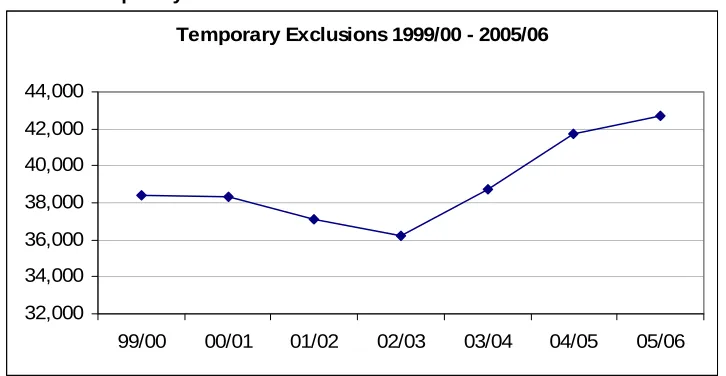
Table 3: Temporary Exclusions 1999/00 – 2005/06
Temporary Exclusions 1999/00 - 2005/06
32,000 34,000 36,000 38,000 40,000 42,000 44,000
99/00 00/01 01/02 02/03 03/04 04/05 05/06
Source: Scottish Executive, 2007a
Who is most likely to be excluded?
Boys in the middle years of secondary school are still far more likely to be excluded than girls or pupils in other years. Children with social, emotional and behavioural difficulties (SEBD), those with additional support needs (especially where in mainstream secondary classes) and pupils entitled to free school meals are also more likely to be excluded.
Girls and primary school pupils have very low rates of exclusion. For example, in 2006, 14.8 per 1,000 pupils in primary were excluded compared with 114.4 per 1,000 in secondary. Only 56.4 per 1,000 girls were excluded from secondary schools compared with 172.4 per 1,000 boys. However, the rate of increase has been higher in primary than secondary and more girls are being excluded than previously.
[image:9.595.43.406.72.260.2]The highest rates of exclusion were for children in secondary school with SEBD. Children with additional support needs were more likely to be excluded from mainstream than special provision. Other groups with high rates of exclusion were children taking free school meals and ‘looked after children’.
Table 4: High rates of exclusion
Pupil group Rate per 1,000 pupils
SEBD secondary school, 981
SEBD special school 864
SEBD primary school 422
Looked after children 337
Pupils with RoN / IEP all the time in mainstream secondary class. 333
Boys S3 276.1
Boys S2 232.1
Boys special school 213.6
Pupils with RoN/IEP secondary: all the time in special class 198
Boys S4 191.8
Boys S1 172.4
Pupils with RoN/IEP special school 159
Free school meals 150
[Rate for all secondary pupils 115]
There is also considerable geographical variation ranging from 11 per 1,000 in secondary schools in Orkney to 229 per 1,000 in Dundee. High rates for secondary school exclusions (between 208 and 229 per 1,000 pupils) were found in Glasgow, West Dunbartonshire, Dundee and North Ayrshire. As mentioned, exclusion rates in primaries are much lower, but local authorities with higher rates (27 to 34 per 1,000) were Aberdeen, Perth and Kinross and East Ayrshire. Research has shown that schools from similar catchment areas often showed marked differences in their exclusion rates, (Cullen, 1997) and a key policy theme has been to increase consistency in the use of exclusion.
Reasons for exclusion
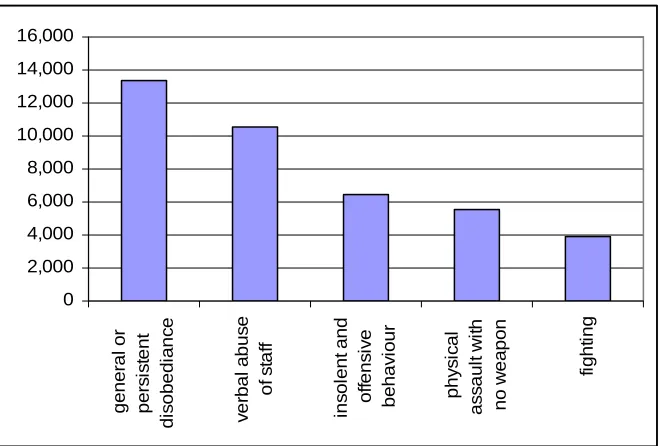
The most common reasons for exclusion continue to be general or persistent disobedience and verbal abuse of staff. Together these made up over half of all exclusions (56%).
Table 5: Most common reasons for exclusions 2005/06
0 2,000 4,000 6,000 8,000 10,000 12,000 14,000 16,000 ge ne ral o r pe rs is ten t d is o be di an c e v e rba l ab us e of s taf f in s o le n t a n d of fe ns iv e be ha v io ur p h ysi ca l a s s a u lt w ith n o w e ap on fi g h ti n g
Source: Scottish Executive, 2007a
Exclusions for violence or threats of violence made up 29% (12,404) of the total with the most common being physical assault with no weapon (5,627 exclusions) and fighting (3,938 exclusions). 2% of exclusions were for physical assault with a weapon or improvised weapon (880 exclusions).
Table 6: Exclusions related to violence 2005/06
physical assault with no weapon 5,627
fighting 3,938
threat of violence no weapon 1,450
physical assault with improvised weapon 633
threat of violence with weapon or improvised weapon 509
physical assault with weapon 247
threat of sexual violence 22
[image:10.595.47.377.244.467.2]ALTERNATIVES TO EXCLUSION
The alternatives to exclusion grant scheme ran from 1997 to 2002, initially under the Scottish Office, and subsequently under the Scottish Executive’s Excellence Fund. A variety of approaches were used to reduce exclusions among pupils with social, emotional and behavioural difficulties which could broadly be seen within a framework of needs relating to:
• the physical environment – degree to which alternative provision to the ordinary classroom has to be made
• the curriculum and how it is delivered • the level of individual support required
• the level of specialised support agency(ies) involved • the level of involvement with / support to families carers (HMIE 2000 appendix 2).
Although the Excellence Fund ended in 2002, similar projects can be funded through the National Priorities Action Fund. Ongoing funding of £11million per annum has been allocated to local authorities under the National Priorities Action Fund for alternatives to exclusion.
The following outlines some approaches to dealing with poor behaviour. These include ‘staged intervention’ which is focused on supporting teachers in coping with low level disruption; ‘nurture groups’ which is a long standing approach to supporting younger children who for a variety of reasons are not ready to learn and ‘support bases’ intended to provide temporary support before returning the pupil to the mainstream class. Circular 8/2003 recommends that ‘out of class’ facilities should be used as a short term strategy.
Behaviour co-ordinators and staged intervention
Under a staged intervention approach, the school appoints a ‘behaviour co-ordinator’ who provides peer support to class room teachers to help them resolve their particular difficulties with classroom management. The focus is on tackling low level disruption but it can also prevent minor problems from escalating. There are three levels of intervention with the emphasis placed on the first level (being the least interventionist). £15,000 pa is offered to each authority by the Scottish Executive to implement the strategy. 27 authorities are now using it in their schools, and others are in the process of opting in. It is predominantly used in primary and secondary schools, but is also being used in nursery and special school settings.
The emphasis in staged intervention is to keep pupils in mainstream schooling where possible and HMIe found that it was “having an increasingly positive impact on the management of challenging behaviour” (HMIe, 2005 p.31). Almost all local authorities had introduced or extended this approach, and it was favourably received by teachers (HMIe, 2005 p.14). However, the report did find common weaknesses in joint assessment teams: shortages of social workers, lack of commitment by senior management teams and sometimes poor communication between teaching and non-teaching staff (HMIe 2005 p.31).
Restorative practices
use negotiation and mediation techniques and schools were encouraged to involve parents wherever appropriate (Scottish Executive, 2004a). An evaluation of the pilots found that enthusiastic implementation of restorative practices could improve behaviour in schools. In the pilots it resulted in fewer exclusions in most primary and some secondary schools.
“When introduced in schools with at least a number of receptive staff and when the initiative was supported by commitment, enthusiasm, leadership and significant staff development, there was a clear positive impact on relationships in school. This was identifiable through the views and actions of staff and pupils, as well as evident in measurable reduction in playground incidents, discipline referrals, exclusion and use of external behaviour support.” (Lloyd et al, 2007).
Nurture Groups
The nurture group approach is a short term, focused intervention that has had a particularly high profile in Glasgow. The approach was first developed by Marjorie Boxall in 1969 in London and is used particularly with young children to help them become ready to learn (Nurture Group Network). The children stay in groups of between six and eight under the supervision of a teacher and classroom assistant for up to three terms before returning to mainstream education. Glasgow Education Services set up a pilot initiative in 2001-2002 involving five schools. Each Nurture Group was established by funding an additional teacher and pupil support assistant to give specific, targeted support to vulnerable children whose barriers to learning, arising from social, emotional or behavioural difficulties, were preventing them and other pupils from fully accessing the curriculum. The evaluation found significant improvements in behaviour and ability to access the curriculum by the Nurture Group children, as well as universal support from parents and staff. A key part of success was effective training in the nurture group approach. By January 2007, there were 58 nurture groups in Glasgow.An evaluation of their use with 179 children in Glasgow strongly endorsed the approach:
“The evaluation findings totally endorse the Nurture Group approach as an extremely effective intervention strategy to identify and address additional support needs which fall into the category of social, emotional and/or behavioural difficulties.” (Glasgow City Council, 2007)
Support bases
HMIe has found that almost all authorities have provided support bases in secondary schools. In the best practice there was a managed approach which provided an alternative curriculum for a limited time before a return to mainstream class. In addition, most schools had ‘time out’ provision – often referred to as ‘sin-bins’. HMIe recommended monitoring the use of these, as most were poorly resourced and did not provide teaching (HMIe, 2005).
Off-site
PREVENTION
Whereas exclusion, support bases and staged intervention are all responses to poor behaviour, a key theme in policy and research has been the preventative value of promoting a positive ethos. Reflecting earlier research (for example Munn et al 1997), the DTG recognised the importance of this:
“Schools which view themselves as learning communities, committed to listening to the views of pupils through the creation of a positive ethos, rather than being top-down institutions of discipline and social control appear to achieve more success in establishing positive pupil participation and behaviour” (Scottish Executive 2001 p.33).
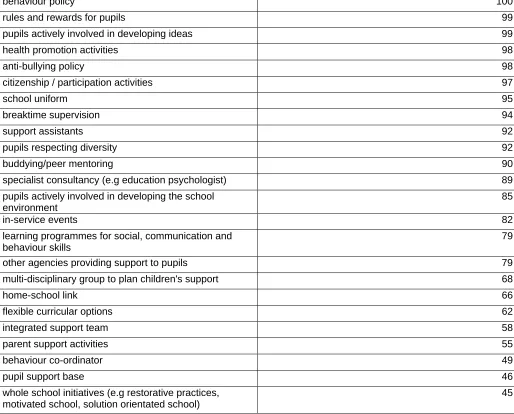
[image:13.595.40.554.349.763.2]Circular 8/2003 reflects the findings of the DTG in recommending better inter-agency working, work with parents, a multi-disciplinary approach and early intervention. Schools are recommended to use a number of methods to develop a positive school ethos in order to prevent the need for exclusion. This includes rewarding good behaviour and taking an inclusive approach. The Wilkin survey found that a range of approaches have been used in schools. Nearly all schools operated a school-wide behaviour/discipline policy, used a range of rules and reward systems, had a school uniform and were involving parents and pupils in school issues (Wilkin et al, 2006). Table 7 below shows the proportion of headteachers who stated that certain preventative approaches were used in their schools.
Table 7: use of different preventative approaches in schools 2006
behaviour policy 100
rules and rewards for pupils 99
pupils actively involved in developing ideas 99
health promotion activities 98
anti-bullying policy 98
citizenship / participation activities 97
school uniform 95
breaktime supervision 94
support assistants 92
pupils respecting diversity 92
buddying/peer mentoring 90
specialist consultancy (e.g education psychologist) 89
pupils actively involved in developing the school environment
85
in-service events 82
learning programmes for social, communication and behaviour skills
79
other agencies providing support to pupils 79
multi-disciplinary group to plan children's support 68
home-school link 66
flexible curricular options 62
integrated support team 58
parent support activities 55
behaviour co-ordinator 49
pupil support base 46
whole school initiatives (e.g restorative practices, motivated school, solution orientated school)
45
The following three specific approaches are recommended by the Discipline Stakeholder Group and were found by the Wilkin survey in around 45% of schools.
The motivated school
The Motivated School programme was created by Alan McLean, Area Principal Psychologist in Glasgow and gives a theoretical framework to sharpen thinking on learner motivation. It hinges on the interaction between learning environment and learner characteristics, and challenges participants to think differently about ‘managing’ pupil disaffection. It aims to optimise the learning environment, whilst progressing pupils towards greater autonomy and self-motivation.
Solution orientated school
This programme offers user-friendly, step-by-step guidelines for developing and enhancing respectful and effective learning environments. Pilots were run in 3 primary schools in Moray from April 2004. In May 2005, the approach was launched in two secondaries. Representatives of 17 Scottish education authorities have received training in the Solution Orientated School approach.
Cool in School
Cool in School is a 10 unit curricular programme which aims to enable children to practice skills and strategies for managing their behaviour and interactions with others in positive ways. Resourced are provided for P6/7 within the Health and Personal, Social Development (PSD) curriculum.
(Better Behaviour Scotland)
EFFECTIVENESS
[image:14.595.40.550.547.630.2]The Wilkin survey found that 84% of headteachers thought that measures to promote positive discipline were effective and 90% of classroom teachers felt confident in promoting positive discipline in their classes. The findings were also very positive (although slightly less so) on responding to indiscipline. Seventy nine per cent of headteachers thought that measures were effective and 86% of teachers felt confident in responding to indiscipline in the classroom (Wilkin et. al, 2006, tables 7.11 and 7.12). Teachers found the most effective methods to be rules and rewards for behaviour. Table 8 below lists the methods with the most support.
Table 8: approaches most often cited as effective – class teachers.
Rules and rewards for pupils 71%
A behaviour/discipline policy 27%
Support assistants 19%
Breaktime supervision 18%
School uniform 17%
Pupils support base 17%
Source: Wilkin et. al, table 7.2
Unlike class teachers, head teachers also cited citizenship activities (20%) and pupil participation such as pupil councils (20%) as effective methods of promoting positive discipline.
The report also found that there is a need to improve capacity to respond effectively to very challenging pupils.
“schools and authorities need to focus on improving support for pupils in mainstream settings, while at the same time maintaining and improving the quality of sufficient specialist provision in on-site and off-site settings”( HMIe, 2005 p.40).
HMIe concluded that, while there was a small minority of schools (particularly secondary schools) where there were important weaknesses in behaviour, or (more often) schools which had problems in particular departments, overall progress was good. At the same time, there was a sense of increased pressure from low level indiscipline which the report suggested may be linked to wider social changes (HMIe, 2005 p.40).
“Overall, it was clear that a change in the culture of schools was developing. In the best examples, schools and teachers were seeing the aims of social inclusion not only as an aspiration, but also as achievable. They were increasingly adjusting their provision and approaches to meet the needs of all pupils. Pupils were responding positively to involvement in decision making and to taking responsibility for others in classes and in playgrounds. The great majority of pupils took pride in their schools and most were open, courteous and well behaved.” (HMIe, 2005 p.39)
POLICY DEVELOPMENT
Indiscipline in schools has been a long running policy concern. Since the 1990s there have been a number of reports and research into its causes and extent, and into ways of tackling the issue. A key theme has been the need to prevent poor behaviour rather than just to react to it. For example, the Scottish Schools Ethos Network was established in 1995, a grant scheme on alternatives to exclusion ran from 1997 to 2002 and a good practice guide, ‘Promoting Positive Discipline’ was published in 1999 (Munn, P 1999b). Guidance on exclusions issued in 1998 (SOIED, 1998) emphasised exclusion as a last resort. In addition, between 1999 and 2003 there was a formal target to reduce exclusions. The current framework for promoting positive behaviour is provided by Better Behaviour Better Learning (Scottish Executive 2001) and guidance on exclusions issued in 2003 (Scottish Executive, 2003a).
BETTER BEHAVIOUR BETTER LEARNING (2001)
The Executive established a Discipline Task Group (DTG) in December 2000. This followed an agreement under McCrone that the issue of school discipline would be referred to the Scottish Negotiating Committee for Teachers (SNCT) and the Scottish Executive. The DTG produced their report ‘Better Behaviour, Better Learning’ in June 2001 (Scottish Executive 2001) which was followed by a joint action plan, ‘Better Behaviour Better Learning’ (Scottish Executive et al 2001) by the Executive, CoSLA, the Association of Directors of Education in Scotland and the Association of Directors of Social Work. Councils received £10 million a year to implement the action plan and £11 million a year to fund alternatives to exclusion (Scottish Executive, 2004a).
• promoting a variety of ways to learn from existing best practice
• considering initial teacher training and continuing professional development
• providing support for families – including considering the impact of home link workers • reviewing the progress made by local authorities to date (Scottish Executive 2003c)
[image:16.595.44.557.179.783.2]The tables below give a summary of the initial joint action plan and how it was addressed by the Executive, local authorities and schools.
Table 9: Scottish Executive Commitments Better Behaviour Better Learning Action Plan
Action Plan Example actions undertaken
Support curricular flexibility Circular 3/2001 encouraged this and it is a key theme in Curriculum for Excellence
Maintain agreed additional funding for classroom assistants and auxiliary staff
Audit Scotland found that local authorities had spent £168m on support staff, (12% less than originally costed) and that their impact is not yet fully felt by a majority of classroom teachers. (Audit Scotland, 2006) £8m per annum is provided to local authorities for supporting parents, including homelink workers; £21m for better behaviour and alternatives to exclusion could be allocated to additional support staff. Of headteachers surveyed, 92% used support assistants. (Wilkin et al 2006).
Fund projects on staged intervention £15,000 per annum offered to each authority by the Scottish Executive to implement staged intervention. 27 authorities now using it in their schools, and others are in the process of opting in. (Better Behaviour Scotland)
Review and introduce improved national networks for publication and sharing of relevant good practice
Actions include:
• Establishing a web site:
http://www.betterbehaviourscotland.gov.uk/
• Establishing the Discipline Stakeholder Group and Positive Behaviour Team
• good practice guidance developed including consideration of pupil participation and reaching out to families. (Scottish Executive, 2007b)
Develop proposals on parenting support In 2006 55% of schools provide parent support activities (Wilkin et al, 2006)
£8m per annum to local authorities for supporting parents, including home-school link officers (Scottish Government, personal communication 21 September 2007).
Fund support for home-school link workers In 2006 there were 14 home-school link workers in primary and 91 in secondary schools. There were also 116 behaviour support workers in secondary schools. (Scottish Executive, 2007c)
£8m per annum to local authorities for supporting parents, including home-school link officers.
Publish information on parents' and carers' rights and responsibilities in the school system
Circular 8/03 sets out parents’ and pupils’ rights and responsibilities with regard to school discipline. The Scottish Schools (Parental Involvement) Act asp 6 enables parents to become active participants in the life of the school, and creates easier ways for parents to express their views and wishes.
The Parentzone website provides information for parents on a number of their rights and responsibilities across all aspects of school education.
Review, in consultation, the nature and purpose of guidance in schools
The national review of guidance was completed in 2004. A standard for personal support was published as, Happy, safe and achieving their Potential (Scottish Executive, 2005a) Fund some quick start work on pupil support
bases
approach across Scotland (HMIe, 2004) Rather than follow the original NCS/ICS model, all schools are now expected to take an integrated approach. Work towards a national framework for
continuous professional development (CPD) of teachers
In 2005, the Executive established an advisory group to ensure delivery of CPD in local authorities (HMIe, 2005 p.18)
Ask local authorities to create their own action plans for implementing the DTG recommendations
Local Authorities reported in April and November 2003 (Scottish Executive, 2004b)
Review progress on the Action Plan Connect (Scottish Executive, 2004b) A Climate for Learning (HMIe, 2005)
Behaviour in Scottish Schools (Wilkin et al, 2006)
Table 10: Action by local authorities
Create their own implementation plans, within Local Improvement Plans, for the actions ascribed to them and to schools;
Most education authorities incorporated the action plan into their improvement plans (HMIe, 2005, p.38) and had provided more support staff.
Work with schools in reviewing/providing the frameworks and support for local action to implement this Action Plan e.g.
• links between learning & teaching and positive behaviour (rec. 2);
• pupil care and welfare (rec.7);
•managing transitions into primary, primary/secondary, into work etc. (rec.28);
All authorities provided some active leadership but only half had “given a clear lead in establishing an integrated framework that helped schools to develop their own linked policies.” All had provided guidance on exclusions, but often these had yet to be fully implemented. All encouraged a dress code, pupil councils and a range of positive behaviour approaches. Half made the links between behaviour and the curriculum and promoted curriculum flexibility (HMIe, 2005)
Provide details of implementation progress to the Executive within their Local Improvement Plans.
[image:17.595.36.556.405.709.2]Local Authorities reported in April and November 2003 (Scottish Executive, 2004b)
Table 11: Action by schools:
In consultation, build upon past achievements in positive discipline through action on the Task Group’s recommendations e.g
Almost all schools had developed approaches to positive behaviour.
Managing pupils in class and elsewhere (rec 4)
Most schools needed to do more on behaviour outside of class – e.g in corridors and playgrounds. (HMIe, 2005) and of headteachers surveyed, 94% had breaktime supervision (Wilkin et al, 2006)
Agreeing a dress code (rec 9) Almost all schools had consulted on a dress code. (HMIe 2005 p.23)
Involving parent/carers (rec 15) HMIe found that while many schools had consulted on dress codes, parents had not been sufficiently involved in determining other policies to promote positive behaviour (HMIe, 2005 p.39). In 2006, parent support activities were provided in 55% of schools (Wilkin et. al, table 7.1).
Place pupils at the centre of structures in school Almost all schools involved pupils in developing ideas and activities in the school (e.g pupil council). (Wilkin et. al, 2006). The Scottish Executive published a good practice guide Positive about pupil participation (2007b).
Promote positive behaviour and improve school ethos
About a quarter of secondary schools had important weaknesses in policies and strategies to promote positive behaviour (HMIe, 2005 p.20)
EXCLUSION GUIDANCE (CIRCULAR 8/2003)
Research by Moray House School of Education in 1997 found a considerable diversity of approach to the use of exclusion and a lack of planning and monitoring. These findings underpinned the guidance issued as Circular 2/98 (SOEID 1998) which emphasised that local authorities should minimise their use of exclusion, that inter-disciplinary working could prevent exclusion becoming necessary and that when exclusion was used, pupils still needed to be provided with education. The Scottish Office and then the Executive supported a series of pilot projects to identify alternatives to exclusion.
In 2003 new guidance was issued as Circular 8/2003. This placed a greater emphasis on the whole school community and dropped the formal target to reduce exclusions. However, it continued the emphasis on the wider context of promoting positive behaviour, the need to minimise the use of exclusion and the need to provide education to excluded pupils.
“(exclusion) should sit within a wider framework of effective policies and practices on discipline within which exclusion is a legitimate last resort.”
While it recognised that strict uniformity was not appropriate, it did seek to ensure greater consistency in approaches to exclusion. In 2005, HMIe found that well led schools had managed to reduce their use of exclusion but “in many schools, the use of exclusion was not set within a broader policy framework of approaches to promoting positive behaviour. In the worst cases, this resulted in the sanction being used excessively and inappropriately.” (HMIe, 2005 at 27).
In addition, this guidance:
• placed greater emphasis on the needs of the majority of pupils to learn without fear or disruption
• recognised the responsibilities of parents and pupils
• introduced support for victims of anti-social or violent behaviour and encouraged the development of mediation and restorative practices.
OTHER MEASURES
Other measures implemented by the Executive to improve pupil discipline included:
• good practice seminars for headteachers
• specialist working groups on behaviour - one to look at behaviour in playgrounds and communal areas, one to look at strengthening the role of parents
• a review of teacher training to ensure teachers are properly equipped to deal with behaviour problems
• allocations of:
o £500,000 to allow councils to train behaviour co-ordinators and implement staged
intervention
o £10m to local authorities to implement Better Behaviour Better Learning, o £11m for Alternatives to Exclusion and
o £8m for Supporting Parents.
POSITIVE BEHAVIOUR TEAM (2005)
The ‘Positive Behaviour Team was established in 2005 to promote positive behaviour approaches in schools. (Better Behaviour Scotland online) The team works regionally with local authorities and schools to support strategic approaches to positive behaviour, and to introduce and embed positive behaviour approaches. The Scottish Executive and Positive Behaviour Team have introduced a number of initiatives including pilot programmes, training schemes, provision of information and development of materials to support positive behaviour. These include:
• Staged intervention • The Motivated School
• The Solution Orientated School • Restorative Practices
• Cool in School and • Nurture Groups
DISCIPLINE STAKEHOLDER GROUP
The Discipline Stakeholder Group was established in 2004 to take forward the work of ‘Better Behaviour- Better Learning.’ It is made up of the Executive, teaching unions, the Association of Directors of Education in Scotland, General Teaching Council for Scotland and the Convention of Scottish Local Authorities, and advised by HM Inspectorate of Education. A joint action plan was published in 2006. In summary, the nine point action plan is as follows:
1. the Positive Behaviour Team will work with teachers, schools and councils to develop and sustain proven approaches to positive behaviour
2. every council and headteacher will be expected to use an appropriate mix of the following: behaviour co-ordinators, staged intervention, restorative practices, the motivated school, solution orientated school and ‘cool in school’
3. the Executive will create a network of staff and publish a good practice guide in relation to on-site and off-site behaviour units
4. the Executive will publish new guidance on behaviour in corridors, playgrounds and around schools
5. Councils will provide strong local co-ordination and leadership and provide extra training 6. headteachers will engage with staff on discipline issues. Staff, parents and pupils will be
involved in behaviour policies
7. support staff in schools need to be more fully valued. The Executive will fund the development of a training package for them on behaviour issues
8. the Executive will do more work on behaviour issues in young children – including nurture groups, pre-school services for two year olds and research
9. HMIe will continue to monitor responses to Better Behaviour Better Learning (Scottish Executive, et. al. 2007).
SNP Manifesto Commitments (2007)
“We will produce new guidelines to help schools establish peaceful working and learning environments. Smaller classes and early intervention will help improve behaviour. As part of our citizenship agenda we will provide advice to tackle bullying in all its forms, including racial and homophobic bullying, violence and anti-social behaviour. Schools will be able to set local policies on issues such as abuse of mobile phones, uniform and exclusion.”
(Scottish National Party, 2007).
POLICY LINKS
The DTG found a number of recurring themes in approaches to tackling indiscipline. These were the need for:
• effective vision and leadership • high quality learning and teaching
• participation in decision-making by teachers, pupils and parents/ carers • consistency in the implementation and application of agreed policies • the development of holistic support through multidisciplinary approaches
• teachers to have high expectations of and share them with children and young people • staff who have responsibility for the care and welfare of children and young people to be
given the time and resources to do this effectively (Scottish Executive 2001 para 8.1)
Key government policies which have strong links to improving behaviour therefore include:
• National Priorities for Education In 2000 the statutory National Priorities for Education
included the following: that every child should benefit from education; that they should be taught respect for themselves and one another and that education should support the self-discipline of pupils. This implied consideration both of the disruptive pupil and of pupils whose education may suffer from such disruption.
• Additional Support for Learning Additional Support Needs has a much wider statutory
definition than the previous ‘special educational needs’ and implementation of the Education (Additional Support for Learning) (Scotland) 2004 Act asp 4 has been phased in over two years from 2005 to 2007.
• Curriculum for Excellence A key principle of the curriculum for excellence is that
children should find their learning challenging, engaging and motivating.
• School Leadership The Executive funded leadership courses such as Columba 1400
initiative and developed the flexible routes to headship programme. In 2005 £500,000 was provided for education experts to strengthen leadership in Scottish schools. (Scottish Executive, 2005b). This summer the new Scottish Government organised an inaugural international summerschool for school leadership in Edinburgh.
• We Can and Must do Better One group consistently high in exclusion statistics are
looked after children. The recent action plan for supporting looked after children includes a focus on school support and preventing exclusions (Scottish Executive, 2007c)
• Getting it right for every child Improvements in joint working, assessment and planning
SOURCES
Audit Scotland. (2006) A mid term report. First stage review of the cost and implementation of
‘A Teaching Profession for the 21st Century’. Glasgow: Audit Scotland. Available at:
http://www.audit-scotland.gov.uk/publications/pubs2006.htm
Better Behaviour Scotland [Online]. Available at: http://www.betterbehaviourscotland.gov.uk/
Cullen, M. (1997) Exclusive Cultures: Factors Affecting Rates of Exclusion from Secondary
Schools. Paper presented at the SERA Annual Conference, University of Dundee, Sept 18-20
1997.
Curriculum for Excellence [Online]. Available at:
http://www.curriculumforexcellencescotland.gov.uk/index.asp
Glasgow City Council. (2007) Nurture Group Evaluation. Glasgow: Glasgow City Council. Available at: http://www.nurturegroups.org/pages/research_html.html
HMIe. (2000) Alternatives to School Exclusion. Edinburgh: HMIe.
HMIe. (2004) The sum of its parts. The development of integrated community schools in
Scotland. Edinburgh: HMIe. Available at:
http://www.hmie.gov.uk/documents/publication/dicss.html
HMIe. (2005) A Climate for Learning. Edinburgh: HMIe. Available at:
http://www.hmie.gov.uk/documents/publication/rbblr.html
HMIe. (2006) Improving Scottish Education. Edinburgh: HMIe. Available at:
http://www.hmie.gov.uk/ise/default.asp
Lloyd, G. McCluskey, G. Riddell, S. Stead, J. Weedon, E. Kane, J. Restorative Practices in
three Scottish Councils: Evaluation of pilot projects 2004-06. Edinburgh: Scottish Executive.
Available at: http://www.scotland.gov.uk/Publications/2007/08/23161140/8
Munn, P. et al. (1997) Interchange 47: Exclusions and In-school Alternatives. Edinburgh: Scottish Office Education and Industry Department.
Munn, P. (1999a) Ethos and Discipline in the Secondary School. In: Bryce, T. and Humes, W. (ed). Scottish Education. Edinburgh: Edinburgh University Press.
Munn, P. (1999b) Promoting Positive Discipline. Edinburgh: Scottish Office.
Nurture Group Network [Online]. Available at:
http://www.nurturegroups.org/pages/our_history.html
Scottish Office Education and Industry Department. (1998) Exclusion from School. Circular 2/98.Edinburgh: SOEID.
Scottish Executive. (2001) Better Behaviour – Better Learning: Report of the Discipline Task
Group. Edinburgh: Scottish Executive. Available at:
http://www.scotland.gov.uk/library3/education/rdtg-00.asp
Scottish Executive. (2003a) Exclusion from Schools in Scotland Guidance for Education
Authorities Circular 8/03. Edinburgh: Scottish Executive. Available at:
http://www.scotland.gov.uk/Publications/2003/11/18496/28823
Scottish Executive. (2003b) Discipline Task Group Reconvenes. Press release 24 March 2003. Edinburgh: Scottish Executive. Available at:
Scottish Executive. (2003c) School Discipline Drive Unveiled. Press release 17 June 2003. Edinburgh: Scottish Executive. Available at:
http://www.scotland.gov.uk/pages/news/2003/06/SEed241.aspx
Scottish Executive. (2004a) Restorative Practice for School Disruption [Online]. Press release 12 January 2004. Available at: http://www.scotland.gov.uk/News/Releases/2004/01/4873
Scottish Executive. (2004b) Connect: A report on the implementation of Better Behaviour, Better
Learning. Edinburgh: Scottish Executive. Available at:
http://www.scotland.gov.uk/Publications/2004/01/18797/32195
Scottish Executive (2004c) Incidents of violence and anti-social behaviour towards local
authority school staff 2002/03. Edinburgh: Scottish Executive. Available at:
http://www.scotland.gov.uk/Publications/2004/01/18797/32195
Scottish Executive. (2005a) Happy, Safe and Achieving their Potential. Edinburgh: Scottish Executive. Available at: http://www.scotland.gov.uk/Publications/2005/02/20626/51543
Scottish Executive. (2005b) ‘New Drive to Improve School Leadership’ [Online]. Press release. 22 April 2005. Available at: http://www.scotland.gov.uk/News/Releases/2005/04/21130942
Scottish Executive. (2006) Getting it right for every child: Implementation Plan. Edinburgh: Scottish Executive. Available at: http://www.scotland.gov.uk/Publications/2006/06/22092413/0
Scottish Executive. (2007d) Looked after children and young people. We can and must do
better. Edinburgh: Scottish Executive. Available at:
http://www.scotland.gov.uk/Publications/2007/01/15084446/0
Scottish Executive. (2007b) Promoting Practice for Positive Relationships. Edinburgh: Scottish Executive. Available at: http://www.scotland.gov.uk/Publications/2007/03/12103614/0
Scottish Executive. (2007c) Teachers in Scotland, 2006. Edinburgh: Scottish Executive. Available at: http://www.scotland.gov.uk/Publications/2007/03/27085753/0
Scottish Executive. (2007a) Exclusions from Schools2005/06. Edinburgh: Scottish Executive. Available at: http://www.scotland.gov.uk/Publications/2007/01/30100624
Scottish Executive et al. (2001) Better Behaviour, Better Learning: a Joint Action Plan.
Edinburgh: Scottish Executive. Available at: http://www.scotland.gov.uk/library3/education/pbis-00.asp
Scottish Executive et al. (2007) Working Together to Improve School Discipline: Discipline
Stakeholder Group Joint Action Plan, October 2006. Edinburgh: Scottish Executive. Available
at: http://www.scotland.gov.uk/Publications/2007/07/17151952/0
Scottish National Party. (2007) SNP Manifesto. PLACE: Scottish National Party. Available at:
http://www.snp.org/policies
Wilkin, A. Moor, H. Murfield, J. Kinder, K. and Johnson, F. (2006) Behaviour in Scottish Schools. Edinburgh: Scottish Executive. Available at: