London East 2003-2005
2
1 Construction
2 Cultural and creative industries
5 Hospitality 6 Manufacturing 7 Public administration
3 Financial services 4 Health and social care
0 Overview
W
orkf
or
ce
Development
A
ction
Plan
R
etail
W
orkf
or
ce
Development
Str
ateg
y
R
etail
Lift for action plan 8 Retail 9 Transport and logistics 10 Voluntary and community
London East 2003-2005
8
Learning and Skills Council London East
Boardman House, 64 Broadway, Stratford, London E15 1NT
Telephone: 0845 019 4151 e-mail: [email protected] www.lsc.gov.uk
This strategy was written by Trevor Carr and members of the LSC London East Workforce Development team.
Trevor Carr McKerr Carr Ltd Telephone: 020 8349 2110 www.mckerrcarr.com
Designed by Creative Leap Telephone: 020 7549 0700 www.creativeleap.com
Nordland Papier AG is committed to the tradition of sustainable forest management and minimisation of its impact on the local environment. WFD/LSCLE/026/03
Our
main
par
tner
s
and
stakeholder
s
• Basic Skills Agency • Business Link for London • Connexions
• DfES • DTI
• Education Business Partnerships • Food Standards Agency • Further education colleges • Higher education institutions • IAG Centres in London East • learndirect
• Local authorities in London East • London College of Printing – School of
Retail Studies, CoVE for the retail sector • London Development Agency
• London East Chambers of Commerce • London East Town Centre managers • London Skills Commission
• LSC National Office - Skills and Workforce Development Division • LSCs - London Central, North, South,
and West
• Skillsmart SSC for Retail
• Thames Gateway London Partnership • The Becton Partnership
• Trade unions • Training providers • TUC Learning Services • Work-based learning providers We, the Learning and Skills Council
London East, fund training and education for those over age 16 in Barking and Dagenham, Bexley, City of London, Greenwich, Hackney, Havering, Lewisham, Newham, Redbridge and Tower Hamlets.
Learning and Skills Council London East Boardman House, 64 Broadway, Stratford, London E15 1NT Telephone: 0845 019 4151 e-mail: [email protected] www.lsc.gov.uk
©LSC 2003. Published by the
Learning and Skills Council.
You may copy extracts from this publication for non-commercial, educational or training purposes as long as you acknowledge the source and do not misrepresent the findings.
Readers please note:
• in this publication where ‘we’ is used, it refers to the Learning and Skills Council London East, and
RET
AIL
PA
GE
C
ontents
Foreword
Introduction
Executive summary
Chapter 1
Chapter 2
Chapter 3
Chapter 4
Chapter 5
Appendices
Chapter 6
Pull-out section inside the back cover
2
3
4
5 The main features of the retail sector
5 Introduction – a national and regional overview 6 Scope of the strategy
6 The size of the sector
8 Current and future developments in the retail sector
8 The economy 9 E-retailing 9 Competition
9 Consumer demands and social change 9 Regulation
9 Information technology 10 Customer service 10 Future demand levels
12 The changing employment pattern 12 Skills
13 Summary
14 Skills supply for the sector
14 Introduction
14 Qualifications and achievements 15 Other training
15 Summary
16 The main issues for the sector
16 Business pressures 16 The local economy
17 Barriers to training – learning needs and opportunities
18 Strategic recommendations
18 Supporting small and medium-sized businesses (SMEs) 18 Qualifications and assessment
18 Learning and training 18 Sector image
20
The action plan
For
ewor
d
In every sector there is potential for growth. The proposal for major housing development in the Thames Gateway by the Deputy Prime Minister, in February 2003, is a boost for the construction industry. The Strategic Rail Authority and Transport for London have ambitious plans to develop the transport infrastructure. Health and social care, and financial services have their own challenges to meet as legislative changes place new demands on the workforce. The cultural and creative industries are thriving, and the retail sector can continue to grow with future town-centre redevelopments planned.
Our task, with you, our partners, is to make sure that London East is ready to meet these challenges with a highly skilled workforce. The consultation paper,Success for All1,in June 2002 set out the role of
learning providers. It stated that “learning in an area must meet national and local skill needs… and be responsive to local employers and communities.” This view was reinforced in the formal publication of
Success for Allwhich set out the joint plans of the DfES and the Learning and Skills Council, in November 2002, to reform the learning and skills sector and raise standards.
This series of workforce development strategies explains the issues affecting each industrial sector. Each strategy then suggests some realistic action to support the skills development of local people. The aims are to meet employers’ needs, and to give individuals positive learning and employment experiences.
By delivering the actions in these 10 sector strategies, we will be helping to:
• fulfil our corporate objectives which we outlined in the Local Strategic Plan 2002-2005
• meet the requirements of the Learning and Skills Council’s National Policy
Frameworkfor workforce development
• support the objectives outlined in London’s
Framework for Regional Employment and Skills Action (FRESA)published by the London Skills Commission, and
• meet the aims of the Skills Strategy White Paper (2003).
We hope that all partners and stakeholders in the various sectors will help deliver the plans presented in these very positive strategy documents. This will enable local people to improve their skills and make the most of the new opportunities being created in the Thames Gateway area.
We are in the middle of an
exciting period of change.
London East’s 2 million
residents have seen many
changes in the last 10 years.
The new developments
announced for the Thames
Gateway show that there
will be further investment
and increased opportunities
during the next 10 years.
Mary Conneely
Executive Director
RET
AIL
PA
GE
Intr
oduction
1DfES,Success for All – Reforming Further Education and Training,Discussion Document, June 2002; DfES,Success for All – Reforming Further Education and Training – Our Vision for the Future, November 2002. 2 This does not include higher education provision.
The Learning and Skills
Council is responsible
for funding and planning
education and training
for those over 16 years
old in England
2.
Workforce development is one of the most challenging and exciting parts of our work, and in November 2002, the national office published its Workforce Development Strategy – National Policy
Frameworkto 2005.
The National Policy Frameworkwas
published at the same time as the Government report,In Demand: Adult Skills in the 21st century – part 2,
produced by the Strategy Unit. These two documents suggested action that would promote workforce development. They state that we should:
• “raise informed demand for employment-related skills among individuals and employers
• support improvements to the responsiveness and flexibility of the supply side, and
• contribute to the development of an underpinning framework of better skills and labour market intelligence, responsive vocational qualifications and improved links to the wider educational agenda”.
Each sector strategy has an action plan which shows how we, at LSC London East, will take practical steps to meet those three objectives. By carrying out the action proposed for each sector, with you, our partners, we will directly contribute to delivering the LSC's goals, which are to: • “raise the participation and achievement
of young people
• increase the demand for learning and equalise opportunities through better access to learning
• engage employers in improving skills for employability and competitiveness
• raise the quality of education and training delivery
• improve effectiveness and efficiency”.
This workforce development strategy for the retail sector is one of ten sector-based strategies. Each one describes the current issues in the sector nationally and locally. They give details of the current levels of employment and skills in the sector, and suggest where improvements in skills are necessary to meet the needs of the local and national economy. The action plan for each sector gives details of the funding opportunities that are being made available to help individuals and organisations fulfil their potential.
Workforce Development Strategies for London East
1 Construction
2 Cultural and creative industries 3 Financial services
4 Health and social care 5 Hospitality
6 Manufacturing 7 Public administration 8 Retail
Ex
ecutive
summary
The retail sector is very
important to the UK
economy and employs
11% of the country’s
workforce. It employed
72,000 people in London
East in 2001.
The importance of small and medium-sized businesses in retailing is shown by the fact that 25,000 people were employed in more than 8,000 establishments in London East.
Retail as a sector has become more efficient and cost-conscious over recent years. Larger organisations are using IT effectively in their operations, and have sophisticated programs to make sure there is good supply-chain management. Meanwhile, customers have become more demanding in terms of quality, and appreciate that companies are very competitive in the prices of their goods and services.
Operationally, retailing has changed with the growth of retail parks and moves by some traders to offer shopping 24 hours a day, seven days a week (depending on Sunday trading restrictions). In London East, major initiatives in the Thames Gateway area will provide more trading opportunities for retailers as new communities are built, and old ones regenerated. Developing transport hubs, such as Stratford, will also have wide-ranging retail facilities.
All of these changes in the broader economy, and the industry itself, need improved skills from the retail workforce.
Although many young people have experience in retail, the sector has problems in keeping them. It is often not seen as a career of first choice. There is a limited number of vocational courses on offer, and those who enrol often do not complete their courses.
As the industry has become more sophisticated, higher-level management skills are needed to manage outlets that are open long hours, have many part-time or temporary staff, and use IT as a central support tool. We see that the lack of problem-solving and team working skills among existing staff are hindering company development. The most sought-after skills when recruiting staff are personal attributes, customer-handling skills, and communication skills. However, the lack of individuals coming forward with these skills, and appropriate qualifications, is providing evidence of significant skills shortages in the sector.
There are barriers to people taking up training including a lack of time, money and cover, but small and medium-sized businesses need to overcome these and make appropriate investments in training. Larger employers often make their own arrangements for staff training rather than using publicly-funded provision. This can be through in-house trainers, or using other private organisations to run training programmes.
The low skill level of many in the workforce means that basic skills and ESOL (English for Speakers of Other Languages) needs are a high priority in the sector. Employers should include learning provision to meet these skills needs in any occupational vocational training. There is a clear role for publicly-funded learning provision to support the current and potential retail workforce.
RET
AIL
PA
GE
Introduction – a national and regional overview
The retail sector is
undergoing major changes,
and this document will try
to explain them and show
how initiatives in workforce
development can be used
to benefit businesses,
employees and consumers.
The largest retail businesses in the sector are efficient, cost-conscious and looking to raise product quality. To do this, they are using new technology in managing the supply chain and in operating their stores. The Internet also provides a sales channel to give a further competitive advantage to larger stores. Many have now made significant investments in setting up complementary services via the web. This in turn creates different job opportunities at a local, as well as at a national, level.
Although there is a vast array of small businesses in the sector, the number of independent retailers has reduced in recent years. Larger chains have ‘squeezed’ small businesses that previously may have had specific advantages, for example, longer opening hours, by also exploiting those same market opportunities. They also have the added economies of scale that multi-national chain organisations can use. Nevertheless, some niche businesses have emerged serving specialist markets.
Large retail operations have not only brought benefits to consumers through competitive pricing, but they have also been able to provide employment and training opportunities in areas where work opportunities have been limited. Some of the larger retail companies have played an active part in the regeneration strategies developed by central and local government.
In spite of being a major contributor to the UK and London economy, and an important part of the social fabric of many communities, the retail sector has a poor image when individuals are considering career and employment options. As a quarter of all 18- to 24-year-olds in London have some experience of working in retailing3, the task for employers in retail
is to change some of those temporary and part-time staff into longer-term employees through training and career progression.
Larger organisations tend to have in-house programmes to support staff, and provide career opportunities. However, overall the sector has a poor record in terms of commitment to, and spending on, training. This strategy will be suggesting action, particularly for small and medium-sized businesses, to meet the challenges of developing workforces that have been hard to recruit, have low skills and lack a long-term commitment to the business.
Chapter
1
The
main
featur
es
o
f
the
retail
sector
0 2,000 4,000 6,000 8,000 10,000 12,000 Emplo yees figure 1
Retail sector employees, London East, 2001
Barking and Dag enham Bexle
y
City o
f London Hac
kney Gr eenwic h Ha ve ring
Lewisham Redbr
idg
e
Tower Hamlets
New
ham
Source: Annual Business Inquiry 2001, ONS Crown copyright (2003)
Scope of the strategy
The focus of this strategy is the retail sector in London East, with a particular emphasis on supporting small and medium-sized businesses. It will draw on regional and national studies to identify the main skills issues, and use information about the workforce from local
stakeholders. The study will not be looking at the associated area of distribution. We have produced the Transport and Logistics Workforce Development Strategy
which considers the distributive trades. Lastly, unlike the Skills Dialogue publication in this area, the strategy will not be including related high-street businesses4
that provide customer services.
Although there is not enough space in this strategy document to cover those other sectors in detail, it should be noted that those services (along with hospitality, retail financial services and the arts and entertainment industry) either share a common employment pool for front-of-house staff, or have employees who need the same skills.
The size of the sector
According to Skillsmart in its strategic business plan for 2002-04: "The Retail sector nationally represents 11% of the UK workforce and 25% of GDP".
This is about 2,750,000 employees. London, and particularly central London, has the headquarters offices of at least 75 major retailers which gives the capital an opportunity to play a lead role in the sector.
The London East area had over 72,000 people employed in retailing in 20015.
This included all forms of retail, but did not include other areas that have sales or customer-service elements, for example, retail financial services, nor did it include warehousing and distribution.
The distribution of employees in London East by borough is shown in figure 1. Greater numbers of jobs were to be found in the outer London boroughs. This was due to the larger number of retail businesses with over 200 employees each, with a significant number of businesses in these boroughs also employing between 50 and 199 employees each.
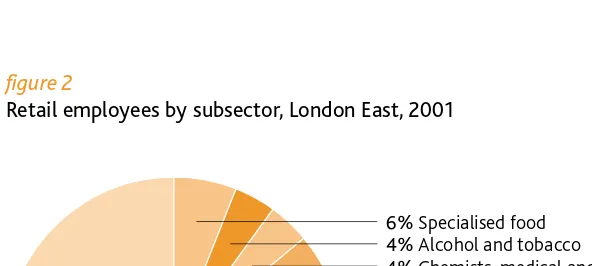
Across London East as a whole there were 54 businesses with over 200 employees. 46 of these were in the non-specialised food classification – usually supermarkets. The 54 businesses accounted for over 18,000 employees in the area. By contrast, there were almost 8,000 businesses with fewer than 11 employees, and a further 800 with fewer than 50 employees. The analysis by sector in the pie chart (figure 2)shows how dominant the supermarkets are over the specialised food stores. This category includes greengrocers, butchers, bakers and so on6. Specialist retailers had a relatively
RET
AIL
PA
GE
6% Specialised food
4% Alcohol and tobacco
4% Chemists, medical and cosmetics
13% Textiles, clothing and footwear
34% Non-specialised food
10% Furniture, electrical and DIY goods
9% Non-specialised stores
3% Books and newspapers
1% Repairs of retailed goods
12% Specialised stores
[image:9.842.31.327.554.687.2]4% Other retail formats figure 2
Retail employees by subsector, London East, 2001
Source: Annual Business Inquiry 2001, ONS Crown copyright (2003)
4DfES,An Assessment of Skill Needs in Retail and Related Industries, 2002. This publication included hairdressing and beauty therapy, postal services, funerals, hire and rental, textiles, dry cleaning, gaming and betting as well as retail, wholesale and distribution following the remit of the former Distributive Trades National Training Organisation.
5Annual Business Inquiry, Crown copyright, 2003.
6 The detailed numbers for each type of outlet are in the appendix.
The economy
During the last two years (2001-2003), the UK and world economies have been sluggish. Domestically, the continual growth in house prices has allowed consumers a personal sense of economic wellbeing that has allowed them to keep spending in the high street. If economic confidence reduces, retailers will suffer as individuals and families become more discretionary in what they choose to buy.
The economic forecasts
in London East suggest
little employment growth
in retail over this decade. It
is anticipated the next two
to three years will be steady
in terms of investment in
the industry, with greater
growth coming towards
the end of the decade.
A downturn in financial services in the west of the subregion, and redundancy and restructuring in the east of the area, have tended to reduce consumer spending power. On the other hand, public announcements of major building work to regenerate the Thames Gateway area could enliven the local economy, and increase spending.
Chapter
2
Curr
ent
and
futur
e
developments
in
the
retail
sector
RET
AIL
PA
GE
E-retailing
Various studies have tried to measure, in financial terms, the impact of e-retailing nationally. The more important factor for a subregional strategy such as this is the effect on jobs and skills needed. After the market was initially overwhelmed by pure online providers, it has now settled down. It is now common practice for retailers with actual premises to add online sales as an extra distribution channel. For London East there have been two effects.
• The creative industries in the area have benefited with website development and hosting contracts.
• Existing retailers and other agencies need to recruit delivery personnel and in-store staff to fulfil customer orders for home delivery on a local basis.
Competition
Competition on price has been a major promotional tool of the large multiple stores in recent years. This includes clothing as well as food, with several large chains having developed the discount-clothing market. There has also been an advance by up-market retailers producing low-volume, but high-value-added goods appealing to consumers who want distinctively different products. This trend has temporarily ‘squeezed’
middle-of-the road retailers who have had to rethink their product range.
Consumer demands and social change The growth of retail parks and moves by some traders to offer shopping 24 hours a day, seven days a week (depending on Sunday trading restrictions), have significant implications for the shape and management of retail workforces. For larger companies there tend to have been large increases in the numbers of part-time staff to be rostered, trained and supervised. For smaller companies, increased competition means that they may have to reconsider their business model, and possibly develop new ways of working in order to survive.
The Henley Centre in its work for the London Skills Forecasting Unit’s publication
Skills for Tomorrow’s High Street, discussed the way some consumers see shopping as part of a leisure experience. It continued by identifying four consumer types. Individuals may belong to one or more of these types at different times in their life, and want different shopping experiences.
• “Those with plenty of time and money seek ambience and a leisure experience, and high levels of customer service.
• Those with limited time but plenty of money seek fast and efficient service. • Those with limited time and little money
look for rapid service at discounted prices.
• Those with plenty of time but little money want discounted prices and are prepared to ‘shop around’.”
Regulation
Keeping to health and safety regulations, food hygiene requirements, and licensing laws should all be part of retail business operations depending on the subsector. The freedom to trade longer hours may be beneficial to businesses, but they must keep within employment law when looking at hiring, firing, salaries and the conditions of service offered to staff.
Information technology
IT has had a major impact on retail operations. Businesses demand basic competence in handling equipment that is linked to IT from many employees. There is an expectation that back-office staff and delivery personnel will use IT in recording the movement of goods. Shop-floor staff will be using hand-held computer devices to monitor sales from the shelves in many supermarkets.
Customer service
In the statistical analysis of London East retail we noted that there were 8,000 small stores employing a combined total of over 25,000 people. The way forward for many smaller outlets, where they cannot compete on price with the larger multiple stores, is better customer service. The Skills Dialogue7noted that this was a challenge
for all retailers. Consumers are demanding better service promptly, and are no longer prepared to tolerate inefficient service standards. In summary, the Skills Dialogue suggested that this cultural shift had raised the skill levels needed to the point where "customer service staff need to possess excellent interpersonal skills, numerical and verbal reasoning, IT competency and general awareness".
Future demand levels
The Distributive National Training
Organisation in its Workforce Development Plan for the Distributive Industry8did not
expect a significant change in the numbers employed in the broader industry9it
represented. It did expect some growth in retail, particularly in part-time working and sales occupations.
In table 1, the modest employment growth expected nationally is seen at a local level, in the London East area, with a rise in total employment by the end of the decade of over 4,000 employees. This needs to be counterbalanced by a slight drop in the forecast numbers of self-employed from 5,300 to 3,000 by 201010.
The two figures (shown opposite) indicate that female employment will continue to grow, perhaps at a greater rate in full-time posts than part-time posts, with a very modest drop in male full-time employment. Nevertheless, the two significant trends we should note are the growth in female employment, and the continued growth in part-time employment.
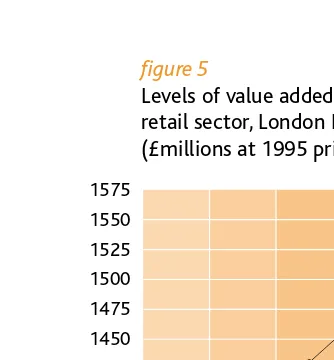
[image:12.842.27.380.546.606.2]Although we can see modest employment growth in the sector, the forecast figures for retail in London East in figure 5show a 20% growth from 2002 to 2010 in gross added value.
table 1
Forecast numbers of retail employees, London East, (thousands)
2002 2004 2006 2008 2010
Male and female full time 35.7 36.4 36.7 36.9 37.2
Male and female part time 38.9 39.9 40.5 41 41.6
Total 74.6 76.3 77.2 77.9 78.8
RET
AIL
PA
GE
11
[image:13.842.279.535.271.415.2]2002 2004 2006 2008 2010
figure 4
Employment levels male and female part time in the retail sector, London East, 2002-2010 (thousands)
0 2.5 5 7.5 1012.5 15 17.5 2022.5 25 27.5 3032.5
Male Female
Source: CE/IER LEFM 2002
2002 2004 2006 2008 2010 1250
1275 1300 1325 1350 1375 1400 1425 1450 1475 1500 1525 1550 1575
value added levels
figure 5
Levels of value added,
retail sector, London East, 2002-2010 (£millions at 1995 prices)
Source: CE/IER LEFM 2002
7 DfES,An Assessment of Skill Needs in Retail and Related Industries, 2002. 8 March 2001.
9The Distributive Trades NTO represented employers in the retail and distribution sectors. The new sector skills council, Skillsmart, only represents the retail sector.
10 Source: CE/IER LEFM 2002.
[image:13.842.27.218.273.416.2]2002 2004 2006 2008 2010
figure 3
Employment levels male and female full time in the retail sector, London East, 2002-2010 (thousands)
0 2.5 5 7.5 1012.5 15 17.5 2022.5
Male Female
[image:13.842.254.421.528.708.2]The changing employment pattern We expect that the total number of managers employed compared to those employed in sales and other front-of-house roles will reduce. As indicated above, part-time working11will increase nationally
and locally. Meanwhile, the job content of particular roles will change, and greater levels of skills will be demanded.
The Henley Centre analysis for the London Skills Forecasting Unit suggested that there was a greater demand for staff to be multi-skilled and multi-functional. They expected that the demand for IT skills and people skills would increase most, followed by numeracy, literacy and visual skills.
Skills
• Skills shortages
The Skills Dialogue12lists the most
sought-after skills for hard-to-fill vacancies as: • personal attributes
• customer handling skills, and • communication skills.
The DNTO13had previously mentioned
that applicants for managerial positions lacked management and problem-solving skills. The Skills Dialogue had also noted a lack of team-working skills among managers as well as a lack of communication skills.
The Skills Dialogue suggested the two main reasons for the skills shortages were:
• the low number of applicants with the necessary skills, and
RET
AIL
PA
GE
13
• Skills gaps
The main skills gaps14reported in the
sector were:
• communication skills
• customer-handling skills, and • team working.
Basic computer literacy was a skills need at most occupational levels, but more advanced IT skills were needed at associate-professional and clerical levels. Those in clerical posts had the most noticeable skills gap in customer-handling. This is probably the result of a trend that has seen the distinction between back-office, front-of-house, shop-floor and sales activities all being blurred. There is an expectation from customers that high-quality service will come from all representatives of retail organisations. It is no longer enough for a retail employee to say that it is someone else’s job when faced with a customer enquiry.
The most common reason given for skills gaps was the failure to train at all levels in organisations. The reason often given by employers for the failure to give training is the high turnover of staff. There is sometimes a lack of commitment from the staff themselves, and a difficulty in making appropriate training arrangements in a sector where half of the employees are part-time, and probably working across an extended working week.
Smaller businesses in the sector offer few barriers to entry for potential recruits. As a result, there is likely to be a need to improve the English language skills of staff. Staff are also likely to need to improve their basic business skills so the business can survive and grow.
Summary
Several of the studies of the retail sector note a ‘skills paradox’ in relation to training. The Henley Centre15called it
a ‘vicious circle’. In other words, the failure to attract and recruit appropriately-skilled staff, and the failure to tackle skills gaps through effective training programmes leads to poor customer service and a failure to meet business objectives. The resulting downturn in business means a lower budget for training (and salaries), and the continued image that the retail sector lacks dynamic career opportunities. As we said earlier, the sector is one of the ‘engines’ of economic growth nationally and locally, and has the capacity, through involving appropriately-skilled and trained staff, to continue its growth.
The problems are summarised in the hard-to-fill vacancy information for the sector, based on national statistics:
• 35% in sales and related occupations (the largest occupational group) • 54% in clerical, and
• 42% in managerial.
“Of these hard-to-fill vacancies, 32% of sales and related occupations were identified as skills-related, 62% of clerical and secretarial were skills-related, and 45% of managers were skills-related16.”
11 See also DNTO,Workforce Development Plan for the Distributive Industry, 2001. 12DfES,An Assessment of Skill Needs in the Retail and Related Industries, 2002.
This publication uses information from the Employers Skills Survey 2001 (DfES/IER) 13 DNTO,Workforce Development Plan for the Distributive Industry, 2001.
14 DfES,An Assessment of Skill Needs in the Retail and Related Industries, 2002 citing ESS 2001. 15 London Skills Forecasting Unit,Skills for Tomorrow’s High Street, 2000.
Introduction
“Whilst most retailers invest significantly in training, the sector is not well perceived by those looking for good employment and career prospects17.”
Many young people are drawn into retailing as a part-time job on the way to a career elsewhere – perhaps using the income to support studies. There is an increasing number of older employees in retailing. Large employers are keen to employ older people, again for part-time posts, as they are seen to be more reliable than younger people. Finally, in areas of social deprivation which have poor employment opportunities, part-time work in retailing can provide a boost to family income for local people.
This implies that retail careers are often seen as a second, third or last choice option when young people are making career choices.
The previous chapter showed that there are large numbers of part-time jobs available in sales-related occupations. However, there is a need for able managers in the industry. With cost-conscious, highly-competitive larger organisations running businesses with highly-organised supply chains using IT, the range of employment opportunities can be much wider than just the ‘shop floor’.
The task for the sector and public agencies is to raise awareness of the breadth of employment opportunities available in the industry.
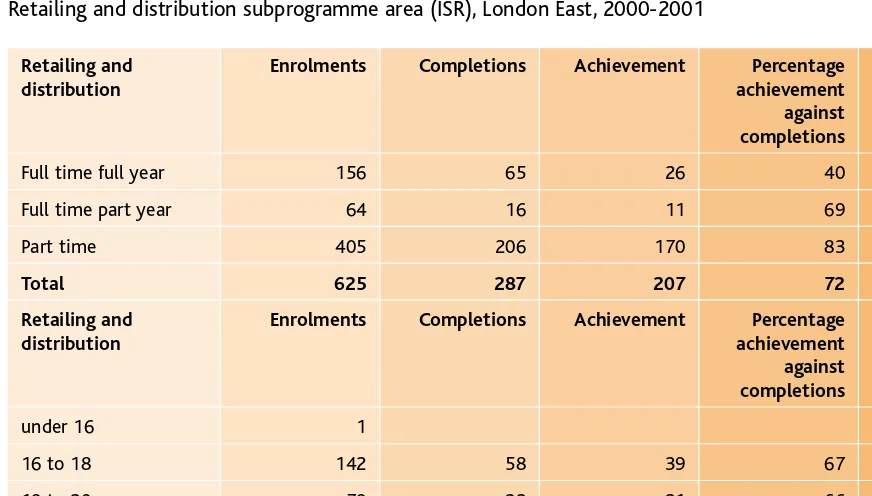
Qualifications and achievements There are few qualifications directly focused on retail. The new range of vocational GCSEs does not have a separate retail GCSE, although there is a new GCSE in Applied Business. Students can study an AVCE in Retail and Distributive Services. This subject is also available at Foundation and Intermediate GNVQ levels. Retail is available as an NVQ and through the Foundation and Advanced Modern Apprenticeship routes. The take-up on the Advanced route is quite low. An analysis of the Individualised
Student Records (ISR) for 2000-2001 shows the relatively low numbers of students enrolled in further education institutions in London East on retail programmes. There is also a very poor retention rate with less than half the people enrolled completing their courses. The problem is most acute among full-time students and the 16 to 18 age range. The highest achievement level among students who completed was to be found on part-time courses. However, when those achievements are set against the original enrolment numbers, the success rates are low.
The Skills Dialogueidentified 28 universities offering courses in retail management or retail specialist subjects. As an academic discipline it does not have a separate categorisation in the Higher Education Statistics Agency (HESA) programme area listing.
Chapter
3
Skills
suppl
y
for
the
RET
AIL
PA
GE
15
Other training
The Distributive Trades National Training Organisation in its Workforce Development Plan18showed the strength of training
activity among the largest retailers in the sector. It did this by listing the number of sector companies that had won major training awards. The training is provided either by in-house staff, or private training providers. Although the plan praises the high quality achieved, it admits the real problem is getting training activity to take place in small and medium-sized businesses. There are 16 providers we have
contracted to deliver work-based learning in retail. Most offer NVQ qualifications in Retail at levels 1, 2 and 3, and Foundation and Advanced Modern Apprenticeships. The number increases to 24 in relation to the NVQ in Customer Services which is offered generally at levels 1 and 2, with one provider offering level 4. Most providers offer Modern Apprenticeships at both levels. Finally, there are four providers offering NVQ level 1 in Distributive Operations.
Summary
[image:17.842.29.465.148.396.2]Retail is an industry where 17% of the workforce has no qualifications, and where the most important consideration in recruitment is personal attributes. If people are attracted to the industry with qualifications at levels 3, 4 and 5, they are unlikely to have come from courses that were focused on retail as a subject area. In London East, there are opportunities for studying retail courses, but few choose to do so compared to the numbers working in the sector.
table 2
Retailing and distribution subprogramme area (ISR), London East, 2000-2001
Retailing and Enrolments Completions Achievement Percentage Percentage
distribution achievement achievement
against against
completions enrolments
Full time full year 156 65 26 4017
Full time part year 64 16 11 69 17
Part time 405 206 170 83 42
Total 625 287 207 72 33
Retailing and Enrolments Completions Achievement Percentage Percentage
distribution achievement achievement
against against
completions enrolments
under 16 1
16 to 18 142 58 39 67 27
19 to 2079 32 21 66 27
21 to 24 75 28 21 75 28
25 to 59 328 169 126 75 38
Total 625 287 207 72 33
17 Skillsmart Business Plan 2002-04.
Business pressures
The retail sector is dominated by some major multi-national businesses that shape the trading environment. Yet much of the employment in the sector is still in smaller businesses. Over one-third of London East’s retail employees were in establishments with fewer than 11 employees.
This trading environment is highly competitive in terms of price levels, and smaller businesses have to find ways of maintaining a competitive advantage. This is because they lack the ‘economies of scale’ to reduce prices to the levels of their larger neighbours.
One advantage that smaller businesses, particularly specialised outlets, could offer is higher-quality customer service. Not all managers and owners have taken this route. There is a tendency to focus on short-term goals. And training, if available, tends to be driven by needs – health and safety requirements – rather than developmental. In some cases training initiatives have been described as "reactive and crisis-driven".
Small and medium-sized businesses need to build on location and local knowledge as a way of gaining competitive advantage. However, the large chains are looking to compete in this area as well. Tesco Express and Sainsbury Local are two examples of neighbourhood shopping outlets from large supermarket companies, often using petrol forecourts to base their stores. There is some evidence of recruitment difficulties for specific tasks, but the barriers to entering the industry are usually set quite low, so new employees can be found. Unfortunately they do not stay, and turnover in low-skilled workers is quite high.
For the rest of this decade there will be slow growth in the sector, but the replacement demand will be high with employees often seeing their posts as temporary rather than long-term.
The local economy
The Government has identified the Thames Gateway as a major area for growth. Up to £446 million has been made available for developing the area, and this will lead to the building of thousands of new homes. Creating sustainable communities in London East will need an active retail sector.
Meanwhile, the town centres of Barking, Stratford and Woolwich are all scheduled for redevelopment.
One of the private-sector developers on its website describes the potential changes to Stratford as follows.
"The masterplan will create an extension to Stratford town centre which will include a full range of retail, commercial, leisure, municipal, hotel and residential uses. Spectacular new buildings will establish a high quality urban environment… A secondary axis containing commercial leisure and additional retail activities will provide a link to Leyton in the east19."
Previously, Romford town centre had gained a major increase in retail floor space with the £118 million development on the Allied Brewery site. This has been followed by a building programme which includes the Liberty shopping precinct in early 2003. This combination of shopping facilities in the immediate town-centre area makes it one of the largest retail centres in the country.
Chapter
4
The
main
issues
for
the
RET
AIL
PA
GE
17
Barriers to training – learning needs and opportunities
Barriers to the take-up of training include:
• lack of time
• lack of cover during training
• lack of courses at the relevant level available locally, and
• large numbers of part-timers whose shift patterns prevent them from taking training opportunities.
Larger employers often make their own arrangements for staff training rather than using public provision. This can be through in-house trainers, or using private organisations to run training programmes. Apart from training designed to meet legislative requirements, training is offered which focuses on product or brand information.
In designing programmes to meet local need in London, providers would need to offer support for learning and training that is delivered at a time and place suitable to the organisation, usually at the retail outlet, and integrated with the daily demands of the business. Because of the low skills and qualifications of the workforce, basic skills and ESOL are a high priority. Learning opportunities for individuals to improve in these areas should be built into vocational training programmes in the workplace.
In spite of the difficulties in making learning opportunities available to retail employees, it is a policy area that we should strengthen.
There has been a low take-up of recognised quality standards such as Investors in People among small and medium-sized businesses in East London and improving this take-up should also be a priority.
The sector plays an important role in offering employment opportunities to people who traditionally face difficulties entering the labour market. Smaller companies need to better manage the way they plan training.
The tasks facing employers are to:
• gain a clear picture of the skill levels of the current workforce
• understand the skills employees need to deliver quality customer service in a highly competitive environment
• develop strategies to help improve the skills of their workforce by accessing new or different learning opportunities, and • recognise that managerial posts demand
a higher level of skills to manage people and technology.
Finally, all employers, and public agencies working with the retail sector, need to raise the profile of the industry to make it a first-choice career. In London East, retail is in competition with the hospitality industry and retail financial services for people choosing to work in customer-service occupations. To do that effectively, retail needs to make its career offer more attractive, particularly in relation to financial services, which can offer more favourable pay and conditions.
Supporting small and medium-sized businesses (SMEs)
We will:
• work closely with Skillsmart to support their initiatives which are targeted at SMEs • encourage a London-wide approach to
develop support for SMEs
• work with each of the local authorities in London East to develop SME retailers in their areas
• work with local business support agencies to develop their retail members
• support the managers of the Barking, Stratford and Woolwich town centres to develop SME retailers, and
• promote and increase the achievement of IiP recognition in the sector.
Qualifications and assessment We will:
• support LSC national office in developing user-friendly NVQs including the associated assessment processes, and • work with Skillsmart, training providers
and other organisations to return NVQs to their original concept – a workplace-assessed qualification.
Learning and training We will:
• work with recognised providers to develop and deliver relevant training activities • support the Skillsmart initiative to
quality assure all training providers delivering to clients in the sector, and
• work with partners to make more Basic Skills and ESOL learning opportunities available in the sector.
Sector image We will:
• work with partners to raise the profile of the sector among school leavers including opportunities for graduates.
Chapter
5
St
rateg
ic
RET
AIL
PA
GE
19
A
ppendices
[image:22.842.216.564.88.457.2]Appendix 1
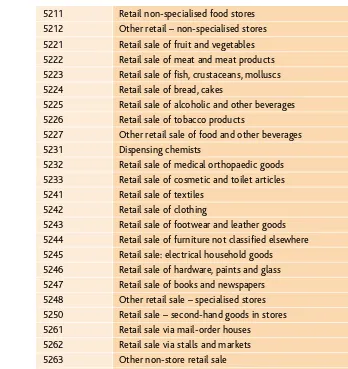
table 3
Number of employees, London East, 2001
5211 Retail non-specialised food stores 24,886
5212 Other retail – non-specialised stores 6,292
5221 Retail sale of fruit and vegetables 501
5222 Retail sale of meat and meat products 810
5223 Retail sale of fish, crustaceans, molluscs 83
5224 Retail sale of bread, cakes 1,418
5225 Retail sale of alcoholic and other beverages 1,467
5226 Retail sale of tobacco products 1,316
5227 Other retail sale of food and other beverages 1,530
5231 Dispensing chemists 1,846
5232 Retail sale of medical orthopaedic goods 57
5233 Retail sale of cosmetic and toilet articles 788
5241 Retail sale of textiles 406
5242 Retail sale of clothing 7,347
5243 Retail sale of footwear and leather goods 1,512
5244 Retail sale of furniture not classified elsewhere 2,212
5245 Retail sale: electrical household goods 2,653
5246 Retail sale of hardware, paints and glass 2,522
5247 Retail sale of books and newspapers 2,206
5248 Other retail sale – specialised stores 8,539
5250Retail sale – second-hand goods in stores 690
5261 Retail sale via mail-order houses 1,672
5262 Retail sale via stalls and markets 173
5263 Other non-store retail sale 626
5271 Repair of boots and shoes 136
5272 Repair of electrical household goods 222
5273 Repair of watches, clocks and jewellery 20
5274 Repair not classified elsewhere 351
Total 72,275
Source: Annual Business Inquiry 2001, ONS Crown copyright (2003)
Appendix 2
Hairdressing and beauty therapy One industry we have not covered in this strategy is hairdressing and beauty therapy. It is an important presence on the high street, and in this short appendix we describe its main features.
Nationally, the industry employs over 200,000 people, and there are more than 40,000 salons. About 85% of these are hairdressing salons, some offering beauty treatments. The rest are beauty therapy salons. Most businesses are
microbusinesses, and generally have four or five staff including the owner. Salons often rent out chairs or treatment rooms to freelance or self-employed hairdressers and beauty therapists.
There are skills gaps among existing staff. These include some technical skills relating to specific treatments, customer-care skills and business skills. There are skills shortages at all levels, but particularly for hairdressing apprentices and stylists, and for beauty therapists.
There is considerable initial enthusiasm for the industry from young people, but the drop-out rate on hairdressing and beauty therapy courses is high. Many of those students who succeed at NVQ level 2, find the NVQ level 3 courses too demanding, and do not take the higher-level qualification.
London East 2003-2005
2
1 Construction
2 Cultural and creative industries
5 Hospitality 6 Manufacturing 7 Public administration
3 Financial services 4 Health and social care
0 Overview
W
orkf
or
ce
Development
A
ction
Plan
R
etail
W
orkf
or
ce
Development
Str
ateg
y
R
etail
Lift for action plan 8 Retail 9 Transport and logistics 10 Voluntary and community
London East 2003-2005
8
Learning and Skills Council London East
Boardman House, 64 Broadway, Stratford, London E15 1NT
Telephone: 0845 019 4151 e-mail: [email protected] www.lsc.gov.uk
This strategy was written by Trevor Carr and members of the LSC London East Workforce Development team.
Trevor Carr McKerr Carr Ltd Telephone: 020 8349 2110 www.mckerrcarr.com
Designed by Creative Leap Telephone: 020 7549 0700 www.creativeleap.com