This is a repository copy of
Cost overruns – helping to define what they really mean
.
White Rose Research Online URL for this paper:
http://eprints.whiterose.ac.uk/120021/
Version: Accepted Version
Article:
Invernizzi, DC orcid.org/0000-0001-8178-9557, Locatelli, G
orcid.org/0000-0001-9986-2249 and Brookes, NJ (2018) Cost overruns – helping to define
what they really mean. Proceedings of the ICE - Civil Engineering, 171 (2). pp. 85-90.
ISSN 0965-089X
https://doi.org/10.1680/jcien.17.00001
© ICE Publishing, all rights reserved. This is an author produced version of a paper
published in Proceedings of the ICE - Civil Engineering. Uploaded in accordance with the
publisher's self-archiving policy.
[email protected] https://eprints.whiterose.ac.uk/
Reuse
Items deposited in White Rose Research Online are protected by copyright, with all rights reserved unless indicated otherwise. They may be downloaded and/or printed for private study, or other acts as permitted by national copyright laws. The publisher or other rights holders may allow further reproduction and re-use of the full text version. This is indicated by the licence information on the White Rose Research Online record for the item.
Takedown
If you consider content in White Rose Research Online to be in breach of UK law, please notify us by
Cost overruns
–
helping to define what they really mean
Diletta Colette Invernizzi, BEng, MSc
School of Civil Engineering, University of Leeds,
Woodhouse Lane, Leeds LS2 9JT (UK)
e-mail: [email protected]
CORRESPONDING AUTHOR
Dr Giorgio Locatelli, BEng, MSc, PhD, FHEA
School of Civil Engineering, University of Leeds,
Woodhouse Lane, Leeds LS2 9JT (UK)
e-mail: [email protected]
Prof Naomi J Brookes, PhD, DIC, FHEA
School of Civil Engineering, University of Leeds,
Woodhouse Lane, Leeds LS2 9JT (UK)
Abstract
Practitioners and academics often debate about cost overruns, a pivotal part of the iron-triangle that is
traditionally used to assess the project management performance. Intuitively, the term “cost overruns”
refers to the situation where the actual costs are higher than the original estimates. However, especially
in the case of long and complex projects, with several different budgets, significantly affected by scope
changes, inflations, etc., the assessment of “cost overruns” can still be subject of misunderstanding.
This paper addresses this topic by proposing a way to define and assess cost overruns, particularly in
the case of long and complex projects (also called megaprojects) and when publicly available
information is scattered. This is exemplified using the case of Nuclear Decommissioning Projects and
Programmes (NDPs) that are representative of the above-mentioned scenario. Lastly, this paper
reflects on the importance of highlighting the existing constraints and the assumptions adopted during
the appraisal of cost overruns.
Keywords
Decommissioning, Economics & Finance, Project Management
List of notation
NDPs: Nuclear Decommissioning Projects and Programmes
: “final” costs
Introduction
Practitioners and academics often debate about cost overruns. But what is the actual meaning of “cost
overruns”? The answer might seem trivial: a cost overrun refers to the situation where the actual cost
is higher than the original estimate. However, especially in the case of megaprojects, this construct can
still be hard to define.
Megaprojects are temporary endeavours (i.e. projects) characterized by: large investment commitment,
a budget over £1 billion, vast complexity (especially in organizational terms), long planning and
construction schedule. Megaprojects are affected by several high level risks and have a long-lasting
impact on the economy, the environment, and the society (Ansar et al. 2016; Brookes & Locatelli 2015).
Moreover, especially in the case of large and complex projects, the assessment of the cost overruns is
hindered by the issue of data availability, reliability and integrity. Indeed, trying to establish cost
overruns is a very difficult task both outside an organisation (due to the lack of publically available
and reliable data), but it is also hard within an organization, because (often) no proper targets are set.
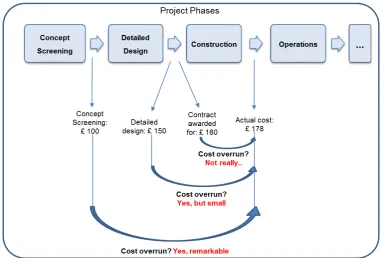
Consider the example in Figure 1. If a construction project was estimated to cost £100 after the concept
screening phase and £150 after the detailed design phase, but the contract was ultimately awarded
after the tendering process at £180 and the final actual cost of the project was £178, are we confident
to say that the project is affected by cost overruns? Or: if the project was approved to proceed after the
concept screening for £200, the detailed design estimated costs for £230, but the contract was awarded
after the tendering process for £180 (at the lowest bid), and the final actual cost were £230, are we
confident to say that the project was affected by cost overruns? And, if so, how much was the cost
overruns?
This case is comparable to the London Olympics 2012, where the initial estimates made by the Labour
Government reached £2.4 billion in 2005 (when London won the bid). These estimates then raised to
£9.3 billion, which allowed the Olympic Minister to declare that the project was a “significant
achievement” and allowed the Government to issue a report on the Olympics being“under budget”,
Figure 1. Assessing cost overruns
It may be considered surprising that neither the Project Management Body of Knowledge (2013) nor
the Association of Project Management (2016) provide a definition for “cost overruns” or “cost over
-budget”, presumably assuming that its meaning is straightforward and its calculation clear. However,
this paper argues that, especially in the situations where the development of a project is long and
complex (e.g. megaprojects (Locatelli et al. 2014)), the assessment of cost overruns can be challenging.
The authors address this topic by firstly reviewing how cost overruns are calculated in the literature.
Secondly proposing a way to assess cost overruns in a rigorous and transparent way, especially in the
cases where the number of projects is low and publically available information is scattered, such as
megaprojects. This is exemplified using the case of Nuclear Decommissioning Projects (NDPs) that are
representative for the above-mentioned scenario. Indeed, since nuclear decommissioning involves the
management of radioactive material, NDPs are highly uncertain, complex, and long projects that involve
several internal and external stakeholders (Invernizzi et al. 2017). Finally, this paper reflects on the
The traditional assessment of cost overruns
Cost overruns are traditionally calculated in absolute terms as in Eq 1 and in relative terms as in Eq 2.
Eq 1:
Eq 2
:
Where refers to the actual cost, i.e. the costs determined at the time of completing a project and
refers to the “original estimated” cost. Eq 2 reflects the “Project Cost Growth” metric presented in
(CII 2016) and below in Eq 3.
[image:6.595.73.524.704.738.2]Eq 3
:
Table 1 provides a review of definitions of cost overruns and of the variables used to calculate it, i.e.
and .
However, even if it is a crucial point, few authors clarify the project stages (e.g. the points in time in
the lifecycle) and the sources to which the figures refer to for the assessment of cost overruns. For
instance, if we consider a 10-years project in a country with 3% inflation, the impact of inflation alone
would be (1+0.03)^10 = 1.344, which means an impact of 34%. The reference year for “cost estimation”
is therefore fundamental to understand if the project is over budget (Lind & Brunes 2015).
Recently, Awojobi & Jenkins (2016, p.21) stated that “the values for ‘estimated’ [costs] are based on
information documented at the approval stage of the projects, most of which can be found in the Staff
Appraisal Reports (SARs) from the World Bank; while the values for ‘actual’ [costs] are determined by
information at the end of construction, following the World Bank's Implementation and Completion
Reports (ICRs)”. In 2002, Flyvbjerg et al. (2002, p.5) defined actual costs as the “real, accounted
construction costs determined at the time of project completion”, while estimated costs denoted the
budgeted or forecasted construction costs “at the time of decision to build”1.
Ref Definition of Cost Overruns
Absolute or relative?
1 “Although the project planning process varies with project type, country, and time, it is typically possible for a
(Jadhav et al. 2016)
Cost overruns are defined as “the difference between forecasted and
actual construction costs”
Absolute C refers to “costs” actual “budgeted amounts”refers to the
(Brookes & Locatelli 2015) and (Locatelli, Invernizzi, et al. 2017)
Projects were judged to be over-budget, i.e. to suffer from cost overruns, when “the final cost of the project was greater than
the 110% of the original estimate (adjusted for the
inflation)”
Relative
C refers to the costs “at the point at which the
project entered
operation”
refers to the “estimated costs”, whose
figures was taken at the time as close as possible to
“the first formal activity”,
e.g. “the acquisition of any land rights required for the
project”
(Ansar et al. 2014)
Cost overruns refer to
“actual outturn costs
expressed as a ratio of estimated costs
Relative C outturn costsrefers to “actual ”
refers to “estimated
costs”, “estimated budget”
and/or “initial budget”
(Tokede et al. 2014)
Cost overruns “insinuate the incongruence of initial
estimates with final estimates, after or during
the delivery of a project”
Absolute
C refers to “final
estimates” both at the
end and during the development of the
project
refers to “initial
estimates”
(Merrow 2011)
Cost overruns are measured as “the ratio of
the actual final costs of the project to the estimate
made at the full-funds
authorization […]”
Relative: although not explicit in the
definition, cost overruns are calculated as a percentage of the
estimated costs
C refers to the “the
actual final costs”
refers to the “estimate made at the
full-funds authorization”
(Cantarelli et al. 2010)
Cost overruns is calculated as “Actual out
-turn costs minus estimated costs as a percentage of estimated
costs”
Relative
C refers to actual costs, where “actual costs are defined as
real, accounted construction costs determined at the time
of project completion”,
as in (Flyvbjerg et al. 2002)
refers to estimated costs, where “estimated
costs are defined as budgeted or forecasted
construction costs determined at the time of
the decision to build”, as in
(Flyvbjerg et al. 2002)
(Odeck 2004)
Cost overruns refer to “Difference between
actual and estimated cost“ Absolute C refers to the cost” “actual “estimated cost”refers to the
“Ratio of actual to
estimated cost in %” Relative
(Flyvbjerg et al. 2002) & following, e.g.
(Flyvbjerg 2008)
Cost overruns is calculated as “actual costs
minus estimated costs in percent of estimated
costs”
Relative
C refers to actual costs, where “actual costs are defined as
real, accounted construction costs determined at the time
of project completion”
refers to estimated costs, where “estimated
costs are defined as budgeted or forecasted
construction costs determined at the time of
the decision to build”
Table 1. Assessment of cost overruns in the literature
Nevertheless, especially for long projects in the public sector, it is likely that multiple changes occur
over time (Flyvbjerg et al. 2002), which affects the definition of “original estimates”. Cantarelli et al.
(2010, p.4), quoting (Cantarelli et al. 2009), highlight that “the estimated costs at the real decision to
build are usually lower than those at later stages of the decision-making process”, which is a situation
called “lock-in”, and that “references to the formal decision to build do not always provide an accurate
made at the full-funds authorization”, and suggests to evaluate cost overruns through (i) a systematic
collection of a large number of cases, (ii) the calculation of cost overruns of single projects, and (iii) the
definition of a threshold (25%) to determine the actual cost overruns. Tokede et al. (2014, p.19), who
describe cost overruns as the incongruence between initial estimates and final estimates, take another
step forward specifying that costs can be evaluated “after or during the delivery of a project”. This shows
a remarkable difference with the other publications of Table 1, as the authors argue that cost overruns
can be calculated when the project is not finished yet but it is still ongoing. Similarly, Locatelli et al.
(2016, p.11) define as the “final cost” or as the “last estimate available for those [projects] still
under construction”. Additionally, the CII (2016) emphasizes the importance of mentioning “according
to whom” the initial estimates are evaluated. This is extremely important, since the iron-triangle was
originally adopting the contractor’s perspective, and therefore most of the time is not even clear if the
values refer to “cost” or “price” (two totally different concepts). Indeed, in the equations Eq 1
and Eq 2 represent for the contractors the cost estimate used as a basis of the contract award, while
for the owners refers to the budget at the time of authorization.
In summary, to assess cost overruns, most of the authors:
rely mostly on the information on completed projects, where both the final costs and the initial
estimates “at the time of the decision to build” are also available;
hardly ever highlight the boundary conditions and the assumptions regarding which point in time
and refer to;
give very limited attention to the provenance of the selected values of and
Nevertheless, this limits the researches in industrial sectors where:
projects are particularly long, complex, affected by scope changes and subsequent re-baseline(s);
the number of completed projects is low; and/or
the information on these projects is scattered.
In these cases, it is often not clear how to define and , and this affects the calculation of
How to define and assess cost overruns
Cost, time and quality are the three pivotal measures of the so-called “iron-triangle”, traditionally used
for assessing the project management constraints. Quality comprises a broad range of topics (safety
and security, environmental constraints, socio-economic aspects, stakeholders expectations, etc.) and
can be assessed at different points in time and according to a number of different stakeholders involved
in the project development (Davis 2014; Turner & Zolin 2012). Time is sometimes argued to be a better
indicator project performances than costs, being “more visible”, harder to be manipulated and a driver
for cost itself. Nevertheless, as presented in the previous sections, practitioners and academics often
debate about cost overruns, which traditionally refers to the situation where the actual costs are higher
than the original estimates. Since capital might be hard to find and it does not necessarily have a linear
relationship with time, it is important to maintain and investigate cost parameters.
Hence, as the aforementioned studies show that cost overruns can still be hard to define, this research
suggests how to transparently assess cost overruns (to eventually and subsequently compare them).
This is exemplified using the nuclear decommissioning industry, but the reasoning is similar for other
projects and megaprojects.
Nuclear decommissioning consists of all the administrative and technical actions to remove all the
regulatory controls from a facility and restore the site to new use (IAEA 2017). Globally, NDPs costs
estimates lie in the range of hundreds of billions of pounds, reaching £55 billion in France (WNA 2015)
and almost £70 billion in the UK (NDA 2016a). Moreover, NDPs estimates are extremely challenging
(Torp & Klakegg 2016) and keep increasing. This is partially due to the fact that the number of the
completed NDPs is negligible compared to the new build, therefore there is limited data regarding the
cost estimation. Indeed, in the nuclear industry, more than 500 Nuclear Power Plants have been built
throughout the 20th century (and still the construction of new units is an enormous challenge), while
only 16 have been fully decommissioned (OECD/NEA 2016).
The following points are therefore highly recommended to assess the cost overruns:
First of all, clearly state which are the points in time in the project lifecycle, that refers
to. The “original” estimated costs at the start of the project might not be available, or might not
even exist. So, it is fundamental to highlight the assumptions underpinning the selection of the
such as Sellafield (UK) (Sellafield Ltd 2016), where the operations of the site are so intertwined
with the decommissioning ones that it is extremely hard to draw a line between the two. In this
case, these “original” estimates can be defined arbitrarily, but the reasons for this decision have to
be clearly stated. For instance, the first publically available information regarding the “original”
decommissioning cost estimates for Sellafield dates back to 2005, i.e. when the UK Nuclear
Decommissioning Authority was established (NDA 2016b), so these estimates can be taken into
account to define Sellafield’s .
Secondly, clearly state which is the point in time that refers to. This can be challenging
because the “final” actual costs at the end of the project might not be available, or might not even
exist (yet), and it is the case of very long projects that last several decades and/or never reached
a conclusion (yet), again as the decommissioning of Sellafield (UK), but also construction projects
such as the bridge on the Strait of Messina in Italy (CIOB 2015). The bridge on the Strait of Messina
has been a “political debate” in Italy for a generation: a company was set up to build the bridge in
the 1980s, and detailed design work was carried out in the 1990s, but the project was cancelled in
2006. Nowadays, this bridge is back on the Italian agenda (CIOB 2015). In these situation, the
“final” actual costs are not available, as the projects are not completed yet. However, the Estimate
At Completion, i.e. “the expected total cost of completing all the work expressed as the sum of the
actual cost to date and the estimate to complete” (PMBOK 2013, p.539), can be used instead. This
has to be clearly stated in order to define .
Clearly state by whom and are defined, being aware of the difference between “cost”
and “price” when assessing cost overruns. In fact, one stakeholder’s price is another stakeholder’s
cost and talking about “cost overruns” only make sense if the viewpoint of one particular
stakeholder is highlighted.
Price is defined as in Eq 4, as a sum of the contractors’ costs plus a mark-up.
Eq 4:
In very simple terms, in a fixed-price contract (known as lump sum contract), the risks are assigned
to the contractors, who is expected to request a higher mark-up to tackle uncertainties. In this
situation, if the actual costs for the contractors increase and cost overruns occur, the mark-up is
eroded (potentially becoming negative, resulting in the contractors’ losses), but the owner is not
cost-plus-fee contract), contractors are reimbursed by the owner for the actual cost of performing the work,
plus a mark-up. In this situation, if the actual costs for performing the work increase compared to
the budgeted ones, the owner is directly affected by the cost overruns as the prices rises. In other
cases, stakeholders create a temporary organisation, called Special Purpose Vehicle (Sainati et
al. 2015), that further complicates the difference between price and cost.
Moreover, for major and mega projects, estimates are made summing up sub-projects cost
estimates. These sub-projects cost estimates refer to the price that will be paid to the contractors
(and not the actual costs of the work to be done). This price is normally higher than the cost of
work to guarantee a mark-up for the contractors. However, it may be lower for strategic reasons,
e.g. to gain the first-mover advantage, or when the actual profit is not made by the selling of the
product itself, but of the products and services that the client will need after having bought the first
item.
This works both for “smaller projects”, such as printer cartridges for printers, coffee capsules for
coffee machines, and more significant ones, such as uranium for refuelling nuclear power plants.
On the latter topic, Anne Lauvergeon (CEO of Areva - a French multinational group specializing in
nuclear power and renewable energy, for ten years) stated in 2008 that the model of the CEA, a
French public government-funded research organisation was indeed following the model of coffee
machines and coffee capsules (Challenges 2008).
Therefore, it is pivotal to clarify “according to whom” and are defined.
Highlight to which stage of the development of the project the estimates refer to (e.g. concept
screening, detailed design, etc.) and which is the degree of uncertainty associated to it, as different
project stages present different uncertainty levels (GIF 2007) and P50 estimates are significantly
different than P80 estimates (UK Government 2015).
Some uncertainties are caused by known unknowns, so they cannot be dealt with upfront. Others
can be mitigated at an early stage of the project development, such as the specification employed
at the procurement stage to share the risk of delays in the supply of equipment and services. For
example, in the comparison between two NDPs, Sellafield (UK) and Rocky Flats (US) (Invernizzi
et al. 2017), it is highlighted that the sharing of responsibility between the US Government and the
avoid delays in the delivery of products or services (Cameron & Lavine 2006) and ultimately avoid
cost overruns.
Investigate scope change(s) and eventual re-baseline(s), highlighting the different contractual
agreements, which can influence the project performance (Suprapto et al. 2016).
Scope changes refers to any change to the project scope, and almost always requires an
adjustment to the project cost or schedule; scope creep is the uncontrolled expansion to product
or project scope without adjustments to time, cost, and resources (PMBOK 2013). So, when scope
creep occurs, the additional costs are mostly sustained by the contractor who might have a limited
understanding and visibility of the overall economic impact of accommodating all the clients’
requirements.
On the other hand, scope changes are dealt with in different ways depending on the type of
contract agreements: in fixed-price contracts, changes in scope are accommodated generally with
an increase of the contract price, while in cost-reimbursable contracts, the client has the flexibility
to re-direct the contractors whenever the scope of work could not have been precisely defined at
the beginning (PMBOK 2013) . This means that, if scope changes are agreed by both parties under
a reimbursable contract, scope changes change the “original estimates” and costs are re-baselined, without causing an increase of the cost overruns, but “only” an increase of the overall
project cost.
Moreover, Lind & Brunes (2015) have also summarized the causes of scope changes (i.e. changes
in the design, in the production function, in the price of the factors of production, and due to
inefficiencies), highlighting the importance of clustering them according to the different phases of
the project development in which they occur and the cost overruns that they cause. Unforeseen
ground conditions are also source of dispute (Fender-Allison & Mcewen 2017; Clarke 2015).
In summary, it has to be emphasized to which re-baseline refers to when calculating the
cost overruns, and the assumptions that underpin the selection of this particular point in time. For
example, in the nuclear industry, scope changes might be trigger by external events that cause
changes in the regulations (e.g. like the ones triggered by the Fukushima accident).
Lastly, clearly state the financial assumptions for the assessment of the cost overruns. In fact,
inflation, discount factors to model the cost of financing the business activities, assumptions
Again, taking the example of decommissioning, the OECD/NEA (2010, p.58) affirm that “a one-half
percent change in either inflation/escalation or discount rate has a far greater effect on long-term
costs than any single cost driver”.
Addressing these points would enable the clear definition of and and therefore allow a
Conclusion
Cost overruns have always drawn the attention of both practitioners and academics. However,
particularly in the case where projects are long, complex, affected by scope change(s) and subsequent
re-baseline(s), the assessment and comparison of cost overruns can still be extremely challenging. This
paper stems from the established literature and presents a way to address these challenges to assess
the cost overruns. In particular, it is envisaged to clearly state the assumptions concerning the point in
time that and refer to, the point of view that is adopted (cost overruns - according to whom?),
the scope changes and the financial aspects. This enables the transparent and rigours assessment of
the cost overruns, which is particularly important in the case of major and megaprojects.
Acknowledgments
This research has been supported by the NDA through the grant NNL/UA/002. The authors are
extremely grateful to Mr Martin Grey and the other NDA and NNL experts for the support received.
References
Ansar, A. et al., 2016. Big is Fragile: an Attempt at Theorizing Scale. The Oxford Handbook of
Megaproject Management, pp.1–40.
Ansar, A. et al., 2014. Should we build more large dams? The actual costs of hydropower
megaproject development. Energy Policy, 69, pp.43–56.
APM, 2016. Glossary - Association for Project Management. APM official website. Available at:
https://www.apm.org.uk/body-of-knowledge/glossary/ [Accessed December 23, 2016].
Awojobi, O. & Jenkins, G.P., 2016. Managing the cost overrun risks of hydroelectric dams: An
application of reference class forecasting techniques. Renewable and Sustainable Energy
Reviews, 63, pp.19–32.
BBC, 2007. Olympics budget rises to £9.3bn. BBC official website. Available at:
http://news.bbc.co.uk/1/hi/uk_politics/6453575.stm [Accessed March 15, 2007].
Brookes, N.J. & Locatelli, G., 2015. Power plants as megaprojects: Using empirics to shape policy,
planning, and construction management. Utilities Policy, 36, pp.57–66.
Cantarelli, C.C. et al., 2010. Cost overruns in large-scale transportation infrastructure projects:
Explanations and their theoretical embeddedness. European Journal of Transport and
Infrastructure Research, 10(1), pp.5–18.
Cantarelli, C.C. et al., 2009. Lock-in and its influence on the project performance of large-scale
transportation infrastructure projects. Investigating the way in which lock-in can emerge and
affect cost overruns. In the 88th annual meeting of the Transportation Research, Washington,
D.C.
Challenges, 2008. «Le modèle d’Areva, c'est... Nespresso» - l'interview. Challenges officail website.
CII, 2016. Performance Metric Formulas and Definitions - Construction Industry Institute. , p.6.
CIOB, 2015. World’s longest suspension bridge back on Italy’s agenda - Chartered Institute of
Buildings. CIOB official website. Available at:
http://www.globalconstructionreview.com/news/worlds-longest-suspension-b7ri7dg7e-back-italys/.
conditions. Osborne Clarke official website. Available at: http://www.osborneclarke.com
[Accessed March 20, 2017].
Davis, K., 2014. Different stakeholder groups and their perceptions of project success. International
Journal of Project Management, 32(2), pp.189–201.
Fender-Allison, J. & Mcewen, L., 2017. Unforeseen ground conditions: why subcontractors must issue
full and prompt notices. Construction News Official Website. Available at:
www.constructionnews.co.uk [Accessed March 20, 2017].
Flyvbjerg, B., 2008. Curbing Optimism Bias and Strategic Misrepresentation in Planning: Reference
Class Forecasting in Practice. European Planning Studies, 16(1), pp.3–21.
Flyvbjerg, B., Holm, S. & Buhl, S., 2002. Cost Underestimation in Public Works Projects: Error or Lie?
Journal of the American Planning Association, 68(3), pp.279–295.
GIF, 2007. Cost Estimating Guidelines for Generation IV Nuclear Energy Systems,
IAEA, 2017. Glossary. IAEA official website. Available at:
https://www.iaea.org/ns/tutorials/regcontrol/intro/glossaryd.htm#D [Accessed March 20, 2017].
Invernizzi, D.C. et al., 2017. Similar but different: a top-down benchmarking approach to investigate
Nuclear Decommissioning Projects - paper presented at the International Conference on
Nuclear Engineering 2017. In ICONE25. Shangai, China.
Invernizzi, D.C., Locatelli, G. & Brookes, N.J., 2017. Managing social challenges in the nuclear
decommissioning industry: a responsible approach towards better performance - article in press.
International Journal of Project Management. Available at:
http://dx.doi.org/10.1016/j.ijproman.2016.12.002.
Jadhav, P., Desai, D. & Gupta, A., 2016. Analysis of Construction Cost Overrun Causes - Contractor ’
s View. Imperial Journal of Interdisciplinary Research, 2(8), pp.908–910.
Lind, H. & Brunes, F., 2015. Explaining cost overruns in infrastructure projects: a new framework with
applications to Sweden. Construction Management and Economics, 33(7), pp.554–569.
Locatelli, G., Mariani, G., et al., 2017. Corruption in public projects and megaprojects: There is an
Locatelli, G., Invernizzi, D.C. & Brookes, N.J., 2017. Project characteristics and performance in
Europe: an empirical analysis for large transport infrastructure projects. Transportation Research
Part A: Policy and Practice, 98, pp.108–122.
Locatelli, G., Mancini, M. & Romano, E., 2014. Systems Engineering to improve the governance in
complex project environments. International Journal of Project Management, 32(8), pp.1395–
1410.
MailOnline, 2012. What a bargain! Olympics is just £ 6.4 bn over budget (or how the Government is
passing the final cost off as a £ 475 m saving). MailOnline official website. Available at:
http://www.dailymail.co.uk/news/article-2159050/London-2012-Olympics-just-6-4bn-budget.html
[Accessed March 15, 2017].
Merrow, E.W., 2011. Industrial Megaprojects: Concepts, Strategies and Practices for Success 1st ed.
John Wiley & sons, ed., Cambridge University Press.
NDA, 2016a. Strategy - effective from April 2016, Available at:
https://www.gov.uk/government/consultations/nuclear-decommissioning-authority-draft-strategy.
NDA, 2016b. What we do. NDA official website. Available at: http://www.nda.gov.uk/what-we-do/
[Accessed November 13, 2015].
Odeck, J., 2004. Cost overruns in road construction —what are their sizes and determinants ?
Transport Policy, 11(1), pp.43–53.
OECD/NEA, 2010. Cost Estimation for Decommissioning, Available at:
https://www.oecd-nea.org/rwm/reports/2010/nea6831-cost-estimation-decommissioning.pdf.
OECD/NEA, 2016. Costs of Decommissioning Nuclear Power Plants, Available at:
http://www.oecd-nea.org/ndd/pubs/2016/7201-costs-decom-npp.pdf.
PMBOK, 2013. A Guide to the Project Management Body of Knowledge - Fifth Edition,
Sainati, T., Locatelli, G. & Brookes, N., 2015. Special Purpose Entities in Megaprojects: empty boxes
or real companies? An Ontological Analysis (paper submitted). Project Management Journal,
48(2).
http://www.sellafieldsites.com/ [Accessed October 30, 2016].
Suprapto, M. et al., 2016. How do contract types and incentives matter to project performance?
International Journal of Project Management, 34(6), pp.1071–1087.
Tokede, O.. et al., 2014. Cost analysis error? Exploring issues relating to whole-life cost estimation in
sustainable housing. Journal of Financial Management of Property and Construction, 19(1),
pp.4–23.
Torp, O. & Klakegg, O.J., 2016. Challenges in Cost Estimation under Uncertainty — A Case Study of
the Decommissioning of Barsebäck Nuclear Power Plant. Administrative Science, 6(14).
Turner, R. & Zolin, R., 2012. Forecasting Success on large Projects: Developing Reliable Scales to
Predict Multiple Perspectives by Multiple Stakeholders Over Multiple Time Frames. Project
Management Journal, 43(5), pp.87–99.
UK Government, 2015. Early financial cost estimates of infrastructure programmes and projects and
the treatment of uncertainty and risk. UK Government official website, pp.1–19. Available at:
https://www.mendeley.com/research-papers/early-financial-cost-estimates-infrastructure-
programmes-projects-treatment-uncertainty-risk/?utm_source=desktop&utm_medium=1.16.1&utm_campaign=open_catalog&userDocument
Id={664d75ab-947f-4491-9ad4-5def7ee1d54e} [Accessed March 17, 2017].
WNA, 2015. Nuclear Power in France. Available at: