A STUDY IN ROLE
Ef'1ERGEfJCE
by
ANNE MONICA MCMAHON
A STUDY IN ROLE
Ef
1E
RGENCE
by
ANNE
MONICA
MCMAHON
This thesis is submitted in partial fulfilment of requirements for the degree of Master of Arts at the Australian National University.
been acknowledged.
J. Zubrzycki, Department of So~iology, Faculty of Arts, Australian National University, for his
assistance throughout the MA programme and for
facilitating the field work for the study in Britain. Thanks are offered to Professor Ralph H. Turner,
Department of Sociology, University of California, Los Angeles, who guided and inspired the initial understanding of role theory.
I sincerely thank Dr. A. Klovdahl and Dr. J. Lally of the Sociology Department, School of General Studies, Australian National University, for their helpful criticism and advice. Wendy Robson deserves special thanks for her care and skill in typing the thesis.
Gratitude 1S expressed to the civil serV1ce
departments in Britain who cooperated with the study ~
First hand knowledge of the work of systems analysis was gained during interviews with systems analysts in the British civil service and prior to these in the discussions with computer experts in the National Computing Centre,
Manchester and the Central Compute.r Agency in London. For several months I was immersed in the field. Although
subjective, the experience gained led to knowing some
things with a kind of certainty which absorbed the interest and stimulated the search for related ideas and facts.
It was a kind of knowing "because i t is so" which some philosophers find irrefutable but which the sociologists need to subject to further scrutiny~ What i t meant
in formulating the research was that knowledge was gained from the people who cooperated with the study and as the trust among us grew there was a flow of
i nformation without constraint. If this had not taken place the work would have beenimpossible. If the
The term 'system' as used in government in Britain embraces an administrative process involving
interpretation of codes of practice in law, as well as the pyocesses undertaken by the computer system itself, the inputting and outputting of data and its storage and processlng. The totality is referred to as a system, a set of entities that forms an organised
whole (Civil Service Department, 1971, p. 176)
• • •
ACKNOWLEDGMENTS PREFACE
NOTE ON TERMINOLOGY LIST OF DIAGRAMS LIST OF TABLES CHAPTER
I
II
III
IV
THE NATURE OF THE PROBLEM Introduction
The Organisational Impact of Systems Analysis
The Field of Systems Analysis
The Organisational Relationship of the Systems Analyst
Identifying the Role of the Systems Analyst
Significance of the Problem The Study
CONCEPTUAL PERSPECTIVE OF THE STUDY Role Theory
The Emergence of an Occupational Role The Occupational Area of Systems
Analysis
Role Relationships of the Systems Analyst
Task Performance of Systems Analysis Role Boundary Negotiation
THE STUDY
The Research Design Conceptual Framework The Sample
The Interview Schedule Limitations of the Study RESULTS OF THE STUDY
Introduction
Analysis of the Sample
The Occupational Area of Systems Analysis The Role Relationships of Systems
Analysts
Performance of the Tasks of Systems Analysis
1'. 2 Boundary Negotiation
1
15
43
Occupation Area of Systems Analysis Role Relationships .
Performance of the Tasks of Systems Analysis
Role Boundary Negotiation Process
Conclusion
Suggestions for further research
APPENDIX
I II
III IV
V
VI
VII VIII
IX
The Interview Schedule
Systems Analysis in the British Civil Service
Analysis of the Sample
Analysis of the Occupational Area Role Relationships of the Systems
Analyst
Performance of the Tasks of Systems Analysis
Role Boundary Negotiation Process Corporate Bodies engaged in Defining
the Role
Goodman and Kruskal's Lambda
REFERENCES
127
135 137 142
150
153 157
161 164
I II III IV
V
VI VII
VIII
IX
x
Behavioural Analysis of Work Adjustment Continua in the Professional Ideal Type Role Episode
Role Orientation of Systems Analysts Career Paths
Number of Specialist Computer Staff Role Senders as perceived by Systems
Analysts, Department of Employment Role Senders as perceived by Systems
Analysts, Department of Health and Social Security
Role Senders as perceived by Systems
Analysts, Department of Inland Revenue Task as Process
XI Denial of Role
XII Role Boundary Negotiation Process
24 27 31
45 71 74
82
83
84
91
1. Sample Distributed According to British Civil Service Grades (Administrative
Group) 52
2. Age Distribution of Systems Analysts
Interviewed 53
3. Education of Systems Analysts 56 4. Systems Experience of Systems Analysts 56 5. Occupational Categorisation of Systems
Analysis 60
6. Professional Characteristics within
Systems Analysis 61
7. Contacts with the Profession 65
8. Status of the British Computer Society
in Representing the Field 66
9. Predictions about the Development of Systems Analysis as an Occupational
Area 68
10. Short Term Career intentions of Systems
Analysts 70
11. Projected Advancement Level of the Systems
Analyst within the Civil Service 73 12. Nature of the Interdependence between
Systems Analysts and Reference Groups 81
13. Task Specification 89
14. Factors Distinguishing Systems Analysis
The Nature of the Problem
Introduction:
There are a number of occupations1 emerging as by-products of the specialisations imposed by the needs of large scale organisations. They do not have a clearly identifiable educational base nor do they have a distinctive body of skills or knowledge.
Their work content varies with the application areas required by the large scale organisation. Even
within the organisation i t is not sufficient to isolate a process or identify a problem to gain understanding of the occupation because i t is concerned with
negotiating an i nterface between the organisation and
a technology. Such a field is systems analysis.
The Organisational Impact of Systems Analysis:
computers are a fact of life In large scale org an-isations and an occupational area has grown concerned with the analysis and design of systems. Automatic
data processing (ADP) systems analysts identify and
organlse user requirements in terrris of computer capaci ty and interpret machine output. With the huge cost of
capital equipment there are pressures to use computers cioser to their full capacity and to develop more
intricate and sophisticated machines. Hargreaves
(1967) claims there is currently an imbalance, "present technology is, at present, in advance of our ability to use it. The bottleneck now lies, not 1n the machine system, but in man's vision".
Norbert Wiener's reminder (1950) that the automatic data processing machine is the " ... prec1se economlC
equivalent of slave labor.," 1S being glven renewed currency by arguments which are being put that
occupations such as systems analysis have caused the emergence of a new ethic in organisational life. The claim made by Young (1972) is that Whyte's 'organisation man' (1956) has been replaced by a new type of person whom he calls a programmed man because he is no longer
able to use the large scale organisation as a referrant of self. At work this person's decision making activity has been superceded by the implementation of systems .
The result in Youngs' view is that he has an under-developed self systeml which makes him a social freak . As such he is
...
alienated man ... drifting in a world that has little"
meaning for him and over which he exercises little power, a stranger to himself and others ", (.Josephson, 1962) .
Young (1972 ) refers to systems analysts, systems engineers and other such data controllers as godfathers to the
freaJ- and claims that new institutional forms are being sought for an authentic man-organisation relationship.
Gergorin (1970) examines the impact of the systems analysts on the American bureaucracy and, reviewing developments there,he finds that these action-intellectuals, (the t~rm he uses for the
systems analyst) began rise to the higher levels of the American bureaucracy for the first time during the 1960's and not having acquired professional ethics as part of their academic training, which was concerned with skills and techniques, they lacked the training to discriminate among the social dimensions of the work problems which faced them. He elaborates the
Chomsky claim that they have debased the academic ideal
and prostituted their intellects to the military industrial complex by agreeing to help rationalise the imperialistic designs of the American establishment.
More general malaise is contained In Seligman 's Most Notorious Victory (1966) where he suggests
"The balance between the imaginative and the mechanical is awry , and the weights are
heaviest on the latter's side. The machine has no ethics , and when we speak of the ethics of
technology, we mean the ethics and actions of those who control the machine. There is nothing
In the computer to ensure its use for the health of society , that is, to ensure its ethical use . The specialists who operate and control the new
and autonomy have no room in their realm. With the victory of the machine - a most notorious victory - the attainment of human autonomy is at best moot."
The Field of Systems Analysis:
There has been an uneven growth pattern in the field of systems analysis,emphasis having been placed on technical expertise. Curren~ developments suggest i t is further differentiating itself into areas of greater specialisation. For example an influential body of British computing opinion (Civil Service
Department Report, 1972) now sees the job of systems analysis as divorced from the computer and concerned primarily with information management and not requiring the skiils of a computer specialist.
There is also evidence of an inilialance in training for systems analysis. Foster (1970) asserts "if we
are to successfully apply computer science and technology to the problems of change in society, i t is necessary
to be more than mere technicians . We must understand the subtle and complex nature of social processes."
Bartlett (1972), in advocating behavioural science training claims that there has been a concentration on the technical and administrative content of the word. This Vlew lS
Currently the work of systems analysis is concerned with the analysis and design of computerised systems
for use in administration and management control .
.
Their job functions and responsibilities have been listed by the OECD's Directorate for Scientific
Affairs Panel on Computer Manpower Training Policies (1972) as follows:
1. Help with the evaluation of the extent of a project and the setting up of work plans.
2. Undertake the collection and analysis of information.
3. Undertake the delineation of problems and work out requirement specifications.
4. Provide system outlines as-well as suggestions
as to organisational needs and machine requirements for the successful completion of a task.
5. Aid In the evaluation of a system.
6. Provide system description and system specifications.
7. Provide the necessary control and emergency procedures.
8. Help with the writing of user instruction manuals and with their interpretation In use.
10. Direct the carrying out of system testing.
11. Help with the writing and updating of edpl handbooks.
The Organisational Relationship of the Systems Analyst:
Mumford (1966) points out that there is an uneasy
fit between the systems analyst and the organisation.
On the one hand they are specialists working for
innovation within a rapidly changing environment and
on the other hand work for stability and order 1n
organisational methods. The first activity 1S not
widely shared and may even be frustrated by those opposed to change. The second task may also be resisted because
of the belief that precedent rather than rationality should be the basis of stability . Systems analysts cannot adhere to the existing operational goals of the
organisa tion because i t is part of their function to alter the
means to change these. They are instigators of change but do not carry out the activities which
constitute the change. Their work is thus concerned with the design of change. They do not have control
over , nor final responsibility for, the implementation of their schemes although they should be able to predict
with some degree of accuracy that they are appropriate to the culture of the particular organisation and that
they will work . But the job of systems analysis can
never be regarded as final . It may be expanded, tapered off or terminated and i t is constantly being revised.
The systems analyst is a new kind of advisor to manage -ment,remaining somewhat removed from both staff and line . His primary task,which is fundamental to the survival of the enterprise,may include altering the functions of
management and even eliminating some positions in t he name of efficiency. Mumford (1972) refers to the dilemma of the seemingly contradictory requirements of this new role . Negotiation of tension is a continuing function of the
job, (Awad, 1970). However, the dilemma cannot necessarily be resolved. The role may require the balancing of
opposing forces in the form of tension management as an ongolng process.
In his organisational adjustment, the systems analyst seems to be ground between several stonesj management, which is seldom able to present a sufficient definition
of the problem, the client group which may impose t echni cal requirements, and the potential user who may resis t
specificat i on because of anxiety or fear of the effects on the detail of his work.
Traini ng for syst ems analysis has been focussed on t echnical skills and efficient machine utilisation and not on negotiating the rel ati onship between the computer experts and the user. Thus t he analyst may have l earned to drive ln a desert and moving into the workpl ace finds he is not equipped for interpreting
i ts greater compl exity , pressures and noise . If the analys t i s abl e only t o reenact t he mode of behaviour
inadequacy. If he negotiates a future state for the organisation which does not correctly anticipate
directions of change,he faces challenges to his competence. As an ongoing experience, his is the isolation of the expert who is also the innovator and therefore works without precedents and guidance. His tool of trade is the computer,yet i t is a
deterministic machine which is required to function for a non-deterministic situation and this creates
a basic inadequacy. The effects of the machine itself, its psychological, social and even physical impac~ are not yet known in any detail.
Identifying the Role of the Systems Analyst:
Some comments made in preliminary interviews illustrate the difficulty of identifying the role of the systems analyst.
An academic. "The role does not exist because there
lS no discipline. There is currently a technology without a core body of knowledge ."
A commercial systems analyst. "The role consists of being a super-software man concerned with devising ways of integrating information within the computer
family. In this he is a new breed of programmer."
not be amenable to specification. Each job imposes its own method."
An administrator. "The role is a preliminary step to becoming an administrator. It gives training in
problem solving and analytical techniques in the organisation. "
It seems that the question of who is the systems analyst occupationally has not yet been asked. What is his
specific training? Does the field constitute a profession? What controls are exerted upon i t internally or by
external forces? Schreier goes so far as to claim (1971) that the systems analys~ in the true sense of the word, does not exis~ but is a generalist with the ability
to expand ideas and to apply them. The policy of the British civil service in not creating a separate
occupational category but regarding systems analysis as a functional specialism may seem, on the face of i t , to l end support to this view. However, in studies such as that by Pettigrew (1973) of the occupational identities of British programmers and systems analysts there 1S
the assumption that they do exist as separate and
identifiable ork groups . This study aims to ask the basic question , can the field of systems analysis be delineated and at what stage of development is i t as
The use of computers is at a rudimentary stage, yet the field of systems analysis has had a wide social impact and generated a considerable malaise about
its potential effects. The occupational area 1S
relatively new and major decisions about its directions are currently being taken in Britain and some await
attention in Australia. With its growth in the civil service i t reenacts the problems of professionalisation in a bureaucratic se-tting. Educators (Ameiss, 1971; Awad, 1970; Keane, 1970; Ross, 1969; Shrout, 1971)
remain divided or at least perplexed about how systems analysis should be taught and how to prevent the
creation of the kind of action-intellectual whom Chomsky describes. In addition there seems to be a gap between what the universities believe to -be relevant educational preparation and what the civil service thinks is useful,
jUdging by official British opinion "Most university degrees 1n computing science (in this country and elsewhere) tend to concentrate on mathematical subjects which are not so relevant to the majority of computer installations.
Because of this studies are in progress to devise more suitable syllabuses" (1972). The Australian Colleges of Advanced Education, in particular, are under pressure to produce graduates who are vocationally competent, and
this requires training 1Tl skills which are immediately
directly so there is little means of predicting whether informed judgement has been communicated to these
graduates as well as relevant skills. It is not known whether they have acquired the foresight to recognise
as problems those matters which may come forward under the guise of legitimate demands on their skills but which, in the long term, may represent compromises
to integrity.
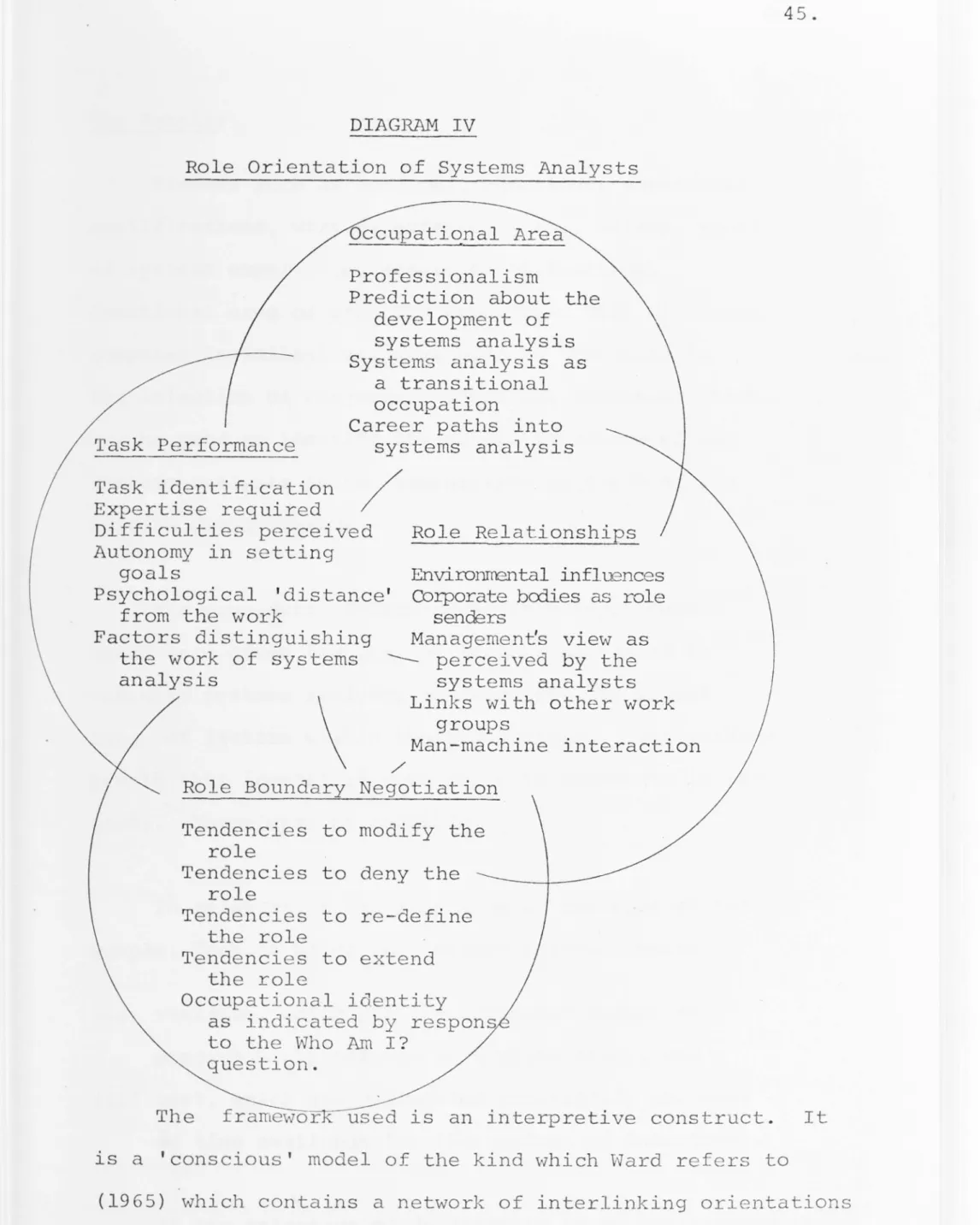
There is some urgency about understanding the field of systems analysis as an occupational area because of its rapid developmen~ but there are problems of designing an appropriate methodology because the field has not yet stabilised. Task identification is useful but no taxonomy has yet been developed. Position is limited because as soon as i t is occupied by a person i t contains some unique aspects and therefore does not allow comparative evaluation. Role which encompasses task and position was selected as
the framework and an attempt is being made to operationalise some role concepts to try to capture tl1e field in a
bureaucratic setting.
The Study:
with these developments as background, a study was undertaken of ADP systems analysts employed in
three departments of the British civi l service during 1973. Forty-three systems analysts in the departments of Inland Revenue , Health and Social Security and
to identify the occupational role of the systems
analyst as perceived by role occupants. A secondary
alm was to attempt to operationalise some role theory
concepts in an emergent occupational area.
The study is exploratory and is intended as
preliminary work for a further study to be done in the
Australian Public Service which shares similar problems
in developing the occupational area. Because there are
important parallels to be drawn and because the Briti sh
have gone further along the way in consolidating the
field, i t was considered useful to explore their situation
at this stage.
The following question areas were raised which are
detailed in the Interview Schedule in Appendix I.
1. What is the nature of the occupation In the
bureaucratic s e tting.
2. How can the job of systems analysis be categorised.
3. What ar e t he occupational paths i nto syst ems
analysis .
4. Is systems analysis perceived as a profession .
5. Who are the role senders t o the systems analyst .
Linkages were explored at a number of levels,
work groups, and with corporate bodies such as the British Computer Society, the National
Computing Centre and the Central Computer Agency. Perceived environmental-influences were also
examined.
6. What are the tasks of systems analysis.
7. What are the operational goals of systems analysis.
8. Are there norms which characterise the work.
9. Does the systems analyst develop a psychological 'distance ' fiom the job in order to remaln
objective within it.
10. Is the work area viewed as transitional by those entering i t , that is to say, does i t contain
exit intentions so that the systems analyst come to the position with the attitude that he is
occupationally mobile.
11. In what direction lS systems analysis seen to be developing, for example, in the direction of
increased specialisation, increased generalisation,
as a skill within many professional fields or
continuing as an occupational area in its own right.
12. Within role occupancy lS there evidence of a
person-role negotiation about the boundaries which separate systems analysis from other occupational
areas. Information was sought· on the following
(a) Tendencies to modify the role, or to
limit its functions;
(b) Tendencies to extend the role, or to lay
claim to activities already performed by
other work groups;
(c) Tendencies to deny the role, or to collapse
i t into related job areas;
(d) Tendencies to re-define the role, or to alter
its content substantially.
These four categories, together with the question
"Who Am I, occupationally" which concerned the
matter of occupational identity, were used to
estimate the state of boundary negotiation within
the role, these being put forward as a measure of
CHAPTER II
Conceptual Perspective of the Study
,
Although the study of the emergence of specialist areas of work requires some form of longitudinal
research, i t is theoretically possible to take an
occupational area at a particular point in time and to ask at approximately what stage of development i t is. This requires cross sectional analysis. Essentially this is static, conveying the notion of time being constant. I t thus contains the difficulty of not portraying the dynamics of the process. How can
the mosalC of the change process be captured? One way that this can be attempted is using the concept of role and exploring the dynamics of the negotiation which is taking place between the person and the
role. This is considerably more than examining a position which is held as each occupant of a role lS engaged continually upon the process of validating
that role. The attempt is being made in this study to explore that negotiation holding time constant, or at
least excluding i t as a significant variable, and asking, what is the state of systems analysis in the here and now.
of Lewin (1938) and his 'force field'surrounding the person, to Carl Rogers (1961) also concerned with
negotiating the 'self' as part of a phenomenal field .
.
In parallel with these strands of theory is the contribution of Ralph H. Turner (1956, 1962) in
formalising role theory concepts and operationalis ing
them particularly in the sociology of occupations .
Turner's work is drawn upon quite heavily in this study in trying to find a way of capturing a role as i t lS
being 'made' by occupants.
Role Theory:
Role behaviour cannot be entirely separated
from the context in which i t occurs. When we play a role we step in and out of new and recurring
patterns of self awareness which rise to conscio us-ness through the mirroring of
one~
self in othersand the transformation of those images into our self
image. Although there lS a continuity in this 'stream of consciousness' (James, 1890),each role
contains innovative and creative elements.
Roles can be ascribed names, but beyond t his we
are faced with difficulties in understanding t heir
nature . Neiman and Hughes (1951) conclude t heir
survey of the literature with the view that the role
and non-definitive ... " being used often without any .
/ .
attempt at definition and found frequently in popular usage/which adds looseness to its meaning. Fifteen
-years later Thomas and Biddle in their short history of role theory are able to comment that II with the exception of fragmented commentary, the scholars of role have not identified, articulated and analysed the component aspects of role theory, namely, its
domain of study, perspective, language, body of knowledge, theory and method of inquiry" (1966). However, there is a considerable body of inter-disciplinary research in the area and i t may be
constrictive to lmpose a language on the field or to create a common conceptual framework at this stage.
Beginning with the elements, Sarbin (1953) offers a definition of role as " ... a patterned
sequence of learned actions or deeds performed by a person In an interaction situation," but he imposes a limitation on the process by claiming i t to be the perceptual and cognitive behaviour of a two-person interaction . Turner (1962) is critical of this
The actor validates the role externally~which
means he derives an appropriate version of i t from
significant others as well as from a 'generalised other~ the concept elaborated by G.B. Mead (1935). This is the organised community or social group which
provides the individual with his unity of self. The
criteria of external validation include the discovery of a name in common use for the role. Turner (1962) links this exteriority with Durkheim's (1964)
conSClence collective which was a referential value
system formed out of the interaction of individual
minds. By entering the language/the role acquires
social meanlng. However, Turner (1962) comments,
"Naming does not assure that there will be agreement
on the content of the role; i t merely insures that
people will do their disagreeing as if there were
something real about which to disagree." The second aspect of external validation is the identification of major norms and values which serve as criteria
for role coherency. Thirdly, security is sought through membership in recognised groups or by
occupying formal positions. Finally, appropriate
combinations of behaviour, norms and attitudes are
learned by acting these out and the use of role models.
Internal validation involves the process of
internalising the role so that an occupational identity
within the occupancy of the role itself. It concerns
creating its content and achieving a 'goodness of fit'
between the persons' perception of the ideal role and
the actual one which they are able to play. One
measure 1S whether behaviour of members of the role
set is being correctly anticipated. Gross, Mason and
McEachern (1958) give an example using the school
superintendent's role . Validating this role involved
acquiring the decision making skills to choose
suitable behaviour from among the many alternatives
deemed appropriate. The process was complicated by
the superintendent's being required to play several
related roles simultaneously, namely school board
member, teacher and parent. Internal validation of
role is akin to the process which Kay (1966) defines
as "role centrism" which is a "concern with one's
own role such that the role behaviour of others is
monitored, perceived and evaluated for its impact
on one ' s self-prescribed role".
Turner (1962) makes a further distinction between
role making and role taking as orientations to role
occupancy. Role
..
making involves the tendency to create and modify conceptions of ' self ' and other roles asthe orienting process in interactive behaviour. As
such, i t is a gestalt-making process 1n which social
exhibiting a high degree of certainty about both the existence and the clarity of the role. He acts as if roles were real and objective entities. This as if behaviour serves to glve greater concreteness and consistency to the role. Aspects of i t which were undefined are made explicit and a role may be created where a loose grouping of tasks existed before.
In the role taking process there 1S less potential for innovative behaviour. Activities are prescribed, its repertoire limited and its boundaries defined. The instances of such constrained roles which Turner glves are -the military and the bureaucracy. In both types the formal regulation system restricts the
free operation of role making. In extreme cases role behaviour may be completely prescribed and all misperformance institutionally punished.
An area of interlock between the two orientations
1S the assumption of an imputed-other role, which 1S
to say the role occupant acts in the perspective supplied, in part, by his relationship to others whose actions reflect the roles he must identify.
For example, the imputed-other of the teacher is the
pupil. Learning this relationship requires much more than understanding a set of rules and acquiring the norms of the position. It involves continual
Even when a ~ole is established/it will not be free from pressures, stresses and strains and may have to resort to structural mechanisms of defense to
~
maintain its existence. Bar-Yosef and Schild for instance, (1966) identify "buffer" mechanisms 'which
line-bureaucrats devised to enable them to resist both
superlors and clients and allowed them to act
according to independent criteria in public health
administration in two development towns in Israel. These employees legitimized their decisions using
values extraneous to the bureaucratic organisation. Snoek (1966) found similar evidence of strain related to diversified role sets, using data from a national
sample survey by Michigan's Survey Research Center
during 1961,and observed that the tension felt was greater in large scale organisations than in smaller
ones.
Goode (1960) put forward a theory of role strain which categorises tactics individuals may develop to
fulfil role obligations under strain caused by role
overload , for example, compartmentalisation of
behaviour, delegation of role activities, and
elimination of role relationships. He concludes:
... the role pattern is held in place by both
internal and external forces ... not only is
role strain a normal experience for the
i ndividual , but since the individual processes
of reducing role strain determine the total allocation of role perfornlances to the social
institutions , the total balances and imbal ances
of role strains create whatever stability the
This is making a large claim for the function
of role strain which is not amenable to substantiation/ but i t does illustrate the point of role itself
being in a state of internal balance .
The Emergence of an Occupational Role :
When an occupational area develops by being differentiated out from other fields of work ,
positions are set up , job descriptions are provided and an occupational grouping emerges centring
around the implementation of certain ski lls . A name is ascribed to the area. Behavioux of occupants in the positions takes on a patterning, which over a period, becomes more stable . Bakke (1953) refers to a ' fusion process ' in the man- organisation
interaction , a kind of psychological bond and this contains the idea of the patterning which is the prelude to the formation of role .
Adjustment to a position in an organisation as
illustrated in Diagram I involves a transformation
process involving a number of individual factors such
as personality, intelligence , and aptitudesi values
which the individual has internalised and task
requirements of the job itself activated by a
motivation process mediated through the work group .
mental Factors
v
B;>[
T ran 5 f 0 ! m () t i 0 II]1---,
L~Persona1 ity Ab iliti es , !\pt:tudes,
I ;-) C •
I nte l~~ce d
n
I
Task
-Requ irements
'1
---~-t--iv-a--t-i-on
}8
r"\v
'--_ _ _ _ _ _ _ _
~
T ran s f 0 r'",-a-t-i -o-n--r}.:1~
1 Adapted from Lofquist and Dawis, (1969)
[
v ~~
l>r-
I
i !
I
I "L
, Satisfaction
-,
II
Promote ~
T ran s fe r
---=::::--Dis m iss "_
w
..--Res i gn
Retain _______ Existing
Job
1
V(
_ _ _ _ _ _ _ _ 2 _ _ _ _ _ _ _ _ I
; or ran s for mat ion
r e COin m e II c e :;
---4---I
.
~.
tv
I The Occupati?nal Area of Systems Analysis
Systems Analysis and Professionalism: 1
Pettigrew (1973) comments on the difficulties of capturing the reality of an occupational area as i t develops and refers to attempts at categorization of the process in terms of ideal type constructs or dichotomies, for example as used by Gouldner (1957)
and Kornhauser (1962). He also refers to an alternative approach, that of viewing occupational development as a process which attempts judgements of "more or less a profession", as used in the work of Vollmer and Mills
(1966) .
Bernard Laver, Chairman of the British Computer Society~quotes Anthony Wedgewood Benn in a recent statement on the so-called technological professions among which he includes systems analysis; "They
invent their own language and complicate what is simple to intimidate the public, and when they have repelled onslaughts their strength rests on a pedestal of
knowledge and power which is more agreeable for them but makes the public feel ignorant and powerless and insignificant." (1973). Although exaggerated/this view conjures up the idea of a pseudo-profession based on
jargon, mystique and devices of secrecy which members
1 Johnson (1972) summarises the discussion on the terms
use to keep themselves apart from clients and the public. At this early stage of the development of the occupational are~ the question needs to be asked
"Is systems analysis a profession?"
The criteria which denotes a profession have been
the subject of continuing debate/particularly in the work of Hughes (1958) , Wilensky (1964), Hall (19 69),
Elliott (1972) and Johnson (1972). There seems to be basic agreement, however, that four factors are
central. Etzioni (1969) summarises these as: special knowledge requiring an extended amount of educational preparation, sets of values and ethics that govern
the professional in his use of knowledge and permit confidential communication with clients/and developed skills which enable implementation of the knowledge
with little supervision or control from outside groups.
However, merely to establish these factors as being
present does not indicate the nature of professionalism
in the particular case . The factors may be present in
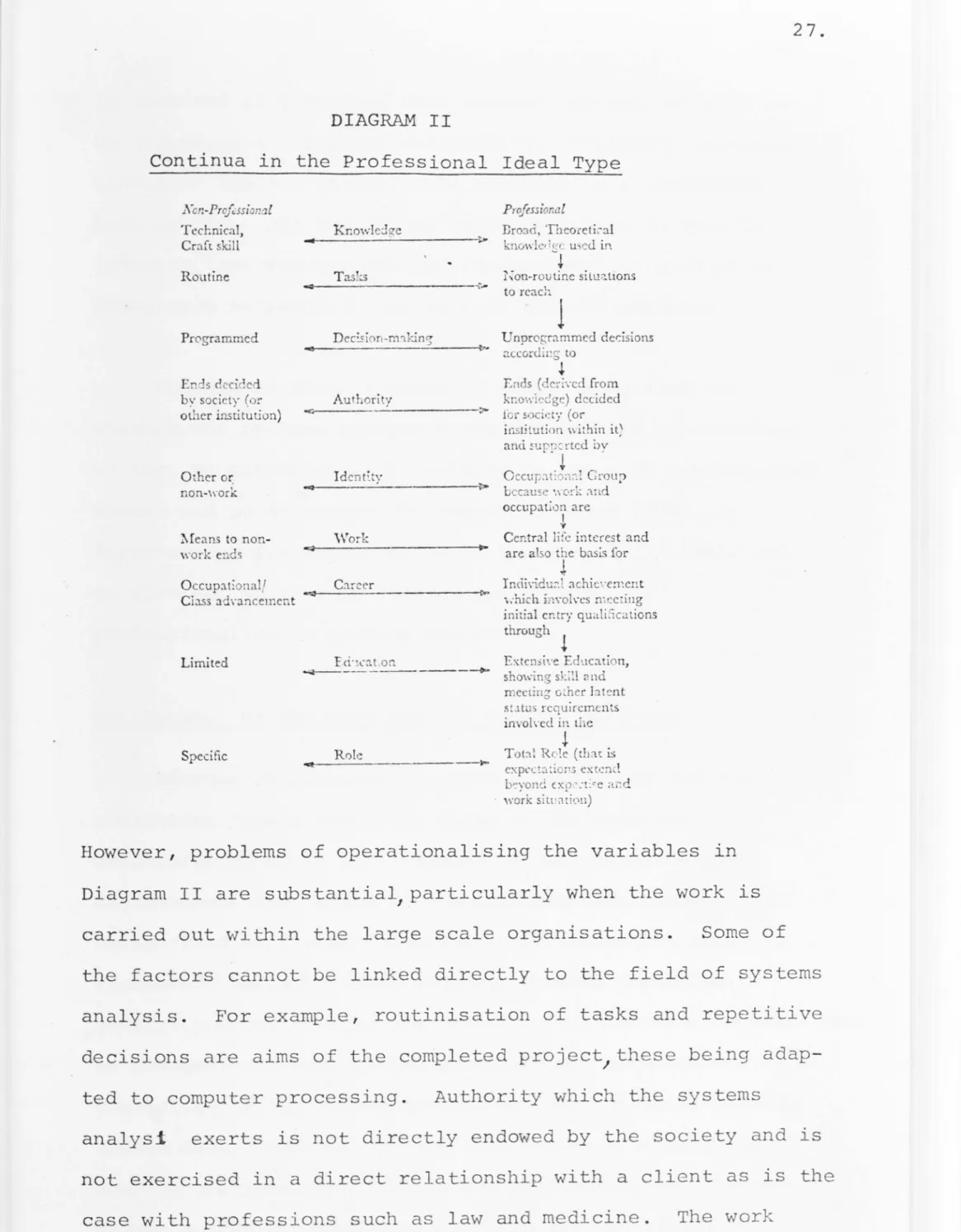
varying amounts forming a continuumfro:n non-professional
to professional. Elliott (1972) outlines such a typology /'
DIAGRAM II
Continua In the Professional Ideal Type
Xon-Proflssional Tecbnical,
Craft skill
Routine
Programmed
Ends deci .ed by socieiy (or
other institution)
Other or
non-\\-ork
}.feans to non-work cuds
Profissional
Kr:owIedge Ermo, Theoreti:-al -~~---~---~ knowleljr~c used in
~J
Tasks l~on-routine silL!~tions
....;;...;1---,... to reach
D
ec~i(\n-m'lying-4!
t.--Authority
< -
:>-1
Unprogrammed det:isions <.!ccordir:g to
!
Ends (cieri,-ed from
kr.o" ... icc!ge) decided lor 50cidy (or
inslitution within it~ and ~uppcrted by
~
Ident~ty OCCUP:lt!OTl:-:! Crol1~
-..---=---> bce:mse 'sork ;\nd
occupation are
~
"'ork Cen raI life interest and
~~---~~ are also the basis [or
l
Occup:ltional/ Career rndi\-idu~l achie\:e!1;er:t
ClJ..SS a · d ,-ancement ...,.,1---"" \; h' JeLlll1.VO L . ' 1 ,'cs meeting
-Limited Ed-KaLon
~---~
Role
Specific
""'i~~---.~
initial entry qualifications through
J
Extcn~\\-e Education, sho\\-j ng skill and
mening other lat~nt
st.ltus requirements
im-oh-ed in the
~
Tot::\l Rc·!e (that i.s
expcc!~ ~iO;15 ex tend
bF:yond (Xi)·:,~·t:~e (tDd
-,,'orK Sitl!;1ti(11)
However, problems of operationalising the variables In
Diagram II are substantial/particularly when the work is
carried out within the large scale organisations. Some of
the factors cannot be linked directly to the field of systems
analysis. For example, routinisation of tasks and repetitive
decisions are aims of the completed project,these being
adap-ted to computer processlng. Authority which the systems
analysi exerts lS not directly endowed by the society and lS
not exercised in a direct relationship with a client as lS the
case with professions such as law and medicine. The work
by necessity a corporate undertaking. Elliott's continua
cannot be applied exactly here/and this is a limitation both of the study and of the continua but i t is used to
/
J
indicate that some aspects of'professionalism need to be drawn upon to identify the role of systems analysis.
The a1m 1n this exploratory study is to find out
whether the systems analyst views the work as a profession
or not, to establish what contacts he has with professional bodies and to determine the nature of these links", to
discover how frequently he is in touch with the field and
to find out whether he relates the criteria of
professionalism to systems analysis .
Development of the Work Area of Systems Analysis:
Because of changes 1n computer technology and the
continuing debate about the place of the computer in
organisations/ there are a number of ways in which the occupational area could develop . These have been
categorised as/firstly movement in the direction of increased specialisation, secondly towards increased
generalisation , thirdly the emergence of the datacrat (Rose 1969) as manager, the work of the executive of the future
consisting of the interpretation and use of electronically stored data, fourthly systems analysis as a skill within many occupations , and fifthly the possibility that i t may
The per~eived development of the occupational area
has relevance to role definition in that the boundaries
of the field will alter as a function of the direction In
which i t is seen to be moving~ For example, systems
analysts predicting that the field will go towards more
intensive specialisation will presumably equip themselves
with the skills, and knowledge to remain competent in
those detailed aspects of the work.
Systems Analysis as a Transitional Role:
One way of dispersing knowledge of computer technology
and software throughout an organisation is to have
employees located in ADP positions for relatively short
periods early in their careers so that they have the
opportunity of passing through the job area. The
position of systems analyst would thus be regarded as
a transitional one which would tend to develop its own
exit procedures. Budworth (1973) suggests that this lS
the case with scientific research workers in Britain where
the field provides careers for only a small proportion of
scientists.
There is evi ence to suggest that this question of
the transitional role may be relevant for the systems
analyst within the civil service. Positions in departments
are not tied to specialisations and promotions are made
potential. The systems analyst will thus not
necessarily see himself as building a career within the ADP field while remaining a 9ivil servant.
II Role Relationships of the Systems -Analyst:
Role Sets:
The term "role set" was introduced by Merton (1957) to designate the array of role relationships in which a person becomes involved by virtue of occupying a
particular social or occupational position. The role set includes those people who transmit information aimed at affecting the performance of the role
occupant. For example, members of the role set of a doctor may include hospital staff, pharmaceutical companies , welfare agencies and other doctors. The set is defined by the existence of communication channels between the two.
Kahn et al e (1964) have devised -a· model of a
role episode which demonstrates the cycle of role sending, response by the focal person and the effects, through the feedback loop, of this response on the role senders .
is illustrated In Djagram III. Environmental factors have been added to Kahn et al e ' s (1964) model to
indicate the presence of external linkages.
Environmental factors Organizational factors A
I
/
/
/
. /ROLE SENDERS
Expectations Perception of focal person 's
behavior; evaluation
Sent role
Information; attempts at
influence
\
'"
Attributes of the person
B
I
I
"
"
\
\
I
I
FOCAL PERSON
+
I
,
(
ll.
Received role
Perception of role and perception of
role sending
r
I
Role Behavior •
Compliance; resistance;
"side effects"
'"
f
Role Senders:
There are three corporate bodies in Britain which are engaged in defining the role of the systems analyst, namely the British Computer Society,l the National
Computing Centre and the Central Computer Agency. All
are adopting postures of professionalism to some degree/ and the official examining body, the British Computer Society 1n particular, has firmed in this direction
and speaks publicly on behalf of the field. Millerson
(1964) has focussed on the qualifying associations as
corporate indicators of the state of development of
professional occupations in Britain through their
educational activity and control over professional
conduct. The assumption implicit in the activities
of the three bodies concerned with systems analysis 1S
that they are significant role senders and therefore
i t would be expected that there would be direct links
between employees in the field and the three corporate bodies.
The development of a system involving the use of automatic data processing is beyond the capacity of one individual . Problem formulation , analysis of the
existing system, revision or redesign, and implementation require expertise in the application area as well as
knowledge of computer technology and software. The job may require detailed work in calculation , analysis,
1 For a note on the BCS , the NCC and the CCA see
coding, testing and documentation. Usually there lS the need to work under time and cost constraints. By
necessity the work of systems analysis is a team under-taking. Members are allocated or select tasks within the overall scheme or project. Individual contributions
may be to a specialised aspect of the scheme. Accepting the fact of this corporate nature of systems analysis, the function of the team/as perceived by the systems
analyst in mediating the rol~is a relevant factor in identifying the role, the assumption being that the
team acts as a primary reference group and therefore its members are role senders to the individual systems
analyst.
Each systems analyst is associated with an array of
other individuals in positions in and outside his department who attempt to influence his job performance. They may
require the performance of certain tasks, impose pressures to change his direction or emphasis; or they may guide
and support him. The associates who relate most frequently
to the systems analyst will probably be found working within the department but there may be others who exert influence
from outside, the government In office being an example.
The specific hypotheses put forward are that the
group perceived as most influential will be located at the higher levels of the organisation. The supervisory
The client or user group will be seen as one of mutual
dependence and resistance. The peer group will also be
perceived as supportive and related through mutual
dependence. The pattern being suggested here is a
re-enactment of traditional bureaucratic relationships
where authority is synonymous with hierarchy.
Man-machine Interaction:
As the computer is the tool of trade of the ADP
systems analyst and may also be a status symbol, the
man-machine links will constitute part of the role. It
is only by virtue of the two being in an "ecological
huddle" which is Goffman's phrase (1961) for the social
encounter, that a machine culture could be said to exist,
the machine by itself being inert and lifeless. The
information being sought is whether systems analysts have
developed attitudes towards the computer as object and
whether they personify the machine in some way and so
create the potential for a two-way relationship. For the
programmer the computer may be an imputed-other of this role
in a similar sense as the patient is the imputed-other of
the doctor role. It is the electronic complementarity with which he palrs ln the performance of his job. Without the
computer there would be no need for the function of
progran@lng . Although the links may not be so direct ln
the case of the systems analyst) the perception of a
The client or user group will be seen as one of mutual
dependence and resistance. The peer group will also be
perceived as supportive and related through mutual
dependence. The pattern being suggested here is a
re-enactment of traditional bureaucratic relationships
where authority is synonymous with hierarchy.
Man-machine Interaction:
As the computer is the tool of trade of the ADP
systems analyst and may also be a status symbol, the
man-machine links will constitute part of the role. It
is only by virtue of the two being in an "ecological
huddle" which is Goffman's phrase (1961) for the social
encounter, that a machine culture could be said to exist,
the machine by itself being inert and lifeless. The
information being sought is whether systems analysts have
developed attitudes towards the computer as object and
whether they personify the machine in some way and so
create the potential for a two-way relationship. For the
programmer the computer may be an imputed-other of this role
in a similar sense as the patient is the imputed-other of
the doctor role. It is the electronic complementarity with
which he palrs ln the performance of his job. Without the
computer there would be no need for the function of
progr~~lng. Although the links may not be so direct ln
the case of the systems analyst;the perception of a man
III Task Performance of Systems Analysis
Task Specification:
.
Task specification remalns a problem in measurlng
human performance at work. Fleishman (1973) has outlined
the major approaches as firstly, activity description
which requires observing what employees actually do at work.
How to order the information obtained in terms of frequency,
duration and criticality needs to be negotiated for each
situation. Observations of this kind are incomplete without
some attempt. to interpret the meaning of the behaviour to
the person enacting i t . Secondly, task definition may be
approached through the behavioural requirements for the
activities necessary to achieve effective performance.
Thirdly, the ability requirements may be specified. Tasks
are described in terms of the abilities which have been
found to be required; for example, manual dexterity,
numerical reasoning ability. Fourthly, there is the task
characteristic approach which treats tasks as sets of
conditions, processes or structures having certain elements
and certain identifiable parameters.
In order to deal with the matter of task analysis i t
was necessary to frame a question which did not introduce
bias but was meaningful and elicited the necessary
information. To use the word "task" would have curried
the implication that the systems analysts could readily
identify his primary task. A further problem was that a
being answered at many levels of generalisation. For example, a reply could carry as little iriformation as that "the systems analysis analyses systems" which 1S 9 f "the teacher teaches", vari-ety. At a very specific level i t would be possible to elicit unnecessary details about the particular system and the requirements of the department. Similarly, a list of duties was not
required/this being available in formal statements and job descriptions which mayor may not reveal what the systems analyst actually does. After consulting with expert advisors in the central computer Agenc~ the question was phrased simply, "How do you go about the work of systems analysis ll
•
Role Distance:
The systems analyst, although located in the organisation needs to obtain an overview of its activities and to
remain an objective observer of the way in which i t functions. Although participating in the design of
systems which impose order and logic on existing processe~
he is a change agent and, as such, has to interface with the forces of anti-change in the organisation in carrY1ng out detailed analysis. Resistance and lack of
cooperation may be facts of his daily work. The systems analyst may need to have or to acquire a facility for remaining psychologically apart from the organisation 1n which he is located and even from the project which
This detachment seems to be something more than objectivity.
Goffman (1961) has put forward a concept to capture the
state of evaluative apartness~which he calls role distance.
He uses this to indicate a state of detachment from the
role while at the same time acting in it. An example offered is within the surgical team where the leade~ in this case the surgeo~creates a joking relationship for
the purposes of maintaining an optimum tension level for
task performance. The concept of role distance is put
forward here to capture the systems analyst's apartness
from the organisation/a tactic which may be adopted to
reduce the possibility of being identified with the system~
or even identifying himself with it.
Norms:
Norms act as guides to behaviour and constraints
on certain actions. Jordan (1968) refers to them as
"ought forces" which embodies the notion of compulsion which is present in norms.
The more clearly defined an occupational area,the
more easily identifiable should be its norms. The question
here being raised was whether systems analysis lS
perceived as having its own norms which could be said to
IV Role Boundary Negotiation:
Person-Role Negotiation
The work of systems analysis in the British Civil
Service has emerged historically from that of Organisation
and Methods (0 & M) officer. It shares techniques with other area~ such as operational research and progr~lming/
and is focussed on the application area of the department in which the system is being designed. Even its
interpersonal skills are cornmon to other fields/such
as management consultancy. It is not possible to define its tasks exactly without overlapping the work of other
fields.
Within the role a continual transaction takes
place between the person and his perception of the role, aimed at negotiating the content of the role and defining its boundary. Berrien (1964) offers some clarification of the concept of boundary by suggesting that i t may be
defined by the nature of its communication channels and that processes within the boundary are qualitatively
different from those outside. For example, communications within a work group are different from those between the work group and the company, in terms of frequency, type
and confidentiality. The boundary then encloses those elements of the system necessary to give i t lis intrinsic character, in this case its gestalt. Boundary negotiation
the role has stabilised over time the person-role transaction is at a relatively low level of activity because the occupant acts with certainty
In
the role. His performance is without ambiguity and he generates an impression of authoritativeness about the content of the role which comes to be accepted by members of the role set, in particular the client group.In order to explore the nature of the role negotiation process 1n systems analysis a conceptual framework was
created by the author which has four facets/namely
tendencies to extent the role, to modify i t , to re-define i t and to deny it. These processes may be taking place while the person 1S acting in role as he works at the
task of establishing a satisfactory content to the role and negotiates appropriate relationships with the
occupants of other related roles. The categories are not necessarily mutually exclusive. They are used in
this study to represent strategies which the systems analyst may adopt. They are aggregated to indicate a total l evel of boundary negotiation and i t 1S suggested that they may be considered as an approach to the
measurement of role stability.
Occupational Identity:
rrhe question "Who are you 11 asked of a person implies
a mutual acceptance of a social iden ti ty (Waterbor, 1972)J
and the person answering does so by trying to name those
the role has stabilised over time the person-role transaction is at a relatively low level of activity because the occupant acts with certainty 1n the role. His performance is without ambiguity and he generates an impression of authoritativeness about the content of the role which comes to be accepted by members of the role set, in particular the client group.
In order to explore the nature of the role negotiation process 1n systems analysis a conceptual framework was
created by the author which has four facets/namely
tendencies to extent the role, to modify i t , to re-define
i t and to deny it. These processes may be taking place while the person 1S acting in role as he works at the
task of establishing a satisfactory content to the role and negotiates appropriate relationships with the
occupants of other related roles. The categories are not necessarily mutually exclusive. They are used in this study to represent strategies which the systems analyst may adopt. They are aggregated to indicate a total level of boundary negotiation and i t 1S suggested that they may be considered as an approach to the
measurement of role stability.
Occupational Identity:
rrhe question "Who are you" asked of a person implies
a mutual acceptance of a social iden ti ty (Waterbor, 19 72)~
recognition of himself. These may be expressed as attributes, skills, patterns of behaviour, beliefs, characteristic feelings, occupations or roles. The answers will vary according td the person who asks the question and the circumstances in which i t is asked.
The "Who Am I" question may be approached specifically ln
terms of the roles an individual plays~ some of these being central to the awareness of self. But even the most
generalised roles regulate interpersonal behaviour and
influence attitudes. Some theorists go so far as to suggest that the self is socially endowed, for example Berger (1963). Brim (1960) makes the assertion that the
"learned repertoire of roles is the personality. There
is nothing else ... ". Others, for example Harry Stack Sullivan (1953), make less comprehensive claim~yet s t i l l regard the interpersonal nature of self as a basic fact
of social life. People develop a self system through interpersonal relationship~ particularly through those
'significant others' with whom they interact and the
self has the overall function of minimizing anxiety. This validating of one's own reality through the
responses and actions of others is a continual process. For Goffman (1959~ socialisation is the learning of
implicit and explicit rules for playing roles. He Vlews
roles as efficient ways of interacting with others because they contain a co~non or shared definition of
There is a body of research in social psychology
which has used the "Who Am I" question and, although its
validity and reliability has been questioned, for example,
by McPhail (1972~ i t rema1ns a legitimate question
although by no means the only question, which can be
asked to determine the nature of self. Having received
an answer,the relationship among the various roles which
an individual plays is not necessarily known nor how the
roles are integrated to form a continuous awareness of
identity and this is an important limitation of the
question. Wylie (1968) noted several additional problems
in examining the self concept, notably that existing
theories were not stated in testable form and that
difficulties of setting up controlled experiments and
designing suitable research methodologies have not yet
been solved. The use which can be made of this question
1S thus limited.
The information being sought through the use of the
"Who Am I" question in this study is whether the role of
systems analyst is associated with the occupational identity
of the persons performing these tasks in the civil serVlce .
Limits were imposed on the question restricting i t to
work roles. The exact form of the question was "In
response to the question 'Who Am I occupationally?' asked
whether the self 1S the role, but to discover whether a
particular occupational role has been internalised by those
~
CHAPTER III The Study
The Research Design
The study was based on semi-structured interviews of forty-three ADP systems analysts working in the
Departments of Inland Revenue, Health and Social
Security (DHSS), and Employment of the British Civil Service. 1 The interviews were conducted in the
offices of the three departments at Londong and Reading during June and July 1973.
Prior to gOlng to Britain, the author gained information about the field of systems analysis from discussions with academics in the School of Information Sciences at the Canberra College of Advanced Education and practising systems analysts in the Australian Public Service. Role concepts were explored under the guidance of Professor Ralph H. Turner while he was visiting
Fellow in the Department of Sociology, Research School of Social Sciences, at the Institute of Advanced Studies, Australian National University during August to December, 1972. During this time the theoretical framework was also formulated for the study.