OF IMONDA - A PAPUAN LANGUAGE
Walter Seiler
A thesis submitted for the degree of Doctor of Philosophy
of
Unless otherwise acknowledged in the text, this thesis represents the original research
of the author.
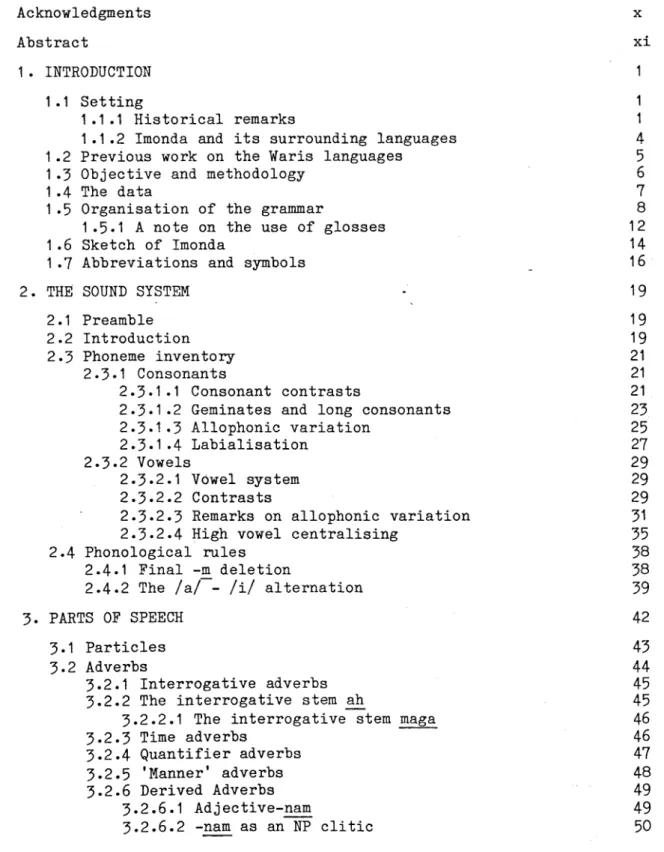
Table of Contents
List of figures ix
Acknowledgments x
Abstract xi
1. INTRODUCTION 1
1 .1 Setting 1
1.1.1 Historical remarks 1
1.1.2 Imonda and its surrounding languages 4 1.2 Previous work on the Waris languages 5
1 .3 Objective and methodology 6
1.4 The data 7
1.5 Organisation of the grammar 8
1.5*1 A note on the use of glosses 12
1.6 Sketch of Imonda 14
1.7 Abbreviations and symbols 16
2. THE SOUND SYSTEM • 19
2.1 Preamble 19
2.2 Introduction 19
2.3 Phoneme inventory 21
2.3*1 Consonants 21
2.3*1*1 Consonant contrasts 21
2.3*1 *2 Geminates and long consonants 23
2.3*1 *3 Allophonic variation 25
2.3*1 *4 Labialisation 27
2.3*2 Vowels 29
2.3*2.1 Vowel system 29
2.3*2.2 Contrasts 29
2.3*2.3 Remarks on allophonic variation 31
2.3*2.4 High vowel centralising 35
2.4 Phonological rules 38
2.4*1 Pinal -m deletion 38
2.4*2 The /a/ - /i/ alternation 39
3. PARTS OF SPEECH 42
3*1 Particles 43
3*2 Adverbs 44
3.2.1 Interrogative adverbs 45
3.2.2 The interrogative stem ah 45
3.2.2.1 The interrogative stem maga 46
3.2.3 Time adverbs 46
3.2.4 Quantifier adverbs 47
3.2.5 'Manner' adverbs 48
3.2.6 Derived Adverbs 49
3.2.6.1 Adjective-nam 49
3*2.6.3 Numerals 51
3.2.6.4 Pronouns 51
3.3 Adjectives 52
3.3*1 Adjectives proper 53
3*3*2 Intensifiers 54
3*3*2.1 Pete and kubui 55
3*3*2.2 Other intensifiers 57
3*3*3 Exclamatories 57
3*4 Kinship terms 58
3*4*1 Number marking 59
3*4*2 Possessive -pef 60
3*4*3 Nominaliser 61
3*5 Nouns 62
3*5*1 Postpositional nouns 63
3*5*1.1 Locative postpositional nouns 64
3*5*1.2 Cause postpositional nouns 67
3.5.1 .3 The special case of _la 68
3.6 Pronouns 71
3.6.1 Personal pronouns 71
3.6.2 Demonstratives 73
3.6.3 Interrogative pronouns 75
3.6.4 S(n)a-1 78
3*7 Quantifiers 80
3*7.1 Numerals 80
3*7.2 Mugo 'one, another one, some' 81
3.7.3 Mag and its derivatives 81
3.7.4 Tomod and mod 82
3.8 Compounding 82
3.8.1 Compound nouns 83
3.8.1.1 Additive compounds 83
3.8.2 Determiner-determined 84
3.8.2.1 Noun-noun 84
3.8.2.2 Adjective-noun 85
3«8.2.3 Verb-noun 85
3*8.2.4 Proper noun plus noun 86
3.8.3 Compound adjectives 87
3.8.3- 1 Meg-na 87
3.8.3.2 Uogo 88
3.8.3- 3 Ude 88
3.8.3.4 Kuel 88
3.8.3- 5 Hoi 89
3-8.3*6 The adjective tit 'ignorant' 89
3.8.3*7 Adjective plus adjective 90
3.9 Affixation 91
3.9.1 -to_ 91
3.9.2 -nam 92
3.9.3 The nominaliser -1 92
3.9.4 -iam 92
3.9.5 -nanal 92
3
.9*6
-ianei 934
. FORM AND FUNCTION OF THE NOUN PHRASE 944.1 NP constituents 95
4.1.1 The head 95
4.1.2 Determiners 96
4
.1.2.1 Kinship terms 974
.1.2.2 Pronouns 974.1.2.4 Possessive NP 100
4*1.2.5 The relative clause 102
4.1.3 The adjective phrase 107
4.2 Co-ordination 109
4.2.1 -i 109
4.2.2 -na 111
4.2.3 Other linking strategies 112
4.2.3.1 -mo 112
4.2.3.2 D-form 112
4.3 Case marking 113
4*3.1 Unmarked NP 114
4.3*2 -ia 'Locative; Causal' 114
4.3.3 -nei 'Source' 117
4.3.4 -na 'Instrumental' 118
4.3.5 -m 'Goal' 119
4.3.6
The Papuan perspective 1194-4 Outer modifiers 120
4.4.1 Topic marking 120
4.4.2 Emphatic clitics 120
4.4.3 Interrogative 121
4.4.4 The D-form 121
5. VERBAL MORPHOSYNTAX 122
5.1 Introduction 122
5.2 Precore 123
5.2.1 The dual marker e- 123
5.2.2 Accompaniment marking 124
5.2.3 Noun-classification prefixes 124
5.2.4 Motion verb prefixes 125
5.2.4.1 ha-/hela- 125
5.2.4.2 iaha- 126
5.2.
4
.3 The subject plural marker ai- 1265.2.4.4 The prefix fe- 127
5.3 Postcore 127
5*3.1 Number agreement 128
5.3.1.1 Subject 129
5.3.1.2 Object 133
5.3*1*3 Recipient 137
5.3.1-4 Beneficiary 137
5.3*1*5 The number agreement marker -abu 139
5.3.1 .6 Possessor 141
5*3.2 The emphasis marker -la 143
5.3*3 Benefactive 143
5.3.4 The 'mood' position 144
5.3.4.1 Irrealis 144
5.3*4.2 Imperative 145
5.3.5 Tense 145
5.3.5-1 Non-past marker -f 1
46
5.3«5*2 Imperfective 147
5.3- 5.3 Perfect 148
5.3*5.4 Past tense 149
5.3.5*5 Zero-marking 150
5.3.6 Position six 151
5.3«6.1 The counterfactual marker -_t 151
5.3- 6.2 The suffix -i_ 154
5.3.7 Position seven 157
5.3.7.1 The interrogative/negative suffix -m(e) 157
5.3•7.3 -be 158
5.3*7.4 -ie 158
5.3-7.5 -_b 159
5-3*8 Position eight 160
5.3*8 .1 -ai 160
5.3*8.2 The D-marker 160
5.3*8.3 -mo 160
5*4 The core 161
5.4.1 Grammatical roots 163
5*4.1.1 Pada 'finish' 163
5.4.1.2 Sabeha 'pretend' 164
5*4.1.3 Seloh 'in vain' 164
5.4.1.4 Puho 'habitual' 165
5*4*1.5 Löh 'habitual, durative' 165
5.4.1. 6 Nög 166
5.4.1.7 Api 166
5.4.1. 8 Ula 'intensity' 166
5.4.1.9 Pia 'come' and uagl 'go' 168
5.4.1.10 Luhi 168
5.4.1 .11 Fia 168
5.4.1.12 Löh 'stand' and l_i 'lie' 168
5.4.2 Motion verbs 169
5.4.2.1 Simultaneity 169
5.4.2.2 Consecutivity 170
5*4.2.3 Direction 171
5«4.2.4 Residual cases 172
5.4.3 Others 173
5.4.3.1 Intensifiers 174
5.4.3.2 Kulo-1 174
5*4.3*3 Emphatic clitics 175
5*4.4 Elements that may shift into the core 175
5.4.5 The pro-verb _fe_ 'make, do' 176
5.4.5.1 Adjuncts + fe 177
5*4.5.2 Other uses of _fe_ 182
5.4.5*3 The status of fe 183
5.4.5*4 Comparative remarks 185
6. THE NOUN-CLASSIFICATION SYSTEM 186
6.1 Introduction 186
6.2 Verbs that take classifiers 193
6.2.1 Verbs with obligatory classifier 194
6.2.1.1 Ai 'give' 194
6.2. 1 .2 *(¥)ia 'get' 195
6.2.1.3 Eha 'put' 197
6.2.1.4 Api 'throw' 198
6.2.1.5 Hödö 'put up' 198
6.2.1 . 6 Keda 'hang up' 198
6.2.1.7 Nugaho 'fill i n ’ 198
6.2.1.8 Ula 'hold, possess' 199
6.2.1.9 Uluh 'hold' . 199
6.2.1.10 Shi 'stick into' 200
6.2.1.11 Ue(-eha) 'put into fire' 200
6.2.1 .12 Pi 'get' 200
6.2.2 Verbs with optional classifier 201
6.2.2.1 The existential verb li 201
6.2.3 Motion verbs 203
6 . 3 Notes on the classifiers 204
6.5 Noun-class membership 208
6.6 Conclusion 209
7. PREDICATE STRUCTURE 212
7.1 Grammatical relations defined for Imonda 214
7.1.1 Subject 215
7.1.2 Direct object 220
7.1.3 Indirect object 223
7.2 Predicate structure 228
7.2.1 0-place predicates 228
7.2.2 1-place predicates 229
7.2.2.1 Subject + predicate 229
7.2.2.2 Object + predicate 231
7.2.3 2-place predicates 235
7.2.4 3-place predicates 239
7.2.5 Idiomatic verbs 240
7.2.6 Deletability of NPs 242
7.2.7 Deletability of verbs 243
7.2.7.1 Give 244
7*2.7*2 Source and goal 244
7.2.7*3 Perfective aspect 244
7.2.7*4 Same event 245
7.2.8 Existential predicates 245
7.2.8.1 Equative 246
7.2.8.2 Ascriptive 246
7.2.8.3 Locative 249
7.2.8.4 Possessive 249
7*2.8.5 Existence 249
7.2.8.6 Existential Verbs 251
7.3 The case marker -m 256
7*3.1 Goal and purpose NPs 257
7*3-2 Recipient and beneficiary 259
7.3.3 Object 260
7.3*3*1 'Optional' object marking 260
7.3«3»2 Obligatory object marking 262
7.3.4 Accompanier 263
7.3.5 'Minor' functions of -m 264
7.3-5.1 S(n)a-1 264
7.3*5.2 Following the nominaliser -1 265 7.3*5*3 Substituting for the locative marker 265
7.3«5.4 Obscure use of -m 266
7.3.6 Final -m deletion 266
7.3.7 Imonda -m and universal grammar 267
7.3.7.1 The Papuan perspective 267
8. THE CLAUSE 270
8.1 Negation 270
8.1.1 Auaia 270
8.1.2 SeTTT-m 271
8.1.3 At 272
8.1.4 Bal 272
8.1.5 Hoi 273
8.1.6 - g a ....-ma 274
8.2 Mood and modalities 274
8.2.1 Illocutionary force 275
8.2.1.1 Interrogative 276
8.2.1.2 Imperative 278
8.2.3 Modality 281
8.2.3.1 The suffix -i 283
8.2.3- 2 —uol 283
8.2.3*3 The counterfactual suffix -t_ 284
8.3 Word order 285
8.4 The D-form 287
8.4.1 Enumeration 287
8.4.2 Distance 288
8.4.3 Cohesion 289
8.4.4 The D-form with at_ 290
8.5 Emphatic clitics 290
8.5.1 -suo 291
8.5.2 -huef and -baihef 291
8.5.3 -gas 292
8.5.4 -fla 292
8.5.5 -ai 292
8.5*6 -gau 293
8.5.7 -ga 293
8.6 The nominaliser -1 293
8.6.1 The occurrence of -1 with nominals 294
8.6.1.1 Body parts 294
8.6.1.2 Kinship terms 295
8.6.1.3 Other cases 296
8.6.2 Nominalisation 300
8.6.2.1 Adjectivalisation 300
8.6.2.2 Clausal NPs 301
8.6.2.3 Adverbs 302
8.6.3 Secondary occurrence of -1 with nominals 303
8.6.3- 1 As 303
8.6.3.2 Pronouns and proper nouns 304
8.6.3*3 Numerals 305
8 .6.4 Other uses of the nominaliser 305
9. SENTENTIAL SYNTAX 307
9.1 Co-ordination 307
9.1.1 Co-ordination of independent clauses 307
9.1.2 Co-ordination of mutually dependent clauses 313
9.2 Subordination 314
9.2.1 Topic 315
9.2.1.1 Introduction 315
9.2.1.2 Clausal topics 323
9.2.1.3 Non-clausal topics 328
9.2.1.4 Alternative topic marking 331
9.2.2 -be 332
9.2.3 -mo 333
9.2.4 The ias.... verb-m clause 333
Appendix A. IMONDA AND RELATED LANGUAGES 335
A.1 Vocabulary 337
A.1.1 Observations 339
A. 1.1.1 Number marking 340
A.1.1.2 Nominaliser 341
A.2 Source-Location-Goal 342
A.3 Noun-classification system 345
A.4 Topic marking 346
Appendix B. TEXT: Sugo-na maklofoklo 348
Appendix C. THE INFLUENCE OF MALAY ON IMONDA 361
List of Figures
Figure 3-1: 43
Figure 3-2: 45
Figure 3-3: 52
Figure 3-4: 58
Figure 3-5: 59
Figure 3-6: 70
Acknowledgments
First and foremost, I wish to express my gratitude to the Imonda people for receiving my friend Christine Hübscher and myself into their community and for teaching me their language. In particular, I would like to thank Kaiuo, my main informant, for his invaluable help and for rarely losing patience over my endless stream of questions. He also helped me with the transcription of narratives.
I would like to extend my thanks to The Australian National University for their grant which made this project possible in the first place, and to the Department of Language at the University of Papua New Guinea, the Institute of Papua New Guinea Studies, the West Sepik Provincial Government and the Imonda Subdistrict Office for allowing me to undertake fieldwork at Imonda.
This thesis was written at The Australian National University in the Department of Linguistics, Research School of Pacific Studies. I wish to thank Stephen Wurm, head of the department, for his support in practical matters. My thanks also go to my supervisors Don Laycock and Bert Voorhoeve for reading a complete draft of this thesis and making helpful suggestions, and to Lois Carrington for helping me with bibliographical matters and proofreading.
I would also like to thank Bob Brown for making his material on Waris available to me.
Abstract
The aim of this thesis is to describe the main structures of Imonda, a Papuan language spoken by less than 300 people in the West Sepik Province of Papua New Guinea.
The introductory chapter provides some socio-historical background
information and discusses the genetic affiliation of Imonda. This
chapter also contains brief discussions on the assumptions underlying the grammar, the organisation of the grammar and related matters. Chapter 2 describes the most important aspects of the Imonda sound system.
Chapters 3 through 9 contain the main body of the thesis. Word classes or parts of speech are formally identified and discussed in
chapter 3* Chapter 4 examines the noun phrase and the ways its
functions are signalled in the clause. Chapter 5 describes the verbal
complex. Chapter 6 provides a discussion of a particularly
fascinating aspect of Imonda grammar, the noun-classification system, which appears to have arisen through a reinterpretation of serial verbs. Chapters 7 and 8 discuss aspect» of the clause and chapter 9 addresses the question of clause linkage.
The first of the three appendixes provides some comparative data of other Waris languages. The second contains an Imonda narrative which illustrates all the major grammatical features previously discussed in
the grammar. Finally, the last appendix looks at the impact the two
Chapter 1
INTRODUCTION
1 .1 Setting
Imonda is a Papuan language spoken in Sandaun Province (West Sepik) of Papua New Guinea. Its speakers number 274 according to the census of September 1983» They live in two major villages and a few small hamlets clustered around Imonda government station, which is located at approximately 3°20' South latitude/141°10' East longitude. The names of the two villages are Pos (grass) and Mol (daughter).
1.1.1 Historical remarks
j u s t a c r o s s t h e p r e s e n t b o r d e r on t h e n o r t h c o a s t . From t h e i r f o o t h o l d
i n Humbol dt Bay, t h e y went i n l a n d , c r o s s i n g t h e t h e n p r a c t i c a l l y n o n
e x i s t e n t b o r d e r , and p e n e t r a t e d q u i t e f a r i n t o t h e S e p i k a r e a . The t r a d e r s c r o s s e d t h e Bewani m o u n t a i n s t o t h e s o u t h o f Imonda and s p r e a d
o v e r an a r e a t h a t was d e l i m i t e d by t h e S e p i k t o t h e s o u t h and r o u g h l y
1 4 2 ° 3 0 ’ E a s t l o n g i t u d e . I n p l a c e s t h e c o n t a c t b e t w e e n t h e M al ays and t h e l o c a l p e o p l e a p p e a r s t o h a v e b e e n r a t h e r s u s t a i n e d , a s E u r o p e a n
e x p l o r e r s i n t h e t h i r t i e s and f o r t i e s e n c o u n t e r e d l o c a l s who we re
f l u e n t i n Malay ( s e e f o r i n s t a n c e Mc Ca rt hy 1936: 12 and A l l i e d
G e o g r a p h i c a l S e c t i o n 1943: 1 4 0 ) . As f o r t h e Imonda a r e a , no k no wl e d g e
o f Malay s eems t o h a v e s p r e a d t h e r e . I n f a c t , p e o p l e a r e n o t a w a r e
t h a t t h e l a n g u a g e o f t h e s e e a r l y i n t r u d e r s and t h e one t h e y wer e e x p o s e d t o d u r i n g t h e Dut ch p e r i o d we re i d e n t i c a l . Nowadays, p e o p l e h a v e o n l y a v a g u e i d e a o f t h e s e t r a d i n g v i s i t s and n o - o n e i s l e f t who
h a s any f i r s t - h a n d k n o w l e d g e . N e i t h e r t h e l a n g u a g e o f t h e Imonda p e o p l e , who knew t h e Malays by t h e name o f s u e - n a - i d 'men o f f i r e ’ , n o r any o f t h e s u r r o u n d i n g r e l a t e d l a n g u a g e s ( on t h e Pa p ua New G u i n e a
s i d e o f t h e b o r d e r , a t any r a t e ) , seem t o h a v e b e e n i n f l u e n c e d by t h e
Malay s p o k e n by t h e b i r d t r a d e r s ( f o r more d e t a i l s on t h i s e a r l y c o n t a c t , s e e A p pe n di x ( C ) ) .
The plume t r a d e c o l l a p s e d i n t h e t w e n t i e s and i t was n o t u n t i l World
War 2 t h a t o t h e r o u t s i d e r s a r r i v e d on t h e s c e n e . T h i s t i m e i t was t h e
t u r n o f t h e J a p a n e s e army whi ch had t o r e t r e a t i n l a n d u n d e r A m e r i c a n
p r e s s u r e . I t would a p p e a r t h a t t h e y s t a y e d a t Imonda f o r a few d a y s , where t h e y g o t i n v o l v e d i n a few s k i r m i s h e s w i t h f r i g h t e n e d l o c a l s o f
whom two wer e k i l l e d . H av i ng a v a i l e d t h e m s e l v e s o f t h e l o c a l women,
b u r n e d down h o u s e s and s l a u g h t e r e d p i g s , t h e J a p a n e s e went f u r t h e r
After the war, the next outsiders to arrive were the Dutch. The border was at that stage still ill-defined and the Australians, who controlled what is now Papua New Guinea, showed little interest in ascertaining the exact position of the border. It was therefore only-natural for Dutch influence to spill over the border, as they were more active on the other side in westernising the people. The area on the eastern side of the border that was under Dutch control is known as the Waris enclave (see Van der Veur 1966), as it is inhabited by speakers of the Waris language, a close relative of Imonda. Many of the Waris went to Dutch schools where they learned Malay, in which many are still perfectly fluent. The Dutch did not establish any schools at Imonda, but went there regularly (and also further east) on patrols on which they hired people as carriers, or for work in Hollandia (present-day Jayapura) and other places. Thus, the Imonda too were strongly exposed to the Malay language and many had a fair grasp of it. Along with the Dutch came Western material culture and the associated Malay vocabulary, both of which were taken over by the people. Today there are hundreds of Malay loanwords in Imonda and related languages. The loanwords are mainly nouns used to refer to newly introduced objects, but there are also others such as verbs, adjectives or interjections. The influence of Malay did not reach beyond loanwords.
which there are a great many, some of them actually replacing previous Malay loanwords; for some aspects of the influence of the Malay language see Appendix (C).
After the arrival of the Australians, Imonda was made into a subdistrict station and an airstrip was built there. This prompted the coming of a fairly large number of people from surrounding areas, some of whom spoke unrelated languages, a fact which helped to further spread the use of Tok Pisin. Up to 1962, the Imonda used to live on a hill in an easily defensible village now called 'Imonda on the Rocks'. They then split into two groups and established the two villages previously mentioned, Mol and Pos, in more accessible terrain. Papua New Guinea independence in 1975 brought no changes to the people of Imonda and development has been very slow indeed and is likely to remain slow for some time to come.
1.1.2 Imonda and its surrounding languages
grammar. I have chosen Sowanda as the name for the rest of the original Waina-Sowanda language area. Amanab lies further to the south and seems to have only a few speakers on the Indonesian side. The languages of Daonda and Simog are to be found to the east of Imonda (see map in Appendix (A)).
As far as Imonda is concerned, Laycock listed it as a dialect of Waris, saying that it is "very distinct, and is regarded by Imonda villagers as a separate language" (Laycock 1973: 46). This is certainly not the place to go into the vexed problem of how different two speech varieties have to be - if this is indeed the criterion - to warrant their being given independent language status. I will just note that: first, Imonda and Waris are indeed considered to be two different languages by the speakers of both languages. Second, mutual intelligibility is absent. The Imonda are in general able to speak Waris, but not vice versa. Frequently, communication between the two groups is carried out in Tok Pisin. Lastly, it needs to be mentioned that Daonda and Imonda may be in fact more closely related to one another than either is to Waris.
1.2 Previous work on the Waris languages
with three important aspects of Waris (case marking, shape classifiers and existential verbs), to which I will have occasion to refer below.
1 .3 Objective and methodology
The aim of this work is to provide a description of the grammar of the Imonda language in an insightful way which reflects the language as faithfully as possible. Therefore, I have tried to keep as closely as possible to the actual language data. This study is not meant to be an application of a particular model to a language nor is it meant to be a discussion of linguistic theory, using data from Imonda for the purpose of illustration. This grammar is primarily descriptive, but some discussion of certain theoretical issues has been included where this seemed either to facilitate an understanding of the relevant grammatical points themselves, or where the Imonda data were seen to be particularly relevant and illuminating to those issues. The one section that contains a rather detailed and lengthy discussion of a theoretical nature concerns topic marking (9*2.1). This is justified, I believe, by the fundamental importance of topic marking in the working of the grammar.
Occasionally, and without any attempt at systematisation, I have included a few remarks on how a particular feature or construction of Imonda grammar compares with other Papuan languages in particular and Universal Grammar in general. In Appendix (A) some of the more prominent and interesting features of Imonda grammar are compared with the corresponding features in some of the other Waris languages.
characterises all of this grammar, first in the interest of readability and second in order not to obscure important grammatical facts. The very first step in the analysis of any hitherto unknown language must be to present a correct account of the basic structures. This task is best carried out by simply examining the raw data without preconceived ideas or the straitjacket of a formalism which leads the analyst to look for certain things and overlook others. The basic, but by no means simple, task complete, theories may then be tested against the body of data for their adequacy. While formal theories have of late a tendency to become outdated before they make their way out of the underground into the published literature, a first-step language description which is theory neutral has some hope of retaining some usefulness.
Writing a theory-neutral, informal grammar does not imply, however, that it is written in a theoretical vacuum. It is clearly impossible to write a grammar without a meta-language, and this constantly changes in the light of theoretical studies. It is the duty of the descriptive linguist to keep abreast of these changes and to take account of the insights into language structure provided by such studies.
1.4 The data
1.5 Organisation of the grammar
The emphasis of this grammar is on the morphosyntactic structures of the language. However, as the sound system of Imonda, or any other Waris language for that matter, has never been described, I have
included a brief treatment of this in chapter 2.
Chapter 3 establishes the parts of speech on a language internal, morphosyntactic basis. With the exception of verbs, which are discussed in chapter 3, the formal properties of the classes thus established are examined in some detail and related to semantic properties.
The connection between that section of chapter 4 that deals with case marking (4*3) and that section of chapter 7 that deals with the syntactic relations of NPs to the predicate (7.1) is a close one. This connection is further accentuated by the fact that the case clitic -m has both syntactic and semantic functions. Syntactically it functions as an object marker while semantically it is a goal marker and as such functions as a marker of peripheral NPs. This particular case clitic could both be described in chapter 4 and chapter 7, according to its respective function. However, a unified description is clearly desirable and this is provided in chapter 7, section 7.3«
grammar, that of the noun-classification system. There is a set of about 100 classificatory prefixes which are used with certain verbs. It appears that these prefixes are reanalysed verb stems which at an earlier stage of the language were used as first verb stems in serialisation. While it is quite common for verb stems in serialisation to be reanalysed and assume new functions, Imonda may be unique in having reinterpreted serial verbs as noun-classification prefixes.
Chapter 7 first discusses the possibility of NPs having a specific syntactic relation to the predicate. The relations of subject and object are set up and verbs are then classified on the basis of their taking one or both of these NP types. One set of verbs displays an ergative pattern. They are 1-place predicates whose NP behaves morphologically and syntactically like the object of 2-place predicates. After discussing the verbal predicate the existential predicate is examined. This type may contain a variety of structures, all of 4h^rr» being optionally linked to the obligatory subject by one of five existential verbs. As mentioned above, the last section of this chapter is concerned with a discussion of the case marker -m, one of the functions of which is that of object marking.
of imperative and interrogative are dealt with. The second category (status) deals with the reality or irreality of the proposition expressed by the clause, while the third one (modality) is concerned with the speaker's attitude to the event.
The third section of chapter 8 briefly demonstrates the free
ordering of clause constituents. The fourth section discusses what I
have termed the D-form. This is a clitic which may appear on any part of speech and which has a variety of functions, one of which is in
talking about something distant, hence its name. Section 8.5
discusses a number of emphatic clitics, some of which may occur on all parts of speech with the exception of particles.
The last issua dealt with in this chapter concerns the ubiquitous suffix -1, which I have (arbitrarily) termed 'nominaliser', as this is one of its functions. It also functions as an adjective marker and appears on nouns that are in some way relational, as for instance those that denote part of a whole.
Chapter 9 examines clause linkage. There are no morphosyntactic
means for conjoining independent clauses. Clauses, often reduced to a
verb, are simply juxtaposed. The possibility of analysing such
grammar. However, certain phenomena of grammar cut across the traditionally strict division between sentence and discourse level. Thus, topicalised clauses have 'sentential' and 'discourse' functions and a complete account of this phenomenon cannot be given without appealing to discourse. Topic clauses with sentential functions are contrastive topics and correspond to adverbial clauses in English. Those with discourse function are resumptive topics. They 'summarise' the information contained in the previous clause and present it as a topic, that is, as a framework against which the subsequent clause needs to be interpreted. These resumptive topics simply provide a back-reference to the preceding clause, provide discourse cohesion and cannot be said to be subordinate to the following clause. This pattern is well known from Philippine languages (also from New Guinea languages) .
Formally, topic clauses are marked by a suffix on the verb. The same suffix may also mark adverbial and NP topics, both clause-internal and clause-external topics. Topic marking might therefore be desribed at least at three different levels, namely clause, sentence and discourse. However, what is clearly one and the same phenomenon needs to be given a unified treatment and this is provided in chapter
9.
1
.5*1 A note on the use of glosses
number marker (dual) and never performs another function. Often, however, what is clearly one and the same morpheme has various functions and the question arises whether we should use different glosses accordingly. If we do so in principle, then the further question is how different the individual functions have to be for us to choose different glosses. This is where the difficulty lies. Thus, the verbal suffix -na agrees with benefactives and possessors and these two functions could arguably be indicated by different glosses. On the other hand, the case marker -m has a host of functions (7-3) the central one of which is that of goal marker. Other functions are more or less closely related to the one of goal marking and there seems to be no non-arbitrary cut-off point for introducing new glosses. Besides goal, -m marks recipients and benefactives, which may be regarded as goals, objects that actually are goals, but it also functions as a disambiguator, marking all [+Human] objects. It seems best to use just one gloss for all these cases. This has the additional advantage that we do not have to invent glosses for those occurrences of -m where its function is entirely opaque (for examples see chapter 7)•
s u c h m i n o r e x c e p t i o n s , h o w e v e r , t h e p r i n c i p l e o f ' o n e g l o s s p e r
morpheme' h a s b e e n m a i n t a i n e d t h r o u g h o u t t h i s gr ammar .
1 .6 S k e t c h o f Imonda
Imonda h a s a s i m p l e c o n s o n a n t s y s t e m and a vowe l s y s t e m (10
phonemes) t h a t i s compl ex by TNGP s t a n d a r d s ( f o r t y p i c a l TNGP f e a t u r e s , s e e Wurm, L a y c o c k and V o o r h o e v e 1975: 1 7 9 - 1 8 9 ) * I t h a s no
p h o n o l o g i c a l l y r e l e v a n t t o n e s and no e l a b o r a t e m o r p h o p h o n e m i c s . B a s i c
c l a u s e c o n s t i t u e n t o r d e r i s f l e x i b l e , w i t h t h e e x c e p t i o n o f t h e v e r b , wh i ch i s f i n a l . The o r d e r o f e l e m e n t s w i t h i n t h e NP i s a b i t more
r i g i d , b u t t h e r e i s s t i l l c o n s i d e r a b l e f l e x i b i l i t y . R e l a t i v e c l a u s e s
p r e c e d e and a d j e c t i v e s f o l l o w t h e h e a d , w h e r e a s t h e p o s s e s s i v e NP may p r e c e d e o r f o l l o w . Imonda i s h e a v i l y v e r b o r i e n t a t e d . The s t r u c t u r e o f t h e NP i s f a i r l y s i m p l e , t h e r e b e i n g no c o n c o r d a n d , w i t h a
m a r g i n a l e x c e p t i o n , no m a r k i n g o f number o r g e n d e r . T h i s a l s o a p p l i e s t o t h e p r o n o u n s y s t e m , wh i ch d i s p l a y s a f o u r - w a y c o n t r a s t o f f i r s t , s e c o n d , t h i r d p e r s o n and an i n c l u s i v e f o r m . T h e r e i s a s p e c i a l
a d j e c t i v e m a r k e r , wh i ch a l s o f u n c t i o n s a s an i n d i c a t o r o f p a r t - w h o l e r e l a t i o n s h i p s i n n o u ns and f u r t h e r m o r e i s u s e d f o r n o m i n a l i s a t i o n
( 8 . 6 ) . The f o l l o w i n g NPs a r e c r o s s - r e f e r e n c e d on t h e v e r b f o r numb er :
t h e s y n t a c t i c f u n c t i o n o f s u b j e c t and o b j e c t and t h e s e m a n t i c f u n c t i o n s o f r e c i p i e n t , b e n e f i c i a r y , p o s s e s s o r and a c c o m p a n i e r . W h il e
t h e l a t t e r f i v e c a t e g o r i e s a r e marked by a f f i x e s , t h e f i r s t o n e , i . e .
s u b j e c t , i s mar ke d f o r p l u r a l by s t em vowel r a i s i n g . Imonda NPs may
be d i v i d e d i n t o c o r e and p e r i p h e r a l on a s y n t a c t i c b a s i s . The s e m a n t i c
f u n c t i o n o f t h e c o r e NPs ( s u b j e c t and o b j e c t ) i s n o t o v e r t l y i n d i c a t e d
and d i c t a t e d by t h e p r e d i c a t e . The s e m a n t i c f u n c t i o n o f t h e p e r i p h e r a l
NPs, h o w e v e r , i s p r e d o m i n a n t l y i n d i c a t e d e i t h e r by c a s e m a r k i n g a l o n e , o r by a c o m b i n a t i o n o f c a s e m a r k i n g and c r o s s - r e f e r e n c e m a r k i n g . As
f a r a s t h e p r a g m a t i c f u n c t i o n o f NPs i s c o n c e r n e d , Imonda p o s s e s s e s a
Imonda displays a good deal of verb serialisation. In fact, this
appears to have been more elaborate at an earlier stage of the
language, when transitive verb stems could be concatenated with one
set of verbal affixation. This serialisation of transitive verbs has
given rise to a covert noun-classification system by way of reanalysis
of the first verb in the serialisation (see chapter 6).
Tense, aspect, negation and interrogation are indicated in part on
the verb and in part by clause level particles. There are no
relation-changing rules like passive. In contrast to many TNGP
languages, Imonda does not have a switch-reference system. While there
are NP-coordinating suffixes, there are no conjunctions to either co
ordinate or subordinate clauses. Independent clauses are co-ordinated
by simply juxtaposing them, while dependent clauses are marked by
verbal affixation. Of overriding importance is the topic clause,
marked with a verbal clitic, which may function as relative clause,
protasis in conditional constructions, temporal and cause clause,
1.7 Abbreviations and symbols
ACC Accompanier 5.2.2 7 .2.4
ADJ Adjective 3-5
ADV Adverb 3-2
BEN Benefactive 5.3.1 .4 5 .3.3
CAU Causal 4.3.2 7.3.5.3
CF Counterfactual 5.3-6.1
CL Classifier 6
CO Co-ordination 4.2 9.1
COM Completive 5.3.5.4
COMI Comitative 4.3.4
CON Connective 4.2.3.1 5 .3 .8.3
D Distance 5.3-8.2 8.4
DEM Demonstrative 3-6.2
DER Derivational 3-2.6 3-9
DET Determiner 4.1 .2
DIM Diminutive 3-9
DL Dual 5.3.1 6.2.1 .2
DO Direct object 5.3.1 .2 7.1
DUM Dummy 00
DUR Duration 5 .3.7.5 5.4.1 .5
EL Elevational 3 .6.2
EMP Emphatic 3 .6.1 5.3.2
EXC Exclamation 3.1
EXCL Exclamatory 3.3.3
FU Future 5 .4.5.2
GL Goal 7.3
HAB Habitual 5 .3.5.2 5.4.1 .4
I C L I n c l u s i v e 3 .6 . 1 I M M I m m e d i a t e f u t u r e 5.3 .6 . 2
I M P I m p e r a t i v e 5 -3 -4 . 2 8 .2 . 1 . 2 I N S I n s t r u m e n t 4.3 . 4
I N T I n t e n s i f i e r 3-3 . 2 I N T I n t e n s i t y - 5.4 . 1 . 3 10 I n d i r e c t o b j e c t 7 . 1 - 3
I R R I r r e a l i s 5.3 .4 . 1 5.3 . 6 L N K L i n k
L O C L o c a t i v e 4.3 . 2 7.3 .5 . 3 M O M o t i o n 5.2 .4 . 1
N A M P r o p e r n a m e
N E G N e g a t i v e 8 . 1 N O M N o m i n a l i s e r 8 . 6 N P N o u n p h r a s e 4
N P L N o n - p l u r a l 3 . 5 5.3 . 1 N S N o n - s i n g u l a r 5.3 . 1
O B O b j e c t 7 . 1 . 2 P E R P e r f e c t 5.3 .5 . 3
P L P l u r a l 5.3 . 1 6.2 . 1 . 2 P O S P o s s e s s i v e 3 .4 . 2 4 .1.2 . 4 P R P r o n o u n 3 - 6
P R O P r o g r e s s i v e 5 .3 .5 . 2 P R O H P r o h i b i t i v e 8 .2.1 . 2 P R S P r e s e n t 5.3 .5 . 1 P R T P a r t i c l e 3 . 1 P S T P a s t 5.3.5 . 4 P X P r o x i m i t y 3.6 . 2
REL R e l a t i v e 4.1 .2.5 5 .3.6.2
SG S i n g u l a r 5.3.1
SI S i m u l t a n e o u s 5.3.7.3 5 .3-7.4
SRC Source 4.3.3
SU S ubject 5.3.1 .1 7.1.1
T N G P T r a n s - N e w G u i n e a P h y l u m
TNS Tense 5.3-5
TO Topic 9.2.1
VP V e r b phrase 5
1 First per s o n 3.6.1
2 Second p erson 3.6.1
3 Third p erson 3.6.1
Phonetic transcription
/ / Phonemic transcription
* Ungrammatical
? Marginally grammatical
X > Z X goes to (or is realised as) Z
Chapter 2
THE SOUND SYSTEM
2.1 Preamble
As the main emphasis of this work is on -the morphosyntactic structures of Imonda, I will content myself in this chapter with discussing only the main points of the sound system. In what follows, I will present a fairly detailed analysis of the phoneme system and discuss the actual realisations of the phonemes (allophonic variation). Two cases that are somewhat problematical for the phonemic analysis are discussed in some detail. This concerns the high mid vowels (2.3*2.4) and labialised consonants (2.3*1 *4). This chapter concludes with a discussion of the only morphophonemic change of importance.
2.2 Introduction
As far as suprasegmentals are concerned, tone and stress have no contrastive function, stress being approximately equal on all syllables. Furthermore, there are no elaborate morphophonemic changes.
As in most languages, in Imonda we find a good deal of variation in pronunciation. We know that phonemic or phonetic differences among speakers of the same language often have social correlates such as age, status or sex. As far as regional differences are conccerned, they are of no importance in the case of Imonda, since, as was pointed out in the introduction, it was spoken in a single village until 1962 and since then in two villages situated very close to one another. It has been found, without rigorous testing, that most speech variations in Imonda may be interpreted in terms of age difference. In the following description of the sound system I shall therefore give two versions wherever appropriate. They are meant to typify the idealised speech of old versus young. If stands for the pronunciation of young speakers, while 0_ stands for that of older people. For some features this idealisation is very close to the actual state of affairs in so far as version X is consistently used by older speakers and vice versa. With some other features there is a strong tendency for this to be true; that is, both old and young speakers have two versions of a given segment in their repertoire, but are fairly consistent in using only one of them.
position in the community. The case of the high mid vowels is revealing in this respect and will be discussed in some detail in
2
.3
-2
.4
.2.3 Phoneme inventory
There are 12 consonants, 10 vowels, and three marginal phonemes. One marginal is the alveolar trill which only occurs in sound-imitating words. The other two are the above mentioned high mid v o wels.
2.3*1 Consonants
Bilabial i
Alveolar Velar
Nasal m
i n
Plosive j p/b t/d k/g
-Lateral (Approximant) i i i i i i 1 Fricative
i f s h
Trill
i i
i (r)
There are basically three places of articulation: bilabial, alveolar and velar. Voice is distinctive in the plosives only. Consonant length is functional. Consonant contrasts, length and allophonic variation will be discussed below in this order.
2.3*1 *1 Consonant contrasts A: Bilabials
All the bilabials contrast initially and medially:
Initial: Medial:
afa 'mother' fe 'make, do'
pe 'fall down'
bef 'you (emphatic)'
rael 'hole* Ama 'name'
In final position, / f/ and /p/ are neutralised, their realisation
being [f ]:
F i n a l :
if 'breadfruit'
sab 'rainbow l o r y ’
sum 'behind'
The neutralisation of / f/ and /p/ is also apparent in the process of
integration of loanwords into the system. Final /p/ in loanwords is
realised as [f], such as in c u p , which becomes [kaf]. However, there
are some instances of secondary final [p] in the language. As
discussed in chapter 8 (8.6), nouns that designate parts of wholes or that are seen in some way to be relational, may take a final -1. When
this -1 is dropped, a preceding vowel tends to be reduced in
polysyllabic words. This vowel reduction is more pronounced in Y than
in 0. The word jdo_ 'water', rarely occurring with -1 (8.6), undergoes the same vowel reduction when it occurs as the second stem in a
compound. While 0 never reduces the vowel completely or at least maintains lip rounding on / p /, in Y's speech there is sometimes no
trace of the vowel left:
ekuko-po 'faeces water' > [ekukopo] / [ekukop]
B: Alveolars
The alveolars contrast in all three positions:
I n i t i a l :
ne 'eat'
se 'cut'
les 'pile up'
M e d i a l :
ini 'armpit'
isi 'pig chase'
olo 'mountain'
F i n a l :
an 'w h o '
es 'sago'
ti 'tree' ete 'big brother' at 'leech di 'younger brother' pada 'finish' id 'men
C: Velars
The velars also contrast in all three positions:
Initial: Medial: Final:
ku 'louse' ekuko 'faeces' aik 'girdle'
hu 'penis' ihu 'mango' oh 'this, here'
ga- 'classifier' mugo 'completely' tog 'illness'
2.3*1 *2 Geminates and long consonants
Geminates are often defined as long consonants or as 'adjacent segments that are the same, such as the two consonants in the middle of Italian "folia" [folia] (crowd)' (Ladefoged 1975: 278). It seems to me that a useful distinction could be made between long consonants and geminates. Ladefoged's Italian example would be an instance of the former, as there are not two segments involved. In fact, the lateral tongue position is just maintained relatively longer than in the short lateral. The term geminate could then be reserved for a sequence of two identical consonants (as suggested by Ladefoged but not illustrated by his example), where there are two distinct onsets. In Imonda we find instances of both types.
A: Long consonants
Long consonants have been noted for /n/ and /1/. Length seems to be functional only in initial position:
nne 'food' vs. ne 'you' nnol 'uncle' vs. nol 'seed' llo 'fish' vs. lo 'tooth'
o-n-n 'he said to them' vs. o-n 'he said' (£ 's a y '; -n- ’BEN/NS'; -n 'P S T ')
mal-1 'scar' fal 'arrow' (mal 'scar'; -1 'NOM')
In final position over morpheme break, long [f] also occurs: sof-f 'wash sago' vs. nof 'eye'
(-f ’P R S ')
Long [f] occurs in Y but not in 0, which has two distinct onsets (see next section).
B: Geminates
Geminates - in Imonda at any rate - represent an intermediate step in the development from 'Cons. X - (Vowel) - Cons. X' to 'Long cons. X'. (Note that in this section, long consonants are symbolised X : ,
and geminates XX_.) Thus, whereas Y has [ f : ] in sof-f 'wash sago' (see above), 0 has [ff], i.e. two distinct onsets, but no intermediate vowel. There are other verbs ending in final -f that are exactly parallel to sof-f. Sometimes three different pronunciations are heard:
malolo 'millipede' 1. [malolo] 2. [mallo] 3. [mal:o]
Vowels between identical consonants tend to be dropped, which results in geminates:
2.3-1 *3 Allophonic variation
/m/ /n/ : The voiced bilabial and alveolar nasals occur initially, medially and finally. There are no allophones. Note that some occurrences of the nasal
consonants are not phonemic but belong to the realisation of stop phonemes (see below).
/b/ /d/ /g/ : Initially, the voiced plosives are slightly prenasalised. In medial position they are heavily prenasalised. This holds also over morpheme or word boundary:
(l) ne-baihef [nembaixef] 2 -EMP
'(it was) you'
In final position, there is a good deal of allophonic variation. [mph]/[nth]/[okh]: One version is a strongly prenasalised, aspirated, voiceless or devoiced lenis stop, [nth] and [qkh] are the norm for Y, but very rare for 0. [mph] often occurs in Y, but never in 0. The most commonly found allophone for 0 is a strongly prenasalised plosive with voiced release. Y shows this allophone only for /b/ with some frequency.
positions. Instead of aspiration, there is sometimes
friction release, i.e. [ts].
/1/ : The voiced alveolar lateral approximant occurs in all
three positions without noticeable allophonic
variation.
/ f/ /s/ /h/ : The alveolar fricative /s/ is found initially,
medially and finally and is voiceless throughout. The
same applies to the velar /h/ with the exception that
it may optionally be voiced intervocalically. In Y's
speech, /h/ sometimes loses its friction preceding a
vowel, in which case it is realised as a voiceless
vowel of the same quality as the one it precedes.
The bilabial fricative / f/ is voiceless initially and
voiced medially. Voicing in intervocalic position is
automatic only word internally:
safa 'taro' [sava]
ka-fa 'I' [kava] (ka 'I';
-fa 'T O 1)
Note that, as shown in the second example,
intervocalic voicing is maintained over morpheme
boundaries, if they are not at the same time word
boundaries. In the latter case there is no voicing:
(2) adeia ka fe-f [fef]
work 1 do-PRS
’I am working'
Intervocalic voicing of / f/ gives a clue as to the
discussed in 5-4-5-1 - The initial fricative of fe in the following example is voiced after the final vowel of the preceding adjective:
(3) abu -fe-f [ambuvif]
ripe-do-PRS 'It is ripe'
The voicing of /f/ seems to indicate that the two morphemes constitute one word. Notice also the raising of the vowel of _fe to the height of the preceding vowel.
In final position, /f/ is voiceless in Y and normally voiced in 0.
2.3*1 *4- Labialisation
I have said that there are basically twelve consonant phonemes in Imonda. Now consider the following pairs:
he 'cut' vs. huef [xwef] 'emphatic particle' pete 'small' vs. pueta [pweta] 'silent'
The sequence Cw symbolises a monosegmental, labialised consonant. The
feature labialisation is contrastive in velar and labial consonants before front vowels. Labialised consonants are however not recognised as independent phonemes, as they can be straightforwardly derived from an underlying sequence of unlabialised consonant plus high back vowel
/u/. The reasons are as follows: first, labial and velar consonants
are automatically labialised preceding a back vowel. This is a purely
ago 'woman' [aQgwo] kofo 'cut' [kwofo] agu 'ear' [aQgwu]
Kota baru 'old name of present-day Jayapura' [kwotambaru]
Labialisation also occurs medially after a back vowel:
ome 'vagina' [omwe] kopi 'coffee' [kwopwi]
An underlying /u/ in those cases where a labialised consonant precedes a front vowel helps to maintain the phonetic conditioning of labialisation. Note that labial or velar consonants may not precede a diphthong starting with [w] at surface level. We would be unable to account for this restriction, assuming phonemic status of labialised consonants.
Alveolar consonants do not coalesce with a following /u/ preceding a vowel to produce a labialised consonant:
sue fire
tui 'butterfly'
Another phonetic process involving /u/, which has not been examined in detail, needs to be mentioned here. In polysyllabic words, /u/ flanked by voiceless consonants tends to be much reduced. The preceding consonant becomes labialised and /u/ is realised as a very short voiceless vowel. However, contrary to the cases mentioned above, /u/ does not lose its syllabicity:
(4) id ago kusi -f men women gather-PRS
'People gather'
bisyllabic and stands in contrast to ksi 'fuck (SU=PL)', which has a real consonant cluster and is monosyllabic.
2.3.2 Vowels
There are 10 vowel phonemes common to both Y and 0. In addition, there are two high mid vowels, which are only found in 0 and whose
phonemic status is marginal (2.3*2.4). No diphthongs are treated as
monophonematic units; the reasons for this are outlined in 2.3*2.3*
2.3.2.1 Vowel system
The lefthand chart represents the vowel phonemes with the familiar IPA symbols, whereas the righthand chart displays the corresponding
typographic conventions used in this grammar:
Front Mid Back Front Mid Back
i [*/»] u i
[*/«]
ue 0 e 0
e a o e M 0
ae a X) a a 0
2.3.2.2 Contrasts
The most common strategy for marking subject plural is by raising of the ultimate stem vowel of the verb. This provides a handy tool for illustrating vowel contrasts:
/ e l vs. /i/ : /se/ vs. /si/ 'cut'
/o/ vs. /u/ : /pos/ vs. /pus/ 'dig'
/a/ vs. /a/ : /sah/ vs. /sah/ 'call'
/a/ vs. /£/ : /sah/ vs. /seh/ 'search'
/o/ vs. /o/ : /o/ vs. /0/ 'say'
The stem vowel is normally raised by one step. /a/ is unique in sometimes being raised to /a/ and sometimes to fef. Note that schwa is raised to the high front position / i / - Singular verb forms with the stem vowel at height 3, i.e. /e/ or /o/, have not been observed and thus, contrast between height 3 and 2 cannot be shown with verb forms. The following noun series shows contrast in medial position for 10 vowels:
teh mul 'firewood' mol 'daughter' mol 'claw'
mol 'tree trunk' mal 'scar'
mal 'river bank' melablo 'crab' mel 'hole' mil 'blunt'
mel 'unmarried (of woman)'
Initial:
In initial position, /e/, /e/ and /o/ do not occur:
/i/ vs. /e/ : i 'grass' vs. e 'stomach'
F i n a l :
I n f i n a l p o s i t i o n a l l v o w e l s o c c u r :
/ i / v s . / e / : t i ' t r e e ' v s . k s e ' f u c k '
/ e / v s . / e / : nne ' f o o d ' v s . n a g l e ' s e e '
/ e / v s . / a / : ne ' e a t ' v s . s a ' c o c o n u t '
/ a / v s . / o / : ma ' i n t e r j e c t i o n ' v s . mo ' t a l k '
fof v s . / o / : nno ' k i n s h i p t e r m ' v s . f o ' b a n a n a '
/ e / v s . J e / : ne ' b u s h ' v s . ne ' y o u '
The v o w e l s / ä / , / e / and / 6 / o c c u r i n f i n a l p o s i t i o n o n l y a s a r e s u l t o f v o we l r a i s i n g i n v e r b s , e . g . :
n a g l a ' s e e ' > n a g l e
l a ' b u m ' > l a
I n a d d i t i o n t o t h i s , a l l wo r ds may end i n / e / t h r o u g h t h e a d d i t i o n o f
t h e D - m a r k e r , one o f whose m a n i f e s t a t i o n s i s / e / ( s e e 8.4) :
( 5 ) k a - f o - n - 6 n e - e [ n e ] 1 -EMP s a y- PS T -D 2 -D ' I t h o u g h t i t was y o u '
2 . 3 * 2 . 3 Remarks on a l l o p h o n i c v a r i a t i o n
As t h e v o w e l s a r e a n a l y s e d w i t h o u t t h e h e l p o f s p e c t r o g r a m s , t h e i r
p h o n e t i c d e s c r i p t i o n i s somewhat v a g u e . The v o w e l s a r e b a s i c a l l y
r e l a t e d t o t h e v a l u e o f t h e c a r d i n a l v o w e l s i n t h e IPA c h a r t .
A: Hi gh v o w e l s and t h e q u e s t i o n o f d i p h t h o n g s
The h i g h f r o n t and b a c k v o w e l s / i / and / u / h a v e a p p r o x i m a t e l y t h e
v a l u e t h a t i s a s s o c i a t e d w i t h t h e s e s y m b o l s i n t h e IPA c h a r t . However,
p r e c e d i n g and f o l l o w i n g a n o t h e r v o w e l , t h e y l o s e t h e i r s y l l a b i c i t y and
become a p p r o x i m a n t s [ y ] and [ w ] . They may t h u s f u n c t i o n a s s y l l a b l e
(6) ka-na ief [yef] 1 -POS house
'My house'
(7) kau [kaw] chin
'Chin'
Whether monosyllabic diphthongs are best interpreted as complex vowel phonemes or as sequences of vowel plus glide is a vexed question. The analysis of diphthongs offered here has a tinge of what has become known as the 'hocus pocus' approach (O'Connor 1973: 211; Fischer-Jorgensen 1975: 78). The main reason for the biphonematic solution is that for all diphthongs that could be analysed as monophonematic there are instances that derive from the coalescence of two segments. The immediate future marker -i (5*3*6.2) and the imperative marker -u (5*3*4.2) combine with the final vowel of a preceding morpheme to produce such diphthongs. As these diphthongs have to be interpreted as biphonematic in any case, it is clearly economical to extend this analysis to all instances of these diphthongs:
(8) sue la -u fire light-IMP
'Light a fire!'
/la-u/ is realised as [law], i.e. the quality of this diphthong is the same as in kau 'chin', mentioned above.
(9) ka-ra fa-ai -h -u 1 -GL CL-give-REC-IMP
'Give m e !'
We therefore need a phonological rule that removes the syllabicity from /u/ if it is suffixed to a morpheme that ends in a vowel, such as in example (8) above. Again, it is clearly economical to extend this rule to all instances of /u/ following a vowel. A slight modification of the rule gets it also to apply to /u/ preceding a vowel. Exactly the same applies to / i/ preceding and following a vowel, as is apparent fom the next three examples:
(10) kai
Q
'Question particle'
(11) sue ka la -i fire 1 light-IMM
'I am going to light a fire'
/kai/ is realised as [kay] and /la-i/ as [lay], i.e. the two diphthongs are identical. The following example shows the syllabic version of the immediate future marker -i:
(12) ne-m ka fa-ai -h -i 2 -GL 1 CL-give-REC-IMM
'I am going to give you'
The locative marker -ia is normally realised as a monosyllabic diphthong [-ya]. However, after certain consonants such as /k/ or certain consonant clusters the desyllabification rule is blocked:
(13) ekuk -ia
distance-LOC 'In the distance'
(14) od -1 -ia heart-NOM-LOC