White Rose Research Online URL for this paper:
http://eprints.whiterose.ac.uk/132686/
Version: Published Version
Article:
Eichenlaub, Jean-Baptiste, van Rijn, E., Gaskell, Mark Gareth
orcid.org/0000-0001-8325-1427 et al. (6 more authors) (2018) Incorporation of recent
waking-life experiences in dreams correlates with frontal theta activity in REM sleep.
Social Cognitive and Affective Neuroscience. ISSN 1749-5024
https://doi.org/10.1093/scan/nsy041
[email protected]
https://eprints.whiterose.ac.uk/
Reuse
This article is distributed under the terms of the Creative Commons Attribution (CC BY) licence. This licence
allows you to distribute, remix, tweak, and build upon the work, even commercially, as long as you credit the
authors for the original work. More information and the full terms of the licence here:
https://creativecommons.org/licenses/
Takedown
If you consider content in White Rose Research Online to be in breach of UK law, please notify us by
Incorporation of recent waking-life experiences in
dreams correlates with frontal theta activity in REM
sleep
Jean-Baptiste Eichenlaub,
1Elaine van Rijn,
1M. Gareth Gaskell,
2Penelope A. Lewis,
3Emmanuel Maby,
4Josie E. Malinowski,
5Matthew P. Walker,
6Frederic Boy,
1and Mark Blagrove
11
Department of Psychology, Swansea University, Swansea, UK,
2Department of Psychology, University of
York, York, UK,
3School of Psychological Science, Manchester University, Manchester, UK,
4Lyon Neuroscience
Research Center, INSERM, CNRS, University of Lyon, Lyon, France,
5Department of Psychology, University of
Bedfordshire, Luton, UK, and
6Sleep and Neuroimaging Laboratory, University of California, Berkeley, CA, USA
Correspondence should be addressed to Jean-Baptiste Eichenlaub, Swansea University Sleep Laboratory, Department of Psychology, Swansea University, Swansea SA2 8PP, UK. E-mail: [email protected]Abstract
Rapid eye movement (REM) sleep and its main oscillatory feature, frontal theta, have been related to the processing of recent emotional memories. As memories constitute much of the source material for our dreams, we explored the link between REM frontal theta and the memory sources of dreaming, so as to elucidate the brain activities behind the formation of dream content. Twenty participants were woken for dream reports in REM and slow wave sleep (SWS) while monitored using electroencephalography. Eighteen participants reported at least one REM dream and 14 at least one SWS dream, and they, and independent judges, subsequently compared their dream reports with log records of their previous daily experiences. The number of references to recent waking-life experiences in REM dreams was positively correlated with frontal theta activity in the REM sleep period. No such correlation was observed for older memories, nor for SWS dreams. The emotional intensity of recent waking-life experiences incorporated into dreams was higher than the emotional intensity of experiences that were not incorporated. These results suggest that the formation of wakefulness-related dream content is associated with REM theta activity, and accords with theories that dreaming reflects emotional memory process-ing takprocess-ing place in REM sleep.
Key words:frontal theta; dreaming; day-residue effect; REM sleep; memory
Introduction
Rapid eye movement (REM) sleep and its main oscillatory fea-ture, frontal theta, play a critical role in the processing of recent and emotional memories (for reviews, see Walker, 2009; Walker and van der Helm, 2009; Genzel et al., 2015; Hutchison and
Rathore, 2015). Although recent studies indicate that slow wave sleep (SWS) could play a complementary role in this processing (Cairneyet al., 2015; Payneet al., 2015), compelling evidence sup-ports the offline benefit of REM sleep for the processing of emo-tional memories (Wagneret al., 2001; Lara-Carrascoet al., 2009;
Received:10 November 2017;Revised:5 May 2018;Accepted:29 May 2018
VCThe Author(s) (2018). Published by Oxford University Press.
This is an Open Access article distributed under the terms of the Creative Commons Attribution License (http://creativecommons.org/licenses/by/4.0/), which permits unrestricted reuse, distribution, and reproduction in any medium, provided the original work is properly cited.
1
doi: 10.1093/scan/nsy041
Gujaret al., 2011; van der Helmet al., 2011; Baranet al., 2012; Payneet al., 2012; Groch et al., 2013, 2015; Spoormaker et al., 2014), and suggests frontal theta activity as a brain mechanism underlying such processing (Nishida et al., 2009; Prehn-Kristensenet al., 2013; Cowdinet al., 2014; Durrantet al., 2015; Seeleyet al., 2016; Marquiset al., 2017).
Memories provide one of the core constituents of our dreams. Although waking experiences are not faithfully replayed in dreams (Fosseet al., 2003), dream content arises from waking-life experiences (Stickgoldet al., 2001; Nielsen and Stenstrom, 2005; Eichenlaubet al., 2017). The notion that dream-ing is connected with experiences of the immediately preceddream-ing days was described by Freud using the term ‘day-residues’ (Freud, 1953/1900), and, more recently, numerous studies have refined this phenomenon (Nielsen and Powell, 1989; Powell
et al., 1995; Nielsen et al., 2004; Schredl, 2006; Blagroveet al., 2011a,b; van Rijnet al., 2015, 2018; Vallatet al., 2017a). In add-ition, the nature of the daily experiences incorporated into dreams has been explored, highlighting that emotional and per-sonally significant experiences are preferentially incorporated (Cartwrightet al., 1998b, 2006; Schredl, 2006; Propperet al., 2007; Malinowski and Horton, 2014).
This study aimed to explore the link between REM frontal theta activity and the references to recent waking-life experien-ces in REM dreams, given that80% of awakenings from REM sleep are followed by a dream report (Nielsen, 2000). Following Schredl’s (2006) finding that the majority of waking-life referen-ces in dreams are from the previous 2 days, recent experienreferen-ces were defined as those occurring on the 2 days before the dream, while older memories were defined as from the 8 days before this, all recorded using a 10 day diary. Specifically, we hypothe-sized that frontal theta power in REM sleep would be positively correlated with number of recent experiences incorporated into REM dreams. By contrast, older experiences and memories, hypothesized to have already been processed in the preceding nights, should no longer be mediated by such oscillations. The association between REM theta activity and wakefulness-related dream content could thus decrease or even disappear for older memories. To test our hypothesis, we explored the correlation between frontal theta power and the number of re-centvsolder wakefulness-related dream incorporations using all the REM dreams collected per participant. In addition, a sep-arate analysis was conducted using the final (i.e. latest) REM dream of each participant, following the view of a sequential processing of memories across the night, as a result of the suc-cessive cycles of SWS and REM sleep (Giuditta et al., 1995; Ambrosini and Giuditta, 2001; Walker and Stickgold, 2010; Giuditta, 2014), and accordingly that REM-sleep memory proc-essing would only emerge fully after earlier sleep cycles had been completed.
Since it has been reported that waking-life experiences that are incorporated into dreams are more emotionally intense than those that are not incorporated (Schredl, 2006; Malinowski and Horton, 2014), we also hypothesized a difference in the emotional intensity of incorporatedvsnon-incorporated recent experiences. Our design extends the previous work in this area, in that Malinowski and Horton (2014) assessed emotional inten-sity but not valence of daily experiences, and these authors and Schredl (2006) had dreams recorded at home, which can be from any sleep-stage. This study assessed both emotional in-tensity and valence of waking-life experiences, and dream reports were collected after experimental awakenings in REM sleep and SWS.
Materials and methods
ParticipantsTwenty healthy volunteers (10 males, 10 females; mean age¼21.10, s.d.¼3.23,Supplementary Table S1), all students at Swansea University and without sleep disorders or neurologic-al/psychiatric history, participated in the study.
Participants were native English speakers and were frequent dream recallers (i.e. recalling dreams 5–7 times/week). Participants self-reported sleeping a minimum of 7 h per night, not taking recreational drugs and not having an excessive alco-hol intake (defined as intake>6 units of alcohol per night or >21 units per week). They were required to abstain from alcohol and drugs throughout the course of the study and were paid for their participation. Ethical approval for the study was obtained from the Research Ethics Committee of the School of Human and Health Sciences, Swansea University, and all participants gave written informed consent to take part.
This study focused on the link between REM frontal theta power and the references to recent experiences in REM dreams, as well as the emotional intensity of these incorporated experi-ences. The dream content data from the same sleep laboratory participants were used for a study on the dream-lag effect, for which there were three further groups/conditions for home dream collection; that study is presented elsewhere (van Rijn
et al., 2015) and these sleep laboratory dreams did not evidence the dream-lag effect.
Experimental design
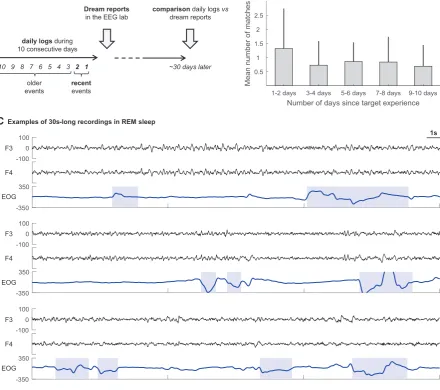
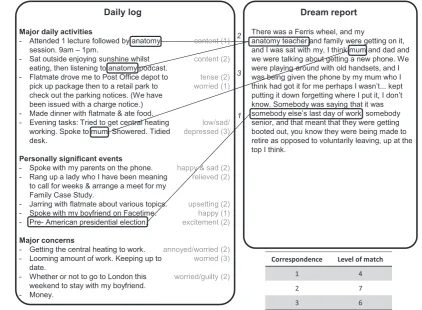
The time-course of the experiment is presented in Figure 1A. Participants kept a daily log (Fosseet al., 2003) for 10 consecutive days before sleeping in the laboratory. They were asked to re-port each evening on the daily log their ‘major daily activities’ (activities that took up most of each participant’s time during the day; e.g. going to work or university, meals, shopping), ‘per-sonally significant events’ (important daily events that may or may not have taken up much time; e.g. emotional events) and ‘major concerns’ (concerns or thoughts that participants had on their mind during the day that may not have taken up much time but were still considered important to them; e.g. money problems, exam stress). Up to five items could be recorded in each category. For each item reported, participants were also instructed to state any accompanying emotion (e.g. anger, anx-iety/fear, sadness, shame, joy/elation, love/erotic and surprise) and to rate the intensity of the emotion on a scale, from 1 (low) to 3 (high). An example is displayed in Figure 2.
On the evening of the 10th daily log day participants slept in the sleep laboratory (Supplementary Table S2). During that night, awakenings were conducted in SWS and REM sleep. Awakenings occurred following 10 min of sleep in each sleep-stage. Two SWS awakenings were scheduled during the first and second SWS periods, while REM awakenings were sched-uled from the third sleep cycle onwards. If participants recalled a dream from either or both SWS awakenings, they were woken 10 min into every following REM period, until morning. If they failed to recall a dream from the first two SWS awakenings, an-other SWS awakening was scheduled during the next SWS period. After three SWS awakenings, only REM awakenings fol-lowed, regardless of participants’ dream recall from SWS.
conducted via an intercom. After turning off the buzzer, partici-pants heard the verbal prompt ‘What was going through your mind immediately before you were woken up?’ from a digital voice recorder, and dream reports were recorded using another recorder. To prompt the participants, they were next asked with a recorded message: ‘Can you remember anything else?’. After giving their dream report through the intercom, they were invited to go back to sleep. A researcher blind to the experiment transcribed each dream report.
A habituation night was not included in the design because this would have acted as an event that might be dreamt of during the subsequent experimental night. It is acknowledged that there may thus have been first-night effect physiological changes to sleep structure due to not having a habituation night.
Correspondence identification task
Approximately 3 weeks after the laboratory night, participants were provided with the materials to perform the correspond-ence identification task. Participants received their daily logs and dream reports on A3 pages, 29.7 cm (high)42.0 cm (wide), each sheet with a daily log on the left side and a dream report on the right, so as to allow comparison of every daily log with every dream report. Each daily log and dream report sheet was assigned a random identifying number and the order of the sheets was randomized. Participants were instructed to com-pare each of their 10 daily logs with each of their dream report transcripts to identify similarities or correspondences between the log items and dream reports, such as of the characters, objects, actions, locations or themes. If they identified a Schematic of the experiment
10 9 8 7 6 5 4 3 2 1 daily logsduring 10 consecutive days
older events
recent events
comparisondaily logs vs dream reports Dream reports
in the EEG lab
F3
F4
EOG
F3
F4
EOG
F3
F4
EOG
Examples of 30s-long recordings in REM sleep
~30 days later
1s Number of REM dream / daily diary item matches across days
A
C
[image:4.612.83.524.83.473.2]B
correspondence, they were instructed to draw boxes around the matched words or sentences in the daily log and around the matched words or sentences in the dream report, and then to rate the level of correspondence between the two parts using a scale from 0 (none) to 8 (extremely strong; Figure 2). Zero, one or more than one correspondence(s) could be identified for each A3 sheet. Examples of sheets and instructions on how to per-form the task were provided.
Behavioral data
The number of daily log items identified by the participants as being incorporated into their dream reports, with scores of 4 or higher, was counted for each daily log and dream report com-bination. The threshold of 4 was used so as to ensure that par-ticipants had confidence in identifying each memory source item used for the analysis. All dream reports were included in the analysis, with no minimum length requirement, as several of the shortest reports were found to exhibit correspondences; furthermore, dream length was controlled for in partial correl-ation analyses.
Recent waking-life experiences were defined as items from the day of going to the laboratory and the day before that (i.e. from daily logs 1–2, respectively). Older waking-life experiences were defined as items from daily logs 3 to 10 and were analyzed in pairs as respectively daily logs 3–4, 5–6, 7–8 and 9–10. Within each pair of days, daily experiences that occurred on both days and identified as being incorporated into a dream were counted only once, to avoid an overestimation of the frequency of in-corporation into dreams.
Independent judges
Two independent judges conducted blind ratings of the corre-spondences between dream content and the daily logs of days 1 and 2, thus identifying incorporation of recent waking-life expe-riences. Ratings were conducted by the judges for these 2 days only because the hypothesized effect was restricted to these days. The judges were asked to identify any elements in the dream reports that matched items in the daily logs, using the same materials, method and instructions as followed by the participants.
The same method of scoring, collation and analysis for the combinations of daily log and dream report was followed for the judge ratings as for the participant ratings. For each daily log and dream report sheet the number of incorporations was com-puted as the average of the two judges’ scores.
EEG recordings and spectral analysis
In the laboratory, electroencephalography (EEG), electrooculog-raphy (EOG) and electromyogelectrooculog-raphy (EMG) were continuously recorded using a Trackit 18/8 system (Lifelines Ltd, UK, sam-pling rate: 200 Hz). EEG electrodes were placed according to the standard 10–20 system at F3, F4, C3, C4, M1 and M2. EOG electro-des were applied above the right outer canthus and below the left outer canthus, and EMG electrodes on the chin muscles. The common reference electrode was placed on top of the head at CPz position, and the ground electrode on the forehead.
EEG analysis was performed using Fieldtrip (Oostenveld
et al., 2011) and MATLAB (The MathWorks, Inc.). Frontal EEG channels (F3 and F4) were filtered between 1 and 25 Hz
(high-There was a Ferris wheel, and my
anatomy teacher and family were getting on it, and I was sat with my, I think mum and dad and we were talking about getting a new phone. We were playing around with old handsets, and I was being given the phone by my mum who I think had got it for me perhaps I wasn’t... kept putting it down forgetting where I put it, I don’t know. Somebody was saying that it was somebody else’s last day of work, somebody senior, and that meant that they were getting booted out, you know they were being made to retire as opposed to voluntarily leaving, up at the top I think.
Major daily activities
- Attended 1 lecture followed by anatomy session. 9am – 1pm.
- Sat outside enjoying sunshine whilst eating, then listening to anatomy podcast. - Flatmate drove me to Post Office depot to
pick up package then to a retail park to check out the parking notices. (We have been issued with a charge notice.) - Made dinner with flatmate & ate food. - Evening tasks: Tried to get central heating
working. Spoke to mum. Showered. Tidied desk.
Personally significant events - Spoke with my parents on the phone. - Rang up a lady who I have been meaning
to call for weeks & arrange a meet for my Family Case Study.
- Jarring with flatmate about various topics. - Spoke with my boyfriend on Facetime. - Pre- American presidential election.
Major concerns
- Getting the central heating to work. - Looming amount of work. Keeping up to
date.
- Whether or not to go to London this weekend to stay with my boyfriend. - Money.
content (1)
content (2)
tense (2) worried (1)
low/sad/ depressed (3)
happy & sad (2) relieved (2)
upsetting (2) happy (1) excitement (2)
annoyed/worried (2) worried (3)
worried/guilty (2)
Daily log
1 2
3
Dream report
Correspondence Level of match
1 4
2 7
[image:5.612.89.512.67.377.2]3 6
and low-pass filters, respectively; bidirectional Butterworth, 4th order) and quantitative EEG analysis was performed on the last 3 min of sleep preceding awakenings. EEG traces were visually inspected and awakenings with overall excessive artifacts were excluded.
Each awakening was first epoched in 4 s-long windows with 50% overlap (resulting in 89 4 s-long epochs per awakening) and 4 s-long epochs with absolute signal amplitude exceeding 70mV in REM sleep and 200mv in SWS were automatically excluded. Visual inspection was then performed to ensure that all win-dows exhibiting artifacts were properly excluded. In addition, in REM sleep, only accepted 4 s EEG epochs that were also free of REMs (that is, tonic REM sleep, not overlapping with REM events) were retained, so as to exclude any potential effect of eye movements in our results. REM events were detected in an automatic fashion as described later.
Power spectra were computed by a fast Fourier transform (‘mtmfft’ method in Fieldtrip, demeaning, hanning tapering). The frequency resolution was set at 0.25 Hz, from 1 to 25 Hz. The spectral power density was averaged across accepted 4 s-long epochs and then in the theta band (4–7 Hz) to test our hypoth-esis. Non-hypothesized spectral power density in the delta (1– 3 Hz), alpha (9–13 Hz) and beta (16–25 Hz) bands were also assessed as control wave bands for REM sleep, and theta, delta and sigma (12–16 Hz) for SWS.
REM detection in REM sleep
Eye movement periods (also called REM events) within the last 3 min of sleep preceding REM awakenings were automatically detected through EOG recordings. EOG channels were filtered between 0.1 and 3 Hz (high- and low-pass filters, respectively; bidirectional Butterworth, 4th order) before being rereferenced to each other (bipolar montage). A detection threshold was then applied (threshold¼meanþ2 s.d.; mean and s.d. were esti-mated after having removed extreme values, i.e. jvaluesj > 400mV). Zero-crossings immediately before and after periods crossing the threshold were localized and used for further analysis.
A REM event was defined between two consecutive zero-crossings as an event meeting the following conditions: (i) event duration<4 s and (ii) a maximal approximate derivative (from zero-crossing to first sample crossing detection thresh-old and/or from last sample crossing detection threshthresh-old to next zero-crossing; using diff function in MATLAB) of at least 0.2mV.ms1. All REM events were verified visually and the num-ber and duration of REM events were computed for each awakening.
Statistical analysis
MATLAB (The MathWorks, Inc.) and SPSS (IBM, USA) were used to perform the statistical analyses.
Correlation analyses.The correlations between frontal theta ac-tivity and wakefulness-related dream content were tested using Spearman rank-order correlation coefficient and the signifi-cance was set atP<0.05 (two-tailed).
For the all REM (and SWS) dreams analyses, where the num-ber of repetitions per participant could vary (from 1 to 4 for REM, and 1 to 2 for SWS), the weighted correlation coefficient as described in Bland and Altman (1995) was computed (using the participant-specific averages for each variable and the number of observations per participant as weights). The significance of
this weighted correlation coefficient was determined using a Spearman statistical table (Ramsey, 1989) withn¼number of participants and df¼n2.
To check that time since sleep onset (i.e. sleep duration from the first epoch scored as N2 to the time of instrumental awak-ening) and length of dream reports (i.e. number of words in the dream report, using the method of Antrobus, 1983) were not confounds in the theta correlations, these parameters were par-tialled out of the correlation coefficients.
Non-hypothesized relationships between power in other fre-quency bands and number of incorporations of waking-life memories into REM and SWS dreams were assessed using the same procedure.
Emotion of memories incorporated vs not incorporated into dreams. The emotional intensity of daily log items that were incorpo-rated into dream content were compared with the intensity of non-incorporated items, as a function of valence and sleep-stage, using mixed model analysis (two-tailed,P<0.05). To be included in the analysis a participant had to have both incorpo-rated and non-incorpoincorpo-rated daily log item(s) for at least one of the four combinations of valence (positive vs negative) and sleep-stage (REMvsSWS dreams).
Results
Sleep measuresOne participant failed to fall asleep during the night in the sleep laboratory and one participant did not complete the corres-pondence task at the end of the experiment, 18 participants were thus considered for further analysis.
In total, 93 awakenings were conducted (mean number of awakenings per participant¼5.2, s.d.¼1.8). Of the 93 awaken-ings, 48 were conducted in REM (51.6% of the awakenings), 39 in SWS (41.9%) and 6 in a mixed state (e.g. a mix of REM and N2, 6.5%). On average, the REM awakenings occurred 347.9 min (s.d.¼123.6) after sleep onset, while SWS awakenings occurred 110.0 min (s.d.¼92.7) after sleep onset.
Dream measures
Of the 48 REM awakenings, 46 were followed by a dream report (95.8% of the REM awakenings, mean number of REM dreams per participant¼2.6, range¼from 1 to 4 REM dreams;n¼18 participants). The REM dream reports contained on average 83.1 words per dream (s.d.¼93.6, min¼3, max¼452). The partici-pants identified on average 1.31 (s.d.¼1.42) recent experiences from days 1 to 2 in REM dreams, and 0.73 (0.86), 0.86 (0.68), 0.84 (0.89) and 0.69 (0.75) older experiences from days 3 to 4, 5 to 6, 7 to 8 and 9 to 10, respectively (Figure 1B).
Of the 39 SWS awakenings, 19 were followed by a dream re-port (48.7% of the SWS awakenings). Nine participants had one SWS awakening followed by a dream report, and five partici-pants had two SWS awakenings each followed by a dream re-port. The SWS dream reports contained on average 25.9 words per dream (s.d.¼26.6, min¼1, max¼104). The participants identified on average 1.07 (s.d.¼1.31) recent experiences from days 1 to 2 in SWS dreams, and 0.93 (1.16), 0.79 (0.83), 0.64 (0.99) and 0.93 (1.02) older experiences from days 3 to 4, 5 to 6, 7 to 8 and 9 to 10, respectively.
identified per participant. Across the 46 REM dreams, the unstandardized Cronbach’s alpha between scores of partici-pants and the judges was 0.78 (considered as acceptable).
EEG recordings and power spectrum
Two REM awakenings (both followed by a dream report) were excluded from the power analyses due to poor quality EEG recordings/excessive artifact components in the 3 min of sleep preceding the awakening. The EEG analyses were thus per-formed on the remaining awakenings (46 REM awakenings including 44 followed by a dream report; 39 SWS awakenings including 19 with a dream report). Examples of 30 s-recordings are displayed in Figure 1C.
Based on the amplitude threshold and visual inspection, the mean percentage of 4 s-long windows excluded was, re-spectively, 5.3% (s.d.¼9.7) in REM periods and 1.0% (s.d.¼1.7) in SWS periods. The mean number of EOG events detected in REM periods was 18.3 (s.d.¼6.5; averaged duration within the 3 min¼31.0 s, s.d.¼9.7). Accordingly, the final set of 4 s-long windows accepted in tonic (without REMs) REM periods was defined as the intersection of the 4 s-long windows passing amplitude threshold and without overlapping REMs, resulting in a mean percentage of accepted windows of 62.3% (s.d.¼13.5) in tonic REM periods. The averaged EEG power spectra in (tonic) REM and SWS at F3 and F4 are displayed in Figure 3.
Correlations between REM frontal theta and number of waking-life memories in REM dreams
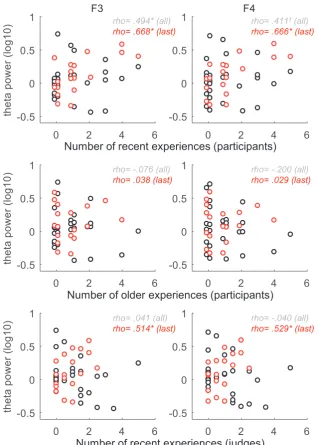
As hypothesized, for the sample of all REM dreams (44 awaken-ings from 18 participants), the correlation analysis showed that the number of recent waking-life items (from days 1 to 2) incor-porated into dream reports was positively correlated with frontal REM theta power (Figure 4, upper panel; F3: weighted Spearman rho ¼ 0.494, P < 0.05; F4: weighted rho ¼ 0.411,
P<0.10).
No significant correlation was observed between theta power and number of older waking-life log items for either F3
(Figure 4, middle panel; weighted rho¼0.176, 0.179,0.076 and 0.006, for respectively days 3–4, 5–6, 7–8, 9–10; allP-values> 0.20) or F4 (weighted rho¼0.113, 0.185,0.200,0.105, for re-spectively days 3–4, 5–6, 7–8, 9–10; allP-values>0.20). As a fur-ther control, correlations between number of incorporations of recent daily log experiences and delta, alpha and beta power in the last 3 min of the REM period were computed. The latter cor-relations were not significant (delta: F3, weighted rho¼0.441,
P>0.05; F4, weighted rho¼0.386,P>0.10; alpha: F3, weighted rho¼0.161,P>0.50; F4, weighted rho¼0.152,P>0.50; beta: F3, weighted rho¼0.162,P>0.50; F4, weighted rho¼0.266P> 0.20).
Partial correlations were computed to adjust for sleep dur-ation preceding the REM awakening, and also to adjust for dream report length. After adjusting for sleep duration, partial weighted correlations (with recent waking-life log items) were rho¼0.507 (P<0.05) at F3 and rho¼0.430 (P<0.10) at F4, while weighted partial correlations were rho¼0.481 (P<0.05) at F3 and rho¼0.390 (P<0.20) at F4 after adjusting for dream report length.
We also analyzed the sample of the last REM dream of each participant (18 awakenings, in red in Figure 4), following the view of a sequential processing of memories across the night, as a result of the successive cycles of SWS and REM sleep (e.g. Giudittaet al., 1995). On average, 1.33 recent incor-porations (s.d.¼1.53) were identified per dream, and a signifi-cant correlation between the number of recent waking-life log items incorporated and theta power was observed at F3 (rho¼ 0.668,P<0.005) and F4 (rho¼0.666,P<0.005). After adjusting for sleep duration, partial correlations were rho¼0.667 (P< 0.005) at F3 and rho¼0.666 (P<0.005) at F4, while partial cor-relations were rho¼0.659 (P <0.005) at F3 and rho¼0.667 (P <0.005) at F4 after adjusting for dream report length in words.
Correlations using external judges
For the sample of all REM dreams, there was no significant cor-relation between theta and number of recent incorporations
[image:7.612.150.465.63.273.2]REM
SWS
identified by judges at F3 (weighted rho¼0.041,P>0.50) or F4 (weighted rho¼ 0.040,P>0.50).
As was done using the participants’ scores, the sample of the last REM dream of each participant was also explored. On average, 0.86 recent incorporations (s.d.¼0.78) were identified by judges per dream, and a significant correlation between theta and number of incorporations was observed at F3 (rho¼ 0.514,P<0.05) and F4 (rho¼0.529,P<0.05). So as to investigate whether this difference in comparison to the all REM dreams analysis was related to the length of the dream reports that were included in the analyses, the mean lengths of the two samples of reports were compared. The last or only dream of participants were found to be longer than the earlier dreams of
participants [early REM dream reports (n¼26) mean¼58.7 words, s.d.¼54.4; last or only REM dream reports (n¼18) mean-¼113.7 words, s.d.¼128.2] but this difference was not signifi-cant [mixed model analysis,F(1, 24.9)¼3.46,P<0.10].
No correlations between EEG power and incorporations in SWS dreams
As predicted, no significant correlation was observed between number of recent incorporations in SWS dreams and SWS theta power for either F3 (weighted rho ¼ 0.219, P > 0.20) or F4 (weighted rho ¼ 0.306, P > 0.20) analyzing all SWS dreams, or analyzing first/only SWS dream for either F3 (rho¼0.066,
Number of recent experiences (participants)
Number of older experiences (participants)
Number of recent experiences (judges)
rho= .494* (all)
rho= .668* (last)
rho= .411
†(all)
rho= .666* (last)
rho= -.076 (all)
rho= .038 (last)
rho= -.200 (all)
rho= .029 (last)
rho= .041 (all)
rho= .514* (last)
rho= -.040 (all)
[image:8.612.147.466.61.507.2]rho= .529* (last)
Fig. 4.Relationship between the number of incorporations of daily experiences in REM dreams and frontal theta activity in REM sleep. The two first panels display the relationship between the frontal theta power in REM sleep and the number of recent (from days 1/2, top panel) and older (from days 7/8, middle panel) experiences identified as being incorporated in REM dreams by the participants. The last panel displays the relationship when judges independently identified recent incorpora-tions in REM dreams (from days 1/2, bottom panel). Higher frontal theta activity in REM sleep was associated with higher number of references to recent waking
experi-ences in REM dreams as identified by the participants for the all REM (weighted correlation coefficient, in gray) and last/only REM (in red) samples (*P<0.05, †P<0.10;
two-tailed) or by independent judges for the last/only REM samples (*P<0.05, two-tailed). The sample of the final or only REM dream of each participant is highlighted
P>0.50) or F4 (rho¼0.296,P>0.20). As the main oscillatory fea-ture in SWS is delta activity, these correlations were rerun using delta power. No significant correlation was observed between recent incorporations and SWS delta power for either F3 (weighted rho¼0.289,P>0.20) or F4 (weighted rho¼0.249,P> 0.20) analyzing all SWS dreams, or analyzing first/only SWS dream for either F3 (rho¼0.258,P>0.20) or F4 (rho¼0.169,P> 0.50). Similarly, no significant correlation was observed between recent incorporations and SWS sigma power for either F3 (rho¼ 0.093,P>0.50) or F4 (rho¼0.211,P>0.20) analyzing all SWS dreams, or analyzing first/only SWS dream for either F3 (rho¼ 0.101,P>0.50) or F4 (rho¼0.261,P>0.20).
Correlations at central channels
Although this study was focused on the relationship between REM frontal theta and the number of recent waking-life experi-ences in REM dreams, we explored this relationship at central channels as a further control. The correlation at central chan-nels was computed following the same analysis as for frontal channels after having visually excluded EEG traces with overall excessive artifacts. For the sample of all REM dreams, the correl-ation analysis showed that the number of recent waking-life items (from days 1 to 2) incorporated into dream reports was not significantly correlated with theta power at C3 (36 awaken-ings from 16 participants; weighted rho¼0.396,P>0.10) or C4 (29 awakenings from 12 participants; weighted rho¼0.429,P> 0.10). A positive correlation was observed for the sample of last REM dreams at C3 (15 participants; rho¼0.564,P<0.05) and C4 (11 participants; rho¼0.602,P<0.05). However, using judges’ scores, no significant correlation was observed using all REM dreams (weighted rho¼ 0.078,P>0.50 at C3 and weighted rho ¼ 0.070,P>0.50 at C4) or last REM dream (rho¼0.315,P>0.20 at C3 and rho¼0.479,P>0.10 at C4). All correlations of central theta with incorporation of older waking-life items were non-significant.
Emotional intensity of the incorporatedvs non-incorporated recent items
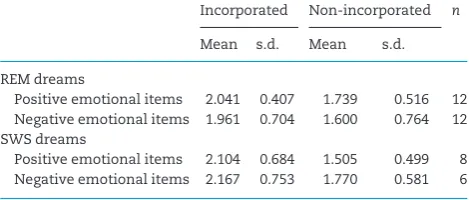
In total, 372 daily log items from the days 1 to 2 logs were ana-lyzed. The number of occurrences of emotion scores3,2,1, 0, 1, 2 and 3 were 44, 66, 19, 94, 42, 64 and 43, respectively. Items scored from3 to 0 and from 0 to 3 were classified as negative and positive emotion items, respectively. The means for emo-tional intensity of incorporated and non-incorporated items are presented in Table 1, as a function of valence of the daily log item and sleep-stage.
Fifteen participants had both incorporated and non-incorporated daily log items for at least one of the four combi-nations of valence (positivevsnegative) and sleep-stage (REMvs
SWS dreams) and so were included in the analysis. As many of these participants did not have incorporated and non-incorporated items for all four combinations, the sample sizes shown in Table 1 for each combination are<15. A mixed model analysis using type III tests of fixed effects showed a significant difference between emotional intensity of incorporated and non-incorporated experiences [F(1, 28.3)¼11.19,P¼0.002] but no interaction between the incorporated/non-incorporated and valence factors [F(1, 28.3)¼0.08,P>0.50], nor the incorporated/ non-incorporated and sleep-stage factors [F(1, 28.3)¼0.44,P> 0.50]. The three-way interaction between the incorporated/incorporated, valence and sleep-stage factors was also non-significant [F(1, 28.3)¼0.29,P>0.50]. Thus, intensity of emotion
was associated with incorporation of waking-life experiences into dreams, and this relationship held for positive and negative emotions and for SWS and REM dreams.
Discussion
The number of references to recent waking-life experiences in REM dreams was found to be positively correlated with frontal theta activity in the last 3 min of the REM sleep period from which the dream was collected. No such correlation was observed for older memories, nor between theta and memory incorporations in SWS dreams, suggesting a REM specific brain correlate of the incorporation of recent waking-life experiences into dreams. The correlations were higher for the last REM dream report of the night. In addition, recent experiences incor-porated into REM and SWS dreams had significantly higher emotional intensity than did non-incorporated recent experien-ces, irrespective of valence.
Although brain activity related to the recall or non-recall of dreams is a field of intense research (Chellappaet al., 2011, 2012; Marzanoet al., 2011; Rubyet al., 2013; Eichenlaubet al., 2014a,b; Scarpelli et al., 2017; Vallat et al., 2017b), few studies, to our knowledge, have attempted to link sleeping brain activities with the content of associated dreams. For example, Dresleret al.
(2011) showed that a predefined motor task performed during REM dreaming was associated with neural activation of the cor-responding sensorimotor cortex, Horikawaet al.(2013) success-fully categorized the dream content of sleepers at N1 sleep onset by applying a machine learning approach on fMRI data, and Siclari et al. (2017) linked different components of REM dream content to EEG activity in the corresponding brain areas. These studies identified brain activity during sleep that under-lies the content of dreams, providing critical evidence of how dreaming is constructed at the brain level. The findings from this study extend this research by identifying a relationship be-tween REM theta activity and the degree to which dream con-tent is related to recent experiences, with this relationship being present for the whole sample of REM dreams but more so for REM dreams later in the night.
Dream content and REM-sleep dependent memory consolidation
[image:9.612.315.550.90.190.2]The literature repeatedly highlights the processing of emotional memories in REM sleep and the relationship of this processing
Table 1.Emotional intensity of the recent experiences as a function of (non-)incorporation into REMvsSWS dreams
Incorporated Non-incorporated n
Mean s.d. Mean s.d.
REM dreams
Positive emotional items 2.041 0.407 1.739 0.516 12 Negative emotional items 1.961 0.704 1.600 0.764 12 SWS dreams
Positive emotional items 2.104 0.684 1.505 0.499 8 Negative emotional items 2.167 0.753 1.770 0.581 6
Emotional intensity (mean6s.d.) of recent daily log items as a function of
whether the item was or was not incorporated into a REM or SWS dream, and as a function of valence of the daily log item emotion. Note: Emotions of daily log
items were rated3,2,1, 0,þ1,þ2,þ3, and negatively valenced items are
represented by absolute value of score.nrefers to number of participants for
to REM frontal theta oscillations (Wagner et al., 2001; Groch
et al., 2013, 2015; Prehn-Kristensenet al., 2013; Cowdin et al., 2014; Durrantet al., 2015; Seeleyet al., 2016). Theta power in REM sleep has been correlated with post-sleep recall of recent emo-tional memories in humans (Nishidaet al., 2009), while theta co-herence between the amygdala, medial prefrontal cortex and hippocampus in REM sleep has been correlated with overnight bidirectional changes in fear memory in rats (Popaet al., 2010). In this study, the finding that recent experiences incorporated into REM dreams are linked to REM frontal theta, and exhibit higher emotional intensity than the experiences not incorpo-rated, support a framework in which dreaming might be reflect-ive of memory consolidation processes, a framework which has already received support (for reviews, see Stickgoldet al., 2001; Payne, 2010; Wamsley, 2014). Our results suggest that the occur-rence of recent waking-life experiences in dreams might reflect the ongoing, theta-mediated, consolidation of these new emo-tional memories in REM sleep. That emoemo-tional experiences are more likely to be incorporated into REM and SWS dreams than less emotional experiences accords with theories of the proc-essing of recent emotional memories during sleep, such as Walker and van der Helm’s (2009) Sleep to Remember and Sleep to Forget theory, that sleep causes a reduction in emotional tone while tagged memories are consolidated, as supported by Vallat et al.’s (2017a) finding that dream elements have a reduced emotional tone in comparison to their waking-life memory sources. That the last reported REM dream of the night evidenced the relationship with theta more than did earlier REM dreams may be due to a greater complexity of processing once earlier cycles have been completed. Alternatively, this time of night effect may be a function of the greater elaboration, length and complexity of dream-stories in later REM periods (Cipolli and Poli, 1992; Cipolliet al., 2015).
Importantly, this link between frontal theta activity and waking-life experiences in REM dreams was not observed with older memories. This result suggests a transformation across nights of the memories, as proposed by the Sleep to Remember and Sleep to Forget model (Walker, 2009; Walker and van der Helm, 2009). Our results bolster this model by suggesting a trans-formation across nights of the memory traces processed in REM sleep, that is, while older memories are still present in dreams, these memory traces are no longer related to REM theta activity.
However, the question whether dreaming itself is a function-al component of the consolidation of memories is highly debated (Wamsley and Stickgold, 2011; Wamsley, 2014), and this study does not provide conclusive evidence for a memory func-tion of dreaming itself since it is impossible to quantify whether the incorporation of recent waking experiences into REM dreams transformed the memory traces in any meaningful way. Nevertheless, it is important to note that the pioneering work by Cartwrightet al.(1998a, 2003, 2006) suggests a role of REM dreams in recovery from emotional trauma, while the affective network dysfunction model of Nielsen and Levin (2007) pro-poses that nightmares reflect failures of a fear memory extinc-tion funcextinc-tion of dreaming. These works highlight a memory function of dreaming through the regulation of emotional com-ponents of memories, and the current results are compatible with this hypothesis that a function of REM sleep, and concomi-tant dreaming, is to transform emotional memories.
Identification of incorporations by external judges
Incorporations of recent experiences identified by judges corre-lated with frontal theta power for the sample comprising the
final REM dream of each participant, while no correlation was observed when all REM dreams were considered. Caution is needed, however, regarding this lack of correlation for judge identified incorporations when early REM dreams were included in analyses. Despite the acceptable reliability between judges and participant scores, the relative shortness in length of early REM dream reports might have resulted in judges having less detail on which to base judgments about dream content than do participants themselves, a point discussed by Sikka et al.
(2014).
Limitations of the study
Although there was no significant correlation for SWS dreams, there were also fewer dream reports in that condition compared with REM sleep, raising the possibility that the absence of a cor-relation could be due to low statistical power. Furthermore, the use of a multiple-night design is recommended for future stud-ies so as to limit the sleep disturbance due to multiple awaken-ings within a single night as used in this study, affording an across-night balance of both sleep-stages and sleep cycles, and greater representativeness of REM dreams for the different cycles.
Although the rationale for the findings of this study con-cerned frontal theta, we acknowledge that as we did not have a full array of control regions for EEG, it was not possible to fully explore to what extent the effect was specific to the frontal re-gion. The effect was also found for neighboring central electro-des using the last REM sample, although not significantly so for the all REM sample nor for judge scored incorporations. That the effect might be present for central regions is plausible. By comparing REM sleep awakenings that were followed by a dream reportvsthose not followed by a dream report, Marzano
et al.(2011) reported differences in theta power between the two conditions that exhibited a topography spreading to central and left temporal areas, although only in frontal areas was the asso-ciation of theta power with dream recall significant. Accordingly, future studies should use a larger number of elec-trodes to refine the involvement of frontal and neighboring cen-tral and temporal regions in the correlation between the number of recent waking-life experiences incorporated into REM dreams and REM theta power.
Conclusion
The number of references to recent waking-life experiences in REM dreams was found to be positively correlated with frontal theta activity in the REM sleep period. No such correlation was observed for older memories, nor for SWS dreams. Furthermore, the emotional intensity of recent waking-life experiences incor-porated into dreams was higher than the emotional intensity of experiences that were not incorporated. These results accord with theories that dreaming reflects emotional memory proc-essing taking place in REM sleep.
Funding
Study funded by UK Economic and Social Research Council award ES/I037555/1 Dream content as a measure of memory consolidation across multiple periods of sleep.
Supplementary data
Conflict of interest. None declared.
References
Ambrosini, M.V., Giuditta, A. (2001). Learning and sleep: the se-quential hypothesis.Sleep Medicine Reviews,5(6), 477–90. Antrobus, J. (1983). REM and NREM sleep reports: comparison of
word frequencies by cognitive classes.Psychophysiology,20(5), 562–8.
Baran, B., Pace-Schott, E.F., Ericson, C., Spencer, R.M. (2012). Processing of emotional reactivity and emotional memory over sleep.Journal of Neuroscience,32(3), 1035–42.
Blagrove, M., Fouquet, N.C., Henley-Einion, J.A., et al. (2011a). Assessing the dream-lag effect for REM and NREM stage 2 dreams.PLoS One,6(10), e26708.
Blagrove, M., Henley-Einion, J., Barnett, A., Edwards, D., Heidi Seage, C. (2011b). A replication of the 5-7 day dream-lag effect with comparison of dreams to future events as control for baseline matching.Consciousness and Cognition,20(2), 384–91. Bland, J.M., Altman, D.G. (1995). Calculating correlation
coeffi-cients with repeated observations: part 2–correlation between subjects.BMJ,310(6980), 633.
Cairney, S.A., Durrant, S.J., Power, R., Lewis, P.A. (2015). Complementary roles of slow-wave sleep and rapid eye move-ment sleep in emotional memory consolidation. Cerebral Cortex,25(6), 1565–75.
Cartwright, R., Agargun, M.Y., Kirkby, J., Friedman, J.K. (2006). Relation of dreams to waking concerns. Psychiatry Research, 141(3), 261–70.
Cartwright, R., Baehr, E., Kirkby, J., Pandi-Perumal, S.R., Kabat, J. (2003). REM sleep reduction, mood regulation and remission in untreated depression.Psychiatry Research,121(2), 159–67. Cartwright, R., Luten, A., Young, M., Mercer, P., Bears, M. (1998).
Role of REM sleep and dream affect in overnight mood regula-tion: a study of normal volunteers.Psychiatry Research,81(1), 1–8.
Cartwright, R., Young, M.A., Mercer, P., Bears, M. (1998). Role of REM sleep and dream variables in the prediction of remission from depression.Psychiatry Research,80(3), 249–55.
Chellappa, S.L., Frey, S., Knoblauch, V., Cajochen, C. (2011). Cortical activation patterns herald successful dream recall after NREM and REM sleep.Biological Psychology,87(2), 251–6. Chellappa, S.L., Munch, M., Knoblauch, V., Cajochen, C. (2012).
Age effects on spectral electroencephalogram activity prior to dream recall.Journal of Sleep Research,21(3), 247–56.
Cipolli, C., Guazzelli, M., Bellucci, C.,et al. (2015). Time-of-night variations in the story-like organization of dream experience developed during rapid eye movement sleep.Journal of Sleep Research,24(2), 234–40.
Cipolli, C., Poli, D. (1992). Story structure in verbal reports of mental sleep experience after awakening in REM sleep.Sleep, 15(2), 133–42.
Cowdin, N., Kobayashi, I., Mellman, T.A. (2014). Theta frequency activity during rapid eye movement (REM) sleep is greater in people with resilience versus PTSD.Experimental Brain Research, 232(5), 1479–85.
Dresler, M., Koch, S.P., Wehrle, R.,et al. (2011). Dreamed move-ment elicits activation in the sensorimotor cortex. Current Biology,21(21), 1833–7.
Durrant, S.J., Cairney, S.A., McDermott, C., Lewis, P.A. (2015). Schema-conformant memories are preferentially consolidated during REM sleep.Neurobiology of Learning and Memory,122, 41–50.
Eichenlaub, J.B., Bertrand, O., Morlet, D., Ruby, P. (2014a). Brain reactivity differentiates subjects with high and low dream re-call frequencies during both sleep and wakefulness.Cerebral Cortex,24(5), 1206–15.
Eichenlaub, J.B., Cash, S.S., Blagrove, M. (2017). Daily life experi-ences in dreams and sleep-dependent memory consolidation. In: Axmacher, N., Rasch, B., editors.Cognitive Neuroscience of Memory Consolidation, Switzerland: Springer Cham, pp. 161–72. Eichenlaub, J.-B., Nicolas, A., Daltrozzo, J., Redoute´, J., Costes, N.,
Ruby, P. (2014b). Resting brain activity varies with dream recall frequency between subjects. Neuropsychopharmacology, 39(7), 1594–602.
Fosse, M.J., Fosse, R., Hobson, J.A., Stickgold, R.J. (2003). Dreaming and episodic memory: a functional dissociation? Journal of Cognitive Neuroscience,15(1), 1–9.
Freud, S. (1953/1900). The Interpretation of Dreams (Trans. J. Stratchey). London: Hogarth Press (Original Publication date 1900).
Genzel, L., Spoormaker, V.I., Konrad, B.N., Dresler, M. (2015). The role of rapid eye movement sleep for amygdala-related mem-ory processing. Neurobiology of Learning and Memory, 122, 110–21.
Giuditta, A. (2014). Sleep memory processing: the sequential hy-pothesis.Frontiers in Systems Neuroscience,8, 219.
Giuditta, A., Ambrosini, M.V., Montagnese, P.,et al. (1995). The se-quential hypothesis of the function of sleep.Behavioural Brain Research,69(1–2), 157–66.
Groch, S., Wilhelm, I., Diekelmann, S., Born, J. (2013). The role of REM sleep in the processing of emotional memories: evidence from behavior and event-related potentials. Neurobiology of Learning and Memory,99, 1–9.
Groch, S., Zinke, K., Wilhelm, I., Born, J. (2015). Dissociating the contributions of slow-wave sleep and rapid eye movement sleep to emotional item and source memory.Neurobiology of Learning and Memory,122, 122–30.
Gujar, N., McDonald, S.A., Nishida, M., Walker, M.P. (2011). A role for REM sleep in recalibrating the sensitivity of the human brain to specific emotions.Cerebral Cortex,21(1), 115–23. Horikawa, T., Tamaki, M., Miyawaki, Y., Kamitani, Y. (2013).
Neural decoding of visual imagery during sleep. Science, 340(6132), 639–42.
Hutchison, I.C., Rathore, S. (2015). The role of REM sleep theta ac-tivity in emotional memory.Frontiers in Psychology,6, 1439. Iber, C., Ancoli-Israel, S., Chesson, A., Quan, S.F. (2007).The AASM
Manual for the Scoring of Sleep and Associated Events: Rules, Terminology, and Technical Specification. Westchester, IL: American Academy of Sleep Medicine.
Lara-Carrasco, J., Nielsen, T.A., Solomonova, E., Levrier, K., Popova, A. (2009). Overnight emotional adaptation to negative stimuli is altered by REM sleep deprivation and is correlated with intervening dream emotions. Journal of Sleep Research, 18(2), 178–87.
Malinowski, J.E., Horton, C.L. (2014). Evidence for the preferential incorporation of emotional waking-life experiences into dreams.Dreaming,24(1), 18–31.
Marquis, L.P., Paquette, T., Blanchette-Carriere, C., Dumel, G., Nielsen, T. (2017). REM sleep theta changes in frequent night-mare recallers.Sleep,40(9), zsx110.
Nielsen, T.A. (2000). A review of mentation in REM and NREM sleep: “covert” REM sleep as a possible reconciliation of two opposing models.Behavioral and Brain Sciences,23(6), 851–66. discussion 904–1121.
Nielsen, T.A., Kuiken, D., Alain, G., Stenstrom, P., Powell, R.A. (2004). Immediate and delayed incorporations of events into dreams: further replication and implications for dream func-tion.Journal of Sleep Research,13(4), 327–36.
Nielsen, T.A., Levin, R. (2007). Nightmares: a new neurocognitive model.Sleep Medicine Reviews,11(4), 295–310.
Nielsen, T.A., Powell, R.A. (1989). The ‘dream-lag’ effect: a 6-day temporal delay in dream content incorporation. Psychiatric Journal of the University of Ottawa: Revue De Psychiatrie De L’Universite D’Ottawa,14(4), 561–5.
Nielsen, T.A., Stenstrom, P. (2005). What are the memory sources of dreaming?Nature,437(7063), 1286–9.
Nishida, M., Pearsall, J., Buckner, R.L., Walker, M.P. (2009). REM sleep, prefrontal theta, and the consolidation of human emo-tional memory.Cerebral Cortex,19(5), 1158–66.
Oostenveld, R., Fries, P., Maris, E., Schoffelen, J.M. (2011). FieldTrip: open source software for advanced analysis of MEG, EEG, and invasive electrophysiological data. Computational Intelligence and Neuroscience,2011, 1.
Payne, J.D. (2010). Memory consolidation, the diurnal rhythm of cortisol, and the nature of dreams: a new hypothesis.
International Review of Neurobiology,92, 101–34.
Payne, J.D., Chambers, A.M., Kensinger, E.A. (2012). Sleep pro-motes lasting changes in selective memory for emotional scenes.Frontiers in Integrative Neuroscience,6, 108.
Payne, J.D., Kensinger, E.A., Wamsley, E.J.,et al. (2015). Napping and the selective consolidation of negative aspects of scenes.
Emotion,15(2), 176–86.
Popa, D., Duvarci, S., Popescu, A.T., Lena, C., Pare, D. (2010). Coherent amygdalocortical theta promotes fear memory con-solidation during paradoxical sleep.Proceedings of the National Academy of Sciences of the United States of America, 107(14), 6516–9.
Powell, R.A., Cheung, J.S., Nielsen, T.A., Cervenka, T.M. (1995). Temporal delays in incorporation of events into dreams.
Perceptual and Motor Skills,81(1), 95–104.
Prehn-Kristensen, A., Munz, M., Molzow, I., Wilhelm, I., Wiesner, C.D., Baving, L. (2013). Sleep promotes consolidation of emo-tional memory in healthy children but not in children with attention-deficit hyperactivity disorder.PLoS One,8(5), e65098. Propper, R.E., Stickgold, R., Keeley, R., Christman, S.D. (2007). Is
television traumatic? Dreams, stress, and media exposure in the aftermath of September 11, 2001.Psychological Science,18(4), 334–40.
Ramsey, P.H. (1989). Critical values for Spearman’s rank order correlation.Journal of Educational Statistics,14(3), 245–53. Ruby, P., Blochet, C., Eichenlaub, J.B., Bertrand, O., Morlet, D.,
Bidet-Caulet, A. (2013). Alpha reactivity to first names differs in subjects with high and low dream recall frequency.Frontiers in Psychology,4, 419.
Scarpelli, S., D’Atri, A., Mangiaruga, A.,et al. (2017). Predicting dream recall: EEG activation during NREM sleep or shared
mechanisms with wakefulness? Brain Topography, 30(5), 629–38.
Schredl, M. (2006). Factors affecting the continuity between wak-ing and dreamwak-ing: emotional intensity and emotional tone of the waking-life event.Sleep and Hypnosis,8(1), 1–5.
Seeley, C.J., Smith, C.T., MacDonald, K.J., Beninger, R.J. (2016). Ventromedial prefrontal theta activity during rapid eye move-ment sleep is associated with improved decision-making on the Iowa gambling task.Behavioral Neuroscience,130(3), 271–80. Siclari, F., Baird, B., Perogamvros, L.,et al. (2017). The neural
cor-relates of dreaming.Nature Neuroscience,20(6), 872–8.
Sikka, P., Valli, K., Virta, T., Revonsuo, A. (2014). I know how you felt last night, or do I? Self- and external ratings of emotions in REM sleep dreams.Consciousness and Cognition,25, 51–66. Spoormaker, V.I., Gvozdanovic, G.A., Samann, P.G., Czisch, M.
(2014). Ventromedial prefrontal cortex activity and rapid eye movement sleep are associated with subsequent fear expression in human subjects. Experimental Brain Research, 232(5), 1547–54.
Stickgold, R., Hobson, J.A., Fosse, R., Fosse, M. (2001). Sleep, learn-ing, and dreams: off-line memory reprocessing. Science, 294(5544), 1052–7.
Vallat, R., Chatard, B., Blagrove, M., Ruby, P. (2017a). Characteristics of the memory sources of dreams: a new ver-sion of the content-matching paradigm to take mundane and remote memories into account.PLoS One,12(10), e0185262. Vallat, R., Lajnef, T., Eichenlaub, J.B.,et al. (2017b). Increased
evoked potentials to arousing auditory stimuli during sleep: implication for the understanding of dream recall.Frontiers in Human Neuroscience,11, 132.
van der Helm, E., Yao, J., Dutt, S., Rao, V., Saletin, J.M., Walker, M.P. (2011). REM sleep depotentiates amygdala activity to pre-vious emotional experiences.Current Biology,21(23), 2029–32. van Rijn, E., Eichenlaub, J.B., Lewis, P.A., et al. (2015). The
dream-lag effect: selective processing of personally significant events during rapid eye movement sleep, but not during slow wave sleep.Neurobiology of Learning and Memory,122, 98–109. van Rijn, E., Reid, A.M., Edwards, C.L.,et al. (2018). Daydreams
in-corporate recent waking life concerns but do not show delayed (‘dream-lag’) incorporations. Consciousness and Cognition, 58, 51–9.
Wagner, U., Gais, S., Born, J. (2001). Emotional memory formation is enhanced across sleep intervals with high amounts of rapid eye movement sleep.Learning & Memory,8(2), 112–9.
Walker, M.P. (2009). The role of sleep in cognition and emotion.
Annals of the New York Academy of Sciences,1156, 168–97. Walker, M.P., Stickgold, R. (2010). Overnight alchemy:
sleep-dependent memory evolution. Nature Reviews Neuroscience,11(3), 218; author reply 218.
Walker, M.P., van der Helm, E. (2009). Overnight therapy? The role of sleep in emotional brain processing. Psychological Bulletin,135(5), 731–48.
Wamsley, E.J. (2014). Dreaming and offline memory consolida-tion.Current Neurology and Neuroscience Reports,14(3), 433. Wamsley, E.J., Stickgold, R. (2011). Memory, sleep and dreaming: