This is a repository copy of ESPRIT-like two-dimensional direction finding for mixed circular and strictly noncircular sources based on joint diagonalization.
White Rose Research Online URL for this paper: http://eprints.whiterose.ac.uk/120209/
Version: Accepted Version
Article:
Chen, H., Hou, C., Zhu, W.P. et al. (4 more authors) (2017) ESPRIT-like two-dimensional direction finding for mixed circular and strictly noncircular sources based on joint
diagonalization. Signal Processing, 141. pp. 48-56. ISSN 0165-1684 https://doi.org/10.1016/j.sigpro.2017.05.024
Reuse
Items deposited in White Rose Research Online are protected by copyright, with all rights reserved unless indicated otherwise. They may be downloaded and/or printed for private study, or other acts as permitted by national copyright laws. The publisher or other rights holders may allow further reproduction and re-use of the full text version. This is indicated by the licence information on the White Rose Research Online record for the item.
Takedown
If you consider content in White Rose Research Online to be in breach of UK law, please notify us by
ESPRIT-like Two-dimensional Direction Finding for
Mixed Circular and Strictly Noncircular Sources Based
on Joint Diagonalization
Hua Chena, Chunping Houa, Wei-Ping Zhub, Wei Liuc, Yang-Yang Dongd,
Qing Wanga
a
School of Electronic Informatin Engineering, Tianjin University, Tianjin 300072, P. R. China.
b
Department of Electrical and Computer Engineering, Concordia University, Montreal, QC H3G 1M8, Canada.
c
Department of Electronic and Electrical Engineering, University of Sheffield, Sheffield S1 3JD, UK.
d
Key Laboratory of Electronic Information Countermeasure and Simulation Technology, Ministry of Education, Xidian University, Xian 710071, Shanxi, P. R. China.
Abstract
In this paper, a two-dimensional (2-D) direction-of-arrival (DOA) estimation
method for a mixture of circular and strictly noncircular signals is
present-ed baspresent-ed on a uniform rectangular array (URA). We first formulate a new
2-D array model for such a mixture of signals, and then utilize the observed
data coupled with its conjugate counterparts to construct a new data
vec-tor and its associated covariance matrix for DOA estimation. By exploiting
the second-order non-circularity of incoming signals, a computationally
ef-fective ESPRIT-like method is adopted to estimate the 2-D DOAs of mixed
sources which are automatically paired by joint diagonalization of two
direc-∗Corresponding author
Email addresses: [email protected](Hua Chen),[email protected]
(Wei-Ping Zhu ),[email protected](Wei Liu),[email protected]
tion matrices. One particular advantage of the proposed method is that it
can solve the angle ambiguity problem when multiple incoming signals have
the same angleθ orβ. Furthermore, the theoretical error performance of the
proposed method is analyzed and a closed-form expression for the
determin-istic Cramer-Rao bound (CRB) for the considered signal scenario is derived.
Simulation results are provided to verify the effectiveness of the proposed
method.
Keywords:
Two-dimensional (2-D), direction of arrival (DOA), noncircular signal,
uniform rectangular array (URA), joint diagonalization, angle ambiguity.
1. Introduction
Direction-of-arrival (DOA) plays a significant role in the area of array
sig-nal processing [1, 2]. Recently, the second-order non-circularity of incoming
signals has been exploited in both one dimensional (1-D ) [3–8] and
two-dimensional (2-D) or multi-two-dimensional [9–15] DOA estimation. However,
the algorithms developed thus far only consider strictly noncircular
incom-ing signals. In practice, a more realistic case is a mixture of circular (e.g.
quadrature phase shift keying, QPSK) and strictly non-circular (e.g. binary
phase shift keying, BPSK) signals.
There have been several approaches for joint estimation of circular and
strictly noncircular signals in 1-D direction finding. In [16], a new data vector
containing both the original data and the conjugate version was proposed to
form two estimators for strictly noncircular and circular signals,
DOAs of strictly noncircular and circular signals separately by exploiting the
circularity difference between the two classes of signals. However, all these
algorithms require the computationally expensive peak search of the MUSIC
pseudo spectrum. Recently, an ESPRIT-based parameter estimation
algo-rithm was developed in [18] for the above case, where a closed-form expression
related to strictly noncircular and circular signals was derived for efficient
1-D 1-DOA estimation. In addition, in [19], a sparse representation algorithm for
mixed signals was proposed, where overcomplete dictionaries were exploited
subject to sparsity constraints to jointly represent the covariance and
ellip-tic covariance matrices of the array output. For the 2-D case, to our best
knowledge, the only work on joint direction estimation of circular and
non-circular signals was reported in [20] where four 1-D peak searching estimators
were constructed using two parallel uniform linear arrays (ULAs) along with
a computationally expensive MUSIC method. Besides, the method in [20]
can not solve the angle ambiguity problem when multiple incoming signals
have the same angle θ or β, and the theoretical performance analysis is not mentioned in [20]. More recently, an ESPRIT based method was proposed
in [21] to estimate 2-D angle parameters for bistatic MIMO radar using a
joint diagonalization algorithm. However, no noncircularity information is
considered in the formulation. Yang [22] proposed an ESPRIT algorithm for
coexistence of noncircular and circular sources in bistatic MIMO radar, but
it can not solve the angle ambiguity problem when multiple incoming signals
have the same angle θ or β. In addition, it needs additional procedure to
pair the 2-D angle parameters.
in this paper a method to deal with the 2-D DOA estimation problem in
the presence of a mixture of circular and strictly noncircular signals. Our
method utilizes a uniform rectangular array (URA) and an ESPRIT-like 2-D
DOA estimation algorithm to exploit the non-circularity information of the
impinging signals. By building a general 2-D array model with mixed circular
and strictly noncircular signals, we first construct a new data vector and its
associated covariance matrix by exploiting the observed array data coupled
with its conjugate counterpart. Then, an efficient ESPRIT-like method is
developed to estimate the 2-D DOA of the mixed sources, where the angleθ
or β are paired automatically, and meanwhile the angle ambiguity problem
of angle θ or β is settled, by joint diagonalization of two direction matrices.
Finally, the theoretical error performance of the proposed method is analyzed
and a closed-form expression for the deterministic Cramer-Rao bound (CRB)
for the mixed signals scenario is derived.
Throughout the paper, the notations (·)∗, (·)T, (·)−1, (·)+, and (·)H
rep-resent conjugation, transpose, inverse, pseudo-inverse, and conjugate
trans-pose, respectively. E(·) is the expectation operation; diag(·) stands for
the diagonalization operation; Ip denotes the p-dimensional identity matrix;
blkdiag(Z1,Z2) represents a block diagonal matrix with diagonal entries Z1
and Z2; the p×p matrix Υp denotes an exchange matrix with ones on its
anti-diagonal and zeros elsewhere; ⊗ is the kronecker matrix product
opera-tion; arg(·) is the phase; Re(·) and Im(·) denote the real and imaginary part;
ei denotes theith column of the identity matrix; tr(·) denotes the trace of a
x y
z
k
b
k
q
( )
k
s t
N
M
x
d
y
d
Fig. 1: Geometry of a URA
2. Array model
Consider K = Kn+Kc (assume the number of mixed signals is known)
uncorrelated far-field sources that are a mixture of Kn strictly noncircular
sources sn,k(t) and Kc circular sources sc,k(t) with identical wavelength λ.
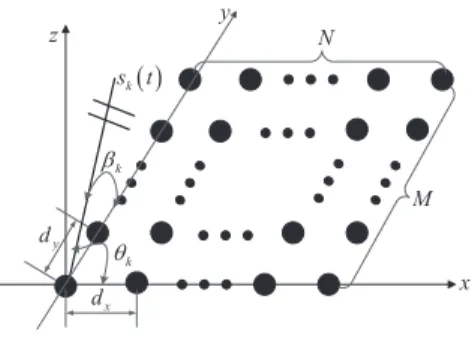
They impinge on to an URA ofM×N omnidirectional sensors spaced bydx
in each row and dy in each column, as shown in Fig.1.
The direction of the kth signal is denoted as (θk, βk), k = 1,2, . . . , K.
Thus, the output of the array at time t can be modeled as
x(t) = As(t) +n(t) (1)
where x(t) = [x1(t),· · ·, xN(t), xN+1(t),· · · , x2N(t),· · · , xM N(t)]T is
com-posed of theM N received array signals,A= [a(θ1, β1),a(θ2, β2),· · · ,a(θK, βK)]T
is the array manifold matrix,s(t) = [s1(t), s2(t),· · · , sK(t)]T is the source
sig-nal vector andn(t) = [n1(t),· · · , nN(t), nN+1(t),· · ·, n2N(t),· · · , nM N(t)]T is
the additive white Gaussian complex circular noise vector with its elements
being of zero mean and variance σ2. The steering vector a(θk, βk) is given
by
where
ay(βk) = [1, ϕy(βk),· · ·ϕyM−1(βk)]T (3)
ax(θk) = [1, ϕx(θk),· · ·ϕxN−1(θk)]T (4)
with
ϕy(βk) = exp{j2πλ−1dycos (βk)} (5)
ϕx(θk) = exp{j2πλ−1dxcos (θk)} (6)
As in [18], we decompose each of the circular sources into two uncorrelated
strictly non-circular sources with the same DOA. Without loss of generality,
let the first Kn elements in s(t) represent the strictly non-circular signals.
Thus, s(t) can be represented as
s(t)=
Ψ 0 0
0 IKc jIKc
sn(t)
sr c(t)
sq c(t)
=Ψ1˜s(t) (7)
whereΨ=diag(ejφ1, . . . , ejφKn) represents the rotation phases corresponding
to the strictly non-circular sources. Furthermore, Ψ1 is of sizeK ×K′ with
K′ =K
n+ 2Kc and the real-valuedK′×1 vector ˜s(t) contains the symbols
of the Kn strictly non-circular sources sn(t) as well as theKc real partssrc(t)
andKc imaginary partssqc(t) of the circular signalssc(t). The array manifold
matrix A can be rewritten as
A = [An Ac] (8)
where An and Ac denote the array manifold matrix related to strictly
in (1) can be expressed as
x(t) =AΨ1˜s(t) +n(t) = ˜A˜s(t) +n(t) (9)
where ˜A=AΨ1 denotes the modified array manifold matrix.
For notional convenience, the indices of θ, β and t will be omitted in the
following discussion while not causing confusion.
3. The Proposed Method
In order to take advantage of the strict circularity of the strictly
non-circular sources and the virtual strict non-non-circularity of the non-circular sources,
a new data vector is defined by stacking the original data and its conjugate
counterpart as ˜ x= x
ΥM Nx∗
=
˜ A˜s
ΥM NA˜
∗ ˜ s∗ + n
ΥM Nn∗
= ˘A˜s+ ˘n (10)
where ˘ A= ˜ A
ΥM NA˜
∗ =
AnΨ Ac
[
IKc jIKc
]
ΥM NA∗nΨ∗ ΥM NA∗c
[
IKc −jIKc
]
(11)
is the extended array manifold matrix of size 2M N ×K′,n˘ =
n
ΥM Nn∗
is the 2M N ×1 noise vector, and ˜s = ˜s∗. Then, the covariance matrix of ˜x
is given by
R=E[˜xx˜H] = ˘AR
sA˘ H
+σ2I2M N (12)
Remark 1: In practice, only a finite number of observed data is available.
Thus, R has to be estimatedby
ˆ
R≈ 1
L
L
∑
l=1
ˆ˜
x(l)ˆ˜xH(l). (13)
where L denotes the number of snapshots.
Since the mixed signals are not correlated with each other, we perform
eigenvalue decomposition (EVD) of R as follows
R=UsΛsUHs +UnΛnUHn (14)
where the 2M N ×K′ matrix U
s and the 2M N ×(2M N −K′) matrix Un
are the signal subspace and noise subspace, respectively. TheK′×K′ matrix
Λs = diag(λ1,λ2· · ·,λK′) and the (2M N −K′)×(2M N −K′) matrix Λn=
diag(λK′+1,λK′+2· · ·,λ2M N) are corresponding diagonal matrices. λ1 ≥λ2 ≥
· · · ≥ λK′ > λK′+1 = · · · = λ2M N =σ2 are eigenvalues of R. As ˘A and Us
span the same column space, there is a non-singular matrix T that satisfies
˘
A=UsT.
Define a new matrix Es as
Es=UsΛ
1 2
s, (15)
and four selection matrices as
J1a = [IN−1 0(N−1)×1] (16)
J1b = [0(N−1)×1 IN−1] (17)
J2a = [IM−1 0(M−1)×1] (18)
Then, the selection matrices of 1-D DOA θ of the mixed strictly
noncir-cular and cirnoncir-cular sources can be expressed as
J1 =blkdiag(J′1a,ΥM(N−1)J′1bΥM N) (20)
J2 =blkdiag(J′1b, ΥM(N−1)J′1aΥM N) (21)
where J′
1a=IM ⊗J1a and J′1b =IM ⊗J1b.
As for the selection matrices of 1-D DOA β, we have
J′1 =blkdiag(J′2a,ΥN(M−1)J′2bΥM N) (22)
J′2 =blkdiag(J′2b, ΥN(M−1)J′2aΥM N) (23)
where J′2a=J2a⊗IN and J′2b =J2b ⊗IN.
Next, we define two direction matrices related to θ and β as follows
Ωθ = (J1Es)+(J2Es) (24)
Ωβ = (J′1Es)+(J′2Es) (25)
It is noticed that in [22], the EVD of Ωθ and Ωβ is performed
indepen-dently as
Ωθ =UθΘθUHθ (26)
Ωβ =UβΘβUHβ (27)
where Uθ and Uβ are the K′ ×K′ unitary matrices, Θθ and Θβ are the
eigenvalue matrices that correspond to θ and β, respectively. It should be
pointed out that performing EVD of (26) and (27) separately, would lead to
the pairing problem between θ and β. Also, there are two identical
decomposed each circular source into two uncorrelated strictly non-circular
sources with the same DOA. This may cause rank-loss problem in (26) and
(27). Moreover, if the same θ orβ exists in the incoming mixed signals, the
eigenvalue spectrum in (26) and (27) may degenerate.
In order to solve the above three problems, we now apply the joint
diago-nalization method as used in blind signal separation [23] to the two direction
matrices Ωθ and Ωβ rather than perform EVD of Ωθ and Ωβ. Analogous to
[21], it can be easily deduced that
Ωθ = (J1Es)+(J2Es) = UΘθUH (28)
Ωβ = (J′1Es)+(J′2Es) = UΘβUH (29)
From (28) and (29), it can been seen that the requirement of joint
diag-onalization is satisfied according to Theorem 3 of [23]. By defining a set
Ω={Ωθ,Ωβ}, we know that there is a unitary matrix V that is essentially
equivalent to U, which minimizes the following nonnegative function
f(Ω,V) = ∑
i=θ,β
off(VHΩiV) (30)
where off(Mn×n) =
∑
1≤i̸=j≤n
|Mij|2, and matrix U is called a joint
diagonal-izer [23]. Since U is the eigenvector of both Ωθ and Ωβ, there is no need
for pairing betweenθ andβ since the one-to-one correspondence is preserved
on the diagonals between eigenvalue matrices Θθ and Θβ. The same joint
diagonalization procedure can be implemented by a series of Givens rotations
in [23, 24] to obtain the unitary matrixU. The key idea of joint
Jacobi-like algorithm with plane rotations, and the detailed pseudo code of
joint diagonalization procedure can be seen in [24].
Then we have eigenvalues of Ωθ and Ωβ computed as
ηθk =u H
kΩθuk (31)
ηβk =u H
kΩβuk (32)
whereuk (k= 1, . . . , K′) is thekth column ofU. From (31) and (32), it can
be easily obtained that
θk = arccos
(λarg(η
θk) 2πdx
)
(33)
βk= arccos
(λarg(η
βk) 2πdy
)
(34)
It should be noted that due to the decomposition of each circular source
into two strictly non-circular sources, we have obtained K′ angle estimates
for either θk or βk, while only K actual 2-D DOAs are present. Thus, we
need to correctly pair the two estimates obtained for each circular source in
a suitable manner. Actually, this can be easily done by finding the same
estimates for each θk orβk and then calculating the average of two identical
estimates for 2-D DOA θc,k and βc,k(k = 1, . . . , Kc) respectively as
θc,k= (θ1
c,k+θ2c,k)
2 (35)
βc,k = (β1
c,k+β2c,k)
2 (36)
Clearly, due to the automatically paired relationship between θk and βk,
all the circular sources have been separated provided that either θk or βk
Table 1: Summary of the proposed method.
Input: {xˆ˜(l)}L
l=1: L snapshots of the new constructed array output vector.
Output: ˆθk and ˆβk: pair-free 2-D estimated angles of K mixed signals.
Step 1 Estimate the covariance matrix ˆR≈ L1
L
∑
l=1
ˆ˜
x(l)ˆ˜xH(l).
Step 2 Perform subspace decomposition ˆR= ˆUsΛˆsUˆ
H
s + ˆUnΛˆnUˆ H n to
get ˆUs, and then compute ˆEs= ˆUsΛˆ
1 2
s.
Step 3 Construct two direction matrices ˆΩθ = (J1Eˆs)+(J2Eˆs) and
ˆ
Ωβ = (J′1Eˆs)+(J′2Eˆs).
Step 4 Implement the joint diagonalization to the set ˆΩ={Ωˆθ,Ωˆβ} to
obtain the unitary matrix ˆU by a series of Givens rotations.
Step 5 Compute the eigenvalues ˆηθk = ˆu
H
kΩˆθuˆk and ˆηβk = ˆu H kΩˆβuˆk
Step 6 Compute the 2-D DOAs as ˆθk= arccos
(λarg(ˆη
θk) 2πdx
) and ˆ
βk= arccos
(λarg(ˆη
βk) 2πdy
)
(k = 1, . . . , K′)
Step 7 Compute the 2-D DOAs of circular signals as ˆθc,k =
(ˆθ1
c,k+ˆθ2c,k) 2
and ˆβc,k = ( ˆβ1
c,k+ ˆβ2c,k)
estimation under the mixed circular and strictly noncircular sources is
sum-marized in Table 1.
Remark 2: Since the noncircularity information is used in the proposed
method, the equivalent number of degrees of freedom of the array is increased
compared to the method in [21]. The maximum number of identifiable targets
by the proposed method isKn+2Kc =min{2M(N −1),2N(M −1)}, while
that of the method in [21] must satisfyKn+Kc =min{M(N −1), N(M −1)}.
Therefore, our method can distinguish more signals than the method in [21],
when at least two strictly non-circular sources are present in the mixed
sig-nals.
Remark 3: The major part of the computational effort of the proposed
method includes the construction of ˆR, performing EVD of ˆR, and joint
diagonalization of the setΩ. To calculate ˆR, we needO((2M N)2L)complex
multiplications; the EVD operation of ˆR requires the amount of complex
multiplications of O((2M N)3)
; and jointly diagonalizing the set Ω (two
K′×K′ direction matrices), is ofO(
2(K′)3)
. Then, the total computational
complexity of the proposed method in terms of complex multiplications is
about O(
(2M N)2L+ (2M N)3+ 2(K′)3)
.
Remark 4: The proposed method is also applicable to the case where
all the incoming signals are noncircular signals (Case 4) since the uniqueness
of joint diagonalization is still satisfied for this case. The simulation results
in section IV will demonstrate the correctness of Case 4. And the 2-D angle
4. Theoretical error performance analysis
In this section, the theoretical error performance analysis of the proposed
method is conducted. The derivation in this paper is along the lines of
the first-order analysis done by Rao [25] and the backward error analysis
by Li [26]. To analyze the proposed subspace algorithm, it is important to
analyze the subspace perturbation. First, subspace decomposition can also
be performed using singular value decomposition (SVD) of ˜x as follows:
˜
x=( Us Un )
Σs 0
0 0
VH
s
VHn
(37)
Following the first-order approximation principles [25, 26] for eigenvalues
in (31) and (32), we have
δηθk ≈u H
kδΩθuk =uHk(J1Ux)+(δUx2−δUx1Ωθ)uk (38)
δηβk ≈u H
kδΩβuk=uHk(J
′
1Ux)+(δUx2 −δUx1Ωβ)uk (39)
where
Ux =UsΣs (40)
δUx =δUsΣs (41)
δUs =UnUHnnV˘ sΣ−
1
s (42)
According to (41) and (42), we obtain
δUx1 =J1δUx = (J1Un)UHnnV˘ s (43)
δUx2 =J2δUx = (J2Un)UHnnV˘ s (44)
δU′x1 =J
′
δU′
x2 =J′2δUx = (J′2Un)UHnnV˘ s (46)
Then, by substituting (43) and (44) into (38), (45) and (46) into (39),
(38) and (39) can be rewritten as
δηθk ≈u H
k(J1Ux)+(J2Un−ηθkJ1Un)U H
nnV˘ suk (47)
δηβk ≈u H k(J
′
1Ux)+(J′2Un−ηβkJ
′
1Un)UHnnV˘ suk (48)
Using the first-order Taylor series expansion [25, 26], the perturbation of
the kth (k= 1, . . . , K′) θ and β can be expressed as
δθk =νθkIm
( δηθk
ηθk
)
(49)
δβk=νβkIm
( δηβk
ηβk
)
(50)
where νθk=λ/(2πdxsinθk) and νβk=λ/(2πdysinβk). The error-variance of
the estimated 2-D DOAs are
var (δθk) =
1 2ν
2 θkvar
(
ξHθ
knϑ˘ k
ηθk
)
= ν
2 θkσ
2
2
ξθH
kξθkϑ H kϑk |ηθk|
2 (51)
var (δβk) =
1 2ν
2 βkvar
(
ξHβ
knϑ˘ k
ηβk
)
= ν
2 βkσ
2
2
ξHβ
kξβkϑ H kϑk |ηβk|
2 (52)
where
ξθH
k =u H
k(J1Ux)+(J2Un−ηθkJ1Un)U H
n (53)
ξβH
k =u H k(J
′
1Ux)+(J′2Un−ηβkJ
′
1Un)UHn (54)
ϑk =Vsuk (55)
For the kth (k = 1, . . . , Kc) circular signals, the variances of the two
estimated angles are given by
var (δθc,k) =
[
var(
δθc,k1
)
+ var(
δθc,k2
)]/
2 (57)
var (δβc,k) =
[
var(
δβc,k1 )+ var(
δβc,k2 )]/2 (58)
5. Cramer-Rao bound (CRB) analysis
In this section, we derive the closed-form expression of the deterministic
CRB of 2-D DOAs for the mixed signals scenario. With (8), the model in
(1) can be rewritten as
x=AnΨsn+Acsc +n (59)
The desired CRB matrix is usually computed by taking the inverse of the
Fisher information matrix (FIM)Ffor the interest parameterθ = [θn,1, θn,2, . . . ,
θn,Kn, θc,1, θc,2, . . . , θc,Kc] and β = [βn,1, βn,2, . . . , βn,Kn, βc,1, βc,2, . . . , βc,Kc]. F
can be written as
F=
Fθnθn Fθnθc Fθnβn Fθnβc
Fθcθn Fθcθc Fθcβn Fθcβc
Fβnθn Fβnθc Fβnβn Fβnβc
Fβcθn Fβcθc Fβcβn Fβcβc
(60)
Note that the (i, j)th element of Fθnθn [27, 28] is given by
F(θn,i, θn,j) = 2 Re{tr[( ˙Aθn,iΨsn)
Hγ−1( ˙A
θn,jΨsn)]}
= 2 Re{tr[( ˙AθnΨeie T
i sn)Hγ−1( ˙AθnΨeje T jsn)]}
= 2 Re[(eT
i Ψ HA˙H
θnγ
−1A˙
θnΨej)(e T
jsnsHnei)]
= 2LRe[(ΨHA˙H
θnγ
−1A˙
θnΨ)ij(R T snsn)ij]
Due toF=FT, we only need to calculate the upper triangular block matrices
of F. Similarly, we get the (i, j)th element of block matrix Fθnθc, Fθnβn,
Fθnβc,Fθcθc, Fθcβn, Fθcβc, Fβnβn,Fβnβc and Fβcβc respectively, as follows
F(θn,i, θc,j) = 2 Re{tr[( ˙Aθn,iΨsn)
Hγ−1( ˙A
θc,jsc)]}
= 2 Re{tr[( ˙AθnΨeie T
i sn)Hγ−1( ˙Aθceje T jsc)]}
= 2 Re[(eT
i Ψ HA˙H
θnγ
−1A˙
θcej)(e T
jscsHnei)]
= 2LRe[(ΨHA˙H
θnγ
−1A˙
θc)ij(R T scsn)ij]
(62)
F(θn,i, βn,j) = 2 Re{tr[( ˙Aθn,iΨsn) H
γ−1( ˙Aβn,jΨsn)]}
= 2 Re{tr[( ˙AθnΨeie T
isn)Hγ−1( ˙AβnΨeje T jsn)]}
= 2 Re[(eTi Ψ H ˙
AHθnγ
−1A˙
βnΨej)(e T
jsnsHnei)]
= 2LRe[(ΨHA˙Hθnγ
−1A˙
βnΨ)ij(R T snsn)ij]
(63)
F(θn,i, βc,j) = 2 Re{tr[( ˙Aθn,iΨsn)
Hγ−1( ˙A
βc,jsc)]}
= 2 Re{tr[( ˙AθnΨeie T
i sn)Hγ−1( ˙Aβceje T jsc)]}
= 2 Re[(eT
i ΨHA˙ H θnγ
−1A˙
βcej)(e T
jscsHnei)]
= 2LRe[(ΨHA˙ H
θnγ
−1A˙
βc)ij(R T scsn)ij]
(64)
F(θc,i, θc,j) = 2 Re{tr[( ˙Aθc,isc)
Hγ−1( ˙A
θc,jsc)]}
= 2 Re{tr[( ˙Aθceie T
i sc)Hγ−1( ˙Aθceje T jsc)]}
= 2 Re[(eT
i A˙ H θcγ
−1A˙
θcej)(e T
jscsHc ei)]
= 2LRe[( ˙AHθcγ−1A˙θc)ij(R T scsc)ij]
F(θc,i, βn,j) = 2 Re{tr[( ˙Aθc,isc)
Hγ−1( ˙A
βn,jΨsn)]}
= 2 Re{tr[( ˙Aθceie T
i sc)Hγ−1( ˙AβnΨeje T jsn)]}
= 2 Re[(eT
i A˙ H θcγ
−1A˙
βnΨej)(e T
jsnsHc ei)]
= 2LRe[( ˙AHθcγ−1A˙βnΨ)ij(R T snsc)ij]
(66)
F(θc,i, βc,j) = 2 Re{tr[( ˙Aθc,isc)
Hγ−1( ˙A
βc,jsc)]}
= 2 Re{tr[( ˙Aθceie T
i sc)Hγ−1( ˙Aβceje T jsc)]}
= 2 Re[(eTi A˙ H θcγ
−1A˙
βcej)(e T
jscsHc ei)]
= 2LRe[( ˙AHθcγ
−1A˙
βc)ij(R T scsc)ij]
(67)
F(βn,i, βn,j) = 2 Re{tr[( ˙Aβn,iΨsn) H
γ−1( ˙Aβn,jΨsn)]}
= 2 Re{tr[( ˙AβnΨeie T
i sn)Hγ−1( ˙AβnΨeje T jsn)]}
= 2 Re[(eTi Ψ H ˙
AHβnγ
−1A˙
βnΨej)(e T
jsnsHnei)]
= 2LRe[(ΨHA˙Hβnγ
−1A˙
βnΨ)ij(R T snsn)ij]
(68)
F(βn,i, βc,j) = 2 Re{tr[( ˙Aβn,iΨsn)
Hγ−1( ˙A
βc,jsc)]}
= 2 Re{tr[( ˙AβnΨeie T
i sn)Hγ−1( ˙Aβceje T jsc)]}
= 2 Re[(eT
i ΨHA˙ H βnγ
−1A˙
βcej)(e T
jscsHnei)]
= 2LRe[(ΨHA˙Hβnγ
−1A˙
βc)ij(R T scsn)ij]
(69)
F(βc,i, βc,j) = 2 Re{tr[( ˙Aβc,isc)
Hγ−1( ˙A
βc,jsc)]}
= 2 Re{tr[( ˙Aβceie T
i sc)Hγ−1( ˙Aβceje T jsc)]}
= 2 Re[(eT
i A˙ H βcγ
−1A˙
βcej)(e T
jscsHc ei)]
= 2LRe[( ˙AHβcγ
−1A˙
βc)ij(R T scsc)ij]
where ˙Aςn, ˙Aςc (ς =θ, β), Rsnsn, Rsnsc, Rscsn and Rscsc has the form of
˙
Aςn=
[ ∂A ∂ς1
,∂A ∂ς2
,..., ∂A ∂ςKn
]
(71)
˙ Aςc=
[ ∂A ∂ς1
,∂A ∂ς2
,..., ∂A ∂ςKc
]
(72)
Rsnsn =
1 Lsns
H
n (73)
Rsnsc =
1 Lsns
H
c (74)
Rscsn =
1 Lscs
H
n (75)
Rscsc =
1 Lscs
H
c (76)
for white noise, γ has the form of σ2IM N.
According to equations from (71) to (76), we obtain
Fθnθn = 2LRe[(ΨHA˙
H θnγ
−1A˙
θnΨ)⊗(R T
snsn)] (77)
Fθnθc = 2LRe[(ΨHA˙
H θnγ
−1A˙
θc)⊗(R T
scsn)] (78)
Fθnβn = 2LRe[(ΨHA˙
H θnγ
−1A˙
βnΨ)⊗(R T
snsn)] (79)
Fθnβc = 2LRe[(ΨHA˙
H θnγ
−1A˙
βc)⊗(R T
scsn)] (80)
Fθcθc = 2LRe[( ˙A
H θcγ
−1A˙
θc)⊗(R T
scsc)] (81)
Fθcβn = 2LRe[( ˙A
H θcγ
−1A˙
βnΨ)⊗(R T
snsc)] (82)
Fθcβc = 2LRe[( ˙A
H θcγ
−1A˙
βc)⊗(R T
scsc)] (83)
Fβnβn = 2LRe[(ΨHA˙
H βnγ
−1A˙
βnΨ)⊗(R T
snsn)] (84)
Fβnβc = 2LRe[(ΨHA˙
H βnγ
−1A˙
βc)⊗(R T
scsn)] (85)
Fβcβc = 2LRe[( ˙A
H βcγ
−1A˙
βc)⊗(R T
Then the CRB matrix Ccan be expressed as
C=F−1 (87)
and the individual CRBs of θ and β for the circular signals as well as the
strictly non-circular signals can easily be extracted from (87) as follows
CRBθi =Ci,i (88)
CRBβi =Ci+K,i+K (89)
where Ci,i (i= 1,2, . . . , K) denotes the (i, i)th element of C.
It should be pointed out that the above CRB analysis is also applicable
to the case where all the incoming signals are noncircular or circular signals.
6. Simulation results
In this section, five sets of simulations are performed to demonstrate the
performance of the proposed method. The first set of simulation is based
on a URA with M = 3 rows and N = 4 columns, while for the next three,
N = M = 5; and for the last one, the number of antennas varies. Both dx
and dy are half wavelength.
The mixed circular and strictly noncircular signals have an equal power.
The power of additive white Gaussian noise is σ2n. The signal-to-noise ratio
is defined as SNR = 10log10(σ2
s/σn2). The root mean squared error (RMSE)
as defined by RMSE = √
1 KMc
K
∑
k=1 Mc
∑
q=1
(ˆζqk−ζk) 2
is adopted for quantitative
evaluation, where Mc is the number of Monte Carlo simulations, K is the
number of signals, ζˆq,k is the estimate of the parameter (ˆθk or ˆβk) in the kth
βk. For comparison, the DOA estimation results obtained using the method
in [21], which does not exploit the noncircular information of the signals,
the theoretical error performance and CRB of the proposed method are also
provided. Note that we cannot compare with the method in [22], because
when the angle ambiguity problem emerges, the method in [22] fails to work.
6.1. 2-D DOA estimation
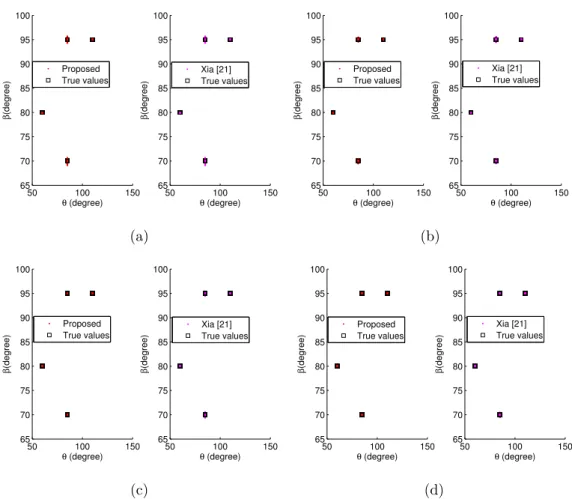
We consider four uncorrelated mixed BPSK and QPSK signals from
di-rections (60◦,80◦), (85◦,70◦), (85◦,95◦) and (110◦,95◦), respectively. Four
cases are studied corresponding to one, two and four BPSK signals. The
SNR is set at 10dB. The number of snapshots is 500, and Mc is 500. Fig.2
(a) to (d) displays the 2-D DOA scattergram of the circular and strictly
non-circular signals by both the proposed method and the method in [21], with
number of strictly noncircular signals increasing from one to four. It can be
seen that the proposed method outperforms the method in [21], especially
when the number of strictly noncircular signals increases. This is because the
noncircularity information is utilized in the proposed method which increases
the effective array aperture.
6.2. Performance versus SNR
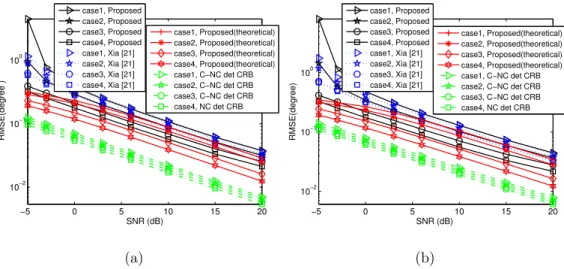
In this simulation, we study the performance with respect to a varying
S-NR ranging from -5dB to 20dB. Here we suppose four uncorrelated mixed
sig-nals are from directions (60◦,50◦), (70◦,50◦), (70◦,60◦) and (80◦,70◦). Three
cases are considered as before starting fromKn = 1 associated with (60◦,50◦)
up to Kn = 4 with all above signals. The number of snapshots is 800 and
50 100 150 65 70 75 80 85 90 95 100
θ (degree)
β
(degree)
50 100 150
65 70 75 80 85 90 95 100
θ (degree)
β (degree) Proposed True values Xia [21] True values (a)
50 100 150
65 70 75 80 85 90 95 100
θ (degree)
β
(degree)
50 100 150
65 70 75 80 85 90 95 100
θ (degree)
β (degree) Proposed True values Xia [21] True values (b)
50 100 150
65 70 75 80 85 90 95 100
θ (degree)
β
(degree)
50 100 150
65 70 75 80 85 90 95 100
θ (degree)
β (degree) Proposed True values Xia [21] True values (c)
50 100 150
65 70 75 80 85 90 95 100
θ (degree)
β
(degree)
50 100 150
65 70 75 80 85 90 95 100
θ (degree)
β (degree) Proposed True values Xia [21] True values (d)
Fig. 2: 2-D scattergram for mixed signals. (a) Case 1: one BPSK and three QPSK signals.
(b) Case 2: two BPSK and two QPSK signals. (c) Case 3: three BPSK and one QPSK
−5 0 5 10 15 20 10−2
10−1 100
SNR (dB)
RMSE(degree )
case1, Proposed case2, Proposed case3, Proposed case4, Proposed case1, Xia [21] case2, Xia [21] case3, Xia [21] case4, Xia [21]
case1, Proposed(theoretical) case2, Proposed(theoretical) case3, Proposed(theoretical) case4, Proposed(theoretical) case1, C−NC det CRB case2, C−NC det CRB case3, C−NC det CRB case4, NC det CRB
(a)
−5 0 5 10 15 20 10−2
10−1 100
SNR (dB)
RMSE(degree)
case1, Proposed case2, Proposed case3, Proposed case4, Proposed case1, Xia [21] case2, Xia [21] case3, Xia [21] case4, Xia [21]
case1, Proposed(theoretical) case2, Proposed(theoretical) case3, Proposed(theoretical) case4, Proposed(theoretical) case1, C−NC det CRB case2, C−NC det CRB case3, C−NC det CRB case4, NC det CRB
(b)
Fig. 3: RMSE of versus SNR with the number of snapshots to be 800. (a)θ. (b)β.
the proposed method for both angles are superior to that of the method in
[21] in all four cases. As before, the performance of the proposed method
im-proves consistently from case 1 to case 4, with more and more noncircularity
information available.
6.3. Performance versus snapshots
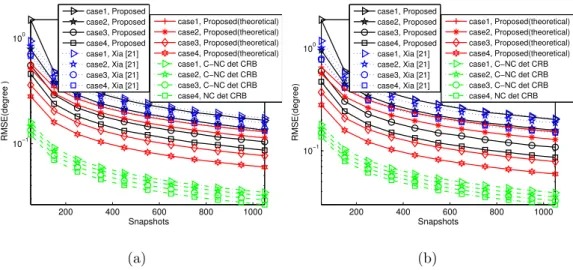
The performance of the proposed method is studied in this part with the
number of snapshots varying from 50 to 1050. The SNR is fixed at 5 dB
and the other parameters are the same as in Sec.6.2. Simulation results are
shown in Fig.4 (a) and (b), and we can draw similar conclusions as in Sec.6.2.
6.4. Performance versus angle separation
Now the performance of the proposed method is investigated with the
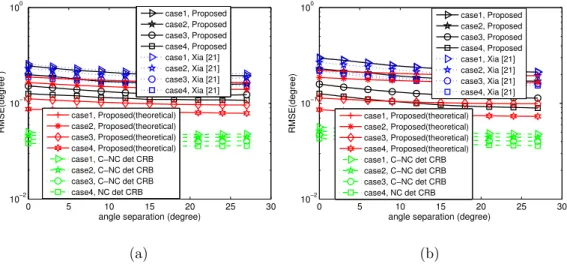
angle separation ∆ of 2-D DOAs varying from 0 to 27. The SNR is fixed at
5dB and the snapshot number is 500. Four uncorrelated signals arrive from
200 400 600 800 1000 10−1
100
Snapshots
RMSE(degree )
case1, Proposed case2, Proposed case3, Proposed case4, Proposed case1, Xia [21] case2, Xia [21] case3, Xia [21] case4, Xia [21]
case1, Proposed(theoretical) case2, Proposed(theoretical) case3, Proposed(theoretical) case4, Proposed(theoretical) case1, C−NC det CRB case2, C−NC det CRB case3, C−NC det CRB case4, NC det CRB
(a)
200 400 600 800 1000 10−1
100
Snapshots
RMSE(degree)
case1, Proposed case2, Proposed case3, Proposed case4, Proposed case1, Xia [21] case2, Xia [21] case3, Xia [21] case4, Xia [21]
case1, Proposed(theoretical) case2, Proposed(theoretical) case3, Proposed(theoretical) case4, Proposed(theoretical) case1, C−NC det CRB case2, C−NC det CRB case3, C−NC det CRB case4, NC det CRB
(b)
Fig. 4: RMSE of versus snapshots with SNR fixed at 5dB. (a)θ. (b)β.
and ((80 + ∆)◦,(70 + ∆)◦). We also consider four cases where one, two, three
and four BPSK signals are present. Naturally, as angle separation varies
from small to large, all methods perform well since the joint diagonalization
procedure can solve the angle ambiguity problem, as shown in Fig.5 (a) and
(b). Moreover, our proposed method again outperforms the method in [21]
for all four cases.
6.5. Performance versus number of rows (columns)
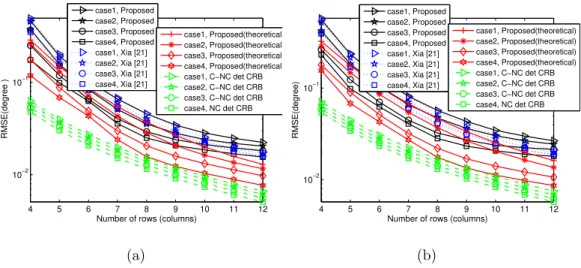
Now we study the effect of array size on the performance. M and N are
assigned the same value and vary from 4 to 12. The SNR is fixed at 5dB
and the number of snapshot is 800. Fig.6 (a) and (b) show the RMSE of
estimated angles obtained by the algorithm in [21] and the proposed one.
From case 1 to case 4, it can be seen that the superiority of our proposed
algorithm is more significant when the size of array is small such as when
the number of rows (columns) equals 4 or 5. When the size of array becomes
0 5 10 15 20 25 30 10−2
10−1 100
angle separation (degree)
RMSE(degree )
case1, Proposed case2, Proposed case3, Proposed case4, Proposed case1, Xia [21] case2, Xia [21] case3, Xia [21] case4, Xia [21]
case1, Proposed(theoretical) case2, Proposed(theoretical) case3, Proposed(theoretical) case4, Proposed(theoretical) case1, C−NC det CRB case2, C−NC det CRB case3, C−NC det CRB case4, NC det CRB
(a)
0 5 10 15 20 25 30
10−2 10−1 100
angle separation (degree)
RMSE(degree)
case1, Proposed case2, Proposed case3, Proposed case4, Proposed case1, Xia [21] case2, Xia [21] case3, Xia [21] case4, Xia [21]
case1, Proposed(theoretical) case2, Proposed(theoretical) case3, Proposed(theoretical) case4, Proposed(theoretical) case1, C−NC det CRB case2, C−NC det CRB case3, C−NC det CRB case4, NC det CRB
(b)
Fig. 5: RMSE of versus angle separation with SNR fixed at 5dB and the snapshot number
to be 500. (a)θ. (b)β.
[21]. This is because when the number of rows (columns) is increased, the size
of the new data vector ˜xbecomes larger, and the accuracy of the estimated
covariance matrix of ˜xwill be worse with given the number of snapshots. We
can improve this phenomenon by increasing the number of snapshots.
7. Conclusion
A 2-D DOA estimation method using the URA has been proposed for a
mixture of circular and strictly noncircular signals. Based on an
ESPRIT-like method, the estimated 2-D DOAs of the sources are paired automatically
by joint diagonalization of two direction matrices. The theoretical error
per-formance of the proposed method is analyzed and a closed-form expression
for the deterministic CRB of 2-D DOAs for the mixed signals scenario is
de-rived. Simulation results show that the performance of the proposed method
non-4 5 6 7 8 9 10 11 12 10−2
10−1
Number of rows (columns)
RMSE(degree )
case1, Proposed case2, Proposed case3, Proposed case4, Proposed case1, Xia [21] case2, Xia [21] case3, Xia [21] case4, Xia [21]
case1, Proposed(theoretical) case2, Proposed(theoretical) case3, Proposed(theoretical) case4, Proposed(theoretical) case1, C−NC det CRB case2, C−NC det CRB case3, C−NC det CRB case4, NC det CRB
(a)
4 5 6 7 8 9 10 11 12 10−2
10−1
Number of rows (columns)
RMSE(degree)
case1, Proposed case2, Proposed case3, Proposed case4, Proposed case1, Xia [21] case2, Xia [21] case3, Xia [21] case4, Xia [21]
case1, Proposed(theoretical) case2, Proposed(theoretical) case3, Proposed(theoretical) case4, Proposed(theoretical) case1, C−NC det CRB case2, C−NC det CRB case3, C−NC det CRB case4, NC det CRB
(b)
Fig. 6: RMSE of versus number of rows (columns) with SNR fixed at 5dB and the snapshot
number to be 800. (a) θ. (b)β.
circularity information of the impinging signals.
Acknowledgement
This work is supported by the National 863 Programs under Grant (No.
2015AA01A706) and China Scholarship Council (CSC).
[1] H. Krim, M. Viberg,“Two Decades of Array Signal Processing
Research-The Parametric Approach,” IEEE Signal Processing Magazine, vol. 13,
no. 4, pp. 67–94, 1996.
[2] A.B. Gershman, M. Rbsamen, M. Pesavento, “One-and two-dimensional
direction-of-arrival estimation: An overview of search-free techniques,”
Signal Processing, vol. 90, no. 5, pp. 1338–1349, 2010.
ar-rival for noncircular sources,” IEEE Transactions on Signal Processing,
vol. 54, no. 7, pp. 2678–2690, 2006.
[4] J. Liu, Z. Huang and Y. Zhou, “Extended 2q-MUSIC algorithm for
noncircular signals,” Signal Processing, vol. 88, no. 6, pp. 1327–1339,
2008.
[5] H. Abeida and J.-P. Delmas, “Statistical performance of MUSIC-like
al-gorithms in resolving noncircular sources,”IEEE Transactions on Signal
Processing, vol. 56, no. 9, pp. 4317–4329, 2008.
[6] S. B. Hassen, F. Belliliand, A. Samet and S. Affes, “DOA Estimation of
Temporally and Spatially Correlated Narrowband Noncircular Sources
in Spatially Correlated White Noise,”IEEE Transactions on Signal
Pro-cessing, vol. 59, no. 9, pp. 4108–4121, 2011.
[7] Y. Shi, X. Mao, M. Cao, and Y. Liu, “Deterministic maximum
likeli-hood method for direction-of-arrival estimation of strictly noncircular
signals,” in Acoustics, Speech and Signal Processing (ICASSP), 2016
IEEE International Conference on. IEEE, 2016, pp. 3061–3065.
[8] S. Cao, D. Xu, X. Xu and Z. Ye, “DOA estimation for noncircular
signals in the presence of mutual coupling,” Signal Processing, vol. 105,
pp. 12–16, 2014.
[9] J. Liu, Z. Huang, and Y. Zhou, “Azimuth and elevation estimation for
noncircular signals,” Electronics letters, vol. 43, no. 20, pp. 1117–1119,
[10] L. Gan, J.-F. Gu, and P. Wei, “Estimation of 2-D DOA for noncircular
sources using simultaneous svd technique,” IEEE Antennas and
Wire-less Propagation Letters, vol. 7, pp. 385–388, 2008.
[11] F. Roemer, and M. Haardt, “Multidimensional unitary Tensor-ESPRIT
for Non-Circular sources,” in Acoustics, Speech and Signal Processing
(ICASSP), 2009 IEEE International Conference on. IEEE, 2009, pp.
3577–3580.
[12] J. Steinwandt, F. Roemer, and M. Haardt, “Analytical performance
evaluation of multi-dimensional Tensor-ESPRIT-based algorithms for
strictly non-circular sources,” in Sensor Array and Multichannel Signal
Processing Workshop (SAM), 2016 IEEE International Conference on.
IEEE, 2016.
[13] Y. Shi, L. Huang, C. Qian, and H.C. So, “Direction-of-arrival
estima-tion for noncircular sources via structured least squares-based esprit
using three-axis crossed array,” IEEE Transactions on Aerospace and
Electronic, vol. 51, no. 2, pp. 1267–1278, 2015.
[14] J. Steinwandt, F. Roemer, M. Haardt, and G. Del Galdo,
“R-dimensional ESPRIT-type algorithms for strictly second-order
non-circular sources and their performance analysis,” IEEE Transactions
on Signal Processing, vol. 62, no. 18, pp. 4824–4838, 2014.
[15] J. Steinwandt, F. Roemer, M. Haardt, and G. Del Galdo, “Deterministic
anal-ysis of the achievable gains,” IEEE Transactions on Signal Processing,
vol. 64, no. 17, pp. 4417–4431, 2016.
[16] F. Gao, A. Nallanathan, and Y. Wang, “Improved music under the
co-existence of both circular and noncircular sources,” IEEE Transactions
on Signal Processing, vol. 56, no. 7, pp. 3033–3038, 2008.
[17] A. Liu, G. Liao, Q. Xu, and C. Zeng, “A circularity-based doa estimation
method under coexistence of noncircular and circular signals,” in
Acous-tics, Speech and Signal Processing (ICASSP), 2012 IEEE International
Conference on. IEEE, 2012, pp. 2561–2564.
[18] J. Steinwandt, F. Roemer, and M. Haardt, “ Esprit-type algorithms for a
received mixture of circular and strictly non-circular signals, ” in
Acous-tics, Speech and Signal Processing (ICASSP), 2015 IEEE International
Conference on. IEEE, 2015, pp. 2809-2813.
[19] Z.-M. Liu, Z.-T. Huang, Y.-Y. Zhou, and J. Liu, “Direction-of-arrival
es-timation of noncircular signals via sparse representation,” IEEE
Trans-actions on Aerospace and Electronic Systems, vol. 48, no. 3, pp. 2690–
2698, 2012.
[20] H. Chen, C.-P. Hou, W. Liu, W.-P. Zhu and M.N.S. Swamy, “Efficient
Two-Dimensional Direction of Arrival Estimation for a Mixture of
Cir-cular and NoncirCir-cular Sources,” IEEE Sensors Journal, vol. 16, no. 8,
pp. 2527–2536, 2016.
[21] T.Q. Xia, “ Joint diagonalization based DOD and DOA estimation for
[22] X. Yang, G. Zheng and J. Tang, “ESPRIT algorithm for coexistence of
circular and noncircular signals in bistatic MIMO radar” inIEEE Radar
Conference (RadarConf ), IEEE, 2016, pp. 1-4.
[23] A. Belouchrani, K. Abed-Meraim, J.F. Cardoso, and E. Moulines, “ A
blind source separation technique using second-order statistics” IEEE
Transactions on Signal Processing, vol. 45, no. 2, pp. 434–444, 1997.
[24] Y. Y. Dong, C. X. Dong, Y. T. Zhu, G. Q. Zhao,and S. Y. Liu, “
Two-dimensional DOA estimation for L-shaped array with nested subarrays without pair matching” IET Signal Processing, vol. 10, no. 9, pp. 1112–
1117, 2016.
[25] B. D. Rao and K. V. S. Hari, “Performance analysis of ESPRIT and
TAM in determining the direction of arrival of plane waves in noise,”
IEEE Transactions on acoustics, speech, and signal processing, vol. 37,
no. 12, pp. 1990–1995, 1989.
[26] F. Li, R. J. Vaccaro, and D. W. Tufts, “ Performance analysis of the
state-space realization (TAM) and ESPRIT algorithms for DOA
esti-mation,” IEEE Transactions on Antennas Propagation, vol. 39, no. 3,
pp. 418–423, 1991.
[27] M. Jin, G. Liao and J. Li, “ Joint DOD and DOA estimation for bistatic
MIMO radar,” Signal Processing, vol. 89, no. 2, pp. 244–251, 2009.
[28] Stoica P., Moses R.L., Spectral Analysis of Signals. Prentice-Hall, NJ,