This is a repository copy of
Genetically Validated Drug Targets in Leishmania: Current
Knowledge and Future Prospects
.
White Rose Research Online URL for this paper:
http://eprints.whiterose.ac.uk/129477/
Version: Published Version
Article:
Jones, Nathaniel, Catta Preta, Carolina, Lima, Ana Paula C.A. et al. (1 more author)
(2018) Genetically Validated Drug Targets in Leishmania: Current Knowledge and Future
Prospects. ACS Infectious Diseases. pp. 467-477. ISSN 2373-8227
https://doi.org/10.1021/acsinfecdis.7b00244
[email protected] https://eprints.whiterose.ac.uk/ Reuse
This article is distributed under the terms of the Creative Commons Attribution (CC BY) licence. This licence allows you to distribute, remix, tweak, and build upon the work, even commercially, as long as you credit the authors for the original work. More information and the full terms of the licence here:
https://creativecommons.org/licenses/
Takedown
If you consider content in White Rose Research Online to be in breach of UK law, please notify us by
Genetically Validated Drug Targets in
Leishmania
: Current
Knowledge and Future Prospects
Nathaniel G. Jones,
†Carolina M. C. Catta-Preta,
†Ana Paula C. A. Lima,
‡and Jeremy C. Mottram
*
,††
Centre for Immunology and Infection, Department of Biology, University of York, Wentworth Way, Heslington, York YO10 5DD, U.K.
‡
Instituto de Biofisica Carlos Chagas Filho, Centro de Ciências da Saúde, Universidade Federal do Rio de Janeiro, Cidade Universitaria, Rio de Janeiro, RJ 21941-902, Braziĺ
*
S Supporting InformationABSTRACT: There has been a very limited number of high-throughput screening campaigns carried out withLeishmania drug targets. In part, this is due to the small number of suitable target genes that have been shown by genetic or chemical methods to be essential for the parasite. In this perspective, we discuss the state of genetic target validation in thefield ofLeishmaniaresearch and review the 200 Leishmaniagenes and 36Trypanosoma cruzi
genes for which gene deletion attempts have been made since the first published case in 1990. We define a quality score for the dif-ferent genetic deletion techniques that can be used to identify potential drug targets. We also discuss how the advances in genome-scale gene disruption techniques have been used to assist target-based and phenotypic-target-based drug development in other parasitic protozoa and why Leishmania has lacked a similar approach so
far. The prospects for this scale of work are considered in the context of the application of CRISPR/Cas9 gene editing as a useful tool in Leishmania.
KEYWORDS: Leishmania, gene knockouts, null, CRISPR/Cas9, target validation, pathogen, Trypanosoma cruzi, drug discovery
L
eishmaniasis is a disease that mainly affects those burdened by extreme poverty, across large swaths of the tropics and subtropics. It consists of a spectrum of human and animal dis-eases caused by at least 20 species of parasites in the genusLeishmania. The symptoms range from self-limiting ulcers to the destruction of mucocutaneous surfaces to fatal disease caused by visceral leishmaniasis; dermal sequelae can also occur following the cure of primary visceral disease. There are up to 1.2 million cases of cutaneous leishmaniasis and up to 0.4 million cases of visceral leishmaniasis each year, resulting in up to 30 000 deaths.1 Collectively, 350 million people live at risk of catching leish-maniasis due to the wide geographic range of the vector insects, phlebotomine sandflies. There are medicines available to treat these diseases, but they have notable deficiencies due to emerging resistance, poor safety profiles, and the long duration of treat-ment, so more effective treatments with improved safety and dosing profiles are desirable. The complex picture of a spectrum of diseases, in several organs, caused by different parasite spe-cies with differing biology means that several new medicines may be required to satisfy quite stringent target product profiles (TPPs) for visceral and cutaneous leishmaniasis.2,3New chem-ical entities will probably require different chemical features for achieving the desired bioavailability in skin versus viscera cou-pled with the challenge of drugging an intracellular parasite that resides in a phagolysosomal compartment. There is growing
appreciation thatLeishmaniainfections can also form quiescent, persistent forms.4Targeting these stages is desirable, though it may also prove challenging. There are a number of ongoing drug discovery programs that aim to address this need, typically working within defined phenotypic or target-based screening strategies to best achieve success.2,3,5−8 Phenotypic or whole
organism screening selects for compounds that cause a loss of parasitefitness, whereas the target-based approach involves screen-ing against a selected target of interest thought to be essential to parasite survival. We will assess these approaches and the role that genetic target validation can play within them.
■
TARGET VALIDATION IN DRUG DISCOVERY PROGRAMSDrug target validation for antiparasitic compounds consists of acquiring the evidence that defines whether a target molecule (usually a protein/enzyme) is selectively inhibited by a chem-ical entity leading to the death of the parasite as well as the link-age of the target molecule to an essential parasite process. The evidence used to validate targets can arise from genetic
Special Issue: Drug Discovery for Global Health
Received: November 22, 2017
Published: January 31, 2018
Perspective
pubs.acs.org/journal/aidcbc
Cite This:ACS Infect. Dis.XXXX, XXX, XXX−XXX
© XXXX American Chemical Society A DOI:10.1021/acsinfecdis.7b00244
ACS Infect. Dis.XXXX, XXX, XXX−XXX License, which permits unrestricted use, distribution and reproduction in any medium,
manipulations of a pathogen or from the interrogation of the organism with specific chemical probes. The strength of valida-tion will depend on how much evidence is accrued, and well-validated targets will be supported by both genetic and chem-ical evidence.5,9For noninfectious diseases, it is estimated that
selecting genetically supported targets doubles the success rate in later stages of clinical development,10highlighting the impor-tance of genetic validation. The best validation of all comes when the molecular target for a compound is known and the compound is available on the market for clinical use, the one example for trypanosomatids being the treatment of human African trypano-somiasis with Eflornithine (difluoromethylornithine, DFMO), a compound that inhibits ornithine decarboxylase.11It is notable that for most antileishmanial drugs (miltefosine, paromomycin, antimonials, and pentamidine) there are no target proteins iden-tified despite extensive research, although amphotericin B is reported to specifically target ergosterol-containing membranes.12,13 Phenotypic Screening. For Leishmania, several hit compounds have been identified by phenotypic-based drug dis-covery, which involves screening druglike molecules against
Leishmania axenic amastigotes or amastigotes in macrophages to identify compounds that kill the parasites. This approach has the advantage in that it can identify bioactive compounds that have appropriate cell permeability characteristics to kill the par-asite within the parasitophorous vacuole. One disadvantage is that the screening is very stringent; consequently, few bioactive compounds are identified.5 Another disadvantage is that one does not immediately know the molecule being targeted by the bioactive compounds. If a large (>1 million compounds) screen is performed, then it may conceivably identify diverse target-class inhibitors whereas sublibraries can be used to increase the chances of hits within a certain target class, for example, by using a protein kinase inhibitor-focused library.14The optimization of
hit compounds by medicinal chemistry involves a level of ran-domness in which it may not be immediately apparent which functional groups of the molecule are the important pharmaco-phores. Structural activity analyses are performed in whole cell assays, and it is not possible to know if increases in activity against parasites are concurrent with activity against a specific target. Therefore, a campaign of target deconvolution is often initiated to identify the molecular target of a hit compound. This can involve a combination of forward genetic screens such as the generation of resistant parasites and the identification of mutant alleles in the target gene by whole genome sequencing;15affi n-ity purification of the target using a compound conjugated to beads;16 and the use of overexpression libraries17,18 or metab-olomics to identify blocks in biochemical pathways.19It is also important to have an understanding of an experimental com-pound’s mode of action as this can enable an assessment of the likelihood of resistance mechanisms evolving in the parasite. Recent successful examples of the phenotypic screening of large compound libraries or focused subset chemical libraries against
Leishmania parasites include the identification of the “ Leish-Box” of inhibitors by GSK,20 the identification of a selective proteasome inhibitor (GNF6702) by Novartis,15and the iden-tification of natural product inhibitors.21
Target-Based Drug Discovery.The alternative strategy of target-based drug discovery is used extensively by the phar-maceutical industry and has been applied to Leishmania; this consists of the selection of a protein target and the develop-ment of a biochemical or biophysical assay that can be used to identify inhibitors of that target, followed by a high-throughput screening (HTS) campaign. Hit compounds from such screens
are validated and then chemically optimized into lead compounds that have improved properties in terms of potency, selectivity, and bioavailability. This is a resource-intensive and costly pro-cess and needs to be built on a solid understanding of why the selected target is an appropriate choice, a process defined as target assessment. Drug targets are evaluated on the basis of gene essentiality in addition to other criteria, for example, the presence of close homologues in the parasite genome that may allow for an easier evolution of resistance through functional redundancy. Alternatively, single-point mutations in a gene may lead to drug resistance with little associated cost to parasite fitness. These examples emphasize the importance of a good understanding of parasite genetics for drug target prioritization. Other parameters for target assessment include the potential druggability of the protein, the availability of in vitro assays, the availability of struc-tural information, and the presence of strucstruc-turally similar proteins in the host proteome that may present a potential risk for host toxicity. The assessment of a target against each of these criteria can be scored, generating a“traffic lights”rating: red ratings will typically stop a target from progression, but those scoring green should progress more easily through development.22The level of rigor in building a strong evidence base to support target-focused approaches means that many targets are shown to be invalid. For these reasons as well as due to the limitation of financial and material resources, there have been notably few HTS campaigns against Leishmania proteins, namely, CRK3 (cyclin-dependent kinase),23NMT (N-myristoyltransferase),24 and PTR1 (pteridine reductase).25Casein kinase (LmCK1.2) has also been the subject of an HTS campaign14after being chemically validated as a target.26,27
Drug Repurposing and Piggybacking. Alternatives to developing or identifying new chemical entities to target
Leishmania exist in the form of drug repurposing, a strategy where a compound that has been developed to treat one dis-ease is used to treat another, different disease. The benefit of drug repurposing is that the treatment can be used in patients relatively quickly and with lower cost compared to de novo drug discovery. Notable examples for leishmaniasis include the use of miltefosine, amphotericin B, and pentamidine, which were all designed or approved for other indications.6Piggybacking is the concept of identifying existing pharmaceutical material, investment, and knowl-edge around a given target or inhibitor class and applying it to infectious disease targets, but this usually stops short of direct drug repurposing.
■
GENETIC TARGET VALIDATION IN LEISHMANIALeishmaniahas some biological features that have made it some-what difficult to genetically manipulate; it is highly prone to aneuploidy, meaning that genetic modification of essential genes can be challenging or unstable.28−30RNA interference does not
function in mostLeishmaniaspecies.31In those species where RNAi does function, it has not been exploited to the same extent asTrypanosoma brucei, primarily due to the lack of an inducible system to investigate the function of essential genes.Leishmania
parasites are easily cultured and genetically manipulated as promastigote stages, those found in the insect vector, but these are not the relevant stage for human disease. It is therefore very important to confirm the essentiality of a potential target using the amastigote stages of the parasite lifecycle. Some species of
Leishmania, such asL. mexicana, are readily converted to axenic amastigotes in vitro32and this can facilitate the study of gene function in the pathogenic stages, but phenotypic analysis is perhaps best carried out using macrophages to perform
DOI:10.1021/acsinfecdis.7b00244
ACS Infect. Dis.XXXX, XXX, XXX−XXX
intracellular amastigote growth and survival assays and/or mouse infections. Amastigotes can be genetically manipulated, but this is not a common practice.33Typically, an in vivo model is used to demonstrate a fitness or virulence defect of a genetically engineered mutant.
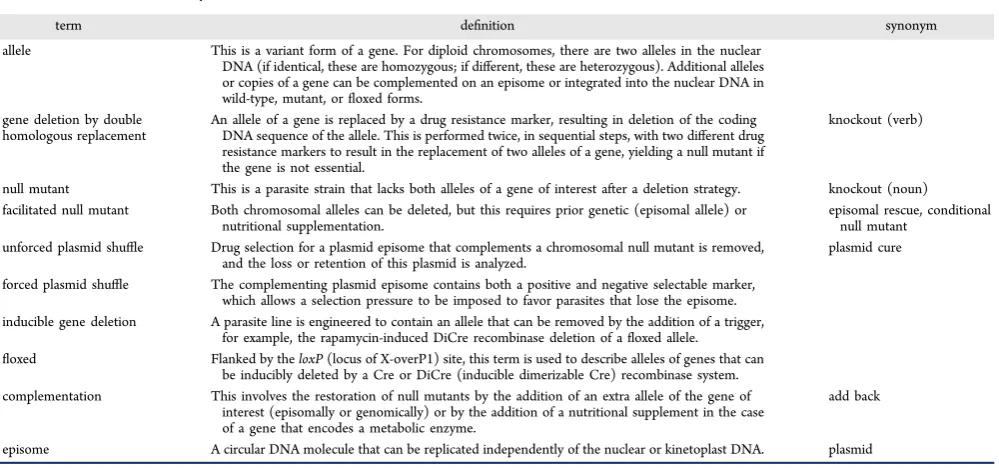
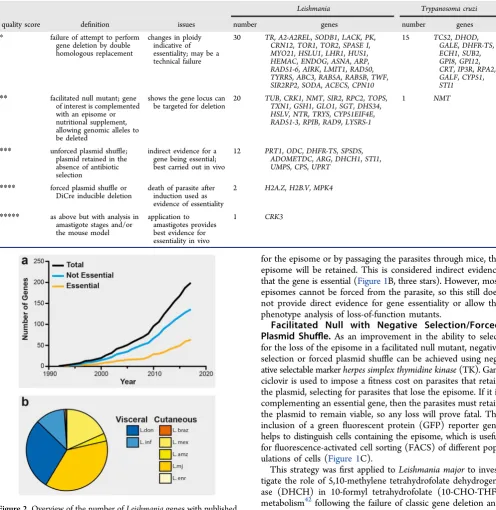
Leishmania possess a very efficient homologous recombina-tion pathway for DNA repair that has been exploited as a basis for generating gene deletions, integrating epitope tags, or expressing transgenes.34 (See Table 1for a definition of terms.) As the technology to manipulateLeishmaniahas improved over time, so has the ability to achieve more confidence in a gene’s essen-tiality. On the basis of the literature, we used a scoring system for the strength of validation resulting from gene deletion stud-ies, on a 1−5-star scale (Table 1andFigure 1), and we discuss these below, with examples. We propose that the higher scoring methods provide better-quality evidence of a gene’s essentiality but acknowledge that they are also associated with increased time and effort to generate the mutants. Despite this, we hope to use this guide to inform good practices for Leishmania genetic manipulation.
■
APPROACHES TO THE GENETIC MANIPULATIONOFLEISHMANIA
Deletion by Double Homologous Replacement and Facilitated Null Mutants.In 1990, it was demonstrated that genes could be deleted fromLeishmaniapromastigotes by homol-ogous replacement with linear dsDNA.35The authors demon-strated proof of concept, which involved deleting a single allele ofDHFR-TSin wild-typeL. major. This was then repeated in a strain that was already identified as heterozygous forDHFR-TS, which permitted the deletion of the remaining allele using a homologyflanked neomycin resistance cassette. The generation of aDHFR-TSnull mutant led to thymidine auxotrophy and could only be achieved in the presence of thymidine nutritional sup-plementation; removal of thymidine supplementation stalled cell growth, demonstrating thatDHFR-TSwas essential for par-asite survival. The complementation of the null mutant with an episome expressingDHFR-TSrestored wild-type growth levels, indicating that the function of this gene could be reconstituted genetically as well as chemically. This set the stage for
other researchers to begin performing reverse genetic analyses in Leishmania. The development of new resistance markers allowed for gene deletions of two alleles of a gene,36given that
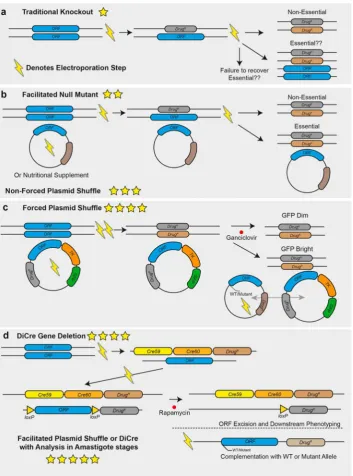
Leishmaniawas considered at the time to have a diploid genome that allowed for the generation of null mutants from wild-type backgrounds. In the following years, a number of papers dem-onstrated that upon deletion of both alleles of a suspected essen-tial gene the system would fail. Either no transfectants would survive the drug selections, parasites would survive but had dupli-cated their genome to retain the gene of interest as well as the drug resistance markers,36or there were extra copies of the gene remaining on supernumerary chromosomes or ectopic elements (Figure 1A). At the time, this was considered evidence for gene essentiality, but with the inability to perform any further, this is classified as the weakest form of evidence (one star) as the fail-ure to generate a null mutant may result from a simple technical failure. For example, as the technology for performing electro-poration became more sophisticated, transfection efficiencies increased, allowing some previously intractable genes to be revealed as nonessential. The Metacaspase gene,MCA, initially could not be deleted from L. major,37 and overexpression caused a growth defect, which was interpreted to mean that the gene played an essential role in cellular proliferation. However,MCAnull mutants could be generated in bothL. major38andL. mexicana39using a newer high-efficiency electroporation system that causes mini-mal cellular damage. Generating this deletion allowed for the characterization of the role of MCA in amastigotes and mice where the null mutant exhibited an increase in virulence.39
[image:4.625.67.567.78.312.2]Several studies have performed deletions that resulted in par-asites auxotrophic for a given metabolite and required chem-ical supplementation to allow null mutants to be recovered35,40 (Table S1). The advantage of a chemical complementation is that it allows for rapid withdrawal and the resulting phenotype was investigated. Where nutritional supplementation could not be used to facilitate the deletion of essential genes, researchers began to introduce an episomal copy of the gene of interest into the par-asite prior to the deletion of the two chromosomal alleles41 (Figure 1B). This approach increases the confidence in the val-idation as it demonstrates that the failure to delete both alleles of the gene of interest is not a technical failure or due to
Table 1. Definitions of Key Terms
term definition synonym
allele This is a variant form of a gene. For diploid chromosomes, there are two alleles in the nuclear DNA (if identical, these are homozygous; if different, these are heterozygous). Additional alleles
or copies of a gene can be complemented on an episome or integrated into the nuclear DNA in wild-type, mutant, orfloxed forms.
gene deletion by double
homologous replacement An allele of a gene is replaced by a drug resistance marker, resulting in deletion of the codingDNA sequence of the allele. This is performed twice, in sequential steps, with two different drug
resistance markers to result in the replacement of two alleles of a gene, yielding a null mutant if the gene is not essential.
knockout (verb) null mutant This is a parasite strain that lacks both alleles of a gene of interest after a deletion strategy. knockout (noun) facilitated null mutant Both chromosomal alleles can be deleted, but this requires prior genetic (episomal allele) or
nutritional supplementation. episomal rescue, conditionalnull mutant unforced plasmid shuffle Drug selection for a plasmid episome that complements a chromosomal null mutant is removed,
and the loss or retention of this plasmid is analyzed. plasmid cure forced plasmid shuffle The complementing plasmid episome contains both a positive and negative selectable marker,
which allows a selection pressure to be imposed to favor parasites that lose the episome. inducible gene deletion A parasite line is engineered to contain an allele that can be removed by the addition of a trigger,
for example, the rapamycin-induced DiCre recombinase deletion of afloxed allele. floxed Flanked by theloxP(locus of X-overP1) site, this term is used to describe alleles of genes that can
be inducibly deleted by a Cre or DiCre (inducible dimerizable Cre) recombinase system. complementation This involves the restoration of null mutants by the addition of an extra allele of the gene of
interest (episomally or genomically) or by the addition of a nutritional supplement in the case of a gene that encodes a metabolic enzyme.
add back episome A circular DNA molecule that can be replicated independently of the nuclear or kinetoplast DNA. plasmid
DOI:10.1021/acsinfecdis.7b00244
ACS Infect. Dis.XXXX, XXX, XXX−XXX
the locus being refractory to genetic manipulation (Figure 2B, two stars).
[image:5.625.137.491.66.543.2]An episome expressing a gene in a null mutant background will be retained if it confers a selective advantage for growth, Figure 1.Overview of techniques that can be used for genetic target validation inLeishmania.(a) Gene deletion by homologous replacement. Drug resistance markers are targeted to the gene of interest by long homologyflanks (0.5−1 kb) in sequential transfections by electroporation. This process can now be facilitated using CRISPR/Cas9 and short homologyflanked cassettes in a single transfection. Deletions targeting essential genes will result in cell death and failure to isolate null mutants or in ploidy changes that allow the cell to retain alleles of the wild-type locus as well as drug resistance markers. (b) Facilitated null mutant with unforced plasmid shuffle. An episome expressing the gene of interest isfirst transfected into the cell line or a nutritional supplement is provided, allowing it to survive the subsequent deletion of the chromosomal alleles of the gene of interest. The drug selection pressure for the episome can be removed and retention of the plasmid can be determined if the gene is not essential; then it will be possible to isolate parasites that lack the episome. (c) Forced plasmid shuffle. As in B, an episome expressing the gene of interest is transfected into the parasite to allow the deletion of the chromosomal alleles of the target gene. The episome also encodes a negative-selectable marker, herpes simplex virus thymidine kinase. Selection with ganciclovir favors the survival of parasites that lack the episome, so if a gene is nonessential, the episome will rapidly be lost from the population but will be retained for an essential gene despite the associated costs. The addition of a second episome containing mutant versions of the gene of interest allows for exploration of the roles of specific domains and residues in the encoded protein for correct gene function by assessing which plasmid of the two is preferentially retained. (d) DiCre inducible gene deletion. One allele of the target gene is replaced by a drug-selectable cassette containing a“floxed”allele, and in a second transfection stage, the remaining allele is replaced by a second drug resistance marker. The addition of rapamycin induces DiCre dimerization and excision of thefloxed allele, and the phenotypes that emerge in the induced null mutants can then be analyzed. As in C, complementation allows for the assessment of null mutant specificity and functional assessment of defined domains or residues in the protein. In all panels, the number of stars indicate the quality of the genetic evidence for gene essentiality, with one star being the weakest andfive stars being the strongest.
DOI:10.1021/acsinfecdis.7b00244
ACS Infect. Dis.XXXX, XXX, XXX−XXX
even if the gene is dispensable for parasite viability. In a facilitated null mutant of a nonessential gene, the episome can be lost in the absence of drug selection, and a null mutant is generated. For essential genes, even after prolonged culturing of the facilitated null mutant in a medium that lacks drug selection
for the episome or by passaging the parasites through mice, the episome will be retained. This is considered indirect evidence that the gene is essential (Figure 1B, three stars). However, most episomes cannot be forced from the parasite, so this still does not provide direct evidence for gene essentiality or allow the phenotype analysis of loss-of-function mutants.
Facilitated Null with Negative Selection/Forced Plasmid Shuffle. As an improvement in the ability to select for the loss of the episome in a facilitated null mutant, negative selection or forced plasmid shuffle can be achieved using neg-ative selectable markerherpes simplex thymidine kinase(TK). Gan-ciclovir is used to impose afitness cost on parasites that retain the plasmid, selecting for parasites that lose the episome. If it is complementing an essential gene, then the parasites must retain the plasmid to remain viable, so any loss will prove fatal. The inclusion of a greenfluorescent protein (GFP) reporter gene helps to distinguish cells containing the episome, which is useful forfluorescence-activated cell sorting (FACS) of different pop-ulations of cells (Figure 1C).
This strategy wasfirst applied toLeishmania majorto inves-tigate the role of 5,10-methylene tetrahydrofolate dehydrogen-ase (DHCH) in 10-formyl tetrahydrofolate (10-CHO-THF) metabolism42following the failure of classic gene deletion and nutritional supplementation strategies. DHCH1was expressed from an episome (also containing TK and GFP), allowing a facil-itated null mutant to be generated. The episome was selected against using ganciclovir, and parasites were then flow sorted into GFP bright or dim populations and cloned into 96-well plates. The dim clones, lacking the DHCH1 episome, were not viable and failed to grow. This system has also been used to examine the essentiality of MAP kinase 4 (MPK4) inL. major
[image:6.625.63.560.87.598.2]promastigotes in a manner allowing more detailed functional genetic analysis.43A facilitated null mutant was achieved by epi-somal complementation, followed by forced plasmid shuffle to assess gene essentiality. After ascertaining thatMPK4was essen-tial for promastigote viability, the authors complemented with a panel of secondary episomes (lacking TK) containing functionally mutated versions ofMPK4. This allowed for exploration of the
Table 2. Scoring System to Assess the Quality of Evidence for Target Essentiality by Gene Deletion Techniques
Leishmania Trypanosoma cruzi
quality score definition issues number genes number genes
* failure of attempt to perform gene deletion by double homologous replacement
changes in ploidy indicative of essentiality; may be a technical failure
30 TR,A2-A2REL,SODB1,LACK, PK,
CRN12,TOR1,TOR2,SPASE I,
MYO21,HSLU1,LHR1,HUS1,
HEMAC,ENDOG,ASNA,ARP,
RAD51-6,AIRK,LMIT1,RAD50,
TYRRS,ABC3,RAB5A,RAB5B,TWF,
SIR2RP2,SODA,ACECS,CPN10
15 TC52,DHOD,
GALE,DHFR-TS,
ECH1,SUB2,
GPI8,GPI12,
CRT,IP3R,RPA2,
GALF,CYP51,
STI1
** facilitated null mutant; gene of interest is complemented with an episome or nutritional supplement, allowing genomic alleles to be deleted
shows the gene locus can
be targeted for deletion 20 TUBTXN1,CRK1,GSH1,NMT,GLO1,SIR2,SGT,RPC2,DHS34,TOPS, ,
HSLV, NTR,TRYS,CYP51EIF4E,
RAD51-3,RPIB,RAD9,LYSRS-1
1 NMT
*** unforced plasmid shuffle;
plasmid retained in the absence of antibiotic selection
indirect evidence for a gene being essential; best carried out in vivo
12 PRT1,ODC,DHFR-TS,SPSDS,
ADOMETDC,ARG,DHCH1,STI1,
UMPS,CPS,UPRT
**** forced plasmid shuffle or
DiCre inducible deletion death of parasite afterinduction used as evidence of essentiality
2 H2A.Z,H2B.V,MPK4
***** as above but with analysis in amastigote stages and/or the mouse model
application to amastigotes provides best evidence for essentiality in vivo
[image:6.625.59.292.109.583.2]1 CRK3
Figure 2.Overview of the number ofLeishmaniagenes with published attempts at the creation of a null mutant. (a) Line graph depicting the cumulative number of genes for which attempts have been made to generate null mutants, for human infectiveLeishmania species. Only the first attempt at a gene deletion for each individual gene was recorded. Data from this study were ordered by year, and cumulative values of publications per year were derived, where the total number of attempted gene deletions is shown as well as the number of essential genes identified. (b) Pie chart showing the proportion of unique gene deletion attempts by species of Leishmania. Cutaneous species are shaded in yellows, and visceral species, in blues.
DOI:10.1021/acsinfecdis.7b00244
ACS Infect. Dis.XXXX, XXX, XXX−XXX
importance of protein motifs and residues forMPK4ATP bind-ing, activity, and activation by upstream MKKs. This study highlighted the power of plasmid shuffle in that anMPK4mutant with altered ATP binding properties, predicted to have reduced protein kinase activity, could replace wild-typeMPK4, resulting in resistance to acidic stress. The results from this study support previous facilitated null and unforced plasmid shuffle data sug-gesting thatMPK4fromL. mexicana44is essential to the mam-malian infection cycle. Profiling of null mutant phenotypes in the amastigote stage is critical to the validation of drug targets, so the compatibility of the plasmid shuffle with this is welcome. However, a limitation of the plasmid shuffle approach is that null mutants of essential genes are never generated in the absence of ganciclovir (which acts as a cytostatic but not a cytocidal drug), so direct analysis of the null mutant phenotypes is not possible. In reference to the suitability ofMPK4as a drug target, it has so far been impossible to identify a biochemical assay for the screen-ing of small-molecule inhibitors, mainly due to its lack of pro-tein kinase activity against generic substrates.43Currently, this lack of an enzymatic activity assay rendersMPK4a genetically well-validated but poorly tractable target for drug discovery programs.
DiCre Inducible Deletion.In order to directly measure the loss of gene function, a population of cells would ideally be sub-jected to an inducible gene deletion approach, allowing synchro-nous, direct analysis of emerging phenotypes in real time. A tech-nique that has recently been applied toLeishmania to directly study gene function is the DiCre inducible gene deletion strat-egy45(Figure 1D). This wasfirst used inLeishmania mexicana to inducibly delete the cyclin-dependent protein kinase,CRK3, a gene that had previous indirect evidence for essentiality in
Leishmania.46Prior to the study by Duncan et al., there was a significant body of indirect genetic evidence for CRK3 essen-tiality, such as changes in ploidy associated with attempts to delete both alleles and that it was possible to delete both chro-mosomal alleles only in the presence of an episome expressing
CRK3, with the episome being retained in the absence of drug selection.46Other chemical evidence existed forCRK3to be a potential drug target as known inhibitors of CDKs were shown to induce a G2/M cell cycle block and halt parasite growth.46−48
This DiCre-mediated deletion ofCRK3involved replacing a genomic allele of the gene with a versionflanked byloxPsites (floxed), the second copy replaced by a cassette encoding two subunits of the Cre recombinase, fused to rapamycin binding domains45(Figure 1D). Once this strain was generated, the dimer-ization of Cre subunits was initiated by the addition of rapamycin, forming a functional Cre recombinase that excised the remain-ingfloxed copy of the gene of interest, resulting in a null mutant (Figure 1D). The advantage of this system is that phenotypes emerging from the gene deletion can be studied over several days, and the mechanism of cell death or dysregulation can be elucidated. The disadvantage is that RNA and protein remain in the cell after DiCre-induced deletion of the gene and the pheno-type may take several rounds of cell division before becoming apparent.
By performing the DiCre analysis, Duncan et al. were able to delete theCRK3flx gene from promastigote cells and observe
precisely the phenotype resulting in CRK3 null mutant−cell cycle (G2/M) arrest, the initiation of G1 phase in the absence of cytokinesis, and impaired cytokinesis leading to an increase in both multinucleated cells and“zoids” (cells lacking nuclear DNA content) and associated cell death. Cell lines were
complemented with both wild-type CRK3 and CRK3T178E
(a mutation in the activation loop) genes to demonstrate that the phenotype was specific toCRK3deletion, that the presence of threonine 178 in the activation loop of the protein kinase domain was important for proper function, and thatCRK3T178E
could not complement the loss of wild-type CRK3. Not only did this study show the importance ofCRK3 in promastigote stages, but the gene was deleted in stationary phase cultures (metacyclic-enriched), allowing the parasites to be inoculated into mice and the progress of the infection to be monitored by noninvasive, bioluminescent imaging using a strain engineered to express red-shifted luciferase.CRK3was shown to be important for the establishment and maintenance of infection by a reduction in bioluminescence from mice infected with theCRK3-deficient cells. This was ranked as afive-star validation (1, Figure 1D). Despite the now extremely good genetic validation ofL. mexicana CRK3as an essential gene, a previous HTS campaign (against LmxCRK3/CYC6) failed to identify compounds that had bio-activity against the parasite in macrophages.49 The compounds identified failed to inhibit parasite growth in macrophages despite having good physiochemical properties and having different scaf-folds, suggesting that these compounds failed because of some unknown aspect of CRK3 biology inLeishmaniaor unknown bio-availability within the parasitophorous vacuole, thus CRK3/CYC6 has not been fully chemically validated.
A more definitive assessment of essentiality would be to induce gene deletions in amastigotes during animal infections. This experiment is not possible with the DiCre system due to the lack of bioavailability of rapamycin/rapalogues and the toxicity of rapamycin to amastigotes. Such a model would enable research-ers to observe that an experimental infection was not compro-mised during the establishment phase, but upon inducible dele-tion of an essential gene the infecdele-tion would fail and be resolved by the host immune system.
■
OVERVIEW OF EXISTING GENE DELETION ATTEMPTSTo assess the current state of target validation inLeishmania, a literature search was performed to identify all instances where these genetic techniques have been used to attempt to generate null mutants in human pathogenic Leishmania (Figure 2A, Table S1). We focused on identifying thefirst instance where researchers had attempted to generate a null mutant for a given gene, but we do not provide a comprehensive review of every genetic study on the same gene in multiple species ofLeishmania. The strategy used to attempt the genetic deletion was identified, whether this was successful or not, along with a broad catego-rization of the phenotype, i.e. essential for promastigotes, con-ditionally essential, or nonessential. If a complementation was required, it was defined if this was genetic or a nutritional sup-plementation. Two hundred genes were identified, where attempts have been made to make null mutants in promastigotes of var-iousLeishmaniaspecies; 65 were classified as essential, and the remaining 135 were classified as nonessential. The rate of genetic deletion studies being published appeared to accelerate after 2008, possibly due to the publication of theL. majorgenome in 200550 and theL. braziliensisandL. infantumgenomes in 2007,51but has remained fairly constant between 2008 and 2017. Our liter-ature search identified a range of different species ofLeishmania under investigation, including those responsible for both cuta-neous and visceral diseases (60 vs 40%, respectively), with
L. major(37%) being the most commonly studied, followed by
L. donovani(29%) (Figure 2B).
DOI:10.1021/acsinfecdis.7b00244
ACS Infect. Dis.XXXX, XXX, XXX−XXX
A gene ontology (GO) analysis was performed on the 200 genes using TriTrypDB52and REVIGO53(Figure 3,Table S1). GO was analyzed by clustering to describe the biological pro-cesses that are performed by the 200 gene products. Clear clus-ters emerge for processes involved in nutrient transport and stress response, and broader clusters emerge for metabolic pro-cesses including nucleotide salvage and synthesis. There are many instances of GO terms associated with oxidation−reduction processes and protein modification such as protein folding, pro-teolysis, and protein phosphorylation, demonstrating the strength of research on metabolism, peptidases, and protein kinases. Impor-tant single gene processes were also identified, such as N-terminal protein myristoylation.
Because of the high variability in the assay protocols used for phenotypic analyses in each study, it is challenging to allocate each gene deletion mutant to a defined phenotypic category, other than essential or nonessential to promastigotes. For example, gene deletions that confer altered virulence may be essential in a given context such as mammalian infection, but the
[image:8.625.159.466.65.352.2]classification of these phenotypes can be quite subtle or depen-dent on the species, infectious dose, or mouse strain used and is outside the scope of this Perspective. In this regard, there is a clear need for a comparative analysis ofLeishmanianull mutants, where the same genetic approaches and phenotype analysis can be car-ried out on a large scale, which is discussed in the next section. By way of comparison and to extend the analysis, the literature was also reviewed to identifyTrypanosoma cruzigenes for which the creation of null mutants had been attempted (Table S2). The genetic tools available for Leishmania are broadly appli-cable toTrypanosoma cruziin that this organism also has a func-tional homologous recombination system and can support the expression of genes from episomes.54,55As for Leishmania, we focused on identifying the first study to report the deletion attempt for any given gene. On the basis of ourfive star scoring system, studies onT. cruzidid not reach a high-quality level of drug target validation. Since 1993, only 36 genes had deletion attempts reported in the literature, and 16 were considered to be essential in epimastigotes (Figure 4, Table S2). Only one Figure 3.REVIGO analysis of GO terms associated with targetedLeishmaniagenes.L. majororthologues for all gene IDs inTable S1were used to recover the associated GO terms for biological processes. The number of occurrences of each GO term was used to weight a REVIGO analysis, depicted as larger circles and hotter colors. The more frequently occurring biological processes are annotated in thefigure, as are key (but less frequent) GO terms such as N-terminal protein myristoylation.
Figure 4.Number of reverse genetic manipulations ofLeishmaniain comparison to other model parasitic protozoans. (A) Comparison of reverse genetic screening in Leishmania spp. (Table S1), Trypanosoma cruzi(Table S2), Trypanosoma brucei,59 Toxoplasma gondii,60 and Plasmodium
berghei.67Pie chart segments depict the proportion of genes in each organism that have been targeted using reverse genetics, with the overall area of
the pie depicting the relative sizes of the genomes.
DOI:10.1021/acsinfecdis.7b00244
ACS Infect. Dis.XXXX, XXX, XXX−XXX
[image:8.625.158.464.410.487.2]study, ofNMT,56used a variant of the facilitated null approach to validate the target gene; the deletion of both chromosomal alleles was not possible until a “rescue” allele was integrated into the ribosomal locus of the parasite. This demonstrated that the generation of chromosomal allelic deletions was possible, but only after genetic complementation; therefore, the gene is likely to be essential. However, because the rescue allele was integrated into the genomic DNA there was no possibility to test that it could be lost to create a true facilitated null cell line. Recently, DiCre57systems were applied toT. cruzi, opening the possibility for better target validation.
■
PROSPECTS FOR LARGE-SCALE GENETIC MANIPULATIONS OF LEISHMANIA: LESSONS FROM OTHER PROTOZOAWhen compared to other, more genetically tractable protozoan parasites, the situation inLeishmanialooks limited, mainly due to the low throughput of the prevailing techniques used to gen-erateLeishmaniagene deletions. Through a brief description of tools and screens that have been used in other kinetoplastids and apicomplexans, despite the unique biology and technical challenges each organism and method present, desirable fea-tures for future genetic screens inLeishmaniacan be identified. To date, the genetic manipulation ofLeishmaniahas been on a gene-by-gene basis, yet several other parasitic protozoa such as
Trypanosoma bruceiandToxoplasma gondiihave been amenable to genome-wide screens58−60 (Figure 4). Combining these
massively paralleled genetic depletion resources with various selection pressures can yield sophisticated experiments that are able to interrogate, identify, and validate drug targets and elu-cidate resistance mechanisms.
Most relevant toLeishmaniatarget validation is the use of RNAi screening inT. brucei, which evolved from gene-by-gene projects to genome-wide RNAi screens58,59and medium-throughput gene family screens.61,62These massively paralleled RIT-seq (RNA interference target sequencing) experiments have led to the identification of genes essential for life cycle progression, drug resistance, and the response to stress.63,64 Of particular rele-vance is the way that this technology was used to identify organelles, proteins, and metabolic pathways responsible for the mode of action of trypanocidal drugs65,66as this may be used to shed light on pan-kinetoplastid biology and drug targets.
Other model pathogens such asPlasmodium bergheihave also been subject to high-throughput gene deletion screens. Although less amenable to genetic manipulation, a herculean effort has allowed half of theP. berhei genome to be assessed for essen-tiality67,68(Figure 4). The PlasmoGem project used recombin-eering to build libraries of long-homology flanked deletion vectors that can be transfected into parasites prior to infecting mice.67,68Pooling these libraries allowed for more than half of the parasite’s genes to be assessed for their role in parasite fitness by sequencing DNA barcodes that were included in the null mutants. This analysis suggested a wealth of drug targets as ∼60% of the P. berghei genes were considered essential. This compares to∼30% inT. brucei, and on the basis of our liter-ature search, we expectLeishmaniato be similar to 32.6% of the
Leishmaniagenes investigated so far that are essential. Increased throughput and efficiency for the genetic manip-ulation of parasitic protozoa has occurred by the adoption of CRISPR/Cas9-mediated gene disruption and editing, with the first genome-wide screen in a parasite performed inToxoplasma
gondii.60T. gondiihas a propensity for repairing double-stranded DNA breaks by error-prone, nonhomologous end joining
(NHEJ), allowing for the inactivation of genes by frame-shifting insertions or deletions. Next-generation sequencing was used to quantify the remaining sgRNAs in the population and thus cal-culate a score for how important a given gene is for parasitefi t-ness. When combined with the comparative genomic assess-ment of essentialT. gondiigenes to conserved genes in other apicomplexans, the authors identified potential pan-apicomplexan targets, some of which were then investigated and confirmed as essential inPlasmodium falciparum. The recent application of CRISPR/Cas9 to Leishmania may enable such genome-wide screening, but this requires further development.69−73 This is
due toLeishmanialacking a functional NHEJ pathway, although it can repair a double-strand break using microhomology-mediated end joining (MMEJ). Despite this, the medium-throughput analysis of gene families inLeishmaniais now a reality using the highly efficientL. mexicanaT7/Cas9 system. This method uses PCR amplicons for both sgRNA and repair templates with no cloning steps, both alleles can be targeted in a single trans-fection, and drug selection in pools has a high efficiency.73These factors permit easy and fast deprioritization of nonessential genes from a family of potential targets.
Combined with the ability to generate facilitated null mutants, CRISPR/Cas9 approaches can begin to provide indirect evi-dence for a gene’s essentiality. Indeed, we expect that soon the number of CRISPR/Cas9 genetic deletion attempts inLeishmania
will rapidly exceed the total number of gene deletions generated between 1990 and 2017, possibly even genome-wide. Because the other genetic techniques, such as DiCre, are more labor-intensive, it would be beneficial to focus them on prioritized genes that cannot be deleted by CRISPR/Cas9; therefore, CRISPR/Cas9 should facilitate faster and more detailed studies on genes that have interesting or essential functions. CRISPR/Cas9 systems have also been developed for T. cruzi, further expanding the toolbox for genetic manipulation.72,74,75
While constructing the spreadsheet of attempted gene dele-tions, we were struck by the range of different phenotypic ana-lyses that were performed, which restricted placing genes into neat categories based on the type or strength of phenotype observed. One of the benefits of cell library screens or massively paralleled approaches is the ability to simultaneously analyze all of the mutants in the same assay, which allows for an easier com-parison of phenotypes. The integration of such data into EuPathDB would make an exceptionally useful resource.52Target selection forLeishmaniacan be guided by mining the data sets available in resources such as TriTrypDB, so we encourage fellow researchers to contribute to this community resource with both historical and current data.
■
CONCLUSIONSThe discovery of new drugs for intracellular pathogens is a com-plex process that usually has a low chance of success. In order to give it the best chance, the evidence needed to support the process must be of a high standard. The optimization of existing genetic techniques, the development of new techniques, and the application of best practices is critical for identifying and validating novel druggable targets. A balanced approach between target-based drug development and phenotypic screening, sup-ported by genetic tools for molecular target validation, is desir-able. High-quality genetic tools now available for conducting research on potential drug targets in Leishmania are optimal, and the new technologies available will facilitate and improve the number of genetically well-validated targets suitable for entry into HTS campaigns.
DOI:10.1021/acsinfecdis.7b00244
ACS Infect. Dis.XXXX, XXX, XXX−XXX
■
ASSOCIATED CONTENT*
S Supporting InformationThe Supporting Information is available free of charge on the ACS Publications website at DOI: 10.1021/acsinfec-dis.7b00244.
Lists of genes for Leishmania species, where gene deletions have been attempted. This table contains a tab for essential genes and a tab for nonessential genes. (XLSX)
Lists of genes for Trypanosoma cruzi, where gene deletions have been attempted. This table contains a tab for essential genes and a tab for nonessential genes. (XLSX)
Descriptions of Tables S1 and S2 (PDF)
■
AUTHOR INFORMATIONCorresponding Author
*E-mail: [email protected]. ORCID
Nathaniel G. Jones: 0000-0001-7328-4487
Jeremy C. Mottram:0000-0001-5574-3766
Author Contributions
N.G.J., C.M.C.C.-P., and J.C.M. designed and developed the work. N.G.J., C.M.C.C.-P., A.P.C.A.L., and J.C.M. carried out data analysis. N.G.J., C.M.C.C.-P., and J.C.M. wrote the article. Notes
The authors declare no competingfinancial interest.
■
ACKNOWLEDGMENTSResearch in the J.C.M. laboratory is supported by a Wellcome Trust Investigator Award (200807/Z/16/Z). The research leading to these results has, in part, received funding form the Research Council United Kingdom Grand Challenges Research Funder under grant agreement‘A Global Network for Neglected Tropical Diseases’grant number MR/P027989/1. We apologize for any published gene deletions that have been inadvertently omitted during our search.
■
REFERENCES(1) Alvar, J., Vélez, I. D., Bern, C., Herrero, M., Desjeux, P., Cano, J., Jannin, J., and Boer, den. M. (2012) Leishmaniasis worldwide and global estimates of its incidence.PLoS One 7(5), e35671.
(2) DNDi. https://www.dndi.org/diseases-projects/leishmaniasis/, accessed November 02, 2017.
(3) WHO.http://www.who.int/leishmaniasis/en/, accessed Novem-ber 02, 2017.
(4) Mandell, M. A., and Beverley, S. M. (2017) Continual renewal and replication of persistent Leishmania major parasites in concomitantly immune hosts.Proc. Natl. Acad. Sci. U. S. A. 114(5), E801−E810.
(5) Field, M. C., Horn, D., Fairlamb, A. H., Ferguson, M. A. J., Gray, D. W., Read, K. D., De Rycker, M., Torrie, L. S., Wyatt, P. G., Wyllie, S., et al. (2017) Anti-trypanosomatid drug discovery: an ongoing challenge and a continuing need.Nat. Rev. Microbiol. 15(4), 217−231. (6) Nagle, A. S., Khare, S., Kumar, A. B., Supek, F., Buchynskyy, A., Mathison, C. J. N., Chennamaneni, N. K., Pendem, N., Buckner, F. S., Gelb, M. H., et al. (2014) Recent developments in drug discovery for leishmaniasis and human African trypanosomiasis. Chem. Rev. 114 (22), 11305−11347.
(7) Zulfiqar, B., Shelper, T. B., and Avery, V. M. (2017) Leishmaniasis drug discovery: recent progress and challenges in assay development.Drug Discovery Today 22(10), 1516−1531.
(8) Rajasekaran, R., and Chen, Y.-P. P. (2015) Potential therapeutic targets and the role of technology in developing novel antileishmanial drugs.Drug Discovery Today 20(8), 958−968.
(9) Gilbert, I. H. (2013) Drug discovery for neglected diseases: molecular target-based and phenotypic approaches.J. Med. Chem. 56 (20), 7719−7726.
(10) Nelson, M. R., Tipney, H., Painter, J. L., Shen, J., Nicoletti, P., Shen, Y., Floratos, A., Sham, P. C., Li, M. J., Wang, J., et al. (2015) The support of human genetic evidence for approved drug indications.Nat. Genet. 47(8), 856−860.
(11) Priotto, G., Pinoges, L., Fursa, I. B., Burke, B., Nicolay, N., Grillet, G., Hewison, C., and Balasegaram, M. (2008) Safety and effectiveness of first line eflornithine for Trypanosoma brucei gambiense sleeping sickness in Sudan: cohort study. BMJ: British Medical Journal 336(7646), 705−708.
(12) Saha, A. K., Mukherjee, T., and Bhaduri, A. (1986) Mechanism of action of amphotericin B onLeishmania donovani promastigotes. Mol. Biochem. Parasitol. 19(3), 195−200.
(13) Mbongo, N., Loiseau, P. M., Billion, M. A., and Robert-Gero, M. (1998) Mechanism of amphotericin B resistance in Leishmania donovani promastigotes.Antimicrob. Agents Chemother. 42(2), 352− 357.
(14) Durieu, E., Prina, E., Leclercq, O., Oumata, N., Gaboriaud-Kolar, N., Vougogiannopoulou, K., Aulner, N., Defontaine, A., No, J. H., Ruchaud, S., et al. (2016) From Drug Screening to Target Deconvolution: a Target-Based Drug Discovery Pipeline Using LeishmaniaCasein Kinase 1 Isoform 2 To Identify Compounds with Antileishmanial Activity.Antimicrob. Agents Chemother. 60(5), 2822− 2833.
(15) Khare, S., Nagle, A. S., Biggart, A., Lai, Y. H., Liang, F., Davis, L. C., Barnes, S. W., Mathison, C. J. N., Myburgh, E., Gao, M.-Y., et al. (2016) Proteasome inhibition for treatment of leishmaniasis, Chagas disease and sleeping sickness.Nature 537(7619), 229−233.
(16) Nishino, M., Choy, J. W., Gushwa, N. N., Oses-Prieto, J. A., Koupparis, K., Burlingame, A. L., Renslo, A. R., McKerrow, J. H., and Taunton, J. (2013) Hypothemycin, a fungal natural product, identifies therapeutic targets inTrypanosomabrucei.eLife 2, e00712.
(17) Begolo, D., Erben, E., and Clayton, C. (2014) Drug target identification using a trypanosome overexpression library.Antimicrob. Agents Chemother. 58(10), 6260−6264.
(18) Gazanion, É., Fernández-Prada, C., Papadopoulou, B., Leprohon, P., and Ouellette, M. (2016) Cos-Seq for high-throughput identification of drug target and resistance mechanisms in the protozoan parasite Leishmania. Proc. Natl. Acad. Sci. U. S. A. 113 (21), E3012−E3021.
(19) Vincent, I. M., and Barrett, M. P. (2015) Metabolomic-based strategies for anti-parasite drug discovery.J. Biomol. Screening 20(1), 44−55.
(20) Peña, I., Pilar Manzano, M., Cantizani, J., Kessler, A., Alonso-Padilla, J., Bardera, A. I., Alvarez, E., Colmenarejo, G., Cotillo, I., Roquero, I., et al. (2015) New compound sets identified from high throughput phenotypic screening against three kinetoplastid parasites: an open resource.Sci. Rep. 5, 8771.
(21) Zulfiqar, B., Jones, A. J., Sykes, M. L., Shelper, T. B., Davis, R. A., and Avery, V. M. (2017) Screening a Natural Product-Based Library against Kinetoplastid Parasites.Molecules 22(10), 1715.
(22) Frearson, J. A., Wyatt, P. G., Gilbert, I. H., and Fairlamb, A. H. (2007) Target assessment for antiparasitic drug discovery. Trends Parasitol. 23(12), 589−595.
(23) Walker, R. G., Thomson, G., Malone, K., Nowicki, M. W., Brown, E., Blake, D. G., Turner, N. J., Walkinshaw, M. D., Grant, K. M., and Mottram, J. C. (2011) High throughput screens yield small molecule inhibitors of Leishmania CRK3:CYC6 cyclin-dependent kinase.PLoS Neglected Trop. Dis. 5(4), e1033.
(24) Bell, A. S., Mills, J. E., Williams, G. P., Brannigan, J. A., Wilkinson, A. J., Parkinson, T., Leatherbarrow, R. J., Tate, E. W., Holder, A. A., and Smith, D. F. (2012) Selective inhibitors of protozoan protein N-myristoyltransferases as starting points for
DOI:10.1021/acsinfecdis.7b00244
ACS Infect. Dis.XXXX, XXX, XXX−XXX
tropical disease medicinal chemistry programs.PLoS Neglected Trop. Dis. 6(4), e1625.
(25) Cavazzuti, A., Paglietti, G., Hunter, W. N., Gamarro, F., Piras, S., Loriga, M., Allecca, S., Corona, P., McLuskey, K., Tulloch, L., et al. (2008) Discovery of potent pteridine reductase inhibitors to guide antiparasite drug development.Proc. Natl. Acad. Sci. U. S. A. 105(5), 1448−1453.
(26) Rachidi, N., Taly, J. F., Durieu, E., Leclercq, O., Aulner, N., Prina, E., Pescher, P., Notredame, C., Meijer, L., and Spath, G. F.̈
(2014) Pharmacological assessment defines Leishmania donovani casein kinase 1 as a drug target and reveals important functions in parasite viability and intracellular infection. Antimicrob. Agents Chemother. 58(3), 1501−1515.
(27) Allocco, J. J., Donald, R., Zhong, T., Lee, A., Tang, Y. S., Hendrickson, R. C., Liberator, P., and Nare, B. (2006) Inhibitors of casein kinase 1 block the growth ofLeishmaniamajor promastigotes in vitro.Int. J. Parasitol. 36(12), 1249−1259.
(28) Sterkers, Y., Lachaud, L., Crobu, L., Bastien, P., and Pagès, M. (2011) FISH analysis reveals aneuploidy and continual generation of chromosomal mosaicism inLeishmaniamajor.Cell. Microbiol. 13(2), 274−283.
(29) Dumetz, F., Imamura, H., Sanders, M., Seblova, V., Myskova, J., Pescher, P., Vanaerschot, M., Meehan, C. J., Cuypers, B., De Muylder, G., et al. (2017) Modulation of Aneuploidy inLeishmaniadonovani during Adaptation to Different In Vitro and In Vivo Environments and Its Impact on Gene Expression.mBio 8(3), e00599-17.
(30) Rogers, M. B., Hilley, J. D., Dickens, N. J., Wilkes, J., Bates, P. A., Depledge, D. P., Harris, D., Her, Y., Herzyk, P., Imamura, H., et al. (2011) Chromosome and gene copy number variation allow major structural change between species and strains ofLeishmania.Genome Res. 21(12), 2129−2142.
(31) Lye, L. F., Owens, K., Shi, H., Murta, S. M. F., Vieira, A. C., Turco, S. J., Tschudi, C., Ullu, E., and Beverley, S. M. (2010) Retention and Loss of RNA Interference Pathways in Trypanosomatid Protozoans.PLoS Pathog. 6(10), e1001161.
(32) Bates, P. A. (1994) Complete developmental cycle of Leishmaniamexicana in axenic culture.Parasitology 108(Pt 1), 1−9.
(33) Sereno, D., Roy, G., Lemesre, J. L., Papadopoulou, B., and Ouellette, M. (2001) DNA Transformation of Leishmania infantum Axenic Amastigotes and Their Use in Drug Screening. Antimicrob. Agents Chemother. 45(4), 1168−1173.
(34) Duncan, S. M., Jones, N. G., and Mottram, J. C. (2017) Molecular & Biochemical Parasitology Recent advances inLeishmania reverse genetics: Manipulating a manipulative parasite.Mol. Biochem. Parasitol. 216(June), 30−38.
(35) Cruz, A., and Beverley, S. M. (1990) Gene replacement in parasitic protozoa.Nature 348(6297), 171−173.
(36) Cruz, A., Coburn, C. M., and Beverley, S. M. (1991) Double targeted gene replacement for creating null mutants.Proc. Natl. Acad. Sci. U. S. A. 88(16), 7170−7174.
(37) Ambit, A., Fasel, N., Coombs, G. H., and Mottram, J. C. (2008) An essential role for the Leishmania major metacaspase in cell cycle progression.Cell Death Differ. 15(1), 113−122.
(38) Casanova, M., Gonzalez, I. J., Sprissler, C., Zalila, H., Dacher, M., Basmaciyan, L., Späth, G. F., Azas, N., and Fasel, N. (2015) Implication of different domains of theLeishmaniamajor metacaspase in cell death and autophagy.Cell Death Dis. 6(10), e1933.
(39) Castanys-Muñoz, E., Brown, E., Coombs, G. H., and Mottram, J. C. (2012)Leishmaniamexicana metacaspase is a negative regulator of amastigote proliferation in mammalian cells. Cell Death Dis. 3 (9), e385.
(40) Jiang, Y., Roberts, S. C., Jardim, A., Carter, N. S., Shih, S., Ariyanayagam, M., Fairlamb, A. H., and Ullman, B. (1999) Ornithine decarboxylase gene deletion mutants ofLeishmaniadonovani.J. Biol. Chem. 274(6), 3781−3788.
(41) Vergnes, B., Sereno, D., Tavares, J., Cordeiro-da-Silva, A., Vanhille, L., Madjidian-Sereno, N., Depoix, D., Monte-Alegre, A., and Ouaissi, A. (2005) Targeted disruption of cytosolic SIR2 deacetylase
discloses its essential role inLeishmaniasurvival and proliferation.Gene 363, 85−96.
(42) Murta, S. M. F., Vickers, T. J., Scott, D. A., and Beverley, S. M. (2009) Methylene tetrahydrofolate dehydrogenase/cyclohydrolase and the synthesis of 10-CHO-THF are essential in Leishmania major.Mol. Microbiol. 71(6), 1386−1401.
(43) Dacher, M., Morales, M. A., Pescher, P., Leclercq, O., Rachidi, N., Prina, E., Cayla, M., Descoteaux, A., and Späth, G. F. (2014) Probing druggability and biological function of essential proteins in Leishmania combining facilitated null mutant and plasmid shuffle analyses.Mol. Microbiol. 93(1), 146−166.
(44) Wang, Q., Melzer, I. M., Kruse, M., Sander-Juelch, C., and Wiese, M. (2005) LmxMPK4, a mitogen-activated protein (MAP) kinase homologue essential for promastigotes and amastigotes of Leishmaniamexicana.Kinetoplastid Biol. Dis. 4, 6.
(45) Duncan, S. M., Myburgh, E., Philipon, C., Brown, E., Meissner, M., Brewer, J., and Mottram, J. C. (2016) Conditional gene deletion with DiCre demonstrates an essential role for CRK3 in Leishmania mexicana cell cycle regulation.Mol. Microbiol. 100(6), 931−944.
(46) Hassan, P., Fergusson, D., Grant, K. M., and Mottram, J. C. (2001) The CRK3 protein kinase is essential for cell cycle progression of Leishmania mexicana.Mol. Biochem. Parasitol. 113(2), 189−198.
(47) Grant, K. M., Dunion, M. H., Yardley, V., Skaltsounis, A.-L., Marko, D., Eisenbrand, G., Croft, S. L., Meijer, L., and Mottram, J. C. (2004) Inhibitors of Leishmania mexicana CRK3 cyclin-dependent kinase: chemical library screen and antileishmanial activity.Antimicrob. Agents Chemother. 48(8), 3033−3042.
(48) Grant, K. M., Hassan, P., Anderson, J. S., and Mottram, J. C. (1998) The crk3 gene of Leishmania mexicana encodes a stage-regulated cdc2-related histone H1 kinase that associates with p12.J. Biol. Chem. 273(17), 10153−10159.
(49) Walker, R. G., Thomson, G., Malone, K., Nowicki, M. W., Brown, E., Blake, D. G., Turner, N. J., Walkinshaw, M. D., Grant, K. M., and Mottram, J. C. (2011) High throughput screens yield small molecule inhibitors of Leishmania CRK3:CYC6 cyclin-dependent kinase.PLoS Neglected Trop. Dis. 5(4), e1033.
(50) Ivens, A. C., Peacock, C. S., Worthey, E. A., Murphy, L., Aggarwal, G., Berriman, M., Sisk, E., Rajandream, M. A., Adlem, E., Aert, R., et al. (2005) The genome of the kinetoplastid parasite, Leishmaniamajor.Science (Washington, DC, U. S.) 309(5733), 436− 442.
(51) Peacock, C. S., Seeger, K., Harris, D., Murphy, L., Ruiz, J. C., Quail, M. A., Peters, N., Adlem, E., Tivey, A., Aslett, M., et al. (2007) Nat. Genet. 39(7), 839−847.
(52) Aurrecoechea, C., Barreto, A., Basenko, E. Y., Brestelli, J., Brunk, B. P., Cade, S., Crouch, K., Doherty, R., Falke, D., Fischer, S., et al. (2017) EuPathDB: the eukaryotic pathogen genomics database resource.Nucleic Acids Res. 45(D1), D581−D591.
(53) Supek, F., Bosnjak, M., Š ̌kunca, N., and Šmuc, T. (2011) REVIGO summarizes and visualizes long lists of gene ontology terms. PLoS One 6(7), e21800.
(54) Kelly, J. M., Ward, H. M., Miles, M. A., and Kendall, G. (1992) A shuttle vector which facilitates the expression of transfected genes in Trypanosoma cruziandLeishmania.Nucleic Acids Res. 20(15), 3963− 3969.
(55) Burle-Caldas, G. de A., Grazielle-Silva, V., Laibida, L. A., DaRocha, W. D., and Teixeira, S. M. R. (2015) Expanding the tool box for genetic manipulation ofTrypanosoma cruzi.Mol. Biochem. Parasitol. 203(1−2), 25−33.
(56) Roberts, A. J., Torrie, L. S., Wyllie, S., and Fairlamb, A. H. (2014) Biochemical and genetic characterization of Trypanosoma cruzi N-myristoyltransferase.Biochem. J. 459(2), 323−332.
(57) Kangussu-Marcolino, M. M., Cunha, A. P., Avila, A. R., Herman, J.-P., and DaRocha, W. D. (2014) Conditional removal of selectable markers inTrypanosoma cruziusing a site-specific recombination tool: proof of concept.Mol. Biochem. Parasitol. 198(2), 71−74.
(58) Schumann Burkard, G., Jutzi, P., and Roditi, I. (2011) Genome-wide RNAi screens in bloodstream form trypanosomes identify drug transporters.Mol. Biochem. Parasitol. 175(1), 91−94.
DOI:10.1021/acsinfecdis.7b00244
ACS Infect. Dis.XXXX, XXX, XXX−XXX
(59) Alsford, S., Turner, D. J., Obado, S. O., Sanchez-Flores, A., Glover, L., Berriman, M., Hertz-Fowler, C., and Horn, D. (2011) High-throughput phenotyping using parallel sequencing of RNA interference targets in the African trypanosome.Genome Res. 21(6), 915−924.
(60) Sidik, S. M., Huet, D., Ganesan, S. M., Huynh, M.-H., Wang, T., Nasamu, A. S., Thiru, P., Saeij, J. P. J., Carruthers, V. B., Niles, J. C., et al. (2016) A Genome-wide CRISPR Screen inToxoplasmaIdentifies Essential Apicomplexan Genes.Cell 166(6), 1423−1435.e12.
(61) Jones, N. G., Thomas, E. B., Brown, E., Dickens, N. J., Hammarton, T. C., and Mottram, J. C. (2014) Regulators of Trypanosoma brucei Cell Cycle Progression and Differentiation Identified Using a Kinome-Wide RNAi Screen.PLoS Pathog. 10(1), e1003886.
(62) Fernandez-Cortes, F., Serafim, T. D., Wilkes, J. M., Jones, N. G., Ritchie, R., Mcculloch, R., and Mottram, J. C. (2017) RNAi screening identifiesTrypanosoma bruceistress response protein kinases required for survival in the mouse.Sci. Rep. 7, 6156.
(63) Stortz, J. A., Serafim, T. D., Alsford, S., Wilkes, J., Fernandez-Cortes, F., Hamilton, G., Briggs, E., Lemgruber, L., Horn, D., Mottram, J. C., et al. (2017) Genome-wide and protein kinase-focused RNAi screens reveal conserved and novel damage response pathways in Trypanosoma brucei.PLoS Pathog. 13(7), e1006477.
(64) Mony, B. M., MacGregor, P., Ivens, A., Rojas, F., Cowton, A., Young, J., Horn, D., and Matthews, K. (2014) Genome-wide dissection of the quorum sensing signalling pathway inTrypanosoma brucei.Nature 505(7485), 681−685.
(65) Alsford, S., Eckert, S., Baker, N., Glover, L., Sanchez-Flores, A., Leung, K. F., Turner, D. J., Field, M. C., Berriman, M., and Horn, D. (2012) High-throughput decoding of antitrypanosomal drug efficacy and resistance.Nature 482(7384), 232−236.
(66) Baker, N., Hamilton, G., Wilkes, J. M., Hutchinson, S., Barrett, M. P., and Horn, D. (2015) Vacuolar ATPase depletion affects mitochondrial ATPase function, kinetoplast dependency, and drug sensitivity in trypanosomes.Proc. Natl. Acad. Sci. U. S. A. 112 (29), 9112−9117.
(67) Bushell, E., Gomes, A. R., Sanderson, T., Anar, B., Girling, G., Herd, C., Metcalf, T., Modrzynska, K., Schwach, F., Martin, R. E., et al. (2017) Functional Profiling of a Plasmodium Genome Reveals an Abundance of Essential Genes.Cell 170(2), 260.
(68) Gomes, A. R., Bushell, E., Schwach, F., Girling, G., Anar, B., Quail, M. A., Herd, C., Pfander, C., Modrzynska, K., Rayner, J. C., et al. (2015) A genome-scale vector resource enables high-throughput reverse genetic screening in a malaria parasite.Cell Host Microbe 17 (3), 404−413.
(69) Zhang, W. W., and Matlashewski, G. (2015) CRISPR-Cas9-mediated genome editing inLeishmaniadonovani.mBio 6(4), e00861-15.
(70) Sollelis, L., Ghorbal, M., Macpherson, C. R., Martins, R. M., Kuk, N., Crobu, L., Bastien, P., Scherf, A., Lopez-Rubio, J. J., and Sterkers, Y. (2015) First efficient CRISPR-Cas9-mediated genome editing inLeishmaniaparasites.Cell. Microbiol. 17(10), 1405−1412.
(71) Zhang, W.-W., and Matlashewski, G. (2017) Optimized CRISPR-Cas9 Genome Editing forLeishmaniaand Its Use To Target a Multigene Family, Induce Chromosomal Translocation, and Study DNA Break Repair Mechanisms.mSphere 2, e00340-16.
(72) Soares Medeiros, L. C., South, L., Peng, D., Bustamante, J. M., Wang, W., Bunkofske, M., Perumal, N., Sanchez-Valdez, F., and Tarleton, R. L. (2017) Rapid, Selection-Free, High-Efficiency Genome Editing in Protozoan Parasites Using CRISPR-Cas9 Ribonucleopro-teins.mBio 8(6), e01788-17.
(73) Beneke, T., Madden, R., Makin, L., Valli, J., Sunter, J., and Gluenz, E. A CRISPR Cas9 high-throughput genome editing toolkit for kinetoplastids.R. Soc. Open Sci.2017,May10.1098/rsos.170095.
(74) Peng, D., Kurup, S. P., Yao, P. Y., Minning, T. A., and Tarleton, R. L. (2015) CRISPR-Cas9-mediated single-gene and gene family disruption inTrypanosoma cruzi.mBio 6(1), e02097-14.
(75) Lander, N., Li, Z.-H., Niyogi, S., and Docampo, R. (2015) CRISPR/Cas9-Induced Disruption of Paraflagellar Rod Protein 1 and
2 Genes in Trypanosoma cruzi Reveals Their Role in Flagellar Attachment.mBio 6(4), e01012-15.
DOI:10.1021/acsinfecdis.7b00244
ACS Infect. Dis.XXXX, XXX, XXX−XXX