Interferometry
.
White Rose Research Online URL for this paper:
http://eprints.whiterose.ac.uk/134924/
Version: Published Version
Article:
Feng, Q., Xu, H. orcid.org/0000-0002-9559-3691, Wu, Z. et al. (1 more author) (2018)
Deceptive Jamming Detection for SAR Based on Cross-Track Interferometry. Sensors , 18
(7). 2265.
https://doi.org/10.3390/s18072265
[email protected] https://eprints.whiterose.ac.uk/ Reuse
This article is distributed under the terms of the Creative Commons Attribution (CC BY) licence. This licence allows you to distribute, remix, tweak, and build upon the work, even commercially, as long as you credit the authors for the original work. More information and the full terms of the licence here:
https://creativecommons.org/licenses/
Takedown
If you consider content in White Rose Research Online to be in breach of UK law, please notify us by
sensors
Article
Deceptive Jamming Detection for SAR Based on
Cross-Track Interferometry
Qingqing Feng1, Huaping Xu1,*ID, Zhefeng Wu2and Wei Liu3ID
1 School of Electronic and Information Engineering, Beihang University, Beijing 100191, China;
2 CASIC, Hepingli South Street, Dongcheng District, Beijing 100013, China; [email protected] 3 Electronic and Electrical Engineering Department, University of Sheffield, Sheffield S1 3JD, UK;
* Correspondence: [email protected]; Tel.: +86-010-8233-8154
Received: 17 April 2018; Accepted: 23 May 2018; Published: 13 July 2018
Abstract: Deceptive jamming against synthetic aperture radar (SAR) can create false targets or deceptive scenes in the image effectively. Based on the difference in interferometric phase between the target and deceptive jamming signals, a novel method for detecting deceptive jamming using cross-track interferometry is proposed, where the echoes with deceptive jamming are received by two SAR antennas simultaneously and the false targets are identified through SAR interferometry. Since the derived false phase is close to a constant in interferogram, it is extracted through phase filtering and frequency detection. Finally, the false targets in the SAR image are obtained according to the detected false part in the interferogram. The effectiveness of the proposed method is validated by simulation results based on the TanDEM-X system.
Keywords: deceptive jamming detection; synthetic aperture radar; electronic counter-countermeasure; synthetic aperture radar interferometry
1. Introduction
With its all-day, all weather, long-range, and wide-mapping capabilities, synthetic aperture radar (SAR) has been applied in a wide range of areas [1–6]. In practice, the SAR system often suffers from complicated electromagnetic interferences. Meanwhile, a variety of jamming techniques, including barrage jamming and deceptive jamming [7–9], were developed to reduce the effectiveness of SAR. Barrage jamming can degrade the quality of SAR image significantly by raising the noise level, while deceptive jamming introduces some false targets to cover useful information or interfere with the target extraction and tracking algorithms employed in SAR [10–12].
Generally, deceptive jamming is an effective electronic countermeasure (ECM) technique against the SAR system. The jammer can generate deceptive signals by rapidly estimating the SAR signal parameters, such as carrier frequency, chirp rate, bandwidth, etc. [13,14], or re-transmit the intercepted SAR signals with different time delays [13,15]. In recent years, various deceptive jamming methods were proposed. A large scene deceptive jamming method for space-borne SAR is proposed in [16]. An improved method for SAR scattered wave deception jamming, proposed by Zhao et al. [17], has been successfully applied for enlarging the jamming area. As an extension, the range difference measuring approach has been successfully utilized for deceptive jamming of squint SAR based on multiple receivers [18]. To protect the SAR system from such attacks, several electronic counter-countermeasure (ECCM) strategies were proposed. In [15], radiometric calibration is utilized to identify false signals through establishing a quantitative relationship between target backscattering and SAR image gray values. After changing the relative RCS of known targets, the jammed area is then discovered by analyzing the pixel gray values of
the image. However, the speed of SAR imaging is very fast and it is difficult to change the relative RCS of known targets in time. In [19], a detection scheme using dual antennas is proposed, where the false target is detected by cancelling the corresponding pixels in two SAR images with a proper weighting coefficient. However, due to difficulty in deriving the coefficient for each pixel, it is not an easy task to identify the false targets on the scene with hypsography changes [19].
The above methods are based on the statistical characteristics of SAR image pixels, especially the amplitude of false signals. However, when the deception reflectors are not strong or the backscattering characteristics of ground targets are complicated, these methods may become less effective. In [20], the influence of SAR deceptive jamming on the InSAR process is studied and it is found that the property of interferometric phase between real targets and false ones are quite different. Therefore, in this paper, to identify deceptive jamming more effectively, a novel approach is proposed based on cross-track interferometry by exploiting the interferometric phase differences between real targets and false ones in the corresponding SAR images.
The proposed method detects deceptive jamming of SAR image with single-pass SAR interferometry. Initially, one antenna serves as a transmitter and two cross-track antennas record the scattered signals simultaneously. Then, the corresponding SAR images are co-registered with each other and the interferogram of the two SAR images are obtained. The real phase, representing terrain features, varies at different positions with the terrain difference, while the false phase approaches a constant value. As a result, the false target can be identified in the interferogram. Finally, the false phase is extracted through frequency detection in the range direction. For more effective extraction, phase filtering is implemented before frequency detection.
The paper is organized as follows. In Section2, the principle of deceptive jamming detection and the geometric configuration among two cross-track antennas, jammers and jammed targets are provided. The detection scheme for the proposed method is presented in Section3and the basic steps of deceptive jamming extraction are further discussed in Section4. In Section5, experimental analysis of the proposed method is provided and conclusions are drawn in Section6.
2. Principle of Deceptive Jamming Detection
In this section, the model for the InSAR deceptive jamming scenario is first introduced, followed by the signal model of deceptive jamming and real signals. Then, the interferometric phase differences between false targets and the surroundings are analyzed. Although, in general, the deceptive scene may be comprised of many false point targets, for simplicity and without loss of generality, an arbitrary single point target is only considered in the following.
2.1. Geometric Configuration
A schematic illustration for deception detection considered in our work is shown in Figure1. The jammerJis located at the origin of the Cartesian coordinate system. PointsA1andA2represent the two cross-track antennas of the side-looking SAR system.(x,y,z)is the location of an arbitrary jammed targetP. Since the SAR platform flies along they-axis at a fixed altitude with a speed of
va, we assume that the instantaneous locations of the master antennaA1and the slave antennaA2 are(Xs,vata,Zs)and(Xs+Bcos(α),vata,Zs+Bsin(α))at slow timeta, respectively. The distances from the master antenna and the slave antenna to the jammer are, respectively, denoted byRmj(ta)
andRsj(ta).Rm(ta)andRs(ta)are the instantaneous slant ranges between the two antennas and the jammed target.αdenotes the inclination of the baseline, whileBis the length of the baseline.
Assume the jammer is a stationary point target within one synthetic aperture time,Rmj(ta)and Rsj(ta)are calculated by
Rmj(ta) = q
Sensors2018,18, 2265 3 of 13
Rsj(ta) = q
(Xs+Bcos(α))2+ (vata)2+ (Zs+Bsin(α))2 (2)
Similarly,Rm(ta)andRs(ta), are given by
Rm(ta) = q
(Xs−x)2+ (vata−y)2+ (Zs−z)2 (3)
Rs(ta) = q
(Xs+Bcos(α)−x)2+ (vata−y)2+ (Zs+Bsin(α)−z)2 (4)
1 A 2 A( , , )x y z
[image:4.595.168.514.528.695.2]a v J P
A Figure 1.InSAR and jammer geometry.
2.2. Signal Model
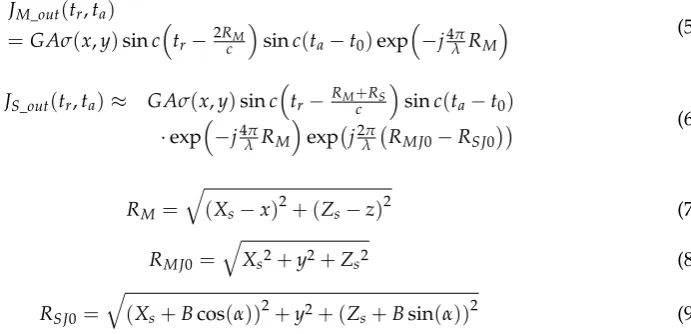
According to [21], the jammer transmits the deceptive jamming signal with a time delay to cover useful information, while the true target reflects echo according to the radar cross section (RCS). As can be seen, the slant range histories for the jamming signal and the real echo are obtained in different ways. After echo analysis and imaging, the final SAR imagery of the deceptive jamming part in the master image and slave image are, respectively, represented by [20]
JM_out(tr,ta)
=GAσ(x,y)sinctr−2RM
c
sinc(ta−t0)exp
−j4λπRM (5)
JS_out(tr,ta)≈ GAσ(x,y)sinc
tr−RM+RS
c
sinc(ta−t0)
·exp−j4λπRM
exp j2λπ RMJ0−RSJ0
(6)
with
RM= q
(Xs−x)2+ (Zs−z)2 (7)
RMJ0= q
Xs2+y2+Zs2 (8)
RSJ0= q
(Xs+Bcos(α))2+y2+ (Zs+Bsin(α))2 (9)
distance between the master antenna and the jammer when the slant range between master antenna and target isRM.RSJ0is the distance between the slave antenna and the jammer when the slant range between slave antenna and target isRS.
For the imaging output of the real target, the master image and slave image can be expressed as [22]
SM_out(tr,ta) = Aσ(x,y)sinc
tr−2RM
c
·sinc(ta−t0)exp
−j4λπRM
(10)
SS_out(tr,ta) = Aσ(x,y)sinc
tr−RM+RS
c
·sinc(ta−t0)exp
−j2π(RM+RS)
λ
(11)
2.3. Interferometric Phase Analysis
In the interferometric process, an envelope shift between the master image and the slave image is compensated by high precision image co-registration. After co-registration, the interferometric phase of Equations (10) and (11) is derived as [23]
∆φreal=−2π
λ (RM−RS) (12)
Assuming that the slave image in Equation (6) is adjusted in the light of the master image,
JS_out(tr,ta)after co-registration is rearranged as
JS_out(tr,ta)≈ GAσ(x,y)sinc
tr−2RM
c
sinc(ta−t0)
·exp−j4λπRMexp j2λπ RMJ0−RSJ0
(13)
Then, the interferometric phase of Equations (5) and (13) is given by complex conjugate multiplication as [20]
∆φdeception=−2π
λ RMJ0−RSJ0
≈ −2λπ RMJ−RSJ
(14)
whereRMJis the minimum slant range between the master antenna and the jammer andRSJis the
minimum slant range between the slave antenna and the jammer.
Equation (14) indicates that the phase difference of false target depends heavily on the relative position between the jammer and the two antennas, while not related to the terrain of imaging scene. In practice, the jammer position will be unchanged when SAR deceptive jamming occurs, which results in a phase constant for false targets on the interferogram. Namely, once the location of jammer is determined, the phase constant will not vary even if the jammer changes signal type or alters different deceptive regions on SAR image. Furthermore, Equation (12) shows that the surrounding real areas appear as varying InSAR phases due to different surface elevation. Therefore, the false phase is significantly different from the surrounding real area in the interferogram.
Sensors2018,18, 2265 5 of 13
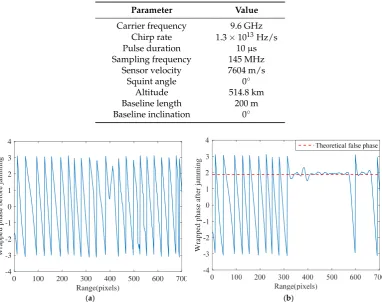
[image:6.595.107.490.148.450.2]ones and fluctuate around a constant value as expected, which provides an opportunity to exact the false part from the deceived SAR image.
Table 1.Simulation Parameters of the InSAR System.
Parameter Value
Carrier frequency 9.6 GHz Chirp rate 1.3×10¹³Hz/s
Pulse duration 10µs
Sampling frequency 145 MHz Sensor velocity 7604 m/s
Squint angle 0◦ Altitude 514.8 km Baseline length 200 m Baseline inclination 0◦
(a) (b)
Range(pixels)
0 100 200 300 400 500 600 700 -4
-3 -2 -1 0 1 2 3 4
W
rapped phase afte
r j
ammi
n
g
Figure 2.Comparison between the interferometric phase before and after SAR deceptive jamming: (a) interferometric phase before jamming; and (b) interferometric phase after jamming.
3. Proposed Detection Scheme
With the principle of our proposed method introduced in Section2, we have the following findings: as the two cross-track antennas are exploited to observe the same area, there exists obvious difference between jammed and non-jammed pixels of interferometric phase; therefore, the cross-track interferometry can be utilized to identify the false targets in the SAR image.
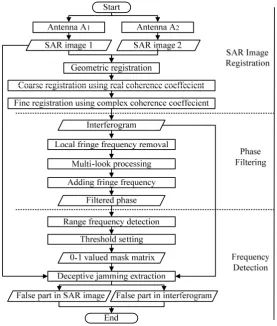
Figure3shows the flow chart of the proposed detection scheme by two cross-track SAR antennas. After SAR imaging, the dual jammed SAR images are combined to derive the interferometric phase. In the interferogram, the interferometric phase of the false targets can be distinguished from that of the surrounding true elevation. Then, the interferogram is filtered and the false phase can be detected through frequency detection. Ultimately, the corresponding deceptive part in the SAR image is extracted.
2 Antenna A
1 Antenna A
[image:6.595.124.473.657.747.2]4. Deceptive Jamming Extraction
[image:7.595.159.437.147.474.2]In this part, deceptive jamming extraction based on the interferometric process is further discussed. The basic steps of the proposed method are shown in Figure4.
Figure 4.Detailed steps of the proposed SAR deception detection method.
To differentiate the deceptive targets from real ones, co-registration of corresponding SAR images is first applied and the interferogram with deceptive jamming is derived. Secondly, phase filtering is carried out to effectively improve the detection accuracy. Then, frequency detection in the range direction is employed to extract the false phase in the interferogram. The false scene in the SAR image is obtained ultimately according to the deduced 0–1 valued mask matrix.
4.1. SAR Image Co-Registration
Generally, SAR image registration consists of geometric registration and image co-registration. The geometric registration based on imaging geometry and orbit parameters is not necessary unless there is obvious offset or angulation between master and slave image. The co-registration of InSAR images, including coarse co-registration and fine co-registration, is one of the key steps of interferometric processing [24]. Normally, the registration offsets in coarse or fine co-registration depend on the peak position of the correlation function. When calculating offsets, the real and complex correlation functions simplified by Fast Fourier Transform (FFT) can be written as [25]
ρr=norm( FFT
−1(FFT(
|SM(m,n)|)FFT(|SS(m,n)|)∗)
) (15)
ρc=norm( FFT
−1(FFT(
|SM(m,n)|)FFT(SS(m,n)))∗
Sensors2018,18, 2265 7 of 13
wherenorm(·)denotes the normalization operator, andSM(m,n)andSS(m,n)represent the master and slave images in the estimated window, respectively.
The research in [26] suggests that the real correlation function is more robust than the complex one in practice, especially in low-coherence regions. Therefore, we choose the real correlation function in coarse co-registration. However, when the two areas have strong coherence and similar scattering properties, the registration error of using real correlation function is approximately√2 times that of using the complex correlation function [27]. Meanwhile, after coarse co-registration, the corresponding small grids on the two images are more coherent and have similar scattering properties. As a result, the complex correlation function is selected to fine co-registration.
4.2. Phase Filtering
By complex conjugate multiplication of two co-registered images, the InSAR phase with deceptive jamming is obtained. In practice, the quality of interferograms is limited by phase noise induced by co-registration errors, thermal noise, temporal decorrelation, baseline decorrelation and so on [28,29]. To reduce the deception extraction difficulty caused by phase noise, a slope-compensated mean filter [30,31] is applied before frequency detection.
First, the local fringe frequency estimation is realized by the maximum likelihood (ML) method [32,33]. Subsequently, to preserve the fringes of real targets and strengthen the feature of the false part, the estimated fringe frequency in each filtering window is removed from the original noisy phase. Then, the residual phase part is smoothed based on InSAR multi-look filter processing. Finally, the removed fringe frequencies and the low-noise residual phase are combined to generate the filtered interferogram. The filtering procedure removes most of the phase noise while still preserving the false phase well.
4.3. Frequency Detection
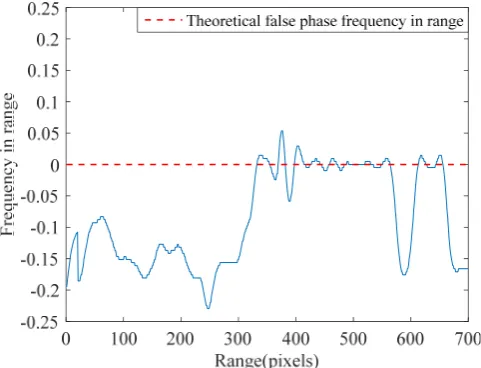
After phase filtering, the normal interferometric phase takes the form of continuous fringes with fewer residues, while the false phase in the interferogram appears as a constant in theory. However, in practice, due to the remaining noise and some scattered echo of true targets in the deceptive area, the false phase is not always a constant in the spatial domain, leading to unreliable detection result. Therefore, we apply principle frequency detection to identify the false regions caused by deceptive jamming.
According to the model of the InSAR phase described in [1], for the normal interferogram, the component of fringe frequency in the radar range direction is related to the flat effect and terrain variety. Therefore, Fourier transform of interferogram in the range direction has continuous changing values in the spectrum. However, the false phase, approximately a constant in the spatial domain, will approach zero in the frequency domain.
To derive the range fringe frequency of the detection window, the maximum likelihood (ML) method is employed using Fourier transforms [34]. The range frequency of(2P+1)pixels in the interferogram can be expressed as
ˆ
f =arg max
fx
x=a+P
∑
x=a−P
S(x)exp(−j2π(x fx))
!
(17)
Therefore, a 0–1 valued mask matrix can be derived subsequently through threshold setting. Based on the mask matrix, the false area can be extracted from both interferogram and the original SAR image ultimately.
Figure 5.Range frequency of the interferometric phase in Figure2b.
5. Experimental Analysis
In this section, to validate the robustness of our method for deceptive jamming detection, simulation results are provided based on the TanDEM-X system [35].
5.1. Interferometric Phase Analysis
A terrain with mountainous areas is considered. The system parameters are listed in Table1. The processing procedures involve SAR imaging, relevant registration, and interferometry. Finally, the interferometric phase with deceptive jamming is derived.
Sensors2018,18, 2265 9 of 13
(a) (b)
(c)
Figure 6.Comparison between the SAR images before and after SAR deceptive jamming: (a) master image before jamming; (b) deceptive jamming template; and (c) master image after jamming.
[image:10.595.104.492.89.378.2](a) (b)
Figure 7.Comparison between the interferograms before and after SAR deceptive jamming: (a) interferogram before jamming; and (b) interferogram after jamming.
5.2. Extraction Results
A slope-compensated mean filter [30,31] is applied as shown in Figure8a. Figure8b shows a cross-section along range direction corresponding to the white line in Figure8a. It can be seen that the interferometric phase of false targets is close to a constant with only little fluctuations while the surrounding real areas appear as varying phases, which again verifies the previous theoretical analysis.
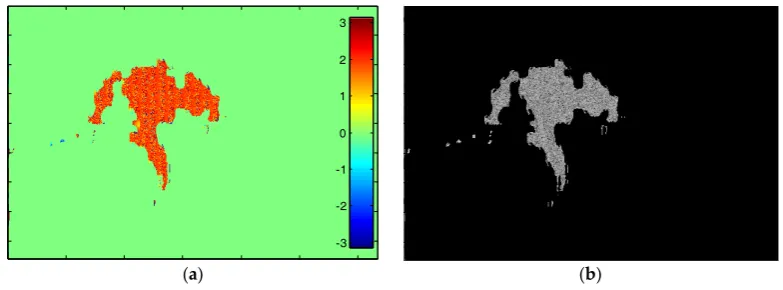
Figure10shows the extraction results of the proposed method. Based on the 0–1 valued mask, the false part in interferogram can be detected as in Figure10a. Correspondingly, the false area in SAR image can also be extracted, as shown in Figure10b. In summary, the false part in SAR image is detected through interferometry, phase filtering, and frequency detection and result extraction.
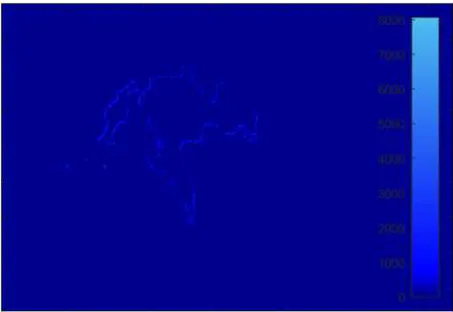
The error detection area of SAR image is provided in Figure11and the quantitative results are listed in Table2. We can see that the correct detection rate of our proposed method has reached 96.84%, while the false alarm rate is only 0.38%, which has again validated the robustness of the proposed method.
[image:11.595.103.497.207.352.2](a) (b)
Figure 8.Filtered interferogram with false phase: (a) interferogram after filtering; and (b) cross-section corresponding to the white line.
(a) (b)
-0.5 -0.4 -0.3 -0.2 -0.1 0 0.1 0.2
0 0.2 0.4 0.6 0.8 1
Figure 9.The frequency detection results: (a) Fourier transform of interferogram in the range direction; and (b) 0–1 valued mask.
(a) (b)
-3 -2 -1 0 1 2 3
[image:11.595.103.494.403.546.2] [image:11.595.100.492.595.740.2]Sensors2018,18, 2265 11 of 13
Figure 11.The detection error area in SAR image (absolute value of complex image).
Table 2.Quantitative Evaluation of our method.
Parameter Value
Pixel number of SAR image 1,093,016 Pixel number of original false target 58,978 Pixel number of detected false target 61,283 Pixel number of correct detection 57,116 Pixel number of error detection 4167
Correct detection rate 96.84%
False alarm rate 0.38%
6. Conclusions
In this paper, a novel method has been proposed by simultaneously employing two cross-track antennas to detect the deceptive targets in the interferogram, with the following two major findings: (1) The interferogram produced by combining two SAR images can identify the position of false
targets, and the interferometric phases of the false targets related to the jammer position are close to a constant.
(2) Range frequency detection after phase filtering can effectively extract the false phase in the interferogram. With the proposed jamming detection algorithm, the jammed parts in a SAR image can be extracted.
As presented by simulation results based on the TanDEM-X system, the proposed method can detect deceptive jamming effectively and shows great promise in the field of ECCM. Moreover, the detection results also provide a good starting point for possible deceptive jamming suppression.
Author Contributions: Q.F. carried out all of the analyses and algorithms under the supervision of H.X. Z.W. performed the experiments. W.L. offered a lot of sound advice on the language. Q.F., H.X., Z.W. and W.L. contributed to writing and improving the paper.
Funding:This research was funded by the National Natural Science Foundation of China (No. 61471020).
Acknowledgments:This work is supported by the National Natural Science Foundation of China (No. 61471020) and the Program for New Century Excellent Talents in University.
References
1. Xiaoming, L.S.; Lehner, S.; Rosenthal, W. Investigation of ocean surface wave refraction using TerraSAR-X data.IEEE Trans. Geosci. Remote Sens.2010,48, 830–840. [CrossRef]
2. Kugler, F.; Lee, S.; Hajnsek, I.; Papathanassiou, K.P. Forest height estimation by means of Pol-InSAR data inversion: The role of the vertical wavenumber. IEEE Trans. Geosci. Remote Sens. 2015,53, 5294–5311. [CrossRef]
3. Romeiser, R.; Runge, H. Theoretical evaluation of several possible along-track InSAR modes of TerraSAR-X for ocean current measurements.IEEE Trans. Geosci. Remote Sens.2007,45, 21–35. [CrossRef]
4. Walterscheid, I.; Espeter, T.; Brenner, A.R.; Klare, J.; Ender, J.H.G.; Nies, H.; Wang, R.; Loffeld, O. Bistatic SAR Experiments with PAMIR and TerraSAR-X—Setup, Processing, and Image Results. IEEE Trans. Geosci. Remote Sens.2010,48, 3268–3279. [CrossRef]
5. Romeiser, R.; Suchandt, S.; Runge, H.; Steinbrecher, U.; Grunler, S. First analysis of TerraSAR-X along-track InSAR-derived current fields.IEEE Trans. Geosci. Remote Sens.2010,48, 820–829. [CrossRef]
6. Breit, H.; Fritz, T.; Balss, U.; Lachaise, M.; Niedermeier, A.; Vonavka, M. TerraSAR-X SAR Processing and Products.IEEE Trans. Geosci. Remote Sens.2010,48, 727–740. [CrossRef]
7. Liu, Q.; Xing, S.; Wang, X.; Dong, J.; Dai, D.; Li, Y. The Interferometry phase of InSAR coherent jamming with arbitrary waveform modulation.Prog. Electromagn. Res.2012,124, 101–118. [CrossRef]
8. Bo, T.; Weiyan, W. The Study of the Characteristic of InSAR in ECCM.J. Electron. Inf. Technol.2006,28, 1809–1811. 9. Bo, T. Effect of Jammer Motion on Two Channels Cancellation in InSAR EW.Infrared Laser Eng.2008,37, 719–722. 10. Schroer, R. Electronic warfare.IEEE Aerosp. Electron. Syst. Mag.2003,18, 49–54.
11. Li, N.; Zhang, Y. A survey of radar ECM and ECCM.IEEE Trans. Aerosp. Electron. Syst.1995,31, 1110–1120. 12. Jia, L.; Jia, X.; Hu, H. Analysis on the Effects of Rebound Jamming on InSAR Imaging. Electr. Inf.
Warfare Technol.2012,27, 1394–1401.
13. Akhtar, J. Orthogonal Block Coded ECCM Schemes against Repeat Radar Jammers. IEEE Trans. Aerosp. Electron. Syst.2009,45, 1218–1226. [CrossRef]
14. Zhang, J.; Zhu, D.; Zhang, G. New antivelocity deception jamming technique using pulses with adaptive initial phases.IEEE Trans. Aerosp. Electron. Syst.2013,49, 1290–1300. [CrossRef]
15. Yang, G.; Li, S.B.; Cao, X.H. SAR counter deception jamming based on radiometric calibration. In Proceedings of the 2009 IET International Radar Conference, Guilin, China, 20–22 April 2009; pp. 1–4.
16. Zhou, F.; Zhao, B.; Tao, M.; Bai, X.; Chen, B.; Sun, G. A Large Scene Deceptive Jamming Method for Space-Borne SAR.IEEE Trans. Geosci. Remote Sens.2013,51, 4486–4495. [CrossRef]
17. Zhao, B.; Zhou, F.; Tao, M.; Zhang, Z.; Bao, Z. Improved method for synthetic aperture radar scattered wave deception jamming.IET Radar Sonar Navig.2014,8, 971–976. [CrossRef]
18. Zhao, B.; Zhou, F.; Bao, Z. Deception Jamming for Squint SAR Based on Multiple Receivers.IEEE J. Sel. Top. Appl. Earth Observ. Remote Sens.2017,8, 3988–3998. [CrossRef]
19. Li, C. The Detection of Deception Jamming Against SAR Based on Dual-Aperture Antenna Cross-Track Interferometry.J. Electron. Inf. Technol.2007,29, 1–4.
20. Wu, Z.; Xu, H.; Li, J.; Liu, W. Research of 3-D Deceptive Interfering Method for Single-pass Spaceborne InSAR.IEEE Trans. Aerosp. Electron. Syst.2015,51, 2834–2846. [CrossRef]
21. Tang, B.; Guo, K.; Wang, J. The 3D Active Deception Jamming of SAR.Acta Electron. Sin.2007,35, 1203–1206. 22. Tulgar, O.; Arif Ergin, A. Improved Pencil Back-Projection Method with Image Segmentation for Far-Field/Near-Field SAR Imaging and RCS Extraction.IEEE Trans. Antennas Propag.2015,63, 2572–2584. [CrossRef]
23. Wang, F. InSAR Dem Reconstruction Using SRTM Data and ERS-1/2 Interferogram. In Proceedings of the 2012 2nd International Conference on Remote Sensing, Environment and Transportation Engineering, Nanjing, China, 1–3 June 2012; pp. 1–4.
24. Stone, H.S.; Orchard, M.T.; Chang, E.C.; Martucci, S.A. A fast direct Fourier-based algorithm for subpixel registration of images.IEEE Trans. Geosci. Remote Sens.2002,39, 2235–2243. [CrossRef]
Sensors2018,18, 2265 13 of 13
26. Kwoh, L.K.; Chang, E.C.; Heng, W.C.A.; Lim, H. DTM generation from 35-day repeat pass ERS-1 interferometry. In Proceedings of the International Symposium on Geoscience and Remote Sensing: Surface and Atmospheric Remote Sensing: Technologies, Data Analysis and Interpretation, Pasadena, CA, USA, 8–12 August 1994; Volume 4, pp. 2288–2290.
27. Bamler, R. Interferometric stereo radargrammetry: Absolute height determination from ERS-ENVISAT interferograms. In Proceedings of the IEEE 2000 International Geoscience and Remote Sensing Symposium, Honolulu, HI, USA, 24–28 July 2000; Volume 2, pp. 742–745.
28. Xu, H.; Chen, W.; Liu, W.; Li, S. Phase Statistics for Strong Scatterers in SAR Interferograms.IEEE Geosci. Remote Sens. Lett.2014,11, 1966–1970.
29. Wu, Z.; Xu, H.; Li, J.; Liu, W.; Feng, Q. A Passive Interfering Method for InSAR Based on Circularly Moving Strong Scatterers.IEEE Trans. Aerosp. Electron. Syst.2015,51, 1877–1890. [CrossRef]
30. Trouvé, E.; Nicolas, J.M.; Maître, H. Improving Phase Unwrapping Techniques by the Use of Local Frequency
Estimates.IEEE Trans. Geosci. Remote Sens.1998,36, 1963–1972. [CrossRef]
31. Spagnolini, U. 2-D phase unwrapping and instantaneous frequency estimation. IEEE Trans. Geosci. Remote Sens.1995,33, 579–589. [CrossRef]
32. Suo, Z.; Li, Z.; Bao, Z. A New Strategy to Estimate Local Fringe Frequencies for InSAR Phase Noise Reduction.
IEEE Geosci. Remote Sens. Lett.2010,7, 771–775. [CrossRef]
33. Feng, Q.; Xu, H.; Wu, Z.; You, Y.; Liu, W.; Ge, S. Improved Goldstein Interferogram Filter Based on Local Fringe Frequency Estimation.Sensors2016,16, 1976. [CrossRef] [PubMed]
34. Zhao, C.; Zhang, Q.; Ding, X.; Zhang, J. An Iterative Goldstein SAR Interferogram Filter.Int. J. Remote Sens.
2011,33, 3443–3455. [CrossRef]
35. Krieger, G.; Moreira, A.; Fiedler, H.; Hajnsek, I.; Werner, M. TanDEM-X: A satellite formation for high-resolution SAR Interferometry.IEEE Trans. Geosci. Remote Sens.2007,45, 3317–3341. [CrossRef]