
R E S E A R C H A R T I C L E
Open Access
Comparing the application of two
theoretical frameworks to describe
determinants of adverse medical device
event reporting: secondary analysis of
qualitative interview data
Laura Desveaux
1and Anna R. Gagliardi
2*Abstract
Background:Post-market surveillance of medical devices is reliant on physician reporting of adverse medical device events (AMDEs). Few studies have examined factors that influence whether and how physicians report AMDEs, an essential step in the development of behaviour change interventions. This study was a secondary analysis comparing application of the Theoretical Domains Framework (TDF) and the Tailored Implementation for Chronic Diseases (TICD) framework to identify potential behaviour change interventions that correspond to determinants of AMDE reporting.
Methods:A previous study involving qualitative interviews with Canadian physicians that implant medical devices identified themes reflecting AMDE reporting determinants. In this secondary analysis, themes that emerged from the primary analysis were independently mapped to the TDF and TICD. Determinants and corresponding intervention options arising from both frameworks (and both mappers) were compared.
Results:Both theoretical frameworks were useful for identifying interventions corresponding to behavioural determinants of AMDE reporting. Information or education strategies that provide evidence about AMDEs, and audit and feedback of AMDE data were identified as interventions to target the theme of physician beliefs; improving information systems, and reminder cues, prompts and awards were identified as interventions to address determinants arising from the organization or systems themes; and modifying financial/non-financial incentives and sharing data on outcomes associated with AMDEs were identified as interventions to target device market themes. Numerous operational challenges were encountered in the application of both frameworks including a lack of clarity about how directly relevant to themes the domains/determinants should be, how many domains/determinants to select, if and how to resolve discrepancies across multiple mappers, and how to choose interventions from among the large number associated with selected domains/determinants.
Conclusions:Given discrepancies in mapping themes to determinants/domains and the resulting interventions offered by the two frameworks, uncertainty remains about how to choose interventions that best match behavioural determinants in a given context. Further research is needed to provide more nuanced guidance on the application of TDF and TICD for a broader audience, which is likely to increase the utility and uptake of these frameworks in practice.
Keywords:Equipment and supplies, Physicians’practice patterns, Determinants, Medical errors, Reporting, Qualitative research
* Correspondence:[email protected] 2University Health Network, Toronto, Canada
Full list of author information is available at the end of the article
© The Author(s). 2018Open AccessThis article is distributed under the terms of the Creative Commons Attribution 4.0
International License (http://creativecommons.org/licenses/by/4.0/), which permits unrestricted use, distribution, and
Background
A growing body of research in implementation science has employed classic or implementation science theories or theoretical frameworks to investigate behavioural determinants influencing the use of evidence-based in-novations by health care professionals [1]. Given the undesirable prevalence of over-, under- or misuse of in-novations and their inconsistent impact on patient out-comes [2], systematic categorization of determinants has been highlighted as a strategy to inform the selection of interventions that best mitigate or address those deter-minants. The Theoretical Domains Framework (TDF) [3] and the Tailored Implementation for Chronic Dis-eases (TICD) checklist [4] are two prominent, validated theoretical frameworks that were rigorously developed based on review of the literature followed by inter-national expert consensus. Both facilitate the design of implementation strategies by identifying one or more in-terventions that may be appropriate for addressing be-havioural determinants.
Unfortunately, application of these theoretical frame-works to develop and implement change strategies has proven challenging [5], with an inconsistent impact on health care delivery or patient outcomes [6]. There is a need to improve the selection of behavioural interventions so that they reliably lead to health care improvement. Hence, more insight is needed about the similarities and differences in the content and application of commonly used theoretical frameworks to understand how their use can be optimized when choosing and designing behaviour change strategies.
Previous research has focused on the determinants of implementing practice guidelines, clinical tests or proce-dures, and quality improvement processes or tools [7,8]. Despite widespread use of medical devices, little atten-tion has been devoted to understanding determinants of the reporting of adverse events associated with their use. Medical devices include a wide range of health or med-ical instruments essential for the prevention, diagnosis, cure or management of a disease or abnormal physical condition [9]. Those considered higher risk for adverse medical device events (AMDEs) include orthopedic plants such as hip or knee joints and cardiovascular im-plants such as pacemakers or implantable cardioverter defibrillators [10, 11]. AMDEs may result from limita-tions in device design or function, and account for 10% of patient safety incidents in hospitals [12]. Growing concern about AMDEs has led to calls for greater moni-toring of outcomes associated with their use [13]. How-ever, registries are not present in every jurisdiction or for every type of medical device. In the absence of sys-tematic data collection, the identification and sharing of information about AMDEs relies on voluntary reporting by physicians.
To learn about AMDE reporting behaviour, we inter-viewed 22 Canadian physicians who varied by geograph-ical region and career stage; 10 implanted cardiovascular devices and 12 implanted orthopedic devices [14]. When AMDEs arose, they often developed work-around solu-tions to continue using the same type of device, or they chose to use other comparable devices available on the market. Some participants said they informally shared information about AMDEs with colleagues or industry representatives, however most did not. Determinants of AMDE reporting were identified at the level of the phys-ician (i.e. beliefs about adverse events, device prefer-ences); organization or system (i.e. lack of hospital, national or international reporting policies, systems or incentives); and the device market (i.e. purchasing group contract obligations) [14].
As invasive health care technologies, the characteris-tics and uses of higher-risk medical devices differ from those of other innovations such as practice guidelines, clinical procedures, or quality improvement processes or tools. Hence, determinants of their use may also differ, providing a unique context within which to study the application of theoretical frameworks for selecting be-havioural interventions. The purpose of this study was to (1) categorize determinants of AMDE reporting be-haviour that emerged in the primary study using the TDF and TICD; (2) systematically identify interventions that could promote and support AMDE reporting; and (3) compare the determinants and interventions identi-fied by the TDF and TICD as a means of exploring how to optimize the use of those theoretical frameworks in behavioural intervention design. At a practical level, study results will identify interventions that are likely to improve AMDE reporting, thereby optimizing the use and outcomes of higher-risk medical devices. Simultan-eously, this work will contribute to the implementation science literature by broadening our understanding of the relevance and application of theoretical frameworks in identifying or describing determinants of innovation use, and selecting corresponding behavioural interven-tions for change.
Methods Study design
a myocardial infarction [17]. ARG is an implementation scientist with extensive experience in studying determi-nants of the use of innovations including teamwork in cancer diagnostic assessment programs [18], timely triage and referral of trauma patients [19], the surgical safety checklist [20], guidelines [21] and integrated knowledge translation [22]. ARG has also evaluated the use of theory in assessing barriers of innovation use [23] and in plan-ning behavioural interventions to implement guidelines [24]. ARG had employed the TICD to collect or analyze data in previous studies; she was familiar with the TDF but had not applied it in previous work. LD had not previ-ously applied the TICD but had previous training and ex-perience related to the TDF. This study was based on secondary analysis of qualitative data and did not require ethics approval. However, the University Health Network Research Ethics Board provided ethical approval for the qualitative study that generated data upon which this study is based, and participants of the qualitative study had provided written informed consent prior to being interviewed [14].
Implementation frameworks
The TDF includes 84 individual determinants across 14 domains (knowledge, skills, social or professional role and identity, beliefs about capabilities, optimism, beliefs about consequences, reinforcement, intentions, goals; memory, attention and decision processes; environment, context and resources, social influences, emotion, behav-ioural regulation). These domains, and not the individual determinants within them, are linked with 93 behav-ioural interventions (referred to as behaviour change techniques) across 16 overarching categories [3]. The TICD includes 57 individual determinants grouped in 7 domains (guideline factors, individual health professional factors, patient factors, professional interactions, incen-tives and resources, capacity for organizational change; social, political, and legal factors), and links individual determinants with one or more of 116 behavioural inter-ventions [4].
Data collection
AMDE reporting determinants and exemplar quotes that illustrated determinants were acquired from the previ-ously conducted study (Additional file 1) [14]. Methods for the previous study are published elsewhere [14]. In brief, qualitative interviews with physicians that im-planted cardiovascular and orthopedic implants were conducted by ARG. Themes reflecting determinants were generated, reviewed and discussed by the entire eight-person research team on four separate occasions to assess thematic saturation, agree upon themes, and interpret data. Themes were organized in the categories
of physician beliefs; policies, processes, and systems; and the device market [14].
Data mapping
Mapping of AMDE reporting determinants to the TDF and TICD was independently performed by LD and ARG. To do this, both used the same version of the TDF [4] and TICD [4] instruments that listed determinant domains, individual determinants (for TICD), and corre-sponding behavioural interventions. The intent was to undertake naturalistic application of the TDF and TICD that relied solely on the content and guidance provided by the theoretical frameworks themselves. LD and ARG did not review or discuss the content of the TDF or TICD before the independent mapping exercise, nor did they attempt to resolve and reach consensus on discrep-ancies after mapping. This was an intentional methodo-logical decision to facilitate comparison across mappers using only the frameworks themselves as a guide. AMDE reporting determinants were matched to determinant domains or individual determinants by reading the defi-nitions and examples provided in each framework. LD and ARG each generated a table in which AMDE report-ing themes and exemplar quotes were listed along with TDF and TICD domains or determinants thought to be relevant and reflective of the data.
Data analysis
The two tables reflecting independent mapping were collated to illustrate the TDF and TICD domains or de-terminants selected by both LD and ARG, and by LD alone and ARG alone. Behavioural interventions corre-sponding to each domain or individual determinant were extracted from the TDF and TICD and added to the col-lated table. Domains, determinants and corresponding interventions identified by LD and ARG in the TDF and TICD were enumerated and compared.
Results
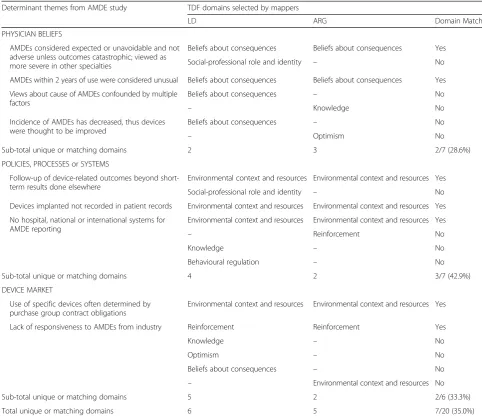
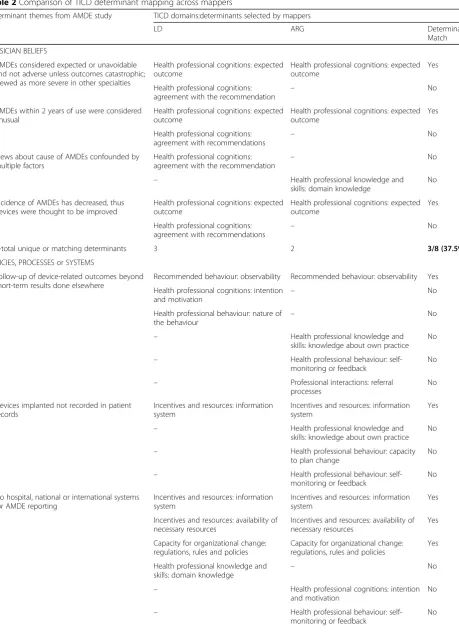
Mapping of AMDE reporting themes to TDF and TICD Table1summarizes the TDF domains and Table2 sum-marizes the TICD determinants selected by one or both mappers.
All themes were successfully mapped to both frameworks All AMDE reporting themes (noted initalicsthroughout the manuscript) were directly and clearly addressed by both frameworks, and therefore mapped to one or more TDF domain and TICD determinant. For example, the theme ‘AMDEs were considered unexpected or
unavoid-able’aligned with the TDF domain of ‘Beliefs about
con-sequences’ and the theme ‘Lack of responsiveness to
AMDEs from industry’ was readily mapped to the TDF
hospital, national or international systems for AMDE
reporting’was readily mapped to the TICD determinant
‘Incentives and resources: information system’ and ‘Use of specific devices often determined by purchasing group
contracts obligations’ was mapped to the TICD
deter-minant ‘Health professional behaviour: capacity to plan change’.
A range of domains and determinants were identified AMDE reporting determinants were mapped to multiple domains and determinants, revealing the interplay of multi-level determinants that influence AMDE reporting, in addition to the complexity of applying the TDF and TICD. In part this was because the previous study [14] identified that physician, organizational, system, and mar-ket level factors influenced whether and how physicians reported AMDEs. This was compounded by the reality
that AMDE reporting themes often mapped to more than one domain or determinant. For example, the theme‘No hospital, national or international systems for AMDE
reporting’ mapped to 4 different TDF domains
[image:4.595.55.538.98.516.2](Environ-mental context and resources, Reinforcement, Knowledge, and Behavioural regulation). The same theme mapped to 5 different TICD domains, representing 9 unique determi-nants [Incentives and resources (4 determidetermi-nants): infor-mation system, availability of necessary resources, non-financial incentives and disincentives, and quality assurance and patient safety systems; Capacity for organizational change (2 determinants): regulations, rules, and policies, and monitoring and feedback; Health profes-sional knowledge and skills (1 determinant): domain knowledge; Health professional cognitions (1 determin-ant): intention and motivation; Health professional behav-iour (1 determinant): self-monitoring or feedback].
Table 1Comparison of TDF determinant mapping across mappers
Determinant themes from AMDE study TDF domains selected by mappers
LD ARG Domain Match
PHYSICIAN BELIEFS
AMDEs considered expected or unavoidable and not adverse unless outcomes catastrophic; viewed as more severe in other specialties
Beliefs about consequences Beliefs about consequences Yes
Social-professional role and identity – No
AMDEs within 2 years of use were considered unusual Beliefs about consequences Beliefs about consequences Yes
Views about cause of AMDEs confounded by multiple factors
Beliefs about consequences – No
– Knowledge No
Incidence of AMDEs has decreased, thus devices were thought to be improved
Beliefs about consequences – No
– Optimism No
Sub-total unique or matching domains 2 3 2/7 (28.6%)
POLICIES, PROCESSES or SYSTEMS
Follow-up of device-related outcomes beyond short-term results done elsewhere
Environmental context and resources Environmental context and resources Yes
Social-professional role and identity – No
Devices implanted not recorded in patient records Environmental context and resources Environmental context and resources Yes
No hospital, national or international systems for AMDE reporting
Environmental context and resources Environmental context and resources Yes
– Reinforcement No
Knowledge – No
Behavioural regulation – No
Sub-total unique or matching domains 4 2 3/7 (42.9%)
DEVICE MARKET
Use of specific devices often determined by purchase group contract obligations
Environmental context and resources Environmental context and resources Yes
Lack of responsiveness to AMDEs from industry Reinforcement Reinforcement Yes
Knowledge – No
Optimism – No
Beliefs about consequences – No
– Environmental context and resources No
Sub-total unique or matching domains 5 2 2/6 (33.3%)
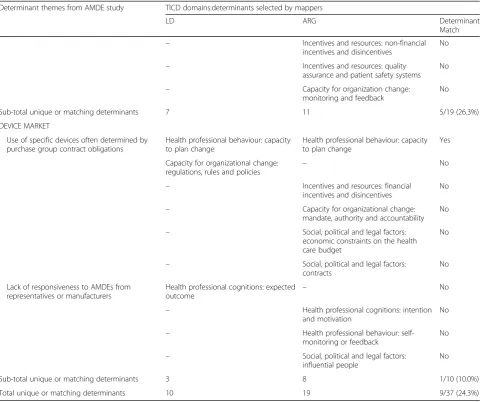
Table 2Comparison of TICD determinant mapping across mappers
Determinant themes from AMDE study TICD domains:determinants selected by mappers
LD ARG Determinant
Match
PHYSICIAN BELIEFS
AMDEs considered expected or unavoidable and not adverse unless outcomes catastrophic; viewed as more severe in other specialties
Health professional cognitions: expected outcome
Health professional cognitions: expected outcome
Yes
Health professional cognitions: agreement with the recommendation
– No
AMDEs within 2 years of use were considered unusual
Health professional cognitions: expected outcome
Health professional cognitions: expected outcome
Yes
Health professional cognitions: agreement with recommendations
– No
Views about cause of AMDEs confounded by multiple factors
Health professional cognitions:
agreement with the recommendation –
No
– Health professional knowledge and
skills: domain knowledge
No
Incidence of AMDEs has decreased, thus devices were thought to be improved
Health professional cognitions: expected outcome
Health professional cognitions: expected outcome
Yes
Health professional cognitions: agreement with recommendations
– No
Sub-total unique or matching determinants 3 2 3/8 (37.5%)
POLICIES, PROCESSES or SYSTEMS
Follow-up of device-related outcomes beyond short-term results done elsewhere
Recommended behaviour: observability Recommended behaviour: observability Yes
Health professional cognitions: intention
and motivation –
No
Health professional behaviour: nature of the behaviour
– No
– Health professional knowledge and
skills: knowledge about own practice No
– Health professional behaviour:
self-monitoring or feedback
No
– Professional interactions: referral
processes
No
Devices implanted not recorded in patient records
Incentives and resources: information system
Incentives and resources: information system
Yes
– Health professional knowledge and
skills: knowledge about own practice No
– Health professional behaviour: capacity
to plan change
No
– Health professional behaviour:
self-monitoring or feedback
No
No hospital, national or international systems for AMDE reporting
Incentives and resources: information system
Incentives and resources: information system
Yes
Incentives and resources: availability of necessary resources
Incentives and resources: availability of necessary resources
Yes
Capacity for organizational change: regulations, rules and policies
Capacity for organizational change: regulations, rules and policies
Yes
Health professional knowledge and skills: domain knowledge –
No
– Health professional cognitions: intention and motivation
No
– Health professional behaviour:
self-monitoring or feedback
Across both mappers, themes relating to physician be-liefs were mapped to 4 unique TDF domains, while orga-nizations or systems and device market were each mapped to 5 unique domains. Overall, the TDF identi-fied 7 unique domains across all AMDE reporting themes. Using the TICD, physician beliefs themes were mapped to 3 unique determinants; policies, processes or systems themes were mapped to 14 unique determi-nants; and device market themes were mapped to 10 unique determinants. Overall, the TICD identified 21 unique determinants across all AMDE reporting themes.
Domains and determinants were convergent across themes Although AMDE reporting themes were identified at the physician, organization or system, and device market levels, selected domains or determinants were often mapped to multiple themes. For example, the TDF do-main ‘Beliefs about consequences’ was applied across
multiple themes pertinent to physician beliefs and device market (Table 1). Similarly, the TICD determinant ‘Health professional cognitions: expected outcome’ was applied across multiple themes pertinent to physician beliefs and device market (Table2).
Comparison across mappers
The two mappers differed in the number and domains or determinants matched to AMDE reporting themes, revealing the subjectivity inherent in the mapping process (Tables1 and2). For example, both applied the TDF domain ‘Environmental context and resources’ to the theme‘No hospital, national or international systems
for AMDE reporting’. For the same theme ARG also
[image:6.595.58.543.98.500.2]chose the TDF domain ‘Reinforcement’ and LD also chose the TDF domains ‘Knowledge’ and ‘Behavioural regulation’. For the same theme, both mappers applied the TICD determinants ‘Incentives and resources:
Table 2Comparison of TICD determinant mapping across mappers(Continued)
Determinant themes from AMDE study TICD domains:determinants selected by mappers
LD ARG Determinant
Match – Incentives and resources: non-financial
incentives and disincentives
No
– Incentives and resources: quality
assurance and patient safety systems No
– Capacity for organization change:
monitoring and feedback
No
Sub-total unique or matching determinants 7 11 5/19 (26.3%)
DEVICE MARKET
Use of specific devices often determined by purchase group contract obligations
Health professional behaviour: capacity to plan change
Health professional behaviour: capacity to plan change
Yes
Capacity for organizational change: regulations, rules and policies –
No
– Incentives and resources: financial
incentives and disincentives
No
– Capacity for organizational change:
mandate, authority and accountability No
– Social, political and legal factors: economic constraints on the health care budget
No
– Social, political and legal factors: contracts
No
Lack of responsiveness to AMDEs from representatives or manufacturers
Health professional cognitions: expected
outcome –
No
– Health professional cognitions: intention and motivation
No
– Health professional behaviour:
self-monitoring or feedback
No
– Social, political and legal factors: influential people
No
Sub-total unique or matching determinants 3 8 1/10 (10.0%)
information system’,‘Incentives and resources: availability of necessary resources’and ‘Capacity for organizational change: regulations, rules and policies’. LD also chose the TICD determinant “Health professional knowledge and skills: domain knowledge” and ARG also chose the TICD determinants ‘Capacity for organizational change: monitoring and feedback’, ‘Health professional cogni-tions: intention and motivation’,‘Health professional be-haviour: self-monitoring or feedback’, ‘Incentives and resources: non-financial incentives and disincentives’ and ‘Incentives and resources: quality assurance and pa-tient safety systems’. Overall LD applied more TDF do-mains and fewer TICD determinants compared with ARG, potentially reflecting their individual familiarity with the respective frameworks. For all 20 TDF domains selected across both mappers for all themes, there were 7 (35.0%) matches across both mappers. For all 37 TICD determinants selected across both mappers for all themes, there were 9 (24.3%) matches across both pers. Thus the proportion of discrepancies across map-pers was relatively consistent across the application of both frameworks.
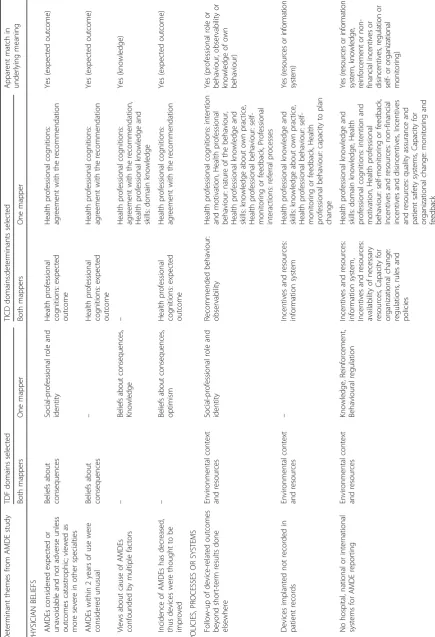
Comparison across theoretical frameworks
Table 3 summarizes the TDF domains and TICD deter-minants chosen by one or both mappers for each AMDE reporting theme. A greater number of TICD determi-nants were applied overall across themes and mappers compared with TDF domains. This could be attributed to the level of the specificity corresponding to interven-tion identificainterven-tion (domains for the TDF and determi-nants for the TICD) or the focus of the frameworks themselves. The TDF largely focuses on determinants of individual behaviour while the TICD offers determinants at the individual, organization or system, and market levels, thus better aligning with the multi-level nature of determinants contributing to AMDE reporting. How-ever, several TDF domains were similar in meaning to TICD determinants, albeit identified by different labels. For example, themes relating to physician beliefs were mapped to the TDF domain‘Beliefs about consequences’ and the TICD determinant ‘Health professional cogni-tions: expected outcome’ and policies, processes or systems themes were mapped to the TDF domain‘ Envir-onmental context and resources’ and the TICD deter-minant ‘Incentives and resources: information system’. Matching of TDF domains and TICD determinants was apparent across all themes and levels.
Interventions corresponding to TDF domains and TICD determinants
Additional file 2 summarizes the interventions corre-sponding to TDF domains and TICD determinants se-lected by one or both mappers.
Many interventions were identified
Both frameworks identified numerous interventions for each AMDE reporting theme. For example, the theme ‘AMDEs were considered unexpected or unavoidable’was mapped by both mappers to the TDF domain of ‘Beliefs about consequences’, for which 23 distinct interventions are suggested across 4 categories (covert learning, com-parison of outcomes, natural consequences, and reward and threat). The same theme was mapped by both LD and ARG to the TICD determinant of ‘Health profes-sional cognitions: expected outcome’, for which 2 distinct interventions are suggested (information or educational strategies that provide compelling evidence, and audit and feedback).
Using the TDF, domains selected by both mappers iden-tified a total of 47 unique intervention options across all themes; this included 23 unique interventions to address physician beliefs, 14 unique for organization or system themes, and 35 for device market themes. Using the TICD, determinants selected by both mappers identified 12 unique intervention options, including 2 unique inter-ventions for physician beliefs, 8 for organization or system themes, and 4 for device market themes.
Convergence of interventions
As was noted previously, selected domains or determi-nants were often similar across AMDE reporting themes and determinant levels. Hence, interventions recom-mended by the TDF and TICD were also similar. For ex-ample, across themes describing physician beliefs, interventions frequently recommended by TDF included covert learning, comparison of outcomes, natural conse-quences, and reward and threat. Common interventions recommended by TICD included information or educa-tional strategies that provide compelling evidence or ad-dress reasons for disagreement, audit and feedback, and a local consensus process.
Direct relevance of interventions
In some cases, interventions recommended by the TDF and TICD were intuitively linked to the determinant theme. For example, the theme ‘Views about cause of
AMDEs confounded by multiple factors’ was mapped to
In other cases, the applicability of interventions rec-ommended by the TDF and TICD appeared less direct, perhaps owing to a greater degree of complexity in de-terminants identified in the primary study. For example, at the device market level, the theme ‘Use of specific devices often determined by purchasing group contract
obligations’was mapped to the TDF domain of ‘
Environ-mental context and resources’for which 14 interventions categorized as antecedents or associations were recom-mended. These interventions involve restructuring the physical or social environment, or adding or removing prompts or cues, and do not seem to readily address the multi-level restrictions on behaviour of purchasing group contracts. Conversely, mapping the same theme to TICD determinants identified the more granular intervention of improvements in contracts.
Similarly, important themes from the predicate study reflecting complex determinants may not have been well-addressed by either TDF or TICD, leading to less than appropriate interventions. For example, the theme
‘Views about cause of AMDEs confounded by multiple
factors’was mapped to the TDF domain of‘Beliefs about
consequences’ by both mappers and the TICD domain of ‘Health professional cognitions: expected outcome’by both mappers, ultimately leading to 23 corresponding interventions recommended by TDF and 5 recom-mended by TICD. All of the interventions address knowledge but none appear to fully recognize the inter-play of determinants inherent in this theme.
Comparison across theoretical frameworks
Overall, although a greater number of TICD determi-nants were applied across themes and mappers com-pared with TDF domains, the TDF identified many more unique interventions across all themes (47 for domains selected by both mappers plus additional domains se-lected by one mapper) compared with the TICD (12 in-terventions for determinants selected by both mappers plus additional determinants selected by one mapper).
Several interventions recommended by TDF and TICD were similar in meaning, irrespective of the theme. For example, for the physician beliefs theme‘AMDEs
consid-ered expected or unavoidable and not adverse’, the TDF
intervention of comparison of outcomes was conceptu-ally similar to the TICD intervention of audit and feed-back, and the TDF intervention of information about health consequences was similar to the TICD interven-tion of informainterven-tion or educainterven-tional strategies that provide compelling evidence.
Even when themes were mapped to domains or deter-minants that were similar in meaning, different interven-tions were recommended by TDF and TICD in some instances. For example, for the device market theme ‘Lack of responsiveness to AMDEs from industry’, the
TDF interventions (categorized as scheduled conse-quences) focused on adding or removing rewards, while the TICD interventions (information or educational strategies and audit and feedback) focused on the provision of information.
Implications for practice
Table 4summarizes overall study findings and their im-plications. Knowledge generated by this study addresses the applied objectives of identifying interventions to stimulate AMDE reporting, and comparing the domains or determinants and interventions identified by mapping AMDE reporting themes to the TDF and TICD.
Interventions to stimulate AMDE reporting
AMDE reporting themes were mapped by both mappers to several domains and determinants, which identified corresponding interventions common to the TDF and TICD. Information or educational strategies that provide evidence about AMDEs, and audit and feedback of AMDE-related data were identified as interventions to target physician beliefs; improve information systems, and reminder cues, prompts and awards were identified to target organization or system themes; and modify fi-nancial/non-financial incentives, and share data on out-comes associated with AMDEs were identified to address device market themes. However, issues and dis-crepancies in the application of TDF and TICD raise un-certainty about which or how many interventions may be relevant to promote and support AMDE reporting.
Application of the TDF and TICD
Issues revealed by this study include a lack of clarity about how directly relevant domains or determinants should be and therefore which and how many to select; if and how to resolve discrepancies in the selection of domains or determinants across multiple mappers; and how to choose interventions from among the large number associated with selected domains and determi-nants. Several TDF domains and TICD determinants were relevant, similar in meaning, and selected by both mappers. Convergence within and across TDF and TICD identified a core set of behavioural determinants and corresponding interventions. Thus, both theoretical frameworks were useful for selecting behavioural deter-minants to which AMDE reporting themes matched and corresponding interventions.
different interventions. TICD recommended interventions that seemed to be more directly applicable to a behavior such as AMDE reporting with multi-level determinants as compared with the TDF. Domains and corresponding in-terventions in the TDF or TICD did not fully recognize
[image:11.595.58.541.97.685.2]the complex interplay of determinants inherent in some themes; it is unclear if this is because the frameworks are better suited to exploring determinants in some contexts (i.e. adherence with clinical guideline recommendations) and not others (i.e. reporting of AMDEs.
Table 4Summary of findings and implications
Finding Implication
All AMDE reporting themes mapped to both TDF and TICD Both theoretical frameworks were useful for systematically analyzing AMDE reporting determinant themes
Multiple TDF domains and TICD determinants were relevant Provide users with flexibility to choose and further prioritize from among the array of relevant domains/determinants but also raises uncertainty about how many to choose and with what precision
Several TDF domains and TICD determinants chosen by one or both mappers were conceptually similar though labelled differently
Convergence across frameworks could be used to identify a core set of behavioural determinants
Selected TDF domains and TICD determinants chosen by one or both mappers applied to more than one AMDE reporting theme
Convergence within frameworks could be used to identify a core set of behavioural determinants
Domains and determinants selected independently by two mappers often did not match; discrepancy rate similar for TDF and TICD
Selection of TDF domains and TICD determinants may be subjective and influenced by mapper familiarity with a given theoretical framework. It is unclear if a process is needed to resolve discrepancies or, instead, if intervention design should be based on only domains/determinants selected by all independent mappers, or on a core set of domains/ determinants most commonly selected by all mappers
Greater number of TICD determinants were applied across themes and mappers compared with TDF domains
Compared with TDF, which focuses on individual level domains, TICD offers multilevel determinants, plus definitions and examples for each, and was thus easier to apply and could be applied with greater precision at a granular level
Numerous interventions corresponded to common TDF domains and TICD determinants selected by both mappers for each AMDE reporting theme
It is unclear how to choose the intervention (s) that are most relevant from among the large number of options presented by the TDF and TICD
Additional interventions corresponded to TDF domains and TICD determinants selected by one mapper
It is unclear if intervention (s) should be chosen based on only those associated with domains/determinants selected by all independent mappers, or with a core set of domains and determinants most commonly selected by all mappers
Given that similar TDF domains and TICD determinants were applied across AMDE reporting themes, corresponding interventions were also convergent
Convergence within frameworks could be used to identify a core set of interventions corresponding to behavioural determinants
Some interventions recommended by TDF and TICD for the same AMDE reporting themes were conceptually similar though labelled differently
Convergence across frameworks could be used to identify a core set of interventions corresponding to behavioural determinants
Although more TICD determinants were applied compared with TDF domains, TDF recommended a greater number of interventions compared with TICD
It is unclear if and how interventions that are most relevant for a given context should be screened or prioritized from among the options recommended by either TDF or TICD
Even when themes mapped to conceptually similar TDF domains and TICD determinants, TDF and TICD often recommended conceptually different interventions
It is unclear how to choose the intervention (s) that are most relevant when two rigorously developed theoretical frameworks differ in the interventions recommended for the same determinant
Some interventions recommended by TICD seemed more intuitively relevant compared with TDF
Compared with TDF, which recommends interventions corresponding to broad domains, TICD recommends interventions corresponding to specific determinants, and may identify interventions that are more relevant. Following the mapping of themes to theoretical frameworks, consultation with stakeholders is likely needed to deliberate the relevance and feasibility of corresponding interventions for a given context.
Complex determinants involving interplay among factors were not well-addressed by TDF or TICD
Domains and corresponding interventions in the TDF or TICD did not fully recognize the complex interplay of determinants inherent in some themes. It is unclear if this is because the frameworks are better suited to exploring determinants in some contexts (i.e. adherence with clinical guideline recommendations) and not others (i.e. reporting of AMDEs.
Discrepancies in applying TDF and TICD may be accounted for by distinctions between their content and format. TDF includes determinant domains largely fo-cused on the individual level while TICD includes deter-minant domains and deterdeter-minants spanning multiple levels and, unlike TDF, offered definitions and examples to guide the application of these more granular determi-nants. Although more TICD determinants were applied compared with TDF domains, TDF recommended a greater number of interventions compared with TICD. While the predicate study did not itself prioritize deter-minants, neither the TDF nor the TICD prompt users to prioritize among the many potentially applicable do-mains or interventions as means of limiting or focusing the number and type of interventions. Overall, uncer-tainty remains about the optimal way to identify inter-ventions that match behavioural determinants for a given behaviour, and the precision and relevance of those choices.
Discussion
This study was a naturalistic application of the TDF and TICD to identify evidence-based interventions corre-sponding with known determinants of AMDE reporting and, in so doing, to explore how use of these theoretical frameworks could be optimized. Both TDF and TICD were useful in identifying several interventions that could promote and support AMDE reporting. However, it is uncertain which interventions are the best options given discrepancies in the selection of TDF domains and TICD determinants, and corresponding interventions across theoretical frameworks and independent mappers. The content and format of TICD (well-defined domains and determinants spanning individual, organizational, system and environmental levels) may make it easier to apply than the TDF for individuals who are not familiar with either framework. Even still, uncertainty remains about how to best apply the frameworks in practice and their precision when used to design behaviour change interventions.
Our findings align with previous work highlighting the uncertainty and challenges surrounding the application of theoretical frameworks to design behaviour change in-terventions. Lipworth et al. analyzed determinants of the uptake of clinical quality interventions and found that all 14 TDF domains and numerous corresponding interven-tions were relevant, necessitating a “drilling down” to identify those that were most“contextually salient”[25]. Lawton et al. used the TDF to conduct and analyze the findings of 60 interviews with 60 general practice health care professionals regarding adherence to various clinical recommendations [3]. A wide variety of determinants were identified but it was difficult to“pinpoint which de-terminants, if targeted by an implementation strategy,
would maximize change”, underscoring the need for “broader contextual consideration”. One potential ex-planation is reality that theoretical frameworks do not address causal mechanisms, or how change occurs, which presents a challenge when attempting to identify which intervention (s) are most likely to support im-provement [1]. Phillips et al. interviewed 10 health care professionals from six disciplines who used the TDF [26]. Frequently cited challenges experienced when ap-plying it included the time and resources required to use the TDF, lack of clear operational definitions, and over-lap between domains. Participants found it difficult, complicated, unwieldy, and subjective to interpret and apply the domains [26]. Birken et al. conducted a sys-tematic review of five protocols and seven studies that used both the TDF and the Consolidated Framework for Implementation Research (CFIR) to examine the ration-ale for having applied both frameworks [27]. Authors of included studies justified the use of both frameworks by stating that one offered greater insight on determinants and the other on interventions, although which frame-work offered determinants versus interventions was interchangeable across studies. A conceptual analysis of reasons for the failure of interventions designed based on the TICD offered several reasons including potential mismatch of determinants to interventions or a subse-quent mismatch of interventions to targeted groups and settings [6]. Thus, our research and that of others reveals uncertainty and challenges in the application of theoret-ical frameworks to design behaviour change interven-tions. More recently a guide to use of the TDF was published [28]. The guide specifies that coding disagree-ments could be resolved by either consensus among coders or assessment of inter-rater reliability, and when uncertain about coding to apply all relevant TDF do-mains. However, these suggestions do not help users se-lect from among the many potential interventions identified by this approach.
contextual advantage when applying the frameworks. The challenges and discrepancies encountered when ap-plying the frameworks may be specific to the single case examined, that of determinants of AMDE reporting. Also, the TDF and TICD may be better suited to asses-sing determinants and corresponding interventions for some contexts more so than others; that could not be determined by this study and will require future research.
With respect to selecting determinants and interven-tions, our research and that of others [3,6,25–27] found that the TDF and TICD are useful for fully describing the range of potentially relevant determinants, a task perhaps best done by implementation scientists who are familiar with the constructs and their definitions. This suggests that selecting the most relevant determinants and inter-ventions is likely to benefit from collaboration with stake-holders with context-specific knowledge. Processes such as Intervention Mapping, whereby researchers and health care professionals can jointly choose and design interven-tions based on the identification and prioritization of determinants, may prove useful for developing and evalu-ating interventions that are more likely to improve the de-livery and outcomes of care [29].
Further research applying the TDF and TCID in spe-cific contexts is needed in order to resolve the differ-ences between them and clarify the circumstances for which each framework is most useful. The critical need remains to make these tools easier to use for a broader audience, and to establish a reliable way to identify which of many potential interventions are likely to suc-cessfully address specific determinants. Key consider-ations include how many independent mappers are needed, what process is needed to resolve discrepancies across mappers, whether intervention design should be based on only those domains or determinants selected by all independent mappers, or on some other combin-ation of domains or determinants identified; and how best to prioritize the selection of potential interventions. Further insight or framework development is also needed to help users address complex determinants, and to prioritize domains and corresponding interventions.
Conclusions
The TDF and TICD were employed to identify behav-ioural interventions corresponding to determinants of the reporting of AMDEs. Interventions common to both frameworks included information or educational strat-egies that provide evidence about AMDEs; audit and feedback of AMDE data; improved information systems; reminder cues, prompts and awards; modifying finan-cial/non-financial incentives; sharing data on outcomes associated with AMDEs. Challenges and discrepancies in the application of frameworks raise uncertainty about
which or how many interventions may be relevant to pro-mote and support AMDE reporting. Given the worldwide imperative to promote the use of evidence-based innova-tions and improve the quality and safety of care, there is an urgent need to make tools such as the TDF and TICD easier to use for a broader audience, and to establish a reliable way to identify which of many potential interven-tions are likely to successfully address specific determi-nants. Just as research more broadly has seen a shift from the production and dissemination of evidence to the plementation of evidence, and it is time for the field of im-plementation science to shift from the development of frameworks to supporting their application in practice.
Additional files
Additional file 1:AMDE reporting themes that emerged from previous
study [14] (DOCX 17 kb).
Additional file 2:Comparison of interventions identified across theoretical
frameworks (DOCX 30 kb).
Abbreviations
AMDE:Adverse medical device event; ARG: Anna R Gagliardi; LD: Laura Desveaux; TDF: Theoretical Domains Framework; TICD: Tailored Implementation for Chronic Diseases
Funding
This study was funded by the Canadian Institutes for Health Research, who took no part in the design of the study; data collection, analysis or interpretation; or in the writing of the manuscript.
Availability of data and materials
All data generated or analysed during this study are included in this published article and its supplementary information files.
Authors’contributions
ARG conceptualized the study and acquired funding; designed the study, collected and analysed data, drafted the manuscript, and gave final approval of the version to be published. LD assisted with study design, collected and analyzed data, drafted the manuscript and gave final approval of the version to be published.
Ethics approval and consent to participate
This study, based on secondary analysis of themes that emerged from a
previous study, did not require ethical approval. For the previous study [14],
ethical approval was granted by the University Health Network Research Ethics Board and all participants provided written informed consent prior to being interviewed.
Competing interests
The authors declare that they have no competing interests.
Publisher’s Note
Springer Nature remains neutral with regard to jurisdictional claims in published maps and institutional affiliations.
Author details
Received: 1 August 2017 Accepted: 29 May 2018
References
1. Nilsen P. Making sense of implementation theories, models and frameworks.
Implement Sci. 2015;10:53.
2. Baker R, Camosso-Stefinovic J, Gillies C, Shaw EJ, Cheater F, Flottorp S, et al.
Tailored interventions to address determinants of practice. Cochrane Database Syst Rev. 2015;4:CD005470.
3. Michie S, Wood CE, Johnston M, Abraham C, Francis JJ, Hardeman W.
Behaviour change techniques: the development and evaluation of a taxonomic method for reporting and describing behaviour change interventions (a suite of five studies involving consensus methods, randomised controlled trials and analysis of qualitative data). Health Technol
Assess. 2015;19:1–188.
4. Flottorp SA, Oxman AD, Krause J, Musila NR, Wensing M, Godycki-Cwirko M,
et al. A checklist for identifying determinants of practice: a systematic review and synthesis of frameworks and taxonomies of factors that prevent or enable improvements in healthcare professional practice. Implement Sci. 2013;8:35.
5. Phillips CJ, Marshall AP, Chaves NJ, Jankelowitz SK, Lin IB, Loy CT, et al.
Experiences using the theoretical domains framework across diverse clinical
environments: a qualitative study. J Multidiscip Healthc. 2015;8:139–46.
6. Wensing M. The tailored implementation in chronic diseases (TICD) project:
introduction and main findings. Implement Sci. 2017;12:5.
7. Murphy K, O’Connor DA, Browning CJ, French SD, Michie S, Francis JJ, et al.
Understanding diagnosis and management of dementia and guideline implementation in general practice: a qualitative study using the theoretical domains framework. Implement Sci. 2014;9:31.
8. Lawton R, Heyhoe J, Louch G, Ingleson E, Glidewell L, Willis TA, et al. Using
the theoretical domains framework (TDF) to understand adherence to multiple evidence-based indicators in primary care: a qualitative study. Implement Sci. 2016;11:113.
9. Maisel WH. Medical device regulation: an introduction for the practicing
physician. Ann Intern Med. 2004;140:296–302.
10. Maisel WH, Moynahan M, Zuckerman BD, Gross TP, Tovar OH, Tillman DB, et
al. Pacemaker and ICD generator malfunction. JAMA. 2006;295:1901–6.
11. Carr AJ, Robertsson O, Graves S, Price AJ, Arden NK, Judge A, et al. Knee
replacement. Lancet. 2012;379:1331–40.
12. Lawton R, McEachan RRC, Giles SJ, Sirriyeh R, Watt IS, Wright J.
Development of an evidence-based framework of factors contributing to patient safety incidents in hospital settings: a systematic review. BMJ Qual
Saf. 2012;21:369–80.
13. Shuren J, Califf RM. Need for a national evaluation system for health
technology. JAMA. 2016;316:1153–4.
14. Gagliardi AR, Ducey A, Lehoux P, Turgeon T, Ross S, Trbovich P, et al.
Determinants of reporting adverse medical device events: qualitative interviews with physicians about higher-risk implantable devices. BMJ Qual Saf. 2018;27:190-8.
15. Ivers NM, Desveaux L, Presseau J, Reis C, Witteman HO, Taljaard MK, et al.
Testing feedback message framing and comparators to address prescribing of high-risk medications in nursing homes: protocol for a pragmatic, factorial, cluster-randomized trial. Implement Sci. 2017;12:86.
16. Desveaux L, Gomes T, Tadrous M, Jeffs L, Taljaard M, Rogers J, et al.
Appropriate prescribing in nursing homes demonstration project (APDP) study protocol: pragmatic, cluster-randomized trial and mixed-methods process evaluation of an Ontario policy-makers initiative to improve
appropriate prescribing of antipsychotics. Implement Sci. 2016;11:1–10.
17. Ivers NM, Schwalm JD, Witteman HO, Presseau J, Taljaard M, McCready T, et
al. Interventions supporting long-term adherence aNd decreasing cardiovascular events (ISLAND): pragmatic randomized trial protocol. Am
Heart J. 2017;190:64–75.
18. Honein G, Stuart-McEwan T, Waddell T, Salvarrey A, Smylie J, Dobrow M, et
al. How do organizational characteristics influence teamwork and service delivery in lung cancer diagnostic assessment programs? A mixed methods study. BMJ Open. 2017;7:e013965.
19. Gagliardi AR, Nathens AB. Exploring the characteristics of high-performing
hospitals that influence trauma triage and transfer. J Trauma Acute Care
Surg. 2015;78:300–5.
20. Gagliardi AR, Straus SE, Shojania KG, Urbach DR. Multiple interacting factors
influence adherence and outcomes associated with surgical safety checklists: a qualitative study. PLoS One. 2014;9:e108585.
21. Gagliardi AR, Brouwers MC. Do guidelines offer implementation advice to
target users?: a systematic review of guideline applicability. BMJ Open. 2015; 5:e007047.
22. Gagliardi AR, Dobrow MJ. Identifying the conditions needed for integrated
knowledge translation (IKT) in health care organizations: qualitative interviews with researchers and research users. BMC Health Serv Res. 2016; 16:256.
23. Willson M, Vernooij RW, Gagliardi AR. Members of the guidelines
international network implementation working group. Questionnaires used to assess barriers of clinical guideline use among physicians are not comprehensive, reliable or valid: a scoping review. J Clin Epidemiol. 2017;86:
25–38.
24. Liang L, Bernhardsson S, Vernooij RWM, Armstrong M, Bussieres A, Brouwers
MC, et al. Use of theory to plan or evaluate guideline implementation among physicians: a scoping review. Implement Sci. 2017;12:26.
25. Lipworth W, Taylor N, Braithwaite J. Can the theoretical domains framework
account for the implementation of clinical quality interventions? Health Serv Res. 2013;13:530.
26. Phillips CJ, Marshal AP, Chaves NJ, Jankelowitz SK, Lin EB, Loy T, et al.
Experiences of using the theoretical domains framework across diverse
clinical environments: a qualitative study. J Multidisc Healthc. 2015;8:139–46.
27. Birken SA, Powell BJ, Presseau J, Kirk MA, Lorencatto F, Gould NJ, et al.
Combined use of the consolidated framework for implementation research (CFIR) and the theoretical domains framework (TDF): a systematic review. Implement Sci. 2017;12:2.
28. Atkins L, Francis J, Islam R, O’Connor D, Patey A, Ivers N, et al. A guide to
using the theoretical domains framework of behaviour change to investigate implementation problems. Implement Sci. 2017;12:77.
29. Bartholomew LK, Parcel GS, Kok G. Intervention mapping: a process for
developing theory- and evidence-based health education programs. Health

![Crystal structure and the DFT and MEP study of 4 benzyl 2 [2 (4 fluorophenyl) 2 oxoethyl] 6 phenylpyridazin 3(2H) one](data:image/gif;base64,R0lGODlhAQABAIAAAP///wAAACH5BAEAAAAALAAAAAABAAEAAAICRAEAOw==)