Published online 6 December 2004 in Wiley InterScience (www.interscience.wiley.com) DOI:10.1002/acs.849
Fractionally spaced blind equalization with low-complexity
concurrent constant modulus algorithm and soft
decision-directed scheme
S. Chen
1,n,yand E. S. Chng
21
School of Electronics and Computer Science, University of Southampton, Highfield, Southampton SO17 1BJ, U.K. 2School of Computer Engineering, Nanyang Technological University, Nanyang Avenue, Singapore 639798, Singapore
SUMMARY
The paper proposes a low-complexity concurrent constant modulus algorithm (CMA) and soft decision-directed (SDD) scheme for fractionally spaced blind equalization of high-order quadrature amplitude modulation channels. We compare our proposed blind equalizer with the recently introduced state-of-art concurrent CMA and decision-directed (DD) scheme. The proposed CMA+SDD blind equalizer is shown to have simpler computational complexity per weight update, faster convergence speed, and slightly improved steady-state equalization performance, compared with the existing CMA+DD blind equalizer. Copyright#2004 John Wiley & Sons, Ltd.
KEY WORDS: fractionally spaced blind equalization; quadrature amplitude modulation; constant modulus algorithm; decision-directed adaptation
1. INTRODUCTION
Blind equalization improves system bandwidth efficiency by avoiding the use of a training sequence. Furthermore, for multi-point communication systems, training is infeasible and blind equalizer provides a practical means for combating the detrimental effects of channel intersymbol interference (ISI) in such systems. For communication systems employing high bandwidth-efficiency quadrature amplitude modulation (QAM) signalling [1], the constant modulus algorithm (CMA)-based equalizer is by far the most popular blind equalization scheme [2–5]. It has very simple computational requirements and readily meets the real-time computational constraint. The CMA is also very robust to imperfect carrier recovery. A particular problem of the CMA, however, is that it only achieves a moderate level of mean square error (MSE) after convergence, which may not be sufficiently low for the system to obtain adequate bit error rate (BER) performance. A possible solution is to switch to a
decision-Received 2 October 2003 Revised 8 March 2004 yE-mail: [email protected]
n
directed (DD) adaptation which should be able to minimize the residual CMA steady state MSE [6]. However, as pointed out in Reference [7], in order for such a transfer to be successful, the CMA steady state MSE should be sufficiently low. In practice, such a low level of MSE may not always be achievable by the CMA.
De Castro et al. [7] have suggested an interesting solution to this problem. Rather than switching to a DD adaptation after the CMA has converged, they have proposed to operate a DD equalizer concurrently with a CMA equalizer. To avoid error propagation due to incorrect decisions, the DD weight adaptation only takes place if the CMA adaptation is judged to have achieved a successful adjustment with high probability. At a cost of slightly more than doubling the complexity of the very simple CMA, this concurrent CMA+DD equalizer is reported to obtain a dramatical improvement in equalization performance over the CMA [7]. Among various low-complexity blind equalization schemes for high-order QAM channels (e.g. References [8–11]), this concurrent CMA+DD scheme represents a state-of-art technique. Another blind equalization scheme, which is relevant to the proposed concurrent CMA and soft decision-directed (SDD) blind equalizer, is the bootstrap maximum a posteriori probability (MAP) blind equalizer [12, 13].
The bootstrap MAP blind scheme was originally derived by Karaoguz and Ardalan [14] for the 4-QAM case and extended toM-QAM channels by Chenet al. [12, 13]. It is only slightly more complex than the CMA in terms of computational requirements and it has been shown to outperform the CMA+DD scheme, in terms of convergence rate and steady-state performance [15, 16]. A drawback of this bootstrap MAP scheme is that its adaptive process requiresL-stage switchings, where L¼log2ðMÞ=2; and each stage of adaptation needs a different set of algorithm parameters. Thus, tuning of the bootstrap MAP algorithm is quite complicated. The proposed CMA+SDD scheme may be viewed as operating a CMA equalizer and a last-stage bootstrap MAP equalizer concurrently, and it does not require complicated switching. The proposed CMA+SDD scheme has a simpler complexity than the CMA+DD scheme. Simulation results obtained under a fractionally spaced equalizer (FSE) setting show that the CMA+SDD algorithm has a faster convergence rate and slightly better steady-state performance, compared with the CMA+DD scheme.
2. LOW-COMPLEXITY BLIND EQUALIZATION
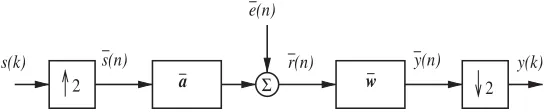
For notational simplicity, blind equalization with a Ts=2-spaced FSE is considered, whereTs denotes the symbol period. The baseband discrete-time model of communication system with a Ts=2-spaced FSE (e.g. Reference [17]) is depicted in Figure 1. For notational convenience, the
s(n) s(k)
Σ
2
e(n)
y(k)
2
r(n) y(n)
[image:2.567.148.420.542.598.2]a w
Figure 1. Multirate baseband model of communication system with Ts/2-spaced equalizer, where Ts
denotes symbol period, the index k indicates Ts-spaced quantities and index n indicates Ts/2-spaced
indexkis reserved forTs-spaced quantities and indexn forTs=2-spaced quantities throughout the discussion. The transmitted Ts-spaced complex symbol sequence sðkÞ ¼sRðkÞ þjsIðkÞ is assumed to be independently identically distributed (i.i.d.) and the symbol constellation isM -QAM with the set of all the symbol points defined by
S¼ fsil¼ ð2iQ1Þ þjð2lQ1Þ; 14i; l4Qg ð1Þ
whereQ¼pffiffiffiffiffiM¼2L;andLis an integer. The receivedTs=2-spaced signal sample is
%
rðnÞ ¼ X 2Nc1
i¼0
%
ais%ðniÞ þ%eðnÞ ð2Þ
where the Ts=2-spaced sequence fs%ðnÞg is a zero-filled version of the transmitted symbol sequencefsðkÞgdefined by
%
sðnÞ ¼ sðn=2Þ for even n 0 for oddn
(
ð3Þ
the channel is specified by the Ts=2-spaced complex-valued channel impulse response (CIR) given by
%
a¼ ½a%0 a%1 a%2 a%3 a%2Nc1
T ð4Þ
with Nc corresponding to the Ts-spaced CIR length, and the Ts=2-spaced sample e%ðnÞ ¼
%
eRðnÞ þj%eIðnÞ is an i.i.d. complex Gaussian white noise withE½e%2RðnÞ ¼E½e%2IðnÞ ¼s2e;andE½ denotes the expectation operator.
To remove the channel distortion, aTs=2-spaced equalizer is employed, which is defined by
%
yðnÞ ¼ X 2m1
i¼0
%
wir%ðniÞ ¼w%T%rðnÞ ð5Þ
where 2mis the order or length of theTs=2-spaced equalizer,
%
w¼ ½w%0 w%1 w%2m1T ð6Þ
is the equalizer complex-valued weight vector, and
%
rðnÞ ¼ ½%rðnÞ r%ðn1Þ r%ðn2mþ1ÞT ð7Þ
is the equalizer input vector. To deal with non-minimum phase channels, the equalizer should have a decision delay approximately to m:Before blind adaptation, the equalizer weights are initialized tow%i¼1þj0 fori¼m1 andm;andw%i¼0þj0 for all the other values ofi:The FSE output y%ðnÞis decimated by a factor of 2 to create theTs-spaced outputyðkÞ:
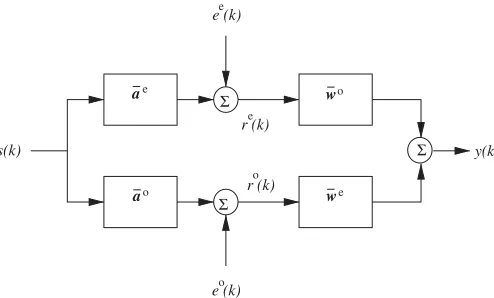
It can easily be shown [17] that the system model of Figure 1 is equivalent to the model depicted in Figure 2 by defining
%
ae¼ ½a%0 a%2 a%2Nc2T; a%o¼ ½a%1 a%3 a%2Nc1T
%
we¼ ½w%0 w%2 w%2m2T; w%o¼ ½w%1 w%3 w%2m1T ð8Þ
and
eeðkÞ ¼e%ð2nÞ; eoðkÞ ¼%eð2nþ1Þ
Further define
w¼ ½w0 w1 w2m1T¼ ½ðw%oÞT ðw%eÞTT ð10Þ
and
rðkÞ ¼ ½rðkÞ rðk1Þ rðk2mþ1ÞT¼ ½ðreðkÞÞT ðroðkÞÞTT ð11Þ
withreðkÞ ¼ ½reðkÞ reðk1Þ reðkmþ1ÞTandroðkÞ ¼ ½roðkÞ roðk1Þ roðkmþ1ÞT Then theTs-spaced equalizer outputyðkÞis given by
yðkÞ ¼ X 2m1
i¼0
wirðkiÞ ¼wTrðkÞ ð12Þ
The equalizer model (12) forms the basis for the discussion of the blind adaptive algorithms in the following subsections.
2.1. CMA-based equalizer
The CMA adjusts the equalizer weights by minimizing the non-convex cost function
%
JCMAðwÞ ¼E½ðjyðkÞj2D2Þ2 ð13Þ
using a stochastic gradient algorithm, where D2 is a real positive constant defined by
D2¼E½jsðkÞj4=E½jsðkÞj2 ð14Þ
At Ts-spaced samplek;givenyðkÞ ¼wTðkÞrðkÞ;the CMA adaptswaccording to [2, 3]
eðkÞ ¼yðkÞðD2 jyðkÞj2Þ
wðkþ1Þ ¼wðkÞ þmeðkÞrn
ðkÞ ð15Þ
wheremis a small positive adaptive gain andrn
ðkÞis the complex conjugate ofrðkÞ:Typically, a very small adaptive gainmhas to be used to ensure convergence.
The CMA has a very simple computational complexity, as is summarized in Table I, and it is by far the most popular blind equalizer for high-order QAM signal constellation. Although
a
e (k)
Σ Σ
Σ e
e (k)o
a
r (k)e
r (k)o
y(k) s(k)
e
o
o
w
e
[image:4.567.160.407.85.234.2]w
Figure 2. Multichannel model of communication system with Ts/2-spaced equalizer, where Ts denotes
M-QAM symbols do not fall on the circle of radius ffiffiffiffiffiffiD2
p
; it is known that the cost function
%
JCMAðwÞis minimized at the equalizer weight solution which restores the signal constellation. Under certain conditions, the CMA converges to this solution subject to a possible phase shift. The CMA is also known to be very robust and is capable of opening ‘initially closed eye’.
2.2. Concurrent CMA and decision-directed equalizer
De Castroet al. [7] proposed a blind equalization scheme that consists of a CMA equalizer and a DD equalizer operating concurrently. Specifically, let
w¼wcþwd ð16Þ
Herewcis the weight vector of the CMA equalizer which is designed to minimize the CMA cost functionJ%CMAðwÞby adapting wc;whilewd is the weight vector of the DD equalizer which is designed to minimize the decision-based MSE
%
JDDðwÞ ¼1
2E½jQ½yðkÞ yðkÞj
2 ð17Þ
by adjusting wd;whereQ½yðkÞdenotes the quantized equalizer output defined by
Q½yðkÞ ¼arg min sil2S
jyðkÞ silj2 ð18Þ
More precisely, at symbol-spaced sample k;given
yðkÞ ¼wTcðkÞrðkÞ þwTdðkÞrðkÞ ð19Þ
the CMA part adapts wc according to rule (15) by substituting wc in the place of wwith an adaptive gainmc:The DD adaptation follows immediately after the CMA adaptation but it only takes place if the CMA adjustment is viewed to be a successful one. Let
*
yðkÞ ¼wTcðkþ1ÞrðkÞ þwTdðkÞrðkÞ ð20Þ
Then the DD part adjusts wd according to [7]
wdðkþ1Þ ¼wdðkÞ þmddðQ½y*ðkÞ Q½yðkÞÞðQ½yðkÞ yðkÞÞr n
ðkÞ ð21Þ
wheremd is the adaptive gain of the DD equalizer and the indicator function
dðxÞ ¼ 1; x¼0þj0 0; x=0þj0
(
ð22Þ
[image:5.567.79.488.97.151.2]It can be seen that wd is updated only if the equalizer hard decisions before and after the CMA adaptation are the same. A potential problem of (hard) DD adaptation is that if the decision is wrong, error propagation occurs which subsequently degrades equalizer adaptation. As analysed in [7], if the equalizer hard decisions before and after the CMA adaptation are the same, the decision probably is a right one. The DD adaptation, when is safe to perform, has a
Table I. Comparison of computational complexity per weight update. The equalizer order is 2m:
Equalizer Multiplications Additions expðÞ
CMA 82mþ6 82m }
CMA+DD 162mþ8 202m }
much faster convergence speed and is capable of lowering the steady-state MSE, compared with the pure CMA. The complexity of this concurrent CMA+DD blind equalizer, summarized in Table I, is still linear in the equalizer order 2m: Obviously, this CMA+DD blind equalizer combines the advantages of both the CMA and DD adaptation. It does not suffer from a serious phase shift problem as the CMA does, and automatically performs a gain control or scaling for the restoration of the signal constellation (1). The adaptive gain md for the DD equalizer can often be chosen much larger than mc for the CMA. Nevertheless, care must be exercised in choosingmd to avoid setting it to a too large value, which would cause serious error propagation due to incorrect decisions.
2.3. Concurrent CMA and soft decision-directed equalizer
After the equalization is accomplished, the equalizer soft output yðkÞ can approximately be expressed in two terms:
yðkÞ xðkÞ þvðkÞ ð23Þ
wherexðkÞ ¼sðkkdÞ; kd is an integer, andvðkÞ ¼vRðkÞ þjvIðkÞis approximately a Gaussian white noise. Thus, if the equalizer weights have correctly been chosen, the equalizer output can be modelled approximately by M Gaussian clusters with the cluster means being sil for 14i;
l4Q:All the clusters have an approximate covariance
E½v2RðkÞ E½vRðkÞvIðkÞ
E½vIðkÞvRðkÞ E½v2IðkÞ
" #
r 0
0 r
" #
ð24Þ
Under the above conditions, the a posteriori probability density function (p.d.f.) of yðkÞ is approximately
pðw;yðkÞÞ X Q
q¼1
XQ
l¼1 pql
2prexp
jyðkÞ sqlj2 2r
ð25Þ
wherepql are thea prioriprobabilities ofsql; 14q; l4Q;and they are all equal.
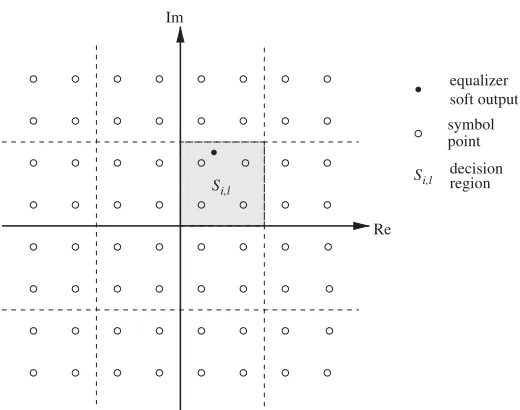
The computation of the p.d.f. (25) involves the evaluation ofMexpðÞfunction values. A local approximation can be adopted for this p.d.f. which only evaluates four expðÞ function values. This is achieved by dividing the complex plane intoM=4 regular regions, as illustrated in Figure 3. Each region Si;l contains four symbol points
Si;l¼ fspq;p¼2i1;2i;q¼2l1;2lg ð26Þ
If the equalizer output yðkÞis within the region Si;l;a local approximation to the a posteriori p.d.f. ofyðkÞis
#
pðw;yðkÞÞ X 2i
p¼2i1
X2l
q¼2l1 1
8prexp
jyðkÞ spqj2 2r
ð27Þ
where each a prioriprobability has been set to 1
4: Obviously this approximation is only valid when the equalization goal has been accomplished. A bootstrap optimization process, however, can be performed to achieve the MAP solution, as is presented in References [12, 13].
The SDD equalizer is designed to maximize log of the local a posteriorip.d.f. criterion
%
JLMAPðwÞ ¼E½JLMAPðw;yðkÞÞ ð28Þ
by adjusting wd using a stochastic gradient algorithm, where
JLMAPðw;yðkÞÞ ¼rlogðp#ðw;yðkÞÞÞ ð29Þ
Specifically, the SDD equalizer adaptswd according to
wdðkþ1Þ ¼wdðkÞ þmd
@JLMAPðwðkÞ;yðkÞÞ @wd
ð30Þ
where
@JLMAPðw;yðkÞÞ @wd
¼
P2i p¼2i1
P2l
q¼2l1 expððjyðkÞ spqj2Þ=2rÞðspqyðkÞÞ P2i
p¼2i1
P2l
q¼2l1 expððjyðkÞ spqj2Þ=2rÞ rn
ðkÞ ð31Þ
andmdis an adaptive gain. The choice ofrshould ensure a proper separation of the four clusters inSi;l:If the value ofris too large, a desired degree of separation may not be achieved. On the other hand, if a too smallris used, the algorithm attempts to impose a very tight control in the size of clusters and may fail to do so. Apart from these two extreme cases, the performance of the algorithm does not critically depend on the value ofr:As the minimum distance between the two neighbouring symbol points is 2, typically ris chosen to be less than 1.
Soft decision nature is evident in (31). Rather than committed to a single hard decisionQ½yðkÞ as the DD scheme does, alternative decisions are also considered in a local region Si;l that includesQ½yðkÞ;and each tentative decision is weighted by an exponential term expðÞwhich is a function of the distance between the equalizer soft output yðkÞand the tentative decision spq: This soft decision nature enables a simultaneous update ofwcandwd without worrying about
Im
Re
i,l
S Si,l
soft output equalizer
[image:7.567.154.414.80.285.2]decision region point symbol
error propagation and, therefore, simplifies the operation. It also has an effect that a larger adaptive gainmd can often be used, compared with the DD scheme. It is also obvious that this SDD scheme corresponds to the last stage of the bootstrap MAP scheme given in References [12, 13]. The complexity of this CMA+SDD scheme is given in Table I, where it can be seen that computational complexity per weight update of this proposed new scheme is simpler than that of the CMA+DD scheme. The four expðÞ evaluations can be implemented through look up table in practice.
3. SIMULATION STUDY
The performance of the CMA+SDD and CMA+DD blind equalizers were evaluated in a computer simulation using the standard CMA blind equalizer as a benchmark. For the case of constant channels, two performance criteria were used to assess the convergence rate of a blind equalizer. The first one was a decision-based estimated MSE at each adaptation sample based on a block ofNMSETs-spaced data samples
MSE¼ 1 NMSE
X NMSE
k¼1
jQ½yðkÞ yðkÞj2 ð32Þ
The second one was the maximum distortion (MD) measure defined by
MD¼
PNf1
i¼0 jfij jfimaxj jfimaxj
ð33Þ
where ffig Nf1
i¼0 was the combined impulse response of the channel and equalizer defined byw%o$a%eþw%e$a%o with$denoting convolution andN
f ¼Ncþm1 being the length of the
Ts-spaced combined impulse response, and
fimax¼maxffi;04i4Nf 1g ð34Þ
The equalizer output signal constellation after convergence was also shown using Ntest¼6000 Ts-spaced testing data samples not used in adaptation.
TheTs=2-spaced equalizer order 2mshould be chosen sufficiently long to ensure the capability of opening closed eye and good steady-state performance, but not too long which can cause the problems of seriously enhancing noise and slow convergence rate. In the simulation study, the actual value of 2m used was found empirically. The values of various adaptive algorithm parameters, namely adaptive gains for the CMA, DD and SDD, and the cluster width for the SDD, were also optimized empirically to ensure fast convergence speed and good steady-state performance. Extensive simulation had been performed, but only two sets of results are presented here due to the space limitation.
Example 1
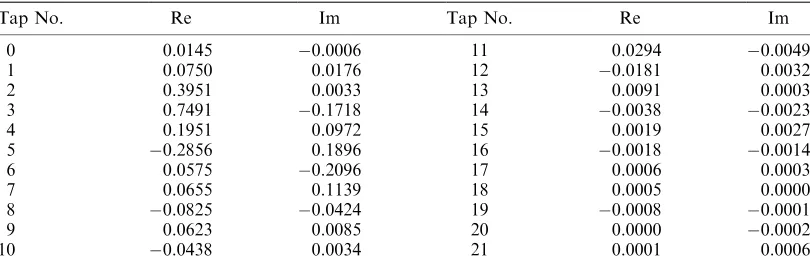
This was a time-invariant system. In this example, 256-QAM data symbols were transmitted through a Ts=2-spaced 22-tap channel whose CIR is given in Table II. The noise power was set tos2
e¼4:24105;corresponding to a channel signal to noise ratio (SNR) of 60 dB:The
md¼105: For the CMA+SDD equalizer, the two adaptive gains were set to m
c¼108 and
md¼2105 with a widthr¼0:4:Note that these values of adaptive gains were found to be optimal empirically.
The learning curves of the three blind equalizers, in terms of the estimated MSE and MD measure, are depicted in Figure 4(a) and 4(b), respectively, while the equalizer output signal constellations after convergence are illustrated in Figure 5. For this example, faster convergence speed of the proposed new scheme over the CMA+DD scheme can clearly be seen. The results also indicate that the steady-state equalization performance of the CMA+SDD algorithm is slightly better than the CMA+DD algorithm.
Example 2
[image:9.567.82.487.97.229.2]This example was a 64-QAM fading channel operated at 4 Msymbols/s. The baseband continuous-time system was simulated. The transmission pulse had a raised-cosine character-istics with a rolloff factor 0.5 and was split equally between the transmitter and receiver filters.
Table II. A simulatedTs/2-spaced 22-tap channel impulse response, whereTsdenotes symbol period.
Tap No. Re Im Tap No. Re Im
0 0.0145 0.0006 11 0.0294 0.0049
1 0.0750 0.0176 12 0.0181 0.0032
2 0.3951 0.0033 13 0.0091 0.0003
3 0.7491 0.1718 14 0.0038 0.0023
4 0.1951 0.0972 15 0.0019 0.0027
5 0.2856 0.1896 16 0.0018 0.0014
6 0.0575 0.2096 17 0.0006 0.0003
7 0.0655 0.1139 18 0.0005 0.0000
8 0.0825 0.0424 19 0.0008 0.0001
9 0.0623 0.0085 20 0.0000 0.0002
10 0.0438 0.0034 21 0.0001 0.0006
0 0.2 0.4 0.6 0.8 1 1.2 1.4
0 6000 12000 18000 24000 30000
MSE
Symbol spaced sample CMA CMA+DD CMA+SDD (a) 0 0.1 0.2 0.3 0.4 0.5 0.6
0 6000 12000 18000 24000 30000
MD measure
Symbol spaced sample CMA CMA+DD CMA+SDD
[image:9.567.81.484.255.412.2](b)
The fading channel was implemented using the following tap-delay line model
vðtÞ ¼c0ðtÞuðtÞ þc1ðtÞuðtt1Þ þc2ðtÞuðtt2Þ ð35Þ
whereuðtÞwas the transmitter output andvðtÞwas the fading channel output;t10:44Tsand t21:13Ts; the magnitudes of the complex-valued tap weights ciðtÞ; 04i42; were i.i.d. Rayleigh processes and the root mean powers of the both real and imaginary components of ciðtÞwere [0.7 0.6 0.5], for 04i42;respectively. Fading was continuously at a fading rate of 10 Hz:The noise powers wass2
[image:10.567.79.487.78.480.2]e ¼0:011:Receiver outputs were sampled at twice of the symbol rate and passed to an equalizer of 8Ts=2-spaced taps.
An appropriate value of the adaptive gain for the CMA equalizer was found to bemc¼106: The two adaptive gains of the concurrent CMA+DD equalizers were set to mc¼106 and
[image:11.567.97.471.82.447.2]md¼0:001:For the CMA+SDD equalizer, the two adaptive gains were chosen as mc¼106 andmd ¼0:002;and the cluster width was set tor¼0:4:Figure 6 depicts the CMA equalizer output signal constellations after (a) adaptation of 20 000 symbols, (b) adaptation of 25 000 symbols, and (c) adaptation of 30 000 symbols. Each signal constellation was shown with 6000 Ts-spaced samples with continuous adaptation, as the channel was time-varying. Similarly, the convergence performance of the CMA+DD and CMA+SDD blind equalizers are demon-strated in Figures 7 and 8, respectively. The results clearly show that the CMA+SDD scheme had the fastest convergence rate.
Figure 6. CMA equalizer output signal constellations for the fading channel: (a) after adaptation of 20 000 symbols; (b) after adaptation of 25 000 symbols; and (c) after adaptation of 30 000 symbols. Six thousand
4. CONCLUSIONS
[image:12.567.78.487.79.477.2]In this paper, a novel low-complexity fractionally spaced blind equalization scheme has been proposed based on operating a CMA equalizer and a SDD equalizer concurrently. Compared with a state-of-art low-complexity blind equalization scheme, namely the recently introduced concurrent CMA and DD blind equalizer, the proposed concurrent CMA and SDD blind equalizer has simpler computational requirements, faster convergence rate and slightly better steady-state equalization performance. This new blind equalizer, together with the concurrent
CMA and DD blind equalizer, offer practical alternatives to blind equalization of higher-order QAM channels and provide significant equalization improvement over the standard CMA-based blind equalizer.
REFERENCES
1. Proakis JG.Digital Communications(3rd edn). McGraw-Hill: New York, 1995.
[image:13.567.91.475.80.461.2]2. Godard D. Self-recovering equalization and carrier tracking in two-dimensional data communication systems.IEEE Transactions on Communications1980;COM-28:1867–1875.
3. Treichler JR, Agee BG. A new approach to multipath correction of constant modulus signals.IEEE Transactions on Acoustics Speech and Signal Processing1983;ASSP-31(2):459–472.
4. Treichler JR. Application of blind equalization techniques to voiceband and RF modems.Preprints of 4th IFAC International Symposium on Adaptive Systems in Control and Signal Processing, France, 1992; 705–713.
5. Jablon NK. Joint blind equalization, carrier recovery, and timing recovery for high-order QAM signal constellations.IEEE Transactions on Signal Processing1992;40(6):1383–1398.
6. Macchi O, Eweda E. Convergence analysis of self-adaptive equalizers.IEEE Transactions on Information Theory
1984;IT-3(2):161–176.
7. De Castro FCC, De Castro MCF, Arantes DS. Concurrent blind deconvolution for channel equalization.
Proceedings of ICC’2001, vol. 2, Helsinki, Finland, June 11–15, 2001:366–371.
8. Benveniste A, Goursat M. Blind equalizers.IEEE Transactions on Communications1984;COM-32:871–883. 9. Bellini S, Rocca F. Blind deconvolution: polyspectra or Bussgang techniques? InDigital Communications, Biglieri E,
Prati G (eds). North-Holland: Amsterdam, 1986; 251–263.
10. Picchi G, Prati G. Blind equalization and carrier recovering using a ‘stop-and-go’ decision directed algorithm.IEEE Transactions on Communications1987;COM-35:877–887.
11. Haykin S (ed.).Blind Deconvolution. Prentice-Hall: Englewood Cliffs, NJ, 1994.
12. Chen S, McLaughlin S, Grant PM, Mulgrew B. Reduced-complexity multi-stage blind clustering equaliser.
Proceedings of ICC’1993, vol. 2, Geneva, Switzerland, 1993; 1149–1153.
13. Chen S, McLaughlin S, Grant PM, Mulgrew B. Multi-stage blind clustering equaliser. IEEE Transactions on Communications1995;43(3):701–705.
14. Karaoguz J, Ardalan SH. A soft decision-directed blind equalization algorithm applied to equalization of mobile communication channels.Proceedings of ICC’1992, vol. 3, Chicago, U.S.A., 1992; 343.4.1–343.4.5.
15. Chen S, Cook TB, Anderson LC. Blind FIR equalisation for high-order QAM signalling.Proceedings of the 6th International Conference on Signal Processing, Beijing, China, August 26–30, 2002; 1299–1302.
16. Chen S, Cook TB, Anderson LC. A comparative study of two blind FIR equalizers.Digital Signal Processing2004; 14(1):18–36.