https://doi.org/10.1007/s40860-018-0054-5
O R I G I N A L A R T I C L E
Building accountability into the Internet of Things: the IoT Databox
model
Andy Crabtree1 ·Tom Lodge1·James Colley1·Chris Greenhalgh1·Kevin Glover1·Hamed Haddadi2· Yousef Amar3·Richard Mortier4·Qi Li4·John Moore4·Liang Wang4·Poonam Yadav4·Jianxin Zhao4· Anthony Brown5·Lachlan Urquhart5·Derek McAuley5
Received: 25 August 2017 / Accepted: 12 January 2018 © The Author(s) 2018. This article is an open access publication
Abstract
This paper outlines the IoT Databox model as a means of making the Internet of Things (IoT) accountable to individuals. Accountability is a key to building consumer trust and is mandated by the European Union’s general data protection regulation (GDPR). We focus here on the ‘external’ data subject accountability requirement specified by GDPR and how meeting this requirement turns on surfacing the invisible actions and interactions of connected devices and the social arrangements in which they are embedded. The IoT Databox model is proposed as an in principle means of enabling accountability and providing individuals with the mechanisms needed to build trust into the IoT.
Keywords GDPR·Accountability·Internet of Things (IoT)·IoT Databox
1 Introduction
The European Union has introduced new general data pro-tection regulation (GDPR), which comes into effect in May 2018 and is explicitly concerned to handle the threat to pri-vacy occasioned by the emerging digital ecosystem.
“Rapid technological developments and globalisation have brought new challenges for the protection of per-sonal data. The scale of the collection and sharing of personal data has increased significantly … … … the proliferation of actors and the technological complex-ity of practice makes it difficult for the data subject to know and understand whether, by whom and for what
B
Andy Crabtree1 School of Computer Science, University of Nottingham,
Nottingham, UK
2 Dyson School of Design Engineering, Imperial College
London, London, UK
3 School of Electronic Engineering and Computer Science,
Queen Mary University of London, London, UK
4 Computer Laboratory, University of Cambridge, Cambridge,
UK
5 Horizon Digital Economy Research Institute, University of
Nottingham, Nottingham, UK
purpose personal data relating to him or her are being collected.” [12]
A key driver of this rapid technological development and technological complexity is the Internet of Things:
“an infrastructure in which billions of sensors embed-ded in common, everyday devices … are designed to communicate unobtrusively and exchange data in a seamless way … clearly raises new and significant per-sonal data protection and privacy challenges” [34]
GDPR, thus, seeks to put in place measures to address these challenges. Key amongst them is theaccountability require-ment.
It might be argued that, while significant, GDPR only applies in Europe. However, if we consider the ‘territorial scope’ of the regulation, it is clear that any such argument is misplaced.
“This Regulation applies to the processing of personal data … where the processing relates to … the offering of goods or services to … data subjects in the Union … or the monitoring of their behaviour as far as their behaviour takes place within the Union … … regardless of whether the processing takes place in the Union or not.” [12]
The accountability requirement has global relevance then, and this paper seeks to articulate what it amounts to in practical terms for the Internet of Things, and to define a computational model that responds to the requirement and thus builds accountability into the IoT.1
Were we to define accountability then we would say that it (a) requires any organization controlling data processing to put policies, procedures and systems in place to demon-strate toitselfthat its processing operations comply with the requirements of data protection regulation. This ‘internal’ focus is emphasized by data protection guidance [e.g., [15]], and may be provided for through such tools as privacy impact assessments (PIAs) [35]. Less pronounced at first glance, though equally as important, is (b) the ‘external’ dimension of accountability, which requires that a data processing entity demonstrate toothers, particularly regulatory authorities and individual data subjects, that its data processing operations comply with regulation. Internal and external demonstrations are not isomorphic. Thus, accountability cannot be reduced to showing that a PIA has been carried out. More is required, especially with respect to making data processing account-able to the individual.
Below we unpack the external data subject accountabil-ity requirement and how it has been translated into practical recommendations for IoT developers by the Article 29 Data Protection Working Party [34], which is set to become the powerful European Data Protection Board under GDPR. These recommendations seek to enable individual control over the flow of personal data through the design of computa-tional mechanisms that enable consent as an ongoing matter, make data processing transparent, and permit fine-grained data flow management, online access and data portability.
1The global relevance of the accountability requirement is further
underscored by US legislation. While new data protection law appears to be terminally ‘bogged down’ in the US [27], the accountability require-ment is enshrined in existing Fair Information Practices [11], and the Federal Trade Commission has been proactive in championing data sub-ject accountability in the IoT [10]. Add to this the Japanese effort to ‘harmonise’ its data protection regulation with international law [28] and it becomes clear that the accountability requirement is poised to exert considerable force on the IoT, whether developers like it or not.
Satisfying the external data subject accountability require-ment requires that we surface and articulate hidden aspects of the IoT ecosystem [38]: not only machine-to-machine or M2M actions and interactions but also, and importantly, the social arrangements connected devices are embedded in [26], for it is not only the data collected by Internet-enabled ‘things’ that must be made accountable but alsowhatis done with the data and bywhom.
We outline the IoT Databox model as a means of surfacing device actions and interactions, and the social or cooperative arrangements they are embedded in, to enable accountabil-ity. The IoT Databox is an edge device that is intended to be situated within the home, a key sector for IoT develop-ment [20]. It collates data from IoT devices, either directly or via APIs, and makes them available to ‘apps’ that enable data processing and actuation. Data processing takes place on-the-box. Moving computation to the data at the edge of the network, rather than data to centralized processing ‘in the cloud’, has a range of potential benefits which are particu-larly relevant to the IoT and drive the shift to edge and fog computing [18,30]. These include low latency (data does not have to be moved to and from remote data centres), resilience (actuation does not need to rely on continuous connectivity), efficiency (centralised data processing costs are significantly reduced), and data minimisation (only the results of process-ing queries are distributed). Makprocess-ing the IoT accountable may, then, have manifold advantages, which also includes opening up data that is currently distributed across manifold silos to innovation on-the-box.
2 The external accountability requirement
The external accountability requirement plays a key role in the processing of ‘personal data’, i.e., any data that relate to an identified or identifiable person, including data gen-erated by connected devices. It requires, by definition, that data processing operations are demonstrably complaint with regulation. This includes, but is not limited, to the following. Data minimisationArticle 5 GDPR requires that the pro-cessing of personal data is limitedto what is necessary to meet the purposes for which they are collected and is thus conducted under the auspices of the ‘data minimisation’ prin-ciple.
process-ing is only lawful if the data subject has givenconsentto the processing of his or her personal data forspecific pur-poses.
Fairness of processingGiven the manifold grounds upon which processing may lawfully conducted it may sound on the face of it that just about anything goes, especially given the ‘legitimate interests’ clause. However, Article 5 GDPR also specifies that data processing must befair.
“Fairness generally requires you to be transparent— clear and open with individuals about how their infor-mation will be used. Transparency is always important, but especially so in situations where individuals have a choice about whether they wish to enter into a rela-tionship with you.” [16]
Consent, thus, becomes a key ingredient in the process-ing of personal data, especially where consumer-oriented IoT devices and services are concerned, insofar as it makes data processing transparent and allows individuals to make informed choices.
Information to be provided to the data subjectThe pro-cessing of personal also requires certain information be provided to the data subject. This includes the specific pur-poses of data processing, what data are required, and by whom. Article 13 GDPR also requires that data subjects be informing of anyother recipientsof their data and the legiti-mate interests those recipients pursue, including thetransfer of datato an international organisation or third country for processing (ibid.). If the data are to be transferred then indi-viduals must be informed of the ‘safeguards’ that have been put in place to provide effective legal remedies for data subjects and/or an ‘adequacy decision’ by the EU on the level of protection offered by third country. Individuals must also be informed of anyfurther processingof personal data, if those purposes are ‘incompatible’ with those for which they were originally collected [33]. GDPR, thus, renders the international distribution of data processing and data reuse accountable to the data subject.
Data subject rightsIndividuals should, wherever possible, also be informed as to the period for which data will be stored and, in accordance with Article 15, should be able toaccess
their data via a secure remote system that enables individ-uals to export their data in a ‘structured commonly used machine-readable format’ as per the right to data portabil-ity (Article 20). Other rights that must be made accountable to the data subject include the right to lodge a complaint (Article 15), the right to rectification (Article 16), and the right to be forgotten and to erasure (Article 17). Where auto-mated decision-making, including profiling, is applied then the logic, significance and envisaged consequences of data processing must be made accountable to the individual (Arti-cle 13). Furthermore, individuals have the rightnot to be subject to decisions based solely on automated data
process-ing which has significant effects (such as automatic refusal of an online credit application) without the implementation of measures that safeguard their rights, including the right to obtain human intervention and to contest decisions (Article 22).
Consent is not simply a matter of obtaining permission to process personal data then. It requires that data process-ing be madeaccountableto individuals in terms of specific (legally defensible) purposes that reveal any and all recipi-ents of the data, data transfers (including EU authorisation or legal safeguards), and further processing. The individ-ual’s rights must also be made accountable, including the right to complaint, rectification, and erasure, and the right to online access (wherever possible) and data portability. Automated processing producing legal effects must also be made accountable to individuals and measures put in place that safeguard their rights, including the right to human intervention. These requirements must be articulated in an ‘intelligible and easily accessible form, using clear and plain language’ (Article 12), and ‘at the time when personal data are obtained’ (Article 13).
Satisfying the external accountability requirement is chal-lenging in the IoT, and not only due to the fact that data processing is routinely distributed across an ‘unobtru-sive’ and ‘seamless’ infrastructure [34] in which connected devices typically lack user interfaces and the communica-tion of data is invisible. Challenging too is the shifting status of the accountability requirement itself. Something which has traditionally been construed of in engineering terms as a ‘non-functional’ requirement—a matter of providing infor-mation to people (e.g., via terms and conditions or privacy notices)—is shifting under GDPR into a ‘functional’ require-ment and something that must, therefore, bebuilt intothe IoT.
3 Implementing the external accountability
requirement
One of the key risks that attaches to the IoT from a Euro-pean perspective is the potential for an opaque infrastructure of connected devices to ‘dehumanise’ the world, ‘alienate’ people, and ‘reduce human freedom’ [29]. This is particu-larly acute in a domestic context, which is seen to constitute a ‘mini IoT environment’ in its own right, capable of revealing its inhabitants’ lifestyles, habits and choices. Ensuring that end-users fully understand ‘the role, functioning and impact IoT services can have on their lives’ thus becomes a critical challenge (ibid.), which the external accountability require-ment seeks to address. More than that, however, it seeks to put end-users in control. Accountability is not simply about explaining the IoT to people [9], it is about giving people the tools toexercise control.
“User empowerment is essential in the context of IoT. Data subjects and users must be able to exercise their rights and thus be ‘in control’ of the data at any time according to the principle of self-determination” [34]
In addition to furnishing end-users or individuals with the information required by GDPR, WP29 recommends that control turn on the implementation of a range of awareness mechanisms. This recognizes that, at the current moment in time at least, communication between devices in the IoT ecosystem often occurs ‘without the individual being aware of it’, which in turn makes it ‘extraordinarily difficult to control the generated flow of data’. The lack of awareness increases the risk of ‘excessive self-exposure’ and ‘functional creep’ as data flows invisibly around the ecosystem. It is fur-ther recognized that ‘classical mechanisms’ for promoting awareness are difficult to apply in the IoT, given the seam-less character of communications and the current inability for connected devices to make the data they generate ‘reviewable by the data subject prior to publication’. WP29, thus, recom-mends that a number of practical measures be implemented to increase awareness and reflexively put users in control of the flow of data in the IoT. In addition to implementing adequate security measures, these include:
Providing granular choice over data captureDevice man-ufacturers must provide users with granular choices over data capture. The granularity should concern not only the cate-gory of collected data, but also the time and frequency at which data are captured. As a feature of granular choice, it is also recommended that devices ‘inform’ users when they are active, e.g., via a physical interface to a device or by broad-casting a signal on a wireless channel, and similar to the do not disturb feature on smartphones, that IoT devices offer a ‘do not collect’ option to quickly disable data collection. Limiting data distributionIn keeping with the data minimi-sation principle and purpose limitation, IoT devices should
limit the amount of data leaving devices by transforming raw data into aggregated data and deleting raw data as soon as the data required for processing has been extracted. As a principle, deletion should take place at the nearest point of data collection of raw data and where possible directly on the device.
Enforcing local control To ‘enforce user control’, IoT devices should enable local controlling and processing enti-ties allowing users to have a clear and transparent picture of data collected by their devices and facilitating local stor-age and processing without having to transmit the data to the device manufacturer. Furthermore, IoT devices should pro-vide tools enabling users to locally read, edit and modify the data before they are transferred to any data controller. It is also recommended, in keeping with GDPR (Article 7), that users should be able to revoke consent and that the tools provided to register this withdrawal should be ‘accessible, visible and efficient.’ Such tools should allow users to con-tinuously withdraw their consent ‘without having to exit the service provided’ by connected devices. Furthermore, and where relevant (e.g., with respect to smart appliances), in withdrawing users should still be able tousethe device in ‘unconnected’ mode.
The controls recommended by WP29 may sound severe but are not dissimilar to the recommendations of the Fed-eral Trade Commission (FTC), the chief agency tasked with protecting personal data in the US. Accordingly, the FTC pro-poses a number of practical measures to put the individual in control of personal data generated by IoT devices. These include the implementation of management portals or ‘dash-boards’ that enable users to configure IoT devices; ‘privacy menus’ enabling the application of user-defined privacy lev-els across all of their IoT devices by default; the use of icons on IoT devices to ‘quickly convey’ important settings and attributes, such as when a device is connected to the Internet, and to enable users to quickly ‘toggle the connection on or off’; and the use of ‘out of band communications’ to relay important privacy and security settings to the user via other channels, e.g., via email or SMS.
“Properly implemented, such ‘dashboard’ approaches can allow consumers clear ways to determine what information they agree to share.” [10]
data minimisation or transparency in US data protection law [14].
Nonetheless, seen through the lens of key agencies tasked with implementing data protection in Europe and the US, satisfying the external accountability requirement becomes a matter of enabling individual control over the flow of per-sonal data through the design of computational mechanisms that provide for consent as an ongoing matter, make data processing transparent, and permit fine-grained data flow management. In Europe that requirement also extends to computational mechanisms which enable online access and data portability, and more radically that ‘local processing entities’ be implemented toenforcecontrol.
One direct implication of the local control recommen-dation is that a great deal of the IoT data processing that currently takes place in the cloud is moved to the edge of the network.
“The edge of the Internet is a unique place … located often just one wireless hop away from associated … devices, it offers ideal placement for low-latency offload infrastructure to support emerging applications … It can be an optimal site for aggregating, analysing and distilling bandwidth-hungry sensor data … In the Internet of Things, it offers a natural vantage point for … access control, privacy, administrative autonomy and responsive analytics.” [3]
Moving data processing to the edge might not only mini-mize but entirely dispense with the distribution of personal data and the privacy threat that accompanies its distribution. In doing so, there is not only the added benefit of low-latency offload, but resilience in actuation (should the broader net-work fail), and a significant reduction in data processing costs to processing entities. It may also be the case that in moving to the edge to meet the external accountability requirement, we can open up personal data for innovation in privacy-preserving, trust-building ways.
4 Accountability at the edge: the IoT
Databox model
Under GDPR the external accountability requirement puts the principle of self-determination into practice and thus requires thatconsent be built into the IoT as an ongoing matter, which means consent can no longer be reduced to ticking a box on a device manufacturer’s or service provider’s remote website; that data processing istransparent, and pro-vided for through information clearly articulating specific purposes, recipients, transfers, and the logic, significance and consequences of automated processing; that data col-lection isminimaland involves only that which is needed to meet the purposes of processing; and that individuals be able
toaccesstheir data online andexportit. Furthermore, it is recommended that external accountability be implemented through computational mechanisms that allow individuals to exercisegranular choiceover data collection;limit data dis-tributionand keep raw data as close to source as possible; and permitlocal controlallowing individuals to review the results of processing operations prior to ‘publication’ or distribu-tion. Limiting data distribution and permitting local control inevitably nudges solutions enabling external accountability to the edge of the network.
4.1 Origin and evolution of the model
The IoT Databox model provides an in principle means of implementing the external accountability requirement. The model extends the Databox concept [2] to incorporate the IoT. The Databox concept posits a physical device as a gateway to a distributed platform and is predicated on the ‘Dataware model’, which sought to develop a business to consumer (B2C) service-oriented architecture providing a new wave of personal digital services and applications to individuals [19]. This model posits a ‘user’ (by or about whom data is created), ‘data sources’ (e.g., connected devices, which generate data about the user), a ‘personal container’ (which collates the data produced by data sources and can be accessed via APIs), a ‘catalogue’ (which allows the user to manage access to the personal container), and ‘data processors’ (external machines exploited by parties, or ‘data controllers’ in GDPR terminol-ogy, who wish to make use of the user’s data in some way). The Dataware model is a logical entity formed as a distributed computing system. Data processing involves requests being sent to the catalogue, which are approved or rejected by the user. If approved, the catalogue issues a pro-cessing token to the data processor for permitted requests. The processor presents the token to the personal container, which accepts the token, runs the processing request on the relevant data sources, and then returns processed results to the data controller. The Dataware model represents a dis-tinctive approach to personal data processing, that not only seeks to enable user control but also data minimization. Thus, the Dataware model takes a significant step towards imple-menting the local control recommendation, minimising data sharing to the resultsof processing. The raw data remains ‘on the box’ under the users control.
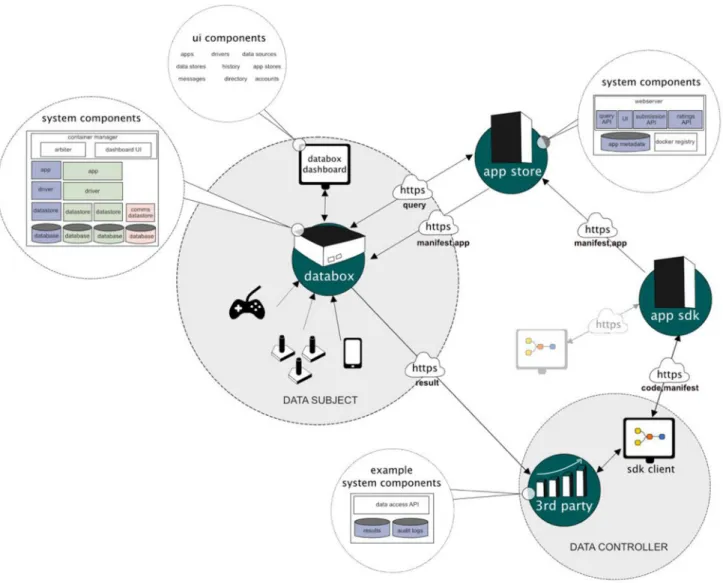
Fig. 1 Enabling external accountability: the IoT Databox Model
reduce the attack surface and management problems associ-ated with general purpose operating systems.
4.2 Architecture of the model
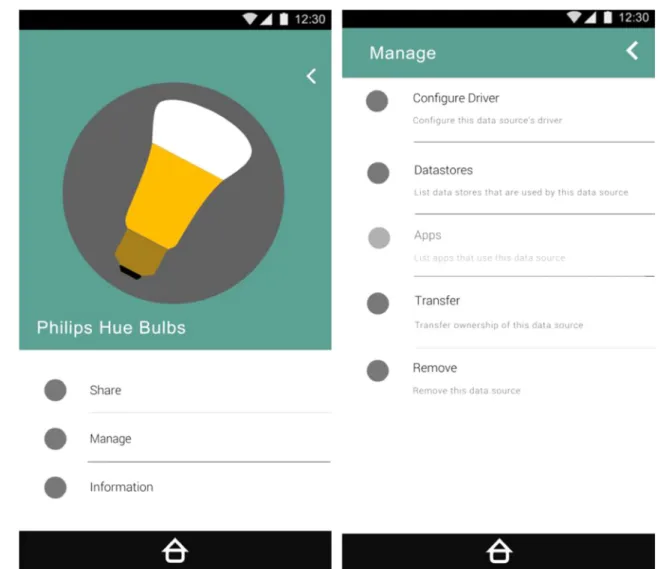
Architecturally the IoT Databox model consists of three key components: theDatabox, anapp store(of which there may be many), and third partyprocessors(Fig.1). Data processing is done through apps that run on the Databox and are publi-cally distributed by developers via the app store. The Databox itself is a small form factor (×86 or ARM) computer consist-ing of a collection of containerised system services includconsist-ing thedashboard(Fig.2), which provides Databox users with a range of management functions including:
• Creating User Accountson the Databox and activating sharing permissions (e.g., that consent from all users of shared resources is required for delete actions).
• Adding Data Sources to the box; including assigning ownership to data sources, annotating data sources (e.g., smart plug X is ‘the kettle’), and sharing data sources with other Databox users.
• ConfiguringDriversto enable data sources to write to data stores.
• Managing Data Stores; including sharing stores with other Databox users, and redacting, clearing, or deleting stores.
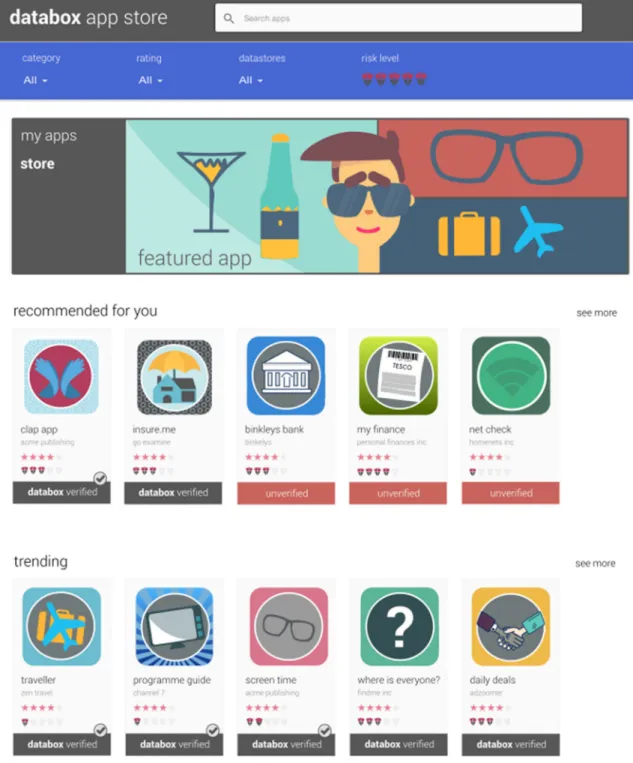
• AccessingApp Stores; apps are recommended by the box based on available data sources but individuals can also search for, download, and rate apps.
• Sharing Apps, with other users within the home and between distributed Databoxes in other homes; the Dash-board also allows apps to be updated and deleted. • Receiving Notifications; including the results of data
Fig. 2 The databox dashboard
• Auditing data processing operations; including all accesses to data stores, and any data transactions.
The app store is a cloud-based service, interacted with using standard internet protocols (principally HTTPS). It consists of a web server that provides the app store UI supporting human interaction, and a query API providing for program-matic (machine-based) interaction. The app store manages a docker repository [8] of apps, which are uploaded via the app submission API and indexed by associated metadata.
4.3 App development
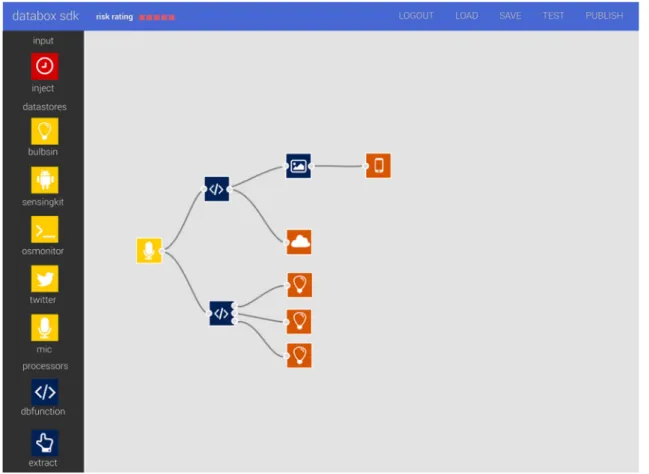
App developers are free to create their own containerised apps as they wish, but the app store provides a dedicated app SDK supporting the app building and publication process. This is a cloud-hosted visual code editor based on IBM’s open source Node-RED [24], which utilises a flow-based programming paradigm in which black-box processes called
‘nodes’ are connected together to form applications called ‘flows’.
There are three principle node types:data sources,processes
and outputs. Process nodes are functions that operate on data; they typically have a single input connection and one or more output connections.Outputnodes typically perform an action, such as actuation, visualisation, or data export. Fig-ure3 depicts a flow taking the output from a microphone, performs some processing on the data and updates a visuali-sation, turns on one or more bulbs, and exports the processed data to the cloud. It is composed of a single data source (yellow node), three processes (blue nodes) and five outputs (orange nodes).
struc-Fig. 3 The IoT Databox App SDK
ture and type of data entering and exiting a node); it provides a full testing environment, where flows are deployed (as containers) and connected to test data; it handles the app publication process by presenting tools for building a ‘mani-fest’ (Fig.6) enabling end-user consent and granular choice; and, upon submission, it containerises an app and uploads it to the app store. The SDK also takes care of source code management as all stages of the app development cycle are recorded in a developer’s GitHub account.
4.4 Managing risk
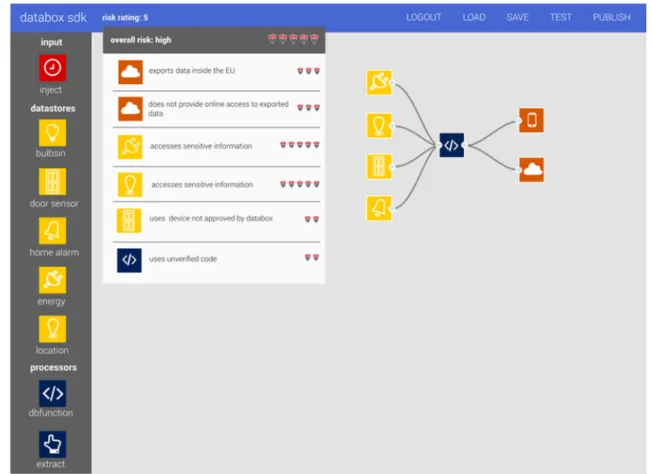
Importantly the SDK also seeks to sensitize app developers to the potential risks that accompany personal data processing. We differentiate between three types of risk:legal risks asso-ciated with GPDPR, particularly those implicated in taking data off-the-box including data export within the EU, out-side the EU, transfer to other recipients, the provision of adequacy decisions or safeguards, and access;technological risks, including apps that use devices that have not been vali-dated by the SDK, use unverified code, or physically actuate essential infrastructure or potential dangerous devices in the home; andsocial risks, including apps that access sensitive information or produce results that may be deemed sensitive
(as articulated, for example, by the notion of ‘special cate-gories’ of personal data in Article 9 GDPR).We take the view that app developers should be clear about the nature and level of risk of posed by an app and provide precise information about the risks they potentially expose users to.
sam-Fig. 4 SDK risk rating apps during development
pling and reporting frequency, provide online access if apps take data of the box, clearly flag that they actuate essential infrastructure in the home (e.g., central heating or windows and doors), and exploit accredited hardware and trustworthy software. Low-risk apps are visibly ‘checked’ in the app store to display their Databox accredited status.
The risk rating assigned by the SDK is reflected in the app store once uploaded. For apps built outside the SDK, the app store reviews and rates them based on features and information provided, e.g., the absence of an API providing users with access to their data would result in a high-risk rating if data were taken off-the-box by an app. Apps may also be posted on the app store with an ‘unverified’ status, in which case their risk rating will also be high. However, an app cannot be posted on the app store or installed on the IoT Databox without a ‘manifest’ being in place, and data (i.e., the results of processing) cannot be transferred to a controller’s processors without a manifest being completed by the individual or data subject.
4.5 Enabling consent and granular choice
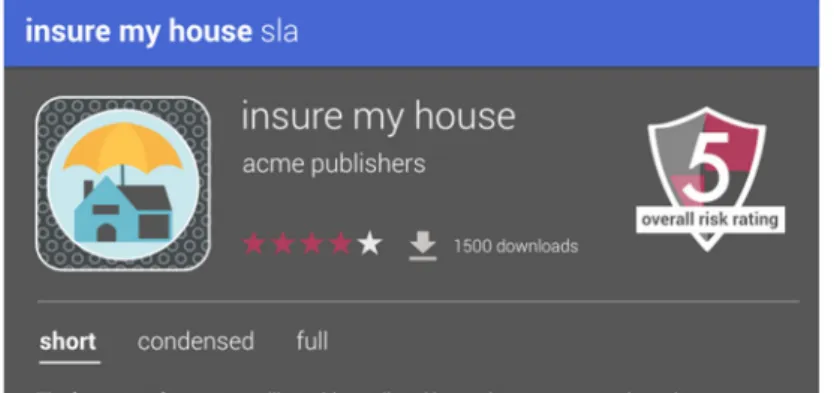
Manifests are ‘multi-layered notices’ [32], which (a) provide ashortdescription of the specific purpose of data
process-ing, (b) acondenseddescription providing the information required by GDPR, and (c)fulllegal terms and conditions. The IoT Databox also adds app information to the short description, including user ratings and an app’s risk profile, and enables control to be exercised over data collection at device level (Fig.6). Multi-layered notices are, thus, trans-formed into dynamic, user-configurable consent mechanisms that surface and articulate who wants to access which con-nected devices and what they want to process personal data for. Thus manifests make specific socio-technical data pro-cessing arrangements, implicating connected devices, data controller’s and their processors accountable to individuals and available to local control.
Fig. 5 At-a-glance risk (bars) and user ratings (stars)
upon by the individual and regulates subsequent data pro-cessing operations. Apps, like data stores, run within isolated containers and interact with data stores to perform a specified (purposeful) task defined in the SLA. Thus apps may query data stores, write to a communications data store that sends query results to external machines, or write to a connected device’s store to perform actuation. Data stores record all actions performed on them (queries, external transactions and
actuation) in an audit log. Access to data stores are enforced by the ‘arbiter’, which issues and manages the use of access tokens.
4.6 Making data processing accountable
Fig. 7 Building runtime accountability into apps
data and operate on users’ behalf, then we expect the ability to inspectwhathas happened andwhywill be a necessary feature of app usage. For example, I know my health insur-ance app provides quotations based on my activity, grocery shopping, location, and financial data, but just how has it arrived at the quotes that it does? Alternatively, one might wonder why the radiators in the living room were set to the maximum at 3 A.M. yesterday, or why a large order of toilet roll has appeared on the doorstep? Whatever the particular case, GDPR makes it clear that the logic, significance and consequences of automated processing be made accountable to individuals. This may in part be provided in the informa-tion contained in consent mechanisms as a preface to app use but, as the above examples indicate, there is also a need to buildruntime accountabilityinto the IoT.
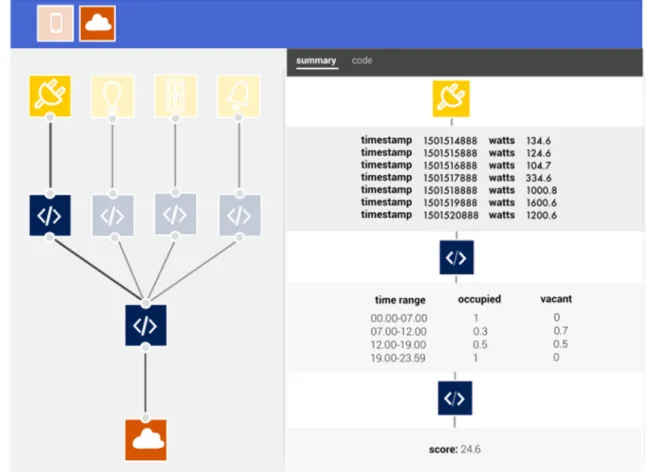
To enable runtime accountability, and in addition to dash-board notifications, apps created in our SDK are bundled with an inspection interface that surfaces how an app ‘operates’, i.e., how data flows through an app and how some action or decision is arrived at, in order to support real-time interro-gation by users. By way of example, Fig.7 illustrates how data is processed as it moves along the flow path. The path summarises how energy data is used as part of a calculation of a final score sent back to a third party to generate a home
insurance quote. The timestamp and watts listing displays the raw data from the energy data source. When it is subsequently processed by the first function node (in blue) it is transformed into an occupancy matrix for times of the day, with the values for house ‘occupied’ and ‘vacant’ represent probabilities in the range from 0 to 1. Finally these data, alongside data from other data sources implicated in the other flow paths (loca-tion, alarm and door sensor data), are provided to the final function to produce an overall score. As with our attempt to convey potential risk, this is a nascent first step towards enabling runtime accountability. Nonetheless we think it an important area of research and topic of future work, partic-ularly with respect to how an app’s operations are conveyed to users, given the emphasis placed on automated processing by GDPR.2
2 In discussion of this paper, it was asked if the Databox has
5 Responding to the privacy challenge
GDPR requires that external data subject accountability be built in to the digital ecosystem in a bid to respond to the privacy challenges occasioned by the emerging digital ecosystem. The Article 29 Working Party provides a num-ber of practical recommendations as to how data protection can be implemented in the IoT in particular. Together, these legal requirements and recommendations suggest that meet-ing the external data subject accountability requirement is a matter of enabling individual control over the flow of per-sonal data through the design of computational mechanisms that (a) provide for consent as an ongoing matter, (b) make data processing transparent, (c) permit fine-grained data flow management, (d) allow online access and data portability, and (e) exploit local processing entities to enforce control. The IoT Databox model provides an in principle means of meeting the external accountability requirement insofar as it provides tangible computational mechanisms that address these concerns.
ConsentThe requirement here is not only that users be able to consent to data processing in the IoT, but also they can do so as an ongoing matter and thus revoke consent. Consent is provided for by the IoT Databox through dynamic multi-layered notices, which do not sit at some remove from data processing (e.g., on a remote website) but are installed on-the-box where processing occurs. That means they can also be uninstalled at any time by the user and data processing be terminated at will. We cannot guarantee that a connected device will still work, as per WP29 recommendations, but that is a matter for device manufacturers to address. TransparencyThe information required by GDPR to make data processing transparent—including purpose specifica-tion, recipients, transfers and salient details of automated processing—is also provided by multi-layered notices. Addi-tionally, the IoT Databox provides a raft of transparency mechanisms articulating the potential risks that attach to apps, dashboard notifications allowing users to review the
Footnote 2 continued
prior to data export, (b) by drilling down into data processing opera-tions in detail, and (c) by inspecting the audit log. In the fifth instance, it may also be possible to build apps that monitor the operations of apps automatically.
It was also suggested in discussion that in enabling runtime account-ability a potential conflict is revealed between what a third party might want to disclose about the inner workings of data processing (e.g., how an algorithm operates) and satisfying the external data subject account-ability requirement. We agree, but GDPR is clear: the logic, significance and consequences of automated processing, including profiling,must
be clearly accounted for (Article 13) insofar as data processing applies to EU citizens. It would appear that there is no way of resolving poten-tial conflict here other than to comply with the regulation, as a failure to comply with the basic conditions of processing, includinginformed
consent, could result in devastating fines of up to ¤20,000,000 or 4% of total annual worldwide turnover, whichever ishigher(Article 83).
result of data processing, runtime accountability mechanisms tracing data processing operations, and audit mechanisms that allow users to inspect the historical operations of apps on the box.
Fine-grained data flow managementMulti-layered notices also enable users to exercise granular choice over data col-lection, insofar as connected devices provide a range of data sampling frequencies. It is also the case that well-designed apps can support granular choice in offering users a range of reporting frequencies (e.g., continuous, hourly, daily, weekly, monthly) built into multi-layered notices. The IoT Databox additionally supports fine-grained data flow management in limiting and minimising data distribution, aggregating data on the box and only returning the results of processing to a controller. Raw data thus remains on-the-box subject to user control.
Access and portabilityInsofar as raw data remains on-the-box, and audit mechanisms log all processing operations, then data portability is non-issue in the IoT Databox model: the data are always available and the results of specific queries can always be recovered. Providing access to data that has been transferred off-the-box is more problematic. Minimally data controllers will have to provide a secure data endpoint and an encrypted connection if they wish to take any data off-the-box, which the box will monitor. While access is a legal requirement under GDPR, we cannot enforce it. We can encourage it, however, by attaching relatively high risk profiles to apps that take data off-the-box but do not provide online access and, where possible, recommending alterna-tives.
Local controlSituated at the edge of the network, the IoT Databox enables local control, which is seen as key to user empowerment. Taking computing to the data, rather than data to the computing, provides individuals with strong privacy management mechanisms. It also has potential computa-tional advantages, decreasing latency, enhancing resilience insofar as devices only need to talk to a local box rather than a remote server, and decreasing network traffic insofar as this approach is adopted at scale, not to mention greater availability and access to data [13].
5.1 Fit with the state of the art
We are not the first to espouse the virtues of privacy-preserving platforms. A raft of Personal Data Stores (PDS) have emerged over recent years. Many provide users, like Mydex [23], with encrypted data stores distributed across the cloud against which a wide a variety of third party appli-cations can be run. Despite the phenomenal growth in PDS solutions—the WEF reports that more than one a week was launched between January 2013 and January 2014 alone [37]—widespread public uptake has been problematic. Iron-ically, a recent report suggests that this is due to ‘perceptions of privacy and security risks’ individuals attach to storing their personal datain the cloud[17].
Alternatives are provided by solutions such as openPDS and HAT. OpenPDS [6] is hosted on either a smartphone or an internet-connected hard drive situated in the home. OpenPDS provides users with a centralized location for storing personal data and exploits the ‘SafeAnswers’ approach [7] to com-pute third-party queries inside a software sandbox within the user’s PDS returning, like the IoT Databox, only the results of processing not the raw data. HAT [36] provides users with a personal container that also stores data client-side. Purpose-built ‘data plugs’ fish personal data from APIs and deposit it into a user’s personal HAT container. HAT-enabled applica-tions access data through ‘data debits’, which permit access to raw data in return for specific services. The primary pur-pose of HAT is to create a marketplace that redresses the current asymmetry in data harvesting and builds users into the personal data value chain.
The MyData initiative [25] takes a different approach again. It does not provide a PDS solution, but instead seeks to enable consent management. MyData thus provides a dig-ital service that focuses on managing and visualising data use authorisations, rather than storing data itself. It seeks to encourage service providers to build MyData APIs, which enable their services to be connected with MyData accounts. MyData APIs enable interaction between distributed data sources and data users, and the MyData account provides users with a single hub for granting services the authority to access and use their personal data. While the MyData account lets individuals activate or deactivate the sharing of specific data flows and lists currently active authorisations, it does not put further measures in place to limit access and minimise data distribution.
Both MyData and HAT expose raw data to applications and thus fail to limit the potential ‘function creep’ [34] that currently characterises data processing in the IoT and results in personal data flowing unfettered around the ecosystem. Both openPDS and the IoT Databox put severe constraints on the flow of data, minimising it to the results of data pro-cessing. While this too has the potential to expose users in ways they might not wish, e.g., through running multiple
applications from a developer that allows them to build rich profiles from an array of returned results, the risk can be mit-igated, e.g., through applications that monitor app usage and notify users as to the potential inferences that can be drawn from combined processing results.
Although openPDS is ‘aligned with the European Com-mission’s reform of the data protection rules’ [6], the IoT Databox seeks to respond directly to the external accountabil-ity requirement mandated by GDPR. In doing so, it provides usersanddevelopers with a more extensive set of tools for GDPR compliant data processing in the IoT. Along with a suite of computational mechanisms enabling consent, fine-grained data flow management and transparency, not only of what data is required for what purpose by whom but also of runtime operations and processing results prior to dis-tribution, the IoT Databox provides a dedicated application development environment fostering a culture of accountabil-ity in the IoT.
Furthermore, the IoT Databox moves beyond the ‘individual-centric’ [7] approach adopted by openPDS and other solu-tions. As [4] point out, most personal data do not belong to a single individual but aresocialin nature, especially in the IoT where connected devices are embedded in the fabric and furniture of buildings. The ability to share devices, data, and applications within and between homes, and to collec-tively as well as individually manage data processing, is also a unique feature of the IoT Databox model.
6 Conclusion
The European Union has introduced new data protection regulation (GDPR) that comes into force in 2018. The regula-tion is largely motivated by the effects of digital technology, which make it difficult for individuals or data subjects to know and understand whether, by whom and for what pur-pose personal data are being collected and processed. The European data protection agency WP29 views the IoT—an infrastructure designed to communicate and exchange data unobtrusively and in a seamless way—as particularly prob-lematic, raising new and significant privacy challenges. The regulation has global reach and applies regardless of whether or not data processing takes place in the Union if it leverages personal data to monitor or deliver goods and service to indi-viduals in the Union. It is also punitive, exacting heavy fines on data controller’s or parties who process personal data, and otherwise provide individuals with the means to process per-sonal data for household purposes, who flaunt the regulation. A key pillar of the regulation is the accountability require-ment:
Accountability has two distinct aspects to it. One ‘inter-nal’, requiring that data processing entities demonstrate to themselves that their operations comply with the regulation. The other ‘external’, requiring that data processing entities demonstrate to others, particularly supervisory authorities and data subjects, that their operations comply with the regulation. The demonstrations are not equivalent, and can-not be provided for in the same ways. The external data subject accountability requirement in particular requires a raft of measures be put in place to enable consent, make data processing transparent, permit fine-grained data flow management, online access and data portability. Recom-mendations from WP29 for IoT developers also advocate providing granular choice, limiting data distribution, and enabling local control to enforce user control over data pro-cessing.
These mandated measures and recommendations mark the shifting status of the external data subject accountabil-ity requirement, from non-functional and the provision of information to functional and the implementation of compu-tational mechanisms thatbuild accountability into the IoT. This paper has sought to address how this might be achieved. We have sketched out the external data subject requirement as laid down by new regulation, and salient recommendations provided by WP29 for making the IoT GDPR compliant, and how these might be built into the ecosystem via the IoT Databox model.
The model builds on prior work on B2C service ori-ented architectures to enable a new wave of personal digital services and applications to individuals. The IoT Databox is an edge solution that implements the local control rec-ommendation and collates personal data on a networked device situated in the home. It meets the external account-ability requirement by surfacing the interactions between connected devices and data processors [9], and articulating the social actors and activities in which machine-to-machine interactions are embedded through a distinctive range of computational mechanisms [26]:
DataboxA physical networked device situated in the home enabling users to exercise direct control over IoT devices and to manage both internal (within the home) and exter-nal (third party) access to the data they generate. The IoT Databox puts the principle of data minimisation into effect, taking computing to the data, and limiting the potential for excessive self-exposure and function creep in executing pro-cessing locally and only returning the results of third party queries.
App storeA familiar environment enabling users to access data processing services and providing resources to make informed choices about the services they wish to use, includ-ing app verification, risk ratinclud-ings, and feedback from the user community. The app store puts the principle of self-determination into effect, and allows individuals to exercise
direct control over the specific data processing operations that run on the Databox.
AppsApps provide a key interface for articulating the trans-parency requirements of GDPR in terms of manifests, which articulate who wants what data for what purposes along with recipients of the data, data transfers, and the nature of any automated processing that may be applied. App manifests put the principle of informed consent into effect, and in being dynamic objects (not just text) further allow users to exercise granular choice over data collection to enable fine-grained data flow management.
DashboardThe Databox dashboard enables individual and collective management of data processing operations. It allows users to exercise fine-grained control over device, data and app use between Databox users both within and between homes. It enables consent to be exercised in an ongoing manner, including revoking it at any time. And pro-vides further transparency mechanisms on data processing operations, both at runtime and on completion, allowing indi-viduals to terminate third party queries should they wish. The dashboard thus enables individuals to exercise further fine-grained control over data processing and the flow of data. SDK The SDK provides developers with an environment enabling accountability to be built into IoT Databox apps, supporting manifest construction to meet the information requirements of GDPR, enhanced granular choice over data collection, and providing for runtime accountability in sur-facing how data flows through an app and how some action or decision is arrived at. The SDK also exploits a risk-based framework to motivate development of GDPR compliant apps providing access to data taken off-the-box.
In adopting the local control recommendation and moving data processing to the edge of the network to ensure the indi-vidual can control the flow of personal data, the IoT Databox model may enhance the efficiency of data processing, make actuation more resilient, minimize the impact of IoT traf-fic on the network, and negate the need for costly privacy regimes. Insofar as it is possible for data processing and data to demonstrablystay on-the-boxthen the IoT Databox model also holds the promise of opening up personal data, giving individuals the confidence to allow data processing across manifold sources of personal data rather than single con-nected devices.
We, thus, envisage validating the performance of the IoT Databox model on different hardware, including relatively powerful devices (such as Intel NUCs) and relatively cheap devices (such as Raspberry Pi 3s), using various macro and micro benchmarks. The former includes end-to-end bench-marks which will assess temporal performance of the IoT Databox model on different hardware platforms. The latter will include evaluations of the memory footprint of compo-nents as the number of apps, drivers and data sources scale up; read/write performance of data stores as the number of stores scales up; latency and throughput limitations introduced by the networking component; the impact of logging; and any constraints introduced by token minting and validation).
Technical measures are necessary but not sufficient to val-idate the IoT Databox, it is also imperative that it meets human need. Two stakeholder groups are of particular rele-vance: industry and end users. We thus envisage verifying IoT Databox utility from industry and end-user perspectives. This will include documenting industry engagement, uptake and use, which is already in progress through the development of project partner use cases. It will also involve deploying the IoT Databox in end-users’ homes and evaluating its use from the mundane perspective of everyday life.
Despite its symbolic status, the IoT Databox model is not a theoretical model. It exists [1,21], albeit in nascent form and its source code is freely available for widespread use [5]. It enables data controllers and app developers working on their behalf to demonstrate compliance with the external data subject accountability requirement. Its ability to support local computation minimises and even circumvents the widespread threat to privacy occasioned by the IoT. And in circumventing the privacy threat, it opens up new possibilities for exploiting personal data in ways that build consumer confidence, and with it widespread trust, into the IoT.
“Data protection must move from ‘theory to practice’ … accountability based mechanisms have been sug-gested as a way [to] … implement practical tools for effective data protection [31].”
Acknowledgements This work was supported by the Engineering and Physical Sciences Research Council (Grant Numbers EP/M001636/1, EP/N028260/1, EP/M02315X/1).
Open Access This article is distributed under the terms of the Creative Commons Attribution 4.0 International License (http://creativecomm ons.org/licenses/by/4.0/), which permits unrestricted use, distribution, and reproduction in any medium, provided you give appropriate credit to the original author(s) and the source, provide a link to the Creative Commons license, and indicate if changes were made.
References
1. Amar Y, Haddadi H, Mortier R (2016) Privacy-aware infrastruc-ture for managing personal data. In: Proceedings of SIGCOMM, Florianópolis, ACM, pp 571–572
2. Chaudry A, Crowcroft J, Howard H, Madhavapeddy A, Mortier R, Haddadi H, McAuley D (2015) Personal data: thinking inside the box. In: Proceedings of critical alternatives, Aarhus, ACM, pp 29–32
3. Chiang M, Shi W (2016) NSF workshop report on grand challenges in edge computing.http://iot.eng.wayne.edu/edge/NSF%20Edge %20Workshop%20Report.pdf. Accessed 18 Aug 2017
4. Crabtree A, Mortier R (2015) Human data interaction: historical lessons from social studies and CSCW. In: Proceedings of ECSCW, Springer, Oslo, pp 1–20
5. Databox,https://www.databoxproject.uk/code/
6. de Montjoye Y, Wang S, Pentland A (2012) On the trusted use of large-scale personal data. Bull IEEE Tech Comm Data Eng 35(4):5–8
7. de Montjoye Y, Shmueli E, Wang S, Pentland A (2014) “openPDS” protecting the privacy of metadata through SafeAnswers., PLOS One.https://doi.org/10.1371/journal.pone.0098790. Accessed 18 Aug 2017
8. Docker,https://www.docker.com. Accessed 18 Aug 2017 9. Dourish P, Button G (1998) On technomethodology: foundational
relationships between ethnomethodology and system design. Hum Comput Interact 13(4):395–432
10. FTC Staff Report (2015) Internet of things: privacy and security in a connected World.https://www.ftc.gov/system/files/documents/ reports/federal-trade-commission-staff-report-november-2013-w orkshop-entitled-internet-things-privacy/150127iotrpt.pdf. Accessed 18 Aug 2017
11. Gellman R (2016) Fair information practices: a basic history.
https://papers.ssrn.com/sol3/papers.cfm?abstract_id=2415020. Accessed 18 Aug 2017
12. General Data Protection Regulation (2016) Official Journal of the European Union, vol 59, pp 1–88
13. Harper J (2016) The necessity of edge computing with the inter-net of things. https://analyticsweek.com/content/the-necessity-of-edge-computing-with-the-internet-of-things/. Accessed 18 Aug 2017
14. ICLG (2017) Data Protection 2017 USA. https://iclg.com/practice-areas/data-protection/data-protection-2017/usa. Accessed 09 Aug 2017
15. ICO (2017) Accountability and Governance. https://ico.org.uk/ for-organisations/data-protection-reform/overview-of-the-gdpr/ accountability-and-governance. Accessed 18 Aug 2017
16. ICO, Processing Personal Data Fairly and Lawfully (Principle 1), https://ico.org.uk/for-organisations/guide-to-data-protection/ principle-1-fair-and-lawful/. Accessed 18 Aug 2017
17. Larsen R, Brochot G, Lewis D, Eisma F, Brunini J (2015) Personal data stores.https://ec.europa.eu/digital-agenda/en/news/study-per sonal-data-stores-conducted-cambridge-university-judge-busine ss-school. Accessed 18 Aug 2017
18. Mahmud R, Buyya R (to appear) Fog computing: a taxonomy, survey and future directions. In: Di Martino B, Li KC, Yang L, Esposito A (Eds), Internet of everything: algorithms, methodolo-gies, technologies and perspectives, Springer, Singapore.https:// arxiv.org/pdf/1611.05539.pdf. Accessed 18 Aug 2017
19. McAuley D, Mortier R, Goulding J (2011) The dataware manifesto. In: Proceedings of the 3rd international conference on communi-cation systems and networks, Bangalore, IEEE, pp 1–6
The%20Internet%20of%20Things%20The%20value%20of %20digitizing%20the%20physical%20world/The-Internet-of-things-Mapping-the-value-beyond-the-hype.ashx. Accessed 18 Aug 2017
21. Mortier R, Zhao J, Crowcroft J, Qi Li LW, Haddadi H, Amar Y, Crabtree A, Colley J, Lodge T, Brown A, McAuley D, Greenhalgh C (2016) Personal data management with the Databox: what’s inside the box? In: Proceedings of the ACM workshop on cloud-assisted networking, Irvine, ACM, pp 49–54
22. Mudhavapeddy A, Scott D (2014) Unikernels: the rise of the virtual library operating system. Commun ACM 57(1):61–69
23. Mydex,https://mydex.org. Accessed 18 Aug 2017 24. Node Red,https://nodered.org. Accessed 18 Aug 2017
25. Poikola A, Kuikkaniemi K, Honko H (2015) MyData—a nordic model for human-centered personal data management and pro-cessing. http://urn.fi/URN:ISBN:978-952-243-455-5. Accessed 18 Aug 2017
26. Robertson T, Wagner I (2015) CSCW and the internet of things. In: Proceedings of ECSCW, Springer, Oslo, pp 285–294 27. Singer N (2016) Why a push for online privacy is bogged down in
Washington. New York Timeshttps://www.nytimes.com/2016/02/ 29/technology/obamas-effort-on-consumer-privacy-falls-short-cr itics-say.html. Accessed 18 Aug 2017
28. Strategic Headquarters for the Promotion of an Advanced Infor-mation and Telecommunications Network Society (2014) Policy outline of the institutional revision for utilization of personal data.
http://japan.kantei.go.jp/policy/it/20140715_2.pdf. Accessed 18 Aug 2017
29. SWD (2016) 110 Final Advancing the Internet of Things in Europe.http://eur-lex.europa.eu/legal-content/EN/TXT/PDF/? uri=CELEX:52016SC0110&from=EN. Accessed 18 Aug 2017 30. Shi W, Cao J, Zhang Q, Li Y, Xu L (2016) Edge computing: vision
and challenges. IEEE Int Thing J 3(5):637–646
31. WP173 (2010) Opinion 3/2010 on the principle of accountabil-ity. Article 29 Data Protection Working Party http://ec.europa. eu/justice/data-protection/article-29/documentation/opinion-reco mmendation/files/2010/wp173_en.pdf. Accessed 18 Aug 2017
32. WP202 (2013) Opinion 02/2013 on apps and smart devices. Article 29 Data Protection Working Party. http://ec.europa. eu/justice/data-protection/article-29/documentation/opinion-reco mmendation/files/2013/wp202_en.pdf. Accessed 18 Aug 2017 33. WP203 (2013) Opinion 03/2013 on purpose limitation. Article 29
Data Protection Working Party. http://ec.europa.eu/justice/data-protection/article-29/documentation/opinion-recommendation/ files/2013/wp203_en.pdf. Accessed 18 Aug 2017
34. WP233 (2014) Opinion 8/2014 on recent developments on the internet of things. Article 29 Data Protection Work-ing Party, http://www.dataprotection.ro/servlet/ViewDocument? id=1088. Accessed 18 Aug 2017
35. WP248 (2016) Guidelines on data protection impact assessment. Article 29 Data Protection Working Party. http://ec.europa.eu/ newsroom/document.cfm?doc_id=44137. Accessed 18 Aug 2017 36. Ward P (2015) Hub of all things. Digital Leaders, British Computer
Society, pp 58–59
37. World Economic Forum (2014) Rethinking personal data: a new lens for strengthening trust. http://www3.weforum.org/docs/ WEF_RethinkingPersonalData_ANewLens_Report_2014.pdf. Accessed 18 Aug 2017