This is a repository copy of Interpreting nowhere dense graph classes as a classical notion
of model theory.
White Rose Research Online URL for this paper:
http://eprints.whiterose.ac.uk/101104/
Version: Accepted Version
Article:
Adler, H and Adler, I (2014) Interpreting nowhere dense graph classes as a classical notion
of model theory. European Journal of Combinatorics, 36. pp. 322-330. ISSN 0195-6698
https://doi.org/10.1016/j.ejc.2013.06.048
© 2013, Elsevier. Licensed under the Creative Commons
Attribution-NonCommercial-NoDerivatives 4.0 International
http://creativecommons.org/licenses/by-nc-nd/4.0/
Reuse
Unless indicated otherwise, fulltext items are protected by copyright with all rights reserved. The copyright exception in section 29 of the Copyright, Designs and Patents Act 1988 allows the making of a single copy solely for the purpose of non-commercial research or private study within the limits of fair dealing. The publisher or other rights-holder may allow further reproduction and re-use of this version - refer to the White Rose Research Online record for this item. Where records identify the publisher as the copyright holder, users can verify any specific terms of use on the publisher’s website.
Takedown
If you consider content in White Rose Research Online to be in breach of UK law, please notify us by
Interpreting nowhere dense graph classes
as a classical notion of model theory
Hans Adler
Vienna University, Austria [email protected]
Isolde Adler
Goethe University Frankfurt, Germany [email protected]
June 18, 2013
Abstract
A class of graphs is nowhere dense if for every integerrthere is a fi-nite upper bound on the size of complete graphs that occur asr-minors. We observe that this recent tameness notion from (algorithmic) graph theory is essentially the earlier stability theoretic notion of superflat-ness. For subgraph-closed classes of graphs we prove equivalence to stability and to not having the independence property. Expressed in terms of PAC learning, the concept classes definable in first-order logic in a subgraph-closed graph class have bounded sample complexity, if and only if the class is nowhere dense.
1
Introduction
Recently, Neˇsetˇril and Ossona de Mendez [14, 13] introducednowhere dense classes of finite graphs, a generalisation of many natural and important classes such as graphs of bounded degree, planar graphs, graphs excluding a fixed minor and graphs of bounded expansion. These graph classes play an important role in algorithmic graph the-ory, as many computational problems that are hard in general become tractable when restricted to such classes. All these graph classes are nowhere dense. Dawar and Kreutzer [4] gave efficient algorithms for domination problems on classes of nowhere dense graphs. Moreover, nowhere dense classes were studied earlier in the area of finite model theory [2, 3] under the guise of(uniformly) quasi-wide classes and also turned out to be well-behaved.1 The book [11] covers the recent results
in this area.
1
In this paper we observe that nowhere density is essentially the stability theoretic notion of superflatness which was introduced by Podewski and Ziegler [12] in 1978 because of its connection to sta-bility.
For some time we have been looking for a way to translate between tameness in finite model theory and in stability theory. A key obstacle was the fact that tameness notions in finite model theory are generally not even invariant under taking the complement of a relation, whereas in stability theory the exact choice of signature does not matter and all first-order definable sets are a priori equal. It now appears that on graph classes such that every (not necessarily induced) subgraph of a member is again in the class, tameness notions from stability theory, finite model theory and also algorithmic graph theory can be compared in a meaningful though somewhat coarse way. For subgraph-closed classes of graphs we show that nowhere density is equivalent to stability and to dependence (not having the independence property, or, equivalently, all first-order formulas having finite Vapnik-Chervonenkis dimension).
The equivalence of stability and dependence in this context is some-what surprising, although it is well known under the stability theoretic assumption of simplicity. Stability and the independence property are two key dividing lines in Shelah’s classification theory programme for infinite model theory [15, 6]. A theory is stable if it does not have a first-order formula that codes an infinite linear order on a set of tuples. This strong and robust tameness property is the key assump-tion on which Shelah originally built his monumental machinery of stability theory. At the other end, theories with the independence property have a formula that can code every subset of some infinite set.2 Stability theory has recently made advances into general theories
without the independence property (see last section of [1] for point-ers), although much remains to be done. The independence property is a strong wildness property, even though some theories with the in-dependence property, such as that of the random graph, are actually very easy to understand from a stability-theoretic point of view. A formula has the independence property if and only if it has infinite Vapnik-Chervonenkis dimension – a key wildness notion in computa-tional learning theory [16, 10].
We hope for further translations between notions of tameness in stability theory and notions of tameness in combinatorial graph theory. This should allow us to identify well-behaved graph classes with good algorithmic properties. Moreover, we hope that these translations can ultimately be refined and extended to more general contexts such as
2
arbitrary classes of relational structures.
2
Shallow graph minors and nowhere
den-sity
In this paper graphs are undirected, without loops or multiple edges, and not necessarily finite. Notationally, we do not distinguish between a graphGand its vertex set (otherwise often denoted byV(G)). From the point of view of model theory, a graph is a relational structureG
with an irreflexive and symmetric binary relationEG ⊆G2. Thus each
edge{a, b}ofGis represented by two directed edges (a, b),(b, a)∈EG.
For the standard notions of graph theory we refer the reader to Diestel’s book [5].
H is aminor ofGif there is a subgraphU ⊆G(not necessarily an induced subgraph) and an equivalence relationǫonU with connected classes, such that H ∼= U/ǫ, i.e. H is the result of contracting each
ǫ-class to a single vertex in such a way that two distinctǫ-classes are connected by an edge if and only if there exist two respective mem-bers that are connected by an edge. H is an r-minor of Gif each ǫ -equivalence class contains a vertex from which the other vertices have distance at mostr.
H is a topological minor of G if there is a subgraph U ⊆ G(not necessarily an induced subgraph) and an equivalence relationǫonEU,
i.e. on the edges, such that eachǫ-class is a path whose interior vertices all have degree 2, andH ∼=U/ǫ, i.e.H is the result of contracting each
ǫ-class to a single edge. H is a topological r-minor of G if moreover eachǫ-equivalence class consists of at most 2r+1 edges. In other words, up to isomorphism the vertices of a topological (r-)minorH ofGform a subset of the vertices ofG(the branch vertices), and the edges ofH
correspond to pairwise internally vertex disjoint paths inG(of length at most 2r+ 1), whose interior points (subdividing vertices) avoidH. In the following, we will consider isomorphism-closed classes C of graphs. A (topological) (r-)minor ofCis a (topological) (r-)minor of a member ofC, respectively. We writeC ∇rfor the class ofr-minors of
C, and C∇er for the class of topological r-minors of C. In particular,
C ∇0 =C∇e0 is the class of all graphs isomorphic to a subgraph of a member ofC. Also noteC∇er⊆ C ∇r, (C ∇r)∇s⊆ C ∇(2rs+r+s) and (C∇er)∇es⊆ C∇e(2rs+r+s).
Neˇsetˇril and Ossona de Mendez proved that as r goes to infinity, there are only three possible asymptotic behaviours for the growth of the number of edges of finiter-minors, or equivalently finite topological
Fact 1.
lim
r→∞lim supH∈C ∇r Hfinite |H|→∞
logEH
log|H| = rlim→∞lim sup H∈C∇er Hfinite |H|→∞
logEH
log|H| ∈ {0,1,2},
whereEHand|H|are the number of edges and the number of vertices
ofH, respectively. Moreover, the quadratic case (right-hand side 2) is equivalent to the statement that for some r there is no finite upper bound on the sizes of complete graphs that occur as r-minors of C, or equivalently as topologicalr-minors.
They calledCnowhere densein the linearly bounded case, i.e. when for everyrthere is a finite upper bound for the sizes of complete graphs that occur asr-minors (or, equivalently, topologicalr-minors) ofC[14]. If C is nowhere dense, then so is every subclass of every class of the formC ∇r.3
An m-clique is a complete graph on m vertices, denoted by Km.
ByKr
mwe denote the result of subdividing each edge of the m-clique Km exactly rtimes. Essentially following Podewski and Ziegler [12],
we call C superflat if for every r there is an m such that Kr m does
not occur as a subgraph of a member of C. Using the finite Ramsey theorem (see e.g. [5]), it is easy to see:
Remark 2. LetC be a class of graphs. Cis nowhere dense if and only ifC is superflat.
3
Stability of graphs
Graphs and digraphs are examples of relational structures in the sense of first-order logic and model theory. Since we will later treat coloured digraphs in this framework, it is worth introducing some of the termi-nology in its general form. Arelational signature is a setσof relation symbols. Every relation symbolR∈σhas an associated non-negative integer ar(R), itsarity. Aσ-structureM consists of a non-empty setU
called theuniverse orunderlying set, and a relation RM ⊆Uar(R) for
everyR∈σ.4 It is customary to writea∈M instead ofa∈U. For
tu-ples ¯a∈U|¯a|, we simply write ¯a∈M (slightly abusing notation). For
the standard notions of model theory see the book by Hodges [9]. An
3
Neˇsetˇril and Ossona de Mendez only consider classes of finite graphs, but the version presented here is an obvious generalisation.
4
undirected graph is an{E}-structure Gwith a single, binary relation
EG that is irreflexive and symmetric.
The formulas of first-order logic are built in the usual way from variablesx, y, z, x1, . . ., the equality symbol =, the relation symbols in
σ, the Boolean connectives∧,∨,¬,→, and the quantifiers∀,∃ranging over the universe of the structure. A free variable in a first-order formula is a variable x that occurs outside the scope of a quantifier
∀x or ∃x. The notationϕ(¯x) or ϕ(x1, . . . , xn) indicates that all free
variables of the formula ϕoccur in ¯x= (x1, . . . , xn), a tuple without
repetitions. For a formulaϕ(x1, . . . , xn), a structure M and elements a1, . . . , anof the universe ofM we writeM |=ϕ(a1, . . . , an) to say that M satisfiesϕif the variablesx1, . . . , xnare interpreted by the elements a1, . . . , an, respectively. Moreover, we let ϕ(¯x)M := {a¯ ∈ M | M |= ϕ(¯a)}.
For example, we can use the following first-order formula to recog-nise a dominating set of sizekin a graph. A set of vertices X ⊆Gis called adominating set inG, if every vertex ofGis either inX or has a neighbour inX. Let
ϕDS(x1, . . . , xk) := ^
1≤i<j≤k
¬xi=xj∧ ∀y k _
i=1
y=xi∨ k _
i=1
Eyxi.
Then for any graph G and vertices a1, . . . , ak ∈ G we have G |= ϕDS(a1, . . . , ak) if and only if{a1, . . . , ak}is a dominating set of sizek
inG.
Let C be a class of structures of a fixed signature. A first-order formulaϕ(¯x,y¯) is said to have the order property with respect toC if it has the n-order property for all n, i.e. if for every n there exist a structureM ∈ C and tuples ¯a0, . . . ,¯an−1,¯b0, . . . ,¯bn−1 ∈M such that
M |= ϕ(¯ai,¯bj) holds if and only if i < j. A class C of structures is
called stable if there is no such formula with respect to C. It is easy to see that C is stable if and only if there is no formula ψ(¯u,v¯) with
|u¯| = |v¯|, such that for every n there exist a structure M ∈ C and tuples ¯c0, . . . ,¯cn−1 ∈M such that M |=ψ(¯ci,¯cj) holds if and only if i≤j, i.e. ψorders the tuples linearly.
Stability and the (n-)order property come from stability theory [15, 6], where they are defined for the class of models of a complete first-order theory. A single structureM is called stable if {M} is stable. This is equivalent to requiring that the class of all structures elementar-ily equivalent toM be stable, and so our notion of stability generalises the usual one. In this paper we are primarily interested in applying the concept to classes of finite graphs.
In this paper, we need to work with first-order interpretations with parameters.5 Fortunately, we will get away with a much simpler (yet
5
still complicated) special case.
For our purposes, a first-order interpretation I:C → D of a class
C ofσ-structures in a classDof τ-structures consists of the following data:
• for eachA∈ C a structureMA I ∈ D, • for eachA∈ C an elementcA
I ∈MIA, • for each structureA∈ Ca mapfA
I : A→MIA, • aτ-formulaδI(x, z),
• for eachσ-formulaϕ(¯x) aτ-formulaϕI(¯x, z).
Moreover, for an interpretation it is required that
• everyA∈ C satisfiesfA
I (A) =δI(x, cAI)M A I, and
• for anyA∈ C,σ-formulaϕ(¯x) and compatible tuple ¯a∈A,
A|=ϕ(¯a) ⇐⇒ MIA|=ϕI(fIA(¯a), cAI).
It is sufficient to haveϕI(¯x, z) given just for formulasϕ(¯x) without
quantifiers or connectives. Formulas ϕI for more general ϕcan then
be constructed by induction on the structure (or length) of a formula. Remark 3. IfC is interpretable inDandDis stable, then so isC.
The notion of superflatness was originally introduced by Podewski and Ziegler as a simple sufficient condition for stability of infinite graphs. A graph G is superflat in their sense if and only if {G} is superflat.
Fact 4 (Podewski, Ziegler [12]). Every superflat graph Gis stable.
Every subgraph of a superflat graph is superflat, but every graph is a subgraph of a complete graph, and complete graphs are stable in the sense of model theory. Therefore the converse of Fact 4 does not hold.
Lemma 5. Let C be a class of graphs. If C is superflat, then C is stable.
Proof. The basic idea is as follows. Let G(C) = ˙SA∈CA denote the graph which is the disjoint union of all graphs in C. If C is superflat, then so isG(C), and by Fact 4 the graphG(C) is stable.
If all graphs in C are connected and have a uniform upper bound on the diameter, then it is not hard to describe an interpretation ofC
in{G(C)}, and to conclude thatC is stable.
parameter cA
I, and the maps f A
go to (MA
I )
n
/ε, for some n ∈ N and an equivalence
With no such connectedness assumptions, we have to add another step. From every graphA∈ C we derive a graphA′ containing Aas
an induced subgraph. A′ has one additional vertex cA, andcAhas an
edge to every vertex ofA. Let C′ :={A′ | A∈ C}. It is easy to see
thatC′ andG(C′) are again superflat. HenceG(C′) is stable by Fact 4.
The following describes an interpretationI:C → {G(C′)}. • MA
I =G(C′) for allA∈ C, • fA
I is the obvious map from Ato its copy inG(C′), • cA
I =cA,
• δI(x, z) is the formulaE(x, z),
• ϕI(¯x, z) is the relativisation ofϕ(¯x) to the set of neighbours ofz.
E. g. ifϕ(x1, x2, x3) =∀x1∃x2∃x3 E(x1, x2)∧E(x2, x3)∧E(x1, x3)
, then the formulaϕI(x1, x2, x3, z) can be taken to be
∀x1 E(x1, z)→∃x2 E(x2, z)∧ ∃x3 E(x3, z)∧
[E(x1, x2)∧E(x2, x3)∧E(x1, x3)].
It is easy to see thatfA
I (A) =δI(x, cA)G(C
′)
and thatA|=ϕ(¯a) ⇐⇒
G(C′)|=ϕ
I(¯a, cA) for all ¯a∈A, so that I is in fact an interpretation.
AsC is interpretable in {G(C)} and G(C) is stable, by Remark 3 the classCis also stable.
4
Stability of coloured digraphs
In this section we extend Lemma 5 to classes of vertex- and edge-coloured directed graphs. More precisely, we extend it to relational structures where all relation symbols are at most binary.
By a coloured digraph we will understand a relational structure whose relation symbols are at most binary. The underlying graph or Gaifman graph M of a relational structure M is the graph with ver-tices the elements ofM and edges all pairs{a, b,}such thata6=band
aandbappear together in an instance of a relation ofM. (I.e. {a, b}
is an edge ofM if and only ifa6=b and there exist a relation symbol
Rand a tuple (c1, . . . , cn)∈RM such thata=ci,b=cjfor somei, j.)
Lemma 6. Every class C of coloured digraphs of a fixed countable signature can be interpreted in a class C′ of undirected graphs such
thatC′ is superflat if and only if C is superflat.
Proof. We enumerate the binary relation symbols in the signature of
CasR1,R2,R3,. . ., the unary relation symbols asP1,P2,P3,. . .and
the nullary relation symbols asA1,A2, A3,. . .. For a single coloured
digraphG∈ C, we define the following graphG′.
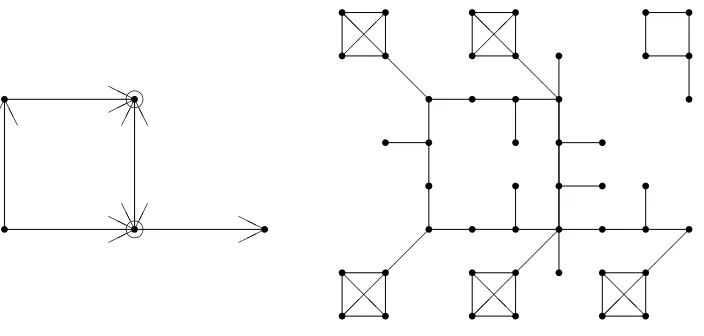
[image:9.595.131.483.240.408.2]s s s s s ✐ ✐ ✁ ✁❆❆ ✁✁❆❆ ❆ ❆✁✁ ✟ ✟❍ ❍ ✟ ✟❍ ❍ ✟ ✟❍ ❍ s s s s s s s s s s s s s s s s ❅ ❅ ❅ ❅ ❅ ❅ s s s s ❅ ❅ ❅ ❅ ❅ ❅ s s s s ❅ ❅❅ s s s s ❅ ❅❅ s s s s ❅ ❅❅ s s s s s s s s s s s s s s s s s
Figure 1: Proof of Lemma 6. Example ofGwith one unary and one binary relation (depicted by circles and arrows, respectively), and corresponding G′. The small
connected component in the top right corner consists of the verticesd, d0, d1, d2, d3
and is recognisable as the only chordless 4-cycle inG′. As there are no nullary
rela-tion symbols in the signature, it serves no real purpose in this particular example.
All vertices ofGare also vertices ofG′. Moreover, for every vertex
aofGthere are four new verticesa0, a1, a2, a3ofG′ and edges (a, a0),
(a0, a1), (a0, a2), (a0, a3), (a1, a2), (a1, a3), (a2, a3)∈ EG
′
. (To make the graph undirected, we also need the opposite edges (a1, a0), (a2, a0),
(a3, a0), (a2, a1), (a3, a1), (a3, a2) ∈ EG
′
. From now on we will not make this explicit.) These 4-cliques will allow us to pick out the vertices of G inside G′ by means of a first-order formula, since there will be
no other 4-cliques inG′ and the 4-clique vertices will have no further
connections. For every vertex a ∈ PG
i we add to G′ new vertices c1, . . . , ci and the path (a, c1), (c1, c2),. . ., (ci−1, ci)∈EG
′
.
For every unordered pair{a, b}of vertices fromG(we allowa=b) such that (a, b) or (b, a) appears in one of the binary relations of G,
G′ contains new vertices c
ba and cab as well as edges (a, cba), (cba, cab), (cab, b) ∈ EG
′
every directed edge (a, b)∈ RG
i we add to G′ new vertices c1, . . . , ci
and the path (cab, c1), (c1, c2), . . . ,(ci−1, ci)∈EG
′
.
Finally, to treat the nullary relations in a similar way to the unary and binary cases, we add new verticesd, d0, d1, d2, d3and edges
(d, d0),(d0, d1),(d1, d2),(d2, d3),(d3, d0)∈EG
′
.
For eachisuch thatG|=Ai we attach a new pathc1, c2, . . . , ci tod.
We get C′ from C by treating each G ∈ C in this way. It is easy
to check thatC can be interpreted inC′ and thatC′ is superflat if and
only ifC is superflat. (For the interpretation, we do not actually need
cA
I in this case, so we can use formulasϕI(¯x, z) in which the variable zdoes not actually occur, and choose arbitrarycA
I ∈A.)
Theorem 7. LetC be a class of coloured digraphs of a fixed signature. IfC is superflat, then C is stable.
Proof. Since every formula contains only a finite part of the signature, we may assume that the signature is finite. By Lemma 6 we can interpretC in a superflat classC′ of graphs. By Lemma 5,C′ is stable.
It follows thatC is also stable.
With a minor extension of the same method, we can also prove the more general result for classes of structures of an arbitrary fixed signature.
5
Independence property
A first-order formulaϕ(¯x,y¯) is said to have theindependence property with respect toCif it has then-independence property for alln, i.e. if for everynthere exist a structureM ∈ Cand tuples ¯a0, . . . ,¯an−1∈M
and ¯bJ ∈ M for all J ⊆ {0,1, . . . , n−1} such that M |= ϕ(¯ai,¯bJ)
holds if and only ifi ∈J. C is said to be dependent or to have NIP if no formula has the independence property with respect toC. One can show thatϕ(¯u,¯v) has the independence property if and only if the ‘opposite formula’ϕ(¯v,u¯) (i.e. really the same formula, but listing the variables differently) has it. It is easy to see that every formula with the (n-)independence property has the (n-)order property. Therefore every stable class is dependent. See [1] for more on the independence property and its relation to the order property. A related notion is the VC dimension from statistical learning theory. Applied to a for-mula, it is essentially the greatest n such that the formula has the
n-independence property.[10]
a single structureM is called dependent if{M}is dependent or, equiv-alently, if the class of all structures elementarily equivalent to M is dependent.
Lemma 8. Let C be a subgraph-closed class of graphs. If C is depen-dent, thenC is superflat.
Proof. SupposeCis not superflat, i.e. for somer, everyKr
moccurs as a
subgraph of a member ofC. Since the following graphAmis a subgraph
ofKr
m+2m, it also occurs as a subgraph of a member ofC, hence is itself
a member ofC (up to isomorphism). Am has verticesa0, a1, . . . , am−1
and bJ for each J ⊆ {0,1, . . . , m−1} as well as additional vertices
that appear in the following. For any i ∈ {0,1, . . . , m−1} and any
J ⊆ {0,1, . . . , m−1} such thati∈J, there is a path of lengthr+ 1 from ai to bJ. The interior parts of these paths are pairwise disjoint
and disjoint from the set of vertices ai and bJ. There are no further
vertices or edges.
Letϕ(x, y) be the formula that says that there is a path of length
r+ 1 fromxtoy. SinceAm|=ϕ(ai, bJ) if and only ifi∈J, the family
of graphs Am witnesses that ϕ(x, y) has the independence property
with respect toC. SoC is not dependent.
It is an open question whether Lemma 8 can be generalised to relational structures of finite signatures.
We will call a classCof relational structuresmonotoneif whenever
M →Nis an injective homomorphism andN ∈ C, we also haveM ∈ C. In other words, a monotone class is closed under isomorphism and ‘non-induced substructures’, the natural generalisation of non-induced subgraphs to arbitrary signatures. Putting all the previous results together, we have the following theorem.
Theorem 9. LetC be a monotone class of coloured digraphs of a fixed finite signature. The following conditions are equivalent.
1. C is nowhere dense. 2. C is superflat. 3. C is stable. 4. C is stable. 5. C is dependent. 6. C is dependent.
Proof. The first two conditions are equivalent by Remark 2 and imply the third by Theorem 7. 3⇒5 and 4⇒6 because every stable formula is dependent. 3 ⇒ 4 and 5 ⇒ 6 because there is an interpretation
As a corollary to the proof, we see that to check stability or depen-dence of a monotone class of coloured digraphs it is sufficient to look at formulas of the formϕ(x, y) with single variablesxandy. This is not true in general.
The condition thatC be monotone is crucial. The class of all com-plete graphs is stable but not nowhere dense / superflat. It is also not hard to code the class of linear orders in a class of graphs that is depen-dent but not stable. Further it is crucial for the equivalence of stability and NIP that C is a class of relational structures (i.e. the signature does not contain function symbols), since the class of all linear orders coded by the binary function min is dependent but not stable. Also note that the underlying graph of a structure with a binary function symbol is always complete. Finally, in a signature with infinitely many binary relation symbols,C may not be interpretable in C, and in fact a monotone classCof such a signature may be stable even thoughC is not.
We obtain a corollary in computational learning theory, which can be seen as the analogue to an earlier result by Grohe and Tur´an, con-necting finite VC dimension of the monadic second order formulas on a subgraph-closed class with bounded tree-width [7].
Corollary 10. Let C be a subgraph-closed class of graphs. Every con-cept class definable in first-order logic on C has bounded sample com-plexity in the PAC model, if and only ifC is nowhere dense.
This immediately follows from Theorem 9 using the standard con-nection between VC dimension and sample complexity in the PAC model of computational learning theory (see e. g. [7]).
6
Conclusion
In this paper, we proved that for a class of graphsCthat is closed under subgraphs,C being nowhere dense is equivalent toCbeing stable, and to C being NIP (i.e. first-order definable concept classes on C being PAC learnable), and we extended this result to classes of coloured digraphs. We leave the following open problem.
Open problem. Can Theorem 9 be generalised to arbitrary relational structures with finite signatures?
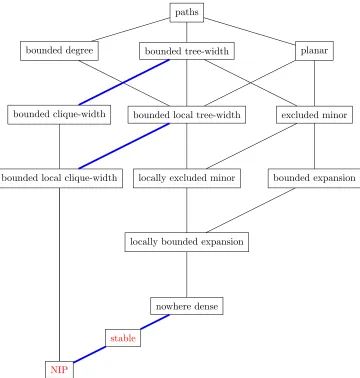
probably make a transfer of ideas from stability theory to the other fields more straightforward than in the other direction. It remains to be seen to what extent parts of stability theory (indiscernibles, forking or splitting, etc.) can be generalised to the new context and whether they are of any relevance to the algorithmically oriented fields.
Using work of Herre, Mekler and Smith [8] and a straightforward generalisation of the model theoretic notion of strong stability into our context, one can show that a class C of coloured digraphs such that C omits a finite topological minor, is strongly stable. Similar statements concerning further model theoretic dividing lines such as superstability or simplicity would be interesting, but for these notions the generalisation to arbitrary classes of structures seems to be less straightforward.
Finally, we hope that bringing together the tools from the different fields will make it easier to find a unifying combinatorial explanation for the algorithmically tame (or wild) behaviour of many graph classes.
References
[1] Hans Adler. Introduction to theories without the independence property. Arch. Math. Log. accepted.
[2] Anuj Dawar. Finite model theory on tame classes of structures. In Ludek Kuˇcera and Anton´ın Kuˇcera, editors,MFCS, volume 4708 ofLect. Notes Comput. Sc., pages 2–12. Springer, 2007.
[3] Anuj Dawar. Homomorphism preservation on quasi-wide classes. J. Comput. Syst. Sci., 76(5):324–332, 2010.
[4] Anuj Dawar and Stephan Kreutzer. Domination problems in nowhere-dense classes. In Ravi Kannan and K. Narayan Kumar, editors, FSTTCS, volume 4 of LIPIcs, pages 157–168. Schloss Dagstuhl – Leibniz-Zentrum f¨ur Informatik, 2009.
[5] Reinhard Diestel. Graph Theory, volume 173 of Grad. Texts in Math. Springer, 2005.
[6] Doug Ensley and Rami Grossberg. Finite models, stability, and Ramsey’s theorem, 1996.
[7] Martin Grohe and Gy¨orgy Tur´an. Learnability and definability in trees and similar structures. Theory Comput. Syst., 37(1):193– 220, 2004.
[8] Heinrich Herre, Alan H. Mekler, and Kenneth W. Smith. Super-stable graphs. Fund. Math., 118:75–79, 1983.
[10] M. Chris Laskowski. Vapnik-Chervonenkis classes of definable sets. J. London Math. Soc. (2), 45:377–384, 1992.
[11] Jaroslav Nesetril and Patrice Ossona de Mendez. Sparsity -Graphs, Structures, and Algorithms, volume 28 ofAlgorithms and combinatorics. Springer, 2012.
[12] Klaus-Peter Podewski and Martin Ziegler. Stable graphs. Fund. Math., 100:101–107, 1978.
[13] Jaroslav Neˇsetˇril and Patrice Ossona de Mendez. First order prop-erties on nowhere dense structures. J. Symb. Logic, 75:868–887, 2010.
[14] Jaroslav Neˇsetˇril and Patrice Ossona de Mendez. On nowhere dense graphs. Eur. J. Comb., 32(4):600–617, 2011.
[15] Saharon Shelah. Classification Theory and the Number of Non-Isomorphic Models. Stud. Logic Found. Math. North-Holland, 2nd edition, 1990.
paths
bounded local clique-width
nowhere dense
NIP
bounded degree planar
stable
bounded tree-width
bounded clique-width bounded local tree-width
bounded expansion
locally bounded expansion
excluded minor
[image:15.595.133.493.180.558.2]locally excluded minor