White Rose Research Online URL for this paper: http://eprints.whiterose.ac.uk/91345/
Version: Accepted Version
Article:
Armitage, C.J., Norman, P., Alganem, S. et al. (1 more author) (2015) Expectations Are More Predictive of Behavior than Behavioral Intentions: Evidence from Two Prospective Studies. Annals of Behavioral Medicine, 49 (2). 239 - 246. ISSN 0883-6612
https://doi.org/10.1007/s12160-014-9653-4
The final publication is available at Springer via http://dx.doi.org/10.1007/s12160-014-9653-4
[email protected] https://eprints.whiterose.ac.uk/
Reuse
Unless indicated otherwise, fulltext items are protected by copyright with all rights reserved. The copyright exception in section 29 of the Copyright, Designs and Patents Act 1988 allows the making of a single copy solely for the purpose of non-commercial research or private study within the limits of fair dealing. The publisher or other rights-holder may allow further reproduction and re-use of this version - refer to the White Rose Research Online record for this item. Where records identify the publisher as the copyright holder, users can verify any specific terms of use on the publisher’s website.
Takedown
If you consider content in White Rose Research Online to be in breach of UK law, please notify us by
Expectations Are More Predictive of Behavior Than Behavioral Intentions: Evidence
From Two Prospective Studies
Christopher J. Armitage, University of Manchester
Paul Norman, University of Sheffield
Soud Alganem, Kuwait University
Mark Conner, University of Leeds
Correspondence to:
Chris Armitage
Manchester Centre for Health Psychology, School of Psychological Sciences
Manchester Academic Health Science Centre, University of Manchester
Coupland Street, Oxford Road
Manchester, M13 9PL, UK
E-mail: [email protected]
Tel: +44 (0) 161 275 2556
Fax: +44 (0) 161 275 2623
Expectations Are More Predictive of Behavior Than Behavioral Intentions: Evidence
From Two Prospective Studies
Background. Understanding the gap between people’s behavioral intentions and their
subsequent behavior is a key problem for behavioral scientists, but little attention has been
paid to how behavioral intentions are operationalized.
Purpose. Test the distinction between asking people what they intend to do, as opposed to
what they expect they will do.
Methods. Two studies were conducted in the domains of alcohol consumption (N = 152) and
weight loss (N = 141). Participants completed questionnaires assessing their behavioral
intentions, expectations and self-efficacy at baseline; alcohol consumption/weight were
assessed at both baseline and follow-up.
Results. In Study 1, expectations were more predictive of alcohol consumption than
behavioral intentions, controlling for baseline alcohol consumption and self-efficacy. In
Study 2, changes in expectations were more predictive of weight loss than changes in
behavioral intentions, controlling for baseline weight and self-efficacy.
Conclusion. The findings support a potentially important distinction between behavioral
intentions and expectations.
Expectations Are More Predictive of Behavior Than Behavioral Intentions: Evidence
From Two Prospective Studies
Behavioral intentions – an aim or a plan and an index of how hard people are willing
to try to perform a particular behavior (1) - is a key concept in the psychology of behavior
change, yet people’s reported behavioral intentions are not always closely aligned with their
subsequent actions (2). One explanation for this gap between people’s stated intentions and
their subsequent behavior centers on whether people are asked what they intend to do (e.g., “I
intend to do x”), as opposed to what they expect they will do (e.g., “How likely is it that you
will do x?” [3]). The rationale behind this distinction is that although someone may have a
strong intention to change their behavior, they think it unlikely that they will actually do so
(e.g., because of the barriers that stand in their way).
The evidence to date suggests that people’s expectations are often more accurate than
their behavioral intentions. For example, Rothschild and Wolfers (4) showed that, among 77
polls where voters’ intentions and expectations diverged, expectations correctly forecasted
the outcome in 60 (78%) of the polls. Accordingly, expectations have been found to be more
predictive of behavior than intentions, confirming the importance of this distinction (5).
Despite this, measures of behavioral intention and expectation are routinely conflated,
perhaps because theorists and researchers have assumed that self-efficacy (“confidence in
one’s own ability”) bridges the gap between behavioral intentions and behavior by tapping
the factors that may facilitate or inhibit performance of a behavior (1)1. According to
Warshaw and Davis (3), the reason why expectations might be more predictive of behavior
than behavioral intentions is that expectations tap into perceptions of facilitators and
inhibitors (3). If this is the case, then measuring behavioral intention and self-efficacy
together should be as predictive as expectations. However, Armitage and Conner’s (2)
measures of expectation were used than when measures of behavioral intention were used
(1%). The implication is that self-efficacy does not explain differences in the predictive
validity of behavioral intentions versus expectations. As noted above, measures of
behavioral intention and expectation are routinely conflated and, in the period since Armitage
and Conner’s (2) meta-analysis, we were able to locate just one study (10) that examined the
distinction between behavioral intention and expectation, and controlled for self-efficacy.
McConnon et al. (10) tested the hypothesis that expectations would be more
predictive of weight loss than behavioral intentions, but reported null findings. However, the
items that McConnon et al. (10) used to measure behavioral intention and expectation were
framed in terms of “preventing weight gain in the next six months,” yet the study examined
only weight at the eight-week follow-up, meaning that Ajzen’s (1) principle of compatibility
was breached.
The aim of the present research was –25 years after Sheppard et al.’s (5)
meta-analysis – to see whether the distinction between behavioral intention and expectation is still
relevant when self-efficacy is statistically controlled. If expectations do tap into perceptions
of facilitators and inhibitors, then measuring behavioral intention and self-efficacy together
should be as predictive as expectations (3). However, Armitage and Conner’s (2) meta
-analysis suggests that expectations may be tapping more than just facilitators and inhibitors.
Study 1
Excess alcohol consumption exerts significant economic and social costs on society.
For example, despite high-profile public health campaigns and legal restrictions designed to
reduce alcohol consumption, alcohol-related admissions to English hospitals increased from
510,800 in 2002-03 to 1,057,000 in 2009-10 (11). Thus, Study 1 was designed to identify
It was hypothesized that, controlling for past drinking behavior and self-efficacy,
expectations would be the dominant predictor of subsequent alcohol consumption compared
to behavioral intention.
Method
Design
A prospective correlational study with two waves of data collection: Baseline
(Thursday) and follow-up (the following Monday). Demographic variables, alcohol
consumption, behavioral intention, expectation and self-efficacy were measured at baseline,
with a repeat measure of alcohol consumption taken at follow-up.
Participants and Procedure
The participants in the study were a convenience sample of 152 University students (42
males; 110 females) recruited via lectures. Each participant completed anonymous
questionnaires about drinking alcohol on a Sunday privately on two occasions: The first
questionnaire was completed on the Thursday prior to the Sunday and the second questionnaire
was completed on the following Monday. Based upon a personal code we were able to match
152 baseline and follow-up responses and analysis was based on these individuals. In asking
about a specific day, only three days in the future, we hoped to maximize the chance of having a
strong predictive effect. In measuring behavior the day after it had occurred we hoped to
minimize bias due to poor recall. Ethical approval was gained from the appropriate internal
review board.
Measures
The measures were assessed on 7-point scales scored -3 to +3 for the measures of
behavioral intention and expectation and +1 to +7 for the self-efficacy items. The items used
Behavioral intention with respect to “drinking alcohol next Sunday” was assessed by
presenting participants with the item: “I intend to drink alcohol next Sunday definitely do
not-definitely do.” Expectation was assessed with the item: “How likely is it that you will drink
alcohol next Sunday? unlikely-likely.” Self-efficacy was assessed with five items: “Whether I
drink alcohol next Sunday is entirely up to me strongly disagree-strongly agree;” “I am
confident that I could avoid drinking alcohol next Sunday if I wanted to strongly agree-strongly
disagree;” “How much control do you think you have over drinking alcohol next Sunday no
control-complete control;” “I would like to avoid drinking alcohol next Sunday but don’t know
if I can strongly agree-strongly disagree;” and “For me, drinking alcohol next Sunday will be
difficult-easy.” Cronbach’s for the scale indicated a lack of internal reliability ( = .45) and
so the five items were treated independently in the subsequent analyses.
Alcohol consumption was measured at both baseline and follow-up using an adapted
timeline follow-back procedure (12). Participants were asked at both baseline and follow-up to
describe the quantity and types of alcohol they had drunk on the preceding Sunday, which were
subsequently converted into standard units (8 grams ethanol = 1 unit) of alcohol.
Results
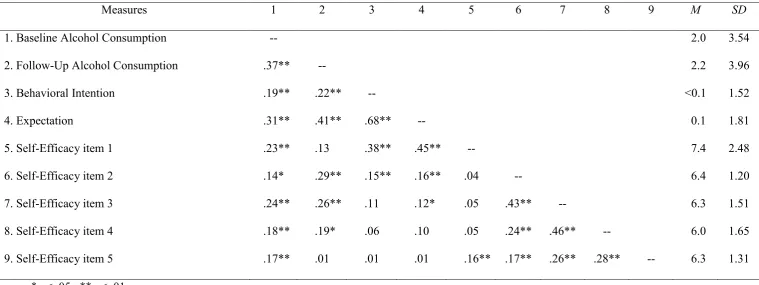
The means, standard deviations and intercorrelations between the key variables are
presented in Table 1. Evidence for discriminant validity between behavioral intention and
expectation is provided by the intercorrelation at baseline, r = .68, which is significantly
weaker than unity (i.e., by more than twice the standard error, SE = .05). Both behavioral
intention and expectation were significantly correlated with subsequent alcohol consumption,
but the correlation between subsequent alcohol consumption and expectation was stronger, r
= .41, p < .01, than that between subsequent alcohol consumption and behavioral intention, r
= .22, p < .01; a difference that was statistically significant (95%CI = 0.07, 0.31, p < .05,
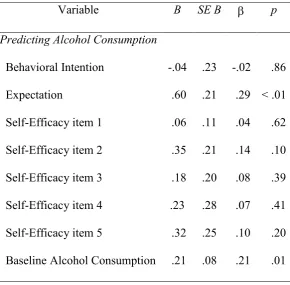
Follow-up alcohol consumption was regressed on behavioral intention, expectation,
self-efficacy, and past alcohol consumption (Table 2). Together, these variables accounted
for 26% of the variance in subsequent alcohol consumption, F(8, 143) = 6.41, p < .01. Prior
alcohol consumption and expectation were the only significant predictors of subsequent
alcohol consumption, with expectation being the stronger predictor.
In order to test whether expectation mediated the effects of prior alcohol consumption
on subsequent alcohol consumption, bootstrapping procedures for testing multiple potential
mediators were used (14). The analyses presented here are based on 10,000 resamples of
random subsets of data. Thus, the independent variable was prior alcohol consumption; the
mediators were behavioral intention, expectation and self-efficacy; the dependent variable
was subsequent alcohol consumption. The confidence intervals associated with behavioral
intention and self-efficacy both contained zero meaning that these variables did not
significantly mediate the effects of prior alcohol consumption on subsequent alcohol
consumption. However, the confidence intervals associated with the indirect effect of
expectation did not contain zero (95% CI = .02, .12). Thus, the effect of prior alcohol
consumption on subsequent alcohol consumption was significantly (p < .05) mediated by
expectation.
Discussion
The key findings from Study 1 were that expectation was more predictive of subsequent
alcohol consumption than was behavioral intention, and that expectation significantly mediated
the effect of past behavior on future behavior. This is potentially important because controlling
for baseline alcohol consumption in this way means that any variable that explains additional
variance in subsequent alcohol consumption provides some evidence for cause-and-effect
relations (15), and it is notable that expectations were more closely related to subsequent
From a public health perspective, it is plausible that challenging people’s expectations
(as opposed to their behavioral intentions or self-efficacy) might be an effective means of
bringing about changes in alcohol consumption. At least, targeted resources designed to reduce
alcohol consumption among people who expect they will drink in the future might be a valuable
strategy worthy of further research attention.
However, Study 1 suffered from several limitations. First, the internal reliability of the
self-efficacy measure was poor. Given that self-efficacy should compensate for the lack of
consideration of potential barriers (3), it would be valuable to replicate the study with an
improved measure of self-efficacy. Second, Study 1 was conducted in a single domain
(alcohol consumption), limited to a student sample, had a relatively short follow-up
(Thursday-Monday), and a self-reported outcome measure. Study 2 was therefore designed
to address these limitations.
Study 2
Study 2 was designed to extend Study 1 by examining the distinction between
behavioral intention and expectation: (a) in a non-student, treatment-seeking sample; (b)
using 6-month follow-up; and (c) employing superior measures, namely, an improved
self-efficacy measure and an objective outcome measure (weight).
Initial weight loss is relatively common among overweight/obese people in weight
loss programs, but the majority (c. 80%, [16]) do not sustain these initial changes in weight.
Identifying modifiable predictors of sustained weight loss is therefore important in enhancing
the effectiveness of weight loss programs. Teixeira et al.’s (17) systematic review of the
predictors of weight control identified “self-motivation” as a potential target.
Recently, McConnon et al. (10) tested the hypothesis that expectations would be more
predictive of weight loss, but reported null findings. As noted above, the measures in
sought to address in the present study, along with an examination of longer-term behavior
change. In addition, we sought to extend McConnon et al.’s (10) work by considering
changes in behavioral intentions and expectations as a result of initial weight loss to see
whether these changes are predictive of sustained weight loss. Taking account of possible
changes in “self-motivation” is important because effective regulation of behavior is
contingent on ongoing assessments of feedback (18). Given that people’s expectations are
likely to be more responsive to initial weight loss than people’s intentions, initial changes in
expectation should be more predictive of sustained weight loss (3). Our review of the
literature revealed no previous studies examining changes in participants’ expectations in
relation to weight loss.
Most of the research into tackling the overweight/obesity problem has been conducted
in the US and Europe, yet this volume of research does not reflect the distribution of excess
weight globally. The present research was conducted in Kuwait, where 80% of adults are overweight ([19]; cf. 38% in England [20]). To date, no studies have examined
psychological predictors of sustained weight loss anywhere in the Middle East.
In the present study it was hypothesized that, controlling for initial weight loss (the
dominant predictor of sustained weight loss [21]) and self-efficacy: (a) expectations will be
better predictors of sustained weight loss than behavioral intentions, and (b) changes in
expectations will mediate the effects of initial weight loss on sustained weight loss.
Method
Design
This was a prospective correlational study with three waves of data collection:
Baseline, four-week follow-up and six-month follow-up, the latter two of which map on to
the standard definitions of “initial” and “sustained” weight loss, respectively (21, 22).
efficacy were measured at baseline, with repeat measures of intention, expectation and
self-efficacy taken at week follow-up. Weight was extracted from clinic records at the
four-week and six-month follow-ups.
Participants and Procedure
Receptionists at private weight loss clinics in Kuwait City invited new registrants
with body mass indices >25 to participate in the research. No incentive was offered for
participation and, of the 273 people who were approached initially, 141 (51.6%) agreed to
participate in the study. The baseline sample consisted of 123 women and 18 men aged
between 20 and 65 (M = 32.1 years, SD = 12.41). Fourteen (9.9%) participants had no formal
qualifications and 44.0% (n = 62) had degree-level qualifications. The clinics provided
weekly one-to-one sessions with a dietician who focused on realistic goal setting and
personalized feedback to support very low calorie diets and moderate physical activity.
Ninety-eight (69.5%) people from the baseline sample were successfully contacted
again at four-week follow-up and 90 (63.8%) people from the baseline sample consented to
provide six-month follow-up data. MANOVAs revealed no significant differences in
baseline variables between those who remained in the study and those who withdrew at either
four-weeks, F(6, 91) = 0.27, p = .95, p2 = .02, or six-months, F(6, 83) = 0.82, p = .55, p2 =
.05. All data were analyzed according to intention-to-treat, with the last observations being
carried forward where data was missing. The patterns of findings remained the same without
analyzing according to intention-to-treat, excepting that the effect sizes were larger than those
reported here. The University Research Ethics Committee gave approval for the research.
Measures
The measures of behavioral intention and expectation were identical to those used in
Study 1 and were assessed on 7-point unipolar (+1 to +7) scales. The measure of
in Study 1. All items were forward and backward translated between Arabic and English
prior to administration. Consistent with Study 1, the items used to measure behavioral
intention and expectation were based on Armitage and Conner (2). Thus, behavioral
intention was measured using, “I intend to lose weight definitely do not-definitely do;” and
expectation was: “How likely is it that you will lose weight? very unlikely-very likely.” The
self-efficacy measure was adapted from Armitage (23): “How confident are you that you will
be able to lose weight? not very confident-very confident;” “My losing weight is/would
be…difficult-easy;” and “I believe I have the ability to lose weight definitely do not-definitely
do.” Cronbach’s indicated good internal reliability at baseline, = .71 and four-week
follow-up, = .76. Residualized change scores were used to capture changes in weight and
motivation over time. Initial weight loss was computed by regressing four-week weight on
baseline weight and sustained weight loss was computed by regressing six-month weight on
baseline weight.
Results
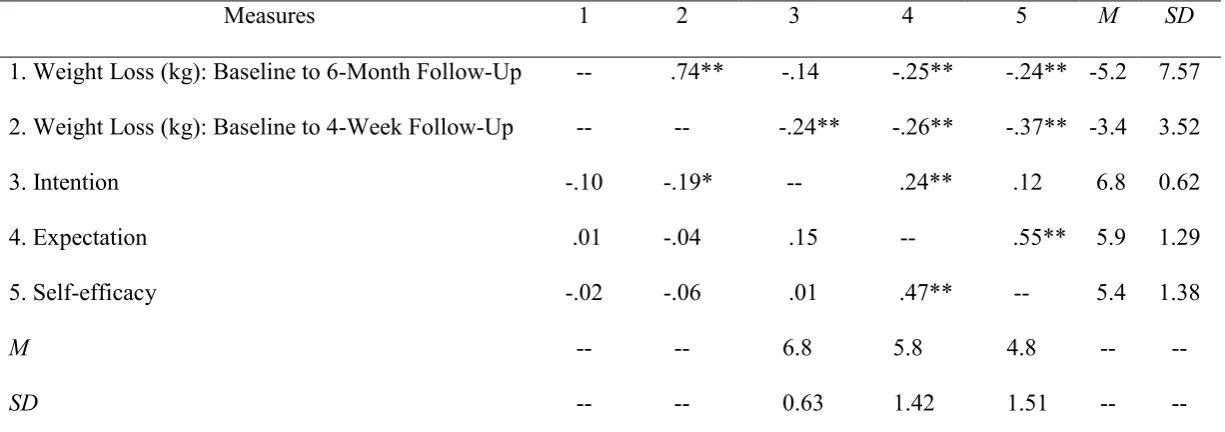
The means, standard deviations and intercorrelations between the key variables are
presented in Table 3. As one would anticipate from new registrants at weight loss clinics,
intention to lose weight was extremely positive, with mean values greater than six on 7-point
scales. Expectation and self-efficacy scores were also positive, but were significantly lower
than intention, Fbaseline(2, 137) = 107.40, p < .001, p2 = .61; F4 week follow-up(2, 137) = 74.61, p
< .001, p2 = .52. Further evidence for discriminant validity between intention and
expectation is provided by the modest intercorrelations at baseline and 4-week follow-up (rs
< .24, Table 3). Change in expectations between baseline and four-week follow-up were
significantly correlated with sustained weight loss, r = -.32, p < .001, as were changes in
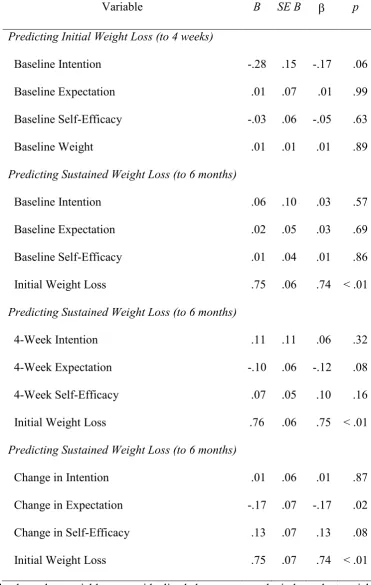
Predictors of initial weight loss were identified by regressing four-week weight loss
on behavioral intention, expectation and self-efficacy (controlling for baseline weight).
However, none of the variables emerged as significant predictors of initial weight loss (Table
4).
The effects of initial weight loss, behavioral intention, expectation and self-efficacy
on sustained weight loss (i.e., at six months) were also tested using multiple regression (Table
4). Sustained weight loss was regressed on initial weight loss and measures of intention,
expectation and self-efficacy in three separate analyses. The first and second analyses
focused on the predictive validity of baseline and four-week measures of behavioral
intention, expectation and self-efficacy on sustained weight loss, respectively. In both
analyses, only initial weight loss significantly predicted sustained weight loss.
The third analysis regressed sustained weight loss on the changes in intention,
expectation and self-efficacy that occurred during the first four weeks of the study (Table 4).
Together, these variables accounted for 56% of the variance in sustained weight loss,
F(4,136) = 42.55, p < .001. Greater initial weight loss was strongly and significantly
associated with sustained weight loss, importantly change in expectation was also
significantly associated with sustained weight loss.
In order to test whether the changes in expectations mediated the effects of initial
weight loss on subsequent weight loss, bootstrapping procedures for testing multiple potential
mediators were used (14). The analyses presented here are based on 10,000 resamples of
random subsets of data. Thus, the independent variable was initial weight loss (baseline to
four weeks); the mediators were changes in each of intention, expectations and self-efficacy;
the dependent variable was sustained weight loss. The confidence intervals associated with
changes in intention and self-efficacy all contained zero meaning that these variables did not
the confidence intervals associated with the indirect effect of expectation did not contain zero
(95% CI = .02, .12). Thus, the effect of initial weight loss on sustained weight loss was
significantly (p < .05) mediated by initial increases in expectation.
Discussion
This is the first study to have examined predictors of sustained weight loss in either
Kuwait or the Middle East more broadly. Consistent with research conducted in the West,
greater initial weight loss was the dominant predictor of sustained weight loss (17).
Moreover, we were able to extend the findings of Study 1 by showing that changes in
expectations were predictive of subsequent weight loss. It is notable that neither
self-efficacy, behavioral intention nor expectation were predictive of initial weight loss, meaning
that adjustments to weight loss expectations play a larger role in sustaining weight loss over a
period of six months. The implication is that directly managing people’s expectations in
relation to their experience of (lack of) weight loss may be a valuable adjunct to weight
management programs that is worthy of exploration in future research.
However, Study 2 suffered from several limitations. First, the sample consisted mostly
of women under the age of 45, meaning that caution should be adopted before generalizing
the findings too broadly. Second, given that no studies have examined psychological
predictors of sustained weight loss anywhere in the Middle East, it is plausible that cultural
context may have influenced the pattern of findings. More specifically, Kuwait is a
predominantly Muslim country, but without cross-cultural research, it is impossible to
determine whether cultural differences exist and how these might be manifest in the present
patterns of findings.
General Discussion
Measures of behavioral intention and expectation have most commonly been used to
colleagues’ contention that intentions and expectations are distinct and that expectations are
more predictive of behavior than intentions (3, 5). The implication is that greater attention
should be paid to people’s expectations (as opposed to behavioral intentions) and that
attempts to change behavior might be targeted at asking people to explore their expectations.
Future research could usefully explore further distinctions, for example the roles of likelihood
and desires (24) in predicting behavior and behavior change, in addition to the distinction
between behavioral intentions and expectations in predicting behavior and behavior change
examined in the present research.
A key question is why expectations are more predictive than behavioral intentions.
According to Warshaw and Davis (3), this is because intentions tap people’s motivation to act
in a certain way without taking into account potential barriers, yet expectations do take
potential barriers into account. However, consistent with Armitage and Conner’s (2)
meta-analysis, self-efficacy seemed not to plug this gap – expectations were more predictive of
behavior than intentions even when self-efficacy was statistically controlled.
The implication is that asking people about their expectations captures more than a
consideration of the potential barriers, and one possible explanation is that asking people
about their expectations elicits more reflective processing than asking them about their
intentions. Rothschild (25) found that prediction markets were better able to forecast
electoral outcomes than were aggregated polls of voter intentions, and Rothschild and
Wolfers (4) argue, “that much of the accuracy of prediction markets could be obtained simply
by polling voters on their expectations, rather than intentions” (p. 2). Given that prediction
markets involve monetary gambles by traders, the implication is that these decisions were
made on the basis of reflective processing, and it is plausible that simply asking about
expectations might similarly elicit more reflective processing than asking about behavioral
relying on reactive processing (26) in situations where people are being asked to monitor
their own progress towards a goal (18). It would be valuable to test this hypothesis in
laboratory-based studies.
From a more applied perspective, it would be valuable to explore the ways in which
expectations interact with the realistic goal setting and personalized feedback that
characterized the treatment described in Study 2 (18). Of particular relevance to future
interventions is the finding that changes in expectation partially mediated the effects of initial
weight loss and it would be valuable to examine the effects of explicitly addressing people’s
expectations following initial changes in behavior to effect greater sustained behavior
change. Relatedly, it would be valuable to identify predictors of changes in people’s
expectations with a view to developing interventions that effectively manage people’s
expectations or to identifying groups of individuals at whom resources should be targeted.
Although the present research takes the literature on behavior change forward in some
important respects, it is instructive to consider some potential limitations. First, consistent
with the broader literature (2), our measures of intention and expectation were single-item
scales. Although this minimized the burden on participants, this leaves our measures
vulnerable to a lack of reliability. However, lack of reliability would only undermine the
strength of the associations between expectations and behavior change yet this does not
appear to be the case in the present research. Nevertheless, it would be valuable to use
multiple item measures in future research (10). Second, all the participants were from
minority populations (i.e., students, clients in private clinics), meaning that it would be
valuable to replicate the work in more representative samples of people who are attempting to
change their behavior.
In conclusion, the present research demonstrates a potentially important distinction
of expectations compared to behavioural intentions in predicting behavior even after
controlling for the effects of past behavior and self-efficacy. Further research is required to
develop interventions that explicitly bolster people’s expectations and establish
References
1. Ajzen I. The theory of planned behavior. Organ Behav Hum Dec. 1991; 50: 179-211. doi:
10.1016/0749-5978(91)90020-T
2. Armitage CJ, Conner, M. Efficacy of the theory of planned behaviour: A meta-analytic
review. Brit J Soc Psychol. 2001; 40: 471-499.
3. Warshaw PR, Davis FD. Disentangling behavioral intentions and behavioral expectations.
J Exp Soc Psychol. 1985; 21: 213-228.
4. Rothschild D, Wolfers J. Forecasting elections: Voter intentions versus expectations. 2011;
Retrieved from: http://assets.wharton.upenn.edu/~rothscdm/RothschildExpectations.pdf
5. Sheppard BH, Hartwick J, Warshaw PR. The theory of reasoned action: A meta-analysis of
past research with recommendations for modifications and future research. J Consum Res.
1988; 15: 325-343.
6. Armitage CJ, Conner M. Distinguishing perceptions of control from self-efficacy:
Predicting consumption of a low fat diet using the theory of planned behavior. J Appl Soc
Psychol. 1999 ; 29: 72-90. doi: 10.1111/j.1559-1816.1999.tb01375.x
7. Armitage CJ, Conner M. The theory of planned behaviour: Assessment of predictive
validity and “perceived control”. Brit J Soc Psychol. 1999; 38: 35-54. doi:
10.1348/014466699164022
8. Tavousi M, Hidarnia AR, Montazeri A, Hajizadeh E, Taremain F, Ghofranipour F. Are
perceived behavioral control and self-efficacy distinct constructs? Eur J Scientif Res. 2009;
30: 146-152.
9. Norman P, Hoyle S. The theory of planned behavior and breast self-examination:
Distinguishing between perceived control and self-efficacy. J Appl Soc Psychol. 2004; 34:
10. McConnon A, Raats M, Astrup A, et al. Application of the Theory of Planned Behaviour
to weight control in an overweight cohort. Results from a pan-European dietary intervention
trial (DiOGenes). Appetite. 2012; 58: 313-318. doi: 10.1016/j.appet.2011.10.017
11. NHS Information Centre. Statistics on alcohol: England, 2011. 2011; Retrieved from:
http://www.ic.nhs.uk/statistics- and- data- collections/health- and- lifestyles/alcohol/statistics-
on- alcohol- england- 2011- %5Bns%5D
12. Sobell LC, Sobell MB. Timeline follow-back: A technique for assessing self-reported
alcohol consumption. In: Litten RZ, Allen JP, eds. Measuring alcohol consumption. Totowa, NJ: Humana Press; 1992: 41-72.
13. Zou GY. Toward using confidence intervals to compare correlations. Psychol Methods.
2007; 12: 399-413.
14. Preacher KJ, Hayes AF. Asymptotic and resampling strategies for assessing and
comparing indirect effects in multiple mediator models. Behav Res Meth Instr. 2008; 40:
879-891.
15. Cohen J, Cohen P, West SG, Aiken LS. Applied multiple regression/correlation analysis
for the behavioral sciences. London: Erlbaum; 2003.
16. Wing RR, Phelan S. Long-term weight loss maintenance. Am J Clin Nutr. 2005; 82:
222S-225S.
17. Teixeira PJ, Going SB, Sardinha LB, Lohman TG. A review of psychosocial
pre-treatment predictors of weight control. Obes Rev. 2005; 6: 43-65. doi:
10.1111/j.1467-789X.2005.00166.x
18. Carver CS, Scheier MF. Control theory - A useful conceptual framework for
personality-social, clinical, and health psychology. Psychol Bull. 1982; 92: 111-135. doi:
19. Al Rashdan I, Al Nesef Y. Prevalence of overweight, obesity, and metabolic syndrome
among adult Kuwaitis: Results from community-based national survey. Angiology. 2010;
61: 42-48. doi: 10.1177/0003319709333226
20. Eastwood P. Statistics on Obesity, Physical Activity and Diet: England, 2011. London:
The Health and Social Care Information Centre, Lifestyles Statistics; 2011.
21. Nackers LM, Ross KM, Perri MG. The association between rate of initial weight loss and
long-term success in obesity treatment: Does slow and steady win the race? Int J Behav Med.
2010; 17: 161-167. doi: 10.1007/s12529-010-9092-y
22. US National Heart, Lung and Blood Institute. Guidelines on overweight and obesity:
Electronic textbook. 2005; Retrieved from:
http://www.nhlbi.nih.gov/guidelines/obesity/e_txtbk/txgd/4311.htm
23. Armitage CJ. Can the theory of planned behavior predict the maintenance of physical
activity? Health Psychol. 2005; 24: 235-245.
24. Perugini M, Bagozzi RP. The distinction between desires and intentions
Source: Eur J Soc Psychol. 2004; 34: 69-84. doi: 10.1002/ejsp.186
25. Rothschild D. Forecasting elections comparing prediction markets, polls, and their biases.
Public Opin Quart. 2009; 73: 895-916. doi: 10.1093/poq/nfp082
26. Armitage CJ Time to retire the theory of planned behaviour? A commentary on Sniehotta,
Footnotes
1Note that some researchers also make a distinction between “self
-efficacy” and “perceived
control over behavior” (6, 7). For example, using factor analysis and a panel of experts,
Tavousi et al. (8) were able to distinguish internal influences on perceived control (e.g.,
confidence in one’s own ability or “self-efficacy”) and external influences on perceived
control (e.g., environmental barriers) in relation to substance use among young adolescents
(see also 6, 7, 9). However, we were unable to support such a distinction in Study 1 and so
we focused on self-efficacy, given that self-efficacy is consistently more predictive of
Table 1
Zero-Order Correlations Between Alcohol Consumption and Psychosocial Predictors (Study 1)
Measures 1 2 3 4 5 6 7 8 9 M SD
1. Baseline Alcohol Consumption -- 2.0 3.54
2. Follow-Up Alcohol Consumption .37** -- 2.2 3.96
3. Behavioral Intention .19** .22** -- <0.1 1.52
4. Expectation .31** .41** .68** -- 0.1 1.81
5. Self-Efficacy item 1 .23** .13 .38** .45** -- 7.4 2.48
6. Self-Efficacy item 2 .14* .29** .15** .16** .04 -- 6.4 1.20
7. Self-Efficacy item 3 .24** .26** .11 .12* .05 .43** -- 6.3 1.51
8. Self-Efficacy item 4 .18** .19* .06 .10 .05 .24** .46** -- 6.0 1.65
9. Self-Efficacy item 5 .17** .01 .01 .01 .16** .17** .26** .28** -- 6.3 1.31
Table 2
Predictors of Alcohol Consumption (Study 1)
Variable B SE B p
Predicting Alcohol Consumption
Behavioral Intention -.04 .23 -.02 .86
Expectation .60 .21 .29 < .01
Self-Efficacy item 1 .06 .11 .04 .62
Self-Efficacy item 2 .35 .21 .14 .10
Self-Efficacy item 3 .18 .20 .08 .39
Self-Efficacy item 4 .23 .28 .07 .41
Self-Efficacy item 5 .32 .25 .10 .20
Table 3
Zero-Order Correlations Between Weight Change and Psychosocial Predictors (Study 2)
Measures 1 2 3 4 5 M SD
1. Weight Loss (kg): Baseline to 6-Month Follow-Up -- .74** -.14 -.25** -.24** -5.2 7.57
2. Weight Loss (kg): Baseline to 4-Week Follow-Up -- -- -.24** -.26** -.37** -3.4 3.52
3. Intention -.10 -.19* -- .24** .12 6.8 0.62
4. Expectation .01 -.04 .15 -- .55** 5.9 1.29
5. Self-efficacy -.02 -.06 .01 .47** -- 5.4 1.38
M -- -- 6.8 5.8 4.8 -- --
SD -- -- 0.63 1.42 1.51 -- --
Note. Baseline intercorrelations and descriptive statistics are presented below the diagonal; 4-week follow-up intercorrelations and descriptive
statistics are presented above the diagonal. The correlations associated with “weight loss” are based on standardized residuals; the descriptive
statistics associated with “weight loss” are raw scores expressed in kg because residuals have Means of 0.00 and Standard Deviations of 1.00.
The data have been analyzed according to intention to treat, with the last observation carried forward; weight change between baseline and
6-month follow-up for people who remained in the study was M = -7.72, SD = 8.34.
Table 4
Predictors of Weight Loss (Study 2)
Variable B SE B p
Predicting Initial Weight Loss (to 4 weeks)
Baseline Intention -.28 .15 -.17 .06
Baseline Expectation .01 .07 .01 .99
Baseline Self-Efficacy -.03 .06 -.05 .63
Baseline Weight .01 .01 .01 .89
Predicting Sustained Weight Loss (to 6 months)
Baseline Intention .06 .10 .03 .57
Baseline Expectation .02 .05 .03 .69
Baseline Self-Efficacy .01 .04 .01 .86
Initial Weight Loss .75 .06 .74 < .01
Predicting Sustained Weight Loss (to 6 months)
4-Week Intention .11 .11 .06 .32
4-Week Expectation -.10 .06 -.12 .08
4-Week Self-Efficacy .07 .05 .10 .16
Initial Weight Loss .76 .06 .75 < .01
Predicting Sustained Weight Loss (to 6 months)
Change in Intention .01 .06 .01 .87
Change in Expectation -.17 .07 -.17 .02
Change in Self-Efficacy .13 .07 .13 .08
Initial Weight Loss .75 .07 .74 < .01
Note. The dependent variables are residualized change scores; the independent variables