Rochester Institute of Technology
RIT Scholar Works
Theses
5-2018
Face 2 Face
Joseph HurleyFollow this and additional works at:https://scholarworks.rit.edu/theses
This Thesis is brought to you for free and open access by RIT Scholar Works. It has been accepted for inclusion in Theses by an authorized administrator of RIT Scholar Works. For more information, please [email protected].
Recommended Citation
1
Face 2 Face - Thesis
By Joseph HurleySUBMITTED IN PARTIAL FULFILLMENT OF THE REQUIREMENTS FOR THE DEGREE OF
MASTER OF FINE ARTS
IMAGING ARTS/COMPUTER ANIMATION SCHOOL OF FILM AND ANIMATION ROCHESTER INSTITUTE OF TECHNOLOGY
ROCHESTER, NEW YORK
May 2018
Peter Murphey Assistant Professor
School of Film and Animation __________________
Dave Sluberski Senior Lecturer
School of Film and Animation __________________
Mari Jaye Blanchard Assistant Professor
2
● Abstract
● Acknowledgements
● Introduction
● Pre-production
o Early development o Story revisions
o Further revisions during summer and fall
● Concept design
o Animation style/approach o Visual style
o Visual inspiration o Humor inspiration
● Storyboard and Animatic o Thumbnails and Boards
o Animatic
● Main production o Animation
o Sound
o Music
o Compositing
● Film screening
o General screening
o Feedback
● Conclusion
● Work Cited
● Appendices
o Appendix A – Original thesis proposal o Appendix B – Production stills
3 ABSTRACT
For my final year at Rochester Institute of Technology (RIT), I worked on my thesis film,
―Face 2 Face,‖ which runs for 6 minutes and 22 seconds. My thesis film tells the story of a
young man attending a Comic-Con convention who spends more time taking photos of what he
sees in front of him for his social media page rather than living in the moment within his
environment. This film was inspired by my experiences at conventions and on vacations, during
which I devoted much of my energy to recording footage of unique events or taking photos of an
unfamiliar area to the neglect of truly experiencing my environment. ―Face 2 Face‖ is a comedic
portrayal of similar experiences and frustrations in a setting with which I am familiar.
I wanted to create a film focusing on a habit I found relatable and use it as the
springboard for a comedic story. In terms of the main production, the film relies on hand-drawn
animation and appears in full color. The animation was primarily completed in TVPaint with
additional visual work done in Adobe After Effects and Adobe Premiere. I also took advantage
of outside help for animation and sound during film production, especially with regard to
cleanup, coloring, voice acting, sound effects, and music. This paper describes the writing
process for the film along with the film’s visual development. I also discuss various obstacles
4 ACKNOWLEDGEMENTS
Several individuals deserve thanks for their contributions to this project. I would like to
thank my thesis advisor, Peter Murphey, for his help and pointers during the production of my
thesis film. We held frequent and consistent meetings, and our corresponding discussions
provided valuable feedback that helped me determine how to approach aspects of my film that
required revision. Peter offered several ideas to explore as I was writing the film and completing
the storyboarding. Even when I was unsure of where my writing was headed, Peter’s suggestions
helped me consider different scenarios for my story and eventually identify those that suited my
vision best. Peter’s guidance throughout the development of this film was hugely helpful in
crafting the finished version.
I would also like to thank my thesis committee members, Dave Sluberski and Mari Jaye
Blanchard, who each assisted in the production of my thesis. Dave provided a great deal of help
regarding how I should approach the sound and offered hands-on assistance, including working
as the ADR for my voice recording and assisting in mixing the sound effects. Dave also provided
substantial help in searching for a sound director for the film. He offered last-minute
sound-mixing help and feedback when the sound director and I were nearing the end of production.
Mari offered valuable input into my animation process and provided helpful comments
on how to approach certain shots and better understand TVPaint’s different tools. In the
beginning, she gave me frequent feedback on general character design and pointed out which
aspects needed to be refined to be suitable for the animation. Mari also provided assistance with
the overall pacing of the film’s individual shots, suggesting which shots would benefit from
5
In terms of direct help with my film’s production, I would like to thank my additional
animators and colorists, Washa Azimi, Chloe Hayes, Kurt Li, Kate McAfee, Ryan Adryandi, and
Emily Yurk, for their assistance with extra cleanup and coloring in areas I did not manage to
complete. I would also like to thank my music composer, Zazu Pitts of Sour Note Productions,
for composing strong and energetic music pieces for the film. I am also grateful for my sound
mixer, Mikaela Kaufman, for organizing a diverse array of sound effects and following up on my
many notes seeking advice on what to work on next. Lastly, I would like to thank my family for
supporting me through the entire production of this film and offering a listening ear whenever I
was exhausted from working on the project. Everyone who helped with ―Face 2 Face‖
6 INTRODUCTION
In today’s society, photography intended for social media has made it increasingly
difficult for people to live in the moment. Given the ubiquity of and easy access to digital
devices and social media, people are prone to devoting much of their time and energy to
documenting what they see in front of them. Individuals can compromise otherwise unique
experiences when their interest in enjoying the world around them is overshadowed by trying to
document various events through photographs and obsessing over how they are responded to
online. My thesis explores this pattern by examining what it takes for a person to change when
he or she seeks self-gratification through a camera lens rather than experiencing reality
first-hand.
When I was initially developing this idea, I chose photography and recreation as a topic
because people frequently embrace such activities while vacationing or visiting an unfamiliar
place. I later broadened my scope to include social media, which seemed to better fit the theme
of the project, the modern world, and my own experience. I am guilty of routinely indulging in
social media on recreational vacations or while attending comic conventions. My family
members, despite being as committed to recording or photographing family and sporting events
as I have been to social media, shared with me a strategy: they deliberately choose not to take as
many pictures as they would like so they could spend more energy enjoying the event in person,
such as by watching a race with their own eyes instead of through a camera. I began to wonder
what enables some people to break free from the allure of cameras and digital devices to
immerse themselves in the moment whereas others seemingly cannot. I decided this dilemma
7
I chose comic conventions as the main setting for my story, as I am quite familiar with
photography getting in the way of experiencing real life in this environment. I thought the unique
attractions, decorations and costumes found at conventions would allow me to showcase my
humor and visual style. I have frequently brought photography and video-recording equipment to
these events to document their unique activities and atmosphere, which I would later share with
my friends. However, I often found myself exhausted from carrying my equipment, unable to
fully appreciate the convention experience for what it is.
As I began writing this thesis, I searched for information on photography addiction and
how it is tied in with social media. I wanted to refine the motivation for Cameron and seek out
ideas that I could implement into the story, visuals and humor with this research. The article
Instagram is Ruining Vacation, by Mary Pilon, discusses how social media’s use of photography
can prevent people from fully enjoying recreational trips and the ways that social media will pull
people away from life experiences in front of them. Pilon discusses how she attended events in
recreational areas where many people opted to take photos of the main attraction and share what
they had to social media, with this habit happening among typical tourist groups to large crowds
at concerts:
That scene, the fight for the perfect Instagram, is one I’ve witnessed over and over…In
Thailand, a woman sitting next to me on a beach squealed to her friends about getting
8
Through my thesis film, I would have Cameron display this habit of tediously acquiring a
desirable photo though his point of view shots, generally having him struggle to get a desirable
visual of the subject he’s attempting to photograph.
While developing ideas for my thesis that involved Cameron falling prey to the
distracting nature of photography and social media, such as when Cameron falls down the stairs
into the Cosplay Robot, I searched for examples of the hazards of this process. The article, More People Have Died From Selfies than Shark Attacks this Year by Cailey Rizzo, goes over how tourists have frequently fallen victim to the use of selfie sticks, even to the point of meeting their
death. Through various vacationing attractions, tourists that engage frequently in photography,
will always run the risk of focusing their energy on getting their desired shot, instead of keeping
their eye on the trail ahead(Rizzo 2-4). Rizzo also describes how tourist spots have brought
awareness to the distracting and dangerous nature of selfies in these areas:
It’s not clear if the number of daredevil selfies is increasing, but more and more tourists
are making headlines because of their dangerous attempts at a memorable photo. Parks –
have had to expressly outlaw selfie-taking, and even Tour de France cyclists are
concerned about selfie danger (Rizzo5).
While figuring out how to define Cameron’s personal conflict with photography through the
story, I looked out for sources that described what specific needs drove people to indulge in this
compulsion. In her article, Photography in Social Media, Maria Popova describes reconstructionist Susan Sontag’s research on the evolution of photography and how the
9
Throughout history, people have taken great satisfaction capturing the events of their lives
throughphotography. By framing certain moments within a still image, people have found a way
to both remember and idealize the past. Sontag (qtd. in Popova 5) describes how this pleasurable
compulsion also marks the ephemeral quality of what we see:
Most tourists feel compelled to put the camera between themselves and whatever is
remarkable that they encounter…Precisely by slicing out this moment and freezing it,
all photographs testify to time’s relentless melt.
Popova asserts that the mechanisms behind someone’s desire to take photographs and share
them on social media is usually driven by their compulsion to express and assert their identity to
a body of people online (Popova5).Sontag (qtd. in Popova 8) contends that the increased access
to photography can also be seen as aggressive, as most people who take up photography don’t
intend to utilize a camera in a specific professional manner, it is instead a tool for very personal
means:
Images which idealize are no less aggressive than work, which makes a virtue of
plainness. There is an aggression implicit in every use of the camera.
Another point of information that I wanted to research was how photography affected one’s
10
Stern Professor and social consumption researcher, who held an experiment where tourists who
traveled along the location were split into two groups, one who took photos, while the other
group didn’t(Love 2). After the tour, it was shown that the people who didn’t take photos had
much more engaging conversations on their experience, while those who took photos had less
descriptive conversations in comparison:
Dr. Barasch…found that for those photographers who took pictures mainly with the
goal of sharing them on social media, the positive effects of heightened
engagement and memory are diminished (Love4).
In Face 2 Face, I have Cameron’s sense of observation change at the end of the film.The last act
finds him back on a convention ride, which he had experienced earlier in the story.He was unable
to enjoy his first attempt, as his selfie compulsion caused him to lose his balance. His final ride is
a fully satisfying event, because he has finally learned the value of being in the moment.
In the Temple of Geek interview, Q&A with Cosplay Photographer Kate York by Monica Duarte, photographer Kate York describes the state of mind she is in when she’s seeking unique
photos at Comic-Cons and why certain visuals catch her eye, specifically cosplayers. Kate (qtd.
in Duarte 15) mentions how much she needs to keep in mind when photographing at a
11
There is so much going on and there’s so many people milling around…I personally
found it difficult to get the space I need to take a shot with the equipment I use daily
and that’s kind of frustrating.
The interview details the workflow of a photographer at a Comic-Con, and what the general
mindset is when it comes to searching for unique photos. What attracted Kate (qtd. In Duarte 4)
to photographing at comic-cons was the strong visual variety among cosplayers, with each
member sporting a unique costume catching her interest at a glance:
Walking around the convention floor, you can see all the love and dedication these people
have for the craft and for the characters they wear. The colors and textures and all the
different faces make working with cosplayers so rewarding.
The overall interview helped give me an insight on what convention attendees are looking to
photograph, which helped me figure out what type of cosplayers and attractions could catch
Cameron’s eye as he’s searching to photograph for social media.
During the summer of 2017, prior to my last semester at Rochester Institute of
Technology, I re-familiarized myself with comic-cons to gain a better idea of how to design the
general setting of my thesis. For a direct and in person approach, I attended ConnectiCon, a
convention in my home state of Connecticut and explored the layout. At ConnectiCon, I took
photographs of different rooms, decorations, and attractions to reference for my film’s
backgrounds. I also took photographs to emulate what Cameron would experience and pay
12
the photographers these conventions attract, in order to examine what might motivate attendees
13 PRE-PRODUCTION
Story Development
I began developing my thesis during the late winter of 2017 throughout most of RIT’s
thesis prep class. I initially considered creatingeither a comedy that would rely heavily on
character dialogue and animation acting to communicate humor or an action-based film to
practice intense animation. I also wanted to apply a looser, rougher animation style, as I had
completed a film during the prior semester that used a relatively less flexible approach; I hoped
to have the freedom in my upcoming project to explore broader character exaggerations and be
more liberal with character design and animation.
When I began conceptualizing ideas inmy thesis prep class, I was having a difficult time
figuring out the beats of the story, which was further compounded by my exhaustion from a
winter internship and an overloaded class schedule. Initially, the story involved the main
character, Cameron, using various camera equipment and taking photos and videos while
accompanied by two friends, who would symbolize what hewas missing at the comic
convention. I also used much more dialog, with my secondary characters commenting frequently
on Cameron’s situation. After my first committee meeting, my advisors recommended that I
revise my approach to communicateCameron’s motivation more clearly. The committee also
suggested that the story progression might be complicated for outside audiences in its current
form.
I began trimming down various elements of my thesis in an attempt to simplify the story
and better realize Cameron’s motivation. Peter suggested replacingCameron’s camera equipment
with a smartphone, which would reduce the number of objects to be animated and better connect
the audience to Cameron’s motivation. Peter also suggested incorporating social media into
14
documentation. As I continued to refine the story behind the film, I eventually removed the extra
characters and reduced the amount of dialogue, which helped shorten the overall runtime. At that
point, I was only left with Cameron and the celebrity he admired, who would eventually become
Lightning Lyra. I showed my updated film scenario to the second thesis committee. The story
was approved, although I was advised to continue reducing the runtime given that more edits
could be made.
During the summer, I continued to refine my story and determine how to flesh out other
aspects of the film. One story element I struggled to resolve was the interaction between
Cameron and Lightning Lyra, which would ultimately motivate Cameron to embrace the real-life
experiences in front of him. Earlier drafts included Cameron and Lyra talking or having Lyra
engage in an exaggerated interaction, such as energetically giving Cameron an autograph, but I
felt those ideas would not be as relatable for a generalaudience. During a meet-and-greet party
during the summer of 2017, I got the idea to have Lyra shake Cameron’s hand. I imagined that
Cameron’s excitement over a simple interaction would offer an accessible joke with aclearer
resolution, as most people can relate to being excited at the chance to shake the hand of a
personthey greatly admire. As the summer went on, I continued refining the story of my thesis
and began developing my character designs and art style.
Concept Design
For the film’s visual style, I aimed to use rougher and looser designs that would allow for
a variety of visuals(either simple or complex as necessary). I felt most comfortable with this style
of animation, as I had worked on several animated shorts before that incorporated the same
approach but on a smaller scale. With this film, I wanted to see how diverse I could make the
15
developed my thesis over the summer, I was also working on several freelance videos, which
gave me the opportunity to experiment with and develop designs and poses for the characters in
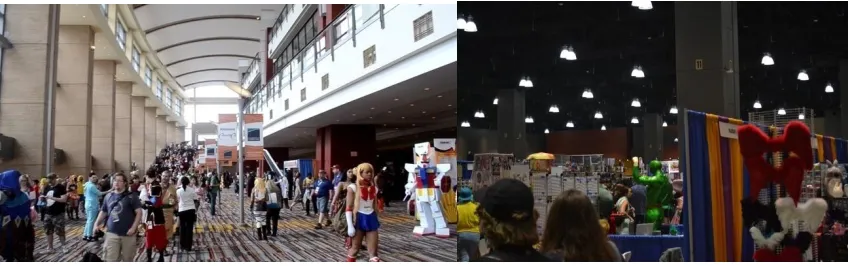
my film through humorous sequences. Backgrounds and crowd shot concepts were also designed
based on images I found through researching comic cons, such as pictures I took while looking
[image:16.612.76.503.210.354.2]around ConnectiCon.
Fig. 1. Hurley, Joseph. Photographs from ConnectiCon (2017)
Fig. 2. Hurley, Joseph. Photographs from ConnectiCon (2017)
The style I choseallowed for flexibilitywhen designing crowd shots that displayed
individual characters with a unique appearance and specific level of detail. Becausemy film
usedrougher and imperfect details for animation and art, I designed crowds by giving various
members more abstract designs. This approach allowed me to be economic with the amount of
time I spent on populated shots while still maintainingfullness in the backgrounds. Characters
[image:16.612.74.499.392.525.2]16
homages to different sources of entertainment I enjoy (e.g., characters/actors from television
shows and movies). The free-flowing designs I gave characters in crowds also allowed me to
create humorous visuals of the designs whenever necessary, usually related to what convention
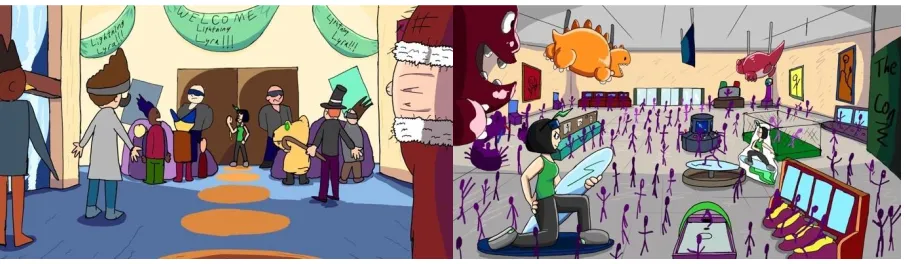
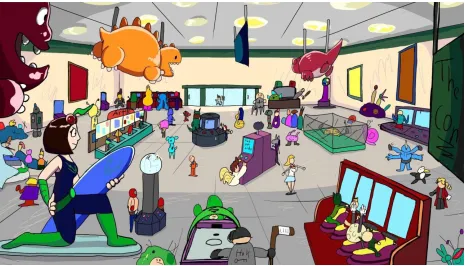
attendees tend to do at a Comic-Con. A part of the film that usedhumorous visuals throughout a
crowd shot was in the convention area from Cameron’s point of view, which includedimages of
different characters attending to the games on display and art vendors talking to customers.
Fig 3. Hurley, Joseph.Face 2 Face,Background Concept
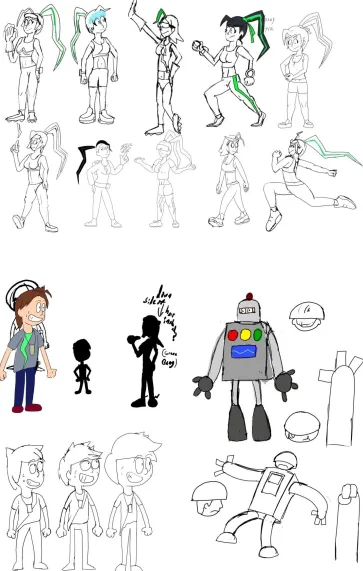
As I created my characters—Cameron, Lightning Lyra, and the Cosplay Robot—I was tasked
with simplifying their designs to ensure each stood out and were simple to animate. I preferred to
use shapes and details that reflected their personalities and roles in the story. I gave Cameron
rounder shapes to emphasize his excitement and innocence and Lyra a leaner design with
complex detail to exemplify her calmness and seriousness. I wanted to show that she was a
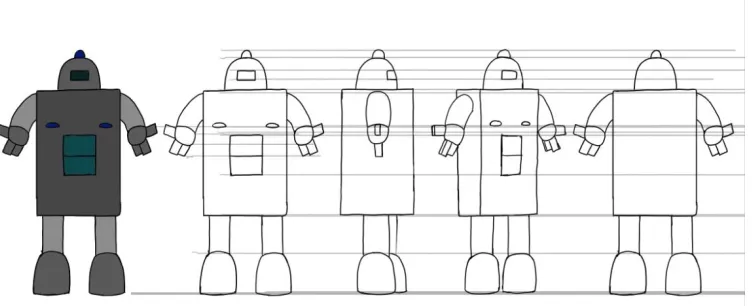
person who Cameron, and many other fans at the convention, admired. I decided the Cosplay
Robot character, who appeared in the background throughout the story and played a critical role
in the climax, would have a heavier design to highlight his clumsiness and instability. He was
prone to being knocked over easily with his heavy costume and was a cause of great destruction
[image:17.612.73.526.235.367.2]17
[image:18.612.142.505.103.674.2]18
[image:19.612.127.466.75.234.2]Fig 5. Hurley, Joseph.Face 2 Face, Cameron Model Sheet
Fig 6. Hurley, Joseph.Face 2 Face, Lightning Lyra Model Sheet
[image:19.612.108.473.279.431.2] [image:19.612.80.456.490.643.2]19
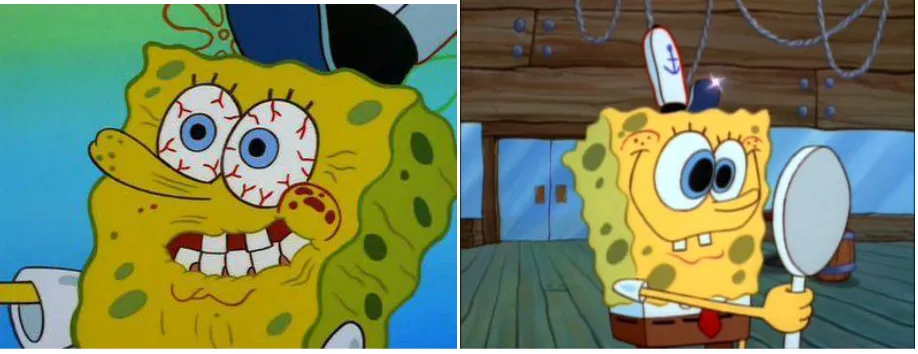
My approach to humor in this film was drawn from animated television shows and shorts
I watched frequently in my youth. Visually, I was inspired by series such as Ed, Edd n Eddy and
SpongeBobSquarePants, both of which used simplistic characters whose designs changed in humorous situations. For example, whenever characters were struck in Ed, Edd n Eddy, their entire bodies would contort and squish to exaggerate the blowback of the hit and to demonstrate
howstrong or weak they were. I applied this level of distortion tosimilar situations in my thesis,
such as when Cameron hits a glass door at a high speed and his entire face and body squish
against the glass. I also took inspiration from SpongeBobSquarePants’s pushing detail with
characters. In many reaction shots and close-ups, this technique gave the characters more
grotesque features to exemplify how stressed they were feeling or how much pain they were in. I
used the same types of exaggerated details in my film to emphasize the frustration or pain of the
characters, such as when Cameron escapes from an air vent and his face and mouth expand to
20
Fig. 8. (A) Tibbit,Paul,dir. still frame from―Employee ofthe Month.‖ SpongeBob SquarePants. Nickelodeon, 1999. Television
(B)Hillenburg, Stephen,dir. still frame from―Help Wanted.‖SpongeBob SquarePants. Nickelodeon, 1999. Television
Fig. 9. (A) Antonucci, Danny,dir. still frame from―One+One=Ed.‖ Ed, Edd n Eddy. Cartoon Network, 1999. Television
[image:21.612.75.534.72.249.2] [image:21.612.73.519.355.519.2]21
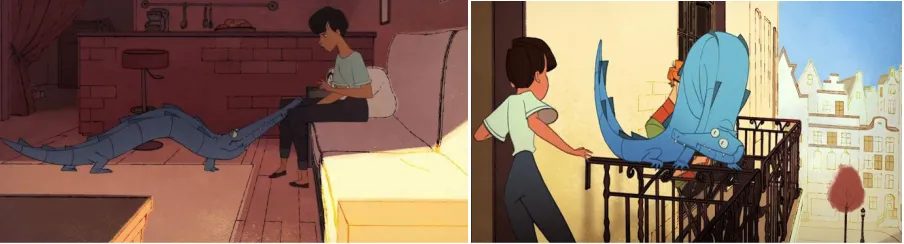
I also searched for inspiration for the visual humor in my film to learn different ways to
maintain the timing and energy for each joke. One source of insight consisted of various shorts
from the French animation school, Gobelins, l'École de l'image, such as In Betweenand Mortal Breakup Inferno. These films gave me a sense of how to approach fast-paced comedy by letting a film’s visuals, rather than its dialogue, explain the moment and express what the characters
were feeling. Throughout Mortal Breakup Inferno, several brief shots are coupled with the chaotic movement of the characters to execute the film’s intense and humorous moments. During
a chase sequence, the boyfriend is running through the woods from his girlfriend; many of the
shots last no more than 3 seconds. Through each subsequentshot, the layout of the scenery and
character designs becomesincreasingly dynamic to evoke the boyfriend’s peril. The quick shots
continue until the boyfriend finds himself alone in a much more relaxed setting, with the rest of
[image:22.612.73.536.407.496.2]the film passing at a much slower pace (Mortal Breakup Inferno, 1:50–2:05).
Fig. 10. Delalande,Maxime,dir. still frames fromMortal Breakup Inferno.Gobelins, 2014.YouTube. Sat, 10 June 2017.
These shorts also inspired me to incorporate several brief shots that would condense
longer moments throughout the film and be shown in rapid successionto ensure consistent
pacing. A part of Face 2 Facethat used a similar sequence of shorter shots is when Cameron goes around taking photos at the comic con. I included several visuals of different events during the
22
This pattern helped communicate the humor of Cameron’s frequent and unhealthy need to
photograph anything that caught his eye. To do this, I started and ended each shot with a camera
flash.
In Betweenalsoused this type of sequencing by employing a series of several quick shots of a character trying to remove a crocodile,which represented her anxiety, and then repeating the
process whenever she returned in each shot of the sequence (In Between, 1:11–1:53).
[image:23.612.75.527.238.360.2].
Fig. 11. Bissonnet, DeAlice,dir. still frames fromIn Between. Gobelins,2012.YouTube. Sat, 10 June 2017.
To time my shots for comedic execution, I also aimed to employ a mixture of slower and
fast-paced moments to build up to various jokes and gags. Some of my inspiration for this
approach came from various independent animators such as Harry Partridge, Chris O’Neil, and
Zach Hadel. These filmmakers have created several animated shorts that rely on a mixture of
snappy visual humorous well as a gradual build up to punch lines, with several jokes executed in
unexpected and surreal scenarios. Chris O’Neil’sLeo and Satan – Thrash Hazard short includes a character, Leo, who is constantly tormented and injured throughout the plot by a Ouija board.
The film ends with Leo being killed, not by the board, but by his friend Satan, who picks him up
in relief and accidentally kills Leo with his claws (Leo and Satan – Trash Hazard, 2:56–4:00). I applied a similar sense of unexpected execution when characters moved around in unexpected
23
his phone is about to be crushedand turns around in horror. To add humor to Cameron’s sudden
realization, he turns his entire upper body far enough for his spinal column to follow him and be
[image:24.612.109.513.154.270.2]indented through his skin and shirt.
24 STORYBOARDS AND ANIMATIC
Thumbnails
Once my story was well established around September 2017, I began working on
thumbnails to plan the film’s layout. The thumbnails allowed me to gain a sense of the timing
and the rough shot composition of my film. During each meeting with Peter Murphey, I created
different variations of thumbnails, revising sections of the story and experimenting with multiple
endings. I pinned up the thumbnails on his office bulletin board and shifted images around
depending on what needed to be revised or removed from the story. Sections that were most
heavily alteredincluded Cameron and Lightning Lyra’s major interaction at the story’s climax
and the overall ending. Prior thumbnailed versions of Cameron and Lyra’s interaction included
more dialogue and a longer lead into how Cameron would rescue her from the floor. The
changes eventually lead to much shorter timing of this sequence to maintainthe pace of the film.
I also brought in alternate thumbnails for the film’s ending, including an earlier version that
concluded with Cameron flying into space and never coming down. Peter suggested I find a way
to end the film by showing the audience that Cameron had changed and learned from his
experience at the convention. This suggestion led me to the ending I used inthe final version of
the film, in which Cameron embraced and trulyenjoyed one of the rides at the convention rather
than photographing himself to post on social media, as he had done earlier in the story.
Animatic
After the thumbnails were completed, I began to work on the film’s initial boards for the
upcoming animatic showcase on October 8, 2017, where students presented their animatics to
25
night, I managed to refine the timing of my thumbnails and get a better sense of staging for my
characters. General changes I made tomy boards, based on Peter’s feedback, included altering
the layout of different panels and making minor timing changes to help the audience better
understand the action in various shots. The first animatic I created had a runtime of 4 minutes
and 45 seconds. After screening my animatic to the audience at the showcase, I was given
constructive feedback, which included speeding up the timing of Cameron’s decision to save
Lyra (when he is forced to choose between her and his phone) and to tie in the mechanical ride at
the end of the story more closely to the overall theme of the narrative. Originally, the ride was a
mechanical bull that threw Cameron because he was so focused on his phone instead of his grip.
I decided to change the bull to a mechanical surfboard, which related more to Lyra’s character,
26 PRODUCTION
Animation
As soon as the animatic revisions were completed by mid-November, animation began
for the film, which was the simplest but most taxing part of production. The film was animated
in TVPaint Pro 11, which gave me the option to work directly off the animatic and to experiment
with different brushes. My priority for animation production was to use as loose a style as
possible so I could experiment freely with visuals throughout the film. I also wanted to keep the
visual design flexibleand not feel overly constrained to stay on model. I was eager to experiment
with different brush types and sizes for different scenes to give shots a specific and unique feel.
One shot enhanced by a specific brush was Lightning Lyra’s descent; I rendered her outline with
a texture brush and used a digital paintbrush for the outlines and colors of the moving
background behind her.
With this looser animation style, I wanted to make the movements of the characters as
fluid and dynamic as possible to allow for moments that involvedlimited animation for comedic
effect. The first shots I began animating occurred in the middle of the film, which gave me the
opportunity to test my characters’ movements and appearance before I began working on
important scenes that required them to stay consistently on model. As soon as I learned how best
to animate Cameron, I began working on his more important and complex shots. I was unable to
do shots that included Lighting Lyra talking, as I had not yet received the character’s lines when
animation production began. During the winter break of January 2018, I worked on designing
layouts in advance so I could return to animating the specific shots I had prioritized while
27
winter break and was able to work on Lightning Lyra, having received all the audio for her
dialogue. By March 2018, the rough animation was completed, and I began cleaning and inking
shots in a similar order as the rough animation. The most important and time-consuming shots
were finished first. Near the end of the semester, in April 2018, I began finalizing the colors and
organized the final composite, such as many of the composited shots that included camera pans
and additional effects I could not apply to the footage of different animated shots.
To ensure my animation met the May 1 deadline, I asked for help from six RIT students
to assist in cleanup animation, inbetweening, and coloring of shots. Approximately four students
worked on cleaning and inbetweening four sequences each, mostly crowd shots, followed by
miscellaneous takes of the main characters. I mainly gave crowd shots to my assistants as the
individual characters in the crowd did not need to stay on model and were not repeated in other
shots. Any animation that included my main characters generally had the keys inked and cleaned
up so assistants could fill in the blanks. I had two artists to help with coloring the animation for
straightforward shots I felt I would not have enough time to complete right away. Most shots that
I colored usually involved more detailed background characters and complex animation layers or
outlines. I also trained my assistants to work with certain functions in TVPaint, namely specific
lines and coloring techniques with which the artists were relatively unfamiliar but were needed to
complete a scene. The assistants worked well on their given scenes and delivered their work to
me on time, which was critical to the film being completed by its due date.
Audio
As dialogue added to the runtime of the film and often made shots less concise and sharp,
28
Lyra, as I thought a female actress would make her sound more authentic. For that role, I used a
voice actress with whom I had worked on previous films, Bindy Coda. I wanted the character to
be distinct from the others and felt that Bindy’s voice range was a strong fit for the role. When I
voiced the characters, I used RIT’s voiceover booth (narration room) to act and record my
dialogue. Dave Sluberski, SOFA’s sound expert, took control of the ADR room to record my
dialogue, get different takes from each of my lines, and edit the lines once they were completed.
For sound design, I worked with Mikaela Kaufman, who also edited the sound and
provided audio mixing. The search for sound effects began in February 2018, where I created a
list of sound effects for each shot to give to Mikaela. I received an update on sound mixing every
few weeksand provided Mikaela notes on the amount of footage to address along with potential
audio changes. During the last month of production, we held frequent in-person meetings and
tooka hands-on approach to fine-tuning the audio in the film. We received additional sound
mixing assistance from Dave Sluberski, who offered pointers on how to more effectively use the
audio in each scene (e.g., which sounds should be louder or quieter and how to effectively
transition the ambiance across each shot).
For the musical composition, I reached out to Zazu Pitts, a composer from the Rochester
NY based music production studio, Sour Note Productions. The studio has composed for both
films and video game based content, and utilizes a variety of styles in their work, such as techno
and orchestral. For the general tone of the music, I searched for a mix of techno and orchestral
music to evoke an upbeat and quirky atmosphere throughout the film. While producing the
animation, I prioritized shots that needed time lock, thus allowing the music to be completed as
soon as possible. Music production was simpleoverall and only required a few retakes for certain
29
Compositing
The overall compositing of the film was done in Adobe After Effects and Adobe
Premiere. I added in several camera movementsin After Effects, such as panning, cross fades,and
zooms in and out that TVPaint Pro could not accomplish quickly. When laying out the shots, I
made the overall animation stage larger than the usual resolution, with the size depending on the
type of camera movement and how dynamic it needed to be. Once the shot was in After Effects, I
moved and timed out the animation footage through the stage to create camera movement. If the
animation needed to be changed, I re-used the same camera movement parameters. I also applied
different filters for camera movements whenever the film was shown from Cameron’s
perspective through his camera. These shots used a subtle camera shake effect to give the
impression that Cameron was holding his camera with his hands. A blur filter was used in the
first shot to replicate a camera changing focus, specifically when Cameron was taking a selfie
with a cardboard cutout of Lightning Lyra.
Through Adobe Premiere, I finalized the film’s overall runtime, edited footage, and
added music and credits. I initially used Premiere to edit the film when it was in its animatic
stage, mostly totime out the shot sequences. While editing the main footage, I used Premier to
time out the music before sending the final version of the track to my sound director. I also
added in minoranimation effects, primarily flash and fade effects for the camera and other harsh
lighting effects. The overall compositing and editing of the film was finalized after sound mixing
30 FILM SCREENING
Face 2 Face was finalized on April 30, 2018 and screened at the SOFA graduate animation film showcase in May 2018. Once my film screened, I gave my artist statement,
described the production of the film, and shared what the film meant to me. Then, I interacted
with the audience and received questions and feedback on the film. Response to the film was
generally positive, with many audience members expressing their enjoyment of the energetic
visual humor. Many also foundCameron’s main dilemma with photography and social media
addiction to be highlyrelatable. Audience members discussed how they enjoyed the pacing and
timing of the film’s comedic beats, particularly when smaller moments helped to lead up to the
punch line of ajoke. One noted example was the scene whenCameron climbs up the air vent,
creating several dents as the camera follows him, eventually leading to him gasping violently for
air when he reaches the top. Audiencemembers also offered a few points of critique regardingthe
beginning and end of the film, particularly in terms of clarity and general execution. One
comment pertained to a scene in which Lightning Lyra passes Cameron, with some audience
members stating they were initially unsure whetherCameron realized Lightning Lyra wasbehind
him. The audience suggested that the shot could have more clarity if a crowd were following
Lyra to emphasize Cameron’s obliviousness. Audience members also felt the film could have
ended withCameron continuing to fly into the sky, as they felt the shot sufficiently
demonstratedCameron’s progression. Overall, the audience reception was satisfying and
reinforced my confidence in the film.
Currently, I am submitting my film for screening at film festivals.It had its first public
31
works in progress. Animators also have the opportunity to network, talk with established
industry animators, solicitfeedback on their work, and receive information about other film
screenings. Before showing the film, each animator discusses who they are as an animator and
what the film was about. The audience’s response to my film at the event was positive, and
althoughthe discussion after the showcase was short, I received commentary similar to that at the
RIT screening. After receiving feedback, a SIGGRAPH member approached me and
32 CONCLUSION
Through Cameron’s actions, I explored how individuals may use an addiction to
photography to share their experienceson social media rather than enjoying the events before
them. I also sought to portray what it takes for a person to put down the camera and begin to
embrace reality for what it is. Throughout my film, Cameron’s habit of being unable to put his
phone down prevented him from experiencing richer and more worthwhile experiences at a
comic convention. His misplaced focus on social media caused him to miss close-up encounters
with his hero, Lightning Lyra. The goal of humor in moments showcasing Cameron’s dilemma is
to bring attention to his flaws and the havoc he causes. In particular, shots where Cameron is
oblivious to his surroundingsbeyond his phone often involve him crashing into objects or
encountering danger, such as when he runs into aglass door, falls down the stairs, or bumps into
another convention attendee as he is taking pictures. By the film’s climax, Cameron has learned
how to step away from the superficial self-gratification of social media by enjoying a simple but
powerful real-life experience: a handshake with Lightening Lyra.
The development of this film afforded me a better understanding of photography and its
interaction with social media. The filmhas also given me great insight into how to approach a
large-scale animation project. Through my research on this topic, I have gained additional
perspective on the variousmotivations that cause people to become addicted to posting photos
online. I have also come to understand that diverse individuals may experience similar
consequences of this habit.
In terms of overall film production, Irealized how to refine my approach to each point of
development for a more efficient workflow.I also acquired a thorough understanding of all
33
assist in the production of this film in terms of animation and sound composition, and I learned
how to maintain strong communication between members to ensure the film was completed on
time. My goal for future films is to apply the same level of understanding of a familiar issue to
34
Work Cited
Duarte, Monica. ―Q&A With Cosplay Photographer: Katie Be Photography.‖ Temple of Geeks, Temple of Geeks, 1 Dec. 2017
“Employee of the Month” SpongebobSquarepants. Written by Paul Tibbit and Mr. Lawrence, Directed by Paul Tibbit, Nickelodeon, 1999.
―Help Wanted.‖SpongebobSquarepants. Written by Stephen Hillenburg, DerekDrymon and Tim HillDirected by Stephen Hillenburg, Nickelodeon, 1999.
In Between.Dir.DeAliceBissonnet, AloyseDesoubriesBinet. Perf. Aude Pepin, Frederic Nagorny, Pierre Zenzius, Gaspard Sumeir.Gobelins, 2012. Youtube. 10 June 2017
Leo and Satan -Trash Hazard. Dir. Chris O’Neill and Sean Kiely. Perf Chris O’Neill and Sean Kiely. Oney Cartoons, 2010, Newgrounds. 3, August, 2017
Love, Ruby. ―Does Photography Distract You From Enjoying Life? It's Complicated.‖ Fstoppers, New York Times, Web, 23 Aug. 2017
Mortal Breakup Inferno. Dir.MaximeDelalande. Perf. Nathalie Dessay, Francois Morel, Clement Solignac. Gobelins, 2014. Youtube. Sat, 10 June 2017
NYU Stern, ―AlixandraBarasch (Biography).‖ NYU Stern, Leonard N. Stern School of Business, 2017, www.stern.nyu.edu/faculty/bio/alixandra-barasch.
―One+One=Ed.‖Ed, Edd n Eddy. Written by Mike Kubat and Danny Antonucci,Directed by Danny Antonucci, Cartoon Network, 1999
Pilon, Mary. ―Instagram Is Ruining Vacation.‖ Wired, Conde Nast, web, 13 Apr. 2016
Popova, Maria ―Aesthetic Consumerism and the Violence Of Photography: What Susan Sontag Teaches Us About Visual Culture and the Social Web‖ Brain Picking, Amazon Services LLC Associates Program. Web
Rizzo, Cailey.―More People Have Died from Selfies than Shark Attacks This Year.‖ Mashable, Mashable, Inc, Web, 21 Sept. 2015.
35 Appendix A – Original thesis proposal
Joseph Hurley
Advisor: Peter Murphey Medium: 2D
Budget: $3475
Time: 4:30
Logline: An excitable film fan tries to win his friend’s respect while attending a comic book convention, but his obsessive passion gets in the way.
Statement: I chose to focus on the obsession with recording/photographing what we see and are fascinated by during a recreational trip, as I identify with the issue and see comedic potential in revolving a story around this habit. The overall message the film will deliver is, to experience the fun events in front of you in life and not just be a spectator to it. Humor will be used to present the relatable frustrationsthat the main character exhibits with his habit of
recording/photographing everything he sees. 2D hand drawn animation will be the film’s medium as I feel most comfortable utilizing the medium to be able to emphasize the humor and tone of the film. I also intend to have voice acting in the film in order to emphasize the humorous situation the character’s are in through the tone of their voice and as a way to help push the animation acting in the characters. I will use other voice actors as well as myself for the characters.
Story:
Act1
REC’S SOCIAL MEDIA PAGE
The film starts through the perspective of a phone camera, with a boy, Rec Oder, taking pictures of himself in front of a Comic Book Convention poster, making faces at weird distorted angles, with each picture shown being displayed in a social media like format (similar to
Facebook and Instagram), receiving ―thumbs up‖ icons underneath the picture (strong/positive, self-empowering feedback).
INTERIOR. COMIC CON CONVENTION HALLWAY ENTRANCE, POSTER WALL
The shot cuts to the boys (ages 13-17), with two of them looking up at a poster
36
specific super hero, with text saying ―Special guest Riza Bale as Lightning Lyra‖, that all three of the boys have a strong appreciation, and attraction to. Two of the older friends argue over who’s going to meet the actress first. Rec then surprises them by taking a group photo of all of them.
REC’s SOCIAL MEDIA PAGE
The picture reveals that Rec is the youngest and shortest of the boys.
INTERIOR. COMIC CON CONVENTION HALLWAY ENTRANCE, POSTER WALL
Rec starts talking to his friends at a super-fast pace, showing them the feedback, he’s received on his recent photos, desperate to impress them. One of the friends interrupts him saying something along the lines of ―can you hold that thought until later?‖ and the two friends begin to run into the convention. Rec is sad and confused by their response.
INTERIOR. COMIC CON CONVENTION HALLWAY
Rec and his friends then head further into the convention. As more people in costume and attractions line up in the hallway, Rec starts to lose his attention to the next entrance and pulls out his phone. He also constantly stops to take photos of the fascinating visuals of the convention and send them to his social media page. He then comes across one group of cosplayers all
dressed in mechanical outfits. Greatly excited, Rec runs up in front of them and attempts to take a selfie, but the cosplayers end up toppling over him.
REC’S SOCIAL MEDIA PAGE
The photo shows Rec underneath the rubble of cosplayers, giving a thumbs up.
INTERIOR. MAIN COMIC CON CONVENTION ROOM
37
The prior series of pictures then transitions out of Rec’s phone and into the next scene where Rec is attempting to show and impress his friends with more photos, though they hold an annoyed expression as he talks. Suddenly, the convention center goes dark. An announcer is heard, saying the Lightning Lyra will to shoot free autographed t-shirts to the crowd in the lunch room. The announcement is then followed up by Lyra being flown across the room on invisible wires (with various visual effects that represent her character’s power), and once she lands, the lights turn on, but with added color too. Lyra then fires off a large storm of t-shirts around the room from large hand held cannon. The friends try to catch some, but rec is more interested in photographing the action, and he constantly runs on top of various cosplayers heads and nearby attractions to capture pictures of the exciting event. A t-shirt comes his way, but it bounces off of him. It takes a moment for Rec to register that it’s one of the prize shirts, but a random
convention attendee swoops by and grabs the shirt before Rec gets a chance to reach it. The event ends and the lighting returns to normal.
Right after Rec misses out on the prize, Rec attempts to show his friends the photos he got, but of his friends approaches him to say ―you were right there! Point blank range! How could you miss out on that?!?‖ This exchange embarrasses Rec as he has not only been unable to get his friends to be happy with his photos, but he has also shown himself to be incompetent and to be a more obvious annoyance to them. Rec then notices that the actress is getting escorted out of the room by security, and that several other attendees are taking photos of Lyra, giving rec the idea to get a photo with the actress in order to impress his friends.
Act 2
Rec then follows the actress and her bodyguards all the way to the entrance to the entrance of an auditorium. Rec looks into the room that they entered and notices that various microphones are being set up on a stage towards the audience, specifically for convention attendees to ask questions.
He attempts to get to the front of the stage, but the same body guards grab and tosses him to the back of the auditorium, where a line for the questions begins, and is followed by several rows of people .
INTERIOR. MAIN COMIC CON CONVENTION AUDITORIUM
38
up knocking over other convention attendees in the line, causing everyone in the line to knock each other over like dominos. With no bodyguards in sight, Rec grabs one of the curtains of the stage, puts his phone between his teeth, and attempts to swing toward Lyra. Rec aims his body toward the beginning of the stage, but as soon as he lands in front of Lyra, a cosplayer in a large robot like costume is knocked over by the people falling behind him, which knocks him over onto Rec and nearly lands on top of Lyra as well.
INTERIOR. MAIN COMIC CON CONVENTION AUDITORIUM – STAGE
Rec pulls himself from underneath the robot and broken floorboards of the stage and brushes himself off. He glances back and notices that Lyra is behind him. He becomes extremely excited and desperately looks for his phone, but can’t find it. The robot cosplayer is holding himself up over the stage over the phone, but is loosing balance. Rec begins to head for his phone, but begins to hear floorboards cracking and stops. Looking toward the direction of the sound he sees Lyra struggling to move, having her leg caught in some of the dislodged floor boards. Rec’s obsessed expression breaks, and his face softens into a look of genuine concern.
He gulps and moves the floor boards to free her. However, when begins to turn around to get his phone, the robot cosplayer lands on top of it, breaking it into several pieces. As Cameron looks to the destruction of his phone, the bodyguards finally arrive and circle her. Cameron notices the security guards surrounding Lyra and turns around. There is a pause, then the wall of bodyguards breaks one more time and Lyra, looking like a goddess, emerges. She thanks Rec by taking a selfie with him with her phone and then slowly gives him a kiss on the cheek. Rec’s face displays an overly happy and dreamy expression, and he glides in the air and out of the room in a euphoric state.
Act 3
INTERIOR. MAIN COMIC CON CONVENTION HALLWAY
39
Budget
Voices $100x3 $350
Backgrounds $500
Composer/Music $150
Adobe Creative Suite $20 per month (starting
around August)
$220
Sound Editor&Mixer $150
Conventions Connecticon and Magfest $400
Sound Recording Equipment $200
Online backup (carbonite) (doesn’t break)
$60
Any additional hard drive $100
Animation Tablet (if current breaks)
$900
Backup Expense-CONTINGENCY
15% of initial total cost (add to total cost later)
$455
40
Timeline
Aug Sept Oct Nov Dec Jan Feb March April May
Animatic x Animatic
Night
Week 8
x x
Story Boards x x
Designs x x
Voices x
Music x x
layouts x x
Rough Animation
x x x
Cleanup x x x
Colors
Backgrounds x x x x
Sound Effects x x x x x x
Sound Mixing x
Title x
Final
Composite/Edit
41 Appendix B – Production Stills
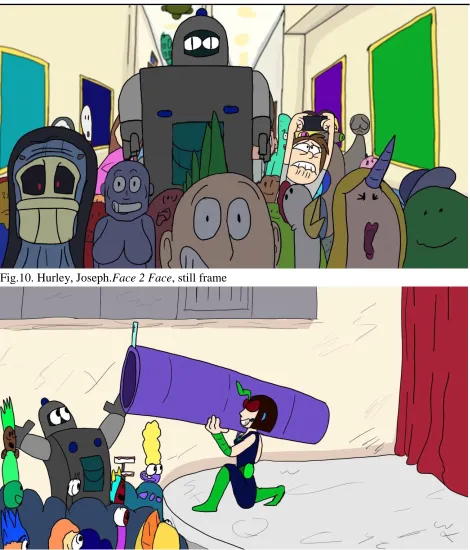
Fig.10. Hurley, Joseph.Face 2 Face, still frame
42
Fig.12.Hurley, Joseph.Face 2 Face, still frame
[image:43.612.76.541.383.649.2]43 Appendix C- Script
0:14:02 –
Cameron: Ok, focus in,
0:16:04
Cameron: Oh no wait! Focus out a little bit…
0:19:00
Cameron: Oh yea! Perfect!
0:22:17
Cameron: AAH!
0:31:03
Cameron: Oh wow!
0:32:10
Cameron: So coooool!
0:40:04
Cameron: Ahh!
0:41:22
Cameron: EEEE!
0:44:05
Cameron: Hmmm?
0:55:14
Cameron: Oof!
0:58:02
Cameron: (gasps)
1:23:11
Cameron: (joyful screaming)
44
Cameron: (giggles) 1:33:11
Cameron: Ahhhhh
1:34:12
Cameron: ooh, whoa!
1:41:00
Robot Cos-player: Whoa
01:49:10
Robot Cos-player: Huh?
2:01:03
Cameron: (groaning)
2:04:10
Cameron: (heavier groaning)
2:17:14
Cameron: (growling)
2:20:10
Cameron: (groans)
2:26:20 Cameron: Oh!
2:44:08
Cameron: (gasps)
2:46:06
Cameron: (sighs)
2:50:07
Announcer: And now ladies and gentlemen,
2:53:05
45
2:55:13
Announcer: Lightning… Lyraaaa!
3:16:19
Cameron: (screaming)
3:19:10
Lightning Lyra: Alright Everyone!
3:21:02
Lightning Lyra: Who’s ready for the t-shirt cannon?!
3:41:10
Cameron: (screaming)
3:43:13
Cameron: Ahhh
3:53:00
Robot Cos-player: warg! Whoa WhoaWhoaWhoaWhoa,
3:57:00
Robot Cos-player: Whoaaaah!
3:59:22
Cameron: (groans)
4:08:10
Lightning Lyra: (struggling)
4:12:15
Robot Cos-player: (struggling)
4:17:13
Lightning Lyra: (struggling)
4:23:10
Robot Cos-player: (struggling)
46
Lightning Lyra: (struggling)
4:29:06
Lightning Lyra: Huh?
4:30:14
Cameron: (Struggling)
4:46:03
Cameron: (shutters)
4:49:02
Robot Cos-player: Oof!
4:51:15
Cameron: (shutters)
4:53:11
Cameron: (screams)
4:57:03
Cameron: Huh?
4:58:11
Lightning Lyra: Thanks for the help!
4:59:16
Lightning Lyra: Do you need a hand getting up kid?
5:10:14
Cameron: (gasps)
5:11:10
Cameron: (inhales)
5:13:09
Cameron: Yaaahooo!
5:17:21
47
5:23:16
Cameron: (Screaming in joy)
5:38:12