Applications and Performances of Extended TTDDs
in Large-Scale Wireless Sensor Networks
Hong Zhou1, Lu Jin1, Zhongwei Zhang1, Hesham Ali2 and Chulho Won2 (1University of Southern Queensland, Toowoomba, Australia, Toowoomba, Australia
hzhou, jin, [email protected], 2Univeristy of Nebraska, Omaha, U.S.A, cwon, [email protected] )
Abstract. There are many applications of large scale sensor networks in which both the stimulus and the data collection stations are mobile (i.e. animal tracking, battlefield chasing). TTDD is a scalable and energy-efficient data dissemination model designed for this type of scenarios. However, TTDD only focused on handling mobile sinks. In this paper, we extend TTDD to deal with both mobile sources and sinks and evaluate the effectiveness of two potential extended TTDD schemes. Simulation results are presented to compare their performance in terms of energy consumption, delay and success rate. It is shown that the two schemes have similar performance when the moving speeds of the phenomena objects are slow. However, when the phenomena objects moving exceed certain speed, the advantages of one scheme over the other become unneglectable.
Keywords: sensor networks, data dessemination, mobile source, mobile sink, TTDD.
1 Introduction
The ultimate goal of communications is to communicate anything anywhere anytime. The recent advances of wireless mobile communications achieved in principle for people to communicate everywhere anytime, while the emerging wireless sensor networks add another dimension to communications by communicating anything. The anything in our lives can be as complicated and huge as few megabytes (or even gigabytes) video file or as simple and small as few bytes of any critical information. With the advances of microelectronics, the intelligent low-cost low-power small sensor nodes can be developed to sense almost anything which is of human’s interest from the phenomenon of hazardous volcanoes and earthquake to the smell of the flowers at the garden. A sensor network consists of a large of number of sensor nodes which are densely deployed and connected through wireless links in a self-configured and self-organised manner. Such sensor networks would enable numerous new and exciting applications and bring another technology evolutionary wave to penetrate to
every aspect of our lives (e.g. home, health, environment, military, agriculture, transport, manufactory, entertainment).
However, the great convenience and functionality of sensor networks also bring significant challenges. A typical sensor has limited memory, power, and computational capacities; often sensor nodes are prone to failures and the topology of the network can dynamically change. Thus, several key issues such as resource constraints, unpredictability, large scale, real time and security must be addressed to enable the exploration of the full benefits of sensor networks. Due to the unique features of sensor networks, many protocols and algorithms proposed for traditional wireless ad hoc networks are not well suited to sensor networks. In addition, a sensor network is usually application-oriented. For different applications, there are different technical issues that need researchers to resolve.
[image:2.595.213.399.450.604.2]There are many applications requiring large scale sensor networks where thousand or even tens of thousands of small sensors are distributed over a large geographic area to obtain fine-grained, high precision sensing data [1]. In such sensor networks, the sink(s) and source(s) can be either stationary or mobile. In this study, we adapt the same terminology in the research work addressed in [1], where a source is defined as a sensor node that detects a stimulus and report the stimulus, and a sink is defined as a user that collects the data reports from the sensor network. We are particularly interested in a large scale sensor network in which both the source and sink are mobile. This scenario often encountered whenever some tracking/chasing/searching and capture/find activities are involved. The accurate data about the mobile target(s)/source(s) has to be received by mobile sink(s) in a timely fashion. This category of sensor networks can be used for military battlefield, border protection, homeland security, and wildlife/pest control.
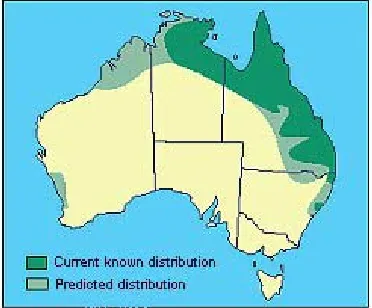
Fig. 1 Cane toad distributions in Australia (qouted from http://www.agric.wa.gov.au)
[2].The cane toad was introduced to Queensland, Australia to control pests of sugar cane in 1935. Since then, the cane toads adapt well into the Australian environment and the populations have exploded. The cane toads now have invaded into Northern Territory and northern New South Wales. The main front is moving towards Western Australia (Refer to Figure 1). The natural rate of spread of Cane Toad is now 30-50 km/year in Northern Territory and about 5 km/year in New South Wales [2]. The toxic cane toads have significant agricultural, environmental, social, and culture impacts [3] and cause increasing problems in Australia. A sensor network deployed in an area where cane toads are populated will assist the environmentalists collect the cane toad movement information to monitor and control them from expanding aggressively.
The sink and source mobility imposes new challenges to sensor networks. The continuous movements of the source and sink require continuous location updates, which can lead to increased transmission collision and rapid power consumption. Although several data dissemination protocols [4, 5, 6, 7] have been developed for sensor networks, they do not perform efficiently for the applications with mobile sources and sinks. A scalable and efficient data dissemination model, called TTDD (Two-Tier Data Dissemination) has been proposed in [1] to address the problem. TTDD uses a grid structure so that only limited numbers of sensors (at the grid points) participate in the location updates. However, the model assumes that the sources are static and only sinks are mobile. The scenario with both mobile sinks and sources has not been studied and the problem with both mobile sinks and sources has not been fully explored. In this paper, we proposed two potential mechanisms to extend TTDD to accommodate the sensor networks with mobile sources and sinks, and we present the modification necessary to improve the energy consumption and performance of TTDD over the sensor networks, and then test this modified protocol on the simulated network
The rest of this paper is organised as follows. Section 2 briefly overviews data dissemination protocols and TTDD mechanism. Section 3 introduces the proposed extensions of TTDD to mobile sources. Section 4 describes the simulation model and presents the simulation results, analyses and compares the performance of the proposed schemes. Finally Section 5 summarises and concludes the paper.
2 An Overview of Two-Tier Data Dissemination (TTDD) Model
Energy-efficiency is one of the most important issues to be addressed in sensor networks. Several energy-efficient protocols have been proposed for delivering data to stationary or very low-mobility sinks (e.g. SPIN [3], DRP [4], GRAB [5]). However, TTDD is the first model which targets at efficient data dissemination to multiple mobile sinks in large-scale sensor networks. Each data source in TTDD proactively build a grid structure which enables mobile sinks to continuously receive data on the move by flooding queries within a local cell only.
2.1 Grid construction
For each source, it builds a grid structure. The location of the source becomes the first cross-point of the grid. It then sends a data announcement message to each of its four adjacent crossing points and finally stops on the closest sensor node. The node stored the source information and further forwards the message to its adjacent nodes. Those nodes closest to the crossing locations are notified to become the dissemination node (DN). The process continues till a grid for the specific source is built.
It is assumed that the sensor field is a two-dimensional plane and divided into a grid of cells. The cell size is chosen as α and each cell is α × α square. Thus, for a source at location Ls = (x, y), dissemination nodes are located at Lp = (xi, yi) which are calculated as:
xi = x+ i ·α, yi = y + j·α ( i, j = 0, ±1, ±2, ±3, ...) (1)
2.1 Query and data forwarding
Once the grid is built and a sink needs data, it floods a query within a local area to discovery its intermediate dissemination node. The intermediate dissemination node forwards the query to the upstream dissemination node from which the intermediate dissemination node receives data announcements. The upstream one in turn forwards the query to its upstream one until finally the query reaches the source. During the above process, each dissemination node remembers its downstream dissemination node and later the data from the source is sent back to the sink along the way the query travels.
Once the data arrive at a sink’s intermediate node, trajectory forwarding is used to relay the data to the sink. In trajectory forwarding, each sink communicates with the intermediate dissemination node through two sensor node agents: a primary agent and an intermediate agent. This mechanism enables the mobile sink to receive or send data from the source continuously. While the sink is constantly moving with unknown location, the intermediate dissemination node communicates with the sink through two stationary relaying agents. If a sink moves out the range of its current immediate agent, it picks another neighbouring node as its new immediate agent. Likewise, if the sink moves out of a cell from its primary agent, it picks a new primary agent and new immediate dissemination node.
2.3 Grid Maintenance
Each grid is set a Grid Lifetime at the time it is built. If the lifetime elapses and no update message received, the grid will no longer exists. To conserve the energy supply, TTDD does not periodically refresh the grid during its life time. The grid is maintained by on-going queries and upstream updates. TTDD trades computational complexity for less consumption of energy.
3 Extensions of TTDD (E-TTDDs)
reports. Then each source proactively builds a grid structure to relay the quires and data. Each source naturally becomes the first dissemination node of the grid. The studies in [1] are only focused on handling mobile sinks. The performance of different options in the scenario with mobile stimulus has not been addressed though the suggestions for mobile stimulus are briefly discussed in [1].
For comparison, we extend TTDD in two ways to accommodate the scenario with both mobile sources and sinks. The first approach is simply to rebuild the grids for each of the sources along the trail of the stimulus. For convenience of expression, we simply call this approach as E0-TTDD. This model may be suitable for stimulus which is not constantly moving or move slowly. If the stimulus is moving constantly, E0-TTDD needs continuously re-build the grids for each of the sources along the trail of the stimulus. The frequent grid constructions may increase the energy consumption significantly.
The second approach is to reuse the grid already built. When a source has a data to send, it floods a “Grid discovery” message within the scope of about a cell size to find an existing grid. For convenience of expression, we call this approach as E1-TTDD. In this approach, only the very first source node generates a data announcement message and disseminates it to create grid structure. Once the grid structure is completed, all subsequent source nodes send a query to search the closest DN within the scope of 1.3 α. if a valid DN is found, the source node may add the DN into its DN routing table and just utilize the existing grid structure to disseminate data. This approach will avoid redundant network traffic and save the scarce energy by decreasing the amount of active sensor nodes.
4. Simulation Model
Network simulation tool NS-2 is used for evaluation of the performance of two approaches. We implement the simulation model based on the original package provided by Ye [1]. The original model is developed in Ns-2.1b8a. It was modified and integrated to new ns2 version, namely Ns-2.29.
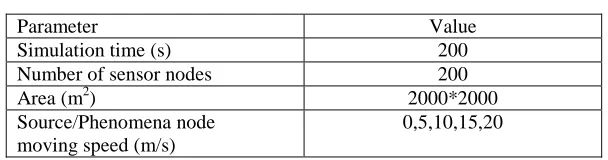
Similar to TTDD, we assume a square sensor field of area A in which N nodes are uniformly distributed. There are a number of Nk mobile sinks and a number of Nc mobile sources. The average moving speeds of sink and source are vk and vc, respectively. The sensor field is divided into cells with size of α by each source. The transmitting, receiving and idling power consumption rates of a sensor node are set to 0.66W, 0.395W, and 0.035W, respectively. The configuration parameters in the simulation are shown in Table 1.
Table 1. Simulation Parameters
Parameter Value
Simulation time (s) 200
Number of sensor nodes 200
Area (m2) 2000*2000
Source/Phenomena node moving speed (m/s)
0,5,10,15,20
5 Simulation Results
The three performance metrics considered in this research include energy consumption, packet delay, and success rate. The energy consumption is defined as the total accumulated transmitting and receiving energy of the participating sensor nodes consumed by the network. The idle energy is not counted for the purpose of performance comparison as it does not indicate the data delivery efficiency. The success rate is defined as the ratio of the total number of packets successfully received at the sink to the total number of packets generated at the source, average over all source-sink pairs [1]. The delay is defined as the average time difference between the instance at which the packet is generated at the source and the instance at which the packet is received at the sink.
We compare the performance of two TTDD extensions with different scenarios and parameters. In particular, we are interested in the impacts of the moving speed on the performance differences between E0-TTDD and E1-TTDD.
5.1 Impact of the moving speeds of source node
0 500 1000 1500 2000 2500 3000
0 5 10 15 20
moving speed (m/s)
C
o
m
s
um
e
d
en
er
gy
(m
w
)
[image:7.595.197.410.146.306.2]E0-TTDD E1-TTDD
Fig.2. Comparison of Energy Consumption
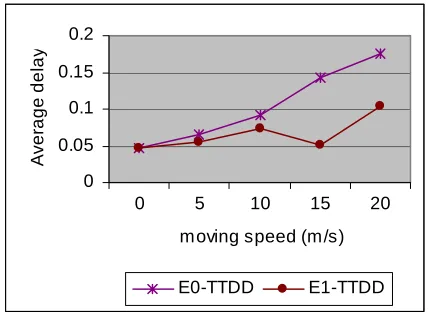
Figure 3 compares the delay performance of the two schemes under the same simulation scenario. As the moving speed increases, the delay increases gradually for both protocols. However, E1-TTDD does not need to send flood packets to rebuild the grid thus shorter delay is experienced than E0-TTDD. The packets for rebuilding the grids increase the network traffic and thus increase the delay significantly.
0 0.05 0.1 0.15 0.2
0 5 10 15 20
moving speed (m/s)
A
v
e
rage
del
a
y
[image:7.595.197.411.413.573.2]E0-TTDD E1-TTDD
Fig. 3. Comparison of Average Delay
0 0.2 0.4 0.6 0.8 1 1.2
0 5 10 15 20
moving speed (m/s)
A
v
er
ag
e s
u
c
c
es
s
r
a
te
[image:8.595.199.408.145.304.2]E0-TTDD E1-TTDD
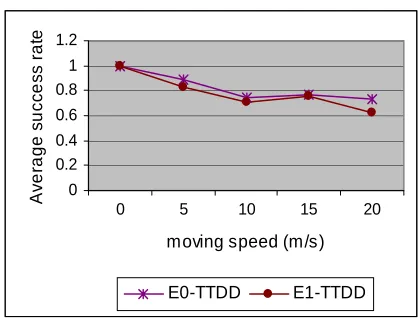
Fig. 4. Comparison of Average Success Rate
6 Summary and Conclusions
This paper presents some preliminary studies of two potential TTDD extensions (ie. E0-TTDD, E1-TTDD) in large-scale sensor networks where the stimulus and data sink are mobile. The two protocols distinguish from each other on the policy of building and maintaining a sensor grid. E1-TTDD reuses the grid built for the fisrt source node at the original location while E0-TTDD builds a new grid when new source node is activated along the track of the phenomena object. The simulation results show that their performance is similar if the moving speed is not very high (<5m/s). However, E1-TTDD has significant performance improvement than E0-TTDD when the stimulus moves at a relatively high speed (>5m/s).
The future research will investigate the impacts of number of active source-sink pairs on the performance of E-TTDDs, also the impacts of the size of the sensor network, the pattern of movements on their performance, and an optimized mechanism of handling mobile sources and sinks at different network scenarios.
Reference
[1] F. Ye, H.Luo, J. Cheng, S. Lu, and L. Zhang, “A Two-Tier Data Dissemination Model for Large-Scale Wireless Snesor Networks”, ACM International Conference on Mobile Computing and Networking, 2002.
[2] R. Speare, “Bibliography of Bufo marinus”,website
http://www.jcu.edu.au/school/phtm/PHTM/staff/rsbufo.htm.
[4] C. Intanagonwiwat, R. Govindan, and D. Estrin, “Directed Diffusion: A Scalable and Robust Communication Paradigm for Sensor Networks”, ACM International Conference on Mobile OCmputing and Networking (MOBICOM’00), 2000.
[5] D. Coffin, D.V. Hook, S. McGarry, and S. Kolek, “Declarative, Ad-Hoc Sensor Networking”, SPIE Integrated Command ENviorments, 2000.
[6] F. Ye, S. Lu, and L. Zhang, “GRAdient Broadcast: A Robust, Long Lived Large Sensor Network, http://irl.cs.ucla.edu/papers/grab-tech-report.ps, 2001.