"
~,.:.:
-.
~ ~""
,..
-(5
EJ~
I~
jrR>
FJ
~~
..::::lI
'2!:
,
IMi
I~
1:-I~
~
~~
r&
@,~I
I@
r!3
,@
.~
I~
I~'
,@
erUi1ii
·~§.·il
,~"'~~
~~
..,
~
",?'
=
.",.
,.
.::;;,
....
"
E:::::::t
d!"
8
~
13
9J
'"
~
tf»
I
©
.A'
CU11
~
©
~
c::::::::t
~
©J
.~
~
cs;,
i!
©
~
g:"rlii
~
,rn)
~
~
c:::::J
~
~
~
~u~
I~
~.
(f))
9-~
.p.
,;.
r;u~
':-"
~~~.
.
#"
13
f
•
,.
,.1
~
.,
'
rsP
,1
M
"
~'::.iI
I
658.15
First published 2005 by
John Wiley & Sons Australia, Ltd 42 McDougall Street, Milton, Qld 4064 Offices also in Sydney and Melbourne
Typeset in 10.5/12 pt Times Roman
Copyright Diana Beal, Michelle Goyen, Brian Gibson and Abul Shamsuddin 2005
National Library of Australia Cataloguing-in-publication data
Beat, D.
Introducing corporate finance
Includes index.
For tertiary students of business and finance. ISBN-13 9780470803905.
ISBN-tO 0470803908.
1, Corporations - Finance - Textbooks. 1. Beal, Diana.
Reproduction and communication for educational purposes The Australian Copyright Act 1968 (the Act) allows a maximum of one chapter or 10% of the pages of this work, whichever is the greater, to be reproduced andlor communicated by any educational institution for its educational purposes provided that the educational institution (or the body that administers it) has given a remuneration notice to Copyright Agency Limited (CAL) under the Act.
For details of the CAL licence for educational institutions contact: [email protected]
Reproduction and communication for other purposes
Except as permitted under the Act (for example a fair dealing for the purposes of study, research, criticism or review), no part of this book may be reproduced, stored in a retrieval system, communicated or transmitted in any form or by any means without prior written permission. All inquiries should be made to the publisher at the address above.
Cover images: copyright 2000 PhotoDisc, Inc
Edited by Sharon Nevile
Disclaimer: text was current at time of publishing.
Printed in Singapore by
Kyodo Printing Co (S'pore) Pte Ltd 10 9 8 7 6 5 4 3 2
n=~
~t._
,
~~~'iI:' i:1~1.", f>
4
ff~@OJm ~[ffi@ Ci1M~[ffi@(f@
'I
Diana Beal is ~n Associate Professor in Finance at the University of Southern Queensland (USQ), where she has taught courses in business finance, personal finance, applied microeconomics, macroeconomics, financial markets and financial institutions
management. Her initial training was as an economist and she worked for the government, both federal and state, for eight years. Since joining USQ in 1988 Diana has completed a Masters degree and a PhD in economics. She also has a commerce degree, and can therefore read between the lines of a balance sheet. Diana has always had an interest in both business and personal finance and has traded property, shares, collectibles, forex and options. In addition, she ran her own business for 15 years before joining USQ.
.
Michelle Goyen is a lecturer at the University of Southern Queensland, where she has enjoyed teaching corporate finance for about a decade. Michelle has an Honours degree in Accounting and Financial Management from the University of New England and a Masters of Commerce from the University of Southern Queensland. Prior to becoming an
academic, she worked in a variety of industries, the most releva~t of which was benchmarking the performance of small firms. Michelle is especially interested in the application of theory to real world settings and in considering how people's behaviour modifies predicted outcomes. Her main research interests are investor behaviour and the valuation of initial public offers .in Australia.
Brian Gibson is a senior lecturer at the University of Newcastle, where he teaches
t managerial accounting and small firm financial management, and a visiting fellow at the
University of New South Wales, where h$,teaches entrepreneurial and small business finance. Brian has been a member of SEAANZ (Small Enterprise Association of Australia
& New Zealand) since its inception in 1987 and has served as a director, senior vice
president and president of the ICSB (International Council for Small Business). He has experience working and consulting in accounting and finance in both large and small businesses, including running his own accounting practice. His major research interests are associated with the means by which owners of small enterprises gather and utilise financial information to aid in the management of their businesses and he has an extensive research
publication~ list.
I'
Abul Shamsuddin is Associate Professor of Finance in the Newcastle Graduate School of Business, University of Newcastle. He received his PhD in 1994 from Simon Fraser University, Canada. Prior to his current position, Abul taught at the University of New
t England and Simon Fraser University for 15 years and has held visiting appointments at the Australian National University, La Trobe University and Simon Fraser University,
,
among others. He is a senior associate of the Australasian Institute of Banking andFinance. Abul is co-author of Investments: Analysis and Management (Wiley, 2003) and has published in various refereed journals. His research interests include asset pricing and
'"
capital market integration.
fY~
"
Part 1
oo~@w ~@[Jl)~@(Ji)~
Preface xii
How to use this book xiv
Acknowledgements xx
Foundations of corporate finance 1
.r
(b@[fi}~rru~
D
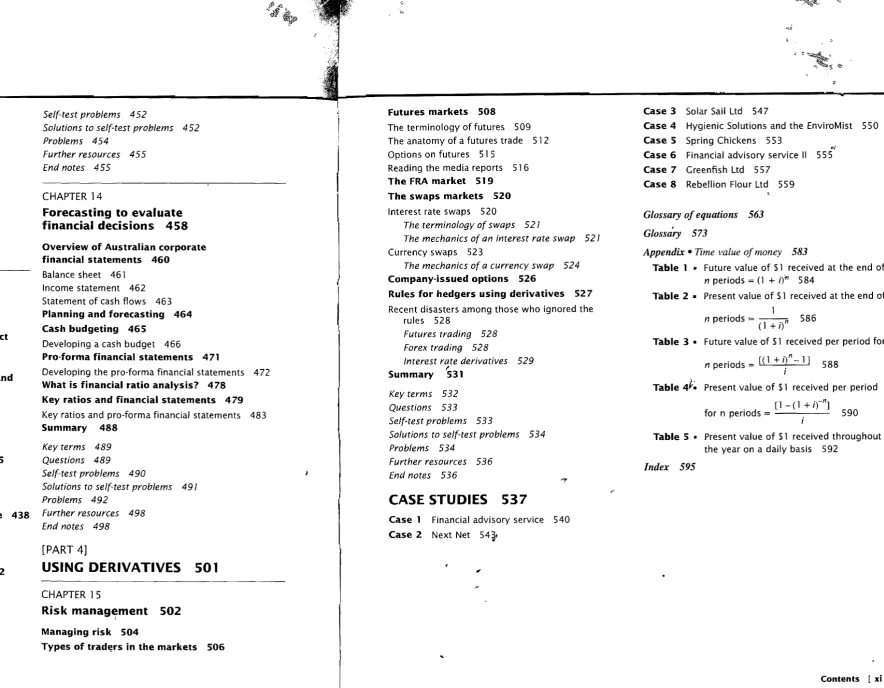
Preface xii
How to use this book xiv Acknowledgements xx
[PART 1]
FOUNDATIONS OF
.lil_
~
i;.":!o
2 ~"
.t
""
Self-test problems 35
Solutions to self-test problems 35 Problems 36
Further resources 37 End notes 37
CHAPTER 2
Part
2
Part 3
Part
4
Chapter 1 Introducing the firm and its goals 2 Chapter 2 Business and the financial markets 38 Chapter 3 Financial mathematics 64
Chapter 4 Understanding risk and return 96
Investment choices 135
Chapter 5 Valuation of bonds and shares 136 Chapter 6 Cost of capital 164
Chapter 7 Planning investments discounted cash flow techniques 204 Chapter 8 Planning investments some real world complications 234
Financing the firm
275
Chapter 9 Short-term finance - working capital 276 Chapter 10 Managing current assets 300
Chapter 11 Long-term external finance 334 Chapter 12 Dividend policy 376
Chapter 13 Capital structure 41 4
Chapter 14 Forecasting to evaluate financial decisions 458
Using derivatives 501
Chapter 15 Risk management 502
Case studies
537
Glossary of equations 563
Glossary 573
Appendix • Time value of money 583
Index 595
CORPORATE FINANCE 1
CHAPTER 1
Introducing the firm and its goals 2
Goals of firms 4
Roles of financial managers 7
Financial governance and financial decisions 9 The principal-agent problem 10
Ethics in business 12
Corporate social responsibility 14 Forms of business organisation 1 5 Sole proprietorship 16
Partnership 17 Company 17 Trust 19
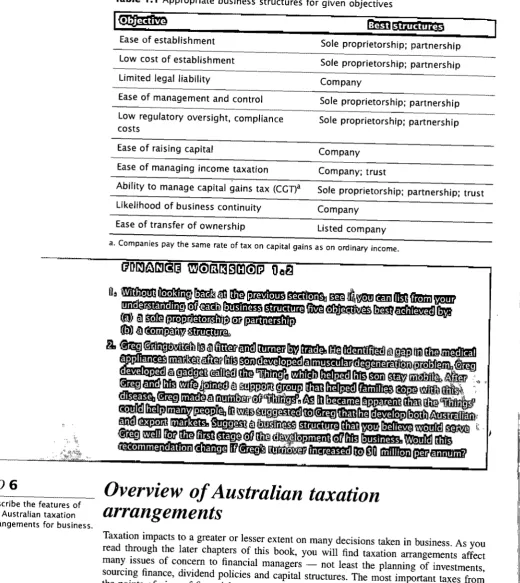
The most appropriate business structure 19 Overview of Australian taxation
arrangements 20 Income tax 21
Capital gains tax (CGT) 23
Goods and services tax (GSn 24 p
The importance of dividend imputation for
company business decisions ~5
Imputation from the company's viewpoint 25 Imputation from the sli'areholder's viewpoint 26 Effects of dividend imputation for corporate finance 26 Challenges facinp modern firms 27
How being a person affects decision making 29
.""
The nature of rationality 29
Summary 31
Key terms 34 Questions 34
Business and the financial markets
38
The 'roles of the financial markets 40 Financing business operations 41 Direct finance 41
Intermediated finance 42
Types of financial institutions 42
Authorised deposit-taking institutions (ADls) 42 Registered financial corporations (RFCs) 43 Classifying the markets 44
Primary and secondary markets 45 Public and private markets 46 Money and capital markets 47 Debt anjl equity 47
The effect of debt on risk 48 The effect of debt on control 49
The effect of varying taxation treatments of payments to debt and equity 49
Debt instruments 50 Equity instruments 52
Regulators and regulation 54 Reserve Bank of Australia 56
Australian Prudential Regulation Authority 56
Australian Securities and Investments Commission 56 Australian Stock Exchange 57
Summary 58
Key terms 59 Questions 59
Self-test problems 60
Solutions to self-test problems 60 Problems 61
Further resources 61 End notes 62
Contents [v 1
#'H ~:
.i'!'
I
~~
'k
CHAPTER 3
Financial mathematics 64
Cash flows. interest and the time value of money 66
Simple interest 68
Future and present values of a single sum 69
An application of simple interest: pricing commer cial bills 70
Compound interest 74 Using time lines 74
Future and present value of a single sum 74 Nominal and effective rates 77
Future and present value of several equal sums 80
Using time lines 80 Ordinary annuities 81 Other types of annuities 85
Annuity due 85 Deferred annuity 87 Perpetuity 89
Present and future value of unequal sums 89
Solving cash flow problems 90
Summary 91
Key terms 92 Questions 92
Self-test problems 93
Solutions to self-test problems 93 Problems 93
Further resources 94
CHAPTER 4
Understanding risk and return
What is return? 99
Measuring returns 100
Ex post returns 100 Ex ante returns 102 What is risk? 106
96
[ vi 1 Contents
,
",--,.
Measuring risk 107
Ex ante standard deviation 1 09 Ex post standard deviation 111 Attitudes to risk 114
The relationship between risk and return 119
Required rates of return 119 Reducing risk 120
The Capital Asset Pricing Model 122
Is CAPM the best model of risk and return? 126 Summary 127
Key terms 129 Questions 130
Self-test problems 130
Solutions to self-test problems 131
Problems 131
Further resources 132 End notes 133
[PART 2]
INVESTMENT CHOICES 135
CHAPTER 5
Valuation of bonds and shares 136
Price and value 138
How are security prices set? 139
Principles of security valuation 141 Valuing bonds 143
Zero coupon bonds 143 Coupon bonds 144
Index bonds 146
Valuing preference shares 146
Valuing ordinary shares 147 Dividend discount model 148 Constant growth model 150
Applying dividend valuation models 152 Price-earnings ratio 155
Summary 157
Key terms 159
Questions 159
Self-test problems 160
Solutions to self-test problems 160 Problems 161
Further resources 162 End notes 163
CHAPTER 6
Cost of capital 164
The cost of capital concept 167
Determinants of the cost of capital 168 Taxation regimes and the cost of capital 169 Simplifying assumptions 170
Estimating the component costs 171
Finding the marginal cost offunds 171 Cost of debt 172
Cost of preference shares 181 Cost of ordinary equity 183
Cost of r'etained earnings 183 Cost of new share issues 185
Under-utilisation of imputation credits 190
The weighted-average cost of capital 192
Alternatives for weighting 194 Summary 196
Key terms 198 Questions 198
Self-test problems 198 'f
"
Solutions to self-test problems 199 Problems 199
Further resources 201 End notes 201 i
CHAPTER 7
...
Planned investments -
discounted
cash flow techniques 204
Investment and the business of the firm 206
Four common characteristics of investment decisions 207
Relatively large initial outlay 207 Relatively long horizons 207
Projects can be difficult to reverse 207 Projects have risk 208 ./-'
Where do project proposals come from? 208 Investments and firm value ~08
Appraisal techniques and maximising wealth 209 Estimating cash flows 210
Identifying relevant cash flows 210 Estimating the initial outlay 214
Estimating the net operating cash flows 218 Estimating the terminal value 219
Identifying annual cash flows 220
Net present value 221
Internal rate of return 223
Comparing NPV and IRR 226 Summary 228
Key terms 229 Questions 229
Self-test problems 230 'I
Solutions#to self-test problems 230 Problems 231
Further resources 232 End notes 233
CHAPTER 8
Planning investments -
some real
world complications 234
Analysing a set of projects 237
Capital constraints 237
Mutually exclusive projects 238
The size disparity 239
Cash flow timing disparity 240 'Unequal lives 240
Incorporating risk into the analysis 243
Taxation and investment planning 246
Taxes and the initial outlay 247
Taxes and net operating cash flows 252 Taxes and terminal value 255
'Il
t;;f
,::
"
'"
"
"" ~Summary 369 Non-discounted methods of project Further resources 298
evaluation 256 End notes 298 CHAPTER 11 Key terms 370
Payback period 256
Long-term external finance 334
Questions 371..
'
Accounting rate of return 259 CHAPTER 10 Self-test problems 371
Intermediated finance 336
Non-financial factors in project choices 260
Managing current assets 300
\
Solutions to self-test problems 372Fixed rate business loans 337
Summary 264 Problems 373
Variable rate business loans 337
The dual meaning of 'cash' 302 Further resources 375·
Key terms 265 Instalment loans 337
\
The motives for holding cash 303 End notes 375
Questions 265 Interest-only loans 338
The transactions motive 303
[
Self-test problems 266 Commercial bills 338
The precautionary motive 304
Solutions to self-test problems 267 Fully drawn advances (FDAs) 338 CHAPTER 12
The speculative motive 304
Problems 269 Leases 339
Dividend policy 376
Managing cash 304
Further resources 272 The lease or buy decision 342
The timing of cash flows 305
!
Fundamental dividend conc:epts 379End notes 272
The financial imperative of having sufficient cash 306
[PART 3] The cost of holding cash 306
The cost of not having enough cash 307
FINANCING THE FIRM 275
Using electronic funds transfer (EFT) 309 Benefits and costs of EFTPOS 310
CHAPTER 9
Using direct entry (DE) 312
Short-term finance -
working
Debtors or accounts receivable 313
capital 276
Benefits and costs of granting credit 313
Working capital 278 Determinants of the level of debtors 314
Managing working capital 279 Total sales 314
An appropriate level of net working capital 280 Credit policies 314
Sources and costs of informal Collection policies and procedures 316
short-term finance 284 Credit sales to debtors 317
Accrued wages, superannuation and taxes 284 Romalpa clauses 319
Trade credit 284 Managing inventories 319
Sources and costs of formal Types of inventories 320
short-term finance 286 Benefits and costs of holding inventories 321
Bank overdrafts 286 Management techniques 323
Commercial bills and promissory notes 288 Just-in-time 325
Factoring or debtor/invoice/trade finance 291 Summary 327
Stock/inventory loans or floor-plan finance 292
Key terms 329
Summary 295
Questions 329
Key terms 296 Self-test problems 329
Questions 296 Solutions to self-test problems 330
Self-test problems 297 Problems 330
Solutions to self-test problems 297 Further resources 331
Problems 297 End notes 331
[ viii I Contents
Leasing and debt in a firm's capital structure 342
The dividend payment process 379 Taxation treatment of lease payments 343
Measures of dividend policy 380 Potential benefits of leasing 344
Dividend payout ratio 380 Taxation benefits 345
Dividend yield 381 Efficiency of asset management and disposal 346
Dividend stability 381 Avoidance of obsolescence 346
Dividend policy - empirical evidence 384
Improved cash flows and conservation of
Dividend irrelevance theory 387
capifal 347
Lease or buy decision analyses 347 Divideq1
d
relevance theories 389Debt finance from the Australian market 350 Tax treatment of dividends and capital gains 389
Corporate bonds 350 Taxation of dividends 390
Floating rate notes (FRNs) 351 Taxation of capital gains 393
Debentures 352 Market value of franked dividends 394
Hybrid finance from the Australian Other dividend relevance arguments 397
market 353 Riskiness of capital gains 397
Convertible notes 354
...
Signalling and asymmetric information 398r
Convertible preference shares 355 Agency costs 398
International sources of funding 356 Transaction costs and clientele effect 398
Alternatives to cash dividends 399 Equity finance securities 359
Share repurchase 399 Ordinary shares 360,
Share repurchase process 400
Preference shares 361
Rationales for share repurchase 400
Raising equity finance 362
Bonus shares 401 Initial public offers 362
Dividend reinvestment plan 402
Setting a fixed'offer price 364
Optimal dividend policy 404
Book-building an offer price 365
RaiSing more equity finance 366 Internal factors 404
Rights 366 v Institutional and market factors 406
Options 368 Alternative dividend policies 406
r;.
.;:,
:J
Residual dividend policy 406 Constant payout ratio policy 406 Stable dividend policy 407
Summary 408
Key terms 409 Questions 409
Self-test problems 410
Solutions to self-test problems 410 Problems 4 1 1
Further resources 412 End notes 413
CHAPTER 13
Capital structure 414
What is capital structure? 41 7
Capital structure and financial risk in perfect markets 419
Homemade leverage 425
Imperfect markets - considering taxation and bankruptcy costs 427
The static trade-off model 427 The influence of personal taxation 431 Capital structure in Australian companies 433
Other explanations of capital structure 435 Agency cost framework 435
The pecking order hypothesis 437 Life cycle approach 437
Comparing explanations of capital structure 438 Other influences on capital structure 438
Firm structure influences 439 Firm operation influences 440
Evaluating changes in capital structure 442 EBIT-EPS analYSis 443
Limitations of EBIT-EPS analysis 448 Summary 449
Key terms 451 Questions 451
[ x 1 Contents
Self-test problems 452
Solutions to self-test problems 452 Problems 454
Further resources 455 End notes 455
CHAPTER 14
Forecasting to evaluate
financial decisions 458
Overview of Australian corporate financial statements 460
Balance sheet 461 Income statement 462 Statement of cash flows 463 Planning and forecasting 464 Cash budgeting 465
Developing a cash budget 466
Pro-forma financial statements 471
Developing the pro-forma financial statements 472 What is financial ratio analysis? 478
Key ratios and financial statements 479 Key ratios and pro-forma financial statements 483 Summary 488
Key terms 489 Questions 489
Self-test problems 490
Solutions to self-test problems 491 Problems 492
Further resources 498 End notes 498
[PART 4]
USING DERIVATIVES 501
CHAPTER 15
Risk management 502
)
Managing risk 504
Types of trad~rs in the markets 506
Futures markets 508
The terminology of futures 509 The anatomy of a futures trade 512 Options on futures 51 5
Reading the media reports 516 The FRA market 519
The swaps markets 520 Interest rate swaps 520
The terminology of swaps 521
The mechanics of an interest rate swap 521
Currency swaps 523
The mechanics of a currency swap 524
Company-issued options 526
Rules for hedgers using derivatives 527 Recent disasters among those who ignored the
rules 528
Futures trading 528 Forex trading 528
Interest rate derivatives 529
f
Summary 531
Key terms 532 Questions 533
Self-test problems 533
Solutions to self-test problems 534 Problems 534
Further resources 536 End notes 536
'7
CASE STUDIES
537
; '
Case 1 Financial advisory service 540 Case 2 Next Net 54~,
~
~
."
Case 3 Solar Sail Ltd 547
Case 4 Hygienic Solutions and the EnviroMist 550 Case 5 Spring Chickens 553
.,
case 6 Financial advisory service II 555 Case 7 Greenfish Ltd 557
case 8 Rebellion Flour Ltd 559
Glossary of equations 563
Glossdry 573
Appendix • Time value of money 583
Table 1 • Future value of $1 received at the end of
n periods
=
(l + i)'t! 584Table 2. Present value of $1 received at the end of
1
n periods = - - n 586
(1 + i)
Table 3. Future value of $1 received per period for
n
periods = [(1 +i( -
1] 588I
L
Table 4". Present value of $1 received per period
[1 - (1 + ifn]
for n periods
=
.
590I
Table 5. Present value of $1 received throughout the year on a daily basis 592
Index 595
[image:6.1187.271.1156.16.704.2],.
~
".~
....
,....,
.•.,-~-~ ,
\-,
~
~
~
~
Letl/fn~flg;
tlbj(!ciJiv({s:
After .studying this chapter. you should be able t:o:
LO
1
iii describe the range of goals of firms, including the significant wealth-maximisation objectiveLO
2
II discuss the roles of financial managersLO
3
1:1 grasp the importance of the principal-agent problemLO
4
g discuss the role of ethicsLO
5
g describe the forms of business organisation and their implicationsLO
6
iii describe the features of the Australian taxation arrangements for businessLO
7
iii discuss the importance of incorporation of dividend imputation effects inbUSiness decisions
LO
8
1:1 discuss some of the challenges facing modern firmsLO
9
1:1 describe the nature of rationality indeclsiQI1 making.~
,
~ ,.,.
HI HI N S U
RANCE COLLAPSES
WITH $5. 5 B I
L
I..
ION OWl NC
BIB. a major insurance company in. Australia,collapsed early in 2001. Its latest set ofaudited accounts at the time showed net assets of almost $1 billion, but It later transpired that, rather than having nefCfssets, the company had net liabilities of about $5.5 billion. Ray Williams was managing director for most of the company's history.
The profligate philanthropist
DAVID BREARLEY
Wayne Martin, the (HIH] commission's tenacious counsel, hit hard when Williams finally appeared on Tuesday, day 129 of the hearing.
Dr Raymond Reginald Williams AM, he suggested, was a vain man who loved his honorifics and donated no end of HIH cash to secure them. Monash University, to which he channelled a good share of the HIH millions, bestowed the honorary doctorate. The Order of Australia came with a citation acknowledging his boundless generosity, but not HIH's role in underwriting it.
Anyone in Williams's sights - client, servrtnt or otherwise - was liable for summary reward. Swiss watches worth $10000 apiece were the standard thankyou for 15 years' service at HIH. An invoice for 38 of them arrived on January 9, 2000, the same day staff were told to stop processing claims because of cashflow problems.
There were baubles and trinkets for all - including high-end jelly beans - but those in Williams's inner orbit prospered in special ways. Stuart Korchinski received a Saab convertible from the boss a~d $20 000 worth of home
airconditioning, apparently while occupying the position of audit general manager. There was also a $250 000 loan, which appears to have been written off.
Executive expense accounts for calendar 2000 show Korchinski's claims topping $100 000, although he was never, strictly speaking, an executive. He was, however, the ultimate Williams insider his jogging partner. In May 2000, Williams authorised $17 000 for three Korchinskis to attend a family funeral in Canada; seven months later he signed off on a $910000 termination payout for Korchinski, whose contract suggests he was entitled to considerably less than that.
'7
On Williams's own evidence, his directors never once blinked at his loose ways with shareholders' money (Williams's personal shareholding in HIH was
insubstantial), even as the company careered towards oblivion. But why would they, when executive bonuses were soaring, from $340 000 in 1998-99 to $7.2 million in 2001. The last days of Pompeii seem tame by comparison.
The donations, he [Williams
1
insists, are the legitimate acts of a good corporate citizen. The other gifts reflect a sense of common decency and a commitment to staff motivation. And the authority for it all resides in the office of chief executive, which invests its occupant with prudence and honour. This is an article of faith with Williams, who regards supreme executive status as Catholics regard the papacy.Bad call.
Source: The Australian, 10 AugustZOO2, p. 21:'
What issues. or problems for the firm:
goes
suggest to you?~
• Financial governance and financial decisions
[t\£fjU[i]jl
-Chapter preview
The HIH report gives you a real-life example of what part of this chapter is about. The col lapse of HIH was a major event in Australian business history. Not only did employees and shareholders lose considerable sums of money, but the market for many types of insurance products virtually collapsed overnight. This was because lllH had undercut reasonable market prices and thus put an artificial cap on pricing while at the same time capturing large market shares. The loss of insurance cover meant that, for a considerable period, builders could not work, some professionals could not risk working and many community events had to be cancelled.
Many of the issues raised by the HIH collapse are covered in this chapter: the goals of firms, the goals of finance managers, the roles of finance managers, the principal-agent problem and the need for ethical behaviour. Additionally, the chapter Covers some basic information about the way business is organised and how it is taxed in the Australian con text. We also consider some of the challenges facing modern business. Finally, we intro duce some concepts from behavioural finance that help us understand the way people make decisions.
The following diagram shows how this chapter is structured.
• Corporate • Sole • Income tax • Imputation
• The social proprietorship • Capital from the nature of responsibility: • Partnership gains tax company's rationality
viewpoint • Company (CGT)
• Goods and • Imputation • Trust
services tax from the • The most (GST) shareholder's
appropriate viewpoint
business
• Effects of structure
dividend imputation for corporate finance
LO
1
Goals offirms
Describe the range of goals of firms, including the
Firms come in all sizes - small, medium and large. Firms are owned by sole operators,
significant wealth
partnerships of two to 20 people or perhaps some hundreds, or by thousands of individual
maximisation Objective_
shareholders and large investment institutions in the case of listed public corporations. This book has been written to cover the financial decisions faced by all these firms, no matter how small or large and no matter how they are owned. However, in practice it is likely that
[ 4 J Part 1 I Foundations of corporate finance
small firms will take a less rigorous approach to decision making and financial analyses than is advocated here because these firms tend not to employ people trained in finance. Additionally, the management of many small finns judge that the benefits of employing a financial manager or a financial consultant do not exceed the costs. This judgement may in fact be an error, as time inevitably will reveal.
Every business has a reason or reasons for being. Because of different sizes- and owner ship structures, it is to be expected that there would be a range of goals among finns. For example, the Grey family partnership which owns a small auto electrical business might want to earn enough to live comfortably, put away some funds to educate their children, not work on Saturday or Sunday, earn a reputation for doing good work 01), time and at a reasonable cost, and have a good relationship with all their customers so that old ones return and new ones are attracted by word of mouth rather than expensive advertising cam paigns. Eventually, the family might want to sell the business to fund a comfortable retire ment.
In contrast, the ownership of a large corporation is much more removed from the oper ations of the company. The owners are you and me - through our direct shareholdings and indirectly through our superannuation funds and managed funds. What are our goals? Are they the same as the Greys? This is unlikely. Because the owners are not closely connected the everyday operations of the finn, it is likely that the goals are simplified. Some owners will want only to make good returns; others will be concerned with returns, but would also want their firm to have good employment policies 'and labour relations or to make all possible attempts not to harm the qatural environment in the course of business operations.
So the range of primary business goals includes: • maximal wealth for owners
• maximal profits
• adequate profits - termed 'satisficing' where owners are happy with reasonable profits
t and company growth
• high revenue growth - especially for. corporations where managers are rewarded for achieving such growth goals P
• large market share • limited working hours
• high reputation for product quality and service
• good employee relations and employment policies a good place to work • minimal or no harm to the natural environment - no pollution or land degradation • ethical treatment of all parties associated with the business - a good corporate citizen.
Some ofr;these goals will not be pursued by all businesses, some are difficult to achieve, some are difficult to measure and some need good returns in order to be able to fund their pursuit. Others are interdependent, and sometimes one goal must be sacrificed to some extent to achieve another. Take wealth maximisation, for example. Wealth maximisation by owners is a simple concept and must stem from at least good, if not maximal, returns in the
f form of either annual profits or capital appreciation. In turn, profit maximisation as a con
cept sounds simple enough, but can be difficult to achieve in practice. For example, are we ~ thinking of short-run maximum profits or of long-run profits? Is there a difference? Yes,
'"
there is.... Consider the case of Jonno, a travelling house painter, who does paint jobs for people and then moves on. He is in business, and he buys paint and completes jobs by adding his labour. He has no plans to return to a particular area again and moves from state to state according to whim. He plans to stay in business only as long as it takes to save for a small fishing boat. He may well maximise his short-run profits by charging as much as he thinks the
..
market will bear so he just gets each job. He could buy cheap paint. After all, the customers can not tell the difference, and he will be well away by the time the green paint fades and the white paint blisters and cracks. Why should he decrease his profits by buying expensive,
Profit maximisation
implies a bUsiness is managed to maximise the difference between revenues and expenses in any period.
Wealth maximisation
implies that the business is managed so that the present and futu re cash flows discounted at an appropriate rate will give a present value (PV) which is maximised.
The time value of money
is the concept that a dollar is worth more the sooner it is received.
high-quality paint? He will try to maximise his short-run profits, because the long term is not relevant to him. Jonno is pursuing profit maximisation.
By contrast, consider the case of Len, a lawnmowing and landscaping contractor, who works in the same region he lives in. He wants his customers to be pleased with the way he tends their gardens, and he wants them to get him back every two or three weeks. When he does landscaping jobs, he puts in durable timbers because he knows he will lose future business if the timbers rot or are eaten by termites within a few years. Thus, businessman will tend to charge reasonable prices (not the maximum the market will bear) and will buy good-quality, more expensive materials. He is much more likely to try to maximise his long-run profits, and his pricing behaviour will be very different from the businessman in the first case. Thus, the element of time is important in our considerations. Len is pursuing wealth maximisation. He is managing his business to maximise the 'pre sent value' of its present and future cash flows. We will learn more about this concept on the following pages. We will learn how to calculate present value in chapter 2.
Both Jonno and Len in these two very different business scenarios try to run their busi ness at a profit, probably as high a profit as they can achieve. But Len is putting in place the foundations for future profits and future wealth while Jonno is 'burning his bridges' and practically guaranteeing that he will not be invited back for future business.
Did you notice that we distinguished between profit maximisation and wealth maximis ation in the range of business goals? Len and Jonno are operating their businesses with dif ferent time horizons. If we compare the profit figures for the two businesses, Jonno's look to be the better performing business, but which business would you prefer to buy into?
The maximisation of owners' or shareholders' wealth is taken to be the optimal objec tive for the firm. This concept takes into account future earnings (and from this basis stems Len's concern to keep his current customers happy so that they provide the foundation for his future earnings). Earnings means profits and profits are a good thing for a firm to have. However, be aware it is possible for a firm to have large profits but not be able to pass these on to the owners because there is no spare cash. The profits are 'soaked up' by increased stock, debtors and necessary purchases of fixed assets.
Further, maximising profits ignores how much risk the firm had to take to generate the profits. As we will see in chapter 4, if owners of firms are exposed to increased risk, they will want a higher return than they would for safer investments. Risk can be incorporated into managers' decisions when the objective of the firm is maximising wealth. J
Another drawback of profit maximisation where owners and managers are different people is that managers have been known to manipulate profit figures. They can do this by changing the way some items are accounted for, reporting revenues early or costs late, or by failing to report some items at all. The collapses of companies like Harris Scarfe and HIH in Australia and Enron in the USA have shown that the profit figures in financial state ments are sometimes not representative of the real situation.
The objective of maximising owners' wealth factors in the time value of money. The time value of money concept merely proposes, and I'm sure you will all agree, that $10 in the hand now is worth more to you than the same $10 if you were to receive it later; say, in one year's time. Regardless of the effects of inflation on your purchasing power, you could invest the $10 at, say, 5% with your local financial institution and have $10.50 at the end of 12 months. Put another way, we could say that the present value (PV) of $10.50 to be received in 12 months' time, when discounted back to the present at 5% pa, is $10.
[ 6 1 Part 1 I Foundations of corporate finance
_
---- -. '
L
Discounting is the process of calculating the present value (PV) of a future amount. The discount factor
incorporates the possible or required earning rate for the funds.
Market capitalisation is the total value of a corporation as measured by the price of each issued share multiplied by the number of issued shares.
The market value of a firm (or a share) is the price that willing buyers are prepared to pay and willing sellers are prepared to accept.
"
I
.,.
."
L02
Discuss the roles of financial managers.
..
Discounting is the process of calculating the present value (PV) of a future amount. It incorporates the possible or required earning rate for the funds. Thus, as we saw with Len's lawnmowing and landscaping business, wealth maximisation implies that the business is managed so that the present and future cash flows discounted at an appropriate rate will give a present value that is maximised. For corporations, the present value is the market capitalisation (share price multiplied by the number of issued shares) and, for non corporate businesses, the market value of the firm.
The present value of the firm is thus the sum of all expected future cash flows discounted at an appropriate rate. Mathematically, this can be represented by equation
CFl CF2 CF3 CFR
PV
= - -
+
+
+ + - -
[1.1(l+k) (1+k)2 (1+k)3 ... (l+k)R
where CF
=
cash flow for the periodn number of periods
k
=
an appropriate discount rateWe will learn how to calculate present values in chapter 2. We will investigate the matter of an appropriate discount rate in chapter 4 and learn to calculate it in chapter 6. For the time being, we can interpret equation 1.1 as the value of the firm. Equation 1.1 tells us that a firm is worth the total of its future cash flows when they are discounted to their present values. In the special situation of corporation~ that pay dividends, equation 1.1 can be
restated in terms of dividends received by the shareholders. Thus, the present value of the company is the perceived current value of future dividends. We will examine this idea fur ther in chapter 5 when we calculate the value of securities.
The total market capitalisation of a company is the price per share multiplied by the number of issued shares. For example, a company with one million issued shares, which are currently selling for $1 each, has a market capitalisation of $1 million, which is the investing public's perception of the present value of future dividends. The market's percep! I tion of firm value tends to change, sometiines quite rapidly, even when the underlying 'true' present value has not changed at all. This can happen because the market price can change rapidly; for example, under the influence of excessive supply or demand.
To sum up, maximising owners' wealth has the following advantages over maximising profit as the objective of the firm. Wealth maximisation:
• uses a long-run perspective of the business • takes future cash flows into account • takes risk into consideration
• does not rclY on accol!nting numbers • considers the time value of money.
Thus wealth maximisation is taken to be the chief financial goal of the firm within the context of other non-exclusive goals such as ethical operations. Assuming wealth maximis ation as the goal of the firm has the further benefit of giving us a quantifiable objective. A quantifiable objective allows us to model the impact of decisions on firm value. Without this assumption, it becomes much more difficult to predict how owners will assess man agers' decisions and invalidates many of the techniques covered in this book.
Roles offinancial managers
If we accept wealth maximisation for owners to be the chief financial goal of the firm, what then are the goals and the roles of the financial manager? The goals should be the same as the owners' goals, as achieving the owners' goals is the task for which the financial manager
"
is employed. In smaller firms, the owners and employed executives are much more likely to meet often, either formally or informally, and owners' goals are more easily transmitted. In large firms, this does not happen and we will discuss that issue in the next major section. How do financial managers in large firms with many shareholders know what the owners (the shareholders) want? The transmission mechanism is the annual general meeting and the right of shareholders to request special general meetings. Shareholders at annual general ~eetings elect directors to represent them. Shareholders also on occasion are asked to vote on important issues or projects. If shareholders become strongly dissatisfied about the way their company is being run or about a particular project, they may request a special general meeting to have the issue discussed.
The financial manager has many roles to play in the essential task of managing the flow of funds through the firm. While some firms split the various functions between many indi viduals and other smaller firms may have one person doing the whole job, the roles or tasks of the financial manager may include overseeing or undertaking the following:
• the accounting and reporting functions
• managing cash and other short-term assets (discussed in chapters 9 and 10), raising funds (discussed in chapters 11, 12 and 13) and managing excess funds
• taxation management, including compliance, forecasts and planning
• risk management (discussed in chapter 15), on both the revenue and expenses sides of the business
• developmental financial analyses of projected investments and projects (discussed in chapters 6, 7 and 8) and capital restructures
• forecasting the impact of financial decisions (discussed in chapter 14) • audit management, both internal and external
• investor relations, including share registers and advice to shareholders, dividend policy, and (for listed companies) managing discussions with investrpent analysts, disclosures to the relevant stock exchanges, such as the ASX, and compliance with exchange rules. The accounting and reporting functions include the daily keeping of the accounts, invoicing, receipting payments and paying bills, the keeping of asset registers and depreciation schedules, and the annual or biannual compilation and summary accounts. In addition, the accounting function includes the presentation and reporting of the annual financial statements to all inter ested parties. These parties include shareholders, regulators, creditors and the general public.
The cash management function includes planning and implementing the cash needs of the business (which is a complex task, particularly in a retail business), banking and main tenance of security systems for the cash. Raising funds involves planning and organising loans from banks and other financial institutions, perhaps arranging lease finance and, for corporations, perhaps issuing equities.
Taxation management includes compliance with all the taxation legislation and submit j
ting the appropriate returns, forecasting taxation liabilities and planning and organising business activities, where possible, to manage the taxation effects. A simple example of such taxation management is the case of a farmer who buys in more stock feed in late June. This purchase increases his costs and business tax deductions, thus reducing his tax lia bility, but is essentially 'money in the bank' until drought comes and he has to feed it out.
Risk management is undertaken on both the revenue and expenses sides of business operations. Depending on the nature of the business, price variations may be managed with futures and forward supply contracts that allow a firm to lock in future selling prices now;
Financial derivatives are
contracts that are derived cost variations may be managed with similar financial derivatives contracts and forward from the value of some supply contracts. Financial derivatives are contracts that are derived from the value of
underlying assets and are some underlying assets and are used to manage risk. Derivati ves include futures, swaps and used to manage risk. forward rate agreements (FRAs) which are all discussed in chapter 15.
[ 8 J Part 1 I Foundations of corporate finance
Financial managers employ a number of analytical techniques including net present value (NPV) and internal rate of return (IRR) to examine the viability of proposed invest ments, projects or products. In addition, they may undertake financial analyses of mergers, takeovers and other capital restructuring proposals. Financial managers should want to make decisions that increase the value of the firm. They can use the forecasting techniques outlined in chapter 14 to help them assess the likely impact of their decisions. ~
Another function of financial management is the audit of the firm's accounting and cor porate governance systems. Internal audits are completed to ensure systems and processes are working well and to keep management informed. Qualified independent auditors con duct audits to ensure processes and transactions are properly managed and financial reports reflect a true and fair view of the financial position and performance of the eniity. External auditors report their findings to the shareholders of companies and the owners of other types of business structures.
Investor relations are very important to public corporatiops. Public corporations can have thousands of shareholders and these stakeholders must be kept infonned. They are advised of all the important news within the company. Additionally, firms with share holders must keep an up-to-date share register. Most medium to large public corporations employ specialist firms to manage their share registration function. Dedicated share regis tries such as Computershare have developed the software and expertise to complete the transfer and registration tasks for share sales efficiently. The task can thus be completed at lower cost externally than a firm could achieve itself. Furthermore, listed public com panies (not all public companies are listed on a stock exchange) must keep the listing exchange infonned of any developments that might be price-sensitive. Any developments that might cause the share price to move up or down must be communicated to the exchange as soon as possible. Listed public companies also meet investment analysts reasonably frequently to brief them of current and future events within the business because such analysts can have a significant influence on institutional sale or purchase of the company's shares.
Financial governance and financial decisions
As you can see, the primary duty of a firm's financial manager (sometimes called the chief financial officer or CFO) is to assist the chief executive officer (CEO) and the other exec utives to carry out board policy to optimise the financial and economic benefits that stem from all investments. All of the systems and processes that are put in place to achieve this
Financial governance aim are called the financial governance in the firm. Financial governance therefore com
comprises all the financial prises all the financial and management accounting systems and processes including the and management
accounting foiboth capit~l and external liabilities, financial reporting, internal controls and
accounting systems and
internal audit, external audit, forecasting, strategic planning, operational planning and
other financial processes
that are put in place to budgeting, purchasing, payments and communication.
achieve the objectives of 'To illustrate the financial governance process for you, let's consider briefly what the firm. , decisions are made in a going concern (an operating business) which is now contemplating
a new project and therefore new investment. Suppose the firm is structured as a company and it grqws sweet corn under irrigation in northern New South Wales and in north
,..
Queensland. It is geographically diversified to take advantage of the ability to extend the growing season so that it can supply corn to its major retail customers for as long a period as possible. The firm is thinking about investing in farmland in the Ord in Western Aus tralia to increase its production dramatically, to reduce its production risk from pests and diseases and to further increase its supply period. The firm is also thinking about putting in
- -
-,.
LO
3
Grasp the importance of the principal-agent problem.
The principal-agent problem is the scope for conflict or division between principals (owners) and agents (managers) over the goals of the firm which are being pursued by its policy and management decisions.
Agency costs are the losses borne by the owners of the firm that can be attributed to the agent having different objectives from the owners (or principals).
a snap-freezing works so that excess production in the Ord can be frozen and sold throughout the year as frozen com on the cob.
What decisions must be made in regard to this investment? First, assuming the firm has collected all the production and financial information necessary to make the decision, the firm (its financial managers) must decide whether the investment will return adequate and acceptable benefits, given the goals of the firm. You will find information on this decision in this chapter (in the section on taxation) and in chapters 3 (financial mathematics), 4 (required rates of return), 6 (cost of capital), and 7 and 8 (investment planning techniques).
Assuming the firm decides to go ahead with the investment, it must then make further financial decisions. How will the investment be funded? Will it use debt or equity? You will find answers to these questions after studying chapters 2 (overview of the financial markets), 11 (long-term external finance), 12 (internal finance), 13 (capital structure), 14 (financial evaluation) and 15 (risk management).
While this major task of planning a substantial new investment is taking place, the other responsibilities of the financial manager continue. Suppose the firm had funds which were in excess of current requirements; it would want to invest these funds at the best possible return for its desired level of risk. You will find information on this decision in chapters 2 (financial markets), 5 (valuation of bonds and shares), 9 (short-term finance) and 11 (Iong term finance). Moreover, the firm must continue to manage its working capital and current assets effectively (see chapters 9 and 10). It must remember the needs of its owners (share holders) and manage the returns to them (chapter 12).
To summarise, the most important classes of financial decisions comprise: • new investment decisions
• investment funding decisions
• management of short-term funding and working capital • management of long-term funding and capital structure • dividend policy
• risk management.
The principal-agent problem
Even though this phrase sounds like a difficulty with the chief agent, the principal-agent problem really has nothing to do with first agents or second agents. Instead, it concerns an owner as principal and a manager as agent. Managers work for the owners as their agents. As we have seen, the owners expect their agents to carry out their wishes and to run busi nesses with the goals of the owners as their primary objectives. However, managers may not do so. They may have other objectives and agendas.
Remember the report about HIH at the start of this chapter? The CEO of HIH donated millions of the company's funds to Monash University and was subsequently rewarded with a personal honour for his generosity with other people's (the shareholders') funds. The CEO could argue that this was good advertising for the firm but, if HIH was not acknowledged as the donor, then it did not constitute advertising expenditure and did not generate any benefits for the owners of HIH. This type of expenditure is an agency cost. Agency costs are the losses borne by the owners of the firm that can be attributed to the agent having different objectives from the owners (or principals). In addition to direct costs, as in the HlH donation, agency costs include the cost of monitoring the agent's behaviour (by requiring regular reporting) and bonding costs (or the cost of trying to align the manager's objectives to those of the owners).
[ 10 1 Part 1 I Foundations of corporate finance
"
(FO code -
where the (FO fits in
A new code of conduct for CFOs has been developed in Australia by a group representative of Australia's largest companies - companies that recognise that accurate financial information is imperative if capital markets are to function properly.
The code and additional commentary may be found at the website of the Group of 100.
,-
I
The Code of Conduct
This code provides that CFOs and senior finance officers influencing financial performance will:
1. Discharge their duties at the highest level of honesty and integrity having regard to their position and their organisation. Integrity is the quality from which public trust is derived and 'a benchmark against which the CFO must measure all decision making.
2. Observe the rule and spirit of the law and comply with the ethical and technical requirements of any relevant regulatory or professional body. 3. Respect the confidentiality of all 'confidential' information acquired in the
course of business and not make improper use or disclose such confidential information to third parties without specific authorisation or legal
requirement.
4. Observe the principles of independence, accuracy and integrity in dealings with the board, audit committees, board committees, internal and external auditors and other senior managers within the organisation and other relevant bodies external to the organisation.
5. Disclose to the board any actual or perceived conflicts of interest of a direct or indirect nature of which the CFO llcomes aware and which the CFO believes could compromise in any way the reputation or performance of the organisation.
6. Maintain the principle of transparency in the preparation and delivery of financial information to both internal and external users.
7. Exercise diligence and good faith in the preparation of financial information and ensure that such information is accurate, timely and represents a true and fair view of the financial performance and condition of the organisation and complies with all ap,Plicable legislative requirements.
8. Ensure the maintenance of a sound system of internal controls to safeguard the organisation's assets and to manage risk exposure through appropriate forms of control.
9. Set a standard for honesty, fairness, integrity, diligence and competency in respect o[the position of CFO that will encourage emulation by others within the organisation.
10. Remain committed, at all times, to observing, developing and implementing the principles embodied in this c'ode in a conscientious, consistent and rigorous manner.
Chapter 1 I Introducing the firm and its goals [11 I
~
One of the problems encountered with corporate governance is perverse incentives. In other words, incentive schemes are set up in order to achieve one thing but in fact they are structured in such a way that they achieve something else. For example, a board of direc tors might offer a CEO a large parcel of share options if certain revenue levels are reached, on the basis that if revenue increases, profit increases and owners' wealth increases. This is an example of a bonding cost. However, the CEO may just focus on increasing revenue, so the objectives of principal and agent remain divergent. This is what happened with HIH. HIH consistently underpriced risk in its insurance businesses and gained large market shares. This meant that revenue was large and kept on increasing, but profitability was low or negative, and the company ultimately failed as claims and costs exceeded the ability of the company to pay. The HIH collapse was so large that it precipitated crises in the pro fessional indemnity, construction insurance and several other insurance markets.
[;lOrnliSmCSIl
~1l'){S~trI®[i'JD
~ ~~~(ftQmmtmm1mm~~
&
ta.n..
·frr~mmmGtitb ~~ ~lIDmm
0000
~tmClmm~~
Gwmm~~~~_~mmlh:Qji1h;m.m~~mm'I
~~~~cmlbIi1dGfirnm&_'lfmmm~
mm~~lmI~mfi
L04
Ethics in business
Discuss the role of ethics.
What actions are right or wrong? Such judgements are in the province of ethics. )!:thics are moral principles or rules of conduct which indicate the acceptability of behaviour within a Ethics are moral principles
or rules of conduct which community. The answer to any specific question of ethical acceptability may be found in
indicate the acceptability of the social framework of the community concerned. In tum, the generally accepted codes of behaviour within a
behaviour or social norms that make up the social fabric stem from religious, legal and
community.
traditional foundations. For a newcomer to any community, the last-named source of behavioural constraint may be the hardest to master, because tradition may be oral rather than written and based on tacit assumptions which native inhabitants inherently understand.
Ethical codes differ between cultures and communities. However, there are IJlany common principles. If it is accepted that ethical laws are based on the desire of humankind to live without conflict with neighbours and without fear for life and property, then prohi bitions on homicide, violence and injury to person and property, and attacks on honour and reputation will be universal prescriptions. In addition, duties such as protection, support and furthering the wellbeing of others, and being truthful and keeping promises are generally respected.
Ethical codes and standards have not always been applied universally to all parts of society. Things have improved in some areas, but not in others. People in lower social classes for a long time were considered fair game for oppression in the workplace; inhabit ants of other communities or continents were prime candidates for slavery; draught animals were starved in the name of economy and flogged to death when weakness pre vented them from exerting the required force; and other animals were killed slowly and painfully for sport. While the ethical pool has widened over time and additional classes of people and other species have had their rights recognised or have been given rights for the
[ 12 I Part 1 I Foundations of corporate finance
first time, still more needs to be done. Even in our society, for example, there are still people who condone and profit from blood sports that the majority find unacceptable. Moreover, the need for thought about ethical problems has grown enormously as life has become more complicated and developing technology has expanded our views on what is possible.
Merchants and consumers who enter markets face not only possible contravention of basic social principles such as the integrity of property ownership (for example, fraud, mis representation, credit card theft and theft of information and intellectual property), but also the possibility of enhanced ethical violations due to the advance of techno!9gy. There are possibly hundreds of different types of cases; the following are just a few.;!
• Exploitation of resources overseas by Australian firms using cheap technology that would not be acceptable legally or ethically here. An example is the Australian mining
company BHP at the Ok Tedi mine in Papua. It dumped~enormous quantities of over burden (soil and rock) into the Ok Tedi and Fly rivers every day and this pollution has destroyed the ecology of the river. Apart from any ethical considerations for other species, the river used to provide the livelihood of local people.
• Importation of goods which do not comply with Australian health and safety standards.
We have in place comprehensive standards for the quality of foodstuffs produced in Australia. For example, the maximum allowable limit for the heavy metal, cadmium, in peanuts is 0.5 mglkg. On numerous occasions when the Australian peanut crop has pro duced less than the required output, importers have brought in peanuts from China to be used in manufactured peanut foods, such as peanut paste and chocolate products. Only the vigilance of the Quarantine Service has stopped peanuts with much higher levels of cadmium from entering the Australian food market.
• Shifting of manufacturing offshore. Closing down old plants in Australia and sourcing
production from other countries, where labour costs are low, may improve profitability but there is an ethical question if costs are low in the new supply country because safety standards are compromised or hours of~~ork are exploitive.
• Industrial espionage. An employee of :libval supplier bidding for a large contract offers
to come to work for your firm provided he is given a large 'golden hello' which is outside the normal remuneration in the industry - and he promises to bring his intimate knowledge of the rival's costings with him. Can the firm ethically employ this person?
• Conspiracy with other firms to cheat consumers. During the 1990s, the property market
on the Gold Coast in Queensland boomed. House and unit construction increased dra matically. Unscrupulous developers devised a system whereby they could 'gouge' additional profits from the market by setting up a two-tier price system, called 'market eering'. They charged the locals one price, but negotiated much higher prices with other people who did not know the market. They offered free trips to the Gold Coast to people living in other states and then subjected them to high-pressure sales techniques. Many people signed up only to find in a few months that their 'dream' investment property had been significantly over-priced and the year-round demand for accommodation by
f
tenants had failed to materialise. Banks, solicitors and real estate agents were all impli cated in this fraud. The Queensland Government strengthened the Property Agents and
". Motor Dealers Act 2000 to deal with the issue and also introduced a compulsory five
day 'cooling off' period for all property deals.
.~ \
• Invasion of privacy through insecure system controls on databanks. The Privacy Act
1988 prohibits data collected for one purpose being used for another purpose without the consent of the affected people. Thus, for example, customer lists may not be sold to other firms so that those firms can direct advertising to people known to be interested in a particular issue. Merchants may build comprehensive databanks on their customers .
..
Whistleblowing means
informing (usually by employees of the perpetrators) the relevant authorities of malpractice or dangers to the public or the environment.
Corporate social responsibility (CSR)
means that the firm has wider responsibilities in relation to objectives and people apart from the owners or shareholders.
There are many aspects to the ethical management of these databanks. Not least, there is an arguable case that it is ethically incumbent upon managers to ensure data are as accu rate as possible, up-to-date, and accessible only on a need-to-know basis. Such data, once recorded - accurately or inaccurately - may be shared with other computers. If security systems are not comprehensive, the potential to invade privacy is created in a way never before possible.
What do ethics have to do with making financial decisions? BHP was subjected to inter national condemnation for the decision not to construct a tailings dam to contain the Ok Tedi mine's waste. As we will see in chapter 7, large capital investment projects like the construction of a mine are difficult to reverse. BHP had to take substantial losses to get out of its Ok Tedi investment and has invested significant amounts trying to restore its environ mental image. Similarly, moving production offshore may not increase the value of the firm if the firm's customers have strong feelings about purchasing domestically produced goods. The 'Buy Australian' campaigns specifically encourage consumers to purchase Australian made products when they can. Being ethical is not necessarily incon