Discovering Web Page Communities for
Web-Based Data Management
A Dissertation submitted to
The Department of Mathematics and Computing
Faculty of Sciences
The University of Southern Queensland
Australia
for the degree of
Doctor of Philosophy
by
Jingyu Hou
PhD and BSc, Shanghai
Abstract
The World Wide Web is a rich source of information and continues to expand in size and complexity. Mainly because the data on the web is lack of rigid and uniform data models or schemas, how to effectively and efficiently manage web data and retrieve information is becoming a challenge problem. Discovering web page communities, which capture the features of the web and web-based data to find intrinsic relationships among the data, is one of the effective ways to solve this problem.
A web page community is a set of web pages that has its own logical and semantic structures. In this work, we concentrate on the web data in web page format and exploit hyperlink information to discover (construct) web page communities. Three main web page communities are studied in this work: the first one is consisted of hub and authority pages, the second one is composed of relevant web pages with respect to a given page (URL), and the last one is the community with hierarchical cluster structures.
For analysing hyperlinks, we establish a mathematical framework, especially the matrix-based framework, to model hyperlinks. Within this mathematical framework, hyperlink analysis is placed on a solid mathematic base and the results are reliable.
For the web page community that is consisted of hub and authority pages, we focus on eliminating noise pages from the concerned page source to obtain another good quality page source, and in turn improve the quality of web page communities. We propose an innovative noise page elimination algorithm based on the hyperlink matrix model and mathematic operations, especially the singular value decomposition (SVD) of matrix. The proposed algorithm exploits hyperlink information among the web pages, reveals page relationships at a deeper level, and numerically defines thresholds for noise page elimination. The experiment results show the effectiveness and feasibility of the algorithm. This algorithm could also be used solely for web-based data management systems to filter unnecessary web pages and reduce the management cost.
In order to construct a web page community that is consisted of relevant pages with respect to a given page (URL), we propose two hyperlink based relevant page finding algorithms. The first algorithm comes from the extended co-citation analysis of web pages. It is intuitive and easy to be implemented. The second one takes advantage of linear algebra theories to reveal deeper relationships among the web pages and identify relevant pages more precisely and effectively. The corresponding page source construction for these two algorithms can prevent the results from being affected by malicious hyperlinks on the web. The experiment results show the feasibility and effectiveness of the algorithms. The research results could be used to enhance web search by caching the relevant pages for certain searched pages.
algorithms are proposed. The first one is the improvement of the conventional K -mean algorithms. It is effective in improving page clustering, but is sensitive to the predefined similarity thresholds for clustering. Another type is the matrix-based hierarchical algorithm. Two algorithms of this type are proposed in this work. One takes cluster-overlapping into consideration, another one does not. The matrix-based algorithms do not require predefined similarity thresholds for clustering, are independent of the order in which the pages are presented, and produce stable clustering results. The matrix-based algorithms exploit intrinsic relationships among web pages within a uniform matrix framework, avoid much influence of human interference in the clustering procedure, and are easy to be implemented for applications. The experiments show the effectiveness of the new similarity measurement and the proposed algorithms in web page clustering improvement.
For applying above mathematical algorithms better in practice, we generalize the web page discovering as a special case of information retrieval and present a visualization system prototype, as well as technical details on visualization algorithm design, to support information retrieval based on linear algebra. The visualization algorithms could be smoothly applied to web applications.
I certify that the ideas, results, analyses, and conclusions reported in this dissertation are entirely my own effort, except where otherwise acknowledged. I also certify that the work is original and has not been previously submitted either in whole or in part for a degree at this or any other universities.
--- ---
Signature of Candidate Date (DD/MM/YYYY)
ENDORSEMENT
--- ---
Signature of Supervisor(s) Date (DD/MM/YYYY)
I am deeply indebted to my supervisor, Associate Professor Yanchun Zhang, for his help, guidance and encouragement throughout the course of my doctoral program at the University of Southern Queensland, and his criticisms and constructive suggestions on the draft of the dissertation. His patience, insights, research style and the ability to draw results out of his students have been integral to the success of this work and to my education as a researcher. Without his professional guidance and help, this work would not have been possible. I am also grateful to him for providing me with various supports to conduct this study and many invaluable suggestions for my future academic career.
Thanks must also go to my associate supervisor, Dr Jinli Cao, for her help, encouragement and many constructive suggestions throughout my doctoral program. I would like to thank many anonymous referees for their comments on our papers, which are the basis of this dissertation. A special thank should be given to Associate Professor Chris Harman for checking the English of my papers and many other appreciated supports.
I am grateful to the Department of Mathematics and Computing for offering me a Postgraduate Research Scholarship, Tutor and Part-Time Lecturer positions to support my study throughout my PhD program. I am also grateful to the Faculty of Sciences and the Department for supplying good services and providing the finance to travel to several conferences during my time here. My gratitude also goes to the Head of the Department, Professor Tony Roberts, the Manager of Research and Higher Degrees, Ms Ruth Hilton, Ms Christine Bartlett, Mrs Carla Hamilton, all staffs in the Department and Faculty, as well as my friends for their help and supports, which enabled me to concentrate on my research.
[1] Jingyu Hou and Yanchun Zhang, Effectively Finding Relevant Web Pages from Linkage Information, IEEE Transactions on Knowledge & Data Engineering, Volume 15, Number 4, July/August 2003.
[2] Jingyu Hou, Yanchun Zhang, Jinli Cao, Wei Lai and David Ross, Visual Support for Text Information Retrieval Based on Linear Algebra, Journal of Applied Systems Studies, Cambridge International Science Publishing, Vol.3, No.2, 2002.
[3] Jingyu Hou, Yanchun Zhang and Jinli Cao, Eliminating Noise Pages for Better Web Page Communities, Journal of Research and Practice in Information Technology, 2002 (to appear).
[4] Jingyu Hou, Yanchun Zhang, Jinli Cao and Wei Lai, Visual Support for Text Information Retrieval Based on Matrix's Singular Value Decomposition, Proceedings of the 1st International Conference on Web Information Systems Engineering (WISE'00), Vol. 1 (Main Program), pp 333-340, Hong Kong, China, 19-21 June, 2000.
[5] Jingyu Hou, Yanchun Zhang and Yahiko Kambayashi, Object-Oriented Representation for XML Data, Proceedings of the 3rd International Symposium on Cooperative Database Systems for Advanced Applications (CODAS'2001), pp 43-52, Beijing, China, IEEE CS Press, April 23-24, 2001.
[6] Jingyu Hou and Yanchun Zhang, Constructing Good Quality Web Page Communities, Database Technologies 2002, Proceedings of the 13th Australasian Database Conference (ADC2002), pp 65-74, Monash University, Melbourne, Australia, 28 January - 1 February, 2002.
[7] Jingyu Hou and Yanchun Zhang, A Matrix Approach for Hierarchical Web Page Clustering Based on Hyperlinks, Proceedings of the 3rd International Conference on Web Information Systems Engineering (WISE’02), First International Workshop on Mining for Enhanced Web Search 2002 (MEWS’02), pp 207-216, Singapore, December 2002.
[8] Jingyu Hou and Yanchun Zhang, Utilizing Hyperlink Transitivity to Improve Web Page Clustering, Proceedings of the 14th Australasian Database Conference (ADC2003), Adelaide, Australia, 4-7 February, 2003.
1 Introduction 1
1.1 Overview ………... 1
1.2 Motivation ………. 6
1.3 Claims of the Dissertation ………. 15
1.4 Outline of the Dissertation ………. 20
2 Fundamentals of Hyperlink Analysis and Web Page Community 25 2.1 Introduction ………... 25
2.2 Hyperlink Models ……….. 27
2.3 Matrix Expression of Hyperlinks ……….. 29
2.4 HITS Algorithm ………. 31
2.5 Singular Value Decomposition of Matrix ………. 34
2.6 Hyperlink Analysis Applications ……….. 38
3 Eliminating Noise Pages for Good Quality Communities 43 3.1 Introduction ………... 43
3.2 Noise Pages Elimination Algorithm (NPEA) ……… 47
3.3 Experimental Results ………. 54
3.4 Related Work and Discussions ……….. 63
3.5 Conclusions ………... 70
Appendix: Noise Page Elimination Algorithm (NPEA) ………... 71
4 Finding Relevant Web Pages for a Given Page 73 4.1 Introduction ………... 73
4.2 Extended Co-Citation Algorithm ……….. 77
4.2.1 Citation and Co-Citation Analysis ……….. 77
4.2.2 Extended Co-Citation Algorithm ………... 80
4.3 Latent Linkage Information (LLI) Algorithm ………... 86
4.4 Experimental Results ………. 92
4.5 Related Work and Discussions ……….. 100
5.1 Introduction ………... 107
5.2 Visualization Examples & System Prototype ……… 112
5.3 SVD-based Information Retrieval ………. 116
5.4 Visualization Algorithms for Information Retrieval ………. 121
5.4.1 Visualization Algorithm for SVD-based Retrieval ………… 123
5.4.2 Algorithm for Match Ratio ………. 125
5.4.3 Algorithm for Displaying ………... 125
5.5 Conclusions ………. 127
6 Web Page Similarity Measurement and Clustering Improvement 129 6.1 Introduction ………... 129
6.2 Web Page Similarity Measurement ………... 131
6.2.1 Page Source Construction ………... 132
6.2.2 Page Weight Definition ……….. 134
6.2.3 Page Correlation Matrix ………. 136
6.2.4 Page Similarity ………... 140
6.3 Hierarchical Web Page Clustering ……… 145
6.4 Evaluations ……… 148
6.5 Related Work and Discussions ……….. 152
6.6 Conclusions ………... 156
7 Matrix-Based Hierarchical Web Page Clustering 158 7.1 Introduction ………... 158
7.2 Matrix-Based Clustering Algorithms ……… 159
7.2.1 Similarity Matrix Permutation ……… 160
7.2.2 Clustering Algorithm from Matrix Partition ………….……. 162
7.2.3 Cluster-Overlapping Algorithm ……….. 165
7.3 Evaluations ……… 169
7.4 Conclusions ………... 174
Appendix ………... 175
8 Object Representation Model for XML Data 177 8.1 Introduction ………... 177
8.2 XML & Object Representation Model (ORM) ………. 181
8.3 Transformation Rules from DTD to ORM ……… 191
8.4 DTD-Tree and Transformation Procedure ……… 198
8.7 Transformation Procedures for XML Documents without DTD ….. 213 8.8 Related Work and Discussions ……….. 217 8.9 Conclusions ………... 218
9 Conclusions 221
9.1 Summary ……… 221
9.1.1 Mathematical Framework for Hyperlink Analysis and Information Retrieval ……… 221 9.1.2 Strategies on Discovering Web Page Communities Using
Hyperlink Analysis ……… 223
9.1.3 Visualization Support for Information Retrieval ……… 226 9.1.4 Object-Oriented Data Model for XML Documents ………... 227 9.2 Possible Future Work ……… 228
1.1 Logical architecture of a web-based data management system …………. 8
2.1 Construction of approximation matrix Ak ……….. 37
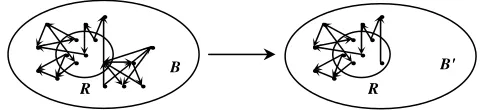
3.1 Getting new base set with less noise pages by applying the proposed Algorithms ………. 47
3.2 Page measurement change trends for 20 arbitrary selected pages with different values of parameter δ ……….. 60
4.1 Page source S for the given u in the DH Algorithm ………... 79
4.2 Page source structure for the Extended Co-Citation algorithm …………. 81
4.3 An example of intrinsic page treatment ………. 84
4.4 Comparison of bcp, dd, and sim values for the selected 10 pages ……… 99
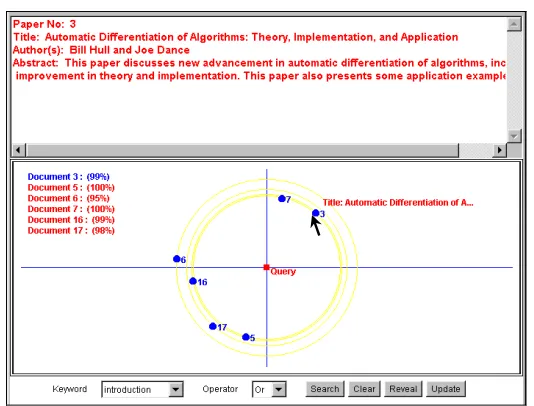
5.1 Visual selection for constructing a query type ……….. 113
5.2 Visual interface of information retrieval system ………... 114
5.3 Visualization of the query and retrieved documents ………. 114
5.4 Information of the mouse pointed document ………. 115
5.5 Details of retrieved document from the database ……….. 116
5.6 Example of cosine threshold ……….. 120
6.1 Structure of the page source S ………... 133
6.2 Example of computing distance between pages ……… 140
6.3 Example of the similarity ……….. 145
6.4 Hierarchical clustering diagram ………. 145
6.5 The average base cluster accuracy with different clustering thresholds (T) ……….. 151
6.6 The average leaf cluster accuracy with different clustering thresholds (T) ……….. 151
6.7 The overall average cluster accuracy with different clustering thresholds (T) ……….. 151
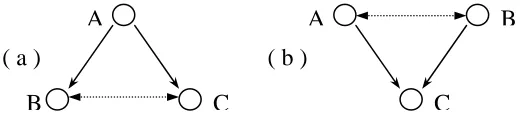
6.8 Co-citation relationship between pages ………. 154
7.2 Matrix-based hierarchical clustering diagram ………... 165
7.3 Construction of new sub-matrix SM'1,1 ……….. 168
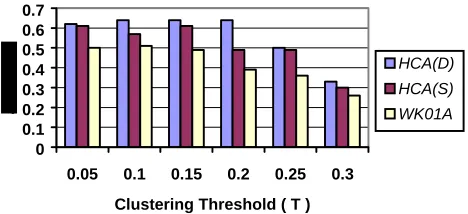
7.4 The average leaf cluster accuracies of the eight clustering algorithms …. 171 7.5 The comparison of CA2(D), CA1(D) and WK01A on the average leaf cluster accuracy ………. 172
7.6 The comparison among the leaf cluster accuracies of CA2(D), CA1(D) and the base cluster accuracies of WK01A ……… 172
7.7 The comparison of PCA2(D), PCA1(D) and WK01A on the average leaf cluster accuracy ………. 173
7.8 The comparison among the leaf cluster accuracies of PCA2(D), PCA1(D) and the base cluster accuracies of WK01A ……… 173
8.1 Structures of two super classes: XMLDoc and Terminal ………... 189
8.2 Object representation model (ORM) for XML data ……….. 190
8.3 Work description ………... 191
8.4 DTD-Tree of bib.dtd ……….. 199
8.5(a) The first result of the rule application ………... 202
8.5(b) The second result of the rule application ……….. 203
8.5(c) The third result of the rule application ……….. 203
8.5(d) The fourth result of the rule application ………... 203
8.5(e) The fifth result of the rule application ………... 203
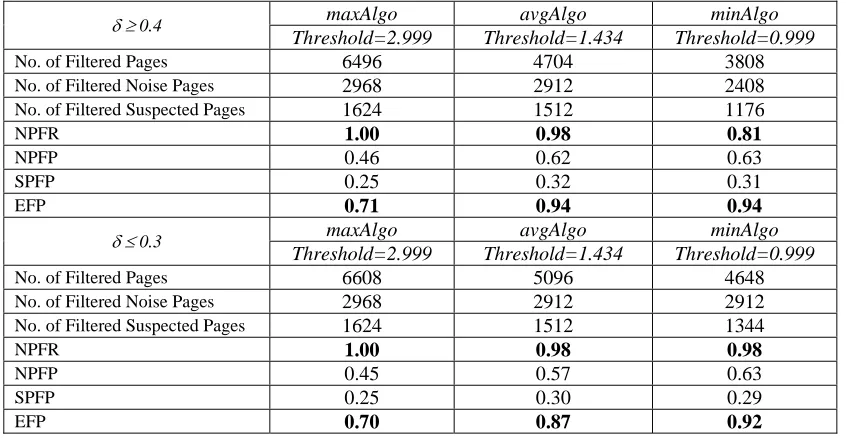
3.1 Numerical results for three algorithms maxAlgo, avgAlgo and minAlgo .. 56
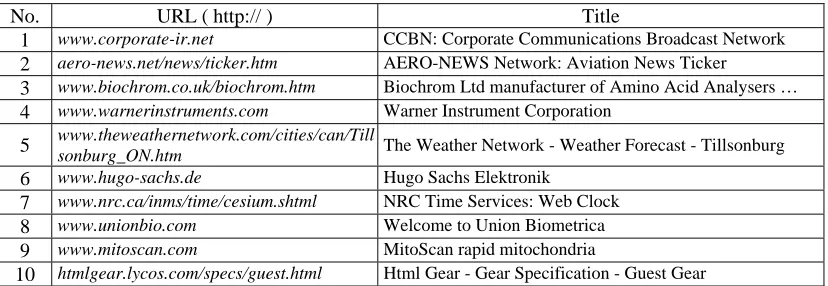
3.2 Ten arbitrary noise pages ………... 59
3.3 Ten arbitrary topic-related pages ………... 59
3.4 Page measurement changes of noise pages with different values of parameter δ ……… 60
3.5 Page measurement changes of topic-related pages with different values of parameter δ ……… 60
3.6 Top five authorities and hubs for "Harvard" before noise pages are eliminated ……….. 61
3.7 Top five authorities and hubs for "Harvard" after noise pages are eliminated ……….. 61
3.8 Top five authorities and hubs for "Jaguar" before noise pages are eliminated ……….. 62
3.9 Top five authorities and hubs for "Jaguar" after noise pages are eliminated ……….. 62
4.1 Top 10 relevant pages returned by the DH Algorithm ……….. 94
4.2 Top 10 relevant pages returned by the Extended Co-Citation algorithm .. 94
4.3 Top 10 relevant pages returned by the Companion algorithm ………….. 95
4.4 Top 10 relevant pages returned by the LLI algorithm ………... 95
4.5 Top 10 relevant pages returned by the "Related Pages" service of AltaVista ……… 95
4.6 Top 10 relevant pages returned by the "Similar Pages" service of Google ………... 96
4.7 Randomly selected 10 pages from the page source BS ………. 99
4.8 Numerical results of bcp, dd values and similarities of 10 selected pages in BS ………... 99
6.1 Examples of some major clusters ……….. 152
6.2 Examples of one major cluster with hierarchical structure ………... 152
7.1 The algorithms used for evaluations ……….. 170
Chapter 1
Introduction
1.1
Overview
The rapid development of the World Wide Web has made itself a huge information
source that has allowed unprecedented sharing of ideas and information in a scale
never seen before. According to the figure in 2000 (CNet, 26 July 2000), the web
held about 550 billion documents. This number is growing rapidly, as well as the
number of users on the web. The boom in the use of the web and its exponential
growth are now well known, and they are causing a revolution in the way people use
computers and perform their daily tasks. On the other hand, however, the web has
also introduced new problems of its own and greatly changed the traditional ways of
information retrieval and management. Because of the absence of a well-defined
underlying data model for the web [BR99], finding useful information and managing
data on the web are frequently tedious and difficult tasks. Since the data on the web
is usually represented as web pages (documents), in this thesis, we use terms web
data and web page/document interchangeably.
Usually, the effectiveness and efficiency of information retrieval and
management are mainly affected by the logical view of data adopted by information
compared with the data in conventional database management systems. The features
of web data are as follows.
• The data on the web is huge. No one could have exactly estimated the data
volume on the web. Actually, the exponential growth of the web poses scaling
issues that are difficult to cope with. Even the current powerful search engine,
such as Google, can only cover a fraction (2 billions) of the total documents
on the web. The enormous data on the web makes it difficult to manage web
data using traditional database or data warehouse techniques.
• The data on the web is distributed. Due to the intrinsic nature of the web, the
data is distributed across various computers and platforms which are
interconnected with no predefined topology.
• The data on the web is heterogeneous. In addition to textual data, which is
mostly used to convey information, there are a great number of images, audio
files, video files and applications on the web. In most cases, the
heterogeneous data co-exist in a web document, which makes it not easy to
deal with them at the same time with only one technique.
• The data on the web is unstructured. It has no rigid and uniform data models
or schemas, and therefore there is virtually no control over what people can
put on the web. Different individuals may put information on the web in their
favourite ways, as long as the information arrangement meets the basic
display format requirements of web documents, such as HTML format. The
absence of well-defined structure for web data brings a series of problems,
other hand, documents on the web have extreme variation internal to the
documents, and also in external meta information that might be available
[BP98a]. Although the currently used HTML format consists of some
structuring primitives such as tags and anchors [Abit97], these tags, however,
deal primarily with the presentation aspects of document and have few
semantics. Therefore, it is difficult to extract required data from web
documents and find their mutual relationships. This feature is quite different
from that of traditional database systems.
• The data on the web is dynamic. Current estimates are that there are over 150
million web pages with a life of less than one year [BP98b]. Theimplicit and
explicit structure of the web data may evolve rapidly, data elements may
change types, data not conforming to the previous structure may be added,
and dangling links and relocation problems will be produced when domain or
file names change or disappear [BR99]. These characteristics result in
frequent schema modifications that are another well-known headache in
traditional database systems [MAG+97].
• The data on the web is hyperlinked. Unlike "flat" document collections, the
World Wide Web is a hypertext and people are likely to surf the web using its
link graph. The hyperlinks between web pages (data) provide considerable
auxiliary information on top of the text of the web pages and establish
topological or semantic relationships among the data. This kind of
relationship, however, is not in a predefined framework, which brings a lot of
The above features indicate that web data is neither raw data nor very strictly typed
as in conventional database systems. It is called semi-structureddata. Furthermore,
the web data contains many noise factors mainly because of the absence of
well-defined data structures or models. Therefore, the web as a whole cannot be
considered as a conventional database in a strict sense.
Because of the above web data features, web information retrieval and web data
management are becoming a challenge problem. In the last several years, much
research and development work has been done in this area. For these work, web
information search and management are always the main themes. Accordingly, the
research and development work could be roughly classified into two main sub-areas:
web search engines and web data management.
Web search engine technology has scaled dramatically with the growth of the
web since 1994 to help web users find desired information, and has resulted in a
large number of research results such as [McB94] [BP98a] [BP98b] [CGP98]
[SM98] [CVD99a] [CVD99b] [RM99] [Hock00] [DCL+00] [CG00a] [CG00b]
[NW01] [TLN+01], as well as various web search engines such as World Wide Web
Worm (WWWW), Excite, Lycos, Yahoo!, AltaVista and Google. Search engines can
be classified into two categories: one is general-purpose search engine and another
one is special-purpose search engine. The general-purpose search engines aim at
providing the capability to search as many web pages on the web as possible. The
search engines mentioned above are a few of the well-known ones. The
special-purpose search engines, on the other hand, focus on searching those web pages on
search engine for medical information and Movie Review Query Engine
(www.mrqe.com) lets the users to search for movie reviews. No matter what
category the search engine is, each search engine has a text database defined by the
set of documents that can be searched by the search engine. The search engine
should have an effective and efficient mechanism to capture (crawl) and manage the
web data, as well as to provide the capabilities to handling queries quickly and
returning the most related search results (web pages) with respect to the user's
queries. To reach these goals, effective and efficient web data management is
necessary.
Web data management refers to many aspects. It includes data modelling,
languages, data filtering, storage, indexing, data classification and categorization,
data visualization, user interface, system architecture, etc. [BR99]. In general, the
purpose of the web data management is to find intrinsic relationships among the data
to effectively and efficiently support web information retrieval and other web-based
applications. It can be seen that there are intersections between the research in web
search engines and web data management. Effective and efficient web data
management is the base for a good web search engine. On the other hand, the data
management could be applied to many other web applications, such as web-based
information integration systems and metasearch engines [MYL02].
Although much work has been done in web-based data management in the last
several years, there remain many problems to be solved in this area because of the
manage web-based data, therefore, is an active research area that is full of many
challenges.
1.2
Motivation
Web-based data management, in essence, belongs to information (data) management
though web data has its own characteristics. For an information system, its
efficiency and effectiveness are directly affected by the user task and the logical
view of the data adopted by the system [BR99]. The research in user task for
information systems is beyond the research scope of this work. This work
concentrates on the logical view of the data in web-based data management systems.
As web-based data management systems are a kind of information system, there
is much work trying to use traditional strategies and techniques to establish
databases and manage the web-based data. For example, many data models and
schemas have been proposed for managing web data [BBB00] [LRS+00]
[MAG+97] [SGN00] [SRL00] [YR00] [PGW95]. Some of them tried to define
schemas, which are similar to the conventional database schemas, for web data, and
use the conventional DBMS methods to manage web data. Others tried other ways
of establishing flexible data structures, such as trees and graphs, to organize web
data and proposed corresponding retrieval languages. However, since the web data is
dynamic, which is significantly different from the conventional data in database
systems, using relative fixed data schemas or structures to manage the web data
could not reflect the nature of the web data [MAG+97]. On the other hand, the
contents of the web data (text, hyperlinks, images, tags etc.) into separated
information pieces, and intrinsic semantic relationship within a web page and among
the web pages would be lost. In other words, web databases alone could not provide
the flexibility to reflect the dynamics of the web data and effectively support various
web-based applications.
In this work, we take another approach, i.e. establishing good web page
communities, to support web-based management and information retrieval. A web
page (data) community is a set of web pages that has its own logical and semantic
structures. For example, a web page set with clusters in it is a community; web
pages in a set that are related to a given web page also form a community. The web
page community considers each page as a whole object, rather than breaking down
the web page into information pieces, and reveals mutual relationships among the
concerned web data. For instance, the system CiteSeer [LGB99] uses the search
engines like AltaVista, HotBot and Excite to download scientific articles from the
web and exploits the citation relationships among the searched articles to establish a
scientific literature searching system. This system reorganizes the scientific
literatures on the web and improves the search efficiency and effectiveness. The web
page community is flexible in reflecting the web data nature, such as dynamics,
heterogeneity. Furthermore, web page communities could be solely used by various
applications or be embedded in web-based databases to provide more flexibility in
web data management, information retrieval and application support. Therefore,
database & community centred web data management systems provide more
shows the logical architecture of a database & community centred web data
management system.
To construct a web page community, it is necessary to find ways of representing
pages and discover their logical or semantic relationships. Previous research
considered a web page as a piece of text or a set of words, and use traditional text
data analysis and management strategies to extract required information and to
represent a page as a vector of terms (keywords). The relationships among the web
data are then found from the relationships among vectors, such as the work in
[ZE98] [BGG+99] and the work surveyed in [MYL02]. Text-content-based data Searched Web-Based Data
WWW
Web Page Communities Web-Based Database
Local Applications Web-Based Applications
User Interface
[image:21.595.146.501.168.485.2]Web-Based Data Management System
analysis and management have been thoroughly studied in traditional data
management. However, for the web data, this approach has its own limitations.
Firstly, since the data on the web is huge, text distilling and analysis are
time-consuming and difficult tasks in practice. Secondly, due to the dynamics of the web
data, web page contents might be changed frequently by the page authors. This
would lead to different content analysis results for the same web page at different
time. Finally, because of the synonymy (different words have similar or same
meaning) and polysemy (one word has different meanings) of the words in web page
content, it is uncertain whether the text analysis results can really represent the web
data and reveal the relationships among the web data.
Although most of the early work concentrated on the content portion of the web
page, little attention was paid to the hyperlinks connecting various web pages.
However, the effectiveness and popularity of the search engine Google, which is one
of the earliest search engines exploiting hyperlink information to improve the web
search quality, have greatly increased researcher interests in using hyperlinks to
mine information from the web. The idea of hyperlink analysis originally came from
the citation analysis of literature, such as [Cam97] [Garf79] and [Hit+97], and has
been applied in many areas such as page ranking in the search engine Google
[BP98a] [BP98b] and other web-related areas [Klein99] [CDG+98] [CHH98]
[DH99]. The idea is based on a fact that if a web page A has a hyperlink to page B,
the author of page A usually considers that page B contains valuable information that
is related to page A [Klein98]. Therefore, reasonable hyperlinks reflect human
judgement is objective and independent of synonymy and polysemy of the words in
web pages. It is argued that the pages connected together by hyperlinks might be not
related. For a large number of pages, however, the hyperlink information among the
pages would show certain statistical regularities [Klein99]. Once these regularities
derived from hyperlinks are revealed (mined), they could be used to find intrinsic
relationships among web-based data for various purposes.
Hyperlink analysis has many other additional advantages. It is concise and
intuitive. Hyperlink analysis results are relatively steady. This is because any
changes in the web page text that do not affect page’s structure will not affect the
relationship between this page and other pages. In practical applications, extracting
hyperlinks is much easier than extracting required words from web pages, as
hyperlinks are marked by specific HTML tags. This would simplify web page
processing and decrease computing cost.
On the other hand, however, hyperlink analysis is a relatively new research area
and there are still many problems to be solved. For instance, because hyperlinks are
more likely to be arbitrarily added into web pages than texts, hyperlink information
would contain many noise factors and hyperlink analysis would result in unexpected
results [CDG+98] [BH98] [DH99]. It has become a challenge for hyperlink analysis
to choose reliable hyperlink information and analyse the chosen hyperlink
information such that the hyperlink analysis results can reveal real and intrinsic
In this work, we will exploit hyperlink information to construct web page
communities for web data management and information retrieval. The objective of
this research is accordingly stated as the following sub-goals:
1. To establish a framework for hyperlink analysis. For the purpose of
extracting semantic information conveyed by hyperlinks, it is necessary to
model hyperlinks within a proper framework, such that the hyperlink
information can be analysed and intrinsic relationships among pages can be
discovered with the functions provided by the framework. In this work, we
will model hyperlinks within a matrix framework and exploit linear algebra
theories and matrix operations to analyse hyperlink information, as well as
discover deeper relationships among web pages. With the support of this
framework, using hyperlink information to discover web page communities
can be carried out on a solid mathematic base.
2. To eliminate noise pages via hyperlink analysis for constructing good quality
web page communities. Web page community construction is usually based
on a concerned page set which is related to a certain topic or topics. Because
the hyperlinked pages are not always related, the concerned web page set
derived from linkages usually contains many pages that are not related to the
topics. These pages are called noise pages. Because of the existence of noise
pages, the constructed community is unsatisfactory or is irrelevant to the
topics in many cases. In this work, we firstly investigate hyperlink-based
community construction algorithms and identify the noise page source. We
from the original concerned page set and obtain another new page set, such
that the percentage of topic-related pages in this new page set is higher, and
in turn to improve the community quality. The noise-page eliminating
algorithms could also be used solely for web-based data management
systems or special-purpose search engines (Internet portals) to filter
unnecessary web pages, to reduce management cost and to increase the
efficiency of information retrieval.
3. To find relevant web pages with respect to a given page through hyperlink
analysis. The web page community that consists of relevant pages with
respect to a given page can be used to increase the efficiency of web
information search and web-based data management. In this work, a relevant
page with respect to a given URL (web page) is the one that addresses the
same topic as the given URL, but is not necessarily semantically identical
[DH99]. For example, given www.nytimes.com which is the online
newspaper of The New York Times, other newspapers and news
organizations on the web are relevant pages, but it is not necessary for these
pages to have tight relationships with The New York Times. A best relevant
page should be the one that addresses the same topic as the given URL and is
semantic similar to the given URL. Our purpose is to find as many best
relevant pages as possible for a given web page. It refers to two issues: one is
how to construct a page source that is rich in relevant pages; another one is
how to extract the (best) relevant pages from this page source. We will firstly
from hyperlink analysis, such that the constructed page source is rich in
relevant pages and is able to shield the influence from malicious hyperlinks.
We then take advantage of hyperlink analysis to reveal deeper relationships
among pages and find out (best) relevant pages from this page source.
4. To improve web page clustering by proposing a new reasonable
hyperlink-based similarity measurement. Clustering is another important aspect of web
page community construction. Clustering techniques are used in traditional
database systems to increase efficiency of data management and information
retrieval, especially for a large amount of data. They are suitable for dealing
with web-based data. Web page clustering usually depends on similarities
among the concerned pages. Because of the limitations of content-based
analyses and corresponding similarities for the web data, in this work, we
will propose new page similarity measurements from hyperlink information,
as well as corresponding hierarchical web page clustering algorithms, to
improve web page clustering.
5. To develop new hierarchical web page clustering algorithms that take
advantage of intrinsic relationships among pages conveyed by hyperlink
information. In this work, we will mainly focus on clustering algorithms in
addition to page similarities. The new clustering algorithms are still based on
hyperlink information, but they will be more effective in taking advantage of
intrinsic relationships among web pages to obtain better cluster results, be
easier in implementation and be more effective in avoiding human
6. To develop visualization algorithms for information retrieval that is based on
mathematical algorithms. Discovering or constructing a web community
within a mathematical framework refers to many mathematical methods and
operations. Although mathematical methods are effective in finding deeper
relationships and retrieving information, they are not intuitive and are
difficult for users to understand in most cases. For better applying this kind
of mathematical algorithms to practical applications, such as web and
conventional information retrieval, we will investigate mechanisms to
visualize information retrieval that is based on mathematical algorithms, and
propose corresponding visualization algorithms.
7. To propose a new object-oriented representation model for XML documents.
Hyperlink analysis is concerned about relationship between pages, rather
than the semantic relationship between different information portions within
web pages. Therefore, the semantic relationship revealed by hyperlink
analysis has also some limitations. As a matter of fact, web page content
contains most semantic information about the page, although it is a challenge
to accurately extract such semantic information. Combining web page
semantics with hyperlink analysis would greatly increase the effectiveness of
hyperlink analysis, as well as the corresponding analysis results. However,
current HTML documents (pages), which are the most popular format for
web-based data, contain little semantic information in their document
structures or schemas, because the tags in HTML documents are mainly for
documents, which are now becoming a new standard for data representation
and exchange on the Internet, allow the definition of semantically
meaningful tags, which makes it possible to extract semantic information
from web-based data. In this work, we will investigate mechanisms to extract
semantic information from XML documents and propose a new
object-oriented data model to represent XML documents. This model establishes a
base to support XML document management, as well as further research in
XML web page communities that combines semantic information with
hyperlink analysis techniques.
1.3
Claims of the Dissertation
This dissertation mainly focuses on discovering (constructing) web page
communities from hyperlink information to support web-based data management
and information retrieval. A mathematical framework is established for hyperlink
analysis and a series of algorithms are proposed to construct web page communities.
Visualization mechanisms, algorithms and XML document data models are
accordingly established to support practical application of the proposed algorithms
and further research work. The main contributions of this dissertation can be
summarized as follows:
A Mathematical Framework for Hyperlink Analysis This framework is based on the matrix theory in linear algebra. Different from other hyperlink models such as
matrices. From these hyperlink matrices, intrinsic relationships among web pages
conveyed by hyperlinks are revealed by matrix operations, such as singular value
decomposition, matrix approximation, vector operation, matrix permutation and
partitioning. Other hyperlink-based information, such as hyperlink transitivity, page
correlation degree and page similarity are also represented and revealed by matrices
and corresponding matrix operations. This framework makes it possible to
systematically analyse hyperlink information using mathematics theories in a
uniform manner, and could be adopted by or integrated into web application
systems. The framework provides a solid mathematical base for discovering various
web page communities.
Algorithms for Web Page Community Construction In this research, we concentrate on the following web page communities:
• the community that consists of hub and authority pages;
• the community that consists of relevant pages with respect to a given page;
• the community with hierarchical clustering structures.
Here, authority pages are those that contain the most definitive, central and useful
information in the context of particular topics, while hub pages are those that points
to (via hyperlinks) many of the authority pages. For different web page
communities, different strategies and community construction algorithms are
proposed.
For the community that consists of hub and authority pages, the following
- Noise Page Elimination Algorithm (NPEA). This algorithm concentrates
on the page source from which the community is constructed. It
eliminates noise pages in the original page source to obtain another good
quality page source, which in turn improves the quality of web page
communities by combining those existing community construction
algorithms. In this algorithm, page linkage relationships are expressed in
a hyperlink matrix, singular value decomposition of matrix in linear
algebra is applied to this matrix to find deeper relationships among the
pages, and then numerical thresholds are defined to eliminate noise
pages.
The following algorithms are proposed for the community that consists of
relevant pages with respect to a given page:
- Page Source Construction Algorithm for Relevant Page Finding. This
algorithm constructs a page source from which the relevant pages are
selected. The algorithm guarantees that the constructed page source is
rich in semantic relevant pages (via hyperlinks) to the given page and can
shield the page source from being affected by malicious hyperlinks.
- Extended Co-Citation Algorithm. This algorithm is stemmed from the
traditional co-citation analysis ideas, but extends some co-citation
concepts and more effectively finds the relevant pages when it combines
with the page source construction algorithm.
- Latent Linkage Information (LLI) Algorithm. This algorithm adapts
matrix, to reveal the intrinsic relationships among the web pages and
effectively find relevant pages that not only address the same topic as the
given page, but also are semantically similar to the given page.
To effectively cluster web pages for the community with hierarchical cluster
structures, the following algorithms are established in this research work:
- Page Source Construction Algorithm for Clustering. This algorithm
constructs a page source that acts as a reference system to determine the
page similarity in it for the pages to be clustered. It also guarantees the
pages in the constructed page source are related to the concerned topics.
- Page Weight Determination Algorithm. This algorithm determines the
page importance within the concerned page source such that the impact
of a page to other pages in the source can be determined numerically.
- Page Correlation Degree Algorithm. The correlation relationships among
the pages (via hyperlinks) in the concerned page source are numerically
determined as correlation degrees by this algorithm. This correlation
degree incorporates the weights of involved pages.
- Page Similarity Algorithm. The similarity between pages within the
concerned page source is determined by this algorithm. This page
similarity is derived from hyperlink information. It incorporates the
hyperlink transitivity, web page weight, and page correlation degree.
- Hierarchical Web Page Clustering Algorithm. The idea of this algorithm
is stemmed but different from the K-mean clustering ideas. The centroids
The page similarity used in this algorithm is provided by the above page
similarity algorithm.
- Matrix-Based Hierarchical Clustering Algorithm without Cluster
Overlapping. This algorithm is based on operations on the page similarity
matrix, which is derived from the page similarity algorithm. It takes
advantage of intrinsic relationships among the pages to conduct
clustering without predefined similarity thresholds. This algorithm does
not take the cluster overlapping into account during the clustering
procedure.
- Matrix-Based Hierarchical Clustering Algorithm with Cluster
Overlapping. This algorithm is also based on operations on the page
similarity matrix, but it considers cluster overlapping during the
clustering procedure, which provides better clustering results.
- Other auxiliary algorithms, such as matrix permutation and partitioning
algorithms, are also established in this work to form a complete
clustering algorithm system.
Visualization Mechanism and Algorithms for Information Retrieval Hyperlink
analysis and web page community construction in this research are within a
mathematical framework equipped with various algorithms. Although this
framework and algorithms are effective in hyperlink analysis and community
construction, the mathematical algorithms are not intuitive and not easy to
community construction procedures as a special case of information retrieval, and
establish a visualization mechanism, as well as a series of visualization algorithms,
to support information retrieval that is based on mathematical algorithms. This work
bridges the abstract mathematical algorithms and friendly application interfaces.
Data Model for XML Documents This object-oriented data model captures
semantic information segments in XML documents and capsulizes data
manipulation methods. Document type definition (DTD), XML documents with and
without DTDs are considered in this model, and corresponding transformation rules
and procedures from these XML data to this model are established. This model
could support XML data management and XML based web applications, as well as
further research in XML data analysis such as XML data community discovery.
1.4
Outline of the Dissertation
The remainder of the dissertation is organized as follows. Chapter 2 describes the
basic concepts and models necessary for understanding hyperlink analysis.
Mathematical (matrix) expression of hyperlinks is presented and related
mathematical knowledge and background are provided for better understanding of
our work. Commonly used hyperlink analysis techniques and web page community
construction algorithms are reviewed and discussed, based on which this dissertation
develops. This chapter provides a foundation for further hyperlink analysis and web
In Chapter 3, we investigate the web page community that consists of hub and
authority pages, and focus on improving the quality of the community by
eliminating noise pages from the concerned web page source. We firstly review the
algorithm of web page community construction and indicate that the existence of
noise pages in the page source would produce the topic drift problem in many cases
when constructing community, i.e. the obtained hub and authority pages in the
community are not related to the concerned topics. Different from other algorithms,
such as [BH98], that reduce the influence of the noise pages in community
construction procedures, we develop another approach that eliminates noise pages
from the page source before the community being constructed to improve the
community quality.
In this work, the relationships among the pages in the concerned page source are
indicated by hyperlinks, which are expressed in a hyperlink adjacency matrix.
Deeper relationships among the pages are then revealed by mathematical operations,
especially the singular value decomposition of matrix, on this matrix. From the
revealed relationships, the thresholds for eliminating noise pages are numerically
determined. Experiments are conducted to show the effectiveness of the algorithm in
eliminating noise pages.
Chapter 4 turns to the web page community that consists of relevant pages for a
given web page (URL). After reviewing the previous methods of relevant page
finding, we indicate that the relevant page finding refers to two issues. The first one
is how to construct page source for relevant page finding. The constructed page
and be rich in relevant pages. The second issue is how to develop effective
algorithms to find the relevant pages. The work in this chapter firstly provides
algorithms for constructing page source, which meets the above requirements. In
addition, the algorithms could also be able to shield the page source from being
affected by malicious hyperlink information. Based on the constructed page source,
we then propose two algorithms to find relevant pages. The first algorithm is the
extension of the classic co-citation algorithm, in which some co-citation concepts
are extended. This algorithm is intuitive and efficient in relevant page finding, but it
is unable to precisely identify relevant pages in many cases because it only takes
advantage of superficial hyperlink information. To solve this problem, we adapt
linear algebra methods, which are also used in Chapter 3, and propose the Latent
Linkage Information (LLI) algorithm to more effectively and precisely find relevant
pages. The effectiveness of the algorithms is demonstrated by a series of
experiments.
In Chapter 5, we investigate the visualization mechanism and propose a series of
visualization algorithms to support mathematic algorithm based information
retrieval. In this work, web page community constructions that are based on
mathematic algorithms, such as those in Chapter 3 and 4, are considered as a special
case of information retrieval. Therefore, the visualization algorithms could be
applied to traditional information retrieval, as well as web page communities. The
prototype of this visualization system is also established in this work.
In Chapter 6, we consider the web page community with hierarchical cluster
Unlike the page similarity that is derived from web page text content analysis, the
page similarity in this chapter is derived from hyperlink information. This
hyperlink-based page similarity takes the hyperlink transitivity and web page importance
(weight) within the concerned page source into consideration, which more
objectively reflects the nature of the web data and its features. From this new web
page similarity, hierarchical algorithms are proposed to improve web page
clustering. The clustering algorithms are the extension of the traditional K-mean
algorithm, which dynamically identify cluster centroids during the clustering
procedure.
In Chapter 7, we further discuss hierarchical web page clustering algorithms
exploiting intrinsic relationships among the pages. The algorithms are also based on
the page similarity in Chapter 6, but the clustering procedure is based on matrix
operations. The similarities among the pages are expressed as a similarity matrix.
Matrix operations, such as matrix permutation and partitioning, are then introduced
to divide the similarity matrix elements into different groups. Accordingly, the web
pages are clustered hierarchically. Two situations are considered in the algorithms.
The first one is the clustering without cluster overlapping, the second one takes
clustering overlapping into consideration. The algorithms are independent of
predefined similarities for clustering and are effective in hierarchically clustering
web pages within a uniform framework as demonstrated in the experiments.
In Chapter 8, we propose an object-oriented data model to support semantic
information extraction from XML documents, XML data management, XML
definition (DTD), XML documents with and without DTD are considered in this
work. A set of transformation rules and steps are established to transform DTDs, as
well as XML documents, into this data model. In addition, DTD-tree is proposed to
represent logical structures of DTDs and describe the DTD transformation
procedures into the model. Further research, such as the research in XML data
analysis and community construction, could be carried out from this object-oriented
model.
Chapter 2
Fundamentals of Hyperlink Analysis and
Web Page Community
2.1
Introduction
The concept of hyperlinks was introduced with the invention of hypertext. A
hyperlink is a structure unit that connects two web pages. This connection is realized
by inserting a hyperlink, which indicates the URL of the destination page, at the
desired point in the source page. When a user browsing the source page clicks on the
hyperlink, the web browser interprets this action as a request to fetch the page
referenced by the hyperlink. The hyperlink was originally conceived as a mechanism
to dynamically link a citation to its actual source page, and was used for purely web
navigation purposes.
Usually, when a hyperlink is inserted in a source page, the author of the source
page has an idea in his mind that the destination page is related to the topics of the
source page. In other words, the hyperlink conveys certain human judgement of
semantic relationship between pages. Therefore, the hyperlink not only provides
topological information of the web, but also provides semantic information between
web pages. It can be use as an additional instrument in effectively mining the World
A user can navigates from a source page to the destination page through the
hyperlink in the source page. If the destination page also has a hyperlink in it, the
user can then navigate to another destination page, and so on. This feature of
hyperlinks is called transitivity. In usual, there are many hyperlinks in a source page.
It can be imaged that a user can navigate the web as far as he can from an original
source page, as long as the hyperlinks are available. Accordingly, the semantic
information conveyed by hyperlinks is also transitive. However, after several or
many steps of web page navigation, whether the final destination page still keeps a
tight semantic relationship with the original source page is uncertain. If the semantic
relationship between the original source page and the final destination page is
weakened because of the hyperlink transitivity, how to measure the semantic
declination rate? These are also the challenge problems in using hyperlink to mine
the web.
Hyperlinks are similar to the citations in scientific literature that form link
between research papers. However, there are still many significant differences
between them. For example, the citations in a paper that has already published
cannot be altered and the citations in a paper cannot point to papers that have been
published later than the paper itself; while hyperlinks are dynamic and authors of
web pages could add hyperlinks at any time, contents and structures of destination
pages could be changed later than the source pages. On the other hand, because there
are no rigid schemas for web data, hyperlinks are more likely to be inserted
arbitrarily into pages. The information conveyed by hyperlinks, therefore, may
semantically related to the source page, destination pages have been removed later
and the hyperlinks become dangling ones, etc. Because of these reasons, hyperlink
analysis is a challenge research area in web mining.
Hyperlink analysis is the name given to a collection of techniques that analyse
the hyperlink structure and semantics that exist in the web. The analysis can be for a
wide variety of purposes, ranging from ranking pages in a web search engine to
understanding the social dynamics behind the usage of the web as a whole. This
widespread use of hyperlinks has made hyperlink analysis an emerging and
important area of research.
2.2
Hyperlink Models
Hyperlink analysis starts with a basic model upon which different analysis
techniques and measures are applied, and the targeted application objective is
achieved. Different kinds of hyperlink models have been proposed. These models
either relate to the basic information unit or the process that focuses on the
application. Among them, graph structure and statistic models are the
representatives.
In the graph structure model, the web as a whole is modelled as a directed graph
containing a set of nodes and directed edges between them [BKM+00]. The nodes
represent the web pages and the directed edges are the hyperlinks. Within this
model, if there is a hyperlink from page P to page Q, then P is called a parent of Q
these two pages are called siblings. Other terms are also defined to describe the web
graph structure. Some commonly used terms are listed below.
- In-degree of a page. The in-degree of a page p is the number of distinct
links that point to p.
- Out-degree of a page. The out-degree of a page p is the number of
distinct links originating at p that point to other pages.
- Directed path. A directed path is a sequence of links starting from page p
that can be followed to reach page q.
- Shortest path. The shorted path is the path that has the minimal number
of links on it of all the paths between pages p and q.
More terms about the hyperlinks will be presented in the following chapters. Within
the graph structure model, from the hyperlink analysis point of view, the correlation
between a web page p and other pages is realized in two ways. One is out-links from
p to other pages, another one is in-links from other pages to p.
Compared with the graph structure model, the statistic models for hyperlinks are
dynamic. The statistic models regard hyperlinks as the paths on which the user surfs
the web. The behaviours of the user in surfing the web are modelled as a stochastic
process, and many statistical models are used, such as Markov model and
probabilistic model. The underlying principle of an m-order Markov chain is that
given the current state of a system, the evolution of the system in the future depends
only on the present state and the past m-1 states of the system. First order Markov
models have been used to model the browsing behaviour of a typical user on the
Getoor et al [GST+01] also proposed probabilistic models to model the behaviours
of web surfers and mine information from the web to find hub pages and to classify
web pages. The statistic models modelling a web surfer have been used significantly
in hyperlink analysis.
2.3
Matrix Expression of Hyperlinks
In addition to the above commonly used hyperlink models, for the pages in a certain
web page set, such as the set of pages returned by a search engine with respect to a
user’s query, hyperlinks can also be expressed as a matrix. This hyperlink matrix is
usually called adjacency matrix.
Without loss of generality, we can suppose the adjacency matrix is an m×n
matrix A = [aij]m×n. Usually, the element of A is defined as follow [Klein99]: if there
is a hyperlink from page i to page j or i = j, then the value of aij is 1, otherwise the
value is 0. If this adjacency matrix is used to model the hyperlinks among the pages
in the same page set, the values of parameters m and n are the same, which indicate
the number of pages in the page set (set size). In this case, the ith row of the matrix,
which is a vector, represents the out-link relationships from page i to other pages in
the page set; the ith column of the matrix represents the in-link relationships from
other pages in the page set to page i.
However, if the adjacency matrix is used to model the hyperlinks between the
pages that belong to two different page sets, the values of parameter m and n usually
are not the same unless the numbers of pages in these two sets are the same.
In this case, the ith row of the adjacency matrix represents the out-link relationships
from the page i in set A to all the pages in set B; the jth column of the matrix
represents the in-link relationships from all the pages in set A to the page j in set B.
Although the above adjacency matrix expression is intuitive and simple, the
values of the matrix elements only indicate whether there exist hyperlinks between
pages (i.e. value 1 of a matrix element indicates that there is a hyperlink between
two pages that correspond to this element, and value 0 indicates that there is no
hyperlink between two pages). In hyperlink analysis, this matrix expression can also
be extended to represent semantics of hyperlinks. In this case, the values of the
matrix elements are not required to be either 1 or 0. The actual element value
depends on the particular situations where the matrix expression is applied. For
example, the correlations between pages can be expressed in a matrix, where the
value of a matrix element aij, which is between 0 and 1, indicates the correlation
degrees from page i to page j, and the matrix is non-symmetric. The similarity
between pages can also be expressed in a matrix in a similar way, except that the
similarity matrix is usually a symmetric one. How to determine the page correlation
degree and similarity will be discussed in the later chapters.
Since the relationships among pages in the concerned page set can be represented
as a set of vectors (rows and columns of the corresponding matrix), it is possible to
find further deeper relationships among the pages through mathematical operations
on the matrix, or to define new metrics for pages from vector operation, such as
cosine similarity of pages from vector inner product. The hyperlink matrix can also
permutation and partitioning. More details of matrix expressions and applications
for hyperlinks will be seen in the ensuing chapters.
2.4
HITS Algorithm
HITS (Hyperlink-Induced Topic Search) algorithm is a representative in applying
pure hyperlink analysis to find out logical relationships among the pages in the
concerned page set. It is proposed by Kleinberg [Klein99]. The algorithm aims at
constructing a web page community that consists of good hub and authority pages
from hyperlink analysis. In fact, the authorities and hubs exhibit mutually reinforced
relationships: a good hub points to many good authorities; a good authority is
pointed to by many good hubs. The HITS algorithm takes this mutual influence (via
hyperlinks) among pages into consideration, and finds good hubs and authorities by
iterative operations, rather than simply counting the number of links (in-links and
out-links) for each page.
The HITS constructs a web page community from a set of pages that are returned
by a web search engine with respect to a user’s query. The algorithm consists of
three main procedures:
1. Collecting r highest-ranked pages for the user-supplied query σ from a
text-based search engine (e.g. AltaVista, Google) to form the root set of pages R.
Growing R to form the base set of pages, B, by adding to R more pages
which are pointed by or pointing to the pages in R. B is considered to be a
query specific directed graph whose nodes are pages and edges are
2. Associating with each page p in B a hub weight h(p) and an authority weight
a(p) with initial values of 1. Then iteratively updating the h(p) and a(p)
(p∈B) according to the following iterative operations:
∑
≠ ∈→ = p q B q p q q h p a , ) ( ) ( ,∑
≠ ∈→ = p q B q q p q a p h , ) ( ) (in which "p →q" denotes "page p has a hyperlink to page q". Normalize the
vectors a and h after each iteration.
3. After iteration reaches steady point (i.e. values of vectors a and h will not
change any more), abstracting s pages (authorities) with s highest a( ) values
together with the s pages (hubs) with the s highest h( ) values to be the core
of a community.
Kleinberg [Klein99] proved that vectors a and h converge. Thus the termination of
the iteration is guaranteed. From our numerical experiment experience, with the
absolute error precision 10-4, the number of iteration is around 20.
Suppose the size of the base set B (i.e. the number of pages in B) is n. Let z
denote the vector (1,1,1, … ,1) ∈Rn, and A be an adjacency matrix such that if there
exists at least one hyperlink from page i to page j, then Ai,j = 1, else Ai.j = 0. The
above HITS algorithm can also be expressed as the following iterative matrix
operations:
x(k) = (ATA)k-1ATz, y(k) = (AAT)kz , k = 1, 2, 3, …
where x(k) and y(k) are the authority and hub vectors respectively after k times
iteration, AT is the transposition of adjacency matrix A. Kleinberg [Klein99] proved
eigenvector of ATA, and the hub vector sequence {y(1), y(2), y(3), …}converges to the
principal eigenvector of AAT.
When the above HITS algorithm is applied to the base set of pages, it usually
encounters the following problems [BH98]: mutually reinforcing relationships
between hosts, automatically generated links, and non-relevant pages. Mutually
reinforcing relationships between hosts occur when a set of pages on the first host
point to a single page on the second host, or one page on the first host points to
multiple pages on the second host. This would greatly and unreasonably increase the
impact of one host to the web community construction. Automatically generated
links are produced by web page generating tools. These links usually do not
represent a human's opinion. The non-relevant pages may cause the topic drift
problem, i.e. the obtained hub and authority pages are not related to the query topics.
To tackle the first problem, Bharat and Henzinger [BH98] improved the HITS
algorithm by assigning authority or hub weights to the edges of graph B. If there are
k edges from documents on the first host to a single document on the second host,
each edge