Rochester Institute of Technology
RIT Scholar Works
Theses Thesis/Dissertation Collections
4-2017
The Luxury Trap
Zhihui WuFollow this and additional works at:http://scholarworks.rit.edu/theses
This Thesis is brought to you for free and open access by the Thesis/Dissertation Collections at RIT Scholar Works. It has been accepted for inclusion in Theses by an authorized administrator of RIT Scholar Works. For more information, please [email protected].
Recommended Citation
Rochester Institute of Technology
A Thesis Submitted to the Faculty of
The College of Imaging Arts and Sciences
School for American Craft
In Candidacy for the Degree of
Master of Fine Arts
Metals and Jewelry Design
The Luxury Trap
By
Zhihui Wu
Committee Approvals:
Chief Advisor: Leonard Urso
Date: / /
Associate Advisor: Juan Carlos Caballero- Perez
Date: / /
Associate Advisor: Graham Carson
Date: / /
School for American Crafts Chairperson: Glen Hintz
Table of Contents
Approvals ...2
Abstract...4
Sources and Research ...5-8
The law of nature...5
Migration...5-6
Cognition...6-7
Industrialization...7-8
Critical Analysis ...9-12
Brief...9
The work...10-12
The Luxury Trap: Migration...10-11
The Luxury Trap: Cognition...11
The Luxury Trap: Industrialization...11-12
Conclusion...13-14
Figures...15-18
Abstract
Human beings have traveled from prehistory through an agricultural era to the industrial age to modern society today. I think every transition is a luxury trap. Why have there been there so many transitions? Why are transitions are traps?
The human being is a special kind of animal that endlessly strives for a better life. Human beings work hard for a better life that includes more luxury, no matter the material aspect or spiritual aspect. But when they complete a transition, they always fall into another trap that has different problems.
My works illustrate three different transitions of the human being. The first transition is migration. I wrote words on my millstone piece to tell the story of my family and myself, and also the changing times in China over the past 40 years, and even though my family moved from the country to the city for a better life in the city, we became stuck in a luxury trap. The second transition is cognition. I use the needles piece to explain how human beings got into a trap when they made the transition from
prehistory to the agricultural era. Human beings settled down and domesticated plants and animals, so they got diseases. They then could not go back to nomadic days. The third transition is industrialization. The human being becomes the god of all other things. All the existence in the world serves the human being. I use my work to explain the existence results of industrial time, which is governed by human beings.
Art is my vehicle to explore the primitive nature of human beings and how the primitive nature dictates our reactions to everything in the world. At the same time, I use my work to provoke the audience's thoughts about humanization in general and our world as a whole.
Sources and Research
The laws of nature
Buddhism maintains that the superhuman order governing the world is the product of natural laws rather than that of divine wills.
About 2500 years ago, at the age of twenty-nine, Siddhartha Gautama slipped away from his palace in India in the middle of the night, leaving behind his family and possessions. He traveled as a homeless vagabond throughout northern India seeking a way out of suffering because he found people around him were suffering from misery.
Gautama found the method to get away from suffering after six years of striving. He found that suffering was caused by the behavioral patterns of one’s own mind, not by misfortune or external forces. If, when the mind experiences something pleasant or unpleasant, it simply understands things as they are, then there is no suffering.
Migration
Between the late eighteenth and the early twentieth century, humans living in Europe and North America made a dramatic migration, influenced by the reinvention of human thoughts, governance and technology. And the migration provoked a series of political and social changes, such as the French Revolution. This period in time was a significant example of grand urbanization in history.
France used parcelization to stay peasants when a huge number of them swarmed into Paris before the French Revolution. However, even though they won a certain sort of rural stability, they lost economic and political stability. Britain experienced a
The first great wave of rural to urban migration in Europe during the late eighteenth and the early twentieth century was not anticipated, and not managed by any
government, and for more than 100 years, the situation did not change. The most recent wave of migration is happening right now. China is going through the latest and largest rural-to-urban migration in human history. “The Great Leap Forward reduced harvest sizes and led to a decline in the production of most goods except substandard iron and steel. Furthermore, bad weather and exports of food necessary to secure hard currency resulted in a great famine. The agricultural products were in desperate shortage, and production of food fell dramatically. The famine resulted in the deaths of millions of people and the severe malnutrition of millions more, particularly in poorer inland regions.” 8 “Urbanization increased in speed following the initiation of the reform and opening policy in 1979. This gave the Chinese people massive employment opportunities from foreign investment. As a result, rural-to-urban migration increased dramatically in the 1990s.” 9
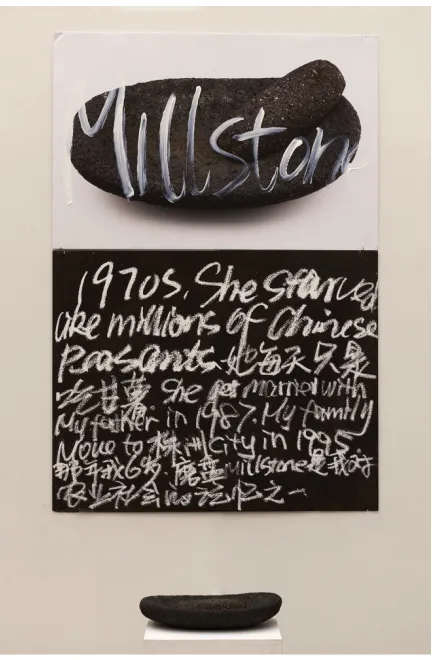
My mother was born in a rural village in Hunan Province in the 1960s. As a child, she starved like millions of Chinese peasants. People who survived the famine would know the importance of food. At age nineteen, she married my father, who lived in a neighboring village. My father had started working in Zhuzhou City when he was fifteen years old, striving for a better life. I always imagine how excited he was at that time, hopping on the bus to the city where he spent the rest of his life, carrying a bag with all his belongings. My family moved to Zhuzhou city and settled down in the city in 1995. I was six years old that time.
Cognition
The human being is a unique kind of animal in the world. What characteristics differentiated humans from other animals and allowed them to ultimately govern the earth?
Sapiens, drove them the Neanderthals away from the earth and then crossed the land and the sea, spreading over the entire surface of our planet.
This evolution relied on the cognitive abilities of Homo Sapiens. Homo Sapiens, who were our ancestors, evolved cognition abilities that allowed them to learn and
communicate similarly to how as we do today. Their cognitive abilities helped them to conquer the world. The language of Homo Sapiens was special: they could connect a limited number of sounds and signs to produce an infinite number of sentences. What is more important is the ability to talk about things that they never experienced or even heard about before. Our ancestors left all kinds of ancient legends, myths, and fictions for us, which stemmed from their unique cognitive abilities. Even though he could not read and write, my grandfather told me the stories about Nuva patching up the sky and Dayu controlling the flood. Between 70,000 and 30,000 years ago, one Homo Sapiens carved a lion-man, a wood figurine with a human body and a lion head. This is powerful evidence to prove that the human being who made this was our ancestor because they were doing the same unique thing that people do today: connecting the living and the supernatural to produce an imaginary being.
During the period from 70,000 to 30,000 years ago, thanks to these cognitive abilities, vast numbers of ancient inventions besides the lion man appeared, such as boats, oil lamps, bows, arrows and needles for sewing.
Industrialization
farmers worked much harder than the foragers of the prehistory era, they did not get a good return and some of them starved.
To solve these problems of diseases and starvation and seek a better life, human beings made the transition to an industrial society, just as their ancestor gave up nomadic life and settled down. What's more, with the improvement of medical science, people will never suffer from smallpox.
The human being was so strong as to be able to conquer the whole world during the industrial era, but we do not experience more happiness than living in the agriculture or prehistory era. Fewer people die of starvation but suicide happens every day because of depression. In the industrial era, not only are human beings tortured by cold machine, but also animals who are innocent creatures are tortured by cold machine. The lifespan and quality of life of animals are determined by the profits and losses of business corporations. These corporations do not care about animals' social or psychological needs. They always put many chickens in a small cage to save their space and improve their production, and never consider that the chicken should live in their natural environment, because they need to build nests and groom themselves. So, the result of industrialization is a luxury trap.
Critical Analysis
Brief
My thesis is composed of three themes: “Migration,” “Cognition,” and
“Industrialization.” I use these themes to explain my concept “The Luxury Trap.” In order to transfer my concept accurately to an audience, I explored many possibilities of materials during the process such as metals, concrete, tree stumps, stones, shoes and dresses. In additional, I utilized three convincing objects as symbols for themes. They are the millstone, the tombstone and needles. I think these symbolized
The Work
The Luxury Trap: Migration (Figures 1-2)
I use the millstone as my symbol to tell the story of migration. The millstone is a kind of stone tool that is commonly used in agricultural societies to grind food.
I was born in a small rural village in the central south region of China and moved to the city when I was six years old. Even though I never saw any millstones after moving to the city, I still remember how my grandfather moved his millstone. I think millstone can not only tell the story of my family but also can tell stories of millions of Chinese families today who are part of the rural-to-urban migration wave.
I use a ready-made millstone in my thesis show to recall the memory of that time and convey the pain of Chinese history as well as the large number of Chinese families who continue to struggle in urbanization. Perhaps lots of people have never
considered if migration is a wise decision, but not one of them has a choice, because this is a luxury trap. It seems like living in the cities can solve all the problems
inherent in the countryside. Cities would provide people with better health care, better hygiene and more entertainment. However, there are different problems in cities. My father was trying to go back to the country life after working in Zhuzhou city for about forty years but he found he could not adjust the way of living. He is an urbanized farmer who could not adjust to the place where he grew up. Sometimes I want to talk with that fifteen-year-old young man who had an innocent and excited face. Undoubtedly, rural-to-city migration is now an uncontrollable and irresistible flood.
I bring the ready-made millstone into the gallery because I am influenced by Marchel Duchamp. This handmade millstone of 200 years ago lost the grinding function as a tool when I put it in the gallery but it became part of the art language I used to tell my story.
in English and Chinese on the board, because I not only want to tell the story but also want to record the moment I am writing.
The Luxury Trap: Cognition (Figures 3-6)
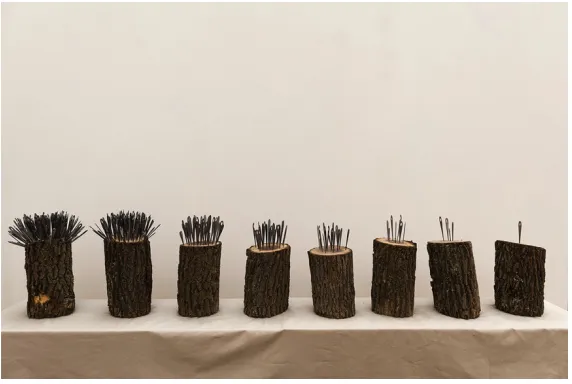
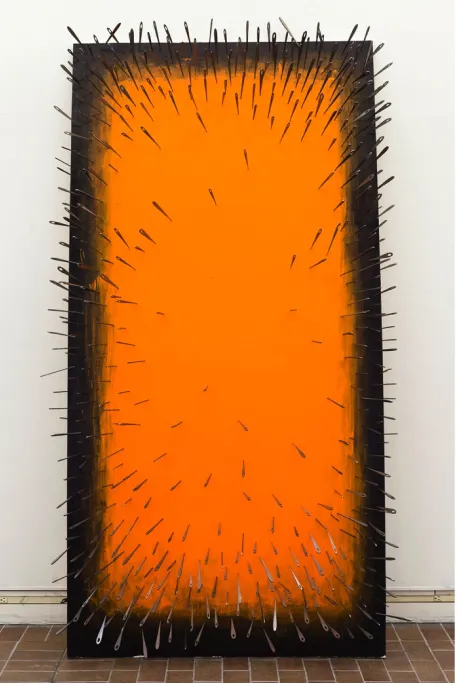
I choose sewing needles as an important symbol in this piece. There are two parts to this composition. The first part is composed of eight tree stumps in a row that are inset with needles in a progressive number from one side to the other side. (Figures 3-4). They represent time. Several months ago, my friend bought me a bunch of flowers and I had no container to hold them, so I put the flowers on the windowsill. I
perceived the status of them every day. I saw the flowers fading as time passed. I got inspiration from those fading flowers and I used progressively changing number of needles to express time. At the same time, the progressive number of needles is a metaphor for human beings who have thrived in larger and larger groups from 70,000 years ago to today. In the second part, I painted the wood board orange and punched hundreds of steel needles into it (Figures 5-6). It represents space. This space is called the “trap”. It seems like hundreds of needles rush into the orange space. What I want to express is the countless human beings rushing into the endless trap with no
hesitation.
Our universe consists of time and space. I used these two parts to express my point to the world and I also used needles in each of parts. Needles were a decisive invention in human cognitive revolution evolution. Our ancestors invented needles to stitch clothes to keep warm so they survived extreme cold weather. In ancient times, there were many humanoid species living on the earth. Some species’ brains were larger than our ancestors and some species were stronger. But only our ancestors survived and had offspring that still thrive on the earth. I think intelligence and being stronger are not important, and the primitive intuitive creation is the most important.
The Luxury Trap: Industrialization (Figures 7-8)
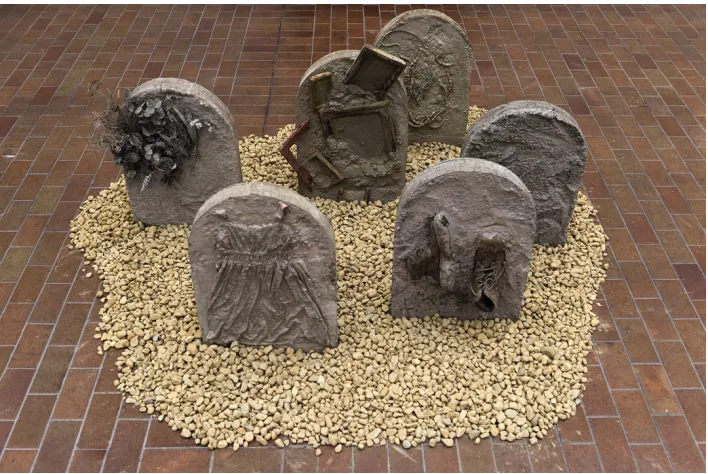
one hand, my piece implies that human beings become the god and they govern the world. On the other hand, it represents a kind of mercy for every soul who has been a sacrifice during industrialization. Animals should have equal rights and freedoms with human beings walking on the earth and confer the natural law of the world.
I use concrete as a material to make the tombstones because concrete is a widely used industrial substance that is cold and tough.
Conclusion
These three works express my concept of the luxury trap. They visualize the stories I want to tell and produce a different way to communicate between viewer and artist. I use my personal story as a background in my works to make statements about my understanding of and perception about the world. I hope my personal story and the symbolic images I choose will evoke the viewers' own memories emotionally and psychologically. I think the personal story and symbolic images in the historical context can introduce more levels, such as the cultural, political and economic, to enhance viewers' experience of art.
I use a millstone to tell my personal story, which reflects the background and culture of migration. I use sewing needles to illustrate the cognitive ability of human beings, which is a unique capability helping this species to conquer the world. I use
tombstones to express the existence of human beings from agricultural time to
industrial time. The millstones, needles, and tombstones are transitional symbols from history. They are the witnesses of human activities. More importantly, they record how human beings got into one or another luxury trap involuntarily.
I am convinced that the human beings get into luxury traps because they never feel satisfied no matter what they achieve. Gautama found the method to get away from suffering 2500 years ago. My works also provoke viewers to be introspective about the meaning of the existence of the human being, and the relationship between human beings and the whole ecosystem. At the same time, I ask viewers to pay attention to the wisdom of religion. The wisdom of religion tells people the way out of this
vicious circle. When the mind experiences something pleasant or unpleasant, it simply understands things as they are, and then there is no suffering.
contains some of the finest examples of Buddhist art spanning a period of 1,000 years.” 10 What's more, I will travel to south Asian where Buddhism is still popular to see the
Figures
Figure1.The Luxury Trap: Migration
Figure 3. The Luxury Trap: Cognition
[image:17.595.155.441.103.295.2]
[image:18.595.184.414.89.432.2]
Figure 5. The Luxury Trap: Cognition
Figure 7. The Luxury Trap: Industrialization
[image:19.595.121.475.102.339.2]Bibliography
1. Annie Dillard. For the Time Being. New York: Vintage, 2000. Print.
2. J.M.Adovasio,Olga Soffer and Jake Page. The Invisible Sex: Uncovering the True Roles of Woman in Prehistory. California: Walnut Creek,2007. Print.
3. Steven Olson. Mapping human history: Discovering the Past Through Our
Genes. New York: Houghton Mifflin Company, 2002.Print.
4. Juan Luis Arsuaga. Translated by Andy Klatt. The Neanderthal’s Necklace: In Search of the First Thinkers. New York: Four Walls Eight Windows,2002. Print.
5. James C Davis. The Human Story: Our History from the Stone Age to Today. New York: HarperCollins, 2005. Print.
6. Bryan Sykes. The Seven Daughters of Eve: The Science that Reveals Our Genetic Ancestry. New York: W.W.Norton& Company,2002,Print.
7. Leslie T.Chang. Factory Girls: From Village to City in a Changing China. New York: Spiegel & Grau, 2009, Print.
8. https://en.wikipedia.org/wiki/Cultural_Revolution
9. https://en.wikipedia.org/wiki/Urbanization_in_China