The End of the Pipeline: Profiling Commencing Students
To Ease Their Transition into an Engineering School
David G. Dowling and Lorelle J. Burton
University of Southern Queensland
Abstract
In recent years changes in secondary school curricula and subject selection policies have meant that engineering schools in Australia have had to accommodate an increasingly diverse
commencing student cohort. Because students have followed different pathways prior to enrolling in their program, there is a conside rable variation in their knowledge, skills, and work experiences, and they also have different educational and socio-cultural backgrounds. It is posited that to facilitate the successful transition of these students into their university programs, educators need to understand the characteristics of the commencing cohort and how these characteristics may influence student success.
This paper describes the first stage of a research project being undertaken in the Faculty of Engineering and Surveying at the U niversity of Southern Queensland (USQ). The project aims to firstly provide an insight into the characteristics of the students in the commencing cohort and then to identify the key predictors of academic success, particularly in the first year engineering programs.
Stage 1 of the project involved collecting data to establish the ‘learning profiles’ of students from the 2004 commencing on-campus cohort. The data included demographic information, learning preferences, verbal and spatial abilities, personality traits, and general self-efficacy. The academic achievement of these students will be tracked through to their departure from the university. The key findings from this study are discussed and the implications for the Faculty are highlighted.
Introduction
Many engineering schools in Australia have experienced increased diversity in the characteristics of their commencing student cohorts. This is due in part to the increasing number of
international students studying in Australia because these students come from a number of countries, all with different educational systems. In Queensland, this increase in the diversity of educational backgrounds also reflects changes in the learning experiences of students entering directly from a secondary school.
All high school students who apply for a tertiary place through the Queensland Tertiary
and 25 (lowest). An OP is a measure of overall achievement in Years 11 and 12 of high school. All other QTAC applicants, including interstate high school leavers, are allocated a Rank based on their previous studies, work experience, and performance in QTAC tests. In the current study, all QTAC Ranks were converted to the equivalent OP to facilitate the analysis of student
performance.
The introduction of revised secondary school curricula and subject selection policies in the 1990s has ensured that high school students have a greater subject choice than in the past. Whilst this flexibility might have enabled many students to achieve higher tertiary entrance scores, many find that they no longer qualify for admission to their preferred university program because they lack the required pre-requisites. In response, Engineering Schools in Queensland have decreased their prerequisite requirements to ensure that those students with a good OP who want to study engineering are not excluded.
Because students have followed different pathways prior to enrolling in their program, teachers cannot assume that their students have a strong mathematics-science background. The
Engineering Schools therefore have to accommodate the diverse learning backgrounds and experiences of their students. They have responded by changing the first year curriculum so that it includes the essential topics in these fields, often including alternative pathways for different groups of students. For example, since 2002, all USQ first-year engineering students are required to study a course in foundation mathematics, unless they achieved at a very high level in
secondary school mathematics subjects.
There are, however, many factors other than prerequisite knowledge and skills that influence the success of university students in their first year of study. O ver recent years the engineering education literature has discussed many of these factors, with most researchers reporting on the impact of just one isolated factor , such as spatial abilities or learning preferences. For example, Magin & Churches1 report that considerable research has found that spatial abilities are critical for success in engineering programs, particularly in the graphics courses in those programs.
The education literature also includes many reports of broader studies aimed at identifying the factors that place students ‘at-risk’ of failure. For example, research by an Attrition Working Party at Edith Cowan University2 identified a number of factors that may place students ‘at risk’, including: (a) Commencing non-school leaver students; (b) distance students; (c) students from isolated regions, particularly Aboriginal students; and (d) students from a low socioeconomic background. Pitkethly and Prosser3 reported that the literature generally supports the notion that a higher proportion of students leave university because of ‘adjustment or environmental factors rather than intellectual difficulties’ (p186).
Because the profile of “at risk” students varies from institution to institution, and even between the programs offered by a single institution (Pitkethly & Prosser3; Walstab4), university or, preferably, program-specific data are required to properly understand the characteristics of the students in the commencing cohort, and to identify those that impact on student success.
The le arning profiles project
individual differences, and socio-cultural factors that influence the academic achievement of first-year engineering students. The research project involves tracking the academic performance of these students until they complete their degrees or leave the university.
By identifying the key factors that influence academic success, educators can make appropriate changes to the curriculum and to the learning environments of their students. This will help to ensure that the teaching and learning environment is designed in a way that facilitates a smooth and successful transition to university for all students. It will also help to target the provision of career counseling, mentoring, or skills enhancement programs for those students who are most at risk of failing or withdrawing from their program.
For the initial phases of the project it was decided to include a broad range of data rather than risk pre-judging the outcome by limiting the factors studied. The project therefore examines the influence of individual differences, socio-cultural, and demographic factors on student success.
Three main areas of individual differences data were included in the study: 1. Learning preferences: The way students prefer to learn.
2. Cognitive abilities: People’s levels of verbal abilities, spatial abilities, and general reasoning skills.
3. Personality traits: Individual differences in the big five factors of personality (Openness to Experience, Conscientiousness, Extroversion, Agreeableness, and Neuroticism) and other constructs relevant to academic success such as self-efficacy, proactive attitudes, and proactive coping styles.
The socio-cultural data and demographic data gathered for the study included age, gender, ethnicity, country of birth, first and second languages, the geographic location of their place of residence, and, where applicable, their year 12 subject results and OP score.
For the 2004 study, a battery of paper and pencil tests was developed to establish a ‘learning profile’ for each student, identifying their learning preferences, cognitive abilities, and personality traits (Burton, Dowling, Dorman, & Brodie5). Individual feedback is provided to each participant that summarises their learning preferences, strengths, and weaknesses and outlines strategies for optimising their learning environments. For 2005 the test battery is being administered via the internet, which provides a far more efficient data collection process and also enables distance education students to participate in the study.
Student diversity within the Faculty
The Faculty of Engineering and Surveying at USQ offers a range of highly articulated
undergraduate programs in engineering and in spatial science: two year Associate Degrees; three year Bachelor of Technology degrees; four year Bachelor degrees; and five year combined degree programs. It should be noted that many of the core courses offered by the Faculty are common to these programs, particularly the first year core courses.
All of the programs are offered on-campus and by distance education, although not all of the majors are available by both modes of study. Approximately 75% of the Faculty’s students study off-campus through the distance education mode (External). A further 5% of students are classified as ‘multimodal’ as they study some courses on-campus and some by distance education.
At the beginning of Semester 1 in 2004, nearly 2400 students were enrolled in these programs, 970 of whom were commencing students. As in previous years, the commencing student cohort exhibited great diversity in a range of characteristics including age, educational background, work experience, mathematical skills, ethnicity, culture, home locality, and social status. With many of these characteristics there are distinct differences between the on-campus and distance student cohorts. This is best illustrated by comparing the age profiles of the two cohorts. The large majority (83%) of commencing students are at least 21 years of age. Forty-five percent of the on-campus cohort and 94% of the distance cohort were over 21 years of age. It is therefore likely that less than 50% of the on-campus cohort have come directly from high school.
In 2004, two hundred and twelve students commenced their program as on-campus students, 86% of whom were Australian citizens or permanent residents with the remaining students coming from 20 overseas countries. Only 13% of the students were female, and only 1.4% identified themselves as being either an Aboriginal or a Torres Strait Islander.
Entry requirements for Faculty programs
The Queensland OP cut -offs and the prerequisite subjects for the three types of programs offered by the Faculty are shown in Table 1. To enable students from diverse backgrounds to study engineering, the Faculty has adopted lower prerequisite requirements in mathematics for both the Associate Degree and Bachelor of Technology programs than for the Professional degree
program. The prerequisite subject for these programs is Mathematics A.
Four Year Professional Degree
Three Year Technology Degree
Two Year Associate Degree
OP Cut-off 12 16 18
OP Band 0 – 12 13 - 16 17 - 18
Prerequisite subjects English and Maths B. Physics recommended
English and Maths A. Maths B recommended
[image:4.612.107.505.563.631.2]English and Maths A. Maths B recommended
Measure s of academic success
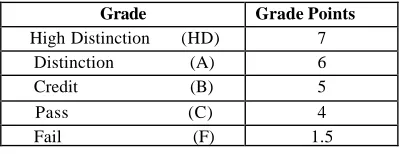
USQ uses the grading scale shown in Table 2 to allocate final grades to students and to calculate their Grade Point Average (GPA). A student must maintain a GPA of not less than 3.00 in order to have Satisfactory Academic Standing (SAS). Students who do not have SAS are asked to ‘show cause’ as to why they should not be excluded from their program. For the purposes of this study, those students identified with a GPA of less than 3.0, are classified as being ‘at risk’.
Grade Grade Points
High Distinction (HD) 7
Distinction (A) 6
[image:5.612.206.406.202.279.2]Credit (B) 5 Pass (C) 4 Fail (F) 1.5
Table 2: USQ grading scale
[image:5.612.91.524.461.542.2]The participants
Table 3 shows the number of students who entered each type of program, and the admission pathways used to enter those programs. A total of 129 of the 212 commencing on-campus students (17 females and 112 males) participated in the study. Of these, 74 students were admitted via QTAC, 8 students were admitted after successfully completing USQ’S Tertiary Preparation Program7 (TPP), and 47 were USQ direct entry students whose admittance was based on their prior studies. Most of these students applied for direct entry based on studies undertaken at other institutions in Australia or overseas. Others used their performance in other USQ programs as the basis for their application, including those seeking to articulate from one program to another.
Four Year Professional Degree
Three Year Technology Degree
Two Year
Associate Degree Totals Admission Pathway
Students % Students % Students % Students % QTAC 55 74% 14 19% 5 7% 74 57.4% Direct entry 18 38% 21 45% 8 17% 47 36.4%
TPP 3 38% 3 37% 2 25% 8 6.2%
Totals 76 59% 38 29% 15 12% 129 100%
Table 3: Participant enrolment data
Only 66 of the 129 participants (13 females and 53 males) completed all of the tests in the battery. All but five students in this group spoke English as their first language, with six other languages spoken across the sample.
Key findings from the study
First Year GPA Admission
Pathway
Number
of students < 3 3 to < 4 4 to < 5 5 to < 6 > = 6 % Pass QTAC 4 8% 16% 31% 30% 15% 76% Direct Entry 47 10% 28% 30% 19% 13% 62%
TPP 8 - 12% 25% 25% 38% 88%
[image:6.612.109.507.114.184.2]Total 129 8% 20% 30% 26% 16% 71%
Table 4: Overall first year results by admission pathway
An inspection of the data in Table 4 shows a variation in the overall pass rates of the three groups of students, with those admitted via the Direct Entry pathway not performing as well as those entering via QTAC or the USQ Tertiary Preparation Program. The higher overall pass rate for the TPP group could, in part, be attributed to the fact that, because these students had
successfully completed the program, they ha d already achieved success at university. A variety of factors may have caused the lower overall pass rate for the students in the Direct Entry group, including differences in educational backgrounds and experiences, the number of years since they last studied, and their cultural background. This question will be a focal point of the next stage of the research project.
Of the 66 students who completed the test battery, 29 entered via QTAC, 34 by Direct Entry, and three via TPP. A key finding was that the students’ OP significant ly predicted academic success (Beta = .48, p < .01). OP showed a strong positive correlation with GPA at the end of the first semester (r = .64, p < .01) and again at the end of the first year of study (r = .87, p < .01). This is not surprising as OP is a measure of academic success at high school. As expected, spatial abilities were related to success in the first year engineering courses (.25 < r < .36, p < .05), and interestingly, the Extroversion personality trait was also a significant predictor of GPA at the end of the first year (Beta = .40, p < .01). Self-efficacy and proactive attitude were also moderately correlated with academic success (.24 < r < .33, p < .05). These findings are reported in detail in Burton and Dowling8 and Burton et al.5.
At the end of their first year of study, 11 students were classified as being ‘at risk’ because their GPA was less than 3.0. Six of these entered via QTAC and five by Direct Entry. None of those students who entered following successful completion of the USQ Tertiary Preparation Program were identified as being ‘at risk’.
It is also worth noting that four students cancelled their enrolment at the end of their first year of study in 2004 and another four students remained enrolled in their program but did not study in Semester 2, 2004. A further six students chose to transfer to another USQ degree program at the end of their first year of study in 2004, five of whom were female. This is a disappointing outcome as the Faculty goes to considerable lengths to attract female students in an attempt to rectify the gender imbalance.
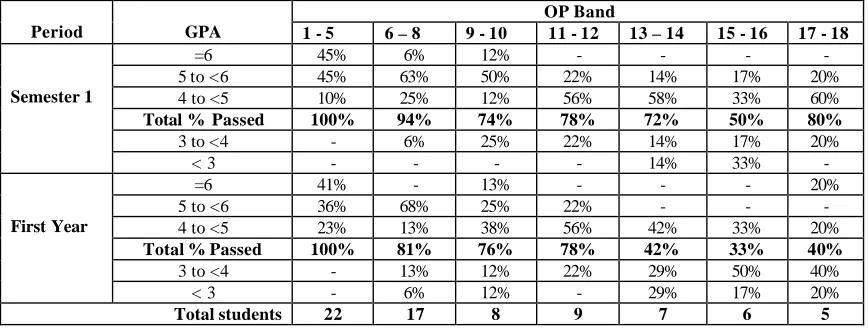
The performance of the students who entered via QTAC
greater than 4, that is, they were likely to have passed all of the courses they studied in that semester. The data also shows that, on average, students with a lower OP (i.e. higher achievers at high school) were more successful.
OP Band
Period GPA 1 - 5 6 – 8 9 - 10 11 - 12 13 – 14 15 - 16 17 - 18
=6 45% 6% 12% - - - -
5 to <6 45% 63% 50% 22% 14% 17% 20%
4 to <5 10% 25% 12% 56% 58% 33% 60%
Total % Passed 100% 94% 74% 78% 72% 50% 80%
3 to <4 - 6% 25% 22% 14% 17% 20%
Semester 1
< 3 - - - - 14% 33% -
=6 41% - 13% - - - 20%
5 to <6 36% 68% 25% 22% - - -
4 to <5 23% 13% 38% 56% 42% 33% 20%
Total % Passed 100% 81% 76% 78% 42% 33% 40%
3 to <4 - 13% 12% 22% 29% 50% 40%
First Year
< 3 - 6% 12% - 29% 17% 20%
[image:7.612.90.524.153.317.2]Total students 22 17 8 9 7 6 5
Table 5: Semester 1 and Year 1 results by OP Band
By the end of their first year of study, however, there is a clear distinction between those who entered with an OP between 1 and 12 and those who entered with an OP between 13 and 18. Although the numbers of students in the latter group is small, the conclusion can be drawn that these students are more likely to be ‘at risk’. Three students from this group were classified as being ‘at risk’ at the end of the first semester, and six were considered ‘at risk’ at the end of the first year.
Unfortunately, a qualitative analysis of the learning profiles of those students identified as being ‘at risk’ was not possible as they did not complete the test battery. Of those students who partially completed the battery, all identified as being low on the Extroversion personality trait. This, together with their low OP, appears to have influenced their academic success.
As the focal point of this paper is on the entry requirements for the programs, the following sections investigate the relevance of the existing subject prerequisites and cut -offs.
Traditionally it would have been expected that a high school student intent on studying
engineering would have undertaken the following subjects at high school in Queensland, or their equivalent at another institution: English, Mathematics B, Mathematics C, Physics, and
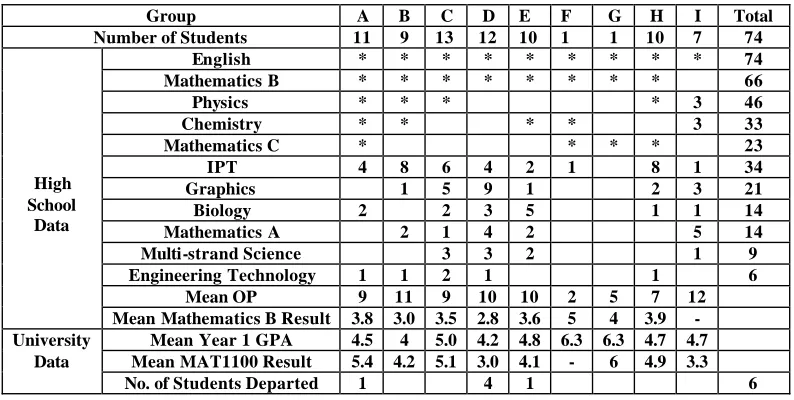
Chemistry. As noted earlier, students are now encouraged to focus on achieving the best possible OP by studying subjects that best suit their individual needs. The impact of this change is shown in Table 6, where it can be seen that only 11 of the 74 participants, who were admitted to USQ via QTAC, studied this traditional combination of subjects at high school. The Table also shows the other popular combinations of subjects and the number of students who studied each subject.
The data in the second column of the Table shows the total number of students who studied each combination of the traditional five subjects, with the subjects in each combination being
subjects is included in the last row of the table. The following data is also included in the table: the average OP for each group; the average results for each group in the high school subject Mathematics B and the USQ course MAT1100 Foundation Mathematics; and the average GPA for the group at the end of end year 1. The data in the right hand column indicates the number of students who have cancelled from their program and either departed the University or transferred to a program offered by another Faculty.
Group A B C D E F G H I Total Number of Students 11 9 13 12 10 1 1 10 7 74
English * * * * * * * * * 74 Mathematics B * * * * * * * * 66 Physics * * * * 3 46 Chemistry * * * * 3 33 Mathematics C * * * * 23 IPT 4 8 6 4 2 1 8 1 34 Graphics 1 5 9 1 2 3 21 Biology 2 2 3 5 1 1 14 Mathematics A 2 1 4 2 5 14 Multi-strand Science 3 3 2 1 9 Engineering Technology 1 1 2 1 1 6
Mean OP 9 11 9 10 10 2 5 7 12 High
School Data
Mean Mathematics B Result 3.8 3.0 3.5 2.8 3.6 5 4 3.9 - Mean Year 1 GPA 4.5 4 5.0 4.2 4.8 6.3 6.3 4.7 4.7 Mean MAT1100 Result 5.4 4.2 5.1 3.0 4.1 - 6 4.9 3.3 University
Data
[image:8.612.108.505.188.388.2]No. of Students Departed 1 4 1 6
Table 6: A summary of the high school and university data for the participants
It is important to note that only 43 of the 74 students who entered via QTAC studied the
prescribed combination of prerequisite and recommended subjects (English, Mathematics B, and Physics). The data also shows that the relatively new computing subject Information Technology Processing has replaced Chemistry as the fourth most popular high school subject for this group.
All of the various student groupings showed an average GPA greater than 4 at the end of their first year of study. Two of the student groups (Groups D and I), however, performed badly, on average, in the course MAT1100 Foundation Mathematics, a course that provides students with the basic skills they will require to complete their program. Therefore, students who fail this course are considered as being ‘at risk’ and it is important to try and establish the reasons for this outcome.
The seven students in Group I did not study Mathematics B at high school and gained entry to their program after studying Mathematics A. Six of these students attempted MAT1100 Foundation Mathematics with only three receiving a passing grade. The four students in this Group who studied at least one of the traditional science subjects at high school had a far better average OP (9). They also performed slightly better in their first year at USQ than the three students who did not study a traditional science subject and who had a lower average OP (15). All of the students in this Group achieved a GPA of 3 or higher at the end of their first year of study, and all are continuing their studies in 2005.
In total, 14 of the 74 participants gained entry to their program based on their satisfactory comple tion of Mathematics A. Seven of these students had studied Mathematics B at high school, but achieved a grade of less than Sound Achievement (SA = 3). Although one of these students was considered ‘at risk’ at the end of the year, this group did, on average , perform better in their first year of study than those who had only studied Mathematics A.
Implications
The results indicate that more than 60% of the students who entered their program with an OP greater than 12 were considered as being ‘at risk’ at the end of their first year of study. These students were enrolled in either a Technology degree or an Associate Degree program. The Faculty adopted the current OP cut-offs for these programs (16 and 18 respectively) as part of the University’s flexible entry policy. This policy will need to be reviewed if the results from the next stage of testing confirm these initial findings.
The results also indicate that those students who have relied on a pass in Mathematics A to gain entry to their program were more likely to be ‘at risk’ at the end of their first year of tertiary study than those who entered with a pass in Mathematics B. Mathematics A is a general mathematics subject that includes topics on financial mathematics, applied geometry, statistics, and probability. This subject does not , however, cover some of the key topics that are central to engineering studies, such as logarithms, algebra, calculus, or optimisation. All commencing students study the introductory course Foundation Mathematics, which in addition to its basic content, offers a comprehensive set of remedial topics for those students with limited
mathematical skills. Students undertaking the remedial topics are supported by staff from the Office of Preparatory and Academic Support. This should enable students entering with Mathematics A to achieve a passing grade in the Foundation Mathematics course. The results from the first stage of this study suggest that the Faculty should review its flexible entry policy that allows students to enter without completing Mathematics B.
The Faculty has changed the recommended prerequisites for its programs because the results of the study indicate that students who have studied two or more of the following subjects, in addition to Mathematics B, are more likely to be successful in their first year engineering studies: Physics, Chemistry, Mathematics C, and ITP.
used to inform a review of the first year courses and learning and teaching environments. For example, the results are being used to inform a current proposal to introduce an enabling skills course that may in future be undertaken by all commencing students.
Conclusion
This paper has focused on the prior educational experiences of first year students and how they influenced academic achievement. The results indicated that the Faculty should review the entry requirements for its programs, and these have been changed for 2008. These results, together with those reported in Burton and Dowling7, challenge academic staff to take a broader perspective when reviewing entry requirements, course content, and the learning environment they provide for their students.
Bibliography
1. Magin, D., & Churches, A. (1996). Gender differences in spatial abilities of entering first year students: What should be done? Paper presented at the 8th AAEE Annual Convention and Conference, Sydney, Australia. 2. Attrition Working Party, 1998, cited in Walstab, A., Golding, B., Teese, R., Charlton, M., & Polesel, J. (2001).
Attrition and wastage in tertiary education. Canberra, Australia: Lifelong Learning Network.
3. Pitkethly, A., & Prosser, M. (2001). The first year experience project: A model for university-wide change.
Higher Education Research & Development, 20, 185-198.
4. Walstab, A., Golding, B., Teese, R., Charlton, M., & Polesel, J. (2001). Attrition and wastage in tertiary education. Canberra, Australia: Lifelong Learning Network.
5. Burton, L. J., Dowling, D., Dorman, M., & Brodie, L. (2005). Understanding student diversity and the factors that influence academic success at university: A preliminary study. In D. M. McInerney & S. Van Etten (Eds.),
Sociocultural influences on motivation and learning, volume 5 (pp. 275-298). Greenwich, CT: Information Age Publishing (In press).
6. Course Information Web Advisory Group (CIWAG). (2004). Sector recommendations to the Minister. Canberra, Australia: Department of Education Science and Training.
7. USQ Tertiary Preparation Program, http://www.usq.edu.au/opacs/tpp/tppcourses/default.htm, 6th August 2005. 8. Burton, L. J., & Dowling, D. G. (2005). In search of the key factors that influence student success at university.
Proceedings of the 2005 Higher Education Research & Development Association Conference,Sydney (in press).
Biographical information
DAVID DOWLING is the Associate Dean (Academic) in the Faculty of Engineering and Surveying at USQ. Whilst he has a background in land surveying and town planning, the major focus of his work and research is on enhancing the teaching and learning environments the Faculty provides for its students, including: academic staff induction; curriculum design; graduate attributes; quality academic processes; and the factors that influence student success .