Entrepreneurial Knowledge and its Effects on
Entrepreneurial Knowledge and its Effects on
Entrepreneurial Knowledge and its Effects on
Entrepreneurial Knowledge and its Effects on
Entrepreneurial Knowledge and its Effects on
Entrepreneurial Intentions: Development of a
Entrepreneurial Intentions: Development of a
Entrepreneurial Intentions: Development of a
Entrepreneurial Intentions: Development of a
Entrepreneurial Intentions: Development of a
Conceptual F
Conceptual F
Conceptual F
Conceptual F
Conceptual Framework
ramework
ramework
ramework
ramework
Banjo G. RoxasBanjo G. Roxas Banjo G. Roxas Banjo G. Roxas Banjo G. Roxas
Victoria University of Wellington [email protected]
Rhowenna Cayoca-Panizales Rhowenna Cayoca-Panizales Rhowenna Cayoca-Panizales Rhowenna Cayoca-Panizales Rhowenna Cayoca-Panizales Ateneo de Davao University
Rowenna Mae de Jesus Rowenna Mae de Jesus Rowenna Mae de Jesus Rowenna Mae de Jesus Rowenna Mae de Jesus Ateneo de Davao University
This study advances the thesis that knowledge gained from a formal entrepreneurship education program will have positive effects on an individual’s overall entrepreneurial intentions through the mediating influences of attitudes and social norms favouring entrepreneurial behaviour. In this proposed conceptual framework, it is argued that the knowledge gained by students attending an entrepreneurship course will have a positive impact on the students’ intentions of starting a business. Guided by the theory of planned behaviour, this study proposes a research design which involves tracking of the changes in the students’ perceptions of the desirability of, self-efficacy in engaging in, and social norms supportive of, entrepreneurship and their consequent influences on the student’s entrepreneurial intentions prior to the start and upon completion of an entrepreneurship course.
Keywords:Entrepreneurial knowledge, intentions, theory of planned behaviour
© 2008 De La Salle University, Philippines INTRODUCTION
The strategic importance of entrepreneurship in economic development has triggered the explosion of entrepreneurial education programs all throughout the world. These programs are designed to promote preference for self-employment as a viable, rewarding and sustainable career option (Low & MacMillan, 1988; Henry, Hill, & Leitch, 2005a; Souitaris, Zerbinati, & Al-Laham, 2007). It is expected that by undergoing
exploratory, descriptive, and cross-sectional in nature which inhibit causal inferences that are necessary in impact assessment of programs (Luthje & Franke, 2003; Fayolle, Gailly, & Lassas-Clerc, 2006).
The current study addresses this issue by proposing a framework whereby entrepreneurial knowledge gained from a formal entrepreneurial course is assessed in terms of its impact on the entrepreneurial intentions of individuals. The fundamental thesis is that entrepreneurial knowledge will enhance one’s entrepreneurial intentions. The importance of entrepreneurial intentions stems from the unequivocal theoretical and empirical evidence suggesting that intentions are prime predictors of starting a new business venture (Dyer, 1994; Krueger, Reilly, & Carsrud, 2000; Fayolle, Gailly, Kickul, Lassas-Clerc, & Whitcanack, 2005; Harris et al., 2008).
In the context of the theory of planned behaviour (TPB) (Ajzen, 1991), the study proposes a longitudinal research design to determine the influence of entrepreneurial knowledge gained from an entrepreneurship course on an individual’s attitudes such as one’s perception on the desirability of starting a business and self-efficacy to pursue such undertaking and on one’s perception on social norms about entrepreneurship. Consequently, the framework presents the process of investigating if these two types of attitudes and perception on social norms about entrepreneurship will influence one’s overall entrepreneurial intentions. It must be noted that the study is concerned with entrepreneurial knowledge gained from the entrepreneurship course rather than with the course itself thereby avoiding the study to be misconceived as an evaluation of an entire entrepreneurship course. This is critical when making inferences as knowledge gained from, and the pedagogical nature of the course are two separate research domains (Honig, 2004; Fayolle, 2005; Henry, Hill, & Leitch, 2005b; Kuratko, 2005).
The paper starts with a conceptual discussion of entrepreneurship, entrepreneurship education programs, entrepreneurial knowledge, and
entrepreneurial intentions. The paper moves on by discussing the link between entrepreneurial knowledge and entrepreneurial intentions. This is followed by presentation of the conceptual framework and propositions. The last part presents the conclusion and implications for future studies.
ENTREPRENEURSHIP
Entrepreneurship has been hailed as the new engine of economic growth in both developed and developing countries (Ebner, 2005; Matlay, 2006). It is paradigmatically referred to as the process of innovatively exploring and exploiting opportunities in the midst of risks and uncertainty by synthesizing resources to create novel outputs often within the context of new organisational formation (Casson, 2003; Shane, 2003). Exalted as the driving force of innovation, entrepreneurship offers the benefits of increased economic efficiencies, bringing innovation to the market, job creation, and sustained employment (Shane & Venkatraman, 2000; Matlay, 2005; Roxas, Lindsay, Ashill, & Victorio, 2007).
As a result, many countries embrace entrepreneurship as a strategic imperative to developing human and socio-technical capabilities necessary for entrepreneurial behaviour development in order to stimulate local employment. Because one of the hallmarks of entrepreneurship is ‘new venture creation’, the terms entrepreneurship, self-employment,
business ownership and starting a business will be used interchangeably in this study (Shapero & Sokol, 1982; Low & MacMillan, 1988; Shane & Venkatraman, 2000; Hisrich & Peter, 2002).
2001; Kennedy, Drennan, Renfrow, & Watson, 2003; Roxaset al., 2007).
Previous research yielded inconsistent, equivocal, and inconclusive findings on the antecedents of entrepreneurial interest, motivations, and behaviour (Segal, Borgia, & Schoenfeld, 2005; Zhao, Seibert, & Hills, 2005; Gelderen et al., 2006). Specifically, the role of the external environment such as the provision of educational programs and its impact on entrepreneurial behaviour remains an exciting area for research (Fayolleet al., 2006; Greene & Rice, 2007; Harris et al., 2008). Hence, leading scholars in the field suggested that current entrepreneurship research should be concerned with issues like “when and how some people and not others discover and exploit these opportunities, when people exploit opportunities, and how the nature of opportunities themselves influences the decision to exploit these” (Shane & Venkatraman, 2001, p. 16). Accordingly, examining the impact of entrepreneurship education programs on the participants of such programs in terms of their entrepreneurial intentions is a research endeavour consistent with the prescribed research directions of the field.
ENTREPRENEURSHIP EDUCATION PROGRAMS
An integral part, if not the hallmark, of a typical entrepreneurship-focused government strategic imperative is the promotion of entrepreneurship education programs particularly among secondary and higher education providers. In the US, entrepreneurship education has exploded to more than 2,200 courses at over 1,600 schools, colleges, and universities as of 2005 (Kuratko, 2005). In the Philippines, the dramatic increase in enrolment in entrepreneurship undergraduate degree programs is evidenced by the 7,166 enrolled students in 2001, which climbed to 9,466 enrolled students in 2003 in around 70 colleges and universities throughout the country (Kalalo & David, 2004). These figures do not even include those entrepreneurship courses or subjects
(whether elective or compulsory) that are integrated into the curriculum of a typical business degree program nor those non-degree special programs offered by specialist institutes or training centres (CHED, 2001). In Philippine secondary schools, students are encouraged to be exposed to entrepreneurship through various educational programs under the auspices of the Student Technologists and Entrepreneurs of the Philippines (STEP) program of the Department of Education (DepEd, 2002).
This increasing trend on entrepreneurship education is mainly triggered by government policies and programs geared towards the promotion of values of entrepreneurship. Higher education providers such as universities and colleges have developed and included entrepreneurship subjects and courses to be consistent with the governments’ mandate that business and management education degree programs must enable students to gain skills not only for successful corporate work but also for self-employment. Apart from government policies and programs, other demand factors include the students themselves and that of the business sector (Jack & Anderson, 1999). It has been shown in the literature that students demand for entrepreneurship educational programs because of their immediate or long-term plans to set up their own business or to acquire knowledge and skills which will be helpful in their careers in larger organisations (Jack & Anderson, 1999). Likewise, the business sector, especially the small and medium cluster, itself being the primary recipients of the products of colleges and universities desire for individuals with the knowledge and skills suited to the context of an entrepreneurial business.
increase the propensity, self-efficacy, and effectiveness of the potential entrepreneur (Jack & Anderson, 1999). These programs are considered as the structural formal conveyance of entrepreneurial knowledge (Young, 1997).
However, to the best of the researchers’ knowledge based on the review of the extant literature, no rigorous scientific study has ever been undertaken to evaluate the impact of these entrepreneurial education programs to date especially in the Asian region. Anecdotal evidence abounds cultivated by popular mass media pontificating some random and un-validated principles and theories on the claimed success stories of selected entrepreneurs. More often than not, these ‘feel good’ snippets of entrepreneurial success stories are embraced as gospel truths which inspire programs of various genres to promote entrepreneurship. Clearly, this cheerleading approach in entrepreneurial education programs does not only underestimate the purposes of developing potential entrepreneurs but also steers away from the pedagogical rigour of imparting learning for entrepreneurial action.
The literature on entrepreneurship education programs shows a variety of models offering various ways on how to design an effective program or course (Matlay, 2005; Matlay, 2006; Harriset al., 2008). It is the argument in this study that an effective impact assessment should go beyond the mechanics of the entrepreneurial education programs by examining the knowledge that program participants have gained (Linan, 2005; Fayolle et al., 2006). For it is what the participants have learned, not the program itself, that will determine their entrepreneurial intention and ultimately entrepreneurial behaviour.
ENTREPRENEURIAL KNOWLEDGE
The current study gives primal attention to entrepreneurial knowledge based on the fundamental belief that knowledge and access to it are the most important resources in entrepreneurship (Widding, 2005). Entrepreneurial
knowledge is a major manifestation of human capital necessary for entrepreneurial success and sustainability (Wu, Chang & Chen, 2008). A well-cited definition of entrepreneurial knowledge describes it as “the concepts, skills, and mentality which entrepreneurs use or should use” (Jack & Anderson 1999, p. 118). This definition implies a number of things. First, entrepreneurial knowledge is viewed as a means to an end. Second, while skills appear to be different from knowledge, the two are closely related. The application of skills is always contextual and influenced by collective and individual knowledge pertaining to a situation (Jack & Anderson, 1999). Moreover, the practice of skills always has a knowledge content.
2000; Fiet, 2000; Agrawal, 2005; Yu & Chan, 2004).
ENTREPRENEURIAL INTENTIONS
Entrepreneurial intentions describe the degree of commitment directed towards the performance of the entrepreneurial endeavour of putting up a business for self-employment (Krueger & Carsrud, 1993; Drennan, Kennedy & Renfrow, 2005; Souitariset al., 2007). Entrepreneurial intention is a state of mind that directs and guides the actions of the entrepreneur toward the development and implementation of a business concept (Boyd & Vozikis, 1994; Gupta & Bhawe, 2007). Hence, to understand why individuals pursue business ownership, it is critical to understand the nature as well as precursors of the intention of putting up such business venture (Krueger, Reilly & Carsrud, 2000).
A review of the extant literature reveals that there are several models explaining the nature, antecedents, and effects of entrepreneurial intention (pls. see Gelderen, 2006 for the review). For the current work, entrepreneurial intention is examined in the context of the theory of planned behaviour (TPB) (Ajzen, 1991). TPB is grounded on social psychology and explains that human behaviour is planned and is preceded by intention toward that behaviour (Ajzen & Fishbein, 1980). According to Krueger, et al., (2000), entrepreneurial behaviour can be predicted more accurately by studying intentions rather than personality traits or demographic characteristics (as cited in Basu & Virick, 2008). A thorough discussion of entrepreneurial intention and TPB is provided in the next section on conceptual framework development.
While entrepreneurial intention has become a popular research topic, only a limited number of studies has focused on the entrepreneurial intention of students (Mitchellet al., 2002; Lee, Wong, Chen & Chua, 2005; Luthje & Franke, 2003) The focus on students rests on the argument offered by Luthje and Franke (2003) that given the right opportunity
and adequate support, majority of students indicate their intention to start a business of their own.
THE LINKAGE BETWEEN
ENTREPRENEURIAL KNOWLEDGE AND ENTREPRENEURIAL INTENTIONS
The principle central to understanding the link between entrepreneurship education programs (and the knowledge gained from it) and entrepreneurship is that these programs cultivate learning necessary to acquire knowledge for entrepreneurial endeavours (Rae & Carswell, 2001; Fayolle, 2005). Entrepreneurial learning has been shown to be essential in the generation of ideas, possibilities and theories useful in opportunity exploration and exploitation (De Clercq & Arenius, 2006).
While the popular view suggests that entrepreneurial education and training influence both current behaviour and future intentions, the causal relationships remain unclear and empirical evidences are not unequivocal (Fayolle et al., 2005; Zhaoet al., 2005). Hence, scholars in the field argue that assessing the impact of education programs on the development of attitudes as precursors of intentions and decisions to engage in entrepreneurial undertakings remains a potent area for research (Basu & Virick, 2008; Harriset al., 2008; Matlay, 2005).
CONCEPTUAL FRAMEWORK DEVELOPMENT
In this study we will analyse the entrepreneurial intentions of students in the context of the TPB (Ajzen, 1987; Ajzen, 1991; Krueger & Carsrud, 1993) which is an extension of the theory of reasoned action (Ajzen & Fishbein, 1980). TPB assumes that social behaviour is reasoned, controlled or planned such that the likely consequences of the behaviour are taken into consideration (Ajzen & Fishbein, 2000). At the core of TPB is the principle that intentions which
refer to the degree of commitment toward some future target behaviour robustly predict and explain a plannable social behaviour (Krueger, 1993; Krueger & Carsrud, 1993; Kruegeret al., 2000).
Entrepreneurial intentions refer to the construct representing the overall intention of starting a business (Krueger, 1993). The entrepreneurial element is based on the generally-accepted concept of an entrepreneur: an individual who engages in entrepreneurship by creating a new business in the face of risk and uncertainty for the purpose of achieving profit and growth by identifying opportunities and assembling the necessary resources to capitalize on them, is considered as an entrepreneur (Mitchellet al., 2002; Zimerer & Scarborough, 2002; Matlay, 2005). Because entrepreneurial intentions are considered in the current study as a manifestation of voluntary and conscious decision to engage in business, it is reasonable to examine how such decision is made. This is done by looking at its three major antecedents in the context of TPB:
a. perceived desirability of starting a business which measures an individuals perception of the positive or negative outcomes of starting a business (Fayolle, 2005); b. perceived social norms on starting a
business which measures the prevailing social pressures emanating from one’s perception of what important people (e.g. family, friends, etc.), group or general
community think of someone who starts or own a business (Krueger et al., 2000; Fayolleet al., 2006); and
c. entrepreneurial self-efficacy which measures one’s perception on the feasibility of starting a business such that he/she believes that he/she can or cannot carry out the act of putting up such business (Boyd & Vozikis, 1994; Kruegeret al., 2000).
Entrepreneurial intentions, perceived desirability and entrepreneurial self-efficacy have been shown in previous studies to be uni-dimensional concepts (Kruegeret al., 2000; Cox, Mueller & Moss, 2002; Gupta & Bhawe, 2007; Souitariset al., 2007). Perceived social norms, however, constitute a multi-dimensional concept as extant literature show various typology of social norms. The study adopts the model developed by Begley and Tan (2001) elucidating the socio-cultural environmental pressures that may hinder or aid one’s decision to become an entrepreneur in an Asian context. These social norms include:
a. perceptions of social status accorded to entrepreneurs in a given society;
b. perceptions of shame of failure which represents the extent to which it is considered shameful when a business fails; c. perceptions of value of work which represents the extent to which society places high value on work; and
d. perceptions on the value of innovation which represents the extent to which society gives high regard for innovative people and places high value on innovation (Begley & Tan, 2001).
literature is the influence of education programs on the development of perceptions about the desirability and feasibility of starting a business (Krueger & Carsrud, 1993). The acquisition of knowledge deemed important in putting up a business may spell the difference in developing perceptions and beliefs that are favorable or unfavorable to entrepreneurial endeavours. Hence, the study shall examine the level of entrepreneurial knowledge an individual possesses and how this knowledge influences the three antecedents of entrepreneurial intentions.
Entrepreneurial knowledge refers to an individual’s level of knowledge required to start and operate a business which subsumes the know-how on entrepreneurial opportunity recognition and exploitation and know-how on the functional aspects of starting and running a business such as financial management, marketing, production, and human resource management (Honig, 2004;
Pretorius, Nieman & van Vuuren, 2005). It is assumed in this study that entrepreneurial knowledge emanates from an individual’s exposure to and hence, learning from a formal e d u c a t i o n p r o g r a m i n t h e f o r m o f a n entrepreneurship course in a university setting (Cox et al., 2002; Fayolle et al., 2006; Souitaris et al., 2007).
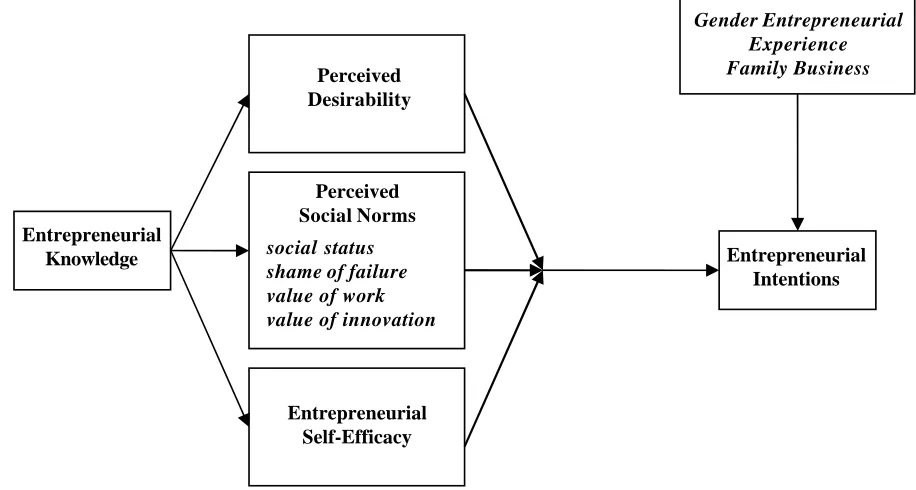
[image:7.612.81.539.452.697.2]The conceptual framework presented below builds on the views advanced by Ajzen (1991), Krueger and Carsrud (1993), Linan (2005), and Fayolle and Degeorge (2006). Figure 1 indicates that entrepreneurial knowledge has direct influence on perceived desirability of entrepreneurship, perceived social norms, and entrepreneurial self-efficacy which in turn have direct influence on entrepreneurial intentions. The presence of other variables like gender, ethnicity, entrepreneurial experience, and family business are expected to also cause variations in the entrepreneurial intentions of students.
Figure 1. Conceptual Model of the Study
Perceived Desirability
Entrepreneurial
Knowledge Entrepreneurial
Intentions Gender Entrepreneurial
Experience Family Business
Perceived Social Norms
social status shame of failure value of work value of innovation
LIMITATIONS OF THE TPB
The application of TPB in this study assumes that entrepreneurial intentions are outcomes of rational choice. Rational choice theory suggests that individuals may choose an entrepreneurial intention and behaviour to maximise utility in the face of clearly perceived choices, complete information, and stable preference functions and constraints facing them (Allingham, 2002).
A major criticism of TPB explains that not all behaviours are rational and logical. Elster (1979; 1989; 2000) among others, challenges the notion of complete rationality by reminding that passions and impulses vis-à-vis the regulations or norms arising from the social setting may also lead an individual into behavioural directions that are hard to predict, irrational and may be considered socially or morally undesirable (Little, 1992; Elster, 2000). Elster (1979) further explains that an individual is perfectly capable of spontaneous, reactive, and impulsive actions which are considered irrational in the context of rational choice theory. A decision-maker is less than completely regulated by rationality due to weaknesses of the will, emotion, impulsiveness, habit, and self-deception (Little, 1992).
This major criticism of rationality implies two things with respect to understanding entrepreneurial intention and behavioural decisions (Little, 1992). First, it is equally important to examine those features of human practical cognition that interfere with reason. Secondly, it is important to understand how a rational individual chooses to act in the present so as to minimise the consequences of these features of imperfect rational capacity in the future (Little, 1992).
While it is beyond the scope of the present study, it is important to recognise these limitations in the application of TPB in explaining the rational decision-making process involved in shaping one’s entrepreneurial intentions and actions. In light of this theoretical controversy, the current study may serve as an initial step towards gathering empirical evidence on the rationality of entrepreneurial intentions and behaviour through the application
of TPB. In effect, the current study may stimulate further investigations to uncover specific directions on how to enrich current understanding of entrepreneurial intentions and behaviour beyond the explanations offered by the rational choice theory, in general, and TPB in particular. It is sufficient to note that this study confines the investigation of entrepreneurial intentions within the TPB context with due regard to the latter’s theoretical shortcomings.
PROPOSITIONS
The conceptual framework presented above suggests that there are direct and indirect relationships between and among the variables subsumed in the framework. The following paragraphs explain these linkages and the corresponding propositions that are worth investigating in future research endeavour.
a. Entrepreneurial Knowledge – Perceived Desirability of Entrepreneurship
Individuals who have gained entrepreneurial knowledge from entrepreneurship education programs are likely to know not only the inherent challenges associated with entrepreneurship, but also the potential intrinsic and extrinsic rewards that can be derived from it (Fayolle, 2005). Positive experience in an entrepreneurship course has been shown to be related to higher levels of perceived interest in business ownership (Wilson, Kickul & Marlino, 2007). The link may be explained by the fact that entrepreneurial knowledge equips an individual with the necessary entrepreneurial know-how thereby breaking down the cognitive barriers associated with new venture creation. Hence, it is advanced in this study that:
P1 – Higher levels of entrepreneurial
b. Entrepreneurial Knowledge – Perceived Social Norms
The extant literature offers scarce views on the linkage between entrepreneurial knowledge and one’s perception on social norms regarding an entrepreneurial career. A plausible explanation is that having entrepreneurial knowledge may have caused an individual to realise that becoming an entrepreneur is not an easy task relative to corporate employment. Knowing that one must be innovative, risk-taker, proactive, hardworking, a dreamer, a pioneer, and able to overcome formidable hurdles to become a successful entrepreneur may have heightened their regard for entrepreneurship thereby perceiving social norms towards entrepreneurship in a more positive manner (Kuratko, 2005). Entrepreneurship programs have been shown to significantly raise students’ subjective norms towards a career in entrepreneurship (Souitaris et al., 2007). Hence it is advanced in this study that:
P2 – Higher levels of entrepreneurial knowledge are positively related to higher levels of perception on the social status of entrepreneurs
P3 – Higher levels of entrepreneurial knowledge are positively related to lower levels of perception on shame of failure associated with entrepreneurship.
P4 – Higher levels of entrepreneurial knowledge are positively related to higher levels of perception on the value of work.
P5 – Higher levels of entrepreneurial knowledge are positively related to higher levels of perception on the value of innovation.
c. Entrepreneurial Knowledge – Entrepreneurial Self-Efficacy
The argument justifying this linkage explains that one’s level of education as well as exposure to
educational programs tend to increase one’s level of belief of being able to do what it takes to pursue business ownership (Noel, 1998; Chowdhury and Endres, 2005; Wilsonet al., 2007; Basu & Virick, 2008). Perceptions of formal learning (Zhao et al., 2005) and functional knowledge in business (Chowdhury & Endres, 2005; Park, 2005) have been shown to increase one’s self-efficacy for business ownership. The more entrepreneurial knowledge an individual possesses, the more self-efficacious the individual becomes with respect to business ownership. Hence, it is advanced in this study that:
P6 – Higher levels of entrepreneurial knowledge are positively associated with higher levels of entrepreneurial self-efficacy.
d. Perceived Desirability – Entrepreneurial Intentions
An individual with strong positive interest and desire to become an entrepreneur is likely to have a heightened level of entrepreneurial intentions to satisfy such desire (Davidsson, 1995; Krueger & Dickson, 1994; Gelderenet al., 2006). Hence it is proposed in this study that:
P7 – Higher levels of perceived desirability of entrepreneurship are positively associated with higher levels of entrepreneurial intentions.
e. Perceived Social Status of Entrepreneurs – Entrepreneurial Intentions
entrepreneurial interest. Hence, it is advanced in this study that:
P8 – There is a positive relationship between perceptions that entrepreneurs have high social status and that of higher levels of entrepreneurial intentions.
f. Shame of Failure – Entrepreneurial Intentions
Fear of failure and the feeling of shame associated with it have negative effects on decisions of individuals to start a business (De Clercq & Arenius, 2006). The theory of face suggests that perceptions that an entrepreneur who failed in business will be frowned at and looked down upon by the community may serve as mental barriers for those individuals who intend to become entrepreneurs (Begley & Tan, 2001). Hence, it is posited in this study that:
P9 – Higher levels of perceived shame of failure is positively associated with low levels of entrepreneurial intentions.
g. Value of Work – Entrepreneurial Intentions
When an individual perceives that honest and hard work is highly valued by society, such perception may instil upon an individual the sense of pride of doing work. This may be more evident in entrepreneurial undertakings where passion for hard work is of prime importance in order to succeed (Kuratko, 2005). Hence it is posited in this study that:
P10 – There is positive relationship between perceptions on the high value of work and that of higher levels of entrepreneurial intentions.
h. Value of Innovation - Entrepreneurial Intentions
Innovation is at the core of entrepreneurship (Drucker, 1999; Casson, 2003). It is expected that when the general external environment places high
respect to and supports innovativeness and innovation, individuals are likely to engage in such behaviour (Shapero & Sokol, 1982; Leeet al.,
2005; Linan et al., 2005). The external
environment provides the signal as to what is acceptable behaviour and conformity to these signals is normally sought consistent with social learning theory (Bandura, 1977b). This theory suggests that a behaviour is performed only when the individual has learned that such behaviour will yield favorable or valued outcomes. Hence, it is argued that:
P11 – There is positive association between perceptions that innovation is highly valued in society and that of higher levels of entrepreneurial intentions.
i. Entrepreneurial Self-Efficacy – Entrepreneurial Intentions
Individuals with self-doubt and who believe that they are inefficacious are likely to be preoccupied with their personal deficiencies, tend to envision failure scenarios more than anyone else and are risk averse (Krueger & Dickson, 1994). It is argued that low level of self-efficacy is a major impediment when considering the creation of a new business (Lee et al., 2005). The decision to engage in self-employment requires that one must have the strong belief that he/she can take on the challenges associated with such endeavours (Bandura, 1977a; Boyd & Vozikis, 1994). Hence the hypothesis:
P12 – There is positive association between high levels of entrepreneurial self-efficacy and high levels of entrepreneurial intentions.
j. The Impact of Entrepreneurship Course
experience changes in attitudes and predisposition towards entrepreneurship as envisioned by the goals of the programs. Hence it is hypothesized in this study that:
P13 – Students will report increased levels of entrepreneurial knowledge at time 2 (upon completion of the entrepreneurship course) relative to time 1 (prior to start of entrepreneurship course).
P14 – There will be an increase in the perceived desirability for entrepreneurship at time 2 compared to time 1.
P15 – There will be an increase in the levels of perceptions on the social status of entrepreneurs at time 2 compared to time 1.
P16 – There will be a decrease in the levels of perceptions on shame of failure at time 2 compared to time 1.
P17 – There will be an increase in the levels of perceptions on the value of work at time 2 compared to time 1.
P18 – There will be an increase in the levels of perceptions on the value of innovation at time 2 compared to time 1.
P19 – Entrepreneurial self-efficacy will increase at time 2 compared to time 1.
P20 – Entrepreneurial intentions will increase at time 2 relative to time 1.
k. Mediating Role of Perceived Desirability, the Four Categories of Perceived Social Norms, and Entrepreneurial Self-Efficacy
The conceptual framework suggests that there is an indirect relationship between entrepreneurial
knowledge and entrepreneurial intentions. The framework suggests that perceived desirability, perceived social norms, and entrepreneurial self-efficacy mediate the relationship between entrepreneurial knowledge and entrepreneurial intentions. TPB suggests that when attitudes and perceived social norms change as a result of the external environment (which in this case is manifested by the changes in the levels of entrepreneurial knowledge due to participation in an entrepreneurship course), it can also be expected the entrepreneurial intensity will show some changes as a result of the variations in its immediate precursors or antecedents. Hence the presence of mediation is detected among these relationships.
l. Mediation in Research Design
Mediation analysis is a four step process (Baron & Kenny, 1986; Hair, Black, Babin, Anderson & Tatham, 2006): (1) the theoretical basis of the relationship between the independent variable(s) and the ultimate dependent variable(s) must first be established; (2) the relationship between the independent variable and the mediating variable must be established; (3) the relationship between the mediating variable and the ultimate dependent variable must also be established; and (4) partial or full mediation must be established by controlling the mediating variable in the statistical analysis of the relationship between the independent variable and the ultimate dependent variable. Full (or partial) mediation is established if the effect of the independent variable on the ultimate dependent variable is zero (non-zero) (Baron & Kenny, 1986). In other words, if the independent variable accounts for variance in the ultimate variable that is not accounted for by the mediating variable, then the mediation is deemed partial in nature (Shrout & Bolger, 2002).
one). Steps two and three have been partly satisfied by the discussions presented above These two steps shall be fully met when statistical analysis is performed on the data that would be gathered at the later stage of the study. Step four is a statistical function to determine if the relationship between the independent variable and the ultimate dependent variable changes when the mediating variable is considered such that complete or partial mediation is established (MacKinnon, Lockwood, Hoffman, West & Sheets, 2002).
Hence is it advanced in this that:
P21 – There is significant relationship between entrepreneurial knowledge and entrepreneurial intentions .
P22 – The relationship between
entrepreneurial knowledge and entrepreneurial intentions is mediated by:
P22a – perceived desirability of
entrepreneurship;
P22b – perceived social status;
P22c – perceived shame of failure;
P22d – perceived value of work;
P22e – perceived value of innovation; and
P22f – entrepreneurial self-efficacy.
m. Personal Characteristics of Respondents
The framework also considers the possible influence of a number of personal characteristics of the study’s respondents on their entrepreneurial intentions. These variables include the gender of respondents, previous entrepreneurial experience; and the previous or current ownership of business by the family of the respondent.
1. Gender
Gender is known to influence one’s interest in business ownership (Matthews & Moser, 1996). Studies have noted gender differences in terms of levels of entrepreneurial self-efficacy (Chowdhury & Endres, 2005), interest in starting a business (Gatewood, Shaver, Powers & Gartner, 2002); and expectancies of self-efficacy for traditional and non-traditional occupations (Gatewood et al., 2002). Given the previous studies’ equivocal results, it is posited in this study that:
P23a – Male respondents will report higher levels of entrepreneurial intentions at time 1 relative to female respondents.
P23b – Male respondents will report higher levels of entrepreneurial intentions at time 2 relative to female respondents.
2. Previous Entrepreneurial Experience
Between 50% to 90% of start up ideas come from prior entrepreneurial experience (Park, 2005). These experiences in business ownership are likely to lead to developing perceptions of oneself as an entrepreneur (Peterman & Kennedy, 2003; Auken, Fry & Stephens, 2006). Likewise, an individual may have gained knowledge, skills and performance strategies from previous entrepreneurial experiences even in the case of failure which may serve as one’s stock of information thereby heightening one’s intentions to pursue an entrepreneurial career (Zhao et al., 2005). Hence it is advanced in this study that:
P24 – Respondents’ years of previous
entrepreneurial experience are associated with higher levels of entrepreneurial intentions.
3. Family Business
one’s desire as well as perception of feasibility of putting up a business (Shapero & Sokol, 1982; Krueger, 1993). Individuals from families with business are likely to have worked in the business as well, hence, shaping their likelihood to engage in future entrepreneurial behaviour (Matthews & Moser, 1996; Auken et al., 2006). Likewise, observations on the positive outcomes benefited by the family from the business might have explained such effect. Studies have shown that childhood experiences involving family business may shape one’s view on self-employment intentions (Drennanet al., 2005).
P25 – Respondents with families who owned/ currently own a business will report higher levels of entrepreneurial intentions relative to those whose families did not/do not own a business.
CONCLUSION AND IMPLICATIONS
The conceptual framework proposed in this study is an attempt to establish the impact of entrepreneurship education programs on entrepreneurial intentions. The framework suggests that entrepreneurial knowledge gained from these programs will influence an individual’s perceptions on the desirability of, entrepreneurial self-efficacy to, and social norms towards entrepreneurship. These perceptions are argued to influence one’s overall intentions to start a business. Theoretical explanations and empirical evidences were presented to substantiate the relationships of constructs used in the framework. Even so, there remains a significant set of issues which are worth pursuing in future studies.
On the theoretical side, it is interesting to explore the limits and validity of the TPB in the context of rational choice theory. It was noted previously that rational choice theory suffers severe limitations in explaining naturally-occurring ‘irrational’ behaviours. Antecedents of entrepreneurial intentions and behaviour other than those offered by models under the rational choice
umbrella are worth investigating. Moreover, future outcome-oriented analyses of entrepreneurial intentions and behaviour may shed light on the strengths and limitations of TPB. Consequently, this type of analysis may help in identifying other non-rational factors that can explain entrepreneurial intentions, behaviour and outcomes.
On the methodological side, a primary issue is on how to measure entrepreneurial knowledge. It is suggested that an exploratory study be conducted to determine the preliminary measures of the entrepreneurial knowledge construct. The investigation may begin with measures reflecting one’s knowledge on the basic functional activities necessary to start a business.
The model may also be expanded to go beyond the measurement of intentions by looking at the future entrepreneurial behaviour of individuals. This would require long-term tracking of participants of a particular entrepreneurship course and investigating if they indeed engage in self-employment. This will provide robust empirical evidence that will support the view suggested by the theory of planned behaviour. Finally, examining the cross-cultural validity of the measures, especially the perceived social norms towards entrepreneurship will yield insights as to the utility of the model to explain and explain entrepreneurial intentions in varying national or cultural contexts.
REFERENCES
Agrawal, R. (2005). Undergraduate curriculum in India: The corporate context. In J. McIntyre and I. Alon (Eds.), Business and Management Education in Transitioning and Developing Countries: A Handbook. London, M.E Sharpe.
Ajzen, I. (1987). Attitudes, traits, and actions: Dispositional prediction of behaviour in social psychology. Advances in Experimental Social Psychology, 20(1), 1-63.
Ajzen, I. (1991). The theory of planned behaviour.
Ajzen, I. & Fishbein, M. (1980). Understanding Attitudes and Predicting Social Behaviour. Englewood Cliffs, NJ, Prentice Hall.
Ajzen, I. and Fishbein, M. (2000). Attitudes, and the attitude-behaviour relation: Reasoned and automatic processes. In W. Stroebe and M. Hewstone (Eds.), European Review of Social Psychology. New York, Wiley: 1-33.
Allingham, M. (2002). Choice Theory: A Very Short Introduction. Oxford, Oxford University Press.
Auken, H., Fry, F. & Stephens, P. (2006). The influence of role models on entrepreneurial
intentions. Journal of Developmental
Entrepreneurship, 11(2), 157-167.
Bandura, A. (1977a). Self-Efficacy: Toward a unifying theory of behavioural change.
Psychological Review,84, 191-215.
Bandura, A. (1977b). Social Learning Theory. Englewood Cliffs, NJ, Prentice Hall.
Baron, R. & Kenny, D. (1986). The moderator-mediator variable distinction in social psychological research: Conceptual, strategic, and statistical considerations. Journal of Personality & Social Psychology, 51(6), 1173-1182.
Basu, A. & Virick, M. (2008). Assessing E n t re p re n e u r i a l I n t e n t i o n s A m o n g s t Students: A Comparative Study. 12th Annual Meeting of the National Collegiate Inventors and Innovators Alliance, Dallas, USA.
Begley, T. & Tan, W. (2001). The socio-cultural e n v i r o n m e n t f o r e n t r e p r e n e u r s h i p : A comparison between East Asian and Anglo Saxon countries. Journal of International Business Studies,32(3), 537-553.
Boyd, N. & Vozikis, G. (1994). The influence of self-efficacy on the development of entrepreneurial and actions. Entrepreneurship Theory and Practice, 18(4), 63-78.
Busenitz, L., West, P., Shepherd, D., Nelson, T., Chandler, G., & Zacharakis, A. (2003). Entrepreneurship research in emergence: Past trends and future directions. Journal of Management, 29(3), 285-308.
Casson, M. (2003). The Entrepreneur: An
Economic Theory. Cheltenham UK, Edward Elgar Publishing.
CHED (2001). CHED Memorandum No. 27, s.
2001: Revised Policies, Rules and Guidelines for Business and Management Education.
Commission on Higher Education, Philippines. Chowdhury, S. & Endres, M. (2005). Gender Differences and the Formation of Entrepreneurial Self-Efficacy. Joint Meeting of the United States Association for Small Business and Entrepreneurship and the Small Business Institute Indian Wells, California, Small Business Advancement National Centre Cox, L., Mueller, S., & Moss, S. (2002). The
impact of entrepreneurship education on entrepreneurial self-efficacy. International Journal of Entrepreneurship Education,1(1), 229-245.
Davidsson, P. (1995). Determinants of
Entrepreneurial Intentions. RENT IX Workshop, Piacenza, Italy.
De Clercq, D. & Arenius, P. (2006). The role of knowledge in business start-up activity.
International Small Business Journal,24(4), 339-358.
DepEd (2002). DepEd Memorandum No. 117,
s.2002 - Thrusts and Activities of the Student Technologists and Entrepreneurs of the Philippines. Department of Education, Philippines.
Drennan, J., Kennedy, J., & Renfrow, P. (2005). Impact of childhood experiences on the development of entrepreneurial intentions.
International Journal of Entrepreneurship & Innovation, 6(4), 231-238.
Drucker, P. (1999). Innovation and
Entrepreneurship. Oxford, Butterworth-Heinemann.
Dyer, W. G. (1994). Toward a theory of entrepreneurial careers. Entrepreneurship Theory and Practice, 17, 7-21.
Elster, J. (1979). Ulysses and the Sirens: Studies in Rationality and Irrationality. Cambridge, Cambridge University Press.
Elster, J. (1989). Solomonic Judgments: Studies in the Limitations of Rationality. Cambridge, Cambridge University Press.
Elster, J. (2000). Ulysses Unbound: Studies in Rationality, Precommitment, and Constraints. Cambridge, Cambridge University Press. Fayolle, A. (2005). Evaluation of entrepreneurship
education: Behaviour performing or intention
increasing. International Journal of
Entrepreneurship and Small Business,2(1), 89-98.
Fayolle, A. & Degeorge, J.M. (2006). Attitudes, intentions and behaviour: New approaches to evaluating entrepreneurship education. In A. Fayolle & H. Klandt (Eds.), International Entrepreneurship Education. Cheltenham UK, Edward Elgar.
Fayolle, A., Gailly, B., Kickul, J., Lassas-Clerc, N., & Whitcanack, L. (2005). Capturing Variations in Attitudes and Intentions: A Longitudinal Study to Assess the Pedagogical Effectiveness of Entrepreneurship Teaching Programs. ICSB World Conference Washington DC.
Fayolle, A., Gailly, B., & Lassas-Clerc, N. (2006). Assessing the impact of entrepreneurship education programmes: A new methodology.
Journal of European Industrial Training, 30(9), 701-720.
Fiet, J. (2000). The pedagogical side of entrepreneurship theory. Journal of Business Venturing,16(1), 101-117.
Gatewood, E., Shaver, K., Powers, J., & Gartner, W. (2002). Entrepreneurial expectancy, task effort, and performance. Entrepreneurship Theory and Practice, 27(2), 187-206. Gelderen, M., Brand, M., Praag, M., Bodewes,
W., Poutsma, E., & Gils, A. (2006). Some advances in the explanations of entrepreneurial
intentions. Regional Frontiers of
Entrepreneurship Research, 448-465. Greene, P. & Rice, M. (2007). Entrepreneurship
Education. Cheltenham UK, Edgar Elgar Publishing.
Gupta, V. & Bhawe, N. (2007). The influence of proactive personality and stereotype threat on women’s entrepreneurial intentions. Journal of Leadership and Organisational Studies, 13(4), 73-85.
Hair, J., Black, W., Babin, B., Anderson, R., &
Tatham, R. (2006). Multivariate Data
Analysis. 6th ed. New York, Prentice Hall. Harris, M., Gibson, S., & Taylor, S. (2008).
Examining the impact of small business Institute Participation on Entrepreneurial Attitudes.
Journal of Small Business Strategy, 18(2), 113-129.
Henry, C., Hill, F., & Leitch, C. (2005a). Entrepreneurship education and training: Can entrepreneurship be taught? Part I. Education and Training, 47(2), 98-111.
Henry, C., Hill, F., & Leitch, C. (2005b). Entrepreneurship education and training: Can entrepreneurship be taught? Part II. Education and Training,47(2/3), 158-169.
Hindle, K. (2007). Teaching entrepreneurship at university: From the wrong building to the right philosophy. In P. Greene and M. Rice (Eds.),
Entrepreneurship Education. Cheltenham UK, Edward Elgar Publishing: 135-158. Hisrich, R. D. & Peter, M. (2002).
Entrepreneurship. New Jersey, McGraw-Hill. Honig, B. (2004). Entrepreneurship education: Toward a model of contingency-based business planning. Academy of Management Learning and Education, 3(3), 258-273.
Jack, S. & Anderson, A. (1999). Entrepreneurship education within the enterprise culture: Producing reflective practitioners.
International Journal of Entrepreneurial Behaviour & Research,5(3), 110-125. Johannisson, B. (1991). University training for
entrepreneurship: A Swedish approach.
Entrepreneurship & Regional Development, 3(1), 67-82.
Kalalo, M. & David, M. (2004). Business class: Entrepreneurship degree programs in the Philippines. The SGV Review, 2(3), 17-24. Kennedy, J., Drennan, J., Renfrow, P., & Watson,
Entrepreneurial Intentions. 16th Annual Conference of Small Enterprise Association of Australia and New Zealand, University of Ballarat, Australia.
Krueger, N. (1993). The impact of prior entrepreneurial exposure on perceptions of new venture feasibility and desirability.
Entrepreneurship Theory and Practice, 18(1), 5-21.
Krueger, N. & Carsrud, A. (1993). Entrepreneurial intentions: Applying the theory of planned behaviour. Entrepreneurship & Regional Development,5, 315-330.
Krueger, N. & Dickson, P. (1994). How believing in ourselves increases risk-taking: perceived self-efficacy and opportunity recognition.
Decision Sciences,25(3), 385-400.
Krueger, N., Reilly, M., & Carsrud, A. (2000). Competing models of entrepreneurial intentions. Journal of Business Venturing, 15, 411-432.
Kuratko, D. (2005). The emergence of entrepreneurship education: Development,
trends and challenges. Entrepreneurship
Theory and Practice,29(5), 577-598. Lee, L., Wong, P., Chen, J., & Chua, B. (2005).
Antecedents for entrepreneurial propensity: Findings from Singapore, Hong Kong and
Taiwan. NUS Entrepreneurship Centre
Working Papers, Retrieved May 16, 2008, from http://www.nus.edu.sg/nec/publications/ papers/WP2005-06.pdf.
Linan, F. (2005). Developing Entrepreneurial Intention among University Students. Fostering Entrepreneurship: The Role of Higher Education: OECD International Conference, Trento, Italy, OECD.
Linan, F., Rodroguez-Cohard, J., &
Rueda-Cantuche, J. (2005). Factors Affecting
Entrepreneurial Intention Levels. 45th Congress of the European Regional Science Association, Amsterdam.
Little, D. (1992). John Elster. In W. Samuels (Ed.).
New Horizons in Economic Thought: Appraisals of Leading Economists. Cheltenham, UK, Edward Elgar Publishing.
Low, R. & MacMillan, I. (1988). Entrepreneurship: Past research and future challenges. Journal of Management, 14(2), 139-161.
Luthje, C. & Franke, N. (2002). Fostering Entrepreneurship through University Education and Training: Lessons from Massachusetts Institute of Technology 2nd Annual Conference on Innovative Research in Management Stockholm, Sweden, European Academy of Management.
Luthje, C. & Franke, N. (2003). The making of an entrepreneur: Testing a model of entrepreneurial intent among engineering students at MIT.
R & D Management, 33(2), 135-147. MacKinnon, D., Lockwood, C., Hoffman, J.,
West, S., & Sheets, V. (2002). A comparison of methods to test mediation and other intervening variable. Psychological Methods,
7(1), 83-104.
Matlay, H. (2005). Researching entrepreneurship and education: Part I: What is entrepreneurship and does it matter? Education and Training, 47(8/9), 665-667.
Matlay, H. (2006). Researching entrepreneurship and education: Part 2: What is entrepreneurship education and does it matter? Education and Training, 48(8-9), 704-718.
Matthews, C. & Moser, S. (1996). A longitudinal investigation of the impact of family background and gender on interest in small firm ownership.
Journal of Small Business Management, 34(2), 29-43.
McMullan, W. E. & Long, W. (1987). Entrepreneurship education in the nineties.
Journal of Business Venturing, 2(1), 261-275. Mitchell, R., Busenitz, L., Lant, T., McDougall, P., Morse, E., & Smith, J. (2002). Toward a theory of entrepreneurial cognition: Rethinking the people side of entrepreneurship research.
Entrepreneurship Theory and Practice, 29(2), 93-104.
Noel, T. (1998). Effects of entrepreneurial education on intent To open a business: An exploratory study. Journal of Entrepreneurship Education, 5, 3-13.
A new perspective and Sspporting case study.
Technovation, 25, 739-752.
Peterman, N. & Kennedy, J. (2003). Enterprise education: Influencing students’ perception of entrepreneurship. Entrepreneurship Theory and Practice, 28(2) 129-144.
Pretorius, M., Nieman, G., & van Vuuren, J. (2005). Critical evaluation of two models for entrepreneurial education: An improved model through integration. International Journal of Educational Management, 19(5), 413-427.
Rae, D. & Carswell, M. (2001). Towards a conceptual understanding of entrepreneurial
learning. Journal of Small Business and
Enterprise Development,8(2), 150-158. Roxas, H., Lindsay, V., Ashill, N. & Victorio, A.
(2007). An institutional view of local entrepreneurial climate. Asia Pacific Social Science Review,7(1), 27-44.
Schaper, M. & Casimir, G. (2007). The impact of tertiary education courses on entrepreneurial goals and intentions. In A. Fayolle (Ed.),
Handbook of Research in Entrepreneurship Education: A General Perspective. Cheltenham, UK, Edward Elgar Publishing. Segal, G., Borgia, D., & Schoenfeld, J. (2005).
The motivation to become an entrepreneur.
International Journal of Entrepreneurial Behaviour & Research,11(1), 42-57.
Shane, S. (2000). Prior knowledge and the discovery of entrepreneurial opportunities.
Organisation Science, 11(4), 448-469.
Shane, S. (2003). A General Theory of
Entrepreneurship: The Individual-Opportunity Nexus. Cheltenham UK, Edward Elgar Publishing.
Shane, S. & Venkatraman, S. (2000). The Promise of Entrepreneurship as a Field of Research.
Academy of Management Review, 25, 217-226.
Shane, S. & Venkatraman, S. (2001). Entrepreneurship as a field of research: A response to Zahra and Dess, Singh, and
Erikson. Academy of Management Review,
26(1), 13-16.
Shapero, A. & Sokol, L. (1982). The social dimensions of entrepreneurship. In C. Kent,
D. Sexton and K. Vesper (Eds.), The
Encyclopaedia of Entrepreneurship.
Englewood Cliffs, Prentice Hall.
Shrout, P. & Bolger, N. (2002). Mediation in experimental and non-experimental studies: New procedures and recommendations.
Psychological Methods, 7(4), 422-445. Souitaris, V., Zerbinati, S., & Al-Laham, A.
(2007). Do entrepreneurship programmes raise entrepreneurial intention of science and engineering students? The effect of learning, inspiration and resources. Journal of Business Venturing,22, 566-591.
Widding, L. (2005). Building entrepreneurial
knowledge reservoirs. Journal of Small
Business and Enterprise Development, 12(4), 595-615.
Wilson, F., Kickul. J., & Marlino, D. (2007). Gender, Entrepreneurial Self-Efficacy, and E n t r e p r e n e u r i a l C a r e e r I n t e n t i o n s : Implications of Entrepreneurship Education.
Entrepreneurship Theory and Practice, 31(3), 387-406.
Wu, W., Chang, M., & Chen, C. (2008). Promoting innovation through the accumulation of intellectual capital, social capital and
entrepreneurial orientation. R & D
Management, 38(3), 265-277.
Young, J. (1997). Entrepreneurship education and learning for university students and practising entrepreneurs. In D. Sexton and R. Smilor (Eds.), Entrepreneurship 2000. Chicago IL, Upstart Publishing.
Yu, C. & Chan, C. (2004). Entrepreneurship Education in Malaysia. 2004 International Council for Small Business Conference. Zhao, H., Seibert, S., & Hills, G. (2005). The
mediating role of self-efficacy in the development of entrepreneurial intentions. Journal of Applied Psychology,90(6), 1265-1272. Zimerer, T. W. & Scarborough, N.M. (2002).