
Form follows function: a comparative analysis of the gestures depicted in anthropomorphic figures at selected rock art sites in Hawai'i and Australia
354
0
0
Full text
(2) A comparative analysis of the gestures depicted in anthropomorphic figures at selected rock art sites in Hawai'i and Australia.. Form Follows Function. Dissertation submitted by. Carol Breese Patterson. July 2003. for the Degree of Doctor of Philosophy in the School of Anthropology, Archaeology and Sociology James Cook University.
(3) Dedicated to my father, Charles S. Sink, one of the world's greatest architects who continually strives to design buildings according to this model. *. * FORM FOLLOWS FUNCTION was Louis Sullivan's improvement upon Furness's "a building should proclaim its use" (Louis Sullivan, in Connely 1960, ZOO)..
(4) STATEMENT OF ACCESS. I, the undersigned, author of this work, understand that James Cook University will make this thesis available for use within the University Library and, via the Australian Digital Theses network, for use elsewhere. I understand that, as an unpublished work, a thesis has significant protection under the Copyright Act and;. I do not wish to place any further restriction on access to this work.. Or I wish this work to be embargoed until :. Or I wish the following restrictions to be placed on this work:.
(5) IV. Abstract Nonverbal communication is inclusive of posture, gesture and proxemic behaviour that is major part of human communication. Therefore, can we observe the gestures, postures and proxemic arrangements displayed in anthropomorphic figures in rock art structured in a way that we can identify patterns and relationships? This thesis sets out to investigate whether these elements displayed in anthropomorphic figures are just random displays or if they are purposeful and reflect cultural symbolic systems. This thesis is not concerned with meaning, but rather patterns that may be meaningful when compared to similar patterns in the ethnography. The systematic analysis examines the rock engravings of selected sites on the island of Hawai'i, Polynesia, and paintings in rock shelters of the Cape York Peninsula, Australia. The methodology is applied to two different culture areas, (Hawaii and Australia), where the subsistence strategies are different (agriculture vs. hunter/gatherer), and where the medium is different (painting and engraving). The purpose is to sample areas where anthropomorphic figures are prevalent and are important within the indigenous tradition of each area. This thesis examines the gestural, postural and proxemic patterns displayed in anthropomorphic figures through a process of triangulation employing three different approaches: the gathering of ethnographic information from the culture considered responsible for the paintings or engravings, conducting convenient sampling of anthropomorphic figures from selected sites and building an empirical database, and the application of a structural analysis to a selected panel of figures from each study area. Form is divided into categories of body types in each study area: T shape, Stick, Triangle Solid, Triangle Empty and Triangle Open in Hawai'i and; Stick, Full Bodied Stick, and Full Body in Australian. In both culture areas these body types operate as separate modes within a formal visual communication system. Distinct information is conveyed through a selection of form that is limited to these disparate body types. Body forms are not random, but seem to have an underlying structure which dictates their use. Gestures and postures are not random but are found in repetitive patterns that suggest purposeful use. Plasticity is defined by the topographic characteristics that include engraved outline, solidly pecked-out forms, single-line figures and various colour pigments. All of these textural and physical topographical techniques encode meaning..
(6) v Proxemic arrangements are used to encode meaning by controlling the spatial relationships between figures within a composition. Cultural definitions of distance define personal and intimate space, as well as private or public space. Patterns emerge from the proxemic arrangements of repeating figures in the Hawaiian example,that mirror cultural constructs such as genealogy and kinship. Similarly, in Australia, the proxemic patterns reflect mortuary ceremonies and totemic relationships. By taking this approach, a better understanding of the patterns and structures embedded within the visual displays by each culture can emerge. This information can then draw upon the similar structures in the ethnographic literature to formulate a better understanding of the rock art. The evidence provided by the two study areas reveal cultural constraints and rules as to how individual figures are presented in rock art in terms of their form, gesture, plasticity and spatial arrangement. The grouping of anthropomorphic figures follows formal patterns depending on the cultural relationships and the intended meaning. Future studies of anthropomorphic figures in rock art could adopt the model of systematic analysis developed here to better understand the nature of symbolic systems in different parts of the world. Studying structures and patterns found in gestures, postures and proxemic arrangements can provide an avenue to the primary 'function' of a visual communication system, which is encapsulated into the 'form,' that inevitably follows..
(7) vi. Table of Contents. Page. Title page. I. Dedication. 11. Statement of access. iii. Abstract. iv. Table of Contents. V11. List of Tables. xv. List of Figures. XIV. Statement of sources. XIX. Acknowledgements. XX. Glossary. xxii. Part I. Background Context Chapter I. 1.1. 1. Introduction. 2. Anthropomorphic figures in rock art. 2. 1.1.1. Body language. 3. 1.1.2. Multi-faceted approach. 4. 1.2. Phenomenon - gesture. 5. 1.3. Addressing the issues. 7. 1.4. Aims and significance. 8. 1.5. Structure of the dissertation. 9. Theory of Gesture, Posture and Proxemics. 12. 2.1. Introduction. 12. 2.2. History of the research of gesture. 13. 2.3. Theory of gesture. 16. Chapter 2. 2.3.1. The difference between gestures and signed languages. 2.3.2. 17. Structure of American Sign Language and Aboriginal sign languages. 18.
(8) vii 2.3.3. The Function of gesture as narrative. 20. 2.3.4. Gesture and mental imagery. 21. 2.3.5. Categories of gesture. 23. 2.4. Kinesics. 25. 2.5. Posture. 26. 2.5.1. Posture from a Western perspective. 26. 2.5.2. Cross cultural studies of posture. 27. 2.6. Proxemics. 30. 2.7. Discussion. 35. 2.8. Gestures, postures and proxemics in visual art. 36. 2.9. Gestures in rock art. 37. 2.10. 2.9.1. Gestures in North American rock art. 38. 2.9.2. Gestures in the rock art of Hawai'i. 40. 2.9.3. Gestural studies in Australian rock art. 41. Semiotics and a Structural Analysis. 44. 2.10.1 Semiotics of non-verbal systems. 44. 2.10.2 Structuralism and a semiotic approach. 45. 2.10.3 Structuralism applied to rock art. 46. 2.10.4 Structural analysis of a North American rock art panel. 47. Conclusions. 48. Methodology. 50. 3.1. Introduction. 50. 3.2. Empirical Data of Observed Gestures. 51. Definition of anthropomorphs. 51. 2.11. Chapter 3. 3.2.1. 3.3. 3.2.2 Terminology: Kinemes. 52. 3.2.3. Observed Matrix. 53. 3.2.4. How a figures is identified. 55. Ethnographic data concerning gesture 3.3.1. Hawai'i. 57 57.
(9) viii 3.3.2 3.4. Laura. 58. Structural analysis of a semiotic system. 59. 3.4.1. Semiotic terminology. 59. 3.4.2. Problems and Constraints. 61. Part II Anthropomorphs in Hawaiian Rock Art. 62. Background of Hawai'i Island. 63. 4.1. Introduction. 63. 4.2. Geological history of Hawai'i. 64. 4.3. The archaeological record. 66. 4.4. The rock art of Hawai'i Island. 71. 4.4.1 History of rock art documentation. 71. 4.5. Petroglyph locations of Hawai'i. 71. 4.6. Petroglyph engraving techniques. 72. 4.7. Rock art typology. 72. 4.8. Petroglyph age determination. 74. 4.8.1. Stylistic age determinations. 75. 4.8.2. Comparison of rock art typology. 76. Chapter 4. The Data from Hawai'i Island. 78. 5.1. The Hawaiian petroglyph data base. 78. 5.2. Body types. 82. 5.2.1. 84. Chapter 5. Plasticity. 5.3. Heads. 85. 5.4. Arms. 86. 5.5. 5.4.1. Upper arms. 86. 5.4.2. Lower arms. 87. Hands 5.5.1. 5.6. 89 Multi-digits and 3 digit hands. 85. 5.5.1.1 Directional use of 3digit hands and feet. 91. Muscles. 91.
(10) IX. 5.7. 92. Torso 5.7.1. Torso orientation. 94. 5.8. Gender. 95. 5.9. Legs. 97. 5.9.1. Lower legs. 98. 5.10. Feet. 100. 5.11. Discussion. 100. 5.11.1 Contiguity. 102. Summary. 102. 5.12. Chapter 6. Ethnographic Parallels in relation to Gesture. 103. 6.1. Introduction. 103. 6.2. Hawaiian ethnography. 103. 6.3. 6.4. 6.2.1. Social organization. 103. 6.2.2. Genealogies. 106. 6.2.3. Linear structures: generations. 107. 6.2.4. Lateral structures. 109. 6.2.5. Family. 112. 6.2.6. Ancestors. 114. Hawaiian cosmology. 117. 6.3.1. Images of Gods. 117. 6.3.2. The pantheon and multiple meanings. 118. 6.3.3. Mana and Tabu (Kapu). 120. 6.3.4. The Family. 121. 6.3.5. Spirits. 122. 6.3.6. The Haka and Noho. 123. 6.3.7. Summary. 125. Iconic gestures and postures in the rock art. 126. 6.4.1. Fishing. 126. 6.4.2. Tabu (kapu). 127. 6.4.3. The Hawaiian hula. 130.
(11) x. Chapter 7. 137. 6.4.5. 139. Summary. Structural Analysis of the 'family scene', Hawai'i. 140. 7.1. Introduction. 140. 7.2. Terms for this analysis. 142. 7.2.1. 143. 7.3. 7.4. 7.5. Part III. 6.4.4 Makahiki Festival. Site Description. Grapheme F and E. 144. 7.3.1. Grapheme F. 144. 7.3.2 Grapheme E. 147. Syntagm; A, B, C, and D. 149. 7.4.1. Grapheme A. 149. 7.4.2 Grapheme C. 151. 7.4.3. Grapheme Band D. 153. 7.4.4. Grapheme D. 154. 7.4.5. Discussion. 156. Syntagrn of Grapheme G and H. 156. 7.5.1. Grapheme G. 156. 7.5.2 Grapheme H. 158. 7.6. Grapheme I. 159. 7.7. Discussion. 160. 7.8. Summary and conclusion. 162 166. Australia Laura Ethnographic Context. 167. 8.1. Introduction. 167. 8.2. Ethnographic background. 169. 8.2.1. 169. Chapter 8. Historical review. 8.2.2 Language affiliations. 170. 8.2.3. 172. Sign language. 8.2.4 Social organisation. 173.
(12) xi. 8.3. 8.5. 8.2.5. Totems. 174. 8.2.6. Country. 175. 8.2.7. Marriage and kinship. 176. Personal Relationships. 177. 8.3.1. 177. Self. 8.3.2 Ancestor. 177. 8.3.3. Spirit. 180. 8.3.4. Totemic Complex. 180. Gesture. 182. 8.5.1. Sign Language. 182. 8.5.2. Life events and gestures. 184. 8.5.3. Birth. 184. 8.5.4. Marriage. 184. 8.5.5. Initiation. 185. 8.5.6. Death. 185. 8.5.7. Mourning dances. 187. 8.5.8. Summary. 188. Data from the Laura area, North Queensland. 190. 9.1. Introduction. 190. 9.2. Methods. 190. 9.2.1. Body types. 194. 9.2.2. Colour. 195. 9.2.3. Body types and colour. 197. 9.2.4. Heads. 200. 9.2.5. Upper arms. 200. 9.2.6. Lower arms. 203. 9.2.7. Hands. 204. 9.2.8. Torso. 204. 9.2.9. Gender. 205. Chapter 9. 9.2.10 Upper legs. 206.
(13) xii 9.2.11 Lower legs. 208. 9.2.12 Feet. 210. Summary. 211. Laura Rock Art. 212. Background. 212. 10.1.1 Introduction. 212. 10.1.2 Antiquity of Laura art. 216. 10.1.3 Geographical distribution. 216. 10.1.4 Archaeological features. 217. Typology. 218. 10.2.1 Style. 218. 10.2.2 Classification. 219. 10.2.3 Hybrids. 221. 10.2.4 Schematization and visual realism. 222. 10.2.5 Superimpositions. 226. 10.2.6 Gestures in superimposing sequences. 227. 10.3. Summary. 229. 10.4. Gestures in Laura rock art. 230. 10.4.1 Sign language gestures. 230. 10.4.2 Extended arm positions. 231. 10.4.3 Horizontal arm positions. 232. 10.4.4 Arms down position. 235. 10.4.5 Arms vertically down. 235. 10.4.6 Anti-gesture. 236. 10.4.7 Horizontal and inverted positions (sorcery). 237. 10.4.8 Eyes. 238. Conclusions. 239. Structural Analysis of the 'snake bite' panel. 242. Introduction. 242. 9.3. Chapter 10 10.1. 10.2. 10.5. Chapter 11 11.1.
(14) xiii. 11.2. 11.3. 11.1.1 Site description. 242. 11.1.2 Superimposition. 244. Syntagm A, B, C, D and E. 245. 11.2.1 Grapheme A. 245. 11.2.2 Grapheme B. 245. 11.2.3 Graphemes C and D. 247. 11.2.4 Grapheme E. 247. Syntagm F and G. 249. 11.3.1 Grapheme F. 249. 11.3.2 Grapheme G. Part IV. 11.4. Discussion. 252. 11.5. Summary. 252. 11..6. Conclusions. 256. Conclusions. 258. Form Follows Function. 259. Review. 259. 12.1.1 The phenomena. 259. Aim Number One - are gestures random or puposeful. 260. 12.2.1 Empirical Recordings. 260. 12.2.2 Ethnographic Data. 261. 12.2.3 Structural Analysis. 262. 12.3. Aim Number Two - Analysing the gestures. 262. 12.4. Aim Number Three - are there constraints to the gestures. 264. 12.4.1 Form. 265. 12.4.2 Phenomena. 266. 12.4.3 Plasticity. 267. 12.4.4 Ethnographic Parallels. 268. 12.4.5 Geographic Constraints. 269. 12.5. Conclusion. 270. 12.6. Future Research Questions. 271. Chapter 12. 12.1. 12.2. References. 249. 272.
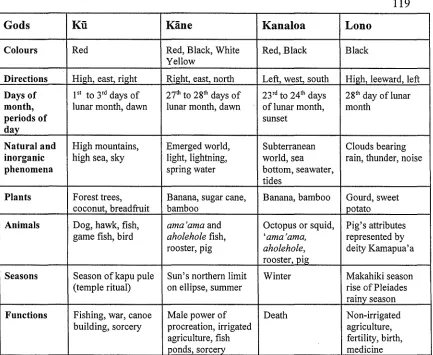
(15) xiv. Appendixes. 302. A. Hawaii. 302. B. Laura. 312. List of Tables Table 2.1. Gestures classification. 23. Table 3.1. Kinemorphic matrix chart. 55. Table 3.2. Sample of Categories. 57. Table 3.3. Terms for human communication systems and graphic Representation. 60. Table 4.1. Style category comparisons. 77. Table 5.1. Summary chart. 80. Table 5.2. Torso orientation. 93. Table 6.1. Stratification in Hawaiian society. 105. Table 6.2. Principle attributes of the four major gods. 119. Table 7.1. Comparative Summary of Patterns and Relationships. 163. Table 8.1. Spelling of linguistic affiliations in the Laura region. 171. Table 9.1. Data summary table. 192. Table 9.2. Six categories for body colour and forum. 196. Table 10.1. Schema of the subject and object portrayed in Laura. 219. Table 10.2. Body types of the Laura area. 221. Table 10.3. Relationships between paint colour. 227. Table 11.1. Mortuary images from selected sites. 248. Table 11.2. Comparative Summary. 255. Table 12.1. Summary of Forms. 264. List of Figures 2.1. Proximal positioning of signs for future, present and past. 19. 2.2. Narratological structure of gesture. 20. 2.3. Postures interpreted by Western culture. 27. 2.4. Cross cultural posture. 29. 2.5. Hall's proxemic chart. 34.
(16) xv 2.6. Family group. 36. 2.7. Family arrangements. 41. 2.8. Arms akimbo gesturing confidence and authority. 42. 2.9. A painting at the Crocodile gallery site. 43. 3.1. Illustrations of grapho-kinemes. 52. 4.1. Islands of Hawai'i. 65. 4.2. Polynesian migrations. 67. 4.3. The Hawaiian cultural sequences. 68. 4.4. Hawaiian petroglyph site map. 72. 4.5. Examples of body styles. 73. 4.6. Summary of Hawaiian petroglyph styles. 75. 5.1. Map of Puak. 78. 5.2. Percentages of body types from six sites. 82. 5.3. Figures from K eo 1 and Paniau. 83. 5.4. Figures from Ka' p lehu. 84. 5.5. Variation of body outline and infill. 85. 5.6. Percentages of head types from six sites. 86. 5.7. Percentage of upper left and right arm positions. 87. 5.8. Percentages of lower left and right arm positions. 88. 5.9. Selection of figures with multi digit hands. 89. 5.10. Percentages of digits on hands and their orientation. 90. 5.11. Examples of three digit hands and feet. 91. 5.12. Outlined muscles of only two arms, legs, or both. 91. 5.13. Solid muscles in arms, legs or both. 92. 5.14. Percentages of torso orientation. 95. 5.15. Gender relationships. 96. 5.16. Percentages of gender. 97. 5.17. Splayed or frog position. 97. 5.18. Percentage of left and right leg positions. 98. 5.19. Percentages of left and right lower legs. 99. 5.20. Two figures from Ka' P lehu. 100. 5.21. Paniau stick figures. 101. showing 3 subdivisions of K eo.
(17) xvi 5.22. Triangle bodied figures. 101. 6.1. Birthing posture. 107. 6.2. Birthings and generations from Paniau. 108. 6.3. Petroglyphs of Kamalalawalu. 110. 6.4. West wall of Kalaoa Cave. 111. 6.5. Samples from K eo 1 showing connected figures. 113. 6.6. Kaeo 1. 116. 6.7. Lono figures. 120. 6.8. The "Family Scene" panel at Paniau. 122. 6.9. A'umaku images. 123. 6.10. Selected figures from the "Family Scene". 124. 6.11. 'Fisherman' from Ka' p lehu. 126. 6.12. 'Fisherman and fish' from Ka' p lehu. 127. 6.13. Prostrate figure. 128. 6.14. Two bas-relief figures from O'ahu. 129. 6.15. Paisner's identification of a hula dancer. 133. 6.16. Hula dancers of the Sandwich Islands. 134. 6.17. Hawaiian man dancing, three views. 135. 6.18. From Puak ,K eo1 and K eo 36. 135. 6.19. Hula heiau "kam'oali'i. 137. 6.20. Boxing match before Captain Cook. 138. 6.21. Boxing match before Captain Cook (second half). 139. 7.1. Anthropomorphic group from K eo 18. 144. 7.2. 'Aumakau figures from Cox and Stasack. 145. 7.3. Petroglyph of bird and open-bodied figure. 145. 7.4. Contrasting figures. 150. 7.5. Birth scene from Kahuluu. 152. 7.6. 'Family Scene'. 156. 7.7. Triangl Bodied figure with long 3 digit hand, Puako. 158. 8.1. Map showing the location of the Laura region. 168. 8.2. Map of Cape York Peninsula. 169. 8.3. Map of movements of tribes in the Laura region. 171.
(18) xvii 8.4. Diagram of 'self' in relation to clan and ancestor. 177. 8.5. Relationship of personal ancestors. 179. 8.6. The inward and outward relationship of 'spirit' to 'self'. 180. 8.7. Sign language gesture for 'marriage'. 185. 8.8. Sign for 'corpse'. 186. 8.9. Mourning dance. 188. 8.10. Morning Dance. 188. 9.1. Unpublished figures. 191. 9.2. Body types in the Laura region. 194. 9.3. Percentage of body types in the Laura area. 195. 9.4. Variations in light and dark colour. 197. 9.5. Giant Wallaroo panel 1. 198. 9.6. Giant Wallaroo panel 2. 199. 9.7. Dark colours with light interior lines. 200. 9.8. Percentages of left and right upper arm positions. 201. 9.9. Percentages of left and right lower arm positions. 203. 9.10. Percentages of hands, both left and right. 204. 9.11. Percentages of torso orientations. 205. 9.12. Percentages of gender depicted by breasts or penis. 206. 9.13. Percentage of left and right upper leg positions. 207. 9.14. Quinkan figures from Amphitheatre site. 208. 9.15. Percentage of left and right lower leg positions. 209. 9.16. Stick figures with toes up from Giant Wallaroo site. 209. 9.17. Percentages for both left and right feet. 210. 10.1. Walaeimini and Wakarma shelters. 213. 10.2. Linguistic affiliations with the rock art sites. 215. 10.3. Site locations in the Laura region. 217. lOA. Anthropomorphic figures of 'stubbie' body types. 220. 10.5. Two hybrid yam/man figures. 222. 10.6. Giant Horse schematic painting. 223. 10.7. Clip-art horse. 225. 10.8. Superimposition sequences. 229.
(19) xviii. 10.9. Gestures in superimposition. 230. 10.10 Native policeman sign language gesture. 231. 10.11 Death Adder site with arms up. 232. 10.12 White female from Yam Camp. 232. 10.13 Timara Quinkan Ancestor figure. 231. 10.14 Red Lady from Brady Creek. 233. 10.15 Red guardian figure at Shepherd Creek. 233. 10.16 Protector figure from Brady Creek. 233. 10.17 Male protector and child figure from Gugu-Yalangi. 234. 10.18 Female protector figure with child. 235. 10.19 Figures with arms down from Brady creek. 235. 10.20 Sign language gesture for a corpse. 235. 10.21 Imjim Quinkan from Split Rock. 236. 10.22 Imjim Quinkans from Quinkan Mountain. 237. 10.23 Inverted 'sorcery' figure at Mushroom Rock. 238. 10.24 Figures from Brady Creek with eyes and no mouths. 239. 11.1. Composite photograph entitled 'snake bite scene'. 243. 11.2. Graphic illustration of 'snake bite scene'. 244. 11.3. Bone cylinders and paintings. 249. 11.4. Photographs of paintings from Brady Creek. 249.
(20) Statement on Sources: Declaration. I declare that this dissertation is my own work and has not been submitted in any form for another degree or diploma at any university or other institution of tertiary education. Information derived from the published or unpublished work of others has been acknowledged in the text and a list of references given.. z; I CJ~ t::)3 -------~------------Carol Breese Patterson. July 2003.
(21) xx. Acknowledgments. The research for this thesis would not have been possible without the strong support of Dr. Alan Watchman, who encouraged me to embark on this project. Nor could I not have continued without the support and encouragement of my family, my daughter, Amelia and son, Daniel for tolerating my absences and preoccupation with prehistoric paintings and engravings.. The field work in Hawai'i was only made possible through the efforts and time of Mikilani Ho. To her lowe deep gratitude for her knowledge of Hawaiian culture, and her superb field drawings of many of the sites. I am thankful to Phil Gam who provided me with important sources and information from his earlier research on Hawaiin petroglyphs.. For the Australian field work, I thank Dr. Watchman again for helping me with travel arrangements to remote sites and special contacts, and his generosity in sharing his knowledge about the region. For the field work in Laura, I thank Noelene Cole and Percy Trezise for their expertise and guidance at Jowalbinna. I thank all the people at the Ang-Gnarra Aboriginal Corporation, Tommy George, George Musgrave, and Victor Stephenson who assisted me in the field and related their knowledge about the.
(22) xxi sites. I thank Eddie McLachlan, who accompanied me in a second field campaign to Laura.. I especially appreciated the opportunity to accompany Julie Drew in the field. She provided valuable contacts and transportation for field work conducted near Katherine. My thanks to the Wardaman Aboriginal Corporation, Bill Harney, his wife and grandsons, and Oliver Raymond, his wife Barbara and his family.. For the writing of this thesis, I thank Dr. Watchman and Dr. Roe for their feedback and constructive criticism. Without their expertise in this field of study I would have gotten 'a bit slewed' for sure. Dr. David Roe's advice on content is most appreciated. I could not have completed the final drafts without the keen eye of Tim Harvey who patiently read and edited each chapter. I appreciate the insightful conversations with Dr. Doug Miles, Dr. Rohan Bastin and Dr. Rosita Henry, Anthropology Department of James Cook University.. I am grateful to James Cook University for an International Student Scholarship and a grant from the School of Anthropology, Archaeology and Sociology, and Dr. John Campbell (then head of the School) for providing the financial assistance enabling me to study in Australia and participate in this graduate program..
(23) xxii. Glossary Affinity Checks - checks conducted with other elements in the panel, and with other panels in the region of the same age and cultural affiliations.. Anthropomorph - a design or motif having human form or attributes. Anthropomorphous - having or resembling the human form - anthropomorphic. Combined Meaning - meaning denoted from the context within which the grapheme is found.. Comparative Affinity - comparison of graphemes with similar characteristics in the same panel.. Contiguity - Any experience of two elements being related by proximity. Extended Meaning - denoted from the cultural idioms, metaphors and site significance.. Factorality - is any experience of something as being a part of a whole, or as being a whole having parts.. Gesture - gestures can be autonomous signs or even 'languages', gestures can be contiguous with other modes of sign behaviour, and may playa part in the evolution of sign behaviour (Noth 1990, 395).. Gestureme - smallest unit of graphic representation of a gesture that is distinguished from another.. -graph a word or element meaning: drawn or written. Grapheme - smallest unit of graphic writing that distinguishes one meaning from another.. Grapho- a word element meaning 'writing' as in graphology. -graphy - combining form denoting some process or form of drawing, representing,.
(24) xxiii writing, recording, describing, etc. photography, pictography.. Grapho-kineme - units of gestural articulation within the kinetograph. Haka - 1. shelf, perch, roost. 2. recipient; medium, oracle, one possessed. * Hanauna - generations; relative whose relationship was established several generations previously; ancestry, birth. Hanaukeiki'ana - childbirth;. Hanaumua - first born child. * Icon - a picture, image, sign or other representation which stands for its object by virtue of a resemblance or analogy to it. Iconic - relating to or of the nature of an icon, portrait, or image.. Iconography - the making of an icon; representation by means of drawing, painting, or carving figures. Iconographic - of or relating to icons.. Kaku mete - poet, composer. To compose songs or chants. * Kapu (Tapu, Tabu, Taboo) - prohibition, forbidden, sacred, holy, consecrated. Ku.auhau - genealogy, pedigree, lineage, old traditions: genealogist, historian; to recite genealogy.*. Kineme -smallest unit of movement. Kinesics - the recording of gestures and body motion using a notation system.. Kinetograph - the overall gestural and postural composition of a figure. Kuamo' 0 - backbone, spine, road, trail. * Mana - supernatural or divine power, miraculous, divinely powerful, spiritual. Mete .- song or chant. * Mele inoa - name chant, ie., chant composed in honour of a person, as of a chief. * Mo'o - succession. * Mo'o kupuna - ancestral genealogy.*.
(25) xxiv. Mo'o ku'auhau - genealogical succession.* Mo' 0 lelo - story, talk, legend, journal*. Morphology - the study of form, structure. The form of an organism considered as a whole, compositions.. Pictograph - a record consisting of pictorial symbols. A pictorial sign or symbol, painted, represented pictorially. Pictographic adj.. Pictography - the use of pictographs, picture writing, (graphics) Pictogram - picture + gram -gram a word element meaning something drawn or written, as in diagram, epigram, telegram, monogram.. Picture writing - the art of recording events or expressing ideas by pictures or pictorial symbols. Pictorial symbols forming a record or communication.. Plasticity - the surface properties of rock engravings or paintings which vary in ways that encode meaning. The plastic layer that functions iconically.. Proto-types - the 'ideal traits' used for describing the whole. Semantic Density - the levels of meaning - polysemy. Sign - a mark, image, gesture, or signal that has a conventional meaning associated with it.. Symbol - something used or regarded as standing for or representing something else; a material object representing something immaterial: an emblem, token or sign.. Symbol Affinity - comparison of a grapheme with others found in the rock art data base and ethnographic record.. Syntagm - a string of constituents forming a syntactic unit..
(26) xxv Syntactic Unit - a group of signs that when combined form a recognizable unit. Syntax - the rules governing the order or structure of symbols. Typification - a trait taken to represent the ideaL Prototype.. * Hawaiian Dictionary. Pukui and Elbert. 1986..
(27) Part I. Background Context.
(28) 2. Chapter 1 Introduction. 1.1. Anthropomorphic Figures in Rock Art. Visual images, either painted or engraved, can be examined as visual communication systems (Olsen 1989) and categorised as styles that encode meaning (eg. Smith 1994, Cole 1998) or as semiotic systems (eg. Bouissac 1994, Sonesson 1994) that communicate through visual forms (Layton 1992). One assumption can be made without argument: that the majority of rock engravings and rock paintings represent visual constructs that communicate meanings at some level. What the meaning is, in absolute terms, will never be known but I would like to offer a multi-tactical approach toward understanding how meaning(s) was conveyed in some prehistoric rock images. I employ a new method to reveal patterns and internal structures ofthe images to achieve a better understanding of these images. This thesis, to a lesser degree, applies theories that have been tried and shown to be useful in rock art studies (eg. Layton1992, Lee and Stasack 1999), particularly with the use of style categories that assist in establishing or suggesting chronologies and have some connections to cultural context.. There are gaps in the rock art literature regarding semiotic analysis ofpictorial imagery. Applying the linguistic model to pictorial imagery as ifit were a text is also problematic (Conkey 2001). There needs to be a new methodology for studying prehistoric art and.
(29) 3 the internal structure of complex compositions. There also needs to be an adequate nomenclature to address its various categories for these internal structures.. This thesis works towards developing such a methodology. It considers only anthropomorphic figures, using examples from two unrelated cultural areas, Hawai'i and the Laura area of Cape York Peninsula, Australia.. I make a broad-based. assumption that anthropomorphic figures are meaningful images produced with purpose although with a great quantity of rock art in the world, there is no exegesis to their semantic content. I intend to explore a 'level of meaning' that is rooted in the human psyche that may not have been fully analysed before. I introduce a methodology similar to the neuropsychological model proposed by Lewis-Williams (1991), and LewisWilliams and Dowson (1989), by examining whether the employment of a human universal body language even though its meaning will be culturally specific. How contemporary people interpret prehistoric images of gesture is problematic, but it is the purpose of this thesis to explore the process by which meaning is derived and to experiment with a new approach. I use a structural analysis to try and understand how humans may have used anthropomorphic figures in rock art images to communicate as part of a multi-faceted language.. 1.1.1 Body Language. The components of human language include spoken, written, and non-verbal communication systems. The latter include gestures, postures, sign language and proxemic behaviour. It has been proposed by Corballis (1991, 1999a), Armstrong et al. (1995) and Armstrong (1999) that human language originated with gestured signs..
(30) 4. They argue that even in cultures with highly developed spoken languages, people still use gestural signs to augment speech.. The last 30 years have produced a renewed. interest in gesture and a more thorough examination of its role in the evolution of language and cognition in humans (McNeill 1995).. The human body can be used to transmit messages to an observer by movements or postures that can include the use oflimbs as well as facial expressions. Non-movement can also transmit information. "There is no attribute of the human body, whether size, shape, height or colour, which does not convey some social meaning to the observer," (Thomas 1991, 1). Of the many channels of non-verbal communication, only gesture, posture and proxemic location are considered in this thesis. The meaning(s) of nonverbal communications are only decipherable to the extent to which its cultural context is available, but semiotic analysis can help elucidate the underlying structures within a sign system.. 1.1.2. Multi-faceted Approach. In his studies of the Arrernte, an Aboriginal people of Central Australia, language is what David Wilkins calls a 'multi-media performance' (Wilkins 2001). In his view, language is composed of three modalities as part of the whole communication process. These are 1) the spoken or verbal narration, 2) the simultaneously gestured aspect, and 3) the visual display drawn in sand or painted on canvas. Each medium (spoken, gestured and drawn) is a component of a larger communication grammar. Neither verbal, gestured or painted stories are autonomous. Like bound morphs, each needs the other as part of a multi-faceted communication system..
(31) 5 Similarly with prehistoric art, the missing components, verbal narration and gestures, cause major problems for determining what the' story' may have been. The rock images in this study are far less 'abstract' than the sand drawings of Central Australia and therefore they supply more figurative displays ofanimals and humans in particular, with their gestures, postures and proxemic arrangement. But the absence of verbal and gestural narration limits the interpretation and revelation of meaning. It is possible, however, if gesture is so intimately bound up with verbal narration, that the pictorial art holds traces of the verbal/performance component. The identification of gestural components might offer an effective methodology for interpreting rock images, especially where the cultural context is known or can reliably be inferred.. 1. 2. Phenomenon - Gesture. It is probable that all humans relate to clear pictures ofhuman beings on some level, and. may interpret gestures and postures depicted therein according to their own experiences and cultural conditioning. The question posed in this thesis is whether gestural phenomena depicted in anthropomorphic figures in rock art communicate information to some degree in the way that gestures do among living people? Or are they simply random, decorative or idiosyncratic? Perhaps the following example from modem society will illustrate the phenomenon I am trying to understand.. The use of pictorial signage in public places in many Western European countries, uses anthropomorphic figures to indicate toilets, street crossings and exits. The most widely used "walk" signal is a silhouette human figure, shown side-on, depicting the action of walking. One leg is stationary while the other is lifted, bent at the knee, as if to take a.
(32) 6 step forward. One arm is swung forward in front and the other one swung back. The signal for "do not walk" is a static full-bodied human figure, face-on, with arms down and legs stationary. These signs are 'read' by pedestrians through an interpretation of gestures and body postures, some of which communicate cross-culturally. Additional colour codes of red (stop) and green (go) accompany the signals but the population of colour blind individuals rely solely on the body posture as a signal. Toilet signage may vary in conventionality from culture to culture but as a rule, these signs are iconic and display a static figure to identify rules of access to the room, rather than an active gesture or posture to indicate the room's purpose, thus:. i. Men. ,. • Women. Examples can be found of stick figures depicting an active gesture to communicate information in public settings, for instruction manuals, safety and emergency exit signage, stairway access etc. For example:. Stairway. These common icons found throughout the western world rely on societal conventions of sexual identity (eg. trousers = male; skirts = female), and a specific motion. The body gesture of 'stepping up' helps to identify an uneven surface, such as a stairway. One need not know how to read, but can identify the gender being familiar with the culture,.
(33) 7 and the action by being familiar with different categories of public access used for walking. A a similar system of communication encodes meaning in anthropomorphic figures in rock art. Each culture has its own system, and what that system is, in two cultural areas, is the focus of this thesis.. 1.3. Addressing the Issues. This thesis addresses the problems of investigating possible gestural displays in anthropomorphic figures and their potential meaning(s) through three complementary but different approaches, which I call triangulation. In this method, no one source of information or method of analysis alone is considered.. The first component is a database built from a sampling of a representative proportion of the total population of images in two culture areas. This provides for empirical data that are entered in a database to create an observational matrix. From this, frequency counts and multi-factor analysis are performed.. The second component uses a rigorous survey ofthe relevant ethnographic data, which includes published statements from living people of the culture. The material from the ethnography is used to suggest parallels in the ways that people encode meaning. The indigenous commentary seeks a subjective view about meaning that would indicate whether a communication system exists. These two methods supply the quantitative empirical data along with the qualitative literature review and informal interviews..
(34) 8 The third component involves a structural analysis (qualitative) applying direct observation and semiotic analysis to identify binary relationships within the composition of anthropomorphic figures. The gestural and proxemic relationships are identified, as is their frequency of occurrence within the data.. A final synthesis combines both structural analysis and ethnographic data, frequency and associative analysis in a diagrammatic form. A single panel of contiguous elements is selected from each study area for analysis. Each element from the composition is analysed within its original context and then deconstructed to reveal its gestural and proxemic structure. I have created new terms to describe the internal consistencies of these semiotic constructs.. 1.4. Aims and Significance. The aim ofthis thesis, therefore, is to investigate whether depictions ofanthropomorphic figures in the rock art, from two diverse culture areas, have relationships to posture, gesture, and/or other aspects of non-verbal communication. The ultimate aim of the research is to suggest a methodology for the investigation and interpretation of anthropomorphic images in rock art, based on a broad hypothesis that such figures may reflect an observable and consistent pattern that is formally structured and culturally mediated. The specific questions that are addressed in this thesis include the following: 1). If gesture is so universal in human non-verbal communication, could we expect to find purpose and meaning in the gestures portrayed in anthropomorphic figures in rock art, or are they simply random idiosyncratic depictions of human gestures? 2). How can a process for analysing graphic information from anthropomorphic.
(35) 9 figures be designed that will elucidate patterns of gestures? 3). Are there constraints to certain gestural positions? 4). Are there cultural influences or conventions that dictate the use of certain gestures?. 1.5. 5).. Are there gestures that occur only in certain sites and not others?. 6).. Is the communication system independently accessible?. Structure of the Dissertation. This thesis is structured in a way to bring together the analysis of two study areas of unrelated cultures by applying a methodology of triangulation. The first, Part I, is the background content, and discusses the non verbal components of language with which this thesis is concerned: gesture, posture and proxemics. The chapter on theory gives a literature review of early studies and how they have evolved to incorporate visual media as communication systems. Semiotic analysis is introduced with a discussion of traditional terms that are problematical and new terms for the methodology are suggested.. The methodology used in this thesis is addressed in Chapter 3. It reveals how I investigate anthropomorphic figures through triangulation of empirical data, ethnographic data and a structured semiotic analysis of selected rock art panels.. Part II of the thesis addresses the first study area, the island of Hawai'i.. The. archaeological and anthropological data for Hawai'i are restricted to those elements that have potential relevance to studies of symbolic systems. Previous studies that have.
(36) 10 identified the rock art typology are presented in Chapter 4. The background to the research process, the method of collection of the data and its analysis are presented in this chapter also. Chapter 5 provides the empirical data from Hawai'i with a description of the frequency of the arm and leg positions at the sampled sites. The next component of the triangulation method is given in Chapter 6: the ethnographic data relating to gestures. Here the ethnographic information that may be related to selected sites ofrock images is compared and contrasted. The final component of the triangulation method is found in Chapter 7, the structural analysis of a selected panel that has been labelled the 'Family Scene'. In this chapter, the elements found in the panel are deconstructed in a manner to reveal the binary relationships, juxtapositions, frequency and contextual occurrences, along with possible associations from ethnographic analogy. This chapter provides an insight into the structure of the visual communication system.. In the third part ofthe thesis, I look at the rock paintings ofthe Laura area in Cape York Peninsula, Australia. Chapter 8 supplies the background geography and archaeological information found in the literature from previous studies. Again, the first component of the analysis is addressed in Chapter 9 concerning the empirical data collected from the Laura area. The chapter presents the data and analysis of five selected sites, and describes the patterns and anomalies in the body gestures. Chapter 10 highlights the relevant ethnographic material concerning gestures and discusses the use of different body types found in the rock art. I include graphic diagrams that I developed to illustrate core concepts of primary concern to these people. The ethnographic context is very complex in comparison to Hawai'i and it certainly warrants more study by future researchers. Chapter 11 applies a structural analysis to a selected panel that I have.
(37) 11. named the 'Snake Bite' Panel. Here the graphic elements are deconstructed in the same manner as with the Hawaiian sample. The elements are discussed in relation to ethnographic analogy, their frequency of use elsewhere in the data and the context in relation to other images in the panel. Colour and superimposition are introduced as additional ways of encoding meaning. Chapter 12, Form Follows Function addresses the thesis questions set out in Chapter 1 based on the observations from the systematic analysis of the two cultural areas. I also identify areas for further research concerning depictions of gesture in rock art..
(38) 12. Chapter 2. 2.1. Theory of Gesture, Posture and Proxemics. Introduction. Human communication includes both verbal and nonverbal elements.. The term. 'nonverbal' communication is used to refer to all of the ways in which communication occurs between people by means other than words. Nonverbal modes ofcommunication include bodily activity, gesture (kinesics), facial expression and orientation, posture and spatial positioning (proxemics), touching (dermal), smell (chemical), and utterance (paralinguistics), that can be considered as communication devices other than verbal (Kendon 1981). Nonverbal communication plays an important role in human social behaviour (Argyle 1975) and may communicate, for example, sexual status, social position and mental attitude (Hall 1959, Darwin 1972, Poyatos 1976, Ekman 1977, Henley 1977, and Kendon 1981).. An Australian example is provided by Levi-Strauss, who noted: The Australian tribes of the Drysdale River, in Northern Kimberley divide all kinship relations, which together compose the social 'body' into five categories named after a part of the body or a muscle. Since a stranger must not be questioned, he announces his kinship by moving the relevant muscle. In this case, too, therefore, the total system ofsocial relations, itselfbound up with a system ofthe universe, can be projected on to the anatomical plane (Levi-Strauss 1966, 168-9)..
(39) 13 Ifnonverbal communication is common to all humans, it begs the question as to whether depictions of anthropomorphic figures in rock art portray aspects of this kind of communication in a structured and understandable way.. 2.2. History of the Research of Gesture. From the time ofthe Renaissance, studies of gesture have been made by many observers. Francis Bacon, for example, believed gestures were like 'transitory hieroglyphics', and 'a kind ofemblem'. Giovanni Bonifacio and John Bulwer believed there was a universal, natural language of gesture which was understood by all nations and could be used to facilitate the conduct· of international trade between European and native peoples (Thomas 1991). Charles Darwin was probably the first scholar to write about nonverbal communication. In Expressions of the Emotions in Man and Animals (1872), he describes animal and human body motions that he thought communicated information. Researchers of animal nonverbal communication have described the signals given by dogs, monkeys, chimps, horses, etc. that show a similarity in communication using facial/ear/eye/mouth expressions with those that humans also use to communicate information and emotions. Body posture is especially important in the animal kingdom although it is not considered a language per se, but rather, a set of signals that trigger responses in other animals (Argyle 1975).. Animal communication is very often. unconscious. The signals that a dog picks up at scent-marked posts or curbs may cause the back hairs to rise or bristle, or the tail to wag in response. The dog is not consciously trying to send a message, but rather responding to signals unconsciously. Whether conscious or not, the dog is still decoding information in the form of signs and responding with encoded body communication that a witness, be it a dog or human, could interpret..
(40) 14 Animal signals are interpreted by human societies who are in constant interaction with animal life. People of hunting societies depend upon their ability to "read' or interpret animal behaviour in order to understand what is being communicated in their environment. The signals given by animals are, for the most part, innate. They have evolved through time into social signals that are specific to each species. The human uses of signals are both innate and culturally constructed forms of nonverbal communication.. Boas (1921) described the body language ofthe Kwakiutl, Northwest Coast Indians who walked and danced in ways foreign to Europeans. Boas was able to use motion picture film to record Kwakiutl oral histories, songs and animated gestures that referred to characters in their mythology. With his early films he was also able to analyse frames of film footage to compare body postures and gestures. One of his students, Edward Sapir (1931), proposed that successful communication depended upon coded information that had to be learned. David Efron (1941), another of Boas' students, studied the cultural relativity of gestures and body language among the south-eastern European, Jewish and Italian communities. A psychological approach was applied by Weston LaBarre (1947), who described nonverbal communication as a 'pseudo language' that was inseparable from vocal language.. Research has shown that gesture is not a universal language but is a socio-cultural construct that is not mutually intelligible by people of different cultural affiliations. Studies by social scientists, linguists and anthropologists have shown how gestures vary from culture to culture (Kendon 1981). Students working in the field invariably learn the.
(41) 15 meanings of gestures so as not to offend the host, nor miss out on important information. LaBarre gives examples such as hissing in Japan as a polite deference to social superiors; the Basuto applaud by hissing whereas in England it is rude and is meant as an insult. Spitting in many parts of the world is a sign of contempt, yet among the Masai of Africa it is a sign of affection and benediction. The spitting of an American Indian medicine man upon a patient is a curing device (LaBarre 1947).. Are there 'innate' gestures that are common to all human beings? It cannot be assumed that simple gestures like head nodding mean 'yes' and turning from side to side meam "no." Holt (1931) believed that the motions of ,yes' stemmed from an infant seeking itE. mother's breast, and the avoidance motion of 'no' was refusal of the breast. J But there are many exceptions when looking at this simple gesture, as demonstrated by LaBarre (1947) who calls this a 'sublinguistic' gesture language that is marked by cultural variances. There are no 'instinctive' gestures for personal relationships and interactions because the same gesture can have opposite or incommensurable associations (LaBarre 1947).. Cross-cultural studies of human societies have shown that some aspects of nonverbal communication have similarities in all cultures, such as facial expressions that convey emotions. But others, for example symbolic gestures, vary greatly from culture to culture. The differences stem from cultural conditioning rather than biological 'hardwiring' of the brain.. LaBarre notes that this idea was originally Darwin's and taken from The Expression ofthe Emotions in Man and Animals, published in 1872..
(42) 16. 2.3. Theory of Gesture. Ofthe nonverbal communication systems, gesture, posture, and proxemic behaviour are ofspecial interest in this thesis. Signed languages are considered to be a more structured gestural communication system. It has been argued by Armstrong, Stoke and Wilcox (1995), Armstrong (1999), and Corballis (1991; 1999) that the development of human language originated with gestured signs and other methods ofnonverbal communication. They point out that even in cultures with highly developed spoken languages, people still use gestural signs to augment speech.. Gesture is treated as a functional unit by Armstrong (1999, 46) "an equivalence class of coordinated movements that achieve some end." Morris (1999) argues that there are both conscious and unconscious gestures that are recognised as cultural communications even though we are unaware of making some ofthem. Symbolic gestures have three kinds of structures, according to Armstrong: conceptual, neuromuscular and symbolic. Gestures are bipolar; that is they are meaningful as an action and as a concept. It is this status that gives them their communication capacity (Armstrong 1999).. Efron (1941) investigated whether gestures were culturally determined, and through his studies demonstrated how immigrant Italians and eastern European Jews changed their gestural habits as they became assimilated into American society. He categorised gestural movements as meaningful units that either accompany speech or add pictorial and symbolic information. A gesture is meaningful, first, by the emphasis it lends to the content of the verbal and vocal behaviour it accompanies. Second, by the connotation it possesses independently from speech ofwhich it may, or may not, be an adjunct (Efron.
(43) 17 1941). The first kind may be 'baton-like' representing a sort of 'timing out' with the. hand the successive stages of the referential activity, or ideographic, in the sense that it traces or sketches out in the air the 'paths' and directions' of the thought-pattern (Efron 1941). These categories may be further broken down into (a) deictic, referring by means of a sign to a visually present object (actual pointing), (b) physiographic, depicting either the form of a visual object or a spatial relationship (iconographic gesture), or that of a bodily action (kinetographic gesture), (c) symbolic or emblematic, representing either a visual or a logical object by means of a pictorial or a non-pictorial form which has no morphological relationship to the thing represented (Efron 1941, 96).. Efron was. followed by McNeill (1992), and more recently Armstrong (1999), in describing the components of gestural systems of communication. The debate continues as to whether gestures conform to the definition of 'language' or should be considered as a structured communication system unique in itself.. 2.3.1. The Difference Between Gestures and Signed Language. McNeill (1992) argues that there is a clear difference between gestures and signed languages. Gestures do not convey meaning in the same way as a signed language or a spoken language that segments and delineates meaning. Gestures are instantaneous with the thought process while sentences composed of words have to be strung out in time. The process of segmentation and linearization to form a hierarchy are essential characteristics of all linguistic systems, including signed languages. According to McNeill, "gestures are different in every way. They are multidimensional and present meaning complexes without undergoing segmentation or linearization. Gestures are global and synthetic and never hierarchical" (McNeill 1992, 19). Gestures are closely.
(44) 18 linked with speech but have characteristics of their own that are different from spoken. language.. Armstrong (1999) argues that the differences between signed language and spoken language can be traced back to the differences in the capacities ofthe brain's methods of perceptions. "The human brain has a much greater sensory acuity in the visual medium making, and this makes possible the use in signed languages of icons to a degree not possible for spoken languages" (Armstrong 1999, 19). He agrees with McNeill that signed languages are lineal constructs, but believes they communicate many bits of information simultaneously, like gestures (Armstrong 1999).. 2.3.2. Structure ofAmerican Sign Language and Aboriginal Sign Languages. Stokoe (1960; 1972) approached American Sign Language (ASL) as a semiotic system and worked out the three major characteristics he called First Articulation, Second Articulation and Syntax of ASL. The main units of meaning were termed signs and gSigns (gestural signs). He characterised them as emic units of ASL in contrast to the etic units of sign language which he defmed as gestures. Using the linguistic model he defined the non-signifying differential units ofgestural signs as cheremes (Stokoe 1972). In contrast to phonemes (units of meaning in spoken language), cheremes are not elements in a sequence, but signed simultaneously as components of a gestural sign. These elementary components are termed 1) dez (designator), the acting (handshape) configuration, 2) sig (signation), the performed movement, and 3) tab (tabula), the location of the action. Stokoe was able to identify fifty-five cheremes (12 tab, 19 dez, and 24 sig) and describe the ASL lexicon of about twenty-five hundred signs (Stokoe et al. 1965)..
(45) 19 Klima and Bellugi (1979), have developed this system further using cheremic analysis to show distinctions in the features of hand shape such as 'dual,' 'radical,' 'touch,' and 'cross.'. They demonstrate the relationship of time and space by the proxemial. positioning of the signing, 'in front'(future), 'beside' (present), and 'behind'(past) the head (see Figure 2.1).. ' - - - - - - - ' , Near Past Past. Present. Near Future. ~Fu~tur~e- - '. L..'. Figure 2.1 Proxemial positioning of signing for future, present and past. From Klima and Bellugi 1979.. Australian Aboriginal and Plains Indian Sign Languages have been studied in detail and both differ from ASL in their communicative functions. Plains Indian sign language (PSL) has a higher degree of iconic and indexical motivation (Umiker-Sebeok and Sebeok 1978) and is a universal language because of its use to communicate between speakers of different languages (Mallery 1881). In contrast, Aboriginal sign languages are used for communication within a group, in circumstances when speech is not possible, as during hunting and in ceremonies when language taboo has to be observed (Kendon 1988). Sign languages ofboth the Plains Indians and Australian Aborigines are discussed further in Part III..
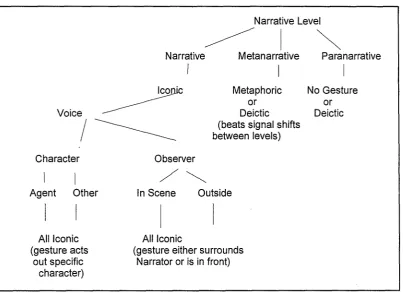
(46) 20 2.3.3. The Function ofGesture as Narrative. McNeil (1992) describes gestures as part of a narratological structure allowing them to embody specific information about the discourse structure. Figure 2.2 shows the different channels or modules of communication during a narrative, or performance (Armstrong 1975).. Narrative Level. ~. Narrative. I. Metanarrative. Paranarrative. I Voice. I~ Character. Metaphoric No Gesture or or Deictic Deictic (beats signal shifts between levels). Observer. I Agent. Other. In Scene. Outside. I All Iconic (gesture acts out specific character). All Iconic (gesture either surrounds Narrator or is in front). Figure 2.2 Narratological structure of gesture. Each branch leads to a specific type of gesture that is the gesture for that combination ofnarratological features according to McNeill (1992). It also diagrams the relationship of gesture in what Wilkins (2001) calls a multi-media performance.. McNeill gives a schematic illustration ofhow gesture and narration work in combination to produce what is considered human language. McNeill writes:. Gestures have relationships in storytelling, they mark various elements ofstory; that is, they participate in the depiction of action, person, space, and time (narrative events); and gestures participate in the articulation ofthe discourse (metanarrative andparanarrative events): that is, the role ofgestures in narrative phenomena such as voice, perspective, order, etc., that take a given set ofabstract story components and realise them in a particular way in a particular story (McNeill 1992, 189)..
(47) 21 For the purposes of this thesis, I regard gestures as one channel of the multi-channelled phenomena of human language. Like Armstrong et al. (1995), Armstrong (1999) and Wilkins (2001), McNeill believes gestures and spoken language are parts of a single system. Language is more than just words because "images and speech are equal and simultaneously present in the process ofthe mind" (McNeill 1992, 2). He gives evidence from childhood development studies that speech and gesture develop in parallel, which demonstrates that they are both components ofa single system (McNeill 1992). Gestural communication requires a different model for studying its structure and its relationship to other modes of language. The misconceptions around gesture have led linguists to study it in terms of spoken language "as a system for translating the hierarchically organised contents ofthe mind into linear strings ofarbitrary symbols" (Armstrong 1999, 5). To correct this, McNeill has provided an understanding of gestural constructs in terms of 'global and synthetic' terms, rather than within the framework of linguistic analysis (McNeill 1992).. 2.3.4. Gesture and Mental Imagery. Recent work by McNeill (1992) examines gesture in its revelation of the idiosyncratic imagery of thought and argues that gestures are an integral part of language as much as are words, phrases and sentences. He states that "Gestures are not just reflected thought but have impacts on thought and are what help to constitute thought. Gestures occur because they are part of the speaker's ongoing thought process" (McNeill 1992, 245).. It has been suggested that gestures -- not words -- are the medium of thought. Not all. people think in words. Mathematicians have stated that they think in other symbol systems. Einstein professed that:.
(48) 22 The words or the language, as they are written or spoken, do not play any role in my mechanism of thought. The psychical entities which seem to serve as elements in thought are certain signs and more or less clear images which can be 'voluntarily' reproducedandcombined. The above mentionedelements are, in my case, of visual and some of muscular type. Conventional words or other signs have to be sought for labouriously in a secondary stage, when the mentioned associative play is sufficiently established and can be reproduced at will (Einstein, quoted in Hadamard 1945, 142-143). In trying to find the "inner voice" that transmits thought, Klima and Bellugi (1979) have. interviewed deaf people who have never heard spoken words. They report that deaf people dream in signs and plan conversations in signs.. Armstrong argues that if gesture, instead of speech, was the basis of graphic communication we would have something like ideograms as writing. This writing system would not evolve into an alphabetic system - in its latest stages, it might be something like the writing system ofmodern Chinese . .. (A)n ideographic (actually logographic) writing system has proved adequate to the needs ofthe Chinese, one ofthe world's most complex societies, through many centuries (Armstrong 1999, 76). The value of ideographic writing is that it transcends different languages. China has many different language groups that make it difficult to use a phonetic writing system. A pictographic system reads in all languages.. Mallery (1972), Martineau (1973) and others have demonstrated that the same process occurred in pre-colonial North America in the presence oftwo hundred or more mutually unintelligible languages.. The graphic communication system is pictographic and. logographic rather than phonetic. Like Armstrong's suggestion, they argue that this writing system is based on gestures and Plains Indian Sign Language. Even linguists, as Armstrong points out, after forty years of their best efforts, "still use pictographs to.
(49) 23 represent the (gesture) signs they discuss because of the extreme complexity of the sublexical structure of ASL (in four dimensions), reducing it to the two dimensions of phonetic writing may prove more troublesome than it's worth" (Armstrong 1999, 77).. 2.3.5. Categories ofGesture. The following categories of gestures are used in coordination with speech. McNeill's (1992) classification of gestural categories is useful and is summarised below:. Iconic - a gesture that bears a close formal relationship to the semantic content ofspeech. Iconic gesture display in its form and manner ofexecution, aspects of the same scene that speech also presents. Metaphoric - gestures are similar to iconics in that they present imagery, but present an image ofan abstract concept, such as knowledge, language, itself, the genre ofthe narrative. More complex than iconics. A metaphoric gesture must depict two things, the Base which is the concrete entity or action that is actually presented in the gesture, and the Referent, which is the concept. Deictic - gestures are pointing movements, which are prototypically performed with the pointingfinger, although any object or body part can be used. Beats - are defined as movements that do not present a discernible meaning, but can be recognised by theirprototypical movement characteristics (McNeill 1992, 80).. Table 2.1 (McNeill 1992, 76) shows four gesture classification schemes that have been proposed. It compares McNeill (1992) with earlier versions from Efron (1941), Freedman and Hoffman (1967), and Ekman and Friesen (1969). McNeill 1992. Efron 1941. Freedman and Hoffman 1967. Ekman and Friesen 1969. iconics. physiographics kinetographics. literal-reproductive. kinetographs pictQgraphs. metaphorics. ideographics. concretization minor and major qualifying. ideographs underliners spatials. deictics. deictics. beats. batons. Table 2.1 Gesture Classifications. deictics punctuating. batons rhythmics.
(50) 24 Like Armstrong (1999) and Corballis (1999), McNeill believes that "speech and gesture are elements of a single integrated process of utterance formation in which there is a synthesis ofopposite modes ofthought - global-synthetic and instantaneous imagery with linear-segmented temporally extended verbalization. Utterances and thoughts realised in them are both imagery and language" (McNeill 1992, 33).. McNeill argues against considering gestures as something interpretable when captured in a photograph or drawing. Separated from the verbal dialogue they are meaningless. He believes gestures are schematic, while photographs are not. Gestures are structured by meaning while a photograph is not. "The meaning of a photograph is something we - the observers - bring to it whereas the meaning of a gesture is the foundation of its construction" (McNeill 1992, 34).. Is it possible, therefore, to do any more than identify possible gestures in prehistoric art, knowing it is without cultural context and accompanying verbal dialogue? I see problems with McNeill's example of a photograph or drawing as the only representation of captured gestures. First, I believe talented photographers are aware· of the absence of spoken language and compensate by capturing gestures that supply to the viewer the information missing from a vocal dialogue. Paintings ofthe Western European tradition are characteristic in employing gesture in their human (and animal) figures that communicate meaning beyond the necessity for a title or supplied story. Silent movies ofthe 1920s and 1930s were brilliant at conveying a story with minimal textual dialogue. The humour of Charlie Chaplin and the famous mime artist, Marcel Marceau are prime examples of gestural communication without speech. Mental images can be created and 'meanings' communicated without the accompaniment of text or verbal dialogue..
(51) 25 2.4. Kinesics. Studies in nonverbal communication, especially gesture, stimulated the need to understand the underlying structure in more detail.. Birdwhistell devised the term. kinesics, that he defined as the "systematic study of those patterned and learned aspects. of body motion which can be demonstrated to have communicative value" (Birdwhistell 1963, 125). He used 'kinemes' as a term representing units of motion, to analyse the components of human postures and gestures. He believed there was a 'language' of movement comparable to spoken language, both in its structure and in its contribution to a systematically ordered communicative system (Birdwhistell 1972). Drawing upon the linguistic model, kinesic studies have distinguished 'gesture' as a bound morph (a stem form) and treated the position and activity of gestures as such forms. He writes: These [units], analyzed, abstracted, and combined in the full body behavioral stream, prove to form complex kinemorphs which may be analogically related to words. Finally, these are combined by syntactic arrangements, still only partially understood, into extended linked behavioral organizations, the complex kinemorphic constructions, which have many of the properties of the spoken syntactic sentence. Only extensive further research is going to give us full understanding of the formal structuring of kinesics (Birdwhistell 1970, 101).. The kinemorphology describes gestures in terms of kines and kinemes. Although kinesic forms resemble linguistic models on some levels, the potentials of body activity and sequences of body motion to communicate are infinite. Kinesic analysis has identified significance and semantic structure that differ from a true linguistic model. According to Birdwhistell "body motion is a learned form of communication, which is patterned within a culture and which can be broken down into an ordered system of isolateable elements" (Birdwhistell 1970, xi). He identified thirty-two kinemes in the face and head area alone. His identification of single units of motion is the basis on which I built the Kinemorphic Matrix (Table 3.1) for my methodology..
(52) 26 2.5. Posture. Posture is the most rudimentary form of nonverbal communication. Key defines posture as "the manner in which the body is held or the arrangement of different parts of the body at the time of the communication item" (Key 1975, 27). Hominization, the erect posture and frontal orientation, is the origin for our categories of direction: up and down; left and right; in front and behind; over and under; beside and around; etc. Our concepts of space come from our eye level view of everything above a fixed ground. It is what Armstrong, Stoke and Wilcox (1995) call 'language from the body politic.' In their analysis language is derived from cognitive models of the body and its interaction with the environment. On a very basic level, the experience of the body is used as a reference for all human experiences.. 2.5.1. Posture from a Western Perspective. Argyle (1975) states that there are three main human postures: standing; sitting, squatting or kneeling; and lying. Each of these has further variations corresponding to different positions of the arms and legs and different angles of the body. Some are used only in particular cultures. Posture is an important means of conveying interpersonal attitudes. Postures are associated with emotional states, either through direct physiological effects of emotions, or for symbolic reasons. Posture accompanies speech, in a way similar to that of gesture, though it is more slow-moving. There are powerful social conventions about posture, such as which postures are proper or what is appropriate in particular situations. (Argyle 1975). The following stick figure illustrations (Figure 2.3), are. examples of the postures and gestures interpreted as emotions and attitudes by western cultures, according to Sarbin and Hardyk (1953)..
(53) 27. (.Jr (,). (b). (g). a. r ] (d). ,,(. a. ,,~. 00. ~ "~. ~~ ,.~. (.)~ ,,~. (j). (~A. (n). (f)J. (P). (r). (I). 1. Figure 2.3 Postures interpreted as : a curious, b puzzled, c indifferent, d rejecting, e watching, f selfsatisfied, g welcoming, h determined, i stealthy, j searching, k watching, 1 attentive, m violent anger, n excited,o stretching, p surprised, dominating, suspicious, q sneaking, r shy, s thinking, t affected, (gay). (illustrations from Sarbin and Hardyk, 1953 reproduced in Argyle 1975, 273).. Figure 2.3 illustrates postures that are easily identified by people of Western European cultures, and figure t is a clue to the era in which terms like 'affected' were used. The generation of the 21 st century probably would not identify some of these postures in the same manner. But the dynamism of gestures in conveying meaning, whatever it is, remains unchanged through time.. 2.5.2. Cross Cultural Studies ofPosture. Early studies of postural habits of different cultural groups include those carried out by Mauss (1935), Bailey (1942), and Mead and Macgregor (1951). Kroeber claimed that posture "is one of the most interesting matters in the whole range of customs "(Kroeber 1925, 728). Hewes (1955) compiled a cross-cultural analysis of body posture in his World Distribution of Certain Postural Habits.. Saitz and Cervenka (1962) followed.
(54) with Colombian and North American Gestures: A Contrastive Inventory.. 28 But it was. Hewes who found the ethnographic record so deplete on postural information that he carried out his own research from published photographs. He surveyed 480 different cultures and found that thirty-four of these cultures were extinct or known only from archaeological data consisting of figurines, carvings, or paintings (Hewes 1955). Hewes found that culturally specific postures could be identified.. One, for example, is the. nilotic one-legged resting stance. Hewes writes: The 'classic' Nilotenstellung occurs not only among the Shilluk and their neighbors in the southern Sudan, but in Nigeria (Elkin and Fagg 1953), Iran (Singer and Baldridge 1936), India (Koppers 1944), Ceylon (Buschan 1923), Australia (Elkin and Fagg 1953), in South America among the Nambicuara and Yecuana (Steward 1948), and, if we can accept the California element survey data, rather widely in the American Southwest (Gifford 1940; Steward 1948)...All instances of this stance seem to be represented by males. Aside from the Nilotic Sudan, where this posture is known to be assumed by cattle herders, we have little information on its cultural functions. Gifford notes that men of the Walpi pueblo at Hopi rest this way in the fields while hoeing (Hewes1955, 236-37). Although Hewe's research is limited, and has been expanded upon by more recent studies, I find one figure of interest in the second line of figures, (no. 23-25) that he calls the "nilotic" stance. (See Figure 2.4 Cross Cultural Postures). It has been singled out by Bill Harney Jr., Aboriginal guide in Katherine, Northern Territory, Australia as the stance for "guarding" or "watching" (Harney 1999 pers comm.). I was also told by Harney that this stance is signified by a single foot print that appears in an engraved rock art panel at Ingaladdii, Victoria River region. This panel has several human foot prints and a ship thought to represent a vessel on the Victoria River in the second half of the nineteenth century (Flood 1977), and so could be of ethnohistoric significance. More research is needed to understand in what context a single foot print signifies this stance, and what other meanings it may signify..
(55) 29. 20. 21. 31. 24. 32. 24. 34. 2S. 35. 25.5. 3Q. 37. 36. Figure 2.4 Cross Cultural Postures, number 23 - 25 showing the nilotic one-legged resting stance. (From Hewes 1957). Although some of Hewes' data sources are problematic, if nothing else, he has drawn attention to the variations of posture cross culturally and pointed out that some postures are culturally specific. Argyle's illustrations of posture identify states of emotion and communicate moods and attitudes. Along with the postures and gestures discussed so far, another aspect of nonverbal communication must be considered: the way humans use space (proxemics) as a communication system..
(56) 30. 2.6. Proxemics. The term 'proxemics,'2. as defined by Hall (1979), is the study of people's perception. and use of space. It pertains to the complex behavioural activities associated with what is known to ethologists as territoriality. It deals primarily with unconscious (out-ofawareness) distance-setting or spatial boundaries. Hall bases much of his work on that of Sapir (1927) and Whorf (1956).. Proxemics is the study of how humans use space and distance in day-to-day interactions. People of different cultures not only structure their spaces differently, but experience them differently. This influences the spatial experiences of the individual. For example, some people perceive 'crowding' while others do not. There are no universal constants in human proxemic behaviour (Hall 1979).. The development of proxemic studies really began with ethologists like Hediger (1950; 1955; 1961) who studied how people interact with other organisms. He believed that humans found it necessary to understand every aspect of game animal communication in order to survive. Hall credits Hediger as one of the first to systematically describe the various distances employed by birds and animals and to introduce the concept of individual space (Hall 1979). Hall designed a research technique to study proxemics with different cultures without being culturally subjective. He writes:. It is possible to learn a good deal about how members of a given culture structure their space at various levels of abstraction by setting up simple situations in which they manipulate objects. I used coins and pencils and asked my subjects to. 2Hall writes: In the course of the development of proxemics, the work was spoken of as "social space as biocommunication," and "micro-space in interpersonal encounters." .. .1 decided to invent a new term that would indicate, in general, what the field was about. Among the terms I considered were human topology, chaology, the study of empty space, oriology, the study of boundaries, chorology, the study of organised space. I finally chose 'proxemics' as the most suitable for that audience likely to encounter the topic in the near future (1979, 307)..
Figure
+7


Related documents