Compositional instability of Earth
’
s solid inner core
D. Gubbins,1,2D. Alfè,3,4and C. J. Davies1
Received 2 November 2012; revised 17 January 2013; accepted 19 January 2013; published 21 March 2013.
[1] All models that invoke convection to explain the observed seismic variations in Earth’s inner core require unstable inner core stratification. Previous work has assumed that chemical effects are stabilizing and focused on thermal convection, but recent calculations indicate that the thermal conductivity at core temperatures and pressures is so large that the inner core must cool entirely by conduction. We examine partitioning of oxygen, sulfur, and silicon in binary iron alloys and show that inner core growth results in a variable light element concentration with time: oxygen concentration decreases, sulfur concentration decreases initially and increases later, and silicon produces a negligible effect to within the model errors. The result is a net destabilizing concentration gradient. Convective stability is measured by a Rayleigh number, which exceeds the critical value for reasonable estimates of the viscosity and diffusivity. Our results suggest that inner core convection models, including the recently proposed translational mode, can be viable candidates for explaining seismic results if the driving force is compositional.Citation: Gubbins, D., D. Alfè, and C. J. Davies (2013), Compositional instability of Earth’s solid inner core,
Geophys. Res. Lett.,40, 1084–1088, doi:10.1002/grl.50186.
1. Introduction
[2] Thermal history calculations show that the Earth’s solid inner core has been growing as the liquid outer core freezes from the bottom up [seeNimmo2007 for a review]. The density difference between solid and liquid cores is too large to be explained solely by freezing, and the liquid is supposed to contain more light elements than the solid. Cosmochemical arguments favor oxygen, sulfur, and silicon as candidate light elements, and ab initio calculations of binary mixtures (Fe-O, Fe-S, Fe-Si) show that O partitions almost completely into the liquid on freezing, S partitions almost equally with a slightly higher proportion in the liquid, and Si partitions equally between the two phases to the accu-racy of the calculations [Alfè et al., 2002]. This partitioning is crucial for powering the geodynamo in the outer core that gives rise to Earth’s magnetic field; in this paper we show that it may also be crucial for the dynamics of the inner core.
[3] Seismic studies have shown the inner core to be both heterogeneous and anisotropic, with a pronounced east-west hemispheric structure [Souriau, 2007; Irving and Deuss, 2011]. There is also evidence of a different structure in the innermost 300 km of the inner core [Ishii and Dziewoński, 2002] and a ~100 km thick isotropic layer below the inner core boundary (ICB) [Waszek and Deuss, 2011]. To explain the observations, much work has focused on inner core con-vection, driven either thermally [Jeanloz and Wenk, 1988; Buffett, 2009] or in combination with compositional gradi-ents [Deguen and Cardin, 2011; Cottaar and Buffett, 2012]. The hemispheric structure has been proposed to arise from a translational convective mode involving a uniform drift of the inner core material [Monnereau et al., 2010; Alboussière et al., 2010], while termination of convection at an early stage has been suggested as the cause of the innermost inner core and the outermost isotropic layer [Deguen and Cardin, 2009]. While the results are encour-aging, the proposition of inner core convection rests on one highly uncertain hypothesis: the inner core is assumed to be unstably stratified.
[4] The aforementioned models all assume a thermal ori-gin for the unstable inner core stratification, implying that the inner core temperature gradient exceeds the adiabatic gradient at the relevant pressure-temperature conditions. Previous studies have found that this may be the case at pres-ent and was more likely in the past [Buffett, 2009;Deguen and Cardin, 2009, 2011], but the results depend critically on the thermal conductivity of inner core material. Recent work found the thermal conductivity at the base of the outer core to be over three times larger than previous estimates [Pozzo et al., 2012] and this value must be further increased when applied to the solid to account for the lower concentra-tion of light elements in the inner core. Such high values for the thermal conductivity make it highly unlikely that thermal convection can arise in the inner core [Buffett, 2012].
[5] When compositional effects have been incorporated into inner core convection models, they have been treated as neutral or stabilizing [Deguen and Cardin, 2011;Cottaar and Buffett, 2012]. This reasoning is based on the assump-tion that the partiassump-tion coefficients (the solid-liquid concentra-tion ratio) do not change with time. The concentraconcentra-tion of light elements in the liquid increases as the outer core shrinks [Stacey, 1995]; a constant partition coefficient there-fore implies that the concentration in the solid rises with that in the liquid causing a stabilizing density gradient. If this were the case, then inner core convection would not be viable because both thermal and compositional contributions to the inner core density gradient would be stabilizing.
[6] In this paper, we show that the partition coefficients for O, S, and Si are not constant but actually decrease with time. This important result is shown to arise as a direct conse-quence of the chemical potentials in the liquid being lower than in the solid and the drop in temperature at the ICB as 1School of Earth and Environment, University of Leeds, Leeds, UK.
2
Institute for Geophysics and Planetary Physics, Scripps Institution of Oceanography, University of California, La Jolla, California, USA.
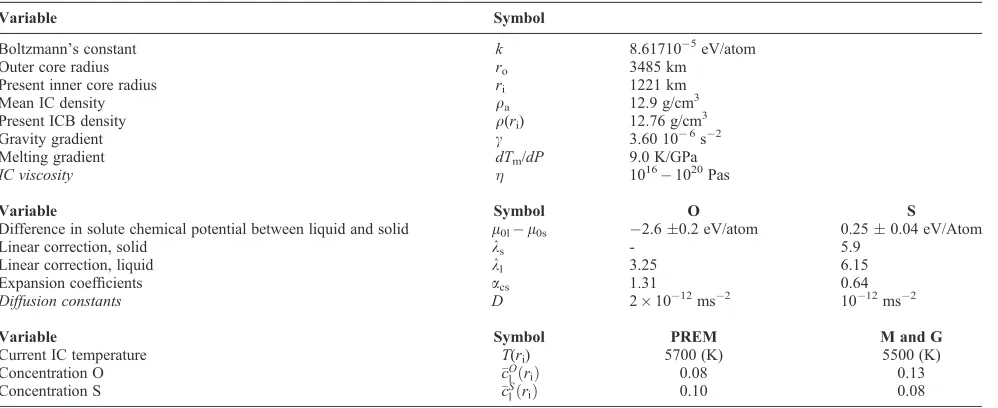
3
Department of Earth Sciences and Thomas Young Centre at UCL, University College London, London, UK.
4
Department of Physics and Astronomy and London Centre for Nanotechnology, University College London, London, UK.
Corresponding author: C. J. Davies, School of Earth and Environment, University of Leeds, Leeds, LS2 9JT, UK. ([email protected])
the inner core grows due to the decrease in melting tempera-ture with falling pressure. The decrease in partition coefficients with time has the opposite effect to the rising concentration in the liquid. A destabilizing gradient results if the partitioning effect is the strongest. The theory and equations are given in section 2; they are solved with appropriate numerical values in section 3 in the form of a Rayleigh number as a function of inner core radius. Conclusions and discussion are presented in section 4.
2. Composition and Density Gradients
[7] The partition coefficient for a light element between solid and liquid is
Psl¼cs=cl; (1)
where c is molar concentration (overbar denotes a molar, rather than a mass, concentration) and subscriptssandldenote solid and liquid, respectively. Alfè et al. [2002] express the chemical potential in the form
m¼m0þlcþkTlogc¼emþkTlogc; (2) wherekis Boltzmann’s constant andlis a linear correction to ideal solution theory obtained from ab initio calculations. The partition coefficient is calculated by assuming chemical equilibrium at the ICB and equating the chemical potentials on either side of the boundary:
Pslð Þ ¼r
csð Þr clð Þr ¼
exp emlems
kTmð Þr
; (3)
where r is the inner core radius and Tm(r) the melting
temperature. As time progresses, the inner core grows, r increases, and Tm(r) decreases because of the lower
pressure at larger radius. Thus, ifemlems<0, the partition coefficient will decrease with time, less of the light element will be incorporated into the inner core, and the density will increase withr.
[8] The melting temperature in earlier times is calculated by assuming a constant gradient with pressureP:
Tmð Þ ¼r Tmð Þ ri Z ri
r
dTm
dP dP
drdr; (4)
whereriis the present-day inner core radius. The inner core
is very close to hydrostatic pressure and uniform density. Acceleration due to gravity is therefore nearly proportional tor:g=gr, wheregis the gravity gradient, and
dTm
dr ¼ dTm
dP dP dr¼
dTm
dP ragr; (5)
where ra is the average inner core density. Equation (4) becomes
Tmð Þ ¼r Tmð Þ þri
1 2
dTm
dP rag r
2 i r
2
: (6)
This expression forTm(r) will be used in equation (3) to
de-termine the partition coefficient as a function of radius. [9] Alfè et al. [2002] found oxygen to partition mainly into the liquid with very low concentrations in the solid, while substantial amounts of sulfur and silicon remained in the solid. The oxygen concentration therefore rises in inverse pro-portion to the outer core’s volume:
clð Þ ¼r
r3 or3i
r3 or3
clð Þ:ri (7)
[10] Alfè et al. [2002] found virtually no difference in composition of silicon between solid and liquid, so there is no change with time and we do not consider it further. For sulfur the concentrations are cl¼0:10 and cs¼0:08 for model PREM [Dziewonski and Anderson, 1981], which is a big enough difference to be worth considering here. Esti-mating the change inclin this case is difficult and requires a few assumptions. We neglect the very small changes in
cs and assume a constant density inner core. The total number of atoms does not change and we can equate their number at a past time, when the inner core radius wasr, with the present to give
clð Þ ¼r
r3 or3i
r3 or3
clð Þ þri
r3 i r3
r3 or3
cs: (8)
Note that whencs¼0 equation (8) reduces to (7), and when
clð Þ ¼ri csthenclð Þ ¼r clð Þri .
[11] Since emlems<0 [Alfè et al., 2002] and Tm(r)
decreases withr, equation (3) showsPsl(r) to decrease with
rwhile (7) and (8) showclð Þr to increase: the composition in the solid could either decrease or increase, i.e., the effect could be stabilizing or destabilizing, depending on which is the stronger effect.
[12] It remains to calculate the density in the inner core thus formed. We assume linear dependence on concentration,
rð Þ ¼r rð Þ ri raacs½csð Þ r csð Þri ; (9)
where acs is the compositional expansion coefficient for the solid.
[13] The stability of the inner core to compositional con-vection is assessed by the Rayleigh number:
Ra¼ r0gr5
D ¼
racs0gacsr5
D ; (10)
where the prime denotes differentiation with respect to r, Dis the diffusion constant in the solid, andthe inner core viscosity. Thefirst form applies to non-interacting mixtures of light elements with the same D, the second to a single species of atom.
[14] The Rayleigh number will be used in the next section to assess the stability of the inner core. The critical Rayleigh number for infinite Prandtl number thermal convection in a self-gravitating sphere of uniform density with a stress-free and isothermal boundary is 3091 [Chandrasekhar [1961], Chapter 6]. The critical Rayleigh number,Rac, for
composi-tional convection withfixed concentration on the boundary is expected to be very similar and we takeRacto be on the
order of a few thousand. We calculateRausing (3) and (6) together with either (7) or (8) to calculatecsfrom (1), which
is then used in (9) and (10). In supercritical conditions (Ra> Rac) this assumes that the mixing timescale is long
concentration gradients as new material, relatively depleted in light elements, is frozen on, and a higher value of Ra. Our goal is to demonstrate the destabilizing nature of com-positional buoyancy independent of any assumptions about the convective processes and so we do not consider the case of rapid mixing further.
3. Numerical Results
[15] Numerical values for the calculations are given in Table 1. The values ofmlms, which are needed to determine
Pslin (1), depend weakly on pressure, but we found that this
made very little difference to the results. We use two seismic models for the density jump at the ICB,dr, which determines the concentrations of light elements in the outer core; they in turn determine the melting temperature in equation (6). The
first, called PREM, uses dr=0.6 g cc1 [Dziewonski and Anderson, 1981]; the second, called MG, uses the higher value 0.8 g cc1[Masters and Gubbins, 2003]. The higher density jump requires a higher O concentration in the outer core; the concentration of the other light elements (S, Si) must be reduced in order to maintain the same total core mass. The higher concentration of O in the outer core carries with it a larger reduction in the melting point at the ICB. We calculate the effect of O and S separately and add them for a final density profile. A mix of O and Si gives the same result as for O alone because Si was found to partition equally between the solid and liquid phases.
[16] EstimatingRarequires values for the expansion coeffi -cients, inner core viscosity, and mass diffusion coefficients. Expansion coefficients for the solid are calculated using the equations and partial volume data inAlfè et al. [2002] (see also the Appendix of Deguen and Cardin [2011]). Geodynamic constraints have been used to place bounds on, but the range of possible values is still very broad. Van Orman [2004] explored the creep mechanism of iron under core conditions and obtained a low value of=1011Pas.Greff-Lefftz et al. [2000] used free-core nutation data to argue >1016Pas, a result supported by Koot and Dumberry[2011], who point out that this value is consistent with the seismologically
determined Poisson’s ratio for the inner core.Buffett[1997] gives bounds <1016or >1020for the inner core to rotate free of its gravitational coupling to the mantle. There are also significant uncertainties in estimates of the mass diffusion coefficients, but they must be smaller than the values for the liquid (108m2s1for O and 5109m2s1for S) [Alfè and Gillan, 1998;Alfè et al., 1999]. However, our calculations reveal that the instability criterion is very insensitive to the values ofandD(Figure 2); the most important factor is the net concentration gradient.
[17] We calculate compositions, densities, and Rayleigh numbers for O and S for the two seismic models. Results for O alone are appropriate for an Fe-O-Si core because Si has a partition coefficient of 1. Results for Fe-O-S are obtained by summing the separate density profiles. Each can be considered as end-members of a more complex Fe-O-S-Si mixture. For O,m0is large in the solid: this dom-inates other terms inem(equation (2)) and we do not need to consider the correction termslwhen calculatingPslin (3).
Almost all the O remains in the liquid, making the calcula-tion of the rise incl with time a simple matter of applying
equation (7). A small but significant amount of S remains in the liquid core, 2% by mole compared with 8% O, double the proportion by mass because of sulfur’s larger atomic weight. The increase in concentration with time requires the less certain equation (8) to calculate cl, and
calculation ofemin (2) requires values forlandcs. Values for l are obtained from Alfè et al. [2002]; values for cs are obtained by solving equation (3) for present-day values, changes with time being completely insignificant for this purpose.
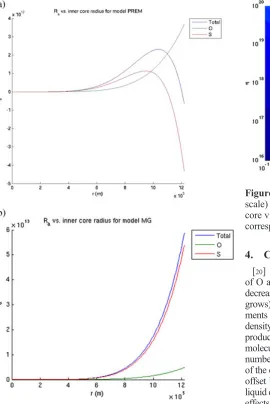
[image:3.612.61.560.527.731.2][18] Rayleigh numbers for the two models are shown in Figure 1. Values of the total Ra, calculated using the first form in equation (10), are both positive and therefore the compositional gradients areunstable: this is the substantive result, which follows directly from the negative argument of the exponential in (3), whereeml<ems, which is typically the case because atoms of different size can find better arrangement in the liquid. The values of Raare also many orders of magnitude greater thanRac, except for very small
Table 1. Numerical Values used in the Papera
Variable Symbol
Boltzmann’s constant k 8.617105eV/atom
Outer core radius ro 3485 km
Present inner core radius ri 1221 km
Mean IC density ra 12.9 g/cm3
Present ICB density r(ri) 12.76 g/cm3
Gravity gradient g 3.60 106s2
Melting gradient dTm/dP 9.0 K/GPa
IC viscosity 10161020Pas
Variable Symbol O S
Difference in solute chemical potential between liquid and solid m0lm0s 2.60.2 eV/atom 0.250.04 eV/Atom
Linear correction, solid ls - 5.9
Linear correction, liquid ll 3.25 6.15
Expansion coefficients acs 1.31 0.64
Diffusion constants D 21012ms2 1012ms2
Variable Symbol PREM M and G
Current IC temperature T(ri) 5700 (K) 5500 (K)
Concentration O cO
lð Þri 0.08 0.13
Concentration S cS
lð Þri 0.10 0.08
aThefirst group are well known and come mainly from seismology; the second group come from ab initio calculations of liquid iron mixtures; the third
r because of the factorr5in the definition of the Rayleigh number. For the cases shown in Figure 1,Racis exceeded
at rc= 30 km in model PREM and rc= 35 km for model
MG. Figure 2 shows for model PREM the radius,rc, where
Ra = Racas a function of the two most uncertain parameters
in the definition ofRa, Dand . We consider the ranges 1013≤D≤109and 1016≤≤1020, which we believe to span the plausible range of values. Increasing and D increasesrcup to a maximum ofrc= 140 km in the parameter
regime considered, much smaller than the present-day inner core radius,ri.
[19] The decrease in Psl with time and inner core radius
is larger than the opposite effect of increasing cl in all
cases except for S in model PREM at radii approaching the present-day value, r= 1100 km (Figure 1a). This corresponds to a decrease inRain the latter stages of inner core growth for this model, which falls below the critical value in the top ~20 km. The results suggest that the destabilizing compositional gradient can drive convection over most of the inner core history, except in the very early stages following inner core formation and possibly in the most recent times.
4. Conclusions
[20] In this work, we have shown that the partition coefficients of O and S between the solid and liquid phases decrease with decreasing temperature (and therefore decrease as the inner core grows), leading to a lowering of the concentration of light ele-ments with radius in the inner core. This produces an unstable density gradient that is very weak but easily strong enough to produce convection in the inner core because of the very low molecular diffusivities and viscosity: our estimated Rayleigh numbers are well above the critical value except near the center of the core. The destabilizing effect of the partition coefficient is offset by the increase in concentration of light elements in the liquid caused by the outer core’s shrinking volume. Both of these effects are small, but for the most part the effect of the partition coefficient is larger, leaving an unstable density gradient. Si has no effect as it partitions equally between the solid and liquid. [21] Our model invokes the common assumptions that the outer core is well-mixed and compositionally uniform. Some seismic observations [e.g., Souriau and Poupinet, 1991] suggest thatPwave velocity in the bottom ~150 km of the outer core is slower than the neutrally stable model PREM [Dziewonski and Anderson, 1981], implying a density-stratified layer. Gubbins et al. [2008] proposed that this structure is caused by partial solidification in the liquid, resulting in a concentration profile in the layer that decreases exponentially from that in the main body of the outer core to the concentration in the inner core. We believe our calcula-tions will still apply if a variable concentration layer exists at the base of the outer core because we expect the partition-ing to be the same whether solidification takes place exactly at the inner core boundary or spread over a layer offluid. In this case, the liquid concentrationclshould be taken to be the composition in the main part of the outer core.
[image:4.612.67.337.57.461.2] [image:4.612.308.553.57.235.2][22] Our calculations suggest that the density gradient is stable for the first few tens of kilometers of growth in the core radius. This could relate to changes in seismic proper-ties in the innermost inner core if our calculations have underestimated the concentration of light elements in the solid at early times; our results show that uncertainties in the inner core viscosity and mass diffusion coefficients are Figure 2. Regime diagram showing the radius in km (color scale) at which Ra=Rac=3091, as a function of the inner core viscosityand the mass diffusivityD. Other parameters correspond to model PREM.
unlikely to delay compositional convection for long enough to account for the innermost inner core. The calculations for model PREM also predict a stable density gradient during the latter stages of inner core growth, where the acceleration of the concentration of S in the outer core overcomes the rather weak rate of decrease of the partition coefficient in the PREM model (Figure 1a). This calculation suggests stability at the top of the inner core, which may also cause a change in seismic properties.
[23] Thermal effects may be superimposed on composi-tional variations, but these are likely to be stabilizing based on recent estimates of the thermal conductivity [Pozzo et al., 2012]. Estimating the combined effect is complicated because thermal effects must be converted to compositional effects or vice versa. The adiabatic gradient increases with radius, which may help create a stable outermost layer of the inner core; these effects may also increase the radius at which inner core convection begins to a value closer to the innermost inner core radius. Whether such a layered inner core is stable will ultimately be determined by numerical models of double-diffusive convection driven composition-ally by the mechanism we have proposed. Such models are also needed to establish the dynamical regimes that are possible, although it seems that previous results for thermal convection [Deguen and Cardin, 2011;Cottaar and Buffett, 2012], including the recently proposed translational mode [Monnereau et al., 2010; Alboussière et al., 2010], will remain valid. Interpretations and implications for seismic structure for compositional convection will be the same: we end by emphasizing that the case for inner core convec-tion is stronger than thought hitherto.
[24] Acknowledgments. D.G. is supported by CSEDI grant EAR1065597 from the National Science Foundation. C.D. is supported by a Natural Environment Research Council personal fellowship, NE/H01571X/1. The authors thank Mike Bergman and an anonymous reviewer for helpful comments and suggestions.
References
Alboussière, T., R. Deguen, and M. Melzani (2010), Melting-induced strat-ification above the Earth’s inner core due to convective translation, Nature,466, 744–747.
Alfè, D., and M. J. Gillan (1998), First-principles simulations of liquid Fe-S under Earth’s core conditions,Phys. Rev. B,58, 8248–8256.
Alfè, D., G. D. Price, and M. J. Gillan (1999), Oxygen in the Earth’s core: Afirst-principles study,Phys. Earth Planet. Int.,110, 191–210.
Alfè, D., G. D. Price, and M. J. Gillan (2002), Ab initio chemical potentials of solid and liquid alloys and the chemistry of the Earth’s core,J. Chem. Phys.,116, 7127–7136.
Buffett, B. (1997), Geodynamic estimates of the viscosity of the Earth’s inner core,Nature,388, 571–573.
Buffett, B. (2009), Onset and orientation of convection in the inner core, Geophys. J. Int.,179(2), 711–719.
Buffett, B. (2012), Earth science: Geomagnetism under scrutiny,Nature, 485, 319–320.
Chandrasekhar, S. (1961), Hydrodynamic and hydromagnetic stability, Clarendon Press, Oxford pp. 235.
Cottaar, S., and B. Buffett (2012), Convection in the Earth’s inner core, Phys. Earth. Planet. Int.,198–199, 67–78.
Deguen, R., and P. Cardin (2009), Tectonic history of the Earth’s inner core preserved in its seismic structure,Nat. Geosci.,2, 419–422.
Deguen, R., and P. Cardin (2011), Thermochemical convection in Earth’s inner core,Geophys. J. Int.,187(3), 1101–1118.
Dziewonski, A. M., and D. L. Anderson (1981), Preliminary Reference Earth Model,Phys. Earth Planet. Int.,25, 297–356.
Greff-Lefftz, M., H. Legros, and V. Dehant (2000), Influence of the inner core viscosity on the rotational eigenmodes of the Earth,Phys. Earth. Planet. Int.,122(3-4), 187–204.
Gubbins, D., G. Masters, and F. Nimmo (2008), A thermochemical bound-ary layer at the base of Earth’s outer core and independent estimate of core heatflux,Geophys. J. Int.,174, 1007–1018.
Irving, J. C. E., and A. Deuss (2011), Stratified anisotropic structure at the top of Earth’s inner core: A normal mode study,Phys. Earth. Planet. Int.,186(1-2), 59–69.
Ishii, M., and A. Dziewoński (2002), The innermost inner core of the earth: Evidence for a change in anisotropic behavior at the radius of about 300 km,Proc. Natl. Acad. Sci.,99(22), 14,026–14,030.
Jeanloz, R., and H. Wenk (1988), Convection and anisotropy of the inner core,Geophys. Res. Lett.,15(1), 72–75.
Koot, L., and M. Dumberry (2011), Viscosity of the Earth’s inner core: Constraints from nutation observations,Earth Planet. Sci. Lett.,308(3), 343–349.
Masters, T. G., and D. Gubbins (2003), On the resolution of density within the Earth,Phys. Earth Planet. Int.,140, 159–167.
Monnereau, M., M. Calvet, L. Margerin, and A. Souriau (2010), Lopsided growth of Earth’s inner core,Science,328(5981), 1014.
Nimmo, F. (2007), Energetics of the core, inTreatise on Geophysics, vol.8, edited by G. Schubert, chap. 2, pp. 31–66, Elsevier B. V, Elsevier Science, London.
Pozzo, M., C. Davies, D. Gubbins, and D. Alfè (2012), Thermal and electri-cal conductivity of iron at Earth’s core conditions,Nature,485, 355–358. Souriau, A. (2007), Deep Earth structure—The Earth’s cores, inTreatise on Geophysics, vol.1, edited by G. Schubert, chap. 19, pp. 655–693, Elsevier B. V, Elsevier Science, London.
Souriau, A., and G. Poupinet (1991), The velocity profile at the base of the liquid core from PKP(BC + Cdiff) data—An argument in favor of radial inhomogeneity,Geophys. Res. Lett.,18, 2023–2026.
Stacey, F. D. (1995), Theory of thermal and elastic properties of the lower mantle and core,Phys. Earth. Planet. Int.,89(3-4), 219–245.
Van Orman, J. A. (2004), On the viscosity and creep mechanism of Earth’s inner core,Geophys. Res. Lett.,31(20), L20,606.