ffffigrLg*t'&.#*6&fbJ
qoMMrsstoN
oF
THE
EUROPEAN
COMMUNITIES
i
,onen n1
f inaLa
Brussetsr
l9
March 1979 It
'ttLi .: :1 tj -r" '
a
AU9
21
tg70MULTIANNUAL PROGRAMME
OF THE JOINT RESEARCH CENTRE
1980
-
1983(presented by the Commission
to
the CounciL)I
a
\
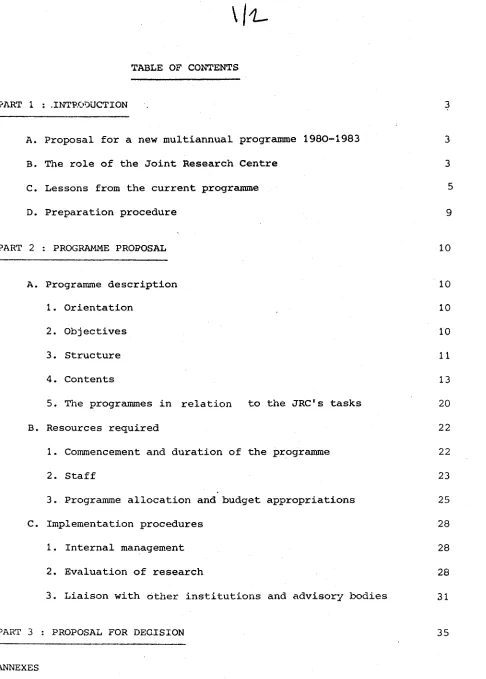
14-TABLE OF COMTENTS
PART I : .INTFf,,DUCTION
A.
Proposalfor
a new multiannual prograllme 1980-1983B. The
role of
theJoint
Research CentreC. Lessons from the current progranme
D. Preparation procedure
PART
2 :
PROGRAMME PROFOSALProgramme description
1. Orientatlon 2. Objectives
3. Structure 4. Contents
5. The programmes in relation
Resources required
1. Commencement and duration of
to the JRCrs tasks
the programme
2. Staff
3. Programme allocation and budget appropriations
C. Tmplementatj-on procedures
1. Internal management 2. Evaluation of research
3. Liaison with other institutions and advisory bodies
PART 3 : PROPOSAT FOR DEOISION
A.
j
3
3
5
9
10
10
IU
IU
II
ZU
22
zz
23 25
28
28
2B
.tl
35
I
B.
ANNEXES
U
1. II. III.
Draft
Council DecisionOpinion
of
the General Advisory Committee [image:2.591.61.547.31.710.2]I
-3-PART 1': INTRODUCTION
A. Ploposa!
for
a new multiannual programme 1980-1983I.
This documentis a
formal proposalfor
a new multiannual programneof
theJoint
Research Centre' coveringa
four-year period from l98Oto
1983 inclusive.With
effect
fromI
January I98O,it will
prolong and replace thecurrent four-year progranme, which was
started
onI
January 1977and
in principle wiII
terminate on3l
December I98O'2.'fhe
Courrcil Decisionof
18,July I9?7(I)
adoptinga
research programmeLo be carried out by the
Joint
Research Centre onbehalf of
theEuropean Atomic Energry Community and the European Economic Community
(I9'/7-I9BO) makes provision
for
the prograrnmeto be
reviewed duringthe
third year
(f979).t
IL also provides that the
review may Councilof
a new four-year programmein
procedure.Accordingily' (iq8o=93) of
Lerms
of lts
lead to the adoPtion bY the
accordance with the aPProPriate
After
reviewingthe activities in
progress,their
stageof
advancement'the
results
achieved, thedifficulties
encountered, and theprospects they hold
cut in
viewof the
evolutionof
requirements'the Comrnission considers
it
expedientto
makecerLain adjustments
andreorientations,
andto
launch a numberof
major operations'it Ls proposing the adoption of the new multiannual- programme
the Joint Research Centre, which is described below in
justification, structure' obiectives and funding'
B. The
role of
theJoint
&e€eglgh SentreOver
the
Last 5 years, the JRC has gone through a periodof
reorientationrvhich,
in
co-operationwittr its
consultative bodi-es, hasled to
thedefinition of
a clearerrole for it
andof
theactivities to
becarried out under
it"
The
results of the first
two yearsof
the progranme haveled
theJRC
to
concludethat its role is
developingin
theright direction,
tf"tit it is
integratedbetter
thanin
the pastinto
the contextof
thesectoral
policies of
the Community, audthat
the JRC has the capacityto
execute the tasks which have been entrustedto it.
U
-
4-2.
The commission has recently described the JRCrsrole within
the Cornmunity science and technology ;:*3'{ctrr ( 1) 'fL
can be summarized asfollows
idt The execution of ra.nmes of a t'central" nature I tjre concentrat'ion
ffiA"r"h'acti,-rities
-
whichjustify
the estabrishmentof
a broad researchpotential at
communitylevel, -
whiclrcall for
the centralization of facilities or: functions (e'g' by the ereation of large-scale iirstallations), * in which the JRC can act as a focal. point or catalyst for co-crdination at community level, - and finally
in which it can promote the application of new technologies through-out the CommutlitY.
The performance
of
apublic
servicerolg.:
the JRCis
developingthis
@
oJ Gcrvernment orgEnizations,universities
andindustry
for
specialized equipment, know-how, products and services'A
significant factor in this
respectls the
independent positi-on ofthe JRC and
its inpartial
judgrnent,1.he provision
of
se{rricesto
the Co+missio{r:
t}re JRC canact
as theCot*"ission's
otn t"of in
tfreprovilion to it of scientific
andtech-nical
expertise and supportin
the forrnulation and 5-mplementation ofthe sectoral
policies of
the Corrnunlties. An important new developmentin this
respectis
the contribution which the ,fRC, can maketo
scienti-fic
and technical co-operation vrith t-kre developing countries vrithinthe development
policies of
t-he Cornmunity"3. In order to consolidate this role and in view of the results in the
Iast two years in the execution of the presenL prograrlme, the JRC
cgnsiders that its new progranrme should broaclly represent a continuation of the present r:ne. But, aL the same time, the researsh carried out
under this prograirrne requires certa-i.n ehanges of empha,sis and d-irection
due to the attainment of cerLain milestones, or because it is proving
necessary to adapt lhis rqsearch to t-he evolutron in the requirements
of the Community and to develcpment,s in the Comrirission's sectoral poli-cies; or to take into account the development.,of research carried out under the indirect actir:n prograrnmes; or fina.lly to draia' lessons
ge-nerally from the experience it has acquirecS.
In this last respect, the JRC has been particularly guided by the
concern to ensure continuity in its research to enable the Community
as a whole and itself to make frrll use of the in'.restments'rnade in the
ac-tivities put in hand under the present progriilnmeo and b}' the need to optimize the use of its resources by concentrating them further into activities of significant dimension,
i:rl ii .!t:l
.l
d'.1
D :i
;,
il
b)
c)
t
( 1) Corrrmunication front
"Common Policy for to the Bulletin of
the Commisslon
to
the Councilof
3O .fune 1974Scierrce and Technologyt'
-
see Supplement 3/77tJle European Communities.
I
.i
&t e
s I
J
-5-C. Lessons from the cPrltent programme
The followlng assessments can be made from the
results of
thepresent research prograsme, which
is
being carried outin
closeassociation with the
indirect
actlon Progranme :I.
Reactor safetyThe execution
of this,
the largest programme among the JRC'Sac-tivities,
j.s being carried forwardwith
success" The constructionof
the LoBI loop has been completed and plans should be made toexploit
the considerable investment whichthis
represents through an extensive experimental progranme culminatingin in-pile
experiments" Whole-core accident, fuel-cool-antinteraction
and post-accj-dent heat removal problems are receivinq increased attention. The prospects of cooperationin this
areaof
researchwith
the United Statesr NuclearRegulatory Ccmmission
hightight
the valueof
the JRCrs work' More emphasiswill
also belaid
on the rnoretheoretical activity of
re-liability
andrisk
assessment. The concern voicedin
somepolitical
circles
and by the generalpublic
on the developmentof
nuclear energ:ycan only serve
to
emphasize the valueof this
areaof
research;2. Plutonium fuels and actinide research
Again in the context of concernfor nuClear safety, JRC activity
in this highly specialized fieLd is centred on long-term objectj-ves" Work is proceeding according to schedule. No external or internal
factor would seem to suggest that the present poltcy should be amended'
3 c Management of luclea-r materials ?nd radioactive- ldaste
It would appear that the part of this programme which deats with chemical
separatj-on ancl transrnutation of actinides will soon reach a stage where a
decision wiII have to be taken at both Conununity and world level on the
continuation of this alternative option to current wasle management
me-thods.
The models for assessing the long-term risks of radioactive waste storage are being given practical appli-cation in certaln specific geographical sites. It may therefore be ccnsidered that this part of the prograume is
entering into a phase of active apptication. The problems posed by
radio-active waste thr-oughout the fuel- cycle require deeper study and offer
development potential.
t
-6-Lastlyr the work on reactor.component decontamination is directed towards the general line, of decomm.isslonlng of_nucl6ar plantsr, a preoccuPation which is beginning,t,o make lt":lf felt at world level'
In view of this trend, new developmgnts should be considered in the
I
4.
future
Solar energy
The "Habitat and thermal conversion" project is being actively carried forward in conjunction with the Indirect Action prograinme and within the International Energy Agency's Implementing Agreement otr solar energy;
the prime i-mportance of the JRC.s -rro:rk in th-is fietd is widely recognized' The construction of the European Solar Test lnstallation (ESTI) is nearing completion. Its elements should come into operation progressively during
1979; the task will then be to exploit in 1980 this substantial investment
for the benefit of European researeh bodies and industry. It would appear quite justified to intensify this Progranme.
The programme is designed to play a special role in the provision of
ser-vices in favour of the developing countrles. This provision of services
is derived in particular from the Communication of the Comqission to the
Council (1) on energy co-operation with the developing countries'
Hydrogen
l97B has been marked by a"world first"'with Lhe putting into operation
of a closed-circuit loop corresponding to the MK 13 (H?SO4/HBr) cycle. The JRC also plays the role of p oject leader in the pioduction of
hydrogen within the International Er.rergy Agency and international
eo-operation is being vigorously established in this fie1d.
Whereas the technical obstacles to producing hyfls6gen from water are
being prcAressively overcome, the fact still remains that any pros-pects for economic competitivity are long-term ones. In this
perspec-tive thought should be given to the method to be aclopted to
maint.ain technical knowledge at an adeguate level until such time as it can be applied on a.nindustri*l scale. T?re problems of hydrogen trans-port and storage, for thei:: part, retain constant world-wide attention as this energy vector is of considerable technical and economic
interest and is environmentally positive.
5.
Thermonuclear fusion technologyThe conceptual studies
of
a future demonstration reactor are beingcontinued
:
the JRcis
nakingefforts to
assembre the EuropeanIaboratories interested
in
these studies. The engineering problemsare being tackled
in
apractical
mannerwith
researchin
material-sfor
post-JET machines. 5.a
t
t
The basic work for intensification of these activities is being pursued both in conceptual studies and desi.gn work and in
re-searclr on materials. The installation and operation of the
cyclotron Is scheduled for the mlddle of 1980. Dissussions on
the new researsh programme fot L979'1983 in controlled thermo'
nuclear fusion have revealed the need tc intensify the Communityrs
efforts to solve fu3ion technology problems. The JRC has a duty
to particiPate in such efforts.
7. Hiqh-temperature materials
This relatively new activity has quickly reached a high degree of
maturity. The Petten Establishmentrs role as a meeting point is
recognized; researsh proper and work on setting up highly-specialized test installations have been carried forward quickly" Participation
in CoST action 50 (1) is givlngi a new dimension to this work. In view of the limited staff resources anlil.ble for the progranme, a great deal
of selectivity will have to be exercised in future in the choice of
new activities.
8. Environmeqt and resources
The various projects are being implemented according to schedule' in close collaboration with the Indirect Action progranme and with the
Environment and Consumer Protection Service. Discussions both within
the Commission and with the Member Statesr competent authorities point
to the importance of the problem of chenical substances irr the envi-ronmen.t and the need to push forward the development of ECDIN (2).
Concentration of the JRC's research on this "chemical products" line
should rapidtY bear fruit'
As regards remote sensing from space, the final repcrt on the AGRESTE
project has been acclaimed by NAsA. The recent launchingis of the HCMM
and NIMBUS-7 satellites have given the new TELLUS and EUFTASEP pro-grarures their full development. The OCS (3) airborne'experiment has
revealed how excellent co-operatJ-on betweerr the numerous associated
laboratories can be organized around such projects" It is
in-creasingly evident that there is an application potential for
remote sensing techniques in both agriculture and marl-ne pollution" The JRC's early effort in this field deserves to be continued and intensified.
(1) COST action 50 : action on materials fcr gas turl:ines earried out
within European Cooperation on Scientific anC Technical- Research (CCIST)
(2) ECDIN : Environmental Chemicals Dai:a end Ii:farmation trletr*crk'
(3) OCS I Ocean Colour Scanner"
J
9.
lteasurements, stan€ards- and r.q,#reJgce :Fechniques (METRE)In
the nuclearfield,
the central Bureauof
Nuclear Measuxementsis
successfully maintainingits
centralposition in
the hiqhly specializedscientific
areaof
nuclear standards' since the trendin
the work loadin this field is
hardly on the decrease, hereagain the problem
of
selecting objectives and optimizinq resourcesand existing capacities arises;
fn
sofar
as the non-nuclearpart
ofthe METRE progr-m*"
is
concerned and leaving aside supporttor
theCornnunity e,rrlu,t
of
Reference (CBR),
the questionis to
determine howfar
theactivities
which the JRC has carried out sofar tally
with lts
specificrole
as described abovein
viewof
the develognentof
cooperationin this field.
10. Service and support
activities
Durlng both 19?7 and 1978 ttre Commission has widely used the JRC|s
scientific
and technical expertise bothin
conneetionwith
develop-rnentpolicy
andparticipation in
INFCE,in
the formof
supportfor
the inspqctions
of
the Safeguards Directorate andin
the evaluationof
demonstratl-on progranmes. Resources allocatedto
these varioustasks already appear too
limited to satisfy
the demand. Otheractivities,
such as the inforrnatics research progranme
or training
and education tasks, are producingpositive results
and should be continued.tastly'
the operationof
the HFR reactor continues as an exampleof
oneof
the JRCtspublic
service roLesin the sectorof
large-scalein-stallations.
The Adviscry Committees on Programme Management have been called upon
at regular intervals to give Opinions on the execution of the present
programme. These Opinions h"ave been transmitted to the Council and to
the Commission according to the relevant legaJ- provisions.
These Opinions reflect the positj-ve views of the experts of the Member
St.at.es on Ehe execution of the e.ctivities for which they are competent.
The discussions on which tl:e O5lin,;sns were based have largely inspired the analysis set out above
C
t'
J
-9-D. PreDaration Procedure
t, The preparation of this programme proposal has involved a long
and complex procedure, whlch started in the early months. of 1978
and which called for the participation of all the Centrers scientific
and technical staff.
The researchers and responsible officials at all Centres have been
involved in the study, selection and delimitation of the possible
areas of activity, where necessary in close collaboration with
those in charge of the indirect action projects and the
represen-tatives of the Directorates-General responsible for the sectoral policies concerned.
On the basis of the preliminary guidelines drawn up by the
Director-General in March L978, thirty discussLon groups and the same number of working parties have worked out specific proposals.
These were put forward at j-nternal "heariD9S", held in July 1978,
which were open to all the staff. In the light of the results' more
stri.ngerL guidelines were laid down by the Director-General to
en-able the working parties Lo Prepare "programme modules", i.e" a
number of basic units which could be put together to form the overalL
proposal. Over 4OO researchers in total helped with the internal
preparatory work.
2. At the level of external consultation, the Advisory Committees on
Progranme Management (ACP!,Is) were called upon, from
November 1978 onwards to give their first reactions to the technical
conLent of the modules. In a second stager'they were formal-Iy
con-sulted at the request of'-Eire General Advisory Committee (GAC) on those
parts of the proposal that came withln their responsibility.
3. In
the courseof
January L979, the GAC held an exploratory discussion,during which
it
reviewed the variousoptions
openfor
the contentsof
the future progranrme.In the liqht of the views expressed during this debate, the Director-General prepared a preliminary draft proposal, r!ig! ya,s placed
be-fore the Committee lt . further*meeting on 21 and 22 Februaryr during which it adopted the formal Opinion appended to this document'
on 5 and 6 Marchr the Scientific and Technical Committee (CsT) was formally consulted on the nuclear sestion of the preliminary.draft'
and formulated an o5rinion, which is likewise appended to this
document.
On these bases, the Director-General of the JRC has drawn up this proposal, which was adopted by the Comnissj-on on
19 March 1979 for transmission to the Council, the E-;rcpean
Parlia-ment and the Economic and Social Commiltee'
I
iD*
PART 2 : PROPOSAL
A.
Programme deEcriptlon1.
Orj-entationThe proqranme proposed
for
the period 1980-83 does notdiffer
essentiallyin its
orientation fromthe
1977-80 progra$me.It is built
arounda
limited
nu.mberof
keY toPics :-
mattersof priority
concernin
nuclear safety;-
the developnentof future
formsof
energy; I-
the study and protectionof
the environment;-
the development and execut,ionof
reference measurementsi-
the provislonof
specialLzedscientific
and technicalsupport
for
the Commissionrs sectoralactivitles.
2.
Objectives_With regard
to its
objectives, the progranme sets outto
:a)
takefull
advantage,in significant
experlmental programmes,of
a numberof
investnents, which were authorized during thepreceding period and which are now
in
thefinal
stageof
I'
implementation (the IOBI loop
for
reactor safetyrcyclotron
:for
fusion materials and the ESTI solartest
instalLation) ,and
in
the samespirit to
giveto
certain partsof
the researchan operational
content
(the ECDINproject in
theprotection
,of
the environnent and the reinforcementof
the lligh Temperaturel,laterials Information Centre)
.
lb)
bring a numberof
research topics whichhitherto
have beenconfined
to
preliminary studies(chiefly
on desiqn)to
a moreadvanced stage
of
development by the commissioning ofexperimental
installations
(the SUPER-SARAproject in
reactorsafety, several projects on the management and storage
of
radio-active waste, and the magnetic isotope separator
project at
theCBNM)
c)
wind up,in
the courseof
the progranme, a nunberof
projectswhich
either
have lesspriority or
are lesswell
adaptedto
thespecific
role of
the JRC (the own research seetionof
thenon-nuclear METRE progra$me),
or
which do not warrant continuationat
current l-evel under present circumstances (the actinideincineration
project in
radioactive waste_management andstorage, decontamination
of
power sLation components, thernochemicalproduction
of
hydrogen'!}
-
11d)
launch alimited
nugrberof
newprojects
(storage andcransport
of
energy, indoorpoltution in
the protection of the environment, solar powerstations,
and thetritium
testinglaboratory
in
fusion technofogy).e)
andlastly
follow up theactivities in
progress under theLg77-8CI prograrune
for the
remainderof
the topics envisaged, theonly adjustnents being those called
for
by managenent experiencegr
by changing requirements.AlL
in all,
the evolutionoi tfr. ptogt**. is
more apparent in the breadth andquality of
the projectsto
be carried out thanin
the areasit
embraces.At
afirst
evaluation,half of
the programmes proposed can begonsidered as q continualion
of
presentactit'ities,
though with.
certain adjustnents (as set out above) requiredeither
by theexperience
of
managing the programmesor
by the evolution ofreguirements. The other
half of
the progreunmes represents asignificant
evolution, whethertotally
new actions (some 1Ot of thetotal), or, within
the same regearch areas, asignificant
development
ln their
dj"reetlonor in
the natureof
the workunder-taken (some 40*
of
thetotal), or thirdly
actions which aresubstantially reduced (a srnall percentage).
3.
StructureThe progranne centres around
six
research areas (as against,five in
the 1977-BO progranne) :
The area "Nuclgar safety and the FueL cyclet'
is
subdivided intofour progranmes
:
,A"1. Reactor Safety
A.2. Ptutonium Fuels and Actinide Research
A.3. Safety
of
Nuclear Materj-alsA.4. Safeguards and Management
of Fissile
MaterialsThe
fact that
the progranme on Safeguards and Managementof Fissile
Materiars comes under
this
Jreading-rather than among the.supportprojects
is
dueto
the scaleof
the researchthat
needsto
be doneand
its
potentiar value as a supportto
the workof
the IAEA.The area "zuture Forms
of
Energy"is
again subdividedinto
fourProgrammes :
8.1.
Solar Energy8.2.
Hydrogen Prodsction, Storage and Transportof
Energy8.3.
Therrnonuclear Fusion TechnologyB.4. High Tenperature Materials
' t
Programme8.2.
takes accountof
the evolut,ionof
the work, and providesfor
the researchto
be extendedto
techniquesof
dtoringenergy
in
forms other than hydrogen.o
-le-C
The area
"$!q$y,,Sltg.Ptgt.qgtt.9+.9
'
comprlreetwo progralmes !
C.1. Protection
of
the EnvironmentC.2. Remote Sensing from SPace
- In
viewof their
homogeneity, it'seemed expedient te,groupall the
i. acttvlties
associated vrith Remote Sensing from Spice underprogranme
I
C.2. rather thdn
distribute
them according'.totheir uses'
itt
The area "Nuclear Measurements"
is dealt with in a
singleprogralnme oe tne saroe name. Owing
to its orientation,
the nonr';
nuclear section
of
the !trTRE progre'q$eis
inclgr{edin topic
Eunder the heading "Support
to
theCBR"
lThe area "Specific Support.
for"the
Corunissionrs Sectoral Actlvitiestris
subdividedinto six
progrrammes :8.1.
Informatics8.2.
Supportto
SafeguardsE'3.
Supportto
the Community Bureauof
ReferenceE-4. Training and Education
g.5. Utilization of
ResearchResults
I
8.6.
provisionof Scientific
and Technical'Services.on Request Thereis
no separate Programmeof
supportfor
another futrportantsectoral
aetivity,
developmentaid.
Owingto
thespecific
natureof
the contributions the JRC witL be called uponto
make, provisionfor
such supportis
made under the appropriate progiralnnes,in
particular
Solar Energy' Remote Sensing and Training.Lastly
the area "Operationof
lgrggaScale Installations"is
representedfor the moment by one prograllme
only relating to
the operatlonof
theHFR reactor.
The structure thus adopted should take
into
accountthe
specificcharacter
of
the research objectives, and assureefficient
technical and
financial
managementof
the prog'rafimes. Asin
thepastl
moreover, a. closetink wiII
be establishedwith
theindireet
action progra$aes on topj.cs sirnilan
to
those bei.ng studied by theJRC (mainly applicabLe
to
ProgranmesA.2' A"3' B'1,
B"zt8.3,
C.1).o
A. t
-
t3
-^^-9^-!^ UVII LEII L>
Reactor safetv
As the most ambitious of the JRC progralnmes, the reactor safety
prograrnme utilizes the nuclear facilities of the Centre to the full'
For the most part, the research is of a confirmative nature and is intended to back up the work of the licensing authorities !'tith
experiments and detailed theoretical analyses. Apart from some
activities of a horizontal nature in areas common to every tlpe of reactorr the projects. are mainly focuse6 on the safety aspects of light water reactors and of liquid metal cooled fast breeder
reactors. The emphasis of the progralffne is on a few major
experi-ments, simulating abnormal events of very low probabllity but with significant consequences.
In addition to the licensing authorities a progranme of this type meets
the requirements of the power plant operators and of the nuclear
con-struction industrY.
The programme breaks down
into
eleven projects- a
large number, butone
that in
no way implies dispersalof
resources,but rather
theintensity of
theeffort
devotedto this field"
a) Projects more specific to light water reactors :
- project LOBI : an experimental out-of-Pile study of the loss-of-coolant phenomenon in light water reactors;
project SUPER-SARA : an in-pile experiment simulating the behaviour of light water reactor fuel in the event of coolant loss;
projet
LliR primarycircuit integrity : early
detectionof faults
inlight
water reactor vesselstb) projects more specific to breeder reactors 3
- project LMFBR subassemPly thermghydraulics : modelling of the
thermohydraulic behaviour of fuel assenlclies in abnormal situations; - project Il"lFBR mechanical tests : study of certain aspects of
the behaviour of structural materials;
- project EAC : development of codes to describe scenarios of
abnormal situations;
- plgjgg$ iggB and PAHR in:gile : theoretical and experimenta.I
study of molten core behaviour, incl-uding in-piJ-e tests..In
accordance with the opinion of the General Advisory C,ommittee,
some of these tests are to be the subject of a special decision during the course of the progranme.
-
project CONT:
study on the behaviourof
structures andcontain-ments subjected
to
accident stresses"c)
generalprojects
:-
project FCr:
studyof
fuel-coolantinteraction
under accidentconditions;
)
-14-- project Rellability anl Risk Astsssment : analysis and collecLion of data on reactor reliability and risk assessment.
a..2.
It should be noted that this "Reactor Safety" programme is intended
to include a large element. of international co-operation, with the
US Nuclear Regulatory Commission co-operating in the FCI, SUPER-SARA
and PAHR projects, and EPRI (Electric Power Research Instituter USA)
and JAERI (Japan Atomic Energy Research Institute) in the SUPER-SARA
programme. It. should be further recalled that the LOBf project has
been financed at the start by the German Reseqrch Ministry.
Plutonium fuels and actinide research
This prograruTre comes partly under the heading of fast reactor fuel
development and partly under that of fundamental research on acti-nides. It is mainly being condueted in the specialized laborator:ies
of the European Institute at Karlsruhe, and is subdivided into three projects :
- utilization limi-ts of plutonium fuels : their behaviour is studied under normal and abnormal conditions;
- Safety of the plutonium fuel cycle : theoretical and experimental
studies will endeavour to provide an answer to some of the problems raised by the presence of transuranium elements in the fuel cycle;
- Actinide research : a study of chemical bonding in solid actinides.
inis fong-term basic research takes the form of fundamental
theoretical studies backed up by solid state physics experiments on pure samples prepared and characterized in the laboratory.
A.3. Safety of nuclear materials
The prograrune centres chiefly ol problems relating to the treatment and temporary or perrnanent storage of radioactive waste. The aim of
the theoretical and experimental research is the safety evaluation of waste management procedures.
The programme
is
dividedinto
four Projecls :-
Rislt evaluation:
studyof
safe waste management technigues;C
a
- Protective barriers to the migration of - jlctinide separatio!
chemical insulation
elemerrts "
:
studyof
natural andartificial
barriersradionucl.ides
into
the biosphere;and actinidg JirotiEoiilg
:
stucliesof
theand control
of
these verylong-life
In this progranme, tlre use of hot ceils witl be considered f,rr experiments
with a rnore direct applicatio:r on j-ndustrj-ai scale"
Moreover, with regard to the rieeoruirissioning of the Ispra I reactol:,
which ought bf its nature to come wj-ihin the scope of this progranme'
the Director-General reserves the right, in accordance with the opinirrn
of the General Advisory Corurrittee, to examine the decommissioning operations from the vi.ewpoint of safety requirements and in the liqht of other projects in this field which are to be carried out under t:"he corresponding indirect action progra$lme
t
-
15-A.4. Fissile materials control and managernent
continuing concern to strengthen safeguards and fissile material management methods calls for a sustained research and deveLopment effort. In close collaboration with the Euratom Safeguards
Directo-rate, the national laboratories, the management of nuclear
instal-lations and the officials of the IAEA,the JRC intends to step up its contribution in this field. The aim of the proposed progranme
is to develop various safeguards techniques for application in the main types of nuclear installations. The prograrune is subdivided
into four projects according to the techniques being studied :
-
thefirst is
accounEancy
concerned w-ith the acquisition of jlata for qaterials
and the evaluation of the material balance;
J
- the second relates to the development of measurement methods and instrumentation and of technigues for evaluating the isotopic
composition of irradiated fuels;
- the third is a study of contaiqgent and,surveillance techniques; - the fourth and last is devoted to the study of safeguar& systems
for the whole of the fuel cYcle.
B.1. Solar energy
Against the background of the substantial efforts being made in
the comr,runity to develop solar ener$tr the JRC intends to follow
up a number of speciallzed tasks which correspond more to its own role than others. They are sufilmed up in four projects :
- project ESTI : exploitation of a large testing facility under
+
naturaf or simulated radiation for both thermal and
photo-voltaic systems;
- project Egbitat : studies of systems that permit the use of
Jo:-ar eneigy in all seasons, and of high-temPerature systems
for industrial and agricultural applications;
- project sofar power plants : a contrl-bution, through materials
research @, to improving the economic
competi-tiveness of Power Plants;
- projecl PPC : basic reasarch on new processes for the conversion
and storage of solar energY.
Provi.sion is made within the solar energlr programme for technical
assistance to developing countries.
roduction
-
-15-B"?.
Inthedevelopmentofnevienergysources,agireatdealof,attentlon
has been devoted
to
the"o,.ro.*i'themselves and eo systems
of
product-ion.
Nevertheless, the storaEe and Lransportof
the energy producedare nat.Eers
that
should not be overlooked;in
many cases, they areatressentialrequirementfoytheeconomicutilizati<rnofthenew
systems, whethei because
of
theintermittent
rratureof
the source(sotar energy),
of
becauseof
the nodeof utj-lization
(rnobileapplj-catior"i, Or because
of
the distance between the centres ofproduction and consumption'
In
these respects' hydrogen holds outattractive
prospects-
hence the JRc'sinterest in
the productionof this
energycarrier'
The project on the ther:nocherrical proguction
oi
hy€ggenis
acontinuationoftheresearc@tedtotheevolution
of
the energy scene, whereas the advanced,qtugiesol
glgrgy carriers and the svstems studies are an extenslon -of t'heactivities
towards energy transport and storage problems through systems analysis andthe testinq
of
components'Ii.3.
Thermonuclear fusion technologyThe JRC'g work on fusion
is
closely linkedwith
the Community'sresearch and
training
programme!n
thefield of
fusion and plasma physics. Itisconcentratedontechnologicatr-problems,inwhichtheexperiencegainedwithfissionreactorscanbeturnedtogood
use, and
is
subdividedinto six projects
i-
conceptual desigrn studies on .fusion reactors!
a contributionto
tfte designof
post-'JET machines;-
blanket technology studie?I
an essential technological componentof
the future reactor;- studies of
structural
material's:
notably the evolutionof their
properties underirradiation;
studies on advanced matelials
: chiefly
exploratory;operation of_ltrg_cyclotron
I
errperimentaL research on theirradiation of
materialst-
preparatory workfor
atritium testing
laboratory.C
a
t
B.4. This relatively High temperature new programme materials is lntended to encourage within the Community the development of th.ese materials which are necessaryfor the energy technologies of the future.
The work is concentrated on three closely connected projects:
a High Temperature Materials Information Centre, which_ relies on
the skiffs developed and maintained within the research project Materials and Enqineering Studies, while the quantifiable data are
"t".ked to r in the Data, Bank which wilt be developed in the third project.
C.1.. Protection of the environment
Within the very large scope of the problems posed by the protection of the environment the JRC proposes to concentrate its activities
on a very limited number of research areas and thus to continue the
rationalization effort begun Ln 1977.
Apart from a project devoted to the theoretical and experimentaL
study 6f the impact on the environment of fossil fuel power plants' in particular the atmospheric pollution which they cause, all the
projects are connected with the problem of the introduciion of toxic chemical substances into the environment.
The projects are five in nunlcer' and are as follows:
a
- the
EO
and
ECDIN project, the transition
data network
which is given a special priority' is tied
towards an operational stage of an information
on chemical substances;
the project Exposure to Chemical Products which is broken down into a sun-pro1ecry' a new activity the aim of
which is to make an inventory of the sources of this pollution
and to analyse and characterize these pollutants; and a sub-project
Organic Substances, which is concerned wlth the development of
anafyLrcal methods of high precision and with the preparation of reference substances in this speeial areai
theprojectsAir Quality and Water guality deal with particular
aspects of the pollution of these environments;
the project Heavy Metals Polllrtion is devoted to the pfoblems of
exposure to these toxic substances and of their effects on health.
-18-C.2. FemoE:_ sensing fj,ory sP-aqg
Even though the techniques
of
remote sensing from airborne platforms and platforrnsin
space ha'r:e reached an operational stagein
certaincases, they nevertheless reqrrire research
activities to
be continued'The bringing
into
operationof
new sysiems te"g" microwave radar)
orthe development
of existing
systemsie"g.
f,anclsat-D) continouslyoffer
new perspectives
for their
apptication which requiretrial
andverif-ication. In parallel,
access fsr new catergoriesof
usersof
thesetechniques,
in particular
the developing countries' must befacilitated
by the realieation
of
demonstration projects'Two projects which concern two areas
of
generalinterest for
the pollciasof
the Cornmunity are proposed: aproject"lg:'isg@'and
a project"Protection
of
the Sea" "p. 1. Nuclear measurements
C
This progranme
is
essentially carriedNuclear Measurements
at
Geel.It
consistsof
three Projects:out
at
the Central Bureau of- measur.emeg! of nucLear dala by means of the 'Iarge accelerators of the Establishment;
- nuclear reference materials and techniques, whieh covers the
develop-ible to the nuclear
indus-try (and to safeguards). In particular, the examination of the
possibilities of production,chemical, purification and isotopic
enrichment by electromagnetie means of rare actinides is proposed
with the aim of arriving at the beginning of European independence in this field, which is dependant upon suppliers outside the
Community;
- European Shielding Infornation S-ervice (ESIS), the aim of which j-s the dissemination of information on protection against shielding
radiati-on.
t1 . r Informatics
These
activities,
which closely integrate service and researchaspects, constitute a framework
for
hosting the management teams of European informatics prograrnmes.They are concentrated on two projects of a recognized centr3J. character:
the project Teleinformatics which places the JRCrs activities within the CF€ST-CIDST plan and the COST actions, and which is tied to the
development of the EURONET network; and the project Eurocopi which will
improve the provisj.on of information on computer progranmes, in parti-cular by studies of programming technigues and languages.
l
t
-
19-B.l. Support to safeguards
As an independent European centre, the JRC plays the role of
reference laboratory for tlte analysis of samples taken during safeguards inspections.
In addition to analytical verification work' the JRC gives technical
assistance to the Safeguards Directorate. This assistance includes
the adaptation and checking of devices or complete systems destined
for scient,ific installations.
E.3. Support to the Community Bu{eau of Reference
The JRC will continue some tasks of co-ordination and organization
of specialist groups and will continue in the earlier staqes to provide technical assj-stance in evaluation and statistical analysis of results. A certain nurnber of specialists from the Ispra, Geel and petten Establishments will participate part-time in this work, which
wiII be accompanied by a certain anount of actual research.
g.{. Training. and education
. Thrs progranime covers the organization of the "Ispra Courses", the ) subiects of which are closely related to the Centre's research. f The number of these courses will be increased, and greater
conside-ration will be given to the specific requirements of the countries
connectedtotheCommunitybycooperationagreements.
8.5. Ut.ilization of research results
The JRC will make a particular effort to promote the utilization of the results of its research and to facilitate the transfer'of iechnology which originates
in patents and know-how derived from its work. The JRC will provide within iis progranmes a specific supporb for the Directorate-General "scientific and Technical Information and Information Management" '
tl .o. Provision of scientific and technical services on r UCSE
:1
i
This progranme covers the JRC!s activities carried out at their
reguest in support of other services of the commission. These services are of two types: technical evaluations which use systems analvsis
methods, or iecnniffin the special skills and
equipment oeffi type of service includes
assis-tance with the technical management of projects derived from the
policies conducted by other Directorates General' Such aetivities are particularly beneficial to the coordination of progralnrnes carried out simultaneously by direct and indirect action.
-20-F.1. HFR reactor
The operation
of
the reactorwill
continueto
thebenefit of
the research progxammesof
the part,icipating Mernber States (fue1be-haviour, basic physics experiments, isotope production) and
for
theJRC's own reguirements (Pu
fuels
progranme, fusion programme' reaetorsafety progranme). Outside customers
will
also be ableto
use theirradiation facilities
on payment.During the next prograil]me, the teams
will
continueto
maintain andupgrade the
reactor,
andto
develop and improve theirradiation
equipment, and apparatus
to
enablethis instaLlation
Lo keepits
position among the Communityrs most important
irradiation
means.5. The programmeF in reLatj-on to the rTRCrs tasks
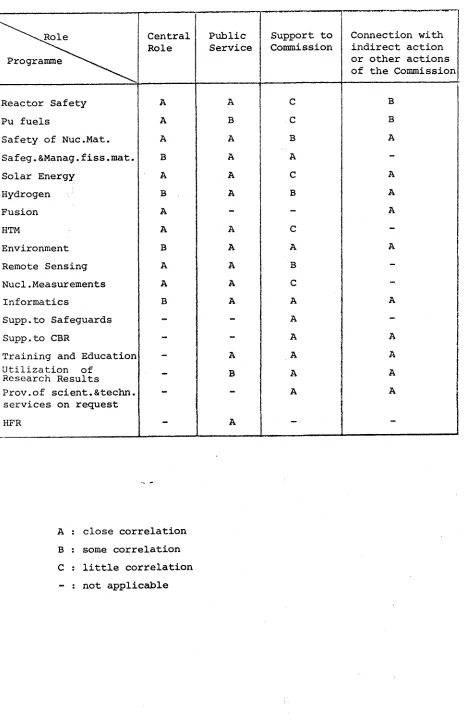
Tl.e t-able 1 (p. 2J-.), qives an overview of the manner in which each
o:l cire progrannes described above relates to one or other of the
e^s;pccts of the,JRC's role within the common policy on science and
tecnnology.
In addition to the three essential tasks - central role, public
service, support for the Commission -a particular heading
indicates the programmes which are connected to an exist,ing indirect iction or other actions of the Commission. A partlcular co-ordination :ffort obviously takes place within the services of the Commi-ssion before this co-ordination is submitted to examination by the external
consultat.ive bodies.
C
.
Table 1 - Theprogranunes
21
-i-n
relatlon to the
JRC's taskst
Programme Central Role PubIic ServiceSupport to Commission
Connection with
indirect
actionor
other actionsof
the Comrnl-ssion6I A2 A3 A4 B1 B2 B3 B4 UI c2 D E1 E2 F? Lq lJ5
Reactor Safety Pu fuels
Safety of Nuc.Mat.
Saf eg. &Manag. f iss . mat,. Solar Energy
Hydrogen ,i Fusi-on
HTM
Environment
Remote Sensing
Nucl.Measurements
Informaties
Supp.to Safeguards Supp.to CBR
Training and Education
Utilization of Research Results
Prov.of scient. &techn.
services on request HFR F} A A A B A B A A B A A B 6 B A A A A A A A A A A B A B A c B c A B c A A A A A A B B A A A A A A A A A A
e
A B c:
close correlation:
some correlation: Iittle
correlation:
not applicable [image:21.591.75.539.85.811.2]-22-Resources reguired
1. counencement and duration
qf
thq progra$nea) The proposed progralnme covers a four-year period from 198O
to
1983inclusive.
Asof
1 January 1980,it wiLl
extend and replace thecurrent prograrmer also
of four
yearsrduration'
which was launchedon 1 January 1977.
b) In this
way the Commission proposesto
implement the Council Decision adopting the current prograrune(1),
which providesfor
a review duringthe
third
year andfor
thepossibility, at
the sametime, of
adopting a new four-year progranme.In this
connection,it
should be recalledthat
the three-year frequency was adopted,first, in
orderto
make due allowancefor
the normalt.i.me-span
of
the prograrnme decision process and the budgetary proceduresthat
followiti
second, becauseof
the needto
carry on the programmeover a long enough period
to
enablesignificant
experienceto
be gained; andlastly
becauseit is
desirablethat
the JRC programmes should beadapted regularly and
fairly rapidly in
thelight of
the progress ofactivities
and the ehanging requirementsresulting
from the evolutionof
various sectoral policies.c) In
applying theseprinciples,
the JRC has cArried out 4careful
analysisof
theactivities in
progress, rnaking a,noverall
reviewof
the resourcesemployed and the
results
achieved,in
orderto
essess thejustification'
progress,
efficiency,
success and usefulnessof
the work.Some
further particulars in this
connecti.onwill
be givenlater.
d) After
concludingthis
analysis, the Comrnisslenfeels that
the time hascome
tq
expand someof
the majoractlvities
and reerientate others,i.e. to
redefine a numberof
objectiveswithin
the contextaf
the broad research areasto
which the JRCis
contfibutingThis
redefinition
has led the Commission ta' propose the aQorption of a new 1980-83 progranme containingsimilef
proyisions with regagd tothe decision procedure.
a
a
t
a
-23-2. Staff
a) The total staff complement of the JRC during the new multiannual
prograllime shou]d be 2r25o employees. This is the same revel as was rald down for the end of the preceding programme, incruding the
JRC staff then assigned to the ESSOR complex.
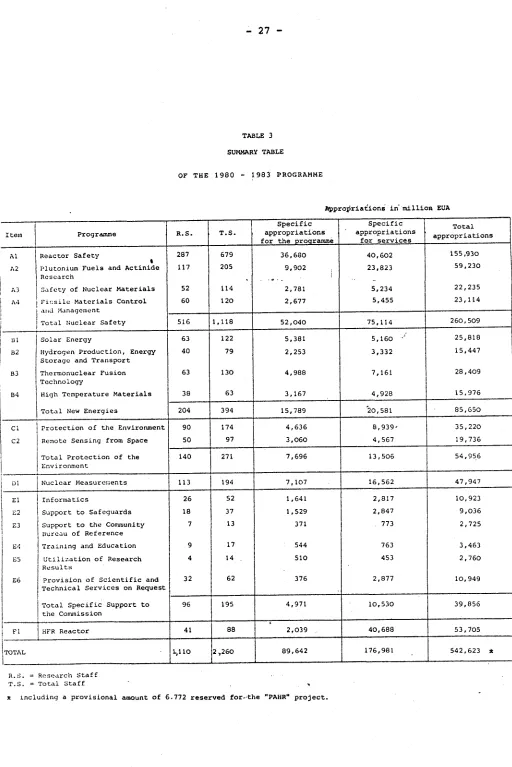
b) An indicative breakdown of thls staff between the various programmes is given in table 3. (p. 27) .
As in the current progranme, the staff complement incrudes :
- personnel directly involved in research (inctuding all categories
of employees, not only graduate staff); these are the research
staff, the most representat,ive unit for measuring the volume and intensity of a programmei
- a portion of the personnel commensurate with the requirements
of the prograrrure for scientific and technical support (services rendered by the computer centre, central- workshops, nledium activity laboratories, etc. ) ;
- and rastly, a portion assi.gned to art generar services (akin to
public services) , and distrj.buted among the various prografllmes
in proportion to the tcLal number of research staff"
ifhese distinctions were originally rnade because of a neecl for greater
cJ-arity in the internal organizatlon and management of the Centre;
this neeci led to an approprj.ate change j-n the structure of the budqet.
from 1977 onwards.
c) rn foreseelng the level of staff aL 21260, the conmission would be
complying with the decision taken earfier to reduce the JRC's s1-aff
by 80 posts in four years"
Althougth the JRC's role could be considerably strengthened by a gradual e:<pansion of its activities, and although its staff is a mere fractj.on
of the research personnel engaged in Europe in the sane fieids, it
does not seem expedient at tiris stage to attempt any reinforcemenr
of team numbers, but rather to take steps to increase their flexihility.
Hence the work of the JRC wtll be directed more towards giving proof
of the optimum efficiency of it.s laboratories and towards wider
participat.ion by its technicians in the world of research.
a
24
-However, the Comrnisslon wishes to point out clearly that no further reduction should now be made in the JRCrs staff, as
otherwise this work force, which in the l.ast few years is
recognized to have acquired new quality and usefulness, would
no longer be eapable of carrying out its tasks with the
desired efficiencv.
The decline in the l-evel of authorized staff over the past ten years or more has helped to bring about an overall ageing and insufficient renewal of technical and scientific skills. New
recruitment has been possible only io the limited extent that natural wastage is in excess of the reqrrired reduclions
but natural wastage is uncontrollable in its consequences.
Witirout doubt, the new staff regulations for researchers offer some
ways of improving their mobility and lhe flexibility of teams, and
thus assist th.e necessary rejuvenation and the adaptation of skill profiles in accordance with the activities undertaken" This
adapta-tion of skills is taking place, it must, be fully expanded, and it,
would be regretable to interrupt it,. If it is true thaL a certain amount of staff renewal has almosb. held stabLe the overall ageing
of the personnel and helped to reinforce some of the scientific
disciplines, the factor of insecurity associated w.ith the contract
system does nob always enable the JRC to attra-ct the proven spec-ia-lj-sts Lhat some of the projects call for. But at all events one
needs to go further and recoginize in i,he first place that an ongoing process of contraction in the authorized staff does not make for sound personnel management.
Accepting that the level of personnel is stabilized, the Commission
considers that in the second place agreement should be reached on a rdcruitment policy based on a multiannu.al forecast of staff Iosses. Thie wastage through resignations' deaths' transfers or
retirements, amounts to forty per year' Though this figure may
seem gubstantial, it is barely 2t per annum of the total staff,
and even le-.rs in the acEive research sector. Oring to the average
age, movenents are more numerous in the general servj-ces, which
are already strained to the linlt and must be maintained at more or less the present level.
In anticipation of an enlargement of the'Community, an early retirement scheme is now being studied by the ii:ter-instj-tutional services, and is expected to enter into force in the near future"
Thus the staff might be given the option of voluntary retirement at sixty, which would speed up the rate of departures over a certain period of tirne.
a
d)
-e)
t
-25-In view of the total number of staff ltkely to be j.eavingr the Commiseion ls proposlng a number of temporary measures designed to telp in readjusting the profile of the JRC staff" With effect from
the first year of the programme, the JRC *ould have 70 posts avail-able in excess of the authorized number to offset the effects of
naturaL wastage; the Commission would undertake to restore the
situation to normal as early as possible, and j.n any case before
the last year of the prografirrne.
This room for manoeuvre would enable the JRC both to launch these
new activities in optimal conditions of dynamism and skill, and to
conduct an overall recruitment poliqg with adequate medium-term prospect.s.
At the practicar level, these temporary measures might be the subject
of special agreement by the Council and find a temporary solution
through budgetary channels. The Commj-ssion would undertake to manage
these posts in the joint interest and would keep the Council
regularly informed.
'Ihe cost of this operation would be not more than 2* of ti:.e personnel expenditure.
Progrgmme allocatl-on and budgqt apgropr.iallon _s_
The overall budget resources required for the i-mplementation of the proposed progranme. given the specified technical contents and
time-scale' is estj.mated at 543 million EUA for the four-year peri.od 1980*83. 'l'iris amount covers all expenditure in respect of the proEramme and
t,akes account of any revenue that can be identified at this stage"
In other words, these appropr.i-ations will cover all the JRCts
actj-vities including those carried out for other Directorates-General"
The latter are not taken into account in bhe prograrnne envelope for the current period" Tire proposed layout complies witfi the ctrange J.n
the budget structure requested by the budget auLhority"
rn accordance wi.th the arrangements adopted by the council for the
current mul.tiannual- programme, this envelcpe includes :
- an alnount of sorne 276 million ELIA for per:sonnel expenditure estinated- as at 1 January 1990 on the basis of hlryrothese envisagecl by the
Commis-sj"on l-n early 1979. Following any Council deci.sion adjustinE the
Ievel of remunerations, f-he Comroissj-on rvill re-assess the expenditure and notify the budgret authority of the effects of tlie re-assessment
on the programne envelope"
- an amount of some 26? rrillion ELIA for operating expenditure, this being a flat-rate a,ssessment expressed in current vaiues;
It. should be noted, moreover, that this total amounc. includes an provision-al amount of 6.77 million EUA for in-pile,experiments in the context of the laHR project (Programme A.1 Reactor Safety) . This amount will not be used
untiL favourable opinions have been.received from the relevant Advisory Committee on Programme l4anagement and the General Advisory Cornmittee;
these opinions ought. to be on hand by the end of 1981.
C
-25-An indlcatlve breakdown of funds and staff be€\deen the proposed pro*
grammes is given in the tabLe 3 (p. 27\. Ivloreover, each of the
tech-nical sheets in the Annex gives a detailed breakdown of the requirements
for staff and specific appropriations (investments, operating expendi-ture and contracts) for the programme in question. It should be noted
that the contracts to be concluded by the JRC will not overlap at any point with those of the indirect action progranune'
b) The allocation of resources between the six research topics in the progra$me is as follows :
e
fuel cycle
-
Specific supportto
the Commission'ssectoral
activities
- q>eration of large-scale installations 10 B
This means that 74 *. of the total funds is concentrated in the
field of energy and the environment, whilst the rerqaining 26 g
is mainly to cover the JRC's public service
functions-It should be recalled in this connection that the JRC's activity until 1972
was entirely devoted to the nuclear field. A gradual evolution has allowed
a balanced solutj-on to be reached, with half of the activities renHining
in the nuclear field, and the other half congerning other research sectors.
c) In comparison with the preceedi|9 progranme, the ratio between staff
expenditure and scientific and technical operating expenditure has
beln slightly adjusted in favour of the latter, rnainly because of the beginning of major technologicat prograffnes. The proportions are 51? and 498 sgspgctively.
The table below sunmarizes the general distribution of funds (estimated :
not entirely accurate due to computer processing).
Table 2 - Distribution of.funds'into main categories
NATURE OF EXPENDITURE 1980-83Total
t
A. Personnel expenditure 276.O 5X
B. Operating expenditure
B.
1.
Specificscientific
appropriations8.2.
Specific support appropriations( j-nfrastructure and laboratory
equipment)
subtotal B
89.6
177 ,A
to
33
*
266.6 49
GRAND TOTAL 542.6 100r
*
Including the provisional amountof
6.77nillion
EUA reserved f,orthe PAHR project.
- Nuclear safety and the
- Future forms of energY
- Study and protection of - Nuclear measurements
488
lo 6
the
environment
10t
94
7*
o
it
I
?.
TABLE 3 SUMMARY TABLE
OF THE 1980 - 1983 PROGRAMME
R.S. = Rcse"rrch Scaff T.S. = Tot.al Staff
r including a provlsional amount of 6,772 reserved f,or-.the 'pAHR' project,
t
Alproprladlond tn' milllon EUA
I get[ ProgrdnDe R. S. T. S.
Specific appropriations
for the prograllune
Specific appropriat,ions
+ appropriations
Reacgor Safecy
I Plutoni.m Fuels and Actlnide
Rescarch
S.rfery of Nuclear l4at.erlals !'i'silc l4aterlals Control alli i,lJnagcment
'fotal Nuclear SafeCY
)4
60
245
36,680
9,907 ,
?,7A1 2,677 40,602 23.823 5,234 5, 455
155 ,930
59,230
22,235
Ito I ro 52,o40 75 ttl4 250, 509
Solar Energy
Hydrogen ProductLon, EnergY
Storagc and Transport Themonuclear Fusion Technology
H!9h Temp€rature MaterLals
TotJI New Energies
bJ
40
bJ
38
L ZZ
79 130
bl
5,381
2,253
4 ,988 5. LO I
5,160
3,332
't ,t6r
4,924
25 ,818
73 ,447
28,4O9
1 5,9?6
JYq I 5, 789 zvr2dl 85 .650
cl ProcecEion of che Envlron$ent Renote Sensing from Space
Total Protecti.on of th€
Env ironment.
90 )U 97 4,636 3,060 8.939-4,567 35,220
7 ,695 13.506 54,955
Nucl,car Measurcrients llJ 194 7, 1c)7 t6,562 47 ,947
E2 f;1
ED
fnformatsics
Supprf Lo Safeguards
Support to the Comunlty Uurcnu of Reference Trainlng and EducaEion
Ut.iI!::ation of Research
Rcsults
Provislon of Sclentiflc and
Technical serviccs on Request
Total specific support to the Conunission
zo I6 9 4 52 37 IJ l4 62 r,ocl 7,529 5tL q1n 376 2,417 2,847 773
/ bJ
453 7A,973 9, 036 2,7?S 3,453 2,760 10,949
96 195 4 ,971 lo,530 39,855
HFR Reactor 4l bo 2,o39 40,588 53,705
TOTAL 1"1 1O I 1260 a9,642 L7 6 ,9Ar 542,623 t
[image:27.590.50.562.20.787.2]28
-Implementation procedures
Internal management
The rationalisation measures for the internal.roperation of the Centre, which were put in place during the preceding progralnnes, make possible a tlT)e
of research management approaching industrial management' while
main-taining the flexibility necessary for carrying out a scientific activity.
The adoption of the matrix structure in the orgianisation of the work and
the use of the functional budget, which reproduces the picture of this structure at financial level, are the most significant elements of this rationalisation. It has been completed by the realisation of a unified system of ;RC publications. In addition to improving and further developing
the tool thus created, efforts under ttre next progranme wiII be directed
mainly towards evaluatj.on of research.
2. Evaluation of research
2,1. Motivation
For some years, the problems associated with the evaluation of research
and the exploitation of results have been receiving increasing attention,
and the JRC has been fully conscious of developments in this area. Since
it is anxious to make the right choices and assess the true impact of its
research, and motivated particularly by the information obtained from the
Milan symposium on science and technologry policy (1976) and the Copenhaqen
symposium on the evaluation of research and development (1978) in which it
was an active participant, the JRC is gradually setting up a nurnber of pro-cedures which should, provide it with greater insight into the manner in
which it fulfiLs the specific tasks assigned to it and into the exact
ex-tent to which its research fonns a valuable part of the entire EuroPean
R&D network"
2,,2. In-programme evaLuation
Sj.nce it began to diversify its prograrnrne (1973) and more markedly, during
the period 1977-80, the JRC has endea'voured to provide an accurate defi-nition of the objectives of its research and the aims of its programme, to
assess the implementation per-iods, the decision points and timetables for
the commitment of, financial resources and staff.
Corresponding to this defini'tion phase is a phase of monitoring and
evaluation in which the effectiveness of the current progira:rrnne is analysed
by the achievement of lts obJectives and which enables any adjustments which
may be necessary to be carried out.
o
c.
'l