promoting access to White Rose research papers
White Rose Research Online
[email protected]
Universities of Leeds, Sheffield and York
http://eprints.whiterose.ac.uk/
This is a copy of the final published version of a paper published via gold open access
in
Consciousness and Cognition
.
This open access article is distributed under the terms of the Creative Commons
Attribution Licence (
http://creativecommons.org/licenses/by/3.0
), which permits
unrestricted use, distribution, and reproduction in any medium, provided the
original work is properly cited.
White Rose Research Online URL for this paper:
http://eprints.whiterose.ac.uk/78815
Published paper
Mind-wandering and negative mood: Does one thing really lead
to another?
Giulia L. Poerio
a,⇑, Peter Totterdell
a, Eleanor Miles
ba
Department of Psychology, The University of Sheffield, UK
b
School of Psychology, University of Sussex, UK
a r t i c l e
i n f o
Article history:
Received 9 August 2013 Available online 19 October 2013
Keywords:
Mind-wandering Negative mood Mental time travel Current concerns Experience sampling
a b s t r a c t
Mind-wandering is closely connected with negative mood. Whether negative mood is a cause or consequence of mind-wandering remains an important, unresolved, issue. We sought to clarify the direction of this relationship by measuring moodbeforeandafter mind-wandering. We also measured the affective content, time-orientation and relevance of mind-wandering to current concerns to explore whether the link between mind-wan-dering and negative mood might be explained by these characteristics. A novel experi-ence-sampling technique with smartphone application prompted participants to answer questions about mind-wandering and mood across 7 days. While sadness tended to pre-cede mind-wandering, mind-wanderingitselfwas not associated with later mood and only predicted feeling worse if its content was negative. We also found prior sadness predicted retrospective mind-wandering, and prior negative mood predicted mind-wandering to cur-rent concerns. Our findings provide new insight into how mood and mind-wandering relate but suggest mind-wandering is not inherently detrimental to well-being.
Ó2014 The Authors. Published by Elsevier Inc. This is an open access article under the CC BY license (http://creativecommons.org/licenses/by/3.0/).
1. Introduction
Imagine a day during which your mind does not wander; you remain intently focused on your present-moment activities. Not only would this be a remarkable feat given that mind-wandering constitutes between a third and half of waking life ( Kil-lingsworth & Gilbert, 2010; Klinger & Cox, 1987), but were it to occur, then there is reason to think you might be happier.
Mind-wandering – defined as mental content that is task-unrelated and stimulus-independent (Stawarczyk, Majerus, Maj,
Van der Linden, & D’Argembeau, 2011) – appears to be closely connected with negative mood. However, the precise nature of this relationship is unclear, with evidence suggesting that a negative mood might be an antecedent (Smallwood, Fitzger-ald, Miles, & Phillips, 2009) or a consequence (Killingsworth & Gilbert, 2010) of a wandering mind. A question that naturally follows from this is whether or not mind-wandering is something that should be discouraged. If mind-wandering does lower mood, then this implies that reducing mind-wandering would be emotionally beneficial. But, if mind-wandering is only pre-ceded by a negative mood, then there would be no (affective) reason to prevent the mind from wandering. Indeed, the con-tention that mind-wandering has a negative impact on our emotional lives has been recognised an important, yet unresolved, issue (Mason, Brown, Mar, & Smallwood, 2013). In this study, we sought to provide more conclusive causal evi-dence to clarify whether negative mood can be considered a precursor or consequence of mind-wandering by measuring moodbeforeandaftermind-wandering in daily life. In addition, we explored whether the link between mind-wandering
http://dx.doi.org/10.1016/j.concog.2013.09.012
1053-8100/Ó2014 The Authors. Published by Elsevier Inc.
This is an open access article under the CC BY license (http://creativecommons.org/licenses/by/3.0/).
⇑ Corresponding author. Address: Department of Psychology, The University of Sheffield, Western Bank, Sheffield S10 2TP, UK.
E-mail addresses:g.poerio@sheffield.ac.uk(G.L. Poerio),p.totterdell@sheffield.ac.uk(P. Totterdell),[email protected](E. Miles).
Contents lists available atScienceDirect
Consciousness and Cognition
and negative mood might be more fully explained by considering three characteristics of mind-wandering: its affective con-tent, time-orientation, and relevance to current life concerns.
1.1. The relationship between mind-wandering and negative mood
The association between mind-wandering and negative mood has been well-documented. Research consistently indicates that individuals with depressive symptomology have elevated levels of mind-wandering. This association has been demon-strated amongst clinically depressed (Watts, MacLeod, & Morris, 1988) and dysphoric samples (Carriere, Cheyne, & Smilek,
2008) from measures of mind-wandering tendency and mind-wandering during experimental tasks (Smallwood, O’ Conner,
& Heim, 2005; Smallwood, O’Connor, Sudbery, & Obonsawin, 2007; Smallwood, Davies, Heim, Finnigan, Sudberry, O’Connor & et al., 2004a, Smallwood, O’ Connor, Sudberry, Haskell, & Ballantyne, 2004b, Experiment 1). Although sadness is a hallmark
of depression, it would be premature to conclude that the above findings are due tosadnessrather than other features of
depression or dysphoria. Even if sadnessisresponsible for these associations, then both the direction of this relationship (does sadness exacerbates mind-wandering or does mind-wandering contribute to aversive feelings?) and the presence of this link in non-depressed/dysphoric individuals remains in question.
Research capable of making stronger causal claims in this regard is conflicting. Induction of a negative, compared to po-sitive, mood has been shown to increase both subjective reports and behavioural measures of mind-wandering, suggesting that negative mood might lead to, or exacerbate, mind-wandering (Smallwood et al., 2009). Another investigation found that
both happy and sad (compared to neutral) mood inductions were associated with more task-irrelevant thought (Seibert &
Ellis, 1991). In contrast,Killingsworth and Gilbert (2010), who collected real-time reports of mind-wandering and happiness
from 2250 participants, concluded that unhappiness was aconsequence(but not a cause) of mind-wandering. This was based
on time-lag analyses in which mood was lower after, than before, mind-wandering. However, it is worth noting that there was often a large time lag between reports of mind-wandering and mood because participants only provided between 1 and 3 daily reports that were hours (sometimes even days) apart. Given this large time lag it is both difficult to imagine that sin-gle instances of mind-wandering would have such an enduring mood-dampening effect and likely that other intervening events might account for this result (Klinger, 2011; Klinger, 2013; Mason et al., 2013). A more direct method to establish whether wandering exerts an impact on later mood would be to measure mood more closely following mind-wandering.
The conclusions from experimental and experience sampling methods diverge: the former suggests that a negative mood may be a precursor of mind-wandering whilst the latter suggest that a lower mood is a consequence of mind-wandering. These possibilities are not mutually exclusive; negative mood might be both preceded and followed by mind-wandering and of course neither could be the case, or there may be third variable explanations (Mason et al., 2013). Given this apparent disparity, we designed a study to determine whether negative mood is consistently preceded or followed of
mind-wander-ing. We saw it as important to measure mood bothbeforeand closelyaftermind-wandering using real-time, ecologically
va-lid, reports. To this end, we used a newly developed smartphone application and software which made it possible to capture reports of mind-wandering and mood as they naturally occurred. We also extended previous research into the link between mind-wandering and negative mood in two ways. First, we measured two dimensions of mood, sadness (which has received the majority of attention to date) and anxiety, because these two dimensions represent major dimensions of affective well-being (Warr, 1990). Second, we measured three characteristics of mind-wandering: its affective content, time-orientation, and relevance to current life concerns. We reasoned that mind-wandering might not be directly linked with negative mood, in which case the characteristics of mind-wandering might provide an insight into the link between mind-wandering and negative mood. For example, negative mood might influence the characteristics of mind-wandering, which might then have an impact on later mood. We chose to examine these three characteristics because they are common to most instances of mind-wandering and have also been associated with negative mood in previous research. Below, we briefly explain how these characteristics of mind-wandering might be expected to be linked with negative mood.
1.2. Negative mood and the affective content of mind-wandering
Negative mood might colour the affective content of mind-wandering, for example, feeling sad before mind-wandering might lead to sad cognitions during mind-wandering. In this way, mood may act as a priming cue that makes mood-congru-ent cognitions more accessible (Isen, Shalker, Clark, & Karp, 1978; Singer & Salovey, 1988). This might then exert a reciprocal influence on later mood, either maintaining or exacerbating negative feelings. Indeed recent research suggests that the link between mind-wandering and later negative mood may be indirect and explained by an increased accessibility of negative cognitions rather than mind-wanderingper se(Marchetti, Koster, & De Raedt, 2012).Killingsworth and Gilbert’s (2010)
re-sults also indicate that mood is associated with the affective content of mind-wandering. Participants were happierat the
momenttheir minds wandered to pleasant topics and unhappier when they wandered to unpleasant topics. However,
be-cause happiness and affective content were measuredconcurrentlyit is unclear whether mood affected the valence of
cog-nitions or vice versa, and whether mind-wandering content then had a lasting influence on feelings. Additionally, a more recent investigation also using experience sampling in daily life, found that the way that mind-wandering made participants
feel (happy–sad, aroused–relaxed, excited–calm) mirrored feelings immediately prior to mind-wandering (Song & Wang,
in a congruent manner (i.e. negative cognitions follow a negative mood). In turn, we might then expect negative cognitions exert a reciprocal influence on mood (i.e. a negative mood follows negative cognitions). That said, it is also possible that a negative mood may prompt mind-wandering to positively valenced thoughts in an attempt to up-regulate negative mood
(e.g. recalling a happy memory when sad;Josephson,1996) which might have positive affective consequences.
1.3. Negative mood and the time-orientation of mind-wandering
Previous research suggests that mood may influence the time-orientation of mind-wandering. Although individuals tend to show a prospective bias in mind-wandering such that mind-wandering is more commonly future, compared to past, ori-entated (Baird, Smallwood, & Schooler, 2011; Song & Wang, 2012; Stawarczyk, Cassol, & D’Argembeau, 2013a; Stawarczyk, Majerus, Maj, Van der Linden, & D’Argembeau, 2011, Experiment 2),Smallwood and O’Connor (2011)found that participants
induced into a sad mood reported moreretrospectivemind-wandering. This suggests that sadness may bias mind-wandering
towards events from the past.Smallwood and O’Connor (2011)note that this is consistent with the response styles theory of depression where rumination about the causes and consequences of a negative mood tends to be associated with events from the past and is a key vulnerability factor for depression (Nolen-Hoeksema, Wisco, & Lyubomirsky, 2008). Although we would predict that a sad mood would bias mind-wandering towards the past, there is no theoretical reason to expect the time orientation of wandering to have an impact on later feelings. Rather, the valence of thoughts during mind-wandering is likely to be the key factor in determining the effect of cognition on later mood.
1.4. Negative mood and the relevance of mind-wandering to current concerns
Thoughts during mind-wandering tend to be directed towards the processing of self-relevant goals (Baird et al., 2011) and associated with current life concerns (Klinger, 2009). In addition, the induction of a personally salient concern has been shown to increase mind-wandering (Antrobus, Singer, & Greenberg, 1966) suggesting that personal concerns are processed
during mind-wandering. As such, mind-wandering has been suggested to facilitate problem-solving in daily life (Smallwood
& Schooler, 2006). One possibility is that negative mood is an indication of personal problems (Watkins & Mason, 2002) that individuals attempt to rectify during mind-wandering. This might lead to effective problem-solving and potentially positive affective consequences. But if attempts at problem-solving are ineffective, mind-wandering may serve to heighten the sal-ience of current life concerns which may, in turn maintain or exacerbate negative mood. Indeed, a recent investigation by
Stawarczyk, Majerus and D’Argembeau (2013b)found that negative mood induced by an upcoming negative concern (having to ostensibly perform a speech to be later evaluated by psychologists) was associated with more mind-wandering during a sustained attention task. Participants who mind-wandered more about the speech during this task also showed a lower de-crease in negative mood over time suggesting that, although mind-wandering may reflect attempts to deal with a current concern, doing so may maintain, rather than decrease, negative mood. We would predict that previous negative mood would be associated with mind-wandering to highly relevant life concerns. However, we would not necessarily expect the rele-vance of mind-wandering to current concerns to have an influence on later feelings as this would most likely depend on the way outcome of the thought processes involved. For instance, mind-wandering about a problem could lead to resolution and positive affective consequences or it could simply heighten the salience of that concern and have negative affective consequences.
1.5. Present research
To summarise, we sought to explore three core questions related to the association between mind-wandering and neg-ative mood. First, is mind-wandering consistently preceded or followed by a negneg-ative mood? Second, does negneg-ative mood influence the characteristics of mind-wandering and in what way? Third, do the characteristics of mind-wandering have an impact on later mood? To answer these questions we used a newly developed smartphone application to sample real-time experiences of mind-wandering, its characteristics, and mood (both before and after mind-wandering) in daily life. If a negative mood is antecedent of mind-wandering, then we expected previous mood to predict mind-wandering. If a neg-ative mood follows mind-wandering, then we expected mind-wandering to predict an increase in negneg-ative mood following mind-wandering. We also expected that previous negative mood would be positively associated with negatively cognitions during mind-wandering, which would then either maintain or exacerbate negative mood. In addition, we expected a nega-tive mood to be followed by mind-wandering that was past orientated and highly relevant to current life concerns. However, we did not expect either of these characteristics to be necessarily associated with later negative mood.
2. Method
2.1. Participants
Twenty-four volunteers, (13 males,Mage= 24.17;SD= 2.9), were recruited to the study via personal contacts and referrals. Of
approval, informed consent was obtained prior to the study, and participants were fully debriefed upon completion. The study was described to participants as an exploration of mind-wandering in daily life and no reference was made to the link between mind-wandering and negative mood in the training session. To check that participants were not aware of our research aim, they were asked to provide an honest description of what they thought the study was about prior to debriefing. None guessed that we were specifically investigating whether mind-wandering tends to be preceded or followed by negative mood.
2.2. Experience sampling protocol
Experience sampling methodology (ESM;Hormuth, 1986) was used to obtain data on mind-wandering and mood. We
used a newly developed system for experience sampling with smartphones called SESAMO (System for Experience Sampling on Mobiles, AICU Research Group, The Technical University of Madrid) which consists of a smartphone application and on-line software that allow the creation and scheduling of questionnaires to smartphones.
Participants were signalled 6 times daily over 7 days and reported on whether they were currently mind-wandering (and if so the characteristics of that mind-wandering instance) and previous mood. Each of these signals was followed by a ques-tionnaire 15 minlaterwhere participants reported their current mood. Thus, participants received a total of 12 signals per day for 7 days, with a total of 84 potential responses. Signals were scheduled to occur within participants waking hours (range: 07:30–23:59) at approximately (but not exactly equal) intervals at the same times each day. This modest irregularity was to prevent anticipation of mind-wandering signals occurring at exactly regular intervals. The average time between
con-secutive signals that asked about mind-wandering across participants was 129.83 min (SD= 35.48, minimum = 60 mins;
maximum = 330 mins). The follow-up mood questionnaire always occurred 15 min later. The timing of signals ensured that (a) there would be no overlap between the mind-wandering and associated follow-up mood questionnaire and the next set of questionnaires and (b) that mind-wandering and mood were sampled during a full range of daily activities.
Power in a multi-level design arises from a complex combination of factors that are still being investigated (Mathieu, Agu-inis, Culpepper, & Chen, 2012). However, it should be noted that in multi-level, compared to single-level, designs sample size is a reflection of both the number of higher-level units (in this case participants) and the number of lower level units (in this
case experience samples), often representing a trade-off between the two (Hox, 2010; Scherbaum & Ferreter, 2009).
Although there are no definitive guidelines for adequate sample size in multi-level designs,Mathieu et al. (2012)suggest
that the choice to obtain greater samples sizes at each level in a design will depend on the level at which effects are of most substantive research interest. They suggest that researchers interested in detecting lower level direct effects (e.g. relation-ships between mind-wandering and mood) might benefit most from maximising the number of lower-level units (experi-ence samples) which in this study is represented by an overall maximum of 1008.
2.3. Measures
When signalled, participants were first asked to indicate whether or not they were mind-wandering and if so reported the characteristics of that mind-wandering instance in the order presented below. They were then asked about previous affect and, 15 min later reported their current affect. Each question was presented individually and responses were made using touch screen facilities. Measures of mood and the affective content of mind-wandering were chosen to reflect the pleasure (valence) and arousal (activation) dimensions of core affect (Remington, Fabrigar, & Visser, 2000). The adjectives used were chosen so that they were applicable to both affective states and cognitions. Specifically, we measured the dimensions of pleasure-displeasure (happy–sad) and pleasant deactivation–unpleasant activation (calm–anxious).
2.3.1. Mind-wandering
Following previous studies (Killingsworth & Gilbert, 2010; McVay, Kane, & Kwapil, 2009), we operationalised
mind-wan-dering as any instance where thoughts wereunrelatedto one’s current activity. The presence or absence of mind-wandering
was measured by response to the following question ‘‘Are you thinking about anything other than what you are doing?’’ (‘‘No’’ = 0; ‘‘Yes’’ = 1).
2.3.2. Affective content
The affective content of mind-wandering was measured using two items with questions corresponding to the dimensions ofhappy–sadandanxious-calm(reverse-scored) (e.g. ‘‘Was what you were thinking about happy/sad?’’). Responses were made on a 5-point scale anchored by the associated adjectives (e.g. 1 = Happy; 5 = Sad).
2.3.3. Time orientation
The time orientation of mind-wandering was measured using a single item (‘‘Was what you were thinking about related to the past or the future?’’). Responses were made on a 5-point scale from 1 (Distant Past) to 5 (Distant Future).
2.3.4. Current concerns
2.3.5. Mood
Previous mood was measured using two items. Participants indicated how they felt 15 min previously (‘‘How did you feel 15 min ago?’’) on dimensions ofhappy–sadandanxious-calm(reverse-scored). Responses were made on a 5-point scale (e.g. 1 = Happy; 5 = Sad). Mood 15 min later (i.e. after either mind-wandering or not) was measured using the same dimensions and response scales in response to the following question ‘‘How do you feel right now?’’
2.4. Procedure
Participants attended an individual training session during which the experimenter explained and demonstrated the ESM procedure and familiarised the participant with the smartphone and SESAMO application. Each participant was provided with a San Francisco II smartphone which they were required to carry around with them during the study. The meaning and response to each measure was explained and when participants indicated their full understanding of the procedure they agreed the start date for the study and appropriate times for signalling.
2.5. Response-rate
Of the 24 participants, 20 completed the study for the full seven day period. Two participants completed six days, one participant four days and one three days. These latter two participants were unable to continue due to the intrusiveness of the study in the workplace (e.g. disruption to colleagues). The former two participants encountered problems with the SESAMO application on the last day and were advised to turn off their smartphones.
Overall, the mind-wandering questionnaires were completed on 891 occasions and the follow-up mood questionnaires were completed on 799 occasions corresponding to an 88.4% and 79.3% response-rate respectively. These response rates are considered better than average (70%) for sampling procedures using computerised methods with greater than 8 signals per day (Christensen, Barrett, Bliss-Moreau, Lebo, & Kaschub, 2003).
3. Results
3.1. Analysis
Data were analysed by multi-level modelling (Hox, 2010) using the Mixed procedure in IBM SPSS software. The data had a
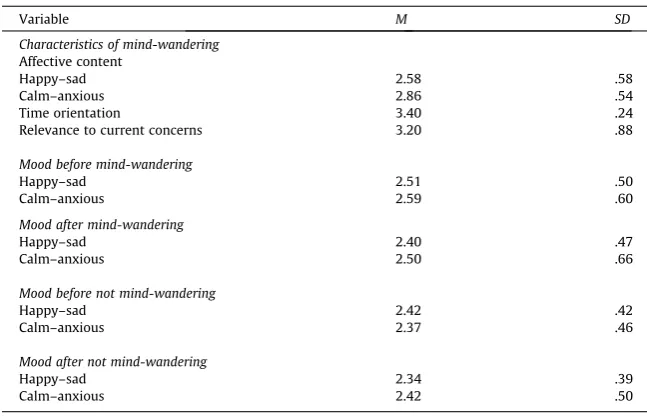
[image:6.544.111.435.79.287.2]natural two-level structure in which responses collected over a series of time-points (event-level units) were nested within individuals (person-level units). Multi-level regression models were constructed to examine the effect of (a) mood on the char-acteristics of mind-wandering (Table 2), (b) mind-wandering on later mood (Table 3) and (c) the characteristics of mind-wan-dering on later mood (Table 3). The within and between subjects variance of the dependent variable was partitioned by fitting random intercept terms for each individual. The slopes as well as intercepts were allowed to vary when doing so produced a better fit to the data. The non-independence of observations within individuals was modelled by fitting an autoregressive correlation structure to event-level residuals. Prior to analyses, all continuous event-level predictors were standardised and
Table 1
Means and standard deviations of the characteristics of wandering and mood before and after mind-wandering or not (N= 24, scales range from 1 to 5).
Variable M SD
Characteristics of mind-wandering
Affective content
Happy–sad 2.58 .58
Calm–anxious 2.86 .54
Time orientation 3.40 .24
Relevance to current concerns 3.20 .88
Mood before mind-wandering
Happy–sad 2.51 .50
Calm–anxious 2.59 .60
Mood after mind-wandering
Happy–sad 2.40 .47
Calm–anxious 2.50 .66
Mood before not mind-wandering
Happy–sad 2.42 .42
Calm–anxious 2.37 .46
Mood after not mind-wandering
Happy–sad 2.34 .39
centred at each individual’s mean following guidelines that group-mean centring is most appropriate when relationships be-tween event-level data are of substantive research interest (Enders & Tofighi, 2007).
To examine the effect of previous mood on mind-wandering, multi-level regression modelling was inappropriate because the outcome variable was dichotomous. We therefore used generalised estimation equations (GEE;Zeger & Liang, 1986) be-cause it provides a way to analyse hierarchical data with binary outcomes.
Both the time orientation and current concerns variable were negatively skewed: mind-wandering tended to be both fu-ture-orientated and highly relevant to current life concerns. This fits well with previous research indicating that mind-wan-dering tends to be prospective (Baird et al., 2011; Song & Wang, 2012; Stawarczyk, Majerus, Maj, Van der Linden, & D’Argembeau, 2011, Experiment 2; Stawarczyk et al., 2013a; Stawarczyk et al., 2013b) and goal-relevant (Stawarczyk, Maje-rus, Maj, Van der Linden, & D’Argembeau, 2011). We used a square root transformation to normalise the distribution of each variable and the following results use transformed variables (we also report analyses with untransformed scores in footnotes).
3.2. Descriptives
Means and standard deviations of key Level-1 variables are presented inTable 1. Overall, there were 322 instances of
mind-wandering corresponding to a mind-wandering rate of 36.14%. This is consistent with other estimates of mind-wan-dering (e.g.Klinger & Cox, 1987; McVay et al., 2009), although there was considerable individual variation in mind-wander-ing frequency (range 7.14–91.18%).
3.3. Do previous feelings predict mind-wandering?
We used generalised estimating equation modelling to examine whether prior sadness or anxiety predicted mind-wan-dering. We used separate models for each predictor (sadness, anxiety) with mind-wandering (no = 0; yes = 1) as the
depen-dent variable. Our results indicate that sadness significantly predicted mind-wandering (B= .15 (.07),Wald Z(1) = 4.80,
p= .029; 95%CI: 1.02–1.33) suggesting that incidents of mind-wandering were associated with higher levels of prior sadness. Anxiety, however, did not significantly predict mind-wandering (B= .14 (.09),Wald Z(1) = 2.61,p= .107; 95%CI: .97–1.37).1
3.4. Does previous mood predict the content of mind-wandering?
3.4.1. Affective content
Feeling sad before mind-wandering predicted mind-wandering with sad (t(299) = 7.23, p< .001) but not anxious
(t(298) = 1.21,p= .226) content. Likewise, feeling anxious before mind-wandering predicted mind-wandering with anxious
(t(302) = 7.8,p< .001) but not sad (t(302) = .16,p= .877) content. These results suggest that the previous feelings colour the content of mind-wandering in a congruent manner.
3.4.2. Time orientation
Feeling sad before mind-wandering predicted mind-wandering with a focus on the past (t(306) = 3.00,p= .003).
Con-versely, feeling anxious before mind-wandering was marginally associated with a future focus (t(306) = 1.88,p= .061).2
[image:7.544.38.505.74.136.2]These results suggest that sadness leads to a retrospective focus during mind-wandering whilst anxiety, if anything, biases mind-wandering towards the future.
Table 2
Fixed effects of previous mood on the characteristics of mind-wandering. Affective content
Sad Anxious Time orientationa
Current concernsb
B SE B SE B SE B SE
Sadness .43*** .06 .07 .06 .04** .01 .07* .03
Anxiety .01 .07 .47*** .06 .02 .01 .08** .03
Note:B= fixed effect estimate andSE= standard error of fixed effect.
*p< .05. ** p< .01. *** p< .001.
a
Positive values indicate a future time orientation; negative values indicate a past time orientation.
b
Random slopes were used for these analyses as doing so produced a better fit to the data.
1
We also performed these analyses using Generalized Linear Mixed Models (GLMM) because this approach is also appropriate for multi-level data with binary outcomes. Results obtained paralleled those using GEE: Sadness =B= .16 (.07),F(1, 886) = 5.11,p= .024; 95%CI: .31–.02; Anxiety =B= .15 (.09),
F(1, 886) = 2.86,p= .091; 95%CI: .33–.02.
2
3.4.3. Current concerns
Both feelings of sadness and anxiety were significantly and positively associated with mind-wandering to relevant life concerns (t(7) = 2.68,p= .033;t(17) = 3.10,p= .006, respectively)3 suggesting that aversive feelings tend to precede
mind-wandering to current concerns.
3.5. Does mind-wandering or its characteristics predict later negative mood?
To examine whether mind-wandering or any of the characteristics of mind-wandering predicted later negative mood, we controlled for the effect of prior mood on later mood by entering the former as a predictor in each model. All analyses re-ported therefore include either previous feelings of sadness or anxiety as a fixed effect. Unsurprisingly, previous mood was a significant (p< .001) positive predictor of later mood, justifying this strategy.
3.5.1. Mind-wandering and affective content
Mind-wandering did not predict later feelings of either sadness (t(787) = .29, p= .771) or anxiety (t(782) = .73,
p= .468) suggesting that mind-wandering, in itself, is not the cause of later, aversive feelings.4However, theaffective content
of mind-wandering had a significant impact on later feelings. Sad mind-wandering was associated with feeling sad 15 min later (t(265) = 5.08,p< .001) and anxious mind-wandering was associated with feeling anxious 15 min later (t(279) = 2.39,p= .017). This suggests that mind-wandering,per se, does not contribute to feeling worse 15 min later, but that the affective content of mind-wandering does.
3.5.2. Time orientation and Current concerns
The time orientation of mind-wandering had no influence on either later sadness (t(241) = .49, p= .626) or anxiety
(t(276) = .74,p= .462).5The effect of mind-wandering to relevant life concerns had no effect on later anxiety (t(275) = .15,
p= .878). However, we found that mind-wandering to relevant life concerns was marginally associated with later feelings of sadness (t(266) = 1.89,p= .059).6
4. Discussion
While a common feature of mental life, mind-wandering has been consistently associated with negative mood. The
pre-cise nature of this relationship is unclear with evidence to suggest that negative mood might precede (Smallwood et al.,
2009) or occur after (Killingsworth & Gilbert, 2010) a wandering mind. In this study, we sought to clarify the direction of
this relationship by measuring mood before andafter mind-wandering using experience sampling methodology with a
smartphone application. We also measured three characteristics of mind-wandering (its affective content, time-orientation,
3
Untransformed analyses: sadness =t(8) = 2.57,p= .035 (B= .23,SD= .09); anxiety =t(18) = 3.02,p= .007 (B= .26,SD= .09). Note that random slopes were used for these analyses because doing so produced a better fit to the data.
4
We also performed an aggregate analysis to check whether any effect of mind-wandering on later mood might be observed at the person-level. We computed variables to represent average reports of sadness and anxiety before and after mind-wandering and not mind-wandering for each participant. We then conducted 2 separate 2(time: pre vs. post)2(mind-wandering: yes vs. no) within-subjects full-factorial ANOVAs for sadness and anxiety. Our analysis indicated that there was no significant interaction between time and mind-wandering on mood (Sadness,F(1, 22) = .24,p= .631; Anxiety,F(1, 22) = 2.37,
p= .138). There was also not a significant main effect of time (Sadness,F(1, 22) = 3.21,p= .087; Anxiety,F(1, 22) = .14,p= .711) or mind-wandering (Sadness,
F(1, 22) = 1.13,p= .300; Anxiety,F(1, 22) = 2.43,p= .133) on mood.
5 Untransformed analysis: sadness =t(241) = .61,p= .543 (B= .03,SD= .06); anxiety =t(277) = .37,p= .709 (B= .02,SD= .06). 6
[image:8.544.41.512.74.175.2]Untransformed analysis: sadness =t(265) = 1.96,p= .049 (B= .08,SD= .04); anxiety =t(275) = .34,p= .731 (B= .02,SD= .04).
Table 3
Fixed effects of mind-wandering and the characteristics of mind-wandering on later mood. Mood after mind-wandering
Sadness Anxiety
B SE B SE
Mind-wandering .02 .06 .05 .07
Sad content .27*** .05 .10* .06
Anxious content .12 .05 .13* .05
Time orientation .09 .19 .16 .21
Current concerns .24 .13 .02 .14
Note:B= fixed effect estimate andSE= standard error of fixed effect.
*
p< .05.
and relevance to current life concerns) to investigate two possibilities: First, that previous mood might influence the content of mind-wandering and second, that the content of mind-wandering might then affect later mood.
Four important conclusions that shed light on the relationship between mind-wandering and negative mood can be drawn from our results. First, we found that sadness was a significant precursor of mind-wandering because instances of
mind-wandering were associated with higher levels of prior sadness. However, mind-wanderingitselfhad no mood lowering
effect over 15 min. This is consistent with the view that sadness might lead to, or exacerbate, mind-wandering but incon-sistent with the view that sadness is followed by mind-wandering. Our results therefore support previous experimental
investigations showing that sad mood inductions exacerbate mind-wandering (Seibert & Ellis, 1991; Smallwood et al.,
2009), but also show that this relationship extends to naturalistic settings. Our results contradictKillingsworth and Gilbert’s (2010)contention that unhappiness is the consequence of mind-wandering. Although we used a comparable experience-sampling method to investigate mind-wandering, we measured mind-wandering more often in daily life (6 times compared to between 1 and 3) and subsequent mood more closely after mind-wandering (15 min compared to hours later). As such we believe that our findings identify the more immediate temporal effect of mind-wandering on negative mood.
Second, our results indicate that the affective content of mind-wandering was both predicted by previous mood and pre-dicted later mood, providing a more nuanced explanation of how mind-wandering is linked to negative feelings. We found that the affective content of mind-wandering was congruent with individuals’ prior feelings: greater levels of sadness and anxiety 15 min prior to mind-wandering predicted mind-wandering with sad and anxious content respectively. This is con-sistent with literature showing that self-relevant cognitions are, in general, influenced by affect in a congruent fashion (see
Sedikides, 1992for a review). Importantly, we found that affectively negative mind-wandering was associated with subse-quent negative mood. When individuals’ mind-wandering was sad or anxious, they tended to report feeling worse 15 min later. This effect was found even after controlling for previous mood, suggesting that negative cognitions during mind-wan-dering may exacerbate a negative mood. Our results therefore suggest that negative cognitions during mind-wanmind-wan-dering,
rather than mind-wanderingper se, have mood lowering effects.
Third, our results suggest that mood not only has an impact on the affective content of cognitions, but also their time orientation. We found that sadness before mind-wandering was associated with thoughts about the past which is consistent
previous research demonstrating that a sad mood induction led to retrospective mind-wandering (Smallwood & O’Connor,
2011). Interestingly, although unexpectedly, we found that greater levels of anxiety were marginally associated with future-orientated mind-wandering. Although we are cautious of interpreting this latter finding, taken together, the differential ef-fect of anxiety and sadness on the time orientation of mind-wandering may reflect the distinction between cognitive mech-anisms of depression (i.e. rumination) and anxiety disorders (i.e. worry). Although both disorders involve negative repetitive thoughts and are co-morbid (Mineka, Watson, & Clark, 1998), one feature that seems to distinguish them is the temporal content of thoughts: depressive thinking is considered past-orientated whereas anxious thinking is considered future-orien-tated (Papageorgiou & Wells, 1999; Watkins, Moulds, & Mackintosh, 2005). Our findings suggest that this distinction may also be relevant for mind-wandering. Indeed, a previous thought sampling investigation found that depression and anxiety
were associated with more past and future orientated thoughts respectively (Klinger, 1996). Although mind-wandering, in
itself, has been considered a form of repetitive thought (Watkins, 2008) it may be that ruminative and worrisome thoughts are often manifested during mind-wandering which seems probable given its prevalence in daily life.
Fourth, we found that mood had an impact on how relevant mind-wandering was to an individual’s current life concerns because prior anxiety and prior sadness predicted mind-wandering to highly relevant current concerns. One interpretation of this finding is that negative mood acts as a trigger for goals or personal problems which are then processed during mind-wandering. This is consistent with the suggestion that mind-wandering may reflect attempts at solving problems that
ex-tend beyond the present moment (Smallwood & Schooler, 2006). Interestingly, we found that mind-wandering that was
highly relevant to current life concerns was marginally associated with later feelings of sadness, which fits with a recent
investigation linking mind-wandering about an upcoming concern with the maintenance of negative mood (Stawarczyk,
Majerus, & D’Argembeau, 2013b).
Although our results provide a deeper insight into the link between mind-wandering and negative mood, there are sev-eral limitations that should be noted. Mood before mind-wandering concerned mood 15 min prior to mind-wandering but
was measuredconcurrentlywith the characteristics of mind-wandering. This was intended to reduce participant burden, but
it may offer alternative explanations for several findings. It could be argued that reports of past mood were influenced by current mind-wandering such that people reported previously feeling negative because they were mind-wandering to neg-ative content. If this is the case, the congruent effects observed may reflect a systematic response bias rather than a genuine effect. Likewise, reports of mood 15 min later may have been influenced by previously reporting the affective content of pre-vious mind-wandering. However, this is less likely given that there was a time lag of 15 min and would require accurate recollections of previous responses. This alternative explanation is also less applicable to time-orientation findings because it is not clear that participants would report mind-wandering towards the past (future) and then report feeling sad (anxious) 15 min previously.
characteristics (e.g. task difficulty and life events) and causal lay theories about mood and mind-wandering (seeMason et al., 2013).7However, our multi-level design suggests that any potential third variable explanations for the relationship between
previous negative mood and mind-wandering would only be at event level (e.g. situational characteristics) rather than at the person level (e.g. dispositional characteristics). This is because the effect of mood on mind-wandering was observed at the level of the individual (it is a within-person effect) and so cannot be fully accounted for by a between person difference (e.g. a dis-positional variable). That said, disdis-positional variables might influence the strength of the within-person effects observed. For instance, we found that there was a significant random slopes effect for the relationship between previous mood and the rel-evance of mind-wandering to current concerns suggesting that there may be a proportion of between-person variance to be explained by a person-level variable. Depression, trait anxiety, and neuroticism could all represent possible moderators that are worthy of future investigation.
Although we acknowledge that this study cannot directly establish causality, we would like to highlight that the unique advantage of our design in this regard was that mood was measured before and after mind-wandering. Naturally, cause comes before effect: if negative mood is a cause of mind-wandering then it should precede it, and if negative mood is a con-sequence of mind-wandering then it should follow it. Because we measured mood before and after mind-wandering, our results suggest that a negative mood is unlikely to be a consequence of mind-wandering because a negative mood did not consistently follow reports of mind-wandering. However, our results suggest that reports of sadness tended to precede mind-wandering which is consistent with the idea that sadness might lead to, or exacerbate, mind-wandering.
Overall, this study suggests that mind-wandering is not something that is inherently bad for our happiness. Although feeling sad is likely to lead the mind to wander, our results suggest that mind-wandering is only followed by a negative mood when the affective content of mind-wandering is negative. This implies that affective experiences while mind-wandering are important in determining the affective consequences of mind-wandering over a relatively short time frame. The close asso-ciation between mind-wandering and sadness has been well-documented in previous research and our results lend to the following explanation of this: Sadness is likely to lead the mind to wander and that mind-wandering is likely to be affectively negative. This exacerbates previous unhappiness and in turn, may lead to a downward spiral of sadness whereby subsequent mind-wandering is both more likely to occur, consist of negative content, and further dampen later feelings (cf. Nolen-Hoek-sema, 1991). This investigation suggests that to understand the link between mind-wandering and negative mood it is
important to considerwherethe mind wanders to. Future research might profit from examining other characteristics of
mind-wandering such as individuals’ subjective appraisals of their mind-wandering (e.g. unwanted or uncontrollable) and responses to mind-wandering (e.g. suppression, elaboration). Exploring the content of the wandering mind is likely to pro-vide a greater understanding of the conditions where mind-wandering relates to negative (and positive) mood.
Acknowledgments
This research was supported by the Economic and Social Research Council [Grant numbers R060-25-0044, ES-J500215-1]. We would like to thank the AICU Research Group at The Technical University of Madrid for kindly allowing us to use SESAMO (System for Experience Sampling on Mobiles) for this research.
References
Antrobus, J. S., Singer, J. L., & Greenberg, S. (1966). Studies in the stream of consciousness: Experimental enhancement and suppression of spontaneous cognitive processes.Perceptual and Motor Skills, 23(2), 399–417.
Baird, B., Smallwood, J., & Schooler, J. W. (2011). Back to the future: Autobiographical planning and the functionality of mind-wandering.Consciousness and Cognition, 20(4), 1604–1611.
Carriere, J. S., Cheyne, J. A., & Smilek, D. (2008). Everyday attention lapses and memory failures: The affective consequences of mindlessness.Consciousness and Cognition, 17(3), 835–847.
Christensen, T. C., Barrett, L. F., Bliss-Moreau, E., Lebo, K., & Kaschub, C. (2003). A practical guide to experience-sampling procedures.Journal of Happiness Studies, 4(1), 53–78.
Enders, C. K., & Tofighi, D. (2007). Centering predictor variables in cross-sectional multilevel models: A new look at an old issue.Psychological Methods, 12(2), 121.
Hormuth, S. E. (1986). The sampling of experiences in situ.Journal of Personality, 54(1), 262–293.
Hox, J. (2010).Multilevel analysis: Techniques and applications. Routledge.
Isen, A. M., Shalker, T. E., Clark, M., & Karp, L. (1978). Affect, accessibility of material in memory, and behavior: A cognitive loop?Journal of Personality and Social Psychology, 36(1), 1.
Josephson, B. R. (1996). Mood regulation and memory: Repairing sad moods with happy memories.Cognition and Emotion, 10(4), 437–444.
Killingsworth, M. A., & Gilbert, D. T. (2010). A wandering mind is an unhappy mind.Science, 330. 932-932.
Klinger, E. (2011).Wandering Minds: Less Happy–Unhappy; Means–Constants; Post Hoc–Propter Hoc. Unpublished letter to the Editor of Science.
Klinger, E. (2013). Goal commitments and the content of thoughts and dreams: Basic principles.Frontiers in Psychology, 4, 1–17.
Klinger, E., & Cox, W. M. (1987). Dimensions of thought flow in everyday life.Imagination, Cognition and Personality, 7(2), 105–128.
7
Klinger, E. (2009). Daydreaming and fantasizing: Thought flow and motivation. In K. D. Markman, W. M. P. Klein, & J. A. Suhr (Eds.),Handbook of imagination and mental simulation(pp. 225–239). New York: Psychology Press.
Klinger, E. (1996). The contents of thoughts: Interference as the downside of adaptive normal mechanisms in thought flow. In I. G. Sarason, G. R. Pierce, & B. R. Sarason (Eds.),Cognitive Interference: Theories, Methods, and Findings(pp. 3–23). Hillsdale, NJ, England: Lawrence Erlbaum Associates Inc..
Marchetti, I., Koster, E. H., & De Raedt, R. (2012). Mindwandering heightens the accessibility of negative relative to positive thought.Consciousness and Cognition, 21(3), 1517–1525.
Mason, M. F., Brown, K., Mar, R. A., & Smallwood, J. (2013). Driver of discontent or escape vehicle: The affective consequences of mindwandering.Frontiers in Psychology, 4, 1–12.
Mathieu, J. E., Aguinis, H., Culpepper, S. A., & Chen, G. (2012). Understanding and estimating the power to detect cross-level interaction effects in multilevel modeling.Journal of Applied Psychology, 97(5), 951–966.
McVay, J. C., Kane, M. J., & Kwapil, T. R. (2009). Tracking the train of thought from the laboratory into everyday life: An experience-sampling study of mind wandering across controlled and ecological contexts.Psychonomic Bulletin & Review, 16(5), 857–863.
Mineka, S., Watson, D., & Clark, L. A. (1998). Comorbidity of anxiety and unipolar mood disorders.Annual Review of Psychology, 49(1), 377–412.
Nolen-Hoeksema, S. (1991). Responses to depression and their effects on the duration of depressive episodes.Journal of Abnormal Psychology, 100(4), 569.
Nolen-Hoeksema, S., Wisco, B. E., & Lyubomirsky, S. (2008). Rethinking rumination.Perspectives on Psychological Science, 3(5), 400–424.
Papageorgiou, C., & Wells, A. (1999). Process and meta-cognitive dimensions of depressive and anxious thoughts and relationships with emotional intensity.
Clinical Psychology & Psychotherapy, 6(2), 156–162.
Remington, N. A., Fabrigar, L. R., & Visser, P. S. (2000). Reexamining the circumplex model of affect.Journal of Personality and Social Psychology, 79(2), 286–300.
Scherbaum, C. A., & Ferreter, J. M. (2009). Estimating statistical power and required sample sizes for organizational research using multilevel modelling.
Organizational Research Methods, 12(2), 347–367.
Sedikides, C. (1992). Changes in the valence of the self as a function of mood.Review of Personality and Social Psychology, 14, 271–311.
Seibert, P. S., & Ellis, H. C. (1991). Irrelevant thoughts, emotional mood states, and cognitive task performance.Memory & Cognition, 19(5), 507–513.
Singer, J. A., & Salovey, P. (1988). Mood and memory: Evaluating the network theory of affect.Clinical Psychology Review, 8(2), 211–251.
Smallwood, J., Davies, J. B., Heim, D., Finnigan, F., Sudberry, M., O’Connor, R., et al (2004a). Subjective experience and the attentional lapse: Task engagement and disengagement during sustained attention.Consciousness and Cognition, 13(4), 657–690.
Smallwood, J., Fitzgerald, A., Miles, L. K., & Phillips, L. H. (2009). Shifting moods, wandering minds: Negative moods lead the mind to wander.Emotion, 9(2), 271.
Smallwood, J., O’ Conner, R. C., & Heim, D. (2005). Rumination, dysphoria, and subjective experience.Imagination, Cognition and Personality, 24(4), 355–367.
Smallwood, J., O’ Connor, R. C., Sudberry, M. V., Haskell, C., & Ballantyne, C. (2004b). The consequences of encoding information on the maintenance of internally generated images and thoughts: The role of meaning complexes.Consciousness and Cognition, 13(4), 789–820.
Smallwood, J., & O’Connor, R. C. (2011). Imprisoned by the past: Unhappy moods lead to a retrospective bias to mind wandering.Cognition and Emotion, 25(8), 1481–1490.
Smallwood, J., O’Connor, R. C., Sudbery, M. V., & Obonsawin, M. (2007). Mind-wandering and dysphoria.Cognition and Emotion, 21(4), 816–842.
Smallwood, J., & Schooler, J. W. (2006). The restless mind.Psychological Bulletin, 132(6), 946.
Song, X., & Wang, X. (2012). Mind wandering in chinese daily lives – An experience sampling study.PLoS ONE, 7(9), e44423.
Stawarczyk, D., Cassol, H., & D’Argembeau, A. Phenomenology of future-oriented mind-wandering episodes.Frontiers in Psychology,1, 1–12.
Stawarczyk, D., Majerus, S., & D’Argembeau, A. (2013b). Concern-induced negative affect is associated with the occurrence and content of mind-wandering.
Consciousness and Cognition, 22(2), 442–448.
Stawarczyk, D., Majerus, S., Maj, M., Van der Linden, M., & D’Argembeau, A. (2011). Mind-wandering: Phenomenology and function as assessed with a novel experience sampling method.Acta Psychologica, 136(3), 370–381.
Stawarczyk, D., Majerus, S., Van der Linden, M., & D’Argembeau, A. (2012). Using the daydreaming frequency scale to investigate the relationships between mind-wandering, psychological well-being, and present-moment awareness.Frontiers in Psychology, 3, 1–15.
Warr, P. (1990). The measurement of well-being and other aspects of mental health.Journal of Occupational Psychology, 63(3), 193–210.
Watkins, E. R. (2008). Constructive and unconstructive repetitive thought.Psychological Bulletin, 134(2), 163.
Watkins, E., & Mason, A. (2002). Mood as input and rumination.Personality and Individual Differences, 32(4), 577–587.
Watkins, E., Moulds, M., & Mackintosh, B. (2005). Comparisons between rumination and worry in a non-clinical population.Behaviour Research and Therapy, 43(12), 1577–1585.
Watts, F. N., MacLeod, A. K., & Morris, L. (1988). Associations between phenomenal and objective aspects of concentration problems in depressed patients.
British Journal of Psychology, 79(2), 241–250.