Copyright © 2000, American Society for Microbiology. All Rights Reserved.
Evolutionary Relationships of Endemic/Epidemic and Sylvatic
Dengue Viruses
ERYU WANG,1HAOLIN NI,1RENLING XU,1ALAN D. T. BARRETT,1STANLEY J. WATOWICH,2
DUANE J. GUBLER,3ANDSCOTT C. WEAVER1*
Department of Pathology and Center for Tropical Diseases, University of Texas Medical Branch, Galveston, Texas 77555-06091; Department of Human Biological Chemistry and Genetics and Sealy Center for
Structural Biology, University of Texas Medical Branch, Galveston, Texas 77555-06452; and Division of Vector-Borne Infectious Diseases, Centers for Disease Control
and Prevention, Fort Collins, Colorado 805223 Received 28 October 1999/Accepted 4 January 2000
Endemic/epidemic dengue viruses (DEN) that are transmitted among humans by the mosquito vectorsAedes
aegyptiandAedes albopictusare hypothesized to have evolved from sylvatic DEN strains that are transmitted
among nonhuman primates in West Africa and Malaysia by otherAedesmosquitoes. We tested this hypothesis
with phylogenetic studies using envelope protein gene sequences of both endemic/epidemic and sylvatic strains. The basal position of sylvatic lineages of DEN-1, -2, and -4 suggested that the endemic/epidemic lineages of these three DEN serotypes evolved independently from sylvatic progenitors. Time estimates for evolution of the endemic/epidemic forms ranged from 100 to 1,500 years ago, and the evolution of endemic/epidemic forms represents relatively recent events in the history of DEN evolution. Analysis of envelope protein amino acid changes predicted to have accompanied endemic/epidemic emergence suggested a role for domain III in adaptation to new mosquito and/or human hosts.
Dengue viruses (DEN) (Flaviviridae:Flavivirus) are serious human pathogens that occur nearly throughout the tropics, with ca. 100 million cases annually (16). DEN comprise four serotypes (DEN-1 to DEN-4); although epidemiologically sim-ilar, they are genetically and antigenically distinct. Infection with one serotype leads to lifelong protection against homol-ogous reinfection but only brief protection against heterolo-gous challenge (21, 38).
DEN cause dengue fever, a self-limited febrile illness lasting 2 to 10 days that has been known in the medical literature for over 200 years. Infrequent epidemics of dengue fever occurred in tropical areas until the 1950s. After War World II, this pattern of disease was disrupted by the emergence of dengue hemorrhagic fever and dengue shock syndrome, more severe diseases characterized by thrombocytopenia, hemorrhage, and excessive plasma leakage (16, 28). Two principal hypotheses have been proposed to explain the hemorrhagic form of dis-ease: (i) the immune enhancement theory maintains that hem-orrhage occurs in secondary infections when DEN-specific an-tibodies and memory T cells resulting from primary infection with another serotype enhance the binding of virus-immuno-globulin G complexes to FcY receptors on monocytic cells, and (ii) certain phenotypes of DEN are more virulent than others. Recent phylogenetic studies suggest that an Asian genotype of DEN-2 recently introduced into the New World may be asso-ciated with increased risk for hemorrhagic fever and shock in the presence of heterologous antibody (32). DEN strains of reduced virulence have also been described; endemic transmis-sion on the South Pacific islands of Tonga, involving vectors other than Aedes aegypti, may result in less severe disease because of the lesser selection for high viremia imposed by more susceptible vectors, likeAedes polynesiensis(13).
Two distinct DEN transmission cycles occur: (i) endemic and epidemic DEN involving human hosts and transmission by
A. aegypti, withAedes albopictusand otherAedesmosquitoes serving as secondary vectors, and (ii) a zoonotic or sylvatic cycle in sylvatic habitats of Africa and Malaysia, involving nonhuman primate reservoir hosts and several differentAedes
mosquitoes (12, 16). AlthoughA. aegyptiplays a greater role in urban transmission, A. albopictus and some other secondary
Aedesvectors are generally more susceptible to experimental infection (12). Considerable variation in susceptibility and transmission efficiency among geographic populations of both
A. aegypti andA. albopictushas also been demonstrated (14, 15). A. aegyptihas reinfested most of the neotropics since its partial eradication earlier this century, resulting in reemer-gence of neotropical dengue (13).
The sylvatic transmission cycles of DEN have received little study. In West Africa, nonhuman primate cycles have been identified in several countries. DEN-2 has been isolated from
Aedes(S.)africanus,Aedes(S.)leuteocephalus,Aedes(S.)opok,
Aedes (D.) taylori, and Aedes (D.) furcifer(5, 33). African DEN-2 sylvatic isolates are genetically distinct from all endem-ic/epidemic isolates and are believed to be evolutionarily dis-tinct (12, 16, 31). In Malaysia, all four serotypes of DEN are maintained in canopy-dwelling Aedes niveus mosquitoes and nonhuman primates (34–37). DEN-1, -2, and -4 were isolated from sentinel monkeys, and monkey seroconversion was dem-onstrated against DEN-1, -2, and -3. DEN-4 was also isolated from canopy collections ofA. niveusmosquitoes (35).
Gubler (13) has hypothesized that endemic/epidemic DEN evolved from sylvatic forms of the viruses that utilize nonhu-man primate hosts and gallery forestAedesvectors (i.e., not
A. aegyptiorA. albopictus). To test this hypothesis, we have sequenced the complete envelope (E) protein gene of DEN-1, -2, and -4 strains isolated in primary tropical forest habitats in Malaysia by Albert Rudnick and colleagues during the 1960s and 1970s (36, 37), as well as DEN-2 strains from sylvatic locations in West Africa analyzed previously using other,
* Corresponding author. Mailing address: Department of Pathology and Center for Tropical Diseases, University of Texas Medical Branch, Galveston, TX 77555-0609. Phone: (409) 0758. Fax: (409) 747-2415. E-mail: [email protected].
3227
on November 9, 2019 by guest
http://jvi.asm.org/
smaller genome regions (31). Phylogenetic analyses indicated that the endemic/epidemic lineages of DEN-1, -2, and -4 evolved independently from sylvatic viruses circulating in the Asian-Oceania region. Estimates of divergence times sug-gested that emergences of endemic/epidemic DEN occurred on the order of 100 to 1,500 years ago.
MATERIALS AND METHODS
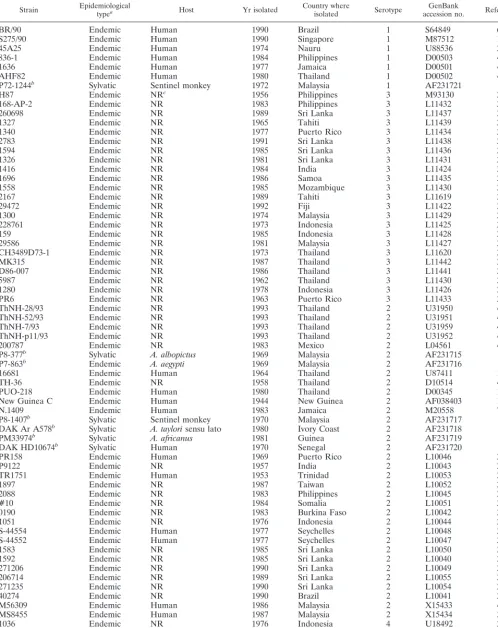
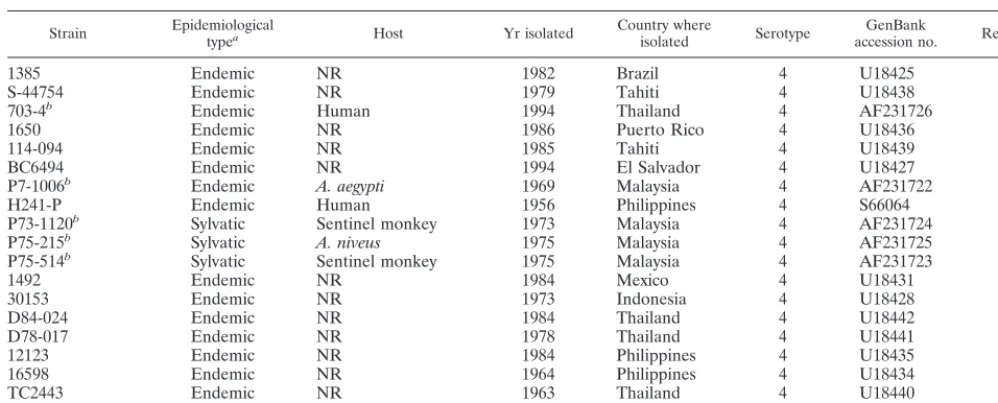
Viruses.The DEN isolates we sequenced were obtained from reference center collections at the Centers for Disease Control and Prevention, Fort Collins, Colo., and the University of Texas Medical Branch, Galveston (Table 1). Sylvatic DEN from Malaysia included sentinel monkey isolates of DEN-1 (strain P72-1244), DEN-2 (P8-1407), and DEN-4 (P73-1120 and P75-514). Sylvatic DEN-4 strain P75-215 was isolated fromA. niveusmosquitoes collected in the Malaysian forest canopy. Endemic/epidemic strains from Malaysia included mosquito iso-lates of DEN-2 (P7-863 and P8-377) and DEN-4 (P7-1006); DEN-4 strain 703-4 was isolated from Thailand. The DEN-2 African sylvatic strains sequenced were DAKAr A578, PM33974, and DAK HD 10674. The sources and years of isola-tion for these and other DEN strains whose sequences were used in our analysis are also listed in Table 1.
Virus growth, RNA extraction, and sequencing.DEN stocks were prepared in C6/36A. albopictuscell culture monolayers at 28°C with a multiplicity of infec-tion of 0.1 to 1.0 PFU per cell. Culture media consisted of Eagle’s minimal essential medium supplemented with 2% fetal bovine serum. Seven days after infection, supernatants were clarified by centrifugation at 1,000⫻gfor 5 min. RNA was extracted with Trizol LS (Bethesda Research Laboratories, Bethesda, Md.) according to the manufacturer’s protocol. PCR primers were designed to amplify the E protein gene based on the genomic sequences of DEN previously published (Tables 1 and 2). RNA was denatured at 65°C for 5 min, and cDNA was synthesized in a 20-l reaction volume with Superscript II reverse transcrip-tase (Bethesda Research Laboratories) at 42°C for 1 h using the antisense primers listed in Table 2. The PCR products were purified from 1% agarose gels and sequenced directly using an Applied Biosystems (Foster City, Calif.) Prism automated DNA sequencing kit and model 377 sequencer according to the manufacturer’s protocol.
Phylogenetic analyses. The deduced E protein amino acid sequences and representative sequences from the GenBank library (Table 1) were aligned using the PILEUP program of the Genetics Computer Group with default gap pen-alties. Although sylvatic DEN-3 strains are not available, GenBank sequences of endemic DEN-3 strains were included in our analysis to provide information on the relative divergence levels in comparison to other DEN serotypes. Nucleotide sequences were aligned manually based on codon homology. Phylogenetic anal-yses of the aligned nucleotide and amino acid sequences were performed using the PAUP maximum-parsimony program (version 3.0; D. L. Swofford, Illinois Natural History Survey, Champaign) and neighbor-joining program imple-mented in the PHYLIP package (version 3.5p; J. Felsenstein, Department of Genetics, University of Washington, Seattle). Homologous sequences from Jap-anese encephalitis, Kunjin, and West Nile viruses (a sister group to DEN [20]) were used as the outgroup to root the DEN tree. Bootstrapping (8) with 200 to 1,000 replicates was used to place confidence values on groupings within the trees.
Estimation of DEN divergence times.Divergence times for ancestral DEN lineages were estimated using synonymous or total nucleotide divergence rates estimated from maximum-parsimony trees using two methods: (i) a regression analysis where each sequence within a geographically restricted clade was com-pared to the predicted sequence of its hypothetical ancestor based on maximum-parsimony analysis, and the synonymous percent difference was plotted versus the year of isolation, and (ii) identification of sister sequences that were closely related and isolated at least 5 years apart in the same geographical region. The differences in synonymous changes depicted in branch lengths separating each sister sequence from the predicted common ancestor were divided by the number of years between isolations to yield rates expressed as synonymous changes per year, and several estimates were compared to provide an estimated mean and standard deviation.
Nucleotide sequence accession numbers.Nucleotide sequences were submit-ted to GenBank under accession no. AF231715 to AF231726 (Table 1).
RESULTS
The E gene sequences we determined for DEN-1, -2, and -4 strains were 1,482 to 1,485, 1,485, and 1,485 nucleotides long, respectively. These lengths were identical to those of most other strains sequenced previously (6, 7, 11, 27, 42, 43). Phy-logenetic trees produced with the maximum-parsimony and neighbor-joining methods produced very similar topologies, differing only within a few terminal groupings in the DEN-3 and DEN-4 groups. Maximum parsimony produced 36 trees of
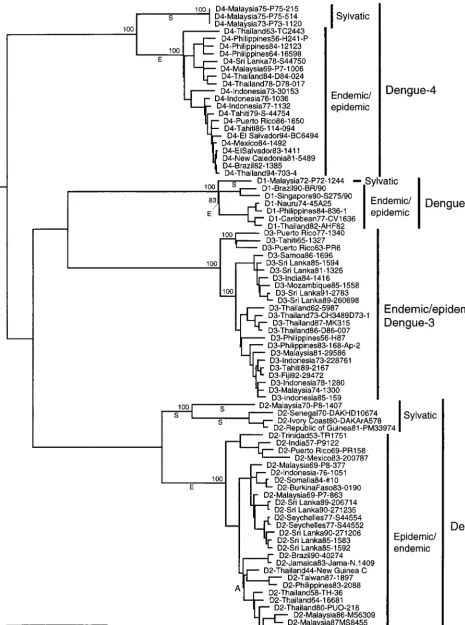
equal total length, also differing only in a few DEN-3 and DEN-4 terminal groupings. All trees indicated that the DEN are monophyletic, with 100% bootstrap support. DEN-1 and DEN-3 were sister groups, with 100% bootstrap support in amino acid trees, and DEN-4 was the basal group in all trees (Fig. 1). These overall relationships are generally consistent with previous findings (1, 24) but are inconsistent with the placement of DEN-2 at the base of the DEN clade by Kuno et al. (20). Our higher bootstrap values, presumably the result of longer sequences and more informative characters, suggest that DEN-4 is correctly placed in the basal position (Fig. 1).
All sylvatic DEN isolates from Malaysia and Africa were genetically distinct from the endemic/epidemic isolates; as in previous studies using other genome regions (31), the African sylvatic DEN-2 isolates were quite distinct from all endemic/ epidemic isolates, differing by about 19% in nucleotide se-quence and 5% in amino acid sese-quence (Fig. 1). The Malay-sian sylvatic isolates of DEN-1, -2, and -4 were also distinct from both endemic/epidemic isolates and African sylvatic strains; the Malaysian DEN-2 isolates differ from endemic/ epidemic strains by about 17% in nucleotide sequence and 4% in amino acid sequence, while the DEN-1 and -4 Malaysian sylvatic strains differed from their endemic/epidemic counter-parts by about 7 and 14%, respectively, at the nucleotide level and 3 and 5%, respectively, at the amino acid level.
All phylogenetic trees placed the sylvatic isolates from Ma-laysia and Africa at the basal positions of their respective DEN serotype groups, with bootstrap values of 84 to 100% support-ing these basal sylvatic positions. Trees constructed ussupport-ing de-duced amino acid sequences yielded identical internal topol-ogy, although the resolution of terminal groups was reduced as expected due to the loss of informative synonymous differ-ences. The geographic origin of the sylvatic DEN isolates is not a valid explanation for their phylogenetically distinct place-ment, because endemic/epidemic strains isolated from humans or mosquitoes in Malaysia grouped with the other endemic/ epidemic isolates.
To determine when the sylvatic and endemic/epidemic forms diverged, we estimated the synonymous nucleotide sequence divergence rate using two methods. A regression analysis was conducted using sequences of all isolates within a geographi-cally restricted clade of DEN-2 strains (isolated primarily from Asia and Malaysia from 1944 to 1995 [Fig. 1, clade A]). Each sequence within this clade was compared to the sequence of its predicted ancestor (the parsimony tree node with its predicted sequence), and the percent synonymous nucleotide sequence changes in the branches was plotted versus the year of isola-tion. This method yielded a slope of 0.05% divergence per year, or 5⫻10⫺4substitutions per synonymous site per year
(R2⫺0.72). The second method utilized sister sequences that
were closely related and isolated at least 5 years apart in the same geographical region. The synonymous differences in branch lengths separating each sister isolate from the common ancestor (parsimony tree node) were divided by the number of years between isolations, and the mean and standard deviation were determined from these values. A divergence rate of 5⫻ 10⫺4(standard deviation,⫾3⫻ 10⫺4) substitutions per
syn-onymous site per year was obtained. The nonsynsyn-onymous rate estimate was 6⫻10⫺5. This rate is similar to the
nonsynony-mous estimate of 7.5⫻10⫺5obtained previously for
mosquito-borne flaviviruses (44).
Using the synonymous nucleotide substitution rates and the formula of Li et al. (26) for correcting synonymous substitution distances for sequential substitutions of the same nucleotide, we estimated that the sylvatic DEN-2 genotypes diverged from the endemic/epidemic forms on the order of 1,000⫾500 years
3228 WANG ET AL. J. VIROL.
on November 9, 2019 by guest
http://jvi.asm.org/
TABLE 1. DEN isolates studied
Strain Epidemiologicaltypea Host Yr isolated Country whereisolated Serotype accession no.GenBank Reference
BR/90 Endemic Human 1990 Brazil 1 S64849 6
S275/90 Endemic Human 1990 Singapore 1 M87512 10
45A25 Endemic Human 1974 Nauru 1 U88536 27
836-1 Endemic Human 1984 Philippines 1 D00503 4
1636 Endemic Human 1977 Jamaica 1 D00501 4
AHF82 Endemic Human 1980 Thailand 1 D00502 4
P72-1244b Sylvatic Sentinel monkey 1972 Malaysia 1 AF231721
H87 Endemic NRc 1956 Philippines 3 M93130 23
168-AP-2 Endemic NR 1983 Philippines 3 L11432 23
260698 Endemic NR 1989 Sri Lanka 3 L11437 23
1327 Endemic NR 1965 Tahiti 3 L11439 23
1340 Endemic NR 1977 Puerto Rico 3 L11434 23
2783 Endemic NR 1991 Sri Lanka 3 L11438 23
1594 Endemic NR 1985 Sri Lanka 3 L11436 23
1326 Endemic NR 1981 Sri Lanka 3 L11431 23
1416 Endemic NR 1984 India 3 L11424 23
1696 Endemic NR 1986 Samoa 3 L11435 23
1558 Endemic NR 1985 Mozambique 3 L11430 23
2167 Endemic NR 1989 Tahiti 3 L11619 23
29472 Endemic NR 1992 Fiji 3 L11422 23
1300 Endemic NR 1974 Malaysia 3 L11429 23
228761 Endemic NR 1973 Indonesia 3 L11425 23
159 Endemic NR 1985 Indonesia 3 L11428 23
29586 Endemic NR 1981 Malaysia 3 L11427 23
CH3489D73-1 Endemic NR 1973 Thailand 3 L11620 23
MK315 Endemic NR 1987 Thailand 3 L11442 23
D86-007 Endemic NR 1986 Thailand 3 L11441 23
5987 Endemic NR 1962 Thailand 3 L11430 23
1280 Endemic NR 1978 Indonesia 3 L11426 23
PR6 Endemic NR 1963 Puerto Rico 3 L11433 23
ThNH-28/93 Endemic NR 1993 Thailand 2 U31950 43
ThNH-52/93 Endemic NR 1993 Thailand 2 U31951 43
ThNH-7/93 Endemic NR 1993 Thailand 2 U31959 43
ThNH-p11/93 Endemic NR 1993 Thailand 2 U31952 43
200787 Endemic NR 1983 Mexico 2 L04561 41
P8-377b Sylvatic A. albopictus 1969 Malaysia 2 AF231715
P7-863b Endemic A. aegypti 1969 Malaysia 2 AF231716
16681 Endemic Human 1964 Thailand 2 U87411 18
TH-36 Endemic NR 1958 Thailand 2 D10514 41
PUO-218 Endemic Human 1980 Thailand 2 D00345 11
New Guinea C Endemic Human 1944 New Guinea 2 AF038403 11
N.1409 Endemic Human 1983 Jamaica 2 M20558 7
P8-1407b Sylvatic Sentinel monkey 1970 Malaysia 2 AF231717
DAK Ar A578b Sylvatic A. taylorisensu lato 1980 Ivory Coast 2 AF231718
PM33974b Sylvatic A. africanus 1981 Guinea 2 AF231719
DAK HD10674b Sylvatic Human 1970 Senegal 2 AF231720
PR158 Endemic Human 1969 Puerto Rico 2 L10046 25
P9122 Endemic NR 1957 India 2 L10043 25
TR1751 Endemic Human 1953 Trinidad 2 L10053 25
1897 Endemic NR 1987 Taiwan 2 L10052 25
2088 Endemic NR 1983 Philippines 2 L10045 25
#10 Endemic NR 1984 Somalia 2 L10051 25
0190 Endemic NR 1983 Burkina Faso 2 L10042 25
1051 Endemic NR 1976 Indonesia 2 L10044 25
S-44554 Endemic Human 1977 Seychelles 2 L10048 25
S-44552 Endemic Human 1977 Seychelles 2 L10047 25
1583 Endemic NR 1985 Sri Lanka 2 L10050 25
1592 Endemic NR 1985 Sri Lanka 2 L10040 25
271206 Endemic NR 1990 Sri Lanka 2 L10049 25
206714 Endemic NR 1989 Sri Lanka 2 L10055 25
271235 Endemic NR 1990 Sri Lanka 2 L10054 25
40274 Endemic NR 1990 Brazil 2 L10041 25
M56309 Endemic Human 1986 Malaysia 2 X15433 40
MS8455 Endemic Human 1987 Malaysia 2 X15434 39
1036 Endemic NR 1976 Indonesia 4 U18492 22
1132 Endemic NR 1977 Indonesia 4 U18431 22
1411 Endemic NR 1983 El Salvador 4 U18426 22
5489 Endemic NR 1981 New Caledonia 4 U18432 22
Continued on following page
on November 9, 2019 by guest
http://jvi.asm.org/
ago (estimate⫾standard deviation). The African and Malay-sian sylvatic lineages of DEN-2 diverged on the order of 800⫾ 400 years ago. Sylvatic and endemic/epidemic DEN-1 and -4 probably diverged on the order of 200 ⫾100 and 600⫾300 years ago, respectively. Estimates using nonsynonymous sub-stitution rates applied directly to the branch lengths of parsi-mony trees, as well as Ka (nonsynonymous distance) values (26), yielded a similar time estimates (800⫾400 years ago) for divergence of the sylvatic and endemic DEN-2 genotypes. The ancestor of all DEN probably occurred much earlier than the estimated times of divergence of the endemic/epidemic and sylvatic forms of each serotype. All of these estimates rely on the assumption of a constant rate of DEN sequence evolution, which may not be completely valid.
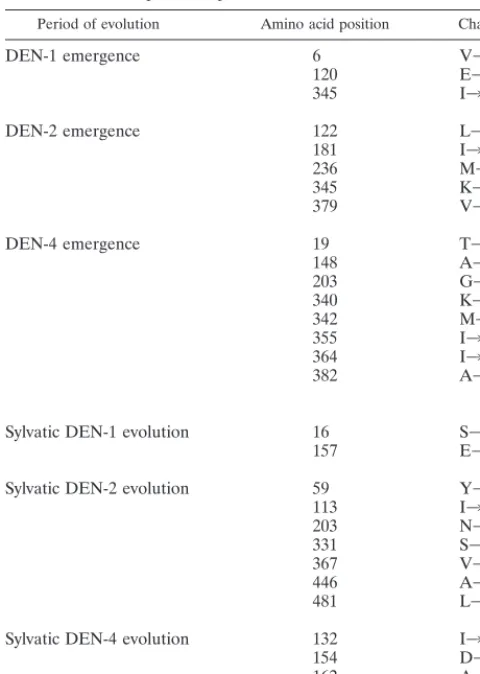
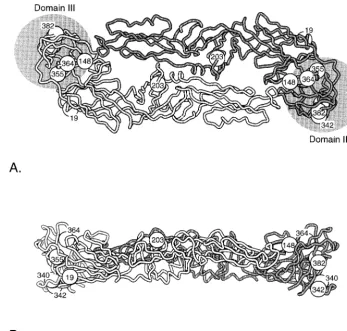
The three-dimensional structure of the soluble portion of the E protein of central European tick-borne encephalitis virus was determined by Rey et al. (30). Due to the conservation of cysteine residues and amino acid similarity among flavivirus E proteins, it is possible to model the E protein structure of DEN. To evaluate amino acid substitutions that may have accompanied the adaptation of ancestral, sylvatic DEN to hu-man transmission involving peridomestic vectors, such as A. aegyptiandA. albopictus, we analyzed amino acid changes on the branches of parsimony trees corresponding to endemic/ epidemic emergence (Fig. 1 and Table 3). One (residue 352) of three DEN-1 amino acids, two (residues 352 and 388) of five DEN-2 amino acids, and five (residues 340, 342, 355, 364, and 382) of eight DEN-4 amino acids showing changes in the tree branches predicted to have accompanied endemic/epidemic emergence lie within domain III, which may be involved in cellular receptor binding. The three amino acids representing DEN-1 emergence are not predicted to be in spatial proximity, while two of the five amino acids for DEN-2 (residues 352 and 388) are predicted to be spatially close to one other within domain III. Of the eight amino acids for DEN-4, six (residues 148, 340, 342, 355, 364, and 382) are predicted to be close to one other within domain III (Fig. 2). Residue 148 is near a
putative glycosylation site that is exposed on the surface of the virus.
To determine whether the E protein changes predicted to have accompanied DEN emergence reflect only a general trend in the evolution of DEN toward domain III changes, we determined the amino acid changes predicted to have accom-panied evolution of sylvatic strains during the same time pe-riod (Fig. 1); these changes are listed in Table 3. In contrast to the changes accompanying endemic/epidemic emergence, these showed no apparent clustering within a particular do-main; i.e., they were distributed throughout the E protein amino acid sequence.
DISCUSSION
[image:4.612.52.551.82.284.2]The relationships among sylvatic and endemic/epidemic DEN isolates that we have determined using nucleotide and amino acid-derived phylogenies are consistent with the ances-tors of DEN-1, -2, and -4 being either sylvatic or endemic/ epidemic strains. Although sylvatic DEN-3 were not isolated in Malaysia by Rudnick, the presence of DEN-3 antibodies in nonhuman canopy-dwelling primates indicated that a sylvatic DEN-3 cycle also existed there (35). The lack of large concen-trated human populations prior to a few thousand years ago suggests that the sylvatic form of these viruses was ancestral;
TABLE 2. Oligonucleotides used for PCR amplification of DENa Primer (genetic sense) Sequence (5⬘33⬘)
DEN1-635 (⫹) ...AGACACATGGGTGACCTAGG DEN1-2472 (⫺) ...CTCTGTCCAAGTGTGGACTTC DEN2-835 (⫹) ...CCAGGCTTTACCATAATGGC DEN2-2420 (⫺) ...CCAGCTGCACAACGCAACCAC DEN4-685 (⫹) ...AGAGCGGAGAACGGAGACGAG DEN4-2454 (⫺) ...TCCGCTTCCACACTTCAATTC
aNumbers indicate 5⬘genomic nucleotide positions homologous or
[image:4.612.312.552.635.710.2]comple-mentary to primer sequences. TABLE 1—Continued
Strain Epidemiologicaltypea Host Yr isolated Country whereisolated Serotype accession no.GenBank Reference
1385 Endemic NR 1982 Brazil 4 U18425 22
S-44754 Endemic NR 1979 Tahiti 4 U18438 22
703-4b Endemic Human 1994 Thailand 4 AF231726
1650 Endemic NR 1986 Puerto Rico 4 U18436 22
114-094 Endemic NR 1985 Tahiti 4 U18439 22
BC6494 Endemic NR 1994 El Salvador 4 U18427 22
P7-1006b Endemic A. aegypti 1969 Malaysia 4 AF231722
H241-P Endemic Human 1956 Philippines 4 S66064 17
P73-1120b Sylvatic Sentinel monkey 1973 Malaysia 4 AF231724
P75-215b Sylvatic A. niveus 1975 Malaysia 4 AF231725
P75-514b Sylvatic Sentinel monkey 1975 Malaysia 4 AF231723
1492 Endemic NR 1984 Mexico 4 U18431 22
30153 Endemic NR 1973 Indonesia 4 U18428 22
D84-024 Endemic NR 1984 Thailand 4 U18442 22
D78-017 Endemic NR 1978 Thailand 4 U18441 22
12123 Endemic NR 1984 Philippines 4 U18435 22
16598 Endemic NR 1964 Philippines 4 U18434 22
TC2443 Endemic NR 1963 Thailand 4 U18440 22
S44750 Endemic NR 1978 Sri Lanka 4 U18437 22
a“Endemic” indicates human orA. aegyptiisolates or those associated with peridomestic transmission; “sylvatic” indicates sentinel monkey or
canopy-dwelling-mosquito isolates.
bThe sequence was determined in this study. cNR, not reported.
3230 WANG ET AL. J. VIROL.
on November 9, 2019 by guest
http://jvi.asm.org/
FIG. 1. Phylogenetic tree derived from E protein gene nucleotide sequences of sylvatic and representative endemic/epidemic DEN strains using maximum parsimony (PAUP, version 3.0) and drawn using branch lengths derived by neighbor joining using the Kimura two-parameter formula (PHYLIP, version 3.5p). The scale shows a genetic distance of 0.1, or 10% nucleotide sequence divergence. Homologous sequences from Japanese encephalitis, Kunjin, and West Nile viruses (a sister group to DEN [20]) were used as the outgroup to root the DEN tree. Numbers indicate bootstrap (8) values for monophyletic groups to the right. Branches labeled “E” indicate periods of evolution predicted to represent emergence of endemic/epidemic DEN and used to generate Table 3; branches labeled “S” represent continued sylvatic evolution during the same time period. Node A defines the clade used for the regression analysis of the DEN evolutionary rate.
3231
on November 9, 2019 by guest
the endemic/epidemic forms probably evolved after urban hu-man populations, sufficient to serve as reservoirs, arose (13). This suggests that all four epidemic/endemic DEN serotypes evolved independently from sylvatic progenitors. Estimates for the minimum human population size required to support en-demic DEN transmission range from 10,000 to 1 million (19). Human populations in Asia are believed to have approached these sizes on the order of 4,000 years ago, when urban civili-zations first arose (3). The DEN-2 divergence estimate of 1,000 ⫾ 500 years ago is consistent with these estimates of human population sizes as well as the first historical record of dengue-like illness in China, dating over 1,000 years ago (13). Although we did not attempt to estimate the divergence times of the different DEN serotypes, they probably diverged in the very distant past. Some rodent-borne RNA viruses with similar levels of sequence divergence have been estimated to have diverged over the course of millions of years during co-evolution with their reservoir hosts (2, 29). The emergences of human DEN transmission are probably relatively recent events in the history of DEN, and most of the evolution of DEN probably occurred when they were sylvatic viruses utilizing only nonhuman primate reservoirs.
The sister group relationship of the African and Malaysian DEN-2 indicates that the sylvatic ancestor of endemic/epi-demic DEN-2 could have occurred in either Africa or the Asian-Oceanic region. The greater diversity of sylvatic
(ances-tral) DEN in Malaysia (presence of all four serotypes) com-pared to Africa suggests that a sylvatic ancestor of all DEN arose in the Asian-Oceanic region and diverged into the four serotypes recognized today. The four independent evolution-ary events leading to the emergence of endemic DEN-1 to -4 from sylvatic progenitors presumably involved switching from sylvatic, canopy-dwelling Aedesmosquito vectors to A. albo-pictusand laterA. aegypti. This indicates that adaptation to new vectors and vertebrate hosts by DEN arboviruses occurred repeatedly. Because A. aegypti presumably did not occur in Asia and Oceania at that time,A. albopictusand/or otherAedes
mosquitoes were probably the original human vectors (13). This hypothesis is also supported by the greater susceptibility ofA. albopictusto infection by DEN, suggesting greater virus adaptation. Acquisition of A. aegypti as a vector may have occurred only during the past few centuries as commerce dis-tributed this mosquito throughout the tropics from its origins in Africa (13).
The exact location where the four DEN serotypes evolved cannot be determined due to very limited sampling of sylvatic strains, especially in Asia and Oceania. However, considering the limited cross protection against heterologous challenge exhibited by current human DEN, it seems likely that more complete cross protection probably existed long ago when an-cestral, sylvatic DEN strains had reached lesser levels of diver-gence than are reflected in contemporary strain sequences. Strong cross-reactivity of protective immunity is believed to result in direct competition among virus lineages and compet-itive exclusion if different strains occupy the same ecological niche (9). Therefore, it seems likely that the divergence of the four DEN serotypes occurred in different geographic regions or in transmission cycles relying on different hosts. The studies of Rudnick and colleagues in Malaysia (34–37) indicate that the four sylvatic DEN serotypes probably overlap in their host utilization. This suggests that DEN may have evolved allopat-rically and later colonized common geographic regions after divergence had reached the level where strain variation could be maintained due to limited cross protection. Additional field studies to identify the natural reservoir host of sylvatic viruses, as well as cross protection studies in nonhuman primates, are needed to evaluate this hypothesis.
Overall, the structural model of the E protein (30) would predict that domain III of the E protein (amino acids 302 to 404) is implicated in the emergence of urban DEN. This do-main is believed to interact with cellular receptors for virus entry. The data for DEN-4 are most compelling, as six of the eight amino acid changes are close to each other within domain III (Fig. 2); residue 382 lies in a four-amino-acid sequence that is specific to mosquito-borne flaviviruses, is predicted to be exposed on the surface of the virus, and may be involved in receptor binding. Similarly, residue 148 is near a putative gly-cosylation site that is exposed on the surface of the virus. It is not known if this glycosylation site is utilized by the sylvatic DEN strains. These modeling predictions are suggestive of different interactions between the viral E protein and host cells, either those of epidemic vectors such asA. aegyptiand
[image:6.612.53.293.92.429.2]A. albopictusor those of human hosts. It is unlikely that the preponderance of amino acid changes in domain III reflects a general trend in the evolution of DEN; examination of the branches predicted to represent continuing evolution of syl-vatic DEN during the same time period showed no similar clustering of E protein changes in domain III (Table 3). The potential adaptive value of some of the E protein changes associated with epidemic emergence should be assessed with reverse genetic approaches using cDNA clones to test the fitness of these mutations in epidemic versus sylvatic vectors.
TABLE 3. Amino acid changes predicted to have accompanied E protein evolution of DENa
Period of evolution Amino acid position Change
DEN-1 emergence 6 V3I
120 E3K
345 I3V
DEN-2 emergence 122 L3K
181 I3V
236 M3T
345 K3R
379 V3I
DEN-4 emergence 19 T3A
148 A3T
203 G3K
340 K3R
342 M3V
355 I3T
364 I3V
382 A3V
Sylvatic DEN-1 evolution 16 S3L
157 E3G
Sylvatic DEN-2 evolution 59 Y3F
113 I3V
203 N3K
331 S3A
367 V3I
446 A3V
481 L3I
Sylvatic DEN-4 evolution 132 I3V
154 D3S
162 A3T
478 T3S
aUnique synapomorphies (shared and derived amino acids) represented in the
branches designated E and S in Fig. 1.
3232 WANG ET AL. J. VIROL.
on November 9, 2019 by guest
http://jvi.asm.org/
ACKNOWLEDGMENTS
We thank Edward Holmes for helpful advice with the phylogenetic methods and divergence time estimates. Robert Tesh kindly provided some of the DEN strains that we studied.
This research was supported by National Institutes of Health grants AI39800, AI39508, and AI10984.
REFERENCES
1.Blok, J., S. M. McWilliam, H. C. Butler, A. J. Gibbs, G. Weiller, B. L. Herring, A. C. Hemsley, J. G. Aaskov, S. Yoksan, and N. Bhamarapravati.
1992. Comparison of a dengue-2 virus and its candidate vaccine derivative: sequence relationships with the flaviviruses and other viruses. Virology187:
573–590.
2.Bowen, M. D., C. J. Peters, and S. T. Nichol.1997. Phylogenetic analysis of the Arenaviridae: patterns of virus evolution and evidence for cospeciation between arenaviruses and their rodent hosts. Mol. Phylogenet. Evol. 8:
301–316.
3.Burns, E. M., P. L. Ralph, R. E. Lerner, and S. Meacham.1986. World civilization, vol. A. W. W. Norton & Co., New York, N.Y.
4.Chu, M. C., E. J. O’Rourke, and D. W. Trent.1989. Genetic relatedness among structural protein genes of dengue 1 virus strains. J. Gen. Virol.70:
1701–1712.
5.Cordellier, R., B. Bouchite, J. C. Roche, N. Monteny, B. Diaco, and P. Akoliba.1983. Circulation silvatique du virus Dengue 2 en 1980, dans les savannes sub-soudaniennes du Cote d’Ivoire. Cah. O. R. S. T. O. M. Ser. Entomol. Med. Parasitol.21:165.
6.Despres, P., M. P. Frenkiel, and V. Deubel.1993. Differences between cell membrane fusion activities of two dengue type-1 isolates reflect modifica-tions of viral structure. Virology196:209–219.
7.Deubel, V., R. M. Kinney, and D. W. Trent.1988. Nucleotide sequence and deduced amino acid sequence of the nonstructural proteins of dengue type 2 virus, Jamaica genotype: comparative analysis of the full-length genome. Virology165:234–244.
8.Felsenstein, J.1985. Confidence limits on phylogenies: an approach using the bootstrap. Evolution39:783–791.
9.Ferguson, N., R. Anderson, and S. Gupta.1999. The effect of antibody-dependent enhancement on the transmission dynamics and persistence of multiple-strain pathogens. Proc. Natl. Acad. Sci. USA96:790–794. 10.Fu, J., B. H. Tan, E. H. Yap, Y. C. Chan, and Y. H. Tan.1992. Full-length
cDNA sequence of dengue type 1 virus (Singapore strain S275/90). Virology
188:953–958.
11.Gruenberg, A., W. S. Woo, A. Biedrzycka, and P. J. Wright.1988. Partial nucleotide sequence and deduced amino acid sequence of the structural proteins of dengue virus type 2, New Guinea C and PUO-218 strains. J. Gen. Virol.69:1391–1398.
12. Gubler, D. J.1988. Dengue, p. 223–260.InT. P. Monath (ed.), The arbovi-ruses: epidemiology and ecology, vol. II. CRC Press, Boca Raton, Fla. 13. Gubler, D. J.1997. Dengue and dengue hemorrhagic fever: its history and
resurgence as a global public health problem, p. 1–22.InD. J. Gubler and G. Kuno (ed.), Dengue and dengue hemorrhagic fever. CAB International, New York, N.Y.
14. Gubler, D. J., S. Nalim, R. Tan, H. Saipan, and J. Sulianti Saroso.1979. Variation in susceptibility to oral infection with dengue viruses among geo-graphic strains ofAedes aegypti. Am. J. Trop. Med. Hyg.28:1045–1052. 15. Gubler, D. J., and L. Rosen.1976. Variation among geographic strains of
Aedes albopictusin susceptibility to infection with dengue viruses. Am. J. Trop. Med. Hyg.25:318–325.
16. Gubler, D. J., and D. W. Trent.1994. Emergence of epidemic dengue/dengue hemorrhagic fever as a public health problem in the Americas. Infect. Agents Dis.2:383–393.
17. Kawano, H., V. Rostapshov, L. Rosen, and C. J. Lai.1993. Genetic deter-minants of dengue type 4 virus neurovirulence for mice. J. Virol.67:6567– 6575.
[image:7.612.128.476.72.403.2]18. Kinney, R. M., S. Butrapet, G. J. Chang, K. R. Tsuchiya, J. T. Roehrig, N. Bhamarapravati, and D. J. Gubler.1997. Construction of infectious cDNA clones for dengue 2 virus: strain 16681 and its attenuated vaccine derivative, strain PDK-53. Virology230:300–308.
FIG. 2. Three-dimensional model of the DEN E protein, based on the crystal structure of the soluble portion of the E protein of central European tick-borne encephalitis virus as determined by Rey et al. (30). Circles represent amino acids predicted to have changed during the period of evolution representing emergence of endemic/epidemic DEN-4 from a sylvatic ancestor (Fig. 1 and Table 3). (A) View of the E protein homodimer from above the virion; (B) side view of the E protein homodimer.
on November 9, 2019 by guest
http://jvi.asm.org/
19.Kuno, G.1997. Factors influencing the transmission of dengue viruses, p. 61–88.InD. J. Gubler and G. Kuno (ed.), Dengue and dengue hemorrhagic fever. CAB International, New York, N.Y.
20. Kuno, G., G.-J. J. Chang, K. R. Tsuchiya, N. Karabatsos, and C. B. Cropp.
1998. Phylogeny of the genusFlavivirus. J. Virol.72:73–83.
21. Kurane, I., and F. E. Ennis.1992. Immunity and immunopathology in den-gue virus infections. Semin. Immunol.4:121–127.
22. Lanciotti, R. S., D. J. Gubler, and D. W. Trent.1997. Molecular evolution and phylogeny of dengue-4 viruses. J. Gen. Virol.78:2279–2284. 23. Lanciotti, R. S., J. G. Lewis, D. J. Gubler, and D. W. Trent.1994. Molecular
evolution and epidemiology of dengue-3 viruses. J. Gen. Virol.75:65–75. 24. Lewis, J. A., G. J. Chang, R. S. Lanciotti, R. M. Kinney, L. W. Mayer, and
D. W. Trent.1993. Phylogenetic relationships of dengue-2 viruses. Virology
197:216–224.
25. Lewis, J. G., G. J. Chang, R. S. Lanciotti, and D. W. Trent.1992. Direct sequencing of large flavivirus PCR products for analysis of genome variation and molecular epidemiological investigations. J. Virol. Methods38:11–23. 26. Li, W.-H., C.-I. Wu, and C.-C. Luo.1985. A new method for estimating
synonymous and nonsynonymous rates of nucleotide substitution consider-ing the relative likelihood of nucleotide and codon changes. Mol. Biol. Evol.
2:150–174.
27. McKee, K. T., Jr., W. H. Bancroft, K. H. Eckels, R. R. Redfield, P. L. Summers, and P. K. Russell.1987. Lack of attenuation of a candidate dengue 1 vaccine (45AZ5) in human volunteers. Am. J. Trop. Med. Hyg.36:
435–442.
28. Monath, T. P.1994. Dengue: the risk to developed and developing countries. Proc. Natl. Acad. Sci. USA91:2395–2400.
29. Morzunov, S. P., J. E. Rowe, T. G. Ksiazek, C. J. Peters, S. C. St. Jeor, and S. T. Nichol.1998. Genetic analysis of the diversity and origin of hantaviruses inPeromyscus leucopusmice in North America. J. Virol.72:57–64. 30. Rey, F. A., F. X. Heinz, C. Mandl, C. Kunz, and S. C. Harrison.1995. The
envelope glycoprotein from tick-borne encephalitis virus at 2 Å resolution. Nature375:291–298.
31. Rico-Hesse, R.1990. Molecular evolution and distribution of dengue viruses type 1 and 2 in nature. Virology174:479–493.
32. Rico-Hesse, R., L. M. Harrison, R. A. Salas, D. Tovar, A. Nisalak, C. Ramos, J. Boshell, M. T. de Mesa, R. M. Nogueira, and A. T. da Rosa.1997. Origins
of dengue type 2 viruses associated with increased pathogenicity in the Americas. Virology230:244–251.
33. Roche, J. C., R. Cordellier, J. P. Hervy, J. P. Digoutte, and N. Monteny.1983. Isolement de 96 souches de virus dengue 2 a partir de moustiques captures en Cote d’Ivoire et Houte-Volta. Ann. Virol.134E:233–234.
34. Rudnick, A.1978. Ecology of dengue virus. Asian J. Infect. Dis.2:156–160. 35. Rudnick, A.1984. The ecology of the dengue virus complex in peninsular Malaysia, p. 7.InT. Pang and R. Pathmanathan (ed.), Proceedings of the International Conference on Dengue/DHF. University of Malaysia Press, Kuala Lumpur, Malaysia.
36. Rudnick, A.1965. Studies of the ecology of dengue in Malaysia: a prelimi-nary report. J. Med. Entomol.2:203–208.
37. Rudnick, A., N. J. Marchette, and R. Garcia.1967. Possible jungle dengue— recent studies and hypotheses. Jpn. J. Med. Sci. Biol.20:69–74.
38. Sabin, A. B.1952. Research on dengue during World War II. Am. J. Trop. Med. Hyg.1:30–50.
39. Samuel, S., C. L. Koh, J. Blok, T. Pang, and S. K. Lam.1989. Nucleotide sequence of the envelope protein gene of a Malaysian dengue-2 virus iso-lated from a patient with dengue haemorrhagic fever. Nucleic Acids Res.17:
8875.
40. Samuel, S., C. L. Koh, J. Blok, T. Pang, and S. K. Lam.1989. Nucleotide sequence of the envelope protein gene of a Malaysian dengue-2 virus iso-lated from a patient with dengue shock syndrome. Nucleic Acids Res.17:
8888.
41. Sanchez, I. J., and B. H. Ruiz.1996. A single nucleotide change in the E protein gene of dengue virus 2 Mexican strain affects neurovirulence in mice. J. Gen. Virol.77:2541–2545.
42. Shiu, S. Y., W. R. Jiang, J. S. Porterfield, and E. A. Gould.1992. Envelope protein sequences of dengue virus isolates TH-36 and TH-Sman, and iden-tification of a type-specific genetic marker for dengue and tick-borne flavi-viruses. J. Gen. Virol.73:207–212.
43. Thant, K. Z., K. Morita, and A. Igarashi.1996. Detection of the disease severity-related molecular differences among new Thai dengue-2 isolates in 1993, based on their structural proteins and major non-structural protein NS1 sequences. Microbiol. Immunol.40:205–216.
44. Zanotto, P. M., E. A. Gould, G. F. Gao, P. H. Harvey, and E. C. Holmes.
1996. Population dynamics of flaviviruses revealed by molecular phylogenies. Proc. Natl. Acad. Sci. USA93:548–553.
3234 WANG ET AL. J. VIROL.