JOlURNAI OFVIROLOGY, Dec. 1993,p. 7472-7481 Vol.67,No. 12 0022-538X/93/1 27472-10$02.00/0
Copyright ©O 1993, American Society for Microbiology
Comparing Regions
of the
Epstein-Barr Virus ZEBRA Protein
Which
Function
as
Transcriptional Activating
Sequences in
Saccharomyces cerevisiae
and in
B
Cells
GEORGE MILLER,'* HOWARD HIMMELFARB,2 LEE HESTON,' JILL COUNTRYMAN,' LYNDLE
GRADOVILLE,'
RAYMOND BAUMANN,' TIANHUAI CHI,3AND MICHAELCAREY3
Departments of Pediatrics, Epidemiology andPublic Health, and Molecutlar Biophysics and Biochemistry, Yale UniversitySchoolof Medicine, New Haven, Connecticut06510-8064'; Department of BiochemistryandMoleclular
Biology, HarvardUniversity, Cambridge, Massachlusetts 021152; and Department of Biological Chemistry, Universityof California, LosAngeles, School of Medicine, Los Angeles, California 900243
Received 15 July 1993/Accepted 13 September 1993
The ZEBRA protein activates expression of Epstein-Barr virus early-lytic-cycle genes in human B
lymphocytes. Here it is shown that ZEBRA also behaves as a sequence-specific transcriptional activator in
Saccharomycescerevisiae. Deletional mutagenesis defined three regions of ZEBRA thatparticipateinactivation in S.cerevisiae. Theseregions are designated YI (amino acids [aal 1 to25), YII (aa 51 to 102), and YIII (aa228 to245). Two of the three regions of the native ZEBRA protein act togethertomediateactivation when assayed on ZEBRA binding sites. However, when fused to the DNA bindingdomain of GAL4 andassayed on GAL4
binding sites, regionsYII and YIII were each sufficient to confer activation in S. cerevisiae.Regionsof ZEBRA which affected activation in S. cerevisiae were also required in human B lymphocytes. The amino-terminal region of ZEBRA (aa 1 to 98) was required for activation both in S. cerevisiae and in human B cells; deletion of thecarboxy-terminal 18 aa also significantly reduced activation in both cell types. Thus, the behavior of ZEBRAin human B cells and S. cerevisiae suggests that the protein contains universal activation motifs that interact with conserved components of the transcription machinery. However, certain deletion mutants of
ZEBRAcontaining mutations in the N-terminal region exhibited discordant behaviors in S. cerevisiae and in Bcells. For example, deletion ofZEBRAaa26 to 51 impairedactivation to a great extent in B cells but had little or no effect in S. cerevisiae. Thediscordant mutants may reflectinteractions with a variable domain of a conserved componentorunique interactions with specialized components of the basaltranscriptionapparatus in different cells.
ZEBRA protein initiates a cascade of events leading to
expressionofEpstein-Barr virus(EBV) lytic-cyclegenes(1, 7, 32). ZEBRA activates transcription by binding to ZEBRA responseelements (ZREs)foundin the promotersof itstarget EBVlytic-cyclegenes(5,9,28,47,49). Some ZREs are related
tomammalianAP-1 recognitionsequences; however, ZEBRA
also recognizes sites which are distinct from those bound by AP-1. Like other eukaryotic activators, ZEBRA is a modular
protein (37),andits domainstructuregenerallycorrespondsto
its exon composition. An activating region is present in the
N-terminal portion (approximatelyamino acids[aa] 1 to 100), and the DNArecognitionanddimerization domains are found in the C-terminal portion (aa 167 to 245) (10, 11, 15, 26, 36, 47). ZEBRAstimulates transcription in many different
mam-malian cell types and in vitro in HeLa cell extracts (4, 26). Thus, activation oftranscription by ZEBRA requires neither
B-cell-specific nor EBV-specific factors. These results suggest that ZEBRA interacts with one or more conserved compo-nentsof the mammalian basal transcription apparatus.
Some mammalian cellular and viral transcriptional
activa-tors function in Saccharomyces cerevisiae cells, and certain yeastactivatorsfunction in mammalian cells(10, 12, 23, 24, 25,
31, 33, 34,42, 45,5()). In one approach to demonstrate that a mammalian activating region functions in S. cerevisiae, the
activator,oraportion thereof,is fused to aheterologous DNA
bindingdomain. For example,c-fosfused to the DNA binding
Corresponding
autlhor.
domain present inaa 1 to 87 of the bacterial LexA repressor
protein will stimulatetranscription inS. cerevisiaeofreporter genes bearing nearby LexA-binding sites (25). Similarly, the
activating domain of the mammalian herpes simplex virus protein VP16, when fused to the DNA binding domain con-tained inaa 1 to 147ofthe yeastGAL4protein, will activate transcriptionfrom GAL4 sites in S. cerevisiae (2,6). When the
mammalian activator isitselfa DNAbinding protein, such as
the bovine papillomavirus E2 protein, it can be shown to stimulate transcription in S. cerevisiae from reporter genes which bear E2 cognatebinding sites (24, 34). The activity of the bovine papillomavirus E2proteincan bemeasured in suchan
assaybecause E2 binding sites are not recognized by ayeast factor.
Among the long-range objectives of such experiments in S.
cerevisiaeis todefineconserved cellularproteinswhichinteract with the mammalian activator and to analyze the mode of activation of downstream target genes. Experiments in S. cerevisiae may help to distinguish transcriptional regulatory regions which are directly and solely acted upon by the activator from those thatrequire complexinteractions between groups ofproteins boundto the same promoter. The experi-mentspresentedhere haveexploredthecapacityof ZEBRAto
behave asanactivator in S. cerevisiae.Theseexperimentsshow that ZEBRA is able to activate transcription in S. cerevisiae when bound to promoters by its own DNA binding domain. Portions of ZEBRA also function as activating regions in S. cerevisiae when fused to the DNA binding domain of GAL4. Byuse of deletion mutants, the regionsof ZEBRA necessary
7472
on November 9, 2019 by guest
http://jvi.asm.org/
FUNCTIONS OF ZEBRA REGIONS IN YEAST AND B CELLS 7473
for activation oftranscription in S. cerev'isiae and in human B
lymphocyteswerecompared. One region ofZEBRAwhich is
dispensable for activation of transcription in S. cerevisiae is required in human B cells.
MATERIALS AND METHODS
Yeast strains andmedia. Activationby intact ZEBRA and by mutants with internal, N-terminal, C-terminal, and point mutations thereofwasassayed inyeaststrain W3031A(MATa
cal1-100his3-11,15 leii2-3,112 trpl-l uira3-1 ade2-1) obtained from Rodney Rothstein, Columbia University College of Phy-siciansandSurgeons. Thisstrain is GAL4+; GAL4 is required
to activate the GAL] promoter from which ZEBRA was expressed (22). Activation by chimeric proteins containing the
DNAbinding domain of GAL4 fusedto ZEBRA orportions of ZEBRA was assayed in several yeast strains. Strain
YT6::171 (MATotgal4-542 gal80-538 ura3-52 his3-200 ade2-101 adel lys2-801 trpl-901 arol leui2-3,112 mell Met) bears an
integrated reporter which contains a portion of the GAL] promoter, UASG, fused tolacZ (51). Strain P56::171 is
con-genicto YT6::171 but bears the GALlIP (potentiator)
muta-tion, whichconvertsweakactivators, fusedtotheDNAbinding domain of GAL4, into strong activators (18). Strain JPY9
(MATot ura3-52 his3A200 leu2Al trplA63 lys2Al385gal4A11)
was derived from FY250 provided by Fred Winston,
Depart-ment ofGenetics, Harvard Medical School. Media were
pre-pared asdescribedby Sherman etal. (43).
Reporters. The reporter plasmid pCZA, shown in Fig. LA,
contains a minimal CYC] promoter, including the TATA
element, fused to the ,B-galactosidase gene (28). It also con-tains the selectable gene URA3 and a yeast chromosomal origin ofreplication
(ARS1)
and a centromere (CEN4).Oli-gomers containing different numbers (1, 3, 5, or 7) of ZIIIB sites wereinsertedinto anXbaI sitein apolylinkerupstreamof the CYCI-lacZ fusion carried on this plasmid (4). The se-quence of the 14-bp oligonucleotide used to make these reporters is 5' GGCAYTGCTAATGT 3'. (The ZIIIB site is underlined.) A reporter which lacks ZEBRA binding sites
contained a 714-bp EcoRI-to-NcoI fragment of EBV DNA
which encompassesthe repeated elementin oriPinserted into the EcoRI site of the polylinker. The reporter 3GAL/CZ
containsthreeoligomerized 17-merGAL4binding sitesinthe pCZA polylinker (6).
Activators. The plasmid vector for the activators was
pBMI25 carrying aLEU2 marker, a gift from James Wang,
Harvard University (Fig. IB). In pBMI25, an 850-bp EcoRI-to-BamnHI fragment contains the galactose-inducible GAL1-GALIO promoter (22). pBM125 contains anARSI origin of
replication and CEN4. The activator pBM125/Z(1-245) [Z(1-245)] contains a BZLF1 cDNA inserted into the unique BamnHIsite ofpBM125. Inthe activatorZ(1-227)+VP16,aa 1
to227of the ZEBRAcDNAhave been fusedin frame atthe
HincIl sitewith aa 411 to 490 of VP16(1,48); this was cloned
as aBamHI fragment intopBM125. Several internal-deletion
mutants of ZEBRA were cloned into pBM125 as BamHI or
BarmHI-to-SalI fragments. These mutants include Z(1-25,
89-245), which contains a deletion of the sequences spanned by
the two HindIll sites in the BZLFI cDNA, and Z(1-25, 141-245), which contains a deletion between the leftmost
HinidIll
siteand theNhel site (1).Two mutantswith altered amino acids in the basic domain of
exonII,constructedbyoligonucleotide-mediatedmutagenesis,
were obtained from E. Flemington. They are M178-180, in which KRY has beenchangedtoEEL,andM187-189,inwhich
RKC has been altered to EES. These mutants do not bind
DNA in vitro(47).
N-terminal-deletion mutants. A set ofnested
amino-termi-nal-deletion mutants of ZEBRAwas constructed by the
poly-merase chain reaction (PCR). The primers contained, in
5'-to-3' direction, 5' AGATCTGCCGCCGCCATG 3',
fol-lowedby 15nucleotidescomplementarytothe 5' boundaryof the deletion end point. This primer contains a BglII site, followed by a consensus translation enhancer sequence,
fol-lowedbyatranslation initiator codon.Themutantsbeganat aa 2, 25, 52, 77,99, and 131 of ZEBRA.The primerflankingthe 3'end of theZEBRAgenecontainedaBainHlsiteGGATCC preceded by 15 nucleotides complementary to the DNA en-coding the carboxy terminus ofZEBRA. The PCR products were cleaved withBglII and BamnHI and insertedintopBXG1 cutwithBglII and Barn HI.Theyweresubclonedinto theyeast vector pBMI25, whichwas cutwith BaniHl and Sall. The 3' end of the ZEBRA gene was a BglII-PstI fragment of the BZLF1 cDNAcloned intopBluescript.This strategywasused
in orderto preservethe stopcodon atthe end of the BZLF1
open reading frame. The nucleotide sequence of the
N-terminal-deletion mutants was determined in the yeast
plas-mids by the Sanger method.
GAL4 fusions. PCR primers for GAL4-ZEBRA fusion
proteins were either the same as those used in the ZEBRA
amino-terminal deletionsor new onesconstructedby placinga
BanHI site 5'andeitheraBanlHI siteor aBglll site 3' tothe
codingsequenceof interest.These PCRproductswerecleaved with Bglll and BainHI and inserted into the BamtiHI site of pBXGl, which contains the simian virus 40 enhancerdriving
expression of DNAencodingaa I to 147ofGAL4
[GAL4(1-147)] (41). This created an in-frame fusion with the DNA
binding domain of GAL4. The GAL4-ZEBRA fusions were then subclonedinto twoyeast expression vectors,pMA424and
pGG29. pMA424 is a
2[Lm
plasmid in which GAL4(1-147) isdrivenbytheADHI promoter(30). pGG29 isanARSJ CEN3
plasmid which contains GAL4(1-147) driven by the GAL4
promoter,agiftfromGraceGill,DepartmentofBiochemistry, University of California at Berkeley. The junction between
GAL4(1-147) and ZEBRAwassequenced.
,-Galactosidase assays. S. cerevisiac wastransformed by a lithiumacetatemethodwith5
[LI
ofEscherichlia coliminilysate plasmid DNA plus 50pLg
ofcalfthymus DNA as the carrier(21).Yeastcellswereplated onto anitrocellulose filterplaced
on the appropriate synthetic complete (SC) yeast medium
drop-out platescontaining2%glucose.Afterthecolonieswere visible(afterabout 48 h), thefiltersweretransferred toX-Gal
(5-bromo-4-chloro-3-indolyl-3-D-galactopyranoside)
indicatormedium drop-out plates containing 2% galactose (43). The
extentofactivation ofLacZwasscoredqualitatively by inspec-tion of the X-Gal plates. Individual representative colonies
weresubculturedfrom theX-Galplatcto aliquidSCdrop-out
culturecontaining2Cc glucose.Aftcrovernight incubation,the cultures were washed once with SC and rcsuspcnded in
drop-out medium containing 2Cc galactosc. Thcsc cultures
were further incubated overnight and were harvested for
0-galactosidase
assay. The cells were fracturedby
vortexingwith glass beads. The lcvel of
P-galactosidase
activity wasmeasuredasdescribed elsewhere(18),and theproteincontent wasdeterminedbyusingaBio-Radproteindetermination kit.
1-Galactosidase activitywascalculated as 1,000 x the optical
densityat420nm/time (minutes) x theoptical densityat595
nm x volumc (milliliters).
Human B-cell transfections. Transcriptional activation
by
ZEBRA and ZEBRA deletion mutants was
assayed
in theEBV-negative human B-cell line BJAB. Theinternal-deletion V()L. 67, 1993
on November 9, 2019 by guest
http://jvi.asm.org/
7474 MILLER ET AL.
(ZIIIB)n
VI
,
I
XbaI 43bp 15bp 129bp
MCS CYC 1
Activator (pBM125)
(BZLFI)
850bp
BamHI
Sail
pBR LEU2
C.
ZEBRA
Clone
Z(1-245)
Z(1-227)+VP16
exonI
_ _
I IC
exonI exonm
I I ,
cw I
0
I II .c
I I
167aa a 43aa|
activation DNA dimerizaton
recogrution
0 40 80 120 160 200
Amino Acids
ZEBRA VP16
240 280 320
D.
0
0 (c c
D
CD 0
Co
cc% 0 cscc$
m
Reporter CZA Zl/CZ Z3/CZ Z5/CZ Z7/CZ
Stimulation 1.0 0.4 0.5 1.0 4.3 19.4 1.0 32.4168.4 1.0 11.7 89.2 1.0 3.9 19.5
Reporter (CZA)
TATA
I_
A.
LAC Z
B.
GALl
/10
J.VIROL.
on November 9, 2019 by guest
http://jvi.asm.org/
FUNCTIONS OF ZEBRA REGIONS IN YEAST AND B CELLS 7475
FIG. 1. Activation of transcription by ZEBRA in S. cerevisiae. (A) Reporter plasmids. Different numbers of oligomerized ZIIIB sites [(ZIIIB)n],towhich ZEBRAbinds,werecloned intoanXbaIsite in amultiple-cloningsite(MCS)in the vector pCZA (29). As a control, a 700-bp fragmentcontaining oriP, to which ZEBRA does not bind, was placed in the MCS inpCZA.The reportercontains a 144-bp minimal promoter from the yeast CYCI gene upstream oflacZ. (B) Activator plasmids. Derivatives of a cDNA of the BZLF1 gene encoding ZEBRA were cloned asBamHIorBamHI-SalI fragments downstream of the 850-bpGALJ-GALIO(GAL1/10)promoter intheplasmid pBM125. (C) Two activator plasmids which contain ZEBRA. The top line shows the approximate location of the activating, DNA recognition, and dimerization regions of ZEBRA. Restriction endonucleaserecognition sites used for preparation of internal-deletion mutants (see Fig. 2B) and ZEBRA-VP 16 fusions are shown. Z(1-245) is an intactBZLF1cDNA.Z(1-227)+VP16 has the carboxy-terminal 18 aa ofZEBRAremoved andreplaced with aa 411 to 490 of VP16(1). (D)Datafromarepresentative experiment. Yeast strainW3031A was cotransfected with one activatorplasmidand one reporter
plasmid. TheactivatorwasZ(1-245)orZ(1-227)+VP16 or, as anegative control, thepBM125 vector.The reporters were derivatives ofpCZA containingno ZIIIBelementsorone,three,five,or seven ZIIIBelements upstream of the minimalCYC]promoterfused to lacZ. Stimulation is calculated as the ratio of,-galactosidase unitsexpressedfromareporter after exposure to an activatortothe number of 3-galactosidase units expressedfrom the same reporter in the presence of thevectorpBM125.
and C-terminal-deletion mutant activators were cloned in pHD1O13, which contains the cytomegalovirus promoter-en-hancer (8). The N-terminal-deletion mutant activators were
cloned downstream of the simian virus 40promoter-enhancer
in pBXG1, a gift from P. Broad (41). The reporter was Z3E4CAT, in which three oligomerized ZIIIB sites were inserted upstream of the minimal adenovirus E4 promoter, fused to chloramphenicol acetyltransferase (CAT) (4, 16). Cellswere transfected by electroporation with 10 ,ug of acti-vator and 10 ,ugof reporter. CAT assays were performed with
30 ,ul of cellextractprepared48hafter transfection. Proteins were detectedby immunoblotting with polyvalent rabbit
anti-sera to ZEBRA.
ones,nolonger activatedtranscription from reporters contain-ingoligomerized ZREs (Fig. 2B and data not shown).
Fig. ID shows that ZEBRA was a weak activator in S.
cerevisiae.Addition of the VP16 activation domainto ZEBRA in the mutant Z(1-227)+VP16 created an activator fivefold more potent than wild-type ZEBRA. As is characteristic of many weakeukaryotic activators,ZEBRAactivated
transcrip-tion inasynergistic fashion (4).In S. cerevisiae, ZEBRAonly weakly activated (4-fold) transcription from a reporter with
one ZIIIB site and maximally stimulated (32-fold in the
experimentillustrated) transcription from reporters containing three tandemZIIIBsites. The stimulation oftranscription on
RESULTS
Experimental design. The capacity ofZEBRA to activate transcription in S. cerevisiae was examined in two types of experiments. In one type, activators were expressed from plasmid constructs encoding the native DNA binding and
dimerization domains of ZEBRA itself (aa 167 to 227)
to-getherwith variousportions of the remainder ofthe ZEBRA
protein (Fig. 1C). In these experiments, transcription was measured from reporter genes containing one, three, five, or
seven oligomerized ZIIIB ZREs upstream of a CYCI-lacZ fusion.Inthe othersetofexperiments, the activators consisted of ZEBRA, or portions thereof, fused to the DNA binding
domain (aa 1 to 147) of the yeast activator, GAL4. Reporter genes contained GAL4 binding sites upstream of a minimal promoter (CYC1 or GALI) fused to lacZ. In both types of experiments,
3-galactosidase
activity served as a measure of transcription. The ZEBRAdeletion mutants were also exam-ined for their capacity to activate transcription in anEBV-negativehumanB-lymphocyte cell line. The reporter used in B cells contained three oligomerized ZIIIB sites upstream of a minimaladenovirusE4gene promoter fusedto theCAT gene (4, 16). CAT activity servedas a measureoftranscription.
ZEBRAis a sequence-specific activator inS. cerevisiae. As
shown inFig. 1D,ZEBRAactivated transcription in S.
cerevi-siaefrom reporter genesbearingone ormoreZREs.ZEBRA failed to activate transcription from a reporter gene lacking
ZEBRA binding sites (pCZA) or from a reporter gene
con-taining20copies ofa30-bp repeat from theEBVlatentorigin ofreplication (oriP)towhich theEBVprotein EBNA-1binds
but to which ZEBRA does not bind (data not shown). The
capacity of ZEBRA to activate transcription from reporters bearing single or multiple ZIIIB ZREs was eliminated by mutations which destroyed the ability of ZEBRA to bind to DNA. MutantsZ(M178-180) andZ(M187-189),in which basic
amino acids required forDNAbindingarechanged toacidic
A
Z(2-245)
Z(25-245)
Z(51 -245)
Z(77-245)
Z(88-245) Z(99-245) Z(131-245)
B
Z(1-245)
Z(1-25,89-245)
Z(1-25,141-245)
Z(1-25,141-227) Z(1-227)
Z(M178-180)
Z(M187-189)
ZEBRA Amino Acids
25 50 75100125 150 175 200
P-GalactosidaseUnits
0137 500 10oo 1500
Stimulation Index
2000
11.6
5.4
5.6
2.8
2.5
0.9
1.3
Reporter:Z3/CZ
ZEBRA AminoAcids 5-GatactosidaseUnits Stimulation
o 25 5075100125150175200225250 0137 500 1000 1500 2000 Index
13.7
11.7 10.7
0.9
2.3
Reporter:__________________Z3C0.3
____________________________ ~~~~~~~0.2
Reponter:Z3/CZ
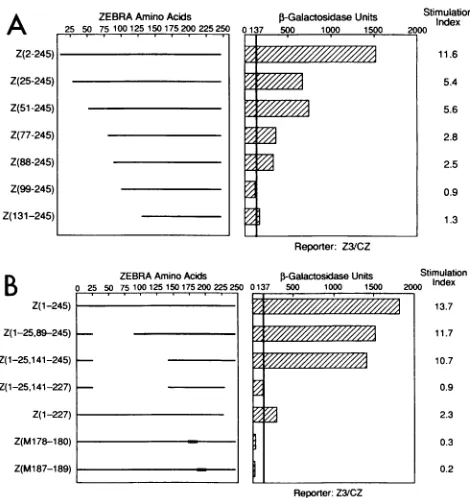
FIG. 2. Activation oftranscriptionbyZEBRAN-terminal-deletion mutants(A)and internal-deletion andpointmutants(B) in S. cerevi-siae.Thedataareaverages forduplicateexperimentswith eachsetof mutants. The experiments were conducted in yeast strain W3031A. Thevertical lines represent the level of,B-galactosidase activity (137 units) as a measure of background transcription from the Z3/CZ
reporter (aderivative ofpCZA containing threeoligomerizedZIIIB sites) cotransfected with thepBM125vector.Thestimulation index is the ratio of,B-galactosidase units measured in yeast cellscarryingan
activatortothose measured in yeast cellscarryingthevectorpBM125.
VOL.67, 1993
VIIIIIIIA
on November 9, 2019 by guest
http://jvi.asm.org/
[image:4.612.319.554.383.632.2]7476 MILLER ET AL.
three adjacentsiteswas8-fold thaton one site;this is 2.5-fold synergy, comparing three sites withone site.
The background level of transcription measured in the
absence of an activator increased when reporters contained five or seven oligomerized ZIIIB sites (Fig. ID). This high
background level of transcription, which was not observed from the reporter bearing 20 copies of the 30-bp repeat elements fromoriP(datanotshown),ispresumablyduetothe action of a yeast factor which recognizes the oligomerized
ZIIIB sites and whose activity required a high degree of synergy.
An N-terminal and a C-terminal region of ZEBRA are
required for activation oftranscription in S. cerevisiae. The deletion mutants illustrated in Fig. 2 defined two separate
regionsofZEBRAproteinwhichwererequiredforactivation of transcription in S. cerevisiae. One region was the amino-terminal 98 aa, and the otherwasthe carboxy-terminal 18 aa. A nested set of deletion mutantsof increasing size from the amino terminus showedaprogressivedecrease inactivity (Fig. 2A). Therewasgreater-than-50% reduction ofactivity
follow-ing removal of the N-terminal 24 aa. Removal of the
N-terminal76aacauseda76% reduction ofactivity,andremoval of the N-terminal 98or 130aa eliminated thecapacityofthe
protein to activate transcription. Deletion of the second
re-quired
region,locatedinthecarboxy-terminal 18aminoacids,in themutantZ(1-227) reduced thecapacityoftheproteinto
activateto less than20%of thewild-type activity (Fig.2B and data not shown). A reduction of activity comparable to that
measured onreporters withthreeoligomerizedZIIIB siteswas
observed on reporters containing five or seven oligomerized
ZIIIB sites (data not shown). Immunoprecipitation
experi-ments showed that Z(1-227)wassynthesizedatthe samelevel as Z(1-245) (datanot shown).
We observed a modest decrease in activation potency in internal-deletion mutants from which aa 26 to 140 were
removed. Thus the mutantZ(1-25, 89-245)was 85% as active asthe wild type, and the mutantZ(1-25, 141-245) was78%as active as the wild type (Fig. 2B). If, however, these internal deletionswerecombined with deletion of the C-terminal18aa, as in the mutant Z(1-26, 141-227), the protein was inactive. These data suggested that the N-terminal 25 aa and the C-terminal 18 aa of ZEBRAwereboth
required
to create a functional activator in S. cerevisiae. Therequired
C-terminalactivating
regionofZEBRA could bereplaced by VP16,asinthe mutant
Z(1-227)+VP16
(Fig.ID).
Intact ZEBRA andportionsof the ZEBRAproteinfused to
the DNAbindingdomain of GAL4 behave asactivators in S. cerevisiae. In preliminary experiments, the entire BZLF1
cDNA encoding ZEBRA was fused to GAL4(1-147) and
expressedfrom the strong constitutiveADHIpromoteronthe
plasmid
pMA424, which contains a high-copy-number yeast2pLm-plasmid
origin of replication. High-level expression ofZEBRAunder theseconditions wastoxic toseveralstrainsof S. cerevisiae,asevident bythe appearance ofsmallcolonieson
SC
glucose
plates.These smallcoloniesdevelopedadarkbluecolorwhen transferredtoX-Galplates,indicative ofhigh-level transcriptionalactivation. Strain JPY9wasleast affected among several strains tested. In this strain, GAL4(1-147)-Z(1-245)
activatedtranscription about 14-fold from GAL4binding sites and about 24-fold from ZEBRAbindingsites (Fig. 3A). Thus
theintactZEBRA
protein
fusedtotheDNAbindingdomainofGALA
behavedina mannerconsistent withtheproteincontain-ing
two different DNA binding domains. Two constructscon-taining
the N-terminal activating region of ZEBRA, namelyGAL4(1-147)-Z(1-198)
andGAL4(1-147)-Z(1-93),
bothacti-vatedtranscriptioninthisassay.Since these twoconstructslack
A
Zt
0
en
Im C)O
00
2000r
1500k
1000k
I
.1.M
3Z3/CZ _ 3GAUCZ
GAL4(1-147) GAL4(1-147) GAL4(1-147) GAL4(1-147) GAL4(1-147)GAL4(1-147) GAL4(1-147) GAL4(1-147)
Activator + + + + + + +
AH Z(1-245) Z(1-198) Z(1-93) Z(228-245) Z(51-103) Z(1-227)
Stimulation 1.0 1.0 65.2 4.3 13.723.8 128 2.0 47.53.7 5.0 2.6 1.8 1.7 1.00.6
B
Z(l98)-1
Z(l-93)
Z(2-51)
ZEBRAAmino Acids FusedtoGal4(1-147)
25 50 75 100 125 150 175 200 225250
Z(2-251
Z(25-51Z Z(51-103) Z(51-77) Z(77-103) Z(99-135) Z(198-245)
Z(228-245)
Galactosidase Units(log10) Stimulation 1.0 2.0 3.0 4.0 Index
4290
= ~~~~~~~~~~~~~~~~~~~~1 972
328
: ~~~~~~~~~~~~~~~~~~~~~~1
~~~~~~~~~~~~~~~~~~~~1
E
~~~~~~~~~~~~~~~~~~~~1
w ~~~~~~~~~110
2 7 16 62
Reporter: 3GAUCZ
FIG. 3. Activation of transcription by ZEBRA or portions of ZEBRAfusedtotheDNAbindingdomainof GAL4.(A) Comparison
ofactivationonGAL4(shaded bars)and ZEBRA(openbars)binding sites. The dataarepooledfromfiveexperiments.JPY9(gal4AJJ)yeast cellswerecotransfected withaGAL4-derived activator andareporter. The two reporters were derivatives of pCZA containing three
oli-gomerized GAL4 binding sites (3GAL/CZ) or three oligomerized ZIIIBsites(Z3/CZ). The activatorsconsistedof ZEBRAorportions
of ZEBRA thatwerefusedtothe DNAbindingdomain of GAL4(aa
1 to147)in theplasmidpMA424(30).AH(amphipathichelix)isan artificial activatorwe used tocompare the relative potenciesof the ZEBRA-derivedactivators(14).Stimulation is the ratio of
3-galacto-sidase units measured in yeast cells carrying an activator to the
background level on 3GAL/CZ orZ3/CZ induced by GAL4(1-147)
alone.Thisbackgroundlevelwas24unitson 3GAL/CZand 10 units
on Z3/CZ. (B) Activation by GAL4(1-147)-ZEBRA fusions in the GALllP strain. Eachplasmid containinga fusion between
GAL4(1-147)andZEBRA,orportionsofZEBRA,wastransformedinto strain
P56::171, which carries an integrated reporter consisting of UASG upstreamof lacZ(18,51).Thestimulation indexrepresentsthe ratio of
13-galactosidase activitymeasured with the GAL4-ZEBRA fusion to the background level of,B-galactosidase activity measured following
transfection of a plasmid containing GAL4(1-147) with no added
activating domain.Thisvalue,4units, is indicatedby avertical line. The dataarefrom a representative experiment.Similar resultswere
obtained in sixreplicateexperiments.
the ZEBRA DNAbinding domain, theywereonly active when measured on GAL4 binding sites. Weak activation, about
fivefold above background level, was also observed when the C-terminal 18aawerefusedtoGAL4. Noactivationwasseen
whenZ(51-103) orZ(1-227)was fusedtoGAL4. None ofthe
constructs containing subregions of ZEBRA were toxic in S.
cerevisiae.
Theresultswiththe GAL4-ZEBRAfusionswereconsistent withthe analysis with deletionmutants. The N-terminal93aa constitutedamoderatelystrongautonomousactivating region J VlIROL.
500F
on November 9, 2019 by guest
http://jvi.asm.org/
[image:5.612.317.550.82.372.2]FUNCTIONS OF ZEBRA REGIONS IN YEAST AND B CELLS 7477
when fused to a heterologous DNA binding domain and assayed in S. cerevisiae, whereas the C-terminal 18 aa consti-tuted aweak activating region onits own.
Activation byGAL4-ZEBRA fusions in a potentiatoryeast strain. Because ZEBRAisaweak activator in S. cerevisiae, the intact protein and subdomains ofZEBRA fusedtotheDNA
binding domain of GAL4 were tested for their capacity to
activate transcription in a yeast strain containing a mutant
GAL 1I allele thatconverts weak activating regions fused to
GAL4(1-147) intostrongactivating regions (18).This mutant GALl1 allele is called GALlIP (potentiator).Thepurposeof theseexperiments was todefinesubregionsofthe N-terminal domain ofZEBRA which might contribute to the activating
response. None of these subregions was an activator when fused toGAL4 and expressed in wild-type yeaststrains orin yeast strains in whichGALl1 was deleted (Fig. 3A and data not shown). To alleviate toxicity due to overexpression, and
thereby to increase the sensitivity of the assay for activation domains of ZEBRA, the level ofexpression of the chimeric
proteins was decreased in the GALlIP strain. Thus the
GAL4-ZEBRA fusionswereplaceddownstream of the GAL4
promoter,which is lesspowerfulthan theADH1 promoter, in
plasmids with low-copy-numberARS-CENorigins of
replica-tion. The reporter, containing a UASG bearing four GAL4
bindingsites fused tolacZ,wasinserted into the chromosome of the GALllP yeast strain (18). The potency of GAL4(1-147)-Z(1-245) increased dramatically in the GALliP yeast
strain. When isogenic yeast strains with and without the
potentiatormutationwere compared,the intactZEBRA
pro-tein fused to GAL4 was about 100-fold more active in the
potentiatorstrain (datanotshown). Figure3Bshows that two constructs which contained the entire N-terminal activating
domain, namely, GAL4(1-147)-Z(1-198) and
GAL4(1-147)-Z(1-93), both behaved as potent activators in the GALl1P
strain. Of various subfragments of the N-terminal region, Z(51-103)wasthemostactive; however,itwas not asactiveas the intactprotein orfusions containingthe entire N-terminal
region.Activationbythe carboxyterminus of ZEBRA,aa228
to245, increased about 10-fold when assessed in the
potenti-atorstraincomparedwithwild-typeS. cerevisiae.Although the N-terminal 25 aa were shown to be important in progressive amino-terminal deletionanalysis (Fig. 2A),they did not
con-stitute an autonomous activation domain when fused to
GAL4(1-147) and testedin the GALllPstrain(Fig. 3B).
ActivationbyZEBRA andits deletion mutants in human B cells. In human B cells, a major activation domain was contained in the amino-terminal 76 aa (Fig. 4). There was
progressive loss ofactivityas this regionwas truncated: dele-tion of the N-terminal 25aareducedactivity by 40%; deletion of the N-terminal 50 aa reduced activity by more than 90%.
Z(77-245), Z(99-245),andZ(131-245)wereinactive inBcells.
All of the N-terminal-deletion mutants were expressed in
mammalian cells to similar extents (data not shown). The
progressivedecrease inactivityassociated with the N-terminal deletionssuggestedthataa26to50werecritical for activation inBcells. Theirimportancewasalsoevident from the behavior of internal-deletion mutants. The removal of these amino
acids,asin the mutantsZ(1-25, 89-245) andZ(1-25, 141-245),
markedly reduced activity; the larger internal deletion caused
agreaterloss ofactivitythan the smallerone. Deletion of the
C-terminal 18 aa reduced activity in B cells by 60to 80% in
various
experiments.
Inrelatedexperiments, GAL4(1-147)-Z(1-93)and
GAL4(1-147)-Z(228-245)wereeach foundtofunctionas anactivatorin
human B-cell lines when tested on reporters containing five
oligomerizedGAL4bindingsites upstreamof CAT(data not
Z(2-245) Z(25-245) Z(51-245) Z(77-245) Z(99-245) Z(131-245) Z(1-245) Z(l1-25,89-245) Z(l1-25,141-245)
ZEBRA Amino Acids
25 50 75 100125 150 175 2002252500
Stimulation Index
50 100 150
100
61
100 13
20 Reporter: Z3 E4CAT
FIG. 4. Activation of transcription by ZEBRA and ZEBRA dele-tion mutants in human Bcells. BJAB cells wereelectroporated with 10 ,ug of an activator plasmid and 10 ,ug of a reporter plasmid. The activators consisted of a nested set of N-terminal-deletion mutantsof
ZEBRA cloned behind the simian virus 40 promoter in the vector
pBXG1 or of wild-type ZEBRA and ZEBRA internal-deletion mu-tantsclonedbehind the cytomegalovirus immediate-early promoter in theplasmidpHD1O13.The double horizontal line indicates that these mutants were in different vectors and contained different translation initiation sequences. The reporter, Z3E4CAT, contains three
oli-gomerizedZIIIBsites upstream ofaminimal adenovirusE4promoter fused toCAT (4). Cell extracts prepared 48 h afterelectroporation
wereassayed for CAT activity. Shown are pooled data from duplicate
experiments. The stimulation of transcription by pBXGI/Z(2-245),
190-fold, is considered 100% in the N-terminal-deletion series. The stimulation oftranscription bypHD1O13/Z(1-245),70-fold, is consid-ered 100% for the internal-deletion series.
shown). Thus, the two regions ofZEBRA shown to contain important activatingsequencesby deletion analysiswere also
autonomous activating sequences when fused to a
heterolo-gous DNAbinding domain.
Comparingbehaviors of deletion mutants in B cells and in S. cerevisiae. Figure 5 compares activities of the mutants on reporterswiththree oligomerizedZIIIB sites. InbothB cells
and S. cerevisiae, the extreme N terminuswas important for activity; deletion ofaa I to 25 had similar effects in the two typesofcells, abouta40- to50% loss of activity. InFig.5,this region is designated YI and BI for yeast cells and B cells, respectively. Moreover, the remaining N-terminal98 aa were
required for activity in bothyeastand Bcells,since themutant
Z(99-245) was inactive in both types of cells. Progressive
N-terminal and internal deletions implicated aa 26 to 50, a
region designated BIT,asbeing crucial in Bcells. This region could be removed without altering activity in S. cerevisiae.
Progressive N-terminal deletions implicated aa 50 to 98, a
regioncalledYII,asimportantin S. cerevisiae.Furthermore,as
shown in Fig. 3B, YII could function as an autonomous
activating region in S. cerevisiae when fused to GAL4. This region also served a function in B cells, since the mutant
Z(51-245)wasstill active while Z(77-245)was inactive. Dele-tionof thecarboxy-terminal 18 aaof ZEBRA,aregion called
BIV andYIII in B cells andS. cerevisiae, respectively, led to marked reduction in activityin both systems.
DISCUSSION
Regions of ZEBRA that participate in activation in S. cerevisiae.Threeregions ofZEBRAproteinaffect thecapacity
of theproteintoactivatetranscriptionin S. cerevisiae. None of the regions is required for DNA binding in vitro (36, 47).
Deletion of region YI, containing the N-terminal 25 aa,
reduced the capacity ofZEBRA to activate transcription by
-- -- - --- ---I -- .. - --- --- ----
.--Ma..M..
W///IIIIIIIIIIIIIAI
V11,111v,11,111A
VOL.67, 1993
on November 9, 2019 by guest
http://jvi.asm.org/
[image:6.612.315.554.80.204.2]7478 MILLER ET AL.
A
Z(2-245)
Z(25-245) Z(25-245)
Z(77-245)
Z(99-245) Z(l31-245) Z(l1-245) Z(1-25,89-245) Z(1-25,141-245) Z(1-227)
ZEBRA AminoAcids
0 25 50 75 100 125 150 175200 225250
Reporter:
RelativeStimulation BCells
100
61
100 13 3 20 Z3E4CAT
Yeast
100
47
48
24
8
11
100
85
78
17
Z3/CZ
yeast YIII
YI YII
-Emz= B-cells
BIV
BI BII Bll
1 50 100 1 50 200 245 amino acids
Functions in
Z Requiredin Yeast with
a.a. Domain Yeast Bcells GAL4(1-147) Charge P
1-25 YI/BI +
26-50 BII
-51-102 YII/BIII +
228-245 YIII/BIV +
Q
-(3) 4/25 2/25
- -(1) 4/25 3/25
+ + -(3) 9/52 6/52
[image:7.612.62.303.85.385.2]+ + -(2) 2/18 0/18
FIG. 5. Comparison of ZEBRAactivating regionswhich function in S. cerevisiac and in B cells.(A) Data for deletionmutants.Aseries ofdeletionmutantsweretested foractivityinS.cerevisiae(Fig. 2)and
in human B cells(Fig. 4).The relative stimulation is derived from the data shown in the above-mentioned two figures. For the N-terminal-deletion series,theactivityofconstructZ(2-245)is considered 100%.
For the internal and carboxy-terminal deletions, the activity of an
intact BZLF1 cDNA is considered 100%. (B) ZEBRA activating
regionsinS. cerevisiae and B cells. In the column headed"Required," + signifies >40% reduction upon deletion. Region YII is required only ifregion YI or YIII isnot present. Under the column headed
"Functions," + signifiesthat transcription is stimulatedinthe poten-tiatoryeaststrain (Fig. 3B).Under thecolumn headed"Charge,"the
number is thenetchargeof theregion.Undercolumns P andQarethe
number of prolines and glutamines, respectively, divided by the
number of residues in theregion.
more than 40%; however, this region did not serve as an autonomous activating domain when fused to GAL4(1-147).
Region YI mayplayanaccessoryfunction in activation,either
through interaction with otheractivation domains of ZEBRA or by contacting cellular proteins. It may also affect protein folding. Region YII, aa 51 to 102, was also shown to be
important in S. cerevisiae through analysis of progressive
N-terminal deletions (Fig. 2A). Furthermore, YII functioned
as anautonomous activation domain when fusedto
GAL4(1-147) and assayed inthe GALllPstrain (Fig. 3B).Deletion of
region YIII, residues 228to245,caused the greatest reduction inactivation (Fig. 2B). Substitution of regionYIII withVP16, asin themutantZ(1-227)-VP16,createdanactivator thatwas manytimes morepowerful than wild-type ZEBRA. Since the
activation domain of VP16 itself does not bind DNA, this
finding suggests that removal of the C-terminal 18 aa from
ZEBRA did notsignificantly affect DNAbinding in vivo. The
mutant
Z(1-227)
bindsDNA in vitroto anextentcomparable
to DNA
binding by
wild-type
ZEBRA(36,
47).
However,
certain ZEBRA mutantswith deletions in the
carboxy-termi-nal 18 aa are deficient in
binding
DNA invitro under condi-tions ofhigh
salt concentration or low temperature(36,
47).
Therefore we cannot exclude a contribution of this
region
toDNA
binding
invivo.Nonetheless,
region
YIIIwas anauton-omous activator when fused to
GAL4(1-147)
andassayed
in the GALlIP strain(Fig. 3B).
Onemodelto accountfortheresults of deletional mutagen-esis istoconsider these three
regions
ofZEBRAasdependent
activating
sequences, each of whichrequires
the presence ofanother
activating region.
Whenonly
oneof the threeregions
is
retained,
the mutant is inactive.Thus,
mutantZ(99-245),
which has
regions
YI and YIIdeleted,
and mutantZ(1-25,
141-227),
which hasregions
YII and YIIIdeleted,
are bothunabletoactivate
transcription
(Fig.
2).
Whentwoof the threeregions
are present, the mutant exhibits a reduced level ofactivity. Thus,
the mutantwithonly
region
YIdeleted,
Z(26-245),
would be consideredtoactivateas aresult ofregions
YIIand YIII.Themutantwith
region
YIIdeleted,Z(1-25,
89-245),
activates as the result of YI and
YIII,
and the mutant withregion
YIIIdeleted,
Z(1-227),
activatesthrough
theactivity
ofYI and YII. The residual
activity
of each functional deletion mutant can be accounted forby
ahierarchy
ofimportance
ofeach set of
activating
sequences: YIII > YI > YII. The leastactive deletion mutant contains YI and YII. The most active deletion mutantcontains YIII and YI
(Fig.
2B and5B).
The GAL4-ZEBRA fusions were consistent with the idea that two groups of
activating
sequences wererequired
forZEBRA to activate
transcription
in S. cerevisiae. A chimeric mutantcontaining
regions
YIandYII,
GAL4(1-147)-Z(1-93),
functionedas an activator in
wild-type
yeast strains.However,
neitherregion
YI nor YII alone functioned as anactivating
sequence when fused to GAL4 and
assayed
inwild-type
S.cerevisiae.
Nonetheless,
region
YIIwas functional when fusedto
GAL4(1-147)
andexpressed
in GAL11P yeast cells(Fig.
3B).
In this yeaststrain,
GAL4(1-147) by
itselfbehaves as aweak activator
(18).
It ispossible
that theactivity
ofZEBRA YII was revealed in the GALlIP strainthrough
synergywiththe
cryptic
activating
sequencesinGAL4(1-147).
Whatever themechanism of action of the GALl1 P
mutation,
it serves as auseful tool for the detection of weak activation domains
by
increasing
theircapacity
to activatetranscription.
A
paradoxical
resultwasthat thechimericprotein
GAL4(1-147)-Z(1-227),
which contains ZEBRAregions
YI andYlI,
didnotactivateeither in
wild-type
orpotentiator
yeaststrains.While this result may be
explained by
aproblem
inprotein
folding,
anotherinterpretation
is thataninternalportion
of theZEBRA
protein
may exert aninhibitory
effect ontranscrip-tional activation.
Inhibitory
sequences inthe centralregion
of the GAL4protein
haverecently
been characterized(44,
46).
GAL4,
likeZEBRA,
hasactivationdomainsatthe amino andcarboxy
termini, separated
by
alarge
internal domain whichcontains the
inhibitory
region.
Whatisthe natureofthese
dependent
activationdomains?They
are allweakly acidic; perhaps
the accumulation ofnetnegative charge
turnsthe wholeprotein
intoan activator(12,
37).
However,thehypothesis
thatnegative charge
by
itselfisamajor
determinantofactivation potency seemsunlikely,
sincedeletion of
YIII,
with acharge
of-2,
has amajor
effect onactivation potency but deletion of
YIl,
with acharge
of-3,
haslittle or noeffect
(Fig.
5B). Regions
YI and YIIare bothrelatively
proline
rich(16%).
YIIismoderately
glutamine
rich(11%) (Fig.
5B). Region
YIII contains a consensus site forcdc2
kinase,
suggesting, perhaps,
thatphosphorylation,
and theB
J. VIROL.
on November 9, 2019 by guest
http://jvi.asm.org/
FUNCTIONS OF ZEBRA REGIONS IN YEAST AND B CELLS 7479
resulting increase in net negative charge, may contribute to
ZEBRA'scapacityto behaveas an activator. Point
mutagen-esis is needed to define the requirements for these different motifsin transcriptional activation (20).
Parallels in activating behavior of ZEBRA in S. cerevisiae and in human Bcells. In S. cerevisiae and in human B cells,
ZEBRAbehavesas asequence-specific activator of transcrip-tion; it activates transcription ofreporter genesbearing ZREs,
and it does not activate reporter genes lacking such elements
orthose containing binding sites for anotherEBV regulatory
protein, such as EBNA-1. The genesresponsive toZEBRA's action in S. cerevisiae may bear synthetic promoters with oligomerized ZREs,ortheymay contain natural promotersof viralgenes,suchasBMRF-1 and BZLF1,whichare activated by ZEBRA as it switches latent EBV to lytic replication in humanBcells (6a). ZEBRA's action isthrough directcontact
withDNA,both in S. cerevisiaeand in humanBcells.ZEBRA mutants, suchasZ(M178-180), which donotbindDNAfailto
activate synthetic promoters (Fig. 2B) and certain natural
promoters, such as BMRF-1, in S. cerevisiae and in B cells (data not shown). In fact, transcriptional activation of oli-gomerized ZIIIB sites in S. cerevisiae in the presence of the
DNA binding mutants is lower than background level (Fig. 2B). These mutants might leadto less-than-background-level activationthrough formation of heterodimers with endogenous
yeastproteins which bind ZIIIB sites. This mightprevent the
yeast proteins from bindingDNA oractivating transcription,
orboth.
ZEBRAisaweak activatorin S.cerevisiae,asit is in human
B cells. In S. cerevisiae, the activation potencyof ZEBRA is
about one-fifth that of GAL4 region II, the strong carboxy-terminalactivating domain ofGAL4(datanotshown). Fusion of the powerful activation domain of herpes simplex virus
VP16 to ZEBRAincreases its activationpotency6- to20-fold in human B cells and about 5-fold in S. cerevisiae (1). As is particularly characteristic of weak activators, transcriptional activity by ZEBRA is synergistic. Model promoters with a
singlebinding siteareactivatedpoorly in humanBcellsandin
S. cerevisiae. Promoters with two or more binding sites are
activated strongly in both systems. The same magnitude of
synergyis observedin vivo in human Bcells,invitroin a HeLa cell extract, and in S. cerevisiae (4).
Conservation of ZEBRA'sactivating regions inS. cerevisiae and in human B cells. The overall functional architecture of
ZEBRA protein is preserved in S. cerevisiaeand in humanB
cells. Acomplex activation domain consisting of several sub-regions is contained in the N-terminal 98 aa; deletion of this entire region severely impairs activation both in S. cerevisiae and in mammalian cells (Fig. 2A and 4) (11, 15, 36). This regionrepresentsanautonomousdomain sufficienttoactivate transcriptionwhen fused toGAL4and expressedinS.
cerevi-siaeorin mammaliancells(Fig. 3) (reference 11 and data not
shown). Furthermore,we show herefor the first time that the carboxy-terminal 18 aa contribute to ZEBRA's ability to behave as an activator in EBV-negative B cells and in S.
cerevisiae and also constituteanautonomousactivating region.
Experimentsthatexamine the capacity of activators to work in heterologous systems have led to the hypothesis that some activators are "universal" and others are "specialized" (38). Universalactivators, suchasthe acidicC-terminal80aaofthe powerful herpes simplex virus activatorVP16 orthe
C-termi-nal 114 aa of the S. cerevisiae activator GAL4, operate in a wide variety of eukaryotic cells, including those of yeasts,
insects, and mammals (2, 6, 23,40). Furthermore, somepoint mutations ofGAL4increaseordecrease its activationpotency in the samedirection in both yeast and mammalian cells(12).
Specialized activators, such as the glutamine-rich domain of the Sp-1 transcriptionfactor, work in mammalian cells butnot
inyeastcells(13). Universal activators are thoughtto contact some component of the transcription machinery which is
highlyconservedthrough evolution (13, 17). Inthe sense that
auniversal activatorcanfunction in bothyeastand mammalian cells, ZEBRAfits the definition.
However, certain mutants with deletions in ZEBRA's
N-terminalactivating regionbehavedinadiscordant fashionin S.
cerevisiae and in human B cells. Forexample, removal of the
N-terminal 50 aa reduced ZEBRA's activity to 7% of the
wild-type level inBcells butonlyto48% of thewild-typelevel in S. cerevisiae. Moreover, in the progressive N-terminal-deletionseries,removalofZEBRAaa26to50 causedamajor
reduction ofactivityinBcells buthadnoeffect in S. cerevisiae.
Furthermore, the internal deletion ofaa 26to88causedonly
minimal loss ofactivity in S. cerevisiac and profound diminu-tion in Bcells. These resultsindicate thataregioncontaining
aa 26 to 50isan essentialcomponent of ZEBRA's activating
domainin human Bcells butnot in S. cerevisiae. Others have
also implicated this region as important for activation by
ZEBRA in other mammalian cells such as HeLa and
EBV-negative Burkittlymphomacells(11, 15). Inrelatedwork,two ofus(T.C. andM.C.)have found thataa 26to51 functionas an autonomousactivatingdomain when fusedtoGAL4(1-147)
and assayed in mammalianepithelial (Cos-1) cells. The
ques-tion is whether thosemutations which have agreatereffecton
the activity of ZEBRA in mammalian cells than in yeast
disqualify the protein as a universal activator. One possible
cellular target for ZEBRA's action is the TATA-binding protein,TBP(35).Thecarboxy-terminal 180aaof thisprotein
are highly conserved through evolution (3, 13, 17, 19, 35). It
has been shown that ZEBRAcan interact directly with TBP
and that amino acids in ZEBRA's N-terminal region are
required for this interaction (27). A likely hypothesis is that some of these amino acids also interact with yeast TBP and
account forZEBRA's universal behavior. Those amino acids ofZEBRAwhich are requiredin mammalian cells butnot in
S. cerevisiae may reflect interactions between ZEBRA and nonconservedregionsintheamino terminus ofTBPwhichare
specificfor mammalian cellsor interactions betweenZEBRA and otherproteins, suchasTBP-associatedfactors,which are not thoughttobeconserved in evolution (39). Thus,ZEBRA
hasattributes of bothauniversal anda specializedactivator.
ACKNOWLEDGMENTS
WearegratefultoMark Ptashnefor advice and encouragement.We thank Peter Broad,Paul Farrell, ErikFlemington, Grace Gill, Clark
Huang, JunMa, Anita Mikeljohn, Susan Oleski, Maryellen
Polvino-Bodnar, Ivan Sadowski, Sam Speck, and James Wang for gifts of
plasmids.Wegive specialthankstoJoePearlbergfor yeaststrains. This work was supported by grants from the American Cancer Society(MV-547andVM-24M)toM.C. and G.M. and from theNIH (CA12055andGM32308)toG.M. andM.P.
The work was initiated when George Miller was an American Cancer Society facultyscholarinthe laboratoryofMarkPtashne.
REFERENCES
1. Baumann, R., E. Grogan, M. Ptashne, and G. Miller. 1993.
Changing Epstein-BarrviralZEBRAproteininto a more power-ful activator enhances itscapacitytodisrupt latency. Proc. Natl. Acad.Sci. USA90:4436-4440.
2. Berger, S. L.,B. Pina, N. Silverman, G. Marcus, J. Agapite, J. Regier,S.Triezenberg,and L. Guarente. 1992. Genetic isolation VOL.67, 1993
on November 9, 2019 by guest
http://jvi.asm.org/
7480 MILLER ET AL.
of ADA2: apotential transcriptional adapterrequired for function of certainacidic activation domains. Cell 70:251-265.
3. Buratowski, S., S. Hahn, P. Sharp, and L. Guarente. 1988. Function of a yeast TATA element-binding protein ina mamma-lian transcription system. Nature (London)334:37-42.
4. Carey, M., J. Kolman,D. A.Katz,L.Gradoville,L.Barberis,and G.Miller. 1992. Transcriptional synergyby the Epstein-Barrvirus transactivator ZEBRA. J. Virol. 66:4803-4813.
5. Chang, Y.-N., D. L.-Y. Dong, G. S. Hayward, and D. Hayward. 1990. TheEpstein-Barr virus Ztatransactivator:amember of the bZIPfamily with uniqueDNA-binding specificityanda dimeriza-tion domain that lacks the characteristic heptad leucine zipper
motif. J. Virol. 64:3358-3369.
6. Chasman, D. I., J. Leatherwood,M.Carey,M.Ptashne,andR. D. Kornberg. 1989.Activation of yeast polymerase IItranscription by
herpesvirus VP16 and GAL4 derivatives in vitro. Mol. Cell. Biol. 9:4746-4749.
6a.Countryman, J., et al. Unpublished data.
7. Countryman, J.,H.Jenson,R.Seibi,H.Wolf,and G.Miller.1987. Polymorphic proteins encoded within BZFL1 of defective and standard Epstein-Barr viruses disrupt latency. J. Virol. 61:3672-3679.
8. Davis, M. G., and E. Huang. 1988. Transfer and expression of plasmids containing cytomegalovirus immediate early gene 1 promoterenhancer sequences ineukaryotic and prokaryotic cells. Biotechnol. Appl. Biochem. 10:6-12.
9. Farrell, P. J., D. T. Rowe, C.M.Rooney,and T.Kouzarides. 1989. Epstein-Barr virus BZLF1 trans-activator specifically binds to a consensus AP-1 site and is related to c-fos. EMBO J. 8:127-132.
10. Fields, S., and S. K. Jang. 1990. Presence ofapotent transcrip-tional activating sequence in the p53 protein. Science
249:1046-1049.
11. Flemington,E.K.,A. M.Borass, J.P.Lytle,andS.H.Speck. 1992. Characterization of the Epstein-Barrvirus BZLFI protein trans-activation domain. J. Virol. 66:922-929.
12. Gill, G., I. Sadowski, and M. Ptashne. 1990. Mutations that
increasc the activity of a transcriptional activator in yeast and mammaliancells. Proc. Natl. Acad.Sci. USA 87:2127-2131. 13. Gill, G.,and R.Tjian. 1991. Ahighly conserved domain of TFIID
displaysspeciesspecificityin vivo. Cell65:333-340.
14. Giniger, E.,and M.Ptashne.1987.Transcriptioninyeastactivated by aputative amphipathiccxhelix linkedto a DNAbindingunit. Nature(London)330:670-672.
15. Giot, J.,1.Mikaelian,M.Buisson, E. Manet, I.Joab, J. Nicolas, and A.Sergeant. 1991. Transcriptional interference between the EBV transcription factors EBI and R: both DNA-binding and activation domains of EBI are required. Nucleic Acids Res.
19:1251-1258.
16. Gorman,C. M.,L. F.Moffat,and B. H. Howard. 1982.
Rccombi-nantgenomeswhich expresschloramphenicol acetyltransferase in mammalian cells. Mol.Cell. Biol.2:1044-1051.
17. Greenblatt, J. 1992. Riding high on the TATA box. Nature
(London)360:16-17.
18. Himmelfarb,H.J., J.Pearlberg,D. H.Last,and M. Ptashne.1990.
GALlI P: a yeast mutation that potentiates the effect of weak GAL4-derived activators. Cell 63:1299-1309.
19. Horikoshi, M.,T.Yamamoto, Y.Ohkuma, P. A.Weil,andR. G. Roeder. 1990. Analysisofstructure-functionrelationshipsofyeast TATA boxbinding factorTFIID.Cell 16:1171-1178.
20. Ingles, C. J., M. Shales, W. D. Cress, S. J. Triezenberg, and J. Greenblatt. 1991. Reduced bindingofTFIID to transcription-allycompromised mutants ofVP16. Nature (London)
351:588-590.
21. Ito, H.,Y.Fukuda,K.Murata,and A. Kimura. 1983. Transforma-tion ofintact yeast cells treated with alkali cations. J. Bacteriol. 153:163-168.
22. Johnston, M.,and R. W. Davis. 1984.Sequencesthatregulate the
divergent GALI-GALIO promoter in Saccharoniyces cerev'isiae. Mol. Ccll. Biol.4:1440-1448.
23. Kakidani, H.,and M.Ptashne. 1988.GAL4 activatesgene expres-sion in mammalian cells. Cell 52:161-167.
24. Lambert, P. F., N. Dostatni, A. A. McBride, M. Yaniv, P. M.
Howley, and B. Arcangioli. 1989. Functional analysis of the papilloma virus E2 trans-activator in Saccharonzyces cerevisiae.
GenesDev. 3:38-48.
25. Lech, K., K. Anderson, and R. Brent. 1988. DNA-bound fos proteinsactivatetranscription in yeast.Cell 52:179-184. 26. Lieberman, P. M., and A. J. Berk. 199(1. Invitro transcriptional
activation, dimerization, and DNA-binding specificity of the
Epstein-BarrvirusZtaprotein.J.Virol. 64:2560-2568.
27. Lieberman, P. M., and A.J. Berk. 1991.The Ztatrans-activator
proteinstabilizesTFIIDassociation with promoter DNAbydirect protein-protein interaction. GenesDev.5:2441-2454.
28. Lieberman,P.M., J.M.Hardwick, J. Sample,G. S.Hayward,and S.D.Hayward. 1990.The Ztatransactivator involvedininduction of lytic cycle gene expression in Epstein-Barr virus infected
lymphocytesbindstobothAP-1andZREsites in target promoter andenhancerregions.J. Virol. 64:1143-1155.
29. Lue,N.F.,A. R.Buchman,andR. D.Kornberg. 1989.Activation of yeast RNA polymerase II transcription by a thymidine-rich upstreamelementinvitro.Proc. Natl.Acad.Sci. USA 86:486-490.
30. Ma, J.,and M. Ptashne. 1987.Deletionanalysisof GAL4defines
two transcriptionalactivatingsegments.Cell 48:847-853. 31. Metzger, D., J. H. White, and P. Chambon. 1988. The human
oestrogenreceptor functions in yeast.Nature(London)334:31-36. 32. Miller, G. 1990. The switch between latency and replication of
Epstein-Barrvirus. J. Infect. Dis.161:833-844.
33. Moore,P.A.,S.M.Ruben,andC. A. Rosen.1993.Conservationof transcriptional activation functions of the NF-KB p50 and p65 subunits in mammalian cells and Sacclhaironycescerevisiae. Mol. Cell. Biol. 13:1666-1674.
34. Morrissey, L. C., J. Barsoum, and E. J. Androphy. 1989. hans activationby the bovine papillomavirusE2 protein in Saccharo-mycescerevisiace. J. Virol. 63:4422-4425.
35. Nikolov, D. B., S.-H. Hu, J. Lin, A. Gasch, A. Hoffman, M.
Horikoshi, N.-H. Chua, R. G. Roeder, and S. K. Burley. 1992.
Crystal structure of TFIID TATA-box binding protein. Nature (London)360:40-46.
36. Packham,G.,A. Economu,C. M.Rooney, D. T.Rowe,and P.J.
Farrell. 1990. Structure and function of the Epstein-Barr virus BZLF1protein. J.Virol.64:2110-2116.
37. Ptashne,M. 1988. Howcukaryotictranscriptionalactivators work. Nature(London)335:683-689.
38. Ptashne, M., and A. A. F. Gann. 1990. Activators and targets.
Nature(London)346:329-331.
39. Pugh,B.F.,and R.Tjian. 1992.Diverse transcriptionalfunctions ofthe multisubunit eukaryoticTFIID complex. J. Biol. Chem. 267:679-682.
40. Sadowski, I., J. Ma, S. Triezenberg, and M. Ptashne. 1988. GAL4-VP16 isan unusuallypotent transcriptionalactivator.
Na-ture(London)335:536-569.
41. Sadowski, I.,and M. Ptashne. 1989.AvectorforexpressingGAL4 (1-147)fusions in mammalian cells. Nucleic Acids Res. 17:7539. 42. Schena, M.,and K. Yamamoto. 1988. Mammalianglucocorticoid
receptor derivatives enhance transcription in yeast. Science 241:
965-967.
43. Sherman, F., G.Fink, andC. Lawrence. 1983. Methods in yeast
genetics. Cold Spring Harbor Laboratory, Cold Spring Harbor, N.Y.
44. Stone, G., and I. Sadowski. GAL4 is regulated by a
glucose-responsive functional domain. EMBOJ., in press.
45. Struhl,K. 1988. TheJun oncoprotein, avertebrate transcription
factor,activatestranscriptioninyeast. Nature(London) 332:649-650.
46. Swaffleld, J. C., J. F. Bromfield, and S. A. Johnston. 1992. Alterations inayeast proteinresemblingHIVTat-bindingprotein
relieve requirement for an acidic activation domain in GAL4. Nature (London)357:698-700.
47. Taylor, N.,E. K.Flemington,J.L.Kolman,R. P.Baumann,S. H.
Speck, and G. Miller. 1991. ZEBRA and a Fos-GCN4chimeric protein differ in their DNA-binding specificities for sites in the Epstein-BarrvirusBZLFI promoter.J.Virol. 65:40)33-4041. 48. Triezenberg, S.,R.Kingsbury,andS.McKnight.1989.Functional
dissection of VP16, the trans-activator of herpes simplex virus immediateearlygeneexpression.Genes Dev.2:718-729.
J. VIROL..
on November 9, 2019 by guest
http://jvi.asm.org/
FUNCTIONS OF ZEBRA REGIONS IN YEAST AND B CELLS 7481
49. Urier,B.,M.Buisson, P.Chambard,and A.Sergeant.1989. The Epstein-Barr virus early protein EB1 activates transcription from differentresponsiveelementsincludingAP-1 bindingsites. EMBO J.8:1447-1453.
50. Wu, L.-C., T.-H. Tan, and S. I. Shahied. 1992. Expression and
characterization of the trans-activating protein Tax of human
T-cell leukemia virustypeI in Saccharomycescereiisiae.J. Virol.
66:7253-7261.
51. Yocum, R. R.,S. Hanley, R. West, Jr., and M. Ptashne.1984.Use of LacZ fusionsto delimit regulatory elements ofthe inducible divergent GALI-GALIO promoter in Sacclarornyces cerevisiace. Mol. Cell.Biol. 4:1985-1998.
VOL. 67, 1993