0022-538X/95/$04.0010
Copyrightq1995, American Society for Microbiology
Naturally Occurring Variants of Human T-Cell Leukemia Virus
Type I Tax Protein Impair Its Recognition by Cytotoxic T
Lymphocytes and the Transactivation Function of Tax
STEFAN NIEWIESK,1* SUSAN DAENKE,1CLAIRE E. PARKER,1GRAHAM TAYLOR,2
JONATHAN WEBER,2SIMON NIGHTINGALE,3ANDCHARLES R. M. BANGHAM1,4
Institute of Molecular Medicine1and Public Health Laboratory,4John Radcliffe Hospital, Headington, Oxford 0X3 9DU, St. Mary’s Hospital Medical School, London W2 1NY,2and The Midland Centre for
Neurosurgery and Neurology, Birmingham B67 7JX,3United Kingdom
Received 27 June 1994/Accepted 27 December 1994
There is a high degree of intraisolate sequence heterogeneity in thetaxgene of human T-cell leukemia virus type I (HTLV-I), although the sequence variation between patients is small compared with that of human immunodeficiency virus type 1. In the present study, we investigated whether naturally occurring amino acid substitutions changed the properties of the Tax protein in two respects: first, recognition of the protein by cytotoxic T lymphocytes (CTL), and second, the ability of the Tax protein to transactivate various promoters. We found that (i) all of the observed amino acid substitutions that occur in known CTL epitopes abolished the recognition of the synthetic peptide representing the respective epitope; (ii) these substitutions occurred significantly more frequently in subjects carrying HLA-A2; and (iii) most of the amino acid substitutions severely reduced the ability of Tax protein to transactivate three promoters: the HTLV-I long terminal repeat, the c-fospromoter, and the interleukin-2 receptor alpha chain promoter.
Cytotoxic T lymphocytes (CTL) are an important part of the immune response against viral infections. Infected cells present a complex consisting of a major histocompatibility complex class I (MHC I) molecule and a viral peptide at the cell surface, which is recognized by the T-cell receptor of CD81CTL (for review, see reference 37). This recognition is very specific, and it is well known that CTL can distinguish between different viral strains (6, 18, 39). Most if not all RNA viruses have a quasispecies structure, i.e., consist of a mixture of closely related but not identical viral genomes (13). It has been suggested that CTL escape mutants might arise during viral infection and contribute to the persistence of virus. There is evidence that certain RNA viruses produce variants that escape CTL recognition, both in experimental models (1, 30) and in human immunodeficiency virus (HIV)-infected individ-uals (29). Two factors seem to favor the emergence of CTL escape mutants: a strong CTL response and a highly variable virus.
The human T-cell leukemia virus type I (HTLV-I) persists for many years in infected individuals, but unlike with HIV, only a minority of them develop disease (adult T-cell leukemia [ATL] [12, 31] or tropical spastic paraparesis [TSP] [2, 11, 25]). Although in HTLV-I infection, sequences differ little between in vivo isolates, intrastrain variability has been shown to be considerable (3, 7, 9, 24). There is also evidence for ongoing virus replication in vivo: Tax protein can be activated by cel-lular transactivation factors (4, 21), and constant transcription of tax mRNA can be detected by PCR and in situ hybridization in healthy seropositive subjects and ATL and TSP patients (10, 15, 23). In addition, activated HTLV-I-specific CTL have been found in the peripheral blood of healthy seropositive subjects and TSP patients (14, 27, 28). These CTL recognize (without in vitro stimulation) the Tax protein and occasionally envelope
and polymerase proteins, which indicates that these proteins are chronically expressed in infected individuals. Among pa-tients with the HLA-A2 haplotype, the simultaneous recogni-tion of at least five epitopes on the Tax protein has been demonstrated (28). In this study, we examined naturally occur-ring mutants of Tax to answer three questions. (i) Do muta-tions arise that interfere with CTL recognition of the Tax protein? (ii) If so, do these putative CTL escape mutations in HLA-A2-restricted CTL epitopes arise more commonly in in-dividuals with HLA-A2? (iii) Is there a cost to the virus of these putative escape mutations?
Subjects and methods.The HLA-A2-positive subjects TE, HD, and HM and the non-HLA-A2 subjects have been de-scribed elsewhere (24, 27, 28). The first letter of the two-letter patient code indicates the clinical state of the subject: TD, TE, and TG have TSP, while HD, HN, and HM are healthy carriers of HTLV-I.
The preparation of genomic and cDNA was done by stan-dard procedures and has been described elsewhere, as have the primers and conditions for PCR amplification (24).
The CTL assays, T-cell culture, and peptide synthesis were done as described before (26–28). To be recognized as specific lysis, chromium release values had to be 3 standard deviations above the respective control value. To try and grow CTL spe-cific to variant peptide sequences, 2 million cells from an au-tologous Epstein-Barr virus (EBV)-transformed B-cell line were treated for 1 h with a 50mM concentration of the respec-tive peptides, irradiated, washed, and added to 1 million CD81 cells. The line was maintained in culture as described before (27, 28) for 3 weeks before CTL activity was assayed.
Three plasmids were used to test the transactivation activity of the Tax protein: (i) U3R-CAT (35), containing the promot-er/enhancer (U3) region of the HTLV-I long terminal repeat (LTR); (ii)2317 IL-2RQ-CAT (33), which contains the pro-moter of the human interleukin-2 receptor (IL-2R) alpha chain gene; and (iii) pF711CAT (38), which contains the c-fos gene promoter.
* Corresponding author. Present address: Institut fu¨r Virologie and Immunbiologie, Versbacher Str. 7, 97078 Wu¨rzburg, Germany. Phone: 931/201-5954. Fax: 931/201-3934.
2649
on November 9, 2019 by guest
http://jvi.asm.org/
Either the tax variants were derived from fully sequenced, naturally occurring clones, or point mutations were introduced into a clone representing the consensus sequence of tax in subject TE by using the T7-Gen in vitro mutagenesis kit (Unit-ed States Biochemicals). The tax variants were cut out of M13mp18 by using EcoRI and XbaI and ligated into the ex-pression vector pJFE14 (36). A microversion of the chloram-phenicol acetyltransferase (CAT) assay relying on the diffusion of reaction products into the scintillation fluid was used as described before (22). For every plasmid, at least two different DNA preparations were tested, and the assay was done at least three times.
The tax gene (1,059 bp) was amplified by PCR from one healthy seropositive subject (HM), one seropositive subject with muscular dystrophy (HD), and one TSP patient (TE) who had chronically activated, HLA-A2-restricted Tax-specific CTL responses at all time points tested. For comparison, the genes from three seropositive subjects who did not carry the HLA-A2 allele were also sequenced. Twenty clones were se-quenced per time point. Genomic DNA was investigated from all three (HD, HM, and TE) and cDNA from two patients (HM and TE). In addition, TE was followed up over time, and genomic DNA derived from samples taken 5 and 10 months after the first time point was studied. The epitopes presented by HLA-A2 all lie in the amino-terminal half of the Tax pro-tein, and sometimes only the 59 two-thirds of the tax clones were sequenced. As PCR is error prone, only changes which were found in two independent amplifications were considered to be true in vivo mutations.
[image:2.612.61.556.83.247.2]Sequence variation in CTL epitope-coding regions in HTLV-I Tax.Although the respective consensus tax gene se-quences of the isolates from the three HLA-A2 and the three non-HLA-A2 subjects differed slightly (at the most in six amino acid residues), within the known CTL epitope-coding
TABLE 1. Tax variantsa
Peptide and variant
Amino acid
residues Peptide sequence
Nucleotide no. mutated
Nucleotide change
No. of times found
Tax clone (CAT assay)
Tax 12–19 LFGYPVYV
TV1 P––––––– 7354 T3C 2 C1
TV2 ––R––––– 7359 G3A 6 C2
TV3 –––C–––– 7363 A3G 3 C3
XN3 21–35 GDCVQGDWCPISGGL
XN3/V1 ––Y–––––––––––– 7387 G3A 2 C4
XN3/V2 –––––––––S––––– 7407 C3T 2 C5
XN3/V3 ––––––––––V–––– 7410 A3G 2 C6
XN4 31–45 ISGGLCSARLHRHAL
XN4/V1 V–––––––––––––– 7410 C6
XN11 101–115 IPPSFLQAMRKYSPF
XN11/V1 ––L–––––––––––– 7627 C3T 2 C7
XN12 111–125 KYSPFRNGYMEPTLG
XN12/V1 ––––––S–––––––– 7669 A3G 3 C8
XN12/V2 ––––––––C–––––– 7675 A3G 2 C9
aNine distinct nucleotide changes were found to change the amino acid code in five epitopes. The sequences of consensus peptides and variant peptides are given.
Nucleotides are numbered according to the numbering in the EMBL database. The frequency is the number of clones carrying a certain nucleotide change (out of the 179 clones sequenced). C1 through C9 are tax clones used for the CAT assay, carrying only the respective nucleotide change. The nucleotide change A to G at position 7410 affects the two overlapping epitopes XN3 and XN4. The nomenclature of TV1 to TV3 differs from that used previously (30). XN4 and XN12 were not recognized by CTL from HD.
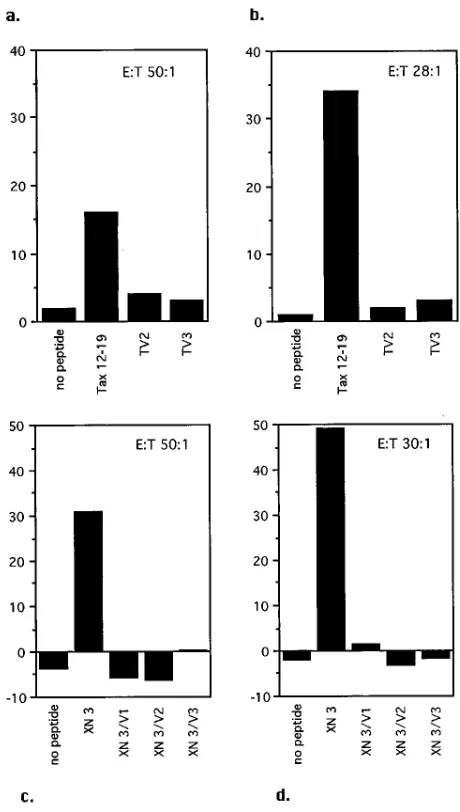
FIG. 1. Variant peptides are not recognized by CTL. The Tax 12-19 epitope and two variants were tested with CTL from TE (top), and the XN3 peptide and its variants were tested with CTL from HM (bottom). Chromium release assays were done with freshly separated CTL (left) or after 19 days in culture (right) at the indicated effector-to-target cell (E:T) ratios.
on November 9, 2019 by guest
http://jvi.asm.org/
[image:2.612.319.549.325.731.2]regions the sequences were identical (Table 1). However, within each isolate, there was considerable sequence hetero-geneity among the clones. For non-HLA-A2 subjects, among 116 tax clones from genomic and cDNA, only 1 clone had one mutation in a CTL epitope-coding region, whereas in a total of 179 tax clones from genomic and cDNA from HLA-A2-posi-tive subjects, 24 clones (13%) had one or more mutations in a CTL epitope-coding region. The difference is highly significant (chi-squared test, P,0.001).
We found nine distinct mutations in five epitopes (Table 1); each individual mutation was found between two and six times. Eight clones had two mutations, and 16 clones had one muta-tion only. All mutamuta-tions were found in genomic DNA. The variants C2 and C3 were also found in cDNA, indicating the current transcription of these variants. The most common vari-ant, C2 (six times), was also found in a single clone in a TSP patient without HLA-A2. The number and distribution of cod-ing changes within the epitopes did not obviously differ from neighboring parts on the tax gene (data not shown).
Mutations in epitopes are not recognized by CTL.We tested the ability of freshly separated CD81T cells from the HLA-A2 patients to recognize the Tax variants without in vitro stimu-lation. Peptides corresponding to the variant sequences were compared with peptides corresponding to the consensus se-quence in a CTL assay. Subsequently, the remaining cells of the sample were cultured for 3 weeks to increase the propor-tion of Tax-specific CTL. In Fig. 1, typical results for two peptides (tax 12-19 and XN3) and their variants are shown. Freshly separated CTL recognized the tax 12-19 and XN3 peptides, but not the variants (Fig. 1a and c), and although culture increased the lytic activity of CTL, no recognition of variant peptides was demonstrated (Fig. 1b and d). Similarly, all other variant peptides failed to be recognized by CTL spe-cific for the consensus peptides (Table 2).
The question arises whether a CTL response subsequently develops in vivo to the variant Tax sequences observed. We tested the recognition of TV2 and TV3 by CTL from TE more than a year after the variant sequences were first documented. The variant peptides were not recognized, and in vitro stimu-lation with TV2 and TV3 did not lead to variant-specific CTL.
CTL escape mutations lead to abolished or diminished Tax function.The Tax protein is able to transactivate, besides the
[image:3.612.314.555.82.260.2]LTR of HTLV-I, promoters regulated by NF-kB and various other cellular promoters (for review, see reference 19). The resulting activation of the infected cell is thought to be bene-ficial for virus replication. We cloned the nine tax variants into the expression vector pJFE14 and tested their ability to trans-activate the LTR of HTLV-I, the promoter of the IL-2R alpha chain, and the c-fos promoter in a CAT assay. As the naturally occurring tax clones carrying C1, C4, and C9 also contained other mutations, these mutations were introduced singly into a clone representing the consensus sequence of TE by in vitro mutagenesis. Lysates from cells transfected with the various mutant plasmids were blotted, and the amount of protein ex-pressed was measured by densitometry. All mutant plasmids produced amounts of protein comparable to those of wild-type
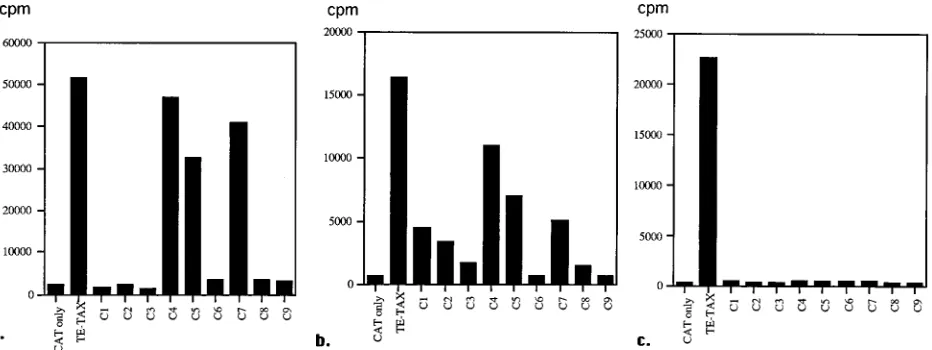
[image:3.612.76.542.515.690.2]FIG. 2. Variant Tax proteins have reduced or abolished transactivational activity. The tax variants tested in CAT assays were naturally occurring clones from subjects HM (C8), HD (C5 and C7), and TE (C2, C3, and C6). Because the changes at nucleotide positions 7354, 7387, and 7675 were on clones with multiple mutations, C1, C4, and C9 were generated by in vitro mutagenesis of the consensus tax from TE. All variants and the consensus tax were cotransfected with a CAT construct under the control of the LTR (a), the promoter of c-fos (b), and the IL-2R alpha chain (c).
TABLE 2. Tax-specific CTL do not recognize variant peptidesa
Peptide
% Lysis at indicated E:T ratio
Fresh CTL Cultured CTL
50:1 10:1 30:1 6:1
None 23.7 22.7 22.1 23.1
XN4
wt 22.4 7 50 29.6
V1 20.8 0.6 10.2 3.3
XN11
wt 17.6 8.4 34.1 20.5
V1 22.0 0.6 23.1 24.6
XN12
wt 18.3 6.9 39.4 22.2
V1 20.7 0.1 2.9 1.2
V2 22.2 20.3 0.5 23.6
None 3.3 1.8 NDb ND
Tax 12-19 20.7 9.8 ND ND
TV1 0.1 2.2 ND ND
aThe wild-type (wt) peptides Tax 12-19, XN4, XN11, and XN12 and their
variants were tested in a chromium release assay with CTL from HM, and the resulting lysis is given as a percentage. Assays were done with freshly separated CTL (left) or after 19 days in culture (right). The second effector-to-target cell (E:T) ratio for Tax 12-19 and the TV1 variant was 25:1. Similar results were obtained with cells from HD and TE.
b
ND, not done.
on November 9, 2019 by guest
http://jvi.asm.org/
Tax except C8, which expressed three times less (data not shown).
Three mutants (C4, C5, and C7) were able to transactivate the LTR but were not as efficient as the consensus Tax (Fig. 2a). The transactivation efficiency for the other mutants (C1, C2, C3, C6, C8, and C9) was at or close to background levels. Similarly, the CAT construct under the control of the c-fos promoter was transactivated not at all (C3, C6, C8, and C9) or at levels strongly reduced compared with wild-type Tax (C1, C2, C4, C5, and C7) (Fig. 2b). None of the Tax mutants was able to transactivate the IL-2R alpha chain promoter (Fig. 2c), which is transactivated by interaction of Tax and NF-kB. Com-paring the overall efficiency of transcription of the tax variants on all three promoters, none was as good as the consensus tax. Two factors probably select against the rise of CTL escape mutants in HTLV-I; one is the simultaneous recognition of multiple epitopes on the Tax protein by CTL (28), and the other is the functional constraints on Tax (32, 34). Most of the tax variants seemed to be functionally impaired, but they oc-curred often enough to be detected within 20 clones. It seems that they have been selected for by the strong CTL pressure on the Tax protein, as they were found almost exclusively in HLA-A2-positive individuals.
Functional impairment of Tax may balance any selective advantage conferred by an amino acid change that abolishes CTL recognition. The naturally occurring Tax variants de-scribed here, which are not recognized by CTL, seem to have a severely reduced functional activity. In vitro mutagenesis has shown that the tax gene is under strong functional constraints (32, 34): most of the single or double mutations introduced into the tax gene impair or abolish tax function. When the HIV transactivator (Tat) quasispecies was investigated, 10 to 15% of the tat clones turned out to be functionally inactive (20). However, these variants of Tat may still form part of the functional gene pool of HIV, as defective HIV genomes can be rescued by a functional genome after cotransfection (5, 17). The same might be true of HTLV-I infection. Another possible mechanism for maintaining mutations within the epitopes is specific antagonism of CTL recognition of the mutant proteins. Certain variant peptide epitope sequences, which themselves are not recognized by T cells, have been shown to inhibit the recognition of the respective wild-type peptide in vitro. This phenomenon of ‘‘peptide antagonism’’ has been described for both MHC class I- and II-restricted T cells (reviewed in refer-ence 8) and has recently been shown to occur in HIV-1 infec-tion (16).
We wanted to evaluate whether the persistence of HTLV-I infection could be explained by the rise of viral mutants which avoid the CTL response. Our data suggest that mutations do indeed arise as a result of CTL selection, but that the func-tional cost to the virus of these mutations is very high, as they severely impair the ability of the Tax protein to transactivate different promoters.
S.N. was supported by AIDS-Stipendienprogramm (Bundesministe-rium fu¨r Forschung und Technologie). C.R.M.B. and S.D. were sup-ported by Wellcome Trust. C.E.P. was supsup-ported by an MRC training fellowship.
REFERENCES
1. Aebischer, T., D. Moskophidis, U. Hoffmann Rohrer, R. M. Zinkernagel, and H. Hengartner.1991. In vitro selection of lymphocytic choriomeningitis virus mutants by cytotoxic T lymphocytes. Proc. Natl. Acad. Sci. USA 88:11047– 11051.
2. Bangham, C. R. M., S. Daenke, R. E. Phillips, J. K. Cruickshank, and J. I. Bell.1988. Enzymatic amplification of exogenous and endogenous retroviral sequences from DNA of patients with tropical spastic paraparesis. EMBO J. 7:4179–4184.
3. Berneman, Z. N., R. B. Gartenhaus, M. S. Reitz, M. E. Klotman, and R. C. Gallo.1992. cDNA sequencing confirms HTLV-I expression in adult T-cell leukemia/lymphoma and different sequence variations in in vivo and in vitro. Leukemia 6(Suppl. 3):67S–71S.
4. Bosselut, R., J. F. Duvall, A. Gegonne, M. Bailly, A. Hemar, J. Brady, and J. Ghysdael.1990. The products of the c-ets-1 proto-oncogene and the related Ets2 protein act as transcriptional activators of the long terminal repeat of human T cell leukemia virus HTLV-I. EMBO J. 9:3137–3144.
5. Clavel, F., M. D. Hoggan, R. L. Willey, K. Strebel, M. A. Martin, and R. Repaske.1989. Genetic recombination of human immunodeficiency virus. J. Virol. 63:1455–1459.
6. Dai, L. C., K. West, R. Littaua, K. Takahashi, and F. A. Ennis. 1992. Mutation of human immunodeficiency virus type 1 at amino acid 585 on gp41 results in loss of killing by CD81A24-restricted cytotoxic T lymphocytes. J. Virol. 66:3151–3154.
7. Ehrlich, G. D. 1992. DNA sequencing analysis of the gene encoding the HTLV-I P21E transmembrane protein reveals inter- and intraisolate genetic heterogeneity. Virology 186:619–627.
8. Evavold, B. D., J. Sloan-Lancaster, and P. M. Allen. 1993. Tickling the TCR: selective T-cell functions stimulated by altered peptide ligands. Immunol. Today 14:602–609.
9. Gessain, A., R. C. Gallo, and G. Franchini. 1992. Low degree of human T-cell leukemia/lymphoma virus type I genetic drift in vivo as a means of monitoring viral transmission and movement of ancient human populations. J. Virol. 66:2288–2295.
10. Gessain, A., A. Louie, O. Gout, R. C. Gallo, and G. Franchini. 1991. Human T-cell leukemia-lymphoma virus type I (HTLV-I) expression in fresh periph-eral blood mononuclear cells from patients with tropical spastic paraparesis/ HTLV-I-associated myelopathy. J. Virol. 65:1628–1633.
11. Gessain, A., J. C. Vernant, L. Maurs, F. Barin, O. Gout, and A. Calender. 1985. Antibodies to human T-lymphotropic virus type-I in patients with tropical spastic paraparesis. Lancet ii:407–409.
12. Hinuma, Y., K. Nagata, M. Hanaoka, M. Nakai, T. Matsumoto, K.-I. Ki-noshita, S. Shirakawa, and I. Miyoshi.1981. Adult T-cell leukemia: antigen in an ATL cell line and detection of antibodies to the antigen in human sera. Proc. Natl. Acad. Sci. USA 78:6476–6480.
13. Holland, J. J., J. C. de la Torre, and D. A. Steinhauer. 1992. RNA virus populations as quasispecies, p. 1–20. In J. J. Holland (ed.), Genetic diversity of RNA viruses. Springer-Verlag, Berlin.
14. Jacobson, S., H. Shida, D. E. McFarlin, A. S. Fauci, and S. Koenig. 1990. Circulating CD81cytotoxic T lymphocytes specific for HTLV-I pX in pa-tients with HTLV-I associated neurological disease. Nature (London) 348: 245–248.
15. Kinoshita, T., M. Shimoyama, K. Tobinai, M. Ito, S.-I. Ito, S. Ikeda, K. Tajima, K. Shimotohno, and T. Sugimura.1989. Detection of mRNA for the tax1/rex1 gene of human T-cell leukemia virus type I in fresh peripheral blood mononuclear cells of adult T-cell leukemia patients and viral carriers by using the polymerase chain reaction. Proc. Natl. Acad. Sci. USA 86:5620– 5624.
16. Klenerman, P., S. Rowland-Jones, S. McAdam, J. Edwards, S. Daenke, D. Lalloo, B. Ko¨ppe, W. Rosenberg, D. Boyd, A. Edwards, P. Giangrande, R. E. Phillips, and A. J. McMichael.1994. Cytotoxic T-cell activity antagonized by naturally occurring HIV-1 gag variants. Nature (London) 369:403–407. 17. Li, Y., H. Hui, C. J. Burgess, R. W. Price, P. M. Sharp, B. H. Hahn, and
G. M. Shaw.1992. Complete nucleotide sequence, genome organization, and biological properties of human immunodeficiency virus type 1 in vivo: evi-dence for limited defectiveness and complementation. J. Virol. 66:6587– 6600.
18. Lichtensteiger, C. A., W. P. Cheevers, and W. C. Davis. 1993. CD81 cyto-toxic T lymphocytes against antigenic variants of caprine arthritis-encepha-litis virus. J. Gen. Virol. 74:2111–2116.
19. Lindholm, P. F., F. Kashanchi, and J. N. Brady. 1993. Transcriptional regulation in the human retrovirus HTLV-I. Semin. Virol. 4:53–60. 20. Meyerhans, A., R. Cheynier, J. Albert, M. Seth, S. Kwok, J. Sninsky, L.
Morfeldt-Manson, B. Asjo¨, and S. Wain-Hobson.1989. Temporal fluctua-tions in HIV quasispecies in vivo are not reflected by sequential HIV iso-lates. Cell 58:901–910.
21. Muchardt, C., J.-S. Seeler, A. Nirula, S. Gong, and R. Gaynor. 1992. Tran-scription factor AP-2 activates gene expression of HTLV-I. EMBO J. 11: 2573–2581.
22. Niewiesk, S. Microversion of a CAT assay. Betaplate News, in press. 23. Niewiesk, S., and C. R. M. Bangham. 1994. Unpublished data.
24. Niewiesk, S., S. Daenke, C. E. Parker, G. Taylor, J. Weber, S. Nightingale, and C. R. M. Bangham.1994. The transactivator gene of human T-cell leukemia virus type I is more variable within and between healthy carriers than patients with tropical spastic paraparesis. J. Virol. 68:6778–6781. 25. Osame, M., K. Usuku, S. Izumo, N. Ijichi, H. Amitani, A. Igata, M.
Mat-sumoto, and M. Tara.1986. HTLV-I associated myelopathy, a new clinical entity. Lancet i:1031–1032.
26. Parker, C. 1994. Ph.D. thesis, University of Oxford, Oxford.
27. Parker, C. E., S. Daenke, S. Nightingale, and C. R. M. Bangham. 1992. Activated, HTLV-I-specific cytotoxic T-lymphocytes are found in healthy
on November 9, 2019 by guest
http://jvi.asm.org/
seropositives as well as in patients with tropical spastic paraparesis. Virology 188:628–636.
28. Parker, E. P., S. Nightingale, G. P. Taylor, J. Weber, and C. R. M. Bangham. 1994. Circulating anti-Tax cytotoxic T lymphocytes from human T-cell leu-kemia virus type I-infected people, with and without tropical spastic para-paresis, recognize multiple epitopes simultaneously. J. Virol. 68:2860–2868. 29. Phillips, R. E., S. Rowland-Jones, D. F. Nixon, F. M. Gotch, J. P. Edwards, A. O. Ogunlesi, J. G. Elvin, J. A. Rothbard, C. R. M. Bangham, C. R. Rizza, and A. J. McMichael.1991. Human immunodeficiency virus genetic varia-tion that can escape cytotoxic T cell recognivaria-tion. Nature (London) 354:453– 459.
30. Pircher, H., D. Moskophidis, U. Rohrer, K. Bu¨rki, H. Hengartner, and R. M. Zinkernagel.1990. Viral escape by selection of cytotoxic T cell-resistant virus variants in vivo. Nature (London) 346:629–633.
31. Poiesz, B. J., F. W. Ruscetti, A. F. Gazdar, P. A. Bunn, J. D. Minna, and R. C. Gallo.1980. Detection and isolation of type C retrovirus particles from fresh and cultured lymphocytes of a patient with cutaneous T-cell lymphoma. Proc. Natl. Acad. Sci. USA 77:7415–7419.
32. Semmes, O. J., and K.-T. Jeang. 1992. Mutational analysis of human T-cell leukemia virus type I Tax: regions necessary for function determined with 47 mutant proteins. J. Virol. 66:7183–7192.
33. Siekevitz, M., M. B. Feinberg, N. Holbrock, F. Wong-Staal, and W. C.
Greene.1987. Activation of interleukin 2 and interleukin 2 receptor (Tac) promoter expression by the transactivator (tat) gene product of human T-cell leukemia virus, type I. Proc. Natl. Acad. Sci. USA 84:5389–5393. 34. Smith, M. R., and W. C. Greene. 1990. Identification of HTLV-I tax
trans-activator mutants exhibiting novel transcriptional phenotypes. Genes Dev. 4:1875–1885.
35. Sodroski, J. G., C. A. Rosen, and W. A. Haseltine. 1984. Trans-acting tran-scriptional activation of the long terminal repeat of human T lymphotropic retroviruses in infected cells. Science 225:381–385.
36. Takebe, Y., M. Seiki, J. Fujisawa, P. Hoy, K. Yokota, K. Arai, M. Yoshida, and N. Arai.1988. SRa promoter: an efficient and versatile mammalian cDNA expression system composed of the simian virus 40 early promoter and R-U5 segment of human T-cell leukemia virus type I long terminal repeat. Mol. Cell. Biol. 8:466–472.
37. Townsend, A., and H. Bodmer. 1989. Antigen recognition by class I-restricted T lymphocytes. Annu. Rev. Immunol. 7:601–624.
38. Treisman, R. 1985. Transient accumulation of c-fos RNA following serum stimulation requires a conserved 59element and c-fos 39sequences. Cell 42:889–902.
39. White, H. D., M. D. Robbins, and W. R. Green. 1990. Mechanism of escape of endogenous murine leukemia virus emv-14 from recognition by anti-AKR/ Gross virus cytolytic T lymphocytes. J. Virol. 64:2608–2619.