A review of practice in the implementation of
the early language development support
element within Flying Start
Ymchwil gymdeithasol Social research
Number 62/2014
A review of practice in the implementation of the early
language development support element within Flying
Start
May 2014
Arad Research in partnership with the National Centre
for Language and Literacy (University of Reading)
Hefin Thomas, Jennifer Lane, Jennifer Evans and Professor Viv Edwards
Views expressed in this report are those of the researcher and not necessarily
those of the Welsh Government.
For further information please contact:
Hayley Collicott
Children, Young People and Families Division
Welsh Government
Cathays Park Cardiff
CF10 3NQ
Tel: 029 2082 3111
Email: [email protected].
Welsh Government Social Research, 28 May 2014
ISBN 978-1-4734-1524-9
Contents
1. Executive summary... 2
2. Introduction to the Review... 9
3. Methodology... 13
4. Awareness and Understanding... 18
5. Engagement... 26
6. Models and Structure of Delivery... 36
7. Monitoring and Assessment... 48
8. Capacity and Training... 54
9. Conclusions and Recommendations... 61
1 Executive summary
Introduction to the review
1. Arad Research, working in partnership with the National Centre for
Language and Literacy based at the University of Reading, was
commissioned to conduct a review of current practice in relation to early
language development (ELD) interventions within Flying Start.1
2. The findings of this review of practice are intended to help shape
guidance associated with the early language development entitlement of
the Flying Start programme. Flying Start is a Welsh Government
flagship programme targeted at families with children aged between
nought and three living in some of the most disadvantaged communities
in Wales.
Methodology
3. The methodology for the review involved a mixture of qualitative and
quantitative methods. This mixed methods approach was chosen to
enable data to be gathered from all local authorities whilst also
collecting more detailed information and views in a smaller number of
areas. The approach included desk research and analysis of information
from all local authorities2, an electronic survey of all Flying Start teams,
fieldwork with Flying Start staff and parents in selected local authorities
and a group discussion with Speech and Language Therapists (SLTs).
4. The electronic survey was designed to collect data and views from all
the local authority Flying Start teams. At the same time, the qualitative
fieldwork with Flying Start staff and parents enabled more detailed views
on the ELD entitlement to be collected. All fieldwork was carried out
between December 2013 and February 2014.
1
Although there is not a standard definition of ELD services/activities, in this report we define them broadly as those activities that are most related to the ELD entitlement. These include, Language and Play groups, one-to-one sessions delivered by SLTs and other professionals; group and one-to-one ELD activities within other settings (e.g. Childcare settings, Health Visitor clinics).
2
Models and Structure of Delivery
5. The type and structure of ELD provision offered by local authorities was
examined during the review. Different types of delivery included
universally available ELD activities, more targeted ELD activities and
ELD activities where delivery is embedded within other Flying Start
entitlements. The links between Flying Start ELD activity and generic
Language and Play/Number and Play (LAP/NAP) provision (i.e. that
which is provided across the whole of Wales rather than only in Flying
Start areas) were also considered during the review.
6. The review found that the delivery of universal ELD provision (e.g. LAP
groups), whilst important, is not sufficient to reach all families and
particularly those in high need groups. To ensure that more families
access ELD activities, greater emphasis should be placed on
embedding ELD across all entitlements. This requires ELD activities to
be regularly delivered within other settings. This also requires clear and
consistent modelling of good practice in adult-child interaction by staff.
7. The role of SLTs in shaping the delivery of ELD activities and providing
advice and guidance to other professionals was considered to be
important. Flying Start staff outlined the value of regular sessions with
SLTs to be able to raise queries and share experiences.
Awareness and Understanding
8. The review considered the views of Flying Start staff in terms of their
perceptions of levels of parental awareness and understanding of ELD.
Flying Start staff who participated in fieldwork reported that awareness
and understanding of the ELD entitlement and the benefits of activities
to develop ELD were low among parents. This was particularly the case
among high need families who are less engaged in universal ELD
activities (e.g. Language and Play groups). This reinforces the findings
of qualitative research undertaken as part of the National Evaluation of
of the programme ... because parents failed to understand the ‘point’ of LAP, often not understanding how it would help’ (p. 49, Welsh
Government, 2013c).
9. During the review, local authorities provided information on their
approaches to raise awareness and understanding of ELD among
parents. Much of the activity highlighted was focused on raising parental
awareness of ELD activities. Less emphasis was placed on promoting
the benefits of ELD to parents. The evidence suggested that a greater focus was placed on embedding messages within activities. This ‘soft promotion’ of ELD across entitlements was considered to be an effective
approach to overcome parental reluctance to engage in ELD and should
be further developed.
10. Many practitioners provided suggestions to improve parental awareness
and understanding of the benefits of ELD. Local authorities outlined a
need for consistent and clear national messages relating to the key
milestones in ELD, good practice in adult-child interaction and the
benefits of ELD for child development. This could help ensure that more
information and activities relating to ELD are presented and delivered
within the other Flying Start entitlements.
11. The cross-cutting nature of the ELD entitlement requires all Flying Start
staff to have an understanding of these key messages and to promote
them across the other entitlements (e.g. in nurseries, during home
visits). The role of SLTs in raising the awareness and understanding of
ELD among staff is a crucial part of this process.
Engagement
12. The review considered how local authorities engaged families in ELD
and how barriers to engagement are addressed. Engagement was
defined as the process of getting families to take part in Flying Start ELD
activities and to maintain their participation. Identification and referral
processes for families with particular needs in terms of ELD were also
13. The multi-disciplinary approach adopted by local authorities was
considered crucial to engaging families in ELD. This is particularly the
case for families with high needs. The relationships built by Health
Visitors and family support workers are vital in building trust with families
as well as encouraging and supporting them to access ELD services. This approach was considered important in creating a more ‘social’ and less ‘medical’ perception of SLT, which could improve the engagement
of high need families.
14. The importance of a multi-disciplinary approach was evident in how
local authorities create opportunities to engage families that are
reluctant to access ELD services. Approaches included ELD drop-in
sessions in Health Visitor waiting rooms, informal introductions to other
staff in childcare settings and personal one to one communication (face
to face as well as via text messaging). The promotion of such
approaches to engage families should be encouraged.
15. Clear referral processes are crucial to identifying the needs of children
and targeting them with appropriate services. The ability of Flying Start
staff to recognise ELD milestones and refer cases appropriately to SLTs
or other appropriate professionals is important. Similarly, the role of
SLTs in advising other staff on the appropriateness of referrals for
additional support is equally crucial.
16. Many staff proposed that engagement in ELD activity should begin
earlier, ideally at the ante-natal stage in order to build awareness and
encourage participation in ELD.
Screening and Assessment
17. The approaches taken by local authorities to identify, screen and assess
children in terms of ELD were considered during the review. As well as
being required to provide monitoring data to the Welsh Government on
children in their Flying Start areas, a variety of tools are used by local authorities to assess and identify children’s needs and to monitor their
18. The use of appropriate screening and assessment tools was considered important in terms of identifying children’s needs and providing evidence
of progression. Staff welcomed the national use of the Schedule of
Growing Skills (SoGS) as a child development assessment tool whilst
acknowledging that it is not a specialist tool for assessing speech and
language development. Although in Flying Start universal training for
using SoGS is provided across Wales, many staff highlighted
inconsistencies in the tool’s implementation and considered that the
guidance for SoGS should be more prescriptive.
19. The Welsh Government outlined several measures that were being put in place to reinforce the national training including a ‘Trainer Network’
and regular communication to SoGS practitioners with further guidance.
20. The role of SLTs in providing advice and guidance on the use of
screening and assessment tools was considered important by Flying
Start staff.
Capacity and Training
21. The review considered the capacity levels of local authority Flying Start
teams to deliver the ELD entitlement as well as the amount and type of
training offered to staff within different roles.
22. The majority of local authorities employ SLTs as part of their core
teams. During visits, Flying Start co-ordinators emphasised the
importance of SLT capacity in the planning, delivery and monitoring of
the ELD entitlement. The role of SLTs in training and supporting other
professionals such as advisory teachers, LAP staff and childcare staff
was highly valued.
23. Flying Start co-ordinators and SLTs outlined a need for all staff to
receive basic ELD training including an understanding of ELD norms3
and good practice in adult-child interaction. The need for staff who
spend more time with children to participate in more detailed accredited
training was also highlighted.
3
24. Many local authorities suggested that staff should receive continued
training or refresher courses to raise awareness of the importance of
ELD.
Recommendations
25. The following recommendations are made on the basis of the review:
i. The Welsh Government could consider developing a pack of
written and digital ELD resources, which could be used by all
local authorities to outline key messages relating to ELD and the
benefits of the entitlement. These messages would be applicable
for parents and staff. The development of these resources could
be led by a group consisting of individuals with a mixed set of
skills including SLTs, representatives of each of the entitlements
and a parent.
ii. The profile of the ELD entitlement within Flying Start should be
raised and it should be embedded as a cross-cutting entitlement
within the Flying Start Health Visitor service, parenting support
programmes and childcare. This could be achieved by
encouraging more information and activities relating to ELD to be
presented and delivered as part of the other Flying Start
entitlements.
iii. Information on the benefits of ELD and activities relating to the
entitlement should be promoted to all parents earlier starting at
the antenatal stage.
iv. Building on the examples highlighted in this report, notable
practice regarding activities that successfully engage high need
families in ELD activities should be identified and disseminated to
local authorities. This could be done via Flying Start co-ordinator
meetings or established regional SLT networks. Examples of
parents during the ante-natal period, delivering one-to-one
sessions in the home and family support workers attending ELD
sessions with families.
v. All local authorities should employ SLTs as part of their core
teams, with a particular focus on the ELD entitlement.
vi. All Flying Start staff should receive a minimum level of training
relating to ELD norms and good practice in adult-child interaction.
This training should be overseen by a SLT.
vii. Flying Start childcare practitioners and other staff who deliver
ELD provision directly to children should be encouraged to
undertake more detailed training relating to ELD. Where possible,
this training should be accredited and planned by a SLT.
viii. All staff using screening and assessment tools should receive
training on the implementation of these tools to ensure that they
2 Introduction to the Review
2.1 Arad Research, working in partnership with the National Centre
for Language and Literacy based at the University of Reading,
was commissioned to conduct a review of current practice in
relation to early language development (ELD) interventions
within Flying Start.
2.2 This research was commissioned to inform future Flying Start
policy, and specifically guidance associated with the ELD
entitlement to the programme.
2.3 This report presents the findings of the review, which was
carried out between December 2013 and February 2014.
Flying Start
2.4 In 2006/7,
t
he Welsh Government launched the Flying Startprogramme, which aims ‘to make a decisive difference to the life
chances of children aged under four in the areas in which it runs’ (p. 1, Welsh Government, 2009). The programme is an
area-based programme, geographically targeted to some of the
most disadvantaged areas of Wales and is universally available
to families with children aged nought to four in those areas.
Through early identification of the needs of these individual
families, the programme aims to improve children's language,
cognitive, social and emotional development and physical
health. By supporting children's development, the programme
aims in the longer term to reduce the number of people with
very poor skills, improve qualifications at the end of schooling
and increase employment prospects.
2.5 Flying Start is administered as a grant to local authorities to fund
provision for children and their families within selected target
areas. Provision delivered as part of the programme consists of
Free, high quality, part-time childcare;
Intensive health visiting support;
Parenting support; and
Support for Early Language Development.
2.6 Families within the targeted areas have access to all the
entitlements of the Flying Start programme. Although the core
entitlements are universally available to families in the selected
areas, tailored support depending on individual families' needs
is an important aspect of the programme. These entitlements
delivered as a holistic package based on specific individual
family needs.
Management of Flying Start
2.7 Each local authority has a Flying Start co-ordinator who manages
a core team of staff delivering the programme. The members of
this core team differ across local authorities but may include:
Health Visitors; Parenting Workers; Childcare Workers;
Midwives; Speech and Language Therapists (SLTs); and
Language and Play Workers. The Flying Start Strategic
Guidance (Welsh Government, 2012a) recognises the important
roles that these various practitioners make to the programme.
2.8 As part of the Flying Start Strategic Guidance, the Flying Start
Financial Management Annex document (Welsh Government,
2012b) states the following:
‘The Welsh Government has allocated Flying Start funding to local authorities. Each local authority’s allocation covers its
own spending and that of its associated third party Flying
Start providers. Within the agreed totals, it has considerable
discretion over setting priorities to deliver the Flying Start
services for which it is responsible’ (p. 11).
2.9 Local authorities are required to submit their Flying Start budget
demonstrates that the ELD budget was only a small proportion
of the overall Flying Start budget in all local authorities in
2012-13: ranging from 13.85 per cent to 0.7 per cent across local
authorities in Wales. This suggests that only a small proportion
of the grant provided to local authorities for the Flying Start
programme is used to fund ELD staffing and contract costs. The
data also indicates that the actual spend on the ELD entitlement
can vary when compared to the budget allocated: this ranged
from an overspend of 20 per cent in one local authority to an
underspend of 63 per cent in another in 2012-13.
Aim and objectives of the study
2.10 The overall aim of the project was to review current practice
across all 22 local authorities in Wales in relation to the
implementation of the ELD support entitlement within Flying
Start. The findings of this review will complement those of a
corresponding review of research evidence (Welsh
Government, 2014a) on early speech and language
interventions undertaken in parallel to this study. Both reports
will help inform Welsh Government Flying Start guidance
documents.
2.11 A number of other evaluation reports have been published over
the last five years (Welsh Government, 2010, 2011, 2013a,
2013b, 2013c, 2014b). One of these reports, Flying Start
qualitative research with high needs families (Welsh
Government, 2013c), highlighted the low uptake of Language
and Play (LAP) courses among families with high needs.4 It also
reported that the ELD entitlement was valued far less than other
elements of the Flying Start programme, attributing this
perception to parents’ lack of understanding of the benefits the
entitlement would bring to them and their children. The present
review of current practice therefore builds on this recent
4
research and explores points that emerged from the recent
3 Methodology
3.1 This section provides an overview of the methodology that was
used to conduct the review of current practice of the
implementation of the ELD entitlement within Flying Start.
Overview of the methodology
3.2 The review involved a mixture of qualitative and quantitative
methods including desk research and analysis of information
from local authorities5, an electronic survey of Flying Start
teams, fieldwork with Flying Start staff and parents in selected
local authorities and a group discussion with Speech and
Language Therapists (SLTs). Below we outline the rationale and
limitations of the methodology, whilst sections 3.7 to 3.13
provide an overview of these approaches.
3.3 The rationale for the mixed method approach outlined above
was to enable a breadth of information to be analysed from all
local authorities whilst undertaking more in depth research in a
smaller group of areas. The electronic survey was designed to
collect data and views from all the local authority Flying Start
teams. At the same time, the fieldwork with Flying Start staff and
parents enabled more detailed views on the ELD entitlement to
be collected.
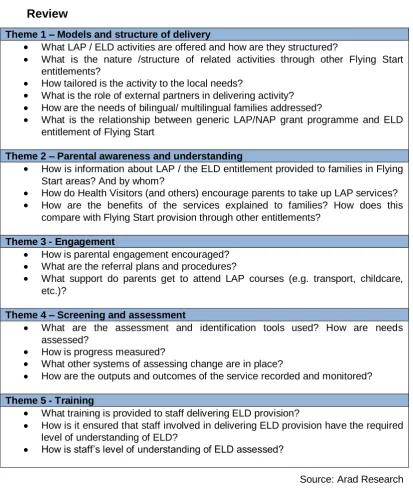
3.4 To ensure a consistent approach, research themes identified
from the outset, and summarised in Table 1, provided a
framework both for the collection of data and for reporting the
findings of the review from section 4 onwards.
5
Table 1. Overview of research themes and key questions for the
Review
Theme 1 – Models and structure of delivery
What LAP / ELD activities are offered and how are they structured?
What is the nature /structure of related activities through other Flying Start entitlements?
How tailored is the activity to the local needs?
What is the role of external partners in delivering activity? How are the needs of bilingual/ multilingual families addressed?
What is the relationship between generic LAP/NAP grant programme and ELD entitlement of Flying Start
Theme 2 – Parental awareness and understanding
How is information about LAP / the ELD entitlement provided to families in Flying Start areas? And by whom?
How do Health Visitors (and others) encourage parents to take up LAP services? How are the benefits of the services explained to families? How does this compare with Flying Start provision through other entitlements?
Theme 3 - Engagement
How is parental engagement encouraged? What are the referral plans and procedures?
What support do parents get to attend LAP courses (e.g. transport, childcare, etc.)?
Theme 4 – Screening and assessment
What are the assessment and identification tools used? How are needs assessed?
How is progress measured?
What other systems of assessing change are in place?
How are the outputs and outcomes of the service recorded and monitored?
Theme 5 - Training
What training is provided to staff delivering ELD provision?
How is it ensured that staff involved in delivering ELD provision have the required level of understanding of ELD?
How is staff’s level of understanding of ELD assessed?
Source: Arad Research
Limitations of the methodology
3.5 The methodology adopted for the review has provided valuable
insights into what Flying Start staff considered to be effective in
delivering the ELD entitlement. However, limited quantitative
evidence of the impact of different approaches is available to
lend greater weight to these perceptions. Furthermore, the
has meant that more in-depth information from practitioners and
parents in other areas of Wales is not included.
3.6 The findings presented in this report are based on the views of
professionals, drawing on their knowledge and experience of
delivering ELD. These insights and views are valuable in
informing future approaches. It is important to note, however,
that there has been limited independent evaluation of the
methods and programmes currently in use across the local
authorities. This is reinforced in the findings from the
corresponding review of evidence report (Welsh Government,
2014a). Indeed, this was acknowledged by many of the SLTs
consulted during the review and may be an area for
consideration in future evaluations of Flying Start.
Desk research
3.7 The desk research consisted of a review of the background
documentation to gain an initial understanding of the ELD
activities and approaches being adopted and delivered through
the Flying Start programme across Wales. Documents that were reviewed included all local authorities’ Flying Start strategic and
delivery plans and data monitoring workbooks, which the local
authorities are required to submit to the Welsh Government.6
3.8 In addition to reviewing the above documentation, data collected
through Schedule of Growing Skills (SoGS) assessments, a tool used by all local authorities to assess children’s development
was analysed to establish any associations with the research
themes and key questions for the Review.
6
Within their Flying Start strategic plans, local authorities are required to outline their plans for the programme from 2012 to 2015. These plans focus on the four core elements of the
programme are submitted to the Welsh Government every three years. Local authorities are also required to submit deliver plans which outline any changes to the delivery of the
Survey of Flying Start teams
3.9 In addition, Flying Start co-ordinators were invited to provide
details of the ELD entitlement within their local authority via an
email survey. Responses were received from all 22 local
authorities in January and February 2014. These responses
were reviewed and common themes were identified. The survey
pro forma is included in Annex 1.
Qualitative fieldwork with selected local authorities
3.10 To gain a more in depth understanding of the ELD provision
delivered within Flying Start areas and to identify examples of
good practice, visits to five local authorities were undertaken in
January and February 2014. These were selected to include: a
mix of urban and rural areas; a geographical spread across
Wales; an area with a high proportion of black and minority
ethnic (BME) families; and an area with a relatively high
proportion of Welsh speakers. The rationale for this approach
was to ensure that the sample of local authorities was as
representative of Wales as possible.
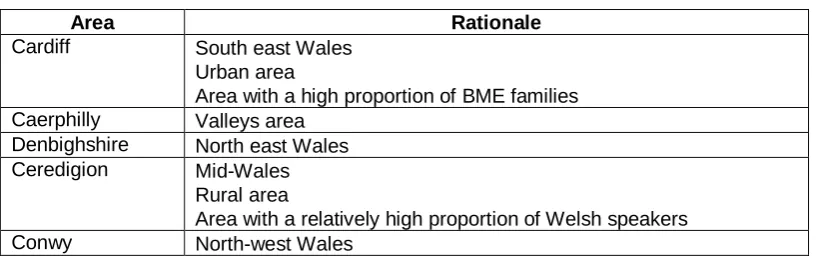
3.11 Table 2 below shows the five selected local authorities and the
[image:18.595.111.526.551.684.2]rationale for their selection.
Table 2. Selected local authorities and rationale for their selection
Area Rationale
Cardiff South east Wales Urban area
Area with a high proportion of BME families Caerphilly Valleys area
Denbighshire North east Wales Ceredigion Mid-Wales
Rural area
Area with a relatively high proportion of Welsh speakers Conwy North-west Wales
Source: Arad Research
3.12 During the visits to the five local authorities, interviews or group
discussions were conducted with the Flying Start co-ordinator,
Advisory Teachers, Childcare Workers, family support workers7,
Language and Play staff and primary school teachers, also took
place during visits8. Observations of ELD activities being
delivered by SLTs and other staff in various settings were also
undertaken in each area. These included baby LAP groups,
ELD activities in nurseries, one-to-one sessions in the home,
training for parents and training for staff. Informal discussions
with parents were also conducted following these activities. A
summary of the fieldwork undertaken in each area is included in
Annex 2.
Group discussion with Speech and Language Therapists (SLTs)
3.13 A focus group with seven SLTs was conducted to determine
their views on current ELD provision as part of Flying Start
across Wales and models of good practice. The SLTs taking
part in the focus group were from a wide range of local
authorities. In addition, participants included a representative
from the Royal College of Speech and Language Therapists
(RCSLT) and a SLT from Aneurin Bevan Health Board.
7
Although this is not a formally defined role in Flying Start guidance, several local authorities employ staff in a ‘family support worker’, ‘family worker’ or ‘family key worker’ role. In the local authorities visited during the fieldwork, this role appears to involve building relationships with a caseload of higher need families and engaging them in the community, often undertaking activities in the home with a view to eventually getting families to attend group sessions. 8
4 Models and Structure of Delivery
4.1 The report on the delivery and implementation of Flying Start, as
part of the National Evaluation (Welsh Government, 2013a),
suggested that different models of delivering the ELD
entitlement could help improve parental engagement.
4.2 This section outlines the findings of the review in terms of the
type and structure of ELD provision offered by local authorities.
These include universally available ELD activities, more
targeted ELD activities and ELD activities where delivery is
embedded within other Flying Start entitlements.
Universally available ELD activities
4.3 The main ELD provision offered through Flying Start is
Language and Play (LAP) / Number and Play (NAP). All local
authorities offer LAP/NAP but structure its delivery in slightly
different ways. Some LAP/NAP provision is through group
sessions, often delivered in childcare or community settings,
and other provision is via one-to-one sessions, delivered in
centres or the family home. Most local authorities offer both
group sessions and one-to-one sessions. Whether families
attend group sessions or receive one-to-one sessions depends
on needs.
4.4 LAP sessions are often delivered in ‘drop-in’ sessions across
local authorities but are also offered as a course (usually 4-6
sessions) within the programme. Several Flying Start
co-ordinators and staff highlighted the challenge of getting parents
to commit to a set course of LAP sessions. Some Flying Start
staff considered drop-in provision to be more appealing to
parents and a way of reaching greater numbers of children.
4.5 In order to overcome barriers, such as the perception that LAP groups were too formal, several local authorities ‘branded’ these
the review included ‘Laugh and Learn’, ‘Little Stars’, ‘Let’s Sing’ and ‘Singing Hands’.
4.6 Local authorities have adopted a multi-disciplinary approach to
delivering LAP, involving SLTs, assistant SLTs, advisory
teachers and other staff in the delivery of these sessions. Some
local authorities ensured that at least one member of staff
involved in delivering LAP in each setting had received training
from a SLT.
4.7 LAP sessions observed during the review involved a number of
methods of delivery with children from four months to three
years old. These included:
parents and children singing and reciting nursery rhymes in
a group (with lyric sheets provided by the local authorities);
families sitting in a circle with children taking turns to play
with various toys;
children listening to a practitioner reading a story;
children observing a puppet show; and
more informal play opportunities.
4.8 During all of the LAP sessions observed, SLTs and other staff
disseminated ideas to parents verbally and through written
materials, and encouraged parents to try these activities at
home. Staff also passed on tips for creating simple toys and
different play strategies that would encourage ELD. Some of the
groups observed offered opportunities for parents to borrow
books and other resources from the setting.
More targeted ELD programmes
4.9 Local authorities reported that, where children are identified as
having additional needs in terms of ELD, specific tailored
interventions are often planned by SLTs in partnership with
SLTs in clinics or Flying Start centres or recommendations to
attend universal ELD sessions such as LAP.
4.10 Staff in local authorities also noted that SLTs often play a more
strategic role in planning interventions for family support
workers to deliver in the home. This could involve undertaking
initial assessments and setting targets for activities to be
delivered with the family. Flying Start co-ordinators emphasised
the important consultative role played by SLTs in planning and
overseeing interventions delivered by other staff as well as
providing guidance and support. This role was considered important because of SLTs’ knowledge of the most appropriate
programmes and interventions as well their ability to assess the
progress of children and advise how best to deliver activities.
Flying Start staff outlined how drawing on the expertise of SLTs
gave them greater confidence in delivering ELD interventions.
4.11 During this review, several local authorities reported that
parents of children in high need families were often reluctant to
engage with SLTs, or with targeted ELD support delivered by
other staff. It was considered important to explain what happens
in a clinical appointment with a SLT as a way of minimising the
number of missed appointments.
4.12 Flying Start co-ordinators and SLTs emphasised the different
approach to missed appointments in Flying Start areas. In
generic SLT services, missed appointments would lead to
children being discharged; it is not be possible for staff to
follow-up families because of a lack of capacity and absence of
consent. In Flying Start areas, the additional capacity and closer
working relationships within a multi-disciplinary team allow SLTs
to ask other staff (e.g. family support workers) to help follow-up
these families, leading to greater re-engagement with ELD services. One SLT noted that: ‘In Flying Start, there is more of a
services is beneficial in engaging high need families through
Flying Start.
4.13 A range of speech and language programmes are used by local
authorities as part of structured activities for parents. Two
programmes cited in the National Evaluation of Flying Start and
mentioned frequently during this review are Elklan and Hanen.
Elklan is a speech and language programme that includes
training for practitioners and parents of children under five. The
Hanen Early Language Programme is a language development
programme used in a wide range of countries. In the context of
Flying Start, many local authorities have integrated these as
part of broader parenting support. Local authorities highlighted
the good feedback received from parents and staff who had
attended these courses and referred to anecdotal evidence of a
positive impact on staff confidence and enthusiasm. However,
they also noted that recruiting high need parents to take part
and maintain their attendance on ten week courses was very
challenging and, in many cases, unrealistic. This was because
many of these families had low confidence or motivation and
were reluctant to commit to attending this many sessions in
advance.
4.14 Several local authorities were focussing on shorter courses for
parents (two to four weeks) in order to try and improve take-up
and attendance. An example of a shorter course outlined by two local authorities was the Ican ‘Talk boost’ programme9
. Recently
introduced in one local authority, this two-week course was seen as ‘parent friendly’ because it involved four sessions over
a fortnight rather than ten sessions delivered over a couple of
months as with some other courses. It was therefore considered
easier to recruit parents and ensure they completed the course.
Staff reported that they had better levels of attendance on these
shorter courses.
9
4.15 Many local authorities offer additional services which focus on
overall child development with an element of ELD within them. For example, one local authority described their ‘portage’ or
home visiting educational service for pre-school children with
additional needs. Similarly another local authority delivers
Parent as First Teacher (PAFT) sessions. PAFT focuses on children’s overall development by emphasising the importance
of parent child interaction through play. Although it aims to support children’s overall development, communication is a key
component.
Embedding ELD delivery within other entitlements
4.16 The importance of embedding the ELD entitlement across the
other three Flying Start entitlements was evident during the
review. The ELD entitlement of Flying Start is not delivered in
isolation from the other three Flying Start entitlements but
instead is embedded across the whole programme. The Flying
Start qualitative research with high need families report (Welsh
Government, 2013c) suggested that integrating LAP/NAP
activities within childcare or as part of parenting programmes
could help boost parental engagement. The evidence from this
review reinforces this conclusion, drawing on a number of
examples of local authorities incorporating ELD within childcare,
parenting and Health Visitor entitlements.
4.17 The review highlighted examples of how the Health Visiting
entitlement of Flying Start links with the ELD entitlement. Health Visitors are normally the family’s first point of contact within
Flying Start and provide information regarding ELD activities.
They also conduct initial assessments on the children, mainly
using the SoGS, and refer children to SLTs or other staff if
assessments identify additional needs. Section 6.9 below
outlines that, in one local authority, LAP sessions are delivered
was considered by staff to be a successful approach to
engaging parents.
4.18 The delivery of ELD provision is also embedded within the
childcare entitlement of Flying Start. Several examples of SLTs
or advisory teachers delivering ELD interventions in nurseries
were encountered during the review. For example, in one local authority’s childcare settings, staff deliver a nine week ELD course entitled ‘First 100 words’ to targeted children.
Additionally LAP sessions are often delivered in childcare
settings.
4.19 In some local authorities, trained staff will visit childcare settings to promote ELD. For example, in one local authority ‘Key Family Workers’ run small group sessions to fulfil this role. In another
local authority, a team of advisory teachers visits childcare
settings to deliver ELD activities and model good practice to key
childcare workers. Targets are then set for key workers to
deliver specific ELD activities with individual children.
4.20 As well as delivering provision, staff within childcare settings will assess children’s language development and refer those
identified as being at risk. SLTs may visit childcare settings and
conduct speech and language assessments. They will provide
support to the childcare staff in delivering the ELD entitlement.
Often, if children are identified as having additional needs, play
plans are developed to support their ELD within the setting.
These play plans are often developed with the input of a SLT
and reviewed regularly by the childcare staff to monitor children’s progress. In some local authorities, Flying Start
childcare staff also receive ELD training e.g. Elklan (see section
8).
4.21 ELD messages are also embedded within parenting
programmes. For example a number of local authorities offer a parenting programme entitled ‘You Make the Difference’. This
interacting with children, including how parents can positively support their child’s language development. Staff in one local
authority identified the Parents as First Teachers (PAFT) course
(see 6.14) as an effective way of embedding ELD within a
parenting course. PAFT focuses on teaching parents about child
development, and in particular brain development, and helping
them to talk, play and interact with their child. PAFT was viewed as offering a ‘non-threatening approach’ and that this therefore
made it easier to get parents involved. One staff member commented that ‘[The PAFT programme] is about changing the culture of how child interaction is viewed’.
4.22 Flying Start co-ordinators highlighted the importance of ensuring
that ELD is embedded across all the entitlements (i.e. that
information and activities relating to ELD are presented and
delivered within the other Flying Start entitlements) and that this
should inform future policy development. The evidence from this
review suggests that this is happening and is effective in
engaging parents. Multi-disciplinary working was considered to
be crucial in ensuring that this happens.
‘Liaison between all services in FS especially as children
move toward childcare settings is vital so that additional support can be put in place where difficulties are identified.’
Flying Start co-ordinator survey response.
Relationship between Flying Start and generic LAP / ELD provision
4.23 In addition to ELD provision delivered through Flying Start, all
local authorities receive a separate LAP grant to deliver
interventions across the whole local authority (i.e. in Flying Start
and non-Flying Start areas). The relationship between the
provision delivered through these funding streams was explored
during fieldwork with local authorities.
4.24 Survey responses from local authorities indicate that they have
Start LAP/NAP provision. These include: delivering and
managing generic and Flying Start LAP/NAP separately;
delivering the same generic provision in both Flying Start and
non-Flying Start areas; and both Flying Start and generic staff
working in partnership within Flying Start areas with generic
services also offered in non-Flying Start areas. The evidence
gathered during the review is not suitable for evaluating whether
one approach is more or less effective than another.
4.25 Eight local authorities provided information in their survey
response to indicate that the LAP/NAP activities delivered in
Flying Start areas were managed and delivered separately to
those offered in non-Flying Start areas. In these local
authorities, greater levels of one-to-one LAP/NAP provision,
screening and assessment appeared to be offered in the Flying
Start areas.
4.26 Two local authorities noted that the same LAP provision was
delivered in both Flying Start and non-Flying Start areas. In one
of these areas, all LAP/NAP provision across the whole local
authority was managed by the generic service, with no Flying
Start funded LAP activities provided. In the other area,
LAP/NAP sessions were universally advertised to all families but
Flying Start families received a personal invitation to attend.
4.27 Four local authorities outlined that both Flying Start and generic
LAP/NAP were delivered in Flying Start areas whilst generic
LAP/NAP services were also delivered in non-Flying Start
areas. In these areas, Flying Start and generic staff tended to
work in partnership to deliver LAP sessions in the Flying Start
areas. In these local authorities, generic and Flying Start staff
tended to share resources (e.g. song sheets) and/or train
together. One local authority noted that
‘The [generic] NAP/LAP co-ordinator runs training courses
local authority staff who work in any organisation involving children 0-4 years old, including Flying Start areas.’
4.28 The information provided by the other eight local authorities was
not sufficient to be able to outline differences in LAP/NAP in
Flying Start and non-Flying Start areas.
4.29 In general, survey responses from local authorities indicated that
greater levels of LAP/NAP provision were provided in Flying Start
areas compared to the generic services in non-Flying Start areas.
Survey responses indicated that there was a greater emphasis on
one-to-one sessions in the home and greater levels of screening
and assessment in Flying Start areas.
4.30 Five local authorities reported that they worked in partnership
with schools and/or libraries to deliver generic LAP/NAP services.
One local authority outlined how their generic LAP services were
focused on schools and on supporting the development of the adult’s key skills alongside their child.
4.31 One local authority noted that some generic LAP provision was
funded through the Families First programme. This tended to be
one-to-one LAP provision delivered in the home with families
progressing to universal LAP groups once they had been
engaged.
4.32 During the qualitative fieldwork, staff in some local authorities
reported that having different sources of funding for LAP meant
provision was not as co-ordinated or consistent as it could be. In
one local authority, the Flying Start co-ordinator outlined how all
staff delivering LAP in Flying Start areas were trained by and
worked closely with SLTs as part of a multi-disciplinary team.
However, this was not the case for staff delivering generic LAP in
other parts of the local authority. As a result, it was felt that the
generic LAP and Flying Start LAP provision were not being
delivered as consistently as they could be. Some co-ordinators
suggested that having one funding stream for ELD could be more
Meeting the needs of bilingual / multilingual families
4.33 Local authorities outlined their approaches to addressing the
needs of bilingual and multilingual families in their survey
responses and during visits. These findings are outlined below.
Welsh-medium provision
4.34 In terms of Welsh-medium provision, approaches to address the
needs of families included:
assessing the language needs of families;
providing written information on provision through the medium
of Welsh and English;
offering specific Welsh language ELD sessions;
offering access to bilingual staff or SLTs;
ensuring one member of staff at each setting was able to
speak Welsh; and
delivering LAP/NAP sessions bilingually.
4.35 In addition to the above approaches, local authorities responding
to the survey mentioned that the Welsh language is embedded
within Flying Start provision. During visits conducted as part of
the review, this was observed in several settings through
incidental Welsh phrases, singing Welsh nursery rhymes or
providing Welsh-medium resources.
Provision in languages other than Welsh or English
4.36 In terms of other languages, approaches taken to address the
needs of bilingual/multilingual families included assessing the
language needs of families; providing information leaflets in
various languages; and providing access to
4.37 Flying Start co-ordinators and SLTs in some areas emphasised
the importance of interpreters being culturally aware and having
some understanding on the topic area. It was noted that having a
contextual understanding of the purpose of a session was
important in order to pass on the messages that SLTs or other
staff were seeking to convey. Some staff reported for instance,
that translators did not always fully understand messages that
SLTs were trying to give. However, local authorities also
highlighted close working relationships with some translators and
having the opportunity to request specific interpreters.
Suggested improvements to delivery
4.38 Some SLTs proposed that a set of ‘design principles’ should be
developed at national level to underpin practice in LAP groups
and to help ensure that the quality of delivery was consistent
across Wales. These principles should include the key
messages that needed to be communicated during these
sessions regardless of how the groups are branded to parents.
4.39 Some Flying Start co-ordinators and SLTs proposed that the
Welsh Government could consider leading the development of
literature to market the importance of ELD in child development
to parents. It was noted that local authorities currently spend
significant sums of money on materials from commercial providers and that a process led by a national ‘task and finish’
group could help develop consistent messages aimed at
parents that could be used by all local authorities.
4.40 Flying Start co-ordinators in several areas proposed that more
emphasis should be placed on embedding ELD practice within
the other entitlements (e.g. childcare), as well as having
ELD-specific activities. Some Flying Start co-ordinators considered
that this could be a more efficient way of reaching a greater
number of children. Some co-ordinators also suggested that
current national monitoring arrangements did not fully recognise
Monitoring the number of children participating in ELD activities
within entitlements was therefore suggested as a way of
encouraging local authorities to embed ELD across the
programme.
4.41 Flying Start co-ordinators and staff emphasised the need for
SLTs to be heavily involved in planning provision and providing
guidance and support to staff delivering activities. Some
proposed that there should be guidance on the recommended
number of children per SLT in Flying Start areas (see section 8
for further discussion on capacity and training).
Summary findings relating to models and structure of delivery
4.42 The delivery of universal ELD provision (e.g. LAP groups),
whilst important, is not sufficient to reach all families and
particularly those in high need groups. To ensure that more
families access ELD activities, greater emphasis should be
placed on embedding ELD across all entitlements. This requires
ELD activities to be regularly delivered within other settings.
This also requires clear and consistent modelling of good
practice in adult-child interaction by staff.
4.43 The role of SLTs in shaping the delivery of ELD activities and
providing advice and guidance to other professionals was
considered to be important. Staff outlined the value of regular
5 Awareness and Understanding
5.1 Qualitative research undertaken as part of the National
Evaluation of Flying Start (Welsh Government, 2013c),
presented findings relating to parent awareness and
understanding of Language and Play activities and the ELD
entitlement of Flying Start. Language and Play was reported to be ‘much less appreciated by parents than other entitlements of
the programme ... because parents failed to understand the ‘point’ of LAP, often not understanding how it would help’ (p. 49,
Welsh Government, 2013c).
5.2 This section outlines the findings of the review of practice
relating to the awareness and understanding of ELD among
parents and staff. The impact national evaluation report (Welsh
Government, 2013b) states that
‘It is vital that the programme increases the awareness of,
referral to and take-up of Flying Start services in order to
achieve medium to longer term improvements to child and
parent outcomes. In this context, the take-up of key Flying Start entitlements has been considerable’ (p. 6).
5.3 Building on the findings from this report,the review considered
how aware parents and staff were of the importance of ELD; how local authorities raise parents’ awareness and
understanding of the ELD entitlement and associated services10;
and how the benefits of ELD activities could be better
communicated to parents. Findings relating to approaches for
engaging families in ELD activities are discussed in section 6.
10
Parental awareness and understanding of ELD
5.4 During the qualitative research with local authorities, Flying Start staff were asked what they perceived to be parents’ levels of
awareness and understanding of the ELD entitlement. We
outline the findings based on these perceptions below.
5.5 In general, Flying Start staff who took part in qualitative
research during the review indicated that parental awareness
and understanding of the ELD entitlement and the services
provided through Flying Start were low. Survey responses
indicated that this presented a barrier to effective practice.
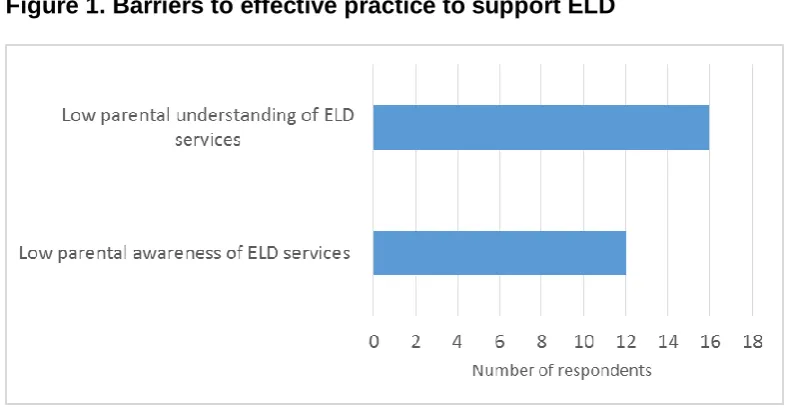
Figure 1 below shows that 16 out of the 22 local authorities who
completed the survey reported that low parental understanding
of ELD services was a barrier to effective practice. Additionally,
12 of the 22 local authorities reported that low parental
awareness of ELD services was a barrier to effective practice.
Interviews with Flying Start staff suggested that low levels of
parental awareness and understanding of ELD had an impact
on the value parents placed on ELD activities and consequently
on their willingness to engage in these activities. This suggests
that raising parental awareness and increasing understanding of
[image:33.595.130.526.527.732.2]ELD activities are important in order to effectively support children’s ELD.
Figure 1. Barriers to effective practice to support ELD
5.6 During visits to local authorities, Flying Start staff suggested that
parental awareness and understanding of the importance of language development need to be improved if children’s ELD is
to be effectively supported. Staff in several local authorities
reported that some parents did not consider themselves to have a significant role in their child’s ELD. Some staff also reported that some parents considered that their child’s ELD was the
responsibility of nurseries or schools. SLTs reinforced this
message, noting that raising parental awareness and
understanding of ELD should be a priority for local authorities across Wales. A SLT interviewed stated that ‘communication is not necessarily a high priority for some parents’.
5.7 The review’s findings suggest that communicating the benefit of
ELD activities to parents is important in order to improve their
understanding of the entitlement and, ultimately, their
engagement in ELD activities.
Staff awareness and understanding of ELD
5.8 The findings of the review suggest that awareness of ELD
among Flying Start staff in local authorities has increased in
recent years. A total of 20 out of the 22 local authorities
indicated in their survey response that they provide training to
staff in relation to ELD (see section 8). This training is generally
provided or overseen by SLTs and varies in its length and
nature depending on the role of the staff.
5.9 Flying Start co-ordinators and staff emphasised the important
role played by SLTs in raising the awareness and understanding
of ELD among staff. Several co-ordinators and staff noted that
key messages relating to ELD should be developed by SLTs
and communicated to staff. It was suggested that this could help
ensure that the knowledge and expertise of SLTs was
disseminated to other Flying Start staff. The role of SLTs in
was also considered to be very important by Flying Start
co-ordinators and staff (see section 8).
5.10 Most Flying Start co-ordinators and SLTs that participated in the
fieldwork highlighted the need for consistent messages to be
communicated by all staff to parents regarding ELD. This included information on their child’s developmental milestones
relating to ELD, the important role of parents in ELD and how parents could support their child’s ELD. A discussion on
developing and disseminating more consistent messages on
ELD is presented in sections 4.39 above and 5.20-5.21 below.
5.11 Most Flying Start co-ordinators and SLTs emphasised that all
staff should follow good practice in adult-child interaction when
communicating with children in the presence of their parents.
They noted that consistent modelling of good practice by Flying
Start staff was vital to ensure that parents were more aware of how to support their child’s ELD. SLTs noted that consistency would also help ensure that parents were not ‘sent mixed
messages’ by different Flying Start staff. A discussion on how to
ensure consistent messages from staff to parents is included in
sections 4.39 and 5.20-5.21.
Approaches used to raise awareness of ELD activities
5.12 Local authorities provide information to parents about the
services that are available in various ways. Different types of
literature and information were highlighted in survey responses
and examples of these were provided during visits, including
information packs, leaflets, posters, booklets, newsletters and
parental case studies. This information was communicated in
various ways, for instance by post to Flying Start families, in
displays at Flying Start settings, and by staff during Flying Start
activities and sessions.
5.13 Electronic communication methods were also used to relay
local authorities provided information on their website and some
use social media. Several Flying Start staff highlighted their use
of text messages to communicate with parents already engaged in Flying Start – both in terms of the ELD entitlement and
activities relating to the other Flying Start entitlements (see
section 6.18).
5.14 Flying Start co-ordinators, staff and SLTs highlighted the
importance of taking a multi-disciplinary approach to raising
awareness of ELD services. As well as ensuring consistent
messages, this was also seen as a way of encouraging families to follow a ‘pathway’ through different services (including ELD
and other Flying Start entitlements) and to remain engaged in
Flying Start activities. Some local authorities outlined the ‘pathways’ that were available to children and families to engage with services at different stages of a child’s
development. This was reflected in informal discussions with
several parents during the visits, who indicated that they had followed a ‘pathway’ by being signposted through several Flying Start activities (e.g. Health Visitor clinics leading to ‘Baby
massage’ and on to Baby Language and Play).
5.15 During visits to local authorities, co-ordinators outlined the
importance of their staff in raising awareness of ELD activities.
In general, Health Visitors were seen as the initial provider of
information for families. Within many Flying Start areas, they
provide families with an information pack which summarises
Flying Start entitlements and the services available. This pack
may include a timetable of ELD activities on offer.
5.16 Many local authorities commented on the importance of raising
awareness of ELD very early on, either directly through
midwives or through other staff at sessions run by midwives.
Providing information to parents during the antenatal stage was
considered an effective approach to raise awareness, with some
practitioners suggesting that parents were more receptive to
engagement included SLTs or advisory teachers attending
antenatal sessions to discuss the importance of ELD, and to
encourage good parenting practice and attendance at ELD
group sessions. During a visit to one local authority, SLTs outlined how they had started to attend ‘Bump and Beyond’
antenatal sessions, working in partnership with midwives.
Although this was a relatively new development, staff hoped that
that this could increase the likelihood of those parents engaging
in ELD activities once their child had been born.
5.17 Although information provided by Flying Start team members
was considered important, many staff deemed word of mouth
from other parents to be one of the most effective approaches to
raising awareness of ELD provision and its benefits. It was
noted that parents were more likely to engage with services that
had been advocated by other parents.
5.18 With the importance of advocacy from other parents in mind,
Flying Start staff in one local authority outlined how they
advertise ELD provision by displaying posters which capture the
positive impact of the services in case studies of families who
have used them. These case studies included photos and
testimonials from families outlining their positive experiences of
participating in Flying Start activities.
5.19 In some areas, parents are encouraged to participate in courses
aimed at developing a more detailed understanding of ELD and
improving adult-child interaction. Parents who took part in the
research in one local authority outlined the benefits of taking part in the Elklan ‘Let’s Talk for Under 5s’ course. 11
These
included increased confidence and improved understanding of
different strategies for interacting with their child (e.g.
understanding the development of communication, different
types of play).
11
Improving awareness of ELD
5.20 Many Flying Start co-ordinators and SLTs provided suggestions
on how to increase awareness of the ELD entitlement and the
benefits of the activities provided. These included:
developing a set of prescribed simple key messages relating to ELD at each stage of a child’s development, (e.g. the
number of words a child should know at the age of 18
months);
good practice in adult-child interaction (e.g. ideas for play or
dialogic reading); and
the benefits of ELD (e.g. improved literacy, behaviour and
social skills).
5.21 Several Flying Start co-ordinators and SLTs proposed that these ‘key messages’ should be developed at an all-Wales level
and then promoted consistently by all local authorities. It was
suggested that this would ensure that all Flying Start staff were
delivering accurate and consistent messages to promote the
benefits of ELD.
5.22 Several Flying Start co-ordinators, staff and SLTs noted that parents were more receptive to information on their child’s
development during the antenatal period. They therefore
suggested that greater efforts should be made to promote the
importance of ELD during the antenatal period. Suggestions for
doing this included: employing more midwives through Flying
Start; more Flying Start staff attending or co-delivering sessions
with midwives; and placing greater prominence on ELD within
antenatal information.
5.23 Staff in local authorities also suggested other approaches to
improve awareness of ELD among parents and staff. Some
highlighted a need for more ELD training and opportunities for
staff to raise queries with SLTs. Staff capacity and training
Summary of findings relating to awareness and understanding
5.24 Awareness and understanding of the ELD entitlement and the
benefits of activities to develop ELD are low among parents,
particularly among high need families who are less engaged in
universal ELD activities.
5.25 Much of the activity highlighted by local authorities during the
review focused on raising parental awareness of ELD activities.
Less emphasis was placed on promoting the benefits of ELD to
parents than on raising awareness of the activities available.
The evidence suggested that a greater focus was placed on embedding messages within activities. This ‘soft promotion’ of
ELD across entitlements was considered to be an effective
approach to overcome parental reluctance to engage in ELD
and should be further developed.
5.26 Local authorities outlined a need for consistent and clear
national messages relating to the key milestones in ELD, good
practice in adult-child interaction and the benefits of ELD for
child development. This could improve the process of
embedding ELD across the other Flying Start entitlements.
5.27 The nature of the ELD entitlement requires all Flying Start staff
to have an understanding of these key messages and to
promote them across the other entitlements (e.g. in nurseries,
during home visits). The role of SLTs in raising the awareness
6 Engagement
6.1 Engaging families in ELD activities is one of the main
challenges facing local authorities. This review defines
engagement as the process of getting families to take part in
Flying Start ELD activities and to maintain their participation.
6.2 Qualitative research as part of the National Evaluation of Flying
Start, (Welsh Government, 2013c), found that LAP did not appear to make ‘a lasting impression on many parents, and few
had tried to put what they had learned into practice on a regular basis’ (p. 51). Echoing this, a separate strand of the National
Evaluation, a report on the delivery and implementation of
Flying Start (Welsh Government, 2013a), found that the
increase in engagement in LAP activity was ‘less marked than that for each of the other entitlements’ (p. 26).
6.3 This section explores the approaches taken to engaging families
in ELD activities and to overcoming some of the barriers to
engagement. It also outlines some of the processes used to
identify families with particular needs in terms of ELD and the
referral processes that are in place to this end.
Levels of engagement in ELD activity
6.4 Many local authorities noted that family engagement with ELD
services was low. Reasons for low levels of engagement
outlined in section 5 above included low levels of awareness
and understanding about ELD and the services that are
available through Flying Start. Limited awareness of the
importance of both ELD and the role played by parents was also
frequently highlighted by Flying Start staff.
6.5 Flying Start co-ordinators, staff and SLTs also suggested a
number of reasons why levels of engagement in LAP courses
were low. These included a general reluctance among parents
LAP groups were ‘too formal’ or ‘too posh’; a perceived stigma
associated with targeted support among some parents; and low
levels of confidence among some parents. These were reported
by Flying Start staff to be greater barriers among higher need
families and younger parents. One Flying Start co-ordinator
echoed the views of many practitioners who took part in the
research in noting that some parents questioned why they were
being offered ELD provision.
6.6 Older parents and parents that were part of a wider parental
peer group (i.e. who could attend with other parents they knew)
were reportedly more likely to attend LAP sessions. Some
parents that took part in discussions following a baby LAP
session noted that their confidence and willingness to attend a
drop-in LAP session had grown significantly over the years. One
parent noted that she would not previously have been confident
enough to sing to her child at home, and certainly not as part of
a group. Parents in other local authorities outlined how their
confidence to attend LAP sessions had increased following
initial engagement in other activities such as baby massage.
These initial courses had helped them gain confidence to attend
a group session and to get to know other parents in their area.
6.7 The barriers outlined above had led many of the local authorities
to adjust their approach to engaging parents, particularly those
from higher need groups. Some of the approaches encountered
during the review are outlined below.
Approaches to engage families in ELD activities
6.8 The report on the delivery and implementation of Flying Start, as
part of the National Evaluation (Welsh Government, 2013a),
noted that
‘… parental demand for Flying Start LAP was said to be
high in areas where the teams had focused on emerging