Collaborative learning in networked classrooms – a new
landscape in higher education
Margaret Anne Carter
James Cook University, Australia [email protected]
Teoh Teik Toe
JCU Singapore, Singapore [email protected]
Abhishek Bhati
JCU Singapore, Singapore [email protected]
Anita Lundberg
JCU Singapore, Singapore [email protected]
Transformations in the social and educational context of higher education are happening in response to real world pressures associated with graduate employability and the rapid advances and modernisation in technologies. Networked classrooms offer an innovative solution to this situation by generating technology-enhanced, collaborative learning spaces in conjunction with new and redesigned teaching methods. In line with the advances in technologically-enhanced networked spaces in higher education, James Cook University’s offshore campus in Singapore (JCU Singapore) recently remodelled and redesigned one classroom with the ProVEOS Wireless Learning Technology (WLT) system. It is this networked classroom that forms the basis of the research reported in this article.
Three hypotheses are examined in this study, they concern: communication, learner satisfaction, and student engagement. Surveys of student participants of networked classrooms demonstrate that communication is fostered, learner satisfaction is reported, and greater student engagement is evident when using the networked classroom.
Keywords: Learning spaces, networked classrooms, collaborative learning
Networked classrooms in higher education
Transformations in the social and educational context of higher education are taking place in response to real life pressures associated with graduate employability and rapid developments and innovations in technology. As Tuan (2011) articluates, “global competition, cultural diversity, advancements in technology, and new management processes have demanded more skills from employees” (p. 176).
Networked classrooms are one inventive solution to this new landscape. These learning spaces foster student-to-student-and-teacher collaboration through the utilization of
In line with these advancements, James Cook University’s offshore campus in Singapore (JCU Singapore) recently remodelled one classroom with the ProVEOS Wireless Learning
Technology system set within a spatial arrangement of group work tables each with an LCD screen, mobile chairs, and easy access to large whiteboards. It is this networked classroom that forms the basis of the research reported in this article.
Graduate attributes and technology futures
Today, employers are expecting graduates educated in multinational locations such as Singapore to have developed as global citizens with knowledge and proficiency in
interpersonal, leadership and technical understanding and skills (Clifford & Montgomery, 2014; Ismail, 2011). Graduate employability is influenced by quality of training and specialisation in conjunction with ‘work readiness’, that is: “possession of the knowledge, attitudes, skills, and commercial understanding that will enable graduates to make productive contributions to organizational objectives soon after commencing employment” (Mason et al., 2006 as cited in Omar, Manaf, Modh, Kassim & Aziz, 2012, p. 103). Based on an analysis of the information recorded in job advertisements on the JobStreet.com website, Omar et al. (2012, p. 106) examined graduate employability in Malaysia. Results from this study indicate that Malaysian employers prioritised the following employability skills during the recruitment process for graduates with degree qualifications: “interpersonal skills (76%), followed by information communication/technology (68%), foreign language (64%), teamwork (36%), and personal qualities (34%).”
Of the interpersonal skills reported by 1700 chief executive officers from 64 countries in the 2012 IBM study, “collaboration came out on top at 75%, with communication (67%),
creativity (61%) and flexibility (61%) close behind” (Lee, 2013, p. 1). In the same study, the Business Learning Institute identified collaboration in conjunction with strategic thinking, being technologically savvy, leadership skills, communication ability, and having a corporate practice/specialty as essential dispositions (Lee, 2013).
As collaborative work is a non-negotiable competency in today’s knowledge society, higher education curricula have been transformed and modified accordingly (Wang, 2009; Warger & Dobbin, 2009). Many courses now include in their curricula “the kinds of activities and circumstances that graduates are likely to experience when they enter the workforce” (Warger & Dobbin, 2009, p. 4).
The combination of workforce pressures and rapid advances and innovations in new
technologies are influencing and changing the social and educational contexts of learning and teaching in higher education. Within the very spaces of classrooms these changes are
apparent. Communication and information technologies are fostering social and cognitive connectivity between students and instructors, and between students with one another (Rajasingham, 2011).
Learning in networked classrooms
technological context is the computer mediated setting” (Kirschner, Strijbos, Kreijns & Beers, 2004, p. 50).
Networked Classrooms (NCs) involve a process–orientated approach to learning, capturing the impact of technology with new and redesigned teaching methods aligned with
constructivist learning, along with emerging notions of connectivist learning (Siemens, 2006; Lundberg, 2013). Such space “encourages students to explore and problem solve in order to create, integrate, and generalize new knowledge” (Ferry, Kydd & Boyles, 2012, p. 141). The skills students are acquiring as they engage with learning in NCs are identified by prospective employees as essential “for building new knowledge and inventing new ideas” (Bicknell-Holmes & Hoffman, 2000 cited in Ferry et al., 2012, p. 141).
The purpose of utilising wireless technologies and social software in NCs is to stimulate a deeper level of learner engagement, as well as encourage curiosity and enthusiasm about the learning process (Jarvela, Naykki, Lara, & Luokkanen, 2007). As Lundberg (2013) observes, “spaces of learning are not empty spaces filled with stuff and stuffed with knowledge. Neither are they simply arrangements of tables and chairs, technology and software. Such spaces are also more than wireless networks. They are resonating spaces of potential” (p. 6).
Androgogy in networked classrooms
Task ownership, task character, and task control are three educational factors central to working in NCs. Individual accountability and positive interdependence determine task
engagement and ownership, which progresses from working independently to collaboratively. Task character encompasses intercultural teams (in the Singapore context) working on
authentic tasks that are deemed ‘wicked problems’ “solved only by multidisciplinary groups working together, where the group members assuage cognitive conflicts, elaborate on each other’s contributions, and co-construct shared representations and meanings” (Kirschner et al., 2004, p. 55). Task control refers to students and instructors managing the context, content, sequence, pace, depth and direction of the learning happening in the networked space. As students actively engage within the NCs they frame more in-depth understanding of tasks, which may contribute to higher satisfaction with the learning process.
Learning in NCs involves students externalizing, internalizing, sharing and negotiating knowledge with others. This process, depicted in Figure 1, implies the existence of both multiple perspectives and of common ground (Kirschner et al., 2007). Common ground
evolves as individual knowledge is shared, distributed, negotiated and understood; and diverse perspectives are articulated, debated, negotiated and pooled. Some members of a group may construct new knowledge, while others may acquire only part of this new knowledge.
Figure 1: From Kirschner, Beers, Bozhuizen & Gijselaers, 2007, p. 407
Central to this process are cognitive conflicts (Valtonen et al., 2011). A disconnect exists between what students know and the meaningful knowledge they are required to know for their ongoing development. Cognitive conflicts evolve from the formation of new schemas, perceived as instigating the formation and restructuring of new knowledge within the learning process. Social software in NCs provides opportunities for active interaction, communication and engagement that contribute to cognitive conflict resolutions (Loi & Dillon, 2006).
It is through interacting with others in the zone of proximal development (ZPD) that existing and new knowledge is examined and cognitive conflicts are resolved (Vygotsky, 1978). Scaffolding in this zone is grounded in collaborative learning and is aimed at “enhancing the learning process and improving students’ academic results with the help of technology. It allows peer interactions and group work while facilitating knowledge sharing and
distribution” (Liponned, 2002 as cited in Cortez, Nussbaum, Woywood & Aravena, 2008, pp. 126-127). Through this process learner groups are guided by instructors and students, with both sharing knowledge that leads to greater engagement, higher order thinking, and new knowledge construction (Kirschner et al., 2007; Girasoli & Hannafin, 2008). According to Cao, Wang and Zheng (2012), the basic principle of this model is that the students’ curiosity in the task is ignited, alongside their intrinsic motivation and higher order thinking, in applying themselves to competently completing the task.
Collaboration and networked classrooms
Purposeful communication, engagement, and collaboration occur at multiple levels of learning in NCs: instructor and student collaborative groups, intra and cross group communication, as well as the potential for cross cultural communication. Students can connect their laptop to the LCD screen or work on their laptop, tablet or smartphone separately. They can work collaboratively, directly with the information displayed on the screen on one or several tasks at the same time. They can network on tasks, sourcing
documents and switching between resources stored on their devises or in the virtual cloud of the world wide web.
With the use of Wireless Learning Technologies in NCs, further applications for networking include online polling, sharing documents, sharing screens, and instant feedback. Through synchronous polling, for example, instructors can poll all, a selection of, or individual
resources, develop their own strategies for addressing these problems, and present and negotiate solutions to these problems in a collaborative manner” (Hannafin & Land, 1997, p. 533).
Thus, NCs constitute an ecology of learning (Siemens in Lundberg, 2013) or a cultural ecology comprising students and instructor (all as participants), the WLTs (in this case ProVEOS), the room arrangement (space and furniture) and the dynamic interaction between them. Acknowledgment of prior learning - connecting students with what they know and need to know - combined with the creation and sharing of new knowledge is characterised as collaborative student ‘improvisations’. Improvisations refer to “‘re-originating meaning’ without leaving behind the original meaning” (Peters, 2009, as cited in Valyonen et al., 2011, p. 576).
A cultural ecology framework focuses on the dynamics between students within NCs and the potential changes to the environment resulting from collaboration between students and students and instructors. This participation modifies the ecology of the networked space. Social constructivism in this space “sees knowledge construction as a social process in which learners share their perceptions and conceptions in the collaborative production of new understanding” (Valtonen et al., 2011, p. 576).
The flexibility and portability of furniture, space, and technology enables students to work in a variety of configurations. Sitting in groups while networked with other group members and the instructor, enables students to work independently or interdependently as a team or as a whole class on specified learning tasks. Working as group members, students “develop shared awareness of goals, progress, and tasks toward co-constructed regulatory processes, thereby sharing regulation processes as collaborative processes” (Jarvela et al., 2007, p. 72).
The network classroom landscape
Located on the third floor of a three story building, the room dimensions for the NC are 9.38m x 6.85m. The room is rectangular in shape, with whiteboards 1.25m x 5.45m permanently fixed across two walls. With a capacity for thirty-six students, six students can position themselves at one of six rectangular tables. These tables, measuring 1.0m x 2.1m are
Figure 2: The ProVEOS networked classroom, JCU Singapore
ProVEOS is a Wireless LAN (Wi-Fi) classroom management software information
transmission system that supports student engagement in this networked classroom. With the internet IP address students and instructors connect to the network to access the features of the wireless platform. ProVEOS has several applications for networking including instant
switching between users, interactive e-whiteboard, interactive testing, electronic polling and surveys, file sharing, sharing screens (including quad display), instant messaging, and online simulation exercises, such as statistical simulations.
Methodology
To date minimal research has been conducted that specifically focuses on higher education students’ perceptions of learning in NCs (Davis, 2003; Liu et al., 2003; Jarvela et al., 2007, Salter, Thomson, Fox & Lam, 2013). Our research team postulates that networked classrooms are responsive to the digital and networked world, engaging students and instructors in
collaborative work. This process involves interaction and communication that contributes to student engagement and higher learner satisfaction.
Hypotheses
With the intention of contributing to literature on students’ experiences with NCs in higher education, the researchers tested three hypotheses:
1. Communication is fostered when working in the networked classroom
2. Higher learner satisfaction is reported after working in the networked classroom
3. More student engagement is evident when working in the networked classroom
Instrument
A survey was developed that aimed to obtain information about a number of different variables in which the researchers were interested, and the interrelatedness between these variables. While a comprehensive literature search located a previous measure (Lu, Ma, Turner, & Huang, 2007), that survey did not contain all the areas of interest under
in subjects taught by members of the research team. After the trial, modifications and additions were made prior to the development of the final survey.
The survey consisted of five sections. Sections one to three used a 5-point Likert scale, while section four used a 7-point Likert scale. Firstly, section one comprised the pre and post-test questions. Here, participants were required to rate their experiences and satisfaction before and after use of the NC in response to eleven questions. Section two comprised five constructs relating to student’s experiences in, and satisfaction with, the NC. These questions were adapted from the related study on wireless learning technology systems (Lu et al., 2007). The five constructs were customised in relation to the NC, they included student-centred learning environment and the following dimensions: pedagogical, technological, cultural and
pragmatic. Section three comprised five questions regarding the wireless learning technology system (WLTs). Section four related to students’ experiences using the NC; it comprised seven questions. Lastly, section five recorded the demographics of the participants including, gender, level of study, nationality, and course of study. Subsequent analyses were conducted using SPSS software.
The survey was distributed towards the end of the study period. It was uploaded via the Qualtrics on-line portal and made accessible to students enrolled in identified subjects taught by members of the research team. An email invitation with the survey link was forwarded to students by the Project Officer who invited their anonymous and voluntary participation in the survey by clicking on the link which remained live for two weeks.
Participants
One hundred students - 56% females and 44% males - enrolled in the JCU Singapore
programs in Business, Information Technology, and Arts and Social Sciences volunteered to participate in this research study. Disciplinary backgrounds included: Business (n=42); Information Technology (n=4); Arts & Social Sciences (BA or B.Psych) (N=54). Of these students, 79% were undergraduates, and 21% were postgraduate. The undergraduate
participants were enrolled at different stages in their course with a noticeable input from first year students: first year (66%); second year (17%); third year (2%), fourth year (1%). The post graduate courses are of one year duration. The ethnic composition of participants represented included: Chinese (n=64); Indian (n=16); Malaysian (n=4); European (n=2); Other (n=14).
The study adopted a simple random sampling method (SRS), which postulates that all subsets within a population would be given an equal probability in selection. The advantages of SRS include the low cost and more effective data collection in measuring the student population.
Data analysis
To test the three hypotheses identified for this study, the researchers examined the findings based on the difference in significance before and after the use of the NC through p-value and t-test. Pair-wise comparisons were generated to ensure more robust results – as examination of difference in data row by row makes results more accurate. Next, the researchers
correlation coefficient (r) was employed to determine the differences between the dependent and independent variables.
Findings
While each hypothesis is reported separately below, the researchers found common themes emerging from the data. These include a positive influence in student engagement with the ProVEOS system, and interaction and collaboration within the NC. In addition, participants reported that participating in meaningful learning opportunities in the NC influenced their engagement as learners, including their interaction and communication with classmates and instructor.
We hypothesised that the use of NCs would foster communication. Improved
communication between instructors and students within the NC was statistically observed (M=4.16) and a preference for similar classrooms on campus was recorded (M=4.16). The findings demonstrate that a more active and interesting lesson was identified when using the NC (M=4.12), and the NC was recognised as a useful learning space (M=4.11). These findings confirm that NCs foster communication between instructors and students.
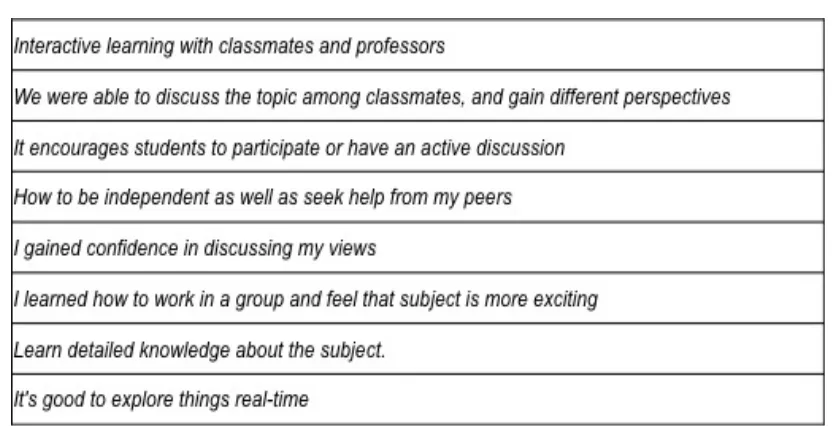
[image:8.595.90.507.459.672.2]Our second hypothesis was that participants would report higher learner satisfaction after working in the NC. To test this hypothesis, we employed the use of matched-sample t-tests as well as open-ended questions regarding: exposure to different ways of learning, greater interest in subject, usefulness of technology, support of group work, confindence in learning, and subject engagement. The majority of positive responses to the open-ended questions provided additional evidence to confirm the second hypothesis. Table 1 demonstrates a sample of student responses, while the matched-sample t-tests are analysed below.
Table 1: Participant’s satisfaction with learning in the networked classroom
A matched-sample t-test with an α of .05 was used to compare participants mean exposure to different ways of learning before (M = 3.44, SD = .868) and after (M = 4.22, SD = .502) using the classroom. On average, participants responded at .779, 95% CI [0.573, 0.985], with greater exposure to different ways of learning after using the NC. This finding was
Similarly, a matched-sample t-test with an α of .05 was used to compare participants’ mean
interest in their subject content before (M = 3.59, SD = .820) and after (M = 4.13, SD = .669) using the NC. On average, participants responded at .584, 95% CI [0.355, 0.741], with a
statistically significant difference in the subject content after using the NC, t(103) = 5.623 . p< .001.
The usefulness of the technology in contributing to higher learner satisfaction was compared before (M = 3.88, SD = .962) and after (M = 4.40, SD = .616) using the NC. On average, participants responded at .529, 95% CI [0.309, 0.749], indicating a statistically significant difference in the usefulness of technology after using the NC, t(103) = 4.766, p<.001.
Support of group work was compared to ascertain if this was a factor contributing to higher learner satisfaction in NCs. A matched-sample t-test with an α of .05 was used to compare participants perception of support of group work before (M = 3.48, SD = .955) and after (M = 4.24, SD = .599) using the NC. On average, participants responded at .760, 95% CI [0.527, 0.992], with more support for group work after working in the NC. Again, these findings are statistically significant, t(103) = 6.485, p< .001.
Engagement with the subject was compared before and after using the NC to identify if this was a factor contributing to higher learner satisfaction. A matched-sample t-test with an α
of .05 was used to compare participants engagement with the subject before (M = 3.41, SD = .888) and after (M = 4.12, SD = .715) using the NC. On average, participants responded at .702, 95% CI [0.494, 0.910], with findings being statistically significant, t(103) = 6.695 . p< .001, after working in the NC.
A matched-sample t-test with an α of .05 was used to compare participants’ confidence in learning before (M = 3.44, SD = .923) and after (M = 3.95, SD = .755) using the NC. On average, participants responded at .510, 95% CI [0.293, .726], with more confidence in learning after working in the NC. This difference is statistically significance t(103) = 4.662. p< .001.
A matched-sample t-test with an α of .05 was used to compare satisfaction with learning experiences before (M = 3.51, SD = .848) and after (M = 4.04, SD = .622) using the NC. On average, participants responded at .529, 95% CI [.335, .722], with more confidence in learning outcomes after working in the NC. Again, statistically significant, t(103) = 5.422 . p< .001.
All of the above matched-sample t-tests were supportive of our second hypothesis of greater student satisfaction using the NC.
Thirdly, and lastly, we hypothesised that more student engagement would be evident when working in the NC. In order to examine this hypothesis, matched-samples t-tests were utilised. Measures regarding excitement about learning, anxiety about learning, learning from class interaction, and communication and interaction, were used to test the third hypothesis.
To ascertain anxiety about engaging in learning a matched-sample t-test with an α of .05 was used to compare before (M = 3.14, SD = .999) and after (M = 3.67, SD = 1.028) use of the NC. On average participants reported more anxiety regarding engaging in learning after working in the NC. This is a statistically significant outcome, t(103) = 4.766 . p< .001.
A matched-sample t-test with an α of .05 was used to compare learning from class
interactions before (M = 3.51, SD = .955) and after (M = 4.14, SD = .630) using the NC. On average, participants responded at .635, 95% CI [0.408, .861], with more learning from class interactions after working in the NC. This result is statistically significant, t(103) = 5.549 . p< .001.
To measure communication and interactions with peers, a matched-sample t-test with an α
of .05 was used to compare before (M = 3.48, SD = .955) and after (M = 4.25, SD = .619) use of the NC. On average, participants responded at .769, 95% CI [0.536, 1.003], with more communication and interactions with peers after working in the NC. This demonstrated a statistically significant difference, t(103) = 6.534 . p< .001
Additionally, participants reported in an open comments section of the survey that they found the NC a useful learning space. The equipment and furniture – including configuration of furniture - contributed to student engagement (Table 2). These comments provide further data to confirm our third hypothesis.
Table 2: Comments on furniture and equipment in the networked classroom
Comfortable furniture, clean environment makes learning more positive.
The tables are more conducive for interaction and the use of the internet allows us to be sure of our content and engage in better and higher debates for interaction and learn better.
I enjoyed the time spent with my classmates with the swivel chairs.
Learn in a more creative and interesting way, leaving a deeper impression.
Discussion
In our study, the NC constituted a ‘cultural ecology’, with students and instructors working together to reach shared understandings and agreements of common ground. The creation and sharing of new knowledge influenced participation and engagement in learning, and in
fostering interactive, collaborative student ‘improvisations’. As students connected and collaborated in NCs, the ecology of the learning space transformed. Throughout this process participants’ reported more excitement as learners, greater exposure to subject content, more active and interesting lessons, and more satisfaction with engaging in a ‘useful learning space’.
Independent and interdependent learning was recognised by participants as key elements of effective interaction and communication in NCs (Wang, 2009; Green et al., 2010). Girasoli and Hannafin (2008) advocate that when students interact and communicate to construct individual and group knowledge they develop their capacity as reflective learners. This
Throughout this study, participants reported the NC provided them with opportunities to confidently collaborate with peers, and to engage in actively processing, translating and applying their knowledge. Our findings indicate that, even with differences in disciplines, subject content, and instructors’ pedagogical practices, participation and interaction between students-students and instructors was a positive component of stimulating this communal leaning in NCs.
Exposure to collaborative work “in a meaningful search for understanding” (Kember et al., 2010, p. 1184), was reported in our study. Higher satisfaction with learning was associated with additional opportunities for examining the subject material, greater interest and confidence in exploring the subject content, more support for group work, and improved communication between students and instructors.
Aligned with Cortez et al.’s (2008) findings, participants in our study reported positive experiences when collaboratively constructing knowledge while working on group decision-making tasks. Sharing knowledge and scaffolding one another’s learning in networked spaces has been recounted in self-regulated learning theory as signaling positive learning outcomes for students (Jarvela et al., 2007).
Similar to Woo and Reeves’s (2006) research findings, participants reported that the NC provided them with opportunities to share, exchange and communicate in meaningfully interconnected ways. As Jarvela et al. (2007) explain, students co-constructing collective knowledge “develop shared awareness of goals, progress, and tasks toward co-constructed regulatory processes, thereby sharing regulation processes as collaborative processes” (p. 72).
One of the most significant findings of our study was that more anxiety was reported by participants when working in the NC. It is unclear if this anxiety is related to technology, for instance: computer anxiety, perceived computer self efficacy, technological attitudes (Celik & Yesilyurt, 2013) or computer experience (Beckers & Schmidt, 2003); pedadogical methods; the multi-focal collaborative learning space – or the ecology of all three. Indeed increased anxiety may be indicative of the process of cognitive conflict, and suggest Vygotsky’s zone of proximal development ZPD as a useful avenue for further investigation.
Overall, participants identified the pedagogy, space, furniture and wireless technology as elements of the NC that contributed to their positive learning experiences. The networked space provided them with more exposure to deeper levels of learning beneficial in promoting effective and efficient engagement and interaction. Regarding the technological enhancement of the space, as Gros, Guerra, and Sanchez (2005) observed, “not only does it [technology] provide a space for sharing knowledge but it also has to act as a mediated environment for reflecting on and constructing knowledge” (p. 28).
Limitations, implications and conclusion
This study examined the impact of one NC on relation to communication, learner satisfaction and student engagement. While the three hypotheses have been confirmed, there are several limitations to this study identified by the researchers.
usefulness of the NC. Comparing experiences of NCs across different faculty and academic disciplines would be an avenue for future research.
The second limitation regards the learning ecology of NCs and the style of teaching of the instructor. Further research examining effectiveness of instruction in NCs is warranted. More systematic exploration is required to ascertain if NCs are pedagogically sound for all subject domains, in all higher education contexts, and across all cultures. An exploration of what subjects, courses, and instructional designs work best in NCs would prove a very useful area of investigation. Likewise, exploring how pedagogy is changed and/or transformed by its integration with the spaces of, and technology in, NCs is deserving of attention. Paying attention to students’ and instructors’ attitudes to using technology in NCs would provide more insight into the operational use of NCs in higher education.
To conclude, participants reported a preference for active learning in the NC, acknowledging the classroom as a useful and exciting learning space. Higher levels of learner satisfaction were reported in conjunction with rich opportunities for communication, interaction and student engagement. Opportunities to construct new knowledge, independently and in groups, were reported, as were deeper levels of learning when working in the NC.
Acknowledgements
The research team would like to express their gratitude to the Project Officer and Research Assistant Crystal Tang. This research has been supported by an Industry Grant and has received Ethics Approval (H5323).
References
Beckers, J., & Schmidt, H. (2003). Computer experience and computer anxiety. Computers in Human Behavior, 19(6), 785-797. doi:10.1016/S0747-5632(03)00005-0
Bhati, A., Lundberg, A., Teoh, T-T., & Carter, M. (2013) Wireless Learning Technology in higher education: a case study in Singapore. GSTF Journal on Computing, 3 (3), doi: 10.7603/s40601-013-0033-x
Cao, X., Wang, F., & Zheng, Z. (2012). The experimental research on E-learning instructional design model based on cognitive flexibility theory. Physics Procedia, 25, 997-1005. doi:10.1016/j.phpro.2012.03.190 Celik, V., & Yesilyurt, E. (2013). Attitudes to technology, perceived computer self-efficacy and computer
anxiety as predictors of computer supported education. Computers and Education, 60(1), 148-158. doi:10.1016/j.compedu.2012.06.008
Clifford, V., & Montgomery, C. (2014). Challenging conceptions of western higher education and promoting graduates as global citizens. Higher Education Quarterly, 68(1), 28-45. doi:10.1111/hequ.12029
Cortez, C., Nussbaum, M., Woywood, G., & Aravena, R. (2009). Learning to collaborate by collaborating: A face-to-face collaborative activity for measuring and learning basics about teamwork. Journal of Computer Assisted Learning, 25(2), 126-142. doi:10.1111/j.1365-2729.2008.00298.x
Ferry, D. L., Kydd, C. T., & Boyles, C. (2012). Creating the global graduate: A Cross‐Cultural videoconferencing case study. Decision Sciences Journal of Innovative Education, 10(2), 139-164. doi:10.1111/j.1540-4609.2011.00336.x
Girasoli, A. J., & Hannafin, R. D. (2008). Using asynchronous AV communication tools to increase academic self-efficacy. Computers & Education, 51(4), 1676-1682. doi:10.1016/j.compedu.2008.04.005
Green, N., Edwards, H., Wolodko, B., Stewart, C., Brooks, M., & Littledyke, R. (2010). Reconceptualising higher education pedagogy in online learning. Distance Education, 31(3), 257-273.
doi:10.1080/01587919.2010.513951
Hannafin, M. J., & Land, S. M. (2000). Technology and student-centered learning in higher education: Issues and practices. Journal of Computing in Higher Education, 12(1), 3-30. doi:10.1007/BF03032712
Ismail, N. (2011). Graduates' characteristics and unemployment: A study among Malaysian graduates. International Journal of Business and Social Science, 2(16), 94.
Kember, D., McNaught, C., Chong, F., Lam, P., & Cheng, K. (2010). Understanding the way in which design features of educational websites impact upon student learning outcomes in blended learning environments. Computers & Education, 55, 1183-1192.
Kirschner, P., Strijbos, J., Kreijns, K., & Beers, P. J. (2004). Designing electronic collaborative learning environments. Educational Technology Research and Development, 52(3), 47-66. doi:10.1007/BF02504675 Lee, D. (2013). Making the hard sell for soft skills. Accounting Today, 27(12), 1.
Liu, T. C., Wang, H. Y., Liang, J. K., Chan, T. W., Ko, H. W. and Yang, J. C. (2003). ‘Wireless and mobile technologies to enhance teaching and learning’ Journal of Computer Assisted Learning, 19, 371-382. Lundberg, A. (2013). Get connected! Collaborative adventures in networked spaces of learning. Emerging
Research Paradigms in Business and Social Sciences. Proceedings of the International Conference, Middlesex University, Dubai.
Murphy, R., & Sharma, N. (2010). What don’t we know about interactive lecturers? Seminar.net – International Journal of Media, Technology and Lifelong Learning, 6, 111-119.
Neo, M. (2003). Developing a collaborative learning environment using a web-based design. Journal of Computer Assisted Learning, 19(4), 462-473.
Omar, N. H., Manaf, A. A., Mohd, R. H., Kassim, A. C., & Aziz, K. A. (2012). Graduates' employability skills based on current job demand through electronic advertisement. Asian Social Science, 8(9), 103-110. Rajasingham, L. (2011). Will mobile learning bring a paradigm shift in higher education? Education Research
International, 2011, 1-10. doi:10.1155/2011/528495
Salter, D., Thomson, D. L., Fox, B., & Lam, J. (2013). Use and evaluataion of a technology-rich experimental collaborative classroom. Higher Education Research & Development, 32(5), 805-819.
Siemens, G. (2006). Knowing knowledge.elearnsppace, Creative Commons licensed. Available at: http://www.elearnspace.org/KnowingKnowledge_LowRes.pdf.
Valtonen, T., Havu‐Nuutinen, S., Dillon, P., & Vesisenaho, M. (2011). Facilitating collaboration in lecture‐based learning through shared notes using wireless technologies. Journal of Computer Assisted Learning, 27(6), 575-586. doi:10.1111/j.1365-2729.2011.00420.x
Warger, T., & Dobbin, G. (2009). Learning environments. Where space, technology, and culture converge. Educause Learning Initiative Paper 1 http://creativecommons.org/licenses/by-nc-nd/3.01
Wessels, A., Fries, S., Horz, H., Scheele, N., & Effelsberg, W. (2007). Interactive lectures: Effective teaching and learning in lectures using wireless networks. Computers in Human Behavior, 23(5), 2524-2537. doi:10.1016/j.chb.2006.05.001
Woo, Y., & Reeves, T. C. (2007). Meaningful interaction in web-based learning: A social constructivist interpretation. The Internet and Higher Education, 10(1), 15-25. doi:10.1016/j.iheduc.2006.10.005 Wow Vision (2012). Veos Wow Vision. Life is a presentation. Present yourself well (Brochure). Singapore:
Wow Vision