HESA CONSULTATION
RESPONSES
WHAT WE HAVE LEARNED
Higher Education Statistics Agency Limited is a company limited by guarantee, registered in England at 95 Promenade, Cheltenham, GL50 1HZ. Registered No. 02766993. Registered Charity No. 1039709. Certified to ISO 27001. The members are Universities UK and GuildHE.
Hannah Prosser
Head of Corporate Communications HESA
95 Promenade Cheltenham GL50 1HZ
2
CONTENTS
Introduction ... 3
Who responded?... 4
What we collect, assure and disseminate ... 5
Estates Management record ... 5
The Staff record – non-academic staff provision ... 6
Additional collections ... 7
Non-statutory onward uses of data ... 8
Onward sharing categories ... 8
The Data Dissemination Service (DDS) ... 10
UK Performance Indicators ... 10
How we support you ... 11
INTRODUCTION
We are grateful for the time and care taken by everyone who contributed to the consultation. The responses provided a wealth of valuable information and feedback about HESA’s activities.
The purpose of the consultation was to:
• gain the necessary information to develop a robust subscription model and agreement covering our statutory and non-statutory activities, and
• gauge the level of sector support for specific elements of the HESA offering.
This summary of responses focusses on elements of the consultation that directly impact the way in which our subscription approach has been formed.
Not all questions have been included within this summary, but the information provided is feeding into almost every area of activity at HESA, from collection reviews, communications approach, and service development.
HESA
4
WHO RESPONDED?
A total of 158 responses were received, of which 141 were from higher education providers (HEPs).
Figure 1: Number of responses by category
Category Responses
Higher education institution (HEI) 126
Alternative provider (AP) 14
‘New’ provider 1
Sector body or representative group 8
Other organisation 9
The 14 alternative providers (APs) only represent 12% of all APs, but responses from Guild HE and Independent Higher Education provide some additional context.
Figure 2: Responses as proportion of each population
Country
% of total HEP population
% of HEI population
% of AP population
England 47% 76% 12%
Scotland 68% 72% 0%
Wales 89% 89% -
Northern Ireland 50% 50% -
We have used the existing status of a provider as either a higher education institution (HEI) or alternative provider (AP) to categorise providers in this consultation. From August 2019 providers in England will be categorised on the OfS register as ‘Approved (Fee cap)’ and ‘Approved’. These categorise do not map directly on to one another.
WHAT WE COLLECT, ASSURE AND DISSEMINATE
Our current understanding is that in England the collection of Estates Management record, and data on non-academic staff within the Staff recordwill no longer be a statutory requirement. Strong concerns were raised through the consultation, and at engagement events, about this change. Under HERA 2017 it is for OfS to determine whether collection of this data is required.
The focus of this section of the consultation was to ascertain whether it is desirable, and feasible, to continue to collect this data within England on a voluntary basis.
Consultation responses indicated a clear and ongoing need from the perspective of English HEIs for HESA to continue to collect both Estates and non-academic staff data. Respondents indicated a clear need for this data collection to maintain a UK-wide perspective and to support their
legitimate requirements such as benchmarking and internal reports.
Staff and Estates data is not currently collected from APs.
ESTATES MANAGEMENT RECORD
The importance of a UK-wide perspective was confirmed by 85% of respondents.
91% of respondents indicated a preference for annual data collection.
Responses included various recommendations to extend or reduce the scope of the data
collection. These recommendations will feed into the Estates management record collection review process.
Of those responses recommending a review, many suggested that this should be developed with the Association of University Directors of Estates (AUDE).
[image:6.595.60.410.562.617.2]Do you use the data included within this record? If so, for what purposes?
Figure 3: Percentage of respondents who use EMR data
Population Yes No
All respondents 83% 17%
All HEIs 94% 6%
English HEIs 83% 17%
Uses of EMR data included;
• Used with an external (non-HESA) tool
• Lobbying
• Year on year comparisons
• Statutory requirements
HESA
6
Are you likely to continue to subscribe to this record when the cost is part of a voluntary subscription?
Figure 4: Likeliness to continue to subscribe among English HEIs
Population Yes No
English HEIs 80% 20%
With 94% of all HEIs confirming that data from the Estates management record is used by their organisation there is clear support for the ongoing provision of this collection.
80% of English HEIs stated that they are likely to continue to submit estates data on a voluntary basis. The current lack of information on the likely cost of this voluntary collection was a theme raised by respondents who use the data but stated they were unlikely to subscribe.
THE STAFF RECORD – NON-ACADEMIC STAFF PROVISION
The importance of a UK-wide perspective was indicated by 87% of respondents.
99% of respondents indicated a preference for annual collections.
Additional recommendations will inform the record review process for the Staff record.
[image:7.595.58.413.488.553.2]Do you use the data included within this record? If so, for what purposes?
Figure 5: Percentage of respondents who use non-academic Staff data
Population Yes No
All respondents 87% 13%
All providers 88% 12%
All HEIs 85% 15%
English HEIs 83% 17%
Uses of data regarding non-academic staff included:
• Benchmarking
• Internal reporting
• Equality/diversity reporting
• Year on year comparisons
• FOI requests
Are you likely to continue to subscribe to this record when the cost is part of a voluntary subscription?
Figure 6: Likeliness to continue to subscribe among English HEIs
Population Yes No
There is clear support for the collection of non-academic staff data to continue, with 88% of all providers and 85% of HEIs confirming that the data is used by their organisation.
As with the responses about estates data, the difference between the 83% of English HEIs who use the data and the 78% likely to continue to subscribe can be, at least partially, attributed to a lack of information regarding the cost of a voluntary subscription.
ADDITIONAL COLLECTIONS
71% of respondents and 73% of providers indicate that they do not feel that we need to collect additional data at this point.
HESA
8
NON-STATUTORY ONWARD USES OF DATA
HESA data is used for both statutory and non-statutory purposes by a wide variety of organisations and individuals. As the Designated Data Body for England, HESA will seek the agreement of English HE providers to continue to share data for non-statutory purposes. The consultation sought to gauge the appetite of providers for HESA to continue the supply of data for non-statutory uses.
ONWARD SHARING CATEGORIES
Non-statutory uses of HESA data were grouped into 6 categories reflecting the benefits to different types of data user:
1. Uses of data for the direct benefit of HE providers.
2. Uses of data for the direct benefit of HE sector bodies and organisation representing or serving HE providers.
3. Uses of data for the benefit of student and academic researchers.
4. Uses of data for the benefit of students, prospective students and their representatives and graduate recruitment.
5. Uses of data that are essential or highly valuable for the activities of other public, private or third-sector organisations.
6. Provision of data to organisations that have a statutory power/function to collect data directly from HE providers.
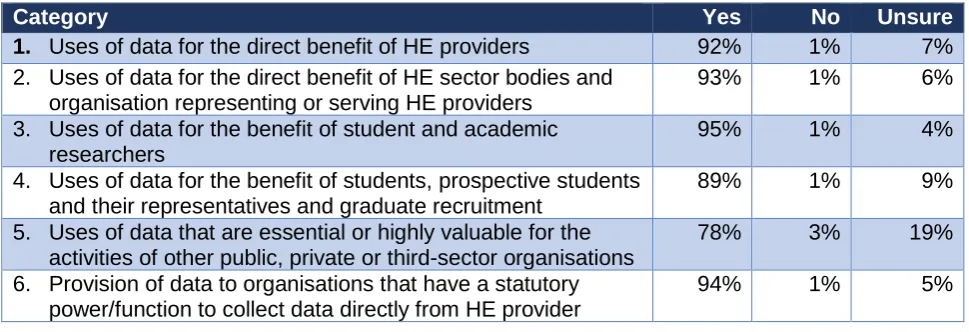
Consultation responses indicated support for HESA to continue supplying data for all use
Do you agree in principle to data collected for category ‘x’ in respect of your provider being shared by HESA?
Figure 7: Agreement in principle to non-statutory onward uses of data – HE providers only
Category Yes No Unsure
1. Uses of data for the direct benefit of HE providers 92% 1% 7% 2. Uses of data for the direct benefit of HE sector bodies and
organisation representing or serving HE providers
93% 1% 6%
3. Uses of data for the benefit of student and academic researchers
95% 1% 4%
4. Uses of data for the benefit of students, prospective students and their representatives and graduate recruitment
89% 1% 9%
5. Uses of data that are essential or highly valuable for the activities of other public, private or third-sector organisations
78% 3% 19%
6. Provision of data to organisations that have a statutory power/function to collect data directly from HE provider
94% 1% 5%
Due to the similarity of responses and the common features shared by categories 1, 2, 3 and 6, we intend to group these categories in the subscription agreement as “Uses for public benefit and in the public interest”. Categories 4 and 5 will remain as above since they each have different benefits and risks for users and providers.
Providers will be asked to confirm their agreement to data sharing by selecting categories of use at the front of the agreement. We will be working over the coming months to increase the amount of information available regarding onward uses of data and how we manage data requests. A desire for more information was a clear theme across consultation responses.
HESA
10
THE DATA DISSEMINATION SERVICE (DDS)
The Data Dissemination Service provides HEIs with a preview of data to be supplied for high profile uses such as league tables.
Do you value and use the DDS preview system?
Figure 8: Percentage support for Data Dissemination Service
Population Yes No
HEIs 91% 9%
There is a clear mandate for the continued operation of the DDS service.
UK PERFORMANCE INDICATORS
The UK Performance Indicators (UKPIs) were designed to provide reliable information on the nature and performance of the higher education sector in the UK and a consistent set of measures for this performance.
76% of respondents supported the continuation of the UKPIs.
Over half of respondents reported that they use UKPIs for benchmarking. The benchmarking dimension to the UKPIs is seen as a key differentiator from many other measures such as Access and Participation Plan data. However, many respondents believe that should other metrics
introduce benchmarking, the UKPIs would become less valuable.
UKPIs are also widely used for reporting, with several respondents emphasising their use in internal monitoring and deriving internal KPIs. Respondents who did not support the continued production of the UKPIs were often those who have replaced UKPIs with other metrics in their internal reporting.
Other themes arising around UKPIs were:
• Transparency of the UKPI methodology
• Desire for more information on the relationship of UKPIs to the Teaching Excellence and Student Outcomes Framework (TEF)
HOW WE SUPPORT YOU
The consultation set out a proposed suite of support services around the collection, assurance and integration of data that would form parts of the statutory and non-statutory HESA subscriptions.
73% of providers confirmed that all of the proposed services were essential for their organisation.
16% of providers suggested that new services should be developed.
Of those providers who had feedback regarding the proposal;
• 40% indicated support for the proposal or elements of the services,
• 26% raised a concern or challenge with existing processes.
The diversity of responses revealed a broad range of differing support needs and preferences.
The level of training support was identified as both ‘too much’ by some providers, and ‘too little’ by others. We will therefore explore ways to provide the optimal level of training support across different providers.
82% of providers supported the proposition that non-statutory collections should receive the same level of support services as statutory collections. 62% of providers indicated no appetite for additional non-statutory support services.
BURDEN MINIMISATION AND THE DATA LANDSCAPE STEERING GROUP
The consultation asked: ‘Are there any other services or activities that you would like to see provided to support the minimisation of burden?’
The majority of responses reflected (either positively or negatively) on the way in which HESA delivers its current range of activities.
Themes raised included:
• Communications
• Relationships with Devolved Administrations and their approaches
• Data Futures related commentary
• Issues with current processes
• Links with other agencies and Statutory Customers
• Reducing data requirements
• Data specification issues and commentary
• Timescales and schedules
A specific question was asked about the continuation of the Data Landscape Steering Group (DLSG) and whether the group should be funded from the HESA subscription.
HESA
Hannah Prosser HESA
95 Promenade Cheltenham GL50 1HZ