City, University of London Institutional Repository
Citation
: Fernandez, R. C., Migliavacca, M., Kalyvianaki, E. and Pietzuch, P. (2013).
Integrating scale out and fault tolerance in stream processing using operator state
management. Paper presented at the 2013 ACM SIGMOD International Conference on
Management of Data, 22-06-2013 - 27-06-2013, New York, USA.
This is the accepted version of the paper.
This version of the publication may differ from the final published
version.
Permanent repository link:
http://openaccess.city.ac.uk/8175/
Link to published version
: http://dx.doi.org/10.1145/2463676.2465282
Copyright and reuse:
City Research Online aims to make research
outputs of City, University of London available to a wider audience.
Copyright and Moral Rights remain with the author(s) and/or copyright
holders. URLs from City Research Online may be freely distributed and
linked to.
Integrating Scale Out and Fault Tolerance in
Stream Processing using Operator State Management
Raul Castro Fernandez
Imperial College London
[email protected]
Matteo Migliavacca
University of Kent
[email protected]
Evangelia Kalyvianaki
Imperial College London
[email protected]
Peter Pietzuch
Imperial College London
[email protected]
ABSTRACT
As users of “big data” applications expect fresh results, we witness a new breed of stream processing systems (SPS) that are designed to scale to large numbers of cloud-hosted machines. Such systems face new challenges: (i) to benefit from the “pay-as-you-go” model of cloud computing, they mustscale outon demand, acquiring additional virtual ma-chines (VMs) and parallelising operators when the workload increases; (ii) failures are common with deployments on hun-dreds of VMs—systems must befault-tolerant with fast re-covery times, yet low per-machine overheads. An open ques-tion is how to achieve these two goals when stream queries include stateful operators, which must be scaled out and recovered without affecting query results.
Our key idea is to expose internal operator state explic-itly to the SPS through a set of state management primi-tives. Based on them, we describe an integrated approach for dynamic scale out and recovery of stateful operators. Externalised operator state is checkpointed periodically by the SPS and backed up to upstream VMs. The SPS identi-fies individual operator bottlenecks and automatically scales them out by allocating new VMs and partitioning the check-pointed state. At any point, failed operators are recovered by restoring checkpointed state on a new VM and replay-ing unprocessed tuples. We evaluate this approach with the Linear Road Benchmark on the Amazon EC2 cloud platform and show that it can scale automatically to a load factor of L=350 with 50 VMs, while recovering quickly from failures.
Categories and Subject Descriptors
H.2.4 [Database Management]: Systems
Keywords
Stateful stream processing, scalability, fault tolerance
1.
INTRODUCTION
In many domains, “big data” applications [2], which pro-cess large volumes of data, must provide users with fresh,
Permission to make digital or hard copies of all or part of this work for personal or classroom use is granted without fee provided that copies are not made or distributed for profit or commercial advantage and that copies bear this notice and the full citation on the first page. To copy otherwise, to republish, to post on servers or to redistribute to lists, requires prior specific permission and/or a fee.
SIGMOD’13,June 22–27, 2013, New York, New York, USA. Copyright 2013 ACM 978-1-4503-2037-5/13/06 ...$15.00.
low latency results. For example, web companies such as Facebook and LinkedIn execute daily data mining queries to analyse their latest web logs [25]; online marketplace providers such as eBay and BetFair run sophisticated fraud detection algorithms on real-time trading activity [24]; and scientific experiments require on-the-fly processing of data.
Thereforestream processing systems (SPSs) have evolved from cluster-based systems, deployed on a few dozen ma-chines [1], to extremely scalable architectures for big data processing, spanning hundreds of servers. Scalable SPSs such as Apache S4 [23] and Twitter Storm [29] parallelise the execution of stream queries to exploitintra-query paral-lelism. By scaling out partitioned query operators horizon-tally, they can support high input stream rates and queries with computationally demanding operators.
A cloud computing model offers SPSs access to a virtu-ally unlimited number of virtual machines (VMs). To gain widespread adoption, however, cloud-hosted systems must hide the complexity of data parallelism and failure recovery from users, as evidenced by the popularity of parallel batch processing systems such as MapReduce. Therefore cloud-hosted SPSs face the same two fundamental challenges: 1. On-demand parallelism. To reduce financial costs un-der “pay-as-you-go” pricing models in public cloud environ-ments such as Amazon EC2 and Rackspace, an SPS should acquire resourceson demand. It should request additional VMs at runtime, reacting to changes in the processing work-load and repartitioning query operators accordingly. 2. Resource-efficient failure recovery. A cloud-deployed SPS with hundreds of VMs is likely to suffer from failure. It must therefore be fault-tolerant, i.e. be able to recover from failures without affecting processing results. Due to the size of deployments, the per-machine resource overhead of any fault tolerance mechanism should be low. Since failures are common, recovery must not affect performance adversely.
While mechanisms for scale out [27, 26] and fault toler-ance [30, 28, 33] in stream processing have received con-siderable attention in the past, it remains an open ques-tionhow SPSs can scale out while remaining fault tolerant when queries contain stateful operators. Especially with recently popular stream processing models [23, 29] that treat operators as black boxes in a data flow graph, users rely on operators that have large amounts of state, which potentially depends on the complete history of previously processed tu-ples [5]. This is in contrast to, for example, window-based relational stream operators [1], in which state typically only depends on a recent finite set of tuples.
op-erator state must be partitioned correctly across a larger set of VMs. Existing techniques either ignore this problem by assuming stateless operators [23, 29] or restrict support to a few relational operators [15]. Similarly, to recover stateful operators, an SPS must restore operator state after failure to maintain correct results. Active operator replication in-curs a prohibitively high resource cost by doubling the num-ber of required VMs, whereas passive replication has been shown to lead to high recovery times, and upstream backup techniques cannot efficiently recover operators whose state depends on the complete history of processed tuples [8].
We make the observation that both scale out and failure recovery affect operator state, and therefore can be solved more efficiently using a single integrated approach. Our key idea is to externalise internal operator state so that the SPS can perform explicit operator state management. The SPS (i) obtains access to operator state through a well-defined interface; (ii) maintains information about the pre-cise set of tuples that have been processed by an operator and are thus reflected in its state; and (iii) assumes a stream data model with a key attribute in order to be able to par-tition state with correct semantics. We then define a set of primitives for state management that allow the SPS to checkpoint,backup,restore andpartitionoperator state.
Based on these primitives, we describe anintegrated ap-proach for scale out and recoveryof stateful operators in an SPS. In our approach, the SPS checkpoints state peri-odically and backs it up to VMs hosting upstream operators. Tuples that are not yet reflected in a checkpoint are buffered by upstream operators until included in a checkpoint. (i) To scale out stateful operators, the SPS monitors queries for bottleneck operators and, according to a scale out policy, parallelises individual operators at runtime. The upstream VM with the checkpointed state of the bottleneck opera-tor requests the allocation of extra VMs and deploys new partitioned operators, alleviating the bottleneck. To reduce the impact of delays when provisioning new VMs, the SPS maintains a VM pool of pre-allocated VMs for fast scale out. (ii) To recover a failed stateful operator, the upstream VM with the most recent checkpointed state of the failed opera-tor requests a new VM and resopera-tores the failed operaopera-tor from that checkpoint. Since unprocessed tuples were buffered by the upstream operator, they can be replayed to bring the restored state up-to-date. To speed up operator recovery, the failed operator may be scaled out before recovery.
We evaluate how our approach scales out queries as part of a prototype SPS using closed and open loop workloads. We report the performance of the Linear Road Benchmark [5] on the Amazon EC2 cloud platform. Our results show that the system can scale to a load factor ofL=350 using 50 VMs— the second highest result reported in the literature. It auto-matically partitions individual operators at a fine granular-ity, with little impact on processing latency, while recovering large stateful operators within seconds.
In summary, the paper makes the following contributions: 1. a description of operator state and associated
manage-ment primitives to be used by an SPS;
2. an integrated approach for automatically scaling out bot-tleneck operators and recovery of failed operators based on managed operator state;
3. an experimental evaluation on a public cloud, showing
that this approach can parallelise complex queries to a large number of VMs, while being resilient to failures. Next we analyse the problem;§3 presents our state man-agement technique; based on this, we introduce the inte-grated approach for scale out and recovery (§4);§5 discusses integration with an SPS; §6 provides experimental results; and we finish with related work (§7) and conclusions (§8).
2.
BACKGROUND
2.1
Problem Statement
We want to enable the deployment of SPSs on infrastruct-ure-as-a-service (IaaS) clouds, such as Amazon EC2 and Rackspace, across hundreds of VMs. An SPS in a cloud setting must support the automated deployment and man-agement of stateful streaming queries. In particular, this re-quires (i) the exploitation ofintra-query parallelismto scale processing across VMs; (ii) the masking offailuresfor con-tinuous processing; and (iii) adaptation to aVM model.
Stateful operators.
Stream processing operators can be stateless (e.g. filter or map) orstateful (e.g. join or aggre-gate). Relational stream models [22] use the concept of a finitewindow of tuples to define the current state of an op-erator. Sliding windows in such models encourage the use of operators with small amounts of state, which only depends on the last few processed tuples. More recently, streaming data flow graph models [29, 23] have gained in popularity, es-pecially as a way for incrementally processing large datasets. They permit users to implement black-box operators (e.g. a frequency counter) that maintain arbitrary state, potentially depending on the entire history of the data stream.Such stateful operators with state, which cannot easily be recreated by re-processing a small section of the input stream, are not well supported by current SPSs. Existing systems typically assume that operators are either state-less [23] or that state can be ignored when e.g. recovering operators [29]. While this simplifies the architecture of the SPS, it puts a considerable burden on developers when they need scalable and fault-tolerant stateful operators.
Intra-query parallelism.
A cloud-hosted SPS can improve the processing throughput of computationally expensive que-ries by parallelising operators, which would otherwise be-come a bottleneck. Existing systems have identified this re-quirement and include mechanisms to indicate the potential for operator-level parallelism [23, 27, 29].exe-query graph
execution graph o1
o1 1
o2 1
o2
o1 2
o2 2 o3
o1 3
o4
o1 4
o2 4 src
src
snk
[image:4.595.84.259.60.172.2]snk
Figure 1: Example of query and execution graphs
cution graph at runtime without affecting the correctness of results. This is simple for stateless operators: the SPS can create new operator instances and split the streams. For stateful operators, however, operator state must also be split across partitioned instances based on operator seman-tics, e.g. by join key and table tag when using animproved repartition join [9].
Fault tolerance.
Previous studies have shown that a sub-stantial fraction of machines in large data centres develop faults during operation [12]. We assume a typical failure model, in which machine and network failures are modeled as independent, random crash-stop failures. Similar to other cloud-deployed applications, an SPS must be fault tolerant and cope with regular failures.After the loss of a VM with operators, stream processing must resume from the point at which the operators failed. Recovering a stateful operator is challenging because it only produces correct output with the correct state. Operator state that depends on a finite subset of a stream (e.g. for a windowed stream join) can be reconstructed using upstream backup [7] by replaying past tuples. However, this increases recovery times and becomes infeasible for operators whose state depends on all past tuples.
Due to the large number of involved machines in a cloud-hosted SPS, the per-node resource overhead of any fault tol-erance mechanism must be low. Active replication strategies are therefore impractical because they typically double re-source requirements, thus substantially increasing the cost of a cloud deployment. Passive replication has a lower re-source overhead, making it more applicable.
In addition, to reduce the impact of failure, fast recov-ery is important. Failure recovrecov-ery incurs an additional re-source demand on top of regular processing by the SPS. For example, processing performance may be reduced when re-processing past tuples during recovery [29].
VM deployment.
A cloud-hosted SPS must adapt to the specifics of an IaaS cloud model. In particular, IaaS plat-forms are known to exhibit delays on the order of minutes when provisioning new VMs. When a cloud-hosted SPS scales out at runtime, this may lead to unpredictable perfor-mance, e.g. incurring a period of degraded throughput due to overload until a VM becomes available.2.2
System Model
Data model.
Astream sis an infinite series of tuplest∈s. Atuplet= (τ, k, p) has a logical timestampτ, a key fieldkand a payloadp. The timestamp τ ∈ N+ is assigned by a
monotonically increasinglogical clockof an operator when a tuple is created in a stream. Tuples in a stream are ordered according to their timestamps. Keys are not unique and used to partition tuples (see§3.1). They can be computed as a hash based on the payload.
Operator model.
Tuples are processed by operators. An operator otakesn input streams, denoted by the set Io = {s1, . . . , sn}, processes their tuples and produces one or more output streams, Oo. For ease-of-presentation, we assumethat an operator emits only a single output stream (unless the downstream operator is partitioned). The notationIo[τ]
specifies all tuples in the input streams with timestamps less thanτ whereτ= (τ1, . . . , τn) are the timestamps of the
in-dividual input streams.
Anoperator function fo defines the processing of
opera-toroon input tuples: fo : (Io, τo, θo, σo)→(Oo, τo, θo, σo).
At each invocation offo, the operator accepts a finite set of
tuplesIo[τo] whereτoare the timestamps of the most recent
tuples already processed. After processing, the operator ad-vances to new positions in the input streams and updates the value ofτo. Astatefuloperator has access to stateθo, which
is updated after processing. We assume that operators are deterministic and do not have other, externally visible side-effects. The timestamp σo specifies the oldest tuples that
affected the state θo, i.e. the state depends only on tuples
with timestampsσoi≤τi≤τoifor each input streamsi. A stateless operator hasθo=∅.
Query model.
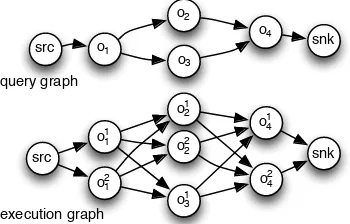
As shown at the top of Fig. 1, a query is specified as a directed acyclicquery graphq= (O,S) whereO is the set of operators and S is the set of streams. A streams∈ Sis a directed edge between two operators,s= (o, o0) where{o, o0} ⊆ O. A query has two special operators, src and snk, which act as the sources and sinks for data streams, respectively. We assume that sources and sinks cannot fail. An operator u is upstream to o, denoted by u ∈ up(o), when ∃(u, o) ∈ S. Similarly, an operator d is downstream too,d∈down(o), when∃(o, d)∈ S.
Query execution.
A query is deployed on a set ofnodes. A node can host multiple operators but, without loss of gen-erality, we assume one operator per node. We distinguish between the logical representation of a query, in terms of its query graph, and its physical realisation, as shown at the bottom of Fig. 1. In the physical execution graph q¯, an operator omay be parallelised into a set of partitioned operatorso1. . . oπ. The valueπ∈N+ is theparallelisation level ofo. Eachoi implements the semantics ofo. It takes as input a partitioned stream s1. . . sπ, which is obtained from the original streams. The current execution graph is maintained by a logically centralisedquery manager.
3.
STATE MANAGEMENT
primitives, the SPS supports more complex operations such as scale out and failure recovery, which affect operator state.
3.1
Query State
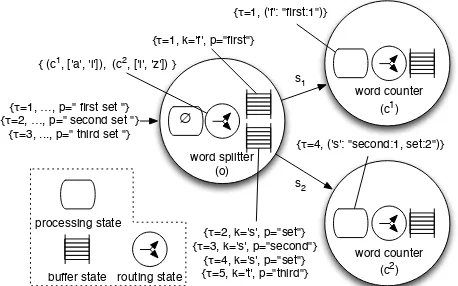
The state of a query consists of theoperator stateof each query operator. We divide the operator state intoprocessing state,buffer state androuting state, as illustrated in Fig. 2. The figure shows a query with three operators for collecting word frequencies in a text stream every minute: a stateless word split operator o, which tokenises a stream of strings into words, and two partitioned statefulword count opera-torsc1 andc2, which maintain a windowed frequency count of words. We use the query as a running example below.
Processing state.
Output tuples from stateful operators depend on input tuples and the history of past tuples. Op-erators typically maintain an internal summary of this his-tory of input tuples, which we term the operator’sprocessing state. The current processing stateθo of an operatorowascomputed from all past tuples withσoi≤τi≤τoi:si∈Io.
Exposing the processing state to the SPS has several rea-sons: (i) it enables the SPS to recover stateful operators more efficiently after failure. Instead of re-processing all tuples in the rangeσoi ≤τi ≤τoi, recreating the
process-ing state, the SPS can restore the state directly from a state checkpoint, as described in§3.2; and (ii) it allows the SPS to redistribute processing state across a set of new partitioned operators to support scale out.
Based on our data model, we define the processing state of an operatoroas a set of key/value pairs,θo ={(k1, v1), . . .}.
Each keykis unique and refers to the corresponding tuple keys from the input streams (see§2.2). Its associated valuev stores the portion of processing state that the operator re-quires when processing tuples with that key. In addition, the processing state is associated with a vector of timestampsτo,
as returned by the operator functionfo. It specifies the most
recent timestamps of input tuples that are reflected inθo.
An operator can maintain state using efficient data struc-tures internally and only translate it to key/value pairs when requested by the SPS. To expose its processing state, the de-veloper of an operatoroimplements a function get-processing-state(o)→(θo, τo). It is invoked by the SPS and takes a copy
of the state. It locks all internal operator data structures to obtain a consistent copy and records the timestamp τo of
the most recent tuples that affected the state.
In Fig. 2, we give an example of processing state for the word frequency operators. To simplify presentation, keys are assumed to be the first letter of a word. The upstream word split operator sends the word “first” to the word count operatorc1 atτ = 1, resulting in the processing stateθc1 =
{(’f’,“first:1”)} and timestampτc1 = (1). The words “set”,
“second” and “set” are processed by c2, instead, which at τc2= (4) holds processing stateθc2={(’s’,“second:1, set:2”)}.
Buffer state.
An SPS typically interposesoutput buffers be-tween operators, which buffer tuples before sending them to downstream operators (see Fig. 2). Buffers compensate for transient fluctuations of stream rates and network capacity. Tuples in output buffers contribute to the query state managed by the SPS: (i) output buffers store tuples that have not yet been processed by downstream operators and therefore must be re-processed after failure; (ii) afterdy-word splitter (o) ∅
routing state processing state
buffer state
word counter (c1)
word counter (c2)
{τ=1, ('f': "first:1")}
{τ=4, ('s': "second:1, set:2")}
{τ=2, k='s', p="set"} {τ=3, k='s', p="second"}
{τ=4, k='s', p="set"} {τ=5, k='t', p="third"} {τ=1, k='f', p="first"}
{ (c1, ['a', 'l']), (c2, ['l', 'z']) }
{τ=1, …, p=" first set "} {τ=2, …, p=" second set "}
{τ=3, ..., p=" third set "}
s1
[image:5.595.321.550.62.205.2]s2
Figure 2: Different types of state in a stateful query for counting word frequencies
namic operator scale out, tuples in output buffers must be dispatched to the correct partitioned downstream operator. We model the output buffer of operator o to a parti-tioned downstream operator d as havingbuffer state βo = {(d1,{t1, . . .}), . . .}with t1 ∈ (o, d1) (see§2.2). It stores a
finite number of past output tuples. The notation βo(di)
refers to the output tuples for a partitioned downstream op-eratordi.
Tuples in an output buffer are discarded after they are no longer needed for recovery (see§4.2). An operator trims tuples from an output buffer by removing tuples with times-tamps older thanτ when it executes the functiontrim(o, τ).
Routing state.
An operatoroin the query graph may cor-respond to multiple partitioned operatorso1, . . . , oπ in the execution graph. An upstream operator uhas to decide to which partitioned operatoroito route a tuple. Since thepar-titioning can change dynamically, an operator has explicit routing state, which must be restored after failure.
For an operator o, we define the routing state as ρo = {(d1,[k
1, k2]), . . . ,(dπ,[kπ−1, kπ])}, which maps the keysk∈
[ki, kj) to a partitioned downstream operatordi. For
exam-ple, the word split operator in Fig. 2 hasρo ={(c1,[’a’,’l’]),
(c2,[’l’,’z’])}. It sends words starting with letters up to ’l’
to operatorc1 and with letters from ’l’ toc2.
3.2
Operations
The above operator state can be manipulated by the SPS through a set of state management primitives.
Checkpoint state.
The SPS can obtain a representation of the processing state θo and the buffer stateβo of anoper-ator o in the form of a checkpoint. This is taken by the function checkpoint-state(o) → (θo, τo, βo). It obtains the
processing state θo safely by calling the user-implemented
functionget-processing-state(), which also returns the times-tamp τo of the most recent tuples in the streams from the
upstream operators that affected the state checkpoint. This permits the SPS to discard tuples with older timestamps, which are duplicates, during replay (see below).
process-Algorithm 1:Operator state backup and restore
operator identifier function: id:O → N, upstream op. ofo:up(o) ={o1, . . . , oi, . . . , om} previous backup operator:backup(o) =ojor⊥if undef.
functionbackup-state(o)
1 (θo, τo, βo)←checkpoint-state(o)
2 i=hash(id(o)) mod|up(o)|
3 store-backup(oi, o, θo, τo, βo)
4 foruin up(o)do trim(u, τoj) :sj= (u, o)
5 if backup(o)6=⊥ ∧backup(o)6=oithen
6 delete-backup(backup(o), o)
7 backup(o)←oi
functionrestore-state(o, θ, τ , β, ρ)
8 set-processing-state(o, θ, τ)
9 βo←β, ρo←ρ
functionreplay-buffer-state(u, o)
10 fort inβu(o)do send o: t
ing state up-to-date, but it incurs a higher overhead. Note that the checkpointing interval should be shorter than the window size of the operator. If checkpoints are taken more rarely, they contain processing state that is superseded by tuples that must be re-processed. To reduce the size of checkpoints, it is also possible to use incremental checkpoin-ting techniques [17].
Note that routing state is not included in the state check-point because it only changes in case of scale out or recovery and not during regular tuple processing. Instead, routing state is maintained by the query manager (see§2.2).
Backup state.
The operator state, as returned by check-point-state, can be backed up to an upstream operator in anticipation of a restore or partition operation. After the operator state was backed up, already processed tuples from output buffers in upstream operators can be discarded be-cause they are no longer required for failure recovery.When an upstream operator has many downstream op-erators that use it for state backups, the backup operation incurs significant overhead, which may result in a scale out of the upstream operator. In that case, operators should balance the backup load across all of their partitioned up-stream operators.
Algorithm 1 defines function backup-state(o) for backing up the state of operatoro. First, the SPS creates a check-point (line 1). It then selects a backup operatorbackup(o) among the upstream operators of o. The backup load is spread among all upstream operators by using a hash func-tion (line 2). The operator state is backed up in line 3. After the state backup, the output buffers of the upstream operators are trimmed (line 4). If the upstream opera-tors are repartitioned, the choice ofbackup(o) may change. If the new backup operator is different from the previous one (line 5), the old backup operator is released (line 6).
Restore state.
Backed up operator state is restored to an-other operator to recover a failed operator or to redistribute state across partitioned operators. The function restore-state(o, θ, τ , β, ρ), described in Algorithm 1, takes the state to restore to operator o. It then initialises the processing state using the functionset-processing-state(line 8) and also assigns the buffer and routing states (line 9).After the state was restored from a checkpoint, the func-tion replay-buffer-state(u, o) is used to replay unprocessed
Algorithm 2:Operator state partitioning
1 key interval : (kl,kh) : (o,[kl,kh])∈ρu∧u∈up(o)
2 key split : (k1,. . .,kπ) :kl=k1< . . . < kπ+1=kh
functionpartition-processing-state(o, π)
3 (θ, τ , β)←retrieve-backup(backup(o), o)
4 fori←1toπdo
5 θi← {(k, v)∈θi:ki≤k < ki+1}
6 τi←τ
7 ifi6= 1then βi← ∅ elseβ1←β
8 store-backup(backup(oi), oi, θ i, τi, βi)
functionpartition-routing-state(u, o, π)
9 ρu←ρu\ {(o,[kl, lh])}
10 fori←1toπdo
11 ρu←ρu∪ {(oi,[ki, ki+1])}
12 store-routing-state(u, ρu)
functionpartition-buffer-state(u)
13 for(o, T)inβudo
14 fort= (τ, k, p)inT do
15 for(o0,[k1, k2])inρudo
16 ifk1≤k < k2 thenβ(o0)←β(o0)∪ {t}
17 βu←β
tuples in the output buffer from an upstream operatoruto bring the operator o’s processing state up-to-date. Before operatoroemits new tuples, it resets its logical clock to the timestamp τ from the restored checkpoint so that down-stream operators can detect and discard duplicate tuples.
Partition state.
When a stateful operator scales out, its processing state must be split across the new partitioned operators. This is done by repartitioning the key space of the tuples processed by the operator. In addition, the rout-ing state of its upstream operators must be updated to ac-count for the new partitioned operators. Finally, the buffer state of the upstream operators is partitioned to ensure that unprocessed tuples are dispatched to the correct partition.In Algorithm 2, we define the function partition-processing-state(o, π), which partitions the state of operatoroforπnew partitioned operators o1, . . . , oπ. The partitioning is per-formed from the state saved by backup(o) to allow parti-tioned operators to recover in case of failure. First, the key range processed by o, as specified by the routing state of the upstream operatoru, is split intoπintervals (lines 1–2). The key space can be distributed evenly using hash parti-tioning, or the key distribution can be used to guide the split. The operator state is retrieved frombackup(o) (line 3) and is split by partitioning the processing state (line 5). The timestamps associated with the processing state are copied for each partition, and the buffer state is assigned to the first partition (lines 6–7). Finally, the operator state for each partition is stored in backup(oi) in order to provide an initial backup for each partition; afterwardsbackup(o) is removed safely from the system (line 8).
The functionpartition-routing-state(u, o, π) is used to up-date the routing state of each upstream operator u. The entry for the old key interval is removed and key intervals for the new partitioned operators are added (lines 9–11). The routing state is then stored at the query manager to be recovered in case of failure (line 12).
An upstream operatorucan repartition its buffer stateβu
according to the updated routing state ρu using the
u o u
o2
o1
u
u2
o6
o1
o5
u1
o6
o1
o5
(a) (b)
(c) (d)
s
s2
s1
.. .
bottleneck new operator
[image:7.595.88.262.57.193.2].. .
Figure 3: Example of scale out of stateful operators
βu(lines 13–14), assigning each tuple to a partition
accord-ing to theρukey intervals (lines 15–16).
3.3
Discussion
As shown in the next section, the above state manage-ment primitives are a minimum set, which lets an SPS per-form scale out and failure recovery in an integrated manner. Other state management primitives, however, can be added to cover a range of previously proposed functionality:
For example, to scale in operators when resources are under-utilised, the state of two operators can bemerged[15]. For operators with large state sizes, aspill operation can temporarily store state on disk, freeing memory resources [19]. More generally, part of the operator state can be supported by external storage through apersist operation, e.g. when combining real-time data processing with historical data [3].
4.
SCALE OUT AND FAULT TOLERANCE
Using the above state management primitives, we present our integrated approach for stateful operator scale out and recovery. We discuss our scaling strategy and fault tolerance, before describing our fault-tolerant scale out algorithm.
4.1
Scale Out
To scale out queries at runtime, the SPS partitions opera-tors on-demand in response to bottleneck operaopera-tors. Bottle-neck operators prevent the system from increasing process-ing throughput. We discuss heuristics for identifyprocess-ing the bottleneck in a query in§5.1. After scaling out a bottleneck operator, its processing load is shared among a set of new partitioned operators, thus increasing available resources to the SPS. Our scale out mechanism partitions operator state and streams without violating query semantics.
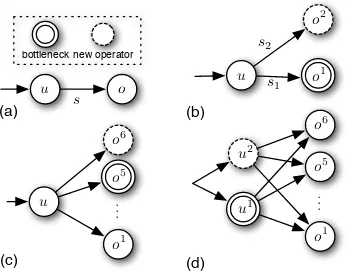
We give an example of operator scale out in Fig. 3, which shows four versions of an execution graph during scale out. When first deployed (Fig. 3a), the execution graph has one operator for each (logical) operator in the query graph. An operator ois connected through stream s to an upstream operator u. We assume that operator o is the bottleneck operator. Fig. 3b shows how the upstream operatoru can partition its output streams into two streams. The two par-titioned operators,o1 ando2, share the processing load and
alleviate the bottleneck condition. In the same way, addi-tional operators can be added to the execution graph for further scale out (Fig. 3c). When the upstream operatoru becomes the new bottleneck (Fig. 3d), it is also partitioned and its output streams are replicated.
Algorithm 3:Integrated fault-tolerant scale out
functionscale-out-operator(o, π)
1 partition-processing-state(o, π)
2 ρ←retrieve-routing-state(o)
3 fori←1toπdo
4 oi←get-new-VM-with-operator()
5 (θi, τi, βi)←retrieve-backup(backup(o), oi)
6 restore-state(oi, θi, τi, βi, ρ)
7 fordin down(o)do replay-buffer-state(oi, d)
8 stop-operator-and-release-VM(o)
9 foruin up(o)do 10 stop-operator(u)
11 partition-routing-state(u, o, π)
12 partition-buffer-state(u)
13 fori←1toπdo replay-buffer-state(u, oi)
14 start-operator(u)
4.2
Fault Tolerance
Even in the absence of bottlenecks, if a VM hosting a stateful operator fails, the SPS must replace it with an op-erator on a new VM. In our approach, overload and failure are handled in the same fashion. Operator recovery becomes a special case of scale out, in which a failed operator is scaled out to a parallelisation level of 1. This means that the SPS does not require a sophisticated failure detector to distin-guish between the two cases but instead scales out an oper-ator when it has become unresponsive.
Operator recovery puts a strain on processing through-put because the SPS must restore operator state and replay tuples missing from the recovered state. In our approach, we can reduce recovery times by restoring a failed operator using several new partitioned operators, i.e. performing par-allel recovery. Parallel recovery improves the recovery speed because it effectively adds extra resources to the SPS for failure recovery.
4.3
Fault-Tolerant Scale Out Algorithm
The SPS maintains two versions of operator o’s state, which could be partitioned for scale out: the current state, maintained byo, and a recent state checkpoint stored by op-erator backup(o). In our approach, the SPS partitions the most recent state checkpoint, which has multiple benefits: (i) it means that the scale out mechanism can be used to recover operatoroafter failure; (ii) it avoids adding further load to operatoro, which is already overloaded, by request-ing it to checkpoint or partition its own state; and (iii) it makes the scale out process itself fault-tolerant: if it fails or is aborted, operatorocan continue processing unaffected.
Algorithm 3 shows the steps for scaling out operator o to a parallelisation level π. First, the SPS executes the functionpartition-processing-stateto partitionso’s processing state located on backup(o), backing it up again to survive failure (line 1). It also retrieves o’s routing state from the query manager (line 2). It then creates π new partitioned operatorsoi to replaceo(line 4). Aftero’s processing and buffer state were retrieved frombackup(o) (line 5), they are restored to the new partitioned operatorsoi(line 6). Tuples
yet unprocessed by the downstream operators are replayed fromoi’s buffer state (line 7). After that,ois stopped and its VM is released (line 8).
reparti-EC2 stats
fault detector scale out
coordinator
deployment manager query manager
queries
bottleneck detector scaling policy VM pool
faults
[image:8.595.59.289.54.131.2]recovery coordinator
Figure 4: Integration with stream processing system
tions their buffer states (line 12). After that, the SPS re-plays tuples that are not reflected in the state checkpoint from the output buffers (line 13). The final step is to restart the upstream operator (line 14).
The same algorithm is used to recover from the failure of a stateful operatoroby executingscale-out-operator(o,1) be-cause it restarts processing fromo’s last checkpoint, without obeing operational. To reduce recovery time using parallel recovery, the SPS can also partition the failed operator by executingscale-out-operator(o,2). In this case, each restored operator only has to process half of the replayed tuples in
replay-buffer-state, thus reducing recovery time (see§6.2).
Discussion.
The above algorithm assumes that a state check-point is available at operatorbackup(o). As a consequence, the SPS cannot scale out ifbackup(o) fails before the state checkpoint is partitioned and restored across the new par-titioned operators successfully (i.e. lines 1-6). In that case, the scale out is aborted and retried afterbackup(o) has re-covered andohas again backed up its operator state. There-fore the VM hostingois only released afterrestore-statehas completed on all partitioned operators (line 8).If any upstream operatoru—other thanbackup(o)—fails, aborting the scale out process is unnecessary. After opera-toruhas recovered, its output buffer is replayed to the par-titioned operators according to the updated routing state retrieved from the query manager (line 2), as stored by the non-failedbackup(o) (line 12 in Algorithm 2). If one of the partitioned operatorsoi fails, it can be recovered from the checkpoint stored atbackup(oi) (line 8 in Algorithm 2).
5.
STREAM PROCESSING IN A CLOUD
In this section, we describe how our integrated approach for stateful operator scale out and recovery can be realised in a cloud-hosted SPS. This entails several challenges: the SPS must (i) have heuristics for identifying bottleneck operators; (ii) have a policy as to when to scale out operators; and (iii) handle the delay when new VMs are provisioned.
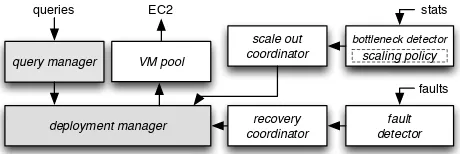
We add our fault-tolerant scale out approach to an ex-perimental distributed SPS developed in our group. Fig. 4 shows the architecture of the system after integration. A query graph is submitted to a query manager, which per-forms a mapping of query operators to VMs, to obtain an execution graph. The execution graph is used by a deploy-ment manager to initialise VMs, deploy operators, set up stream communication and start processing.
To support dynamic scale out, we add abottleneck detec-tor that, based on system statistics, identifies the bottle-neck operators in the query, as explained in the next sec-tion. According to ascaling policy, it invokes thescale out coordinator, which implements scale out decisions. For fault recovery, afailure detector notifies therecovery coordinator to recover a failed operator. The deployment manager is
extended so that it can request new VM instances from a VM pool. The VM pool masks the delay of cloud platforms when provisioning new VM instances, as described in§5.2.
5.1
Bottleneck Detection and Scaling Policy
When detecting operator bottlenecks, we focus on com-pute bottlenecks because they are the most common type observed in practice. In particular, they limit the scalability of the Linear Road Benchmark used in§6.1.
We adopt a simple yet effectivescaling policy based on measured CPU utilisation of operators. Every rseconds, VMs hosting operators submit CPU utilisation reports to the bottleneck detector, which record the user and system CPU time that each operator executed. This accounts for “stolen” CPU time when other VMs on the same physical node were scheduled. Whenk consecutive reports from an operator are above a user-defined thresholdδ, the bottleneck detector notifies the scale out coordinator to parallelise the operator. Empirically, we determined that collecting CPU utilisation reports every r=5 s and scaling out after k=2 consecutive measurements are above δ=70% utilisation of the CPU time slice leads to appropriate scaling (see§6.1).
5.2
Virtual Machine Pool
The time taken to deploy a new operator is a critical issue. When scaling out, VMs must be allocated quickly in order to reduce the duration of an overload condition. When re-covering a failed VM, fast recovery minimises the disruption caused by the failure. Current IaaS cloud platforms, how-ever, require on the order of minutes to provision new VM instances, as confirmed by our own empirical experience. This makes it impractical to request new VM instances on-demand when they are required by an SPS.
Our solution is to decouple the request for a new VM from the provisioning of the VM. We pre-allocate a small pool of VM instances of size p ahead of time. New VM instances for operators are requested from this VM pool, which can happen in seconds. Asynchronously the pool is refilled to sizepby requesting VM instances from the cloud provider. A challenge is to decide on the optimal VM pool size. A VM pool that is too small may get exhausted when mul-tiple VMs are requested in short succession. A large VM pool incurs an unnecessarily high financial cost because pre-allocated VMs are billed by the cloud provider.
We make two observations regarding the VM pool sizep: (i) with real-world failures, preallocating 1–2 VMs is suffi-cient, which means that p is primarily determined by the scale out requirement; (ii) p can be adjusted to the scale out behaviour over time. For example,pmay be kept larger while the SPS scales out aggressively to adapt to an open loop workload. After the rate of new VM requests decreases, the VM pool can shrink to support steady-state operation. For simplicity, we use a constant VM pool size in§6.1.
6.
EVALUATION
Next we evaluate our integrated approach for dynamic scale out and fault tolerance in an SPS. The goals of our experimental evaluation are to investigate:
Data Feeder
Balance Account* Forwarder
Toll Calculator*
Toll Assessment*
Toll Collector
Sink [24 instances]
[12 instances]
[image:9.595.337.528.55.170.2][5 instances] [6 instances]
Figure 5: Query for the Linear Road Benchmark
i.e. when tuples can be discarded during overload, using a streaming map/reduce-style query over Wikipedia data. We show that our approach scales effectively with the input rate while maintaining low processing latency;
(ii) the recovery time of the stateful recovery mech-anism for a windowed word frequency query (§6.2). We show that our approach recovers operator state faster than source replay [29] and upstream backup [8] of tuples. We also demonstrate how recovery times can be reduced through parallel recovery; and
(iii) the impact of our state management approach on tuple processing latency (§6.3). We study how input rate, state size and the checkpointing interval affect the overhead. The experiments are conducted using an experimental stream processing system implemented in Java. We deploy it on Amazon EC2 usingsmall VM instances for the query operators, which have 1.7 Gb of RAM, moderate IO perfor-mance and 1 EC2 compute unit (equivalent to a 1.0–1.2 GHz 2007 Xeon CPU). While these VMs have low processing ca-pabilities, they are representative of public cloud VMs. We use high-memory double extra large VM instances (34 Gb of RAM; high IO performance; and 4 virtual cores with 3.25 compute units) to emit the source data streams and to gather output results.
6.1
Dynamic Scale Out
Closed loop workload.
We first evaluate the effectiveness of our scale out approach when adapting to an increasing closed loop workload, i.e. when the SPS has to scale out to match an increasing input stream rate without tuple loss. Linear Road Benchmark (LRB). Similar to previous work [32, 18], we use the LRB [5]. It models a road toll network, in which tolls depend on the time of day and level of congestion. It specifies the following queries: (i) provide toll notifications to vehicles within 5 s; (ii) detect accidents within 5 s; and (iii) answer balance account queries about paid toll amounts. The goal is to support the highest num-ber of express-waysLwhile satisfying the above latency con-straint. Over the course the benchmark, the input rate for a single express-way (L=1) begins at 15 tuples/s and increases to 1700 tuples/s. An SPS without dynamic scale out sup-port would have to be provisioned to sustain the peak rate. To generate a sufficiently high input stream rate, we pre-compute the input stream forL=1 in memory and replicate it for multiple express-ways [10].Our LRB query implementation consists of 7 operators, as shown in Fig. 5. Adata feeder acts as the source and gen-erates the input data stream. Aforwarder operator routes tuples downstream according to their type. The statefultoll calculator maintains tolls and detects accidents. The state-fultoll assessmentoperator computes account balances and responds to balance queries in tuples. The statelesscollector operator gathers notifications. The statefulbalance account
0 1 2 3 4 5 6 7
0 500 1000 1500 2000 0
5 10 15 20 25 30 35 40 45 50 55 60
Tu
ples
/s (x
100
K)
Nu
mbe
r of
VMs
Time (seconds) Throughput (tuples/s)
Input rate (tuples/s) Num. of VMs
Figure 6: Dynamic scale out for the LRB workload withL=350 (closed loop workload)
0 1000 2000 3000 4000 5000
0 500 1000 1500 2000 0 5 10 15 20 25 30 35 40 45 50 55 60
La
tenc
y (m
illise
cond
s)
Nu
mbe
r of
VMs
[image:9.595.69.278.57.116.2]Time (seconds) Latency Num. of VMs
Figure 7: Processing latency for LRB workload
operator receives the balance account notifications and ag-gregates the results. Thesink operator collects all results. We deploy the LRB query on Amazon EC2 and set the scale out threshold to 70% utilisation, as discovered below. Our deployment achieves a maximum L-rating of L=350 with 50 VMs. After that, the source and sink become the bottle-neck, handling a maximum of 600,000 tuples/s due to seri-alisation overheads. The partitioned execution graph of the LRB is as shown in Fig. 5. The main computational bottle-neck in the query, thetoll calculator, is partitioned the most by the system, followed by theforwarder.
This result is about 70% ofL=512, which is currently the highest reported L-rating in the literature by Zeitler and Risch [32]. Their result was obtained on a private cluster with 560 dedicated cores with 2.27 Ghz—substantially more resources than what we used. Since our approach only scales out bottleneck operators at a fine granularity, it can be more resource efficient than the replication of the whole query graph used by Zeitler and Risch.
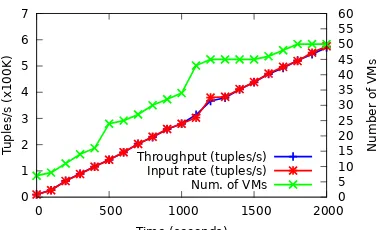
Fig. 6 shows the number of allocated VMs along with the input rate and achieved result throughput over time. For L=350, the input rate is initially approx. 12,000 tuples/s and increases to 600,000 tuples/s. We observe that the SPS maintains the required result throughput for the input rate, requesting additional VMs as needed. At timest=475 and t=1016, multiple operators are scaled out in close succession because bottlenecks appear in two operators simultaneously. In Fig. 7, we show the processing latencies of output tu-ples, as a representative metric for the performance expe-rienced by the query. The 99th and 95th percentiles of the
[image:9.595.334.527.207.322.2]0 1 2 3 4 5 6
0 100 200 300 400 500 600 0 10 20 30 40 50 60 70 80
Tu
ples
/sec
ond
(x10
0K)
Nu
mbe
r of
VMs
[image:10.595.335.527.57.173.2]Time (seconds) Number of VMs Tuples consumed/second
Figure 8: Dynamic scale out for a map/reduce-style workload (open loop workload)
Towards the end of the experiment, the median latency in-creases when the system becomes overloaded.
Open loop workload.
In addition, we explore an open loop workload, in which the SPS is initially under-provisioned. Map/reduce-style top-k query. We implement a map/re-duce-style top-k query that outputs every 30 seconds the ranking of the most visited Wikipedia language versions based on Wikipedia data traces. Initially, we set the in-put stream rate to be well over the performance capacity of the SPS, incurring tuple loss. The goal is to let the SPS scale out the query in order to sustain the incoming rate.We use 18 data sources to inject tuples to a statelessmap operator, which removes unnecessary fields from tuples, and a statefulreduce operator, which maintains a top-K dictio-nary of the frequency of visited Wikipedia language versions. When the reducer scales out, we use the sink to aggregate the partial results and output the final answer.
We present the dynamic scale out behaviour in Fig. 8. As ex-pected, the SPS scales out until it can sustain the incoming rate of 550,000 tuples/s. The scale out process leads to peaks in the tuple throughput. After scaling out an operator, the input buffers of the new partitioned operators consume tu-ple faster than they can be processed. Only after the input queues have filled, performance stabilises again.
Another observation is that the rate of scale out is higher in the first part of the experiment (untilt=100). The reason is that initially more map operators are scaled out than re-duce operators: the stateless map operators scale out faster than the stateful reduce operators.
Impact of scale out threshold.
Next we evaluate the im-pact of the scale out policy. We study how different scale out thresholds δ affect the number of allocated VMs and the tuple processing latency (see§5.1). The goal is to find the best trade-off between resource allocation efficiency and processing performance. To explore the efficiency of VM allocation, we compare our dynamic scale out approach to manual scale out by a human expert.We investigate different thresholdsδusing the LRB with L=64. We initially deploy the query with one VM per op-erator and observe the number of VMs at the end of the experiment and the processing latency. Fig. 9 shows that, as δ increases from 10% to 90%, fewer VMs are allocated. The median latency curve is concave, increasing not only for high thresholds, when VMs are close to overload, but also for low ones. This behaviour can be understood better by considering the 95thpercentile of tuple latencies. Whenδis
0 200 400 600 800 1000 1200 1400 1600
0 10 30 50 70 90 100 0 5 10 15 20 25 30 35 40 45 50
La
tenc
y (m
illise
cond
s)
Nu
mbe
r of
VMs
Scale Out Policy Threshold Latency (95th) Latency (median) Num. of VMs
Figure 9: Impact of the scale out threshold δ on processing latency
0 500 1000 1500 2000
10 15 20 25 30
La
tenc
y (m
illise
cond
s)
Number of VMs Latency (95th), manual Latency (95th), dynamic Latency (median), manual Latency (median), dynamic
Figure 10: Comparison between dynamic and man-ual scale out
small, the system performs many scale out operations, which impacts processing latency, especially at higher percentiles. Based on these results, a thresholdδof 50%–70% provides the best trade-off. It follows the best practice in data centre management to maintain a headroom of unused resources in anticipation of workload bursts and transient peaks [13].
Efficiency of resource allocation.
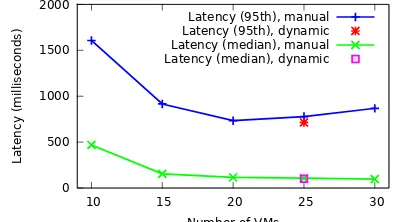
We evaluate the effi-ciency of the dynamic scale out policy against a human expert who manually parallelises operators. In this exper-iment, we use the LRB query with L=115. The human expert is given a fixed number of VMs and uses them as effectively as possible to support this workload. The human expert, based on their understanding of the relative costs of operators, tracks the bottleneck across multiple scaled out versions of the LRB query. The dynamic scale out policy allocates 25 VMs at the end of the experiment.Fig. 10 shows the processing latency as a function of the number of VMs for the manual scale out decisions. In ad-dition, the median (101 ms) and 95th percentile (714 ms) of latencies for the dynamic scale out policy are indicated in the figure. The results show that the most efficient manual allocation for this workload is 20 VMs—with fewer VMs, the 95thlatency percentile starts to increase due to the high VM
utilisation. In comparison, automatic scale out achieves low latency with only 25% more resources than the optimum.
6.2
Failure Recovery
To evaluate failure recovery, we first compare recovery time against other fault tolerance approaches that can han-dle stateful operators. We also measure the impact of the checkpointing interval on recovery time. We finish with an exploration of the benefit of parallel recovery.
[image:10.595.75.267.57.171.2] [image:10.595.332.530.207.318.2]re-0 2 4 6 8 10 12 14
100 500 1000
Re
cove
ry T
ime
(sec
ond
s)
Input Rate (tuples/s) Recovery using State Management (R+SM) Source replay (SR)
[image:11.595.73.265.56.172.2]Upstream backup (UB)
Figure 11: Recovery time for different fault toler-ance mechanisms
0 1 2 3 4 5 6 7 8
1 5 10 15 20 25 30
R
e
cove
ry T
im
e (
seco
nds)
Checkpointing Interval (seconds) Input rate (100 tuples/s)
[image:11.595.337.525.58.171.2]Input rate (500 tuples/s) Input rate (1K tuples/s)
Figure 12: Recovery time for different R+SM check-pointing intervals
play(SR).UBbuffers tuples in each operator and re-processes them to recover operator state. SR is a variant of UB, in which tuples are only buffered and replayed by the source [29].
SRandUBare only suitable for stateful operators whose state can be restored after re-processing few tuples. As a result, we cannot use the LRB query for comparison because its operators require the whole history of tuples. Instead, we use a simple windowed word count query.
Windowed word frequency query. This query counts word frequencies over a 30 s window. It executes over a stream of sentence fragments, each 140 bytes in size. It has two operators: a word splitter tokenises the input stream into words; and aword countermaintains frequency counters for each word. The state of the word counter is a dictionary of words and their counters.
Recovery time.
We observe the recovery times for the three approaches. ForR+SM, we set the checkpointing intervalc to 5 s. During the experiment, we fail the VM hosting the word counteroperator and measure the time to recover (i.e. until the complete operator state was restored).Fig. 11 shows results averaged over 10 runs for different input rates. SRachieves slightly faster recovery thanUB be-cause of the short length of the operator pipeline and the fact that it stops the generation of new tuples during the recov-ery phase. R+SM achieves lower recovery times than both
UB and SR. Due to the state checkpoints, it re-processes fewer tuples to recover the stateful operator. In the worst case, it must replay 5 s worth of tuples instead of the entire window of 30 s. Especially at higher input stream rates, the overhead of re-processing tuples dominates recovery time.
Impact of checkpointing interval.
In Fig. 12, we show the change in recovery time as a function of the checkpointing interval for different input rates. Recovery time increases0 1 2 3 4 5 6 7 8
1 5 10 15 20 25 30
R
e
cove
ry T
im
e (
seco
nds)
Checkpointing Interval (seconds) Serial recovery
Parallel recovery
Figure 13: Recovery time for serial and parallel re-covery using state management
with longer checkpointing intervals because more tuples are replayed. Tuple buffering is the main factor determining re-covery time, which is why rere-covery time increases consider-ably with higher rates. While frequent checkpointing incurs overhead, it reduces recovery time, even for high rates.
Parallel recovery.
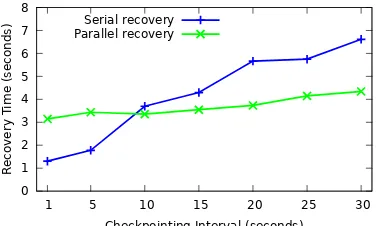
To prevent the SPS from falling behind during recovery,parallel recoverycombines scale out with re-covery (see§4). In this experiment, we compare serial to par-allel R+SM with two partitioned operators. Fig. 13 shows recovery times for different checkpointing intervals with an input rate of 500 tuples/s. For short intervals, parallel re-covery does not bring a benefit due to its higher overhead with two partitioned operators. As the interval increases, however, more tuples have to be replayed when restoring operator state, and parallel recovery can process at a higher rate with two partitioned operators.6.3
State Management Overhead
Our state management approach based on periodic check-pointing incurs an overhead. Since the overhead on process-ing throughput is negligible and could not be observed, we measure its effect on tuple processing latency for different input rates, state sizes and checkpointing intervals.
Processing latency.
We explore the processing latency of the windowed word frequency query with different opera-tor state sizes and input rates. We synthetically vary the dictionary size betweensmall (102 entries;≈2 Kb),medium (104 entries;≈200 Kb) andlarge (105 entries;≈2 Mb). Weuse a checkpointing interval of 5 s and a window of 30 s. We compare to a baseline without checkpointing, which gives raw processing latency independent of state size.
Fig. 14 shows that the 95th percentile of tuple process-ing latencies increases with state size. For large state sizes, checkpointing takes longer and occupies more CPU time, which is unavailable for tuple processing. Higher input rates increase the load on the operator, resulting in less head-room for the checkpointing process. For input rates of 100 and 500 tuples/s, the latency remains small but grows for 1000 tuples/s. Since the system becomes overloaded at this rate, it does not have sufficient resources for checkpointing, which could be addressed by scaling out the operator. Note that measuring overhead as a high latency percentile results in a worst case—the effect on the medium latency is less pronounced and on the throughput is not observable.
[image:11.595.70.265.206.313.2]0 100 200 300 400 500
Small Medium Large No
Checkpointing
La
tenc
y (m
illise
cond
s)
[image:12.595.74.264.57.172.2]State Size Input rate (100 tuples/s) Input rate (500 tuples/s) Input rate (1000 tuples/s)
Figure 14: Overhead of state checkpointing for dif-ferent input rates and state sizes
0 1 2 3 4 5 6 7 8 9
1 5 10 15 20 25 30 0 100 200 300 400 500 600
R
e
cove
ry T
im
e (
seco
nds)
La
tenc
y (m
s)
Checkpointing Interval (seconds) Recovery time
Latency
Figure 15: Trade-off between processing latency and recovery time for different checkpointing intervals
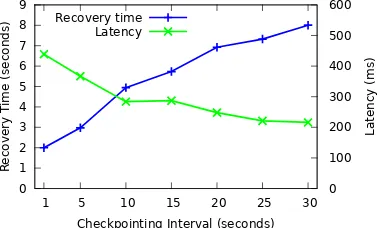
processing latency for the windowed word frequency query with 1000 tuples/s. Fig. 15 shows how the 95th percentile
of latency decreases with an increased checkpointing inter-val. For comparison, the plot includes the expected recovery time for that interval. There is a trade-off: the larger the interval, the lower the impact on tuple processing, at the expense of a longer recovery time after failure. The check-pointing interval should therefore be chosen based on the anticipated failure rate and the performance requirements of a query.
7.
RELATED WORK
State management in stream processing. There are proposals for managing state in SPS with particular goals. Gulisano et al. [15] describe how to partition the state of specific operators such as join and aggregate for scale out. State spilling was proposed to handle overload conditions by temporarily storing parts of operator state on disk or a remote node [19]. In addition, operator state is made explicit when replicating operators across nodes. Feng et al. [11] use counting bloom filters to improve the performance of state transfers for replicated operators. In contrast, we expose state through a set of generic set of management primitives to integrate scale out and failure recovery.
Parallelism in stream processing. Much work has fo-cused on exploiting parallelism in stream processing and, more recently, performing scale out. Apache S4 [23] and Twitter Storm [29] express queries as directed acyclic graphs with parallel operators. S4 schedules parallel instances of operators but does not manage their parallelism or state. Storm allows users to specify a parallelisation level and sup-ports stream partitioning based on key intervals but it ig-nores operator state and cannot scale out at runtime.
IBM System S [4] supports intra-query parallelism through
a fine-grained subscription model, which specifies stream connections, but management is manual. Hirzel [16] pro-vides a MatchRegex operator for System S, which detects tuple patterns in parallel. This approach does not con-sider dynamic repartitioning, and the state is specific to automata-based pattern detection. Schneider et al. [27] add elastic operators to the SPADE language, which gradually find the optimal number of threads for stateless processing with maximum throughput. Our work is orthogonal in that it focuses on parallelising stateful operators.
StreamCloud [15] parallelises stateful queries at runtime but does not support failure recovery. It uses a query com-piler to synthesise high-level queries into a graph of rela-tional algebra operators. It uses hash-based parallelisation, which is geared towards the semantics of joins and aggre-gates. Instead, we develop lower-level state management primitives, applicable to a wider class of stateful operators. As shown in §6.1, our approach can support custom opti-mised operators for the LRB query, which can achieve higher per-node performance than relational operators.
Some proposals for scalable SPSs [21] are inspired by the map/reduce paradigm, adapting it for low-latency stream processing, but are limited by its expressiveness. Martin et al. [21] add stateful reducers to map/reduce and rely on external fault tolerance mechanisms. In contrast, our state management approach is integrated as part of the SPS.
Zeitler and Risch [32] propose theparasplit operator for partitioning streams statically according to a cost model. Instead, we make decisions about the parallelisation level at runtime in response to performance metrics. Backman et al. [6] partition operators across nodes in an SPS to minimise processing latency by balancing load according to simulated latency estimates. In contrast, we partition operators on-demand to remove processing bottlenecks and show experi-mentally that this maintains low latency.
Fault tolerance in stream processing. Active replica-tionin SPSs suffers from a high resource overhead, doubling the number of required processing nodes, which is not cost-effective in large cloud-based deployments.
Martin et al. [20] propose to reduce the resource footprint of active replication in cloud-hosted SPSs by using spare resources due to over-provisioning. However, this requires an average utilisation of less than 50%—active replication is suspended when peak workloads demand all resources. While we assume long-lived failures, Zhang et al. [33] focus on transient failures. They combine active replication in the face of failures for fast recovery with passive replication during normal operation.
Passive replication is more resource efficient but incurs a periodic overhead due to state synchronisation, and is prone to higher recovery times, especially with large state sizes.
IBM System S [30] provides a reliability mechanism, in which operator state is persisted using an object/relational mapping to a DBMS. It ensures the consistency of check-points with asynchronous operations pending at the time of failure by saving them along with the state, similarly to our buffer state. Our approach, however, does not depend on an external DBMS, which may become a bottleneck.
[image:12.595.75.266.207.321.2]D-Stream [31] is a streaming version of the Spark parallel processing framework. It processes datasets across different nodes and periodically checkpoints results. Similar to our parallel recovery, missing results are recovered in parallel from multiple nodes. However, the use of Spark means that processing latencies are high.
Upstream backup [8] requires nodes to buffer tuples until they have been processed by downstream operators. On fail-ure, lost tuples are replayed by upstream nodes. In general, this suffers from long recovery times when a large number of tuples have to be re-processed to restore stateful opera-tors and cannot support state that depends on the complete stream history. Sweeping checkpointing [14] reduces recov-ery times by checkpointing state when all downstream op-erators have completed processing and buffers are smallest. This is orthogonal to our approach and could be used to choose the best checkpointing time.
8.
CONCLUSIONS
We presented an integrated approach for scale out and failure recovery through explicit state management of state-ful operators. Our approach treats operator state as an in-dependent entity, which can be checkpointed, backed up, restored and partitioned by the SPS. Based on these oper-ations, the SPS can support dynamic scale out of operators while being fault tolerant. Our results show that our ap-proach can be used effectively to provision Amazon EC2 resources against increasing input rates in the Linear Road Benchmark and also support open loop workloads. Despite the state checkpointing, processing latency remains within desired levels. As future work, we plan to extend our scale out policy with support for scale in to enable truly elastic deployments of cloud-based SPSs.
Acknowledgements. This work was supported by a PhD CASE Award funded by the Engineering and Physical Sci-ences Research Council (EPSRC) and BAE Systems.
9.
REFERENCES
[1] D. J. Abadi, Y. Ahmand, et al. The Design of the Borealis Stream Processing Engine. InCIDR, 2005. [2] D. Agrawal, S. Das, et al. Big Data and Cloud
Computing: Current State and Future Opportunities. InEDBT, 2011.
[3] Y. Ahmad, O. Kennedy, et al. DBToaster: Higher-Order Delta Processing for Dynamic, Frequently Fresh Views. InVLDB, 2012.
[4] L. Amini, H. Andrade, et al. SPC: A Distributed, Scalable Platform for Data Mining. InDMSSP, 2006. [5] A. Arasu, M. Cherniack, et al. Linear Road: A Stream
Data Management Benchmark. InVLDB, 2004. [6] N. Backman, R. Fonseca, et al. Managing Parallelism
for Stream Processing in the Cloud. InHotCDP, 2012. [7] M. Balazinska, J. Hwang, et al. Fault Tolerance and
High Availability in Data Stream Management Systems. InEncyclopedia of Database Systems, 2009. [8] M. Balazinska, A. Rasin, et al. High-Availability
Algorithms for Distributed Stream Processing. In ICDE, 2005.
[9] S. Blanas, J. M. Patel, et al. A comparison of join algorithms for log processing in mapreduce.SIGMOD, 2010.
[10] M. Duller, J. S. Rellermeyer, et al. Virtualizing Stream Processing. InMiddleware, 2011.
[11] Y.-H. Feng, N.-F. Huang, et al. Efficient and Adaptive Stateful Replication for Stream Processing Engines in High-Availability Cluster.TPDS, 22(11), 2011. [12] P. Gill, N. Jain, et al. Understanding Network Failures
in Data Centers: Measurement, Analysis, and Implications. InSIGCOMM, 2011.
[13] A. Greenberg, J. Hamilton, et al. The Cost of a Cloud: Research Problems in Data Center Networks. In SIGCOMM, 2008.
[14] Y. Gu, Z. Zhang, et al. An Empirical Study of High Availability in Stream Processing Systems. In Middleware, 2009.
[15] V. Gulisano, R. Jimenez-Peris, et al. StreamCloud: An Elastic and Scalable Data Streaming System. TPDS, 99(PP), 2012.
[16] M. Hirzel. Partition and Compose: Parallel Complex Event Processing. InDEBS, 2012.
[17] J. H. Hwang, Y. Xing, et al. A Cooperative,
Self-Configuring High-Availability Solution for Stream Processing. InICDE, 2007.
[18] N. Jain, L. Amini, et al. Design, Implementation, and Evaluation of the Linear Road Benchmark on the Stream Processing Core. InSIGMOD, 2006. [19] B. Liu, Y. Zhu, et al. Run-time Operator State
Spilling for Memory Intensive Long-running Queries. InSIGMOD, 2006.
[20] A. Martin, C. Fetzer, et al. Active Replication at (Almost) No Cost. InSRDS, 2011.
[21] A. Martin, T. Knauth, et al. Scalable and Low-Latency Data Processing with Stream MapReduce. InCLOUDCOM, 2011.
[22] R. Motwani, J. Widom, et al. Query Processing, Resource Management, and Approximation in a Data Stream Management System. InCIDR, 2003. [23] L. Neumeyer, B. Robbing, et al. S4: Distributed
Stream Computing Platform. InICDMW, 2010. [24] N. Parikh and N. Sundaresan. Scalable and Near
Real-Time Burst Detection from eCommerce Queries. InSIGKDD, 2008.
[25] M. Russell.Mining the Social Web. O’Reilly, 2011. [26] B. Satzger, W. Hummer, et al. Esc: Towards an
Elastic Stream Computing Platform for the Cloud. In IEEE CLOUD, 2011.
[27] S. Schneider, H. Andrade, et al. Elastic Scaling of Data Parallel Operators in Stream Processing. In IPDPS, 2009.
[28] Z. Sebepou and K. Magoutis. CEC: Continuous Eventual Checkpointing for Data Stream Processing Operators. InDNS, 2011.
[29] Twitter Storm.github.com/nathanmarz/storm/wiki. [30] R. Wagle, H. Andrade, et al. Distributed Middleware
Reliability and Fault Tolerance Support in System S. InDEBS, 2011.
[31] M. Zaharia, T. Das, et al. Discretized Streams: An Efficient and Fault-Tolerant Model for Stream Processing on Large Clusters. InHotCloud, 2012. [32] E. Zeitler and T. Risch. Massive Scale-out of
Expensive Continuous Queries.VLDB Endowment, 4(11), 2011.