City, University of London Institutional Repository
Citation
:
Wilk, S., O'Sullivan, D., Kezadri-Hamiaz, M., Kuziemsky, C., Rosu, D.,
Michalowski, W. and Fung-Kee-Fung, M. (2016). Aligning Interdisciplinary Healthcare Team
Behavior with Workflow Execution: An Example of a Radical Prostatectomy Workflow. 2016
IEEE 29th International Symposium on Computer-Based Medical Systems (CBMS), doi:
10.1109/CBMS.2016.62
This is the accepted version of the paper.
This version of the publication may differ from the final published
version.
Permanent repository link:
http://openaccess.city.ac.uk/16229/
Link to published version
:
http://dx.doi.org/10.1109/CBMS.2016.62
Copyright and reuse:
City Research Online aims to make research
outputs of City, University of London available to a wider audience.
Copyright and Moral Rights remain with the author(s) and/or copyright
holders. URLs from City Research Online may be freely distributed and
linked to.
City Research Online:
http://openaccess.city.ac.uk/
[email protected]
Aligning Interdisciplinary Healthcare Team Behavior with Workflow Execution:
An Example of a Radical Prostatectomy Workflow
Szymon Wilk
Poznan University of Technology Poznan, Poland
Dympna O’Sullivan
City University London London, UK
Mounira Kezadri-Hamiaz
Taibah University Medina, Saudi Arabia
Craig Kuziemsky
University of Ottawa Ottawa, Canada
Daniela Rosu
University Of Toronto Toronto, Canada
Wojtek Michalowski
University of Ottawa Ottawa, Canada
Michael Fung-Kee-Fung
The Ottawa Hospital Ottawa, Canada
Abstract—Operationalizing care delivery through an interdisciplinary healthcare team (IHT) requires knowledge about the overall structure of an IHT and the behavioral rules that “control” the dynamics of this structure interpreted as team and clinical leadership maintenance and task allocation. While progress has been made in understanding IHT structure, there is less work on the behavioral aspects of an IHT associated with its dynamics. In this paper we fill this void by extending our Team and Workflow Management Framework (TWMF) with a set of rules to operationalize IHT behavior in terms of clinical leadership, coordination of workflow execution over multiple days as part of continuity of care, and management of tasks, including urgent ones that prevent planned workflow execution. We briefly describe a proof-of-concept implementation of extended TWMF in the form of a computer system for supporting cooperative execution of clinical workflows by an IHT. The system is built on top of an existing business workflow execution engine and employs behavioral rules to control the IHT behavior. We also illustrate the operations of TWMF in a case study where an IHT is executing a workflow for the management of post-operative inpatient recovery after radical prostatectomy.
Keywords-interdisciplinary healthcare team; clinical workflow execution; radical prostatectomy; computer-supported cooperative work
I. INTRODUCTION
We define an interdisciplinary healthcare team (IHT) as a group of practitioners (care providers) coming from multiple clinical disciplines who work together towards a shared goal [1]. Care delivery by an IHT is a common recommendation from expert panels, as teams provide several benefits including safer and more effective care, higher patient satisfaction and better use of available resources [1].
However, despite such benefits, provision of care by IHT in clinical practice poses a number of challenges, including communication and coordination of the activities between team members [2]. Ambiguous specifications about responsibilities and task assignments and a lack of continuity in provision of care by the IHT are impediments to quality care [2]. While possible improvements of care delivery by an IHT has been studied from several perspectives, including
education [3], team composition [4] and patient-centeredness [5], there is a lack of research on how such care delivery should be operationalized, so the above mentioned challenges are addressed. More specifically, we suggest that IHT operationalization involves aligning team behavior with workflow execution that focuses on how the team interacts to realize a sequence of tasks and how team leadership is established and implemented [6].
Workflow designed for IHT execution needs to include a defined structure along with a set of behaviors that describe how the IHT operates. While good progress has been made defining structural aspects of IHT delivery, there is less research on behavioral aspects of teamwork [7]. One possible approach has been to develop generic design patterns as frameworks of common situations [2]. That work focuses on modeling tasks that a team performs and how to allocate tasks to members. However, it does not consider important aspects of care delivery, such as team leadership [4, 6] or the need for flexible task assignments in temporal workflows, where care delivery may take place over multiple days and therefore tasks and/or leadership may need to be transferred across team members [6]. Another complicating aspect of IHT operationalization is the need to manage urgent tasks that may occur dynamically and cause issues in normal workflow execution. Finally, any attempt to operationalize IHT executing a workflow should promote continuity of care – the same practitioner managing a patient over multiple days can lessen chances of adverse events and improve patient outcomes [8]. Some of these requirements (e.g., continuity of care) may be satisfied by a specialized team description language proposed in [9], however, this language is aimed at business process and thus does not capture all relevant characteristics of IHT, like clinical leadership.
preferences, availability, competence and cooperation by process mining event logs. From an industry perspective, the roles of teams and team behavior have also been recognized - IBM Business Process Manager V8.5 contains a new team construct for defining sets of users who are authorized to perform actions on processes and tasks [12]. However less work has taken into account settings such as clinical care, where new and dynamic processes continuously “emerge” because of human decision making. Furthermore, in our approach we introduce capabilities to characterize practitioners and tasks, what results in a more fine-grained representation of teams and workflows and more flexible task-practitioner assignment, than in the other approaches.
This paper extends our prior work, where we proposed a comprehensive framework to model IHT behavior and operationalize it using ontological engineering and first-order logic (FOL) [13, 14]. Here we report a richer model for team leadership, combined with temporal workflow execution and an ability to manage urgent tasks. To achieve this we have developed a new set of rules to operationalize selection of the most responsible physician (MRP) as team leader, coordination of workflow over multiple days as part of continuity of care, and identification and management of dynamic workflow issues such as urgent tasks.
II. METHODS
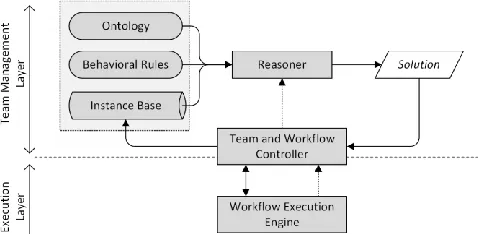
[image:3.612.58.297.565.682.2]We previously developed the Team and Workflow Management Framework (TWMF) to align team behavior with workflow execution [15]. TWMF is represented in Fig. 1 and consists of a Team Management Layer (TML) built on top of a Workflow Execution Engine (WEE). The TML consists of (1) an ontology describing concepts and relations pertinent to IHTs, executed workflows and managed patients (therefore we refer to it as IHT ontology), (2) an instance base that stores instances of concepts from the ontology and provides run-time information about teams and their members, workflows, task assignments and patients, (3) a set of behavioral rules describing the dynamics of an IHT (i.e., principles for team formation, management and task-practitioner assignments), (4) a FOL reasoner (solution finder) that uses the first three elements to derive instructions for workflow execution, and (5) the Team and Workflow Controller (TWC) which acts as a broker between the TML and workflow execution engine.
Figure 1. General architecture of the TWMF
In general terms the TWMF implements capability-based assignment of IHT members to tasks, where we assume that each task is described by the capabilities required and each practitioner possesses certain capabilities for executing a task (see [13, 14] for detailed description). In previous work we used the IHT ontology to illustrate how it could support IHT delivery of patient participatory medicine [13]. Here we describe an extension of the framework to support complex IHT behavior, including team leadership selection and transfer, the temporal aspects of a workflow that impact task assignments to support continuity of care, and finally management of urgent workflow tasks. Adding a temporal dimension to workflow execution is one of our main contributions as it has an impact on a team’s operation, including MRP selection and task assignment. To illustrate, in the radical prostatectomy case discussed later, the surgeon operating on a patient becomes the team’s MRP. However, on days when he/she is not available, the role of MRP needs to be temporarily transferred to another IHT member – for example, the senior surgical resident who assisted with surgery. Once the surgeon becomes again available (e.g., on active duty or on call), the MRP role is transferred back to him/her, along with all relevant information and responsibilities. Further, when workflow execution spans a number of days (as in the case of radical prostatectomy management in a hospital), the same practitioner should preferably perform the same tasks over several days (e.g., patient assessments should be done by the same nurse, if possible) to support continuity of care. Finally, there is a need to identify and manage urgent tasks to prevent downstream impact on the workflow.
III. IHTONTOLOGY
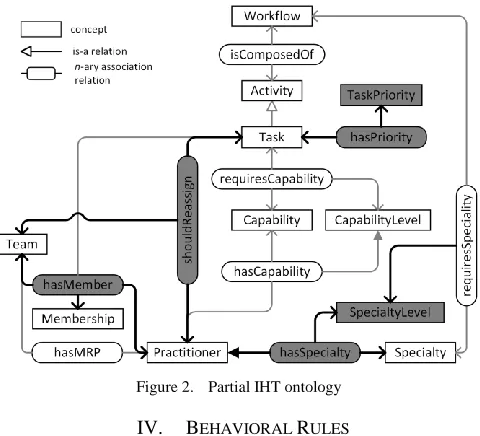
To accommodate these extensions we revised the IHT ontology by expanding existing concepts or introducing new concepts and relations. These revisions are marked with gray background and thicker lines in Fig. 2 (due to space limits the figure includes only these concepts and relations that provide the context for introduced changes – detailed description of the IHT ontology is given in [14]). The expanded hasMember relation keeps track of past task and MRP role assignments, thus indicating preferred team members for future assignments. These preferred members are checked first, and only then remaining practitioners are considered for a given task or the MPR role. The transfer of the MRP role should occur within a team managing a specific patient and this role should be assigned to the preferred and most appropriate team member. To achieve this we need to distinguish between practitioners with the same specialty but possibly varying experience (i.e., resident vs. staff). Therefore, we expand the hasSpecialty and requiresSpecialty relations to reference the concept of SpecialtyLevel. This allows us to ascribe a practitioner with a clinical specialty of a given level.
capabilities) as part of the continuity of care requirement. However, this requires managing situations where the preferred practitioner is already assigned to other tasks within a different team (a common occurrence in healthcare). We deal with this situation by reassigning practitioners to tasks; however, we assume we can only reassign those who are busy with non-urgent tasks. In order to achieve this we have introduced a new TaskPriority concept and hasPriority relation (see Fig. 2), which allow for more detailed characterization of tasks. The reassignment is then handled by the TWC. We assume that a practitioner executing an urgent task cannot be reassigned to other tasks, while an urgent task needs to have a practitioner assigned to it from a pool of available practitioners, including those currently executing tasks of normal priority. In the latter case, the execution of a normal task needs to be suspended and the practitioner’s original assignment needs to be changed. We indicate this with the shouldReassign relation.
Figure 2. Partial IHT ontology
IV. BEHAVIORAL RULES
In the TWMF, IHT’s behavioral aspects are modeled using rules written in FOL (their structure is driven by the IHT ontology). Due to space limits in Fig. 3 we present a few selected rules introduced in the extended TWMF. The other rules are described in the text below and their formal representation is given in [14].
A. Defining Preferred Practitioner
Each practitioner assigned a task in an IHT should be identified as a preferred practitioner for that team.
Rule A1: A practitioner who is selected as MRP for a specific team is marked as a preferred member for that team.
Rule A2: A practitioner who is assigned to a task to be executed by a team is marked as a preferred member for that team.
B. MRP Selection
The MRP for a given team is selected on the basis of the clinical specialty and specialty level that are required by the workflow to be executed.
Rule B1: If there are available preferred team members who have the specialty required by the given workflow, then a member with the highest specialty level will be selected as MRP for the IHT.
Rule B2: If MRP cannot be selected from preferred practitioners, then any available practitioner having the specialty required by the workflow at the highest level is selected as MRP for that team (see Fig. 3).
Figure 3. Selected behavioral rules
C. Practitioner Assignment
Addition of a temporal dimension to a workflow requires enriching how a practitioner is assigned to a task. This is achieved with four new behavioral rules.
Rule C1: If a preferred practitioner is available and capable of executing a task pending for a practitioner assignment, then this practitioner is selected for that task.
Rule C2: If there is no preferred practitioner capable of performing a task pending execution, a practitioner who is available and capable of executing the task is assigned to it.
Rule C3: If an urgent task needs to be executed and all preferred practitioners capable of doing this task are busy, then this task will be assigned to a preferred practitioner executing a normal priority task elsewhere (see Fig. 3).
Rule C4: If an urgent task needs to be executed and all practitioners capable of doing this task are busy and none of them is preferred, then this task will be assigned to a capable practitioner executing a normal priority task elsewhere.
V. IMPLEMENTATION OF TWMF
The extended TWMF has been implemented as a prototype clinical system for supporting coordinated workflow execution by an IHT. All components of the TML are encoded in FOL using the SMT-LIB standard. As a reasoner, we use SMT-solver Z3. The TWC is composed of two modules – one that interacts with Z3 and another that communicates with the WEE. The first module is implemented using the Z3 C++ API. It invokes the reasoner
( ( ) ( ) ( )
( ) ( ) ( )
( ) ( )
( )
( ( ( ) ( )
( ) ( )
( )))
( ( ) ( ))) ( )
( ( ) ( ) ( )
( ) ( ) ( )
( ) ( ) ( )
( ) ( )
( )
( ( ) ( )
( ) ( )
( ))
( ) ( ))
( )
Rule B2:
and captures its response for further processing. The second module is written in Java taking advantage of REST technology using HTTP to communicate with IBM Business Process Manager that executes clinical workflows according to suggestions provided by the TML.
VI. CASE STUDY:EXECUTION OF A RADICAL
PROSTATECTOMY PATIENT WORKFLOW BY IHT Radical prostatectomy is surgery to remove a cancerous prostate gland and tissue around it. It can be conducted as an open or laparoscopic surgery. Here we assume the patient is treated using open surgical procedure and recovery is subsequently managed by an IHT using a radical prostatectomy patient workflow. Table 1 presents practitioner information required by the TWMF for task allocations (for brevity only selected capabilities are included) and describes the following practitioners: a urological surgeon (S), a senior resident in urological surgery (R), an anesthetist (A), two nurses (a surgical nurse N1 and a ward nurse N2), a physiotherapist (Ph), and a nutritionist (N). Specialty levels are measured by scores, where 1 corresponds to a senior resident of a given specialty and 2 to a specialist. Moreover, capability levels are captured by scores, where 1 corresponds to novice, 2 to regular clinical staff member, and 3 to an expert.
TABLE I. PRACTITIONERS AND THEIR SELECTED CHARACTERISTRICS
Practitioner Specialty (level) Capability (level)
S s_surgery (2) c_surgery (3), c_tests(3), …
R s_surgery (1) c_surgery_assistance (2),
c_tests (3), …
N1 s_surgical_nursing (2) c_instrumentation (2), …
N2 s_nursing (2) c_specific_medications (2), …
Ph s_physiotherapy (2) c_activity (3)
A s_anesthesia (2) c_anesthesia (3)
N s_nutrition (1) c_nutrition (3)
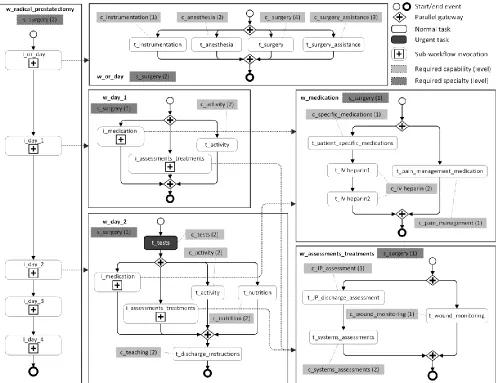
The radical prostatectomy workflow is shown in Fig. 4. In this figure we use a custom notation that has been inspired by Business Process Model and Notation (BMPN) – we could not adopt BPMN directly because it was not able to capture the fine-grained workflow description. The workflow is laid out as a series of sub-workflows that correspond to a day (or complex task). Each day’s sub-workflow has an associated specialty that defines the MRP continuation or selection of a new one. Within each day’s sub-workflow there is a set of tasks with associated capabilities and their levels. We assume all tasks from a sub-workflow associated with a given day need to be completed on that day. In order to simplify presentation, we replaced specific medications or activities with generic labels.
We now describe the radical prostatectomy workflow while illustrating how behavioral rules allow us to address different IHT situations. We focus our description on the extensions described above (MRP selection, defining preferred practitioners, assigning tasks to account for temporal aspects and priority of tasks). Information presented in Table 1 is stored as set of instances (facts) in the instance base (Fig. 1). In order to infer IHT behavior, the TWMF invokes the reasoner that applies all behavioral rules
to facts stored in the instance base and then uses triggered rules to derive a solution. This solution identifies a specific practitioner for task execution or MRP role. The content of the instance base is constantly updated to account for changes in practitioners’ (available, busy, etc.) and tasks’ (pending, etc.) statuses.
A. MRP Selection and Role Transfer
The workflow starts on the day of surgery (i_or_day) with the patient being admitted and then going into surgery.
Let us assume that at this point there is no previously defined MRP and all the practitioners from Table 1 are available. Before the workflow can be executed, the MRP for the team managing patient P1 needs to be selected. In order to do so, the TWC updates the instance base to indicate that the workflow is waiting for MRP selection, and invokes the reasoner. The reasoner applies all behavioral rules to the instance base. In this situation, Rule B2 is triggered and according to the solution practitioner S (surgeon) who has the required specialty (s_surgery) with the highest specialty level (2) is selected as the MRP. Moreover, according to Rule A1, S is also marked as a preferred practitioner for the team managing patient P1.
Let us also assume that S goes off duty on the first day post-surgery (i_day_1) requiring the MRP to be transferred. The specialty needed for the MRP executing this sub-workflow is also s_surgery but with specialty level of 1. The status of practitioner S is updated in the instance base to reflect that she is not available on day 1 post surgery and the TWC invokes the reasoner to establish the MRP for that day. Surgical resident R performed the t_surgery_assistance task during surgery, and according to Rule A2, is marked as a preferred practitioner for the team. A search for the MRP first takes place among preferred practitioners and R has the required specialty level, therefore, according to Rule B1 she is selected as the new MRP.
When the WEE begins executing the workflow for the second day post-surgery (i_day_2), the first task is to establish the MRP for that day. Let us assume that S (the original MRP) is now available (updated status in the instance base) and following the same process, she is identified again as the MRP as a result of triggering Rule B1 ( S is the preferred practitioner in the team managing patient P1 with the required specialty and its highest level).
B. Defining Preferred Practitioners
As already mentioned, every practitioner assigned to a task in a particular team or selected as MRP for that team, becomes a preferred practitioner. For example we have described in the previous section how Rule A1 is triggered to mark S as a preferred practitioner when she is selected as MRP for the first time and Rule A2 marks R as preferred upon assignment of the t_surgery_assistance task.
surgery (w_medication is invoked by the w_day_1 and w_day_2 sub-workflows). If nurse N2 was assigned to t_patient_specific_medication task on the first day, then she will be tagged as the preferred practitioner by Rule A2 and subject to availability, she will be assigned to the same task on the second day by Rule C1.
C. Sub-workflow Execution and Task Assignment
As shown in Fig. 4, i_medication from w_day_1 sub-workflow is an activity invoking the w_medication sub-workflow. Once w_medication has started, information about the tasks that need to be executed is communicated to the TWC which invokes the reasoner to select the most appropriate practitioner for each task. This selection is based on behavioral rules, capabilities and capability levels required for each task, and instances currently stored in the instance base. In the examples below we describe how task assignments are handled.
The t_patient_specific_medication task requires the capability c_specific_medications with a capability level of 1. When this task needs to be executed, the WEE sends a request to the TWC to select a practitioner for this task. The TWC sets the status of the t_patient_specific_medication task in the instance base as pending to indicate that it is waiting for practitioner assignment and invokes the reasoner. Data in the instance base indicates that nurse N2 is a preferred practitioner for the team, is available, and has the required capability with sufficient capability level. The reasoner applies behavioral rules to the instance base and according to Rule C1 derives a solution that indicates that N2 needs to be assigned to t_patient_specific_medication task.
The t_tests task is marked as urgent, so this task must be assigned to a practitioner as soon as possible. Assume that S is not available. The capability needed for this task is c_tests and according to the data stored in the instance base the only practitioner who is available and has this capability with the required capability level is R (see Table 1). However, suppose that R is busy executing another task for another team with normal priority level (R’s status in the instance base is updated to busy). The TWC sets the status of t_tests as pending for team member selection, and invokes the reasoner. Applying the behavioral rules to the instance base, the reasoner triggers the Rule C3, and derives a solution assignment where R’s assignment is changed from the original task with normal priority (that will now be postponed) to the t_test urgent task.
A slightly different situation occurs when the same urgent task t_tests needs to be executed and R is busy with another urgent task, while S is now available. Considering all the data in the instance base, the reasoner will now again trigger Rule C1 instead of Rule C3 and identify S as the practitioner to be assigned to the urgent task.
When the t_activity task needs to be executed, according to the instance base, there is no preferred practitioner capable of doing this task. Assuming that Ph is available the reasoner will trigger Rule C2 and she will be assigned to thistask.
VII. DISCUSSION CONSCLUSIONS
Operationalizing IHT behavior is challenging because of the need to capture and formally represent the IHT dynamics, and then to enact it during workflow execution. Previously reported unintended consequences of team based care delivery [16] can be partially attributed to a lack of explicit attention to fine detail of how IHTs function. Our contributions with regards to the proposed TWMF framework include the IHT ontology and behavioral rules, which draw attention to finer details and provide guidelines on how to manage them. For example, we provide means of describing available practitioners with their clinical specialties and capabilities in order to support MRP selection and identifying preferred practitioners. Our approach also provides flexibility for IHT workflow operationalization allowing leadership to change as needed, and showing how to deal with urgent tasks that may occur in the course of dynamic care delivery. Marking team members as preferred also allows allocating the same practitioner to the same or similar tasks over multiple days to support continuity of care. A shortcoming of many existing clinical information technology (IT) solutions is that they are often not explicitly designed to support teamwork and cannot be aligned with workflows [17]. Our extended TWMF addresses this problem and can serve as a starting point for new IT solutions as demonstrated by the proof-of-concept implementation. Moreover, by relying on well-established technologies, such as WEE, it responds to a call for “transferring” recognized experience and findings in computer-supported cooperative care from business to healthcare [18].
Limitations of our work include limited testing of the framework and making implicit assumptions about the availability of practitioners without considering impact on resource loads in a clinical unit. Also, we have not tested how efficiently large sets of behavioral rules will be processed, which may be an issue for IHT workflow execution in real time critical care situations. Studying these different IHT contexts are the next steps of our research.
ACKNOWLEDGEMENT
We acknowledge funding from the Natural Sciences and Engineering Research Council of Canada (CREATE program and Discovery Grants) and Telfer School of Management Research Fund. The research was conducted when Dr. Kezadri-Hamiaz and Dr. Rosu were postdoctoral fellows with the MET Research Group at the Telfer School of Management, University of Ottawa.
REFERENCES
[1] M. Meterko, D. C. Mohr, and G. J. Young, "Teamwork culture and patient satisfaction in hospitals," Med. Care, vol. 42, pp. 492-8, May 2004.
[2] M. A. Grando, M. Peleg, M. Cuggia, and D. Glasspool, "Patterns for collaborative work in health care teams," Artif. Intell. Med., vol. 53, pp. 139-60, Nov 2011.
health care by transforming health professionals' education," Acad. Med., vol. 86, p. 1351, Nov 2011.
[4] A. Xyrichis and K. Lowton, "What fosters or prevents interprofessional teamworking in primary and community care? A literature review," Int. J. Nurs. Stud., vol. 45, pp. 140-53, Jan 2008. [5] S. C. Porter, "Patients as experts: a collaborative performance support
system," AMIA Annu. Symp. Proc., pp. 548-52, 2001.
[6] M. Courtenay, S. Nancarrow, and D. Dawson, "Interprofessional teamwork in the trauma setting: a scoping review," Hum. Resour. Health, vol. 11, p. 57, 2013.
[7] M. J. Press, M. D. Michelow, and L. H. MacPhail, "Care coordination in accountable care organizations: moving beyond structure and incentives," Am. J. Manag. Care, vol. 18, pp. 778-80, Dec 2012. [8] G. Freeman and J. Hughes, Continuity of care and the patient
experience. London: The King's Fund, 2010.
[9] C. Cabanillas, M. Resinas, J. Mendling, and A. Ruiz-Cortes, "Automated team selection and compliance checking in business processes," in Proceedings of the 2015 International Conference on Software and System Process, ed New York: ACM, 2015, pp. 42-51. [10] W. van der Aalst, A. Weijters, and L. Maruster, "Workflow mining:
Discovering process models from event logs," IEEE Trans. Knowl. Data Eng., vol. 16, pp. 1128-1142, 2004.
[11] Z. Huang, X. Lu, and H. Duan, "Resource behavior measure and application in business process management," Expert Syst. Appl., vol. 39, pp. 6458-6468, 2012.
[12] G. Dermler, G. Pfau, and H. O'Shea. (2014). Teams in Business Process Manager V8.5, Part 1: Modeling teams with IBM Process
Designer. Available: http://www.ibm.com/developerworks/bpm/ library/techarticles/1402_dermler1/1402_dermler1.html
[13] C. Kuziemsky, D. Astaraky, S. Wilk, W. Michalowski, and P. Andreev, "A framework for incorporating patient preferences to deliver participatory medicine via interdisciplinary healthcare teams," AMIA Annu. Symp. Proc., vol. 2014, pp. 835-44, 2014.
[14] S. Wilk, M. Kezadri-Hamiaz, D. Rosu, C. Kuziemsky, W. Michalowski, D. Amyot, and M. Carrier, "Using semantic components to represent dynamics of an interdisciplinary healthcare team in a multi-agent decision support system," J. Med. Syst., vol. 40, p. 42, 2016.
[15] M. Kezadri-Hamiaz, D. Rosu, S. Wilk, C. Kuziemsky, W. Michalowski, and M. Carrier, "A framework for modeling workflow execution by an interdisciplinary healthcare team," Stud. Health Technol. Inform., vol. 216, p. 1100, 2015.
[16] C. E. Kuziemsky and P. Bush, "Coordination considerations of healthcare information technology," Stud. Health Technol. Inform., vol. 194, pp. 133-8, 2013.
[17] D. A. Dorr, S. S. Jones, and A. Wilcox, "A framework for information system usage in collaborative care," J. Biomed. Inform., vol. 40, pp. 282-7, Jun 2007.