City, University of London Institutional Repository
Citation
:
Jarzabkowski, P., Bednarek, R. & Cabantous, L. (2014). Conducting Global Team-based Ethnography: Methodological Challenges and Reflections. Academy of Management Proceedings, 2014(1), 16809.. doi: 10.5465/AMBPP.2014.16809abstractThis is the accepted version of the paper.
This version of the publication may differ from the final published
version.
Permanent repository link: http://openaccess.city.ac.uk/17027/
Link to published version
:
http://dx.doi.org/10.5465/AMBPP.2014.16809abstractCopyright and reuse:
City Research Online aims to make research
outputs of City, University of London available to a wider audience.
Copyright and Moral Rights remain with the author(s) and/or copyright
holders. URLs from City Research Online may be freely distributed and
linked to.
City Research Online: http://openaccess.city.ac.uk/ [email protected]
1
Conducting global team-based ethnography: Methodological challenges and practical methods
Abstract
Ethnography has often been seen as the province of the lone researcher; however,
increasingly management scholars are examining global phenomena, necessitating a shift to
global team-based ethnography. This shift presents some fundamental methodological
challenges, as well as practical issues of method, that have not been examined in the literature
on organizational research methods. That is the focus of this paper. We first outline the
methodological implications of a shift from single researcher to team ethnography, and from
single case site to the multiple sites that constitute global ethnography. Then we present a
detailed explanation of a global, team-based ethnographic research project that we conducted
over three years. Our study of the global reinsurance industry involved a team of five
ethnographers conducting fieldwork in 25 organizations across 15 countries. We outline three
central challenges we encountered; team division of labour, team sharing, and constructing a
global ethnographic object. The paper concludes by suggesting that global, team-based,
ethnography provides important insights into global phenomena, such as regulation, finance,
and climate change among others, that are of interest to management scholars.
2
Introduction
This paper focuses on designing and conducting global team-based ethnography. Our
focus is motivated by the fact that many phenomena of importance in the management field
are not contained within single organizational or geographical boundaries. Globalization of
economies and societies, and the spread of practices between organizations call for new
forms of organizational ethnography (e.g., Falzon 2009; Rouleau, de Rond and Musca 2012;
Van Maanen 2006; Watson 2011). Specifically, there is a need to move to a global or
multi-sited conceptualization of ethnography as a “response to empirical changes in the world and
therefore to transformed locations of cultural production.” (Marcus 1995: 97). We suggest
that global team-based ethnography not only enables us to extend our theoretical frameworks
and understanding, but also delivers particularly rich and relevant findings for managers and
organizations operating within increasingly globally interconnected domains (Watson, 2011).
Yet it also presents challenges that must be worked through and understood for management
and organization scholars interested in global practices. However, there has thus far been
little discussion in the literature about “global ethnography”, based on a multi-sited and
team-based research design.
Drawing on our experience of conducting multi sited team based ethnography of the
global reinsurance industry; this paper is organized along the following lines. We first review
the different types of research designs that have been used in the organizational ethnography
literature, and position our multi sited and team-based approach within this research tradition.
As we do not aim to provide an exhaustive analysis of the organizational ethnography
literature, we do not address directly other dimensions of ethnographic research, such as
analysis or the writing of ethnographic tales, which have been comprehensively examined
elsewhere (Cunliffe 2010; Emerson, Fretz and Shaw 2011; Van Maanen 1988). Second, we
summarize our research project – an ethnography of the global reinsurance industry –
explaining how our ethnographic object unfolded. The ‘ethnographic object’ is, quite simply,
that which is being studied ethnographically (Falzon, 2009). Such ethnographic objects
unfold as they are constructed by ethnographer(s), including the boundaries of the study,
which is particularly in pertinent in global ethnography (Hine, 2007; Marcus, 1995). In the
last section, we reflect on our experience of doing global team-based ethnography and how
3
a global ethnographic object. Our aim is to conceptualize the methodological challenges of
conducting multi-sited, team-based ethnography, and to provide some practical insights into
methods for its conduct.
Two evolutions in the conduct of organizational ethnography
We build on Watson (2011: 205) to define ethnography as a method “which draws upon the
writers close observation of and involvement with people in particular social settings and
relates the words spoken and the practices observed or experienced to the overall cultural
framework within which they occurred.” This section briefly outlines some important trends
in organizational ethnography research towards multi-sited global ethnography (Falzon 2009;
Hannerz 2003; Marcus 1995), and team ethnography (Creese et al. 2008). The idealized
image of ethnography
Ethnography research has traditionally been carried out by a single ethnographer
immersed in a single site, with the aim of gaining a very fine-grained understanding of a
(usually) small scale society or community (Geertz 1973; Mead 2001). Hannerz (2003:
201-202), for instance, recalls that the typical figure of the ethnographer in the 1950s was an
“Oxford man (no doubt here about gender) (…) [who] would proceed to his chosen primitive
society to spend there usually two years.” “Being there” – embedded in the detail of a
specific location, culture, community – is essential. Even though some traditionally trained
ethnographers could move from one site to another and engage with a variety of spatial
practices as part of their field work, as did Philippe Descola for instance in his study of the
Jivaro Indians of Amazonian Ecuador (Descola 1996; see also: Malinowksy, in Hannerz,
2003: 202), the spirit of these works remained that of traditional ethnography. The
conceptualization of space was very traditional, not explicitly acknowledging that space is
socially produced (Lefebvre, 1991/1974), and not questioning the idea that the “local was an
adequate form of ethnographic space” (Falzon, 2009: 5).
In addition, traditional ethnography is also primarily performed by a single
ethnographer, who through in-depth immersion in a local single community comes to
produce a subjective and situated account. Through the ethnographic narrative, the researcher
translates his/her own experience of being there. As Cunliffe (2010: 226) nicely puts it
“ethnography [is] a room with a view”. Ethnographers have long acknowledged that “who”
4
Most ethnographic experiences thus remain “lonely” experiences tied to the experience of
that individual.
The traditional approach to ethnography where a single researcher focused on a single
site is well represented in organizational research (Dalton 1959; Kanter 1977; Kunda
1992/2006; Pettigrew 1985; Selznick 1949; Van Maanen 1975, Watson, 1994, to name a
few). For example, the ethnographic works which are “organizational studies avant la lettre”
(Yanow, Ybema and van Hulst 2012: 333; Zickar and Carter, 2010) were conducted in single
locations, such as, a steel mill in Pittsburg (Williams, 1920), or the Pennsylvania Railroad
system (Hersey, 1932). This single site approach and spirit is also prevalent in Van Maanen’s
classic works (1975), and remains the characteristics of most current organizational
ethnographic research (Alvesson 1998; Kaplan 2011; Orr 1996; Rouleau 2005;
Samra-Fredericks 2003; Zilber 2002, to name a few).
Global and multi-sited ethnography
From the early 1980s, some scholaethnographers have advocated a new form of ethnography, called multi-sited (Falzon 2009; Marcus 1995), multilocal (or translocal)
(Hannerz, 2003) or global (Burawoy 2000, 2001; Gille and Riain 2002) ethnography. These
all share an interest in the ethnographic study of the global (or interconnected) contemporary
world; for example in Marcus’ (1995) case being inspired by Immanuel Wallenstein’s
world-system analysis. Despite sharing with traditional ethnography the assumption that “there is no
supra-local phenomenon except in so far as it is constituted in the local”, they attempt to
study “apparently global phenomena” (Hine, 2007: 655-656) which “cannot be accounted for
by focusing on a single site” (Falzon, 2009: 1). Consequently, such ethnography centres
attention to “the construction of the ethnographic object” (Hine 2007: 655), with these
authors promoting imagery about the unfolding ethnographic object and the relation between
the local and the global.
This emphasis on “the global”, contrasts with a definition of multi-sited ethnography
more commonly used in organization studies, which does not refer to this global dimension,
even as they might look beyond a single site ethnographies (e.g., Michel 2011; Pratt 2000). Here, we instead look at multi-sited designs as a means to follow global phenomenon: “the
global is an emergent condition of arguing about the connection among sites in a multi-sited
5
and global (Burawoy, 2000) as entwined in Marcus’ definition here, using the term ‘global
ethnography’ to mean accessing global phenomena through multiple-sites.
Two main reasons explain ethnographers’ interest in the 1980s for a new approach to
ethnography, and a new way of conceptualizing the ethnographic object (Falzon, 2009).1
First, with theoretical interest in spatiality growing in social sciences, ethnographers came to
realize that the ethnographic space also is socially constructed (Falzon 2009; Golden-Biddle
and Locke 1993; Lefebvre 1991/1974; Van Maanen 1988; Watson 1994, 2000). Second,
ethnographers began to question their traditional approach due to the globalization of
societies and economies, together with the greater interconnectedness of many social
phenomena (Marcus, 1995). As ethnographers recognized that contemporary societies are
characterized by mobility and interconnection, that communities are dispersed in many
locations and ultimately, that lives are “lived not in discrete locations, but through various
forms of connections and circulation” (Hine, 2007: 656), they needed a new way of doing
ethnography that would allow them to follow the myriad of connections that constitute
contemporary life (Marcus, 1995). All this led some ethnographers to re-conceptualize the
ethnographic object, and to formulate a new way of doing ethnography. However, a central
challenge that is implicit (Burawoy 2000), yet rarely illustrated, is how to simultaneously
retain the local and deep immersion at the heart of ethnography (Van Maanen 1996; Van
Maanen 2011; Watson 2011; Yanow et al. 2012) with the desire to expand understanding of
the global as it plays out across multiple sites (Marcus, 1995).
Global ethnography emphasizes the circulation of objects, meanings, identities and the
associations and connections between local practices. As Falzon (2009: 2) explains:
Research design proceeds by a series of juxtapositions in which the global is collapsed into and made an integral part of parallel, related local situations, rather than something monolithic or external to them. In terms of methods, multi-sited ethnography involves a spatially dispersed field through which the ethnographer moves – actually, via sojourns in two or more places, or conceptually, by means of techniques of juxtaposition of data.
In particular, Marcus (1995) argues that “tracing” (or following) something is central to
constructing the global in ethnography. The global is not posited as merely the context of the
local; it is the focus of study, and “emergent” in “arguing about the connection among sites in
6
interest in understandings the global “flow” of the Tokyo seafood market, Bestor (2001: 78).
conducted a multi-sited ethnography that took him to the “auction floods of the Tsukiji
[Tokyo] market, on docks in New England, into hearing rooms in Washington D.C., to trade
shows in Boston, into markets in Seoul, abroad supply boats in the Straits of Gibraltar and
inside refrigerated warehouses at Narita’s airfreight terminals, amongst many other places”
(also see: Caliskan’s (2010) study of the global cotton market)
In organizational studies, insights applicable to the study of globally situated
phenomenon are also visible – even though it does not (yet) constitute a clear turn. While
“global” ethnography is uncommon, many studies nonetheless draw on multi-sited methods
to access knowledge about a particular organization (Pratt 2000; Yanow 1996), or to compare
two different types of contexts or organizations (Vallas 2003; Zaloom 2006), or a type of
actor within a similar organizational context (Michel 2011). Further, some organizational
scholars develops the notion of “mobile” ethnography which priorities the phenomenon, such
as a particular practice, rather than a particular geographically or culturally-bounded site,
demanding instead that the ethnographer follows that actor or practice (Cooren, Brummans
and Charrieras 2008; Czarniawska 2007; Nicolini 2013). Such mobility is required to follow
global phenomenon in multiple settings.
Team ethnography
Another recent trend in ethnography is a greater reliance on teams (e.g., Creese, Bhatt,
Bhojani, and Martin 2008; Erickson and Stull 1997). As Bresler et al. (1996) explain, the
myth of the “lone ranger” has progressively been softened and more ethnography studies now
involve research teams (e.g., Creese et al., 2006; Prus and Irini 1980; Snow and Anderson
1993). An increased interest in team ethnography is partly due to changes in the academic
mode of production– larger grants and increasing competition lead researchers to do more
teamwork projects (Creese et al., 2008; Mauthner and Doucet 2008). Beyond enabling
researchers to share the work of large scale projects (Price, 1973), team-based research is also
promoted because it brings diverse set of expertise, and can allow more interdisciplinary and
thorough comprehension (Barry et al., 1999). However, this movement from individual to
team is critical when we consider that the ethnographer is the instrument, and the movement
from individual to team thus touches the heart of ethnographic method (Mauthner and Doucet
7
whole given that the ethnographic experience of “being there” is said to be intrinsically
personal (Cunliffe 2010; Price 1973; Van Maanen 2011). Team ethnography is much more
than a change of scale, there are some substantial differences between the two ways of doing
ethnography, such as the necessity to collaborate to share observation and confront
interpretation (Scales et al. 2011). As a result, reflexivity in research teams leads to collective
sense making processes that are quite different from the ones experienced by “lone ranger”
scholars. There is much discussion of potential pitfalls for teams of ethnographers (e.g.,
Mountz et al. 2003), such as strict delineations of labour that prevent sharing and reflexivity (Mauthner and Doucet, 2008). Such issues are likely to be exacerbated in multi-national
teams where geographical distance between team members is a factor (Easterby-Smith and
Malina, 1999). Yet, as Bresler and Wasser (1996: 6) argue, research teams can represent a
powerful “interpretative zone (…) where multiple viewpoints are held in dynamic tension as
[the] group seeks to make sense of fieldwork issues and meaning”. Others suggest that
sharing of other elements of the ethnographic experience beyond simply data, such as
emotions, might be important and positive aspects of team-ethnography that differentiate it
from the “lone-ranger” approach (Barry et al. 1999).
Despite these important differences “there has been little discussion about the
relationship between collaborative research, as an ‘academic mode of production’ (Stanley
1990: 4) and the knowledge it produces” (Mauthner and Doucet 2008: 972). Very few
research teams actually share their experience of team-based ethnography and explain how
they have produced a shared understanding (exceptions include: Erickson and Stull 1997;
Gerstl-Pepin and Gunzenhauser 2002; Wasser and Bresler 1996). Further, most that have
discussed their experiences have focused on specific issues such as reflexivity (Barry et al.,
1999) or fieldnotes (Creese et al., 2009). Hence, we still know little about how teams of
ethnographers work together, their concrete methods and the way they practice research.
Team ethnography is, however, indubitably growing in social science and this trend is
also visible in organization studies, although rarely discussed. One historical exemplar in
organizational studies is the ethnographic team research into psychiatric institutions lead by
Anselm Strauss (1964), and issues concerning team ethnography have been recognized in
organizations studies since Price (1973) reflected on such a research design. More recently,
8
together, is one of the first to reflect on team ethnography within organization studies. These
authors show how one researcher was able to access the common shared experience of the
expedition, while another focused on individual experiences at specific moments of the same
expedition. They provide an important example of team ethnography where experiences are
shared (Creese et al. 2008; Mauthner and Doucet 2008) rather than divided (Mountz et al.
2003). However, explicitly multi-national ethnography teams have been less examined
(Marcus, 1995) and those who have written about team ethnography do not explicitly reflect
on the fact that a team might also be a way to access multiple sites (Smets, Burke,
Jarzabkowski & Spee, 2014).
Towards a team ethnography of global practices
We now present our experience of conducting team ethnography while following the
global practice of risk trading in the reinsurance industry. This involved bringing together the
two streams of research on global and team ethnography outlined above. As we have
highlighted, each comes with specific methodological challenges, and bringing these two
streams together results in its own unique array of challenges. There are very few guiding
examples of such studies in the organizational studies field as the available literature tends to
focus on issues to do with global ethnography or team ethnography rather than both. For
instance, in their ethnography of the “market for technical contractors”, Barley and Kunda
(2006) discuss how they accessed the global through a multi-sited study that incorporated
contractors, clients and staffing agencies, but they do not explain the team element of this,
simply using the term “we.” Conversely, Hannenz (2003) reflects on the multiple sites he
accessed as a single researcher. We thus had little to follow on how to simultaneously balance
the localized immersion at heart of ethnography with following phenomena globally, and
how to construct shared experiences in a team.
Our unfolding research project: Context, team and project parameters
Reinsurance context and the ethnographic object
Reinsurance is a financial industry that provides the capital to pay claims following
large-scale disasters such as the attack on the World Trade Centre or Hurricane Katrina. It is
effectively the insurance of insurance companies. Insurance companies buy reinsurance in
9
expected losses. Reinsurance companies are the capital suppliers that underwrite these risks,
in return for which they receive premium, just as insurers receive an annual premium from
you for insuring your car or house.
Throughout our study we came to define a global financial industry as one in which
‘patterns of relatedness and coordination … are global in scope’ and in which ‘processes have
global breadth’(Knorr Cetina and Bruegger 2002: 907). As we generated our ethnographic
object, we found that the notion of “global” ethnography was particularly relevant to a study
of the reinsurance industry. While reinsurers are competing firms, no single reinsurer takes
on all the risk represented in any reinsurance deal. This is because the events such as
Hurricane Sandy or the Japanese earthquake and tsunami, that underpin such deals are simply
too large. Rather, multiple reinsurers around the world take shares of the same reinsurance
deal, so that if something catastrophic happens these reinsurers bear the risk collectively
(Borscheid, Gugerli and Straumann 2013). Our ethnographic study addresses the question of
how globally dispersed reinsurers are able to collectively bear vastly different types of risks
from around the world. Consequently, we see the reinsurance industry as enacted within the
densely woven practices of participants located in multiple sites (see also: Abolafia 2001;
Beunza and Stark 2012; Knorr Cetina and Bruegger 2002; Zaloom 2006) who interact with
sufficient coherence to enact a pattern of collective risk bearing (Jarzabkowski, Bednarek &
Spee, forthcoming). In this section we explain how we generated the ethnographic object of
the “global practice of reinsurance trading” as part of an unfolding process in the field to
answer this question.
Our Research Team
This project evolved over three years. It began with a single researcher (PJ) but rapidly
expanded to a team of three (APS & MS) and later to a team of five (RB and LC). PJ had
considerable prior ethnographic experience, including conducting longitudinal multi-sited
and team ethnography and as the grant-holder was the project leader. Both APS and MS had
ethnographic experience, with MS some multi-sited and multi-national experience. RB had
experience in qualitative research across multiple sites but had not been engaged in
ethnography. These four team members had a background in business studies, while the fifth,
LC, had an academic background in management studies as well as in the economics of risk
10 Project overview
From mid-2009 we accessed 51 subsidiary sites in 25 organizations, across 15 countries
(see Table 1). We became deeply immersed in the everyday practice of trading reinsurance
deals in the trading hubs in London, Bermuda and cities in Continental Europe that, together,
comprise the majority of the world’s reinsurance capital. We also included the important
Asia-Pacific region, through fieldwork in Hong Kong, Japan, Singapore and Australia. The
selection of these sites emerged as our immersion in the field unfolded, the “end-result” of
which is outlined in Table 1 below.
[Insert Table 1 about here]
The team had extensive and unusual access to conduct such an ethnographic study of a
global industry. We spent hours sitting along alongside underwriters at their desks, attended
their meetings and conferences, and joined them in social activities. We also interviewed
everyone from CEOs, to underwriters, account executives and analysts within those
reinsurance companies. Quite literally, we sipped champagne on sun-drenched terraces in
Monte Carlo at the main industry conference, drank pints in watering holes on the square
mile in London, downed shots on Christmas Eve in Bermuda, had leisurely lunches and
climbed mountains in Continental Europe, and danced at cabaret parties in Singapore. We
arrived early and sat late in offices during the major renewal periods, observing frustration,
boredom, exhilaration and stress, as underwriters dealt in major financial transactions,
sometimes worth millions. During this time, we experienced the global industry reaction to
natural disasters, such as earthquakes in Chile, New Zealand and Japan, floods in Australia
and Thailand, bushfires in Australia and California, and manmade disasters such as Deep
Water Horizon through the eyes of the people who underwrite such events and pay for their
losses. As an outcome of “being there” in these different sites as a team we collected 932
separate observation field-notes2 and 382 interviews.
Consistent with the ethnographic method the phenomena of interest evolved through
fieldwork and guided our on-going data collection (Marcus 1995; Watson 2011; Zickar and
Carter 2010). We now provide a chronological narrative of how the project unfolded,
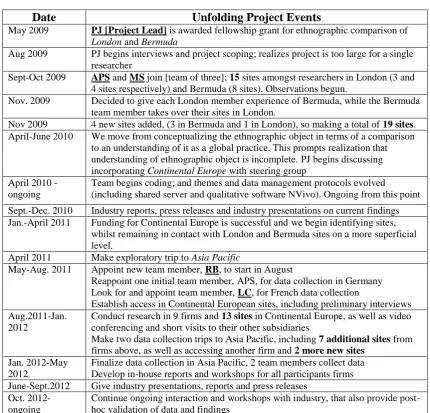
including selecting team members and sites as the ethnographic object evolved (see Table 2).
[Insert Table 2 about here]
11
The PJ won a competitive grant to conduct research within the reinsurance industry in
May 2009. The call for this grant set up the research parameters as an ethnographic
comparison of two critical reinsurance trading hubs: London and Bermuda; entitled: ‘London
compared with Bermuda: an ethnographic comparison of the basis of trading and the
implications for future evolution.’ From the outset, therefore, the project was intended to be
multi-sited. Further, the ethnographic object was broadly defined as a comparison of trading
in two hubs rather than related to any specific organization. While the grant set out the
desired methodology (ethnographic) and general focus (comparison of industry trading
practice in two hubs) all other decisions around method were left to the researcher and
intellectual property remains with the academic. Nonetheless, a steering group was helpfully
appointed to assist with access and disseminating industry-focused knowledge.
Unfolding Point 1: Defining the scope
In mid-2009, as PJ undertook preliminary interviews and scoped the study, it became
apparent that the project was beyond a single researcher. As the focus was on industry trading
practices, developing ethnographic understanding of these practices required us to select a
group of organizations located in each of the two trading hubs under study. Eleven firms were
initially accessed, four with subsidiaries operating out of both hubs, so constituting 15 sites at
which to access data. Further, underwriting practice would need to be observed across four to
six underwriters in each site to get sufficient depth of understanding about their basis of
trading. Furthermore, as a firm basis for comparison, practice would need to be followed
simultaneously in real-time in each region (Czarniawska 2007). As the scope of the study
become clearer, further funding was agreed and APS and MS were appointed to the project
fulltime in September and October 2009 respectively.
Unfolding Point 2: What data should we collect?
Before entering the field this team of three set up a common protocol for observation.
We needed to observe the basis of industry trading, allowing for comparison of the
differentiators between practices in London and Bermuda. We had some indicators from
interviews to guide us on what shaped industry trading, such as a series of common dates at
which all deals are renewed and when trading is at its busiest. Hence we decided to follow the
annual cycle by observing underwriters in the various sites in each trading hub in the lead up
12
underwriting was identified as the basis of trading, the underwriters trading the reinsurance
deals became the unit of observation. Specifically, we sat beside them, making notes and
recording, while they analysed, quoted and placed capital on deals, observing their actions
and interactions, listening to their phone calls, noting their emails, and following them to
their team, client and broker meetings, as well as to conferences, in the lead up to these
deadlines. Beyond that, we could not say what to observe as this would unfold naturally in
the field. This remained the basis of our observational data for the lifespan of the project.
Unfolding Point 3: Sharing observations at sites as ethnographic object unfolds
While PJ negotiated the initial access in the expanding number of sites prior to
observation, we felt that for every member of the team to be spread across every site would
be inappropriate. Consistent with the notions of researcher as instrument (Cunliffe 2010;
Marshall and Rossman 2006; Van Maanen 1996; Van Maanen 2011; Yanow 2012) we
decided to immerse different team members in specific organizational contexts, to achieve
deep saturation in that site (Watson 2011). This was also felt to be the most efficient way of
operating. Hence, one member (PJ) would go to Bermuda, while the other two would divide
the sites in London.
The flaw in our plan became obvious in November 2009 not long after our initial
immersion in fieldwork. Embedded as we were in different trading hubs, we quickly
recognized that while we felt we were speaking to the same issues, we couldn’t be sure. As
we began to share our initial experiences we realized that our comparisons would be richer if
we could share the experience of trading practices in at least some sites across the trading
hubs (Mauthner and Doucet 2008). In short, to feel comfortable with the comparative picture
that was emerging we needed to share the actual ethnographic experience in both hubs.
Hence, we decided that APS and MS should experience Bermuda at a peak trading times as
well, while PJ would take over their respective London sites during the periods either of them
was in Bermuda. To ensure a good handover, each investigator in London first took take PJ
for a week of shadowing with them in their respective sites. Similarly, PJ accompanied each
investigator to Bermuda, and shadowed together for a week. Everyone now experienced all
contexts, enabling us to better share reflections and tie together our interpretations as a basis
for comparison of trading practices (Smets, Burke, Jarzabkowski & Spee, 2014).
13
By mid-2010, the comparative basis of the ethnographic object had faded into the
background and the collective risk trading practice became the foreground. Our
understanding had evolved and we realized that we were seeing in the two trading hubs was
only part of a picture of an interconnected global practice. While there were obviously
different nuances in the different trading hubs and firms, underwriters appeared to be doing
very similar things to make capital allocation decisions, often on the same deals.
Furthermore, they often seemed to connect with, or consider each other across our sites and
trading hubs in doing so. In particular, the specificity of this industry, that each reinsurance
deal is spread over several reinsurance companies that take shares at the same price, had
become clear. Hence, underwriters in different firms were sharing risk collectively across
much of the global market on each deal. As the team followed the observation to the end of a
renewal cycle (the date where deals are traded by) in both Bermuda and London, it seemed
the basis of trading was interconnected, based on common and somewhat interdependent
practices across firms and regions. The ethnographic object was no longer a comparison of
distinct practices, but a single global risk trading practice.
With this reconceptualization of the ethnographic object, we began to experience
frustration with the project’s scope. Continental Europe was frequently mentioned by
participants and was coming up in our data as critical to the dynamics of the industry.
Together London, Bermuda, and Continental Europe comprise over 80% of the global
reinsurance industry, with the largest players in Continental Europe(Holborn 2009). And yet
we had no experience of underwriting practice in this critical trading hub.
Unfolding Point 5: We extend to other sites; it’s global
In early mid-2010 PJ discussed the role of Continental Europe with the industry
steering group; it seemed the missing part of the emerging puzzle about how an industry of
globally distributed and independent actors could collectively bear risk on a range of deals.
They agreed and we managed to negotiate further funding through a number of sources. We
could continue to follow the unfolding ethnographic object into the global space, with a
second round of funding entitled “Trading risks: The role of European firms in the global
reinsurance market”. Again, the ethnographic object of study was not upon European firms
14
Turning our attention to Continental Europe we identified organizations that would
ensure we covered the range of risks in the global industry. In additional to three European
subsidiaries of organizations we had already engaged with, from early 2011 we identified
another seven firms covering the largest to the more specialist players in the Continental
European trading hubs. These nine firms resulted in 13 subsidiaries in multiple countries,
with the main concentration in Switzerland (Zurich), Germany (Munich) and France (Paris)
(see Table 1) as these cities were the key trading hubs in Continental Europe. In addition, we
would do some interviewing, shorter 2-3 day observational visits, and video calls with
subsidiaries of our nine firms in their other locations, to confirm any emerging impressions.
We had also become very aware of the impact upon the industry of risks originating in
parts of the globe that we had not yet understood. For example, during 2010 and 2011 we
observed the industry as it suffered heavy losses from flooding in Australia and Thailand,
earthquakes in New Zealand, and an earthquake and tsunami in Japan, which all had
ramifications for pricing globally. Realizing that data from the Asia Pacific region would
complement our understanding of global industry trading in response to such events, PJ made
an exploratory trip to Singapore, a key hub in the region. Following this initial trip, we
accessed funding to collect interviews and conduct some short observations in nine sites
across four countries, Japan, Singapore, Hong Kong and Australia.
Unfolding Point 6: We extend the team
These extensions of the study necessitated evolution in our team during 2011. First,
while PJ remained fully devoted to the project, as is typical of such projects (Barry et al.
1999; Garland et al., 2006), APS and MS could not continue to be full-time ethnographers as
they had posts that required other commitments. Second, we needed specific language skills.
While Zurich was largely English speaking, even in the corridors because underwriters came
from all over the world, we needed native French and German speakers to be the
ethnographic instrument to make observation in the likes of Munich or Paris possible
(Markus, 1995). There was funding to buy-out some of the teaching of MS, a native German
speaker, to collect observational German data, while APS, also a native German speaker,
conducted some interviews in German. We also appointed RB as a new full-time postdoctoral
research fellow, who was responsible for Zurich. Finally, LC, a native French speaker joined
15
involved in data collection in all main sites in Continental Europe as well as being primarily
responsible for the extension of the study into the Asia-Pacific.
Unfolding Point 7: We are close to saturation
By the beginning of 2012, we had a fairly clear idea of the unit of observation how
global underwriting trading practice across a range of deals generates collective risk bearing.
Our ethnographic object now remained relatively stable, but the details surrounding it became
much richer, as we understood how different elements of global practice are brought together
in an interdependent and collective approach to trading. Our team meetings had evolved from
discussing and sharing new insights and experiences into the global practice, to refining our
already held understandings; which was also reflected in our increasingly stabilized coding
structure. We presented our findings, which resonated strongly with our industry participants.
Indeed, they were very surprised at how much they learned from us about their industry, as
we made reports, industry presentations, press releases and interviews to conclude our study.
After nearly three years, we felt we could withdraw from the field.
Reflections on the Challenges of Team-Based Global Ethnography
This section reflects on our responses to fundamental methodological challenges that
global team-based ethnography represents. We focus on three key issues that were both
practical problems and also have implications for the nature of the ethnography. Figure 1
outlines these three challenges and how they were “worked through”.
[Insert Figure 1 here]
Team division of labour
As illustrated in the unfolding points of the project narrative, division of labour within
the team was a practical challenge about who should do what and where? It is also addressed
in the literature that discusses methodological challenge of team ethnography, as the
decisions we made would affect shared reflexivity and the ability to generate a common
ethnographic object for study (Creese et al, 2008; Mauthner and Doucet, 2008). Essentially,
we had two challenges.
First, we had to select between the tendency to ‘divide and conquer’ (Easterby-Smith
and Malina 1999; Mountz et al. 2003), which gives efficiency through separate cover of sites,
and shared immersion across sites, which enhances collective interpretation (Creese et al,
16
interpretations within individual organizations by each researcher. Yet, as Mauthner and
Doucet (2008) suggest, this presented a barrier to sharing interpretations and generating
confidence in constructing a collective ethnographic object (see Unfolding Point 4). Hence,
we decided that one researcher should remain the primary ‘expert’ in each region and/or
subsidiary site, but that at least one other team member should also have substantial
ethnographic experience of that site and trading hub. As shown in Table 1, this added
interpretive ‘density’, with many organization as well as individual subsidiaries having three
researchers involved in ethnographic observation (Creese et al, 2008). For example, in Firm
4, PJ undertook initial data collection with RB and with LC, conducing joint interviews and
some joint observations. As RB and LC then focused on two subsidiaries of that organization
with some ongoing contact from PJ, the three of us shared emails, discussing our joint
experience, as with LC’s email to RB: “Henry has just mentioned that there is something
going on about [ClientX] but wouldn’t elaborate. See if you can find out more in your
afternoon meeting as it might be interesting.” Similarly, when in Singapore, PJ added context
to the discussions about the “Singapore office” we were hearing about in the European
headquarters. Our densely overlapping experience thus enabled us to construct a global
ethnographic object (see Unfolding Point 4).
Second, as it became apparent that we were following a global phenomenon, it was also
ideal that one team member be familiar with all companies, trading hubs and subsidiaries3.
This meant that in addition to country overlaps (see Table 1) at least one of us would be
familiar first-hand with the majority of sites4. As the project progressed, this did mean PJ’s
role became what Price (1973) terms the conduit for the different parts of the ethnography
done by multiple team members. As team membership evolved over time (see Unfolding
Point 6), this was important in developing understanding our observations as an
interconnected global phenomenon. Importantly, however, while this division of labour
meant PJ assumed a leadership role, we avoided criticisms that project leaders can become
remote from the field (e.g. Mauthner and Doucet, 2008). Rather, we ensured that PJ, through
immersion in the field throughout the life of the project, was able to provide coherence in
knitting the various contexts together, in consultation with other team members who might
have greater country, firm or subsidiary-specific expertise. This meant that ‘fieldwork’ was
17
data collection and all had immersion in the field from which to generate shared experience
of the ethnographic object (Mauthner and Doucet, 2008). This division of labour continues
into the writing phase of this project. Writing is not disconnected from the field-experience,
as those who have collected the data remain central to the writing of any outputs that drew on
their particular field experience (see for example, Smets, Jarzabkowski, Burke and Spee,
forthcoming). These very practical steps to dividing our labour are thus critical in the conduct
of global, team ethnography.
Team sharing
Another challenge we faced was how to develop shared understanding about our
ethnographic object as a global phenomenon. With multiple team members dispersed
globally, engaged in fieldwork at different times in different places, sharing was a critical
challenge, especially in a multi-national team. Yet, in order to build knowledge of a global
phenomenon we needed to move beyond multiple fractured understandings. This was no
jigsaw, which we could simply bring our pieces to at the end; without adequate sharing and
co-construction of the global phenomenon of interest we might find out we were all instead
working on different puzzles! For example, it was not enough to have separate
understandings of “Bermuda”; “Zurich” and “London”; these needed to come together to
build a picture of the global practice of underwriting. The literature outlines this as a
methodological challenge: team sharing is critical but difficult to achieve because the
reflexivity that is central to ethnography is often understood as an individual activity (Barry
et al. 1999; Creese et al. 2008). In particular, Barry et al. (1999) mention that a dispersed
team such as ours presents added challenges to sharing and the development of team
reflexivity.
We engaged in five ‘modes’ of sharing in an effort to work through these challenges:
emotional, empirical, thematic, analytic output and codified sharing. These modes overlapped
throughout our project and included a range of practices such as face-to-face sharing (e.g.,
team meetings as well as longer retreats), sharing in the field (e.g., emails, texts and Skype)
and protocols for turning our data into a shared depository (see Table 3).. These practices
helped construct collective knowledge about the ethnographic object, as we developed norms
that prioritized sharing.
18
First, emotional sharing enabled us to feel less isolated in the field, so enhancing our
sense of being team members (Erikson and Stull, 1997) and building an ethos of openness
within our team that was foundational to all other forms of sharing (Barry et al., 1999). For
example, early in the fieldwork, PJ and APS met for a coffee after each spending the morning
in separate sites. As PJ sat down she said ‘that was my worst experience in the field ever’,
relating her tale of an unusually intransigent research participant. It turned out the APS had
had an equally difficult morning with a participant to whom he’d intitially struggled to
explain the project. Sharing their experiences, each felt reassured that ‘these things happen’,
rather than being a fault of the investigator per se, and together were able to discuss ways to
better work with these particular participants. This became a dominant modus operandi when
participants were in the same location; meeting for lunch, dinner or coffee to share
experiences, including emotional ones.
We also developed a norm of emotional sharing by email, including any particularly
amusing experiences, such as emails entitled ‘funniest quote of the day’. In this way, sharing
all types of emotional experience, tiredness, humour, and so forth, became the norm, so also
enabling sharing of those occasions that generated negative emotions, as this reflexive
fieldnote shows:
It was a tough day. I’d been kicked out of conference-call with a major client which I had pre-arranged to be at and rushed to get to in time. We’d all been sitting down and at the last minute the lead manager suddenly, and graciously, realized he didn’t want to explain to the client that I was sitting in on the call. The next meeting was also particularly tough. I had become an object of interest, despite them all being use to me “hanging around”. Someone had thought it was funny to disrupt the meeting to try and see what I was writing; it was one of the times when I had most conspicuously ‘failed’ at my job as a “shadow!” At lunch, before rushing to the tram and another company, I sent a quick email to PJ, just letting her know about my day. I quickly got an email back putting everything in perspective. PJ had been through things like that herself “don’t worry; there are always meetings you miss. There’s always data around the corner.” That afternoon I was able to focus on the observation rather than my own disappointment.
This capacity for “emotional sharing” tended to take time and naturally developed to different
degrees between team members. For example, emotional sharing was most powerful when it
was based on a sense of shared experiences, such as being in the field at the same time.
Nonetheless, the sense of team engendered through emotional sharing was a common
experience underpinning the other elements of sharing explained below. Such sharing,
provided a foundation for team-members to engage in constructive and robust debate which
19
Second, we developed norms for sharing empirical reflections when we were in the
field. For example, whenever we found ourselves having a “that was interesting” type
reflection we sent an email to the team. We labelled these “memo-notes.” One example was
an email titled “You’re not in Kansas now, Toto!” (a reference to Dorothy in the Wizard of
Oz, as an indicator of encountering something unfamiliar) where PJ reflected on one of her
initial days observing Asian reinsurance business in Singapore; a new region for our team:
When a cedent [insurer] diversifies outside Pakistan or India, they do so into places like Kenya, Uganda, Rwanda (...) so when you reinsure them, you get those risks in the international programmes…The Bahrain reinsurer, for example, is specifically interested in clients who are expanding in African energy business. I was fascinated. While the diversification principle of international programmes is the same, we just haven’t seen that sort of business included in a programme anywhere else (Email; 3rd November, 2011).
Such emails often enabled empirical connections to be made; for example, MS might send an
email from Germany “this is what [John] thinks of the start-ups in Zurich” and RB was able
to email back; “that’s almost what I am seeing the start-ups in Zurich doing, but....” This
norm persisted throughout the life of the project, being perpetuated through frequent emails
and, where relevant, Skype calls (see Table 2). We also built on and shared empirical
reflections through lunches and dinners whenever we were conducting fieldwork in the same
city, as well as debriefing and comparing fieldnotes after a shared field-experienced, such as
when we observed meetings together.
Third, as our fieldwork progressed we formalized the above interpretive reflections
through thematic sharing. Specifically, we generated and shared invivo codes based on our
experiences, discussing these to decide collectively on areas of interest that were emerging
across our project. These collectively derived themes progressively informed how we
constructed our ethnographic object as a team. For example, at one of our many face-to-face
meetings where we shared experiences, it became clear that the theme of “whole account
underwriting” (considering a client’s multiple deals as a whole rather than each singularly)
was important to underwriting practice in many European firms. This became something that
we all subsequently focused upon as we returned to the field. In a following team meeting we
were then able to further share our experiences and interpretations of this theme, developing
additional insight into how “whole account” underwriting shaped trading in the global
20
sporadic interpretations in the field, to a shared construction of emerging important concepts,
enabled us to transcend individual reflections and construct the ethnographic object as a team.
Fourth, as we moved towards creating outputs, we drew upon these collectively-derived
themes for analytic output sharing to develop practical implications (e.g., industry reports)
and, eventually, academic outputs. This process was always shared and, in retrospect, we see
it as critical to building “global” insights based on our shared experiences. Our first main
experience was collectively writing the interim reports for each reinsurer. At one of our
away-days we set aside time for the person most acquainted with each organization to share
reflections on that firm in a very practical empirically-based fashion. For example, “Firm 3 is
structured in the following way…”, which then allowed someone who had not been involved
with that organization to draw connections and ask questions and those familiar with Firm 3
to share additional layers of insight. Building on this technique, we worked together to
develop the co-authored industry reports and presentations resulting from the project, as well
as a series of academic conference papers. In particular, any framework we developed from
our project, whether for industry or for academic papers, was based on multiple team
meetings (either in person or via Skype), ensuring that they reflected our collective
experiences. Furthermore, a sense of those closest to a particular empirical experience (such
as Firm 3 above) was retained within that sharing. In summary, we engaged in further sharing
to develop analytic outputs based on our collective, rather than individual, experiences and
understanding, so allowing us to co-construct the unfolding ethnographic object even after
the completion of fieldwork. Finally, our teamwork involved a surprising amount of effort
and discipline in developing codified sharing. Ostensibly careful labelling, a depository and a
clear record of the data are the easiest to achieve or at least control as a form of sharing. Yet,
the ambiguities inherent in the unfolding nature of the data, and its sheer scope made this
challenging at times. As the project evolved it became obvious that codified sharing was as
important and as difficult as more tacit forms, such as emotional and empirical sharing. A
high level of care and detail was required in terms of data records, labelling and a shared
electronic depository, both to share field-notes and also to ensure that future searches would
be easy and comparable. During a team meeting in January 2010, we recognized the
importance of this and APS took charge of devising strict protocols for the management of
21
complexity. Our labelling system, allowed any of us to search for and find a particular piece
of data within our database based on when it was recorded, which firm, which geographic site
(e.g. Lon for London, Par for Paris, or BM for Bermuda), what type of data (e.g. observation,
OBS, or interview, INT), what was observed (e.g. SHA for workplace shadowing, or CM for
client meeting) the content of the data (e.g. international property, INP as opposed to marine
and energy, MNE), and the researcher, as this label for a specific fieldnote shows:
2011-10-02_FirmXPar_OBS_SHA_ INP_LC. Such codification ensured that all of our individual data
was shared, could be identified individually, and yet become part of the collective database.
Such labelling also enabled careful auditing for consistency of the database (Lincoln and
Guba, 1985). For example, using the “data-log” RB was able to inform PJ that interviews 2
and 3 from her recent fieldwork were missing; allowing PJ (who had conducted 17 interviews
that particular week) to realize these two had not yet been sent to the transcriber.
Importantly, labelling and depositing was only the first step in codified sharing. We
also had to find ways to develop shared coding schema that we could all access, particularly
as the coding evolved and continues to evolve based around specific academic papers. For
this, we developed NVivo databases (a qualitative data software program), where strict
protocols were developed to enable data to be indexed and sourced by anyone in the team. It
also had sophisticated search functions. For example, when RB began to collate our
collective experience regarding “major events” that occurred during our fieldwork, she could
search for terms such as “Chile” [earthquake] and “Thai” [floods] across all interviews and
fieldnotes. Using the shared repository she could access all notes across the corpus of data,
regardless of where or when they were collected, and identify who did the observation, so
further following up on that data with the primary investigator. Consequently, codified
sharing was critical as we began to write from our data. In summary, a multi-faceted
conceptualization of sharing was critical to accessing the “global” nature of our dataset,
rather than it being a series of individual and separate ethnographies.
Constructing a global ethnographic object
Accessing the ethnographic object globally presented us with another methodological
challenge (Burawoy, 2000; Marcus, 1995). Ethnography is a “local” method (Van Maanen
2011) and yet we wanted to follow a global practice across multiple local sites. This meant
22
connected and interdependent practice5 (Marcus, 1995). Accessing the global included
practical questions about what sites to access (see Unfolding Points 4 and 5) and the need to
follow the phenomenon in multiple languages (see Unfolding Point 6). While we started with
an initial topic, we had no blueprint about how or what to follow. We reflect on how we
worked through these challenges below.
First, we had to evolve from comparing trading practices to conceptualizing the
ethnographic object as global. This involved moving from a multi-sited approach,
conceptualizing our study in terms of “sites” of the practice, as we did initially (Unfolding
Object 2 and 3) to a global approach, conceptualizing our study in terms of the
interconnected phenomenon of interest (see Unfolding Object 4 and 5). For example, while
we initially thought we were comparing underwriting practice in two distinct but interrelated
trading hubs, as the project unfolded we began to interpret this practice as following a
common object across sites (Czarniawska 1997, 2007) that was globally interconnected in
nature (Marcus 1995). For example, we were not studying underwriting practice in
reinsurance hubs as separate practices, but rather seeking to understand the common
interconnected global practice of reinsurance trading. This reconceptualization shifted us
from thinking in terms of a dichotomy of local and global to focusing on a global collective
practice (Marcus, 1995; Burawoy, 2000).
The 2011 Thai floods, which occurred while we were in the field, provide a useful
example, as we understood this event as shaping part of the global practice of collective
trading of reinsurance. The floods had global ramifications as these deals were underwritten
by reinsurers in all our main sites, showing how events are not confined to locales, but
involve globally interconnected collective practice. We accessed this “event” as it occurred
naturally across our sites. For example, PJ was in Singapore when the severity of the floods
became apparent and observed market actors rushing to position themselves and interpret
these events. She returned to the Asia-Pacific region numerous times as the event unfolded,
later accompanied by RB, even as reinsurers flocked to the region to evaluate their potential
losses. Meanwhile, in Europe, LC and RB were in client meetings where the floods were
discussed and in reinsurance offices generally as reinsurers consumed the market news,
discussed the event and its impact in meetings, tried to collect information and finally, priced
23
meetings in London, as they discussed the impact of the floods upon the forthcoming renewal
prices. Noticing this event as it was constructed across our sites, and more broadly in the
industry media, we were able to share interpretations as a team (described above) to construct
a composite picture of the global interconnected industry practice. For example, while PJ
observed the specific actions of a particular large reinsurer in Singapore, emailing the team
about her experiences, these very activities were being reacted to and discussed by
underwriters whom RB and LC were observing in Europe. In short, immersion in the
multi-sited nature of our dataset enabled us to understand how practices performed in different sites
comprised an interconnected global practice.
Constructing the global ethnographic object involved drawing boundaries around our
study: that is what sites to include in our study. As ethnographers we could not, and did not
need to, be ‘everywhere’; for example, in every country reinsurance is traded (Marcus, 1995).
Rather, we needed to access the phenomenon through carefully selected sites and trading
hubs that provided understanding. Site selection was shaped as our understanding grew
through immersion in the field (see Unfolding Points 4 & 5). We needed to select sites
strategically to represent crucial points within the global connections we were tracing (Tsing
2011; Upadhya 2008); and we could not know in advance what those critical sites were
(Marcus, 1995). Once embedded in London and Bermuda, it became clear that this provided
important but incomplete understanding (Unfolding Point 4). It was rare that a deal that we
had seen in London or Bermuda was not also traded in Europe, and these European players
were critical in shaping the collective global practice of risk trading. Thus, the main
reinsurance trading hubs in Europe became important to our study as the ethnographic object
we were constructing became more apparent (Unfolding Point 5). A key practical challenge
became ensuring we had a multi-lingual team (Unfolding Point 6), which enabled us to
follow the global practice based on these critical sites rather than restricting ourselves to an
English-speaking context as many ‘global’ studies do (Markus, 1995)6. Finally, as we spent
more time in the field it became clear that we needed to broaden our understanding of the role
of emerging trading hubs in the wider reinsurance industry particularly in the Asia Pacific
region that was a key focus area for global reinsurance trading (Unfolding Point 5). We could
have continued to collect data in other regions where reinsurance is traded, but we also
24
approach’, accessing every possible location. Rather, we examined practice in a wide corpus
of important sites, that were sufficient to understand how different parts of the reinsurance
industry interrelated to collectively trade and bear risk. In this sense theoretical saturation
regarding the ethnographic object; rather than of any particular subsidiary site, determined
the boundaries of our study. As we conducted our final observations and interviews, they
provided interesting and confirmatory illustrations of our interpretations. However, we were
not coming up with any new codes or major insights. In this sense, we felt able to end our
period of intense fieldwork.
Conclusion
This paper has reflected on the methodological challenges global, team-based
ethnography presents, and how we worked through these practically in the methods we
adopted. We conclude with some further brief reflections. First, it is never possible for
everything to be shared amongst team members. The notion of researcher as instrument in
ethnography implies “subjecting the self – body, belief, personality, emotions, and cognitions
– to a set of contingencies that play on others” (Van Maanen, 2011: 219). As this suggests, an
ethnographic experience is specific to the individual who has experienced it (Hannerz 2003;
Zickar and Carter 2010). This is likely particularly true in multi-national studies where these
individual experiences may even occur in a language not accessible to all team-members
(Marcus, 1995). For example, although in any particular organization our experiences might
overlap, the experience of our French team member embedded in French speaking offices
would never be the same as another team member, even in the same office, and hence, can
never be fully shared. It is therefore important to privilege different voices in the team, as
required for particular analytic purposes. For instance, LC’s voice needs to be central when
discussing, drawing from data or writing about sites in Paris. In short, ‘being there’ as
individual ethnographers remains important, even as the team benefits from the collective
insights developed beyond any single researcher in constructing a global ethnographic object.
Second, global ethnographies demand considerations of breadth and depth (Markus, 1995).
Naturally, we could not be in each company to the same extent as in typical single-site
ethnography, as our aim was not to access the local in specific sites. Rather, our focus was on
gaining depth in the collective practice of underwriting as it occurred across multiple sites.
25
primary aim. We therefore had to “trade” some depth in particular organizational sites, for
depth in our understanding of the global ethnographic object, in which the key consideration
was the connections and place of each site within the “global” dataset (Marcus, 1995: 100).
In this sense it was theoretical saturation regarding the ethnographic object; rather than of any
particular organizational site, which shaped our study.
We have not directly reflected on the issue of conflict in research teams in this paper as
conflict was not a central part of our experience. PJ was the sole grant holder and
decision-making regarding issues such as the project’s scope were ultimately hers, and no one in the
team challenged her leadership and experience. This is not to say that these questions and
decisions were not discussed within the team, but, due to the specific fellowship funding
arrangements, they did not have to be negotiated between multiple leaders. Indeed, debates
around these issues actually arose more between PJ and the members of the industry steering
group than within the research team. Furthermore, it seems that in our case, the fact that we
experienced the challenges and joys of fieldwork together and that we shared the associated
emotions set up a team-dynamic of engaging in constructive debate and productive open
dialogue rather than conflict. Furthermore, respecting individual experience, as described
above, to appropriately privilege different people’s voices helped ensure everyone was heard.
This paper has conceptualized some methodological challenges of conducting global
team ethnography and provided practical insights into the methods we used to traverse these.
These insights provide helpful grounds for future research, as there is a recognized need to
access global phenomena using ethnographic methods, but little reflection on or examples of
such projects in the organizational literature (e.g., Falzon 2009; Rouleau et al. 2012; van
Maanen 2006; Watson 2011). Global team ethnographies present opportunities for
researching many phenomena of interest in management and organization studies, such as
regulation, financial systems and climate change, to name but a few, that are increasingly
global in nature (Marcus, 1995; Van Maanen, 2006). As we followed a global practice, we
emphasize the potential of global team ethnography for practice-based studies. Practice
research has been criticized for insufficient linking of micro-activities to the broader context
in which they are situated (Jarzabkowski 2004; Lounsbury and Crumley 2007). This has
![Table 1. Summary of research sites and researchers Sites [Subsidiaries]](https://thumb-us.123doks.com/thumbv2/123dok_us/1512131.103863/33.595.68.534.67.739/table-summary-research-sites-researchers-sites-subsidiaries.webp)