City, University of London Institutional Repository
Citation
: Bergamelli, M., Novotny, J. & Urga, G. (2015). MAXIMUM NON-EXTENSIVE
ENTROPY BLOCK BOOTSTRAP FOR NON-STATIONARY PROCESSES. L'Actualité Economique, 91(1-2), pp. 115-139.This is the accepted version of the paper.
This version of the publication may differ from the final published
version.
Permanent repository link:
http://openaccess.city.ac.uk/14897/Link to published version
:
Copyright and reuse:
City Research Online aims to make research
outputs of City, University of London available to a wider audience.
Copyright and Moral Rights remain with the author(s) and/or copyright
holders. URLs from City Research Online may be freely distributed and
linked to.
Maximum Non-Extensive Entropy Block Bootstrap for
Non-stationary Processes
IMichele Bergamellia,1, Jan Novotn´yb,2, Giovanni Urgac,3
aCass Business School, City University London, UK
bCass Business School, City University London, UK and CERGE-EI, CZ cCass Business School, City University London, UK and Bergamo University, Italy
Abstract
In this paper, we propose a novel entropy-based resampling scheme valid for non-stationary
data. In particular, we identify the reason for the failure of the original entropy-based
algorithm of Vinod and L´opez-de Lacalle (2009) to be the perfect rank correlation
be-tween the actual and bootstrapped time series. We propose the Maximum Entropy Block
Bootstrap which preserves the rank correlation locally. Further, we also introduce the
Maximum non-extensive Entropy Block Bootstrap to allow for fat tail behaviour in time
series. Finally, we show the optimal finite sample properties of the proposed methods via
a Monte Carlo analysis where we bootstrap the distribution of the Dickey-Fuller test.
Keywords: Maximum Entropy; Bootstrap; Monte Carlo Simulations.
J.E.L. Classification Numbers: C12, C14, C15, C46, C63.
Current version: 18/10/2014
IWe wish to thank participants in the 15th OxMetrics Conference (Cass Business School, 4-5
Septem-ber, 2014), in particular to Guillaume Chevillon for useful comments. Special thanks to Russell Davidson and Lynda Khalaf for very useful comments on a previous version of the paper. We are greatly in debt with the Editor, Marie-Claude Beaulieu, and an anonymous referee for providing us with very insight-ful comments and suggestions that greatly helped to improve the paper. The usual disclaimer applies. Michele Bergamelli acknowledges financial support from the ”PhD Scholarship in Memory of Ana Tim-berlake”, while Jan Novotny acknowledges financial support from the Centre for Econometric Analysis and GA ˇCR grant 14-27047S.
1Centre for Econometric Analysis, Faculty of Finance, Cass Business School, City University London,
106 Bunhill Row, London, EC1Y 8TZ, UK. [email protected], Tel: +44 (0)20 7040 8089, Fax: +44 (0)20 7040 8881.
2Centre for Econometric Analysis, Faculty of Finance, Cass Business School, City University London,
106 Bunhill Row, London, EC1Y 8TZ, UK and CERGE-EI, CZ. [email protected], Tel: +44 (0)20 7040 8089, Fax: +44 (0)20 7040 8881.
Maximum Non-Extensive Entropy Block Bootstrap
for Non-stationary Processes
In this paper, we propose a novel entropy-based resampling scheme valid for
non-stationary data. In particular, we identify the reason for the failure of the original
entropy-based algorithm of Vinod and L´opez-de Lacalle (2009) to be the perfect rank correlation
between the actual and bootstrapped time series. We propose the Maximum Entropy
Block Bootstrap which preserves the rank correlation locally. Further, we also introduce
the Maximum non-extensive Entropy Block Bootstrap to allow for fat tail behaviour in
time series. Finally, we show the optimal finite sample properties of the proposed methods
via a Monte Carlo analysis where we bootstrap the distribution of the Dickey-Fuller test.
Keywords: Maximum Entropy; Bootstrap; Monte Carlo Simulations.
1. Introduction
Since the seminal contribution of Efron (1979) for identically and independent
dis-tributed (i.i.d.) data, the bootstrap method has been extended to handle more complex
data structures. In particular, time-series data fail to satisfy the i.i.d. assumption because
both the data distribution might well change over time and the observations are far from
being independent. In order to preserve the dependence structure, K¨unsch (1989)
pro-poses the non-parametric block bootstrap technique which involves re-sampling blocks of
data rather than individual observations. In the same spirit, Buhlmann (1997) develops a
parametric alternative usually called sieve bootstrap which circumvents the dependence
structure in the data by first fitting an AR(p) process – where p grows with the sample
sizeT – and then resampling from supposedly i.i.d. residuals. Finally, another widely
em-ployed resampling scheme, aimed at dealing with heteroskedasticity, is thewild bootstrap
method developed by Wu (1986) (see also Mammen, 1993). Other resampling schemes, or
variations on the above mentioned ones, are however available and we refer the interested
reader to Politis, Romano, and Wolf (1999) for an overview.
The above methods are designed to work with dependence structures that die away
over time, i.e. with stationary processes. Yet, in economics and finance, we frequently
study relationships that involve integrated processes and most typically integrated
pro-cesses of order one. In this case, we are interested in bootstrapping the distribution of
the statistical test to assess the unit root hypothesis. To this purpose, it is possible to
follow two approaches: the first one consists in resampling the first differences of the data
(which can exhibit their own dependence structure), the second one consists of
resam-pling directly from the original non-differenced data. The first approach is by far the most
widespread as after first-differencing it is possible to apply resampling schemes valid for
stationary data (see Palm, Smeekes, and Urbain, 2007 for an overview of the alternative
methods). On the contrary, resampling directly from non-stationary data seems to be
still rather uncommon practice as it requires resampling schemes designed to mimic the
first differences. The only valid method providing consistency of the bootstrap procedure
available in the statistical literature is the Continuous Path Block Bootstrap of
Paparo-ditis and Politis (2001). In the econometric literature, the method is largely unexplored
and although we have a theoretical validation of its consistency (Phillips, 2010), its finite
sample behaviour has not been explored yet.
Recently, Vinod and L´opez-de Lacalle (2009) have proposed a new bootstrap method
based on the entropy concept allowing for any degree of persistence in the time series,
including the unit root case. As pointed out for instance by Davidson and Monticini
(2014), however, this resampling scheme has internal flaws, which cause significant size
distortions.
In this paper, we show that this resampling scheme has significant size distortions
when used to bootstrap the distribution of a test statistic under the null of unit root and
we propose a correct entropy-based resampling scheme valid for non-stationary data. In
particular, we identify the reason for the failure of the original entropy-based algorithm
of Vinod and L´opez-de Lacalle (2009) to be the perfect rank correlation. We therefore
relax the rank constraint and preserve the rank correlation locally; this is our proposed
Maximum Entropy Block Bootstrap. Further, we employ the notion of non-extensive
entropy allowing for power-law behaviour leading to the general Maximum non-extensive
Entropy Block Bootstrap. Finally, we compare the finite sample properties of our proposed
methods with respect to the existing ones via a Monte Carlo analysis where we bootstrap
the distribution of the Dickey-Fuller test.
The remainder of the paper is organized as follows: In Section 2, we briefly introduce
the Maximum Entropy Bootstrap and explore the reasons beyond its failure. In Section
3, we propose a correction and introduce the notion of the Maximum Entropy Block
Bootstrap. In Section 4, we evaluate its finite sample properties for the unit root test
case via an extensive Monte Carlo simulation. In Section 5, we generalize the concept
of entropy to non-extensive one providing the definition of the Maximum non-extensive
2. Maximum Entropy Bootstrap
The Maximum Entropy Bootstrap (MEB), introduced by Vinod and L´opez-de Lacalle
(2009), is a fully non-parametric bootstrap technique designed to resample from time series
with any level of persistence. The method is based on the maximum information entropy
principle, which works as follows: the probability distribution to find a system in a given
state conditional on the prior data is such that the information entropy is maximized. This
principle allows one to avoid any functional assumptions on the probability distribution
function.
Let f(x) be a probability density function to find the system in a state x, then the
Shannon entropy, HS, is defined as:
HS =E[−log (f(x))] . (1)
The maximum entropy principle leads to a probability distribution function which
satisfies the following optimization problem
f = arg max
f0 E[−log (f
0
(x))]. (2)
There are several solutions to (2). First, for the system with finite and bounded
support, the probability density function is the uniform distribution. Second, for the
system with half-infinite support and finite means, the probability density function is the
exponential distribution. Third, for the system with infinite support and given mean and
standard deviation, the normal distribution is the one which maximizes the entropy.
In order to use the Maximum Entropy principle to construct a bootstrap method valid
for time series with any level of persistence, we have to ensure that the full set of prior
information is correctly taken into account, and that persistence is preserved. Vinod
and L´opez-de Lacalle (2009) propose the MEB procedure as a solution to address both
points; they suggest to impose the mass preserving and the mean preserving constraints
to incorporate all the prior information, and to impose the perfect rank correlation to
2.1. The MEB Algorithm
Let us consider an observed time series X = x1, . . . , xT and denote the associated
order statistics as x(t). Further, let us assume we know the support of the order statistics
x(t)∈
h
x(0), x(T+1)
i
. We define the midpoints zt as
zt =
1 2
x(t)+x(t+1)
, t∈ {1, . . . , T −1} ,
z0 = x(0),
zT = x(T+1).
Using the midpoints, we define T half-open intervals It = (zt−1, zt] around each
observa-tion. The maximum entropy density function is the solution to (2) with two additional
constraints:
a. The mass preserving constraint imposed on the density function states that, on
average, 1/T of the mass of the density function lies in each of the intervals It.
b. Themean preserving constraint states that
T
X
t=1
xt=
T
X
t=1
x(t) =
T
X
t=1
mt,
where mt is the mean off over the interval It.
The constrained solutions are given by the following choice of the density function
f(x) = 1
z1−z0
, x∈I1, m1 =
3x(1)
4 +
x(2)
4 (3)
f(x) = 1
zk−zk−1
, x∈Ikk ∈ {2, . . . , T −1} , mk =
x(k−1)
4 +
x(k)
2 +
x(k+1)
4 (4)
f(x) = 1
zT −zT−1
, x∈IT , mT =
x(T−1)
4 +
3x(T)
4 . (5)
The mass of the distribution f over the intervals I1 and IT depends on the choice of
the x(0) and x(T+1), respectively. We can therefore impose the alternative constraints to
the one in (4), which would in fact define the x(0) and x(T+1), respectively. On the other
distributional properties of the sample path. Thenm1 andmT are implied by this choice.
To create a single realizationX →X∗, the MEB is based on the following algorithm:
Step 1. We create the order statistics x(t) based on the empirical data set xt and define
the support of the order statistics hx(0), x(T+1) i
where:
x(0) = x(1)−dtrm,
x(T+1) = x(T)+dtrm,
with dtrm = Etrim
h
x(t)−x(t−1)
i
being the trimmed mean of the distances between the
consecutive sorted observations.
Step 2. We define a (T ×2) sorting matrix, S1, and place the index set t={1, . . . , T} in
the first column and the observed time series xt in the second column.
Step 3. We sort the matrixS1 with respect to the second column,xt, and define the order
statistics x(t). We then define the midpoints zt and the half-open intervals It.
Step 4. We draw T uniform pseudo-random numbers ps ∼ U[0,1], with s ∈ {1, . . . , T}
and assign the range Rt=
t T,
t+1
T
i
fort ∈ {0, T −1}wherein each ps falls.
Step 5. We match each Rt with It and using the density function defined in (3)-(5), we
draw the new set ˜x∗t.
Step 6. We define a corresponding (T ×2) sorting matrix S2, analogous to S1. We sort
the T elements ˜x∗t in an increasing order of the magnitude to form the ordering statistics
x∗(t).
Step 7. We replace the second column ofS1, the order statisticsx(t), by the second column
ofS2, the order statisticsx∗(t)of the newly generated set. We sort thex
∗
(t)based on the first
column of S1, and thus recover x∗t. The set x∗t represents a resampled set of observations
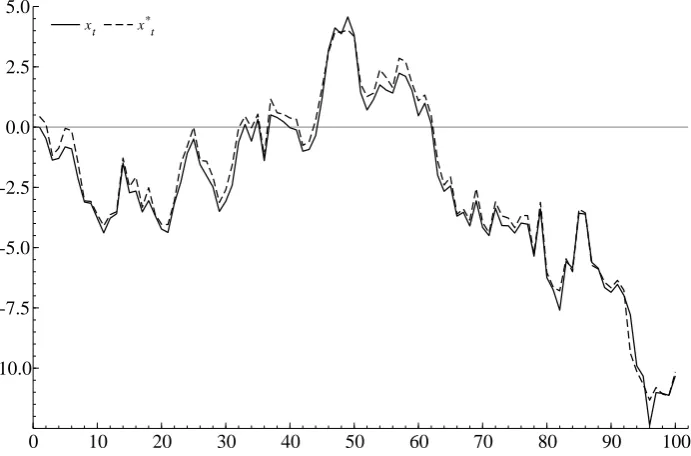
Figure 1: The MEB sample path replication.
xt x*t
0 10 20 30 40 50 60 70 80 90 100
-10.0 -7.5 -5.0 -2.5 0.0 2.5 5.0
xt x*t
Note: The figure reports the sample path of X and its bootstrapped counterpart X∗ obtained using the MEB algorithm. The true data generating process is given as xt =
xt−1+εt, with εt∼N(0,1), x0 = 0, and T = 100.
The MEB algorithm can be iteratively employed to approximate the distribution of
the desired statistic. The method thus combines the maximum entropy principle with the
perfect rank correlation to resample from the observed data.
2.2. The Maximum Entropy Bootstrap to Assess the Unit Root Hypothesis
Let us consider a standard AR(1) process frequently used in the econometric analysis
xt=ρ·xt−1+εt t = 1, . . . , T, (6)
where εt ∼i.i.d.N(0,1). In this paper we focus on the unit root case, i.e., ρ= 1.
Figure 1 reports the plot of the sample path generated by (6) with ρ = 1 and the
bootstrapped path obtained using the Maximum Entropy algorithm proposed above. The
figure shows that the MEB algorithm provides a close replication of the original time series.
We employ the MEB to assess the rejection frequency of the test with null hypothesis
ρ= 1 in (6) against the alternative of|ρ|<1. In Figure 2, we plot the empirical rejection
frequencies to assess the quantile of the bootstrap distribution of the t-statistic. We
[image:9.595.119.465.105.333.2]Figure 2: Empirical rejection frequencies of the MEB.
45 Line MEB
0.0 0.1 0.2 0.3 0.4 0.5 0.6 0.7 0.8 0.9 1.0
0.1 0.2 0.3 0.4 0.5 0.6 0.7 0.8 0.9
1.0 45 Line MEB
Note: The figure reports the empirical rejection frequencies against the nominal levels of the test H0 : ρ= 1 against HA: |ρ|<1 with distribution approximated by MEB .
create 299 bootstrap samples. We consider T = 100 and initial point to be set atx0 = 0.
We report the Q-Q plot for the MEB of the test under the null H0 : ρ = 1 against
the alternative HA: |ρ| <1. In our case, the Q-Q plot deviates from the 450 line, where
the MEB has very low size and thus suggests the presence of significant flaws in the MEB
suggested by Vinod and L´opez-de Lacalle (2009).
2.2.1. Why the Maximum Entropy Bootstrap Fails?
The MEB test may fail for two main reasons, as suggested by Davidson and Monticini
(2014):
1. The distribution of the MEB statistic is on average more dispersed than that of
the statistic itself. Thus, the mass of the bootstrap distribution to the right of the
statistic is too large and so the p-value. Analogously, when the t-statistics is small,
the p-value is small.
2. For each replication, the bootstrap statistics are positively correlated with the
orig-inal statistic meaning that the bootstrap does not provide an independent draw of
In order to identify the cause of the MEB failure, we first plot the distribution of the t
-statistic using the same setup we employ to generate the sample path. Figure 3 reports the
plot of the distribution of the original t-statistic for 1000 replications under H0 : ρ = 1.
Further, for each realization of the data generating process, we store the value of one
boostrapped statistic to obtain the following series {τi∗}1000
i=1 and we plot its distribution.
The figure shows that the two distributions are very close to each other and hence the
first explanation does not apply. Therefore, we check whether the second one may explain
the MEB failure. In order to study the relationship between the two statistics, we regress
the bootstrapped t-statistics obtained using the MEB algorithm, τi∗, onto the t-statistics
obtained simulating from the data generating process. The resulting estimates are
τi∗ = − 0.2452
(0.00326)
+ 0.8728
(0.00299)
τi i= 1, . . . ,1000.
(7)
with an adjusted R2 = 0.9445, suggesting that the samples obtained using the MEB
mimics too closely the sample they are drawn from, as Figure 1 also shows. Thus, there is a
strong positive correlation between the twot-statistics which explains the severe undersize
of the unit-root test when bootstrapping its distribution using the MEB algorithm.
Another way to visualize why things go wrong is to plot the joint density of the Monte
Carlo statistic and the bootstrapped counterpart. Figure 4 reports the kernel based joint
density of (τi, τj∗) (gaussian kernel) and the related contour plot which resembles an ellipse
with the semi-major axis sloping upwards. This is symptomatic of the high correlation
between the bootstrapped statistics and the corresponding Monte Carlo draws.
It is worth stressing that the maximum entropy principle itself is not the cause of
the MEB failure. Rather, the perfect rank correlation between the true data and the
bootstrapped draws is causing the problems. In the next section, we propose a novel
procedure to overcome the issue with the perfect rank correlation.
3. A New Procedure: The Maximum Entropy Block Bootstrap
We introduce the Maximum Entropy Block Bootstrap (MEBB), which preserves the
Figure 3: Distribution of the MEB statistic underH0: ρ= 1.
τ τ*
-4 -3 -2 -1 0 1 2 3 4
0.05 0.10 0.15 0.20 0.25 0.30 0.35 0.40
τ τ*
Note: The figure reports the distribution of the original t-statistic and one corresponding bootstrapped replication under H0 : ρ= 1.
Figure 4: Joint Kernel Density
(a) Gaussian Kernel pdf (b) Contour
-3 -2 -1 0 1 2
-3 -2 -1 0 1 2
path. In order to ensure consistency of the bootstrap procedure, we apply the algorithm
on the time series obtained as a partial sum of the demeaned residuals as in Paparoditis
and Politis (2001)4. In addition, it is free of tail trimmings.
3.1. The MEBB Algorithm
We propose to break the perfect rank correlation locally such that the MEB algorithm
is employed block-wise. In each block, the perfect rank correlation is preserved, while over
the entire sample path, the rank correlation between the entire data generating process
and the bootstrapped sample is unrestricted. We define the MEBB algorithm as follows:
Step A. We choose the block length ` < T and let i0, i1, . . . , ik−1 i.i.d. uniform random
numbers on the set [1,2, . . . , T −`] wherek =bT /`c, (number of blocks).
Step B. For each ij, with j = 0, . . . , k−1, we get the subset of the original time series
X(j) =nx
ij, xij+1, . . . , xij+`−1
o .
Step C. We apply the MEB algorithm corresponding to Steps 1-7 in Section 2 for each
subset X(j) separately and generate X∗(j) =nx∗ ij, x
∗
ij+1, . . . , x
∗ ij+`−1
o .
Step D. We recover the bootstrapped sample path by sewing the X∗(1), . . . , X∗(k) such
that x∗i
j+1 −x ∗
ij+`−1 is set in a way to correspond to the difference xij+1 −xij+`−1.
Step E. If the length of the bootstrapped sample path is exceeding T, we take the first
T values.
In addition, when employing the MEB, we omit the trimming in the algorithm. In
such a case, Step 1 in the MEB algorithm is modified as follows:
Step 1*. We create an order statistics x(t) based on the empirical data set xt and define
the support of the empirical data to be [−∞,∞].
The constrained solution for the maximum entropy distribution on the half-open
in-terval [0,∞) is given by f = λe−λx with mass at 1/λ. Therefore, the solution analogous
to (3) and (5) for the intervals I1 ≡(−∞, z1] and IT ≡[zT,∞), respectively, is given by
4Phillips (2010) shows that this initial step is not needed to achieve consistency under the null
fI1(x) =β1λ1e
−λ1(z1−x), x∈I1, m1 = 3x(1)
4 +
x(2)
4 (8)
fIT(x) = βTλTe
−λT(x−zT), x∈I
T , mT =
x(T−1)
4 +
3x(T)
4 , (9)
where the parametersλ1 andλT are set such that the mean preserving constraints imposed
onm1 andmT are satisfied, respectively, whileβ1 andβT assures that the mass preserving
constraints hold. Namely,
β1 =βT =
1
T , (10)
and
λ1 :
3x(1)
4 +
x(2)
4 =
ˆ x(1)+x(2)
2
−∞
dx xλ1e
−λ1
x(1)+x(2)
2 −x
(11)
λT :
x(T−1)
4 +
3x(T)
4 =
ˆ ∞
x(T−1)+x(T)
2
dx xλTe
−λT
x−x(T−1)+x(T) 2
(12)
giving λ1 = x 4
(2)−x(1) and λT =
4
x(T)−x(T−1), respectively.
Finally, Steps 2-7 of the MEBB algorithm for a given subsetX∗ are the same as for the
MEB. To draw an observation from I1 and IT, we employ the knowledge of the analytic
solution to the cdf offI1 and fIT, respectively. The advantage is that the mean preserving
constraint is by construction satisfied for the tails, as opposed to use the trimmed values.
Such a modified algorithm forms the basis of the MEBB for the non-stationary time
series, it preserves the perfect rank correlation locally and uses the proper form of the
tails in the maximum entropy distribution function.5
3.2. A Numerical Illustration
In Figure 5, we report a bootstrap sample path based on the new MEBB algorithm.
We use the same setup as in Section 2 with T = 100 and x0 = 0. The original sample
path and the bootstrap one are different and thus the new algorithm does not mimic the
5The tails are of the exponential form, which advocates the use of the trimming algorithm. On the
Figure 5: MEBB sample path replication.
xt x*t
0 10 20 30 40 50 60 70 80 90 100
-10.0 -7.5 -5.0 -2.5 0.0 2.5 5.0
xt x*t
Note: The figure reports the sample path xt and the replicated path x∗t by the MEBB.
The true data generating process is given as xt=xt−1+εt, with εt∼N(0,1), x0 = 0, and T = 100.
sample data too closely.
In order to provide evidence that our proposed method works, we report in the left
panel of Figure 6 the empirical rejection frequency of thet-statistic to test forρ= 1 using
the same design as in the previous section. The MEBB rejection frequencies coincide
with the nominal values as required. In the right panel of Figure 6, we present the
distribution of the t-statistic based on the simulated series as well as the distribution of
the corresponding bootstrapped t-statistic based on the MEBB . The two distributions
coincides in the same manner as for the original MEB algorithm, see Figure 3.
By comparing Figure 6 with Figure 2, it is evident that our proposed procedure allows
us to restore the correct size. Indeed, a regression similar to that in (7) gives
τi∗ = −0.4541
(0.0354)
− 0.005663
(0.0323)
τi i= 1, . . . ,1000
, (13)
with the adjusted R2 = 0.00097. As a further evidence that the MEBB works properly,
we report in Figure 7 the counterpart of Figure 4. As expected, the absence of correlation
Figure 6: The MEBB.
(a) Empirical rejection frequencies.
45 Line MEBB
0.0 0.1 0.2 0.3 0.4 0.5 0.6 0.7 0.8 0.9 1.0
0.1 0.2 0.3 0.4 0.5 0.6 0.7 0.8 0.9 1.0
45 Line MEBB
(b) Distribution of the bootstrapped statistic under H0: ρ= 1.
τ τ*
-4 -3 -2 -1 0 1 2 3 4
0.05 0.10 0.15 0.20 0.25 0.30 0.35 0.40
τ τ*
Note: The left panel reports the plot of the empirical rejection frequencies against the nominal levels of the test under H0 : ρ = 1 against HA : |ρ| < 1 with the distribution
approximated by the MEBB. The right panel depicts the distribution of the original t -statistic and the distribution of thet-statistic obtained by bootstrapping underH0 : ρ= 1.
Figure 7: Joint Kernel Density
(a) Gaussian Kernel pdf (b) Contour
-3 -2 -1 0 1 2
-3 -2 -1 0 1 2
The link between the data generating process and the MEBB draws are weak in this
case and therefore our method is able to preserve the perfect rank correlation locally for
each block and it provides a truly viable and working entropy-based bootstrap algorithm.
4. Simulation Study of the MEBB
In this section, we carry out a comprehensive Monte Carlo simulation study to evaluate
the finite sample properties of the MEBB. We compare the entropy-based resampling
schemes with standard bootstrap approaches, i.e. residual-based bootstrap and
non-parametric block-bootstrapping techniques. The comparison is based on the bootstrapped
empirical rejection frequencies of the t-statistics for testing that the value of the AR(1)
coefficient, ρ, estimated by OLS, equals unity (Dickey-Fuller test). The unit-root set-up
is of particular interest as bootstrapping directly a non-stationary series is not common
practice in the econometric literature. In particular, for non-stationary time series there
exists in the literature only the Continuous Path Block Bootstrap (CPBB) developed by
Paparoditis and Politis (2001) and studied also by Phillips (2010).
Bootstrapping unit-root tests is thus one of the potentially most interesting application
of the entropy-based bootstrap method constituting an alternative to standard
residual-based bootstrapped unit-root tests (see Palm et al. 2007 for a review) which are not easy
to apply when the dependence structure of the residuals is difficult to ascertain.
4.1. Monte Carlo Design
We consider approximating by bootstrapping thet-statistic distribution for the AR(1)
coefficient. As benchmark, we consider the empirical rejection frequencies based on the
standard residuals-based bootstrap (RB) and CPBB. Then, we compute empirical
rejec-tion frequencies for the MEBB.
In particular, we generate a time series according to the following data generating
process
xm,t =ρ0xm,t−1+ηm,t
where m = 1, . . . , M denotes a realizations of the sample path. Further, we consider
different sample sizes T = {50,100,300} and we set ρ0 = 1 in order to assess the
size, while we consider progressive deviations from the unit root hypothesis, specifically
ρ0 ={0.99 ,0.95,0.90,0.80,0.70,0.60, 0.5}, in order to assess the power.
Moreover, we generate the{ηm,t} series allowing for “progressive” fat-tails by
consid-ering in turn the following distributions
ηt
iid
∼
N(0,1)
T(5)
T(3) ,
with T(k) denoting the standard t-distribution with k degrees of freedom. Next, we fit
an AR(1) model and compute the t-statistic
τm =
ˆ
ρm−1
ˆ
σηm(
PT
t=1x2m,t−1)−1/2
, for testing
H0 : ρ= 1
H1 : |ρ|<1
(14)
where ˆρm=
PT
t=1x2m,t−1
−1
PT
t=1xm,t−1xm,t
is the least squares estimator of the
autore-gressive coefficient and ˆσηm = (T−1)
−1/2(PT
t=1ηˆm,t2 )1/2 is the residuals standard deviation.
To compute the empirical rejection frequencies, we draw b = 1, . . . , B bootstrapped
samples under H0 denoted{x∗b,m,t}Tt=1 either by resampling from the residuals when using
the RB approach or by resampling directly from levels {xm,t} when using both MEBB
and CPBB.
4.1.1. Residuals Bootstrap
x∗b,m,0 =xm,0
x∗b,m,t =ρ0x∗b,m,t−1 +η
∗
b,m,t t = 1, . . . , T
where ηb,m,t∗ are drawn from the centred residuals nηˆm,t− T1 PTt=1ηˆm,t
oT
t=1 obtained from the residuals of the regression of xb,m,t on its first lag either parametrically or
4.1.2. Continuous Path Block Bootstrap
Following Paparoditis and Politis (2001), we implement the CPBB procedure as
fol-lows:
1. We compute the centred residuals
ˆ
um,t =xm,t−xm,t−1−
1
T −1
T
X
t=1
(xm,t−xm,t−1)
and define
˜
xm,t =
xm,1 t = 1
xm,1+Ptj=2uˆm,j t = 2, . . . , T.
The null is imposed by building the intermediate time-series{˜xm,t}generated through
{ˆum,t}.
2. We choose the block length ` < T and let i0, i1, . . . , iu−1 i.i.d. uniform random
numbers on the set [1,2, . . . , T −`], where u=bT /`c (number of blocks).
3. We build the bootstrapped series of length l =u·` as
x∗b,m,j =xm,1+ [˜xi0+j−1 −x˜i0] first block
x∗b,m,rs+j =x∗b,m,r`+ [˜xim+j−x˜ir] (r+ 1)
th block
for j = 1, . . . , `and r = 1, . . . , u−1.
4.2. Simulation Results
We then use{x∗b,m,t}T
t=1 to compute the bootstrapped counterpart of (14),
τm,b∗ = ρˆ
∗ m,b−1
ˆ
σ∗
ηm,b(
PT
t=1x∗m,b,t−12)−1/2
b = 1, . . . , B (15)
and we select the α-quantile τm∗(α) of the distribution of the bootstrapped statistic (at
the mth iteration) such that B−1PB
b=1I(τ
∗
m,b ≤ τ
∗
m(α)) ≈ α. The empirical rejection
frequencies are computed as
1 M
M
X
m=1
I(τm ≤τm∗(α)), (16)
being a one-sided test with rejection to the left.
To compare the size of the different approaches, we compute (16) forα ∈[0.01 , 0.025,
works well, as we are simulating under H0, we should observe a graph close to the 450
line.
Figure 8 reports the rejection frequencies under H0 (size) for the bootstrap methods
introduced in the previous paragraphs. For the CPBB and MEBB, the block length is set
to u=bT1/3c. Overall, the figures suggest that even for small samples with T = 50, our
proposed MEBB provides rejection frequencies close to the nominal level, outperforming
the original MEB.
Figure 9 reports the power curves for the alternative bootstrap procedures. The closest
method to the MEBB is the CPBB, which shows also very similar power to our proposed
method. In conclusion, the MEBB provides a valid alternative to the (unique) existing
bootstrap method, which allows to replicate the levels for non-stationary time series.
In the next section, we extend the MEBB and introduce the Maximum non-extensive
Entropy Block Bootstrap, which is based on the generalization of the non-extensive
en-tropy.
5. Beyond the Shannon Entropy: The Maximum non-extensive Entropy Block Bootstrap
We extend the Maximum Entropy Block Bootstrap to the case when the underlying
principle is driven by maximization of the non-extensive entropy and define the Maximum
non-extensive Entropy Block Bootstrap (MnEBB).6
The key concept of our framework is the generalized Tsallis (1988) entropy defined in
the discrete form as
Hq=−
1
1−q 1−
N
X
i=1 (pi)
q
! ,
and in the continuous form as
6The MEBB presented in Section 3 is based on the Shannon entropy. Such an entropy is suitable for
Figure 8: Emp irical reje ction freque ncies. (a) T = 50 N (0 , 1)
45 Line PRB ME (Vinod) MEBB Asym NPRB CPBB
0 0.1 0.2 0.3 0.4 0.5 0.6 0.7 0.8 0.9 1 0.1 0.2 0.3 0.4 0.5 0.6 0.7 0.8 0.9 1.0
45 Line PRB ME (Vinod) MEBB Asym NPRB CPBB
(b) T = 100 N (0 , 1)
45 Line PRB ME (Vinod) MEBB Asym NPRB CPBB
0 0.1 0.2 0.3 0.4 0.5 0.6 0.7 0.8 0.9 1 0.1 0.2 0.3 0.4 0.5 0.6 0.7 0.8 0.9 1.0
45 Line PRB ME (Vinod) MEBB Asym NPRB CPBB
(c) T = 300 N (0 , 1)
45 Line PRB ME (Vinod) MEBB Asym NPRB CPBB
0 0.1 0.2 0.3 0.4 0.5 0.6 0.7 0.8 0.9 1 0.1 0.2 0.3 0.4 0.5 0.6 0.7 0.8 0.9 1.0
45 Line PRB ME (Vinod) MEBB Asym NPRB CPBB
(d) T = 50 T (3)
45 Line PRB ME (Vinod) MEBB Asym NPRB CPBB
0 0.1 0.2 0.3 0.4 0.5 0.6 0.7 0.8 0.9 1 0.1 0.2 0.3 0.4 0.5 0.6 0.7 0.8 0.9 1.0
45 Line PRB ME (Vinod) MEBB Asym NPRB CPBB
(e) T = 100 T (3)
45 Line PRB ME (Vinod) MEBB Asym NPRB CPBB
0 0.1 0.2 0.3 0.4 0.5 0.6 0.7 0.8 0.9 1 0.1 0.2 0.3 0.4 0.5 0.6 0.7 0.8 0.9 1.0
45 Line PRB ME (Vinod) MEBB Asym NPRB CPBB
(f ) T = 300 T (3)
45 Line RPB ME (Vinod) MEBB Asym NPRB CPBB
0 0.1 0.2 0.3 0.4 0.5 0.6 0.7 0.8 0.9 1 0.1 0.2 0.3 0.4 0.5 0.6 0.7 0.8 0.9 1.0
45 Line RPB ME (Vinod) MEBB Asym NPRB CPBB
(g) T = 50 T (5)
45 Line RPB ME (Vinod) MEBB Asym NPRB CPBB
0 0.1 0.2 0.3 0.4 0.5 0.6 0.7 0.8 0.9 1 0.1 0.2 0.3 0.4 0.5 0.6 0.7 0.8 0.9 1.0
45 Line RPB ME (Vinod) MEBB Asym NPRB CPBB
(h) T = 100 T (5)
45 Line RPB ME (Vinod) MEBB Asym NPRB CPBB
0 0.1 0.2 0.3 0.4 0.5 0.6 0.7 0.8 0.9 1 0.1 0.2 0.3 0.4 0.5 0.6 0.7 0.8 0.9 1.0
45 Line RPB ME (Vinod) MEBB Asym NPRB CPBB
(i) T = 300 T (5)
45 Line PRB ME (Vinod) MEBB Asym NPRB CPBB
0 0.1 0.2 0.3 0.4 0.5 0.6 0.7 0.8 0.9 1 0.1 0.2 0.3 0.4 0.5 0.6 0.7 0.8 0.9 1.0
45 Line PRB ME (Vinod) MEBB Asym NPRB CPBB
Note: The figure rep orts the empirical rejection frequencies for sev eral b o otstrap metho ds. The data generating pro cess is giv en as xt =
xt−
Figure 9: P o w er of the tests. (a) T = 50 N (0 , 1)
Asym NPRB CPBB PRB ME (Vinod) MEBB
0.5 0.55 0.6 0.65 0.7 0.75 0.8 0.85 0.9 0.95 0.1 0.2 0.3 0.4 0.5 0.6 0.7 0.8 0.9 1.0
Asym NPRB CPBB PRB ME (Vinod) MEBB
(b) T = 100 N (0 , 1)
Asym NPRB CPBB PRB ME (Vinod) MEBB
0.5 0.55 0.6 0.65 0.7 0.75 0.8 0.85 0.9 0.95 0.1 0.2 0.3 0.4 0.5 0.6 0.7 0.8 0.9 1.0
Asym NPRB CPBB PRB ME (Vinod) MEBB
(c) T = 300 N (0 , 1)
Asym NPRB CPBB PRB ME (Vinod) MEBB
0.5 0.55 0.6 0.65 0.7 0.75 0.8 0.85 0.9 0.95 0.1 0.2 0.3 0.4 0.5 0.6 0.7 0.8 0.9 1.0
Asym NPRB CPBB PRB ME (Vinod) MEBB
(d) T = 50 T (3)
Asym NPRB CPBB PRB ME (Vinod) MEBB
0.5 0.55 0.6 0.65 0.7 0.75 0.8 0.85 0.9 0.95 0.1 0.2 0.3 0.4 0.5 0.6 0.7 0.8 0.9 1.0
Asym NPRB CPBB PRB ME (Vinod) MEBB
(e) T = 100 T (3)
Asym NPRB CPBB PRB ME (Vinod) MEBB
0.5 0.55 0.6 0.65 0.7 0.75 0.8 0.85 0.9 0.95 0.1 0.2 0.3 0.4 0.5 0.6 0.7 0.8 0.9 1.0
Asym NPRB CPBB PRB ME (Vinod) MEBB
(f ) T = 300 T (3)
Asym NPRB CPBB PRB ME (Vinod) MEBB
0.5 0.55 0.6 0.65 0.7 0.75 0.8 0.85 0.9 0.95 0.1 0.2 0.3 0.4 0.5 0.6 0.7 0.8 0.9 1.0
Asym NPRB CPBB PRB ME (Vinod) MEBB
(g) T = 50 T (5)
Asym NPRB CPBB PRB ME (Vinod) MEBB
0.5 0.55 0.6 0.65 0.7 0.75 0.8 0.85 0.9 0.95 0.1 0.2 0.3 0.4 0.5 0.6 0.7 0.8 0.9 1.0
Asym NPRB CPBB PRB ME (Vinod) MEBB
(h) T = 100 T (5)
Asym NPRB CPBB PRB ME (Vinod) MEBB
0.5 0.55 0.6 0.65 0.7 0.75 0.8 0.85 0.9 0.95 0.1 0.2 0.3 0.4 0.5 0.6 0.7 0.8 0.9 1.0
Asym NPRB CPBB PRB ME (Vinod) MEBB
(i) T = 300 T (5)
Asym NPRB CPBB PRB ME (Vinod) MEBB
0.5 0.55 0.6 0.65 0.7 0.75 0.8 0.85 0.9 0.95 0.1 0.2 0.3 0.4 0.5 0.6 0.7 0.8 0.9 1.0
Asym NPRB CPBB PRB ME (Vinod) MEBB
The figure depicts the p o w er of the test for sev eral b o otstrap metho ds. The data generating pro cess is giv en as xt =
xt−
Hq=−
1
1−q 1−
ˆ
dx(p(x))q
! ,
where the parameter q governs the non-extensiveness of the system. The Tsallis entropy
converges to the Shannon entropy in the limit when q →1.
For a given q, the density function fq is given as
fq(x) =
[1−β(1−q)x]1/(1−q)
Zq
, (17)
with normalization constant
Zq =
ˆ
dx[1−β(1−q)x]1/(1−q) .
The non-extensiveness of the system can be expressed for two systemsA and B as
Hq(A+B) = Hq(A) +Hq(B) + (1−q)Hq(A)Hq(B) .
The density function resulting from the optimization of the Tsallis entropy has a finite
integral over the semi-definite interval forq∈(1,2). The limit of this distribution function
is exponential function for q → 1. For q ∈ (1,2), we get power law behaviour and thus
fatter tails for the distribution. For q < 1, we get a non-standard behaviour of the
distribution function as it is infinite over the semi-definite interval and thus it requires
a normalization by an infinite normalization factor. This still allows for a comparison
between the two draws as ∞/∞ ∼ c, but it provides unnecessary complications. As
q → 0, we get uniform distribution, or, fq→0(x) = c/∞, where c does not depend on x.
For q >5/3, we get a distribution with non-existing second moment, or E[x2] =∞.7 At
q = 2, the first moment cease to exist. In this paper, we explicitly consider q ∈ [1,5/3),
which covers a broad range specifications ranging from the standard Shannon entropy to
cases with non-existent second moments and fat tails.
7In general, it would be more appropriate to deal with the q-expectations, which remain finite and
5.1. The MnEBB Algorithm
The MnEBB algorithm is defined as follows. First, the mass preserving constraint
states that, on average, 1/T of the mass of the density function lies in each of the intervals
It. This is achieved by bootstrapping the set xt as a T draws, each from the different
interval It. Second, the mean preserving constraint says that
T
X
t=1
xt=
T
X
t=1
x(t) =
T
X
t=1
mt,
where mt is the mean off(x) over the interval It.
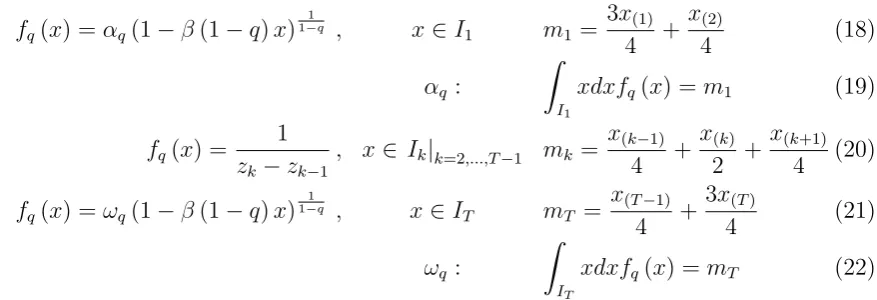
The new framework thus leads to the following choice of the density functions
fq(x) =αq(1−β(1−q)x)
1
1−q , x∈I1 m1 = 3x(1)
4 +
x(2)
4 (18)
αq:
ˆ
I1
xdxfq(x) =m1 (19)
fq(x) =
1
zk−zk−1
, x∈ Ik|k=2,...,T−1 mk =
x(k−1)
4 +
x(k)
2 +
x(k+1)
4 (20)
fq(x) =ωq(1−β(1−q)x)
1
1−q , x∈I
T mT =
x(T−1)
4 +
3x(T)
4 (21)
ωq :
ˆ
IT
xdxfq(x) = mT (22)
The remaining structure of the MnEBB algorithm is just as defined for the MEBB.
The choice of q >1 suggests using the distribution with fatter tails than implied by the
standard entropy.
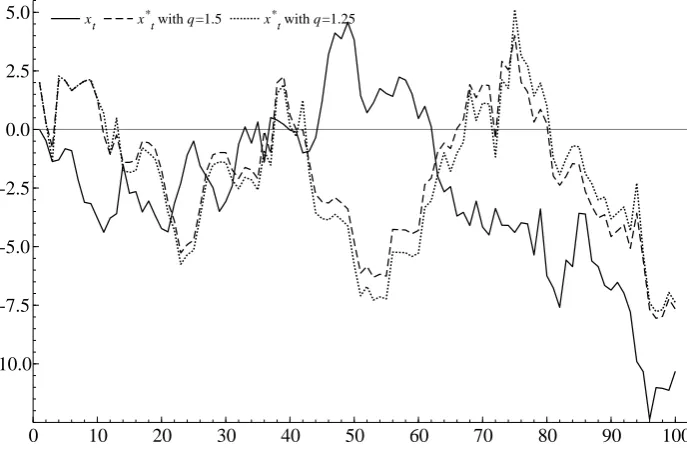
Figure 10 reports a bootstrap sample path based on the new MnEBB algorithm. We
use the same setup as in the previous section with T = 100, y0 = 0 and two values of
non-extensiveness parameter: q = 1.25 and q = 1.5. The figure supports the intuition
that more the non-extensive the system is, the more variation in the replication sample
is present.
5.2. Simulation Results
We replicate the extensive simulation analysis as in Section 4 and focus on the
[image:24.595.86.525.325.475.2]Figure 10: MnEBB sample path replication.
xt x*t with q=1.5 x*t with q=1.25
0 10 20 30 40 50 60 70 80 90 100
-10.0 -7.5 -5.0 -2.5 0.0 2.5
5.0 xt x*t with q=1.5 x*t with q=1.25
Note: The figure reports the sample path xt and the replicated path x∗t by the MnEBB.
The short-dash line corresponds to MnEBB with q = 1.25 and dot line corresponds to MnEBB with q = 1.5. The true data generating process is given as xt =xt−1 +εt, with
εt∼N(0,1), x0 = 0, and T = 100.
Figure 11 reports the rejection frequencies for three MnEBB methods withq= 1, 1.25,
and 1.5, respectively, introduced in the previous paragraphs. The data generating process
is given as xt = xt−1 +εt, with εt ∼N(0,1), T (3) and T (5), respectively, with x0 = 0,
and T = 100. Overall, the figures suggest that for q = 1.25, the MnEBB underperforms
in terms of size the MEBB. However, with increasing q, the MEBB and MnEBB are
becoming indistinguishable.
Figure 12 reports the power of the alternative bootstrap procedures. The power
sup-ports the inferiority of MnEBB with q = 1.25 to the original MEBB, while the MnEBB
with q = 1.5 is dominating in terms of the power. Therefore, the MnEBB method with
fatter tails provides a significant improvement to the entropy based algorithm even for
the data generating process based on the Gaussian distribution.
6. Conclusions
In this paper, we proposed the Maximum Entropy Block Bootstrap, a fully
[image:25.595.119.463.108.333.2]Figure 11: Non-exte nsiv e size. (a) N (0 , 1) q = 1 . 25
45 Line MNEBB
MEBB 0 0.1 0.2 0.3 0.4 0.5 0.6 0.7 0.8 0.9 1 0.1 0.2 0.3 0.4 0.5 0.6 0.7 0.8 0.9 1.0
45 Line MNEBB
MEBB (b) T (3) q = 1 . 25
45 Line MNEBB
MEBB 0 0.1 0.2 0.3 0.4 0.5 0.6 0.7 0.8 0.9 1 0.1 0.2 0.3 0.4 0.5 0.6 0.7 0.8 0.9 1.0
45 Line MNEBB
MEBB (c) T (5) q = 1 . 25
45 Line MNEBB
MEBB 0 0.1 0.2 0.3 0.4 0.5 0.6 0.7 0.8 0.9 1 0.1 0.2 0.3 0.4 0.5 0.6 0.7 0.8 0.9 1.0
45 Line MNEBB
MEBB (d) N (0 , 1) q = 1 . 5
45 Line MNEBB
MEBB 0 0.1 0.2 0.3 0.4 0.5 0.6 0.7 0.8 0.9 1 0.1 0.2 0.3 0.4 0.5 0.6 0.7 0.8 0.9 1.0
45 Line MNEBB
MEBB (e) T (3) q = 1 . 5
45 Line MNEBB
MEBB 0 0.1 0.2 0.3 0.4 0.5 0.6 0.7 0.8 0.9 1 0.1 0.2 0.3 0.4 0.5 0.6 0.7 0.8 0.9 1.0
45 Line MNEBB
MEBB (f ) T = 100 T (5) q = 1 . 5
45 Line MNEBB
MEBB 0 0.1 0.2 0.3 0.4 0.5 0.6 0.7 0.8 0.9 1 0.1 0.2 0.3 0.4 0.5 0.6 0.7 0.8 0.9 1.0
45 Line MNEBB
MEBB Note: The figure rep orts the empir ical rejection frequencies for the MEBB and MnEBB. The data generating pro cess is giv en as xt =
xt−
Figure 12: Non-exte nsiv e p o w er (a) N (0 , 1) q = 1 . 25 MEBB MNEBB 0.5 0.55 0.6 0.65 0.7 0.75 0.8 0.85 0.9 0.95 0.1 0.2 0.3 0.4 0.5 0.6 0.7 0.8 0.9 1.0 MEBB MNEBB (b) T (3) q = 1 . 25 MEBB MNEBB 0.5 0.55 0.6 0.65 0.7 0.75 0.8 0.85 0.9 0.95 0.1 0.2 0.3 0.4 0.5 0.6 0.7 0.8 0.9 1.0 MEBB MNEBB (c) T (5) q = 1 . 25 MEBB MNEBB 0.5 0.55 0.6 0.65 0.7 0.75 0.8 0.85 0.9 0.95 0.1 0.2 0.3 0.4 0.5 0.6 0.7 0.8 0.9 1.0 MEBB MNEBB (d) N (0 , 1) q = 1 . 5 MEBB MNEBB 0.5 0.55 0.6 0.65 0.7 0.75 0.8 0.85 0.9 0.95 0.1 0.2 0.3 0.4 0.5 0.6 0.7 0.8 0.9 1.0 MEBB MNEBB (e) T (3) q = 1 . 5 MEBB MNEBB 0.5 0.55 0.6 0.65 0.7 0.75 0.8 0.85 0.9 0.95 0.1 0.2 0.3 0.4 0.5 0.6 0.7 0.8 0.9 1.0 MEBB MNEBB (f ) T (5) q = 1 . 5 MEBB MNEBB 0.5 0.55 0.6 0.65 0.7 0.75 0.8 0.85 0.9 0.95 0.1 0.2 0.3 0.4 0.5 0.6 0.7 0.8 0.9 1.0 MEBB MNEBB Note: The figure depicts the p o w er of the test for the MEBB and MnEBB. The data generating pro cess is giv en as xt =
xt−
persistence structure. Our procedure employed the maximum entropy bootstrap while
preserving locally the rank correlation between the original sample and the bootstrap
draws. We used unit root test to illustrate that our procedure performs well. In
ad-dition, we employed the notion of non-extensive entropy and introduce the Maximum
non-extensive Entropy Bootstrap, which allows for the inclusion of fat tails and
power-law behaviour. This generalized procedure outperforms the Maximum Entropy Bootstrap
for large values of the non-extensiveness even when the underlying data generating process
involves the normal distribution.
The results in this paper suggest some interesting developments. First, it would be
useful to derive the limiting theory of the MEBB and MnEBB methods proposed in
this paper. Second, it would be interesting to extend the proposed procedure to a
non-stationary framework such as co-integration analysis. This is part of an ongoing research
References
Buhlmann, P. (1997). Sieve Bootstrap for Time Series. Bernoulli 3, 123–148.
Davidson, R. and A. Monticini (2014). Heteroskedasticity-and-autocorrelation-consistent
bootstrapping. Technical report, Universit`a Cattolica del Sacro Cuore, Dipartimenti e
Istituti di Scienze Economiche (DISCE).
Efron, B. (1979). Bootstrap Methods: Another Look at the Jackknife. Annals of
Statis-tics 7, 1–26.
K¨unsch, H. (1989). The Jack-knife and the Bootstrap for General Stationary Observations.
Annals of Statistics 17, 1217–1241.
Mammen, E. (1993). Bootstrap and Wild Bootstrap for High Dimensional Linear Models.
Annals of Statistics 21, 255–285.
Palm, F. C., S. Smeekes, and J.-P. Urbain (2007). Bootstrap Unit-Root Tests:
Compar-isons and Extensions. Journal of Time Series Analysis 29, 371–401.
Paparoditis, E. and D. Politis (2001). The Continuous Path Block-Bootstrap. In M. Puri
(Ed.), Asymptotics in Statistics and Probability, pp. 305–320. VSP Publications.
Phillips, P. C. B. (2010). BootstrappingI(1) Data.Journal of Econometrics 158, 280–284.
Politis, D., J. Romano, and M. Wolf (1999). Subsampling. Springer Series in Statistics.
Springer New York.
Tsallis, C. (1988). Possible Generalization of Boltzmann-Gibbs Statistics. Journal of
Statistical Physics 52(1-2), 479–487.
Vinod, H. D. and J. L´opez-de Lacalle (2009). Maximum Entropy Bootstrap for Time
Series: the meboot R Package. Journal of Statistical Software 29, 1–19.
Wu, C.-F. J. (1986). Jackknife, Bootstrap and Other Resampling Methods in Regression