Rochester Institute of Technology
RIT Scholar Works
Theses
Thesis/Dissertation Collections
7-1-1989
Determination of image quality for added noise as a
function of spatial frequency
Yun-Ching Kuo
Follow this and additional works at:
http://scholarworks.rit.edu/theses
This Thesis is brought to you for free and open access by the Thesis/Dissertation Collections at RIT Scholar Works. It has been accepted for inclusion
in Theses by an authorized administrator of RIT Scholar Works. For more information, please contact
.
Recommended Citation
DETERMINATION OF IMAGE OUALITY
FOR ADDED NOISE AS A FUNCTION OF SPATIAL FREOUENCY
by
Yun-Ching Kuo
A.A.
World College of Journalism
(1981)
A thesis submitted in partial fulfillment of the requirements for
the degree of Master of Science in the Center for Imaging science
of Rochester Institute of Technology
July 1989
Signature of the Author
Oenter for Imaging Science
Accepted by
Name Illegible
Center for imaging Science
Rochester Institute of Technology
Rochester,
New York
CERTIFICATE OF APPROVAL
M.S. DEGREE THESIS
The M.S. Degree Thesis of Yun-Ching Kuo has been examined and
approved by the thesis Committee as satisfactory for the
thesis requirement for the Master of Science degree.
Dr. E.M.
Granger,
Thesis Advisor
Dr. R.L.Easton
Dr. D. Marsh
THESIS RELEASE PERMISSION FORM
CENTER FOR IMAGING SCIENCE
ROCHESTER INSTITUTE OF TECHNOLOGY
Title of Thesis
: Determination of Image Quality for Added Noise
as a Function of Spatial Frequency
I,
Yun-Ching
Kuo,
hereby
grant
permission
to
the
Wallace Memorial Library of Rochester Institute of Technology to
produce my thesis in whole or in part. Any reproduction will not
be of commerical use or for profit.
Signature
Date
Determination
ofImage
Quality
for
Added
Noise
as aFunction
ofSpatial
Frequency
by
Yun-Ching
Kuo
Submitted
to
the
Center
for
Imaging
Science
in
partial
fulfillment
ofthe
requirements
for
the
Master
ofScience
Degree
at
the
Rochester
Institute
ofTechnology
ABSTRACT
The
noisein
colorimages
whichis
referredto
as
chromatic
noise represents adistribution
withinthree
spectral
bands
and
contributes
to
chromatic
andachromatic
visualeffects.
The
chromatic
noisedepends
very
strongly
onthe
spatial
frequency
response ofthe
visualsystem.
Therefore,
this
study
characterizes
the
variationin
perceived
chromatic
noise
level
and
generatesthe
noise
field
to
addto
the
color
image
samples.
From
these
degraded
images,
wefound
that
noise
in
low
spatial
frequencies
is
much moredisturbing
than
in
the
medium
and
high
spatial
frequency
regions.The
perceived
quality
scales
of
the
modulated
chromaticnoise
images
werecompared
to
the
subjective
quality
factor
(S.Q.F.)
scales.By
using
category
analysis,
this
quality
scale
yieldsthe
S.Q.F.
rating,
and
determines
the
dependence
ofthe
spatialfrequency
content
ofchromatic
noise
TABLE
OF
CONTENTS
I
INTRODUCTION
1
II
BACKGROUND
STUDIES
3
1.
Literature
Review
3
A.
The
MacAdam-Friele
Study
3
B.
Implication
ofthe
MacAdam
Data
4
C.
MTF
ofAchromaticity
andchromaticity
5
2.
Visual
System
8
3.
Image
Quality
andS.Q.F.
12
4.
Psychophysical
Evaluation
Method
18
5.
Colored
Noise
22
A.
Image
Signal
22
B.
Random
Noise
22
III
OBJECTIVE
25
IV
EXPERIMENTAL
28
1.
Image
Scanning
28
A.
Scanning
Process
28
B.
Image
Size
andSampling
33
2.
Random
Noise
Generation
35
3.
Gaussian
Bandpass
Filter
36
4.
Noise
Scaling
40
V
DESIGN
AND
ANALYSIS
61
1.
The
Category
Scaling
Method
61
2.
Multiparameter
Hypothesis
65
3.
A
Graphical
Solution
70
4.
Subjective
Quality
Scale
77
5.
Data
Analysis
79
VI
DISCUSSION
&
CONCLUSION
83
1.
Experimental
Results
84
2.
Conclusion
86
APPENDIX
-I
92
APPENDIX
-II
10g
APPENDIX
-III
110
APPENDIX
-IV
!14
LIST
OF
TABLES
TABLE
4
.1
TABLE
5.1
TABLE
5.2
TABLE
5.3
TABLE
5.4
TABLE
5.5
TABLE
5.6
TABLE
5.7
TABLE
5.8
TABLE
5
.9
TABLE
5.10
TABLE
6.1
Mean
andVariance
ofthe
Passband
Noise
53
Analysis
ofVariance
for
Rating
Data
67
Comparison
onthe
Rating
Data
68
Observed
Frequencies
72
Observed
Cumulative
Frequencies
73
Observed
Cumulative
Proportions
74
Normal
Deviates
75
Boundary
Mean
Values
Vs.
SQF
Values
78
Regression
Analysis
onGirl
Imagery
80
Regression
Analysis
onMask
Imagery
81
Regression
Analysis
onTwo
Images
82
Analysis
Results
83
LIST
OF
FIGURES
FIGURE
2.1
FIGURE
2.2
FIGURE
2.3
FIGURE
2.4
FIGURE
2.5
FIGURE
2.6
FIGURE
3.1
FIGURE
3.2
FIGURE
FIGURE
FIGURE
FIGURE
FIGURE
FIGURE
FIGURE
FIGURE
FIGURE
FIGURE
FIGURE
Figure
FIGURE
FIGURE
FIGURE
FIGURE
FIGURE
FIGURE
FIGURE
FIGURE
4.1
4.2
4.3
4.4
4.5
4.6
7
8
.9 .10 .11 ,12 ,13 ,14 .15 ,16 ,17 ,18 ,194.20
MTF
ofVisual
Achromaticity
andChromaticity
7
MTF
ofHuman
Observer
8
Predicted Versus
Observed
Brightness
Distribution
9
Spectral
Luminous
Efficiency
for
Normal
Observers
11
Subjective
Quality
Factor
Passband
16
Magnification
Comparison
17
Noise
Distribution
onVisual
Transfer
Function
26
Noise
Distribution
vs.Subjective
Quality
Scales
26
Girl
Image
28
Mask
Image
29
Comparison
ofTwo
Images
-I
30
Comparison
ofTwo
Images
-II
31
Imaging Scanning
and
Process
Sequence
32
Low
Frequency
Gaussian
Filter
37
Medium
Frequency
Gaussian
Filter
38
High
Frequency
Gaussian
Filter
39
Noise
Scaling
Process
42
Low
Frequency
Noise
44
Medium
Frequency
Noise
45
High
Frequency
Noise
46
Comparison
ofGirl
Images
-I
47
Comparison
ofGirl
Images
-II
48
Comparison
ofGirl
Images
-III
49
Comparison
ofMask
Images
-IV
50
Comparison
ofMask
Images
-V
51
Comparison
ofMask
Images
-VI
52
FIGURE
4.21
FIGURE
4.22
FIGURE
4.23
FIGURE
4.2 4
FIGURE
5.1
FIGURE
6.1
FIGURE
6.2
FIGURE
6.3
FIGURE
6.4
High
Frequency
Noise
Girl
Image
57
Low
Frequency
Noise
Mask
Image
58
Medium
Frequency
Noise
Mask
Image
5 9
High
Frequency
Noise
Mask
Image
60
Average
Rating
vs.Noise
Levels
69
Spatial
Frequency
Response
vs .SQF
-I
85
Spatial
Frequency
Response
vs.SQF
-II
85
Noise
Distribution
onVisual
Transfer
Function
86
Comparison
ofHypothesis
andExperiment
resultI.
INTRODUCTION
The
questions
ofhow
to
characterize
image
quality
andwhat
constitute
optimum
visualquality
are commonto
many
applications.
This
study
is
concerned
withcharacterizing
perceived
quality
ofimages
with noise anddeveloping
atechnology-independent
method
for
predicting
image
quality.The
principal
source
ofnoise
willbe
regarded asthe
randomnoise
ofthe
system.In
the
study
of colorimage
quality,
the
mostimportant
factor
is
the
luminance
effect.The
noise of colorimages
is
adistribution
in
three
spectralbands:
red,
green,
andblue.
By
varying
the
noiselevel,
the
effective noisein
these
frequency
regions will contribute
to
chromatic
andachromatic
visualeffects.
The
reportinvestigates
the
image
quality
for
added
noise
asa
function
of spatialfrequency.
This
study
will showthat
the
visual effect ofthe
noise
exhibits
a
very
powerfuldependence
onthe
spatial
frequency.
If
one
is
to
relate subjective andobjective
quality
in
absolute
terms,
it
is
necessary
to
accountfor
the
variousfunctional
properties
of
the
human
visual system.The
visualsystem
is
known
to
be
complexin
its
behavior,
for
example,
it
often
appears
to
have
non-linear responseto
complexstimulus
patterns,
(e.g.
the
various
brightness
illusions1and
the
receptivefield
characteristics2).
Thus
a visual modelfor
image
quality
perception
must
accomodate
alinear
objectiverelationship
with anonlinear
subjective
relationship.
An
image
quality
meritfunction
(Subjective
Quality
Factor)
has
been
proposed as an objectivefigure
of merit whichcan
be
easily
calculated anddirectly
measuredin
practice andwhich will correlate with subjective rank3.
The
resultshave
shownthat
the
image
quality
meritfunction
is
ableto
predictimage
guality
within normal readererror and
is
linearly
correlated withthe
measureddata.
In
this
study,
we usedthe
SQF
to
define
the
quality
ofthe
images
anddemonstrated
a correlation of96%
withthe
measureddata.
The
visualefficiency
for
noise perception exhibits alinear
objectiverelationship
in
this
study.The
variation ofthe
perceived color
image
in
different
noiselevels
were correlatedwith
the
subject's perception ofimage
guality.II.
BACKGROUND
STUDIES
1
.LITERATURE
REVIEW
A.
The
MacAdam-Friele
Study
-In
1942,
MacAdam
published
results ofexperiments
in
which a single observermade
25,000
observations
of colordifferences
from
25
selectedpoints
in
the
x-y
chromaticity
diagram4.
These
experiments were carriedout
by having
observers view a pair of visualfields
to
determine
the
point at which onefield
became
visually
different
from
the
other.
The
experiment5was
designed
to
"measure"the
distance
shift
in
eachdirection
in
the
x-y
diagram
that
would produce ajust-noticeable,
orthreshold,
colordifference.
Because
ofthe
dependence
of such experiments onthe
level
ofillumination
andadaptation of
the
eye,
MacAdam
surroundedthe
test
fields
with aneutral
gray
field
to
stimulatethe
object mode withoutdis
tracting
from
the
visualtask.
The
results ofhis
experiments showthat
the
eye candiscriminate
between
small changesin
x-y
coordinatesin
the
violet
region,
whilethe
eyeis
least
sensitiveto
chromaticity
changes
in
the
green region ofthe
diagram.
Friele
(1961)6 usedthe
Muller
(1930)7
theory
of colorseeking.
He
usedMacAdam
's
data
onequally
perceptible
intervals
to
guide
the
selection
oftristimulus
responsefunctions.
Friele
followed
the
Muller
theory
in
proposing
that
the
lightness-response
function
L
is
the
sum of red-receptor and green-receptorsignals
(R+G)
.The
redness-greenness
responsefunction
A
resultsis
the
difference
between
the
sametwo
signals(R-G)
.The
yellowness-blueness
responsefunction
B
is
the
difference
between
the
blue-receptor
signal andthe
red-plus-green average :
R+G
Z
B
]
.B
.Implication
ofthe
MacAdam
Data
-The
threshold
ellipsoids
ofMacAdam
aretransformed
to
a coordinate system offundamental
primaries.The
thresholds
of colordiscrimination
can ftbe
described
as a Weber-Fechneriandifferential
sensitivity
inthe
fundamental
process,
i.e.
equal stimulus ratios are predictedto
elicit equalsensory
differences.
This
is
combined with onesummation process
(lightness)
andtwo
chromaticprocesses
(red-green,
yellow-blue)
.When
a small signalis
combined with alarge
signal,
the
threshold
ofthe
small signalis
enhancedto
overcomethe
"noise"of
the
larger.
If
a small signalfrom
one receptoris
combined
with a
large
signalfrom
anotherreceptor,
the
effective
threshold
for
the
first
receptoris
limited
by
the
"noise" ofthe
second.
The
brightness
ofthe
surrounding
field
also
limits
the
thresholds
.-4-The
problems
of visual adaption ofthe
eye andthe
spatialfrequency
suggested
afurther
study
which varysthe
brightness
(amplitude
ofthe
noise)
ofthe
subject
to
produce a new colorperception
formed
by
the
three
spectralbands.
Also,
the
variations of
the
noiseamplitude
canbe
relatedto
the
human
color vision
perception.
Therefore,
the
relationship
of spatialfrequency
andimage
quality
will alsobe
examinedin
this
study.C.
MTF
of
Achromaticity
and
Chromaticity
-Many
studies
in
the
field
ofimage
quality
definition
have
noticedthat
aperceptible
difference
in
image
quality
canbe
obtainedby
changing
the
scale of eitherthe
point spreadfunction
orthe
modulation
transfer.
This
tells
usthat
image
quality
is
relatedto
logarithmic
spatialfrequency
weighting
ofthe
system opticaltransfer
function
(OTF)
.Specifically,
image
quality
correlates
with
the
area underthe
systemOTF
whendisplayed
on alog
spatial
frequency
scale.The
quality
of a visualimage
is
relatedto
the
scale
ofthe
image
onthe
retina.The
human
visual systemhas
a
modulation
transfer
function
(MTF)
withbroad
peak response at6
cycles
perdegree
(cpd)
.The
eye response canbe
correlated
withquality
rank
and
computed rankif
the
"true"eye
MTF
is
used
in
the
calculation of
quality
rank.In
fact,
computations
that
useonly
the
one-dimensionalMTF
have
proven quitesuccessful
in
predicting
quality
rankfor
two-dimensional
image
structure.
includes
the
proper
weighting
function
to
describe
the
two-dimensional
visualproperties
ofthe
image.
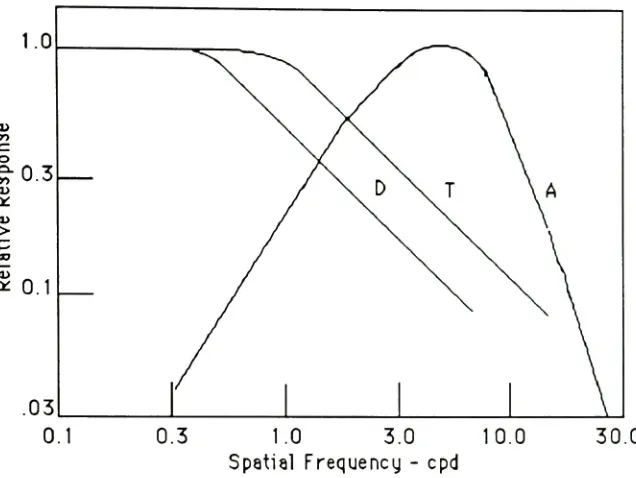
The
visual systemrequires
three
mechanisms,
the
so-calledA,
T
andD
mechanisms9.
Each
ofthese
mechanismshas
its
ownspatial
frequency
response.The
so-called "A" or achromaticmechanism
is
the
spatially
"differential"mechanism plus
the
"integrative"
mechanism and assumed
to
be
the
same asthe
brightness
mechanism.The
chromatic mechanism ofthe
"T" ortritanopic
mechanism mediatesthe
perception of redness andgreenness
in
a colorimage.
The
"D"or
deuteranopic
mechanismmediates
blueness
and yellowness perceptions.The
perception ofthe
image
is
assumedto
involve
the
sum ofthese
three
mechanisms.
Therefore,
the
quality
ofthe
image
shouldbe
directly
relatedto
the
spectral and spatialbandwidths
ofthe
mechanisms.
Figure
2.1
showsthe
MTF
of visualachromaticity
(luminance)
and chromaticity. [image:16.553.48.505.121.451.2]-6-0.3
1.0
3.0
10.0
Spatial
Frequency
-cpd
30.0
[image:17.553.69.387.78.317.2]2.
VISUAL
SYSTEM
Studies
ofthe
modulation
transfer
characteristics ofthe
visual system show
that
the
visual system's responseto
luminous
sine-waves
defines
a visual system modulationtransfer
function
(MTF)10
which
has
avery
broad
peak with maximum response at6
cycles per
degree
(cpd)
.A
typically
observedMTF
is
shownin
Figure
2.2
Measurements
down
to
very
low
spatialfrequencies
show
that
the
MTF
continuesto
decrease
in
linear
fashion.
From
the
measurement ofthe
visual system's responseto
the
modulus ofthe
sine-wave,
aImage
Quality
Merit
Function
(IQMF)
c canbe
derived
.0.1
1.0
10.0
100.0
Spatial
Frequency
-Cycles/Degree
Figure
2.2
MTF
OF
HUMAN
OBSERVER
Studies13
of
the
visualfield
demonstrate
alinear
organization of
inhibitory
andexcitatory
regions ofthe
field.
The
response ofthe
elementary
visualfields
is
turned
to
respond-8-to
lines
of a givenorientation
that
traverse
a givenlocality
onthe
retina.The
action ofthe
visualfields
suggeststhat
the
visual
information
is
collected
in
onedimension
by
the
spatialdifferencing
mechanism.
Cornsweet
performed
aFourier
analysis of abar
oflight
and
calculated
its
hypothetical
appearance afterprocessing
by
the
measured systemMTF.
The
results ofhis
analysis are shownin
Figure
2.3.
Note
the
large
difference
between
the
calculatedappearance
(Figure
2.3b)
andthe
appearance of abar
as perceivedby
human
observer(Figure
2.3c)
.:*7>
(a)
j|
timul
=
5
*
S
J3
(b)
cSo>
r
Computed Response
<u > f>
(c)
t?
.a s O OObserved
Response
Figure
2.3
PERDICTED
VERSUS
OBSERVED
BRIGHTNESS
DISTRIBUTION
perception of
the
object
indicates
that
higher-order
processesin
the
brain
areperforming
something
analogous
to
anintegration
ofthe
differential
spatial
information
derived
from
the
early
visual
processing
stage.
Without
the
"integration"process,
the
observer would report
the
bar
as calculatedby
Cornsweet
(Figure
2.3b)
.From
these
studies,
we can assumethat
the
spatial actionof
the
visual system canbe
modeledin
two
stages;
the
first
is
spatially
differential
and orientation selective.This
stageis
followed
by
anintegrative
process which sumsthe
contributionsof
the
differential
stagesto
producethe
visualfield.
The
second stage
is
assumedto
be
non-directionalin
nature.This
model of visual system
is
called subjectivequality
factor.
To
modelthe
color visionsystem,
we needto
considerthe
spectral response of
the
system.Color
vision requires atleast
three
mechanisms .Experience
with colortelevision
indicates
that
the
luminance
(black-and-white)
component of color visionis
mostimportant
in
maintaining
picturequality
andthat
two
chromaticcomponents
play
a much smaller role.In
these
studies of colorimage
quality, wefound
that
the
luminance
component wasthe
only
significant contributor
to
image
quality
exceptfor
some caseswith extreme chromatic aberration.
Therefore,
for
a colorimage
which
is
good colorbalance
only
the
luminance
mechanismcontributes
significantly
to
image
quality
considerations.
The
sp<
2.4
.10
jectralluminosity
response15
1.0,
400
500
600
Wavelength
-nm
700
Figure
2
.4
SPECTRAL
LUMINOUS
EFFICIENCY
FOR
NORMAL
OBSERVERS
3.
IMAGE
QUALITY
AND
S.Q.F.
Images
are
produced
for
viewing
by
humans
orfor
inter
pretation
by
computers.
The
viewing
situationis
eithera
"performance"
or a
"non-performance
"situation
depending
onwhether an
immediate
active
response
to
the
image
is
expected.Computer
vision
applications
always
have
the
character ofperformance
situations.
Image
in
graphic
artstechnology
are
viewed
for
information
and
pleasure
in
anon-performance
manner.
Because
image
quality
is
instrumental
in
determining
the
magnitude
ofinformation
which canbe
extractedfrom
animage
aswell as
image
outlook.
It
important
in
both
types
ofviewing
situtions
.From
the
standpoint ofresearch,
image
quality
consitutes
a research
area
ofits
own.This
is
because
the
problems
ofimage
quality
in
different
applications
have
many
commonfeatures.
The
topics
ofstudy
in
the
area ofquality
canbe
roughly
divided
to
three
categories:-
image
quality
components and measurement ofquality,
relationships
between
processphysics,
chemistry,
processparameters or
image
processing
algorithms andimage
quality
and- relationships
between
human
visualperformance
andimage
quality
.Our
prime
interest
in
this
study
is
the
specification ofcolor
image
quality;
therefore
we will usethe
Subjective
Quality
Factor
(S.Q.F.)
to
define
image
quality.
SQF
wasintroduced
by
Granger
andCupery17,
and
incorporates
aweighting
function
to
simulate
the
visualprocess
outlined
in
the
last
section.The
integration
performed
by
the
higher
processis
simulatedby
weighting
the
visual systemMTF
by
a1/f
factor
wheref
is
the
spatial
frequency.
Application
ofthis
factor
in
the
frequency
domain
is
equivalent
to
performing
anintegration
in
the
spatialdomain.
The
weightfactor
canbe
convertedto
a convenientform
by
noting,
that;
df
d
(
In
f
)
=.
Thus,
alogarithmic
spatialfrequency
weightfunction
alsosimulates
the
assumed spatialintegration.
The
image
quality
merit
function
canbe
obtainedfor
atwo-dimensional
opticalsystem
OTF
by
describing
the
systemOTF
in
polarcoordinates
andperforming
the
following
integration
to
simulatethe
assumedaction of
the
visual system:SQF
=K
J
|
|T
(lnf,6)
I
I
T
e
(Inf)
!
d9
d(lnf)
,In
a
0
where
%
(ln
f,
8
)
is
the
systemOTF
expressed
in
polarcoordinates and
log-spatial-frequency
coordinates.
T
(In
f)
is
the
one-dimensional visual systemMTF,
is
the
azimuthangle,
andf
is
the
spatial
frequency
in
cycles perdegree.
The
normalizing
constant
K
is
the
inverse
ofthe
above equation withthe
systemOTF
setto
unity.The
lower
limit
of spatialfrequency
in
the
integration,
a,
is
chosen asthe
limit
ofthe
range ofimage
quality
to
be
considered.
Since
spatialfrequency
is
expressedin
cycles perdegree
of visual
angle,
this
form
ofthe
integral
takes
into
accountthe
scale of
the
image
onthe
retina.Therefore,
by
definition,
SQF
includes
the
system magnification .The
eyeresponse,
T
(f
)
,has
ca
broad
bandpass
structurein
the
spatialfrequency
domain
asillustrated
in
Figure
2.2.
This
response canbe
approximatedby
aretangular spatial
frequency
responsebetween
the
limits
of3
cpd and12
cpd.This
approximation eliminatesthe
one-dimensional
visual systemMTF
and allowsthis
simplification:In 12
2
71
SQF
=K
J
J
I
I
(lnf.9
)
I
d8
d(lnf)
.In3
0
The
SQF
meritfunction
canbe
extendedto
colorimages
by
using
a spectral weight whichincludes
the
spectral response ofthe
visual system andthat
ofthe
transparancy
or print material.Therefore,
the
image
quality
of an optical systemis
givenby:
In 12 2n
700
SQF
=kJ
J J
I
T(Inf,9,X)
Sxvxdx
I
d6
d(lnf)
In
3
0
400
where
T
(In
f,
8,
X)
is
the
spectralOTF
in
polarcoordinates,
[image:24.553.56.508.71.400.2]14-S
X
is
the
sPectral
transmittance
orreflectance
of a neutral(white)
reproduced
in
the
or
transparency,
andV.
is
the
spectral
luminosity
response
ofthe
visual system.The
wavelengthX
is
measured
in
nanometers
and
the
spatialfrequency
f
in
cycles
per
degree
.One
convenience
offered
by
this
equationis
that
the
givenvalue of
SQF
is
easily
evaluated
graphically.The
eye responsehas
a
broad bandpass
structure
in
the
spatialfrequency
domain
as
illustrated
in
Figure
2.2.
This
response canbe
approximated
by
arectangular spatial
frequency
responsebetween
the
limits
of3
cpd
and
12
cpd.The
SQF
merit
function
canbe
extendedto
colorimages
by
using
a spectral weight whichincludes
the
spectralresponse of
the
visual system andthat
ofthe
transparency
orprint material.
The
given value ofthe
SQF
is
easily
evaluated
graphically.
The
quality
rankis
simply
the
area underthe
MTF
between
the
two
spatialfrequency
limits
as
shownin
Figure
2.5.
S.Q.F.
wasdefined
to
duplicate
the
operation ofthe
human
visual system
as
shownin
Figure
2.5,
whichshows
that
human
are
able
to
utilizeonly
a smallband
of spatialfrequencies.
The
position of
the
SQF
passband onthe
linear
spatialfrequency
axis
can
be
readily
located
in
the
following
manner.A
viewing
distance
of34
cm willdefine
unit magnification.This
viewing
condition places
the
center ofthe
SQF
passband
conveniently
at
aspatial
frequency
of1
cycle per mmat
the
image
plane.
Using
mm
is
just
equal
to
the
magnification
usedto
viewthe
image
PASSBAND
APPROXIMATION
VISUAL SYSTEM
<>34 CM VIEWING
DISTANCE
3
6
12
Spatial
Frequency
-cycles/mm
Figure
2.5
SUBJECTIVE
QUALITY
FACTOR
PASSBAND
Therefore,
at a normalviewing
distance
of34
cm,
this
region ofsharp
visual response correspondsto
a spatialfrequency
regionof
0.5
to
2.0
lines
per mm.We
have
found
that
we canpredict
with excellent
accuracy
the
quality
name response ofa
human
observer
to
the
information
availablein
this
spatial
frequency
region.
Figure
2.6
illustrates
anotheradvantage
ofthe
log
frequency
weighting.Two
separateS.Q.F.
regions(Ml
andM2)
are
shown.
These
representthe
changein
visual responseto
a givenimage
as
afunction
of magnification.Greater
magnification
pushes
the
passbandto
higher
spatialfrequencies.
Two
systems
can
also
be
evaluated ata
variety
ofmagnifications
by
converting
the
angular spatialfrequency
coordinates
to
linear
coordinates.
-16-SQF(A)>SQF(B)
SQF(A)<SQF(B)
1.0
1
<L)
V
lens
A
o*>c
\
Ni
CO k_ 1 ez o CD
15
~^T"
^-^^
T3
O
lens
B
z
M 1
M2
^
\
1
w
Log
Spatial
Frequency
Figure
2.6
MAGNIFICATION
COMPARISON
4
.PSYCHOPHYSICALEVALUATION
METHOD
In
studies
of
color
reproduction,
it
is
usually
desirable
to
scale
the
"quality"of
images
to
predict
the
subjective effectof
variations
in
the
physical
parameters
ofthe
reproductionsystem.
In
this
study,
observers
are
requiredto
indicate
their
relative
preferences
for
the
individual
members ofa
group
ofdissimilar
colorimages.
When
the
number of stimuli arefixed
and
their
characteristics are
invariant,
there
are a number oftasks
that
observers
may
performto
derive
the
data
from
which aquality
scale
may
be
constructed.Instructions
for
performing
suchtasks
are :
1)
Rate
each stimulus ona
scale
of n equalsteps.
2)
Sort
the
stimuliinto
npiles
or groups sothat
the
intervals
between
the
piles aresubjectively
equal.3)
Given
that
stimulusA
has
a value ofR
units,
reportthe
value of stimulusB.
These
tasks
are quantitativejudgement
methods;
that
is,
the
unit of measurementis
obtaineddirectly
from
quantitative
judgements
of stimuli with respectto
the
attribute.The
task
set
for
the
observer always requires morethan
the
ability
to
differentiate
stimuli onthe
basis
oftheir
order.
There
are
a number ofmethods
to
performthe
multiplepresentation
for
quantitative-judgement
tasks.
The
method usedfor
this
study
recognizes
assuccessive
categories or categoricaljudgment.
The
scheme
requires
an observerto
make an absolute ordirect
estimate
ofthe
magnitude
ofquality
differences
among
stimuli and
to
classify
eachstimulus
in
one of severalcategories
having
equalincremental
differences.
The
underlying
rationale
for
this
methodhas
been
described
by
Torgerson18and
involves
treating
the
category
boundaries
asif
they
exhibited
the
dispersion
characteristicsassociated
withstimulus
orderin
comparative
judgment.
The
Law
ofCategorical
Judgment19assumes
that
the
response continuum
may
be
divided
into
a specified number ofordered categories or steps.
Owing
to
variousfactors,
a givencategory
boundary
is
not
always
located
at aparticular
point,
but
rather over a range of positiondescribed
by
anassociated
normal
distribution.
The
observerthen
classifies
agiven
stimulus
below
a
givencategory
boundary
wheneverthe
value
ofthe
stimulus
onthe
response continuumis
less
than
that
ofthe
category
boundary.
Essentially,
this
amounts
to
assuming
that
the
boundaries
between
adjacent categoriesbehave
like
stimuli,
and
it
is
possibleby
alternativedata-reduction
techniques
to
scale
either on
the
basis
ofthe
category
limits
or
on
the
central
Procedures
directly
analogous
to
those
used
in
deriving
the
Law
ofComparative
judgement
lead
to
aformal
expression ofthe
law
ofcategorical
judgement,
tg
-Rj
=Zjg
(Sj
2
+sg
2
-2rjg
Sj sg
)
1/2
,where
g
= mean
location
of
the
g
th
category
boundary;
sg
=dispersion
of
the
g
th
category
boundary;
rjg
=the
correlation
between
position
ofstimulus
j
and
category
boundary
g
;
Zjg
=the
standard
normaldeviate
corresponding
to
the
proportion
oftimes
that
stimulus
j
is
sorted
below
boundary
g.In
this
study,
wemake
simplifying
assumptions
that
the
covariance
between
stimuliis
constant
andthat
the
variance
ofthe
distribution
ofdiscriminal
difference
is
constant20.
This
leads
to
a simplified statement:t
g
R
j
-Z
jg
K'
where
K
is
a constant.It
is,
then,
to
derive
aninterval
scale
of subjective
quality
by
this
method.The
categoricaljudgement
provides
a psychophysical methodfor
evaluating
colorimages
that
is
most economical ofequipment,
experimental
labor,
and observer skill.In
otherwords,
the
psychophysical method
for
evaluating
the
quality
of colorimages
5.
COLORED
NOISE
A
.Image
Signal
-A
two-dimensional
chromaticimage
can
be
defined
in
terms
ofthe
image
signalS
which representsit.
S
is
a
function
ofwavelength
and
spatial coordinates.This
is
to
say
that
image
signal
can
be
writtenas
follows:
image
signal
=S
[
>,
,x,
y
]
,where
X
is
the
spectralluminance
from
400
to
700
nanometers
and
x
and
y
are spatialcoordinates.
In
adigital
reproductionprocess,
an originalimage
(called
input)
undergoes several process stepsbefore
the
final
is
obtained.
These
stepsinclude
sampling
and
digitiza
tion,
halftoning,
and outputimaging
(printing)
andmodify
the
image
signal(e.g.
they
addnoise)
.Apart
from
halftoning,
the
process
steps
canbe
approximately
depicted
as
spatially
linear
operations
.B
.Random
Noise
-There
is
always somelevel
ofnoise
in
an
image
from
scattering
ofthe
light,
the
imaging
electronics,
the
formation
ofimage
itself.
This
noise
interferes
withthe
color
and
luminance
ofthe
image.
The
analysis of noisein
recordedimages
has
been
extensively
described
in
the
literature.
Particular
interests
-22-have
included
Fourier
analysis
and
micro-densitometry,
mathematical
models
ofimage-structure
statistics,
andthe
psychophysical
attributes
ofimage
noise,
i.e.
graininess .In
this
study,
the
systemnoise
willbe
investigated
as a randomvariable,
termed
"colored
random noise"to
describe
an unknowncontaminating
signals.
When
a signalis
recorded,
an undesiredcontaminating
random signal will
be
superimposed
uponthe
desired
signal.The
functional
form
ofthis
noiseis
noteasy
to
express,
evenif
its
origin
is
known.
By
observing
the
noisefor
a period oftime,
wecan
develop
some
knowledge
ofits
characteristicsthough
it
cannever
be
predictedin
detail.
Thus
the
concept of a randomvariable
may
be
a usefultool
in
dealing
with noise .When
we referto
a randomvariable,
we meanthat
it
is
anunknown
function
with aknown
autocorrelation.Since
the
autocorrelation
function
ofthis
random variable canbe
estimated,
socan
its
power spectrum.The
phase spectrum cannotbe
determined
Indeed,
the
ensembleis
composed ofinfinitely
many
functions
that
differ
only
in
their
phase spectra.The
contrast of colorimages
may
be
disturbed
in
brightness
or chromaticity.In
addition,
the
spatialfrequency
character of
the
noise must alsobe
investigated.
The
effect
ofcolored noise
depends
onthe
responseproperties
ofthe
human
may
not
affect
ourability
to
evaluate
the
performance ofthe
image.
In
a medicalimaging
context,
for
example,
there
may
be
high-frequency
"noise".
If
the
objectto
be
detected
has
mainly
low
spatialfrequency
components,
the
"noise"may
not affectthe
detectability
ofthe
"signal".
That
is,
we couldvery
well seethe
graininess of animage
withouthaving
it
affect ourability
to
make outthe
signal.24-III.
OB.-rEr.TTVR
In
studies
of colorreproduction,
it
is
necessary
to
scale
the
"quality"of
images
to
predict
the
subjective effect ofvariations
in
the
physical
parameters
ofthe
reproductionsystems.
The
effect
ofchromatic
noise modulation willdegrade
the
perception onthe
images.
The
object
for
this
experimentis
to
find
the
effect
ofnoise
onimage
quality.Studies
ofunsharp
masking
indicate
that
the
bandpass
filter
shouldbe
located
within
the
medium spatialfrequency
band
wherethe
visualresponse
is
most
sensitive
to
maximize
image
quality.This
wouldsuggest
that
noise
is
mostdisruptive
at mediumfrequencies.
A
diagram
ofthe
spatialfrequency
distribution
ofthe
noise
vs.the
luminance
transfer
function
ofhuman
visual systemis
shown onFigure
3.1.
Three
narrownoise
bands
willbe
usedin
this
study
ofimage
quality.The
hypothesis
ofthis
study
is
that
there
willbe
a
much greatersensitivity
to
chromaticnoise
in
the
mediumfrequency
region.The
expectedtrend
for
noise perceptionin
different
spatial
frequency
regions versus subjectiveimage
quality
is
0.1
"Ol
i~0
To"
Spatial
Frequency
-cpd
Figure
3
.1
NOISE
DISTRIBUTION
ON
VISUAL
TRANSFER
FUNCTION
Low
Medium
High
Spatial
Frequency
Regions
Figure
3.2
NOISE
DISTRIBUTION
VS.
SUBJECTIVE
QUALITY
SCALES
This
figure
suggestthat
noisein
the
mediumfrequency
region
would
be
mostdestructive
to
image
quality.
The
different
noise
levels
for
the
image
indicates
the
noise
perception
trend
in
the
three
spatialfrequency
regions.The
standard
deviation
of
[image:36.553.64.474.60.700.2]-26-the
noise
level
willbe
converted
to
digital
count.
We
expectthat
the
reduction
in
image
quality
wouldhave
a expecteddiagram
as shown
in
this
figure
.The
objective
ofthis
study
is
to
add noiseto
animage
in
three
distinct
narrow spatialfrequency
regions andto
study
the
loss
ofimage
quality
as afunction
of noiselevel
and noisefrequency
location.
The
method ofcategory
scaling
willbe
usedto
scalethe
subjective evaluation ofimage
quality.The
subjective
quality
factor
willbe
usedto
correlatethe
IV.
EXPERTMT.NT&T.
1
.IMAGE
SCANNING
A.
Scanning
Process
-Two
continuous-tone colorimages
which contain
low,
medium,
andhigh
spatialfrequency
information
are used
in
this
study.
The
images
are
denoted
"Girl"and "Mask"
and
are
shownin
Figures
4.1
and4.2.
These
two
images
werecompared
by
analyzing
their
radial powerspectra,
i.e.
the
powerspectrum
integrated
over2
radians.Figure
4.1
GIRL
IMAGE
[image:38.553.153.420.371.643.2]Figure
4
.2
MASK
IMAGE
The
radial spatialfrequency
tells
the
image
signals
vary
as
afunction
of spatialcoordinates.
Images
withslowly
varying
patterns
have
predominantly
low
spatialfrequencies,
and
those
with much
detail
andsharp
edgeshave
high
spatialfrequencies.
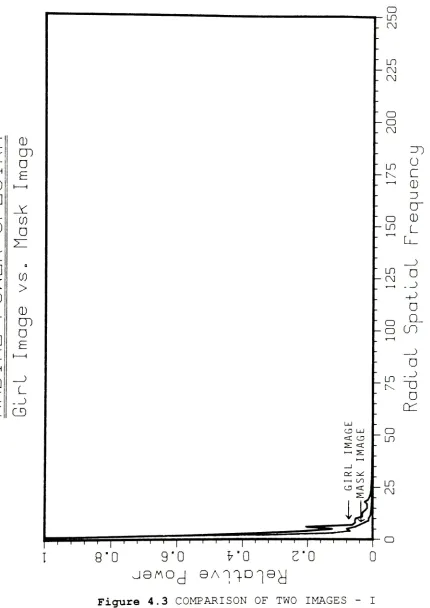
Figure
4.3
showsthe
radial powerspectrum
ofthese
two
images.
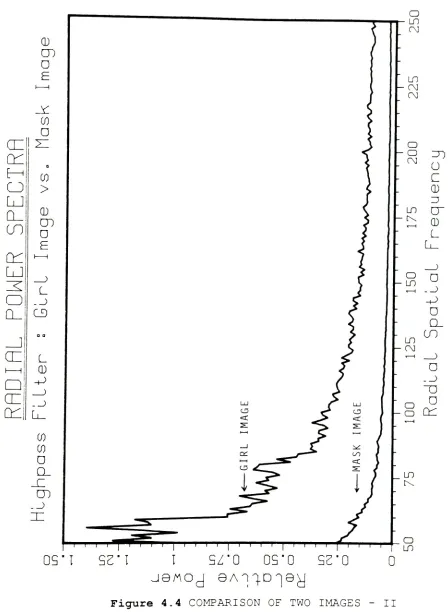
Figure
4.4
showsthe
differences
between
the
Girl
image
and
the
Mask
image
afterhighpass
filtering.
It
proves
that
the
Girl
image
has
morehigh
frequency
information.
The
Mask
image
CT
CD
C
o
F
E-<
CJ
i iri i
CL_
CO
o
CO
^
(H
LJ
aCO
^
>
o
n
CD
CD
_ja
F
en
1 1CE
L
QZ
CD
CD UJ
s: <c
I
' rt r
o
-m
.CM
"m
-oo
.CM
a
-a
.CM
=n
in
u
-1\
L_
- ^
CD
Z5
o~ "o
CD
-LT)
L
L_
"LO
n
-CM
t __> +>a
o
Q_
-a
U )
r 1
a
LO
..j t\u
D
Lr^
O
LO
LO
CM
a
8'0
9'0
fr'O
Z'O
J8AOJ
9An^D^|9y
Figure
4.3
COMPARISON
OF
TWO
IMAGES
-I
[image:40.553.73.503.58.666.2]CD
en
0
F
J
CO
0
en
JZ
(H
E--CO
CJ
>
LjJ
ci_
CO
CD
0
F
ct:
iLJ
^
(
LJ
-_J>Q_
CD
_J aaCE
L
1 i
CD
Q
-H>CE
-_)or
Li_
CO
CO
O
D_
._)HI
~I T i i i
o
LflCM
0
OS"
I
SZ"I
I
SZ'O
0S"0
Sc"0
Figure
4.4
COMPARISON
OF
TWO
IMAGES
[image:41.553.52.500.60.674.2]The
two
images
were
scanned
and
digitized
by
scannerinto
a
magnetic
tape
file.
The
different
noise
samples were addedto
the
images
by
digital
image
processing.
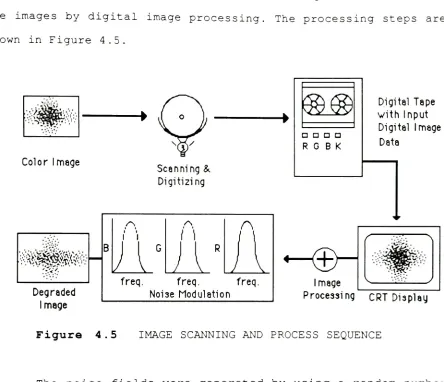
The
processing
steps areshown
in
Figure
4.5.
Color Image
Digital Tape
with
Input
Digital Image
Data
Scanning
&
Digitizing
Degraded
Image
i i
i
i
j \
B
11'
){
{
freq.
freq.
freq.
Noise
Modulation
Processing
CRT
Display
Figure
4
.5
IMAGE
SCANNING
AND
PROCESS
SEQUENCE
The
noisefields
were generatedby
using
a randomnumber
generator
to
createthe
random noise with zeromean,
uncorrelated
feature,
and unit variance.This
randomnoise
field
canproduce
asalt-and-pepper effect
particularly
visiblein
flat
(uniformly
gray)
fields.
The
images
weredigitized
by
HELL
Chromagraph
DC-300
scanner
into
a
512
x512
array
at8
bits/pixel.
Image
processing
steps
were performed onthe
VAX-8600
computersystem.
[image:42.553.61.505.102.484.2]32-Random
noise
wasadded
to
the
images,
which werethen
displayed
on andphotographed
off a colorCRT
monitor.B.
Image
Size
and
Sampling
-The
sampling
theorem
states
that
any
band-limited
function
canbe
specifiedexactly
by
its
sampled
values
at regularintervals,
providedthat
the
intervals
are
smaller
than
specified
by
the
Nyquist
criterion,
i.e.,
the
sampling
rate
must
be
twice
that
ofthe
highest
spatialfrequency
to
be
resolvedin
the
constructed
image.
To
obtain512
x512
pixelsfor
images
ofwidth,
the
Girl
and
Mask
images
are91.5
mm and88.0
mm,
then
the
sampling
interval
(Ax)
is
91.5/512
(mm/pixel)
and88.0/512
(mm/pixel)
for
the
Girl
image
andthe
Mask
image.
The
sampling
increments
in
the
spatial andfrequency
domains
are relatedby:
N
*^x
*^F
=1
and
thus
A
f
=1/91.5
(line/mm)
for
the
Girl
image
andA
f
=1/88.0
(line/mm)
for
the
Mask
image.
These
scaling
factors
wereused
to
design
Gaussian
filters
in
three
frequency
regions.The
maximum
frequency
1
f
max
2 Ax
'therefore,
f
=2.7978
line/mm
for
the
Girl
image
and2.9091
line/mm
for
the
Mask
image.
calculate
that
the
low
spatialfrequency
regions are centered at0.46
line/mm
and0.48
line/mm,
the
medium spatialfrequency
regions at
1.39
line/mm
and1.45
line/mm,
andthe
high
spatialfrequency
regions at2.32
line/mm
and2.42
line/mm
for
the
Girl
and
the
Mask
images
.2.
RANDOM
NOISE
GENERATION
The
different
levels
ofthe
noise
were addedto
the
binary
gray
values
ofthe
originals
witha
random number generatorprogram.
The
program
is
shown
in
the
subroutineRANDOM. FOR
in
Appendix-I.
The
randomnumber
generator adds20
uniformly
distributed
randomvariables
to
obtainthe
random variables witha
Gaussian
distribution.
A
Gaussian
distribution
is
commonly
called a "normal"
distribution,
andits
graphis
frequently
referred
to
as
a
"bell-shaped
curve".A
ratherfundamental
theorem
ofmathematical
probability,
the
"Central-Limit
Theorem",
explains
why
Gaussian
distribution
is
the
resulting
distribution.
The
theorem
statesthat
the
sum of random variablestends
to
give
an
average
outcomethat
follows
the
Gaussian
bell-shaped
curve.
The
random number generatoris
important
because
it
cansimulate
the
uncorrelated system noise with values chosenmoment-by-moment
from
aGaussian
distribution.
From
the
convolutionrelation with
the
randominput
ofthe
numerical values ofthe
noise,
the
numerical valuesmay
be
establisheddirectly
by
carrying
out
the
successive convolutions.When
a randomnoise
input
is
passedthrough
a smoothbandpass
Gaussian
filter,
the
output
is
a
sum of successiveinput
values,
duly
weighted,
and
so
we
expect a normalprobability
distribution
ofthe
amplitude
of3.
GAUSSIAN
BANDPASS
FILTER
The
two-dimensional
radially
symmetric
Gaussian
function
can
be
writtenin
polar
coordinates
as;
2 n (r rO)
2
r d
Gaus
[
]
= ed
where
(r
- rO)2is
the
center ofthe
Gaussian
function,
andd
is
the
area underthis
Gaussian
function.
The
Gaussian
function
is
frequently
encounteredin
statistics and
is
avery
usefulfunction
for
studying
linear
systems.
It
is
a smoothfunction
(i.e.
all ofits
derivatives
arecontinuous),
andits
Fourier
transform
is
anotherGaussian
function
.The
three
Gaussian
filters
for
different
spatialfrequency
region are shown on
Figure
4.6,
4.7,
and4.8.
The
chosenfilters
have
peaks atthree
different
spatialfreguencies:
low
(0.46
line/mm
and0.48
line/mm),
medium(1.39
line/mm
and1.45
line/mm),
andhigh
(2.32
line/mm
and2.42
line/mm)
frequencies.
36-LOW
FREQUENCY
FILTER
[image:47.553.34.518.106.599.2]EDIUM
FREQUENCY
R
Figure
4.7
MEDIUM
FREQUENCY
GAUSSIAN
FILTER
[image:48.553.32.521.104.595.2]4.
NOISE
SCALING
Noise
scaling
was
used
to
create
a
random noisearray
in
the
spatial
domain.
The
uncorrelated
noisearray
has
zero meanand unit
variance.
The
mathematical
processesfor
scaling
the
noise
are
:1)
generate
aGaussian
distributed
noisearray
in
the
spatial
domain
and
Fourier
transform
it
to
frequency
domain,
n
(i, j)
;-rNf
(i, j)
where --^
is
the
Fourier
transform
operation.
2)
filter
the
noisearray
withthe
desired
Gaussian
filter
then
inverse
transform
to
yield afiltered
noisearray
Nr(i,
j)
,{
Nf
(i,
j)
Gaus
(i, j)
}
N.
(i,
j)
3)
filtered
noisehas
standarddeviation
ofSn
equalto
C
(the
noisearray
of random variables withstandard
deviation
of20)
.The
scaling
factor
k
for
scaling
the
filtered
noise variance canbe
found
by,
for
example,
Nr
(i, j)
=C
n(i,
j)
where
n(i,j)
is
the
unsealednoise,
but
40-- i
m n
for
the
variance
ofn(i,
j)
.4)
If
the
variance ofNr(i,j)
is
to
be
equalto
C,
andstandard
deviation
n =Sn
,then
the
scaling
constantk
mustbe
C
k
=and
C
=k
S
,n
S
n
5)
the
filtered
noisearray
with standarddeviation
is
20
by,
N
(i, j)
=k
n(i, j)
.r
In
general,
C
Nr
(i, j)
= n(i, j)
.n
The
colored noiseimages
were producedby
adding
the