Any enquiries related to this output should be addressed [email protected]
Suggested citation: Andy Hart, Anthony O’Hagan, John Quigley, Fergus Bolger, 2015. Training Course on Steering an Expert Knowledge Elicitation. Final Report. EFSA supporting publication 2016:EN-1009, 235pp.
Available online:www.efsa.europa.eu/publications
© European Food Safety Authority, 2016
Training Course on Steering an Expert Knowledge Elicitation
Final Report
Andy Hart*, Anthony O’Hagan**, John Quigley***, Fergus Bolger****
*Fera Science Limited, **Professor A O’Hagan Ltd., ***University of Strathclyde, ****Dr Fergus Bolger
ABSTRACT
EFSA’s scientific expertise and capacity consists of the members of the Scientific Panels, the Scientific Committee, their Working Groups, and the Authority’s own scientific staff as well as the scientists in Member State institutions working with EFSA.
The overall objective of this project was to organize and deliver high quality training courses to meet the needs identified by EFSA to implement Expert Knowledge Elicitation (EKE) approach for quantifying uncertainty in food safety risk assessment.
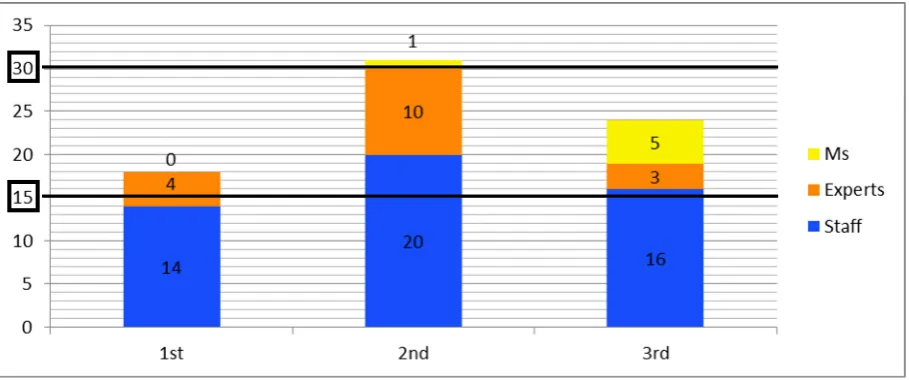
As outcome of the project a training course was developed on ‘Steering an Expert Knowledge Elicitation’. The course covered two working days and was conducted three times during the year 2015. The three courses had 73 participants in total, whereof 17 EFSA experts, 50 EFSA Staff and 6 Network members.
This report contains a summary of the project, a technical description of the training, the final curriculum, the training materials, results from evaluation of the course by the participants, and recommendations for future training on this subject.
©Fera Science Limited, 2015
KEY WORDS
Expert knowledge elicitation, Probability judgements, Uncertainty, Parameters, Risk assessment DISCLAIMER
EFSA supporting publication 2016:EN-1009
The present document has been produced and adopted by the bodies identified above as author(s). This task has been carried out exclusively by the author(s) in the context of a contract between the European Food Safety Authority and the author(s), awarded following a tender procedure. The present document is published complying with the transparency principle to which the Authority is subject. It may not be considered as an output adopted by the Authority. The European Food Safety Authority reserves its rights, view and position as regards the issues addressed and the conclusions reached in the present document, without prejudice to the rights of the authors.
2
The overall objective of this project was to organize and deliver high quality training courses to meet the needs identified by EFSA to implement Expert Knowledge Elicitation (EKE) approach for quantifying uncertainty in food safety risk assessment.
As outcome of the project a training course was developed on ‘Steering an Expert Knowledge Elicitation’. The course covered two working days and was conducted three times during the year 2015. The three courses had 73 participants in total, whereof 17 EFSA experts, 50 EFSA Staff and 6 Network members.
EFSA supporting publication 2016:EN-1009
The present document has been produced and adopted by the bodies identified above as author(s). This task has been carried out exclusively by the author(s) in the context of a contract between the European Food Safety Authority and the author(s), awarded following a tender procedure. The present document is published complying with the transparency principle to which the Authority is subject. It may not be considered as an output adopted by the Authority. The European Food Safety Authority reserves its rights, view and position as regards the issues addressed and the conclusions reached in the present document, without prejudice to the rights of the authors.
3
Introduction and Objectives ... 5
Objective ... 5
Intended learning outcome ... 5
EFSA and other guidance documents and opinions ... 6
Materials and Methods ... 6
Summary of project ... 6
Training methodology ... 6
Technical description of training... 7
Final curriculum ... 7
Course tutors ... 9
Training materials ... 9
Course attendance certificates ... 9
Results ... 10
Course participation ... 10
Overall evaluation ... 10
Conclusions and Recommendations... 11
References ... 11
Appendices ... 12
Appendix A. List of project partners and subcontractors ... 12
Appendix B. Final version of training materials... 13
EFSA supporting publication 2016:EN-1009
The present document has been produced and adopted by the bodies identified above as author(s). This task has been carried out exclusively by the author(s) in the context of a contract between the European Food Safety Authority and the author(s), awarded following a tender procedure. The present document is published complying with the transparency principle to which the Authority is subject. It may not be considered as an output adopted by the Authority. The European Food Safety Authority reserves its rights, view and position as regards the issues addressed and the conclusions reached in the present document, without prejudice to the rights of the authors.
4
Guidelines on systematic review methodology. In result Guidelines for expert knowledge elicitation in food and feed safety risk assessment were produced, tested in case studies by EFSA, and discussed via public consultation and a workshop.
In June 2014 the Guidance was published. According to the mandate one task of the Guidance was to give practical advice on how to conduct an expert knowledge elicitation in the context of EFSA‘s risk assessments. The working group considered this by incorporating three concrete protocols into the Guidance. Nevertheless the working group noticed also that a written Guidance alone is not sufficient to put a new methodology into the practice of an institution. The procurements resulting from the present projects should therefore support EFSA in the implementation of the new Guidance by the development of curricula on “Steering an Expert Knowledge Elicitation (EKE)”.
It is intended for scientists closely working for EFSA, which shall be realized in a series of in-house trainings.
This contract was awarded by EFSA to:
Contractor: Food and Environment Research Agency (FERA, now Fera Science Limited) with partners Professor A O’Hagan Ltd., University of Strathclyde and Dr. Fergus Mark Innes Bolger (private person).
EFSA supporting publication 2016:EN-1009
The present document has been produced and adopted by the bodies identified above as author(s). This task has been carried out exclusively by the author(s) in the context of a contract between the European Food Safety Authority and the author(s), awarded following a tender procedure. The present document is published complying with the transparency principle to which the Authority is subject. It may not be considered as an output adopted by the Authority. The European Food Safety Authority reserves its rights, view and position as regards the issues addressed and the conclusions reached in the present document, without prejudice to the rights of the authors.
5
This project is one of two commissioned by EFSA to develop training for EKE: a web-based training in making probability judgements and (this project) face-to-face training courses in steering an EKE. Objective
The objective of this project was to develop and conduct three in-house training courses on “Steering an Expert Knowledge Elicitation”, especially for experts from the EFSA Scientific Committee, EFSA panels and their Working Groups, as well as EFSA scientific staff.
The purpose of the training courses is:
• to enable the understanding and practical implementation of Expert Knowledge Elicitation amongst Panel/Scientific Committee members, EFSA scientific staff and MS, and
• to strengthen the dissemination of guidance on expert knowledge elicitation amongst Panel/Scientific Committee members and EFSA scientific staff, and promote and facilitate its uptake.
The course is intended primarily for EFSA staff and experts who will be involved in steering EKE studies, i.e. as a member of the ‘Steering Group’ or ‘Elicitation Group’.
Intended learning outcome
EFSA’s specification for the project required that, on completing the course, participants shall be able to:
• Explain probabilistic expert judgements
• Recall the characteristics of Expert Knowledge Elicitation (EKE)
• Identify tasks in risk assessment applicable for EKE, e.g. identify priorities for EKE • Reason the use of EKE in risk assessment
• Frame a problem for EKE
• Identify, select, and motivate experts for an elicitation • Discuss and select the appropriate elicitation method
• Define the elicitation protocol, incl. realistic resources, adaptations and selection of elicitors • Produce background information for an elicitation
• Decide on training needs for the experts
• Recall typical protocols using different elicitation methods (evt. software),including the Cooke method, the Delphi method and the Sheffield method
• Document and interpret results; discuss and handle risks of elicitations • Produce a complete documentation of an EKE
EFSA supporting publication 2016:EN-1009
The present document has been produced and adopted by the bodies identified above as author(s). This task has been carried out exclusively by the author(s) in the context of a contract between the European Food Safety Authority and the author(s), awarded following a tender procedure. The present document is published complying with the transparency principle to which the Authority is subject. It may not be considered as an output adopted by the Authority. The European Food Safety Authority reserves its rights, view and position as regards the issues addressed and the conclusions reached in the present document, without prejudice to the rights of the authors.
6
sessions:
• Chemical risk assessment: bisphenol A (BPA),
http://www.efsa.europa.eu/en/efsajournal/pub/3978.htm
• Biohazards: Ebola virus in bushmeat,http://www.efsa.europa.eu/en/efsajournal/doc/3884.pdf
• Nutrition: Dietary Reference Values for cobalamin (vitamin B12),
http://www.efsa.europa.eu/en/efsajournal/pub/4150.htm
• Plant health: citrus black spot disease,
http://www.efsa.europa.eu/en/efsajournal/pub/3557.htm
• Environmental risk assessment: Exposure of protected species of Lepidoptera to pollen from genetically modified Bt-maize,http://www.efsa.europa.eu/en/efsajournal/pub/4127.htm
• Animal health and welfare: Rift Valley Fever,
http://www.efsa.europa.eu/en/efsajournal/doc/3180.pdf
References to additional documents used in the course are listed in the final slide of each lecture (see Training Material, below).
MATERIALS ANDMETHODS
Summary of project
The project started in December 2014 and ended in December 2015. It was undertaken by a consortium of 4 partners (Fera Science Limited, Professor A O’Hagan Ltd., University of Strathclyde, Dr Fergus Bolger) supported by 7 subcontractors (see Appendix A for a full list of partners and subcontractors and their roles in the project). All contributed to the development of the training materials. Three of the partners led the delivery of the training courses, with one of the subcontractors (Warwick University) providing backup in case of illness or non-availability. The other six subcontractors were experts from different areas of EFSA’s work, who contributed to developing the case study materials for the training. All partners and subcontractors attended a rehearsal of the course in May 2015, providing feedback to improve the course design and materials.
The three courses were held in June, August and September of 2015. The course design and materials were further improved after each course, based on detailed feedback from the course participants and from EFSA staff overseeing the project. The final version of the course materials is provided in Appendix B to this report.
Training methodology
EFSA supporting publication 2016:EN-1009
The present document has been produced and adopted by the bodies identified above as author(s). This task has been carried out exclusively by the author(s) in the context of a contract between the European Food Safety Authority and the author(s), awarded following a tender procedure. The present document is published complying with the transparency principle to which the Authority is subject. It may not be considered as an output adopted by the Authority. The European Food Safety Authority reserves its rights, view and position as regards the issues addressed and the conclusions reached in the present document, without prejudice to the rights of the authors.
7
following section.
Participants were asked to make the following preparations before attending the course:
• Identify which of the case studies tailor-made by the Consortium (chemical risk assessment, biohazards, environmental risk assessment, human nutrition, animal health and welfare assessment, plant health assessment) is most relevant to their own area of EFSA work and read a short briefing document on it, to be provided by the course organisers in advance. • Bring an example from their own area of EFSA to the course: preferably a risk assessment
they had recently completed, or one that was currently in progress.
• Make arrangements to be available for the entire duration of the course (e.g. arrange childcare, avoid other commitments).
At the start of the course, participants were provided with a complete set of printed course materials including the course timetable, handouts of all presentations for lectures and practicals, and templates, a spreadsheet and background information needed for the practical exercises and case studies. All the course materials were also made available to participants electronically, and the EFSA EKE Guidance is publicly available on EFSA’s website.
Final curriculum
The final version of the curriculum, including improvements based on feedback from the three courses, is shown below.
SESSION I. AFTERNOON OF DAY 1.
PART 1. Problem definition: role of the Working Group
13:30 WELCOME. Course objectives and agenda
13:40 LECTURE 1. Introduction – reasons and roles for the use of EKE in EFSA risk assessments
14:05 PRACTICAL 1. Examples of expert judgement in EFSA’s work
14:35 LECTURE 2. Key principles for EKE
14:55 PRACTICAL 2 - plenary. Discussion of key principles 15:10 LECTURE 3. Probabilistic expert judgements
15:35 PRACTICAL 3. Probabilistic expert judgements - work individually
15:55 Break
EFSA supporting publication 2016:EN-1009
The present document has been produced and adopted by the bodies identified above as author(s). This task has been carried out exclusively by the author(s) in the context of a contract between the European Food Safety Authority and the author(s), awarded following a tender procedure. The present document is published complying with the transparency principle to which the Authority is subject. It may not be considered as an output adopted by the Authority. The European Food Safety Authority reserves its rights, view and position as regards the issues addressed and the conclusions reached in the present document, without prejudice to the rights of the authors.
8
HOMEWORK– consider how what you've learned on day 1 would apply to an example assessment from your own area of work.
SESSION II. AFTERNOON OF DAY 1.
PART 2. The pre-elicitation phase: role of the Steering Group
09:00 LECTURE 5. Framing parameters for EKE
09:30 PRACTICAL 5 - breakout groups. Framing problems for EKE
09:55 PLENARY DISCUSSION - report back from breakout groups
10:15 LECTURE 6. Identifying, selecting, motivating and training experts for an elicitation
10:45 Break
11:15 PRACTICAL 6 - breakout groups. Identifying, selecting, motivating and training experts for an elicitation
11:40 PLENARY DISCUSSION - report back from breakout groups
12:00 LECTURE 7. The evidence dossier
12:15 LECTURE 8. Sheffield Method
13:00 Lunch
SESSION III. AFTERNOON OF DAY 2.
PART 3. The elicitation phase: role of the Elicitation Group
14:00 PRACTICAL 7 - breakout groups. Key aspects of steering the Sheffield method
14:30 LECTURE 9. Delphi Method
15:05 PRACTICAL 8 - breakout groups. Key aspects of steering the Delphi method
15:35 Break
16:05 LECTURE 10. Cooke Method
16:50 PRACTICAL 9 - breakout groups. Key aspects of steering the Cooke method
EFSA supporting publication 2016:EN-1009
The present document has been produced and adopted by the bodies identified above as author(s). This task has been carried out exclusively by the author(s) in the context of a contract between the European Food Safety Authority and the author(s), awarded following a tender procedure. The present document is published complying with the transparency principle to which the Authority is subject. It may not be considered as an output adopted by the Authority. The European Food Safety Authority reserves its rights, view and position as regards the issues addressed and the conclusions reached in the present document, without prejudice to the rights of the authors.
9
09:00 LECTURE 11. Selecting the appropriate elicitation method
09:25 PRACTICAL 10 - breakout groups. Selecting the appropriate elicitation method
09:55 PLENARY DISCUSSION - report back from breakout groups
10:25 Break
PART 4. The post-elicitation phase
10:55 LECTURE 12. Documentation: repeatability, transparency and confidentiality
11:10 LECTURE 13. Advanced topics in EKE
11:35 LECTURE 14. Steering the elicitation process: review of main points
11:55 PRACTICAL 11 - work individually. Planning EKE for examples from each
participant’s own area of work
12:35 PLENARY DISCUSSION - opportunities and challenges for uptake in participants' work areas
12:55 COURSE EVALUATION QUESTIONNAIRE.
13:00 COURSE ENDS
Course tutors
The course tutors are shown Appendix A. Training materials
Specific training materials were provided at each course. The training materials included the Course programme, Hand-outs of PowerPoint presentations and Materials for practical exercises. The training material was provided both on paper and electronically by email. The final version of the training materials is provided in Appendix B.
Course attendance certificates
EFSA supporting publication 2016:EN-1009
The present document has been produced and adopted by the bodies identified above as author(s). This task has been carried out exclusively by the author(s) in the context of a contract between the European Food Safety Authority and the author(s), awarded following a tender procedure. The present document is published complying with the transparency principle to which the Authority is subject. It may not be considered as an output adopted by the Authority. The European Food Safety Authority reserves its rights, view and position as regards the issues addressed and the conclusions reached in the present document, without prejudice to the rights of the authors.
10
[image:10.595.72.527.177.367.2]Staff and 6 EFSA Network members (see Figure 1).
Figure 1. Breakdown of participants by course (Ms = EFSA Network members).
Overall evaluation
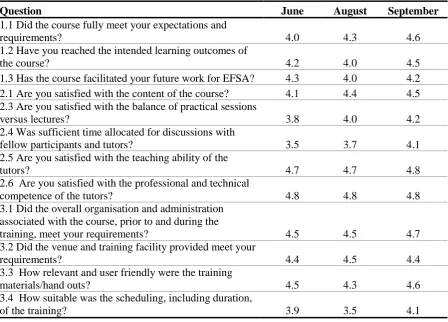
Participants were asked by the trainers to complete a detailed questionnaire and leave it behind at the end of the course. This feedback included scores on different aspects of the training, which are summarised below in Table 1. Feedback was optional, and anonymous unless the participant wished to identify themselves in their comments.
The questionnaire also invited participants to offer text comments and/or suggestions for improving the course, which were reviewed in detail by the tutors immediately after each course. Additional feedback was obtained from participants via EFSA’s training system and from EFSA staff overseeing the project.
EFSA supporting publication 2016:EN-1009
The present document has been produced and adopted by the bodies identified above as author(s). This task has been carried out exclusively by the author(s) in the context of a contract between the European Food Safety Authority and the author(s), awarded following a tender procedure. The present document is published complying with the transparency principle to which the Authority is subject. It may not be considered as an output adopted by the Authority. The European Food Safety Authority reserves its rights, view and position as regards the issues addressed and the conclusions reached in the present document, without prejudice to the rights of the authors.
11
1.1 Did the course fully meet your expectations and
requirements? 4.0 4.3 4.6
1.2 Have you reached the intended learning outcomes of
the course? 4.2 4.0 4.5
1.3 Has the course facilitated your future work for EFSA? 4.3 4.0 4.2
2.1 Are you satisfied with the content of the course? 4.1 4.4 4.5
2.3 Are you satisfied with the balance of practical sessions
versus lectures? 3.8 4.0 4.2
2.4 Was sufficient time allocated for discussions with
fellow participants and tutors? 3.5 3.7 4.1
2.5 Are you satisfied with the teaching ability of the
tutors? 4.7 4.7 4.8
2.6 Are you satisfied with the professional and technical
competence of the tutors? 4.8 4.8 4.8
3.1 Did the overall organisation and administration associated with the course, prior to and during the
training, meet your requirements? 4.5 4.5 4.7
3.2 Did the venue and training facility provided meet your
requirements? 4.4 4.5 4.4
3.3 How relevant and user friendly were the training
materials/hand outs? 4.5 4.3 4.6
3.4 How suitable was the scheduling, including duration,
of the training? 3.9 3.5 4.1
CONCLUSIONS ANDRECOMMENDATIONS
Covering all the topics requested by EFSA within a 2 day course required a full agenda. Several participants commented on this and suggested increasing the proportion of time allowed for discussion. Substantial adjustments were made to moderate the intensity of the course and achieve a good balance between lectures, practicals and discussion. It is understood that if future courses are given on this subject, participants may be required to complete an e-learning module on probability judgements before attending the training. If so, consideration could be given to replacing lectures 2 and 3 of the course with a single shorter lecture, designed to refresh participants’ memory of the material from the e-learning. It would be difficult to make further decreases in course time without removing technical content that would be needed by participants when steering an EKE study.
REFERENCES
[image:11.595.76.525.133.455.2]EFSA supporting publication 2016:EN-1009
The present document has been produced and adopted by the bodies identified above as author(s). This task has been carried out exclusively by the author(s) in the context of a contract between the European Food Safety Authority and the author(s), awarded following a tender procedure. The present document is published complying with the transparency principle to which the Authority is subject. It may not be considered as an output adopted by the Authority. The European Food Safety Authority reserves its rights, view and position as regards the issues addressed and the conclusions reached in the present document, without prejudice to the rights of the authors.
12
Fera Science Ltd. (formerly the Food and Environment
Research Agency)
Lead Partner Dr Andy Hart – course developer, tutor and project manager
Imogen Foster/Paul Lansell – co-project managers
Professor A O’Hagan Ltd. Partner Professor Anthony O’Hagan – course developer and tutor
University of Strathclyde Partner Professor John Quigley – course developer and tutor
Fergus Bolger (private person) Partner Dr Fergus Bolger – course developer and tutor Warwick University Subcontractor Professor Simon French – course developer and
backup tutor (substituted for Professor Quigley in the August course)
Norwegian Institute of Public Health
Subcontractor Dr Trine Husoy – case study expert, chemical risk assessment
University of Florida Subcontractor Professor Dr Ir Arie H Havelaar – case study expert, biohazards
Alterra Subcontractor Dr Theo Brock – case study expert,
environmental risk assessment
RIVM Subcontractor Professor Dr Hans Verhagen – case study
expert, human nutrition Dr Hans-Herman Thulke
(private person)
Subcontractor Dr Hans-Herman Thulke – case study expert, animal health and welfare
EFSA supporting publication 2016:EN-1009
The present document has been produced and adopted by the bodies identified above as author(s). This task has been carried out exclusively by the author(s) in the context of a contract between the European Food Safety Authority and the author(s), awarded following a tender procedure. The present document is published complying with the transparency principle to which the Authority is subject. It may not be considered as an output adopted by the Authority. The European Food Safety Authority reserves its rights, view and position as regards the issues addressed and the conclusions reached in the present document, without prejudice to the rights of the authors.
1
Thank you very much for registering for the EFSA training course on Steering an Expert Knowledge Elicitation (EKE), which will be held on [INSERT DATES HERE].
The course times are:
1330-1800 on [INSERT DATE HERE] (PLEASE NOTE START TIME IS 1330)
0900-1300 and 1400-1800 on [INSERT DATE HERE]
0900-1300 on [INSERT DATE HERE]
Please arrive in good time as we have a lot to get through and will start each session promptly. Also, please make any necessary arrangements to enable you to stay until the end of the sessions at 1800 on Monday and Tuesday.
The agenda for the course is attached. We will provide a printed booklet of all the lectures and practicals at the start of the course.
IMPORTANT: Before the course, please DECIDE which of the risk assessment examples you would like to work with during the practical sessions, PRINT a copy of the handout for that example, READ it before the course and BRING it with you to the course. There are 6 examples in all, and the handouts are in the zip file attached to this email. Here’s a list of the practical examples:
• Chemical risk – dermal exposure to bisphenol A • Nutrition – Vitamin B12 requirement
• Environmental risk – GM pollen transport • Plant health – Citrus Black Spot entry pathway • Animal Health – Rift Valley Fever
• Biohazard – Ebola in bushmeat
The handouts include links to the original EFSA assessments for these examples, but it is not necessary for you to look at those.
ALSO – please identify another example of a risk assessment in your own area of work, which you are personally familiar with. Ideally this would be a current assessment, or one you are about to start, but previous assessments are also okay. If you are new to EFSA, ask a colleague to suggest a relevant example. It is important that your example includes at least some quantitative aspects (e.g. an exposure calculation, a no-effect level, etc.) Please bring to the course (electronically or on paper) any documentation you need to remind yourself of the details of your example.
2
Your tutors for this course will be [INSERT NAMES AND AFFILIATIONS HERE].
We look forward to meeting you at the start of the course – please arrive promptly! If anyone has any queries before then, please email me.
Best wishes
[INSERT NAME AND CONTACT DETAILS HERE]
ATTACHMENTS:
[ATTACH COURSE AGENDA HERE]
1
b/3978.htm
•
Short title
: Bisphenol A
The following slides contain a simplified assessment for use only as training example for the EFSA Training Course on Steering an Expert Knowledge Elicitation
Description of Risk Assessment
•
EFSA was asked to:
– evaluate the toxicity of BPA for humans, including specific (vulnerable) groups of the population
– carry out an exposure assessment from dietary sources and non-dietary sources, and characterise the human health risks of BPA taking into account specific groups of the population
•
One of the non-dietary sources was exposure to BPA
in thermal paper used for receipts.
•
In the toxicity assessment, available studies on
different types of effects were considered, including
effects on the mammary gland.
•
Information on toxicokinetics was used to convert
2 Number of
receipts (nreceipts)
Number of thermal paper receipts a person handles each day
receipts/day
Skin deposit (dskin)
The amount of BPA that remains on the skin after touching thermal paper
μg BPA per
finger Skin
penetration (pskin)
The percentage of BPA on the skin that is absorbed and enters the body and the bloodstream %
Model
•
We consider the
amount of BPA absorbed into the
body
from dermal exposure to thermal paper
receipts (
E
dermal .tp), in μg BPA/kg bw/day.
•
Model:
•
bw
is set to the EFSA default for adults (70kg)
•
100 is required because
p
skinis a percentage
•
We need to prioritise EKE for
d
skin,
n
fingers,
n
receipts,
p
skin3
•
As most people have 10 fingers (including thumbs), the
actual number of fingers that handle individual receipts
can be between 2 and 10, but the number required here is
the average
•
Thermal paper has BPA only on the front (printed) side
•
Based on an experiment where 2 persons with inked
fingers handled 4 receipts and the area of ink on the
receipts was measured, a Danish study states that
‘typically approx. 10 cm
2of the finger pads (on 8 fingers)
will be in contact with receipt when it is checked and
folded with the front side turning out’
Number of receipts
• There was only one study, from Denmark in 2011, providing data relevant to this
parameter.
• This study estimated the number of receipts used in Denmark by two methods:
– 1220 million thermal paper receipts/year, based on numbers of credit card transactions reported by a large Danish supermarket, the total number of payment cards in Denmark, and estimates of the proportion of receipts using thermal paper – 1355-1627 million BPA receipts/year, based on a supplier’s estimate of total tonnage
of thermal paper delivered, the average weight of 47 sample cash register receipts, and assuming 75% by weight contains BPA.
• The Danish population above age 12 was stated as 4.7 million
• It was roughly assumed that consumers who carefully check the receipts and
keep them, on average handles each one 2.5 times
• BPA is also used in thermal paper used for other purposes, e.g. library receipts,
queue tickets, labels, parking tickets, boarding passes, etc.
• Based on the above, the Danish study estimated that:
– The number of BPA-containing receipts per consumer per is 0.7 per day – The number handled per day is 1.8 per day (0.7x2.5)
– Women with children at an age where they do not shop themselves handle about double this number, i.e. 3.6 per day
4 ‘Standard’ conditions: dry, slightly greasy
fingers, firm pressure, 5 seconds
Paper source BPA in
paper (g/kg) finger, μg (n)Mean per
Lab recorder 1 11 0.13 (4) Lab recorder 2 16 0.6 (4) Canteen 17 3.3 (2) Shop 4 17 0.5 (2) Shop 7 15 1.1 (2)
Effect of finger condition*
Finger
condition finger, μg (n)Mean per
‘Standard’ 0.6 (6) Dry, clean 0.4 (4) Humid 8.8 (2) Wet 20.5 (2) Oily 5.8 (4)
Effect of holding behaviour*
Behaviour Mean per finger,
μg (n)
Holding 1 sec 0.2 (2) Holding 5 sec 0.6 (4) Low pressure 5s 0.2 (2) Wipe 5s 0.4 (2) Holding 60 sec 0.6 (2) 3 new contacts 0.5 (2) 10 new contacts 0.5 (2) *Paper from Recorder 2
and Shop 4
*Paper from Recorder 2
Skin penetration
• Estimates vary considerably between studies (summarised from EFSA opinion) • It is assumed that the rate constantkfollows first-order kinetics, but there is
no data on this
• Skin in the hands is thicker than the skin used in the experiments
Study 1 Study 2 Study 4 Study 5
Skin type pig skin from the
flanks human skin samplesfrom breast surgery human skin explantsfrom abdominal region
dorsal part of the upper leg from 2 human cadavers
Number of skin
sections 6 (?) 11 3 7
Skin viability non-viable viable skin non-viable
Skin Section thickness 800–1000 µm 500 µm 200 µm
Applied surface
density 259 µg/cm
2 2.75 µg/cm2 1.82 µg/cm2
Temperature 32.0 ± 0.1 °C ≈32 °C 37 °C 30–32 °C
Method static Franz diffusion
cell static Franz diffusioncell OECD TG 428
organ culture in Transwell cell culture
inserts
flow-through Franz cell OECD TG 428
Duration of
incubation 24 h 48 h 72 h 24 h
Recovery 84.3 ± 9.0 % at 10 h 82.1 % 92.6 ± 5.8 % 101.5 ± 1.6 %
Skin deposition 24.6 ± 5.8 % 41.5 ± 10.8 % 35.5 ± 6.6 %
Percutaneous penetration (mean ± SD)
4.1 % at 24 h 13.0 ± 5.4 % 45.6 ± 6.2 % at 72 h (15.2% when down-scaled to 24 h)
5 Number of
receipts (nreceipts)
receipts/day
Skin deposit
(dskin) μg BPA per finger
Skin penetration (pskin)
%
m: approximate central estimate s: approximate standard deviation
1
b/4150.htm
•
Short title:
Vitamin B12
The following slides contain a simplified assessment for use only as training example for the EFSA Training Course on Steering an Expert Knowledge Elicitation
Description of Risk Assessment
• EFSA’s NDA Panel provides advice on dietary reference values (DRVs) fornutrients, micronutrients and other essential substances • Vitamin B12 is the generic descriptor for compounds exhibiting
qualitatively the biological activity of cobalamin
• Cobalamin/vitamin B12 deficiency can lead to various health problems including megaloblastic anaemia and neurological dysfunction.
• The Panel considered the biomarkers serum cobalamin, holotranscobalamin, methylmalonic acid plus plasma total homocysteine as most suitable to derive DRVs for cobalamin. • Due to limited data an Average Requirement (AR) and Population
Reference Intake (PRI, intake meeting the requirements of 97.5% of individuals in the population) cannot be determined.
2 Adult body
weight bwadult Body weight of adults kg Scaling factor SF Exponent for estimating the ratio of
metabolic requirements from the ratio of body weights, for mature organisms.
dimensionless
Growth factor GF Additional daily intake of cobalamin required by an EU infant aged 7-11 months compared to an EU adult, as a proportion of the amount that would be required for the infant based on scaling with body weight alone.
dimensionless
Lot 2 Model
•
SF = allometric scaling factor
•
GF = growth factor
•
For cobalamin, AI
infantis estimated from AI
adultby
allometric scaling, on the assumption that cobalamin
requirement is related to metabolically active body mass.
•
When scaling from adult to infant, a growth factor GF is
included to account for the nutrient required to be
incorporated into newly-formed tissue.
3 greater is associated with biomarker levels indicative of
adequate cobalamin status.
• Dietary intake of cobalamin was estimated using consumption
data for EU countries from the EFSA Comprehensive Database. – Estimated averages (μg/day) for males aged 18-65ywere 5.3 (UK),
5.8 (NL), 6.2 (Italy), 6.4 (Ireland), 6.8 (France & Finland), 8.2 (Sweden).
– Estimated averages (μg/day) for females aged 18-65ywere 4.3 (UK), 4.4 (NL & Ireland), 4.9 (Finland), 5.1 (Italy), 5.2 (France & Latvia), 6.1 (Sweden).
– Averages foradults over 65yranged from 4.2 (women, Italy) to 8.6 (men, Sweden) (μg/day)
Infant body weight
•
The Panel based its assessment on weight-for-age
values from WHO.
•
WHO used a combination of longitudinal and
cross-sectional data on 8440 infants and children in Brazil,
Norway, Oman, USA and ‘affluent neighbourhoods’ in
Ghana and India.
Age (months) Median boys, kg Median girls, kg
7 8.3 7.6
8 8.6 7.9
9 8.9 8.2
10 9.2 8.5
4
10Data from Bulgaria, Czech Republic, Finland, France, Germany, Ireland, Luxembourg, Poland, Portugal, Slovakia, Spain, The Netherlands, UK
Scaling factor
• As the requirement for cobalamin is associated with
metabolic rate, allometric scaling is performed.
• Kleiber (1932,1947) predicted that requirement for nutrients
should be proportional to the metabolic body weight for mature organisms at rest in indifferent environmental temperatures.
• If the ratio of weights is R then the average ratio of metabolic
requirements is R raised to the power of the allometric scaling factor.
• This rule has never directly been proven with respect to
nutrient requirements and discussion whether the scaling factor is nearer 0.67 or nearer 0.75 has not yet been conclusively resolved. Scaling as the 0.75 power of body mass has been widely accepted in nutritional science.
• If requirement for the nutrient is not associated with
5 based on the proportional increase in protein requirements for
growth. These can be applied to either isometric or allometric scaling.
• If the requirement based on scaling with body weight is D then
the average additional requirement for an infant is D times the growth factor.
• The Panel’s assessment for the growth factor was based on the
following estimates from WHO/FAO/UNU, which apply to both boys and girls:
Age (years) 0.5 1 2 3
Calculated growth factor 0.70 0.44 0.20 0.11
Your estimates
Parameter name Symbol m s Units
Adult Adequate
Intake AIadult μg/day
Infant body weight
bwinfant kg
Adult body
weight bwadult kg
Scaling factor SF dimensionless
Growth factor GF dimensionless
m: approximate central estimate s: approximate standard deviation
1
•
Link:
http://www.efsa.europa.eu/en/efsajournal/pu
b/4127.htm
•
Short title
: GM maize
The following slides contain a simplified assessment for use only as training example for the EFSA Training Course on Steering an Expert Knowledge Elicitation
Description of Risk Assessment (GM maize)
•
Bt-maize, expressing insecticidal protein of
Bacillus
thuringiensis,
is a genetically modified crop grown
commercially in the EU.
•
Pollen of Bt-maize may be transported to off-field habitats
in which protected Lepidoptera (e.g. butterflies) occur.
•
EFSA has used mathematical modelling to assess the risk
associated with the ingestion of Bt-maize pollen by
non-target larvae of Lepidoptera.
•
EFSA recently updated its assessment to take account of
new data on dispersal of maize pollen over long distances.
•
At the same time, EFSA identified additional factors that
2 horizontal surface in the same conditions
Wind and rain f3 Effect of wind and rain on pollen concentrations, expressed as theratioof average pollen concentration encountered by non-target Lepidoptera of conservation concern when foragingtothe concentration originally deposited
dimensionless
Degradation f4 Degradation of Bt-protein in pollen, expressed as theratioof average Bt concentration in pollen encountered by non-target Lepidoptera of conservation concern when foragingtothe average concentration of Bt in the pollen when originally deposited
dimensionless
Model
• F = multiplicative effect of modifying factors on exposure of
larvae of non-target Lepidoptera of conservation concern to Bt maize pollen, in protected habitats at specified distance from the nearest Bt maize field.
• The EFSA 2015 opinion models the effect of eight modifying
factors, but for this exercise we focus on four factors (f1 to f4), which are assumed to act independently.
• Exposure varies spatially, temporally and between larvae but it
is assumed that the factors f1 to f4 operate equally on all exposures.
• The factors are applied to conservative estimates of exposure
that are expected to be over-estimates. Therefore the factors are expected to take values less than one, although the possibility of increases in exposure (factors >1) should be considered if appropriate.
3
Bt-maize. To allow for this it is desired to estimate what
proportion of maize fields will be Bt-maize.
•
One study reports that the proportion of Bt-maize pollen
collected by pollen samplers ranges between 7 and 44% at
distances between 5 m and 120 m from a single Bt-maize
field.
•
There is a requirement that a minimum of 20% of the
maize area should be cropped with non-Bt-maize as refuge
for insect resistance management.
Vegetation structure
• Exposure assessments estimate pollen deposition assuming
a one-sided horizontal surface.
• However, vegetation has a three-dimensional structure. To
allow for this, it is proposed to apply a factor extrapolating from deposition on a 1-sided surface to deposition on leaf surfaces in three dimensional vegetation.
• Vegetation structure can be described by the leaf area
index (LAI), defined as the one-sided green leaf area per unit ground surface area.
• The LAI varies between vegetation types. In the literature,
4
exposure of larvae of those species that feed on lower
leaves.
•
In most cases, larvae do not prefer to feed on leaf veins
and leaf axils; this could lead to a lower exposure of
larvae of those species.
•
Existing exposure estimates ignore these effects of
wind and rain. It is proposed to allow for them by
applying a multiplicative factor that modifies exposure
upwards or downwards to an appropriate degree.
Degradation
• Data on degradation of Bt-protein in pollen is scarce. • One study examined effect of ultra-violet light on
degradation of Bt-protein in maize pollen. There was no significant difference between concentrations in pollen exposed to UV light and control (unexposed) pollen. However, concentrations in both UV-treated and control pollen reduced by about 50% during the 240 hours of the experiment (statistically significant, P = 0.001). Flaws in this study include limited data on expression of Bt-protein in the pollen compared with other studies.
• In a different study, it was observed that Bt-proteins in
5 Vegetation
structure f2 dimensionless
Wind and rain f3 dimensionless
Degradation f4 dimensionless
m: approximate central estimate s: approximate standard deviation
1
http://www.efsa.europa.eu/en/efsajournal/pu
b/3557.htm
•
Short title
: Citrus black spot disease
The following slides contain a simplified assessment for use only as training example for the EFSA Training Course on Steering an Expert Knowledge Elicitation
Description of Risk Assessment
• The European Commission asked EFSA in 2013 to make a risk assessment of the fungusPhyllosticta citricarpa, causal agent of a plant disease called “citrus black spot” (CBS).Phyllosticta citricarpa can be carried on living plants and on citrus fruit, either in trade or with passenger traffic.
• EFSA was asked to identify risk reduction options and to evaluate their effectiveness in reducing the risk posed by CBS to European citrus.
• EFSA was also asked to carry out an evaluation of the effectiveness of the present EU requirements in reducing the risk of introduction ofP. citricarpainto the EU.
2 Proportion
infected Pinfected Proportion of fruits which are infected dimensionless Proportion at
packing houses Ppacking Proportion of fruits sent to packinghouses dimensionless Proportion
exposed Pexposed Proportion of fruits exposed at packinghouses dimensionless Transfer to citrus Ptransfer Proportion of infected fruits with spores
transferring to citrus
dimensionless
Model
• I is the number of infected fruits exposed at Spanish packing houses from whichPhyllosticta citricarpaspores reach citrus trees
• EFSA based its assessment in part on a quantitative model of the entry pathway into Spain. For this exercise, we use a simplified version of the model, in which regional distribution within Spain is ignored.
• Transfer to citrus was omitted in the EFSA model but is included here.
• The model considers only fruit originating incountries where P. citricarpa was present in 2015, defined as Argentina, Australia, Bhutan, Brazil, China, Cuba, Ghana, Indonesia, Kenya, Mozambique, Philippines, South Africa Taiwan, Uganda, the United States,
Uruguay, Vanuatu, Zambia and Zimbabwe
3
142000 tonnes with a range of 111000 to 192000 tonnes.
•
Data for the last three years were all close to the
minimum as a result of the economic recession, but the
fact that they were close together may suggest that
further reduction is unlikely and that imports may return
to normal variation as the economy recovers.
•
Comext data exclude intra-EU trade, which is described as
‘considerable’. Some EU Member States, particularly the
Netherlands and the UK, import citrus fruit from
CBS-affected third countries and then re-export the fruit
within the EU.
Weight per fruit
•
Data on unit weights of fruit are used when assessing
human exposure to pesticides in food.
•
The EFSA Pesticide Residue Intake Model (PRIMo),
which is used for these assessments, includes the
following:
– Grapefruit 160g – Oranges 160g – Lemons 71.8g – Limes 67g – Mandarins 100g
•
The above values are stated in the model to be average
4
– A meta-analysis of average infection level in trials in affected countries
after the most effective fungicide regimes (2% with 95% CI 0.6 – 7%)
– Inspection in the country of origin reducing infection by a factor of 100 – Inspection at the EU border removing badly infested consignments,
reducing overall infection by a further factor of 20
– An implied assumption that infection level varies considerably between
consignments
• The second line of reasoning gave an estimate of 7.67 per million with a range of 2.19 – 26.9 per million, based on:
– Data on inspections of citrus entering the Netherlands in 2012-2013,
showing 100 interceptions in 36729 lots
– Estimation of the efficiency of the inspection procedure, using a Poisson
approximation and assuming the proportion infected is constant between lots
Proportion at packing houses
•
Fruit is imported mostly by boat, and transported
by road in trucks to packing houses, distribution
centres for retail and food processing industries.
•
Based on a personal communication from a citrus
expert at the Valencian Institute of Agrarian
Research (IVIA), the allocation of citrus between
destinations was estimated as follows:
– Packing houses: 40 % (plausible range 30–50 %) – Retail: 40 % (plausible range 30–50 %)
5 require, during the season and then apply further checks
during the packing process.
• Packing houses produce waste, but they select not specifically
for spots on the peel, such as those produced byP. citricarpa, but for major blemishes and bruises. Data from FAO and WRAP indicate a waste fraction of 3 % in the grading process followed by a further 0.1–0.5 % in the packing process, with the total loss being quoted as up to 4 %.
• The waste from packing houses is usually mixed with rotten
fruit so it cannot be used for juicing. Instead, it is stored in open containers, generally under cover, until full and then spread outdoors in open-air facilities for solar drying.
Transfer to citrus
• All packing houses in Spain are located in the citrus-growing areas because they are associated with local fruit production. Consequently, packing houses are in close proximity to the citrus orchards, with distances between the waste and the nearest citrus trees often in the order of metres.
• Experiments with sweet orange fruit showed that fruit misted to simulate light rainfall continue to exudeP. citricarpapycnidiospores from pycnidia for at least one hour. • In still air conditions, 99.4 % of the splashes produced by single incident rain drop on the
fruit were of less than 2 mm diameter, with an average of 1–21 pycnidiospores. Larger but less frequent splashes of 4–5.5 mm diameter contained an average of 308 pycnidiospores. • In these experiments, the maximum horizontal distance of splash was 70 cm and the
maximum height was 47.4 cm. However, when multiple incident rain drops were combined also in still air, splashes were forced higher than occurred in single-drop experiments to over 60 cm.
• In another experiment combining single incident rain drops and wind, splashes from infected fruit were disseminated up to two metres downwind from the target fruit with a 4 m/s wind speed and up to eight metres at a wind speed of 7 m/s, the highest wind speed evaluated, reaching heights up to 75 cm and even higher as a result of fine droplets becoming aerosolised.
• When the rain is combined with a moderate wind (7 m/s), the pathogen can be dispersed at least eight metres downwind from the infected fruit to heights of at least 75 cm. Such conditions occur about 0.5-1% of time over the year in Spanish regions where packing houses occur.
6 Proportion
infected Pinfected dimensionless
Proportion at
packing houses Ppacking dimensionless
Proportion
exposed Pexposed dimensionless
Transfer to citrus Ptransfer dimensionless
m: approximate central estimate s: approximate standard deviation
1
c/3180.pdf
•
Short title:
Rift Valley Fever
The following slides contain a simplified assessment for use only as training example for the EFSA Training Course on Steering an Expert Knowledge Elicitation
Description of Risk Assessment
• EFSA was asked to deliver a scientific opinion on the risk of
Rift Valley fever (RVF). One of the terms of reference was to assess the risk of introduction of Rift Valley fever virus (RVFV) into the region of concern (RC) through the movements of live animals from countries in East and West Africa where it is endemic. Officially, movements of such animals are banned, and the extent of illegal movements is very uncertain
• The RC was defined as comprising Morocco, Algeria, Tunisia,
Libya, Jordan, Israel, the Palestinian Territories, Lebanon and Syria.
• RVF is a disease of cattle, sheep, goats and camels. The virus is
transmitted by mosquitoes.
• RVF is typically a mild infection of adult animals, the primary
2 Prevalence p Prevalence of Rift Valley Fever Virus in
animals to be transported. dimensionless Transport t Change of infection during transport,
expressed as a ratio. Animals may become non-infectious during transport, but there may also be reinfection.
dimensionless
Entry control e Proportion of infected animals that are
denied entry to the Region of Concern. dimensionless
Lot 2 Model
•
N = v x p x (1 – d) x t x (1 – e)
•
N is the number of animals entering the RC
from endemic countries
•
d (departure control) is the proportion of
animals for export that are denied departure
from the endemic country
–
It is assumed equal to 0, so the model becomes
3 Africa.
• Sudan is considered to be a main producer of livestock and exporter of animals. There are two major trade flows: from Sudan upwards over the Nile into Egypt, and from the Horn of Africa into Yemen and Saudi Arabia.
• Official animal imports from the Horn of Africa into Saudi Arabia are around 6 million ruminants.
• There is a vast demand for sheep around Eid al-Adha, a Muslim feast when it is traditional for a family to slaughter an animal, which may increase the numbers of undocumented animal movements. • Control measures at ports and on the Red Sea are severe.
• From the occurrence of diseases with African origin, such as lumpy skin disease in Israel, undocumented movements into Jordan and Israel must exist, but they are hard to quantify.
Prevalence
• This parameter is the proportion of animals for transport that are infective, averaged over the whole year.
• The proportion of animals in an epidemic area that would be infected at some time during an epidemic is between 10% and 40%, based on data from antibody testing after epidemics.
• Prevalence in animals for export over the whole year will be reduced by the following factors:
– Prevalence is negligible except when an outbreak of RVF occurs.
– The proportion of animals infected in an epidemic that would be infected at
any one time during the infection. This would depend on the length of the epidemic (typically around 12 weeks) and the length of time that an animal is infected (from a few days to two weeks).
– The proportion of traded animals from the East Africa that would be traded
during the epidemic period. In 2014 the Muslim festival Eid al-Adha (when there is increased demand for sheep) was in October, at the end of the rainy season, when both vector population density and age are compatible with the RVF transmission.
– The proportion of animals traded from the East Africa that will be traded
from the epidemic area. For example, a recent large epidemic in West Africa was 20,000km2in Senegal, while the total area of the West Africa source is
4
length would typically be shorter from East Africa than
West Africa.
•
Animals that are infective when loaded for transportation
may no longer be infective on arrival at the RC. The
infective period is thought to be about 30 days.
•
New infections of vectors are possible during the journey
since RVF vectors are important in some places along the
Nile river. However, taking into account the incubation
period for RVFV in mosquitoes, infection from mosquitoes
that were infected by animals on the same truck seems
very unlikely.
Entry controls
•
No official import, so all trade is undocumented import
and thus no import controls applied.
•
The quarantine procedures applied in adjacent
countries to the Region of Concern, such as Egypt or
Saudi Arabia, do not prevent recently infected animals
from entering and spreading the virus further to
mosquitoes or susceptible animals, since only
serological testing (Immunoglobulin G) is carried out in
these quarantines.
•
The great majority of movements of live animals will
5
Entry control e dimensionless
m: approximate central estimate s: approximate standard deviation
1
•
Short title
: Ebola
The following slides contain a simplified assessment for use only as training example for the EFSA Training Course on Steering an Expert Knowledge Elicitation
Risk Assessment Description
• EFSA was asked to review the risk for persons in Europe
linked to transmission of Zaire Ebola virus (ZEBOV) via handling and preparation (both carried out by consumers immediately before consumption) as well as consumption of bushmeat illegally imported from Africa.
• The risk is the result of a combination of several necessary
steps:
– the bushmeat has to be contaminated with ZEBOV at the point of origin;
– the bushmeat has to be (illegally) introduced into the EU; – the imported bushmeat needs to contain viable virus when it
reaches the person;
– the person has to be exposed to the virus;
– the person needs to get infected following exposure.
• The public health consequences of any infection are very
2 Proportion
contaminated p1 Proportion of bushmeat that iscontaminated with ZEBOV proportion of1kg units Processing
effect p2 Effect of processing on viability ofZEBOV virus proportion of1kg units Transport
effect p3 Effect of transport on viability ofZEBOV virus proportion of1kg units
Lot 2 Model
•
This example assesses the amount of contaminated
bushmeat illegally entering the EU
•
Evidence from primate studies indicates that ZEBOV is
highly infective. Consequently the number of
bushmeat portions containing any viable ZEBOV virus
will be a major driver of the potential number of
human infections.
•
Therefore, the model for this example estimates E,
the
number of 1 kg units of bushmeat illegally imported to
the EU during 2015 that contain viable ZEBOV virus
3
kg was bushmeat. The total annual bushmeat inflow for
Switzerland was estimated by modelling as 8.6 tonnes (95
% CI 0.8 to 68.8)
•
A 2010 study found 7% of 134 air passengers arriving at
Paris from sub-Saharan Africa carried bushmeat, and
estimated that 273 tonnes per year are imported annually
on these flights.
•
A 2007 study estimated the total flow of illegal meat (not
just bushmeat) from West Africa to UK as 1213 tonnes per
year (95% CI 399 to 3082). This study included both air
and sea routes.
Proportion contaminated
• Contamination with ZEBOV is more likely in bushmeat from
areas experiencing active virus transmission in wildlife, especially for species susceptible to infection by ZEBOV and for animals found dead rather than hunted.
• A 2012 study detected EBOV in 17/33 apes and 1/22
non-primates found dead during a human Ebola outbreak. Of animals captured alive, 13/1418 bats were positive and 0/3891 other animals.
• The EFSA opinion lists species from which imported
bushmeat has been reported as including apes, antelopes, pangolin, birds, porcupines, other rodents, crocodile and blue duiker
• Six bushmeat samples detected at Vienna airport
4 – Of six bushmeat samples detected at Vienna airport, 1 was
cooked, 2 smoked and 3 dried
– Processing was known for only 2 of the bushmeat items detected in Switzerland: one was fresh, one dried
– Bushmeat detected entering the USA included some fresh items, some raw transported in a cooler, some lightly smoked, some well dried
• There is almost no information on the effect of processing
on ZEBOV. Heat and smoke constituents may lead to inactivation of ZEBOV. The virus has an envelope as outer membrane.
Transport effect
• Survival of ZEBOV in transport will depend on type of product, conditions (vacuum packing, temperature, etc.) and duration of transport
– Some studies suggest most carcasses sold in West African markets are
processed to prolong shelf life
– Of six bushmeat samples detected at Vienna airport, 1 was cooked, 2
smoked and 3 dried
– Processing was known for only 2 of the bushmeat items detected in
Switzerland: one was fresh, one dried
– Bushmeat detected entering the USA included some fresh items, some
raw transported in a cooler, some lightly smoked, some well dried
• ZEBOV will survive better in fresh or frozen meat, less well in dried or smokedmeat
• EFSA opinion notes that some items could contain moist inner tissues, which could favour survival of the virus
• There is no information on survival of ZEBOV in meat or animal
products, but it is expected to be better at low temperature (4⁰C) than
5 Proportion
contaminated p1 proportion of1kg units Processing
effect p2 proportion of1kg units
Transport
effect p3 proportion of1kg units
m: approximate central estimate s: approximate standard deviation
13:40 LECTURE 1. Introduction – reasons and roles for the use of EKE in EFSA risk assessments 14:05 PRACTICAL 1. Examples of expert judgement in EFSA’s work
14:35 LECTURE 2. Key principles for EKE
14:55 PRACTICAL 2 - plenary. Discussion of key principles 15:10 LECTURE 3. Probabilistic expert judgements
15:35 PRACTICAL 3. Probabilistic expert judgements - work individually 15:55 Break
16:25 LECTURE 4. Identifying priority parameters for EKE
17:00 PRACTICAL 4 - breakout groups. Identifying priority parameters for EKE: sensitivity analysis 17:40 PLENARY DISCUSSION Feedback from practical
18:00 SESSION ENDS
SESSION II. 0900 – 1300, DAY 2
09:00 LECTURE 5. Specifying questions for EKE
09:30 PRACTICAL 5 - breakout groups. Specifying questions for EKE 09:55 PLENARY DISCUSSION - report back from breakout groups
10:15 LECTURE 6. Identifying, selecting, motivating and training experts for an elicitation 10:45 Break
11:15 PRACTICAL 6 - breakout groups. Identifying, selecting, motivating and training experts for an elicitation 11:40 PLENARY DISCUSSION - report back from breakout groups
12:00 LECTURE 7. The evidence dossier 12:15 LECTURE 8. Sheffield Method 13:00 Lunch
SESSION III. 1400 – 1800, DAY 2
14:00 PRACTICAL 7 - breakout groups. Key aspects of steering the Sheffield method 14:30 LECTURE 9. Delphi Method
15:05 PRACTICAL 8 - breakout groups. Key aspects of steering the Delphi method 15:35 Break
16:05 LECTURE 10. Cooke Method
16:50 PRACTICAL 9 - breakout groups. Key aspects of steering the Cooke method 17:20 PLENARY DISCUSSION - report back from breakout groups
18:00 SESSION ENDS
SESSION IV. 0900 – 1300, DAY 3
09:00 LECTURE 11. Selecting the appropriate elicitation method
09:25 PRACTICAL 10 - breakout groups. Selecting the appropriate elicitation method 09:55 PLENARY DISCUSSION - report back from breakout groups
10:25 Break
10:55 LECTURE 12. Documentation: repeatability, transparency and confidentiality 11:10 LECTURE 13. Advanced topics in EKE
11:35 LECTURE 14. Steering the elicitation process: review of main points
11:55 PRACTICAL 11 - work individually. Planning EKE for examples from each participant’s own area of work 12:35 PLENARY DISCUSSION - opportunities and challenges for uptake in participants' work areas
12:55 COURSE EVALUATION QUESTIONNAIRE. 13:00 COURSE ENDS
PART 2. The pre-elicitation phase: role of the Steering Group
PART 3. The elicitation phase: role of the Elicitation Group
PART 4. The post-elicitation phase
HOMEWORK – consider how what you've learned on day 1 would apply to an example assessment from your own area of work
FINAL Introduction - 1
Training course on
steering an expert knowledge elicitation
Introduction: Objectives and Agenda
Andy Hart
FINAL OC.EFSA.AMU.2014.03-CT2: EFSA Training Course on Uncertainty and Variability L0/1
WELCOME TO THE COURSE !
•
Participants
: EFSA staff and experts who may be involved
in steering EKE exercises in the future
•
Tutors
for September 2015:
– Andy Hart – Tony O’Hagan – John Quigley
•
Other contributors to course material:
– Simon French – Fergus Bolger
FINAL OC.EFSA.AMU.2014.03-CT2: EFSA Training Course on Steering an Expert Knowledge Elicitation L0/2
FINAL Introduction - 2
EFSA Guidance on EKE
•
Published June 2014
•
Applicable to all areas of
EFSA’s work
•
Part of EFSA’s wider set
of guidance on risk
assessment methodology
FINAL OC.EFSA.AMU.2014.03-CT2: EFSA Training Course on Uncertainty and Variability L0/3 EFSA (2014)
http://www.efsa.europa.eu/en/ efsajournal/pub/3734.htm
Related EFSA Guidance and Courses
•
E-learning module on Making Probability Judgements
(in preparation)
•
Draft Guidance on Uncertainty in EFSA Scientific
Assessment (EKE plays a key role in this)
•
Training Courses on Uncertainty and Variability in
Risk Assessment
•
Guidance on Weight of Evidence Assessment (in
preparation)
•
Guidance and Course on Systematic Review
•
EFSA Prometheus Project (Promoting MeTHods for
Evidence Use in Scientific assessments)
FINAL Introduction - 3
Learning objectives
On completing the course, participants shall be able to:
1. Recall the characteristics of Expert Knowledge Elicitation (EKE) 2. Explain the role and purpose of EKE in risk assessment
3. Explain probabilistic expert judgements
4. Identify and prioritise tasks in risk assessment suitable for EKE 5. Frame a problem for EKE
6. Identify, select, and motivate experts for an elicitation 7. Decide on training needs for the experts
8. Produce background information for an elicitation
9. Recall typical protocols using the Cooke, Delphi and Sheffield methods 10. Discuss and select the appropriate elicitation method
11. Define the elicitation protocol, incl. adaptations, resources and selection of elicitors
12. Document and interpret results; discuss and handle risks of elicitations 13. Produce a complete documentation of an EKE
14. Discuss handling of confidentiality during an EKE 15. Discuss issues of repeatability of an EKE.
FINAL OC.EFSA.AMU.2014.03-CT2: EFSA Training Course on Steering an Expert Knowledge Elicitation L0/5
Course agenda
•
Part 1: Problem definition phase
–
Introduction, key principles, probability judgements,
identifying where EKE is needed
•
Part 2: Pre-elicitation phase
–
Framing EKE questions, selecting experts, collating
evidence
•
Part 3: Elicitation phase
–
Three basic methods; choosing which to use
•
Part 4: Post-elicitation
–
Documentation, advanced topics, overview
FINAL Introduction - 4
Examples for practical sessions
•
Chemical risk – dermal exposure to bisphenol A
•
Nutrition – Vitamin B12 requirement
•
Environmental risk – GM pollen transport
•
Plant health – Citrus Black Spot entry pathway
•
Animal Health – Rift Valley Fever
•
Biohazard – Ebola in bushmeat
FINAL OC.EFSA.AMU.2014.03-CT2: EFSA Training Course on Steering an Expert Knowledge Elicitation L0/7
Note: Examples have been simplified for purpose of training course
Your contribution
•
Before the course:
– Choose one of the course examples (previous slide) – Also,choose an example assessment from your area of
EFSA and bring relevant documentation to the course
•
During the course:
– Consider how the course content applies to your examples – Ask if anything isn’t clear
– Please return promptly after breaks!
•
After the course:
– Give feedback to help us improve the course
– Work with your colleagues to apply what you learned – Refer to the Guidance Document for more detail