City, University of London Institutional Repository
Citation:
Williams, P., McBain, H. B., Mulligan, K. and Steggall, M.J. (2014).Cardiovascular disease: The effect of erectile dysfunction on adherence to cardiovascular disease medication. International Journal of Urological Nursing, 8(2), pp. 54-61. doi: 10.1111/ijun.12032
This is the accepted version of the paper.
This version of the publication may differ from the final published
version.
Permanent repository link:
http://openaccess.city.ac.uk/4252/Link to published version:
http://dx.doi.org/10.1111/ijun.12032Copyright and reuse: City Research Online aims to make research
outputs of City, University of London available to a wider audience.
Copyright and Moral Rights remain with the author(s) and/or copyright
holders. URLs from City Research Online may be freely distributed and
linked to.
City Research Online: http://openaccess.city.ac.uk/ [email protected]
1
Cardiovascular Disease: The Effect of Erectile Dysfunction on
adherence to cardiovascular disease medication
Paul Williams MSc1, Hayley McBain MSc CPsychol1 2, Kathleen Mulligan PhD CPsychol1 2,
Martin J Steggall PhD, MSc, BSc (Hons) RN (Adult) FHEA1 3
1 School of Health Sciences, City University London, UK
2 Community Health Newham, East London Foundation Trust, UK
2
Abstract
Due to their similar aetiologies, cardiovascular disease and erectile dysfunction are closely
linked, with the prevalence of erectile dysfunction being approximately 75% for individuals
at high risk of cardiovascular disease. Erectile dysfunction can have a detrimental effect on
quality of life not only for the individual but also his sexual partner which in turn impacts
upon their intimate relationship. Some cardiovascular disease medications have been found
to have a negative effect on erectile function and therefore act as an influential factor for
the cessation of important cardiovascular disease medication. Low adherence to
cardiovascular disease medication has been linked to increased health costs,
hospitalizations and importantly, a higher risk of mortality. Research has shown that men
find it difficult to seek medical help in relation to ED which is also compounded by the
notion that health care providers do not address sexual issues adequately. Patients’ beliefs
about cardiovascular disease medication are modifiable and therefore an opportunity exists
not only for health care providers to facilitate discussions in relation to erectile dysfunction
and medication adherence but also encompass an opportunity to increase adherence to
3
Introduction
Erectile Dysfunction (ED) is the persistent inability to attain and maintain a penile erection
adequate for sexual performance (Kloner, 1993). A recent review that collated results from
59 studies from across the globe suggests that the prevalence of ED increases with age.
Estimations range from 20 – 40% for men 60 – 69 years and 50 – 100% for men in their 70’s
and 80’s (Lewis et al, 2010). Estimations of prevalence vary widely however, due to: the
definition of ED that is used; the population studied; and the method by which ED is
measured (Rosen et al, 1999; Lewis et al, 2010).
Cardiovascular disease (CVD) and ED share a similar disease profile in relation to their
aetiology and risk factors. Vascular diseases have been documented as the most common
cause of ED (Hodges et al, 2007) and both share risk factors such as obesity, diabetes
mellitus, physical inactivity, hypertension, dyslipidaemia and tobacco usage (Ponholzer et al,
2005). Exposure to such risk factors can result in the build-up of plaque around arteries or
atherosclerosis, which can in turn lead to CVD. Arteries in the penis are small (around 1 – 2
mm) in comparison to e.g. coronary arteries (around 3 – 4 mm) (Jackson, 2013) and as a
result, arteries in the penis suffer obstruction caused by atheromatous plaque earlier than
coronary arteries or indeed other arteries. Therefore ED is typically experienced before the
onset of a cardiac event and is regarded as an indication of the presence of CVD (Montorsi
et al, 2003). Solomon et al (2003) found that 40% of men experience ED before they are
diagnosed as suffering from coronary artery disease (CAD). Further, a retrospective cohort
study of 26,000 participants found a two-fold increase in risk of myocardial infarction at 1
year follow-up for 13,000 men who reported ED at baseline (Blumentals et al, 2004).
4
high-risk of CVD. Studies such as these indicate not only a relationship between ED and CVD
but also that ED is an important indicator of increased CVD risk.
The aim of this paper is twofold. Firstly, the paper will consider both CVD, ED and the
contemporary understanding of the link that exists between the two conditions. Further,
the similarities between their disease profiles such as their risk factors and aetiologies will
be considered. Secondly, adherence to CVD medication regimes and the mediating role of
ED will be considered. The impact of suffering with CVD and ED will be approached from the
individual level and will consider both help-seeking behaviour and quality of life. Finally,
suggestions are offered in relation to the role future research could take in exploring the
link between ED and adherence to CVD medication.
Cardiovascular Disease
Cardiovascular disease (CVD) includes all diseases of the heart and circulatory system,
including coronary heart disease (angina and myocardial infarction), heart failure, congenital
heart disease and stroke (BHF, 2013). CVD is the number one cause of mortality, responsible
for 17.3 million (30%) of total deaths worldwide in 2008 (WHO, 2013).
The Relationship between CVD and ED
From the onset of ED, the mean time to a cardiac event such as coronary artery disease
(CAD), myocardial infarction or stroke, is approximately three years (Jackson, 2013). This
5
window of opportunity in which preventative action can be taken to avoid a potential
cardiac event. For health care professionals, this provides an important opportunity to
identify any underlying CVD in patients. Therefore it is essential to discuss ED with the
patient at the earliest possible opportunity (refer to Box 1).
Insert box 1
Studies have shown that ED, after controlling for age, body mass index (BMI), blood
pressure, diabetes, cholesterol and smoking, is likely to be an independent risk factor for
CVD. In a meta-analysis of 12 prospective cohort studies, Dong et al (2011) found that ED
was shown to significantly increase the risk of CVD, stroke, CAD and all-cause mortality. The
severity of CVD has also been shown to correlate with the severity of ED. For example, men
with single vessel CAD have been found to experience firmer erections than men with two
or three vessel CAD (Johannes et al, 2000). The severity of ED can be indicated by using the
5-item International Index of Erectile Function (IIEF-5) (Rosen et al, 1997; 1999, refer to box
2). The severity of ED is classified with these breakpoints: score of 1-7 = severe ED; score of
8-11 = moderate ED; score of 12-16 = mild to moderate ED; score of 17-21 = mild ED. Scores
>21 indicate ‘normal’ erectile function (Cappelleri and Rosen, 2005). Using an instrument
such as the IIEF-5 can help to identify both the presence of ED and also be used as an entry
point into discussing adherence with CVD medication. Baumhäkel et al (2011) suggest that
in the last four decades both the medical press and lay media have reported an association
between drugs used for treating CVD and their negative effect on erectile function.
Baumhäkel et al (2011) contend that this has had an impact on patient adherence to
6
Insert box 2
Adherence
Unwanted or unused medication is estimated to cost the National Health Service (NHS) in
excess of £100 million annually (Nunes et al, 2009). The cost of CVD medication to the NHS
is approximately £2.8 billion per annum which constitutes 20% of the health care costs
associated with CVD (Knapton, 2012). This figure becomes salient in light of research such as
that of Naderi et al (2012) who carried out a meta-analysis of 376,162 patients with CVD and
found that approximately 50% of individuals do not take CVD medication as prescribed.
Adherence to CVD medications can involve a complex interplay of patient and treatment
characteristics (Munger et al, 2007). Factors that have been suggested to influence
non-adherence to CVD medication include being of a younger age (Hassan et al, 2005), suffering
with depression (Aggarwal and Mosca, 2010), complexity of the prescription regimen
(Grégoire et al, 2006), beliefs about necessity (Ruppar et al, 2012), beliefs about medication
(Benson and Britten, 2002; Ogedegbe et al, 2004; Fergus, 2009) and beliefs about the
severity of CVD (Stafford et al, 2008).
Voils et al (2008) carried out a qualitative study of 38 male hypertensive patients and 13
spouses. Sexual dysfunction emerged as a factor preventing people from taking their
antihypertensive medication as prescribed. Participants reported ceasing their medication
7
which antihypertensive medications participants were taking. In a randomised
placebo-controlled trial of the thiazide diuretic, bendrofluazide, and the beta-blocker, propranolol,
ED as a reason for withdrawal from treatment was significantly higher in both treatment
groups than in the placebo (MRC, 1985). Baumhäkel et al (2011) examined the evidence for
the effect of ACE-inhibitors, angiotensin-receptor-blockers, beta blockers, calcium
channel-blockers, and diuretics on erectile function. They concluded that thiazide diuretics and
beta-blockers (excluding nebivolol) may have an adverse effect on erectile function; however
they report that ACE-inhibitors, angiotensin-receptor-blockers and calcium channel-blockers
have no effect and in fact potentially have a positive effect. It has also been suggested that
the effect of beta-blockers on ED may be partly related to patient expectations about side
effects.
The notion that patient beliefs about CVD medications and erectile function can potentially
impact upon response to medication has been explored by studies such as Silvestri et al
(2003). In a cohort of 96 men prescribed atenolol for CVD, one third were not advised which
drug they had been given, one third were advised of the drug but not told about ED as a
potential side effect and the remaining third were informed about the drug and the side
effect. ED was reported in 3.1%, 15.6% and 31.2% of the groups respectively. At the end of
the 90-day treatment period, those reporting ED were randomised to receive sildenafil
citrate or a placebo, which were reported to be equally effective, although it must be borne
in mind that the sample size was very small.
The type of medication prescribed and patients’ perceptions in relation to side effects are
8
et al, 2013). If patients believe that CVD medications impair their sexual function they may
be less likely to adhere to treatment; non adherence has serious consequences, in relation
to increased health costs, hospitalisation, as well as increased morbidity and mortality
(Baroletti et al, 2010). It is important therefore that healthcare professionals discuss ED with
patients so that they can identify concerns, clarify any misconceptions and choose the most
suitable treatments. Scranton et al (2013) suggests that such discussions are important
because they have the potential to lead to improved adherence to CVD medication. An
observational study by McLaughlin et al (2005) examined men’s prescription claims for
antihypertensive, oral hypoglycaemic, lipid lowering or antidepressant medication in the 12
months before and 12 months after they were first prescribed sildenafil citrate. Patients
classified as non-adherent (a medication possession ratio of <0.8, which means that less
than 80% of doses were collected from the pharmacy) before being prescribed sildenafil
citrate were more likely to have been prescribed antihypertensive and antidepressant
medications. McLaughlin et al (2005) found that in the period after sildenafil citrate was
prescribed, adherence to all the comorbid medications increased significantly.
Help-seeking
Research from Kirby et al (2001) found that out of 980 men consulting a clinician for help in
relation to ED, 60% had lipid abnormalities, 18% were suffering with undiagnosed
hypertension and 5% had ischemic heart disease. One possible reason for such diseases
going undiagnosed can be found in studies such as that of Laumann et al (2009), who found
that less than 25% of men actively seek treatment for ED. Avoiding medical help has been
9
disease, as well as the expectation that healthcare professionals should be responsible for
broaching the subject (Steggall et al, 2006). Further, Steggall (2012) suggests that the
terminology used to describe ED may not be understood by all patients, they may not know
which words are appropriate to use when describing the problem and therefore will not
approach the issue with their health professional. A further barrier to effective
communication includes language. The term ED does not easily translate into languages
such as Bengali and therefore an alternative term may be needed for patients whose first
language is not English (Steggall, 2009).
Byrne et al (2013) carried out research into both male and female patients’ and their cardiac
healthcare providers’ experiences of communication in relation to sexual issues. They found
that sexual issues were more likely to be addressed in hospital cardiac rehabilitation settings
rather than in general practice. The majority of cardiac rehabilitation staff as well as patients
reported that they believed sexual issues were poorly addressed within their service.
Patients felt that it would be easy to discuss such issues and reported a desire for more
opportunities during consultations to discuss sex with their healthcare provider. It is
interesting to note that patients identified embarrassment as their greatest barrier when
discussing sexual health issues, while simultaneously heath providers reported that they
feared causing patients discomfort and anxiety. Therefore, this simultaneous desire to avoid
upsetting or embarrassing one another needs to be addressed as it has important
implications for not only for diagnosing and managing both ED and CVD, but also in relation
10
Psychosocial well-being
CVD has been found to impact significantly on a person’s psychological well-being including
their quality of life and mood (Ôunpuu et al, 2001). A key component of quality of life is an
individual’s sexuality and for men, an important aspect of sexuality is the ability to have and
maintain an erection in order to carry out sexual intercourse. Kushiro et al (2005)
investigated the impact of ED on health-related quality of life in a group of patients with
hypertension and compared them to a matched normotensive control group. Whereas men
with hypertension only had lower scores on general health compared to those without
hypertension, men with ED had significantly lower scores in physical, mental health,
emotional, vitality, and general health-related quality of life compared to those without ED.
This suggests that ED has a more serious impact on quality of life than hypertension;
interestingly men living with both hypertension and ED scored the lowest in relation to
quality of life compared to all other groups.
Depression is recognised as a particularly important factor in understanding the relationship
between ED and CVD. Men, post myocardial infarction, are likely to experience a significant
amount of distress and are also more likely to have ED despite age, current medication,
smoking, weight and other co-morbidities (Vacanti and Caramelli, 2005). Research suggests
that almost 40% of men with CVD experience co-morbid ED and depression (Lemogne et al,
2010). However, the impact of this co-morbid triad is complicated; not only are men with
depression more likely to develop chronic heart disease (CHD) and ED, older men with CHD
11
research suggests that these three conditions overlap (Feldman et al, 1994) and therefore
presentation of one should trigger further investigations of one or both other conditions.
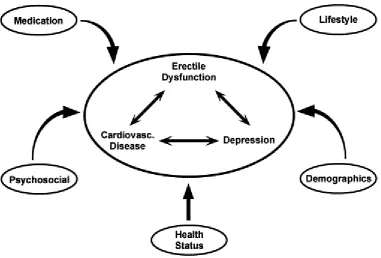
To understand the overlap between CVD, ED and depression, Goldstein (2000) proposed an
integrated model (See figure 1) in order to understand that depressive illness, CVD and ED
share many of the same risk factors and etiological associations. The model highlights the
potential impact of psychosocial well-being, treatment, overall health status, personal
characteristics and lifestyle behaviours in aetiology and the cyclical relationship between
these co-morbid conditions. Goldstein (2000) suggests that a practical implication of the
model is that patients presenting with symptoms of ED should be routinely screened for
symptoms of depression and CVD. Equally those that present with depressive symptoms
should be screened for ED and CVD. Clinicians involved in the management of sexual
dysfunction are encouraged to be particularly sensitive to the potential comorbidity of CVD
and depression as well as the potential increased risk of cardiac morbidity and mortality in
patients with such conditions (Goldstein, 2000).
Insert Figure 1.
Research has been conducted that supports the theory that ED in CVD is independently
associated with depressive symptoms (Lemogne et al, 2010). Further work has also linked
this relationship to overall quality of life. In order to estimate the prevalence of sexual
disorders and depressive symptoms in patients attending cardiac rehabilitation and examine
the association between sexual disorders, depressive symptoms and quality of life, Kriston
12
moderate to severe ED and 14% of the sample had moderate or severe depression. It was
found that impaired sexual functioning was moderately associated with decreased quality of
life and this relationship was mediated by depression.
In addition to depression, anxiety and specifically performance anxiety can have a significant
impact on the ability of men to resume sexual activity and function after a cardiac event.
This may be further amplified if a couple had interpersonal or sexual difficulties prior to the
cardiac event. Friedman (2000) suggests that cardiac rehabilitation should integrate sexual
activity in discussions around regaining and maintaining quality of life and this should
include a patient’s sexual partner (Friedman, 2000). Partner involvement in the
rehabilitation process is particularly important given the impact ED can have on intimate
relationships. Fisher et al (2005) carried out a study of a general sample of men with ED and
their partners. Self-reported severity of ED by both males and their respective partners were
found to be highly correlated. Both partners reported dramatic reductions in sexual activity
after the onset of ED, compared to retrospective reports prior to onset. Research carried
out by Günzler et al (2009), used self-report methods to investigate sexual problems in a
sample of men attending cardiac rehabilitation. Sexual problems were associated with
greater engagement in quarrelling, significantly less tenderness and communication as well
as poorer quality of partnership in comparison to men without sexual problems. In addition,
orgasmic function, sexual desire, intercourse satisfaction, overall sexual satisfaction and ED
were significantly correlated with aspects of partnership quality indicating that as sexual
13
Implications for practice
There are potential opportunities to improve the care of individuals living with CVD and ED.
One such opportunity is how healthcare providers discuss ED (refer to Box 1 and 2). The
terminology used by healthcare professionals to describe ED may not be understood by all
patients. For example ‘Erectile dysfunction’ does not translate directly into other languages,
such as Bengali. Therefore an alternative term may be needed (Steggall, 2012). Difficulties
such as language barriers as well as cultural differences can therefore create difficulties for
clinical practitioners to identify ED. Byrne et al (2013) suggest that patients not only report
that they would find it easy to discuss sexual issues with their healthcare provider but also
report a desire for more opportunity during consultations to discuss sexual issues. This
indicates that healthcare professionals could create an environment in which issues around
sexuality can easily be raised and discussed. This may mean that specific training should be
offered in order for healthcare professionals to possess the awareness and skills to facilitate
this in clinic. Clinicians unused to assessing sexual dysfunction may find the assessment
guide helpful to identify the severity and nature of the problem (refer to Box 2).
Research also highlights the importance of involving the patient’s partners, where possible,
in the rehabilitation process. This not only provides an opportunity for the clinician to have
an understanding of how ED may be impacting on a patients’ quality of life and that of their
partner; it also permits a discourse to emerge in which ED and the couple’s intimate
14
Implications for research
Research and anecdotal evidence suggests an association between ED and adherence to
CVD medication. However, the strength and direction of that relationship has not been
confirmed. Further research needs to be carried out in order to investigate the prevalence
of non-adherence to cardiac medication in those with ED as well as how treatment for ED
and beliefs about these co-morbid conditions influence adherence behaviour. By identifying
the demographic, clinical and psychosocial factors which predict adherence to CVD
treatment only then can research begin to look at the possibility of designing a behaviour
change intervention aimed at improving adherence.
Conclusion
There is a growing body of literature indicating that men with CVD either cease taking their
prescribed medications, or miss doses; this may be related to the common side effect of
reduced erectile strength. Non-adherence poses significant risk to these men, in terms of
morbidity and mortality, but also in terms of their sexual relationship. Opportunities have to
be created to facilitate discussions of adherence and ED, and these can be facilitated by
using the IIEF-5 either at the point of prescribing CVD medication or during the annual
medication review. Where ED has been identified, patients will need to be assessed for the
15
References
Aggarwal, B., and Mosca, L. (2010). Lifestyle and psychosocial risk factors predict non-adherence to medication. Annals of Behavioral Medicine, 40(2), 228-233.
Baroletti, S., and Dell'Orfano, H. (2010). Medication adherence in cardiovascular disease.
Circulation, 121(12), 1455-1458.
Baumhäkel, M., Werner, N., Böhm, M., & Nickenig, G. (2006). Circulating endothelial progenitor cells correlate with erectile function in patients with coronary heart disease.
European heart journal, 27(18), 2184-2188.
Baumhäkel, M., Schlimmer, N., Kratz, M., Hacket, G., Jackson, G., & Böhm, M. (2011). Cardiovascular risk, drugs and erectile function–a systematic analysis. International journal of clinical practice, 65(3), 289-298.
Benson, J., & Britten, N. (2002). Patients' decisions about whether or not to take antihypertensive drugs: qualitative study. BMJ, 325(7369), 873.
Blumentals, W. A., Gomez-Caminero, A., Joo, S., & Vannappagari, V. (2004). Should erectile dysfunction be considered as a marker for acute myocardial infarction? Results from a retrospective cohort study. International journal of impotence research, 16(4), 350-353. British Heart Foundation (2013). “Cardiovascular Disease”. retrieved 03/10/2013 from http://www.bhf.org.uk/heart-health/conditions/cardiovascular-disease.aspx.
Byrne, M., Doherty, S., Murphy, A.W., McGee, H.M., Jaarsma, T. (2013). Communicating about sexual concerns within cardiac health services: do service providers and service users agree? Patient Education and Counseling, 92(3), 398-403.
Cappelleri, J. C. and Rosen, R. C. (2005) The Sexual Health Inventory for Men (SHIM) : A 5-year review of research and clinical experience. International Journal of Impotence Research 17 : 307-19
Dong, J. Y., Zhang, Y. H., & Qin, L. Q. (2011). Erectile Dysfunction and Risk of Cardiovascular DiseaseMeta-Analysis of Prospective Cohort Studies. Journal of the American College of Cardiology, 58(13), 1378-1385.
Feldman, H. A., Goldstein, I., Hatzichristou, D. G., Krane, R. J., & McKinlay, J. B. (1994). Impotence and its medical and psychosocial correlates: results of the Massachusetts Male Aging Study. The Journal of urology, 151(1), 54.
Fergus, I. V. (2009). Antihypertensive pharmacotherapy: adverse effects of medications promote nonadherence. Journal of the CardioMetabolic Syndrome, 4(1), E1-E3.
16
Friedman, S. (2000). Cardiac disease, anxiety, and sexual functioning. The American journal of cardiology, 86(2), 46-50.
Goldstein, I. (2000). The mutually reinforcing triad of depressive symptoms, cardiovascular disease, and erectile dysfunction. The American journal of cardiology, 86(2), 41-45.
Grégoire, J. P., Moisan, J., Guibert, R., Ciampi, A., & Milot, A. (2006). Predictors of self-reported noncompliance with antihypertensive drug treatment: A prospective cohort study.
Canadian Journal of Cardiology, 22(4), 323-329.
Günzler, C., Kriston, L., Harms, A., & Berner, M. M. (2009). Association of sexual functioning and quality of partnership in patients in cardiovascular rehabilitation—A gender perspective. The journal of sexual medicine, 6(1), 164-174.
Hassan, N. B., Hasanah, C. I., Foong, K., Naing, L., Awang, R., Ismail, S. B., & Rahman, A. R. A. (2005). Identification of psychosocial factors of noncompliance in hypertensive patients.
Journal of human hypertension, 20(1), 23-29.
Hodges, L. D., Kirby, M., Solanki, J., O'Donnell, J., & Brodie, D. A. (2007). The temporal relationship between erectile dysfunction and cardiovascular disease. International journal of clinical practice, 61(12), 2019-2025.
Jackson, G. (2013). Erectile dysfunction and cardiovascular disease. Arab Journal of Urology,11(3), 212-216.
Johannes, C. B., Araujo, A. B., Feldman, H. A., Derby, C. A., Kleinman, K. P., & McKinlay, J. O. H. N. (2000). Incidence of erectile dysfunction in men 40 to 69 years old: longitudinal results from the Massachusetts male aging study. The Journal of urology, 163(2), 460-463.
Kirby, M., Jackson, G., Betteridge, J., & Friedli, K. (2001). Is erectile dysfunction a marker for cardiovascular disease?. International journal of clinical practice, 55(9), 614.
Kloner, R. A. (1993). NIH Consensus Development Panel on Impotence. JAMA, 270(1), 83-90. Knapton, M. (2012). Cardiovascular disease in primary care: concordance and risk reduction.
The British Journal of General Practice, 62(599), 284.
Kriston, L., Günzler, C., Agyemang, A., Bengel, J., & Berner, M. M. (2010). Effect of Sexual Function on Health‐Related Quality of Life Mediated by Depressive Symptoms in Cardiac Rehabilitation. Findings of the SPARK Project in 493 Patients. The journal of sexual medicine,
7(6), 2044-2055.
17
Laumann, E. O., Glasser, D. B., Neves, R. C. S., & Moreira, E. D. (2009). A population-based survey of sexual activity, sexual problems and associated help-seeking behavior patterns in mature adults in the United States of America. International journal of impotence research,
21(3), 171-178.
Lemogne, C., Ledru, F., Bonierbale, M., & Consoli, S. M. (2010). Erectile dysfunction and depressive mood in men with coronary heart disease. International journal of cardiology,
138(3), 277-280.
Lewis, R. W., Fugl‐Meyer, K. S., Corona, G., Hayes, R. D., Laumann, E. O., Moreira Jr, E. D., Rellini, A.H., & Segraves, T. (2010). Original articles: Definitions/epidemiology/risk factors for sexual dysfunction. The journal of sexual medicine, 7(4pt2), 1598-1607.
McLaughlin, T., Harnett, J., Burhani, S., & Scott, B. (2005). Evaluation of erectile dysfunction therapy in patients previously nonadherent to long-term medications: a retrospective analysis of prescription claims. American journal of therapeutics, 12(6), 605-611.
Medical Research Council Working Party. (1985). MRC trial of treatment of mild hypertension: principal results. BMJ, 291:97-104.
Montorsi, F., Briganti, A., Salonia, A., Rigatti, P., Margonato, A., Macchi, A., & Montorsi, P. (2003). Erectile dysfunction prevalence, time of onset and association with risk factors in 300 consecutive patients with acute chest pain and angiographically documented coronary artery disease. European urology, 44(3), 360-365.
Munger, M. A., Van Tassell, B. W., & LaFleur, J. (2007). Medication nonadherence: an unrecognized cardiovascular risk factor. Medscape general medicine, 9(3), 58.
Naderi, S. H., Bestwick, J. P., & Wald, D. S. (2012). Adherence to drugs that prevent cardiovascular disease: meta-analysis on 376,162 patients. The American journal of medicine, 125(9), 882-887.
Nunes, V., Neilson, J., O’flynn, N., Calvert, N., Kuntze, S., Smithson, H., ... & Steel, J. (2009). Clinical guidelines and evidence review for medicines adherence: involving patients in decisions about prescribed medicines and supporting adherence. London: National Collaborating Centre for Primary Care and Royal College of General Practitioners, 364.
18
Ogedegbe, G., Mancuso, C. A., & Allegrante, J. P. (2004). Expectations of blood pressure management in hypertensive African-American patients: a qualitative study. Journal of the National Medical Association, 96(4), 442.
Ôunpuu, S., Negassa, A., & Yusuf, S. (2001). INTER-HEART: A global study of risk factors for acute myocardial infarction. American heart journal, 141(5), 711-721.
Ponholzer, A., Temml, C., Mock, K., Marszalek, M., Obermayr, R., & Madersbacher, S. (2005). Prevalence and risk factors for erectile dysfunction in 2869 men using a validated questionnaire. European urology, 47(1), 80-86.
Rosen, R. C., Riley, A., Wagner, G., Osterloh, I. H., Kirkpatrick, J., & Mishra, A. (1997). The international index of erectile function (IIEF): a multidimensional scale for assessment of erectile dysfunction. Urology, 49(6), 822-830.
Rosen, R. C., Cappelleri, J. C., Smith, M. D., Lipsky, J., & Pena, B. M. (1999). Development and evaluation of an abridged, 5-item version of the International Index of Erectile Function (IIEF-5) as a diagnostic tool for erectile dysfunction. International Journal of Impotence Research, 11(6), 319-326.
Ruppar, T. M., Dobbels, F., & De Geest, S. (2012). Medication beliefs and antihypertensive adherence among older adults: a pilot study. Geriatric Nursing, 33(2), 89-95.
Scranton, R. E., Goldstein, I., & Stecher, V. J. (2013). Erectile dysfunction diagnosis and treatment as a means to improve medication adherence and optimize comorbidity management. The journal of sexual medicine, 10(2), 551-561.
Silvestri, A., Galetta, P., Cerquetani, E., Marazzi, G., Patrizi, R., Fini, M., & Rosano, G. M. (2003). Report of erectile dysfunction after therapy with beta-blockers is related to patient knowledge of side effects and is reversed by placebo. European Heart Journal, 24(21), 1928-1932.
Solomon, H., Man, J. W., Wierzbicki, A. S., & Jackson, G. (2003). Relation of erectile dysfunction to angiographic coronary artery disease. The American journal of cardiology,
91(2), 230-231.
Stafford, L., Jackson, H. J., & Berk, M. (2008). Illness beliefs about heart disease and adherence to secondary prevention regimens. Psychosomatic Medicine, 70(8), 942-948. Steggall, M. J., Butler, J., Coals, S., & Chinegwundoh, F. I. (2006). Heart disease and erectile dysfunction: Management at a nurse-led clinic. British Journal of Cardiac Nursing, 1(12), 596-601.
Steggall, M. J. (2009). Clinical management of erectile dysfunction. Trends in Urology, Gynaecology & Sexual Health, 14(6), 14-17.
Steggall, M. (2012). Pharmacological management of erectile dysfunction. Nurse Prescribing,
19
Tan, R. S., & Pu, S. J. (2003). The interlinked depression, erectile dysfunction, and coronary heart disease syndrome in older men: a triad often underdiagnosed. The journal of gender-specific medicine: JGSM: the official journal of the Partnership for Women's Health at Columbia, 6(1), 31.
Vacanti, L. and Caramelli, B. (2005). "Distress: associated variables of erectile dysfunction post-acute myocardial infarction. A pilot study." International Journal of Impotence Research 17(2), 204-06.
Vlachopoulos, C., Jackson, G., Stefanadis, C., & Montorsi, P. (2013). Erectile dysfunction in the cardiovascular patient. European heart journal,34:2034-46
20 Box 1. Creating the opportunities for discussing ED
Ask: ‘Some men who are taking medication for cardiovascular disease may have trouble with erections. If you have any questions or would like to discuss that, I can arrange an appointment for you’
Awareness: Posters informing men of the prevalence of ED can be used to create the
environment where questions can be asked
Inform: ED is common. There are several treatment options that can be considered. If you
21
Box 2. 5-item International Index of Erectile Function (IIEF-5) Adapted from Rosen, et al. (1999)
How do you rate your confidence that you could get and keep an erection? Very low 1 Low 2 Moderate 3 High 4 Very high 5 When you had erections with sexual stimulation, how often were your erections hard enough for penetration?
Almost never/Never
1
A few times (much less than half the
time) 2
Sometimes (about half the time)
3
Most times (much more than half the
time) 4
Almost always/always
5
During sexual intercourse, how often were you able to maintain your erection after you had penetrated (entered) your partner?
Almost never/Never
1
A few times (much less than half the
time) 2
Sometimes (about half the time)
3
Most times (much more than half the
time) 4
Almost always/always
5
During sexual intercourse, how difficult was it to maintain your erection to completion of sexual intercourse? Extremely difficult 1 Very difficult 2 Difficult 3 Slightly difficult 4 Not difficult 5 When you attempted sexual intercourse, how often was it satisfactory for you?
Almost never/Never
1
A few times (much less than half the
time) 2
Sometimes (about half the time)
3
Most times (much more than half the
time) 4 Almost always/always 5 Score _____
22
[image:23.595.74.456.71.329.2]