Proceedings of the 15th International Operation & Maintenance conference (OMAINTEC 2017), 23-25th October 2017, Beirut, Lebanon
BIG DATA FOR SMART OPERATIONS AND MAINTENANCE OF
BUILDINGS
Dr Ibrahim Motawa
Department of Architecture, University of Strathclyde
,
Glasgow, United Kingdom
[email protected]
Abstract
The trend in industry to move towards smart buildings will in turn necessitate the move to smart operations and maintenance. As buildings lifecycle continues for a number of decades, various data about performance and operations need to be captured. There are various smart data collection tools available such as: mobile devices, social media, smart meters, sensors, satellites, camera footage, traffic flow reports, etc.. The analysis of the collected data can provide huge feedback for better buildings management. This research aims to adopt the concept of Big Data to capture the information and the knowledge of buildings operations; particularly for building maintenance and refurbishment. With the use of Building Information Modelling (BIM) systems to store various structured data of buildings, the unstructured data for various buildings operations will be also captured. For this purpose, a new system is proposed that integrates cloud-based Spoken Dialogue System (SDS), case-based reasoning, and BIM system. The proposed smart system acts as an interactive expert agent that seeks answers from buildings managers/users about building maintenance problems and help searching for solutions from previously stored knowledge cases. Capturing multi-modes data into BIM systems using the cloud-based spoken dialogue systems can utilise the high volume of data generated over building lifecycle. This can help design and operation teams to manage buildings, spaces, and services more efficiently. The data capture tools (including SDS) provide granular real-time data about utilization patterns which can improve the maintenance of buildings services and operations.
Keywords: Big data, BIM, Spoken Dialogue Systems
1.
Introduction
With the growing demand to optimise building operations/maintenance, sufficient information on products is always needed to relate past experience of maintenance cases to help conduct new work. The principles behind capturing such information and knowledge about the various project life cycle phases have moved from manual recording to the use of IT solutions such as Radio Frequency Identification (RFID). Meanwhile, other IT solutions have been introduced which include the development of Building Information Modelling (BIM) and more recently with the use of Internet of Things and Big Data.
“Big data” is the “Extremely large data sets that may be analysed computationally to reveal patterns, trends, and associations, especially relating to human behaviour and interactions”, Oxford English Dictionary [22]. Big Data is always defined in terms of the four Vs: Volume (the amount of data), Velocity (timely data processing and analysing), Variety (data from a range of sources), and Veracity (data integrity).
For the AEC sector, Big Data applications can transform the practices of design, construction, and operation of projects. The available variety of data collection tools such as: mobile devices, social media, smart meters, sensors, satellites, camera footage, traffic flow reports, etc. collect data on performance and behaviour of operations, which can provide huge feedback from buildings occupants and projects teams. This can help design and operation teams better understand occupants and users needs, and also help operate buildings, spaces, and services more efficiently. These data capture tools can now provide granular real-time data about utilization patterns which can improve the maintenance of buildings services and operations.
This paper will establish the position of BIM systems within the big data framework. The following section will first review the digital transformation of the construction industry. Then, the paper reviews how BIM and the analytic knowledge systems were applied for building maintenance.
2.
Digital transformation of the construction industry
2
“The global economy, driven by the combination of a number of megatrends including rapid urbanisation, increasing resource scarcity and an exponential growth in the availability of smart technologies and connectivity is entering a transformative phase”, The Construction Products Association [26]. The modern Built Environment is turning to integrated and intelligent smart systems in conjunction with big-data concepts to deliver public services such as: Healthcare, Smart Energy Grids, smart Transport and Parking, Water management, Waste management, etc. The built environment is rapidly changing with the advanced development of the Internet of Things, the move towards a resource efficient circular economy, and the drive for more efficient, agile and customisable manufacturing through Industry 4.0.
Industry 4.0, as a concept, targets the automation of data exchange using cyber-physical systems, the Internet of Things, and cloud computing. Figure 1 shows the collection of automated technologies that support the concept of Industry 4.0. The cyber-physical systems create virtual versions of the physical world. These systems cooperate with each other and with humans in real time via the Internet of Things. Furthermore, the internal and external organizational services are managed and offered via cloud computing. The Industry 4.0 concept requires the availability of all relevant information in real time. The ultimate aim is to optimise the costs, availability and consumption of resources towards achieving the circular economy. The World Economic Forum identifies the drivers of circular economy as:
increasing utilisationof an asset or resource
looping an asset through additional use cycles (using more than once) extending the use cycle length of an asset
[image:2.595.75.520.312.585.2] regenerationof natural capital
Figure 1: Industry 4.0 and supporting technologies Source: PwC (2016) - Global Industry 4.0 Survey [24]
‘Industry 4.0: Building the digital enterprise (Engineering and construction)
3
The construction of ‘Intelligent buildings’ provides means for buildings to adapt to changeable conditions. For example, an intelligent building with a building management system can control the artificial intervention, tune lighting and HVAC control, adjust the positioning of external shading devices, and regulate energy usage. As components of a larger compound, intelligent buildings make smart and sustainable cities efficient. On a large scale, Smart Cities utilise ubiquitous communication networks, widely distributed wireless technology and major intelligent management systems to create new services and tackle challenges. Smart cities should also properly integrate other relevant aspects of economics, society, environment, knowledge and user-experience.Figure 2: Construction products
Source: “The Future for Construction Product Manufacturing”, The Construction Products Association (October 2016)
The massive volume of the captured data from intelligent buildings and cities such as: energy consumption, building occupancy levels, user comfort, traffic intensity, economic activity, and people happiness needs highly sophisticated analytic techniques. In addition to the usefulness of the captured data for buildings operation and maintenance, this data helps designers when working on new buildings. A major current challenge for such usefulness is how this unstructured data can be integrated with BIM systems which can currently hold huge structured data only about buildings. This combined data with the analytic tools help in creating what is called ‘knowledge societies’, in which, data security becomes a challenge for many organisations.
As data is coming from multiple sources (internal and external to projects) and in different formats, effective data analytic capabilities are essential to ensure that data creates value. However, in a survey conducted worldwide by PwC (2016), only 19% of the engineering and construction companies have advanced data analytic capabilities.
3.
Data handling for smart building operations
4
the FM Exemplar project of Sydney Opera House [1], AROMA-FF which is developed to utilise data including BIM databases to obtain information and geometric representation of facilities and equipment [12], and the web-based Facilities Maintenance Management prototype decision support system [9]. As all such systems are BIM-based, they mainly utilise structured data. However, they generally do not consider the kind of unstructured knowledge gained during the operation of buildings. With further development of BIM systems, researchers such as Motawa and Carter [21] recommended that knowledge of buildings operations should be also incorporated with the traditional BIM systems to transform the typical information model of buildings (as it is currently developed) into innovative knowledge models.On the other hand for Knowledge Management (KM), several KM systems have been revolving around managing knowledge in construction and FM. The concept of KM has been utilised to improve performance, reduce cost, increase efficiency and quality. Examples include: A prototype KM system to improve the management of Reactive Maintenance projects [2] and [3], the web-based system “Consulting Knowledge System” [13], and “Building Maintenance Community of Practice” [7]. The chief objective of such applications is the improvement of knowledge sharing and communication between stakeholders. As new levels of efficiency in sharing information and knowledge have been emerged, the integration of BIM systems with knowledge management tools to capture and retain the operational knowledge has been proposed, Motawa and Almarshad [20]. Therefore, this has established the need to consider various types of data that can be collected from various sources using various tools which the characteristic of big data; “data variety”, is mainly about. Therefore, this research proposes a methodology of capturing operation and maintenance knowledge using Spoken Dialogue Systems (SDS) and integrates this knowledge within BIM models for future use by building stakeholders.
The motivation to develop SDS has been based on the need of having more effective user-interface to computers in order to reduce the training and efforts required to enter/retrieve data and provide users with additional flexibility to perform tasks. SDS are human-computer interactive systems that use human natural language speech in input and output modalities to complete a task or solve a problem. Over the years, several specific dialogue systems have been developed in many fields such as: in weather reports [29], tourism and navigation [10], and in more complex domains like Self-Help where the system engages the user in technical tasks like troubleshooting by requesting information and providing instructions [27]. If developed with KM systems, SDSs can act as interactive expert agents that seek answers from the users for questions specific to the problem and help searching for solutions from the previously stored knowledge cases, which is the purpose of this research.
4.
System Modules
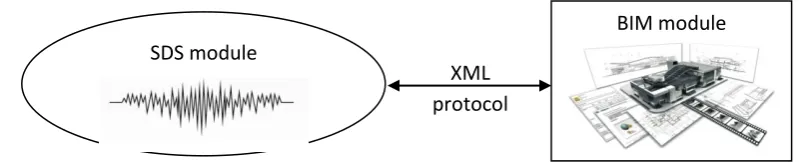
Figure 3 shows the proposed system modules which integrate a BIM module with a SDS module to verbally capture the maintenance-related knowledge. The BIM module is used to develop the virtual building model, Further details on this module can be found elsewhere; Motawa [18].
[image:4.595.80.480.583.664.2]In the developed prototype of the SDS module, there are dialogue manager and a speech synthesiser module. The dialogue manager module uses a script in which the questions are prepared and coded in eXtensible Markup Language (XML). This script consists of a series of questions concerning the maintenance issue that will be put to the expert. The expert can answer these questions using speech input. Each question is displayed on the screen as well as spoken to the expert using a speech synthesis module. The answers are converted into text strings by the speech recognition module. These recognised text strings are then stored in the knowledge base as a XML script linked to the appropriate component of the BIM model.
Figure 3:Main modules of the proposed system
5.
Case study
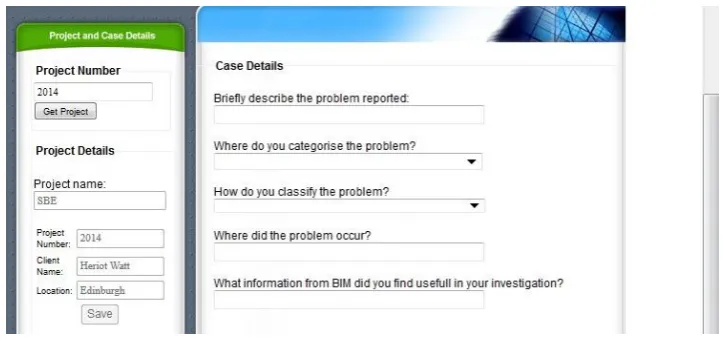
The proposed system has been applied to maintain a complex of commercial buildings. For validation, the developed system was tested by building professionals. When the expert (e.g. Facility managers) identifies the building element in the BIM model that has a problem and needs maintenance or repair, all details of the element and the added parameters will be populated. In addition, the required details of the maintenance case are acquired by the system using a dialogue
SDS module
XML
protocol
5
interface, as shown in Figure 5. In contrast to existing approaches where experts are asked to type in their experiences in dealing with the issue into a text box, the system acquires expert knowledge as an interviewer and presents the expert with a series of questions concerning the different dimensions of the problem at hand. Instead of typing the answers to the questions which are at the same time the required input in the parameter fields, the expert can switch to the voice mode of the system and answer the questions one by one. The answers to the questions will be then converted by the SDS module and stored into the knowledge base. Once all questions are answered, the user can search the knowledge base to retrieve the closest stored case to the new one and investigate the old adopted solutions. This is done using a developed knowledge module, further details of this knowledge module can be found elsewhere; Motawa and Almarshad [19]. [image:5.595.116.478.272.443.2]The proposed system has the ability to seek relationships between cases of several elements using the intelligent features of BIM objects. By tracing history of work and identifying related problems, this feature can provide professionals with a comprehensive understanding of issues related to their maintenance works. The proposed system identifies the spatial relationships between elements that are provided by an IFC schema. The system then clusters elements along with the associated cases into groups. Whenever a case has been searched and demonstrated, related cases of the same spatial group are presented.
Figure 4: The dialogue interface to capture the knowledge case
6.
Conclusions
Big data can be used to improve the development of the next generation of buildings and services. BIM will be a major contributor to this development. However, BIM largely considers structured data and allow the access to multiple databases. Therefore, new analytics methodology is sought to allow the analysis of unstructured data. For this research, an intelligent knowledge-based BIM system integrated with Spoken Dialogue System has been developed to capture and retrieve maintenance related information and knowledge of buildings. The advancements in Dialogue technology to handle data from various input and output modalities to generate a conversational interface was employed in the proposed system. The system acts as an interactive expert agent that seeks answers from the user for questions specific to the problem and help searching for solutions from previously stored knowledge cases.
References
[1] P. Akhurst, & N. Gillespie (2006). "Sydney Opera House Facilities Management Exemplar Project." In: FMA Conference. 1 June 2006.
[2] N. Ali, M. Sun, G. Petley, & P. Barrett (2002). "Improving the Business Process of Reactive Maintenance Projects." Facilities. 20 (7). p.p. 251–261.
[3] N. Ali, M. Sun, G. Petley, P. Barrett, & M. Kagioglou (2004). "MoPMIT: A Prototype System for Reactive Maintenance Projects in the UK." Journal Alam Bina. 6 (2)
[4] P. Barrett and D. Baldry (2003). Facilities Management: Towards Best Practice, 2nd, Blackwell Science, Oxford, 2003.
6
[6] H. Chen, R. Chiang, and V. Storey (2012). “Business Intelligence and Analytics: From Big Data to Big Impact,”MIS Quarterly, 36(4), 1165-1188.
[7] P. Fong, and K. Wong (2009). "Knowledge and Experience Sharing in Projects-Based Building Maintenance Community of Practice." International Journal of Knowledge Management Studies. 3 (3/4). p.p. 275 – 294.
[8] Google Web Toolkit (2014). http://www.gwtproject.org/
[9] Q. Hao, Y. Xue, W. Shen, B. Jones & J. Zhu (2010). "A Decision Support System for Integrating Corrective Maintenance, Preventive Maintenance, and Condition-Based Maintenance." In: Construction Research Congress. 8 May 2010, Banff, Alberta.
[10] S. Janarthanam, O. Lemon, P. Bartie, T. Dalmas, A. Dickinson, X. Liu, W. Mackaness & J. Goetze (2013). "Evaluating a City Exploration Dialogue System with Integrated Question-Answering and Pedestrian Navigation." Proc. of ACL 2013, Bulgaria.
[11] Y. Jiao, Y. Wang, S. Zhang, Y. Li, B. Yang & L. Yuan (2013). A cloud approach to unified lifecycle data management in architecture, engineering, construction and facilities management: Integrating BIMs and SNS. Advanced Engineering Informatics, 27, 173-188.
[12] S. Lee and Ö. Akin (2011). "Augmented Reality-Based Computational Fieldwork Support for Equipment Operations and Maintenance." Automation in Construction. 20 (4). p.p. 338–352.
[13] N. Lepkova and Z. Bigelis (2007). "Model of Facilities Management Consulting Knowledge System." In: 9th International Conference on Modern Building Materials, Structures and Techniques, May 16-18. 16 May 2007, Vilnius, Lithuania.
[14] J. Li, X. Wang, J. Wang, J. Guo, S. Zhang & Y. Jiao (2014). A Project-based Quantification of BIM Benefits. International Journal Of Advanced Robotic Systems 11, 1-13.
[15] W. Mao, Y. Zhu & I. Ahmad (2007). Applying metadata models to unstructured content of construction documents: A view-based approach. Automation in Construction, 16, 242-252.
[16] McKinsey Global Institute "MGI" (2011). " Big data: The next frontier for innovation, competition, and productivity", June 2011, Copyright © McKinsey & Company. Available at:
http://www.mckinsey.com/insights/business_technology/big_data_the_next_frontier_for_innovation, accessed on 15/06/2015
[17] J. McMalcolm (2015). "Companies must not overlook big data security needs", available at
http://www.businessreviewcanada.ca/technology/1225/Companies-must-not-overlook-big-data-security-needs, accessed on 10/06/2015.
[18] I. Motawa (2015). BIM-Knowledge system for building operations,In the Proceedings of the 13th International Operation & Maintenance conference (OMAINTEC 2015), 17-19th November 2015, Cairo, Egypt
[19] I. Motawa and A. Almarshad (2015). "Case-based reasoning and BIM systems for asset management", Built Environment Project and Asset Management, Vol. 5(3), pp.233 - 247
[20] I. Motawa and A. Almarshad (2013). "A knowledge-based BIM system for building maintenance." Journal of Automation in Construction, Volume 29, January 2013, Pages 173-182.
[21] I. Motawa and K. Carter (2013). "Sustainable BIM-based Evaluation of Buildings." Procedia - Social and Behavioural Sciences Journal, Volume 74, pp. 116-125.
[22] Oxford English Dictionary (2015). Available at: http://www.oxforddictionaries.com/definition/english/big-data [23] S. Parise, B. Iyer and D. Vesset (2012). Four strategies to capture and create value from big data, Issues: July/
August 2012, Ivey Business Journal, ISSN 1492-7071
[24] PwC (2016), Global Industry 4.0 Survey ‘Industry 4.0: Building the digital enterprise (Engineering and construction)
[25] J. Shrestha (2013) "Big Data, Predictive Analytics, and Data Visualization in The Construction Engineering" CCEE Graduate Student Research Showcase and Poster Competition. Town Engineering Building. Dec. 2013. Available at: http://works.bepress.com/joseph_shrestha/2
[26] The Construction Products Association (2016). The Future for Construction Product Manufacturing - Digitalisation, Industry 4.0 and the Circular Economy (October 2016)
[27] J. Williams and S. Young (2007). “Partially Observable Markov Decision Processes for Spoken Dialog Systems.” Journal of Computer Speech and Language, volume 21(20), pages 231-422.
[28] Y. Zhu, W. Mao & I. Ahmad (2007). Capturing implicit structures in unstructured content of construction documents. Journal of Coumputing in Civil Engineering, 21, 220-227.
![Figure 1: Industry 4.0 and supporting technologies Source: PwC (2016) - Global Industry 4.0 Survey [24]](https://thumb-us.123doks.com/thumbv2/123dok_us/1477445.100379/2.595.75.520.312.585/figure-industry-supporting-technologies-source-global-industry-survey.webp)