City, University of London Institutional Repository
Citation: Mena, S. & Suddaby, R. (2016). Theorization as institutional work: The
dynamics of roles and practices. Human Relations, 69(8), pp. 1669-1708. doi: 10.1177/0018726715622556This is the accepted version of the paper.
This version of the publication may differ from the final published
version.
Permanent repository link: http://openaccess.city.ac.uk/12985/
Link to published version: http://dx.doi.org/10.1177/0018726715622556
Copyright and reuse: City Research Online aims to make research
outputs of City, University of London available to a wider audience.
Copyright and Moral Rights remain with the author(s) and/or copyright
holders. URLs from City Research Online may be freely distributed and
linked to.
THEORIZATION AS INSTITUTIONAL WORK: THE DYNAMICS OF ROLES AND
PRACTICES
Sébastien Mena
Cass Business School, City University London
Roy Suddaby
University of Victoria & Newcastle University
Theorization as institutional work: The dynamics of roles and practices
Abstract
This study unpacks the construct of theorization – the process by which organizational ideas become delocalized and abstracted into theoretical models to support their diffusion across time and space. We adopt an institutional work lens to analyze the key components of theorization in contexts where institutional work is in transition from creating institutions to maintaining them. We build on a longitudinal inductive study of theorization by the Fair Labor Association (FLA), a private regulatory initiative which created and then enforced a code of conduct for working conditions in apparel factories. Our study reveals that when institutional work shifts from creating to maintaining an institutional arrangement of corporate social responsibility, there is a key change in how the FLA theorizes roles and practices related to this arrangement. We observe that theorization on key practices largely remain intact, whereas the roles of different actors are theorized in a dramatically different manner. Our findings contribute to a better understanding of the work involved in the aftermath of radical change by demonstrating the relative plasticity of roles over the rigidity of practices.
Keywords
Research in institutional theory has typically been interested in explaining either profound social change (e.g. Delbridge and Edwards, 2008; Greenwood and Suddaby, 2006) or the work that goes into the maintenance and stability of established institutions (e.g. Currie et al., 2012; Dacin et al., 2010; Heaphy, 2013; Trank and Washington, 2009). Surprisingly little attention has been devoted to understanding the transition from change to maintenance, and especially how institutional work (Lawrence and Suddaby, 2006) shifts when the intent of actors moves from changing institutions to maintaining them. In this paper, we address the work that underpins such institutional transitions.
In particular, we examine one form of institutional work in transition: theorization. Theorization refers to the process whereby institutional roles and practices are abstracted into comprehensive and compelling theoretical models that foster institutional change and the subsequent diffusion of those roles and practices (Greenwood et al., 2002; Strang and Meyer, 1993; Strang and Soule, 1998). We know that theorization of roles and practices is a key element of institutional work toward change (Strang and Meyer, 1993; Tolbert and Zucker, 1996), but we know very little about the potential role of theorization in processes of
institutional maintenance. Especially, we do not know how theorization, about both roles and practices, is altered when actors shift from the work needed to effect institutional change to the one needed to maintain the change they have created.
We address this question by building on an inductive longitudinal study of
theorization by the Fair Labor Association (FLA), a private regulatory initiative for corporate social responsibility (CSR) in the global apparel industry. The FLA is a consortium of
universities, non-governmental organizations (NGOs) and firms implementing a code of conduct for working conditions in factories of the apparel industry, initiated as a reaction to the sweatshop scandal of the 1990s. The FLA was intimately involved in the
of a code of conduct following the exposition of poor working conditions in apparel factories. As a regulatory body, the FLA is a central actor in the field, and therefore key to the
maintaining of these new norms, especially as it audits firms’ adequate enforcement of the code of conduct. Examining theorization by the FLA when it transitions from institutional change to maintenance is thus an ideal case for our enquiry. Change in the institutional
arrangement of CSR in the industry – from apparel multinationals’ denial of responsibility for factory working conditions to their acceptance of such responsibility, along with new roles and practices – was first fostered and diffused by theorization work of the FLA (among others), whose efforts then turned toward the maintenance of this arrangement, much like a number of other organizations in the field.
Our analysis of theorization by the FLA demonstrates that when shifting from changing to maintaining institutions, there is a key change in how institutional workers
theorize roles and practices. We observe that while the FLA’s theorization of practices largely remains intact, most of the FLA’s theorizing work is devoted to completely modifying the roles of different actors, including its own. More specifically, we identify two transitioning mechanisms, whereby theorization by an institutional worker shifts to assist the transition from change to maintenance. The first mechanism, practice accretion, refers to the
observation that theorization of most practices remained consistent in both the change and maintenance phases, but that a few practices are added on without changing the content of other existing practices. The second mechanism, role modification, refers to the critical finding that actors’ roles are theorized in a fundamentally different way when transitioning from institutional change to maintenance.
organizations (DiMaggio and Powell, 1983). Often these ideas are adopted because of social pressures to conform to ‘myths of rationality’ rather than to improve economic performance (Meyer and Rowan, 1977). Considerable empirical research has demonstrated this process in a variety of contexts showing how organizational structures and practices, such as ISO quality standards (Guler et al., 2002), Total Quality Management (Westphal et al., 1997), golden parachutes (Fiss et al., 2011) and a host of other business templates, diffuse globally. And we know that theorization is key to such diffusion, by its process of taking a popular local
practice, dis-embedding it from its local context and abstracting it so that it can move across different cultural contexts and become re-embedded in diverse and distant cultural contexts (Strang and Meyer, 1993). Still, the precise mechanisms that underpin theorization are underspecified and the construct remains a black box. Our research points to the importance of the interaction between roles and practices in theorization for institutional transitions. Our findings hold important implications for explaining how some organizational innovations move effortlessly across organizational boundaries while others do not. It also helps understand how some social movements (i.e. CSR) take root and others (i.e. Occupy Wall Street) do not. We demonstrate that a key to successful transition from revolutionary to evolutionary institutional change is to attend carefully to the relative degree of change in role structures versus organizational practices. We elaborate this contribution in the balance of this paper.
Conceptual grounding
Theorization for institutional change
models, with underlying constructs and relationships (Strang and Meyer, 1993; Tolbert and Zucker, 1996). The formulation of these theoretical models facilitates and legitimates widespread diffusion and adoption of a new institutional arrangement (and associated roles and practices) because it provides actors with meaning – ‘standard and authoritative […]
interpretations and schemas’ (Strang and Meyer, 1993: 495) – about this arrangement.
Subsequent institutional change is therefore successful when other actors than the ‘theorist(s)’ (or change agent) appropriate the theoretical model and use it to make sense of the world. In turn, when this occurs, theorization is deemed to increase the speed of institutional change and adoption of new practices or roles (Strang and Meyer, 1993).
Theorization implies the creation of new or alternate constructs and relationships between outcomes, practices and actors, as well as the restructuring of existing ones. Theorization accounts provide explanatory statements of those constructs and relationships, and link them to desired outcomes (Greenwood et al., 2002). Theorization also explicates causal relationships between constructs and specifies boundary conditions or moderating effects in those relationships. As in our own academic theorization, relationships between constructs are not always necessarily correlational, but can take the form of process models (Strang and Meyer, 1993). As an example, Strang and Meyer illustrate how new countries (such as post-soviet countries) ‘adopt organizational forms built up and legitimated as models in the United Nations and its specialized agencies’. These models typically emphasize state powers embedded in constitutions and individual rights of citizens (Strang and Meyer, 1993: 499).
Etzion and Ferraro, 2010; Soule, 2004; Zilber, 2008). A second, less researched, element of theorization is to socially construct the roles of different actors into the theoretical model to facilitate adoption (Greenwood et al., 2002; Strang and Meyer, 1993). Thus, theorization applies both to the object of adoption – practice theorization – and to actors – role theorization.
Practice theorization. One aspect of theorization concerns the practices implied by an institutional arrangement, as ‘theoretical accounts of practices simplify and abstract their properties and specify and explain the outcomes they produce’ (Strang and Meyer, 1993: 497). It involves two major tasks: specification of the failure of the institution to be replaced, and justification of the appropriateness of the new one (Tolbert and Zucker, 1996). For example, Greenwood, Suddaby and Hinings (2002) show how theorization by the accounting profession in Canada effected changes in organizational structures and practices for
accounting firms, where accounting firms became ‘multidisciplinary’ and extended their provision of services to business under the same roof. Theorization, in this case, specified what the problem was with previous practices (e.g. the profession was under threat by not providing comprehensive multidisciplinary business services) and justified new practices as a legitimate way forward. By prescribing new practices, an actor theorizing them will first facilitate their diffusion and, second, sustain the self-reproduction and legitimacy of the underlying institutional arrangement (Leblebici et al., 1991).
determine which actions and behaviors are ‘allowed’ to an actor (Maguire and Hardy, 2006), especially in terms of their interactions with other actors (Maguire et al., 2004). Theorizing actors’ roles will also define the manner in which they can gain legitimacy (Tolbert and Zucker, 1996). Role theorization can entail the elaboration of new categories of actors, and how they fit within the overarching theoretical model (Strang and Meyer, 1993; Suddaby et al., 2007). Rao et al (2003), for example, show how a social movement used theorization to create new roles of chefs and consequently institutionalize new practices and meanings of cuisine in French gastronomy. Suddaby and Greenwood (2005), similarly, show how efforts to create a new organizational form for the delivery of professional services sparked a rhetorical contest over redefining the subject positions of lawyers and accountants. In both cases, the new roles were theorized as central to the overall new theoretical models put forward, and fostered change in those fields.
Theorization for institutional maintenance
While most of the literature has examined the role of theorization in institutional change, we have little understanding of how theorization might occur under conditions where purposeful actors seek to maintain existing institutional arrangements, and how theorization for change compares to theorization for maintenance. Prior research tended to assume that, during times of stability, institutional processes were relatively passive if not automatic: as fields become highly institutionalized, roles and practices are taken-for-granted and, as a result, become so normalized that they become relatively invisible (Jepperson, 1991).
long-term institutional change necessitates the active work of central actors to be sustained, sedimented, and institutionalized (Greenwood and Suddaby, 2006). However, most research in neo-institutionalism has assumed a sharp distinction between change and maintenance, even though a few studies suggest that there is high continuity between the two conditions (e.g. Perkmann and Spicer, 2008; Slager et al., 2012; Smets and Jarzabkowski, 2013; Zietsma and Lawrence, 2010). Such continuity implies that key mechanisms continue to operate in the transition between the two conditions.
As initially conceptualized by Strang and Meyer (1993), theorization is one such mechanism of transition that has to be sustained over long periods of time to facilitate
diffusion and change. However, extant research has merely reduced theorization as but a step in institutionalization processes (e.g. Greenwood et al., 2002; Tolbert and Zucker, 1996), and has not examined how theorization potentially changes during the transition from change to maintenance. As a result, we do not understand how processes of theorization might vary once a new institutional arrangement has been adopted and the field seeks to maintain successful change – translated in new practices and roles. Examining such a transition is important, as we know that institutional arrangements adapt themselves and evolve over time even after radical change (Seo and Creed, 2002; Zilber, 2008). Hence, our enquiry is of importance as it points to the more micro processes underpinning the work of actors when they transition from highly visible support for radical institutional change toward more subtle – but as important – maintenance. Moreover, it informs on how organizations can
successfully navigate the aftermath of radical change in their environment, which we examine in more details in our conclusion.
Our study is concerned with change in the global apparel industry in the wake of the sweatshop scandal of the 1990s, from an institutional arrangement of CSR as the denial of responsibility for working conditions by multinational apparel firms towards their acceptance of such responsibility. At the beginning of the 1990s, when criticized by NGOs for the poor working conditions in sweatshops, multinationals argued that contracting factories did not belong to them and were independent business partners, therefore outside the scope of their legal duties (Esbenshade, 2004; Lam, 1992; Zadek, 2004). At that time, the institutional arrangement of CSR of the global apparel industry was driven by a legalistic and economic understanding of the issue, resulting in the denial by multinationals of their responsibility for supply chains (Bartley, 2005; Lam, 1992).
As a result of increased NGO criticism and widespread media and public attention on the sweatshop issue (Bartley, 2010; Spar and La Mure, 2003), this institutional arrangement was radically disrupted in the mid-1990s. Considering the risks to their reputations, apparel firms began to take responsibility for working conditions in supply chains, as they endorsed their own or external codes of conduct and sometimes allowed third parties to monitor code implementation in contracting factories. Hence, the institutional arrangement of CSR in the global apparel industry radically and abruptly changed to one of an – at least seemingly – acceptance of supply chain responsibility by multinationals, implying new practices and roles for different actors, such as the firms themselves, but also workers, factory managers, or NGOs (DeWinter, 2001). This responsibility for supply chains is now widely taken-for-granted and apparel firms are expected to deal with poor working conditions in supply chains (Bartley, 2005; Esbenshade, 2004; Spar and La Mure, 2003; Zadek, 2004).
While such radical change was initiated by NGOs, it was then sustained by an array of private regulatory initiatives1, that set up codes of conduct for business operations and
unions, or governments2 (Mena and Palazzo, 2012; Mena and Waeger, 2014). These initiatives have been key to the change from denial to acceptance of supply chain
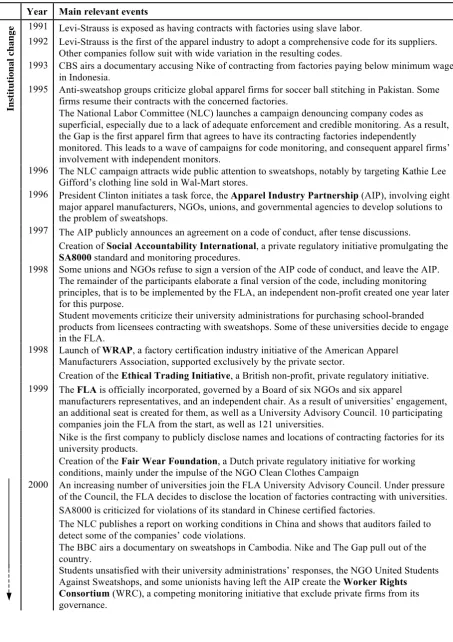
responsibility by apparel firms: as they enforce codes, they define legitimate behavior for apparel firms, and shape the understanding and practice of CSR in this industry (Bartley, 2005). By the same token, and subsequently, private regulatory initiatives became central to the maintenance of this new institutional arrangement (Marx, 2008). We focus on one of these private regulatory initiatives, the Fair Labor Association (FLA), because it was one of the two first initiatives created (Bartley, 2007), it had the most corporate members when founded, and witnessed continuous growth (see Table 1 below). Given the associative nature of the FLA (i.e. its constituents include firms, NGOs and universities) and its centrality and regulatory authority in its field, looking at changes in the FLA’s institutional work allows us to also identify changes in the broader field, rather than merely intra-organizational changes.
conduct in factories that supplied participating companies. The FLA also accredited several auditors (‘monitor’ in FLA language), mainly specialized NGOs, to verify code enforcement. Under pressure by unions and student associations, the FLA replaced firm-decided audits with unannounced audits (so-called ‘FLA 2.0 methodology’) performed by third-party
organizations trained and accredited by the FLA (‘independent external monitoring’) (Esbenshade, 2004). The reporting of audit results was improved notably, as they became public. A new 3.0 methodology was set up in 2006, and intended to complement the 2.0 approach: dealing with working conditions in a sustainable way requires firms to focus on the causes of non-compliance to prevent their re-occurrence, through capacity-building of factory management, workers, and communities. Table 1 retraces the radical change in the
institutional arrangement of CSR in the global apparel industry and highlights the related history of the FLA.
--- INSERT TABLE 1 ABOUT HERE ---
Data sources
The analysis built on longitudinal archival data from the FLA (1998-2009). Three different sources of archival data were used: annual reports, press releases, online resources from the FLA (such as fact sheets, various guidelines and recommendations, charters, newsletters, FAQs, blog entries, and diverse web pages) – all retrieved online. These data represent 1352 pages from 142 archival documents. These documents are not necessarily consumed in the same way by different constituents and stakeholders. Typically, annual reports are addressed at civil society actors to provide information on corporate social performance, whereas press releases are rather geared toward the media and business actors, and yet the website provides (quite generic) information to all interested stakeholders. Nevertheless, public data are
stakeholders at whom theorization by the FLA is aimed. And because theorization is aimed at all of these audiences, using such diverse public data allows us to capture theorization
accounts broadly and triangulate the accounts from different sources of evidence. We did not find substantive differences in how theorization was used in these different data.
Given that this study is part of a larger research project, we have extensive knowledge of the FLA and had access to additional sources of evidence. They include information from the FLA (board meeting minutes, interviews, participation in conferences and meetings in which one or more FLA staff participated), but also from other organizations (constituents’ website archives, newspapers, NGO reports, academic articles and books on the topic). We used these data as exploratory and confirmatory sources of evidence, but our formal analysis was based on the coding of public data from the FLA describe above. These additional sources of evidence helped us building and refining the analysis, validating and contrasting information and claims from the FLA, and providing more information on CSR in the global apparel industry.
Data analysis
Our analysis of theorization by the FLA unfolded in four steps, following an inductive grounded theoretic approach (Suddaby, 2006). First, we established a chronological narrative that helped us identify what was said by the FLA at what time. We especially focused on understanding the underlying theoretical model of CSR as the acceptance of responsibility for multinationals’ supply chains and its evolution.
constructs (related to roles, practices, or both), relationships between these constructs
(including expected results), and explanatory, causal, or processual statements explicating the model in more details (Strang and Meyer, 1993). An example of a relationship pertaining to the theoretical model is how the FLA argued, in the later period of our data, that identifying root causes of poor working conditions is the linchpin to improving those conditions.
In a third step, we proceeded to regroup the manifest theorization accounts into latent second-order categories (Strauss and Corbin, 1998). This latent analysis helped uncover the deeper meaning structure of the accounts – and therefore toward which aim theorization was used. In iterating between raw data, first-order concepts, and theory, we generated different tasks of role or practice theorization by the FLA (such as policing or defining subject positions).
The fourth step of the analysis was directly concerned with answering our research question: how theorization transitions from fostering change to maintaining an institutional arrangement. To do so, we analyzed the evolution of theorization over time by comparing early with late theorization accounts. The former took place during the process of radical change and are thus more likely to relate to institutional change. On the contrary, late theorization accounts are more likely to pertain to institutional maintenance, as change was already well established in the later period of our study. With such a comparison, we analyzed the way in which theorization evolved as the FLA transitioned from change to maintenance and identified two main transitioning mechanisms described below.
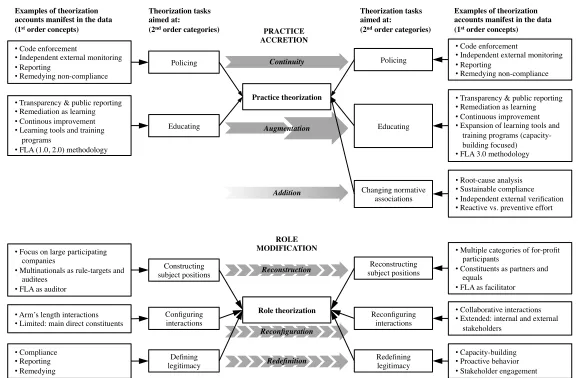
maintenance) periods. It also highlights the transitioning mechanisms in theorizing work by the FLA when shifting from fostering institutional change to maintenance.
--- INSERT FIGURE 1 ABOUT HERE ---
Findings
We found that the FLA used theorization toward different aims (theorization tasks) and that theorization transitioned over time. We observed that shifts in theorization started in 2004, most between 2004 and 2006, and were sustained until the end of the period under study (2009). We uncovered two transitioning mechanisms whereby these tasks of practice and role theorization shift, when the focus of the FLA’s institutional work transitions from change towards maintenance: practice accretion and role modification. Firstly, we found that there is accretion in practice theorization: most of the theorization accounts of practices are continued throughout the period under study, even though some are augmented with a few additional constructs and relationships and yet others are added on to sustain the introduction of new practices – but without challenging existing practices. Secondly, we observed a complete modification by the FLA of the theorization accounts of roles.
Hence, our main finding is that the use of theorization persists after institutional change, but that it is manifest in a substantially different way as the FLA shifts from promoting institutional change to ensuring stability. While theorization related to practices was either continued unchanged or slightly augmented, theorization related to roles was completely modified in the transition. We thereafter first briefly develop on the model of CSR as acceptance of supply chain responsibility that the FLA theorizes, and the different tasks of practice and role theorization. Second, we turn to answering our research question by
A theoretical model of CSR as acceptance of supply chain responsibility
As explained above, the radical change that the global apparel industry witnessed was focused on acceptance of supply chain responsibility to solve working conditions problems. This ‘independent variable’ is at the core of the FLA mission and its practices are geared toward this goal. The theoretical model theorized by the FLA starts with this premise, and elaborates on how the acceptance of supply chain responsibility can be conceived and put in practice.
The institutional arrangement implies that apparel firms have to implement a code of conduct for working conditions in contracting factories, as well as verify that the code is adequately applied and followed. The FLA therefore theorized a relationship between code enforcement and monitoring by firms, actions that indicate appropriate behavior. The FLA expects participating firms to comply with the code of conduct, to apply it throughout their supply chains, to authorize independent monitoring on the code’s application, and to
remediate issues in an effective and timely manner. Should non-compliance nevertheless be found by auditors in factories, the involved firms and factory are expected to remedy the problems in 60 days. The FLA therefore theorized specific practices, but generally depicted this entire ‘methodology’ (code enforcement, monitoring, reporting, and remediation) as a construct in itself. The methodology is theorized as an ever-unfolding process – compliance is not achieved at the moment a code is adopted and enforced, but improves over time. What is more, the FLA theorized about practices aimed at training both firms and auditors in
endorsing and supporting this process. The FLA depicted firms, focusing mostly on large multinationals, as auditees, whose compliance with the code of conduct is to be monitored continuously. Conversely, the FLA depicted itself as the enforcer of the code and controller of its adequate application in supply chains. As a result, the FLA theorized a dyadic and
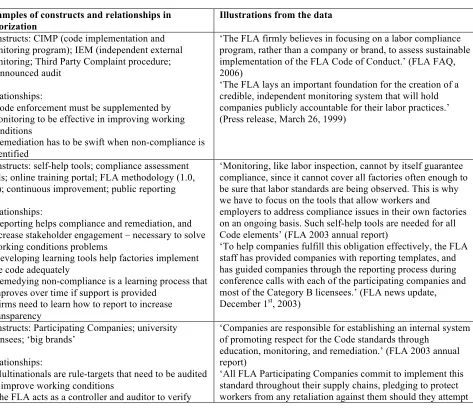
This simplified theoretical model of supply chain responsibility entails theorization of practices and roles by the FLA. On the one hand, we found that practice theorization is aimed at: (a) policing and ensuring compliance with norms of the institutional arrangement, and (b) educating different actors concerned with the arrangement. On the other hand, we found three tasks of role theorization: (i) constructing the subject positions of different actors (such as participating companies or factory managers), (ii) configuring the interactions between those actors, i.e. how they are expected to interact with each other, and (iii) defining ways to gain and maintain legitimacy for participating companies. Table 2 provides more details on these five theorization tasks, as well as examples of constructs and relationships we found in the data and illustrative quotes. While these different tasks of practice and role theorization are important in themselves, as they form the basis of the model theorized by the FLA, our research question is interested in identifying shifts in theorization, that we now examine in more detail.
--- INSERT TABLE 2 ABOUT HERE ---
Transitioning mechanisms in theorization work
The above described theorization tasks were changed or continued over time, as the FLA shifted from fostering institutional change at the turn of the millennium toward maintaining the institutional arrangement of CSR as acceptance of supply chain responsibility by apparel multinationals in the second half of the 2000s. These shifts in theorization might not have originated only from a conscious and intentional transition by the FLA from change to
maintenance; they could have been the result of external, field pressures on the FLA to adapt3.
Nevertheless, even if field pressures might have been at the origin of shifts in theorization by the FLA, it in fact underlines the need to change theorization in order to maintain the
or not intentional. Moreover, while our analysis looks only at theorization by the FLA (i.e. how the FLA depicts roles and practices as part of a larger theoretical model for diffusion), we contrast and support these findings by providing additional evidence in Table 3 from FLA constituents’ (especially participating companies) communication and media articles, which should highlight whether theorization by the FLA echoes in its field and generate according changes. Indeed, theorization should also be reflected by firms, as ‘it is employed in
individual-specific ways by the potential adopters themselves’ (Strang and Meyer, 1993: 493). As mentioned before, the fact that the FLA has constituents that have to follow its rules makes theorization by the FLA more impactful – as it steers constituents in a certain
direction, and also has the effect of potentially be reflected in the field because those constituents and stakeholders interact with other actors in the field (e.g. non-participating companies or NGOs, governments, factory workers, etc.). Moreover, and as noted before, the FLA is central in the global apparel industry, as it is a regulator and is concerned with the maintenance of the norms previously established. We now examine how the two transitioning mechanisms operate for each of the five theorization tasks our analysis uncovered.
--- INSERT TABLE 3 ABOUT HERE ---
Practice accretion
conditions need to be addressed to solve those issues in the long term. Hence, some practice theorization accounts are continued without changes, but some new accounts are added on, or augment existing accounts – but without challenging existing practices. We dub this
mechanism practice accretion, and now examine how the three theorization tasks evolved (or not) in the transition from change to maintenance.
Continuity in policing. Theorization aimed at policing refers to ways to enforce and control the norms of the institutional arrangement. In creating categories related to control, practice theorization aimed at policing creates complex relationships between elaborated systems to verify compliance and establish sanctions. The aim of this theorization task is to ensure both the adoption of norms and their reproduction over time.
For example, the policing system is theorized as a construct by the FLA in the form of various categories related to control, such as its code implementation and monitoring program (CIMP), the need for independent external monitoring (IEM) and unannounced audits in factories, without which, the FLA emphasizes, working conditions in factories would not improve (additional theorized constructs and relationships are provided in Table 2 above). The FLA also theorizes several relationships between improvement in working conditions in factories and a credible system of enforcement of, compliance with, and monitoring of the code, as well as fast remediation of issues found in audits. To solve working conditions issues in factories, the FLA theorizes that such a policing system must be sustained and thoroughly checked over time. The following quote illustrates one such relationship, how a code of conduct and independent monitoring is needed to improve working conditions:
We foundthat policing in practice theorization remained the same throughout the period under study. The categories and relationships related to control are depicted as core to the policing system (and ultimately to solving working conditions issues) of the FLA. While practice theorization accommodates necessary additions (such as learning tools geared toward capacity-building or independent external verification, as detailed below), theorization about the policing system does not experience any significant changes. Policing remains focused on compliance with the norms and monitoring that compliance over time. The following quotes from the later period in the data show how another relationship related to control
(unannounced audits help improve working conditions by uncovering issues), is still seen as a cornerstone of the policing system:
‘When the FLA’s work began in the late 1990s, the greatest challenges were evaluating the situation in a particular factory and determining how best to target efforts to improve workplace conditions. The most effective tool at the time, the unannounced audit, exposed existing violations. It was followed up with the creation of a corrective action plan that included remediation and subsequent verification that the necessary changes had been made. This has been the core of the FLA system and makes it unique as compared with other initiatives.’ (FLA 2007 annual report)
‘Traditional labor compliance audits continue to be a very important due diligence tool for checking and measuring compliance at key points.’ (FLA 2008 annual report)
Practice theorization geared toward policing thus defines the basis upon which
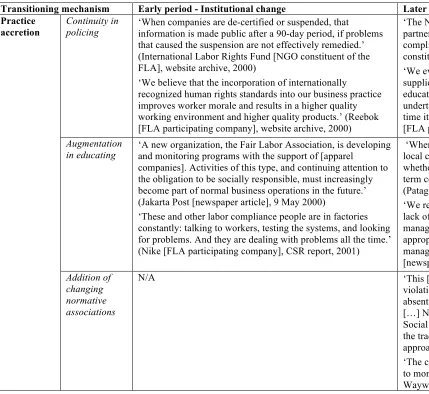
additional and incremental changes can be made to ensure the maintenance of the institutional arrangement. In keeping theorization aimed at policing constant, the FLA ensures that the basic underlying policing system is not questioned. The quotes in Table 4, from the later period in our data, show continuity in policing when compared to those of Table 2 (from the earlier period) above.
--- INSERT TABLE 4 ABOUT HERE ---
norms of the institutional arrangement) in their day-to-day operations to solve working conditions issues. Educating therefore involves theorizing about several practices that are geared toward embedding the norms of the institutional arrangement in the mindset of firms and auditors.
Indeed, educating firms and auditors facilitates the embedding and routinizing of FLA requirements (such as compliance reporting, transparency, etc.), as realized by the FLA:
‘There is an interconnection between the issues […] that requires an integrated, comprehensive response. Part of that response lies in installing the appropriate policies and management tools, and part of it requires structural change in the way suppliers organize their business. This will take time and expertise that suppliers do not always have.’ (FLA 2003 annual report)
For example, the creation of categories, such as learning tools or training programs, simplifies and abstracts practices to facilitate their adoption by firms, as well as provide technical support to implement them. The FLA therefore theorizes about practices aimed at training both participating companies and auditors (essential actors for the control of norm enforcement):
‘The FLA responded [to monitors not picking up violations] by introducing a number of measures to improve the quality of the monitoring, including more stringent accreditation criteria, specific terms of reference for each audit, additional guidance on topics like freedom of association, regular observation of audits for quality control purposes, and meetings with monitors and participating company compliance staff in key regions to discuss issues and approaches. The FLA also improved the audit instrument and provided additional tools to the auditors.’ (FLA 2005 annual report, emphasis added to highlight theorization aimed at educating)
Altogether these categories and relationships aimed at educating form the basis of continuous improvement of factories, an abstract construct which, as the FLA theorizes, ultimately helps protecting workers’ rights:
While policing is continued throughout the transition from change to maintenance, practice theorization aimed at educating is augmented with additional categories and relationships from about 2004 on (comparing illustrative quotes from Tables 2 and 4 highlights how educating has changed over time). The FLA theorizes additional abstract categories aimed at adapting and transforming the structures (e.g. online reporting tool) and practices (e.g. training programs for factory management) in place to deal efficiently with working conditions issues and avoid their recurrence. For example, in later years, the FLA theorizes that, to deal with issues once for all, there is a need to educate participating
companies and factories to identify root causes of working conditions problems with the help of capacity-building projects:
‘Every problem that is discovered must be corrected in a comprehensive manner. And whenever possible, it is supplemented with training and other forms of education and tools that will help in making the changes sustainable.’ (FLA press release, November 30, 2007)
The FLA theorizes such projects to empower some actors, in particular workers and factory managers, to deal themselves with issues, thereby reducing these issues’
re-occurrence.
The FLA also theorizes its 3.0 methodology as an overarching construct, focused on sustainable compliance and introduced in 2006, that encompasses these capacity-building and training programs and takes increasing importance over time:
‘This brief description of the tools and techniques we have developed in response to the sustainability question provides some insight into the role and value of our projects. They have been combined into a coherent program code-named FLA 3.0 that we hope will generate workplaces that can manage code issues on a self-sufficient basis. We recognize that code self-sufficiency cannot simply be decreed. It has to be built in a very deliberate and purposeful manner. We need to know exactly which capacity gaps exist at factory level and we need to facilitate the filling of those gaps.’ (FLA 2007 annual report)
appropriate training programs for those new categories of for-profits (such as participating suppliers or more fine-grained categories of university licensees):
‘Because a number of the licensees are likely to begin at a relatively low level of compliance, the methodology will focus on training and capacity building. Regional, in-person trainings will take place to introduce licensees to the FLA and its labor compliance standards, and will cover such subjects as the university program, the FLA Code of Conduct, licensee obligations and strategies to build compliance programs.’ (FLA 2007 annual report)
The addition of these constructs and relationships in theorization aimed at educating served the purpose of embedding new practices and fostering their adoption by firms. While the FLA was cognizant of the fact that educating would be needed all along (the notion of ‘continuous improvement’), it realized that attaining its goals required additional education and training of actors. The augmentation of theorization aimed at educating by the FLA therefore reflects such additional ways that will enable firms to routinize new practices.
Addition of changing normative associations. The FLA not only augments existing practice theorization, but also adds on a theorization task when it transitions from change to
maintenance. This additional task of practice theorization emerged around 2004, and is aimed at changing some of the normative associations underlying the institutional arrangement (see illustrative quotes in Table 4). Changing normative associations implies ‘re-making the connections between sets of practices and the moral and cultural foundations for those practices’, but without challenging such practices (Lawrence and Suddaby, 2006: 224).
While not dismissing the policing system, in later years, the FLA emphasizes the need to deal with recurring issues in working conditions. The FLA therefore theorizes new
augmentation of some existing practices (such as the ones described in educating above) and the introduction of a few new practices to deal with working condition problems in the long term. These theorization accounts support and justify associations between the new focus on root cause analysis and long-standing firm compliance and code monitoring. For example, one specific theorized relationship emphasizes prevention over reaction to deal with recurring issues:
‘The FLA’s initial focus and approach to ending sweatshops and improving workers rights were largely reactive as well. The focus was primarily on developing immediate answers to stopping sweatshop labor and creating a system of factory monitoring intended to catch and put an immediate end to the flagrant and tragic violations of human and labor rights that were occurring’. (FLA 2007 annual report)
Theorizing work by changing normative associations between the origins of issues, practices, and outcomes ensures that practices do not become decoupled from the ultimate goal of solving working conditions problems. It also provides the grounds for the introduction of a few additional practices, and to perform slight adjustments to the institutional
arrangement. As mentioned by Lawrence and Suddaby (2006), changing normative associations do not challenge existing practices, but rather extends previous theorization accounts to accommodate adaptations.
Role modification
As opposed to continuity and incremental changes in theorization about practices, we
Reconstruction of subject positions. One task of role theorization is aimed at constructing subject positions for actors concerned with the institutional arrangement, in particular
participating companies, but also other constituents and stakeholders, such as workers, factory managers, or auditors. By theorizing subject positions, the FLA places itself and participating companies in a way that facilitates the enforcement of norms, and that defines appropriate behavior under the diffusing institutional arrangement, thereby enhancing the arrangement’s self-reproduction and maintenance.
The FLA theorizes clearly defined categories of actors concerned with the institutional arrangement in order to separate tasks and outline duties. For instance, participating firms are divided into different categories: participating companies (large brands) and university and college licensees, which imply different responsibilities. Moreover, auditors are also defined as a separate category, ‘monitors’, as they ensure and verify firm compliance with the code. These categories are always theorized in an elaborate fashion by the FLA to delineate their subject positions, and therefore their duties, clearly. For example:
‘Accredited monitors must meet specified standards regarding their capability and independence. These monitors must abide by clear evaluation guidelines and criteria; verify internal monitoring; have independent access to and conduct independent audits of employee records; conduct periodic visits and audits, mostly unannounced; […] conduct confidential employee interviews; submit an evaluation report to the company and the FLA’. (FLA FAQ 2002-2005)
In the beginning of its existence, the FLA puts a lot of emphasis in role theorization on constructing subject positions of for-profits. Firms are placed in subject positions that require them to abide by the FLA’s rules and accept responsibility for their supply chains:
‘All FLA Participating Companies commit to implement this standard throughout their supply chains, pledging to protect workers from any retaliation against them should they attempt to organize’. (FLA press release, October 10, 2003)
the power to revoke firms’ participation (an event that has happened once in the period under study). The FLA therefore also theorizes its own subject position as one of an enforcer of rules and controller of firms:
‘The FLA will oversee the monitoring of apparel and athletic footwear factories in the U.S. and abroad to ensure that participating companies are upholding internationally recognized labor rights standards’. (FLA press release, March 26, 1999)
These subject positions are theorized differently when the FLA shifts from supporting change to maintenance. Whereas the subject position of participating firms has previously been theorized by the FLA to be that of auditees, corporations were later constructed as partners in the process of improving labor conditions, as illustrated in this quote:
‘Our accredited affiliates are agents of change that have worked hard to meet the considerable obligations of the FLA, as well as working closely with us to help develop sustainable solutions to some of the most challenging labor concerns’. (FLA press release, November 19, 2008)
Moreover, the FLA also redefines its own subject position, not as the enforcer it described itself before, but rather as a facilitator to improving working conditions, helping firms in this process.
While large multinationals and university licensees (revenues over $50 mios) were the main actors whose subject positions were theorized in the beginning, the FLA theorizes more consistently about other categories of for-profit organizations over time. For instance, when previously fostering change, the FLA positioned suppliers as peripheral actors (as opposed to multinationals who were theorized as the main source of working conditions problems). When supporting maintenance, however, the FLA creates (in 2007) a category dedicated to participating suppliers, which highlights the reconstruction of suppliers’ subject positions as more central. By the same token, under maintenance, the FLA theorizes several new
categories of university licensees.
universities), but also external stakeholders, such as employees, factory managers, trade unions or external NGOs. This is reflected, for example, in the number of university seats on the FLA board, which increased up to six in 2006, equaling that of NGOs and companies. The balance between the three constituents (for-profits, NGOs, universities) of the FLA is
theorized as being necessary to address poor working conditions. The FLA therefore theorizes subject positions on a more equal footing to be able to attain its goals.
Reconfiguration of interactions. The second task of role theorization we identified is related to subject positions, but deals more specifically with configuring and prescribing the
interactions between actors. In the beginning of the period under study, focusing on large multinationals, the FLA theorizes a patterned relationship of the interactions between firms as auditees, whose compliance with the code of conduct is to be monitored, and the FLA itself as an enforcer and controller, as illustrated here:
‘As this [sweatshop] debate moves forward we urge you to join with us in focusing on our common adversary, namely the many companies in this country and abroad who have kept their heads down and who have been unwilling to face their responsibilities with respect to these issues. Our collective energies need to be focused on developing new models of oversight and enforcement that will serve to isolate those who continue to sell products produced in complete disregard for the human rights of their workers. We believe that the Fair Labor Association is one such model’. (FLA press release, 26 March 1999)
As explicated above, the FLA, in the early period, theorizes a dyadic and antagonistic interaction between the FLA and participating firms – the latter enforce the norms and the FLA controls their enforcement, as illustrated at numerous occasions in the data:
‘The FLA process begins with companies making a formal commitment to the FLA’s standards and system. Companies agree to adopt the FLA Workplace Code of Conduct in the manufacture of their products. This marks the first step. The “continuous improvement approach” of the FLA program then requires companies to put principle into practice.’ (FLA 2004 annual report)
compliance by firms, auditors are the actors that implement monitoring. In case of non-compliance, remediation is to be undertaken by firms, under the control of the FLA.
Such theorization of interactions between actors is also modified over time by the FLA. Especially, the interactions between the FLA and large firms are now theorized as a collaborative and collectivistic relationship, that has to involve other constituents and external stakeholders:
‘It is all part of a constantly evolving process that requires vigilance, creativity and the support and involvement of the companies, universities and colleges, and NGOs and trade unions who have made the commitment to work with the FLA and uphold fair labor standards’. (FLA 2007 annual report)
Hence, role theorization aimed at configuring interactions between actors shifts focus from the FLA and participating companies to compliance as an open and consultative process with other constituents and external stakeholders:
‘A key objective of many projects and undertakings by the FLA is to involve a wider and more diverse set of stakeholders in our efforts to address global issues in labor compliance. The FLA frequently hosts multi-stakeholder forums to provide a respectful environment for different groups to provide their perspectives on the issues and to collaborate on projects and solutions. The FLA forums draw representatives from non-governmental organizations, trade unions, government agencies, suppliers, companies, and universities to exchange experiences, ideas, and possible initiatives to improve working conditions in the supply chain.’ (FLA 2008 annual report)
Trust is theorized as a cornerstone of these more cooperative interactions between actors. While previously the FLA theorized arm’s length and command and control
interactions, it now emphasizes the need for trust between parties, which will generate closer and more collaborative interactions as well:
‘It is important to understand that a critical piece of the 3.0 system is the development of a relationship of trust between the FLA, the supplier and the buyer. The supplier has to be confident it will not be judged for revealing potential problems in the facility. For that reason FLA affiliates are asked to start implementing 3.0 in those factories they know well and with which they have a good relationship. Communication and cooperation are crucial’. (FLA 2007 annual report)
taken-for-granted norms (Meyer and Rowan, 1977), the FLA theorizes about appropriate norms and prescribing adequate behavior, as illustrated by multiple normative statements by the FLA:
‘Global brands can’t afford any longer to be associated with sweatshops, and the FLA creates a credible system for empowering consumers to punish dirty companies and reward improving ones’. (FLA press release, June 20, 2000)
The FLA therefore creates, in the early period, a relationship between code enforcement and monitoring by firms, and appropriate behavior. Participating firms are expected to follow the policing system to the letter. By following the behaviors prescribed by the FLA consistently, participating companies can be accredited as ‘good citizens’ after three years.
Along with the modifications in theorizing the subject positions of and interactions between actors, the FLA also modifies its theorization aimed at defining the source of legitimacy for firms. In the later period of our study, the FLA theorizes that participating firms are granted a ‘license to operate’ if they engage in proactive actions toward solving working conditions issues in the long term:
‘The increasing transparency of the supply chain will place an onus on socially responsible companies to take proactive steps to manage the risks present in the life cycle’. (FLA 2008 annual report)
According to the reconstruction of their subject positions as partners, companies are required to engage in capacity-building projects, empower factory managers, workers, and surrounding communities to prevent the emergence of issues. Along with the reconfiguration of interactions as collaborative reported above, firms are expected to engage in such
collaborations:
‘[FLA staff member] argued that brands legitimize their compliance programs when they demonstrate collaboration with other brands and multi-stakeholder initiatives and when they are transparent’. (FLA news update, March 20, 2006)
of the institutional arrangement that are reflected in the augmentation of and addition to practice theorization. Firms are now granted legitimacy by engaging in capacity-building activities, rather than simply abiding by a code of conduct. As available practices to deal effectively with the problems at hand evolve, so does role theorization on firms’ legitimacy. In order to maintain the institutional arrangement, the FLA shifts the basis for legitimacy alongside other dimensions of the arrangement.
Discussion
Our research question asked how theorization about roles and practices change when
organizations shift from creating to maintaining institutions. Broadly, our results demonstrate that, in transitions, theorization about practices change only in degree, but not fundamentally in content. Theorization about roles, by contrast, demonstrated profound change in content in order to foster the diffusion and sedimentation of the institutional arrangement. This main finding is instantiated in our uncovering of two transitioning mechanisms: practice accretion and role modification.
Our analysis thus shows the necessity of continuity in some practices for transitioning to maintenance, but also expansion of others. More surprisingly, and contrary to extant literature, our analysis shows that, as some new practices (e.g. capacity-building focused projects) are introduced, the subject positions of their endorsers are redefined to facilitate the adoption of these practices, both by original intended adopters (apparel multinationals), but also by newly theorized adopters (smaller firms, licensees, or suppliers). This modification of subject positions allowed the FLA to deal with a larger set of problems. While theorizing additional subject positions reflected the increasing number and diversity of firms
participating in the FLA as the institutional arrangement diffused, the FLA had to
several stakeholders, mostly left out in the beginning, as more central (such as suppliers or factory managers), the norms are theorized as becoming more efficient, representative, and better able to deal with poor working conditions in the long term.
Our analysis has focused on theorization (that is, a certain form of talk) by the FLA only. Hence, some of the causes of shifts in such talk can be external to the FLA. Our goal was not to explain these causes, but rather to show how the FLA transitions from effecting change to sustain the acceptance of supply chain responsibility by apparel firms over time. We have acknowledged some potential sources of change in theorization efforts by the FLA. That the FLA was pressured to change some practices actually supports our analysis, because such pressures show the critical need for maintaining work. Indeed, without such work, the responsibility for working conditions, so far assigned to apparel multinationals, could shift to other actors, such as national governments or multilateral organizations (e.g. the ILO or the UN). Hence, to keep multinationals responsible for supply chains (and to have them adopt according practices), the FLA had to alter part of its theorization efforts. Those firms too must have been willing to shift toward capacity-building to some extent. We have given some evidence that FLA’s theorization is reflected in the field by providing quotes from participating companies and the media. Our data suggest that firms have gone along the transition because moving away from a strict policing, arm’s length model of compliance, toward capacity-building allows firms to regain some control on the process. Moreover, being regulated by a private body allows firms to escape governmental regulation to some extent (Gond et al., 2011; Marques, 2015).
2002: 72). By contrast, our results show that ongoing theorization is not merely repetition, but must evolve to accommodate the different aims of social change versus maintenance. We therefore address the problem of institutional research to resolve the apparent contradiction of stability and change (Greenwood and Suddaby, 2006), by exploring more comprehensively the dynamic relationship between practices and roles.
More specifically, research has not completely appreciated the degrees of creative freedom that exist in role repertoires. Neo-institutionalism has, traditionally, adopted a structuralist view of roles as relatively stable bundles of norms, expectations, and positions, understood as confining spaces or path dependent strictures that actors, as cultural dopes, must reify in a given way (Scott, 2001). Symbolic interactionists, however, tend to see roles as much less determinative social structures, and are understood as resources for creativity and change (Goffman, 1974; Stryker, 1980), and therefore as tools for agency in highly institutionalized contexts (Baker and Faulkner, 1991; Callero, 1994). Following this line of thought, our analysis reinforces the view of roles as rhetorical opportunities, offering enhanced reflexivity and creativity of actors engaging in processes of institutional work (Golant et al., 2014; Heaphy, 2013). Our data demonstrates a high degree of plasticity in the roles theorized by the FLA. Not only did the range of types of roles theorized increase as the FLA began to focus on promoting stability, but the way in which existing roles were made manifest also changed. Hence, to the extent that newly theorized roles are picked up by other actors and diffuse (Strang & Meyer, 1993), our data suggests that roles are social resources for theorization and, as such, constitute a key tool for institutional work.
realization that root causes of poor working conditions need to be addressed) and in the organization of one of its central actor (the strategic planning process of the FLA began in 2004). How should we account for this contradictory influence of stability in the face of powerful forces of institutional change? We view the relative stability of practices as an essential counterbalance to the malleability of roles in processes of theorization. In order to maintain legitimacy, an institution must present as an enduring and relatively stable social structure (Boiral, 2007). Practices, commonly understood as basic categories of social action (Bourdieu, 1977; Feldman and Orlikowski, 2011; Garfinkel, 1967; Giddens, 1979), are, perhaps, the most visible component of institutional structures. An institution that changes roles and practices simultaneously cannot possibly maintain the illusion of stability. The stability of practices, therefore, is an inherent component of theorization that masks the degree of social change and reinforces the legitimacy of, and confidence in, institutions.
Our findings on the dynamics between roles and practices have boundary conditions. Prior research has shown different dynamics between roles and practices. Studying the maintenance of the British class system through formal dining in Cambridge colleges, Dacin et al (2010) show how practices (e.g. dressing attires) and roles (e.g. of fellows or students) are repeated in the same way over hundreds of years to reify the class system. On the contrary, studies of institutional change have highlighted shifts in both practices and roles (e.g. Delbridge and Edwards, 2008; Greenwood et al., 2002). As noted, institutional
Conclusion
We contribute to and extend research in institutional theory by offering a detailed examination of the dynamic interaction of roles and practices in the theorization of
institutional transitions. Foremost, we highlight that theorization is important, not only during processes of institutional change, but also during periods of maintenance. Our results extend prior work on diffusion and theorization in three key respects. First, while most prior studies assume that diffusion occurs relatively effortlessly and largely based on the strength of the ideas being theorized (Gondo and Amis, 2013), we demonstrate that there is, in fact, a high degree of reflexivity and agency required on the part of actors engaged in promoting new institutional arrangements. Second, while prior studies often assume that the ideas – new models of management, innovative organizational structures or new ways of measuring organizational effectiveness – themselves remain intact as they move from one context to another (e.g. Boxenbaum and Battilana, 2005), our results demonstrate instead a high degree of malleability in how roles and practices are theorized. This plasticity of ideas is particularly obvious when institutional arrangements become established and need to be maintained. Third, while most prior studies of diffusion conflate practices and roles as equivalent
constructs (Ansari et al., 2010), we demonstrate that practices and roles are distinct elements of theorization that are not equally institutionalized. Our study points to an understanding of roles, not as iron cages of institutional reproduction, but rather as key rhetorical resources for institutional variation and experimentation, even when the focus is on institutional
maintenance, which ultimately impact on the diffusion, sedimentation, and ultimate form of the institutional arrangement. Overall, our core contribution is to unpack theorization as a highly agentic and complex process of institutional work.
change to skillfully manage changes in their own subject position. Successful diffusion, thus, is less dependent on the content of the ideas as it is on the interests, agency and plasticity of the institutional workers. This observation is particularly visible and acute in contexts where institutional change is shifting from a phase of revolutionary change to evolutionary
maintenance. Our core contribution thus is that if we want to understand the mechanisms of effective theorization in processes of the diffusion of new ideas, we should shift attention away from the content of the ideas and the pathways through which they diffuse and pay more attention to the roles, practices and subject positions of the institutional workers.
Our study has implications for a larger set of literatures in management research. Our results can be of interest to anyone interested in understanding successful organizational change or who wish to understand how some innovations or ideas successfully diffuse while others do not (e.g. Boxenbaum and Battilana, 2005; Perkmann and Spicer, 2008). Our findings therefore speak to areas such as, for example, organizational change, strategic planning, or technological standards. Landau et al (2014: 1323), for instance, show how narratives supporting successful organizational change focus on legitimizing practices rather than roles. In contrast, we would argue that focusing on roles rather than practices can also fuel successful organizational change. Similarly, part of the literature on strategic planning as emphasized the role of specific practices, such as committees (Hoon, 2007), for successful change. In research on technology and standards, it is commonly accepted that features of a new technology will influence its supremacy (Garud et al., 2002). In most of these literatures, hence, the focus is on practices as resources to implement change. Our study highlights the need to examine roles as a potentially more important resource for maintaining successful change over time.
change – whether it is a code of conduct, but also a technological innovation, or a change in organizational structure – is to carefully change one’s own role and subject position before one’s practices. Our case also highlights the fact that an organization can theorize about the role of its members or stakeholders (such as employees, managers, or suppliers) in order to deal with the consequences of radical change and to successfully stabilize one’s place in an environment in flux.
There are limitations to this study. We analyze a single case and our results, while generalizable to theory, may not necessarily generalize to other empirical settings. Also, we analyze a single actor. That is, we have not examined the dynamics of roles and practices in other key actors in this organizational field, even though we have accounted for firms’ communication and media reflections of changes in the FLA’s theorizing work. Future research should address the extent to which theorization by a central actor is picked up by other actors in the field, and the impact that it has on further change and stability in the field. Another important research avenue would be to examine theorization by competing
organizations, and the extent to which theoretical models for an institutional arrangement are different and how this influences change and stability.
Despite these limitations, we see this paper as answering ongoing calls for neo-institutional theory to adopt a more process-oriented view of institutions (Suddaby, 2010), and to attend more carefully to the micro-dynamics (Powell and Colyvas, 2008) and
phenomenological roots (Barley, 2008) of institutional theory. Moreover, we see this study as an important step in overcoming the unfortunate separation or duality of processes of
Endnotes
1 The most well-known and influential of those global initiatives are: the Apparel Industry
Partnership/Fair Labor Association, the Ethical Trading Initiative, the Fair Wear Foundation, SA8000, the Worker Rights Consortium and Worldwide Responsible Accredited Production. Those initiatives and their founding dates are highlighted in bold in Table 1.
2 The private regulatory oversight of business is by far not unique to the apparel industry. A
large number of industries worldwide have witnessed the emergence of private regulatory initiatives in the last 25 years (Djelic and Sahlin-Andersson, 2006; Mena and Palazzo, 2012), in diverse areas such as forestry (Cashore et al., 2005), coffee (Reinecke et al., 2012), or accounting (Richardson and Eberlein, 2011).
3 These field pressures could be as follows. First, the entire field reconsidered the value of
monitoring and audits (Esbenshade, 2004). As contracting factories often supply various multinationals, these factories could be audited multiple times, sometimes leading to audit fatigue and therefore less relevant audit results (Locke et al., 2007). What is more, over the years, audits began to uncover problems that had already been identified beforehand (Lim and Phillips, 2008; Yu, 2009), pushing the FLA and other private regulatory initiatives in the industry to develop more sustainable solutions. Second, the FLA undertook a strategic planning starting in 2004. According to board meeting minutes, this process was the result of the above mentioned recurring problems, which needed more long-term and effective
References
Ansari SM, Fiss PC and Zajac EJ (2010) Made to Fit: How Practices Vary as they Diffuse.
Academy of Management Review, 35(1): 67-92.
Baker WE and Faulkner RR (1991) Role as resource in the Hollywood film industry.
American Journal of Sociology, 97(2): 279-309.
Barley SR (2008) Coalface institutionalism. In: Greenwood R, Oliver C, Sahlin K , Suddaby R (eds.), The Sage handbook of organizational institutionalism. London: Sage, 491-518.
Bartley T (2005) Corporate Accountability and the Privatization of Labor Standards: Struggles over Codes of Conduct in the Apparel Industry. Research in Political Sociology, 14: 211-244.
Bartley T (2007) Institutional Emergence in an Era of Globalization: The Rise of
Transnational Private Regulation of Labor and Environmental Conditions. American Journal of Sociology, 113: 297-351.
Bartley T (2010) Transnational Private Regulation in Practice: The Limits of Forest and Labor Standards Certification in Indonesia. Business & Politics, 12(3): art.7. Boiral O (2007) Corporate greening through ISO 14001: a rational myth? Organization
Science, 18(1): 127-146.
Bourdieu P (1977) Outline of a theory of practice. Cambridge: Cambridge University Press. Boxenbaum E and Battilana J (2005) Importation as innovation: Transposing managerial
practices across fields. Strategic Organization, 3(4): 355-383.
Cashore B, Van Kooten GC, Vertinsky I, Auld G and Affolderbach J (2005) Private or self-regulation? A comparative study of forest certification choices in Canada, the United States and Germany. Forest Policy and Economics, 7(1): 53-69.
Currie G, Lockett A, Finn R, Martin G and Waring J (2012) Institutional work to maintain professional power: recreating the model of medical professionalism. Organization Studies, 33(7): 937-962.
Dacin MT, Munir K and Tracey P (2010) Formal dining at Cambridge colleges: Linking ritual performance and institutional maintenance. Academy of Management Journal, 53(6): 1393-1418.
Delbridge R and Edwards T (2008) Challenging conventions: Roles and processes during non-isomorphic institutional change. Human Relations, 61(3): 299-325.
DeWinter R (2001) The Anti-Sweatshop Movement: Constructing Corporate Moral Agency in the Global Apparel Industry. Ethics & International Affairs, 15(2): 99-115.
DiMaggio P and Powell WW (1983) The iron cage revisited: Institutional isomorphism and collective rationality in organizational fields. American Sociological Review, 48(2): 147-160.
Djelic M-L and Sahlin-Andersson K (2006) Transnational governance: Institutional dynamics of regulation: Cambridge University Press.
Esbenshade J (2004) Monitoring sweatshops: Workers, consumers, and the global apparel industry. Philadelphia: Temple University Press.
Etzion D and Ferraro F (2010) The Role of Analogy in the Institutionalization of Sustainability Reporting. Organization Science, 21(5): 1092-1107.
Feldman MS and Orlikowski WJ (2011) Theorizing practice and practicing theory.