City, University of London Institutional Repository
Citation
: Laybourne, A. H., Morgan, M. J., Watkins, S. H., Lawton, R., Ridsdale, L. and
Goldstein, L. H. (2015). Self-management for people with poorly controlled epilepsy:
Participants' views of the UK Self-Management in epILEpsy (SMILE) program. Epilepsy and
Behavior, 52(A), pp. 159-164. doi: 10.1016/j.yebeh.2015.08.023
This is the accepted version of the paper.
This version of the publication may differ from the final published
version.
Permanent repository link:
http://openaccess.city.ac.uk/12640/
Link to published version
: http://dx.doi.org/10.1016/j.yebeh.2015.08.023
Copyright and reuse:
City Research Online aims to make research
outputs of City, University of London available to a wider audience.
Copyright and Moral Rights remain with the author(s) and/or copyright
holders. URLs from City Research Online may be freely distributed and
linked to.
UNCORRECTED PR
OOF
Q1
Self-management for people with poorly controlled epilepsy:
2
Participants'
views of the UK Self-Management in epILEpsy
3
(SMILE) program
Q2
A.H.
Laybourne
a,⁎
,
M.
Morgan
b,
S.H.
Watkins
a,1,
R.
Lawton
a,2,
L.
Ridsdale
a,
L.H.
Goldstein
a5 aKing's College London, Institute of Psychiatry, Psychology, and Neuroscience, 16 de Crespigny Park, London SE5 8AF, United Kingdom 6 b
King's College London, Division of Health and Social Care Research, Addison House, Guy's campus, London SE1 1UL, United Kingdom
a b s t r a c t
7
a r t i c l e i n f o
8 Article history:9 Received 10 July 2015
10 Revised 11 August 2015
11 Accepted 17 August 2015
12 Available online xxxx
13 Keywords:
14 Epilepsy
15 Self-management
16 Long-term conditions
17
Background:Epilepsy is a long term condition that requires self management,but currently,there is no well
18
evaluated epilepsy self education or self management intervention in the United Kingdom (UK).
Aim:The aim of this study wasto examine the views and experiences of thefirst participants of the Self Q3
20
Management in epILEpsy UK (SMILE UK) program to assistthedevelopment of a full trial.
21
Method:In depth semistructured interviews and group discussions were conducted with 10 people with poorly
22
controlled epilepsy to explore their views and experiences of the self management program. Interviews were
23
audio recorded, transcribed,and analyzed thematically.
24
Results:All participants viewed the program positively. Three themes emerged: i) peer support was experienced
25
through knowledge sharing, disclosure of experiences, and exchange of contact details; ii) participants felt better
26
equipped to enter discussions with doctors and other health care professionals about their condition;and
27
iii) participants reported an improvement in their personal life through increased confidence to live with
28
epilepsy and acceptance of their diagnosis.
29
Conclusion:A brief group self management intervention increased knowledge and confidence in managing
30
epilepsy.
31
© 2015 Published by Elsevier Inc.
36 1. Introduction
37 One of the greatest challenges to global health and social care orga
38 nizations is the increasing prevalence of long term conditions and mul
39 tiple morbidity[1]. The associated health care costs are considerable:
40 estimates for the proportion of total national health expenditure in
41 the United States associated with chronic disease is 75%[2]. In England,
42 80% of general practitioner consultations are by people with chronic dis ease[3].
Q4 Theconcerntoboth reduce costs and increase quality of life has
44 led to an increased focus on self care strategies as a central component
45 of the management of long term conditions with the aim of enhancing
46 patients'knowledge, skills,and confidence to manage their own health
47 [4]. Variations exist in the literature for defining self management,but
48
in its simplest form, it describes a patient taking an active role in his
49
or her treatment[5].
50
Epilepsy is a long term condition that requires individuals to learn to
51
manage their own condition, including identifying and managing sei
52
zure triggers, implementing strategies to comply with multiple antiep
53
ileptic drugs, implementing precautions to minimize seizure related
54
risks, and educating others what to do during and following a seizure.
55
A consistentfinding is that many people with epilepsy would like to re
56
ceive better provision of information about how to live with and man
57
age their condition[6 10]. However, currently,there is no well
58
evaluated self education or self management intervention in the
59
United Kingdom (UK) for epilepsy, despite this being a relatively com
60
mon condition with over 600,000 people with epilepsy in the UK and
61
estimates that countries in Europe spend around 1% of their national
62
health care expenditure on epilepsy[11].
63
Cochrane reviews[12,13]have found four epilepsy specific educa
64
tional interventions, including the Modular Service Package Epilepsy
65
(MOSES) program, developed in Germany and offered as part of routine
66
epilepsy care in the German health care system[14].TheMOSESpro
67
gramcan be offered as a two day educational program for groups of be
68
tween eight and 12 individuals,and relatives/carers may attend. It is
69
suitable for application in both inpatientand outpatient settings for
70
people with epilepsy aged 16 years and older without a learning
Epilepsy & Behavior xxx (2015) xxx–xxx
⁎ Corresponding author at: School of Health Sciences, City University London, Northampton Square, London EC1V 0HB, United Kingdom. Tel.: +44 20 7040 5903.
E-mail addresses:[email protected](A.H. Laybourne),
[email protected](M. Morgan),[email protected](S.H. Watkins),
[email protected](R. Lawton),[email protected](L. Ridsdale),
[email protected](L.H. Goldstein).
1
Present address: School of Social and Community Medicine, University of Bristol, 39 Whatley Road, Bristol BS8 2PS,United Kingdom.
2
Present address: Hospital & Health Care, The London Clinic, 20 Devonshire Place, London W1G 6BW,United Kingdom.
http://dx.doi.org/10.1016/j.yebeh.2015.08.023
1525-5050/© 2015 Published by Elsevier Inc.
Contents lists available atScienceDirect
Epilepsy & Behavior
UNCORRECTED PR
OOF
71 disability. The program is designed to foster interaction between those
72 attending as well as with the course leaders and to encourage process
73 ing of material at an emotional and cognitive level as well as facilitating
74 a change in behavior. The MOSES program has demonstrable benefits
75 including improved knowledge about epilepsy, better seizure control
76 and coping, and a greater tolerance of and fewer reported side effects
77 of antiepileptic drugs[14]. We contend that MOSES shows promise for
78 transfer to the UK setting[15].
79 In preparation for trialing MOSES in the UK, we took advantage
80 of developmental work[16]to adapt it to the UK setting and build
81 workforce capacity through the development of high quality program
82 Facilitators. The materials and course content werefinalized as the
83 SelfManagement in epILEpsy (SMILE (UK)) program in May 2013, com
84 prising nine modules: living with epilepsy,people with epilepsy,basic
85 knowledge,diagnosis,treatment,self control,prognosis,personal and
86 social life,and networking. These topics are delivered using a range of
87 teaching techniques that encourage group participation and are also
88 based around some factual information: the use of statement scales
89 (participants are each invited to identify where on a scale they view
90 themselves in response to a statement such as“Epilepsy makes me
91 feel lonely”),brainstorming by the group,the provision of ideas used
92 for mind mapping,and conveying some information via factual slides.
93 Prior to undertaking a randomized controlled trial of SMILE (UK)[15]
94 with patients with poorly controlled epilepsy, we carried out pilot
95 work including the qualitative exploration of pilot patients'personal
96 views and experiences of the program. It is these views and experiences
97 of thefirst UK recipients of the program that we report here.
98 2. Method
99 2.1. SMILE (UK) program
100 Two pilot courses were delivered. A course comprised two days
101 each 09:30 to 17:00 scheduled as four main half day sessions with a
102 lunch break and two further breaks for refreshments per day. Staff
103 with expertise in aspects of epilepsy management were recruited by
104 LR to act as course Facilitators. Each pilot course was delivered by two
105 Facilitators who were an epilepsy nurse specialist (ENS) and an EEG
106 technician. The venue was the education center of a large teaching hos
107 pital that was familiar to the participants through their treatment and
108 adjacent to the emergency department. Each participant was given a
109 copy of the program workbook, with chapters corresponding to the
110 nine modules that formed part of SMILE (UK). Each chapter contained
111 some factual information that served to underpin the more interactional
112 nature of the delivered sessions, with dedicated spaces for participants
113 to write notes or complete exercises, as well as bullet point summaries
114 of each of the topics covered during the sessions.
115 2.2. Participants
116 Twenty two people were recruited to the pilot study through an ad
117 vertisementplaced on the website and social media associated with
118 Epilepsy Action (March 2013 May 2013). Nine were lost to recruitment
119 (unable to contact, health reasons, work commitments). Thirteen adults
120 with a formal diagnosis of epilepsy, being prescribed antiepileptic medi
121 cation, who had experienced more than one seizure in the previous 12
122 months participated in one of two pilot SMILE programs and,additional
123 ly, were invited to give their views and experiences. Two participants did
124 not complete the course. One participant required emergency depart
125 ment treatment for an injury sustained during a seizure and did not at
126 tend one afternoon session,and the second participant left an hour
127 early on one of the days due to seizure related tiredness. Three partici
128 pants declined to participate in these interviews.
129 The views and experiences of 10 participants in the SMILE (UK) pro
130 gram were collected pragmatically through group interviews with one
131 group of three participants and semistructured interviews with seven
132
participants, of which four were conducted face to face and two as tele
133
phone interviews, in response to individual preference. One individual
134
responded via email. Individual interviews typically lasted between 20
135
and 30min,and the group session took 60min. All data collection oc
136
curred within one month of completing the SMILE (UK) course.
137
2.3. Interview topic guide
138
A topic guide was developed by the research team in consultation
139
with colleagues at Epilepsy Action. The topic guide covered participants'
140
reasons for volunteering, views of the course materials and style of the
141
course, and perceived usefulness of the program (Table 1). AL conduct
142
ed the interviews and was not involved in the implementation of the
143
pilot courses to minimize data contamination.
144
2.4. Data analysis
145
Interviews and discussions were audio recorded and transcribed
146
verbatim. Each transcript was checked and read in full by AL, with a
147
sample read by MM and LR, to gain an overall perspective of the data
148
and to allow for a comparison of interpretations, thereby enhancing re
149
flexivity. The topic guide prompts wereflexible, allowing for revision of
150
prompts during interviewing phase if necessary. The formal process of
151
data analysis began with reading the transcripts and making notes of
152
participants'perceptions and explanations in the margins. Data were
153
analyzed iteratively, going back and forth between data and an emerg
154
ing structure of‘ground up’themes related to the study objectives. The
155
qualitative data analysis software NVivo 9 (QSR International) was used
156
to systematically code the data and assist analysis. Emergingfindings
157
and interpretations were discussed during group meetings.
158
The National Research Ethics Committee London (Fulham) approved
159
the study (12/LO/1962). Informed consent was obtained from all
160
participants.
161
3. Findings
162
3.1. Participants'characteristics
163
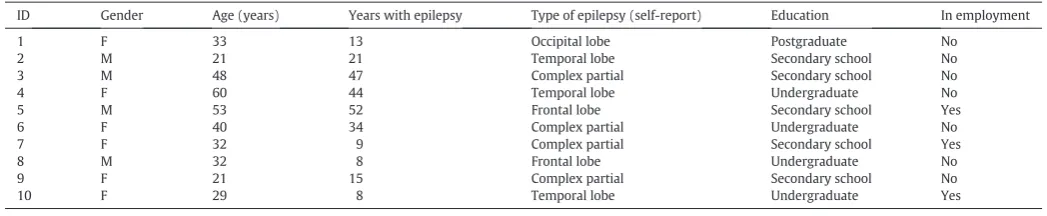
The participants'mean age was 37 years (SD 13.1), mean years living
164
with epilepsy was 25 years (SD 17.5), and 60% were female (Table 2).
t1:1
Table 1
t1:2 Topic guide.
t1:3 Following brief introduction and reappraisal of consent and questions about
t1:4 participants'circumstances (age, living arrangements, educational achievement),
t1:5
they were asked about their views and experience of taking part in the pilot SMILE
t1:6
(UK) program. The main prompts (in italics) are given below:
t1:7 Why did you decide to take part in the SMILE pilot?
t1:8
Have you been involved in anything like this before?
t1:9
Was it because it was something you had been looking for already,or was it the idea
t1:10
of being part of something new in epilepsy treatment,for example?
t1:11 What did you think of the content of material that was delivered during the two
t1:12 days?
t1:13
Topics covered?Were any that were particularly useful?Any that you found you
t1:14
didn't particularly like?
t1:15
How did youfind the way in which information was delivered?Was it easy to
t1:16
understand or a bit difficult?
t1:17
How did youfind learning with others in a group?
t1:18
Were there any advantages to this for you?Were there any disadvantages for you?
t1:19
Did youfind it easy to participate and contribute or was this difficult?
t1:20
What did you think of the different teaching methods used? (Statements, mind
t1:21
maps, brainstorming and information slides)
t1:22
Did you like the different teaching methods used during the course or did youfind
t1:23
them confusing?
t1:24
How useful do you consider the course to be for the future?
t1:25
Do you think you'll be able to use anything you experienced on SMILE again?Useful
t1:26
to use with others in your life?
UNCORRECTED PR
OOF
165 The most frequent type of epilepsy self reported by participants was
166 temporal lobe epilepsy. Only three participants were in formal employ
167 ment, all on a full time basis. All participants had achieved GCSE level
168 qualification atasecondary school, four had obtained an undergraduate
169 degree,and oneobtaineda postgraduate degree.
170 3.2. Smile (UK): participants'views
171 Participants reported a variety of reasons for volunteering to take
172 part in the pilot SMILE program. For one, it was part of taking control
173 of her life andfitted in with her self management decision making;
174 for four participants, taking part was for general interest, in particular
175 meeting others with epilepsy; two participants took part because the
176 research was developing a new treatment, including one individual
177 who saw it as“giving back”to the medical community.
178 Of the nine topics covered during the course, four were highlight
179 ed as being particularly useful: Basic Knowledge, a chapter which
180 covers common questions about epilepsy, including the different
181 causes of epilepsy, the development of seizures, and how to identify
182 different types of seizures; Diagnosis, a chapter which covers the
183 most important investigations for the diagnosis of epilepsy, includ
184 ing how to accurately observe and describe seizures and document
185 them, and to assess correctly the risks of different investigations;
186 Self control, a chapter which covers opportunities to influence how
187 and when seizures occur, including avoiding seizure triggers and
188 learning how to interrupt seizures; and Personal and Social Life, a
189 chapter which covers the psychosocial aspects of epilepsy, including
190 how to improve self esteem and supporting independent living. No
191 topic was identified as being redundant. The main areas of criticism
192 about the program were about duration and infrequent use of the
193 workbook during classroom based activities:first, participants per
194 ceived the course to be intensive over two days and the preference
195 would have been for the course to have been scheduled over three
196 days;and second, participants would have appreciated greater refer
197 ence to the program workbook by the Facilitators, including more
198 encouragement for participants to write in it and make individual
199 ized notes.
200 When participants described their experiences more deeply, three
201 themes began to emerge: the group experience,application of new
202 knowledge,and personal life improvement.
203 3.2.1. Peer support
204 A key motivating factor in participating in the SMILE (UK) program
205 was meeting others with epilepsy. This was especially demonstrated
206 by the fact that during the second day for each pilot course, participants
207 requested the exchange of personal details and a forum to be set up for
208 them, e.g.,Facebook page, email mailing list. Eight respondents saw
209 other group members as having become experts in epilepsy through ex
210 perience, thus,allowing their own personal knowledge to be increased
211
about shared types of epilepsy. In particular,participants commented
212
on the value of exchanging personal experiences of treatments for epi
213
lepsy, especially drugs and surgery. There was a feeling that decision
214
making was improved by interacting with people who had already
215
made a similar decision and who were living with that decision:
216
“I was very keen to meet other people with epilepsy and learn new
217
information…it was really interesting to see a variety of perspectives
218
based on personal experiences…[The group discussed]…different
219
treatments they have experienced, and talk about how the drugs
220
they have tried and share different views on how the drug worked
221
for them differently…it was also good to speak to people who have
222
had other treatments such as surgery or VNS”(participant 9).
223 224
“I have met with a doctor here about surgery and also it was good to
225
meet somebody else [on the course] who has been through surgery
226
and to be able to talk about it, how it made her feel”(participant 7).
227 228
The three participants who had been living with epilepsy for more
229
than 34 years were able to share their knowledge about different situa
230
tions and experiences, which was of particular importance for those
231
with a recent diagnosis of epilepsy who were just starting on the jour
232
ney of acceptance:
233
“I've caught up with being alright like they're just starting off with
234
square one, down on the bottom”(participant 5).
235 236
Participant 6 corroborated this by describing the different stages of a
237
process of having epilepsy. She placed it in the context that she had
238
been living with epilepsy since she was seven years old, yet someone
239
else in the group had only been diagnosed at the age of 20, which was
240
very recent:
241
“So we're all in a different stage of the epilepsy process and it's learn
242
ing to live with epilepsy, the initial shock,finding a voice, positive
243
steps about epilepsy. Some of these other people might just be at
244
an initial staged, still in shock, still processing the fact that they have
245
epilepsy and so to put people with their experiences in the course,
246
we could influence from our experiences”(participant 6).
247 248
It was acknowledged that as they were all in the same situation of
249
having epilepsy, this made the group situation much easier:
250
“Normally, I'd be a bit self conscious about these groups but once I
251
got used to it, knowing that everyone's like, the same, as me and
252
there's like a big understanding amongst the group and become
253
friends and stuff, it was actually pretty good”(participant 2).
254 255
However, a barrier to a successful group setting sometimes arose
256
through “one upmanship”, a dominant individual, or nervousness t2:1 Table 2
t2:2 Demographics of people with epilepsy participating in SMILE (UK) pilot.
t2:3 ID Gender Age (years) Years with epilepsy Type of epilepsy (self-report) Education In employment
t2:4 1 F 33 13 Occipital lobe Postgraduate No
t2:5 2 M 21 21 Temporal lobe Secondary school No
t2:6 3 M 48 47 Complex partial Secondary school No
t2:7 4 F 60 44 Temporal lobe Undergraduate No
t2:8 5 M 53 52 Frontal lobe Secondary school Yes
t2:9 6 F 40 34 Complex partial Undergraduate No
t2:10 7 F 32 9 Complex partial Secondary school Yes
t2:11 8 M 32 8 Frontal lobe Undergraduate No
t2:12 9 F 21 15 Complex partial Secondary school No
[image:4.595.40.564.76.184.2]UNCORRECTED PR
OOF
257 about participating in front of strangers. One respondent also noted
258 how the extreme positive experiences could sometimes impact nega
259 tively on others in the group:
260 “Because you were very positive about your epilepsy and that
261 narked somebody at the end. They were narked with you about be
262 ing so positive”(participant 6).
263
264 She also reflected on the potential problem of one upmanship and
265 although she had not experienced it in her group, she explained that
266 she had kept quiet deliberately for some of the course to avoid this. As
267 she explained:
268 “Sometimes people with epilepsy have to go one worse than the per
269 son next to them. In some sort of perverse way, it turns out to be a
270 competition for who…who's worse and who's undergone the worst
271 experience…”(participant 6).
272
273 Finally, it was noted by participant 3 that the danger of a group set
274 ting was that an individual could dominate discussions and cause diffi
275 culties within the group:
276 “Some of the topics [in the programme] weren't touch because indi
277 viduals dominated the group and so the discussion went off on a
278 side track…so I think being aware of one individual not being able
279 to dominate the whole thing”(participant 3).
280
281 3.2.2. Applying new knowledge and learning
282 This was facilitated through the course workbook, which was con
283 sidered by all to be essential as a reference resource for the future and
284 a way of making the content portable for them as well as allowing
285 others access the new information:
286 “It lives kind of by my bed…everything I want is in one place, which
287 is nice…My Mum loved the book, because obviously she can read it
288 as well”(participant 10).
289
290 “I can't stop carrying it around. Before I used to carry around my iPad
291 all the time and bring that out all the time. But this is what I have to
292 read all the time”(participant 7).
293
294 Two types of explanation emerged of how participants would apply
295 their new learning. One related to being able to offer more to a doctor or
296 nurse during clinic appointments through more detailed answers,
297 which they felt would then produce better answers from the health pro
298 fessional. As participant 2 explained:
299 “When I see epilepsy nurses and neurologist and consultants in the
300 future, instead of just hoping to give them small answers…you can
301 give them more detailed and structured answers. And you'll proba
302 bly get a better sort of answer out of the person you're speaking
303 to.”(participant 2).
304
305 Similarly, participant 4 saw her increased knowledge as empowering
306 and put her on a level footing with her doctor:
307 “It's empowering you when you got to see the doctor to be more
308 two way about the discussion”(participant 4).
309
310 Participant 3 also spoke of being more informed and able to talk and
311 have an opinion about a course of treatment:
312 “It's armed me with more information and sort of questions that I
313 can ask and talk to other people…it's encouraging to go and ask
314 questions rather than just being told and saying to your doctor well
315
have you thought of doing this, can I do this or can I try this new
316
medication? Rather than just relying on the doctors. It's inspired
317
me in that respect to question and not actually just to accept what
318
the doctor says”(participant 3).
319 320
For another participant (participant 7),it was a way to help a general
321
practitioner understand her condition. She described a“blind leading
322
the blind”relationship with her GP,and her increased SMILE (UK)
323
knowledge would help them both through discussions about her epi
324
lepsy and strengthen their relationship:
325
“I think it will [be useful for interacting with health professionals].
326
With my GP as well….because I don't feel my GP, I don't think he
327
knows…I think he feels I don't know enough about epilepsy and I
328
don't feel he knows enough either so we're both in the same boat
329
in a way so just to talk to him, so during my appointments with
330
him, talk to him about it”(participant 7).
331 332
The second response to the learning and understanding gained
333
through SMILE (UK) was through the education of family members.
334
Some described their relatives as benefiting from the workbook, while
335
the husband of one participant accompanied her to the hospital for the
336
course and stayed for thefirst day because he felt that he also had a
337
need to increase his knowledge and understanding. The same partici
338
pant's family believed that her epilepsy was caused by evil spirits and
339
she appreciated having information she could share with them to educate
340
them better:
341
“And it was also good for my partner [attended day 1]. He actually,
342
because he said he needed to learn a bit more”(participant 7).
343 344
“With my family. Like, to inform them more about it. Because a lot
345
of them feel like, around the religion part, because they feel it's
346
the evil spirits but they need to know a bit more about it”
347
(participant 7).
348 349
3.2.3. Improving the person's personal life
350
Some participants described the SMILE (UK) training as leading to an
351
improvement in their life through increasing their acceptance of the
352
diagnosis:
353
“Because I know a bit more and before [the course] it was actually
354
having acceptance of epilepsy [that was a problem]. I would say
355
I'm, by percentage, I'm like on 80% now…and it was meeting other
356
people as well and being able to talk about it.”(participant 7).
357 358
Three participants spoke of their increased confidence following
359
their interaction with others with epilepsy, with one participant feeling
360
“proud”, suggesting the potential for a protective effect against per
361
ceived stigma.
362
“I came away from this course feeling more confident and proud”
363
(participant 9).
364 365
“Oh the confidence to talk, yeah. Because it has given me more, more
366
confidence, because I know a little bit more…and it was meeting
367
other people as well and being able to talk about it”(participant 7).
368 369
“I think you've probably re stimulated me to organise my life! I don't
370
know that I will but it at least had that effect”(participant 4).
371 372
One participant seemed to suggest that through the discussions with
373
peers and guidanceby the pilot course leader,he began to reflect on his
UNCORRECTED PR
OOF
374 personal coping mechanisms and that perhaps,he judges himself too
375 harshly in his day to day life:
376 “It does make you think though, maybe I'm, you know, I'm too mis
377 erable, am I a bit harsh with myself?”(participant 8).
378
379 4. Discussion
380 Epilepsy is a common long term condition requiring a high level of
381 daily self management,yet no self management program has yet been
382 tested in the UK. We present here the experiences and views of thefirst
383 UK patients with epilepsy to participate in a pilot of a self management
384 program, SMILE (UK),prior to a formal randomized controlled trial
385 [15,17]. Broadly speaking, participants enjoyed the program and the asso
386 ciated manual, supporting previous work that found universal popularity
387 for a self management intervention[18]and the generally positive re
388 sponses to MOSES in Germany[14]. Importantly, three keyfindings
389 emerged about program experiences:first, participants described power
390 ful peer support during the program, experienced through the sharing of
391 knowledge, disclosure of experiences, and exchange of contact details
392 between peers independently of the program; second, participants felt
393 better equipped to enter discussions with doctors and other health care
394 professionals about their condition following the program; andfinally,
395 participants experienced an improvement in their personal life through
396 increased confidence to live with epilepsy and acceptance of their
397 diagnosis.
398 Thefinding that the group setting and peer support through the
399 SMILE (UK) program was perceived to be a positive experience echoes
400 other self management studies[19 24]. For example, Skinner et al.
401 [20]demonstrated that interaction between participants during a self
402 management program for diabetes mellitus changed their illness percep
403 tion, with the less facilitators talked (and thus,the more group partici
404 pants interact) having a positive effect on change in illness perception.
405 An explanation of the effect of peer support may be found in Social
406 Learning Theory; a Cochrane review[25]of lay educator delivered self
407 management programs for people with chronic disease considered
408 peers to be role models, based on the modeling construct in Bandura's
409 Social Learning Theory [26]. This construct indicates that learning
410 through the observation of others is a particularly important influence
411 on behavior and there needs to be a quality that is desirable to be imitat
412 ed. Thus,someone dealing particularly well with their epilepsy was a po
413 tential role model to others in the group; this opportunity for learning
414 would not have come about through didactic learning styles or indeed
415 from health professionals'expertise. Indeed, to illustrate this, partici
416 pants spoke strongly of the benefit of meeting someone with epilepsy
417 who had made the decision to undertake a surgical treatment about
418 which they had been grappling to make a decision. Patients can see
419 how others manage their disease, learning from their experiences, and
420 thus,work to improve their own health status[27]. Particular aspects
421 of the program delivery facilitated the peer supportfindings reported
422 here; for example, the timetable for the program included three sched
423 uled breaks per day, meaning participants could informally interact
424 with individuals from whom they wanted to gather specific or intimate
425 information. Facilitators also could offer more tailored advice during
426 these breaks. The teaching methods also facilitated role modeling, with
427 participantsbeinginvited to enact situations personally experienced,
428 e.g.,being found postseizure.
429 The aim of self management approacheswasto have well informed
430 patients, who are able to make effective decisions and choices them
431 selves about their long term condition; this is referred to as increased
432 health literacy[28]. Definitions of health literacy initially mostly cen
433 tered on the patient's ability to understand health information, although
434 recent conceptualizations include the influences of social determinants
435 such as peer groups, mass media,and culture[29]. Low health literacy is
436 related to poor self management[30], low involvement in consultations
437
with health professionals and decision making[31], higher emergency
438
department use[32],and increased hospitalization[33]. Health literacy
439
seems to focus on knowledge,but perhaps,what is also important and
440
gained from self management groups is confidence, self esteem, and
441
practical guidance. Certainly, our pilotfindings suggest that there is an
442
effect of empowerment for these participants that might enable more
443
equal engagement with health professionals. The teaching methods
444
employed by the program encourage participation and build up during
445
the day, from speaking in pairs to participants standing in front of the
446
group to indicate on a diagram their personal feelings about their condi tion, e.g.,a response to the statement“epilepsy makes me feel sad”. The Q5
448
building up of methods develops the confidence of participants to con
449
tribute to the group and to learn to communicate their experiences or
450
feelings. Furthermore, the program offers sustained interaction with
451
specialist health professionals, where some individuals may only see
452
an epilepsy specialist annually, depending on their health service provi
453
sion. Having the program facilitated by experienced epilepsy practi
454
tioners gives participants the opportunity to develop strategies to
455
communicate with potentially unfamiliar health professionals.
456
Finally, the benefits of collecting qualitative data during a trial are
457
considerable. At this pilot stage, it was possible to further develop the
458
skills of newly trained Facilitators by, for example, disseminating partic
459
ipant responses about the perceived competitiveness within the groups
460
that might be present among people living with epilepsy, advising how
461
to deal with the problems posed by a dominant member of a group, and
462
instructing Facilitators to refer more explicitly to the workbook, encour
463
aging participants to annotate their workbook to tailor it and build per
464
sonally salient knowledge. By including qualitative methods at the pilot
465
stage, the nested qualitative study for the main trial has been strength
466
ened through reflecting on important areas to include in future inter
467
view schedules.
468
4.1. Limitations of the study
469
First, this is a small study of self selected volunteers from an
470
epilepsy specific charity (Epilepsy Action),and the sample may have in
471
cluded highly motivated and interested people with epilepsy, for whom
472
learning more about their condition was particularly important. Such
473
self selection is a general feature of participation in self management
474
programs[25]. Second, we report here thefirst patients receiving this
475
intervention from health care professionals newly trained to deliver
476
SMILE (UK),and it is possible that the course leaders'ability to deliver
477
the intervention will increase with greater experience, thus,enhancing
478
the benefits of SMILE (UK). In addition, we acknowledge that data were
479
collected by different means and that in particular,group interviews
480
might have inhibited participants'comments. However, it was felt that
481
any effects of group interviews (e.g.,not wanting to answer in front of
482
others, reveal true feelings) would be limited through the fact that the
483
interview groups were made up of participants who had attended the
484
same pilot course together and there was already a sense of familiarity
485
and trust between them. We did not, given the small sample size and
486
the different means of data collection employed, seek to explore wheth
487
er the two pilot courses gave rise to different views by participants.
488
5. Conclusions
489
Qualitativefindings from modest pilot work suggestthatpeople
490
with poorly controlled epilepsy experience important peer support
491
and increased self efficacy effects from thefirst UK delivery of the
492
SelfManagement in epILEpsy (SMILE) program.
493
Acknowledgments
494
This paper describes independent research funded by the National
495
Institute for Health Research (Health Technology Assessment(HTA)
496
UNCORRECTED PR
OOF
497 poorly controlled epILEpsy (SMILE) A Randomised Controlled Trial). In
498 addition, LHG receives salary support from the National Institute for
499 Health Research (NIHR) Dementia Biomedical Research Unit at the
500 South London and Maudsley NHS Foundation Trust and King's College
501 London. The views expressed are those of the authors and not necessar
502 ily those of the NHS, the NIHR,or the Department of Health. The funder
503 had no involvement in the study design, collection, analysis or interpre
504 tation of the data, or in the decision to submit this article for publication.
505 On behalf of Epilepsy Action, Margaret Rawnsley supported the pilot
506 work and recruitment. We are also grateful to Margerete Pfäfflin,
507 Rupprecht Thorbecke,and Dieter Dennig, who have supported our ad
508 aptation of MOSES to SMILE (UK). We would like to acknowledge the
509 Department of Neurophysiology at King's College Hospital NHS Founda
510 tion Trust, in particular Franz Brunnhuber and the neurophysiology and
511 nurse specialist teams. We are grateful to Sanofifor funding the publica
512 tion of the Facilitator and participant workbooks. We are grateful to
513 King's College Hospital NHS Foundation Trust for funding the cost of
514 the program Facilitators'time.
515
516 Disclosure
517
518 The authors have no conflict of interest to declare.
519 References
520 [1] World Health Organisation. Innovative care for chronic conditions. Building Blocks
521 for Action; 2002[Geneva].
522 [2] Centers for Disease Control and Prevention. The power to prevent. The Call to
Con-523 trol. National Center for Chronic Disease Prevention and Health Promotion; 2009.
524 [3] Wilson T, Buck D, Ham C. Rising to the challenge: will the NHS support people with
525 long-term conditions? Br Med J 2005;330:657–61.
526 [4] Department of Health. National Service Framework for long-term conditions.
527 London: Department of Health; 2005.
528 [5] Lorig K, Holman H. Self-management education: history, definition, outcomes, and
529 mechanisms. Ann Behav Med 2003;26:1–7.
530 [6] Jain P, Patterson V, Morrow J. What people with epilepsy want from a hospital clinic.
531 Seizure 1993;2:75–8.
532 [7] Goldstein L, Minchin L, Stubbs P, Fenwick P. Are what people know about their
533 epilepsy and what they want from an epilepsy service related? Seizure 1997;6:
534 435–42.
535 [8] Clinical Standards Advisory Group. Services for patients with epilepsy. London:
536 Department of Health; 2000.
537 [9] Ridsdale L, Kwan I, Cryer C. The effect of a special nurse on patients'knowledge of
538 epilepsy and their emotional state. Epilepsy Evaluation Care Group. Br J Gen Pract
539 1999;49:285–9.
540 [10] Moran N, Poole K, Bell G, Solomon J, Kendall S, McCarthy M, et al. NHS services for
541 epilepsy from the patient's perspective: a survey of primary, secondary and tertiary
542 care access throughout the UK. Seizure 2000;9:559–65.
543 [11] Kotsopoulos I, Evers S, Ament A, de Krom M. Estimating the costs of epilepsy: an
in-544 ternational comparison of epilepsy cost studies. Epilepsia 2001;42:634–40.
545
[12] BradleyP, Lindsay B. Care delivery and self-management strategies for adults with
546
epilepsy. Cochrane Database Syst Rev 2008:CD006245.
547
[13] RamaratnamS, BakerG, Goldstein L. Psychological treatments for epilepsy. Cochrane
548
Database Syst Rev 2008:CD002029.
549
[14] May T, Pfäfflin M. The efficacy of an educational treatment programme for patients
550
with epilepsy (MOSES): results of a controlled randomised trial. Modular Service
551
Package Epilepsy. Epilepsia 2002;43:539–49.
552
[15] Kralj-Hans I, Ridsdale L, Goldstein L, Noble A. Self-management education for adults
553
with poorly controlled epilepsy (SMILE (UK)): a randomised controlled trial
proto-554
col. BMC Neurol 2014;14.
[16]Thorbecke R. In. Q6
556
[17] Macgill N, Ridsdale L, Goldstein L, McCrone P, Morgan M, Noble A, et al.
Self-557
management education for adults with poorly controlled epilepsy (SMILE (UK)):
558
statistical, economic and qualitative analysis plan for a randomised controlled
559
trial. Trials 2015;16:269.
560
[18] Noble A, Morgan M, Virdi C, Ridsdale L. A nurse-led self-management intervention
561
for people who attend emergency departments with epilepsy: the patients'view.
562
J Neurol 2013;260:1022–30.
563
[19] MullerI, KirbyS, Yardley L. Understanding patient experiences of self-managing
564
chronic dizziness: a qualitative study of booklet-based vestibular rehabilitation,
565
with or without remote support. BMJ Open 2015:5.
566
[20] Skinner T, Carey M, Craddock S, Dallosso H, Daly H, Davies M, et al.‘Educator talk’
567
and patient change: some insights from the DESMOND (Diabetes Education and
568
Self Management for Ongoing and Newly Diagnosed) randomized controlled trial.
569
Diabet Med 2008;25:1117–20.
570
[21] DAFNE Study Group. Training inflexible, intensive insulin management to enable
571
dietary freedom in people with type 1 diabetes: dose adjustment for normal eating
572
(DAFNE) randomised controlled trial. Br Med J 2002;325:746.
573
[22] Skinner T, Carey M, Cradock S, Daly H, Davies M, Doherty Y, et al. Diabetes education
574
and self-management for ongoing and newly diagnosed (DESMOND): process
575
modelling of pilot study. Patient Educ Couns 2006;64:369–77.
576
[23] Khunti K, Gray L, Skinner T, Carey M, Realf K, Dallosso H, et al. Effectiveness of a
577
diabetes education and self-management programme (DESMOND) for people with
578
newly diagnosed type 2 diabetes mellitus: three year follow-up of a cluster
579
randomised controlled trial in primary care. Br Med J 2012;344.
580
[24] de Silva D. Evidence: helping people help themselves. London: The Health
Founda-581
tion; 2011.
582
[25] Foster G, Taylor S, Eldridge S, Ramsay J, Griffiths C. Self-management education
583
programmes by lay leaders for people with chronic conditions (Review). Cochrane
584
Database Syst Rev 2009;4.
585
[26] Bandura A. Social learning theory. Oxford: Prentice-Hall; 1971.
586
[27] Willis E. The making of expert patients: the role of online health communities in
587
arthritis self-management. J Health Psychol 2014;19:1613–25.
588
[28] Zaracadoolas C, Pleasant A, Greer D. Elaborating a definition of health literacy:
589
a commentary. J Health Commun 2003;8:119–20.
590
[29] Zaracadoolas C, Pleasant A, Greer D. Understanding health literacy: an expanded
591
model. Health Promot Int 2005;20:195–203.
592
[30] Ho Tang Y. Health literacy, complication awareness, and diabetic control in patients
593
with type 2 diabetes mellitus. J Adv Nurs 2007;62:74–83.
594
[31] Manning D. Health literacy: more choice, but do cancer patients have the skills to
595
decide? Eur J Cancer Care 2006;15:448–52.
[32]Acheson D. Independent inquiry into health inequalities in health report1998 ed. Q7
597
1998 [London].
598
[33] Baker D. Functional health literacy and the risk of hospital admission among
medi-599
care managed enrollees. Am J Public Health 2002;92:1278–83.
600